Yesterday, I talked generally about the impact PlayStation had on me and my friendship group thanks to stone-cold classics like Ridge Racer, Tekken and Final Fantasy VII. Today I want to talk about another aspect of that time which I have fond memories of — but which hasn't been a thing for some years now, and which will definitely no longer be a thing once Sony finally pulls the plug on production of physical PlayStation discs. (Incidentally, their announcement of this is now, at the time of writing, up to 135 pages of comments, with over 7,000 universally negative responses, and I suspect these numbers will continue to grow for some time as yet.)
Anyway. Yes. What I wanted to talk about was the fact that once we got into sixth form, a lot of us started to enjoy our first real tastes of proper independence, despite, in most cases, still living with our parents. Learning to drive allowed us to go places without having to rely on getting our parents to give us a lift — and give them the full details of where we were going. We were trusted to take responsibility for our own education, meaning several of us went to one single General Studies lesson in two years and still managed to ace the exam. Taking part-time jobs of various descriptions allowed us to earn some money, giving us considerably more financial freedom than childish "pocket money" provided. (Although saying that, my grandparents were always very generous in that regard.)
That latter one is an important one, as it coincided with us being able to spend that money on things that we liked. For my friends and I, those things were video games. And it was an enormously exciting time to be interested in video games, with the PlayStation having hit the market a few years earlier, and the Nintendo 64 finally arriving in Europe as we were kicking off our period of post-compulsory education.
I have fond memories of sixth form not just because I enjoyed the academic side of things — that's something I've talked about elsewhere — but also because of what happened between those classes. For my friends and I, we spent the majority of our time hanging out in the Art department of the school rather than the main sixth form common room; the corner of the Art department had essentially been taken over as a semi-private secondary common room that was almost exclusively used by my friends and I. It was a comfortable place to hang out, and we had many pleasant free periods spent there enjoying a bacon and cheese baguette from the recreation centre on the school site, just chatting about all sorts of silly things.
Quite often, if we had several free periods in a row, or free time up to and including lunchtime, we would wander off the school site — as we were allowed to do now, because we were big, brave, responsible 16+ year olds — and walk into the town centre. This was a walk of about a mile in total — my 45 year old bones ache just thinking about that — but we did it on a pretty regular basis. When we got into town, we had a bit of a routine: we'd go to The Baker's Oven for a bacon and cheese puff and a Belgian bun (though not if we had recently consumed one of the aforementioned baguettes), then head to Barneys, the local record shop, and have a little look around. I would always feel mildly uneasy in there because it was still the age where one felt distinctly judged for one's taste in music, but after a while I learned to just own my self-described "eclectic" tastes in music.
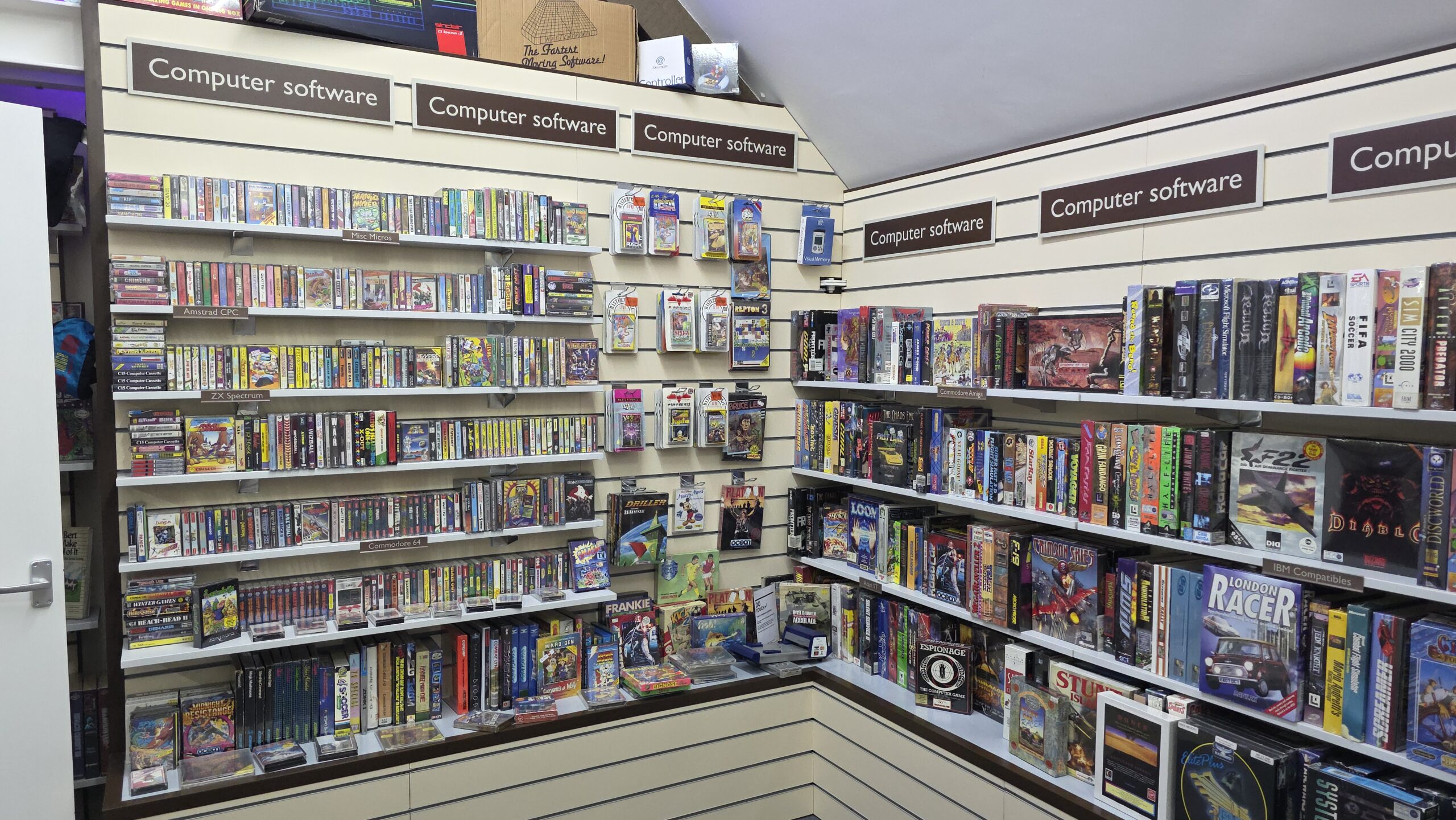
Barneys wasn't the main attraction of our trips to town, though. We saved the best for last by heading to First Compute, a pokey little shop in the "Cross Keys" shopping mews that was initially little more than a cupboard with games for pretty much every platform you can think of festooning every wall (and a fair bit of the floor). By the time we were in sixth form, though, the owner, who we only knew as "Richie", had moved venue to a slightly larger establishment, but the distinct feeling that as much stuff as possible was being crammed in remained. There were big box PC games on some shelves on the left, and PlayStation and N64 games on the right.
At the time, I had had the good fortune to score a few freelance writing opportunities for outlets such as PC Zone and the Official Nintendo Magazine. These at least partly came about because I did my Year 10 work experience on PC Zone when my brother was the editor, but my brother's the sort of person who wouldn't have recommended me to his successors if he didn't think I could have done a good job. And I did do a good job — and, more to the point, in those days, you got paid a hell of a lot more for cranking out an article than you do for many of today's websites. We're talking about £300-£500 per piece here.
As you can probably imagine, being in a situation where I had very little in the way of living expenses thanks to still living at home, this cash very quickly burned a sizeable hole in my pocket, and my friends knew this. I would often get a little "gentle encouragement" to pick up a new game for either PlayStation or Nintendo 64, and honestly, as much as peer pressure very much was involved, I didn't need much convincing. I found both systems to be a ton of fun, and I loved being able to share my enjoyment of them with my closest friends.
On the Nintendo 64 front, we quite often picked up games with a multiplayer focus, as we spent a lot of time around one another's houses, crowded around the television enjoying split-screen fun. We even tried some types of game that, in prior years, we would have never considered, like EA's World Cup 98 when the eponymous tournament was on.
On the PlayStation front, my preference was, as you can probably imagine if you know me even a little bit, for role-playing games, and dear Lord do I ever wish I'd held on to the vast majority of those games I bought all those years ago, because little was I to know that role-playing games in particular would become enormously expensive on the second-hand market.
Of all those times I was mildly peer-pressured into buying a new game, I only remember one solitary occasion when I was disappointed and regretful enough in my purchase to actually return the game in question. That game was a title for PlayStation called Blaze & Blade: Eternal Quest, and it was a polygonal action RPG for up to four players. It looked like it might be cool from the box art, and there were some interesting ideas in it, but it was very much not what I was looking for from a game at the time. I'm actually quite curious to revisit this game through older, more mature eyes, as I suspect I may have treated it a bit harshly.
The pattern of go-to-town, buy-a-game continued once I got to university and fell in with friends who also enjoyed gaming. Since I was still getting some cash from freelancing, I still had a bit of disposable income, though living away from home meant I did actually have living expenses now. Still, I managed to pick up a bunch of interesting games, and reading the manuals while on the bus home was always a highlight of these times that I think back on fondly. It's a cliché to talk about reading the manual on the way home, but it really was a thing we did, and it really is something I have exceedingly happy memories of.
New games haven't come with manuals for a long time now, outside of a few special cases in limited-print editions, and situations like Evercade where the whole thing is built on the idea of "how it used to be" — and with the apparently impending death of physical releases, even the experience of going to a game shop, picking up a game and coming home with it will be lost. Of course, many people — including me — tend to order their games online these days anyway, so many of us haven't been doing that anyway — but it's still sad to think that there are generations of video game enthusiasts who will never be able to enjoy things in quite the same way we did around the end of the millennium and the turn of the century.
I'm mad at Sony for actively encouraging the death of that. They are deliberately trying to destroy what was once an important part of the overall culture surrounding video games. I suspect those who have never been deeply into them might not understand why this is a big deal — and I equally suspect the C-suite execs who mandated this are exactly the sort of people who have never actually given a shit about video games as a creative medium or form of expression — but it really was. Sony's announcement left a lot of people feeling like they really had lost something; feeling something akin to grief. It might sound silly to say that about something as simple as going into a shop and buying a box with a bit of plastic inside it, but it really is the case.
I sincerely hope the company does a hasty U-turn on this, but I very much doubt they will. If that's the case, that's the end of me and PlayStation. Once there's no more games to buy and proudly put on my shelf, that's it for me and new games. I've always said this. And in some respects, I don't mind, either — it'll mean I don't have to worry about running out of what little space I have left on my shelves, and that I will be able to focus on diving deep into my collection and discovering all the things I haven't gotten around to yet.
But still. I will be sad to have lived long enough to see a medium and a culture surrounding it grow, thrive and then wither. I am already sad that I have seen that happen, but every new week seems to bring a new horror in that regard.
We will always have the good times, though. That's the one thing they can never revoke the license for.
Want to read my thoughts on various video games, visual novels and other popular culture things? Stop by MoeGamer.net, my site for all things fun where I am generally a lot more cheerful. And if you fancy watching some vids on classic games, drop by my YouTube channel.
If you want this nonsense in your inbox every day, please feel free to subscribe via email. Your email address won't be used for anything else.
Discover more from I'm Not Doctor Who
Subscribe to get the latest posts sent to your email.
