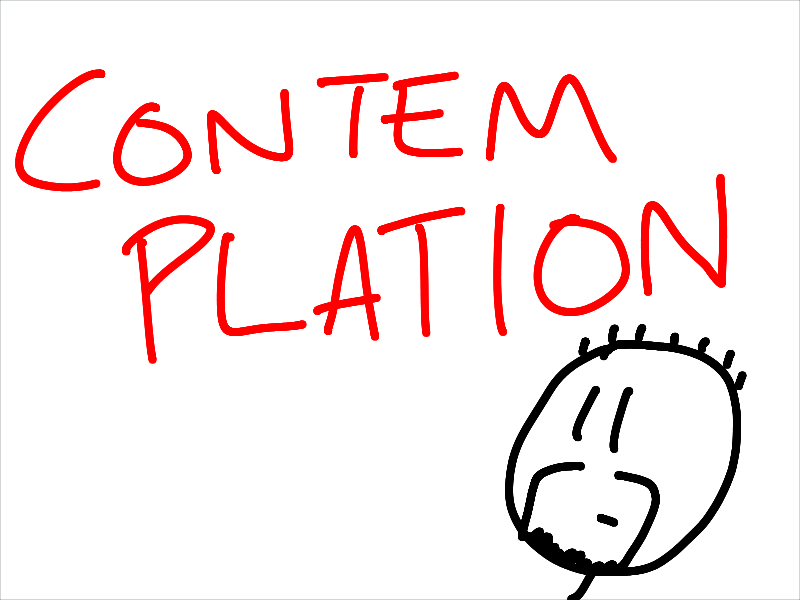
It is, I suspect, a natural part of growing older that you start to miss things that are no longer a regular part of your life. So I thought I might reflect on that a bit today. In what turned out to be rough chronological order:
I miss my school days. While there are aspects of those days I'd rather not repeat, there were, on the whole, far more fond memories than sad or otherwise upsetting ones. I enjoyed having a sense of structure to my day; I enjoyed learning new things; I enjoyed having a group of friends around me.
I miss being part of musical groups. I miss the satisfaction of being part of something bigger than myself. I miss the inimitable atmosphere and sense of romance that formal performances brought. I miss surprising people with my capabilities, and earning the respect of people who might never have known who I was otherwise.
I miss my sixth form days. They were like school days, but better. I'd just learn the things I was truly interested in, and the rest of the time, I felt like I was spending good times in good company.
I miss sleepovers at friends' houses, keeping one another awake with relentless farting and impressions of The Emperor from Star Wars. I miss parties where the host thought making a Devil's Food Cake would be a good idea with a house full of drunken teenagers.
I miss that one endless-feeling summer when my parents went away and I had the house to myself. I miss having friends over every day to drink heavily and play Final Fantasy VII on the living room TV. I miss arguing with my friend Woody over whether or not my Japanese PlayStation fucked up the timing on Bust-a-Move (turns out it did, sorry Woody). I miss leaving a metronome outside my friend Edd's door because he'd flaked out early and gone to bed while we were playing Frogger on MAME until 3am.
I miss that first year of university, where it felt like there were endless possibilities ahead of us. I miss being part of a group of people who had been thrown together by chance, but who became fast friends. I miss showing up to morning lectures and only once having to leave because I needed to be sick after a heavy night. I miss having things to learn and do, but the freedom to approach them how I saw fit.
I miss the subsequent years of university, which was the first taste most of us had of living somewhere that was imperfect but charming in its own way. I miss piling around a friend's house to play Mario Kart and Perfect Dark multiplayer on his N64. I miss couch-surfing on a nightly basis.
I miss the university Theatre Group, where I initially felt out of place, but after inadvertently displaying my vulnerability one night in Edinburgh, feeling embraced and comforted by people who did, in fact, like and respect me. I miss growing to feel like I was an important part of that group as a whole. I miss exploring a fascinating form of self-expression. I miss truly finding my voice and my sense of humour. I miss learning to be assertive and confident.
I miss the early days of the Internet, which felt like a brave new frontier and an opportunity to connect with like-minded individuals in a way I had never really experienced. I miss those first real attempts to express myself freely, and learning to understand how to express why the things that were important to me resonated so deeply. I miss an age when going online was a time when you could truly be yourself, and didn't have to have your guard up at all times.
I miss playing board games with friends, on evenings where none of us had any real commitments save those we had made to our collective friendship. I miss communal takeaways. I miss that one drunk guy outside the Indian restaurant that one time who warned us that we'd "get our legs lifted" if we went in there. Still no idea what that means.
I miss having friends, whether we were going out and having a raucous, drunken night out or a quiet night in with board or video games. I miss the feeling of sharing my life with others, like we mattered to one another.
I miss a time where not feeling lonely was a normal state of being.
I miss lots of things. But I think I miss that last one the most.
Want to read my thoughts on various video games, visual novels and other popular culture things? Stop by MoeGamer.net, my site for all things fun where I am generally a lot more cheerful. And if you fancy watching some vids on classic games, drop by my YouTube channel.
If you want this nonsense in your inbox every day, please feel free to subscribe via email. Your email address won't be used for anything else.
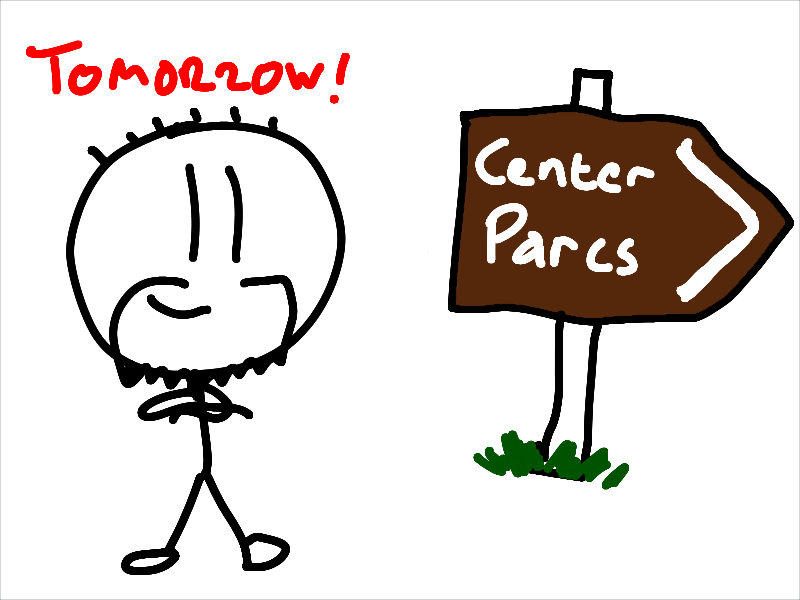
We're off on holiday tomorrow! It may seem extravagant to have two going-away holidays in the same year (to the exact same place, no less), but as I've mentioned previously, our prior attempt earlier in the year was spoiled somewhat by worrying over a certain idiotic orange cat who had decided to explore the Great Outdoors the week before we went away.
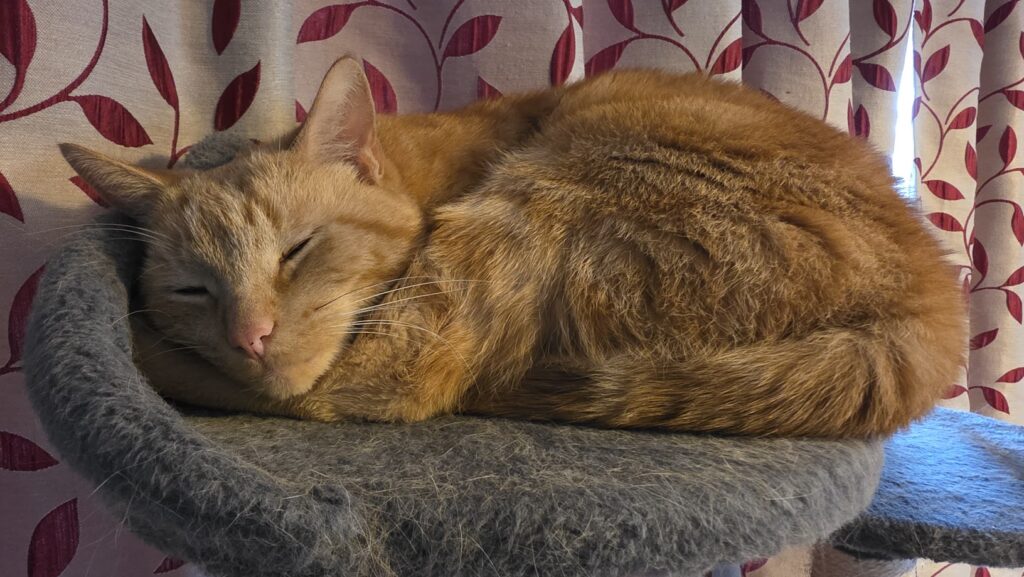
I am pleased to report that Oliver is, as I type this, safely inside our house, and has given no indication he is going to escape. (I know, I know, he gave no indication that he was going to escape last time, but he doesn't even seem interested in sneaking out of the front door when we put the bins out any more, even.) This means that, barring any sort of major disaster which occurs over the course of the next 24 hours, we will be able to go away on holiday without any sort of guilt or unease, and just enjoy ourselves. (Hopefully no major disasters will happen between tomorrow and the 14th of September, either.)
I'm really looking forward to some time away. I'm looking forward to spending some time in the pool, for a combination of just relaxing in the water and actually getting a bit of exercise by, y'know, swimming. I'm looking forward to our spa day. I'm looking forward to our inevitable trip to The Pancake House, and buying at least one Massive Cake from the ParcMarket.
Center Parcs, in its various forms, has become rather special to me over the years, even though I know there are almost certainly plenty of reasons one could criticise it. And it all, as with so many other things in my life, extends back to my childhood and adolescence.
I forget exactly what year we first went to Center Parcs, but I do remember the trip itself. My brother was still living at home, and he brought his friend Alex with him. One of the most enduring memories of the trip was Alex, who fancied himself a bit of a womaniser, causing two girls to fall off their bikes by delivering a thoroughly Leslie Phillips-style "Hell-O!" at them as they rode past. My other enduring memory of the trip is the fact that, at the time, Center Parcs used those weird Dutch toilets where you poo on a little platform rather than into a bowl of water. Most disconcerting.
On that first trip, I was still pretty young, as I can determine from my brother still living at home with us, and thus I was still pretty nervous about things like water slides. I do remember going on "the slow slide" at the pool, which is the longer of the two, and enjoying it, but also being too scared to go on either "the fast slide" or "the big white slide", the latter of which is just a big wet slope made out of the slipperiest material known to man. These slides are all still present at the Center Parcs pool complex to this day, along with the Wild Water Rapids, which I did not go on on this first trip.
Some years later, we went on another trip to Center Parcs, and I took my friend Edd with me. This was partly as payback (positive) for his family graciously taking me along with them on a trip to Gran Canaria, and we had a good time. My enduring memories that time around are of being old enough to enjoy the slides a bit more, and having a great time on the Wild Water Rapids. A particularly vivid memory is of getting halfway down the Rapids, only for Edd to pop up from under the water going "Hoo-haa-haa!" (which is what we thought the blue SS guards in Wolfenstein 3-D said, rather than "Schutzstaffel", which you probably shouldn't shout in public) and pretend to machine-gun me. Good times.
I also remember an awkward conversation over breakfast in which Edd attempted to convince my Dad that bloody violence in video games was fine because "you just stop noticing it after a while". That, it turns out, was not the most convincing argument, but did not result in me being disallowed from playing games like the aforementioned Wolfenstein 3-D and Doom, even though I had historically not been allowed to watch 15- or 18-rated movies.
There was another trip to Center Parcs at some point where I went with my friend Craig, and my one enduring memory of that particular trip was seeing Savage Garden and Ray of Light-era Madonna on the television, and us both realising that we actually quite liked both of them despite historically having been "indie rock" boys.
Andie and I have now been to Center Parcs ourselves a number of times, and it still feels like a proper example of "being a grown-up" to go on a holiday like this by ourselves. I mean, I know we technically are both "grown-ups", but as I was talking about with my therapist recently, I still find it immensely difficult to think of myself as such. This is not an altogether unusual position to hold, it seems; no-one in this world really knows what they are doing, it's just some people are better at hiding that fact than others.
Anyway, tomorrow we are off for yet another excursion into the forest. I will continue to blog while I am there, as usual, but I may be quiet on the socials while I am away. It is nice to have a bit of peace and quiet — and this time around, it will be nice for said peace and quiet to not be interrupted by intrusive thoughts worrying about whether or not we are ever going to see our beloved pet again.
Want to read my thoughts on various video games, visual novels and other popular culture things? Stop by MoeGamer.net, my site for all things fun where I am generally a lot more cheerful. And if you fancy watching some vids on classic games, drop by my YouTube channel.
If you want this nonsense in your inbox every day, please feel free to subscribe via email. Your email address won't be used for anything else.
Living, as we do, in an age where the entirety of human knowledge and creativity — and an increasing amount of machine-generated garbage — is available at our fingertips, it can be easy to forget that in the past, certain portions of entertainment were a lot more linear. And that brought with it its own considerations.
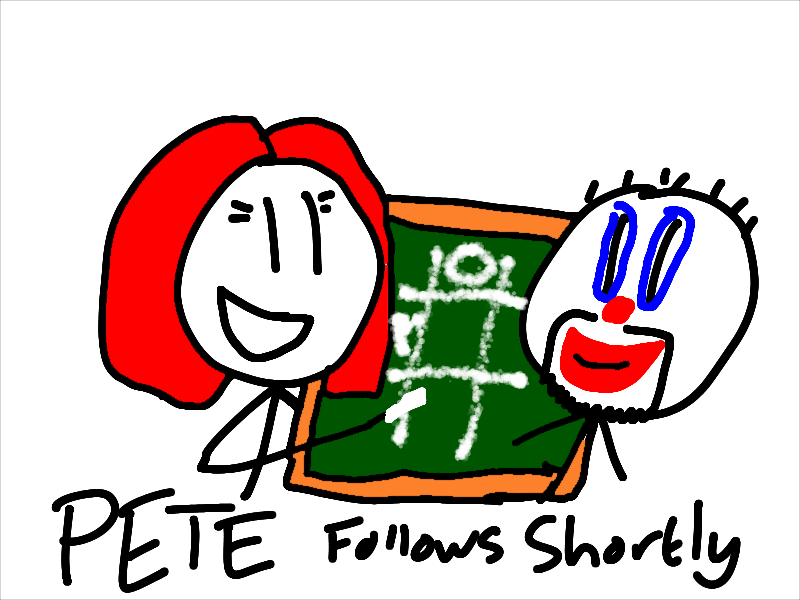
One of the most interesting things I occasionally think back on is the phenomenon of the "Follows Shortly" screen on television, which punctuated programmes that apparently weren't quite long enough, or, presumably, covered for when the continuity announcer needed to go and take a really big shit or something.
You never see these any more today, but at a certain point in the 1980s in particular, they were quite frequent. (I don't know about before that, because I wasn't alive to see them then, but I assume they still happened in the earlier years of television, too.) They are, in effect, "loading screens" for live television. And they came in varying degrees of elaborateness.
One of the most elaborate was the one that came before ITV's schools programming on Channel 4, which if I remember correctly was broadcast in the middle of the night because no-one in their right mind would want to watch that voluntarily. Thus, in this case, I'm pretty sure the "Follows Shortly" screens were there to cater for variations in the clocks on video recorders, which everyone would have had to set manually rather than just letting the Internet do it for them. If you build in a buffer of a few minutes either side of your programme, that means even if there is some variation in the time people have set their clock to, everyone will be able to record the whole programme without having to leave an impractical amount of time either side of it.
The other thing about ITV Schools is that it had incredibly memorable music, particularly for the final 1-minute countdown to the programme actually starting:
In fact, a lot of these continuity-filling slots actually had some really great music, similar to that heard during Pages from Ceefax. Have I talked about Pages from Ceefax on here? I forget. [checks] Apparently not. Well, there's something to talk about another day, then.
Anyway, all you need to know for the moment is that Pages from Ceefax had great music, and a similar crop of inoffensive yet undeniably catchy instrumental tunes were used for "Follows Shortly" pages, particularly when schools programming was involved.
It's funny the things that you start to miss and even pine for as you get older. When I was a kid, a "Follows Shortly" page coming up on TV was immensely frustrating, because I just wanted the show to start now! Today, though, they can be seen as a symbol of a lost age: a time when we didn't feel the need to be constantly "consuming content", and when it was okay to stop for a moment, put the kettle on, have a wee, tickle the cat and perhaps have a brief conversation before the programme you were waiting for actually came on.
So yeah. I miss them. And I suspect my thinking back oddly fondly on these stupid inconveniences is at least part of the reason why I've never minded load screens and load times in video games all that much. Sometimes waiting a moment is just part of the experience, and it doesn't have to be a negative thing. Sometimes it can be quite valuable.
Want to read my thoughts on various video games, visual novels and other popular culture things? Stop by MoeGamer.net, my site for all things fun where I am generally a lot more cheerful. And if you fancy watching some vids on classic games, drop by my YouTube channel.
If you want this nonsense in your inbox every day, please feel free to subscribe via email. Your email address won't be used for anything else.
Yesterday, I left off with a lovely flat my then-wife and I lived in in a fairly shitty area; a place which I nonetheless have mixed feelings about due to how it was where I was living when I suffered a nervous breakdown and left teaching as a career behind as a result. Today, we continue.
At some point, my then-wife and I made the decision to move back to Southampton. I forget exactly what the reasons for us doing this was — it may have been the fact that I had got a job at the then-new Apple Store in the WestQuay shopping centre, or it may have been some other reason — but regardless, we found ourselves coming back to Southampton, initially in a ground-floor flat in an area on what I will always think of as "the far side" of Southampton, known as Sholing.
My enduring memory of living in this place will always be, on our day moving in, walking in to the Indian takeaway that was next door to the block we lived in — as everyone knows, British moving days are fuelled by takeaway curry — and the proprietor of said establishment bellowing "WELCOME TO THE SHOLING!" as we walked in. It was a great little takeaway, that place, and I was always grateful for the warm welcome the owner provided.
We rented that flat off a woman who had a cat. We kind of wanted a cat, but we had lived in so many rented places that didn't allow pets that we didn't think to ask if we could have a cat. When we moved out, the landlady said that not only would she have been more than happy for us to have a cat in that flat, we could have had her cat. I'm still not entirely sure how to feel about that.
Anyway, it was a nice flat with some big rooms and a lovely oversized comfy sofa in the living room. My "study" of sorts, where the computer lived, was also a utility room, so I had to share space with the tumble dryer. My Sony Vaio desktop PC, which had been a loyal companion for a number of years, died in that flat, which I was annoyed about, because it was a great system. But one day it just started inexplicably screeching at me, and that was that. I eventually ended up replacing it with an iMac, which I got for a generous discount thanks to working at the Apple store.
At some point, we moved out of that flat. Again, I don't entirely remember why, but we ended up moving into the town centre of Southampton, into what appeared to be quite a new block of apartments. It was a really nice flat with a huge living room, a massive kitchen and a generously sized bedroom. It was a very comfortable place to live, with the only real hiccup being that one day I came home to the sound of rushing water downstairs in the block. It turned out the basement was flooding from somewhere, which ultimately knocked out the power in the whole building and meant I had to spend several days staying on a friend's sofa.
However, this is also the flat where my first wife and I parted ways, so as nice as it was, it will always be the most bittersweet of past places I lived, and the subject of a number of posts from around that time.
Due to a perfect storm of unfortunate circumstances, including not only the end of my marriage but also being bullied out of a job that I once loved, I ended up unable to stay in that lovely flat by myself, and having to temporarily move back in with my parents. At the time, I was mortified at the prospect of having to do this; today, I am eternally grateful for the fact they supported me while I picked myself up after such a massive setback.
While living back in my childhood home — which was still familiar despite having changed a bit — I eventually ended up meeting Andie, my now-wife. Both of us had experienced a somewhat challenging period in our respective lives, and ended up finding one another at what appeared to be a good time. I was also in the process of building a new career at that time, and I was gradually getting to a point where I felt I would be able to support myself again. So Andie and I eventually agreed to move in together.
We ended up moving to Chippenham in Wiltshire, which was near to where Andie was working at the time, and since I was working from home, I could do that from anywhere with an Internet connection. We had a nice house there, and were greeted almost immediately by the two cats who lived next door, Artie and Chester. Chester was a black cat who liked sitting on suitcases, and Artie was a long-haired tabby who liked shouting at towels. The pair of them were absolutely lovely cats who paid us a visit on many occasions, and we always welcomed them in.
During our time at Chippenham, we also decided that, in the absence of being able to have our own cats, we would try keeping rats, and we discovered the joy of these little creatures — as well as their sadly short lifespans. Also the smell, which you soon get used to. During our time at Chippenham, we had a wonderful time with Willow (who sadly did not live very long as she was quite poorly), Lara and Lucy.
Our house in Chippenham is another place I have somewhat mixed feelings about, as both Andie and I were facing numerous challenges in our own lives at that point in time — among other things, I lost my job at GamePro when we all logged in one morning to find out the parent company had unceremoniously laid us all off — and also there was apparently a murder in the Sainsbury's car park that was, like, two minutes away from our house.
Our next move was, once again for me, a return to Southampton. We found ourselves a lovely flat whose only mild inconvenience was the fact it was on the third floor, which made moving everything in a bit of a pain. We ended up having to buy a whole new sofa because the one we had bought while we were at Chippenham simply wouldn't go up the staircase; it lived in the garage for a whole year, and thankfully survived, though we ended up replacing it some time later.
This flat, I have fond memories of. Both Andie and I had overcome some significant troubles in our own lives, and things started to seem like they were getting back on track. I still wasn't in what I would call a position of stable employment, but I was getting by, initially by writing about odious mobile and social games, and subsequently being a founder staff member of the now-defunct USgamer.
We also still kept rats in this flat — Lucy, Clover and Socks — though after the last survivor of the various pairs we had cared for, our dear Clover, hung in there for a lot longer than we expected she would, we decided that we should maybe take a little break from keeping pets. It was sad to eventually say goodbye to Clover, but we feel like she stuck around for us even as she got old and life clearly became a bit harder for her.
Eventually circumstances dictated that Andie and I would be in a position to actually buy a house instead of renting, and that's how we ended up where we are now — and have been here for over ten years at this point. This is officially the longest I have lived in one place for, except for my childhood home. As I said yesterday, we're not ruling out moving someplace a bit bigger some time — just not yet — and we've done a lot to make this place into our home — not least of which is having cats. The dearly departed Ruby and Meg will always be in our hearts, and Patti and Oliver bring us so much joy in the here and now I cannot imagine ever being without such wonderful companions again.
I've lived in many places over the years. All of them hold their own memories, both good and bad. All of them have helped make me into the person I am today, for better or worse, and I'm sure I will always remember them all.
Want to read my thoughts on various video games, visual novels and other popular culture things? Stop by MoeGamer.net, my site for all things fun where I am generally a lot more cheerful. And if you fancy watching some vids on classic games, drop by my YouTube channel.
If you want this nonsense in your inbox every day, please feel free to subscribe via email. Your email address won't be used for anything else.
I have, over the years, lived in a number of different places. This is, I'm sure, true for quite a few people — though there does come a point where you seemingly pick somewhere and just settle down. Our current place definitely falls into that category — though neither of us have completely ruled out moving somewhere a little bit bigger at some point in the future. Not any time soon, though.
Every so often, I like to think back over the various places I've lived, because they all have different memories attached to them. Some memories are good; some are bad. Most are good. In fact, I'd go so far as to say that I do have good memories at every place I've lived; it's just that some happen to have more bad memories to go along with them than others.
My first house that I lived in is the only one I don't remember at all, because we moved away when I was just one year old or so. We kept a vague attachment to the area in which it was, though, because some friends of my parents still lived in that area, and one of them was also our family dentist. When we'd go to visit these friends, my parents would often point out the house in which we used to live, but while it was interesting to know, I felt no real attachment to it. I felt more attachment to the homes of these friends, as we visited them quite a few times in my youth.
The next place I lived is the house my parents still live in to this day. That house will always be "home" more than anywhere else, I think. It's a nice house with an unusual split-level design, with the living room on a "middle" floor between the ground floor and the floor with all the bedrooms on it, and a garage that is below the ground floor, but still above ground, if that makes sense. (To put it another way, you go up some steps to get to the front door, and the garage is on the level where those steps start.)
My parents have made a few changes to that house over the years, but it's mostly still the house I grew up in. A bit older, a bit dustier, but most of the things I will always remember about it are still in the same place they always have been, and looking the same as they always have done. The cupboard where the biscuits are still squeaks incredibly loudly — we used to joke it was an "alarm" for someone "biccy-nicking" — and the upstairs toilet flush mechanism still doesn't quite work properly.
The first place I moved to after leaving home for university was a halls of residence. Well, technically I spent a week staying in another halls of residence for a pre-term music course, but I consider that more of a "trip" than actually "moving in" there. The place I spent a week was a bit of a shithole, being an old tower block that has, at some point in the intervening years, been demolished. The place where I spent my first year of university, however, was really nice.
It was a brand new complex when we moved in, meaning that everything was clean and in good condition. Remarkably, it was still clean and in good condition when we moved out, as the occupants of our flat were all pretty considerate about such things. Okay, most of us occasionally let the washing up pile up a bit, but we eventually all settled into a routine of keeping things neat and tidy in the communal kitchen, then if we wanted our rooms to be a pigsty we could. But since they were pretty nice rooms, none of us did.
I have fond memories of living in that flat, even if it's unthinkable now that I once lived out of a single en-suite room that was my own, along with a communal kitchen. It was good times with good people, and I was enjoying being at university. I have a few memories from there that make me wince slightly out of embarrassment, but on the whole I have no real bad memories there whatsoever.
In my second year, we all moved out into houses and flats around the city. I had agreed to move in with a friend's girlfriend (who was also my friend; the boyfriend in question was going to university in another city) and we had a fair amount of trouble finding a decent place for an affordable amount of rent; I forget exactly why, but I do remember it being a stressful time finding it.
Eventually we found a flat that looked pretty nice, but was in fairly shabby, dirty condition when we viewed it. The landlord promised that it would be cleaned up in time for us to move in. It very much was not, which meant that our moving in day was mostly spent cleaning. We eventually got it looking presentable, though, and once we were settled, it was a nice flat with absolutely enormous rooms. There was a huge living room at one end, then down a corridor there were the two bedrooms: my friend's first, then mine at the far end.
Oddly, my most vivid memories of living in this flat are of the fact that I lived two minutes' walk away from a Blockbuster Video, and quite often went in there to buy games and DVDs. I remember plucking up the courage to buy an erotic Kathy Lloyd Playboy DVD on one occasion, but I also remember buying Baldur's Gate II and Diablo II there.
This flat was a fair distance away from both the university and the rest of my friends, so I quite often spent time "couch-surfing", staying over at various people's houses so I didn't have to walk all the way home. My flatmate was quite often away to visit her boyfriend, so during those times, rather than sit all on my own, I would tend to spend my time with friends.
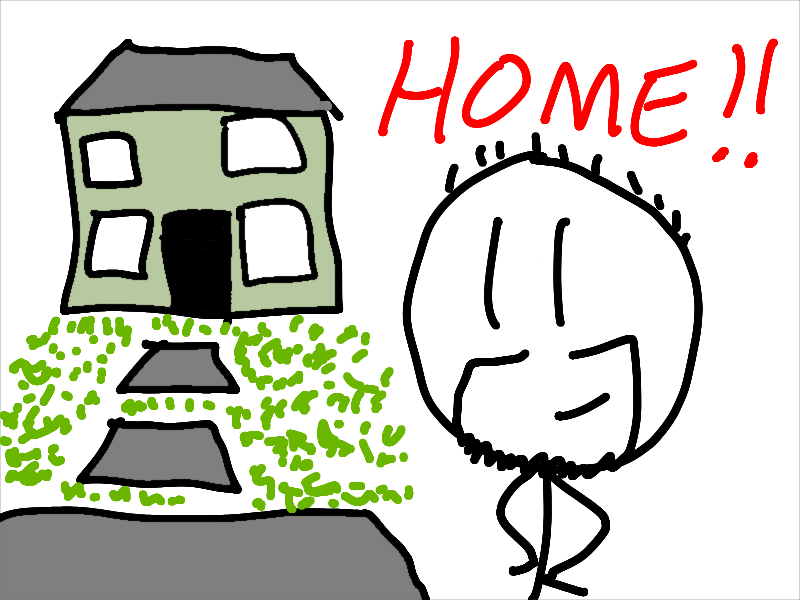
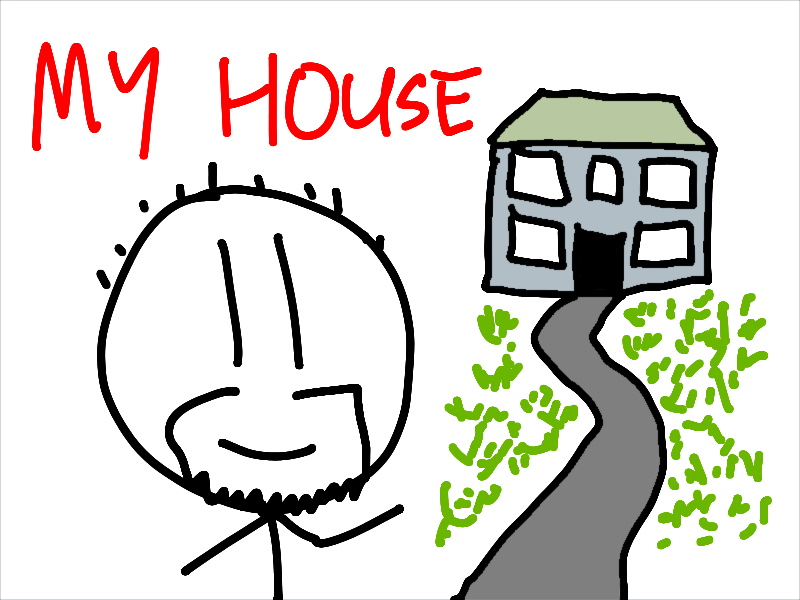
In my third year of university, we again found ourselves having trouble finding a place — but this time we lucked out by finding an absolutely lovely house that was incredibly cheap rent-wise. Sure, it was in a notoriously fairly shitty area, but the house was in excellent condition, and the landlords didn't seem to be scam artists. It was also, to date, the only house I have lived in that literally looked like the drawing of a house you draw if you can't draw a house. (See illustration.) That year, I was supposed to have a second housemate along with my friend's girlfriend, but despite always paying her rent and bills on time, she never even moved in. I don't know what happened there — and I was mildly gutted, as I quite fancied her — but still, she helped keep that house nice and affordable for the two of us, so we were grateful!
Again, I have fond memories of this house. There was a nice TV cabinet in the living room, where I put my enormous CRT TV that I bought from a second-hand shop in Portswood. It was surrounded by shelves, where I put my new PS2, and I vividly remember a friend of mine, upon visiting, telling me how much he loved the blue LED on the eject button. It is pretty nice, to be fair.
We didn't mow the lawn once during our time at that house. Well, not until it was approaching time to leave, at which point we discovered why you should mow your lawn more than once a year.
My most enduring memory of that particular house is probably my friends coming down and bringing a copy of the newly released Silent Hill 2 with them. I was given the task of playing it while the others watched, but the pair of them both fell asleep after a hearty curry and some relatively heavy drinking, and only woke up as I was rolling credits on the "In Water" ending.
We also had NTL cable in that house. I remember signing up for one night of the Adult Channel and setting the VCR to record it all. I also remember being mildly disappointed in the overall quality of the smut on the resulting tape, but it served its purpose.
In my fourth year of university, my friend had moved on, so I was moving in with a new friend I'd made through the university Theatre Group, along with some other people she knew but I didn't. We found a really lovely house that, again, was very affordable. It had a weirdly narrow kitchen, though, and a strange arrangement at the back where there was a standalone toilet, then a bathroom next to it. These were both on the ground floor, behind the kitchen. It was a very odd arrangement, but we learned to live with it.
One unfortunate memory I have of that place is, being the first one there, thinking I had pick of the rooms and thus picking the big one at the front. I subsequently found out that my friend had bagsied that room first, but I had already moved all my stuff in by then. She didn't seem to mind getting the room next door. She laid down laminate flooring as the first thing she did when she arrived. She was… like that.
I have good memories of that house, despite the fact that I didn't really interact with any of the other residents. My friend was absolutely never there, and I didn't really know the other two guys at all. I was intimidated by the one who was growing weed in his wardrobe, and the other one just gave no indication whatsoever that he really wanted to get to know me at all. They all seemed to appreciate my big TV and surround sound system in the living room, though.
I spent a lot of time drinking wine and… enjoying the company of someone who was quite special to me at that house. We'd drink until we were giggly, watch Spaced and Black Books on repeat, and… well, other stuff, too. It was nice, though I ended up wanting more from the arrangement than she did. Still, I have no regrets.
After finally finishing university, I moved to Winchester with someone I knew from my music course, who was training to be a midwife. We were extremely fortunate in this case to find a gorgeous flat almost in the dead centre of Winchester. It was fully furnished — and well furnished — and just a beautiful, beautiful place. We absolutely loved living there, but we could only enjoy it for a year, because after that the landlord decided that they wanted it back so their kid could live in it, which I suppose is all right.
I fitted an extension phone socket in that flat, without any consideration of the fact that I probably wasn't allowed to hammer that many pins into the walls of a flat I didn't own. Still, I wouldn't have been able to access the Internet if I didn't do that, and given that I was having my first contact with Final Fantasy XI around that time, I needed that Internet connection.
Probably my fondest memory of that particular flat is one I've shared numerous times before: the time I had several friends over to play LAN party Halo, and we all got drunk and took our shirts off. My housemate came home in the middle of all this, took one look at the living room full of half-naked, drunk men and declared the game "Gaylo" which, you know, fair.
It was in this flat I was first starting to have doubts about teaching — the career I had, at that time, chosen. While I never developed a problem as such, there were numerous evenings when I would seek, shall we say, chemical comfort after a particularly hard and trying day. Mostly gin and tonic, though a friend did once leave me an "emergency joint" that I made use of on one particular evening that felt like an emergency, only to discover it was so strong that after finishing it, I immediately threw up (in the toilet) and then passed out on the couch. To be fair, after that I wasn't thinking about the day I'd just had at the chalkface.
After being turfed out of that flat, we moved into a strange little cottage that backed onto a little river, quite close to the previous flat, so we didn't have to move far. It was in a bit of an awkward location on the Winchester ring road, though, and it subsequently transpired that the place was full of damp and mould that the landlady tried to blame on us when we eventually moved out. My housemate, who doesn't take shit from anyone, took her to court and… resolved the situation. I don't know exactly what went down, but I know we did eventually get our deposits back.
It was while I was living in that house that I met my first wife online, and after she moved back to the UK after spending some time abroad, she would often come down to visit and stay. As a result, I have some bittersweet memories of that time; I think enough time has passed now that they err mostly on the side of "sweet", to be honest, but I do know that my housemate did not like my wife-to-be very much. Still, it never came to a confrontation or anything, so that's all right, I guess.
After that, my wife-to-be and I moved away from Southampton so we could both be close to the schools in which we were working, which were in Surrey. Our new flat was technically in a shitty area, but it was actually a really lovely place; some sort of huge converted single-floor house with enormously high ceilings and massive rooms.
It was while we were living at this house that I had a nervous breakdown and finally determined once and for all that teaching was not, in fact, my chosen career. (That didn't stop me trying again once more later, but I recognised the signs and escaped from that before anything bad happened.) It's a shame, because my memories of this place are otherwise nice; it was a lovely place to live, and I was sorry to have to leave it.
You know what? That's two and a half thousand words, so I think I'm going to call time there and ponder the rest tomorrow. This has been a fun exercise, though, so join me tomorrow as I remember other places I have lived! Gosh, I bet you can't wait.
Want to read my thoughts on various video games, visual novels and other popular culture things? Stop by MoeGamer.net, my site for all things fun where I am generally a lot more cheerful. And if you fancy watching some vids on classic games, drop by my YouTube channel.
If you want this nonsense in your inbox every day, please feel free to subscribe via email. Your email address won't be used for anything else.
As a pleasant perk of my job, I get copies of all the Evercade cartridges ahead of when they actually release. Consequently, I have been enjoying the two upcoming Visco Arcade collections for a little while now, and, shush, come over here where no-one will overhear — I think they're my favourite carts this year.
Yes, I know we have some Big Names lined up for the rest of the year, one of which everyone already knows about (The Banjo-Kazooie Double Pack, which is releasing alongside Evercade Nexus in October) and another of which is pretty bloody obvious if you've been paying any sort of attention, even though it hasn't officially been announced as yet. And don't get me wrong, both of those carts are great. I am proud of the immense amount of work we put into them, and I think people are going to have some thoroughly pleasant surprises with them besides just rediscovering some old favourites. (There are also two more carts we haven't talked about at all yet, which are also going to be a fun time.)
But Visco Arcade 1 and 2? These carts reflect one of the main reasons I, personally, got into Evercade in the first place: the celebration and enjoyment of weird and wonderful stuff that I've never heard of before, and which has never seen official rereleases for one reason or another. (That's not quite true in the case of the Visco games, in that current rights holder PixelHeart sells NEOGEO cartridges, but the ability to enjoy those is dependent on you owning a working NEOGEO, which is… not something a lot of people have just lying around… although it will be interesting to see what effect, if any, the upcoming NEOGEO AES+ has on the market. But I digress.)
Anyway, yes. Visco Arcade 1 and 2 are both jam-packed full of games I'd mostly never heard of prior to working on the cartridges, and which are now titles I find myself playing and enjoying quite a lot. I'd previously come across the shoot 'em up Andro Dunos and the fighting game Breaker's (although we all learned recently about the apostrophe in the name, which is seemingly not common knowledge despite it being right there in the logo) and I also knew the Drift Out series by reputation (if only because everyone always mistakes Gaelco's excellent World Rally series, which is on Evercade too, for Neo Drift Out) but the others? Brand new to me.
Helicopter shoot 'em up action in Ashura Blaster! Time-travelling jet fighter shoot 'em up fun in Asuka & Asuka! Triple weapon space blasting in Galmedes! Driving a definitely-not-Volkswagen Beetle around mazes and hunting for treasure in Maze of Flott! Hacking and slashing Sengoku-style in Ganryu! Delightful, one and all.
Two of my favourite discoveries are Battle Flip Shot and Bang Bead, two games that are effectively evolutions of Pong, in which you control colourful anime-style characters and try to knock down targets behind your opponent. I partly like these because they're just simple, fun, well-presented arcade games — and I suspect they'd be great with a friend — but I mostly like them because they remind me of a Klik and Play project my friend Edd made once, which he dubbed Impact!
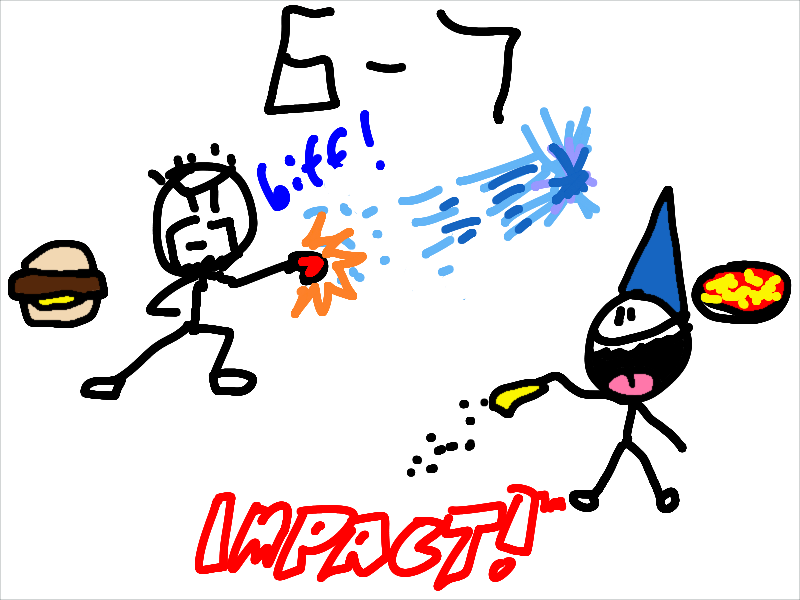
Impact! was a game in which two of the default, included sprites from Klik and Play — "Merlin" and "Street Puncher" — faced off against one another on a top-down representation of a tennis court. They then proceeded to knock an energy ball back and forth, each attempting to hit the item of fast food behind their rival in order to either score points or deplete the opponent's energy bar, I forget which. I believe Street Puncher guarded a hamburger, while Merlin guarded a pizza, though it may have been the other way around. There were lots of burping and farting noises, and it was an endearingly stupid, completely unbalanced but enormously fun way to while away an afternoon with a friend.
I couldn't stop myself from laughing when I booted up Battle Flip Shot for the first time and realised what the game was. "This is just Impact!" I said to myself, realising that there was absolutely no-one around who would have any idea whatsoever what I was talking about. That made me a bit sad, but mostly I smiled at the good memories, and consequently both Battle Flip Shot and its fairly similar (but notably different) successor Bang Bead suddenly became quite special to me, despite me only learning about them relatively recently.
In fact, if I think about the dates we were most likely fiddling with Klik and Play — between 1997 and 1999, during our time at sixth form, primarily — it's entirely possible that Impact! did, in fact, predate Battle Flip Shot, which came out in 1998. And certainly none of us were playing NEOGEO at that time; around then, the NEOGEO was a mythical beast, spoken of only in hushed tones in multiformat games magazines, and we didn't have any arcades anywhere near us to go play an MVS cabinet, either. So Edd's creation was all original do not steal.
I have idle thoughts of trying to get The Old Gang™ back together for some sort of Event that will likely involve drinking, cake and video games. I am also not entirely sure how to go about organising such a thing, as there are several members of said Old Gang I have not spoken to, let alone seen, for many years at this point. But that is, at least partly, why I think it would be fun to get everyone together and have a drunken Battle Flip Shot tournament. And see how long it takes Edd to notice that we're really just playing Impact! – Pro-Gear Spec Edition.
[Obligatory note, since I am talking about Work Stuff: the above is my opinion and my opinion alone, and does not reflect or represent the views of my employer and all that guff.]
Want to read my thoughts on various video games, visual novels and other popular culture things? Stop by MoeGamer.net, my site for all things fun where I am generally a lot more cheerful. And if you fancy watching some vids on classic games, drop by my YouTube channel.
If you want this nonsense in your inbox every day, please feel free to subscribe via email. Your email address won't be used for anything else.
I've been meaning to get back to doing stupid little doodles on posts for ages, but have just never… well, to be honest, I just haven't really been bothered to. Best to be honest about these things, and it's been nice seeing the stock images that kind and talented people from around the world have made freely available on Pexels, which you can access right from WordPress. But today, I thought I might as well actually use the fancy S-Pen that is stuck in the bottom of my phone, and so I did a tiny bit of research, found an actually pretty good-seeming free drawing app for Android (no more leeching off ClipStudio Paint's free trial) and just doodled a very quick thing for today.
Yeah, I know. Hardly worth making a big song and dance about, is it. But I tried to analyse why I fell off doing doodles on this site in the first place, and it was because I think I was trying to do a bit too much too soon. I thought that if I got a fancy graphics tablet and started faffing around with a fancy piece of software, then some sort of latent artistic ability would suddenly emerge and I would be able to produce something truly amazing, immediately.
Of course, it doesn't work like that. Not only does producing things that are genuinely amazing take time and effort, everyone also has their own distinct ways of working that they find most comfortable. For me, that has always been stupid little stickmen with oddly expressive faces. And so, I think for the immediate future at least, the stupid little stickmen with oddly expressive faces are back for now.
The thing I've always liked about doing the stupid little stickmen with oddly expressive faces in the past is that they make me think a little bit about what I've just written. I wouldn't go so far as to say sketching a companion doodle for a post makes me really reflect on things in any great depth, but it does at least make me think about how — and if — it would be possible to get the general vibe of the post across using a quick and dirty doodle.
Often that takes the form of a stupid joke. Back when I did three-panel comics on this blog — which I know at least one person enjoyed, but no-one else ever mentioned, so I stopped doing them just in case I was actually embarrassing myself with them — there were even some running storylines that went along with the blog posts, and sometimes the blog posts and the comic storylines would feed off one another in various ways. That was always pretty fun, actually, but like I say, outside of one once-regular commenter who I haven't seen for a long time (I hope you're well, Jud!) and my wife Andie, who bought me a large canvas print of one of my comics that still hangs above our bed, no-one ever really mentioned them, and I had no great designs of being "a webcomic" or anything anyway; it just seemed like a fun thing to do, and I had a copy of Comic Life on my Mac, so things just sort of went from there.
When you have your own site, though, I think it's important to make your own little mark on it somehow. I mean, obviously you already do that if you're writing things on it, but we are creatures that respond well to obvious visual stimuli, so if the overall look of the site helps get someone's personality across, so much the better, I say. I have tried to do this to a certain degree with the use of the Atari ST's system font for headlines — I tried putting the whole site in it once, but several commenters said it was difficult to read, and it probably was — but nothing beats a bit of scrappy artwork from someone who doesn't really do visual arts.
I've told the story of why I like drawing expressive stickmen many times before on this blog, but for the benefit of those disinclined to go searching through the archives, it stems from, as so many things do, my time at school.
I did pretty well for myself at secondary school. What eventually turned out to be an autistic spectrum condition (though I wouldn't know that until several decades later) meant that I kind of thrived in the structured environment where I was always learning things. But I wasn't, like, the school swot or anything. I had a mischievous streak, which was brought out of me by my friends — and particularly my good friend Edd, who I sat with in many different lessons.
Edd and I liked to doodle. We would doodle all sorts of things, all the time. It was one of our favourite activities — though we knew not to do it anywhere that we might get in vaguely "serious" trouble for. No drawing on desks, no defacing school property, and no doodling on our exercise books that the teacher would mark. (I must confess, however, that during one especially memorable Year 7 Humanities class, my other friend Daniel Blyth and I went through an entire History textbook and drew at least one dick on every single page. My favourite was the one that was poking out of a Roman water gourd, inexplicably shouting "I SCREAM!")
No, Edd and I would doodle on paper that we would specifically bring in for that purpose, or our "Rough Books", which I know I have talked about multipletimes on this very site, so I won't tell that specific story again. But anyway. Given the opportunity to doodle, we would take it. And one of the things that we loved doodling was stickmen doing stupid things.
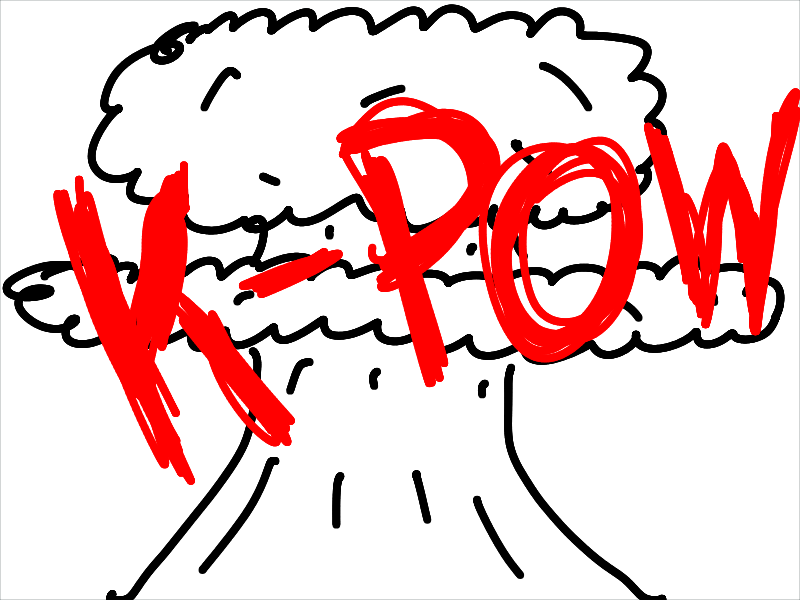
One of the earliest things we did with stickmen began in German lessons, which were so boring we eventually came to the conclusion that was some sort of temporal disruption around the Modern Languages department. (I successfully freaked several of my friends out by using the "countdown timer" feature on my snazzy Casio digital watch to make it look as if time was indeed running backwards.) We livened things up with "The German Stickmen", which was a four-panel comic in which two people would argue about something really stupid in German in the first frame, the second frame would devolve into them yelling "Nein!" "Ja!" at one another multiple times, the third frame would always be one of them shouting "ACHTUNG!" (like in Wolfenstein 3-D, see) and drawing some form of (usually explosive) weapon, and the final frame would inevitably involve some form of extreme violence or, most commonly, a mushroom cloud.
Over time, our ambitions for the stickmen became more elaborate. We'd already "created" (and I use the term loosely) the characters Edlock Holmes and Watson as a result of our shared enjoyment over the point-and-click adventure games The Lost Files of Sherlock Holmes: The Case of the Serrated Scalpel and Indiana Jones and the Fate of Atlantis, and when we went on holiday to Gran Canaria together, we produced an epic-length stickman comic, drawn in extreme haste and with no real care, called Fate of Thingy. This thing took on a life of its own and was rewritten multiple times, and I still have it somewhere — though I think it's missing one or two pages. The intent, you see, was to do a "rough" version of the comic using stickmen, then when we got home we'd do a "proper" one. I did, indeed, start doing a "proper" version, at one point, but we both decided we liked the stickmen so much they would become the canonical versions of Edlock Holmes and Watson. As Fate of Thingy continued to expand across multiple parts, all further development was in stickman form — and continued to be on the bright yellow legal pad Edd had acquired from his mother's workplace, until we ran out of that and had to start using bog-standard notebook paper.
So yeah. Stickmen are important to me, as ridiculous as that might sound. I have an intense, nostalgic and emotional attachment to them. And thus I think they should continue to be an important part of this blog. I will, therefore, from hereon, endeavour to provide you with a stupid little doodle to accompany each post (except when I really can't be bothered). Is that enough of a commitment for you? Well, tough shit, because it's all you're getting.
Nein! Ja! Nein! Ja! ACHTUNG!
Want to read my thoughts on various video games, visual novels and other popular culture things? Stop by MoeGamer.net, my site for all things fun where I am generally a lot more cheerful. And if you fancy watching some vids on classic games, drop by my YouTube channel.
If you want this nonsense in your inbox every day, please feel free to subscribe via email. Your email address won't be used for anything else.
There's a meme going around on Bluesky today where you write "verify your age" and then post something in text or image form that you remember from Times Past™. In the absence of anything particularly interesting happening today, I thought I would do a bumper crop of these in one post. So prepare to verify my age! With, apparently, a lot of things about the phone. That wasn't deliberate, but it just worked out that way.
Answering the phone by giving your phone number to the person who just dialled it. This is one of those things that, when I was young, my Mum gave the impression of it being really important. I always felt weird doing it, but we continued doing these even after phone numbers got longer. "Great Gransden [xxx]" became "[xxx][yyy]". (Numbers censored so you don't phone my parents, who are still at the same house and phone number.)
Answering the phone at home with a "script" to determine who is calling, please? If I felt awkward reciting digits to a mystery person before I knew who it was, I felt really awkward acting like a receptionist. I wonder how much feeling obliged to do this as a kid has contributed to my general distaste for using the telephone today.
Having a phone number that, excluding area code, was three digits long. Yep, really; we had an area code that was five digits long, and a phone number that was three. During my childhood, this changed to a different five-digit area code with a "1" as its second digit, and which covered a wider region, and a six-digit phone number.
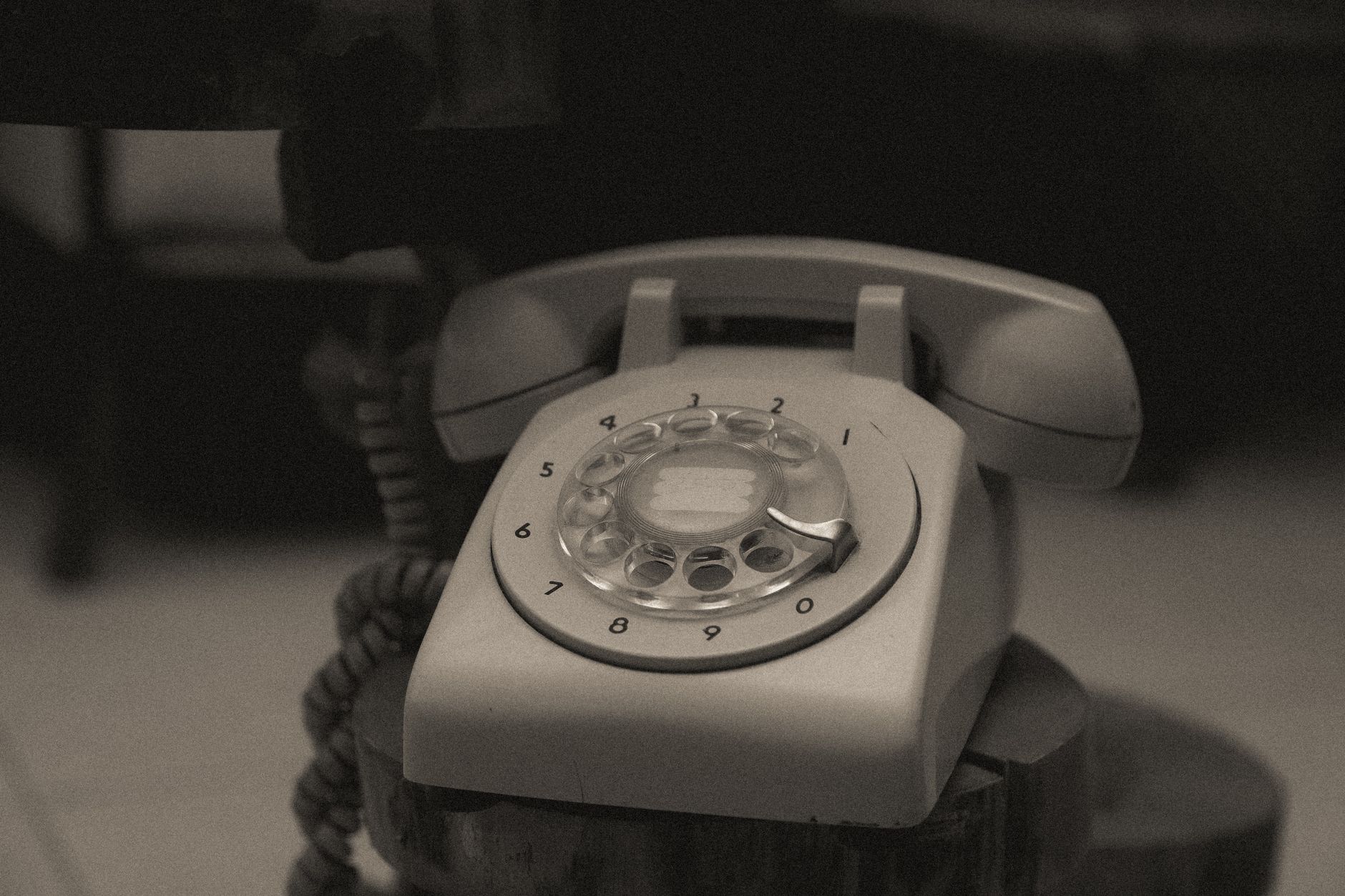
Being able to accurately dial a full-length phone number using a rotary phone and not panicking halfway through that you're not sure if you pulled the "9" around far enough. The phone in our hall was a rotary one. While I never really liked having to use the phone, dialling it was pretty fun. If you like mechanical noises, I encourage you to go play with a rotary phone, as it makes some very good sounds.
Being able to remember at least five phone numbers that were not your own. At some point, I could remember my own phone number, my Nan B's phone number (but not my Nan D's), my friend Matthew's phone number, my friend Edd's phone number and the phone number for my school. And possibly some more. Now I can just about remember Andie's mobile number… plus my parents' phone number, which is the same as it's been for nearly 50 years (and used to be "mine" also) so that one's kind of cheating.
Having a phone that actually rang, like, with a bell, not an electronic beeper. Again, the hall phone had a proper ringer and dear Lord it was loud. Heaven help you if you were standing next to it when it rang. Interestingly, every so often I do think I hear a proper ringer phone somewhere — I believe they might use them in places like construction sites still, as that piercing ring can be heard from a mile off.
"Going on the computer" being a discrete activity rather than the default behaviour. Get home from school, do homework, have dinner. Then, if I had been "good", I could maybe "go on the computer", as long as my Dad wasn't using it for anything. I feel like we lost something when we plugged ourselves into our PCs semi-permanently — and definitely when we effectively started carrying around a tiny PC in our pocket.
Sweet treats costing less than a pound each. There was an ice-cream man who came to our school every lunchtime — I assume (hope) he had some sort of special arrangement with the school — and he sold cans of drink for 30p, and "2p sweets" for… well, you know. (You could buy a bag of 2p sweets, too. I don't think we got screwed over with those.) Nowadays you'll pay a quid or more for a can of Coke, and the same again for a basic bitch chocolate bar. Don't even get me started how a "quick trip to the shops for some snacks" can end up costing £40 or more these days.
Going to a newsagent and coming out with something paper that you can read. I'm not even sure we have a newsagent anywhere near us any more. There's a pathetic little "Magazines" section in our local Sainsbury's, but it's nothing compared to the glory days of my Mum getting pissed off at my Dad for standing around reading Computer Shopper in WHSmith rather than actually buying a copy. I internalised my Mum's objections and preferred to buy a magazine that I wanted to read; it was much more fun reading it at home at my own pace.
Going out of the house to be with people who shared an interest. While I'm eternally sorry that I'm just a little bit too young to have been able to enjoy the phenomenon of "Computer Clubs" and "User Groups" in the early days of the 8-bit micros, when I was a kid I did have things that I went to each week and enjoyed, along with my peers. Cub Scouts was probably the highlight of these; that was an interesting time where I learned a lot of things that I probably otherwise wouldn't have found out about, had the opportunity to go (extremely heavily supervised) camping, and just generally had a pretty good time. I know that "interest groups" for grown-ups do exist, but I don't really know where to begin looking for them these days — particularly with all the dogshit information that is out there on platforms like Facebook these days. I miss the simplicity of your parents just knowing that there's a Cub Scout pack in the next village over, and wouldn't you like to join it, your friends are going to join!
So there you are. That's my age. I hope you enjoy it.
Want to read my thoughts on various video games, visual novels and other popular culture things? Stop by MoeGamer.net, my site for all things fun where I am generally a lot more cheerful. And if you fancy watching some vids on classic games, drop by my YouTube channel.
If you want this nonsense in your inbox every day, please feel free to subscribe via email. Your email address won't be used for anything else.
One thing I regret not really getting into when I was younger is role-playing games — of the tabletop variety. Actually, saying I didn't "get into" role-playing games isn't accurate at all; I've bought a whole bunch of sourcebooks over the years (I had a great collection of Vampire: The Masquerade books while at university!) but just, for one reason or another, never really had the chance to play them all that much.
I have two particularly fond memories of times when I have been able to indulge in some role-playing, and interestingly enough, neither of them involve a well-established, rules-heavy system. In both cases, they were simple acts of collective creativity — and they were vast amounts of fun as a result.
The first time wasn't really an organised session as such. I was in my second year at university, living in a grotty old flat that had very large rooms. Some of my friends from my school days had come down to visit, and they were sleeping in the living room; rather than retiring to my own bedroom down the hall, I decided to sleep in the living room with them. And before long, rather than falling asleep, one of our number kicked off a completely improvised role-playing session where our probably drunk, definitely tired and increasingly delirious selves got our characters into increasingly ridiculous situations — inevitably with the worst possible outcomes constantly happening to one of our number, because that was the funniest way things could go.
I forget the details of the "adventure", such as it was, but I do recall that my friend Edd found himself under attack by a giant penis monster at one point. So, naturally, he decided to cast the spell he'd made up called "REMOVE COCK", and you can imagine what the actual result of that was. It was an utterly ridiculous evening that I will always remember immensely fondly — and not a single die rolled along the way.
The other occasion was when I was around at a friend's house, and one of said friend's friends with whom I had previously become casually acquainted said he was going to run a role-playing game session for us, using what he described as a "freeform system" that he'd devised himself. Said system had just three statistics: Attack, Defence and Power, and all three of those statistics fluctuated according to the things we were doing; you'd "spend" points from each on various actions, and could regain them in various ways, usually by making progress through the adventure.
Because the system was so freeform, we were invited to come up with any kind of character we wanted. Being big into Japanese role-playing games at the time — not like now, obviously — my character was somewhere between a vaguely imagined half-elf character I'd mentally doodled at various points over the prior months, and basically Dante from Devil May Cry. Lots of flashy moves, big sword, pyrotechnics, all that sort of thing. His name was Rush Hurin.
Alongside Rush we had The Luggage from Discworld, a sentient suit of armour named Arryth, a cloud of amorphous pink gas and the archangel Tyrael from Diablo. It was a motley crew to be sure, but we had some grand adventures — and the skill of our dungeon master was such that he was able to devise dungeons and scenarios on the fly that meant we all had an opportunity to shine along the way.
Okay, yes, he pulled puzzles from a straight-up Big Book of Puzzles that he brought along with him — and on more than one occasion we entered a room in a dungeon with an elaborate-looking mechanism that had a big sign on it saying "COME BACK LATER" — but even using that "source material" and occasional little "cheats" to keep things flowing along, we ended up with an enormously entertaining adventure that culminated, as I recall, with us fighting a skyscraper-sized flaming demon, each using our own unique abilities to bring it down in various ways — culminating with The Luggage swallowing it and sending it to an unknown other dimension, as most of our other encounters concluded.
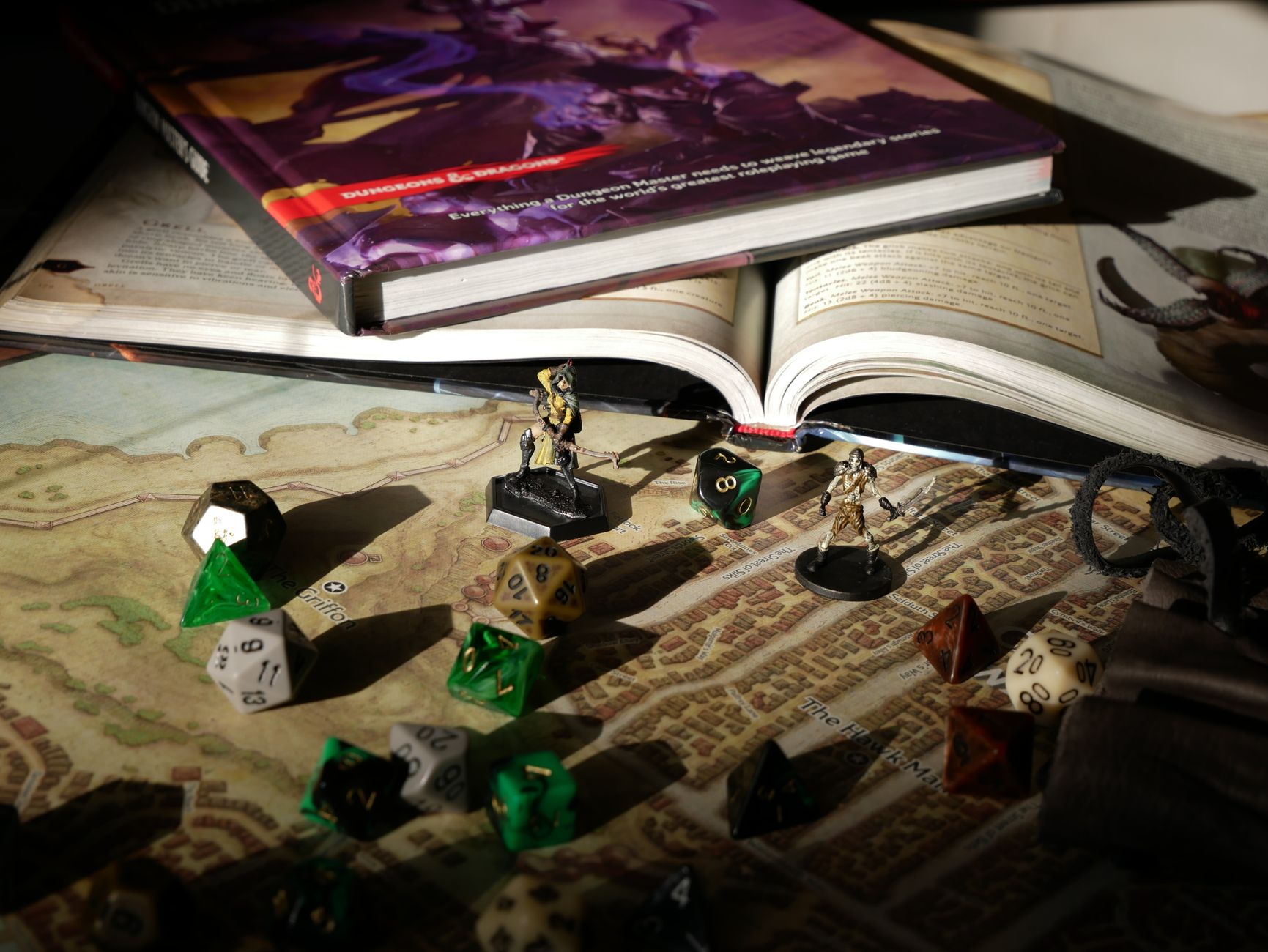
Both of these were great fun, yes, but I also just kind of… hunger for an opportunity to play something as basic bitch as Dungeons & Dragons, even though I know that's not fashionable any more. I always thought Vampire: The Masquerade would be fascinating to play, too — hence why I had a bunch of sourcebooks for it back in my early 20s — but that, more than almost anything else, strikes me as something you very much Need The Right Group For.
Why am I talking about all this? Well, I watched an episode of Mythical Kitchen this evening where they had the cast of Critical Role on there, and it reminded me that I've never… watched, listened to, whatever you do with Critical Role, and I was thinking I should probably correct that at some point. Sure, it's not quite the same as being part of my own campaign, but I think I might enjoy it… maybe it's time to add it to the "bedtime listening" rotation.
Want to read my thoughts on various video games, visual novels and other popular culture things? Stop by MoeGamer.net, my site for all things fun where I am generally a lot more cheerful. And if you fancy watching some vids on classic games, drop by my YouTube channel.
If you want this nonsense in your inbox every day, please feel free to subscribe via email. Your email address won't be used for anything else.
Yesterday, I talked generally about the impact PlayStation had on me and my friendship group thanks to stone-cold classics like Ridge Racer, Tekken and Final Fantasy VII. Today I want to talk about another aspect of that time which I have fond memories of — but which hasn't been a thing for some years now, and which will definitely no longer be a thing once Sony finally pulls the plug on production of physical PlayStation discs. (Incidentally, their announcement of this is now, at the time of writing, up to 135 pages of comments, with over 7,000 universally negative responses, and I suspect these numbers will continue to grow for some time as yet.)
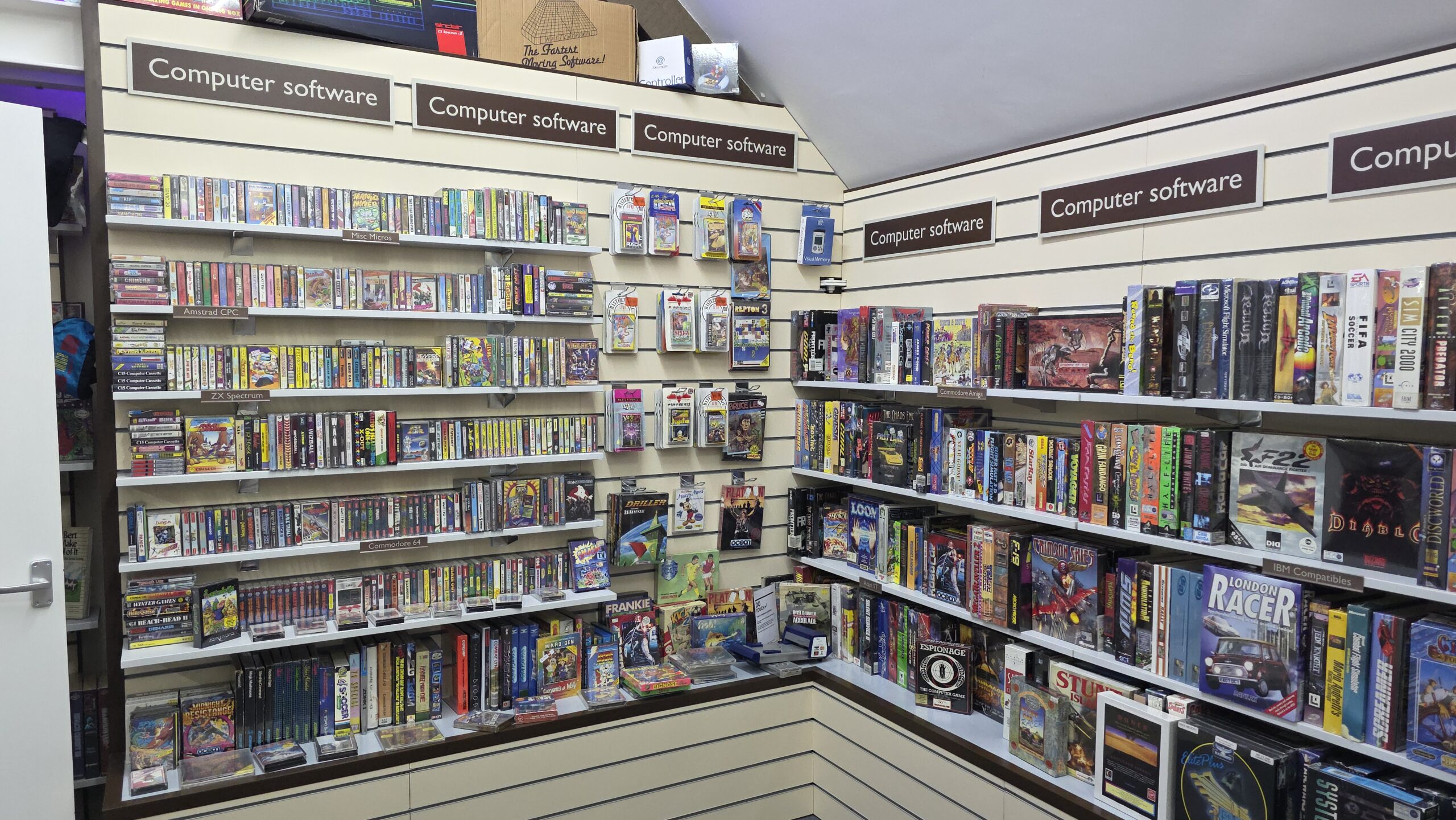
The Cave museum, part of the Retro Collective, has an interactive recreation of what an old software shop would have looked like back in the day.
Anyway. Yes. What I wanted to talk about was the fact that once we got into sixth form, a lot of us started to enjoy our first real tastes of proper independence, despite, in most cases, still living with our parents. Learning to drive allowed us to go places without having to rely on getting our parents to give us a lift — and give them the full details of where we were going. We were trusted to take responsibility for our own education, meaning several of us went to one single General Studies lesson in two years and still managed to ace the exam. Taking part-time jobs of various descriptions allowed us to earn some money, giving us considerably more financial freedom than childish "pocket money" provided. (Although saying that, my grandparents were always very generous in that regard.)
That latter one is an important one, as it coincided with us being able to spend that money on things that we liked. For my friends and I, those things were video games. And it was an enormously exciting time to be interested in video games, with the PlayStation having hit the market a few years earlier, and the Nintendo 64 finally arriving in Europe as we were kicking off our period of post-compulsory education.
I have fond memories of sixth form not just because I enjoyed the academic side of things — that's something I've talked about elsewhere — but also because of what happened between those classes. For my friends and I, we spent the majority of our time hanging out in the Art department of the school rather than the main sixth form common room; the corner of the Art department had essentially been taken over as a semi-private secondary common room that was almost exclusively used by my friends and I. It was a comfortable place to hang out, and we had many pleasant free periods spent there enjoying a bacon and cheese baguette from the recreation centre on the school site, just chatting about all sorts of silly things.
Quite often, if we had several free periods in a row, or free time up to and including lunchtime, we would wander off the school site — as we were allowed to do now, because we were big, brave, responsible 16+ year olds — and walk into the town centre. This was a walk of about a mile in total — my 45 year old bones ache just thinking about that — but we did it on a pretty regular basis. When we got into town, we had a bit of a routine: we'd go to The Baker's Oven for a bacon and cheese puff and a Belgian bun (though not if we had recently consumed one of the aforementioned baguettes), then head to Barneys, the local record shop, and have a little look around. I would always feel mildly uneasy in there because it was still the age where one felt distinctly judged for one's taste in music, but after a while I learned to just own my self-described "eclectic" tastes in music.
Barneys wasn't the main attraction of our trips to town, though. We saved the best for last by heading to First Compute, a pokey little shop in the "Cross Keys" shopping mews that was initially little more than a cupboard with games for pretty much every platform you can think of festooning every wall (and a fair bit of the floor). By the time we were in sixth form, though, the owner, who we only knew as "Richie", had moved venue to a slightly larger establishment, but the distinct feeling that as much stuff as possible was being crammed in remained. There were big box PC games on some shelves on the left, and PlayStation and N64 games on the right.
At the time, I had had the good fortune to score a few freelance writing opportunities for outlets such as PC Zone and the Official Nintendo Magazine. These at least partly came about because I did my Year 10 work experience on PC Zone when my brother was the editor, but my brother's the sort of person who wouldn't have recommended me to his successors if he didn't think I could have done a good job. And I did do a good job — and, more to the point, in those days, you got paid a hell of a lot more for cranking out an article than you do for many of today's websites. We're talking about £300-£500 per piece here.
As you can probably imagine, being in a situation where I had very little in the way of living expenses thanks to still living at home, this cash very quickly burned a sizeable hole in my pocket, and my friends knew this. I would often get a little "gentle encouragement" to pick up a new game for either PlayStation or Nintendo 64, and honestly, as much as peer pressure very much was involved, I didn't need much convincing. I found both systems to be a ton of fun, and I loved being able to share my enjoyment of them with my closest friends.
On the Nintendo 64 front, we quite often picked up games with a multiplayer focus, as we spent a lot of time around one another's houses, crowded around the television enjoying split-screen fun. We even tried some types of game that, in prior years, we would have never considered, like EA's World Cup 98 when the eponymous tournament was on.
On the PlayStation front, my preference was, as you can probably imagine if you know me even a little bit, for role-playing games, and dear Lord do I ever wish I'd held on to the vast majority of those games I bought all those years ago, because little was I to know that role-playing games in particular would become enormously expensive on the second-hand market.
Of all those times I was mildly peer-pressured into buying a new game, I only remember one solitary occasion when I was disappointed and regretful enough in my purchase to actually return the game in question. That game was a title for PlayStation called Blaze & Blade: Eternal Quest, and it was a polygonal action RPG for up to four players. It looked like it might be cool from the box art, and there were some interesting ideas in it, but it was very much not what I was looking for from a game at the time. I'm actually quite curious to revisit this game through older, more mature eyes, as I suspect I may have treated it a bit harshly.
The pattern of go-to-town, buy-a-game continued once I got to university and fell in with friends who also enjoyed gaming. Since I was still getting some cash from freelancing, I still had a bit of disposable income, though living away from home meant I did actually have living expenses now. Still, I managed to pick up a bunch of interesting games, and reading the manuals while on the bus home was always a highlight of these times that I think back on fondly. It's a cliché to talk about reading the manual on the way home, but it really was a thing we did, and it really is something I have exceedingly happy memories of.
New games haven't come with manuals for a long time now, outside of a few special cases in limited-print editions, and situations like Evercade where the whole thing is built on the idea of "how it used to be" — and with the apparently impending death of physical releases, even the experience of going to a game shop, picking up a game and coming home with it will be lost. Of course, many people — including me — tend to order their games online these days anyway, so many of us haven't been doing that anyway — but it's still sad to think that there are generations of video game enthusiasts who will never be able to enjoy things in quite the same way we did around the end of the millennium and the turn of the century.
I'm mad at Sony for actively encouraging the death of that. They are deliberately trying to destroy what was once an important part of the overall culture surrounding video games. I suspect those who have never been deeply into them might not understand why this is a big deal — and I equally suspect the C-suite execs who mandated this are exactly the sort of people who have never actually given a shit about video games as a creative medium or form of expression — but it really was. Sony's announcement left a lot of people feeling like they really had lost something; feeling something akin to grief. It might sound silly to say that about something as simple as going into a shop and buying a box with a bit of plastic inside it, but it really is the case.
I sincerely hope the company does a hasty U-turn on this, but I very much doubt they will. If that's the case, that's the end of me and PlayStation. Once there's no more games to buy and proudly put on my shelf, that's it for me and new games. I've always said this. And in some respects, I don't mind, either — it'll mean I don't have to worry about running out of what little space I have left on my shelves, and that I will be able to focus on diving deep into my collection and discovering all the things I haven't gotten around to yet.
But still. I will be sad to have lived long enough to see a medium and a culture surrounding it grow, thrive and then wither. I am already sad that I have seen that happen, but every new week seems to bring a new horror in that regard.
We will always have the good times, though. That's the one thing they can never revoke the license for.
Want to read my thoughts on various video games, visual novels and other popular culture things? Stop by MoeGamer.net, my site for all things fun where I am generally a lot more cheerful. And if you fancy watching some vids on classic games, drop by my YouTube channel.
If you want this nonsense in your inbox every day, please feel free to subscribe via email. Your email address won't be used for anything else.