#oneaday Day 661: When people would gnaw off an arm for a freelance writing gig, using generative AI is unforgivable

In the last 18 years, 4,535 posts and 3,263,700 words (yes, really, I got a plugin to count them and everything), I have never once felt the need to outsource my thinking and creativity to a machine. There are two posts written by "guest authors" (which, spoiler, were actually both me in a cunning disguise!) and there are a couple of posts where I permitted drunken friends the opportunity to contribute a sentence or two to a post I was writing while out and about, but the remainder is all me, scooping out the contents of my brain and plopping it onto the page for no other reason than the fact that I enjoy doing so, and occasionally find it helpful.

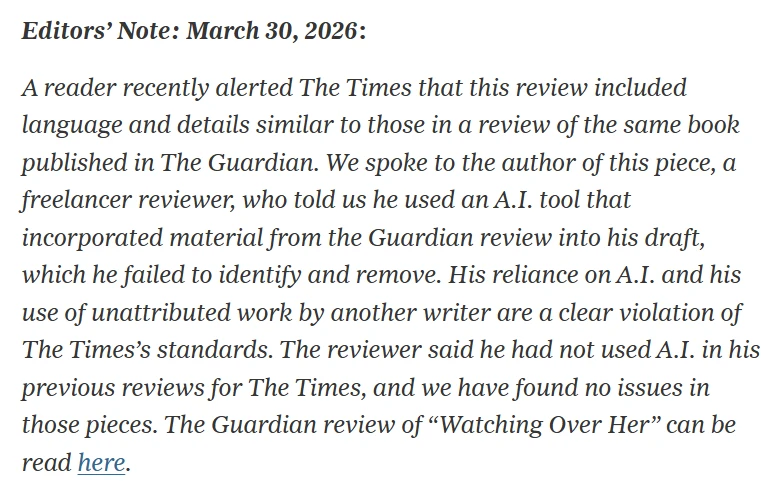
Today, this notice appeared in the New York Times on a book review it had published:

Editors' Note: March 30, 2026:
A reader recently alerted The Times that this review included language and details similar to those in a review of the same book published in The Guardian. We spoke to the author of this piece, a freelancer reviewer, who told us he used an A.I. tool that incorporated material from the Guardian review into his draft, which he failed to identify and remove. His reliance on A.I. and his use of unattributed work by another writer are a clear violation of The Times's standards. The reviewer said he had not used A.I. in his previous reviews for The Times, and we have found no issues in those pieces. The Guardian review of "Watching Over Her" can be read here. (link)

This, to me, is unforgivable. Supposedly there are plenty of writers out there who are doing this — or something like it, anyway — but to me, it is unfathomably awful. To be a writer, someone who cares about one's craft, you have to give a shit. And absolutely nothing says "I don't give a shit" quite like relying on generative AI so heavily that your article has to be pulled because its plagiarism was too obvious.

I mean, when you think about it, it's obvious that this would happen, given the way generative AI works and is trained — if it's pulling all its wording from existing texts that it has absorbed (without any compensation for the original authors) from around the Web, then of course it's going to come up with some of the same things, perhaps even the exact same phrasing.

You'd think it would be obvious, anyway — and that any writer worth their salt would not, as a result, rely on it — but apparently this is not the case. Much how the above-linked Wired article should really result in all the authors named being blacklisted from every freelance writing pool, effective immediately, this incident should be the end of Alex Preston's career. There should be no second chances. To quote the old Batman meme, this is the weapon of the enemy; we do not need it; we will not use it.

Believe me, at this point I've heard every pro-AI argument there is — some, like the nonsensical "back in the '90s some people thought the Internet would be a bad thing!!" one, more than others — and none of them stand up to the slightest bit of scrutiny. AI does not make you a better writer. AI does not make you a writer. The only thing that makes you a writer is, quite simply, writing. And if you are not sitting down and writing something for yourself — whether that be through putting pen to paper, tapping away at a keyboard or dictating your words verbally — you are not a writer. And no, "writing" your prompt to get the bot to churn out a thousand words for you does not count.

Humanity's written languages have survived for thousands of years — albeit with plenty of evolution — through people being taught how to use them. It is, today, a fundamental part of your early socialisation process to learn how to read and write; yes, some folks have specific learning needs that make it harder or even impossible for them to do so, but even for them, generative AI is emphatically not the answer, as we have plenty of assistive methodology and technology that can allow these people to thrive that does not rely on the odious fad that is presently bleeding the planet dry.

So I'm sorry, I have no patience left whatsoever for any incidents like this. The people involved in the Wired and New York Times articles above deserve to be kicked out of their career. Because if they have no respect for writing as a craft, why on Earth should any readers be expected to have any respect whatsoever for the shit they've churned out through the bots?

There are myriad people out there who would chew off their own arm for an opportunity to have a byline beneath a prestigious masthead — and every one of them who relies entirely on their own writing abilities, rather than outsourcing their creative process to the planet-burning chatbot, deserves those opportunities a million times more than those who clearly have no respect for themselves, their peers, or their readership.


Want to read my thoughts on various video games, visual novels and other popular culture things? Stop by MoeGamer.net, my site for all things fun where I am generally a lot more cheerful. And if you fancy watching some vids on classic games, drop by my YouTube channel.

If you want this nonsense in your inbox every day, please feel free to subscribe via email. Your email address won't be used for anything else.

#oneaday Day 633: Garfield had it right all along

Pic unrelated. I was just experimenting.

I hate Mondays. I mean, I hate getting out of bed most days, but on Mondays it's always particularly challenging, for a variety of reasons. The most obvious, of course, is that getting out of bed on a Monday is an acknowledgement that the weekend is, in fact, over, and that you are going to have to do something vaguely useful with your existence for the next five days.

For me, I have the added annoyance that Monday is Meetings Day. I have one at 10am, another at 11am, sometimes another at 2pm and yet another at 3pm. Somewhere amid all that I have to figure out a week's worth of stuff to get done in the space of a couple of hours so that I can actually use the rest of my week in a manner that is productive and useful to the rest of the team.

I despise meetings. I always have. I'm not sure I've ever had a meeting that I walked out of where I felt "that was an excellent use of my time". I got in trouble at one job for finding a meeting so boring that I actually fell asleep in it. When working from home started, I discovered that I could literally go to bed and fall asleep during the 60-90 minute long "Good Morning Call" meetings we had every Tuesday at the job I was working at the time, and no-one ever noticed. I am the embodiment of the concept "This Meeting Could Have Been an Email".

And yet certain people are obsessed with the idea of having meetings. I'm talking generally here, not about anyone specific at my current or previous jobs — these are just some observations that I've seen over the course of various occasions of employment. But yes. Some people are obsessed with the idea that having everyone looking bored on Zoom or Teams several times a week is somehow productive, when in fact everyone would be much more productive if they were left alone to get on with their job, and only got bothered when someone specifically needed their attention on something.

I sort of get the justification. The idea is that if you all get together — preferably face-to-face — on a semi-regular basis, you will communicate better with one another because you are more likely to think of one another as actual people. But I can't help but feel there are much, much better ways to do this than Having A Meeting.

I don't know anyone who relishes the prospect of weekly meetings, at any job I have ever worked at. I know plenty of people who dread it, particularly if they have been forced into having to speak or present something, but no-one who actually enjoys these things. So why do we continue to insist on them?


Want to read my thoughts on various video games, visual novels and other popular culture things? Stop by MoeGamer.net, my site for all things fun where I am generally a lot more cheerful. And if you fancy watching some vids on classic games, drop by my YouTube channel.

If you want this nonsense in your inbox every day, please feel free to subscribe via email. Your email address won't be used for anything else.

#oneaday Day 606: How evil is too evil?

Every new reveal from the Epstein files seems to bring with it brand new and exciting horrors to be disgusted by. It is unsurprising to see a veritable Who's Who of The Worst People In the World cropping up as having had contact with the rancid old paedo — and yet with every new name that bubbles up from the sewer, I find myself wondering, more and more, if anything is actually going to happen because of all this.

You'll forgive me for not having a lot of faith that these people will suffer any consequences whatsoever.

We live in a world where companies can just set fire to billions of dollars a year for a technology no-one wants, and where no amount of people going "please fuck off, please fuck off" will make them fuck off.

We live in a world where the President of the United States is demonstrably both an actual criminal and an incompetent fuckhead who shits himself in public, but nothing is done about either of these things — both of which, one would argue, should probably put him out of the running for being in charge of one of the most powerful nations on Earth.

We live in a world where the world's richest man proudly takes over what was once a good method of online communication and turns it into his own personal playground, where his antisemitic, CSAM-generating chatbot floods the world with disinformation and allows some truly vile examples of humanity to thrive. (At least, in this case, something is being attempted in response, though due to all of the other things I'm talking about today, I don't have much faith this will end in any other way than someone paying a lot of money to make it all just "go away".)

The world is dominated by rich people who are making existence for everyone except themselves objectively much, much worse. And I feel like they're going to get away with it. I know legal action takes time and money to come to fruition, and it's entirely possible that things are going on behind the scenes to bring some of these scumbags to some sort of justice, but I somehow doubt it at this point. I suspect what will happen is that some of them will get a slap on the wrist at most, and then maybe asked to pay some money that is a meaninglessly miniscule fraction of their total fortunes, and then we will all be expected to forget about everything.

As the quote frequently misattributed to Final Fantasy Tactics goes, "if the penalty for a crime is a fine, then that crime only exists for the lower class". It's true. If Elon Musk is made to pay even several million dollars by the French authorities for his CSAM-generating chatbot, it means nothing to him. Same for Donald Trump. Same for the myriad rich folks who engaged in barely literate email exchanges with Epstein about "partying" (and we know what that means, unfortunately) on his special paedo island, or how they were going to manipulate and fuck up the economy, politics, tolerance and inclusivity… the list goes on.

I'm open to being proved wrong on all this. But at the moment it feels like there simply isn't anyone to hold these rich fuckheads to account… aside from The People themselves. And, despite growing evidence that people in the States are willing to hit the streets when it really counts, I'm not sure The People have the motivation or the strength to be able to undo all this damage that's been done.

I hope one day we can look back on this period from a better place, and feel like we all learned something from it. After all, the world has recovered from terrible things before. But has anything ever really been quite like what we're dealing with right now…?


Want to read my thoughts on various video games, visual novels and other popular culture things? Stop by MoeGamer.net, my site for all things fun where I am generally a lot more cheerful. And if you fancy watching some vids on classic games, drop by my YouTube channel.

If you want this nonsense in your inbox every day, please feel free to subscribe via email. Your email address won't be used for anything else.
#oneaday Day 579: Fresh hell

No drawing today; it doesn't quite feel appropriate.

So much for new year, new beginnings. Just the last week has seen all manner of fresh hell being served up, particularly across the pond in America, but these things have the potential to affect everyone in the world, directly or indirectly.

The first thing I want to acknowledge is America's Immigration and Customs Enforcement (ICE) terror group murdering someone in cold blood in Minneapolis today. I have no real words to express what I feel about the continually declining situation in the States right now, and as someone who has relatives who live there, I am frightened. I can't even begin to imagine how people who live there in the knowledge that this horrendous shit is going down must be feeling right now.

That's about all I can say about that for the moment, because that situation is still ongoing. I at least wanted to acknowledge it, however, because it's just one of many things that have been going horribly, horribly wrong recently, making it clear that 2026 is not going to offer any sort of respite from the general shitshow the 2020s have been so far. I hope the perpetrator of this heinous act is brought to justice, and that this can be the starting point for the people of the United States to take their country back — by force, if necessary — from an increasingly, dangerously unhinged administration.


The main thing I want to talk about today is Grok, the generative AI large language model attached to X, the child sexual abuse material and revenge porn platform formerly known as the social media platform formerly known as Twitter. Grok has been trouble ever since Elon Musk, idiot-in-chief of The Everything App, decided that he needed to make it Cool and Based, and not subject to those pesky guardrails that the boring folks at OpenAI and Anthropic were doing. (Guardrails which, I will add, are consistently failing, as people keep dying as a result of following chatbot "advice" when it comes to drugs and suicidal ideation. But that's beyond the scope of what I want to talk about today.)

If you've somehow missed what's been going on, Grok, ostensibly an on-platform AI able to provide additional context and explanation to a post if someone asks it to chip in, is being used to a frightening degree to produce non-consensual pornography based on real people's photographs — including those of minors. And it has been complying with these requests, posting uncensored nude and lingerie-bikini clad images of women and girls who had previously posted perfectly normal, innocent images of themselves online.

Not only that, but the "community" has been quickly finding ways around what little guardrails Grok does have in place, as reported by the excellent 404 Media, one of the best, most rigorous sources in tech journalism today. For example, Grok supposedly won't generate an image of someone covered in cum, but it will happily comply with a request to "donut glaze" someone, as reported by Eliot Higgins in a lengthy thread on Bluesky earlier today.

There's been disturbingly little critical reporting of this from the media, too. There was a half-arsed attempt to cover the situation during which multiple news outlets unironically said that "Grok apologised" for producing the inappropriate material, when, as a large language model, it is not capable of doing such a thing. The "apologies" posted were simply responses to further prompts, and the insincerity of them was emphasised by someone also prompting it to basically post a Cool and Based "deal with it" kind of response immediately after the initial "apology".

X, The Everything App, so far appears to have done little to curtail the issue. Indeed, if you go click on Grok's profile right now — don't do that — and look at the replies tab, you will almost certainly see a request to put a non-consenting woman in a bikini within two or three posts, if not as the very first post you see. This has been done to a vast number of people so far, including celebrities, public figures, individuals just posting selfies and, yes, minors. And, as one might expect, it has been overwhelmingly women that have received this treatment.

This has been absolutely revolting to see, and although I left Twitter behind myself long ago for a variety of reasons, I am still obliged to check in on it every so often for the day job. And I kind of feel sickened to have to do that; I have absolutely no desire to associate the brand I work for, which I actually care about, with a platform that is seemingly okay with the material I've just been describing. If it were up to me, I would remove the brand from the platform entirely, but unfortunately that is not my decision to make — and thankfully, at some point hopefully not too long away, I will be stepping away from having to deal with social media entirely, in favour of some new responsibilities at the company I will enjoy a lot more.

But if you still have a Twitter account on the grounds that "your audience is still there", let me be blunt: no, they are not. Anyone with any decency abandoned that hellsite long before this latest nonsense started to be a thing, because they could see how things were going a mile off. I wish I could say I was surprised that Grok ended up being used for non-consensual deepfake revenge porn of minors, but I am not.

Back in 2023, I wrote about how I'm not surprised so many people become misanthropes in this day and age, and how I had pretty much lost faith in my fellow man. Things haven't gotten any better since then. In fact, they've become much, much worse. If you've ever thought "ah, no, that's ridiculous, there's no way that'd ever happen", then I'm sorry to say that it probably has already. And then some edgelord shithead has "donut glazed" it just to add insult to injury.


Want to read my thoughts on various video games, visual novels and other popular culture things? Stop by MoeGamer.net, my site for all things fun where I am generally a lot more cheerful. And if you fancy watching some vids on classic games, drop by my YouTube channel.

If you want this nonsense in your inbox every day, please feel free to subscribe via email. Your email address won't be used for anything else.

#oneaday Day 182: Unpopular gaming opinions

As a veritable old fart of video games, I am, of course, fairly set in my ways, as older folks are wont to be. And as such, I have come to hold certain opinions that appear to deviate from "the norm" among younger folks. You are not "wrong" to think differently to what I am about to describe below, but know that you are not going to convince me to change my viewpoint, because I have felt this way about all these things for years now.

So why am I writing this? I dunno. Something to write about, innit? Plus there might be some of you out there who actually agree with some of these. It doesn't really matter. Let's just start, shall we?

Games don't "need" updates for months or years after their release

Baldur's Gate 3 happened to drift across some form of feed that I was looking at the other day, and the thumbnail image that came with it proudly boasted something along the lines of "Community update 30".

Now, whether this was just the 30th blog post for the community or the 30th actual update for the game I don't actually know, but both are equally offputting to me. I haven't even considered touching Baldur's Gate 3 yet because it launched unfinished and apparently is still getting bits and pieces bolted onto it after the fact.

I hear it's very good. I believe that it's very good, as Larian has a good track record. But I have precisely zero desire to play it until it's finished, because when a game as big as this gets significant updates after I've already ploughed a significant number of hours into it, I feel a bit hard done by. Worse, if I've already finished it by the time a significant update shows up, I feel very hard done by, because I should just have waited to play it.

Unfortunately, regular updates to games are expected by a certain class of The Gamers™, particularly those on PC. Look at the Steam reviews for any game that hasn't had an update for a month or two and you'll see people complaining about "devs abandoning the game" and it being a "dead game".

No. Sometimes it's just finished, and sometimes the devs would like either 1) a break or 2) to go and work on something else. I am, sadly, in the minority on this, but few things make me lose interest in a game faster than if it launches with a "roadmap". Just delay the thing a few months and finish the fucking thing. Then I will play it.

DLC is worthless

As an extension to the above, if a game releases and then immediately announces that it is getting a bunch of DLC, I will also immediately lose interest. Not only does it make me feel like stuff has been cut out of the base game to make the DLC — and don't throw the "well actually it's developed at a different rate to the main game" argument at me, that is an easy problem to solve — but I am struggling to think of a piece of DLC that I have genuinely thought was actually worth the money.

I remember being particularly disappointed with the DLC chapters for stuff like Dragon Age and Mass Effect back in the day, and I haven't seen much to change my opinion ever since those days. And, at the other end of the spectrum, you have games like Stellaris, where there is now so much DLC that it's impossible to know what the "best" way to get started with the game is. So I just… don't.

Mods are vandalism

"You should play games on PC!" the PC gamers say. "Because of mods!"

Fuck mods. I hate mods. A significant portion of them are outright vandalism to both the artistic and mechanical design of the teams that worked on a game. I saw someone on Bluesky earlier sharing an image of someone who had installed a "QoL" ("Quality of Life") mod to STALKER 2 to remove all encumbrance mechanics from the game. STALKER 2 is a game about survival in difficult circumstances, and the encumbrance mechanics force you to determine whether you really need to carry various things around with you. By removing it, you're stripping out part of the game.

Likewise, graphical mods can get in the bin, too. Games are designed with both a particular artistic vision in mind and are a reflection of the era in which they were designed, and I don't really give a toss if you can add ray-tracing to something that didn't have it before, or if you can make a game look like Generic Photorealistic Open World Game #927.

And I'm sure I don't need to say anything about nude mods. I say this as someone who enjoys a good sexy game.

"But I need 357 mods to make Skyrim fun!" Then Skyrim isn't a very good game, is it? Maybe play something else.

My only begrudging exception to this is in the case of games where extensibility is designed to be part of the game — stuff like Doom/Quake/Duke/whatever levels are fine with me, because those games were designed to be extendible. Although I must confess, when I play any of those games, I tend to stick to their official campaigns. And in some cases, mods for a game specifically designed to be mod-friendly inevitably remain perpetually unfinished and not as good as the stuff built-in to the game: most stuff for the excellent driving sim BeamNG.drive falls into this category, to name just one example.

I don't want to join your Discord

I use Discord when I absolutely have to, for work and for the few groups of friends who are only reachable there. But I do not want to join a fucking Discord for every single game I play, and I don't want to be bugged to join your Discord on the title screen for your game. Go away, leave me alone, and if I decide I want to engage in the official community for your game, I will seek out your Discord myself.

I absolutely do not want to have to join your Discord to read documentation or download helpful files. Host that shit on your website like a normal person.

I want your game to end

It's all very well offering "potentially limitless replayability", but I do actually want to be able to finish your game. If I can't finish your game, I almost certainly won't start it, because the way my brain works means that I will get annoyed by the fact I'm playing something that doesn't have a "point".

This is one of numerous reasons I think idle games and incremental games are dumb. Sure, numbers get big to a point that they become largely meaningless… but that's it. There's no sense of having achieved anything there. And I strongly suspect that a significant number of idle game fans have no idea that the genre largely stems from a pisstake at the expense of people who grind their way through mobile games with no conclusion.


Anyway, that'll do for now, because I'm sure I've pissed someone off with at least one of the above. As noted at the beginning, though, I don't care. I am an old man, I have things I like and things I dislike. And all of the above can get in the bin. A good evening to you!


Want to read my thoughts on various video games, visual novels and other popular culture things? Stop by MoeGamer.net, my site for all things fun where I am generally a lot more cheerful. And if you fancy watching some vids on classic games, drop by my YouTube channel.

If you want this nonsense in your inbox every day, please feel free to subscribe via email. Your email address won't be used for anything else.

The TikTokification of comedy

I fucking hate TikTok. I hate "short-form content" in general, which means I loathe YouTube Shorts, Instagram/Facebook Reels and anything anyone feels the need to send me that is in a 9:16 aspect ratio. So if you're considering it… don't. I won't watch it.

My reasons for despising short-form content are numerous and varied, so I won't go into all of them here, but one thing in particular vexed me so when I stumbled across it yesterday that I felt the need to get this particular rant out of my system. And that is what I call the TikTokification of comedy — or, to put it another way, the divorcing of comedic moments from context purely so that idiots can quickly and easily steal them and share them on their mindless social media.

I've actually been thinking about this for a while. The first time I was particularly conscious of it was when I started seeing that a number of comedians had started upping their YouTube presence. And all their videos had a few things in common. Take a look at these thumbnails:

All of these are completely transparent clickbait. And while a certain amount of clickbait is a necessity on a platform as saturated with material as YouTube is, I really detest the whole "half a sentence" thumbnail format. I didn't click on this one, which has almost certainly floated across your YouTube recommendations at some point, either:

This, to me, is the YouTube equivalent of the Twitter engagement bait (that thankfully seems to have died a bit of a death… along with the rest of Twitter) where a brand would go "[our brand] is _________" and expect people to "fill in the blank". And people, dumb consumers that they are, absolutely would. And it didn't matter whether they were filling it in with obscenities or bootlicking nice things, it was engagement. It made the numbers go up. That's all that mattered.

It's the same with these comedy clips. I like all of those comedians above, but I don't want to click on their videos because it's rewarding manipulative behaviour, and also encouraging the main problem that I want to talk about today: encouraging people away from enjoying a creative work in its entirety and towards a grab-bag full of "best moments" that completely lack their original context.

Good stand-up comedy makes the entire show into an event, and runs a narrative thread through the whole thing. Not all comedians do this, but the best comedians, in my experience, make you feel like you've enjoyed a complete story by the time you've left the room. Sure, there may have been some deviations along the way, and the story may not have made all that much sense… but there was still a sense of narrative progression. A beginning, middle and end, if you will. For some great examples, check out Rhod Gilbert's show Rhod Gilbert and the Award-Winning Mince Pie and pretty much anything by Eddie Izzard.

When you slice a show up into little bite-sized bits, you lose that context. Sure, the individual moments might be funny on a superficial level, but you lose the added depth of them being part of something bigger. And that's a real shame. And this leads me on to the real reason I'm writing this today: my discovery yesterday that Friends, a TV show I absolutely adored during my formative years, has its own YouTube channel.

And yes, you guessed it, the Friends YouTube channel looks like this:

The stand-up comedy thing I can sort of forgive. While I much prefer seeing an entire stand-up set and enjoying that feeling of context and narrative, there are sometimes just single jokes or routines that you want to share with someone. And you can probably make the same argument about Friends.

But for me, and regardless of what you and/or the general public might think of it now in 2023, Friends was always about more than just the jokes. Friends was a phenomenon. Friends was about us spending 10 years alongside these characters in an important, turbulent part of their lives, and watching them grow and change. Friends was about us simultaneously being envious of these twentysomethings somehow being able to afford massive apartments in Manhattan, but also feeling like the moments they shared were relatable in their own ways.

And an important part of the entire experience was context. While Friends actually starts kind of in medias res, halfway through a member of this pre-existing friendship group telling a story in their favourite coffee shop, it still makes an effort to introduce us to everyone through the way Rachel enters the picture as a formerly estranged friend of Monica.

We feel included. We feel like we're learning who these people are — and over the course of the subsequent ten seasons, we really get to know everyone. And while the age of the show means that life in general is quite different for most folks right now — look how infrequently anyone on the show uses a mobile phone or a computer, for example — it's still relatable to anyone either going through that "20s to 30s" part of their life, or who has already been through it.

These characters grow and change as a result of the things that happen to them and the simple act of getting older. They enjoy amazing high points and some heartbreaking low points — although nothing too heartbreaking; this was a primetime comedy show, after all. But everything that happens helps to define these characters and make them more than simple, mawkish, two-dimensional representations of a single personality trait.

Slice all 236 24-minute episodes up into one-minute chunks, though, and you have content. You have individual moments that, in many cases, simply don't really work as standalone "jokes" because they rely on you knowing and understanding the characters and their relationships. And you have no sense of that ongoing growth and character development, because all these clips are posted in a seemingly completely random order determined by whatever the person running the Friends YouTube account felt like putting up today.

I realise this is a bit silly to get annoyed and upset over, but it's frustrating to me to see something that I loved so much in its original form and its original context be treated as fodder for the mindless content consumption machine of 2023. It irritates me to think that there are doubtless some people out there whose only contact with Friends will have been minute-long clips on YouTube, and through those they will likely have formed a totally different opinion of the show than someone who watched it from start to finish.

Is this elitist and gatekeepery? Not really, since Friends itself is easy enough to watch in its entirety via either streaming services or undoubtedly cheap DVD box sets that no-one wants any more. It's just the latest symptom in a disease that blights society, where no-one believes they have "time" for anything any more, so watch badly cropped minute-long 9:16 clips on double speed while they're doing their daily quests in Mindless Gacha Bullshit X, rather than settling down, taking some time to relax and just enjoying something in its entirety.

I hate it. Hate it. And while I'm aware there's nothing stopping me from doing what I describe above — I think I even still have my Friends DVD box set somewhere — it's exhausting just to be around all this short-form garbage, and frustrating to live in a world where seemingly no-one has an attention span longer than a TikTok video.

#oneaday Day 878: I'd Tap That for £70 of In-App Purchases

20120615-020941.jpg

Despite my day job, which is reviewing mobile and social games for the fine folks over at Inside Network, I have to confess that the reason some of these games end up being quite so popular eludes me. Don't get me wrong, I'm trained to spot a free-to-play game that's going to be profitable a mile off… I just can't pin down the reason as to why some of these games resonate with people so much. And no-one seems to want to tell me, either.

(Naturally it probably goes without saying that these are my personal, not professional views. But I'll say it anyway. Oh, I already did.)

Let's take a title called Rage of Bahamut as a case study. Rage of Bahamut is a game for iOS and Android devices. Ostensibly it's a "card battling" game in which you collect (virtual) cards a la Magic: The Gathering and then use said cards to do battle, either against other people or "boss" monsters. There's also a large number of "quests" that you can take one of the characters represented on your cards on, the ability to organise players into "Orders" and cooperate, trade cards, help each other out on difficult fights and all manner of other stuff.

Sounds pretty good, right? Well, it's not. The game features one of the most dreadful user interfaces I've ever seen, with most of the game looking like a Web page from the early '90s, albeit without animated "Under Construction" GIF files. The "quest" feature consists entirely of tapping a button, watching a short animation of a monster dying and observing your stamina bar gradually decrease as your experience and "quest progress" bars increase. Battling another player involves selecting your cards in advance, pressing "Battle" and then doing absolutely nothing. Battling a boss involves selecting your cards in advance, pressing "Battle" and then doing absolutely nothing. Oh, and there's no sound, either. It wasn't deemed necessary, it seems. The game's sole slightly redeeming feature is that the anime-style artwork for the cards is quite nice, but that certainly doesn't make it any fun to play. At all. Go on, try it. (Android users, go here.)

Despite this crippling lack of entertainment value, somehow the game is presently the third top grossing game on the iPhone — and it has been at the top of that chart in the last few days, too. It's free to download, meaning that people are enjoying this hateful, monotonous, tedious pile of steaming un-fun crap enough to want to voluntarily hand over money.

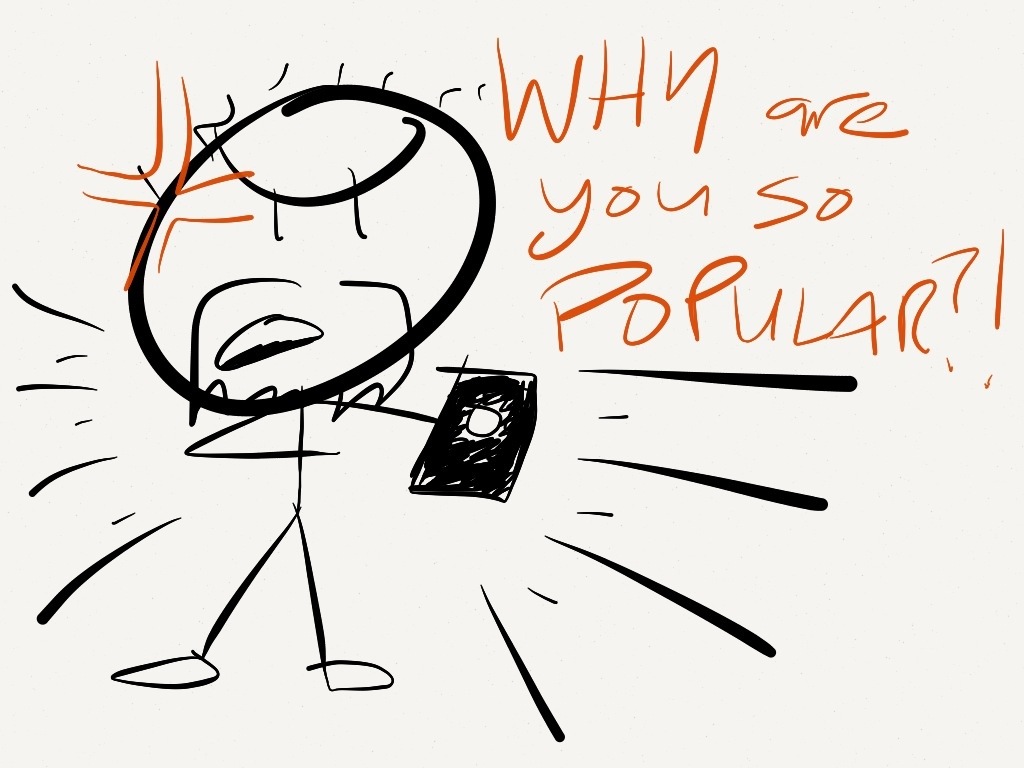
Why?!

It's not the only game of this type which has enjoyed success, it's just the most recent. Various studies by research companies indicate that the majority of profitable apps on the various app stores of the Internet include in-app purchases in one form or another — and many of these titles are of the free-to-play variety. I have nothing against free-to-play as a concept or business model, but I do question the taste of some people when something as unbelievably lacking in virtue as Rage of Bahamut proves itself to be more profitable than lovingly-crafted paid apps which developers have poured large quantities of time and money into. This depressing tale from Joystiq springs to mind.

I can't help but feel that the press is partly to blame in all this. Titles like Rage of Bahamut often get great reviews from the press despite their lack of innovation, gameplay, interface design or anything even resembling entertainment, when in fact they should be summarily panned for providing an experience akin to scrolling through an Excel spreadsheet equipped with a macro that requires you to click "OK" every ten seconds.

But then I guess I've never seen the appeal of football management games, either…

(Incidentally, if you're looking for a card-battling game that's actually good, try Gamevil's Duel of Fate, Hothead's Kard Combat or Kyle Poole's Shadow Era.)

#oneaday Day 779: Snark Pit

20120307-235746.jpg

I've kind of had it with snark. The whole "let's piss on everything" parade that shows up any time something vaguely interesting or cool happens is getting really rather tiresome, and over the last few weeks and months I've actually been taking steps to minimise my exposure to it by simply unfollowing people on Twitter who prove to be irritants in this fashion. (British game journos, you don't come off well in this poll, by the way, naming no specific names.)

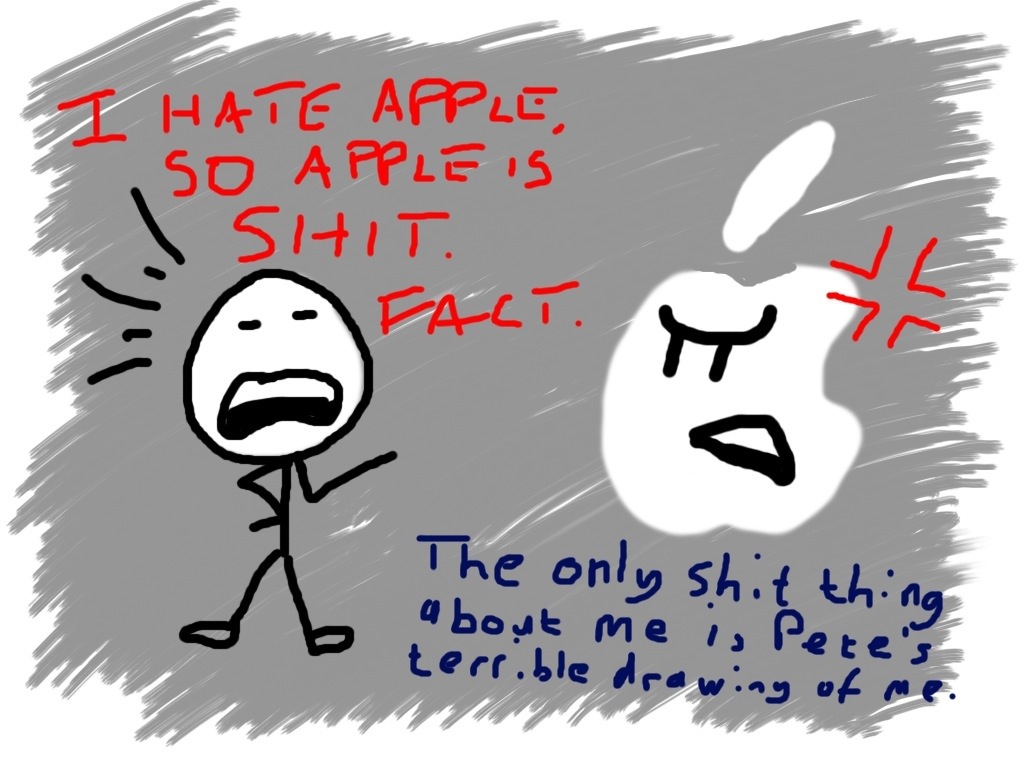
Unfortunately, on a day like today, which held among other things the promise of a hotly-anticipated iPad-related announcement from Apple (which turned out to be "The New iPad" with its shiny retina display and quad-core processor… yum) it's difficult to avoid said snark. It seems that for a lot of people nowadays that if something isn't to your own personal preference, then no-one should enjoy it.

At this point I'll say that I'm well aware I've been guilty of this in the past, and for that I apologise. (The X-Factor is still unquestionably shit, though. There is no valid argument in favour of a show that gave the world Jedward. I'm just not going to rant at length about the subject any more.) I am trying my best these days to see arguments from both sides, but unless you're some sort of level 99 mediator, you're always going to come down on one side or another. So long as you don't force your views on others and expect everyone to agree with you, everyone should be free to do that. (Unless it's about something dickish. I think we can pretty much universally agree that those who judge people based on skin colour or sexual orientation can all pretty much just bugger off and sit on a spike.)

I digress. I was talking about snark, and specifically relating to today's Apple announcements. The new iPad is, by all accounts, a lovely-looking device, and the Retina display is sure to raise some eyebrows. As per usual for an Apple event, the company came out with its usual stuff about how it believed we were entering a "post-PC" era and about how people supposedly "preferred gaming on their iPad" to consoles and computers.

Contentious comments, for sure, but firstly, they're marketing hyperbole — Apple announcements are press events, after all, and a company as big as Apple is never going to be humble about its achievements or lofty ambitions — and secondly, it might not be quite so unreasonable as you think. Already many households are making use of iPads for simple tasks such as browsing the Web, checking email, watching TV and movies, playing games, keeping themselves organised and all manner of other things. And the sheer number of people who have downloaded Angry Birds, whatever you may think of it (I hate it) should give you pause when considering the gaming-related comments.

But instead of thinking these points through rationally and considering the perspective that Apple might have been coming from, in it was with the snark about how wrong Apple was and how much bullshit they were talking. Up went the defensive walls, and a veritable barrage of snark was fired over the parapets towards anyone who dared to say "hmm, hang on, that's actually quite interesting, and possibly plausible". (I'm not saying their comments were true, rather that they deserved greater consideration than immediate outright dismissal.)

It only continued when, as usually happens in Apple announcement events, software started to be shown. The new versions of iMovie and GarageBand for iOS drew particular ire, with various Twitter users making acidic comments about how awful the music people makes with GarageBand supposedly is, and how terrible the "movie trailers" facility of iMovie is.

Once again, no consideration was given to the audiences that these features might be directed at. As a former employee of the Apple Store, let me assure you there is absolutely no love lost between me and the tech giant of Cupertino, so I have no "need" or contractual obligation to defend them — and also, a company the size of Apple certainly doesn't need my defence either. But as a former employee, I know that Apple customers aren't just high-falutin' creative types, gadget freaks, tech snobs and people with more money than sense. I know that people who walk through the front door of that store range from very young to very old; from experienced computer user to complete beginner. I know that there's a considerable proportion of that audience who came to Apple because of its products' reputation of ease of use. I've even taught plenty of those people how to achieve simple tasks in products such as iMovie and GarageBand, and to see the looks on their faces when they realised that yes, they could be creative with their computers despite their lack of technological knowhow was, to use a word Apple itself is very fond of, magical.

As such, I feel it's grossly unfair and downright blinkered for people (including professional commentators in some situations) to completely dismiss a considerable proportion of Apple's audience and declare a feature to be "awful" or "crap" simply on the grounds that they don't see the appeal, or think that its results are cheesy. (They are, but imagine if you had no idea how to edit a video and suddenly discovered you could put together a slick-looking movie trailer from your holiday footage and upload it to the Internet. You'd be pretty stoked, and you wouldn't care that it was a bit cheesy. If you were inspired by this ease of use, you might even look into the subject further to find out how to take more control over the stuff you were creating.)

I'm using Apple as an example today since the announcement is still pretty fresh in everyone's mind. But the presence of snark can be found pretty much any time something interesting is announced or discussed, especially in the tech or gaming industries. You can count on there being an unfunny hashtag pun game mocking the story within a matter of minutes; endlessly-retweeted "jokes" trying to look clever; and, of course, protracted slanging matches any time someone calls these people out on it.

And, you know, I've had enough. If you have a valid criticism of something, by all means share it and back up your point. But if you have nothing to say other than "I think this is crap, therefore everyone else should too" then kindly keep it to yourself. Because, frankly, your opinion isn't anywhere near as important as you think it is.

#oneaday Day 687: E for Exploitative, A for Arseholes

EA and I are done. I will not be purchasing any of their future titles (with the possible exception of BioWare titles — though even those are becoming prone to the problem I'm about to describe) and I think the world should pay attention to what they're up to, rather than simply letting them get away with it.

What, then, is their sin?

Exploitation of consumers, to put it in simple, general terms. This accusation covers a variety of unpleasant behaviour, and none of it is good for people who like playing games and holding on to their money. Let's delve into these things one at a time.

Origin

Let's start with EA's digital distribution platform Origin. I don't have a problem with digital distribution platforms which aren't Steam, but EA needs to accept that I, along with many other gamers out there, choose to rely on Steam for the vast majority of our PC gaming needs.

There are a variety of reasons for this, not least of which is Steam's ubiquity and social functionality. If you want to see what your friends are up to in an Xbox Live style, chances are, you'll be able to see via Steam. Most people even add their non-Steam games to their Steam library, so you'll always be able to see what they're up to.

Origin has designs on this too, with its own integrated social functionality, but no facility to add non-Origin games. And given that the platform launched with only EA titles, few people are going to want to switch to Origin as their primary means of communicating with friends during gameplay. It's just silly to try. Steam works, no pun intended. It works well. That's why it's popular.

Alongside this, there's the shady business of EA removing its titles from Steam on the grounds of mysterious, non-specific "policies" that supposedly no other digital distribution services impose on poor little EA. Funny how these objections only arose shortly after Origin showed up.

And then there's the fact that increasing numbers of people are reporting that they're losing access to their games — even single-player titles — following often wrongful bans from the EA forums. Granted, some people who have been in touch deserved a forum ban (come on, do you really think making your username "TheGreatRapist" is really going to depict you as a fine, upstanding member of the community?) but even then, there is no way that behaviour on forums should prevent people from accessing the content they have paid for. Rock, Paper, Shotgun is running a good investigation into the matter at present.

And then there's EA's stubbornness even when it comes to online games. In their recent mobile releases (which we'll come on to shortly) all online functionality is handled not through Game Center which is, let's not forget, built in to iOS, but instead through Origin. This has the ridiculous side-effect of meaning that you can't use the Game Center app to do things like check high scores or compare games — something which it is designed for.

Anyway. Enough about Origin — except for the fact that EA's adoption of that particular name is like rubbing dirt into the good name of Origin Systems, who produced some of the finest games ever created.

Project Ten Dollar

This is all the rage now, and not just with EA. I blame EA for introducing it, however, since it was they who talked about it first. But it is not cool to lock off content from full-price games, whether it's single player or multiplayer. If I pay £40/$60 for a new game, I damn well expect to get what I paid for on the disc without having to enter a selection of alphanumeric codes. And if I buy a used copy of the game, I likewise expect to get full access to the game. People don't tear out the last five chapters of a second-hand book, people don't erase five random scenes from a second-hand DVD. So why should a game be gutted for those of us who didn't want to buy it new, whether that's due to financial constraints or simply being unable to find a new copy?

An episode of Extra Credits had a good solution for this which would be perfectly palatable to me. If they must lock off content, then charge less for the game in the first place. Sell me a disc with the single player gameplay on for considerably less than $60 and charge me an additional $15-20 for the multiplayer mode — a $15 to $20 that I don't feel obliged to pay, largely because I rarely play multiplayer modes, anyway — particularly in games that don't need them.

As it is, Online Passes are a transparent method of fleecing more money out of consumers. They are indefensible.

Drip-Feed DLC

This largely relates to BioWare games. I would much rather have a full-on expansion pack for $15-20 than drip-fed DLC which often adds very little to the experience. The few pieces of Dragon Age DLC I've played really weren't worth the money — they didn't even integrate with the main campaign — and they've put me off checking out Mass Effect 2's offerings.

Part of this is for pricing reasons. But part of it is, again, due to the fact that I'd much rather have the whole game up front. In the case of Mass Effect 2, why not hold the release back and include the content in the game? Answer: because it makes more money, which is kind of the root of all these problems. Money-making trumps consumer convenience and goodwill every time.

Thar Be Whales!

By far the most obnoxious behaviour that EA has been indulging in recently relates to its mobile games. First of all, they updated their iOS version of Tetris. This is not, in and of itself, a bad thing. All iOS developers update their games fairly regularly, whether that's with bugfixes or additional content. And, for the most part, buying that app in the first place means that developer is happy to provide additional content to you for free throughout the product's active development lifecycle.

Not so with EA. They removed the original version of Tetris from the App Store before replacing it with the new version, meaning that even people who had already bought the original and wanted to take advantage of the new features had to pay again. Dishonest.

Couple that with the fact that the game has added compulsive, manipulative social game features such as an utterly meaningless "rank bar" and virtual currency — both of which you can pay real money to jack up at a higher rate — as well as a subscription option (for Tetris! Seriously!) and you get something altogether unpleasant.

Then there's Theme Park. Theme Park was a brilliant strategy/building game which many people would love to play again today in its original form. It doesn't need anything changing. But no — EA decided that it really needs to be a gameplay-free social game, complete with aforementioned compulsive, manipulative mechanics such as an XP bar and purchasable virtual currency. Not only that, though, but some of the rides in the game cost up to $100 of real money to purchase. Let that sink in for a moment. To buy certain attractions in Theme Park, you need to pay more than the cost of one and a half full-price console titles.

The trouble is, there are just enough idiots out there who have more money than sense who will pay these ludicrous prices just to be "the best". These people are unaffectionately known as "whales", for obvious reasons — and it only takes a few of them to make such a business strategy worthwhile.

In all, I'm pretty ashamed of EA right now, and have no desire to give them any of my money for the foreseeable future. The trouble I have is that they're swallowing up otherwise reputable companies like BioWare and forcing them to fit in with their shady business practices. I have no doubt that Mass Effect 3 will be a great game, but I also know that it will have an Online Pass, it will doubtless have a "robust post-release DLC strategy", it will surely cut out content from the main game to sell back to me at a later date, and it will almost certainly only be available on Origin for PC.

I long for the days when EA were the ones with the funny logo that looked like EOA, and they make games like M.U.L.E. and Racing Destruction Set. I know you can't go back, but you can move in a direction which doesn't make you look like you just want to squeeze your customers for every penny they've got, rather than provide them with quality entertainment.

In summary: sod off, EA. Get back to me when you've had some humble pie.

Talking Point: What do you do when a favourite developer (BioWare) is an cahoots with an organisation like EA? I like BioWare games, as I've said above. But I'm strongly tempted to not buy any more for the reasons outlined above. I certainly won't be purchasing anything from Origin and especially if it's an Origin exclusive. Competition is good. Removing your products from the competition (Steam) is not.

#oneaday Day 650: Rules are Made to be Kept

"Rules are made to be broken." I want to go back in time, find whoever coined that phrase and punch them in the testicles. The reason for this is simple: far too many people out there seem to live by these words, and allow subsequent generations to do so also.

This was particularly frustrating when I worked as a teacher. As a teacher, you're expected to uphold the behavioural standards of the school and punish miscreants according to the school's policies. In most cases, because teachers aren't able to dish out any form of physical or psychological punishment, this means Giving Them A Detention. Fair enough. If you gave a child a detention and they turned up to it, this would be an effective punishment. However, unfortunately, in the vast majority of cases, they will not turn up at all.

Let's take a couple of examples. In the first school I taught at, there was this objectionable little scrote in one class who constantly played up, threatened other children, swore, gave attitude to adults and was generally someone you really didn't want to have around but had to. Attempt to punish him for his relentlessly obnoxious behaviour and he'd simply come back with the response "my Mum says I don't have to do detentions, so I'm not going to." And indeed, she didn't think he should have to do detentions, and as such he didn't.

Another example comes during my brief stint as a primary school teacher. One of the brightest kids in the class was, unfortunately, a little arsehole behaviourally. Much like the previous example, he'd swear, shout, get angry at adults, punch and kick his peers and occasionally storm out if he felt like it. He'd also goad the real problem child in that class into kicking off and causing trouble. When I confronted his parents with his behaviour one parent's evening, they told me that they'd taught him to retaliate if he ever thought he was being treated unfairly. You really can't win in that situation.

It sometimes surprises me how little regard people have for rules and even laws in reality. Obviously people don't go around murdering each other or anything, but small thing like littering, smoking and doing things that signs politely ask you not to do — all of those make a regular appearance.

It was particularly apparent during our trip to Legoland this weekend. In some of the queues for the rides were small Duplo stations where bored kids could build things. On every one was a sign saying "please do not build tall towers" — presumably so they didn't collapse, spray Duplo everywhere and make a mess. And yet in every instance, what was the first thing built by kids? You guessed it.

It wasn't just the kids, though — the adults were just as much to blame, whether it was not correcting their children when they did something they'd been politely asked not to, or smoking outside the designated smoking area for no apparent reason other than to be slightly (but not massively) rebellious.

Accusations of this country being a "nanny state" are often bandied around, and often with some degree of accuracy. But just because we feel that we're being regulated too tightly on some things doesn't really mean that we should just only follow the rules that we think we should. I'm not talking about blindly following instructions and being a mindless robot here — I'm talking about following rules that just make common sense or are based on courtesy. If you've been asked not to smoke in the nice family-friendly theme park, smoke in your little smoking area — at least you've been provided with one. If your children are doing something they shouldn't, inform them that they are doing something they shouldn't — and don't get pissy with someone else if they ask you to keep your children under control.

Also, get off my lawn, you pesky kids don't even know you're born, etc. etc.