#oneaday Day 605: Bob Mortimer's Pocket Meat

I got a copy of Bob Mortimer's autobiography, And Away… for Christmas, and just finished reading it last night (having started it… maybe last week sometime, I think?) — it's a really good read, and Bob's voice shines through clearly for the duration. Which is interesting, because he spends a lot of the book talking about how for much of his life and career, he has been exceedingly self-conscious and shy, feeling like he has never really been able to show his actual "self" without the support of others like Jim "Vic Reeves" Moir.

That said, his conclusion — that, after a heart bypass and some independent projects he did without the crutch of Moir to rely on, he was able to properly "find his voice", such as it were — is fitting, and certainly seems in keeping with how much we've seen him by himself over the course of the last decade or so, rather than being "…And Mortimer".

Mortimer's decision to not construct the book as a simple "this is what happened in my life in roughly chronological order" was a solid one. With the initial chapters using a scare over his heart health — and the worry that his heart issues might bring a career he had grown to love to a screeching halt — as a framing device, we get a series of fun snapshots of Mortimer's life, both past and present, and really feel like we're being included in the varied scenes. Mortimer often addresses the reader and encourages them to go and explore certain things for themselves — there are several YouTube videos whose comments sections now largely consist of "Bob Mortimer sent me" now — and the whole thing feels like you're having a story told to you, rather than a "celebrity" on a throne talking down to you, the great unwashed public.

Many folks will likely be familiar with Mortimer's notoriously hilarious appearances on the beloved panel show Would I Lie To You? — and, indeed, many of the stories he tells (and the names featured therein) throughout And Away… will be familiar to those who have heard him spin a tangled tale on the show. Pocket meat, Steve Bytheway, Garry "The Sniper's Dream" Cheeseman, "we do beg your pardon, we are in your garden"… they're all here, and Mortimer admits in a couple of chapters that he's making some of this stuff up. But with the way he tells these stories, I could quite easily believe everything he's written in the book, because his tales are not only memorable for their surreal edge, but also for the fact that he has clearly taken something worthwhile and meaningful away from each and every one of them.

It's particularly heartwarming to hear his tales of how first seeing Vic Reeves' Big Night Out helped him to come out of his shell somewhat, gradually becoming part of the act and growing in confidence as he did so. His description of reaching a certain age and not really having the energy to maintain friendships — and being satisfied with that — also resonated somewhat, although not because I feel like I'm there myself. On the contrary, as I've mentioned on quite a few occasions in the relatively recent past, I've been going through a period where I really do feel exceedingly lonely at times, but I had also become exceedingly weary of feeling like I was the only one putting an effort in. So I guess maybe I was there, kind of. Ah well. Either way, reading Mortimer's reflections on it made me feel… a little better, maybe? I don't know.

Anyway, without getting too maudlin, I found the book very enjoyable. By turns hilarious and relatable, it is a pleasure to read, and confirms what I'm sure many of us have always suspected: that Bob Mortimer is simply a thoroughly nice, hilariously funny man — and one who, finally, is at peace with and comfortable with the person he's always been.


Want to read my thoughts on various video games, visual novels and other popular culture things? Stop by MoeGamer.net, my site for all things fun where I am generally a lot more cheerful. And if you fancy watching some vids on classic games, drop by my YouTube channel.

If you want this nonsense in your inbox every day, please feel free to subscribe via email. Your email address won't be used for anything else.

#oneaday Day 460: A rainy day in the forest

It has rained most of today. I'm not complaining; it's been nice for the heat that we've been enduring for the past few months to break, and I've always been rather fond of the look and feel of a forest during the rain, particularly if you have a decent amount of shelter and/or the appropriate clothing to protect you — both of which we have, because we are English, and we are always prepared for torrential downpours, even in the height of summer.

It's been a relatively unremarkable day today, and that's just fine with me. I went down to the gym earlier and did a bit of stuff there, then caught the "land train" back to near our accommodation. The term "land train" always seems a bit redundant; most trains go on land. What they really mean here is "road train", given that it's a train that goes on roads rather than rails. Regardless of what they call it, though, it's a nice way of getting around the forest, and means you don't have to walk everywhere. This is good, because the site here is pretty large, and the topography varies quite wildly in one particular area, so it's nice to be able to jump on something that means you don't have to stagger up steep hills after, say, doing a workout that your body really isn't used to.

We spent much of the rest of the day in the lodge. I played Arzette: The Jewel of Faramore, which I've had on my shelf for a while, and seemed like a nice holiday game. I reckon I could have probably polished the whole thing off in an afternoon, but I've called it a day for now, so there's a bit left to play tomorrow.

I haven't taken many photos as yet — while I love the forest surroundings, I tend to find that one shot of a bunch of trees tends to look like every other shot of a bunch of trees if you take too many, but if you're curious, here's a few little photos for you to enjoy:

This is a photo of a bunch of trees, as taken from the aforementioned "land train". While there is a lot of accommodation here, it's integrated very nicely into the forest, so there's usually at least one direction you can look in and see nothing but trees. Very nice indeed.

Here's where we're staying. It's an "Executive Lodge", which means it's slightly posher than the one we stayed in last time. That means it's a bit roomier, it has two toilets (one for pooing!) and a bubbly jacuzzi "hydrobath" in the bathroom. This is a noisy thing that… well, it makes your bath bubble like you're perpetually farting in it, but it's nice and relaxing for brief periods, particularly when combined with something relaxing in the water like a bath bomb. Andie and I have a tradition of stopping by Lush before a trip to Center Parcs and grabbing a few bath bombs to enjoy while we're here — I have indeed been doing just that for the past couple of days.

Here's a mildly artful shot by Andie showing a regular visitor to our patio (we absolutely, definitely haven't encouraged this with the judicious application of walnuts) framed by an empty glass and some Peperami ketchup bottles. (The Firestick one is really good!) According to Andie, the squirrel's name is Susan, though we don't actually know what its gender is, because we don't know how to tell that in squirrels. The Sword in the Stone led me to believe that lady squirrels had long eyelashes and sobbed over their loved ones, but I have seen no evidence of this.

Oh! And yes, I watched The Black Cauldron last night. As expected, it deviated significantly from the plots of the first two Chronicles of Prydain books, but it stood quite nicely as a story in its own right, so long as you don't get too sniffy about certain details of it. In the books, for example, Taran is completely unable to wield the magic sword Dyrnwyn, but in the movie he unleashes its full power with no difficulty whatsoever. Also, the one who sacrifices themselves to finally destroy the Cauldron once and for all at the end is completely different between the book and film, too, largely because the movie is a strange hodgepodge of influences from those first two books, discarding significant amounts of both in favour of making one nicely standalone movie.

In a way, I think this is probably for the best. We've all seen what happens when one story gets stretched out over multiple movies — be it whatever the fuck the Marvel cinematic universe is doing these days, or even the numerous Peter Jackson Tolkien adaptations. You can go a bit far in that regard; Disney's approach of acknowledging that books and animated movies are very different forms of media and thus have different requirements to tell their stories seemed to work well.

Anyway, we're hoping to get up at a reasonable hour and go for a swim tomorrow. We've also booked a session at the ultra-posh "Aqua Sana" spa for Saturday, so that will be a particularly luxurious opportunity to rest, relax and enjoy ourselves. In between, I'm sure we'll occupy ourselves appropriately. With that in mind, it's probably a good time to head bedwards for me!


Want to read my thoughts on various video games, visual novels and other popular culture things? Stop by MoeGamer.net, my site for all things fun where I am generally a lot more cheerful. And if you fancy watching some vids on classic games, drop by my YouTube channel.

If you want this nonsense in your inbox every day, please feel free to subscribe via email. Your email address won't be used for anything else.

#oneaday Day 454: The Black Crochan

I mentioned a while back that I'd started reading The Chronicles of Prydain by Lloyd Alexander, the series of novels that the Disney movie The Black Cauldron was loosely based on — and which, in turn, the Sierra adventure game The Black Cauldron (my first encounter with the series) was even more loosely based on.

The other night, I finished reading the second book in the series. Much like the best-known book in the Chronicles of Narnia series is the second one (The Lion, The Witch and the Wardrobe), so too, it seems, is the case for The Chronicles of Prydain. Because the second book in the series is the one called The Black Cauldron. But if you're only familiar with the Disney movie or the Sierra game, it's around here that things diverge a bit more wildly.

Y'see, in the Disney movie, the Big Bad of the piece was the Horned King. And he was terrifying. He was terrifying in the 160×200 chunky pixel graphics of the Sierra game and, while I haven't watched the Disney movie yet (though I did acquire it on DVD recently) I am given to understand that he is even more frightening in fully animated form.

But in the actual books — spoiler, I guess, though I'm not apologising for it, given that we're talking about a series from the mid-1960s — The Horned King is offed rather unceremoniously at the end of the first book, The Book of Three, and this is well before protagonist Taran and his buddies have come anywhere even vaguely close to the Black Cauldron itself. As the name suggests, it's not until the second book, The Black Cauldron, that Taran and company set off on a quest to deal with the infernal thing once and for all, and the whole situation is resolved rather differently to how things happen in the movie — and in the game, which is different again.

To be clear, I don't mind these differences at all. If anything, it makes experiencing The Black Cauldron in all its different forms all the more worthwhile. It makes sense for the movie to have a more self-contained story with fewer characters — and for the game to be even more limited in scope. The book has no such constraints, meanwhile, and as such there's a much stronger feeling of "fantasy epic" to the whole thing.

Thus far I've found the whole thing to strike an excellent balance between readability and not treating the reader like a moron. Lloyd Alexander respects the intelligence of his readers, but he doesn't overwhelm them with difficult prose, over-elaborate descriptions or pretentious language. Instead, we get a clear story with some well-crafted characters and some genuine stakes to the action.

I particularly want to highlight his character work. While many of the characters in the series are relatively simplistic — Taran in particular is clearly intended for the young male reader to project himself onto — there are some definite standouts. As mentioned in my previous piece on The Book of Three, I am thoroughly enamoured with the Princess Eilonwy, who takes her place alongside Ce'Nedra from David Eddings' The Belgariad/Malloreon and Lady Mandragorina from Douglas Hill's Talents series as one of my favourite spunky, sassy princesses. She might even be my favourite to date. The girl's got bite, but she also knows when to switch it off and be supportive. Since she and Taran are clearly going to end up together, I'll preemptively say that he's a lucky man.

Anyway, I'm yet to start the third volume of the series — I'll likely kick that off once we're on holiday — but I've been really enjoying it so far. Looking forward to reading the rest, for sure — and, as I've previously said, very sorry and frustrated with myself that I've never read it prior to today!


Want to read my thoughts on various video games, visual novels and other popular culture things? Stop by MoeGamer.net, my site for all things fun where I am generally a lot more cheerful. And if you fancy watching some vids on classic games, drop by my YouTube channel.

If you want this nonsense in your inbox every day, please feel free to subscribe via email. Your email address won't be used for anything else.

#oneaday Day 442: Munchings and crunchings

After listening to Danny from Game Grumps play Sierra's The Black Cauldron game while falling asleep the other evening, I decided that it was high time to do something I've been meaning to do for… probably several decades at this point, which is to actually read Lloyd Alexander's The Chronicles of Prydain, the books The Black Cauldron is based on. (I've still never seen the Disney movie either, for that matter, but I did collect several of the plastic figures you got free in boxes of Corn Flakes back in the day! The Horned King made a great Chaos Sorcerer for Advanced Heroquest.)

Thus far I'm about 75% through The Book of Three, the first in the series, and I am really enjoying it. Really enjoying it. Like, "wish I'd read this much earlier in my life" enjoying it. I'm finding it kind of fascinating quite how differently it is unfolding from The Black Cauldron game — which I'm sure was partly out of technological limitations necessitating a simpler narrative, and partly out of the Disney movie almost certainly diverging from the source material somewhat — but yeah. Really enjoying it.

As someone with a major soft spot for spunky princess characters (see: Mandra from Blade of the Poisoner, Ce'Nedra from The Belgariad/The Malloreon) I am absolutely a thousand per cent in love with Eilonwy, who has some of the most formidable sass I think I've ever seen committed to paper. The fact that she consistently delivers some truly wonderful withering lines at the expense of our protagonist, Taran, while being incredibly well-spoken the whole time is just… ah, man. I live for it. Absolutely live for it.

But anyway, it's entirely possible that you, dear reader, are unfamiliar with either The Black Cauldron of The Chronicles of Prydain in general, so here's the gist.

We join the story in Caer Dallben, a peaceful little farm seemingly in the middle of nowhere, where nothing ever happens — but with a slight air of mystery around it due to the fact its master is a man of nearly four hundred years in age who is in possession of a magical tome known as The Book of Three.

Taran, an orphan boy on the cusp on manhood who helps out around Caer Dallben, is discontent with this simple life, and wishes to know more of the world. After successfully being granted the rank of Assistant Pig-Keeper to the oracular pig Hen Wen — and after having burnt his fingers attempting to consult the magical Book of Three against Dallben's wishes — finds himself forced to set out on a journey when the aforementioned Hen Wen escapes following some grim omens.

The Book of Three follows Taran's journey to track down Hen Wen, during which he encounters several thoroughly interesting companions — including the warrior-prince Gwydion, the subservient and obsequious man-beast Gurgi, the bard-king Fflewdur Fflam and the aforementioned Eilonwy — and learns a lot more of the peril facing the world. The setting's great evil is positioned as Arawn, lord of the lands of the dead, but the more immediate threat is the Horned King, a frightening figure who roams the land in search of conquest — and, it seems, Hen Wen.

For context, The Black Cauldron game has none of this — at least, not in the exact same form. The game opens with Taran feeding Hen Wen, then her having a vision of the Horned King, then Taran being tasked with taking her to a safe haven with the Fair Folk to keep her safe from harm. Along the way, he encounters several of the characters introduced in The Book of Three, but in somewhat different contexts. This doesn't make the game a bad adaptation — as I say, for all I know, it's entirely possible that the Disney movie also played this fast and loose with the narrative, since I haven't seen it — but it is interesting to have all this additional context.

So anyway, yes. I am really enjoying The Chronicles of Prydain so far, and I will be moving straigh on to the other four books in the series once I've finished The Book of Three. Which will be pretty soon at the rate I'm going!


Want to read my thoughts on various video games, visual novels and other popular culture things? Stop by MoeGamer.net, my site for all things fun where I am generally a lot more cheerful. And if you fancy watching some vids on classic games, drop by my YouTube channel.

If you want this nonsense in your inbox every day, please feel free to subscribe via email. Your email address won't be used for anything else.
#oneaday Day 440: eBooks are a good

Considering my predilection for collecting physical releases of video games, I'm kind of surprised at myself with how readily I took up eBooks in favour of a physical library of books. I still have some physical books — mostly nice "coffee table" ones like the Bitmap Books stuff, plus a number from my childhood that hold sentimental value — but over the years, a huge pile of books I used to own have ended up in the book banks or charity shops. Some of them I've replaced with electronic versions; some I haven't. At this point, there are some books I've only ever owned as eBooks.

I enjoy reading; always have done. I grew up being supported and encouraged by my parents to read, and quickly established a "reading age" well ahead of where I was "supposed" to be at any given point in primary school. I vividly recall spending time reading books from the Ginn 360 Reading Scheme that were much higher in "level" than those of my peers, and being given special "reading comprehension" tests further up the school to test that my proficiency with reading was, in fact, the real deal. (It was.)

I had a lot of books at home, too. I collected the Roald Dahl books for quite a while, and read many of them repeatedly — including the two volumes of his autobiography, which were much more challenging than his work that was explicitly for children. I remember reading the Chronicles of Narnia books. Blade of the Poisoner, of course. Enid Blyton books. Choose Your Own Adventure books. All manner of different things — including some quite challenging titles as I grew older, like the complete Sherlock Holmes stories, recreated as they originally appeared in the Strand magazine, but slightly smaller and thus in obscenely tiny print. Bram Stoker's Dracula. The works of H.P. Lovecraft.

At secondary school, by the time I got to GCSE and A-levels, I was getting extra assignments in English Literature classes encouraging me to read beyond the standard syllabus. (I wasn't thrilled at having to read more John Steinbeck — Cannery Row, as I recall — after having just suffered through Of Mice and Men, but being pleased at being singled out for praise and attention by my teacher counterbalanced that somewhat.) At university, I enjoyed reading some of the books we were assigned, but found myself bouncing hard off anything that involved what I still regard as the "absolute bollocks end of philosophy".

As most of us do, once I was past compulsory education, my rate of reading for pleasure slowed somewhat, but I still enjoyed the odd novel here and there. But I moved house a lot over the course of the years between starting university and getting to a point where I felt vaguely "settled", and moving a big pile of books every time was getting increasingly tiresome. So, eventually, over time, I gradually shed those books, making sure they went to what was hopefully a good home rather than just throwing them in the bin. While I wasn't especially attached to the books themselves as collectibles, I at least wanted to show them the respect of passing them on to someone else rather than discarding them. To me, a book had meaning and value, and even if you didn't want it any more, someone else might still get some pleasure from it.

I can't remember when I got my first Kindle offhand. To my shame, I didn't use it all that much, and I felt a fair bit of guilt about that. A good few years later, I upgraded the Kindle I didn't use all that much to a newer Paperwhite model with a built-in light, and found myself reading a whole lot more. Even more recently, I splurged on a Kindle Scribe, primarily for its "endless notepaper" facility and lovely electronic pencil, but was pleased to discover that the Scribe's form factor is great for reading manga.

Now, while I don't read every single day, I wouldn't want to be without some form of e-reader. I know folks quite rightly have mixed opinions about anything Amazon related, and I don't begrudge them that. Not only that, but Amazon (and the Kindle store) is becoming increasingly filled with AI-generated slop, making "just browsing" for something new to read more of a pain. But if you have at the very least a rough idea of what you might want to read, it's hard to beat the experience of being able to look something up, hit the "buy" button and be reading it a moment later.

I'm honestly not really sure why I'm 100% fine with this when it comes to books, but much more precious about wanting to keep physical releases of video games. Both are essentially "collectible" in the same way, but I guess at some point my brain has just decided that for me, it's the contents of the book that is the most important thing, whereas with video games, the physical package and the tactile feeling of putting in a disc or cartridge is as important a part of experiencing the thing as it is actually seeing the thing on the television and interacting with it.

I suppose it doesn't really matter. I don't have room for a library of books and a library of video games in my house, and the video games have, to date, won. But that doesn't mean my Kindle library isn't bulging with cool and interesting things to read! Now, I just need to pick what I'm going to read when we go on holiday, because that seems like some prime reading time.


Want to read my thoughts on various video games, visual novels and other popular culture things? Stop by MoeGamer.net, my site for all things fun where I am generally a lot more cheerful. And if you fancy watching some vids on classic games, drop by my YouTube channel.

If you want this nonsense in your inbox every day, please feel free to subscribe via email. Your email address won't be used for anything else.

#oneaday Day 437: Reflecting on the Talents duology

The other night, I finished reading through Master of Fiends, Douglas Hill's sequel to Blade of the Poisoner. This is a book I've read fewer times than Blade of the Poisoner, since I didn't have my own copy of it growing up, but I remember liking it nonetheless.

Taken as a pair, Blade of the Poisoner and Master of Fiends make for some entertaining, uncomplicated and undemanding fantasy that I am pleased to report was almost as enjoyable today as it was when I was a kid. The breezy young adult-level writing makes the whole thing remarkably quick to zip through — particularly as both volumes are quite short in and of themselves — but it doesn't feel especially "dumbed down" or "childish". There's a good, dramatic tone to the narration — towards the end of Master of Fiends I found myself internally voicing the narrator as the late Tony Jay, which added immeasurably to the experience and makes me sad we'll never hear him do an audiobook reading of these — and the characters, although straightforward and somewhat archetypal, are all likable.

I realise in my past musings on these books, I haven't really talked about the details of their narratives. So here we go, then.

In Blade of the Poisoner, we're introduced to our protagonist: 12 year old Jarral, who is out hunting in the Wellwood, when he comes into contact with a veritable giantess of a woman named Archer that he has, over the years, struck up something of a friendship with. Before long, Jarral discovers that his village has been destroyed by Prince Mephtik, better known as the Poisoner, and he flees the Wellwood with Archer — or at least attempts to, though before long he and his gigantic companion are captured by Mephtik and his monstrous spiders.

During their captivity, Mephtik opts to use his "favourite toy", a magic sword known as the Tainted Blade. It is said that a single scratch from this sword is fatal, with the recipient of the wound dropping dead (or, more accurately, pretty much magically burning to death) when the moon next turns full. It is nearly a full month before the moon is next full, and Mephtik makes it clear that he intends for Jarral to be in his captivity when the time comes, so he can watch the young boy die.

He doesn't get the chance, though, because before long two more of our central heroes enter the picture after being sent to the Wellwood by the mysterious wizard Cryltaur Tabbetang (Cryl to his friends): the blind warrior Scythe, and the fifteen year old Lady Mandragorina, or Mandra for short. Between them — and through judicious use of their mental powers known as Talents, which Cryl trained them in — they manage to free Jarral and Archer, escaping from the Wellwood and getting well clear of Mephtik and his beasts before they can pursue.

There is, of course, a problem that remains, which is that Jarral has been marked by the Tainted Blade, and will thus die in a month's time unless both the Blade and its wielder are destroyed. That sure sounds like an epic quest to me! And, sure enough, things unfold pretty much as you expect — though at kind of a breakneck pace compared to some other works of fantasy fiction.

There's not a lot of getting bogged down in the details of travelling, Hobbit songs or whatever; it's remarkably soon that the party finds themselves looking upon the city of Xicanti, where Mephtik has his stronghold, and a few chapters after that where, between them, they have defeated Mephtik in a thematically appropriate manner, defeated a Greater Demon using the Tainted Blade — which, conveniently, destroyed it in the process — and decided that rather than going home to celebrate, it would probably be a good idea to go after the world's Big Bad, a "thou shalt not speak his name" evil sorcerer known variously as the Demon-Driver or, you guessed it, the Master of Fiends, particularly as said Big Bad has kidnapped Cryl and promises to keep him alive for an "eternity of torment" or some such equivalent gesture.

Master of Fiends picks up almost immediately after Blade of the Poisoner after the party's second journey is underway. All of them are still present, including Jarral, who, during the climactic battles of Blade of the Poisoner, discovered he had the extremely rare Talent of being able to summon the powerful forces of nature that are Elementals: one of the few Talents that can stand up to honest-to-goodness demons, because demons are weakened and even paralysed with fear in the sheer presence of an Elemental. However, Jarral, being just twelve years old and having had no training in his Talent, is not entirely able to control his ability to everyone's complete satisfaction, so part of the running theme of Master of Fiends is Jarral quickly having to grow up and figure things out under, at times, extreme duress.

Throughout both books, Jarral is very obviously the teenage reader's wish-fulfilment character. Despite being unremarkable and inept, he has The Most Powerful Thing, and he's also the centre of the universe so far as the narrative of Blade of the Poisoner is concerned. As a young reader, I remember feeling like I was supposed to almost "inhabit" the role of Jarral, particularly when it came to his growing feelings towards Mandra — feelings that, I would note, are shot down in flames at the end of Master of Fiends due to the age gap between the pair of them, but with a whiff of hope that when they're both "grown up" something might be able to happen between them, maybe, possibly. I recall feeling a bit put out at that part of the ending when I was younger, but looking at it now, it does make a certain amount of sense, and means that none of us had to sit through any particularly awkward pre-pubescent romance scenes.

One could probably pick many faults with both Blade of the Poisoner and Master of Fiends. We don't learn much — if anything — about the background of any of the characters, for one thing, though I actually found this didn't really matter all that much in the grand scheme of things. The most backstory we get is when Scythe is introduced early in Blade of the Poisoner, and we discover he's been making his living using his ability to "see without sight" (and his formidable weapon-handling skills that come with it) to act as a juggler. We learn nothing about Archer, including why she is regarded as a "giantess"; similarly, we don't learn all that much about Mandra, either, just that she is from a noble background, unlike the others.

It might have been nice to learn a bit more about all the characters — particularly in an epilogue, as Master of Fiends does feel like it ends rather abruptly — but, as I say, these two books weren't really trying to be the next Lord of the Rings. They were just trying to tell an interesting, exciting and accessible story for young adults, and the many holes one can pick in their respective narratives and the overall settings don't get in the way of them achieving that goal. I came away from rereading both feeling vindicated at my longstanding fond memories of them both, and glad that I had taken the time (very little time, as it happened) to reread them as an adult.

So while they're not classics of great literature or anything, nor are they in any way the most amazing pieces of fantasy fiction you'll ever read, they were both perfectly enjoyable — and probably a good introduction to the genre for younger readers who are up to handling the more "horrifying" aspects of both narratives. Perhaps a fun exercise sometime could be to imagine what happened next for these characters, since sadly Hill, having passed away in 2007, is no longer around to do it for us.


Want to read my thoughts on various video games, visual novels and other popular culture things? Stop by MoeGamer.net, my site for all things fun where I am generally a lot more cheerful. And if you fancy watching some vids on classic games, drop by my YouTube channel.

If you want this nonsense in your inbox every day, please feel free to subscribe via email. Your email address won't be used for anything else.

#oneaday Day 432: My Girlfriend's Not Here Today

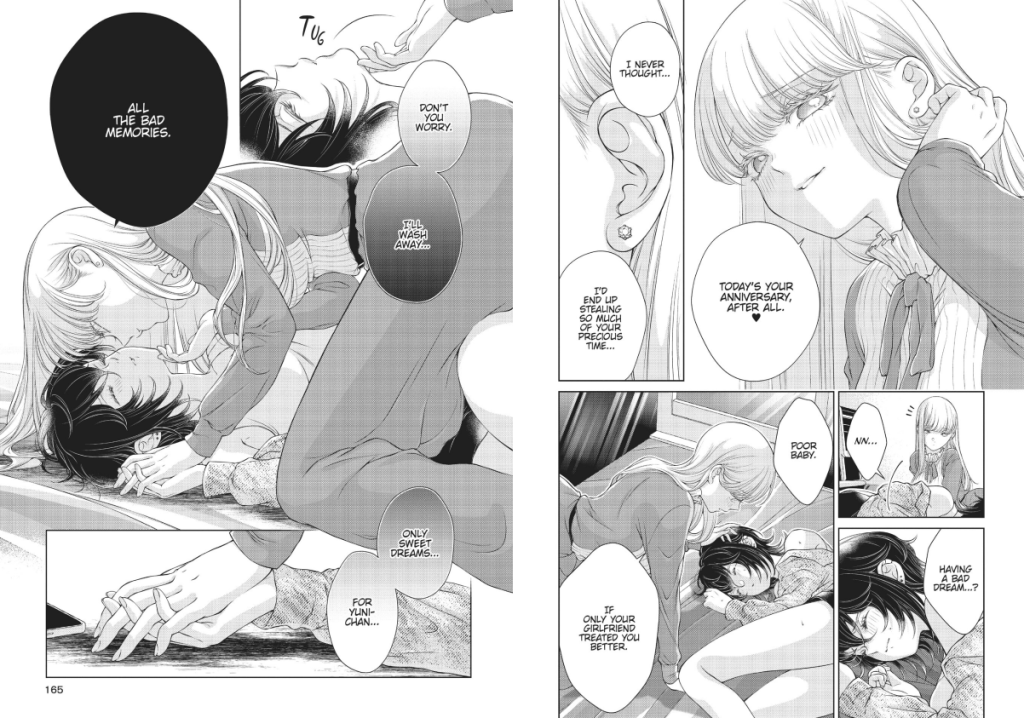
I haven't read any manga for a while, so after Amazon recommended a new-ish series called My Girlfriend's Not Here Today and showed off some excitingly racy cover art, I decided to jump into my second yuri manga series about cheating.

I like yuri stories, and I don't mind admitting that at least part of the reason is due to, shall we say, baser instincts. But I also just like the general tone and vibe that stories which focus entirely on girls have. As anyone who has explored various subdivisions of Japanese popular media will know, there are certain conventions in play when it comes to particular categories of story. They're not completely universal, of course — that would probably be boring after a while — but it's not unusual to find yuri/girls' love stories about interpersonal drama and cheating, while yaoi/boys' love, in my limited experience, often tends to delve into darker themes like abuse, emotional manipulation and even violence.

I must confess, at this point, that yaoi is a bit of a black spot in my overall knowledge, hence the generalisation above, but I'm not against the idea of exploring it; there are a lot of very well-regarded yaoi visual novels that I'm very curious to investigate at some point, for example.

Yuri, meanwhile, I have a bit more experience with. In the video game/visual novel space, I've particularly enjoyed the Nurse Love series, which consists of two tonally very different girls' love games, ostensibly about the careers of young and trainee nurses, but which go to some… interesting places in certain of their routes. I can also highly recommend the incredible SeaBed, which is just a beautiful masterpiece of writing generally that just happens to be yuri at its core.

In the manga space, meanwhile, I read through all of the delightfully sweet Our Teachers are Dating! and Netsuzou Trap (NTR for short, because why hide it?) a while back and enjoyed all of those (and doubtless a few others I've forgotten) a lot.

Anyway, My Girlfriend's Not Here Today has an intriguing premise. We have a pre-established girl-girl relationship between main protagonist Yuni and her volleyball enthusiast partner, Nanase. Yuni is frustrated with Nanase because Nanase seems to care more about volleyball than about her — and, on top of that, she refuses to show any signs of affection in public or acknowledge their relationship to anyone. Yuni, being a teenage girl in the 2020s, naturally takes to her "vent" account online to complain about her situation, and ends up getting noticed by the mysterious, quiet honour student Fuuko — who, it turns out, is quite the scheming, manipulative little succubus, and someone who has been watching Yuni's vent account for quite some time.

Frustrated with Nanase, Yuni hesitantly confides in Fuuko, who very quickly becomes attached to Yuni. Things come to a head in the first volume when the pair duck into a private room at an Internet café to discuss things and end up sharing a passionate kiss after Yuni believes Nanase had forgotten their six-month anniversary. Naturally, she immediately regrets this — particularly when Nanase phones her, better late than never — but also finds that she can't stop thinking about Fuuko. While she believes she loves Nanase, her growing frustration with the seemingly growing distance between her makes the contrast with the passionate, impulsive Fuuko all the more apparent — and it's clear Yuni finds that attractive, despite herself.

What I've found interesting about My Girlfriend's Not Here Today so far after reading two volumes is how definitively "2020s" it feels. Some manga feels like it deliberately places its setting in an idealised alternate reality where people still talk to one another face-to-face and smartphones were never invented — wouldn't that be fun? — but it's a core part of My Girlfriend's Not Here Today's identity to include thoroughly modern concepts such as a "vent account" and related matters, such as young people's tendency to overshare things online without necessarily considering the long-term consequences.

There's a great tense of tension between Yuni and Fuuko, who obviously have a lot of chemistry with one another. Fuuko in particular is presented as striking an excellent balance between terrifying yandere and someone who has quite legitimate reasons for feeling and acting the way she does, and Yuni's frustration at her inability to communicate effectively with her supposed partner is very much a story for the ages.

I particularly love the way the art is presented, especially in the early parts of the first volume. Fuuko is initially drawn in an almost ethereal, ghost-like style, which can perhaps be interpreted as Yuni gradually coming to "notice" her more, with her attention having been firmly devoted to Nanase up until this point. She's presented as a delicate beauty, yet her behaviour subverts the expectations one might initially have based on her appearance, and, although she is, at times, an overbearing, even aggressive instigator of the illicit relationship between her and Yuni, she also clearly has flaws and weaknesses that I suspect will continue to be exposed and explored as the story proceeds.

I'm not sure why I'm drawn to stories like this. Having been on the receiving end of cheating multiple times in my life, one would think that I would not care to seek out such things in my entertainment. But the fact is, situations that often get boiled down to "cheating" are often complex, volatile affairs — and that makes for thoroughly interesting, compelling stories about interpersonal relationships. For some reason that is something that many yuri authors in particular find themselves drawn to, and, honestly, I'm here for it.

I've enjoyed the first two volumes of My Girlfriend's Not Here Today a great deal so far. I look forward to reading the rest.


Want to read my thoughts on various video games, visual novels and other popular culture things? Stop by MoeGamer.net, my site for all things fun where I am generally a lot more cheerful. And if you fancy watching some vids on classic games, drop by my YouTube channel.

If you want this nonsense in your inbox every day, please feel free to subscribe via email. Your email address won't be used for anything else.

#oneaday Day 430: Poisonous fantasy

So I picked up Blade of the Poisoner last night, as offensive as the Kindle version's cover is to me, and started to read it. As predicted, it is pleasantly easy to read, and the fact that each chapter is less than five minutes "long" at the speed I read means that I suspect I'm probably going to power right through this in short order. As noted yesterday, though, that's no bad thing; sometimes it's nice just to read something that stimulates the imagination a bit without challenging the more "technical" parts of your brain too much.

I'm actually surprised how much of Blade of the Poisoner I'm remembering — and I don't necessarily mean the details of the story, I mean certain little turns of phrase that have, for one reason or another, stuck in my mind for many years, even without having touched this book for probably several decades at this point. There were a few in the first chapter alone: protagonist Jarral's hesitant question "Can we go and … look at the village?" after his village has been burned to the ground by the evil Prince Mephtik, and the description of the character Archer falling to the ground, "sudden blood staining her brown curls" after being lamped over the head with the butt of a crossbow. Neither of these are particularly remarkable pieces of writing, but they are, for some reason, apparently lodged in my long-term memory, and I'm sure they won't be the only ones.

Thinking about it, despite a longstanding interest in and appreciation for the genre, one thing I don't think I've ever really tried my hand at writing myself is straight-up fantasy. I've done sci-fi, I've done "real world with fantastical elements", I've done "gritty realism", but one thing I don't think I've ever done is create-your-own-world-with-its-own-rules fantasy. And, dipping into Blade of the Poisoner for the first time in a long while last night, I feel like that's something which might be fun. I'm still yet to do anything with my "Scratch Pad" creative writing site that I've set up, largely because I haven't really been struck with any sort of "inspiration" just yet. But I think this might be it: it might be time for me to have a go at fantasy, and see what happens.

Fantasy is interesting because it has a whole different set of considerations to other types of writing. By its very nature, you don't have to follow the "rules" of reality, but you are then faced with the challenge of ensuring your world is internally consistent. How does magic work, if it is present at all? What species call that world home, and how are you going to ensure none of them accidentally end up as thinly veiled racial stereotypes? What social structures are in place? How do you strike a balance between giving the baddies threatening-sounding names and ensuring they don't end up sounding like medical terminology? Is there any connection between that world and ours? Is that world an "alternate Earth", or is it a completely different planet, perhaps with its own rules?

Lots of things to consider, and establishing a setting in this way can, at times, be a really fun part of writing. It is also an easy part to get very bogged down in, so one has to find a good balance between making notes on things that are important to the story you want to tell and the setting in which you want to convey that story, and not getting carried away writing what effectively amounts to a Dungeons and Dragons sourcebook. Of course, there's also a certain amount of value in fleshing out your setting to a ridiculous degree, because that can lay the foundations for future stories you might want to tell in that setting, but one shouldn't lose sight of one's main goal. As with any type of creative project, particularly if one hasn't indulged in such things for a while, it pays to start small and see where things go from there.

So yes. I am thinking. Hard. I can't promise if and when anything will appear over on the Scratch Pad, but I'll be sure to link it here when something does. And in the meantime, perhaps just a chapter or two more of Blade of the Poisoner, you know, as inspiration


Want to read my thoughts on various video games, visual novels and other popular culture things? Stop by MoeGamer.net, my site for all things fun where I am generally a lot more cheerful. And if you fancy watching some vids on classic games, drop by my YouTube channel.

If you want this nonsense in your inbox every day, please feel free to subscribe via email. Your email address won't be used for anything else.
#oneaday Day 429: Past poisonous pleasures

After finishing Jane Eyre, I find myself pondering what I might want to read next. At the moment I am torn between wanting to keep my sufficiently "Victorian-calibrated" reading mind in practice by reading something else from the 19th century — I have several things in mind, including things that are both new and familiar to me — and wanting to read something simple, straightforward and, let's be honest, dumb.

There's a certain appeal to reading something that is well below your ability level. I'm obviously not talking about regressing to See Spot Run or suchlike, but returning to what tends to be lumped under the all-expansive "YA" (Young Adult) umbrella today offers a compelling prospect. Not only are titles from this particular part of the literary sphere easy to read, they also tend to be short, which, after ploughing through Jane Eyre (which had been formatted incorrectly on Kindle so it only displayed the amount of reading time remaining in the book rather than in your current chapter as it is supposed to) is definitely appealing.

One pair of books I'm actually quite interested to return to is Douglas Hill's Poisoner duology, which consists of Blade of the Poisoner and Master of Fiends. These were probably some of my earliest exposure to fantasy fiction, and I remember absolutely loving them as a kid. Well, more accurately, I loved Blade of the Poisoner; I never had my own copy of Master of Fiends, though I believe my friend Matthew had a copy that I borrowed on more than one occasion. I definitely read it at least once.

Blade of the Poisoner is fairly traditional, unremarkable fantasy with a touch of childish wish-fulfilment in there. The protagonist is a 12 year old boy called Jarral who, in fantasy novel tradition, grew up as a country bumpkin. Through certain misadventures, the details of which I forget, Jarral becomes marked by Prince Mephtik's magic blade; specifically, he gets a big letter "M" carved on his chest, and the nature of Mephtik's blade means that anyone given so much as a scratch with it will die on the next full moon, hence his colloquial name, "The Poisoner". You probably see where this is going.

Blade of the Poisoner does indeed go exactly where you expect it to, but that's what made it appeal to me as a kid. I enjoyed the simple, straightforward fantasy story of good versus evil, and even though I knew things were almost certainly going to be all right for the good guys by the end of proceedings, I still enjoyed reading it. Blade of the Poisoner, I recall, stood quite well by itself, but Master of Fiends was a solid sequel that raised the stakes somewhat.

I also remember being quite taken with the descriptions of the Lady Mandragorina as a kid; from what I recall, she was a pretty young woman around a similar age to Jarral (and me, when I was reading the book) and… well, there was definitely some teenage wish fulfilment going on there. These days, I suspect the formidable figure of Archer may have some appeal for me, from what I remember of her powerful thighs and suchlike.

Sorry, where was I? Oh, right. Yes. I think I might actually re-read Blade of the Poisoner (and possibly Master of Fiends also) if it's available on Kindle (it is!) and see how well it holds up to my old, jaded eyes. And then I'll jump back into some sort of Victoriana. Maybe.

Aside: The cover for the Kindle version sucks. Look at this low-effort photoshoot of a dude in an anorak in someone's back garden:

And compare, if you will, to the cover of the version I grew up with:

Yeah. C'mon. That's more like it.


Want to read my thoughts on various video games, visual novels and other popular culture things? Stop by MoeGamer.net, my site for all things fun where I am generally a lot more cheerful. And if you fancy watching some vids on classic games, drop by my YouTube channel.

If you want this nonsense in your inbox every day, please feel free to subscribe via email. Your email address won't be used for anything else.

#oneaday Day 427: Reader, I married him

I finished reading Jane Eyre last night. I can't quite remember exactly what prompted me to read it again — for it was the third time I've read it in my life, having read it once at school, once at university and a third time now — but I'm glad I did read it. I suspect it was most likely on my mind after playing, writing about and making a video about the rather fabulous adventure game, The Excavation of Hob's Barrow, which is very much steeped in the ideas of "the female Gothic" and particularly that style of literature's distinctive breed of heroine.

But I feel like it was also a bit of a challenge to myself; in recent years, all I've really read in book terms are modern English novels and serialised (translated) light novels that originated in Japan — not that there's anything wrong with either of those, but they're not exactly one might call a challenging read for the most part. And that's fine; sometimes you don't want to have to work to enjoy something.

Going back and reading literature from the past, though, is always interesting. I found with this most recent re-read of Jane Eyre that, as I expected, it took a while to get back into the swing of 19th century English. This is a particularly interesting time for the language when there is a lot that is perfectly recognisable and parsable to a modern audience — we had reached a point where most words were spelled as they are today, for example — but there are a lot of more subtle things, like structural elements, turns of phrase and the way sentences are constructed, which can be challenging to dive headlong into. Take a look at this, for example, which is technically all one sentence:

He was, in short, in his afterdinner mood; more expanded and genial, and also more self-indulgent than the frigid and rigid temper of the morning: still, he looked preciously grim, cushioning his massive head against the swelling back of his chair, and receiving the light of the fire on his granitehewn features, and in his great, dark eyes—for he had great, dark eyes, and very fine eyes, too; not without a certain change in their depths sometimes, which, if it was not softness, reminded you, at least, of that feeling.

(Jane Eyre, Chapter XIV)

I'm willing to bet that, unless you make a habit of reading 19th century literature on the regular, it probably took you a scan or two to read and fully parse that single sentence. There's nothing there that is particularly difficult in and of itself — there are no complex, archaic words to decipher, no random untranslated French phrases (which do occur elsewhere in the book) and not even any particularly complicated concepts to understand — but the sheer number of subordinate clauses, semicolons, colons, dashes and suchlike means that the sentence, as a whole, goes several "layers" deeper into nested punctuation marks than a 21st century copy editor would be altogether comfortable with.

And so it was for me when I started re-reading Jane Eyre. I remember having this struggle when first I beheld it for (I think) A-level English Literature, and being actually quite relieved when it came up early in my university studies, as it was still fairly fresh in my mind, meaning I wouldn't have to go through the whole "calibration" process again. But it had been long enough since those university studies and today that this time around, I did have to recalibrate my mind somewhat — and I wasn't sure I'd be able to do it at first.

But, to my surprise (and delight) it happened a lot quicker than I thought it would. The thing with pre-20th century literature (heck, anything from before the mid-20th century, even) is that you kind of have to bang your head against it repeatedly until it yields enough to let you in. And when it does — because it will, eventually, given sufficient perseverance — you will be rewarded. Because as complicated as that sentence quoted above is, it's also terribly evocative. If you're the sort of person who can derive mental pictures from the words you read — and I'm aware not everyone can do that — then you probably got a pretty strong one from the above description of Mr. Edward Fairfax Rochester.

The thing that makes Jane Eyre particularly enjoyable to me is its first-person narration. You're not just listening to a disinterested narrator explaining what has happened; you are, instead, listening to a participant of the story recount and reflect on the things that happened to them. I've always been rather drawn to first-person narratives — many of my own prior creative works are written in first-person — and I suspect that Jane Eyre was one of several influences on me in that regard. For me, a first-person narrative style really allows you to get to know the protagonist of the work; it's why I resonate so well with Japanese visual novels and light novels today, I think, which are also typically written from the first-person. It gives you the sense of separation that you are not the star of the story — this is a contrast between visual novels and traditional adventure games, for example, as the latter use second-person narration — but also allows you a particularly intimate relationship with the protagonist; one that even the protagonist's closest confidantes in the narrative itself don't enjoy, in many cases.

For example, consider the relationship between Jane and Rochester in Jane Eyre. Many of their interactions between one another take the form of verbal sparring, with Jane's sharp wit matched by Rochester's sarcasm; both spend a significant portion of the novel trying to get the full measure of the other, with each concealing their true feelings for reasons that are their own. If this were presented from a disinterested outsider's perspective, we might not get the same understanding of the situation, as to someone who doesn't know at least part of what is going on, their interactions might look like genuine snippiness with one another.

In the case of us, the audience, we only get to learn the absolute truth of Jane's take on the situation, which is that part of her wants to keep Rochester at arm's length because she senses a certain degree of danger from him (which, it turns out, is not entirely unjustified) but also because she detects he enjoys their repartee. We later, of course, learn from Rochester himself that he has been playing his own little game with Jane — with certain members of high society forming his playing pieces — but without Jane's suspicions about the situation or Rochester's eventual admission, it would have been very easy to misinterpret everything.

It's interesting to contemplate the book's viewpoints on certain matters, given how society has changed since the time it was written. Jane Eyre is often cited as one of the first great feminist works, for example, and it's not hard to see why. Jane herself is a powerful figure who is, for the most part, in control of her own destiny; she learns and grows stronger from hardships and adversity, and it's only at one point in the narrative — where she flees Thornfield Hall after learning of Rochester's mad wife in the attic, then accidentally leaves her meagre worldly possessions in a coach before getting stranded on the Moors in the middle of nowhere — that we ever see her display what one might call "weakness". Even during that time, however, she's shown to have a good head on her shoulders, and makes some wise decisions that ultimately pay off, despite the indignity of collapsing on a stranger's doorstep.

The book is surprisingly scathing about religion — a fact which caused some critics to baulk at it on its original release — but it makes a solid argument. The figure of St. John Rivers, a character from the latter part of the narrative, presents an interesting challenge for Jane; up until now, she has attempted to live her life in a good, Christian sort of way, but St. John shows that one can perhaps take things in that regard a little too far — particularly once he starts proposing a loveless marriage to Jane (who, we have learned by this point, is actually his cousin) on the grounds that she would "make a good missionary's wife". Jane is having none of that shit, of course, and tells him so; even so, the fact that she does start to wonder if she might be coming around to his way of thinking by one point presents a surprisingly potent exploration of how abusive relationships work, because this crack in her resolve is the result of St. John's unrelenting dickishness towards her after her initial rejection of him. St. John is a cunt and I'm glad he died alone in India. There, I said it.

Anyway, yeah. Jane Eyre was a good read. This is, of course, something of an understatement given what a classic work of literature it is considered to be — and how it ranks highly in various "greatest books of all time" polls — but I think it's easy to forget that pre-20th century literature can just be "enjoyable" as well as "great" and "important".

I certainly enjoyed re-reading Jane Eyre. Now I have to determine whether to continue riding this wave of enthusiasm for classic literature, given that my brain has been successfully recalibrated for 19th century prose, or if I should read something for a bit of light relief. I haven't quite decided yet, but I will definitely be making more time for reading.


Want to read my thoughts on various video games, visual novels and other popular culture things? Stop by MoeGamer.net, my site for all things fun where I am generally a lot more cheerful. And if you fancy watching some vids on classic games, drop by my YouTube channel.

If you want this nonsense in your inbox every day, please feel free to subscribe via email. Your email address won't be used for anything else.