One of the most irritating new developments in the world of generative AI is the use of "agents" to spam you. This can take numerous forms; earlier today, Luke Plunkett of Aftermath shared an AI "pitch" he had received via email, Frank Cifaldi of the Video Game History Foundation shared something similar, and of late I've seen a marked uptick in blog comments that are obviously (but, of course, undisclosed) AI-generated spam.
The reason I can tell they are AI-generated spam is because they don't come from a person. Inevitably, they come from a "company", with the email address and website you can optionally include when leaving a comment linking to some sketchy website or other that wants you to download their new AI-powered tool to, I don't know, delete all the shit on your hard drive or some such shit.
The reason why these are infinitely more frustrating than good old-fashioned spam (and man, at this point I really miss the surreal narrative spam from 2009) is because, using the magic of AI, they might initially appear to be a genuine comment. In other words, the "agent" (spit) has taken a blog post as input, been tasked with composing a comment that might initially appear to be engaging directly with the subject matter, but which is actually just stating what you wrote back to you with slightly different wording, then attached a sketchy link and email address to it. The hope, presumably, is twofold: firstly, that the blog's owner will fall for the spam by clicking on the link or sending a message to the email address; and secondly, that the blog's owner will publish the comment, making the link public and thereby, potentially, tricking others into inadvertently clicking on it.
This is fucking scummy behaviour! Moreover, this is not convincing me that "agents" are in any way a net good for humanity! Not to the absurd degree that I think they're going to "destroy humanity" or any of that utter nonsense, but slowly but surely, generative AI in general is making the Internet harder and harder to use effectively — and, moreover, it's destroying our trust in one another.
Earlier today on Bluesky, I saw someone share a post from an "Atari news" account that looked interesting. Supposedly there's a project out there that is attempting (and starting to succeed) to get Sierra's Adventure Game Interpreter (AGI, but not that one) games working on Atari 8-bit. They've supposedly already got King's Quest up and running, and the parallel C64 project is, it seems, a little further along.
However, I was immediately inclined to distrust everything about this news, firstly because of the amount of vibecoded bullshit that is out there at the moment — and apologies to the creators of the project in question if it has all been done by hand; you might want to put that very fucking prominently on your website — and secondly, because the Atari news Bluesky account that shared it in the first place is absolutely fucking infested with garbage AI-generated artwork, leading me to believe that the account is automated. An automated news-aggregating account isn't necessarily a bad thing in its own right, but when combined with the amount of AI imagery that account shares, every single one of my bullshit sensors starts going off.
Want another example? Time Extension, the retro gaming website, has recently been dealing with AI-powered plagiarism and harassment from an account calling itself "Generation Amiga", ostensibly a news site about… well, the Amiga. And yet if you ever accidentally have the misfortune to end up on Generation Amiga's website, you will discover that not one of the articles there (very few of which are actually Amiga-related) is written by a person. Their "exclusive reviews" consist of LLM-generated slop derived from marketing material. And they even had the gall to accuse Time Extension of being "Big Media" harassing a poor, innocent little independent creator who was just using an ickle-wickle bit of planet-destroying AI to construct a vibecoded website that has a net negative value to humanity — all because Time Extension's editor, Damien McFerran, quite rightly called this absolute bullshit out, for the benefit of anyone in retro gaming who had never had the misfortune of stumbling across these fucknuts.
You know, contrary to how it might appear, I don't like ranting and raving and complaining about this all the time! (All right, maybe a little bit.) I would much rather live in a world where it wasn't happening at all! But when I'm in a situation where I can no longer trust that comments on my fucking personal blog are written by actual people, I think I am more than justified in losing my patience. When I am in a situation where my first response to a potentially cool piece of retro gaming-related news is not "wow, that's cool!" but instead "is this AI bullshit…?" I think I am very fucking justified in losing my patience.
I'm so, so tired of this all. None of this is making the Internet better. None of this is making the world better. All it's doing is, at best, sowing division and mistrust, and at worst, completely obliterating what was once the world's most valuable repository of information, knowledge and human creativity. That's the "AIpocalypse" we should be concerned about.
Want to read my thoughts on various video games, visual novels and other popular culture things? Stop by MoeGamer.net, my site for all things fun where I am generally a lot more cheerful. And if you fancy watching some vids on classic games, drop by my YouTube channel.
If you want this nonsense in your inbox every day, please feel free to subscribe via email. Your email address won't be used for anything else.
It feels like pretty much every day for the last few months we've seen a story that claims some game or other has been translated for the first time ever, or ported to PC for the first time ever… and I feel like a good nine times out of every ten of these projects that show up, the project ends up being vibecoded slop.
I'm afraid I don't give any credence to the theory that AI development tools "democratise" development of stuff like this. The biggest problem — besides the fact that AI models are all built on stolen data, of course… and the environmental impacts — is, without a doubt, the fact that people using them end up shitting out something that they have absolutely no understanding of. Thus, when a problem arises — and you can bet a problem will arise with something shat out by AI — they have no idea how to fix it.
"Well, just hand it over to someone who knows what they're doing!" you might say. And to that I say, any developer worth their salt will not accept such a project. No-one wants to debug the spaghetti code shat out by a plagiarism robot. Not only will that be a lot of work, much of which wouldn't have needed to happen if the project had been done properly in the first place, but the person fixing the job will end up with their reputation tarnished purely by virtue of having worked on an AI project.
Unfair? Perhaps. But at this point, people have to know that using generative AI is going to attract backlash. People fucking hate it! People would rather not have a thing than have a thing that was pumped out using generative AI tools! And any short-lived kudos you might attain for being the "first" person to do something (except you didn't actually do the thing yourself) will, in short order, absolutely torpedo your reputation. At this point, with all the high-profile cases there have been of backlash against projects that involve generative AI, you would have to be either wilfully ignorant or just outright sticking your fingers in your ears to be unaware of the resistance to all this.
And the thing that sucks is that, for me and numerous others like me, the torrent of vibecoded slop projects has completely destroyed any interest or excitement we might have had for things that should be interesting and exciting. The decomp/recomp scene should be fascinating, and the non-vibecoded examples of these games put out amazing results that can potentially breathe new life into all manner of different games. But I've seen so many announcements that conclude with "…and this was made with Claude" that I'm afraid I just don't give a shit any more. I just do not care. I do not have the time, energy or inclination to sort through everything just to find the few things that have been made with genuine human knowledge and craft. And so I just can't be arsed to keep up with any of this sort of project any more, be they fan translations or decomp/recomp efforts. It's enough of a pain having to resist generative AI bullshit in full-price commercial titles already.
I know pushback against generative AI is repetitive and tedious and annoying, but, frankly, the signs are very much apparent that we haven't been pushing back hard enough. We need to get to a point where even thinking about using generative AI for something like this makes these dorks flush their own heads down the toilet. I'm sick of it. And, if you're reading this, you probably are too.
Still, with any luck the bubble will burst soon, and all of this garbage will go the way of NFTs. I cannot wait. Cannot wait.
Advance notice to any AI boosters already composing an indignant comment: I think I have made my stance on this abundantly clear at this point. If you come in here with any of the usual garbage about "just a tool" and "what about the motor car" or "Amazon Web Services" or "Luddites", you will be banished to the pit of I Never Have To Hear From You Ever Again. You have been warned. Go cry to your precious Claude about it. And it will not care, because it can't. You are going to die alone. And you deserve it.
Want to read my thoughts on various video games, visual novels and other popular culture things? Stop by MoeGamer.net, my site for all things fun where I am generally a lot more cheerful. And if you fancy watching some vids on classic games, drop by my YouTube channel.
If you want this nonsense in your inbox every day, please feel free to subscribe via email. Your email address won't be used for anything else.
Well, as predicted that was a massive waste of time. Six hour round trip for a one-hour meeting that was of very little value whatsoever. Never mind, it's done with now, and I can start getting back to normality.
After my mini PC unceremoniously died on me on the first day of our holiday, I was waiting to get home in the hope that hooking it back up to its usual setup would sort things out. It did not, sadly, so I ended up ordering another one. Andie and I suspect that some loose screws inside had just shorted something out — likely on the video circuit — and thus it was just bad luck, really. I had heard something rattling around inside the case for ages and had never gotten around to checking it because it hadn't been a problem; I guess it finally was a problem. Whoops. Oh well.
I was hoping that setting up the new one would be a simple case of whipping out the SSD from the old one and putting it in the new one, but nothing involving computers is ever that simple. Doing this booted to Windows seemingly correctly, but with the computer completely refusing to acknowledge the existence of Wi-Fi and Bluetooth hardware. After several attempts to fix the problem, I just resigned myself to putting the "new" SSD back in and doing a completely fresh start, then transferring my stuff over from the old SSD as required. It's a minor inconvenience, but easy enough to sort out. After the lengthy process that is setting up a fresh install of Windows 11 (and then "debloating" it) I copied my stuff over, installed the important applications and now the thing is — hopefully, anyway — ready to go for work tomorrow.
Computers are really fucking annoying these days. During the setup process for the new machine, I had to go through multiple two-factor authentication steps, several of which completely refused to work using the most convenient methods. The system continually bugs me for a "passkey", which I cannot be arsed with because I fail to see how it is more secure than the existing security measures. (This is not an invitation to "educate" me.) Then I had to download Office, tell it not to register itself automatically using my Hotmail account and instead use my work account… then sign in to my multiple work accounts, each of which asked me for two-factor authentication multiple times for no apparent reason, and finally we were up and running again.
While I acknowledge that some of the above is due to the cloud-based world we live in these days, and all this nonsense allows us to be able to recover our Stuff much more easily when something happens like the situation I've been dealing with… man, it really makes me miss the days of the Atari 8-bit and ST, when you just turn the thing on and load the software you need from a disk. I'm sure attempting to function normally with a setup like that would present its own pain points today, but with the increasingly inhospitable environment of the modern Internet and the far-ranging splattering of sewage that generative AI has covered everything with, I find myself longing for a somewhat simpler implementation of technology.
Unfortunately, with the work I do — and to a lesser extent, with the life I lead — going back to a life where I could run everything from a computer with one megabyte of RAM and no hard drive is an impossibility.
Technology today is more advanced. But is it really better?
Want to read my thoughts on various video games, visual novels and other popular culture things? Stop by MoeGamer.net, my site for all things fun where I am generally a lot more cheerful. And if you fancy watching some vids on classic games, drop by my YouTube channel.
If you want this nonsense in your inbox every day, please feel free to subscribe via email. Your email address won't be used for anything else.
Okay. I mentioned it yesterday, so I may as well talk about it today, since apparently I'm on an "old TV" kick at the minute. Pages from Ceefax, right? It's something that I sometimes find hard to believe was actually broadcast on television, but the evidence is out there.
For the unfamiliar, Ceefax is the name for the teletext service that was available on the terrestrial BBC TV channels, BBC1 and BBC2. Over time the distinction between the two channels' service developed in such a way that you looked on BBC1 if you wanted to find something out quickly (they eventually managed to make the "page seek" on BBC1 work faster) while on BBC2 you'd get more in-depth material. This was in keeping with the channels' main remit; BBC1 had all the mainstream, primetime programming on it, while BBC2 had more niche-interest, specialist or cult favourite shows. And lots of Star Trek repeats, like, all the time.
I realise there may be a few of you reading this who don't even know what teletext was, since it's not been A Thing for most of the world for a while now, but basically it was an information service you could access through your television using your remote control. You'd press a button to switch from live TV to teletext mode, and the programme would continue in the background as just audio while you entered a world of coloured text and, occasionally, extremely low-resolution pixel art. Some TVs provided the ability to "mix" the teletext and TV programme, so anything that was blank, black space normally would allow the programme to show through. It wasn't a terribly practical means of either watching a TV programme or accessing teletext, but it was nice that the option was there.
Anyway, the interesting thing about the various forms of teletext, including Ceefax, was that you could type in a number on your TV remote and it would take you to that page, allowing you to browse through information in a non-linear manner many years ahead of domestic Internet access becoming commonplace. Okay, there were limitations, probably chief among which was how most "pages" on teletext services were actually made up of multiple sub-pages, and you had to wait for them to cycle around rather than be able to browse them completely freely. For a practical example, if you were looking at what's on TV this evening and when the page came up it was only showing things late at night, you'd have to wait for it to cycle back around to showing what is on currently and up next, rather than just being able to immediately call up that information.
But! You might ponder at this point: what about people who do not have a television that can access teletext services, or which they have lost the remote control for? Well, never fear, for Pages from Ceefax is here! This is a chunk of time that the BBC carved out each day specifically for showing a selection of… well, pages from Ceefax, accompanied by some delightful elevator music. You'd normally get things like the news headlines, the weather, maybe the sport. Things that normal people might be interested in. It didn't tend to delve into more "magazine-esque" features or special-interest areas; if the legendary Digitiser had been on Ceefax rather than Oracle or Teletext with a capital T (which were the teletext services that were on the terrestrial TV channels ITV and Channel 4) it probably wouldn't have come up in Pages from Ceefax.
And, I mean… that's a bit weird, right? You would think that the BBC would want to fill up its timeslots with actual programming, rather than a clunky text-based interface that was designed to be interactive, but which was not, in fact, interactive at all when it was broadcast as part of the linear TV signal. But, like the "Follows Shortly" slides we saw yesterday, I guess Pages from Ceefax provided the opportunity for things to happen behind the scenes. Perhaps it's during Pages from Ceefax that continuity announcers swapped over, or had a break, or something like that.
It definitely broadcast when there was no other programming planned, such as before the first programme of the day or late at night, but I have definite memories of it coming up in the middle of the day, too. Like the "Follows Shortly" slides, I found Pages from Ceefax frustrating and boring as a child, but now I am oddly nostalgic for it.
Thankfully, as with literally everything you might be nostalgic for, you can recreate the Pages from Ceefax experience for yourself right now in various ways. Firstly, there's this delightful website, which presents today's headlines in the style of an authentic Pages from Ceefax broadcast, complete with optional music.
Then there's a whole channel devoted to the full playlists that were used for the various Pages from Ceefax broadcasts, an example of which you can enjoy right here:
Anyway. Yeah. That's that. Pages from Ceefax. Stupid. Pointless. Annoying. A waste of time that could have been used for more interesting programming. And yet I miss it. How strange.
Want to read my thoughts on various video games, visual novels and other popular culture things? Stop by MoeGamer.net, my site for all things fun where I am generally a lot more cheerful. And if you fancy watching some vids on classic games, drop by my YouTube channel.
If you want this nonsense in your inbox every day, please feel free to subscribe via email. Your email address won't be used for anything else.
I dread to think how much money I have spent on headphones over the years. I never buy particularly pricy ones — I think the most expensive ones I've bought were some nice noise-cancelling Sony ones a while back, which I use when recording videos — but I do get through 'em. I'm annoyed that probably my favourite headphones of all time — a pair of Sennheiser on-ear headphones that cost me about £35 — went missing and I have no idea where, but no matter; I have replaced them a bajillion times over since.
My most recent acquisition in this department is a set of "bone-conducting" headphones. I have been curious to try this technology for a while, and as it was a nice day without being "can't breathe" levels of hot today, I thought I would go for a walk and try them out.
For the unfamiliar, bone-conducting headphones are exactly what they sound like. Rather than sticking them in or on your ear, they sit just in front of your ear on the bony bit that is there. They then transmit the sound through that bone and into the complicated stuff that is inside your ear. This means they bypass your eardrum, which has a number of benefits — most notably allowing those with hearing issues to hear things much better than through things you put in or on your ear — but for me their main appeal element is the fact that… well, they don't sit in or on your ear.
I don't like earbuds because I've never found a pair that are comfortable or that will stay in — and with how bloody tiny wireless ones are these days, I'd be terrified of losing them if I'd paid any sort of premium for them. I do like over-ear headphones, but they do make my head hot, so they're not especially practical for wearing out and about, particularly in the summer. And you just don't really seem to see on-ear headphones much these days. At least, I haven't. Maybe I just haven't really been looking.
These bone-conducting headphones I got were a cheapo pair from Amazon, because I wasn't about to pay through the nose for these if they were any sort of unknown quantity. They're wireless, have USB-C charging and Bluetooth, which is all I really needed. There are fancier (and much more expensive) pairs you can get that have on-board music storage, heavier waterproofing that lets you use them while swimming, and all manner of other features, but I figured just for now, just to begin with, something basic and affordable would be plenty.
And they are! I wore them out for a walk around the Common earlier today, and they definitely do the job. Music is audible and clear, and the fact they're not stuffed in your ears means that if you keep the volume down a bit you can still hear everything going on around you; if you turn the volume up, meanwhile, you can get almost as much immersion in the sound as with a regular pair of earphones.
Sound quality is okay. If you had a Walkman back in the day and had a pair of those over-ear headphones with the foam ear covers, the sound quality seemed roughly equivalent to a pair like that — nothing super-remarkable, a little lacking in the bass end, but perfectly adequate for most things, particularly if "listening to music" is not the primary activity on your agenda and you just want some background noise.
I'm surprised how effectively the bone-conducting method works. I was expecting it to feel weird or be somehow "unusual", but when the music's on, it just sounds like it's being piped into your ears like with a regular pair of headphones. The only real notable difference I noticed is beyond a certain volume level, you can feel the vibrations a little bit, giving a slight tickly sensation around the temples. I found a decent balance between sound quality, not being tickled and being able to hear important noises around me to be a few steps down from max volume, whereas on a lot of other headphones I tend to find myself whacking them up to max and leaving it there.
While I'm not going to go and recommend these things as a replacement for proper audiophile gear — I suspect even the more expensive models will be somewhat limited in their sound quality by the very nature of the tech — they're absolutely a great solution for having some music on while you're out and about, and they're discreet enough that you can just leave them on all the time even while you're not actively using them.
I'm definitely going to be using these a lot more, as I'm definitely (haha) going to be getting out and having a nice walk on a more semi-regular basis than I have been. Weather-permitting, of course; I suspect with how most days have been of late, I will be having a lot of evening walks rather than going in the daytime!
Want to read my thoughts on various video games, visual novels and other popular culture things? Stop by MoeGamer.net, my site for all things fun where I am generally a lot more cheerful. And if you fancy watching some vids on classic games, drop by my YouTube channel.
If you want this nonsense in your inbox every day, please feel free to subscribe via email. Your email address won't be used for anything else.
I read a good piece earlier that got me thinking: why do I continue to tap out words here, day after day, in an age where those odious "Generate with AI" buttons are ubiquitous, whether you want them or not? (Even here in my own self-hosted version of WordPress, I cannot escape the "Improve with AI" button that I have never, ever clicked, even out of curiosity.)
It's a fair question. Over the course of the last eighteen years, I have written 3.35 million words on this site across 4,642 posts. (Okay, technically a chunk of those were originally posted on my now-defunct blog on Patreon, but since that effectively took the place of this site while it was active, I am counting them.) I could stop at any point. In fact, I have stopped on multiple occasions. And yet something keeps bringing me back. And, moreover, every time I come back, the absolute last thing on my mind is to get the lying, lake-boiling plagiarism robot to "write" something for me.
Because why would you do that? If you want to write, just fucking write. Generative AI isn't "democratising" the creative process, as some people argue, because the creative process was democratised the moment everyone could afford writing implements and things to write on. Moreover, if you get the stupid dumbass robot to regurgitate some vapid garbage on your behalf, you have not written that. You do not deserve any credit whatsoever, even for "engineering" the prompt. You are a lazy, feckless idiot who does not want to do something creative; you want to fill the world with more content that no-one actually wants. To quote a memorable Reddit post I saw once in response to someone like this: "best of luck on something literally no-one, including you, will read."
"Oh, but it helps for resear-" Shut up. Shut up. It demonstrably gets things wrong a statistically significant proportion of the time, thereby making it completely worthless for research by its very definition.
"Oh, but it helps for brainsto-" Shut up. Shut up. What you are talking about is the creative process. Brainstorming is part of it all! The creative process doesn't start the moment you start typing, writing, recording or using your tools. It starts the moment a little light goes on in your mind and you have a vague idea that you want to make something. It starts the moment you get a flash of a character you want to construct. It starts the moment you get the hint of a melody. It starts the moment you read something else that inspires you to want to write something on the same subject — as I am doing right now.
I do not want generative AI. I did not ask for generative AI. I have no use for generative AI. And I think people who rely on generative AI to conjure some shit up out of a vague prompt rather than writing things themselves are, as previously noted, lazy, feckless idiots who have no interest in genuine creativity. They do not care about the quality of their eventual output; all they care about is that they have produced content. Consistency of content is key! Churn it out like a good little drone! Doesn't matter if it's good or not, so long as it gets engagement!
(Aside: I will begrudgingly admit that generative AI does have some potential use cases, but only as part of a human-led workflow and only if it is not being used as a means of attempting to replace the skills and knowledge of a real person. Even then, I can't help but feel there are other, less damaging ways to achieve the same thing — often with better results. And, indeed, many things that are now labelled as "AI-powered" are, in fact, not generative AI-based — they are just using "AI" as a supposedly fashionable buzzword, apparently blissfully unaware of the growing distaste for anything labelled "AI", when what they actually mean is "computer-controlled" or "based on machine learning". The auto-accompaniment mode on the Yamaha keyboard I used as a child would probably be labelled "AI" today when it is nothing of the sort.)
I often find myself thinking about all this, considering that I write something on this site every day as the result of a self-imposed but only loosely enforced challenge — and part of that challenge is to just write something, regardless of if it ends up being any good. At no point do I feel like I am creating content, because I am not doing this for anyone other than myself, and I am certainly not doing it for "engagement". I am doing it because I enjoy it; because I find it a helpful means of expressing myself; and because, occasionally, it allows me to form a connection with another person, when something I have written resonates with them, for one reason or another.
This website has over 3.5 million words on it, but not a single one of them has come from a machine. Not a single one of them has been written out of a desire to create content. Every one of them has come out of my brain because I wanted to write them, because there was something I wanted to express, because there was something I wanted to remember or because there was something I wanted to process. This may seem like a stupid, pointless website to the casual observer, but to me, it is immeasurably valuable.
If I had sullied even the tiniest bit of it with generative AI, it would no longer be mine. And yes, I'm aware that by the very virtue of it being On The Internet, it has probably already been ingested into one or more of the AI models out there. But I'm not taking it down or giving up on this valuable means of self-expression, because fuck you, Clammy Sam Altman and Wario Amodei, that's why.
Want to read my thoughts on various video games, visual novels and other popular culture things? Stop by MoeGamer.net, my site for all things fun where I am generally a lot more cheerful. And if you fancy watching some vids on classic games, drop by my YouTube channel.
If you want this nonsense in your inbox every day, please feel free to subscribe via email. Your email address won't be used for anything else.
One of the most common refrains of people who discuss the topic of enshittification is that so much stuff related to tech just flat-out doesn't work any more, and no-one seems in any great hurry to fix it — particularly when all the actually knowledgeable engineers have been replaced with "vibe-coding" cunts.
Here is a list of tech-related things that, through no fault of my own, have occurred in the last week:
My Windows 11 PC inexplicably took twenty minutes to start up. There does not appear to be anything actually wrong with it. It has had every scan, virus check, hardware tweak imaginable run, and has had Windows completely reinstalled multiple times. Once Windows starts, it is mostly fine, with the following exception:
When browsing the Internet, occasionally both Firefox and Chrome will just… stop doing anything, to such a degree that they prevent the rest of Windows from doing anything. Checking logs indicates that nothing is particularly happening on the CPU, memory, storage or network front whenever this happens, it just… happens. Firefox does it marginally less than Chrome did, thus I have switched to Firefox.
When using my computer to browse Nextdoor, which is a site that eventually paid off during our search for Oliver, scrolling down more than about a screen and a half will cause the entire website to completely shit the bed, moving its sidebar to the middle of the screen before snapping you back to the top of the feed you were attempting to scroll through.
When using my phone to browse Nextdoor, a post where someone said the bin men had just been and not taken their bin remained at the top of my feed for the entire three weeks that Oliver was missing.
My keyboard just told me it had "low battery" despite being plugged in. I unplugged it and replugged it in and now it claims to have 98% battery.
My keyboard doesn't charge while plugged in if I don't have the Razer software running.
My mouse can have its wireless signal blocked by a packet of crisps.
My PC game controller sometimes requires turning on three times before it's actually turned on.
The Bluetooth on my work PC refuses to turn on despite showing as being present and working.
When listening to YouTube videos while falling asleep, at least 8 times out of 10, the app will randomly close itself for no apparent reason in the middle of a video.
It's frustrating that, when you're someone who takes good care of their tech — as I always have been — stuff just… fucks up after a while for no apparent reason. My woes with Windows on my living room PC are a longstanding issue that I am at my absolute wits' end with; I am getting perilously close to installing Bazzite and being done with Windows, particularly now I no longer need to work on this machine. Oddly enough, I have had zero Windows-related issues with my work mini PC, other than the Bluetooth problem, which may well be hardware-related.
I just miss the time when you bought something that was expensive and fancy, that it worked, and it continued to work for many years after you spent lots of money on it. Still, I knew that age was long past all those years ago when I updated my iPhone 3G to the latest iOS and it became completely unusable. I still went and upgraded to an iPhone 4 like a big mug, though, didn't I? Twat.
Want to read my thoughts on various video games, visual novels and other popular culture things? Stop by MoeGamer.net, my site for all things fun where I am generally a lot more cheerful. And if you fancy watching some vids on classic games, drop by my YouTube channel.
If you want this nonsense in your inbox every day, please feel free to subscribe via email. Your email address won't be used for anything else.
There is increasing talk of the video games industry staring down an honest-to-goodness crash — and this time around, unlike the notorious Great Global Video Game Crash of North America from 1983, it looks very much like it could be one that will happen across the world. All this said, I feel like, at this point, there is enough disparity between the bit that will be affected by it and the bit that will be able to continue on regardless for the latter to be able to survive comfortably.
This will, in its own curious way, reflect what happened in 1983, where a significant portion of the game-playing world — the UK and Europe, notably — were blissfully unaware of the problems the broader games business were suffering, because they were enjoying the fruits of a thriving cottage games industry. Here in the UK, we had no idea a "crash" was happening across the pond because we were all cheerfully buying £1.99 Mastertronic tapes from our local corner shop.
Something's gotta give, though, because the relentless torrent of shit that is coming out from shareholder-beholden companies — particularly with regard to the odiousness that is generative AI — is completely unsustainable. And we've reached a point where all but the most ardent bootlickers are feeling more and more emboldened to criticise what's going on — though sadly this also coincides with a period where thousands of people are being laid off and games aren't actually getting any better.
Take this statement attributed to Sony, posted on Bluesky earlier today:
This is a complete nothing of a statement! It says nothing! It gives precisely no examples of how AI "improves productivity", "drives efficiency, personalisation and customer value at scale" and "unleashes the creativity of Sony Interactive Entertainment's studios"! It is five paragraphs that explain nothing and say nothing, but which exist purely to, supposedly, placate shareholders who, apparently, have absolutely no functioning brain cells between them and desire nothing more than every stupid fucking company to follow every stupid fucking trend in existence, even when they are demonstrably, actively harmful and just plain shit!
I am mildly heartened that a number of developers are starting to speak up a bit more about this. There's a good piece on Aftermath on the subject, and another on gamesindustry.biz. There are still the annoying sycophants in every single comments section who all parrot the exact same lines about "the genie being out of the bottle" and "get used to AI or get left behind", but there is, I feel, increasing resistance to that side of things. A lot of smaller-scale developers are also making a good name for themselves by saying, out loud, and prominently, that they do not use generative AI at any point in their development process. Good!
The utterly dumbshit thing about corpos like Sony sucking Sam Altman and Wario Amodei's robophalluses is that there is not a single documented instance of a project involving generative AI being well-received by either press or public. I'm not even convinced that it's actually what shareholders want to see. The otherwise excellent Clair Obscur: Expedition 33 was soured for a lot of folks (including me) when it was found that they had used generative AI for "placeholder" (sure) assets, and likewise for the apparently also very good The Alters. New projects coming out that are revealed to be using generative AI are subject to mass shunnings and censure from press and public alike — and rightly so. It is starting to feel less and less desirable to have any involvement whatsoever in the top end of today's games industry — a once-exciting, vibrant place — and more and more understandable when people choose to focus their time and attention on both small, independent projects and retro titles.
On top of that, the very generative AI that all these shareholder-appeasing corpos are rushing to use for no real specified purpose is becoming increasingly responsible for pricing people out of games and tech! No good having "volume and diversity of content" (ugh) if no-one can fucking afford the devices to play it on, is there?
All this can easily be avoided! We have been making games for a very long time without the use of a glorified Autocorrect trained on stolen data! I find it near-impossible to believe that every game developer has suddenly completely forgotten how to do things the way we've been doing them for many years at this point, just because you can tell "Claude" to churn you out some spaghetti code using conversational English. And yet. And yet.
I don't know exactly what a "crash" is going to look like in this instance, but I feel like it's not going to be pretty — and the potential knock-on effects concern me somewhat. Like, if games consoles go away — and with the current tech pricing situation, that's a real risk — what does that then mean for people who like to collect games, and for the long-term archival of games using physical media? There are so many potentially terrible things that could happen that I don't feel like the world of video games has adequately prepared for, and it's really quite worrying.
Still, if the worst comes to the worst, I have shelves full of games, many of which are complete-on-disc or complete-on-cart, and a fully-loaded MiSTer. I could, at this point, duck out of "modern gaming" at any time — and with each passing month, it feels more and more like I might end up doing that.
To pre-empt the inevitable comments from weirdly aggressive generative AI-boosting corpo bootlickers: fuck off; you are not welcome here, if the above doesn't make that abundantly clear already, and your comments will just be deleted, so you may as well just not bother. Hope that helps!
Want to read my thoughts on various video games, visual novels and other popular culture things? Stop by MoeGamer.net, my site for all things fun where I am generally a lot more cheerful. And if you fancy watching some vids on classic games, drop by my YouTube channel.
If you want this nonsense in your inbox every day, please feel free to subscribe via email. Your email address won't be used for anything else.
Hello. I am Pete, and I love the Atari 8-bit range of computers. You probably knew that already, but I wanted to talk about it a bit today.
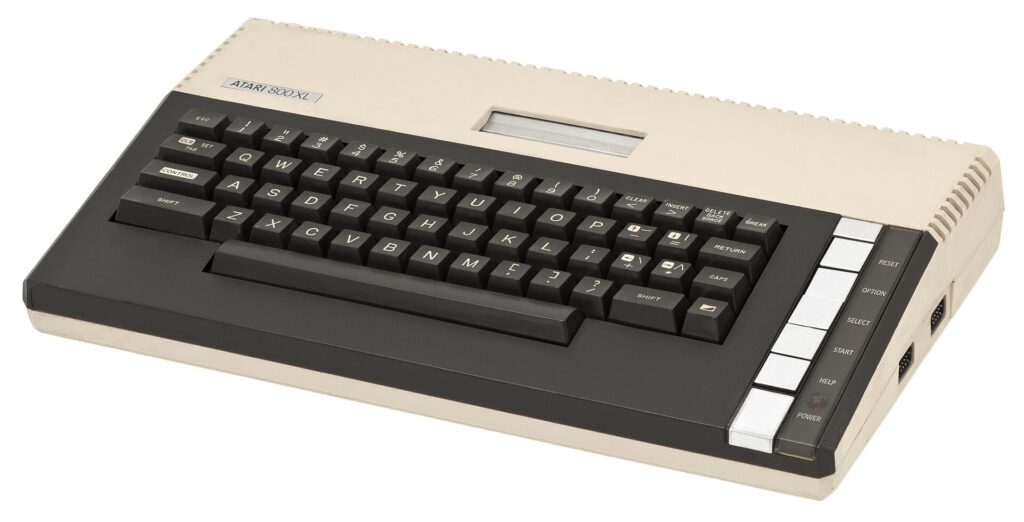
By Evan-Amos – Own work, CC BY-SA 3.0, https://commons.wikimedia.org/w/index.php?curid=18553927
I think I'm probably going to make a video along these lines sometime soon — although my prior video on the announcement of The400 Mini a while back covers a lot of the points I'd want to cover — but it's on my mind today, so that's what we're talking about today.
One of the reasons I want to talk about Atari 8-bit computers is because I don't feel they get nearly enough respect. No, they were by no means as popular as the Commodore 64 and Spectrum — the former of which is the subject of a cover feature in Retro Gamer magazine this month — but I also feel like they had a significantly stronger foothold in the market than other "failed" micros from the era. Not only that, but they are historically very significant for a number of reasons, some of which I'll try and outline today.
This is going to be a bit of a stream-of-consciousness sort of probably autistic infodump, because I'm just banging this out as I feel like it. If and when I do decide to make a video about all this, there will probably be a bit more structure, research, that sort of thing. Like I say, this was just rattling around in my head today, though, so I wanted to at least get some thoughts down on paper. So here it is.
For the unfamiliar, the Atari 8-bit range consists of several models:
The Atari 400, which released in 1978, and initially features 8 kilobytes of RAM, though later revisions bumped this up a bit. This was marketed in some areas as a games machine, as it was the cheaper of the two models to release in 1978, had four joystick ports and sported a flat, supposedly spill-proof membrane keyboard to make it suitable for "family" use.
The Atari 800, which released alongside the 400 in 1978, and was positioned as a more "serious" machine. It had a "normal" keyboard, user-upgradable RAM (up to a maximum of 48 kilobytes) and two cartridge slots instead of one (though there were very few releases that took advantage of this) — and it cost considerably more.
The Atari 1200XL was the first step in a refresh of the Atari 8-bit line in 1983, intended to replace the 800. It came with 64 kilobytes of RAM, a completely redesigned case, built-in self-test features and a rather nice keyboard. It was also much too expensive and had a number of issues, causing Atari to pull it from sale before long, and to not release it in PAL territories at all.
The Atari 800XL (pictured above) was a do-over of the 1200XL project. It also had 64 kilobytes of RAM, the newly designed case (now not quite so deep), built-in self-test features and lovely keyboard, but also added built-in BASIC to the mix along with revisions to the operating system. It was Atari's best-selling 8-bit home computer.
The Atari 600XL was a cost-reduced version of the 800XL, which had an even slimmer case and only 16 kilobytes of RAM. With the 800XL replacing the 800, this was effectively the replacement for the 400, but it did not sell very well compared to its big brother.
The Atari 130XE was launched in 1985, after Jack Tramiel took over Atari, and was designed to look like a "little brother" to the 16-bit Atari ST. It featured 128 kilobytes of RAM, new revisions of the operating system and BASIC and a new case design, but otherwise didn't bring anything significantly new to the table. It is a nice machine, though, and my Atari 8-bit of choice.
The Atari 65XE was essentially identical to the 130XE, only with 64 kilobytes of RAM instead of 128.
The Atari XEGS was a 65XE in a console-style case with a detachable keyboard. It was positioned primarily as a games console, even more explicitly than the 400 back in 1978, but was a fully functional computer that would work with all Atari 8-bit peripherals.
Broadly speaking, these models are all cross-compatible with one another, aside from obvious exceptions such as programs that need a particular amount of RAM to run properly. There are a few compatibility issues between very early pieces of software that were designed for the 400 and 800 and the later XL/XE models, but these can usually be got around by using a "translator" program to temporarily load in an older version of the operating system, and the Atari community at large has also been hard at work patching many games to work universally on all Atari 8-bit systems.
Like most other 8-bit computers, the Atari 8-bit had three means of loading software: ROM cartridge, cassette tape or 5.25" floppy disk. ROM cartridges are incredibly simple: plug them in, turn on the machine and the software is there, ready to go. These were primarily used for games, particularly in the early days of the platform, but there are some pieces of utility or productivity software that run from cartridge, too. Notably, using a cartridge effectively allows the ROM within to "extend" the Atari's capabilities; a good example of this is the SpartaDOS X package, which adds an MS-DOS style command line for manipulating files on floppy disks.
Cassette tapes were certainly used by Atari enthusiasts, but not to the same extent as on the Commodore 64 and ZX Spectrum. The reason for this is that the tape loading system in the Atari 8-bit was significantly slower than on its main rivals, resulting in load times of half an hour or more for games that would take just a few minutes on other platforms. That said, the Atari 8-bit could make innovative use of the tape medium by playing back audio during a program — a good example of this is the Conversational Language series of packages, which teach French, German, Italian and Spanish through interactive lessons, with recorded speech coming straight off the tape and being played back through the TV speakers at the appropriate moments.
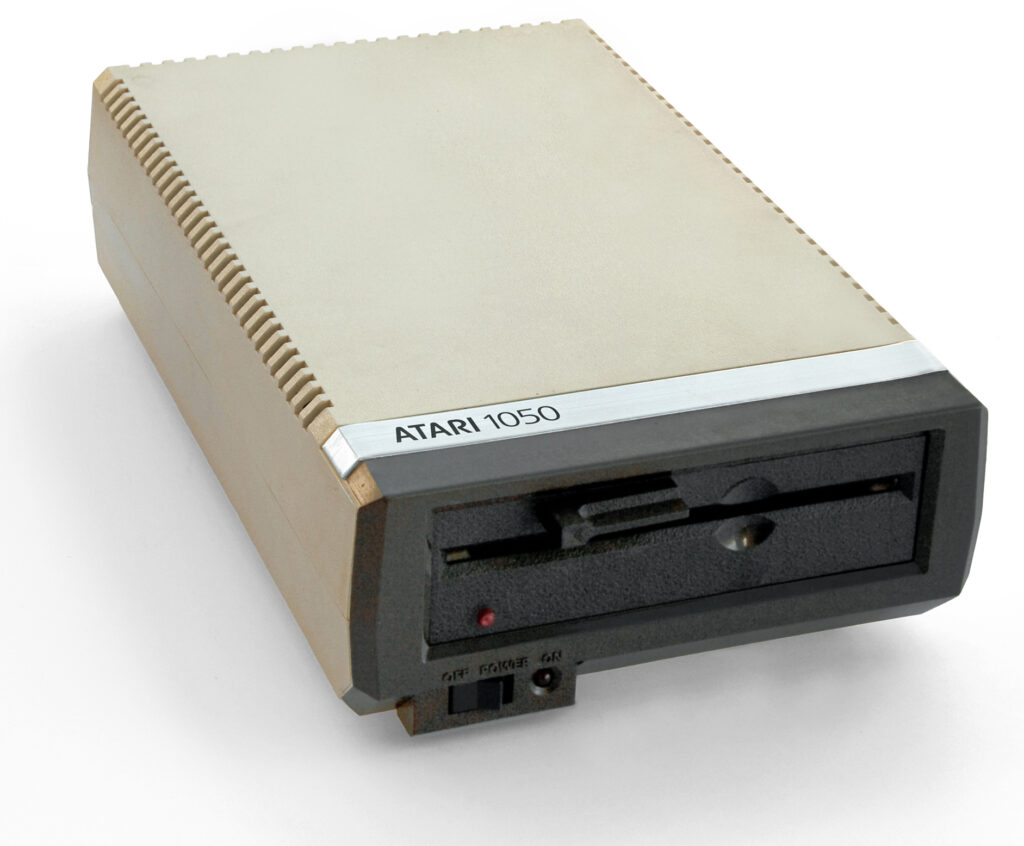
By Bilby – CC BY 3.0, https://commons.wikimedia.org/w/index.php?curid=48108881
Instead, disk drive use was very popular. There were two main disk drives in the prime of the Atari 8-bit's lifespan: the original Atari 810, which followed the design language of the 400 and 800, and the Atari 1050, which was designed to fit in alongside a 600XL or 800XL setup. There was an even later XF551 drive, but this didn't really catch on for various reasons, and these drives are a lot harder to find today.
You connected a tape deck or disk drive to the Atari via its proprietary Serial Input/Output (SIO) port, and this brings us to one of the most historically significant things about the range: SIO was designed as a universal connector for all manner of different peripherals, not just media storage devices. Sound familiar? That's right; it's very much a precursor to modern USB; Joe Decuir, who created this architecture, holds patents on USB.
SIO had a few differences to modern USB, most notably the fact that devices could be daisy-chained together. This means that even though the system only had one SIO port, you could connect multiple devices simply by linking them together. Obviously this was dependent on the device in question having a suitable port — and not every device did — but in theory you could keep on linking as required, making it easy to have, for example, setups that used multiple disk drives, and even cassette and disk simultaneously if you so desired.
Using a disk drive with the Atari 8-bits required one extra step: the use of a Disk Operating System, or DOS. Atari made its own DOS that underwent several revisions over the lifespan of the Atari 8-bit models, and although closed source and distributed under a proprietary license agreement, it could be redistributed. Good job, too, because in order to actually boot something from disk, DOS needed to be loaded first. If you wanted to be able to save BASIC programs to disk, you also needed to boot DOS from disk before starting to write your program.
The most commonly seen versions of Atari's DOS from back in the day used a menu-driven interface that allowed various disk functions such as copying and deleting files as well as locking/protecting them, loading executable files that were not set up to automatically boot when turning the computer on, formatting disks and creating new DOS disks.
Programming on the Atari used, like most of its contemporaries, a dialect of BASIC. Unlike many other BASICs at the time, it is not a version of the popular Microsoft BASIC (although this was available) and thus had a number of its own unique Atari-specific commands. Carrying out many functions, particularly relating to graphics, that would require POKEs on other platforms could be done with dedicated commands on the Atari, but conversely Atari BASIC lacked the ability to create arrays in string variables. It was, on the whole, a well-liked language, and the two main Atari magazines of the era, Page 6 and Atari User (which later merged to become New Atari User), typically printed type-in listings for all manner of programs in every issue. Not just games, either; both magazines were keen to position the Atari computers as capable, multi-function devices that were far more than just sources of entertainment.
Other programming languages were, of course, available. Those keen to get their hands dirty could write programs using 6502 assembler, while as the years went by, speedy languages such as Action! and Turbo BASIC XL came along and offered compelling alternatives to the built-in or cartridge-based BASIC that was, for many, the foundation of programming on the Atari range. These languages could be compiled into executable binaries, too, meaning that an end user would not need a copy of the language to run a program written in it.
The Atari's audio-visual capabilities were very solid. The dual ANTIC and GTIA graphics chips offered hardware scrolling, built-in "player-missile" sprites, and a wealth of different graphics modes allowing various balances between memory usage, resolution and colour depth. The POKEY chip offered four-channel audio with a good amount of customisation — although not quite as flexible as the SID chip found in the Commodore 64. It also handled a lot of the Atari 8-bit's input/output, meaning the system has the charming feature of making blippity bloop sounds when loading and saving from/to disk or tape rather than the horrific screeching heard on other platforms.
And then we come to the games. While some of the high-profile software houses — notably outfits like Ocean, Imagine, Ultimate and suchlike — refused to support the Atari 8-bit, others, like Electronic Arts and Activision, did, at least in the early days, and the budget companies like Mastertronic, Atlantis, Zeppelin and Alternative had a good presence on the platform, too. The end result of this from a 2026 perspective is that the Atari 8-bit library is largely unique, with many titles not being found on any other platforms — and in the case of multiplatform affairs, the Atari release often being a particularly good version. (There are exceptions, of course; the Atari 8-bit versions of Action Biker and The Last V8 are woeful compared to the C64 releases.)
There's also the fact that a lot of games which went on to worldwide success on a variety of platforms often originated on Atari 8-bit. All-time classics like Boulder Dash, M.U.L.E., Miner 2049'er and Spelunker debuted on Atari before spreading to other platforms, and esteemed creators like Archer Maclean were really able to make the system sing with games like Dropzone.
The only thing the library is lacking compared to its more successful 8-bit counterparts is a library of solid arcade conversions from the years following the initial early '80s "golden age"; those early '80s titles are well-covered, however, with excellent versions of Pac-Man, Dig Dug, Pole Position, Qix and plenty more — and a wealth of "unofficial" clones, too.
So why doesn't this system get anywhere near the love and attention that the Commodore 64 and ZX Spectrum do? I honestly don't really know, because although the platform undoubtedly sold considerably less than both of its main rivals, I don't think one can in any respect call it a "failure". Its longest-lasting magazine published its final issue in 1998, for heaven's sake — and said magazine was including material for the Atari 8-bit right up until that very final issue. Not only that, the modern "homebrew" scene is incredibly active and vibrant to this day, with some truly amazing new games being released for the platform on a regular basis, along with some excellent ports of C64 and Spectrum games that never made it to Atari back in the day.
I would love to see the Atari 8-bit get more acknowledgement. There are some YouTubers who do give it its dues — Kim Justice is a good example — but I do wish the field of "gaming history" would, more broadly, pay attention to the Atari 8-bit: a platform that still has a lot to offer, which is a hell of a lot of fun to have been involved with since its original inception, and which is dead easy to explore today with solutions like Altirra for software emulation, and the excellent Atari800 core for MiSTer if you're an FPGA person.
Still, that's a big reason my YouTube channel exists. So I will continue to champion the system how I can — and at least then I know that I have done my part in remembering this wonderful platform and the many amazing journeys it has taken me on over the years.
Want to read my thoughts on various video games, visual novels and other popular culture things? Stop by MoeGamer.net, my site for all things fun where I am generally a lot more cheerful. And if you fancy watching some vids on classic games, drop by my YouTube channel.
If you want this nonsense in your inbox every day, please feel free to subscribe via email. Your email address won't be used for anything else.
I have, today, finally ditched Google Chrome. At least that's the plan. I am typing this from Firefox. I actually haven't had nearly as many issues with Chrome as some people seem to have had — at least not on my work computer upstairs — but just recently I've been having some awful performance issues on my downstairs living room PC, and it certainly very much seems like Chrome is to blame.
Photo by Alan W on Pexels.com. This fox is thinking about installing Linux.
I could be wrong, of course. It could just be Windows 11 being shit (although in that regard, my work PC also runs Windows 11 and seems fine performance-wise, despite being a meagre mini-PC) and it could also just be my PC being shit (the living room PC, much as I love it, has had a litany of problems over the years that has necessitated multiple reformats and reinstalls) — but for now, I'm taking Chrome out of the equation down here.
I've been putting off doing this, because changing Web browsers feels like a massive pain in the arse. You have your previous one all set up the way you like it with extensions, saved passwords and everything already logged in, and then you switch over and have to set everything up again, log into everything again and it's… man, it just feels like work, y'know, and all I want to do is look something up online.
That said, despite the mental block I've historically felt towards doing this, the process of switching over to Firefox has been mostly painless so far. The export-import procedure seems to have gone fairly smoothly (though it did import duplicates of all my bookmarks which it has apparently previously imported from Chrome) and thus far Firefox has neither crashed nor frozen my entire system for minutes at a time, which is more than I can say for the current state of Chrome.
I even managed to export my passwords from Google Password Manager to Firefox's autofill feature, so logging in to most websites hopefully won't be a huge pain in the arse, aside from those that insist on two-factor authentication and I have, inevitably, left my phone in a location that I am not in.
Firefox isn't perfect, I know, but I do have a modicum of respect for it for allowing you to set a blanket "fuck off with all this AI shit" switch. It unfortunately doesn't prevent Google from serving you up stupid AI Overviews or stop the Internet in general from obsessing over this loathsome technology, but I like being able to ensure the software I am running locally on my computer — at least while it's still possible to do that — is working the way I want it to and not, say, downloading 4GB local LLMs in the background.
Talking about one's Web browser is the height of tedium, I know, but it's been very hot today, I'm very tired and stressed out, and I just wanted to write something before my chicken wings arrive. This was the first thing that came to mind, so that's what you get. Hey, I never promised that every day's posts would be interesting, all right?
Want to read my thoughts on various video games, visual novels and other popular culture things? Stop by MoeGamer.net, my site for all things fun where I am generally a lot more cheerful. And if you fancy watching some vids on classic games, drop by my YouTube channel.
If you want this nonsense in your inbox every day, please feel free to subscribe via email. Your email address won't be used for anything else.