The Late Review

If you've read my About page on MoeGamer, you'll know that one of the core philosophies behind my site is the idea of "the Late Review". Today I wanted to talk a little about that, and why I think it's important.

Timely reviews have a place, of course — it's helpful for consumers to at least have an idea of whether or not a new release is going to appeal to them, whether it actually works as intended and whether there are any controversial issues such as lootboxes involved. But there's a significant downside to these "on release" reviews, too, primarily due to the highly competitive nature of commercial sites (and plenty of non-commercial ones too, for that matter) and their desire to be the first outlet with something up about [latest new game]: quick coverage is not always accurate, in-depth coverage, particularly when it comes to large games such as RPGs.

There are also instances where it's simply not possible to judge a game accurately immediately on launch, either. Take the recent release of the new Dragon Ball fighting game, for example; I'm not going to pretend to know anything about that game, since I am terrible at fighting games, but even I know that putting a review of a fighting game up before you've had a chance to adequately judge the online community is not a good way of doing things… particularly when the high-profile beta test for the game brought up some significant network issues for some players.

There's another benefit to coming to something late, too, and that is the ability to divorce the individual game from its original context, and resist comparing it to other things that are around at the same time. While sometimes this can be helpful and interesting, often it simply encourages a rather reductionist approach to criticism in which heavy emphasis is based on the comparison aspect rather than simply judging the individual game under the microscope on its own merits.

I've been aware of this for a while, but it became particularly apparent to me when I covered the Ridge Racer series a few months back. I never played Ridge Racer 6 and 7 back on their original release because, at the time, I recalled them getting relatively mediocre reviews, primarily due to the fact that there were considered to be other, "better" games around at the same time as them. Ridge Racer 6 in particular took a beating from its contemporary Project Gotham Racing 3 despite the two games being very different styles of racer; coming to the former many years later, on the other hand, allowed me to completely disregard the latter and judge Ridge Racer 6 entirely on its own merits. And what do you know? It's a superb arcade racer that I really wish I'd played back when it was "current"!

This matter is also interesting when it comes to games with controversial elements. Next month, as I noted in last week's roundup post, I'm intending to take a look at Inti Creates' recent output, and as part of that I decided I'd give the notorious Mighty No. 9 a go. (I know this isn't entirely Inti Creates' work, but they were still involved, so it's relevant.)

I was unsurprised to discover that Mighty No. 9 actually isn't a bad game at all. Sure, it has a number of flaws and areas where it could be better — its performance problems in certain areas being the most glaring issue — but it turns out the game itself is playable, charming and enjoyable; these aspects just got overshadowed by the absolute dog's dinner that was made of the Kickstarter, its marketing, its community and pretty much everything surrounding it that wasn't the actual game itself. Again, it's nice to be able to divorce the game from all that and just judge it on its own merits. But more on that next month.

Anyway, while it's sometimes nice to write about something "current", for the most part I find that the most effective analysis and criticism can be done once the initial media frenzy and hype storm has died down. And that's why I'll continue to run MoeGamer in such a way that affords me plenty of time to explore a game in its entirety before I ever put "pen to paper" about it.
Video: Tell Me What You Want!

I've got some time off from the day job later this week, so I'm going to take the opportunity to do a bit more experimenting with video now I have my voice back after grappling with winter colds.

I'm interested to hear what you, the people who are directly supporting the site, would like to see more of, and as such I've set up a short survey asking for your opinions. If you have two minutes to share your ideas with me, that would be absolutely marvelous!

You can find the survey at https://goo.gl/forms/GJlu1KEFEGlUICCn1 — please don't share the link publicly for now as I'd like to give you folks priority in terms of input on this 🙂

"We're Not Trying to Take Your Games Away"

If you'd told me a few months ago that the hot new meme of 2018 would be hordes of deformed 3D Knuckles models wandering around in virtual reality quoting a low-budget Ugandan action movie at anyone and everyone who would listen, I would have probably laughed at you and said "what the fuck?" But this, it seems, is the world we live in. And I kind of love it.

Unfortunately, that ever-reliable source of finger-wagging, public-shaming "games journalism" (and I use that term loosely) Polygon has elected to write a finger-wagging, public-shaming news piece on the new phenomenon, even going so far as to call it their favourite word "problematic" and actually put some pressure on the makers of VRChat to ban the meme. It's "racist", you see.

This is just the latest in a long line of incidents where people who don't bother to do a bit of basic research into something that is going on feel like they should make sweeping moral judgements about things. Japanese games, of course, are particularly prone to getting this sort of negative attention about them, with the latest example being Xenoblade Chronicles 2.

I posted about this recently on Twitter, but it bears exploring in a little more detail. Having spent most of the weekend playing the game, I came to the unsurprising conclusion that everyone who had been complaining about how "problematic" Pyra's outfit and figure were had not even bothered to consider her as an actual "person"; all they had done was judge her by her appearance.

Pyra is, for those who have not played the game, an absolutely lovely person. She's kind and caring, has some nice chemistry with protagonist Rex, and is badass when she needs to be, yet also has an endearing fragility about her that makes you want to protect her — not because she's a woman, but because she's just someone without whom the world would be a darker, less happy place. She is much more than a pair of boobs.

This is, of course, not the first time this has happened; I've previously commented on some absolutely vile reviews of the Senran Kagura and Valkyrie Drive games in which supposedly professional reviewers admit to playing less than a couple of hours of the games and write them off as mindless fanservice, completely failing to take into account any of the actual characterisation and narrative arcs throughout the games. I'm yet to play Valkyrie Drive — I'd like to cover it in detail later this year, actually — but I can speak from extensive experience with Senran Kagura that there is not a single character in that enormous cast who is not a fascinating individual in one regard or another.

This sort of thing is why I find myself getting frustrated, and why I feel sites like MoeGamer are important. While professional, commercial sites are calling for things to be banned because they don't understand them, as in the case of Polygon and VRChat, and large communities such as ResetEra are libelling legally available titles like Criminal Girls as being "child pornography" without having any actual experience of what the game really is, we have a problem. A serious problem.

It's easy to get angry and frustrated at this situation, and indeed I know I have done in the past. It's less than productive to lash out wildly, though, since this just causes people to be further entrenched in their positions. Instead, what I intend to put a greater focus on going forward is ensuring that MoeGamer provides ample resources for people to be able to argue against ill-informed opinions based on nothing but hearsay and superficial glances.

There are already more than 350 articles on MoeGamer, covering over 150 games. I hope at least some of them help you find out a bit more about games that habitually get misrepresented by the supposedly "professional" side of the press, and perhaps even win an argument or two. 🙂

Thanks, as ever, for your support.

Revisiting Gal*Gun: Double Peace

Good morning, dear Patrons! A happy new year to you. I hope you all had a restful holiday season and, where applicable, aren't finding the return to work or school too traumatic. I am having a lot of trouble getting up in the morning at the moment, but aside from that all is well. With me, anyway; my wife has proper full-on 'flu but I have thankfully escaped that so far.

I'm going to try and make a bit more of an effort to make these Patron-Only updates a bit more regular in 2018, and one of the things I thought might be quite fun to do would be to look back on and revisit some of the games I've previously covered, particularly those that I find myself naturally wanting to return to.

Generally speaking, I'm someone who plays a single game to absolute death and then sets it aside, possibly permanently. I'll generally do my best to get all endings (and perhaps a Platinum trophy) on that original playthrough, but after that I'll set it aside and probably won't return to it for quite some time, if at all. I still keep all my games, however, since I will never rule out the possibility of wanting to replay or revisit something in the far future; I still enjoy revisiting old Atari, SNES, Mega Drive, PS1 and PS2 games, after all, so there's nothing to say I won't feel the same about PS4 and Vita games in 20 years time.

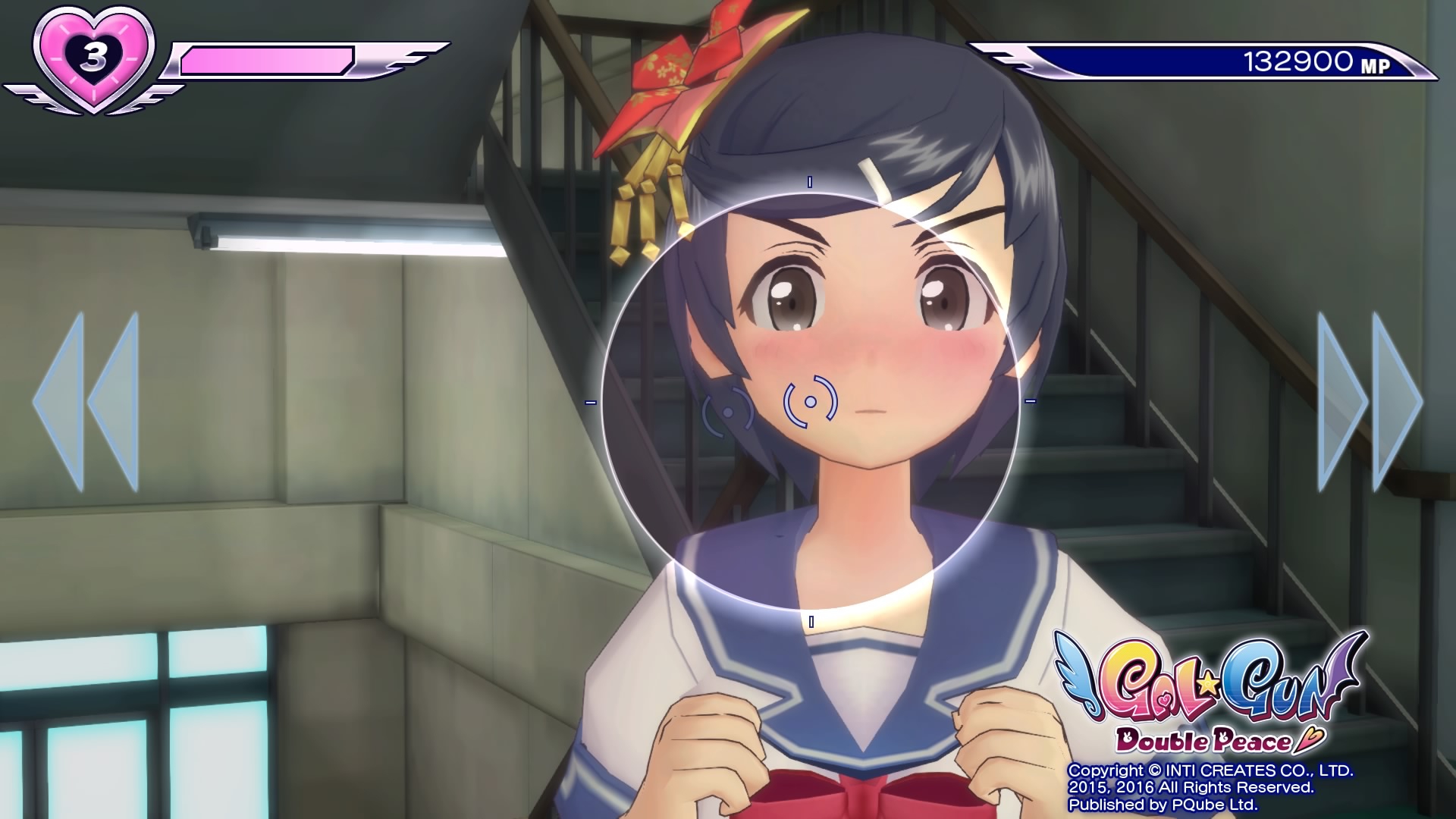
There are exceptions to this not particularly hard and fast rule, however; games that I refer to as "evergreen" games, that I always like to return to every so often, either because they're structured in such a way as to encourage replays or simply because I want to experience them again. Inti Creates' excellent Gal*Gun Double Peace, which I originally covered back in 2016, falls into the former of these two categories.

For the uninitiated, Gal*Gun is a curious hybrid of on-rails shooter and dating sim in which you guide protagonist Houdai through a day in which he has accidentally become afflicted with an angelic popularity aura that is 32x more powerful than it was supposed to be. As his clumsy guardian angel Ekoro — the source of said accident — helpfully informs him, the effect of such a high dosage of angelic power means that unless he finds his true love by the time the aura wears off, he will end up forever alone.

Thus begins an adventure in which Houdai has the opportunity to pursue several different girls, including one or both of his two childhood friends Shinobu and Maya (who just happen to be demon hunters), a demon named Kurona who was indirectly responsible for Ekoro messing up her shot in the first place, Ekoro herself, or indeed any of the other girls at Houdai's school, where he appears to be the only male person, student or teacher.

There are many reasons I enjoy Gal*Gun, but probably the chief reason is the fact that it's a game that has far more depth and replayability to it than its rather silly premise might suggest. There's a substantial metagame that involves collecting profile information on all the characters you see throughout the game, for example, and on top of that just getting the "true" endings for each of the main heroines is a challenge in itself, since doing so requires that you not only score enough points in the shooting sequences, but that you also make appropriate choices when you get a number of different dialogue options.

One of the things I like most about it is that there are no "generic" enemies. Every girl who "attacks" Houdai has a name, personality, voice, weak spot, unique appearance and, uh, set of measurements. The more you play the game, the more you'll come to recognise each girl by her appearance and name and know how to quickly deal with her. This helps you feel like you're getting to know the cast, even those members who don't play an active role in the main story.

And that story, as silly as it is, is endearing and compelling, too. Those who enjoyed the anime Gabriel Dropout will get a particular kick out of it, since the idea of inherently infallible and incompetent apprentice angels and demons is very similar to what we saw in that series. Shinobu and Maya are well-defined characters with some depth to their depictions, too, and there's even a surprising amount of non-verbal characterisation through things like their body language, the situations in which they find themselves and their responses to the various dialogue options.

Most of all, though, it's simply a really fun, well-designed game that I adore playing any time I boot it up. There are lots of different paths through it, lots of different ways to play — besides the main story routes, there's a "True Love" route in which you have to manipulate Houdai's stats to be appealing to the members of the extended cast you want to pursue, as well as a Score Attack mode — and a ton of longevity through the collectible profiles and numerous secrets to discover.

It's definitely a game that I will keep coming back to time and time again… and with a sequel on the horizon, well, you can count on more Gal*Gun on MoeGamer in the near future!