My year and a bit reviewing social and mobile games was enough to make me never, ever want to play one of them ever again, but I feel it is worth educating people on the things that these games are doing — seriously unpleasant things.
I'll preface this with the caveat that not all social and mobile games do these things. But a huge majority of them do. And you should be aware of it, if you're not already.
First thing to do is read this.
If you read that, I probably don't actually need to say any more. But I will anyway.
"Coercive monetization." Sounds horrible, doesn't it? Well, it is; it's the practice of convincing players that they "need" to spend money, and that it's their "choice" to spend money. It's underhanded trickery, in other words, and it's massively commonplace in the free-to-play sector — but particularly in the realms of mobile and social games.
That post's author Ramin Shokrizade describes the use of coercive monetization techniques in relation to "fun pain" — a term coined by Roger Dickey from Zynga to describe games that actively put obstacles in the way of the player's fun. These could be any of a wide variety of things — an energy system telling them they can't play any more; a timer saying they can't use this building/hero/object until it's been readied/built; an object which is just slightly too expensive, and which is all but necessary to progress. All of these things are used in order to get the player making that all-important first payment — to "convert" them from a freeloading bastard (albeit one with some common sense) into a person blindly willing to continue paying into an obviously manipulative business model while under the illusion of having "fun".
Shokrizade cites one of my least favourite games ever in his piece — King's Candy Crush Saga. This game is immensely popular, yet is 1) a Bejeweled ripoff and 2) one of the most manipulative, exploitative, outright unpleasant games I have ever encountered.
It begins innocently enough. You're given levels that are pretty straightforward to complete, and you'll make good progress through them. Gradually, they'll get more difficult, but not noticeably so — not until you reach an artificial barrier on the game map that requires you to either spam your friends with requests or pay real money to progress. Since to many people, spamming one's friends with Facebook requests is becoming something of a taboo, many choose to pay the $1 fee to progress — but in doing so they break that seal and "convert" themselves into a paying player.
King knows this, and thus makes the levels after this barrier noticeably more difficult. But it doesn't do this in a fair way; as with Bejeweled (and particularly its free-to-play social counterpart Bejeweled Blitz) Candy Crush Saga is primarily based on luck rather than skill — you can't plan ahead because you don't know what's going to fall from the top of the screen, so more often than not running out of moves is unavoidable. What Candy Crush Saga does as it progresses is weight the behind-the-scenes random number generators significantly against the player so it will be very difficult for them to progress without paying up for boosts, or extra lives, or permanent upgrades, many of which are extremely expensive.
You may feel that there's no harm in this, and indeed some people make it a badge of personal pride to play through something like Candy Crush Saga without paying a penny. But in the process, they're having a frustrating, boring experience. Why would you deliberately do that to yourself, when you can pay, say, $1 for the iOS version of Bejeweled and have literally infinitely more fun than with Candy Crush Saga?
These manipulative business models are not harmless, nor are they worthy of praise, regardless of how many millions of dollars they're bringing in every day. They're making money from conning gullible idiots — and while some of you may argue that people with no common sense need to be woken up a bit, it's not really fair to take advantage of people in this manner, particularly when many of them are children.
I find the whole practice utterly reprehensible, and I can't help hoping that the whole bubble on free-to-play social and mobile games bursts very soon. Unfortunately, with the amount of money many of the more popular titles are making every day — and the sheer number of the bastard things that are released each day — I don't see that happening any time soon, making mobile gaming in particular all but a lost cause for me these days.
Do yourself a favour: if you're currently playing something like Candy Crush Saga or its ilk, stop. You're being manipulated. Find a low-cost game with the same mechanics, pay for it, then play it as much as you want. This is the way it's always been in the past, and I long to go back to a time where that is the only model.
"Coercive monetization" is gross. It is borderline unethical. So don't support it.
 Been playing a bit more Hyperdimension Neptunia Victory this evening. While the newest game is, as I mentioned a few days ago, more of an evolution from mk2 than the revolution that mk2 was over the original, I'm starting to notice some more pronounced differences — differences that make it abundantly clear Idea Factory and Compile Heart are both receptive to feedback and keen to iterate on their past work in order to make things better in subsequent installments.
 I really, really like Final Fantasy XIV.
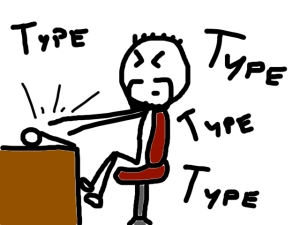 I've always been pretty good at touch-typing, so I thought it would be an interesting experiment to see how well I could type a blog post with my eyes shut. This is the result. I apologise in advance if it is completely indecipherable.
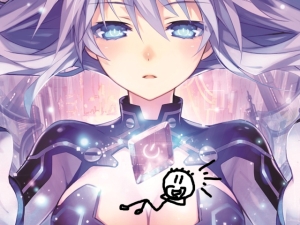 As I mentioned yesterday, alongside Atelier Rorona, I'm also finally getting around to playing the third Hyperdimension Neptunia game, Hyperdimension Neptunia Victory.
 Now Ar Tonelico is over and done with, I've been able to start up some other games without guilt. Specifically, I made a start on Hyperdimension Neptunia Victory today, which I'll talk about in more detail in a day or two, as well as Atelier Rorona: The Alchemist of Arland.