#oneaday Day 611: The sad loss of the Olympic video game

I've always been extremely fond of Olympics-themed video games, ever since I played titles like Epyx's Summer Games and Activision's Decathlon on the Atari 8-bit. I haven't always kept up with all of the Olympic releases over the years, but I have added a few to my collection in more recent years. And I'm a bit sad, as the Winter Olympics are unfolding at the time of writing, that the official Olympic video game is no more. At least, on consoles and PC; I believe for the last Olympics, there was some horrible mobile game that looked like absolute microtransaction-riddled garbage. So that's the end of that, I guess.

I'm not sure exactly what it is I like so much about these multi-disciplinary sports games. They are, in essence, just a collection of minigames, and some don't get more adventurous than asking you to tap a button or waggle a joystick very fast. But I have always enjoyed them a lot — at least in part because they tend to simulate sports that you don't otherwise get much of an opportunity to engage with in the video game space.

One of my favourite Olympics video games was Sega's official Tokyo 2020 game — released just before the COVID-19 pandemic hit and the "real" Tokyo Olympics were postponed. This was a huge amount of arcade-style fun, made all the better by the fact that you could create custom characters. Yes, multiple; while you spent most of the game playing as your one "main" athlete, you could also create a team of other athletes who would show up in events that required multiple participants, such a rugby sevens, soccer, judo and suchlike.

What made this even more fun is that Sega decided to err on the side of "silly" to a certain extent, so these characters were somewhat cartoonish in their proportions, and you could unlock and dress them up in all sorts of thoroughly silly outfits as well as vaguely plausible athletic gear. If you wanted someone to enter the swimming competitions dressed like a spaceman, you absolutely could do that.

These games were always great fun with friends, too. While it's been a very long time since I had the opportunity to play one of these games with other people, I have very fond memories of enjoying them together when I was younger.

One of my favourite memories in this regard was the first time I went up to the Edinburgh Festival with the university theatre group. On my first night there, I felt like I might have made a bit of a mistake coming along, because my social anxiety was making it enormously difficult to involve myself with the other members socialising. I actually ended up sitting up late, in tears, over the whole situation.

Yes, I know I said this was a "favourite" memory; I'm getting to that.

Two of the theatre group members found me in the corridor being thoroughly sorry for myself and took pity on me. They sat with me, helped reassure me that people did like me and appreciated my presence, and then they played some International Track and Field on PlayStation with me. I chose to play as Germany, and attempted to enter my name as "HELMUT" because I thought that was funny, but there were only enough letters to put "HELMU". My nickname within Theatre Group remained "Helmu" for several years, until it was replaced with "Beast Man". That's probably a story for another day.

Anyway, I will always be extremely grateful to those two lovely people from Theatre Group — known colloquially to everyone as Stiffy and Des — for taking the time to bring me under their wings. That night, I actually stayed in their room instead of the one I'd been assigned, and it was enormously comforting. It was definitely a turning point, and means that International Track and Field, as relatively a minor part as it had played in proceedings, will always be rather special to me.

That got well off the point, didn't it? But still. I like Olympics games, be they summer or winter-themed, and I think what we have there is definitive proof that they can bring people together — just like, in theory, the real Olympics.


Want to read my thoughts on various video games, visual novels and other popular culture things? Stop by MoeGamer.net, my site for all things fun where I am generally a lot more cheerful. And if you fancy watching some vids on classic games, drop by my YouTube channel.

If you want this nonsense in your inbox every day, please feel free to subscribe via email. Your email address won't be used for anything else.
#oneaday Day 479: The PS1 retro revival

I saw a fun trailer last night for a game called, rather amusingly, Parasite Mutant. Those of you of a certain age are probably already thinking "I wonder if that's anything like Parasite Eve", to which the answer is yes, yes it is, very much so.

The great thing is that this isn't even the only Parasite Eve-like that is on the way — the folks who made the excellent visual novel VA-11 HALL-A have also been working on one for quite some time. And it looks awesome — though when it comes out is anyone's guess at this point.

Yes, indeed, we are well and truly in an age where the original PlayStation is retro enough to have modern homages to it. In fact, we've been there for a while, with the indie horror scene latching on to the system's distinctive 3D aesthetic a few years back, and more and more developers deliberately adopting low-res, low-poly, unfiltered 3D as their game's distinctive look and feel.

So with all of the above in mind, here's a few PS1 games from back in the day that I think would be simply smashing to see some modern imitators of. In fact, some of these already have modern imitators on the way — I will do my best to link to those where I am aware of them. (If you are aware of any I missed, please do let me know.)

Ridge Racer

C'mon. Obviously. The 16-bit-style arcade racer has been present and correct in the modern scene for a while thanks to titles like Horizon Chase Turbo and Slipstream, and we've even seen a couple of homages to Virtua Racing, but we haven't seen that many Ridge Racer-likes. I'm not sure we've seen any, in fact — though I am aware of one that is currently early in development.

Yes, we're getting a new Screamer, but it's trying to be all modern and do the twin-stick drifting thing that Inertial Drift did. That's not a bad thing in itself, but it's not "PS1". Just make a new Ridge Racer or equivalent. Namco even released the original Ridge Racer on modern consoles, so there's a market for it!

Parasite Eve

On the off-chance some of you don't know what Parasite Eve is, the elevator pitch is that it's a cross between Resident Evil-style survival horror (fixed camera angles, limited resources) and an RPG. Combat unfolds using a variation on Final Fantasy's Active Time Battle mechanics, with a time bar that gradually fills up and allows you to act when it's full, but the twist of being able to move freely while it's charging. This adds an interesting blend of real-time and turn-based mechanics, whereby you can avoid enemy attacks, but you still have to wait your turn.

Parasite Eve was noteworthy for what was beautiful presentation at the time: pre-rendered backdrops with detailed (for the late '90s) polygonal characters atop them, punctuated by completely pre-rendered FMV sequences depicting major plot moments. It had two sequels, neither of which I've played (yet) but is currently in rights hell, making an official rerelease exceedingly unlikely — leaving the stage wide open for imitators (complimentary).

Brave Fencer Musashi

From the same era and publisher as Parasite Eve came something completely different. Brave Fencer Musashi was also a blend of things we'd seen before — in this case, the early 3D platformer (a la Crash Bandicoot) with the action RPG. It was a fully polygonal action game with a fair amount of platforming in it, and a delightfully silly script. I don't know how true the English script was to the Japanese original and kind of don't care, because the introductory "Princess! Sir Little Turd!" sequence is the stuff of legends.

Brave Fencer Musashi has a little in common with Konami's Mystical Ninja series, particularly its first N64 incarnation Mystical Ninja Starring Goemon. And we've had a Mystical Ninja-like in recent years in the form of Bakeru, so surely a Brave Fencer Musashi-like isn't too much to ask for, no?

Any form of puzzle game

The PS1 was a golden age for puzzle games. And not just the competitive "versus" kind that still have a certain following today — the PS1 also played host to a wide variety of puzzlers, most of which could be enjoyed by a solo player for hours at a time.

The rise of the free-to-play mobile game all but killed the standalone puzzle game genre, but releases like Tetris Effect and Puyo Puyo Tetris have showed that there's still something of a market there for them. It'd be lovely to see some developers have a crack at mechanics similar to those seen in lesser-known puzzlers like Starsweep and Landmaker as well as the predictable bubble shooters, match-three and line-clearing games we occasionally get today.

Vagrant Story

If someone wants to get really ambitious, they can pay homage to Vagrant Story, a thoroughly interesting Square Enix title that forms part of the loose "Ivalice" series that includes Final Fantasy Tactics and Final Fantasy XII. (Although apparently its connections may just be fanservice.)

Vagrant Story was interesting for its ambitious storytelling and its unusual combat system, which, a bit like Parasite Eve, blended real-time and turn-based elements together, this time placing an emphasis on "risk". You could attack as often as you liked, but doing so would build up Risk, which reduces your hit rate but increases your critical chance. It's a tad more complex than that, with things like damage to individual limbs being tracked, but I think it's high time we revisited some of its ideas.


Want to read my thoughts on various video games, visual novels and other popular culture things? Stop by MoeGamer.net, my site for all things fun where I am generally a lot more cheerful. And if you fancy watching some vids on classic games, drop by my YouTube channel.

If you want this nonsense in your inbox every day, please feel free to subscribe via email. Your email address won't be used for anything else.
2505: Final Fantasy

0505_001

With Final Fantasy XV out tomorrow and my excitement for it at an extreme level, I've decided that I'm going to devote the next month on my other site MoeGamer to an in-depth exploration of the series as a whole.

Final Fantasy as a whole may be a little outside my usual mission with MoeGamer — it is neither underappreciated nor overlooked — but it's worth discussing nonetheless, particularly with regard to those installments along the way that are regarded less favourably.

It's also worth discussing as it's a series with a long, interesting history, and can quite rightly be described as genre-defining alongside its longtime rival Dragon Quest.

Mostly I want to talk about it because it's been important to me for a long time now. Nearly 20 years, in fact, which is a scary prospect, as my first encounter with the series is still absolutely fresh in my mind, as if I'd just experienced it yesterday.

I first heard of Final Fantasy VII, my first point of contact with the series, through my brother. I had a PlayStation at the time (well, more accurately, I had a hand-me-down Japanese PlayStation that my brother left behind) but, what with it being a Japanese model, I hadn't really explored the games available for it beyond the three I already had: Ridge Racer, Tekken and Raiden Project.

Hearing my brother describe Final Fantasy VII made me want to try it, though. I'd already had experience with story-heavy games thanks to our family's mutual love of point-and-click adventure titles from Sierra and LucasArts, but this sounded like something different; something more. Specifically, the thing that got me interested in it was the promise of a scene partway through the game where pretty much everyone who had played it ended up crying. (Said scene is now one of the most famous scenes in all of gaming, but back in '97, it was easier to remain unspoiled.)

So, reading up on the old "disc swap" trick that allowed you to play different region games on a PlayStation, I propped my PlayStation's lid open with a biro lid and a bit of Blu-Tack and inserted the first of the three discs of my shiny new copy of Final Fantasy VII, not sure what to expect.

I was immediately blown away by the spectacular video intro sequence that moved almost seamlessly into in-game action, with polygonal characters moving perfectly in sync with the prerendered background camera angles. (I was then slightly distracted by the rather primitive field screen character models Final Fantasy VII is now somewhat notorious for, but I quickly became accustomed to them.)

The music drew me in. The action started right away. It was like being part of a movie. Then I got into my first battle and, having never really played an RPG before, was initially baffled. Once again, though, it didn't take me long to become accustomed, and there was no turning back from that point: the game had me well and truly in its clutches.

I enthused about the game to my friends at school. They were initially skeptical, but it didn't take a lot of convincing to get them to give it a try. And before long, they were as obsessed with this spectacular new game as I was. We played it through together, discussing things we'd found and things we'd achieved; we'd complete it, and start over again, eager to enjoy the story all over again. We devoured guidebooks and online FAQs about the game, keen to see everything it was possible to see. And, on one particularly memorable occasion fueled by tequila and various other intoxicants, we played for 36 hours straight, my friend Woody passing out midway through the G-Bike sequence, having some very peculiar dreams and suddenly waking up demanding to know "what's an X-Walker?" (To this day, we have no idea. X-Potions? Sure. X-Walker? No clue.)

The impact Final Fantasy VII had on me drew me to explore the rest of the series. While at the time I found the NES original a little hard to appreciate — it was just a bit too clunky in comparison to the later games — from IV onwards (or II as it was known back then thanks to the fact Final Fantasy II, III and V didn't see Western releases until many years after their NES and SNES original versions) in particular I found them to be just as compelling despite their more primitive visuals and sounds.

These were games that told stories that resonated with me. Stories about people who rose up from humble beginnings, gathering a group of close companions and achieving something incredible. This sort of thing is seen as cliched as all hell these days, but there's a reason the standard JRPG tropes have been a thing for as long as they have: even before video games, this story structure is proven to be an effective way of telling a heroic epic.

Even in those early days, though, I could tell that the Final Fantasy series wasn't one to rest on its laurels. While had a fairly Western RPG feel to it with its completely mute, characterless party, II introduced the series convention of having a party of predefined characters with actual personalities. III brought us the Job system for the first time. IV gave us an incredibly detailed story full of emotion. refined the Job system further. VI turned the narrative conventions of the series on its head by not really having a "main" character, instead allowing us the opportunity to spend time with an enormous ensemble cast. And so on, and so on.

I'll talk about this in detail once I start writing the MoeGamer pieces, but Final Fantasy is a series that has constantly reinvented itself over and over again. Even in those installments that seem superficially similar (I-III, IV-VIVII-IX) there are enough unique components to each title to make them distinct from one another, and from onwards the series has enjoyed even more drastic, dramatic reinventions with each installment. And this isn't even getting into the myriad spin-off titles, many of which are even more fondly regarded than the mainline titles in the series.

As you can tell, I'll have plenty to write about. And I'm afraid you're almost certainly going to have to put up with a lot of enthusing about XV on this here site from tomorrow onwards, too. I make no apologies for my excitement in this regard.

Now, just a good night's sleep and a day of work between me and my first adventures in the lands of Eos. Can't wait.

2155: On Dead or Alive Xtreme

0155_001

It will probably come as no surprise to you, dear reader, to learn that I enjoy the Dead or Alive Xtreme series — perhaps even more so than the fighting game series that they are a spin off of. Dead or Alive has always been the one fighting game series that I've actually felt like I sort of almost understood, though I've never been able to play it at anything approaching competitive level; however, the fact that I've always enjoyed it has, at least, meant that I know a lot of the characters reasonably well, and am a particular fan of several of them.

So when the original Dead or Alive Xtreme Beach Volleyball came out on the original Xbox, of course I was all over it, but not only for the prospect of seeing Kasumi's delicious curves in a swimsuit. No, the concept of the game actually sounded rather interesting to me; bear in mind that in the original Xbox generation, getting our hands on some of Japan's quirkier games — particularly those that weren't RPGs or fighting games — was a bit of a rarity, especially in Europe, and I had always been fascinated by the idea of non-violent games about relationships. Dead or Alive Xtreme Beach Volleyball, despite the name, is more a game about relationships than it is about volleyball — and this is a pattern that continued throughout subsequent installments.

Let's back up a moment for the benefit of those unfamiliar with the Dead or Alive Xtreme series. The concept is simple and rather silly: Zack, a character from Dead or Alive who is noteworthy for having some of the more outlandish costumes among the male cast, lures a bevy of beauties to his own private island under the pretext that he's holding a new round of the titular fighting tournament that forms the ultimately irrelevant backdrop to the plot of all the main installments in the series. When the girls arrive, they are momentarily shocked to discover that Zack lied to them, and instead has simply lured them to his island so they can take some time off from kicking each other in the tits and so he can enjoy the view. No-one involved appears to have a problem with any of this, and thus begins a virtual vacation in the extremely pleasant surroundings of Zack Island. Dead or Alive Xtreme 2 is based on the exact same concept, and almost certainly Dead or Alive Xtreme 3 will be too.

The gameplay involves you taking on the role of one of the girls and doing whatever you feel like on the island for two virtual weeks. On each day, you have the opportunity to hang out with characters, buy swimsuits and items, play volleyball, roll around in the sand provocatively, play a pool-hopping game and, in Dead or Alive Xtreme 2, go jetskiing and watersliding. It initially seems like a rather shallow, silly game — and it is — but there's actually more going on than meets the eye.

Essentially, at its core, Dead or Alive Xtreme is a game about collecting things. There's not really a set way to "beat" the game, but most players would probably agree that this is achieved when you've successfully filled every character's inventory with every single possible swimsuit and every single collectible item. This takes a very long time indeed, since it's not a simple case of just grinding out enough money to buy all the items; many of the swimsuits in particular can only be put in a girl's inventory by successfully giving them to her as a gift — and in order for her to accept them as a gift, she has to like both you and the gift itself, and in order for that to happen, you have to hang out with her, partner up with her, play volleyball with her and all manner of other things. Manipulating the relationship system in order to further your collection is the main point of the game once you get into it.

There's another reason I like Dead or Alive Xtreme, though, besides the relationship gameplay and the boobs. It's the fact that each game in the series is, without question, one of the most unashamedly happy, cheerful and genuinely summery-feeling games I've ever played. This is achieved through a combination of brightly coloured, highly saturated visuals, beautiful character models and animations, an airy, lightweight tone to everything that happens, and some simply wonderful soundtracks that feature some of the most horrendously cheesy summer pop hits you'll ever hear. We're talking Baha Men, B*witched, Hilary Duff and all manner of other goodness. It's quite something, and even if you don't particularly like listening to the songs on the soundtrack in isolation, it's hard not to have a broad grin on your face when they're used in context in the game to add to the overall atmosphere.

In short, it saddens me that there's so much negativity surrounding Dead or Alive Xtreme, largely from people who have never played it, because it's a wonderfully positive, happy, uplifting and enjoyable series of games in which you can just switch off your brain and enjoy a virtual holiday alongside beautiful people. And, in a world increasingly filled with cynicism, bitterness and snark, something so unabashedly honest about its intentions — to make the player happy — is refreshing and enjoyable.

So yes. I will be importing Dead or Alive Xtreme 3's Asian English version when it releases. And I'm far from the only one; import specialist PlayAsia has had so many preorders following the announcement that it would not be officially localised that they've even dropped the price today.

So much for people not wanting this game on Western shores, huh.

2052: Platinum Grind

0052_001

I'm coming up on the Platinum trophy for Hyperdevotion Noire on Vita, and I've asked myself more than once why I was doing it, given that it's completely unnecessary to fully appreciate the game, and has extended what would probably be a 40-50 hour game well over the 100 hour mark.

Despite questioning my motivation a few times, I've never found myself resenting the game, somehow — this is partly because I undertook the most grindy of grinds for the Platinum trophy while watching several seasons of Community on Netflix (#teamhandheld) and consequently wasn't just staring at a screen repeating the same actions over and over again, which is essentially what I was required to do to get 20+ of the trophies in the list.

Now I'm approaching the end of that epic grind, I'm glad that I've done it. It hasn't been difficult in the sense of the game being difficult to complete — on the contrary, once all the characters are level 99 you can steamroller pretty much everything in the game with a few exceptions — but it has been challenging from the perspective of committing to the long-term goal and seeing it through to its conclusion.

This raises an interesting point about the nature of "challenge". When we talk about "challenge" in games we're normally referring to something along the lines of Dark Souls, which requires you to understand its systems thoroughly, otherwise it will punish you until you mend your ways and play better. But "challenge" can exist in other ways, too. It can refer to subject matter that makes you uncomfortable — not generally a problem with the Neptunia series, though mk2 does some interesting things with the squick factor and some people still won't check the series out because of assumptions about fanservice. It can also refer to the challenge of making it through something lengthy and weighty, or holding out in a test of endurance, such as I've been doing with Hyperdevotion Noire.

And that, I think, is why I've been doing the Platinum grind. The challenge factor. Overcoming challenges is satisfying, even if they're more endurance than skill. Endurance and patience are worthwhile traits, and I've noted on a number of past occasions that I feel my experiences with role-playing games over the years — and my willingness to see them through to the end, even if they have a three- or four-digit hour count — have helped me train these particular abilities in myself. And these abilities are something that transfers across to life at large; it can be difficult to wait for things, or hold out against something that is proving to be an obstacle, but with patience and endurance in spades, you can usually overcome most challenges.

Anyway. After all that, I will say that I will be glad to finally see that Platinum trophy pop in Hyperdevotion Noire, because it means I'll finally be able to put that game to bed and move on to something else without feeling like I need to try and get anything else out of it. And, as I've noted before, it feels good to know that trophies are used as metrics by developers and publishers — unlikely though it might be, someone might see my Platinum trophy in the game and recognise that it is something only achieved by people who have truly engaged with it and want to see everything it has to offer.

Also I can't break my streak of Platinum trophies on Neptunia games now, can I?

2016: What an Achievement

0017_001I was chatting with my friends earlier this evening about the matter of achievements and trophies in games. As long-term readers will know, my opinions on these metagame awards that were introduced with the last generation of games consoles have gone back and forth somewhat, but on the whole I feel I'm starting to come down on the side of liking them.
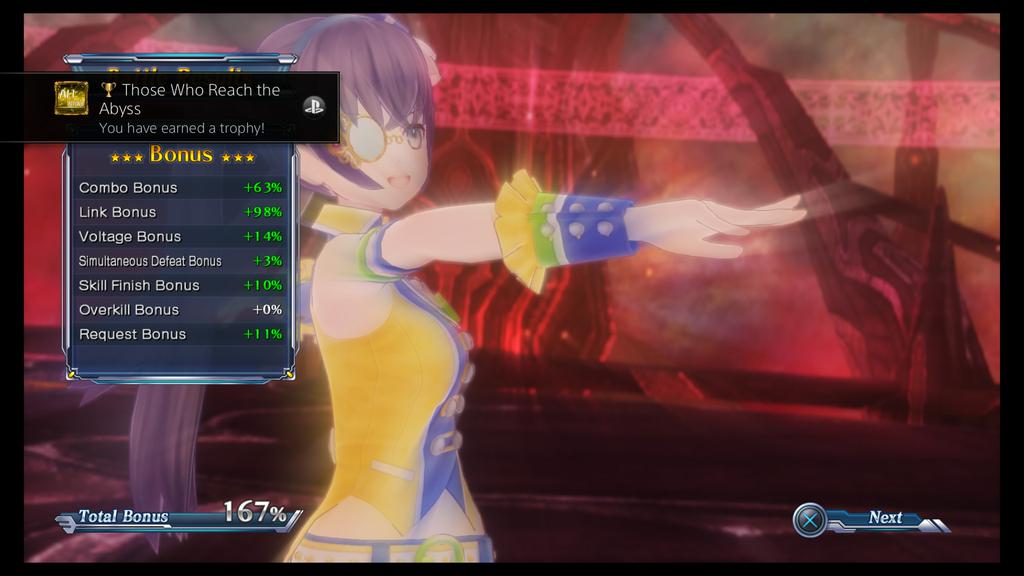
The reason for this is simple: after nearly 10 years of them being A Thing in gaming, a lot of developers are getting the hang of how to use them effectively — and the reasons for using them.

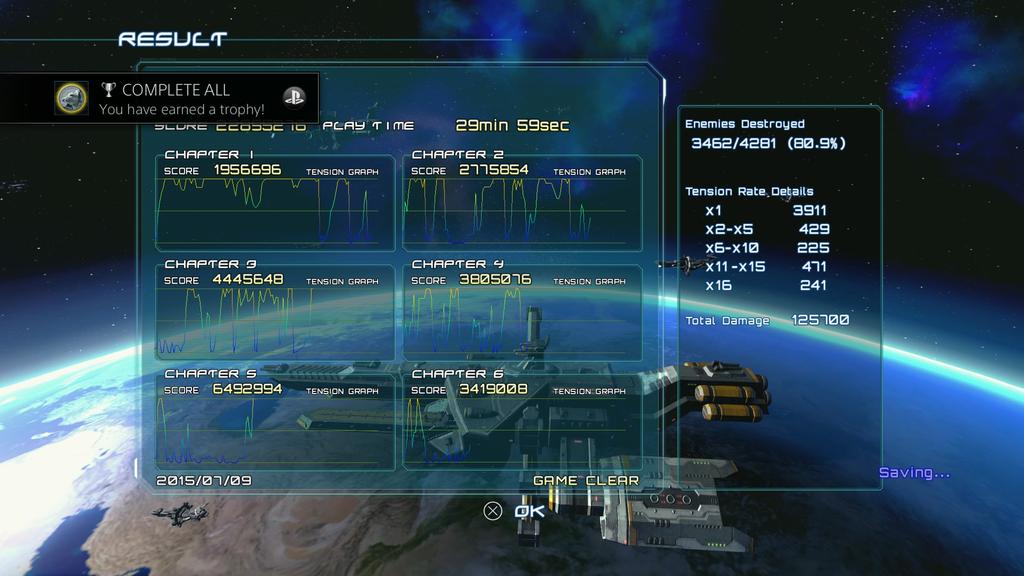
There are, in fact, several reasons for the existence of achievements. From a developer perspective, they provide feedback on just how much people are playing games and what they're doing. This is why so many games have a "started the game" achievement — look at the rarity statistics on PSN and you'll see that there are a surprising number of people who have booted a game up for long enough to add the trophy list to their profile, but not actually started to play it. I couldn't even begin to contemplate what the reasons for doing this might be, but it happens; as an example, the wonderful shoot 'em up Astebreed gives you a trophy for completing the interactive prologue sequence — something you have to do before you can even access the game's main menu — and yet only 91% of players have accomplished this, suggesting either that 9% of players simply turned the game off for some reason or other during the prologue, or were unable to complete it. And I'm not sure that last option is even possible.

CJex_cVXAAAFJlV

From a player perspective, a well-designed trophy list provides a metagame to layer on top of the existing game structure. They can provide challenges for players to complete and encourage them to explore a game in full rather than simply making a beeline for the credits — and, again, those rarity statistics suggest that relatively few people who pick up any game, regardless of length and quality, make it to the end, which is kind of sad — or suggest new ways to play.

A good example from recent memory that I'm still engaged with is Compile Heart's PS4 RPG Omega Quintet. I have gone for the Platinum trophy in most of Compile Heart's games to date (largely the Neptunia games) because I have a keen awareness of how the developers probably use them for statistics, as mentioned above. I see attaining a Platinum trophy — which for those unfamiliar with PSN is the trophy you acquire when you have achieved all of the other trophies in a game — as a mark of support for the developer; a sign that someone out there cared enough about a game to play it to absolute death. (Omega Quintet's Platinum trophy, incidentally, has a 1.1% rarity rating, which is not altogether surprising as going by my own experiences it's something of a beast to attain.)

CKys-zPWUAES5s7

And in Omega Quintet's case, that Platinum trophy really is a sign that you have explored everything the game has to offer, because it's a good trophy list that runs the gamut from "deal 1 million points of damage in a single combination attack" (something that gets significantly easier the further in the game you go) via "complete all the quests" (something which you can miss in a single playthrough if you're not fastidious about cleaning up quests before advancing the story) and "see the True Ending on Advanced difficulty" (having figured out the conditions to do so, of course — hint: get Aria and Otoha's affection levels to 4 to guarantee this) to "defeat Double X" (a superboss who sits at the bottom level of the optional Training Facility dungeon and provides one of the stiffest challenges the entire game has to offer)

The interesting thing about Omega Quintet's trophy list is that by the time I finished my second playthrough (during which I achieved the True Ending on Advanced difficulty) I had only accomplished about 50% of the available trophies. Deciding early on that I wanted to go for the Platinum, I jumped into the post-game (the ability to keep playing the game after you've beaten the final boss and seen the end of the story) to explore what these additional challenges might be.

CKw_OBRWcAIOjoj

Nearly 50 hours of gameplay later, I'm still playing, though the end is finally in sight. In those 50 hours, I've beaten the 13-floor Training Facility dungeon, pretty much mastered the game's combat system — the extreme difficulty of the Training Facility encounters, including Double X, demands that you know what you are doing, otherwise you will get your ass kicked, even if you grind all the way up to the level cap of 999 — maxed out the affection values for all my party members, mastered all the weapon proficiencies with Kyouka and have come pretty close with a couple of the others, completed all the sidequests and recovered all the hidden archives. This latter one is particularly interesting, as the archives reveal an absolute ton of story context that isn't made explicit in the main narrative, largely because it's not directly relevant to the main cast's personal stories, but instead provides some interesting background lore and worldbuilding context. You stumble across some of these as you simply explore the main game, but quite a few of them are hidden in post-game content.

In other words, without the trophies to give me a nudge in the direction of this additional content, I might not have gone looking for it. One might argue that the game not necessarily signposting this sort of thing is a problem, but if the trophy system is there — and it's compulsory to use on both Xbox and PlayStation  — it may as well be used to push people on to explore things further. Combine that with PSN's "rarity" feature and there's a really nice sense of… well, achievement when you know that you're one of the 1.1% who has seen everything Omega Quintet has to offer.

CLBJINSWoAASbZh

(Just two more trophies left to go: kill 10,000 enemies and get 1 billion approval rating points. I sense that the challenging DLC dungeons and bosses — including the fearsome Banana Demon pictured above — will be my main means of achieving this!)

1961: Sound Shapes

I remember first seeing Sound Shapes at a Gamescom I was covering for GamePro back when GamePro was still a thing. I found it immediately intriguing — partly because it was a game on the then-new-and-shiny Vita, but also because it looked to have some interesting ideas. Now, some several years later, thanks to a significant PlayStation Plus discounted price, I've finally played it. And I've been quite surprised by what I found.

Sound Shapes, if you're unfamiliar, is ostensibly a platform game, but with a few peculiar twists, the first of which being that you don't play as a "character" as such, instead this weird sort of ball thing that can switch between "sticky" and "non-sticky" states at will. When in its default sticky state, it can stick to certain walls and even ceilings; when in its non-sticky state, it moves faster and can jump further. These are the only controls you use in Sound Shapes; where the game gets interesting is in the sheer variety of ways it uses these very simple mechanics.

The "sound" part of the title comes from the fact that the game is heavily music-based. Elements of each screen you visit — no scrolling here; only old-school 8-bit style flick screens — move in time with the music, and the collectible objects in each level are "notes" that affect the soundtrack once you've picked them up. Indeed, when you make use of the level editor, you're not only putting together some fiendish platforming puzzles, you're also composing a piece of music.

And there's a surprising amount of variety, too. Shipping with a number of different "albums" and providing plenty more to explore online, Sound Shapes sees you exploring a number of different environments according to special guest musicians and artists. The first "world"'s art is done by Capy, for example, while the second is a collaboration between Jim Guthrie on music and Superbrothers on art. The two contrast hugely; Capy's world is very organic and smooth, looking like it's been drawn in flat-shaded vector graphics. Guthrie and Superbrothers' world, meanwhile, looks very much like their well-known game Sworcery, but appears to be some sort of introspective reflection on the futility of modern everyday office life.

What I like about Sound Shapes is that it's arty without being pretentious about it. You can treat it as a straightforward platformer if you like, or you can treat the stages as works of interactive art, where the overall multimedia experience has been crafted to put a particular image in your mind, or make you feel a particular way. Some are more successful than others, but all are satisfying and fun to play.

I've been really surprised at quite how good Sound Shapes is. It's a shame I didn't pick it up sooner, really, but I'm having fun with it now, at least; I can recommend it if you're in the mood for some straightforward, pick-up-and-play platforming with a very distinctive, striking audio-visual aesthetic.

1840: Further Tales from Akihabara

When I've not been playing Final Fantasy XIV or Final Fantasy II, my game of choice has been Final Fant– no, wait, Akiba's Trip: Undead and Undressed. I talked a little about this game a few days ago and, after a few more hours with it, I can confirm that I really, really like it a lot.

It's a very peculiar game by modern standards. Not quite RPG, not quite adventure, not quite dating sim, not quite open-world sandbox game, Akiba's Trip is a thoroughly interesting experience that seems to get more rewarding the longer I continue playing it.

One thing that sprang to mind while I was playing it the other day is something I also felt when playing games that are spiritually somewhat similar: Shenmue and Yakuza being the two that I think of immediately. The thing I thought about was how nice it is to have a game world that is small, but dense. Akiba's Trip unfolds in a single district of Tokyo, split (in the Vita version, anyway) into maybe ten or so different areas, all of which are interlinked in various ways. Yakuza was the same, unfolding in a single district, and Shenmue saw you progressing through just a few different areas of a town. (Shenmue II got a little more ambitious, but still split its story into several distinct "chapters", each of which unfolded in a relatively small geographic area.)

If you take this approach and do it well, it gives an extremely strong sense of place to the setting. The setting almost becomes a character in its own right, as you start to recognise distinctive landmarks in each area, and know that if you want [x] you need to go to [y]. It also encourages the player to wander round, explore and drink in the atmosphere: although Akiba's Trip features a fast-travel system, for example, I've found myself deliberately walking from one end of the map to the other just so I can get a stronger feel of this lovingly modelled setting.

Okay, Akiba's Trip in particular has some technical limitations holding it back — the poor old Vita can't cope with all that many people wandering down the streets at the same time as you, for example, and the shops that you can go "in" tend to amount to a simple buy/sell menu rather than a further environment you can explore — but the combination of visuals, sound and personality that the game boasts makes it an experience where it's fun to just wander around and see what you can see — particularly when unexpected things happen.

This isn't even getting into the meat of the game, though: there's a strong and interesting story surrounding the man-made vampire-like "Synthister" creatures; there's plenty of mystery surrounding several of the central characters; there's an entertaining series of sidequests involving the main character and his hikikomori (shut-in) little sister; and even the non-plot-related sidequests help to flesh out the world by bringing you into contact with a diverse and fun array of incidental, supporting characters.

Plus, why on Earth wouldn't you want to play a game where you defeat enemies by pulling off their trousers? 🙂

1837: A Trip to Akihabara

I've had a copy of Akiba's Trip: Undead and Undressed loitering in my backlog pretty much ever since it released over here, but I've never gotten around to playing it until recently. I'm not sure what convinced me to give it a go, but I decided that it was time, so I booted it up the other day.

Akiba's Trip is a game that proved to be notorious for two reasons: one, that supposedly, it was a game about beating up girls and pulling their clothes off; and two, it features the transphobic slur "trap" used for its intended purpose, i.e. to insult a transgender person.

Both of these things are accurate; however, as is usually the case with this sort of thing, the fact that they were focused on by loudmouthed critics almost to the exclusion of everything else about the game obscured the fact that the other 99% of Akiba's Trip is a very interesting, ambitious experience indeed, and a game very much worth playing. Not to mention the fact that both of the heavily criticised elements can be fully justified through the game's narrative context.

In Akiba's Trip, you play you, assuming you're a floppy-haired male anime protagonist. (After clearing the game once, you unlock the ability to play as other character models, so from that point onwards you can play as a lady if you so desire; canonically, however, the hero is male.) After answering a seriously sketchy-sounding job ad about taking part in a drug test in exchange for as many rare anime figures and other merchandise as you can handle, you find yourself turned into a Synthister, a man-made vampire with superhuman strength and the ability to absorb "life energy" from people around you. While Synthisters aren't vulnerable to crosses and garlic like "real" vampires, they are still extremely sensitive to sunlight, however, with something of a propensity for exploding into a cloud of dust if too much of their bare skin is exposed to the elements.

I'm sure you see where this is going.

In short order, you're rescued from your precarious situation by another Synthister called Shizuku, and you make your way back to your group of plucky gamer buddies who hang out in a cool bar run by an old dude everyone calls "Pops". From here, you're tasked with investigating the Synthister threat as well as helping out the locals of Akihabara, primarily by either finding things in the district or by beating up people until you can pull their trousers off: the game's combat system is primarily about damaging clothing until it's in a state where you can whip it off, rather than whittling down a more conventional health bar. In order to defeat most enemies, you need to remove their headgear along with their top and bottom clothing. Interestingly, in contrast to something like Senran Kagura, a game which also has a heavy emphasis on clothing damage, the "strip" mechanic in Akiba's Trip is unsexualised; it's simply part of combat, and is, frankly, hilarious. (Not only that, but you'll find yourself stripping men as well as women; I believe my session earlier is the first time ever in gaming that I have defeated a man in full motorcycle leathers by diving head-first into his crotch, grabbing his helmet and flinging it away, then whipping his trousers off and tearing his jacket from his chest.)

Stripping aside, the big hook in Akiba's Trip is that it features a lovingly detailed rendition of the real-world Akihabara district of Tokyo in Japan — a Mecca for otaku of all descriptions for sure. Featuring recreations of real-life shops, some excellently authentic-sounding ambient sound and a pleasingly diverse array of random people wandering the streets, it's an enormously atmospheric game that it's a pleasure to just wander around and explore — particularly when you start to notice interesting things happening without any intervention from you.

I was searching for some street thugs with Shizuku at one point, for example, and I decided to try and ask a suspicious-looking man in the street for directions. He responded that he "wasn't into dudes" and refused to talk to me. As I pondered what to do next, he then started to hit on Shizuku, who stood there patiently while he said his piece and then, marvellously, wound up one hell of a punch and socked him right in the face, flattening him. He then ran away crying. It was a beautiful moment that just happened to occur due to me being in the right place at the right time.

If there's one game that Akiba's Trip reminds me of so far, it's Yakuza. The lovingly crafted real-world environment; the blend of JRPG-style mechanics with action game brawling; the fact the game acknowledges the more unpleasant, seedier side of humanity without judgement. (The aforementioned "trap" comment, for example, comes in the context of a forum thread you read on your phone; said forum thread was clearly localised by someone who has spent a lot of time on real-world forums, since the text-based "dialogue" is some of the most convincing and realistic I've seen in an English localisation for a very long time — right down to the use, or lack thereof, of punctuation, and the way that anonymous people online are quite frequently complete shitheads to one another.) That and the endless stream of sidequests to complete that have nothing to do with the main story but provide a pleasing sense of "place" and "context" to the overall setting; the NPCs who are delighted to relieve you of your money through various scams; the strong characterisation.

I've only played a couple of hours so far, but already I like it a lot. I'm playing the Vita version, which has a few technological limitations, but is proving enjoyable regardless; I can imagine that the PlayStation 4 version would be a most enjoyable experience indeed, particularly with its additional features and enhancements.

1784: Follower of Black Heart

It was Sony's PlayStation Experience keynote presentation today. I haven't yet caught up on all the bits of news that came out of it, but the snippets I have heard so far all confirm something that I've been thinking for quite a while now: in the new generation of gaming hardware (PlayStation 4, Xbox One, Wii U) Sony is going to be the one to beat. And the other two (well, one; we've established Nintendo likes doing its own thing and bugger what the other two are up to) are going to have their work cut out for them.

Sony's got a pretty comprehensive-looking gaming package at present, and one that covers a number of different markets. Speaking as someone who has not yet jumped into the next generation of hardware wholeheartedly — though I do own a Wii U — the PlayStation 4 is an infinitely more enticing prospect than the Xbox One. It's still not quite enough to make me want to rush out and buy one just yet — I'm still waiting for that absolute must-have game that I can't get anywhere else, and bear in mind my definition of "must-have" is somewhat different from the mainstream — but I'm getting closer and closer with every new announcement that comes out of Sony.

Speaking more objectively, though, the PlayStation 4 has a solid lineup of titles. Many of them are available on Xbox One as well, of course, but the PS4 versions are, in most cases, technically superior, running at better resolutions in many cases. As for exclusives, Sony has this pretty much stitched up. The Xbox One lineup of exclusives is a moribund array of unimaginative titles that tend to fit into the neat triple-A pigeonholes of "killing things", "driving things" or "doing sports with things" — there are a few exceptions, of course, such as SWERY's intriguing new project — whereas the PS4's lineup is vibrant, interesting and, importantly, worldwide, with Japanese developers rapidly jumping on board Sony's train even as they continue to eye Microsoft warily after the Redmond giant's two abject failures in the Far East.

The PS4 has the mainstream market pretty well stitched up, then, it seems — although with titles like Hyperdimension Neptunia Victory II and its ilk coming to the platform, it looks set to follow in the PS3's footsteps and provide a great home for more niche titles, too, not to mention the array of excellent independent titles that are making the jump from PC to PS4, too.

And then there's the Vita. Sony still doesn't make a big deal about the Vita at events like this, which annoys some people, but really, a big keynote speech isn't the place to shout about how great the Vita is. The reason? Vita has carved out a rather wonderful little niche for itself as arguably the best place to go for… well, niche games. Highly creative indie titles? Check. Fanservicey Japanese games? Check. Non-fanservicey Japanese games? Check. Access to a staggering back catalogue of brilliant games from the PS1 and PSP eras? Check.

Developers and publishers alike are really starting to get a handle on what makes the Vita tick, and what those who own one like doing with their time. Rather than attempting to continue pushing the frankly dumb "triple-A in your pocket!" angle — the whole point of triple-A is that it's spectacular, and consequently built for the big screen — Vita devs and publishers are now embracing the fact that Vita is a handheld device whose players like the freedom to play either for a short session over lunch, or for more protracted periods of free time. The best Vita games are built with this in mind: FuturLab's Velocity 2X, for example, features lightning-fast, short levels that encourage you to replay for the best times and scores; even Hyperdimension Neptunia Re;Birth1 which I've been playing recently is eminently handheld-friendly thanks to its short and snappy dungeons punctuated by clearly signposted event scenes that you move onto when you're good and ready rather than when you least expect it.

And let's not forget the PS3 in all this, still managing to remain relevant despite its successor having been on the market for a year now. Today we learned that Sega is bringing the much-requested Yakuza 5 to the West next year, and the new installment in the Persona series is coming to PS3 as well as PS4. On top of that, publishers like NIS America, Xseed Games, Aksys Games and their ilk are continuing to localise a wealth of interesting (and occasionally outlandish) Japanese titles for the Western market, so while those continue to flow in my PS3 won't be getting put away any time soon.

All this may sound rather fanboyish and perhaps it is, but the fact is, Microsoft has consistently failed to make me want to pay any attention to the Xbox One whatsoever — the first thing that still springs to mind when I think of the Xbox One is the stupid "Snap" functionality, which is something I don't think I've ever felt I wanted from a console — while Sony continually intrigues and excites me with each new announcement they make.

All it'll take is one great game to get me to grab an Xbox One, though, but at the moment I see that happening on PS4 first, by quite a considerably margin.