I've had a copy of Akiba's Trip: Undead and Undressed loitering in my backlog pretty much ever since it released over here, but I've never gotten around to playing it until recently. I'm not sure what convinced me to give it a go, but I decided that it was time, so I booted it up the other day.
Akiba's Trip is a game that proved to be notorious for two reasons: one, that supposedly, it was a game about beating up girls and pulling their clothes off; and two, it features the transphobic slur "trap" used for its intended purpose, i.e. to insult a transgender person.
Both of these things are accurate; however, as is usually the case with this sort of thing, the fact that they were focused on by loudmouthed critics almost to the exclusion of everything else about the game obscured the fact that the other 99% of Akiba's Trip is a very interesting, ambitious experience indeed, and a game very much worth playing. Not to mention the fact that both of the heavily criticised elements can be fully justified through the game's narrative context.
In Akiba's Trip, you play you, assuming you're a floppy-haired male anime protagonist. (After clearing the game once, you unlock the ability to play as other character models, so from that point onwards you can play as a lady if you so desire; canonically, however, the hero is male.) After answering a seriously sketchy-sounding job ad about taking part in a drug test in exchange for as many rare anime figures and other merchandise as you can handle, you find yourself turned into a Synthister, a man-made vampire with superhuman strength and the ability to absorb "life energy" from people around you. While Synthisters aren't vulnerable to crosses and garlic like "real" vampires, they are still extremely sensitive to sunlight, however, with something of a propensity for exploding into a cloud of dust if too much of their bare skin is exposed to the elements.
I'm sure you see where this is going.
In short order, you're rescued from your precarious situation by another Synthister called Shizuku, and you make your way back to your group of plucky gamer buddies who hang out in a cool bar run by an old dude everyone calls "Pops". From here, you're tasked with investigating the Synthister threat as well as helping out the locals of Akihabara, primarily by either finding things in the district or by beating up people until you can pull their trousers off: the game's combat system is primarily about damaging clothing until it's in a state where you can whip it off, rather than whittling down a more conventional health bar. In order to defeat most enemies, you need to remove their headgear along with their top and bottom clothing. Interestingly, in contrast to something like Senran Kagura, a game which also has a heavy emphasis on clothing damage, the "strip" mechanic in Akiba's Trip is unsexualised; it's simply part of combat, and is, frankly, hilarious. (Not only that, but you'll find yourself stripping men as well as women; I believe my session earlier is the first time ever in gaming that I have defeated a man in full motorcycle leathers by diving head-first into his crotch, grabbing his helmet and flinging it away, then whipping his trousers off and tearing his jacket from his chest.)
Stripping aside, the big hook in Akiba's Trip is that it features a lovingly detailed rendition of the real-world Akihabara district of Tokyo in Japan — a Mecca for otaku of all descriptions for sure. Featuring recreations of real-life shops, some excellently authentic-sounding ambient sound and a pleasingly diverse array of random people wandering the streets, it's an enormously atmospheric game that it's a pleasure to just wander around and explore — particularly when you start to notice interesting things happening without any intervention from you.
I was searching for some street thugs with Shizuku at one point, for example, and I decided to try and ask a suspicious-looking man in the street for directions. He responded that he "wasn't into dudes" and refused to talk to me. As I pondered what to do next, he then started to hit on Shizuku, who stood there patiently while he said his piece and then, marvellously, wound up one hell of a punch and socked him right in the face, flattening him. He then ran away crying. It was a beautiful moment that just happened to occur due to me being in the right place at the right time.
If there's one game that Akiba's Trip reminds me of so far, it's Yakuza. The lovingly crafted real-world environment; the blend of JRPG-style mechanics with action game brawling; the fact the game acknowledges the more unpleasant, seedier side of humanity without judgement. (The aforementioned "trap" comment, for example, comes in the context of a forum thread you read on your phone; said forum thread was clearly localised by someone who has spent a lot of time on real-world forums, since the text-based "dialogue" is some of the most convincing and realistic I've seen in an English localisation for a very long time — right down to the use, or lack thereof, of punctuation, and the way that anonymous people online are quite frequently complete shitheads to one another.) That and the endless stream of sidequests to complete that have nothing to do with the main story but provide a pleasing sense of "place" and "context" to the overall setting; the NPCs who are delighted to relieve you of your money through various scams; the strong characterisation.
I've only played a couple of hours so far, but already I like it a lot. I'm playing the Vita version, which has a few technological limitations, but is proving enjoyable regardless; I can imagine that the PlayStation 4 version would be a most enjoyable experience indeed, particularly with its additional features and enhancements.
It was Sony's PlayStation Experience keynote presentation today. I haven't yet caught up on all the bits of news that came out of it, but the snippets I have heard so far all confirm something that I've been thinking for quite a while now: in the new generation of gaming hardware (PlayStation 4, Xbox One, Wii U) Sony is going to be the one to beat. And the other two (well, one; we've established Nintendo likes doing its own thing and bugger what the other two are up to) are going to have their work cut out for them.
Sony's got a pretty comprehensive-looking gaming package at present, and one that covers a number of different markets. Speaking as someone who has not yet jumped into the next generation of hardware wholeheartedly — though I do own a Wii U — the PlayStation 4 is an infinitely more enticing prospect than the Xbox One. It's still not quite enough to make me want to rush out and buy one just yet — I'm still waiting for that absolute must-have game that I can't get anywhere else, and bear in mind my definition of "must-have" is somewhat different from the mainstream — but I'm getting closer and closer with every new announcement that comes out of Sony.
Speaking more objectively, though, the PlayStation 4 has a solid lineup of titles. Many of them are available on Xbox One as well, of course, but the PS4 versions are, in most cases, technically superior, running at better resolutions in many cases. As for exclusives, Sony has this pretty much stitched up. The Xbox One lineup of exclusives is a moribund array of unimaginative titles that tend to fit into the neat triple-A pigeonholes of "killing things", "driving things" or "doing sports with things" — there are a few exceptions, of course, such as SWERY's intriguing new project — whereas the PS4's lineup is vibrant, interesting and, importantly, worldwide, with Japanese developers rapidly jumping on board Sony's train even as they continue to eye Microsoft warily after the Redmond giant's two abject failures in the Far East.
The PS4 has the mainstream market pretty well stitched up, then, it seems — although with titles like Hyperdimension Neptunia Victory II and its ilk coming to the platform, it looks set to follow in the PS3's footsteps and provide a great home for more niche titles, too, not to mention the array of excellent independent titles that are making the jump from PC to PS4, too.
And then there's the Vita. Sony still doesn't make a big deal about the Vita at events like this, which annoys some people, but really, a big keynote speech isn't the place to shout about how great the Vita is. The reason? Vita has carved out a rather wonderful little niche for itself as arguably the best place to go for… well, niche games. Highly creative indie titles? Check. Fanservicey Japanese games? Check. Non-fanservicey Japanese games? Check. Access to a staggering back catalogue of brilliant games from the PS1 and PSP eras? Check.
Developers and publishers alike are really starting to get a handle on what makes the Vita tick, and what those who own one like doing with their time. Rather than attempting to continue pushing the frankly dumb "triple-A in your pocket!" angle — the whole point of triple-A is that it's spectacular, and consequently built for the big screen — Vita devs and publishers are now embracing the fact that Vita is a handheld device whose players like the freedom to play either for a short session over lunch, or for more protracted periods of free time. The best Vita games are built with this in mind: FuturLab's Velocity 2X, for example, features lightning-fast, short levels that encourage you to replay for the best times and scores; even Hyperdimension Neptunia Re;Birth1 which I've been playing recently is eminently handheld-friendly thanks to its short and snappy dungeons punctuated by clearly signposted event scenes that you move onto when you're good and ready rather than when you least expect it.
And let's not forget the PS3 in all this, still managing to remain relevant despite its successor having been on the market for a year now. Today we learned that Sega is bringing the much-requested Yakuza 5 to the West next year, and the new installment in the Persona series is coming to PS3 as well as PS4. On top of that, publishers like NIS America, Xseed Games, Aksys Games and their ilk are continuing to localise a wealth of interesting (and occasionally outlandish) Japanese titles for the Western market, so while those continue to flow in my PS3 won't be getting put away any time soon.
All this may sound rather fanboyish and perhaps it is, but the fact is, Microsoft has consistently failed to make me want to pay any attention to the Xbox One whatsoever — the first thing that still springs to mind when I think of the Xbox One is the stupid "Snap" functionality, which is something I don't think I've ever felt I wanted from a console — while Sony continually intrigues and excites me with each new announcement they make.
All it'll take is one great game to get me to grab an Xbox One, though, but at the moment I see that happening on PS4 first, by quite a considerably margin.
Well, if it's good enough for Sony — they are celebrating the 20th anniversary of their console, after all — it's good enough for me.
Here are my top three original PlayStation games.
…Shit.
There are too many. There are way too many to choose from that I've played over the years. Some of them are incredibly obvious choices. Others are games that I have but a dim memory of playing, but which have stuck in my brain ever since. I can't choose three. I can't.
So I won't. Instead, I'm going to present some fake awards for the games that have stuck in my mind ever since I first played them. In some cases, it may have been 15-20 years since I played them, but they still carry significant meaning to me for one reason or another. In many cases, they may not even be among the best games on the platform, but for whatever reason I have remembered them fondly ever since.
Here we go then. The first one is an obvious one, but I don't think many people will argue against it.
The "wow, this is better than anything I've ever seen before" award
What other game could this go to than the original Ridge Racer?
The word "revolutionary" is thrown around far too much with regard to games these days, but Ridge Racer was genuinely revolutionary. It clearly demonstrated the vast difference in power between the 32-bit PlayStation and the 16-bit Super NES and Mega Drive that had come before.
Its slick 3D graphics and unapologetically arcadey handling — remember this was in the days when we were still using digital control pads rather than analogue sticks — made it an absolute joy to play. And despite a relative lack of content compared to modern games — there really weren't very many tracks at all, and all of them were based in the exact same environment — it was a game that could keep you occupied for hours as you tried to beat the irritating yellow car and its even more irritating later counterpart, the black car: an adversary so cocky that it often parked on the side of the road in order to allow you to catch up a bit.
A not-particularly-interesting anecdote about Ridge Racer is that it also kind of introduced me to electronic music. Prior to that game, I'd dismissed a lot of electronic music as being just noise — at least partly due to my parents regarding it as such — but over time I came to appreciate the weird and wonderful accompaniments to the racing on the soundtrack, and was much more open to the idea of listening to electronic music outside of games as a result.
The "holy crap, this is on the same system?" award
It would be remiss of me to talk about Ridge Racer and not mention the much later Ridge Racer Type-4, a game which came out much later in the PlayStation's lifespan but which still plays like a dream today.
Ridge Racer Type-4 was noteworthy not just for being a great game — and a great-looking game with what passed for "photo-realistic" visuals at the time of its release — but also for being beatifully designed, too. Take a look at the video above and tell me that those bright yellow animated menus aren't immediately distinctive and memorable — and instantly recognisable as being from Ridge Racer Type-4.
Everything about Ridge Racer Type-4 fitted together perfectly. The hour-long Grand Prix campaign gave you several mini-stories to follow through as you challenged various races in various vehicles. The vehicles you unlocked ran the gamut from the relatively sensible to the ridiculous, such as the jet-propelled monstrosity you unlocked later that really, really didn't like going around corners.
And the music. Oh, the music. At the time Ridge Racer Type-4 came out, my friends and I had discovered a genre of music known as acid jazz — a blend of jazz, funk and hip-hop typified by artists such as the Brand New Heavies and Jamiroquai. We would listen to pretty much nothing other than this type of music, and so we were delighted to discover that Ridge Racer Type-4's soundtrack consisted almost exclusively of music of this ilk — certainly a far cry from the early-'90s electronica of the first game — and even more delighted when we found that Namco had very much made this distinctive sound part of their in-house "style" for a while, as other games such as Anna Kournikova's Smash Court Tennis (an honourable mention in this list) also had a rather jazz-funk flavour about them.
Racing games have come a long way, but few modern titles provide the same degree of satisfying arcade fun that Ridge Racer Type-4 still does. And now you can download and play it on PSP and Vita. And typing this, I'm very tempted to go and do that after I'm done here.
The "so I like RPGs now" award
Final Fantasy VII. I don't think I really need to say anything else about this, so here's the intro — still one of my favourite game openings of all time.
The "inexplicably burned into my memory" award
I played a lot of role-playing games on PlayStation — at least, after I discovered Final Fantasy VII and the genre as a whole — but I actually have a pretty good memory of most of them, and indeed enjoyed most of them, too, even those that were objectively lower-quality and lower-budget than other games available at the time.
One such game that has stuck in my mind for a long time is The Granstream Saga.
I remember only a few very specific details about The Granstream Saga: it had some lovely anime cutscenes; it had a great battle system that was somewhere between a traditional RPG and the real-time combat of games like Zelda; it featured two heroines called Arcia and Laramee (the latter of whom donates her name to my custom characters in games any time "Amarysse" is not available); and that none of the polygonal models had any faces.
I'm not sure why The Granstream Saga has burned itself into my memory quite as much as it has, but of all the RPGs I played on PlayStation, it's one of the ones I remember most fondly. I'd be interested to replay it sometime and see how it holds up, graphics aside.
The "I like this more than Zelda" award
Yes, I like The Adventures of Alundra more than pretty much any Legend of Zelda game I've played to date. (Disclosure: I only played a couple of hours of Wind Waker and Twilight Princess, and haven't played Skyward Sword at all.)
Alundra surprised me, because it came along at a time where, so far as many teenage gamers were concerned — teenage gamers like my school friends and I, for example — it was 3D or nothing. 2D games were things of the past; it was all about the 3D now, and preferably games that came on more than one disc. (My friend Woody believed for many years that it was physically impossible for a game to be as good as FInal Fantasy VII, which came on three discs, if it only came on a single disc. This was despite me pointing out that the three discs of FInal Fantasy VII all included the exact same game data, and the only thing different between them was the prerendered cutscenes. I could never convince him.)
Alundra was staunchly 2D, though. It wasn't even a little bit 3D — games like Castlevania: Symphony of the Night (which we'll get onto in a moment) supplemented their beautiful 2D art with 3D backdrops and other scenery elements, whereas Alundra was a pixel-art labour of love, with hand-animated characters, a distinctive and consistent aesthetic and the feel that, aside from the screen resolution, it may well have been possible to recreate on the Super NES.
After I got over my initial culture shock at playing a 2D game, though, I discovered something wonderful: a beautifully designed Zelda-style action RPG with, to date, some of the best-designed puzzles I've ever solved without the aid of GameFAQs. Alundra's puzzles were difficult — more difficult than that which Zelda typically offered — but never insurmountable, and consequently they gave a wonderful feeling of achievement when you successfully solved them.
The plot was pretty cool, too. In fact, it went on to inspire a story that I've had half-finished in my head and various word-processing documents ever since. One day I should probably finish that.
The "Hmm, 2D platform games are still relevant" award
2D platformers have had something of a resurgence in recent years thanks to the indie scene, but in the early years of the 32-bit era, developers and players alike were thoroughly enamoured with 3D, with everyone trying to recapture the magic of Super Mario 64.
Castlevania: Symphony of the Night proved that 2D still had a place, however. And what a game it was.
The game was immediately striking thanks to its intro, seen in the video above. The beautiful pixel art, the incredible soundtrack — by gosh, I miss old-school Castlevania music — the cringeworthy but memorable voice acting and script… all of it combined to make the second-most badass intro sequence after Final Fantasy VII in my book.
What was perhaps most interesting about the Symphony of the Night intro, however, was the fact that it was actually the last level of the previous game. Only after you beat Dracula — in a fight that you couldn't lose this time around — did the game proper begin, and then you were in to one of the earliest examples of the "Metroidvania" genre: a type of 2D platformer where you could freely explore a single, huge world split into distinct areas, some of which were blocked off by the requirement for you to unlock specific abilities first.
Symphony of the Night as a whole was so great because it was designed well, played well, treated the player fairly and didn't outstay its welcome. It was over and done with in about 10 hours — including the "secret" second castle — and by that point you'd had an eminently satisfying experience filled with thrilling boss fights, challenging platforming and, of course, amazing music. It's no surprise that this Castlevania above all others is the one that keeps getting re-released.
The "this game is broken as hell, but I still love it to pieces" award
Bust-a-Groove took up a considerable proportion of one of our summers. Why? Because it was brilliant.
Bust-a-Groove was one of the earliest examples of "rhythm action" games that I remember playing, and took the unusual approach of being somewhat like a fighting game — it had different characters, each of whom had their own iconic stage, and you worked your way through them to a non-playable final boss. The whole thing was over in the space of about 20 minutes or so — a single playthrough was, anyway — but it was the kind of thing we all enjoyed playing over and over again with different characters.
Why was it broken as hell? Because of its multiplayer mode, and because of the nature of its gameplay. By requiring the player to input specific button sequences in time with the music, it was possible to get a "perfect" score on a level, and if two evenly matched players squared off against one another, it almost always ended in a stalemate. The game's answer to this was to provide a couple of special attacks that could be triggered in time with the music, but there was also a dodge button and a very obvious cue that these attacks were coming so, again, two evenly matched players would more than likely end in a draw, while two players of different skill levels would be a foregone conclusion.
As dumb as it was, the personality-packed characters, the detailed stages and the incredibly memorable soundtrack made this one of my favourite games of the PlayStation era.
The "I like this more than Zelda, too" award
Here in Europe, we got screwed over on the RPG front for a good few years, with many localised titles not making the hop across the pond from America. Fortunately, I had a modified PlayStation capable of playing imported games, so when I visited my brother in the States on one occasion, I took the opportunity to pick up a selection of games I couldn't get back home, one of which was Squaresoft's Brave Fencer Musashi.
Brave Fencer Musashi was a funny game. And I mean that in several senses. It was clearly Japanese through and through, but an excellent job on the localisation filled it with exaggerated Western stereotypes such as the valley girl princess (who calls the protagonist a "little turd" within two minutes of them meeting), the mystic who overdid it on the archaic English and the distinctly camp scribe named Shanky.
Structurally, it was peculiar, too. It had many of the trappings of an RPG — levelling up, HP, MP and the like — but the feel of a 3D platformer, with you exploring a world of gradually increasing size and getting into various setpiece scrapes against bosses and special events. I never got around to beating it, but it was a lot of fun, and I still have a copy on my shelf, so… hmm.
The… hmm.
I've gone on for over 2,000 words and I think I could probably continue if I tried. But I'm going to hold it there for now and perhaps revisit some more PS1 classics tomorrow.
The PlayStation is celebrating its 20th birthday in Europe today. What better way of celebrating than with a rather lovely picture of Hyperdimension Neptunia's Noire, personification of the PlayStation brand and platform, dressed up to the nines and clearly in slightly awkward party spirit?
Hnng, I'm sure you will agree.
Lovely Noire aside, the PlayStation's 20th anniversary feels like a suitable occasion to share some fond memories of my time with Sony's platforms over the years, and what PlayStation has meant to me. I realise that by doing this I am, of course, falling into Sony's cunning marketing trap, but since I'm not a professional games journalist any more I can say whatever the fuck I want, not to mention post pictures such as that seen above.
Anyway.
My first memory of PlayStation is much like my first memory of many consoles from the SNES and Mega Drive era onwards: a unit came home with my brother, courtesy of his work on games magazines, accompanied by a few games, and thus I had the opportunity to try it out well before any of my friends ever did — though I would find myself biting my lip and never being sure whether or not five minutes after the poor chap had arrived was too soon to go rifling through his bags in search of technology and game cases.
The first three games I ever played on PlayStation were Ridge Racer, a pre-release version of Tekken (which had a bug or two here and there) and Raiden Project. Ridge Racer was, of course, absolutely gobsmacking at the time (though I still find it amusing that it upstaged itself with its fourth installment coming bundled with a remake of the original that ran at twice the resolution and twice the framerate) and Tekken was one of the most "physical"-feeling fighting games I'd ever encountered. (That cracking sound Paul Phoenix makes when he throws someone still makes me wince.) Conversely, I was initially unimpressed by Raiden Project owing to the fact that its 2D sprite-based graphics looked like the sort of thing the SNES and Mega Drive had been offering us for years by this point. (I later realised that I was being somewhat blinded by the then-revolutionary 3D graphics of the former two games, and came to enjoy Raiden Project a whole lot.)
Ridge Racer and Tekken were both noteworthy for incorporating something that I haven't really seen since: games to play while you waited for the main game to load. Ridge Racer offered Galaxian — and unlocked bonuses if you managed to complete it before the main game loaded — while Tekken offered Galaga. Both were impressive, arcade-perfect ports that ran flawlessly while the game loaded in the background, and I'm sad that this concept didn't take off more, perhaps due to Namco remaining somewhat tight-fisted with the technology. These days the best we get is an interactive loading screen that lets us practice our moves or something, but these tend to only come up once the game has already loaded, not the moment you put the disc in.
Eventually, for some reason, I came into possession of that same (Japanese) PlayStation that had originally come home with my brother. I forget the exact circumstances — I imagine it was due to him getting an official local model — but I was certainly extremely grateful for it. Unfortunately, as still happens with many console games today, the PlayStation was region-locked, meaning that it would only run Japanese games straight out of the box; running European games required you to either install a mod chip (which also enabled piracy, since it effectively bypassed the console's internal copy-and-region-protection systems) or make use of a somewhat questionable trick involving a piece of Blu-Tac, a pen lid, a Japanese game disc and the European game disc you were actually trying to play.
Oh yes, the disc swap trick: most PlayStation owners of the late '90s at least tried it at one point or another. Essentially the trick involved allowing the console to read the copy protection and region info from a disc it would normally accept, then quickly swap this disc out for the game you were actually trying to run. It was a somewhat perilous process that required you leave the lid of the console open at all times (propped open by the pen lid, which was also pressing down the button that told the console the lid was closed) and then whip out the first disc the moment it stopped spinning quickly. It often took a few attempts to get right, but my gosh, the first time I got Final Fantasy VII running in this way was an exciting day indeed.
Ah, Final Fantasy VII. I've waxed lyrical about this game many times on this blog, so I won't reiterate that here, but I will say that at the time it was hyped up to me as "a game that will actually make you cry" and it did not disappoint. It introduced me to the wonderful world of roleplaying games, and gave my friends and I many, many hours of entertainment, since we all finished it several times over. In retrospect, I have no idea how we had the time to do this, but I do know that to date, I have played Final Fantasy VII from start to finish at least ten times over.
Even in those early days, I was someone who enjoyed investigating interesting-looking and strange games, particularly those of Japanese origin. I recall spending a whole lot of time playing the wonderful dance-off game Bust-a-Groove as well as cracking RPGs such as Breath of Fire III, Star Ocean: The Second Story and, of course, subsequent installments in the Final Fantasy series. Visiting my brother over in the States also saw me picking up a number of games that, for whatever reason, never made it to the UK's shores: titles like Brave Fencer Musashi, Parasite Eve, Xenogears and Lunar: Silver Star Story.
Have another Noire to break things up a bit.
I was well into university by the time I joined the PlayStation 2 generation. I wasn't an early adopter, but I was intrigued by this new console and the supposedly immense power it had. But once again when I picked one up, it was not to grab the latest and greatest new titles — the game I chose to purchase my console with was a little-known adventure by Konami known as Shadow of Memories, to date one of the most interesting narrative-based games I think I've ever played.
For the uninitiated, Shadow of Memories casts you in the role of Eike, a man who keeps getting murdered and then having the opportunity to go back in time and save himself. The solutions to the situations become increasingly convoluted as you progress through the story, occasionally involving travelling back hundreds of years in order to, say, prevent a tree from being planted and, by extension, removing the place your assailant was hiding. I'd encountered strong stories in games before — particularly through the aforementioned Final Fantasy VII and adventure games on PC — but Shadow of Memories was noteworthy for me in that it was a console game that had taken the bold step of having neither attack nor jump buttons — it was simply about exploring, enjoying the story and working your way to the truth. (To date, I still haven't seen the game's true ending; I should probably rectify that at some point.)
Shadow of Memories aside, it took me a while to come around to the PlayStation 2, largely due to the fact that for a little while, there didn't seem to be that many role-playing games available for it. I later discovered that this was an inaccurate assessment, of course — and in fact am still discovering great RPGs on the platform today, two hardware generations later — but it took me a little while to warm up to it.
Outside of RPGs, though, the PlayStation 2 did play host to some wonderfully memorable games. The Timesplitters series provided some of the best local multiplayer shooting since GoldenEye — largely due to being developed by the same people — while many a drunken evening was spent with my friend Sam post-Poundstretcher (the regular "everything is really, really cheap" evening at the Student Union) playing various incarnations of the Grand Theft Auto series. And some strange things from that era have remained in our collective vernacular ever since; if we'd never played State of Emergency (not Rockstar's finest hour, but actually a surprisingly fun game) we'd never have come across the phrase "[do something] for BOOOONUS SCOOOOORE!", which is frequently still used among our friendship group whether we're cooking, playing a video game or gathered around the tabletop for a board game.
Have some more Noire. And yes, that brooch is supposed to look like the old Sony Computer Entertainment logo.
I've had an interesting relationship with the PlayStation 3. Initially, I didn't quite see the point of it — in fact, I vividly recall doing some podcasts with my friends Edd and Woody where we were fairly merciless about that big ol' lump of black shiny plastic, but then we were all fairly obnoxious Xbox 360 fanboys at that point, too.
I forget what caused me to pick up one in the first place. I think it was simply a pretty good deal — the console and three games for an eminently reasonable price. The games were Ghostbusters, Fight Night and something else I've forgotten. I played about ten minutes of Ghostbusters, booted up Fight Night once and didn't play it, then quickly found that downloadable games like Flower were much more interesting than many of the retail titles available at the time. My Xbox 360 still got considerably more use — primarily due to the fact that multiplatform titles were often better on 360, and that my friends would typically play multiplayer on 360 — but I always held on to the PS3.
These days, the situation is a complete reversal. I haven't turned on my Xbox 360 for a very long time now — I don't think it's been a whole year, but it's certainly been a good few months — whereas my PS3 still gets regular use, largely due to the fact that, as has been the PlayStation platform's wont ever since its inception, it's still the best place to go for Japanese role-playing games, including titles like the Neptunia series which have since become some of my favourite games of all time. (Yes, really.)
And this isn't even getting into Sony's portable platforms the PSP and the Vita, both of which are criminally underrated platforms full to absolute bursting with top-quality entertainment to cater to all tastes and play styles. My Vita is getting more use than any of the other gaming platforms I own right now thanks to games like Hyperdimension Neptunia Re;Birth1 and Senran Kagura Shinovi Versus, and there's plenty more queued up beyond those two titles, on both PS3 and Vita.
As for the now year-old PlayStation 4? Well, I still don't have one yet, but frankly, with new Neptunia and Senran Kagura games both on the horizon for the new platform, it's clearly only a matter of time before I cave and grab one, isn't it? It just remains to be seen how long I can hold out. I've been doing all right so far, but it only takes one game — perhaps something unexpected — that I really have to play right now for me to take that plunge. Soon. But perhaps not just yet.
Anyway. Happy birthday, PlayStation. You — and let's not forget the myriad developers behind all the games I've talked about today and more — have brought my life great joy over the years, and you continue to fill my free time with fun and frolics even now, 20 years later. Long may it continue — for another 20 years and beyond, maybe?
Reading this post from Matt Mason earlier made me think somewhat about my own game buying and playing habits and how they have evolved over time. I've come to the conclusion that I'm becoming something of a "collector", particularly when it comes to more obscure games that almost inevitably become hard to find if you don't snag them immediately upon release.
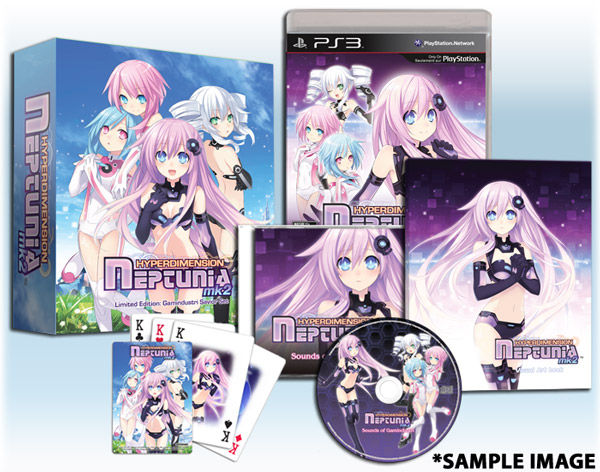
This doesn't mean that I pay over the odds to get "Collector's Editions" of games, though, because I tend to think that for the most part those are a waste of time — or perhaps it's just that I've never really had a Collector's Edition for a game that I felt particularly passionately about. Had I known how much I was going to love Hyperdimension Neptunia mk2, for example, I might have seriously considered spending a bit more and picking up the swanky limited edition that came with a soundtrack CD, an art book and some playing cards. (Yeah, I know the cards are a bit lame, but I love soundtrack CDs.)
More often than not, though, the super-expensive limited edition versions are for games I have no interest in, like Call of Duty, Assassin's Creed and Skyrim. For sure, these limited editions are often cool, but there's only so many gigantic statuettes that you can scatter around your house before people start asking questions. (Particularly if one of those statuettes is a gory female torso… but let's not open that can of worms again.)
I'm actually fine with this, though, because I've been tending to find that the games I'm most interested in playing are the ones that maintain their value the best — simply because they're often not put out in particularly large quantities and thus often become quite hard to find after a little while. As such, I've come to accept that taking a chance on a new game like this often involves an outlay of at least £20 and may, in a few isolated cases, require payment of a price considerably inflated from what it would have cost when the game was first released. (I ordered a copy of Fire Emblem for Gamecube recently, for example… I'm pretty sure that's not what it cost when it first came out.) The fact that I've had to hunt for these games and occasionally pay a bit more for them than something of an equivalent age that had a wider release makes them feel somehow more "valuable", and makes me feel like my growing collection is something that I can be proud of. I know they're "just" games, but they represent a hobby that I truly love and which inspires me to do other things.
What this "collector's" attitude has meant in practical terms is that I'm now much more inclined to pick up interesting-sounding titles as soon as I become aware of them, rather than when I know I have time for them. This inevitably leads to an ever-growing backlog, of course, but it also means that I have things to look forward to. It's also an approach which works for my personal circumstances at present. In other words, I don't spend a lot of money on other "vices" — I don't drink, I don't smoke, I don't buy DVDs (with the exception of anime that can't be found for streaming online), I don't tend to travel a lot and, by the end of this month, I won't have any car expenses either (apart from any contributions I make to help Andie out with hers). This means that I tend to have a fair bit of disposable income that I don't feel guilty about splurging on my collection, and still have plenty left over for living expenses and to do nice things for Andie.
I like having physical things that I collect. My bulging Steam library also counts as part of my collection, but somehow that big list of games inevitably acquired for a couple of quid during a holiday sale isn't quite as satisfying as seeing that big shelf full of cases. Downloadable games feel more "disposable" somehow, like they won't last; I often find myself worrying what will happen to all these games when, say, Steam or PSN or Xbox Live don't exist any more. How will future generations be able to play awesome stuff like Flower, or Journey, or any of the other titles which everyone raves about now but which are only available via download? (I got around this issue with some of the visual novels I own by burning a copy to disc and printing my own inlay for the DVD case. Sad? Perhaps. But it means I can add them to my shelf with some degree of pride.)
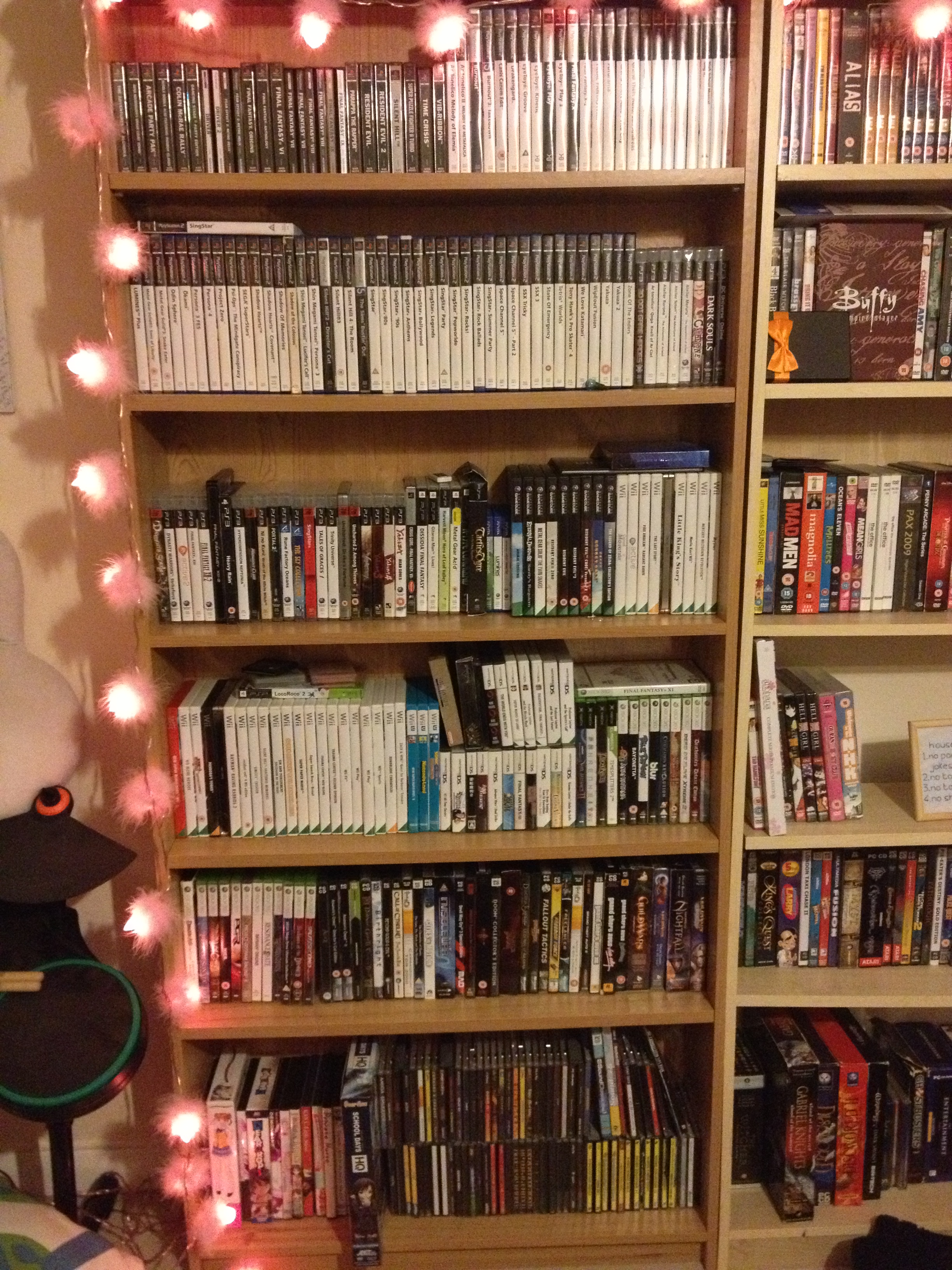
The unfortunate side-effect of collecting physical things, of course, is that you have to find space for all of them, and if you get into full-on "hoarding" mode, where you don't want to trade anything in, ever, then you need more and more space as time goes on. I've currently still got a few shelves free on the other bookcase, but it's starting to get a little bit tight… and then what? Creative packing time.
If you're curious, here's my game shelf as it stands right now. (The fairy lights were Andie's idea, but they are pretty sweet.) If you click to embiggen and zoom in on the image, you might even be able to see individual titles of at least some of the games. I haven't played all of these, not by a long shot, but they each — even the array of PS2 SingStar titles — represent something with genuine meaning to me. And that's pretty neat to think about.
I bought a PlayStation Vita today. I'd had my eye on one for a little while, but having successfully paid off my credit card for the purchase of my new Mac, I decided a little treat was in order, so I did a bit of research as to what the fine folks of the Internet thought was good games-wise, and grabbed one today. I was fortunate enough to be able to snare a preowned but unused model from Game in Southampton today, which cut down the price considerably, allowing me to also grab an (overpriced) 32GB memory card along with a copy of Everybody's Golf to enjoy for about £270 in total.
I've only spent one round with the latter so far (but it's bringing back pleasing memories of Tee Off on the Dreamcast) so I won't comment on that too much, but I did want to talk a little bit about the system itself, as I believe it's worthy of note.
The Vita distinguishes itself from its predecessor the PSP immediately with its touchscreen-friendly interface. Featuring an icon-based homescreen somewhat akin to modern smartphones, the Vita invites you to touch, swipe, flick, peel and all manner of other things. You can reorganise your homescreen icons as you see fit, and even set backgrounds for different pages. You can't organise things into folders, though, which is a bit of a shame, but I can cope with that. PlayStation Network (sorry… Sony Entertainment Network, which still amuses me because its abbreviation is the same as Special Educational Needs) provides plenty of downloadable goodness, ranging from complete games that you could also buy as physical products at retail to smaller, cheaper, download-only titles and even free apps for access to Twitter, Facebook, Skype and Flickr.
The downloadable side of things has, for me, always been a big strength of Sony's systems from the PSP onwards. The PlayStation Store is a veritable treasure trove of underappreciated and overlooked gems as well as some of the most memorable "art games" (for want of a better term) in the business — games like Flower and Journey, for example. PlayStation Minis, too, provide portable-friendly experiences akin to what you might play on a smartphone, only with dedicated controls to enjoy them with, which is a big boon to anyone sick of poorly-implemented touch controls.
Besides the games themselves, though, Vita has a number of interesting and intriguingly noteworthy features. For starters, the system actually does multitasking considerably better than both iOS and Android. A tap of the PlayStation button freezes whatever you're doing and takes you immediately back to the "OS". From here, you can "peel" the app off the screen to close it completely, switch to something else (like, say, the settings app, or Twitter) and then be back into your game without any messing around. This is particularly beneficial when you want to browse the PlayStation Store for addon content, for example — even the PS3 requires a quit out of a running game to access the Store, whereas Vita manages to seamlessly switch to it, let you browse as you see fit, then switch back. This functionality also allows you to effectively do what the Steam Overlay does for PC gamers — while running a game, you can pop open a browser window and, let's face it, look at GameFAQs.
Vita's interface is gorgeous, too. The big, high-resolution LED screen makes things look great anyway, but the design of the OS just begs to be played with, too. On the homescreen, flicking between screens causes the icons to wobble like they're hanging on pegs. Rather than "slide to unlock" if the machine goes into standby, you use the same "peel" motion that is used for closing apps. And the soft keyboard is pretty good, too, with a decent predictive text dictionary built in — though the size of the screen and its position means that "thumb typing" as on a smartphone is next to impossible. Fortunately, as the Vita is primarily a gaming platform, you won't be doing that much typing on it, so it's a design flaw I can forgive.
The built-in apps are interesting, too. Near allows you to see other Vita owners in your nearby vicinity, see what they've been playing and their responses to them. (I was surprised to see quite a few Vita owners living near me — I was expecting it to be a virtual ghost town around here.) Welcome Park introduces the system's little quirks — the multitouch screen, the rear touchpanel, the two cameras and the built-in microphone — through a series of simple but surprisingly engaging minigames, all of which have Trophy support for those who care that much. There's also a pleasing number of free downloads from the PlayStation Store, including a selection of social apps, a simple finger-painting app and even some games, including the hilarious and WarioWare-esque Frobisher Says.
All in all, I'm very pleased with my purchase so far. I've become somewhat disillusioned with iOS gaming recently — perhaps due to the fact I get to see some of the very best and worst titles as part of my day job — so I've been surprised how good it feels to have a dedicated handheld system again, particularly one that doesn't possess an app ecosystem that encourages developers to include "Get More Coins!!" options even where they're not wanted/needed. I shall look forward to many Everybody's Golf sessions on the toilet in the near future as well as a thorough exploration of the myriad joys the PlayStation Store has to offer me.
A lot of my fellow One A Day bloggers are avid video gamers. Many of them even write words about them on a professional basis. But there are others, like Pete Fraser, who are understandably bewildered by the whole thing. Sure enough, it's a fast-moving, exciting medium which many believe is difficult to penetrate if you haven't been along for the whole ride.
To that I say: pish, pfaugh and nonsense. There's never been an easier time to get into video games and find out more about them. Let me explain why.
It's unfortunate that the early days of gaming were plagued with stereotypes (which some people, see the delightful Jeff Minter, pictured to the right, are still more than happy to live up to) and this put a lot of people off getting into the hobby. It wasn't a "cool" thing to do. It was the thing that "nerds" did, and the sort of thing that could potentially get you beaten up at school if you were in a particularly rough and less-enlightened place.
The thing is, though, at least some of the stereotypes had partial basis in fact. Early gaming demanded many things. Patience. An understanding that you were dealing with a brand new technology that wasn't particularly refined yet. In many cases, a mathematical mind. A willingness to practice things until you got better. Early games were frequently simple affairs that artificially inflated their playtime by being ludicrously difficult. This made the hardcore gamers very happy when they were able to finally beat a particularly difficult level, but for people who might be interested in passing? They didn't want to spend that much time in front of a TV listening to the whining and squeaking of a cassette deck loading games.
Over time, though, games have become more and more sophisticated, family-friendly and accessible. A big part of this movement has come via games consoles, which have actually been around almost as long as home computers. Games consoles are made to be hooked up to "the big television" of the house and, in the early days at least, were often filled with experiences made to be shared—indeed, the very first gaming machines were primitive multiplayer "tennis" affairs. Later, we got many arcade conversions, and TV advertising, particularly the cringeworthy efforts from Atari, encouraged family participation and friendly competition.
As consoles became more and more sophisticated, developers started experimenting with a greater focus on developing narratives throughout their games. We saw titles such as the ambitious Final Fantasy series telling surprisingly mature, sophisticated (if now clichéd) stories through the SNES and PlayStation 1 periods having graduated from their primitive roots on the original NES. Graphics improved at a rapidly-increasing rate, giving us games that wanted more and more to be like the movies. But still they were tied to arbitrary control schemes that required practice; there was still a barrier of entry: "you must be this skilful to enjoy this medium".
Until we get to this generation. This generation of gaming has exploded. We're at a stage now where gaming is accessible to pretty much anyone. We're at a stage where gaming is no longer confined to one specific demographic. We're at a stage where you don't even need a controller to work your Xbox if that's the route you want to take.
Love them or hate them, several things have done a huge amount to make gaming more accessible to the masses. The Wii and the variety of plastic-instrument music games such as Rock Band brought family-friendly, "lifestyle" and party gaming back, reminding people how much fun it was to get together with friends and play in the same room. Kinect for the Xbox provides entertaining, active games that kids and adults alike can enjoy without having to remember which button does what. Facebook games like Farmville, while shallow to people who have been playing games for years, provide bored office drones and soccer moms with fun things to do on the Internet. Call of Duty lets the frat boys (and girl-equivalents) of the world blow seven shades of shit out of each other whilst shouting racial epithets at one another. And the blossoming independent development scene sees digital artists and creative minds pushing the boundaries of what "interactive entertainment" really means.
Games may or may not be art—that's an interminable question that may never be answered conclusively. But one thing games aren't? Just for teenage boys. Give 'em a shot. You might surprise yourself.
Why does the phenomenon of fanboyism still exist? And more to the point, why does it exist amongst men (and it pretty much is always men) who are old enough to know better?
The simple and easy answer is, of course, that it's always been around. I remember growing up as an Atari-based family and all of the Atari magazines at the time belittling the competition with stupid names like Spectrash (Spectrum) and Crappydore (Commodore 64). Then came the schoolyard arguments – SEGA vs Nintendo. Sonic vs Mario. "We've got Street Fighter II! Hah! …Oh wait, now you have, too." It got pretty silly.
Once the Dreamcast came out, it was hard to justify fanboyism because, certainly once SEGA's wondermachine came out, it was so far ahead of its competition – the 64-bit Nintendo 64 and the 32-bit PlayStation – that half-hearted attempts to call it things like "Dreampants" always came across as more than a little desperate.
Things then kicked off again with Sony vs Microsoft, with Nintendo kind of relegated to "background observer" by this point. The PS2 and the original Xbox both had fiercely loyal supporters when, in fact, you'd have a far better experience if you bought both systems, played the relevant exclusives on their respective platforms and played multiplatform titles on the Xbox. That's what I did, and I never felt the need to slag off any of the systems.
And it still goes on today, despite each of the consoles arguably offering a more distinct and unique experience from each other than ever before. The Xbox 360 offers its legendary ease of online play, the PS3 is home to a variety of unusual and interesting games (like Flower, flOw, Linger in Shadows, the Pixeljunk games) and the Wii is the family-friendly bundle of fun.
Still the hating goes on, though.
But nowhere is it more apparent than in the world of smartphones, particularly between the owners of iPhones, BlackBerries (let's pluralise it properly, please) and Android-based phones. iPhone owners are either Apple fanboys who bang on about how great Apple is all the time or jailbreakers who bang on about which ludicrously-named hack they're installing this week – and, of course, which apps they could get for free rather than paying for them on the App Store. BlackBerry owners seem to be updating their OS every night. And Android owners seem to be particularly sore about the iPhone for some inexplicable reason.
The question is: why? When it came to the early console wars, slagging off the systems your friends had was just schoolyard banter. You didn't really think that the systems were inferior, otherwise you wouldn't have gone around to their houses and played those games with them. The fact that this juvenile banter has grown up with people who have been using gaming and other consumer electronics for years is utterly baffling. Even people who started gaming at the same time as me – or before – are still bitching and moaning about how much better their handset is that [x]'s handset, and blahblahblah open source, blahblahblah build quality, blahblahblah BlackBerry Messenger, blahblahblah… You get the picture.
Am I alone in thinking that all of this stuff, without exception, is seven degrees of awesome and we should appreciate the brilliant things we have? Yes, some of them have more features. Yes, some of them are objectively "better" in terms of capabilities, power and technical specifications. But is that really any reason to act like 5-year olds telling each other that their respective Mums smell of wee?
 Hnng, I'm sure you will agree.

 A lot of my fellow
 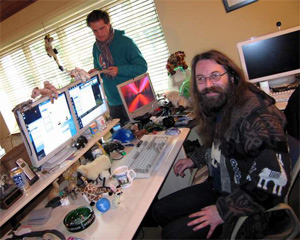 It's unfortunate that the early days of gaming were plagued with stereotypes (which some people, see the delightful Jeff Minter, pictured to the right, are still more than happy to live up to) and this put a lot of people off getting into the hobby. It wasn't a "cool" thing to do. It was the thing that "nerds" did, and the sort of thing that could potentially get you beaten up at school if you were in a particularly rough and less-enlightened place.