#oneaday Day 476: A few first impressions from Silent Hill f

I'm excited to be playing a brand new Silent Hill game in 2025. I wasn't sure how I felt about Silent Hill f transplanting the series from late '90s/early '00s America to 1960s Japan, but thus far it appears to be a change that works. If you've played any entries in the Project Zero/Fatal Frame series, you'll know that small-town Japan has plenty of scope for eerie activities, and such is the case with Silent Hill f.

I'm just shy of four hours in so far and thus far I've been having a good time. Protagonist Hinako, in true Silent Hill tradition, clearly has some Issues to work through, though the exact specifics of these haven't been revealed as yet, aside from the fact that her father is an abusive alcoholic and she resents her sister for moving away to get married. She also may or may not be dead; my internal jury's out on that one thus far.

As with prior Silent Hill games, Silent Hill f sees Hinako wandering through a sort-of open environment, stumbling across interesting happenings and finding horrific trouble at fairly regular intervals. This time around, rather than being completely alone, Hinako regularly runs into her school friends, who are seemingly seeing the same things she is seeing — there's always been some ambiguity in the series as to whether things are "really" happening — but for the most part she ends up having to act by herself in order to catch up with her peers in various ways.

Part of the narrative is clearly going to involve how Hinako is ostracised from certain parts of her supposed "friendship" group for refusing to conform to behavioural gender norms. Her best friend is an icky boy named Shu, and even as teens, they are still obsessed with their imaginary "Space War" games that they've been playing together since childhood. I'm interested to see quite how far the game ends up leaning into matters of gender identity, because it would very much be in keeping with the series' past of exploring psychosexual matters, among other things.

Much of Silent Hill f sees Hinako stumbling around in the fog as is series tradition, but likewise there are times when she finds herself in "other" places. In one sequence, she finds herself lost in a seemingly endless field of scarecrows and must solve a puzzle to find a way out; on several other occasions — seemingly when she's unconscious in the "fog" world — she goes somewhere completely different, shrouded in darkness, filled with mysterious temples and shrines, and guided by a man in a fox mask who almost certainly is not entirely trustworthy.

As you might expect, the game dives deep into traditional Japanese spiritualism and superstitions, with the main angle exploring the fox god Inari. There have been a couple of mentions of an "ancient god" that may or may not be Inari at various junctures too, though, so it remains to be seen where all that ends up — and whether Inari is a force one should feel comfortable putting one's faith behind.

Mechanically, it's pretty much as you would expect for a modern survival horror game. Combat takes a few cues from heavy-hitting stamina management action RPGs because of course it does, everything seemingly has to these days, but since the Souls games, trope codifiers for this type of experience, are effectively survival horror RPGs in many respects, it does make a certain amount of sense. It also helps to highlight that Hinako, as a teenage girl, is not a fighter. She can't take much punishment and she isn't particularly agile at swinging anything around with the intention of doing damage. As such, combat has a rather deliberate pace, though mistakes are punished quite severely, even on the default "Story" difficulty.

Initially I wasn't all that enamoured with this, but once you get a feel for its distinctive rhythm and learn to spot enemy tells — including some particularly explicit ones that allow you to counterattack — it's probably a good fit for Silent Hill, if indeed the series really "needs" combat at all. (Silent Hill: Shattered Memories was an attempt to do a Silent Hill game without combat, and it was mostly successful, though the "chase" sequences it had in lieu of actual fights were, at times, a little frustrating.)

The puzzles have been interesting so far, though despite the default puzzle difficulty being "Hard" none have been too taxing as yet. The trickiest one thus far took place in the aforementioned scarecrow field and required reading of body language and facial expressions to match a particular statement; I'm not entirely sure I solved this one "correctly", but it made internal sense to me while doing so and thus I'm counting it as a success.

I'm intrigued, then. I want to know more about Hinako's situation and what is really going on with her. There are quite a few different ways I can potentially see things proceeding from where I am thus far, and in keeping with series tradition, not many of them promise a happy ending for our heroine. And we longstanding Silent Hill fans wouldn't have it any other way.


Want to read my thoughts on various video games, visual novels and other popular culture things? Stop by MoeGamer.net, my site for all things fun where I am generally a lot more cheerful. And if you fancy watching some vids on classic games, drop by my YouTube channel.

If you want this nonsense in your inbox every day, please feel free to subscribe via email. Your email address won't be used for anything else.

#oneaday Day 472: Goodbye and thank you to Billy Chaser

I've made a YouTube video about this (above), but I thought I may as well type something up also. I will likely repeat myself.

Today I learned that a few days ago, Billy Hudson, better known as Billy Chaser and one half of The Game Chasers on YouTube, lost his battle with a brain tumour and passed away. I was deeply saddened by this news, because Billy was a wonderful part of the retro gaming community, and someone who had entertained and inspired me ever since I first stumbled across his channel about ten years ago.

At that time, I was working a boring, dead-end office job. I wasn't having a terrible time or anything, but I was bored and creatively unfulfilled. I was fortunate enough to have a desk with its back to the wall and in a corner, so I could watch YouTube videos without anyone noticing.

As it happened, prior to that job I had never really taken the time to explore YouTube at all, so I didn't really know where to start. I forget exactly how I found my way to The Game Chasers, but it was via a deep and branching rabbit hole that included channels such as Classic Gaming Quarterly, Classic Game Room, LGR, ProJared, Game Grumps, Game Sack and all manner of other folks, many of whom are still making great videos to this day.

The Game Chasers was really striking, though. This was a YouTube channel that had the production values of a TV show. Each The Game Chasers video could have easily been a broadcast TV show. Billy, one half of the core pair of Billy and "Shady" Jay, was a trained filmmaker, and it showed in his fantastic editing for each and every episode of the show.

The Game Chasers' concept was simple. It was like those reality shows where people rummage through storage lockers in search of treasure, but with a focus on video games. Billy and Jay would visit flea markets, antique stores, storage lockers and all manner of other places in search of retro classics — and often find some real wonders. This was in the years before "graded" collecting pushed the price of retro games up into ridiculously unattainable territory for most of us, so their stories were inspiring; indeed, watching The Game Chasers was pretty much the direct cause for me expanding my own collection so massively.

Billy was a wonderful character. He was funny and silly, but smart and knowledgeable. Part of the beauty of The Game Chasers is it made the viewer feel included. It made the viewer feel like they were part of the excitement of taking these trips, and part of the joy of discovering hidden treasures in dusty old lofts. It made the viewer feel like a valued friend.

And that was important to me! I have tried, and I have tried, and I have tried to get across to the people I know "in real life" how important retro gaming and computing is to me, but with each passing year, I grew more and more lonely as it became very clear that people not only don't care, they are, at times, actively hostile.

This was heartbreaking, because a hobby is so much more fun if you can share it with people. And as time went on, it was starting to feel I just… didn't really have anyone like that. As unhealthy as parasocial relationships are, watching shows like The Game Chasers made me feel less alone. It made me feel like there were other people out there as passionate about this as me. It made me feel like I wasn't the only one who still enjoyed all this stuff that I grew up with — and for more than just nostalgia. I enjoy collecting, playing and exploring retro games in the here and now — including both revisiting titles from my past, and discovering brand new favourites. That's entirely what my YouTube channel is about.

And that's why it's so sad that the retro gaming community has lost as wonderful a friend as Billy was. Most of us didn't know him personally, but I suspect if we found ourselves at a convention, he would have made the time to shake each of us by the hand and make us feel as welcome as we do watching his videos. And those out there who were fortunate enough to know Billy in real life had nothing but wonderful things to say about him. He would play up the joker aspect for the camera, but in private he would be an incredibly supportive friend.

The world is a worse place without Billy in it. And I hope wherever he is now, he finds eternal happiness amid endless aisles of every video game one might ever want — and endless friends to enjoy them with.

Rest in peace, you magnificent chode. You will be missed, not just by your close friends, but by the entire retro gaming community.


Want to read my thoughts on various video games, visual novels and other popular culture things? Stop by MoeGamer.net, my site for all things fun where I am generally a lot more cheerful. And if you fancy watching some vids on classic games, drop by my YouTube channel.

If you want this nonsense in your inbox every day, please feel free to subscribe via email. Your email address won't be used for anything else.
#oneaday Day 455: The Last Banana

I finished Donkey Kong Bananza this evening. I know I said I did that the other day, but I properly finished it this evening — all 777 collectible bananas and all the fossils (collecting all of which is, I was dismayed to discover very late, a prerequisite for getting all of the bananas) then completing the game's monstrously difficult final challenge in order to get… a slightly underwhelming "true" ending, to be honest, but I don't begrudge the game the additional time I spent with it. In fact, some of the game's best platforming challenges are found in the endgame sequence, so it's very much a case of "the journey is more important than the destination" here.

I mostly stuck to my desire to not use a guide for Donkey Kong Bananza, and I'm glad I did that, because dear Lord, a lot of the guides, even from "big" sites out there, are full of wrong information, or outright handwaving away the possibility of providing helpful information, largely because I suspect the author hadn't actually completed the game in some cases. I know this because the absolute final challenge in the postgame is something that could really do with a helpful walkthrough, and all one guide from a big site offered was a paragraph basically saying "use everything you've learned to clear these challenges" without going into any detail whatsoever. Good job!

Another guide even promised to "explain the ending", after there was some pre-release discussion on where this game might fit in "Nintendo canon", if such a thing even exists — then went on to post an entire article that basically shrugged its shoulders and went "I dunno, it's all speculation really". Clickbait at its absolute finest. No wonder the games press — and indeed the whole Internet — is dying.

But anyway. One of the nice things about Donkey Kong Bananza is that it has built-in hint functions. You have to pay the in-game price for them, but by the time you're doing the "cleaning up" required for the postgame, you will generally have plenty of the currency required to purchase these hints, along with a selection of powers that make 1) searching for hidden items and 2) acquiring more of said currency much easier. Consequently, on the few times I did peep at a guide, I found it didn't really help matters, and I inevitably found myself better off just exploring the game for myself and stumbling across things. The game is well-designed enough that you can just piss around and discover pretty much everything it has to offer, and that's testament to Nintendo's skills at making games like this — even with the added wrinkle of almost entirely destructible levels.

So, yeah. I really enjoyed Donkey Kong Bananza. I'm glad. I had a feeling it would be good, because I really enjoyed Super Mario Odyssey, and the same team worked on this. I had my misgivings, because I've never really had a lot of time for Donkey Kong as a character, but I must say, spending a considerable amount of time in his company has brought me around on him. Granted, he's almost as much of a blank slate as his stablemates Mario and Link in terms of characterisation — he has no dialogue whatsoever, despite the other "Kongs" you encounter being able to talk — but his goofy facial expressions and his interactions with Pauline are consistently delightful. Not only that, but they evolve over the course of the game as a whole; the eventual close relationship between Pauline and DK by the end of the game is rather heartwarming to see — even if in the "normal", pre-postgame ending, DK comes across as a bit of a selfish dickhead. It's at times like that you have to remember that he is, in fact, a gorilla.

Donkey Kong Bananza is a great addition to Nintendo's pretty flawless record of first-party games, then. It's definitely a good showcase of the Switch 2, even if other titles in this regard are a bit thin on the ground, and absolutely worth the money, time and effort to fully enjoy it. I'll remember this fondly for a very long time, I feel. But now I need to go to bed!


Want to read my thoughts on various video games, visual novels and other popular culture things? Stop by MoeGamer.net, my site for all things fun where I am generally a lot more cheerful. And if you fancy watching some vids on classic games, drop by my YouTube channel.

If you want this nonsense in your inbox every day, please feel free to subscribe via email. Your email address won't be used for anything else.

#oneaday Day 453: The Generation Game

There's been some resurrected discussion today on the subject of "video game console generations", primarily based on a month-old Bluesky post from a member of the Video Game History Foundation describing them as largely unhelpful, and something that serious video game historians don't rely on at all. He posited that "generations" were made up by a Wikipedia editor in the early 2000s, and people have just sort of accepted them as "gospel" ever since.

As another part of the discussion, others have objected to descriptors like "8-bit", "16-bit" and suchlike for similar reasons.

My feelings on the subject are relatively straightforward. I agree that the "generation" thing isn't necessarily helpful — if someone uses it, I always have to look them up and check which one is which, particularly when people like EA attempt to redefine what the "generations" were, as they did around the start of the PS4 era — but I don't have a problem with "8-bit", "16-bit", "32-bit" and the like — up to a point. Dreamcast was the last console that people really referred to in terms of its "bits" ("128-bit") and that didn't really catch on; after that people just sort of… gave up, perhaps because console architecture became a bit more complicated. I don't actually know why we stopped talking "bits", but we did.

Anyway, one area where I do disagree a little with what appeared to be emerging as the popular consensus is that I think it is helpful to stratify computer and video gaming technology in terms of rough contemporaries, because while numbering generations isn't necessarily helpful, saying that the Atari 8-bit, ZX Spectrum, Commodore 64, Apple II, Amstrad CPC and numerous others all coexisted at the same point in history — though some endured longer than others — is useful.

If you consider rough contemporaries, you get into some interesting overlapping territories, too, such as where the Commodore 64 and Spectrum were happily coexisting with the Atari ST and Amiga, or where the Super NES was still holding its own against early PlayStation games. Those are interesting periods of history to talk about, not least because the "outgoing" hardware tends to have thoroughly fascinating (and often quite hard-to-come-by) games released during those curious times of overlap. And this is to say nothing of the fact that the "generations" of home computers work a bit differently to those of the consoles, especially since it pretty much went "8-bit, 16-bit, PC" and then sort of stopped when "PC" became a thing unto itself.

I think it is also helpful to distinguish distinct groups of computer and gaming hardware by their capabilities, also. Again using the home computers as an example, there is an obvious technological leap between the ZX Spectrum and the Amiga. There's another massive difference between the NES and Super NES. Those differences aren't all down to the "bits" of course — in most cases, it's more about the custom hardware and its capabilities, hence how the "8-bit" PC Engine is more commonly considered as a contemporary and rival of something like the Mega Drive rather than the NES — but there are clear moments when the industry has gone "we're releasing something new now, and it's going to be way more impressive than anything you've ever seen before".

I actually think it's somewhat easy to forget quite how fast things moved in the '80s and '90s, since today's technological advancements, particularly in terms of visual fidelity, have slowed to a crawl. There was another good post recently about how you could have released a game from ten years ago (like Metal Gear Solid V) today, completely unchanged, and no-one would know it wasn't a brand new game. That certainly wasn't the case ten years ago, and not at any point prior to that, either. Things were moving just so quickly that it was kind of mindblowing to see.

And it's easy to forget how surprisingly early some of these advancements happened, too. The Atari ST and Amiga came out in 1985, when the 8-bit home computers were still thriving — hence the considerable years of crossover. The PlayStation came out (late in) the same year as Super Metroid, Sonic the Hedgehog 3, Earthbound and Donkey Kong Country, all games that most would probably agree were released while the SNES and Mega Drive were in their absolute prime.

So yes. Numbered generations are kind of stupid. But I do think there's value in looking at the things that were coexisting at a given moment — and at the notable leaps forward computer and gaming technology was taking throughout the 1980s and 1990s in particular.

I guess, as with everything, the real value is in just saying what you actually mean rather than trying to find a catch-all shorthand — if only because that catch-all shorthand often assumes knowledge that not everyone has. Same reason I don't like using "Metroidvania" or "JRPG"; much better to be specific about these things and say what you really mean. In an age of attention-deficit "short-form content", being verbose and detailed can actually make you stand out quite a bit. In a good way.

At least I hope so, because I'm not changing.


Want to read my thoughts on various video games, visual novels and other popular culture things? Stop by MoeGamer.net, my site for all things fun where I am generally a lot more cheerful. And if you fancy watching some vids on classic games, drop by my YouTube channel.

If you want this nonsense in your inbox every day, please feel free to subscribe via email. Your email address won't be used for anything else.
#oneaday Day 452: Creepy, kooky, mysterious and spooky

Now I've got the MiSTer Multisystem 2 up and running to my satisfaction (not helped by some sort of accident corrupting the entire SD card's filesystem, necessitating a complete reinstall of everything — I'm running games from an external hard drive now, and have taken a complete backup of the system software!) I have been enjoying the pleasurable experience of being able to sit down in front of my old faithful Sony Trinitron CRT and play… pretty much anything I want up to the Saturn, PS1 and N64 era.

As you will doubtless know if you've been following me for any length of time, I am a passionate advocate for physical releases of video games. My living room is effectively a games library, and I wouldn't have it any other way.

But I must say, there is an absolute, definite appeal to having a dedicated box that I can boot up, say "I feel like playing [insert game name here]" and be doing so within a matter of seconds. No fiddling around with SCART cables needed. No digging out the correct power adapter required. No blowing on cartridge pins or isopropyl alcohol on cotton buds required.

Not only that, but a significant portion of software that one can play on the MiSTer has been creeping into "unattainably expensive and/or hard-to-find" territory over the course of the last few years — particularly anything from the 16-bit or 32-bit platforms, and especially role-playing games. I could drop several hundred quid on a copy of Panzer Dragoon Saga, or I could just play it on MiSTer. The choice is pretty clear.

"Now hold on a minute, good sir," I hear you say. "Don't you work in official retro gaming rereleases?" And to that I say, yes, absolutely, I most certainly do. But unfortunately, however much many of us might want them, there are some games that are never, ever, ever going to get an official rerelease for all manner of different reasons. And in those cases in particular, there is zero shame to be felt in experiencing them via… let's just call them "unofficial" preservation methods.

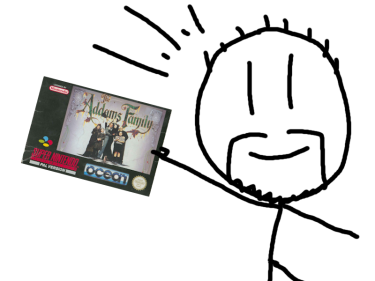
But anyway. I want to talk a bit more specifically about one of those unofficially preserved games I have been playing and enjoying for the past few evenings. It's not a particularly rare or hard-to-find game to my knowledge (checks CEX — £12 loose, £38 complete in box at the time of writing) but it is one I have some fond memories of, and one that I doubt will ever get an official rerelease. It's Ocean's The Addams Family, a platformer based loosely (very loosely) on the 1991 movie, and which was available on numerous different platforms; I've been playing the SNES version.

I'm actually not entirely sure how I attained those memories, mind, because I never owned a copy of The Addams Family on any platform back in the day. I might have had a demo of the ST version (which is surprisingly competent) but I certainly never had the full game on anything. But I definitely played it.

What I suspect happened is that on one of my brother's trips home to visit us — by this point he had left home to go and work on Games-X magazine at Europress up in Macclesfield — he had brought a SNES with him, and one of the cartridges he had also brought along was The Addams Family. The only other possible alternative is that one of my friends from school had it — and I don't think they did. My main SNES-owning buddy at school played various versions of Street Fighter II almost to the exclusion of everything else (although I did borrow Super Star Wars multiple times from him), and my other main console-playing friend was a Mega Drive man.

Anyway, I guess that isn't really important. What is important is that The Addams Family for SNES left a solid impression on me, with probably the most potent part of that memory being the amusing farty noises that play whenever Gomez jumps on an enemy (fart-POP!) or if he takes damage (breathless clown car-horn HONK). Aside from those excellent sound effects (and they are excellent; it's been a delight to hear them again), I remember simply enjoying the game a great deal, too, and I'm pleased to report that It Holds Up.

Lest you've never played The Addams Family on SNES (or any of the other platforms it appeared on), you take on the role of Gomez, who is attempting to rescue the various members of his family from… some sort of unfortunate circumstance that was probably a flimsy reference to the movie's plot. I forget. It doesn't matter. What does matter is that your quest unfolds as an open-structure 2D platformer that eschews a linear level-based structure in favour of giving you a big, open map, the vast majority of which is open to you from the outset, and then inviting you to just get on with it.

I'm not sure I'd call The Addams Family a "Metroidvania", largely because that term can get in the bin, but also because I'm not sure its commonly agreed definition applies here. Sure, you have a big open map to explore, but areas are not gated by abilities that you gradually acquire as you progress. Instead, only the finale sequence is gated by you having completed the rest of the game, and you are otherwise left to tackle the game's various challenges in whatever order you see fit.

These challenges are upgrading your health bar three times, then finding Wednesday, Pugsley, Granny and Fester Addams in whatever order you please. (You can even find them before the health upgrades if you want to, but the extra hearts make it much easier.) After that, the door to the final challenge, where you can rescue Morticia and take on the game's final boss, opens up and you're on the way to beating the game.

Being developed by Ocean, one would expect The Addams Family to have a certain "Euro" feel to it, and this comes across in its structure, with each of the game's main areas being split into named rooms that give a hint as to what hazards the player can expect in there; there's definite shades of classic home computer games like the Dizzy series and Spellbound from the Magic Knight series here, but rather than being single screens, each room in The Addams Family is a scrolling mini-level in its own right.

Thankfully, the game resists the temptation to get a bit too Euro in its structure, as while it is non-linear and often presents the player with multiple possible routes, it's not really possible to get "lost", and any necessary backtracking is generally assisted by helpful shortcuts. There's no map to refer to, either; while it might have been helpful to have one, after spending a bit of time with the game you'll find it pretty intuitive to navigate. The real joy is in discovering the game's many, many, many secret areas.

The Addams Family drew some criticism on its original release for being "derivative" — and by that most reviewers meant that because you jump on enemies' heads, it's a Super Mario clone. And, to be sure, there were a lot of 16-bit platformers around at the time, many of which were based on popular movies.

But for me, something always stood out about The Addams Family, even with its many peers in the genre. It was slick, well-designed and enjoyable to play — and I'm pleased to report that it is still all of those things. It's been a genuine pleasure revisiting it over the course of the past few evenings, and I'm looking forward to creeping my way gradually towards beating it. I've already got all the heart upgrades and rescued Wednesday; next up is Granny, Pugsley or Uncle Fester. It'll be great to finally tick this off my list — and I suspect it won't be the last time I play it through once I've beaten it, either.


Want to read my thoughts on various video games, visual novels and other popular culture things? Stop by MoeGamer.net, my site for all things fun where I am generally a lot more cheerful. And if you fancy watching some vids on classic games, drop by my YouTube channel.

If you want this nonsense in your inbox every day, please feel free to subscribe via email. Your email address won't be used for anything else.

#oneaday Day 450: Ooh, banana

I finished the main story of Donkey Kong Bananza last night, and I've been playing through the postgame today. I will do a proper full post about the game as a whole over on MoeGamer in the not-too-distant future, but suffice to say for now that I have had an absolutely lovely time with this game, and I'm very likely going to "100%" it. Or, at the very least, get all the collectible bananas; I haven't decided if I'm going to try and max out the skill tree (which requires a touch of grinding other collectibles to purchase even more bananas that aren't scattered throughout the game world) — probably not.

Donkey Kong Bananza is one of the best examples to date of how Nintendo still understands what makes video games a distinct medium all their own. It tells a story, sure, but that story is brief, to the point and never obtrusive. There is no point in Donkey Kong Bananza where more impatient types will find themselves mashing buttons to bypass dialogue; the emphasis is firmly on keeping you playing, exploring and having a good time.

And the very nature of Donkey Kong Bananza's mechanics means that it is more of a toybox than even the most recent Super Mario games. The fact that a significant portion of each level is completely destructible means there are a lot of challenges you can approach in very different, creative ways. There are obvious "intended" ways for you to solve things, but the game is open to you trying other things and experimenting. Even more so than Super Mario Odyssey, Donkey Kong Bananza rewards you for asking questions of it and going in search of answers. Almost everything you do will reward you somehow; curiosity and creativity are encouraged, and it's very difficult to get "stuck".

That's not to say it's easy. It strikes a good balance between accessibility and challenge factor. Blasting through the main story will probably be fairly breezy for most players, but each of the game's areas has numerous optional challenges that test all sorts of different skills. Donkey Kong is capable of quite a few different actions by the end of the game, but crucially, the game never overwhelms the player with options and obtuse button combinations. Instead, the control scheme is simple and straightforward, and new mechanics are introduced gradually, one at a time, with plenty of opportunity to practice them in a "safe" environment before having to contend with them under more challenging circumstances.

This is, of course, the same philosophy that modern Super Mario games are designed around, and there's a reason: it works. It gives the game a good sense of pace, means it never gets bogged down, but also keeps things constantly interesting. And, by the end of the game, having all these options available to you doesn't mean "pick the right one to succeed"; it instead, under most circumstances, means "pick the one you think will succeed, and you can probably make it happen".

It's a truly magnificent game, and absolutely a good reason to grab a Switch 2 — even if other reasons to have one are still a little thin on the ground right now. (That said, don't discount the Switch 2's improved performance on a significant number of Switch 1 games as a selling point; it really does make a difference, and is a worthwhile upgrade for that alone.)

I've got a week to finish the postgame before we go on holiday. Nothing bad will happen if I don't — and I will probably be taking the Switch 2 with me — but it would be nice to have it all wrapped up before then. I think I've done a lot of the hardest, most challenging/annoying (delete as applicable) postgame objectives already, so now it's just a case of working my way through and cleaning up the remaining objectives on my way to the grand finale. Easy, right…?


Want to read my thoughts on various video games, visual novels and other popular culture things? Stop by MoeGamer.net, my site for all things fun where I am generally a lot more cheerful. And if you fancy watching some vids on classic games, drop by my YouTube channel.

If you want this nonsense in your inbox every day, please feel free to subscribe via email. Your email address won't be used for anything else.
#oneaday Day 445: An evening with MiSTer

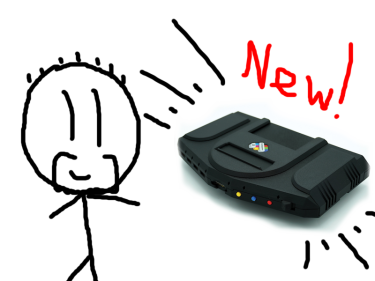
The many, many gigabytes of Stuff I'd been copying to my MiSTer Multisystem 2 finally finished during the workday today, so as soon as I was off the clock it was time to dive in and try some things!

I had a couple of unfortunate hiccups along the way, most notably with Starwing, which kept freezing up and crashing, seemingly at random. I tried several different ROM files and that didn't seem to fix it; other SNES games seemed to work fine, but other Super FX games (such as Yoshi's Island) also displayed the same lockup problems with the same or even greater frequency. A bit of digging around the Internet revealed that the SNES core is seemingly having a few woes with Super FX games right now, so I guess I'll just have to wait until that's sorted to get my Starwing on. Unfortunate, but it's not as if there's nothing else on there to play!

My second hiccup was with the Atari ST. I set it up to use Pera Putnik's excellent hard drive image of games that had been converted to run from hard drive and under pretty much any revision of the operating system (under normal circumstances, quite a few ST games can be very picky about this) and… starting any game up resulted in the dreaded "bombs" — the ST's error screen. Then I remembered that it's recommended you run the games from this hard drive image with more than a megabyte of RAM due to the extra features that have been bolted onto them, such as save states. On my real STE I was running them with 4MB and it worked great, so I bumped the MiSTer's virtual ST RAM up to 4MB and suddenly everything was working perfectly. Wonderful.

I had a bit of a tinker with the 60Hz games, too. The 60Hz squish that is my TV's trademark is a tad variable depending on what system you're using — presumably it relates to the specific resolution a console is outputting, which would account for why ColecoVision is super squished, while SNES, PS1, PC Engine and suchlike just have black borders no bigger than your typical unoptimised PAL conversion from back in the day — but the performance is absolutely lovely. I tried the NEOGEO core, and it's beautiful.

For me, I think the biggest thing that CRTs provide over and above modern displays is the sheer smoothness of movement, particularly with something like scrolling. I'd long suspected that this was the case, and while I was setting up the MiSTer I put it to the test, running a game through both the analogue and HDMI outputs simultaneously. On the CRT, the scrolling was silky smooth. On the HDMI monitor, it was pretty smooth, but nowhere near as slick. Granted, the HDMI monitor I'm using is not exactly one optimised for gaming (it's an office castoff from a friend) but the difference was… marked.

So what have I actually played this evening? A few things! I didn't want to be jumping around too much, so I tried to pick a few things that I could settle in with for a while. I was hoping to spend the whole evening revisiting Starwing, since I haven't played that properly for many years, but, well, see above for what happened there.

After a bit of fiddling around trying (and failing) to get that to work, I booted up a game I'd only ever played a demo of previously: Kula World (aka Roll Away to Americans) on PlayStation. This is a puzzle game in which you control a beach ball on some suspended platforms, and your aim is to gather the keys to open the exit, perhaps score some bonus points along the way, then get to the exit. The twist is that as well as rolling along the platforms and jumping, you can also roll around the "end" of platforms to move onto different faces, thereby opening up different angles of exploration. The game starts simple but becomes a bit of a brain-bender before long, particularly as you're against the clock on each stage!

Then I thought I'd have a poke around in the AmigaVision collection, which is a huge pile of Amiga games with a nice front-end launcher. I plumped for HeroQuest II: Legacy of Sorasil, a game I've always been curious about — and a tad bitter that it never came to ST, as I really enjoyed the original HeroQuest on ST. I reckon the ST could definitely handle HeroQuest II — though I suspect the fact it was a 1994 release was the main reason we never saw an ST version, rather than fears the platform wouldn't be able to handle it. By 1994, I'm pretty sure we'd converted to being an MS-DOS and Windows 3.1 household, though the STs still got some use by my Dad for MIDI purposes. The Amiga, meanwhile, was still clinging on for dear life at this point, bless it.

I'm really impressed with the home computer experience on MiSTer so far — though given the project's origin primarily as a means of emulating Amiga and ST in FPGA hardware, this probably shouldn't surprise me. The Atari 8-bit core is very pleasing indeed, happily runs both disk images and Atari executable .xex files, and makes the correct noises while loading. I haven't tinkered with the C64 and Spectrum cores as yet, but I suspect those will be just as enjoyable to play around with.

I made the right choice hooking up a keyboard and mouse to the MiSTer from the get-go. Having it ready to go as both a classic computer and a games console really showcases the flexibility of the device — and the many generously provided USB ports on the Multisystem 2 mean there's no real swapping things around needed. I'm definitely looking forward to getting back into some proper classic computing with the system — I might see if I can make more sense of the programming tutorials in magazines than I could as a kid, and actually see if I can learn something along the way. We'll see.

For now, I'm very happy indeed. It was a lengthy process to get everything setup — and it doesn't have to be quite as lengthy as what I did, but I wanted a fairly "future-proof" setup — but now I can just flip a switch and be in retro heaven without having to swap cables around or remember where I put fifteen different power adapters. Plug and play! It'll never catch on.


Want to read my thoughts on various video games, visual novels and other popular culture things? Stop by MoeGamer.net, my site for all things fun where I am generally a lot more cheerful. And if you fancy watching some vids on classic games, drop by my YouTube channel.

If you want this nonsense in your inbox every day, please feel free to subscribe via email. Your email address won't be used for anything else.

#oneaday Day 444: The 60Hz Squish

The MiSTer is nearly completely set up! It's just copying over a shitload of PlayStation and Saturn games, and then it will be ready to go. I got a replacement SCART cable today, and I'm delighted to report I can now get an absolutely lovely picture on my beloved old CRT, which means the MiSTer can be used to enjoy a retro gaming experience as "authentic" as it's possible to get without using real hardware.

I've elected to load the system up with primarily PAL-format ROMs. I know some folks will get sniffy about this, but I have three reasons for doing so.

Firstly, I live in the UK. PAL gaming is what I grew up with, and part of getting the MiSTer set up and working is about recreating that classic experience of using computers and consoles on this Sony Trinitron TV — which is the same one we used to run the Atari ST through back at my parents' house, and which is the same one I took with me to university and played PlayStation games on, right up until I bought an absolute monster of a CRT from a local second-hand shop in my second year at university. That TV, sadly, died after probably one too many house moves (it moved to three different houses in Southampton, then another in Winchester before finally giving up) but the CRT I'm using now is still going almost as strong as it ever was.

Secondly, this TV has a peculiar idiosyncrasy where it is capable of displaying a 60Hz signal, but rather than switching "modes" to do so, it instead just takes the reduced number of lines from a 60Hz/NTSC signal (480 vs 576 for PAL) and plonks them in the middle of the screen as-is. This means that, in stark contrast to slightly later TVs with marginally better 60Hz compatibility, where switching to 60Hz ensures you get a screen-filling picture and slightly better frame rate with more prominent scanlines, running 60Hz systems and games on my particular TV results in varying degrees of picture squish, ranging from "a bit" to "I never knew the ColecoVision had a 16:9 mode". As such, since I'll be primarily using the MiSTer on this CRT, the optimal experience for me is actually to use 50Hz versions of games.

Thirdly, I feel like to a certain extent, PAL gaming history gets a bit forgotten about. It was quite a challenge to track down EU/PAL-specific ROMsets for each console that I want to run on the MiSTer, but I took the time to do so, and I think it will have been a worthwhile use of my time to do so. A lot of complete ROMsets archived online these days are US-centric, and, sure, the 60Hz NTSC versions of games may, in most cases, be the "best" way to experience these games, but that doesn't mean the PAL experience should be erased from history. In fact, there are several cases where PAL versions of games were substantially different from their North American counterparts, with a great example being the Gex games on PlayStation; the voice of the titular character was completely different between the US and Europe, giving each version a very different feel. Several Gran Turismo titles, too, also had markedly different soundtracks between regions.

So yeah. Outside of a few NTSC-specific things I'm loading on where there was no PAL equivalent (we missed out on a lot of RPGs until the PS2-3 era!) this MiSTer is primarily going to be a celebration of the PAL experience. And I'm really looking forward to this danged copy job being over and done with so I can actually sit down and play with the thing!

Still, this is what I signed up for. I knew it was going to take a while to get everything up and running. It's going to be well worth it when it's done.


Want to read my thoughts on various video games, visual novels and other popular culture things? Stop by MoeGamer.net, my site for all things fun where I am generally a lot more cheerful. And if you fancy watching some vids on classic games, drop by my YouTube channel.

If you want this nonsense in your inbox every day, please feel free to subscribe via email. Your email address won't be used for anything else.

#oneaday Day 443: MiSTer whatchacallem whatcha doin' tonight

So! My MiSTer Multisystem from the lovely folks at Heber and the Retro Collective arrived yesterday, and… I've been spending a lot of time setting it up. This was entirely expected, so I'm not annoyed or anything — though I was a tad surprised that the update_all script took nearly 24 full hours to complete. It's my fault for running it on Wi-Fi in the room that has the weakest Wi-Fi signal in the whole house. I thought before I started, "I wonder if I should do this over Ethernet," and I knew on some level even then that the answer to that was an emphatic "yes", but still.

Anyway, it is done now, and now I have a working, functional MiSTer Multisystem up and running. There's one thing I haven't been able to test thus far, which is analogue connectivity to a CRT TV — it seems the cable I bought to use with the MiSTer isn't quite right, so I have some replacement options arriving tomorrow — but from a very brief play earlier, I'm very impressed so far. While there is plenty of scope for nerdy nerds to get deep into the weeds tinkering with things and trying to "optimise" their experience, after running update_all and installing some games, the whole thing is remarkably straightforward and easy to use, particularly if you're just connecting up to an HDMI display.

On the offchance you don't know what a MiSTer Multisystem is, it's… well, it's sort of complicated. MiSTer itself is an open-source project that uses FPGA hardware emulation to recreate the experience of using classic computer and gaming hardware. It is different from software emulation for reasons I don't entirely understand, but the gist of it is that an FPGA chip can be reconfigured by issuing it commands, and in doing so you can make an extremely accurate simulation of a physical piece of electronic hardware. The upshot of it is that FPGA emulation has the potential to be much smoother and more authentic to the original experience than software emulation is.

The MiSTer Multisystem — or, to be more accurate, the MiSTer Multisystem 2, which is what I've got — is an attempt to make MiSTer more accessible. For many MiSTer users, putting together a MiSTer system involved getting a DE-10 Nano little computer-on-a-board thing, plus some I/O boards, putting them altogether in a stack and then installing the software on an SD card. As hardware projects go, it's not especially complicated or super-expensive, but there was definitely a market for a more "consolised" experience. MiSTer Multisystem 2 takes all the pain out of the actual hardware side of things in that it's a ready-to-go console available in both digital (HDMI) only or digital-and-analogue (HDMI plus VGA and/or SCART) forms. The whole thing is pre-assembled, no need to build anything, and it's also not reliant on the DE-10 Nano, either, which can sometimes be tricky or expensive to track down.

You still have to set the software side of things up yourself, though this is made pretty straightforward through the aforementioned update_all script, which connects to the Internet and downloads pretty much everything you need apart from the actual games themselves — and even then, it will even download the arcade games that the MiSTer's various "cores" support, so once you've run it, you'll have things to play, ready to go, even if you don't add any of your own ROMs and disc images to the system.

MiSTer itself is modular and expandable, and so too is the Multisystem 2. A cartridge slot allows for the connection of "SNAC" (Serial Native Accessory Converter) cartridges, which allow you to plug in original control pads and accessories for a variety of systems, plus the system has 7 USB ports for connecting controllers, keyboards, mice, external storage devices, Wi-Fi dongles and any other gubbins that might be useful. There are also some slots inside the system itself, accessible by removing the special flaps at the side, though exactly what those are used for is not yet known.

But anyway! Once you're up and running, you pick something from the main menu to play, the "core" for the device the system is emulating will boot up, and then you're away. Some excellent video options allow for some quite convincing CRT emulation on HDMI displays, and if you have a model that supports analogue video output, you should be able to just plug in an RGB SCART cable and connect to a suitable display. I'm hoping to take advantage of that side of things when my new cables arrive tomorrow.

I have a lot of games still to transfer to the system, but I think I've earned a bit of a play for the rest of this evening. Hopefully by the end of tomorrow I'll have this thing up and running and ready for a whole heap of fun!


Want to read my thoughts on various video games, visual novels and other popular culture things? Stop by MoeGamer.net, my site for all things fun where I am generally a lot more cheerful. And if you fancy watching some vids on classic games, drop by my YouTube channel.

If you want this nonsense in your inbox every day, please feel free to subscribe via email. Your email address won't be used for anything else.

#oneaday Day 441: Is it actually impossible to recommend things to anyone any more?

I can't remember the last time I successfully recommended something to someone. Be it TV show, movie (not that I really watch movies any more), music or video game, it seems inordinately difficult to get anyone to give a shit about something you might feel quite passionately about — even if you're close with the person you're attempting to recommend something to.

I say this in the light of online Discourse™ right now being taken up almost entirely by breathless ejaculations in the direction of Hollow Knight: Silksong, which apparently now has a release date and everybody (except me) is enormously excited about to the exclusion of pretty much anything else in existence.

I've talked before, I think, about the phenomenon of "inverse hype", where the more something is talked up and talked up and talked up, the less I give a shit about it. It's happened with numerous things over the years for me: Star Wars, Mass Effect (I've still never even touched the third one despite quite enjoying the first two), Undertale (which I have since played and enjoyed) and now — and for the last seven years — Hollow Knight: Silksong.

It's the Internet's fault, of course. The seven-year long "joke" of responding to literally every video game announcement or livestream with "silksong when" quickly wore out its welcome and then proceeded to continue for nearly a decade. It's been so long now that I feel active antipathy towards Hollow Knight as a whole, despite it being a type of game I would typically rather enjoy. I don't want anything to do with Hollow Knight precisely because people will not shut the fuck up about it.

And part of that not shutting the fuck up also includes closing one's ears to any alternative possibilities. Already other developers are (perhaps wisely) moving their release dates so they don't "overlap" with Silksong when it eventually releases in early September.

The problem exemplified by Silksong, I think, is that apparently "The Community", whatever that actually means, is only capable of Giving A Shit about one Thing at a time. That Thing changes from moment to moment, but it's always something that has, for one reason or another, had both a lot of blanket coverage and a lot of speculation about it. And while that Thing is the Thing Of The Moment, no-one has any time whatsoever to even contemplate that other Things might exist, because if you're not "part of the conversation" while Thing is Thing Of The Moment, you might as well just kill yourself, you stupid, pointless, irrelevance, you.

It's probably a personal failing to be frustrated and resentful of this, but I've never really operated that way. There's the occasional thing that I enjoy jumping on board with to enjoy at the same time as everyone else — the last two were Mario Kart World and Donkey Kong Bananza — but other than that, I typically enjoy things at my own pace, sometimes a very long time after they were initially released. This often means that I "discover" something when it's outside of the mainstream public consciousness — if it was ever there in the first place, which in many cases for the things I personally enjoy, it wasn't.

Unfortunately, that lack of blanket coverage and generally mainstream "approval" is seemingly crucial for a lot of people, so if you recommend something that the person you're making the recommendation to hasn't heard of, typically, I find, you'll be dismissed or even ignored.

I suspect this ties in with the "well, why would I waste my time with a 65/100 game when I could be playing nothing but 95/100 games?" I'm sure many of you know my answer to this already — it's because the 65/100 games are, in many cases, more interesting and creative than the 95/100 games, and also because slapping numerical ratings on something unquantifiable is stupid. But too many times I've encountered the "well I read a review once that didn't like it" response to a personal recommendation — which I made because I knew the thing I was recommending would particularly appeal to the person I was recommending it to, if they'd give it a chance — and, at this point, it's just getting far too annoying to even attempt recommending anything any more.

The real problem at the heart of all this is doubtless that there are too many Things. The implication behind the "why should I waste my time with a 65/100 game" question is that an individual has a finite amount of time, and that time is somehow "wasted" if it is not spent "optimally", even if that time is being spent engaging with something that is entertaining, artistic, enriching. And "optimal" to a lot of people today means the mistaken assumption of the "objectively best" thing — a concept which doesn't actually exist.

Right now, while polishing off Donkey Kong Bananza, I'm also playing through Mystery Detective Archives: Rain Code, a game which came out in 2023. I'm willing to bet that I'm probably the only person playing that game right now, because two years ago might as well be the Dark Ages for some people.

Sigh. This really isn't worth getting worked up over, I know. It's just frustrating when you try and start a conversation and you feel like you're continually confronted with a blank wall with "silksong when" scrawled on it in crayon.


Want to read my thoughts on various video games, visual novels and other popular culture things? Stop by MoeGamer.net, my site for all things fun where I am generally a lot more cheerful. And if you fancy watching some vids on classic games, drop by my YouTube channel.

If you want this nonsense in your inbox every day, please feel free to subscribe via email. Your email address won't be used for anything else.