
#oneaday Day 259: Excavations

I successfully did what I planned yesterday — for two nights in a row, even. Last night I spent some time with Smashing the Battle on Nintendo Switch, which I'll write a bit more about once I've spent some more time with it, and tonight I have seemingly spent nearly six hours playing The Excavation of Hob's Barrow, a point-and-click adventure by Cloak & Dagger Games, published by modern adventure game specialists Wadjet Eye Games.

It always does my soul good to see how not-dead the point-and-click adventure genre has been for quite some time now, because there was definitely a period in the mid 2000s and early 2010s where it felt like there weren't any being made. 3D tech was getting better and everything was suddenly all about cinematic action games — something that certainly hasn't gone away in more recent years — but, looking back, it's clear that adventure games never really went anywhere. And these days, I'd say they're thriving more than they ever have done, even in their supposed golden age. Because not only can we enjoy the established classics from that golden age, there's a host of new ones seemingly being made all the time.

I'll write more specifics about The Excavation of Hob's Barrow when I've fully completed it — I've pressed pause on it for this evening as it's a quarter to one and I should probably sleep. Suffice to say for now that it's very good, though.

In The Excavation of Hob's Barrow, you take on the role of Thomasina Bateman, an antiquarian who has made it her mission to document the various ancient burial mounds scattered around the English countryside. We join the story as she arrives in a remote Northern village, supposedly the home of the titular Hob's Barrow, but she's immediately confronted with mysteries as her contact is nowhere to be seen and no-one seems to want to talk about Hob's Barrow.

That's all I'll say on the plot for now. The interface uses a pretty standard two-button system, with left-clicking "doing" things and right-clicking "looking" at things, but there's plenty of thinking required. Thus far there has been no real "moon logic" to speak of, just a sequence of tasks to complete that provide a sense of relative freedom without overwhelming you with possibilities. In fact, the game is quite cleverly designed in that the "freedom" you feel is not really present at all; there's quite a fixed sequence of things to do with a chain reaction of dependencies, but the fact you discover the beginnings of all these various threads before you start figuring out which order you need to solve them in is what makes this game really work.

It's beautifully presented in low-res pixel art combined with modern graphical techniques and greater colour depth, which gives it a wonderfully distinctive aesthetic. The voice acting is very good, too, seemingly making use of native Northerners in many cases.

I'm intrigued to see where it goes, but not quite enough to pull an all-nighter on it. After all, GOG Galaxy says I've already spent 5 hours and 28 minutes on it this evening and I've only completed two of the in-game "days". I don't know how many there are in total, but it does feel as if the third one is going to be somewhat climactic, so I estimate I'm maybe a little over halfway to two-thirds through? We shall see, I guess.

Anyway, if you're jonesing for a modern point-and-click adventure, I can definitely recommend this one. It's kept me pretty enraptured for the whole evening and I'm looking forward to seeing how it all concludes.

For now, though, sleep. Sleep!


Want to read my thoughts on various video games, visual novels and other popular culture things? Stop by MoeGamer.net, my site for all things fun where I am generally a lot more cheerful. And if you fancy watching some vids on classic games, drop by my YouTube channel.

If you want this nonsense in your inbox every day, please feel free to subscribe via email. Your email address won't be used for anything else.

#oneaday Day 258: Mix it up

One thing I find myself having a bit of trouble with these days is feeling like I'm able to "mix things up" with regard to the things that are entertaining me. I feel a peculiar sense of "guilt" if I start on a new game, TV series or any other form of media before finishing one that I have already been working on for a while. And while in some respects that's not necessarily a bad thing — I estimate I finish more games and TV series than probably 95% of the average game-playing public out there — it's also a bit different from how I used to live.

When I think back to, say, the PS2 era, I had absolutely no problem chopping and changing between what games I was playing. Sure, if I found myself particularly compelled by an RPG or other narrative-based game, I'd probably make that a priority, but I also wouldn't feel any sort of "guilt" if I decided that no, that evening I really wanted to play Grand Theft Auto III. And I'm trying to figure out what, exactly, changed in my mind to create this, frankly, irrational feeling.

My initial reaction was that it might stem from the time where I was doing "Cover Game" features on MoeGamer, where I committed to playing a (usually long) game through from start to finish, penning at least four articles about it along the way. But then I remember while that was at its peak, I was also putting out pretty much daily articles about all manner of other games that I was playing. Granted, a lot of that came down to the fact that I was desperately bored at my day job and thus spent a lot of "work" time actually writing new articles for MoeGamer, but I still had to actually play the games in order to be able to write about them.

So whatever it is, it's happened since that time, so I estimate probably within the last 5 years or so.

Perhaps it's just generally feeling pretty run-down, and not wanting to have to think about too many things at once. That's a plausible suggestion, but inevitably I tend to find when I do have an evening where I just say "fuck it", put my current "big game" to one side and play something else for a bit, I have a good time. So it's not necessarily that I don't want to engage with something else; it's that I'm putting up a weird mental roadblock preventing me from doing so.

Part of it also may well be a false, completely unreal sense of "urgency" that is all in my own head. "I have all these games," I think, "so I have to get through all of them as soon as possible!" And this is nonsense. When I think back to that PS2 era and even earlier, I thought nothing of going back and replaying a favourite game multiple times, just because I enjoyed doing so. I thought nothing of playing a game with multiple endings repeatedly from start to finish without skipping anything. And those were good times!

I'd like to try and get back into that vibe I had when I was writing daily posts on MoeGamer. A while back, I experimented with the idea of "Gaming on a Schedule", and chronicled my thoughts on the process. I came away thinking that it was kind of a good idea, but that it was also possible to be too rigid about such things. The optimal balance is one where you still make time for your "big game" so you actually finish it, but also feel free to have an evening or two or three a week where you just… do something else instead.

So I think I just need to have a bit of a word with myself. If I have an evening such as I am having tonight, where I feel like "I don't really feel like playing Xenoblade Chronicles," there is no reason that I should feel guilt about that. I've already spent nearly 100 hours on that game, and I'll be spending at least that amount of time again on Xenoblade Chronicles X starting this time next month. So what does it matter if I have an evening "off" and play something else instead? It doesn't mean that I'm never going to finish Xenoblade Chronicles, which I think is where this whole roadblock stems from. Leaving aside the fact that I'm already very near the end, I have, after all, already beaten it once in my life, albeit on a different console.

So y'know what? This evening I'm going to play something else. Exactly what, I haven't quite got as far as deciding just yet. But I'm going to go with my gut rather than agonising over it for hours and then getting to bedtime having not actually done anything fun at all this evening.

So there. That's that. Here we go.


Want to read my thoughts on various video games, visual novels and other popular culture things? Stop by MoeGamer.net, my site for all things fun where I am generally a lot more cheerful. And if you fancy watching some vids on classic games, drop by my YouTube channel.

If you want this nonsense in your inbox every day, please feel free to subscribe via email. Your email address won't be used for anything else.
#oneaday Day 257: When it's bollocks, say it's bollocks

I am an avid reader of Ed Zitron's blog (sorry, newsletter, because apparently that's just what we call blogs now) Where's Your Ed At? If you're at all interested in the tech space, I highly recommend you subscribe or at least check in on it regularly, because Zitron is one of the only people in the space who has the balls to say it like it is: that an awful lot of what is coming out of the mouths of tech companies right now is complete and utter bollocks.

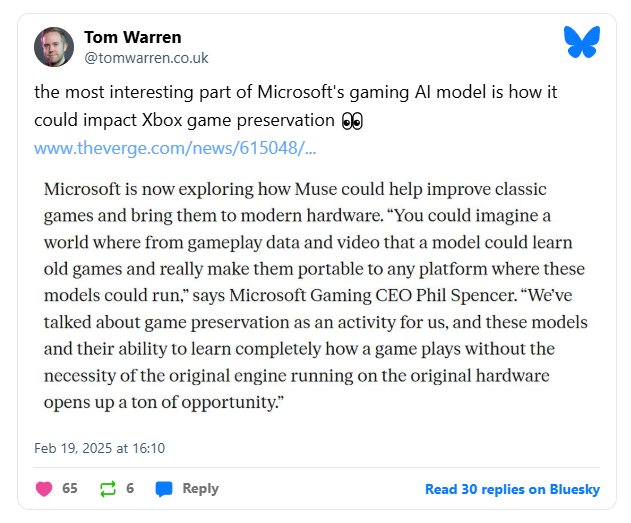
Today, a story went round about a research project at Microsoft where they were using generative AI for "game ideation", and also noted that they thought they could use their generative AI models for "preservation". This was reported on by Tom Warren, senior editor at The Verge, thus (screenshotted rather than embedded 'cause the coward deleted it after everyone dunked on it):

Now, if you know anything about video game preservation, you know that feeding an old game into a generative AI model and then hoping it will hallucinate at least a rough approximation of the original game experience is not "preservation". It's bastardisation at best, a completely useless endeavour at worst, and a massive waste of energy and money regardless of the result that comes out of the other end.

Game preservation is a problem that, for the most part, we have solved. We have excellent software emulation solutions, built over the course of decades of development. Hardware emulation via FPGA at an affordable cost for the general public has advanced hugely in just a few short years. Software libraries for pretty much any system you can think of are archived in their entirety at numerous places across the Internet, and strong strides have been made in providing commercial, legally relicensed versions of classic games for a modern audience, both on existing modern systems and on bespoke emulation-centric devices.

So why, then, why the fuck would we want a generative AI model to make a best guess at what a video game that already exists and has been preserved perfectly well might look like if you play it for longer than 10 frames?

That paragraph above is what tech journalists should be asking. And the reason I bring up Ed Zitron at the start of this post is because he's one of the only people to actually ask questions like this: to take a look at the utter garbage being spewed by today's tech companies and to say "this is complete horseshit, what the actual fuck are you on?"

And Zitron, being an outspoken type, is not afraid to call out today's tech journalism space for not doing this. And he's absolutely right to do so. It is the tech journalism sector's job to look at what it going on, to realise that it is complete horseshit and then have the confidence to say that it is complete horseshit.

But they won't do that, for a variety of reasons. Advertising deals. Exclusive access. PR partnerships. An inexplicable desire not to rock the boat, despite the fact the boat has a huge hole in it and has been steadily sinking for 15-20 years at this point.

I'm not one of those people who thinks that journalists are taking bribes for positive reviews in literally all circumstances — I have experience in the industry, remember, and the most I had to worry about in that regard was a mild admonishment from my editor for criticising a Mortal Kombat game's DLC plan when Mortal Kombat was the cover game for that issue of GamePro.

But come on now. Tech journos should be looking at this utter garbage that keeps getting flung our way, and instead of declaring it "interesting" and doing the stupid looky-eyes emoji that makes their post immediately look like a 14 year old girl wrote it, they should be going "hang on a minute, what does that actually mean?" then exploring it further, asking some probing questions (which inevitably won't get a response, but that in itself says something) and then confidently declaring the latest generative AI "innovation" to be what it is: complete and utter horseshit doused in the finest snake oil.

And people wonder why the entire journalism sector is floundering. Could it perhaps be because very little actual journalism seems to be getting done?

Shout-out at this point not only to Ed Zitron's aforementioned blog, but also the excellent coverage of the Elon Musk nonsense in the States by Wired's politics department, 404 Media being a rare example of tech journalism that actually asks those hard-hitting questions, and Aftermath for doing something similar with games journalism. There are still people doing good work out there. But the people on the big, well-known mastheads, like Warren above, need to step their game up, stop being so incredulous and start acting like actual journalists.


Want to read my thoughts on various video games, visual novels and other popular culture things? Stop by MoeGamer.net, my site for all things fun where I am generally a lot more cheerful. And if you fancy watching some vids on classic games, drop by my YouTube channel.

If you want this nonsense in your inbox every day, please feel free to subscribe via email. Your email address won't be used for anything else.
#oneaday Day 256: I'm tired of collective hateboners

I don't think it's an exaggeration to say that probably 75-80% of the games I've bought in the last… maybe 5 years or so, possibly more, have come from limited-press companies. My reasoning for this? I like owning physical copies of games, and most of the limited-press companies wait to put out a physical version of a game until it has all its updates applied and usually (though not always, these days) all its DLC.

Taking this approach to buying games has a few effects. Firstly, it makes me consider whether or not I really want something, or if, as often happens with digital releases, I'm likely to download it, play it maybe once or twice and then never think of it ever again.

I value physical releases more. I just do. This isn't a slight against those who can't afford to, don't want to or aren't able to do physical releases, it's just a fact about how I approach my video game collection. If it's not on a cart or a disc, I am very likely to forget about it.

One thing I'm growing increasingly tired of is the collective whingeing that goes on any time a limited-press company announces its involvement in a physical print run of something. It happened just today with Digital Eclipse's long-awaited announcement that it will be publishing physical versions of its "Gold Master" interactive documentary series on Karateka, the back catalogue of Jeff Minter and Tetris. Because Limited Run Games are involved, some people have already written the release off completely. One person in a Discord I frequent described it as the "worst birthday present ever".

And… I just don't see it. Limited Run used to have big problems back when they opened pre-orders for five minutes and then promptly had them all swallowed up by scalpers, but they don't do that any more; instead, they have an open preorder window, during which they establish who actually wants a copy, then they print those copies. Sometimes it takes a good few months from ordering a game to actually getting it, but the company has always been up-front about that being a thing, at least partly for the reasons I described above — wanting to ensure that the game is "complete on cart/disc" with all updates applied — and partly to give them the time needed to take all those preorders, pass those orders on to their manufacturing partners and then sort the whole shebang out.

The same is true for other limited-press houses. Probably the "worst" of the batch in terms of being kept waiting is Strictly Limited Games, who has been sitting on preorders for some games for (checks) three years at this point, but when their eminently affordable special editions do arrive, they are absolutely lovely in terms of quality, with tons of extras and just plain gorgeous packaging.

I guess I just… don't mind waiting. I am under no illusions as to when I will be getting a game when I order from one of these companies; more often than not, it's a nice surprise several months (or even years, in the case of Strictly Limited) down the line when I get a dispatch notification for something I'd all but forgotten I ordered.

To an extent, I get why this pisses people off. We live in an age where if you order from Amazon at the right time, you can get something on the same day you ordered it. We live in an age where you can click a button online and get food delivered to your door within half an hour or so. We live in an age of digital convenience, where if you want to watch something you just click the thing to watch it rather than having to search for somewhere that has it in stock, order it and wait for it to arrive.

To anyone who is used to those modern conveniences, paying up for something you won't get for months is unthinkable. But it's not that unusual. Many online shopping sites that aren't Amazon take a while to ship things. eBay sellers can be relied upon to not even think about shipping your item until a week after you paid. Things go out of stock and sometimes aren't back in stock for months. Granted, most of these situations doesn't see you waiting as long as you do for a limited-press video game, but after several years of hearing people constantly whining out non-specific complaints about Limited Run and its ilk, I just have to say… I don't care. Shut up.

In seven years of ordering from Limited Run, I've had precisely one mishap, and that was down to the courier in this country making a mess of things rather than anything Limited Run did — I ended up with a slightly crushed Switch case for the Contra collection from Konami. So y'know what I did? I got a new Switch case and replaced the damaged one. Job done.

In multiple years of ordering from other limited-press companies, I've had no issues. Yes, I have the aforementioned outstanding Strictly Limited orders, but I have faith that those are going to arrive. It doesn't really matter when they arrive, because I have over a thousand other games on my shelves all around me, and even more in my Steam library and downloaded to various consoles. It'll be nice to finally have those, but I'm not mad about them not being here yet, because there's really no point in being mad about it. I paid my money knowing that I'd be waiting for a while, and so that's exactly what I will continue to do.

I will also be ordering the Digital Eclipse Gold Master games when preorders open on February 25 — although as it happens, Digital Eclipse have sensibly partnered with a European distributor (Clear River Games, who also distributed their excellent remake of the first Wizardry game) as well as Limited Run for North America, which makes life quite a bit easier.

I'm tired of not feeling like I can be excited or pleased that something I hoped would get a physical release is actually getting a physical release, because The Internet can't get over its collective hateboners. And I can almost guarantee that a significant proportion of the people whingeing about it being Limited Run don't have any specific complaints other than they don't like them, or because someone involved in the company said something dumb on Twitter.

If you don't like them, you have no obligation to give them money. You have no obligation to buy anything if, for whatever reason, you don't want to give the people making it any money. I happen to like what they do, and I'm getting real tired of people pissing over my excitement for things like the Digital Eclipse releases because they can't get over the publishing partner.

Anyway, that was a useless rant. No-one's reading this anyway. But I feel a bit better. Time to go watch Angel in bed.


Want to read my thoughts on various video games, visual novels and other popular culture things? Stop by MoeGamer.net, my site for all things fun where I am generally a lot more cheerful. And if you fancy watching some vids on classic games, drop by my YouTube channel.

If you want this nonsense in your inbox every day, please feel free to subscribe via email. Your email address won't be used for anything else.
#oneaday Day 249: The Hankering

I'm getting a hankering to make a game again. I say "again", having only ever finished one game-making project (technically two, though one was a remake of the first). I'm not sure what triggered this — perhaps a recent post on Bluesky that I found quite striking:

Just make insanely self-indulgent shit. Quality does not matter. Quantity does not matter. "It's just [thing] yet again 🙄" does not matter. Whether or not you ever show it to anyone does not matter. Make self-indulgent shit because it's the only way to live and be happy.

Lee 🌿 (@desertghosts.bsky.social) 2025-02-03T23:41:57.952Z

And… this is good advice. Being creative is fun, and the biggest mistake a lot of people make when pondering whether or not to be creative is "can I monetise this?" The modern Internet has made us all believe that everything we do should be to the end of making money from it, but it really doesn't work that way. Some of the most rewarding creative work I've ever done came about because I just… wanted to create it. (Frustratingly, one of my all-time favourite works in this regard, my epic, albeit unfinished, RPG Maker 2000 project The Adventures of Dave Thunder, has long been lost to the ghosts of PCs past.)

And so I've been pondering booting up one of the many different versions of RPG Maker I've acquired over the years. My specific thinking this time around is not to do what I always do — which is to get overly, stupidly ambitious, spend six months gathering plugins and reading half-finished, unresolved Reddit threads about how to do stuff, then never actually make a finished game — and instead to just do something simple, unassuming and straightforward. To that end, I have my eye on a couple of asset packs for RPG Maker MV that include Famicom-inspired graphics and music, and I kind of want to see if I can make an enjoyable game using just that and the stock RPG Maker MV mechanics.

I've been hovering over the "Buy" button for those asset packs all day. They're £50 in total, which is quite a lot to spend on what will almost certainly be little more than a vanity project, but I also feel like I'll probably get £50 worth of fun out of making something, even if the only person who ever plays it is me.

The other thing stopping me is pondering what sort of concept I should use. In past RPG Maker projects I've always had grand ambitions to do something unusual and expectation-subverting — but subverting players' expectations is almost a cliché in its own right these days, so just making a straightforward Famicom-style RPG feels like it would be more fun at this point. And, thinking back on my beloved The Adventures of Dave Thunder project, I had the most fun by just making the damn thing up as I went along, balls to any sort of coherence. Self-indulgence was the name of the game there, and I loved it.

So I think that might be the play. Just download those assets (perhaps waiting an hour to see if they go on sale in the RPG Maker event that's supposed to be starting today) and just make, and see where things end up. Who knows? I might even end up making something actually good. Or, indeed, finish something. But we'll see.


Want to read my thoughts on various video games, visual novels and other popular culture things? Stop by MoeGamer.net, my site for all things fun where I am generally a lot more cheerful. And if you fancy watching some vids on classic games, drop by my YouTube channel.

If you want this nonsense in your inbox every day, please feel free to subscribe via email. Your email address won't be used for anything else.
#oneaday Day 247: Enjoying things as we used to

One thing I'm becoming increasingly conscious of as time goes on is how my attitudes towards enjoying my hobbies have… well, they've stayed the same, really, but other people are changing around me, even people who are older than me who I would have thought would be even more set in their ways than I am.

I'm thinking of two particular examples when it comes to this. First is the "I don't have time to play long games any more" person, who no longer wishes to commit to any game over the 20 hour mark because they'll "never finish it", ostensibly because they are "much too busy" now to be able to commit to it.

In some cases, this may be true, particularly if the person in question has started a family in the interim. But realistically speaking, I know a lot of people who say this actually have pretty much the same amount of free time as they had 20+ years ago, and are thus talking bollocks.

Why do they think they have no time, though? Because daily life has changed. We are so overstimulated with our daily lives — and particularly the ever-present nature of the Internet and its endless reams of Content™ — that it's easy to feel overwhelmed, like you simply don't have time to just switch off from all that and enjoy something that takes your full attention. What if you miss a pithy tweet from someone? (To that I would say "get off Twitter, it's a Nazi bar") What if you don't see breaking news happening as it breaks? (To that I would say "we used to do just fine with news bulletins on the TV at 1pm, 6pm and 9pm") What if you miss a message from someone you like? (To that I would say "most forms of online communication are inherently asynchronous, meaning it doesn't really matter if you reply now or in 6 hours' time")

But I get it. It's easy to get locked into that "loop" of cycling around the same three websites, hoping something interesting happens. And before you know it, several hours have passed — several hours you could have (and should have) spent doing something much more enjoyable. This is one of the biggest reasons I've tried to curtail my own social media activity as much as possible, and why I'm still not entirely convinced that signing up to Bluesky wasn't a big mistake. But we'll see on that. At least Bluesky isn't a Nazi bar now.

The other situation that gives me pause these days is when coming across people who won't even consider starting to watch a TV series if they don't have access to every piece of information ever written about it immediately. In a couple of Discords I'm in, there are people who won't start a new TV show if there isn't also a YouTube channel of some boring GenZ type holding a lapel microphone in their hand (clip it to your shirt, for fuck's sake) giving "summaries" of what went on in a monotone drawl.

This latter one is absolutely alien to me, because it makes watching a TV show into a complete chore — to say nothing of how much time it adds to the complete series' runtime if you insist on watching BrackityPoop420 read out an AI/Wikipedia summary of what you literally just watched along with each episode. I watched all of Star Trek: Deep Space Nine last year and the only time I looked at a wiki or any sort of commentary was to see if the actors I thought I recognised actually were the actors I thought they were. (They usually were.)

I feel like our overall sense of media literacy has taken a real tumble over the course of the last 20 years, and I feel it myself at times, too. Last night, I watched the first episode of The Wire, and I found it enjoyable, but a little hard to follow to begin with. By about halfway through, I'd settled a bit more into the rhythm of things and I think I'll find the rest of the series a little more palatable, but that first half an hour made me think "have I made a mistake here?"

20+ years ago, we would quite happily pick up a box set of some show that we liked and watch it repeatedly. This was partly down to how media was relatively expensive compared to what you can pick it up for these days, but I feel it also helped our overall sense of media literacy to be more willing to do the work ourselves and watch something again to see how we responded to it second time around. Today, there are two things standing in the way of that: one being the crippling fear of spoilers, and two being the constant desire to consume new content.

I've talked before on here about how much I object to the use of the word "content" (and "consume", for that matter) when we're talking about creative works and art. And nowhere is this more apparent than with folks' media literacy. It's not about watching something and understanding it deeply any more; it's about watching as much as possible, as fast as possible.

And this isn't an exaggeration; Netflix has gone on record as saying that numerous shows and movies on its service are specifically designed to be "second screen experiences" that people don't really have to pay attention to, and the proliferation of people who will quite happily admit to watching everything on 1.5x normal speed "just so they can get through more" is… well, I don't like it.

Just recently, I picked up a few box sets of DVDs from CEX because they were dirt cheap. I've grabbed The Wire, Angel, Scrubs and Friends — all complete runs. I already have Buffy the Vampire Slayer and Battlestar Galactica (which, probably 10+ years after acquiring, I must shamefully admit I am still yet to watch) and there's probably a couple of other series I might nab at some point (notably some Star Trek series, maybe Frasier and House) — and then I think I might be happy with just that. Watching new stuff is cool at times, but it can also be overwhelming — and it can also cause things you once loved and thought were a fixture in your head to just… fall out. I can't remember a lot of what happened in Angel, for example, and I fucking adored that series when it first came out.

I think it's okay if you don't "get" something first time you watch it, or if it takes a little while to get into the groove of a new series, like I suspect I'm going to be with The Wire. I'm going to consciously try to resist running straight to a wiki wherever possible, though; we used to live without these things and still be able to enjoy our media, so I'm pretty sure I still can live like that.

Also I still have time to play long RPGs. And I suspect I always will.


Want to read my thoughts on various video games, visual novels and other popular culture things? Stop by MoeGamer.net, my site for all things fun where I am generally a lot more cheerful. And if you fancy watching some vids on classic games, drop by my YouTube channel.

If you want this nonsense in your inbox every day, please feel free to subscribe via email. Your email address won't be used for anything else.
#oneaday Day 240: Fair and Balanced Critique

Hello! First of all, here:

That's the first of the two videos I recorded this weekend. Please enjoy a full playthrough of King's Quest II: Romancing the Throne on Atari ST.

Part of the reason I'd felt inspired to play this (and Space Quest) this weekend is because I've been watching the videos of a channel called Space Quest Historian. This is a chap who absolutely loves adventure games, but had little experience with the King's Quest series prior to a donation drive on his Patreon, where he said he would play through each and every King's Quest game for reaching various donation milestones. He also doesn't really like "fantasy" as a genre.

I have been absolutely loving his entertainingly scathing teardowns of the King's Quest games, and I adore those games for the most part. And I've been racking my brains trying to think why I'm enjoying these vids so much when sometimes I feel oddly upset and defensive when someone is negative about something I love.

And it all comes down to intent. Space Quest Historian isn't malicious about these games at all, even when ripping them a new one for their more absurd elements. Instead, he's inviting us to be in on the joke; inviting those unfamiliar and existing fans alike to come along on a ride where he entertainingly points out all the ridiculous things in these games. And, to be clear, as a fan of King's Quest, I can quite happily admit that there are a lot of ridiculous things in those games.

Where this differs from, say, reviews of Japanese stuff that have upset me in the past, is that Space Quest Historian is not being mean about these games, nor is he being mean about the people who like them. He's not suggesting that you are a bad person for liking the games, nor is he suggesting that you are wrong for liking the games; instead, he is simply providing some light-hearted commentary in a series of videos that it should be abundantly clear from the very opening seconds should not be considered serious critique or analysis. And he's often the first to say as much.

Compare and contrast that approach with, say, reviews of Japanese games that outright call people who like them paedophiles, or suggest that people who enjoy a particular series are sex pests, or that they only like anime women because no real woman would ever want to touch them. That crosses a line. That's mean, and uncalled for. All of the games I'm thinking of with those examples have plenty about them that can be poked fun at, but without it being at the expense of those who genuinely love them and have found meaning in them.

It can be a fine line, of course, between being hyperbolically nitpicky about something and the audience feeling like you're attacking it. And indeed, some commenters on Space Quest Historian's channel feel he veers too far in the "bad" direction. But as someone who is normally quite sensitive to this sort of thing, I've been really enjoying his work, and I'm looking forward to seeing more. It doesn't stop me from enjoying the King's Quest games; in fact, I probably find these videos funnier precisely because I recognise all the things that he's discussing.

Anyway, just fancied saying all that — and sharing my King's Quest II playthrough above. Please enjoy!


Want to read my thoughts on various video games, visual novels and other popular culture things? Stop by MoeGamer.net, my site for all things fun where I am generally a lot more cheerful. And if you fancy watching some vids on classic games, drop by my YouTube channel.

If you want this nonsense in your inbox every day, please feel free to subscribe via email. Your email address won't be used for anything else.

#oneaday Day 239: Two Quests in one day

I recorded some videos earlier. I really like doing adventure game playthroughs, so I decided to play through both King's Quest II (I've already done the first one) and Space Quest, the latter of which I've never played all the way through by myself, but which I've fallen asleep to Dan from Game Grumps playing on numerous occasions.

I was hoping to get The Dagger of Amon Ra done also, but it turns out playing and beating three adventure games in one day is just a little too ambitious, so I've settled for just the two mentioned. The Dagger of Amon Ra is still on the list, though; I found The Colonel's Bequest far too interesting to just leave Laura Bow hanging like that.

I mostly enjoyed the experience of these two games. King's Quest II is a game I have fond memories of playing as a kid, though I'm not sure I ever actually beat it when I was younger. Space Quest was mostly a pleasure, also, save for two truly awful and mandatory sequences you have to endure: a "skimmer" race where you have to dodge incoming rocks, and a slot machine sequence where you need to earn an obscene amount of money using a purely luck-based system. (If you're playing a later revision of the game, there is a cheat to bypass this sequence, but sadly, the ST version I was playing was not said later revision, so I had to do it "the hard way".)

I always find it fascinating to go back to adventure games, because when I was younger actually making it all the way through one seemed like a literal impossibility. Particularly if we're talking about Sierra games, which most certainly are not afraid to kill off the player regularly, or leave them in a situation where they forgot an item earlier in the game that is mandatory to progressing later. King's Quest is probably more notorious than Space Quest in this regard, but as it happens, of the two games I played today, King's Quest II was probably the gentler, fairer of the two, while Space Quest had several opportunities to miss important objects and completely screw your entire playthrough over.

But no. Those games that seemed impossibly huge and insurmountable as a child are almost laughable in their length today. Actually, no, I don't mean that; both King's Quest II and Space Quest (annoying bits aside) are just the right length to be satisfying, so far as I'm concerned, but I do feel like if a modern equivalent of both of these was released today, they would be quickly review-bombed by entitled Steam kiddies whinging about "lack of content" and "no updates, abandoned game".

For me, though, it's nice to be able to power through a game like this in the space of a couple of hours — possibly even quicker if you know exactly what to do and the best order to do it in. I certainly enjoyed recording these two videos today — and I'm looking forward to publishing them over on YouTube over the course of the next few days. Now, though, it's 1.15 in the morning and I should probably go to sleep. Adventure is calling, but an adventurer also needs his rest, to be sure!


Want to read my thoughts on various video games, visual novels and other popular culture things? Stop by MoeGamer.net, my site for all things fun where I am generally a lot more cheerful. And if you fancy watching some vids on classic games, drop by my YouTube channel.

If you want this nonsense in your inbox every day, please feel free to subscribe via email. Your email address won't be used for anything else.

#oneaday Day 238: The Sims is still good

The rumours were true! Just ahead of the series' 25th anniversary, EA dropped rereleases of The Sims and The Sims 2 on their own storefront and Steam earlier today, for the eminently reasonable price of £34.99 for the both of them. Considering they both come with all the expansions (well, I think The Sims 2 might be missing the IKEA "stuff" pack, but that's about it), I'm perfectly happy to pay up for them both, particularly considering The Sims has never had a digital release, and The Sims 2 has been unavailable for a long time.

"But you can get them both for free!" the entitled corners of the Internet shout. "They're abandonware, and that means you can legally download them for free!" Well, firstly, one, no it doesn't, because abandonware isn't actually a thing, legally speaking, and two, it is important to support official rereleases of stuff like this, because it gives a thumbs up to companies making a commitment to actually preserving their history and making it available to everyone, even those who weren't there for it first time around. It's no good carrying on about "preservation" if you don't support actual attempts to do that. Piracy is all well and good if there is no other way, but official preservation efforts should be supported. Yes, even if they're by EA.

Both rereleases have been updated so that they work just peachy on Windows 10 and 11, and The Sims is able to run in much higher resolutions than it ever has before, and in widescreen. Okay, the game could arguably do with a UI scale option when playing at 1080p or higher, but it's not unplayable by any means, particularly if you're playing on a big TV as I have been.

I've spent a few hours revisiting The Sims this evening by making a rough recreation of my original "Hartley Family" save file, which featured me and the other members of my hall of residence flat at university struggling to survive. I am reminded that the original The Sims is actually surprisingly challenging compared to some of its follow-ups; thus far, keeping on top of six people's needs has been quite difficult, particularly with a lack of substantial income. Things will get easier once some of them start getting promoted and bring in a bit more money each day, but for the moment it's very much in "scraping by" territory.

Also one of them has died already after burning down the kitchen, but I managed to "Plead" with the Grim Reaper quickly enough for him to be able to return as a zombie. I have made a promise to myself that I'm not going to save scum at all, I'm just going to deal with the consequences of everything that goes on as it happens. Emergent narrative and all that.

I'm interested to spend a bit more time with the original The Sims, as back when it was current, I had a lot of the expansion packs, but not all of them. I don't think I had Superstar, Unleashed or Makin' Magic, and those are three that have some substantial additions to the gameplay — the pursuit of fame, pets and the ability to cast spells using appropriate components respectively.

At present, I've got one of the six Hartley family members equipped with a magic wand and (thus far) the ability to turn someone into a toad, and another who keeps slipping off to the "Studio Town" area to go and sing karaoke badly (earning a whopping 5 Simoleons per performance at present) but so far, it's a struggle to keep their mood high enough to be able to truly take advantage of those features. Much as with real life, getting a solid and stable income stream is important if you want to start doing anything out of the ordinary.

So that's that. The Sims and The Sims 2 are both available on Steam and EA's own storefront right now, either separately or in a bundle together. You also get a "free" copy of The Sims 4 with them, but since that went free-to-play a while back anyway it's probably best ignored unless you want to get into DLC hell. The rereleases of both The Sims and The Sims 2 are complete, meanwhile (aside from the aforementioned Ikea pack for The Sims 2) and should keep you busy for a very long time indeed.

I'll probably write more about one or the other or both at some point, but for now, I'm happy. It's been a nice bit of nostalgia to revisit The Sims — and a reminder that as cynical as people got about the series over the years (not without good reason), it's still just a damned fine game at heart, too.


Want to read my thoughts on various video games, visual novels and other popular culture things? Stop by MoeGamer.net, my site for all things fun where I am generally a lot more cheerful. And if you fancy watching some vids on classic games, drop by my YouTube channel.

If you want this nonsense in your inbox every day, please feel free to subscribe via email. Your email address won't be used for anything else.

#oneaday Day 237: The library is open

A number of things occurred today that I could potentially talk about: some positive, some not so positive. In the interests of… (gesticulates at all this) everything I'll focus on probably the most positive one, because it's something I'm really excited and happy to see.

Those of you interested in video games as a medium may be aware of the work of the Video Game History Foundation. They've been working as a charitable organisation chronicling the history of the medium for some time now, and they're responsible for the figure you may have seen bandied around that "87% of classic games are not available".

Something they've been working on for a while is providing a means of public access to their library of materials, which includes not only old computer and gaming magazines, but also development and marketing materials as well as some thoroughly fascinating bits of miscellanea, such as a gamer's hand-drawn maps of two early Zelda games that found themselves among a donation of other bits and pieces.

Today, the organisation launched the library for "early access", presumably meaning that there might be some kinks to work out and that it will expand over time, but already it's clear that it's going to be both a valuable resource and something that is just interesting to explore.

There are two main components to the library. First of all is the main catalogue at library.gamehistory.org, which is a catalogue of the materials that the organisation holds. This is interesting to browse through and see what's in their collection, but isn't of that much use when researching things. For most, the real attraction will be the digital archives at archive.gamehistory.org, which include digitally preserved material — scans and other digitised content, in other words.

At present the archives only contain a fraction of what is listed in the main catalogue, and the organisation notes that there is some material that may never be digitised for public access via the Internet for one reason or another. But what's there already is plenty to get stuck into. There's a library of magazines, for example, including 33 publications at the time of writing, including complete or near-complete runs of well-known mags such as Game Informer, Electronic Gaming Monthly and GamePro, plus early attempts at gaming media like Electronic Games, a spinoff of Video magazine's Arcade Alley column.

Right now there is, unsurprisingly, a bit of a US bias to things (and as I type this, the site has crashed under the weight of day-one demand so I can't check what non-American stuff they have, if any!) but there's a significant chunk of gaming media history to explore here; the aforementioned publications all played an important part in shaping video game fandom at one point or another, and the digitally available collection will only continue to expand over time. I'm particularly excited to see the archive of Electronic Games there, as this is an incredible resource to see how early consoles (like the Atari 2600, Intellivision and suchlike) and 8-bit home computers were covered by a fledgling enthusiast press.

But it's not just about magazines. There's also stuff like an archive of the CDs GamePro had that contained press materials, from the days before press assets being distributed via the Internet. There's production materials from games, some of which never made it to market, like SimPeople (what would subsequently become The Sims). There's development materials from a wide variety of sources. And tons more.

I'm really looking forward to exploring this library of stuff and seeing how it expands over time. It's going to be an absolute boon to anyone researching the history of video games and how they were covered by the media of the day, and I can't wait to make use of all this material when composing videos and articles.


Want to read my thoughts on various video games, visual novels and other popular culture things? Stop by MoeGamer.net, my site for all things fun where I am generally a lot more cheerful. And if you fancy watching some vids on classic games, drop by my YouTube channel.

If you want this nonsense in your inbox every day, please feel free to subscribe via email. Your email address won't be used for anything else.