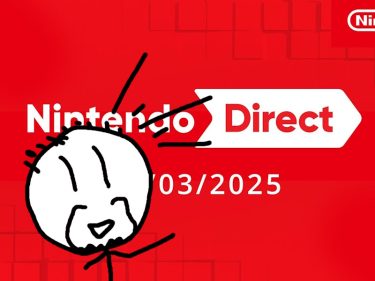
#oneaday Day 293: Nintendo Direct immediate reactions

There was a Nintendo Direct today, almost certainly the last one we'll ever see devoted to the original Nintendo Switch. So it seems fitting to go through the stuff that was announced and discussed and provide my own personal feelings about them.

Note: my own personal feelings. If you feel differently about any of these things, great! You have an opinion and a personality. You are not wrong for feeling differently to me, just as I am not wrong for feeling differently to you.

Standard procedure Internet of 2025 disclaimer over, let's get to it, shall we?

Dragon Quest I & II HD-2D Remake

Brilliant news. I haven't bought III yet, let alone played it, but I'm thrilled we finally have a modern way to play early Dragon Quest games that isn't those fucking awful mobile phone ports with the horrible visuals. Here's hoping they give IV, V and VI similar treatment, because while I'm lucky enough to own the Nintendo DS versions, I certainly wouldn't complain at the opportunity to play them on the big screen.

To date, the only Dragon Quest I've played to completion is IV. I got right to the end of V, but was underpowered for the final boss and couldn't be arsed to grind, so I never got around to beating it. I loved it up until that point, though. Bianca was my waifu.

No Sleep for Kaname Date

HELL YES. I love Kotaro Uchikoshi's work, and the two AI: The Somnium Files games are absolute masterpieces. I'm thrilled that we're getting another one. If you're yet to play the first two, I highly recommend setting some time aside for them (they're both pretty chunky by adventure game standards) and playing them fully. Can't wait to get back into that world with those wonderful characters.

Raidou Remastered

I never played the Raidou Kuzonoha games back on PS2, and they're super-expensive to collect today. I remember several folks whose opinions I trust enthusing greatly about them 15-20 years ago though, so I'm excited that I'll finally have the opportunity to check one of these games out. And that Shoji Meguro soundtrack sounds great.

I know absolutely nothing about the game other than it's supposed to be a pretty good time, so I'll likely be going in fairly blind to this. But I will be going in!

Shadow Labyrinth

Pac-Man-themed exploratory platformer? Interesting, and I can see the potential there. The "dark and edgy" thing is a bit of a turnoff, to be honest, but if the game's decent I can live with it. Not something I'm on the edge of my seat waiting to play, but I will follow with interest.

Patapon 1+2 Replay

Yes! Never really played the PSP versions much beyond trying them out at a friends house a very long time ago, but I liked their vibe and their music. Plus me and my wife often tease our cat Patti by going "pon, pon, Patti-pon", so it will be nice to finally educate my wife on where that actually came from.

Story of Seasons: Grand Bazaar

I've played a few Story of Seasons/Harvest Moon games in my time and quite enjoyed them, but my trouble is I've got it in my head that they sort of never end. I don't think that's actually true, and that my opinion is probably largely based on the number of people who have been playing Stardew Valley for approximately 300 years, but it's kind of put me off jumping into any of the more recent ones. I think the last one I played was the one on Gamecube?

Certainly not against this, but not rushing out of my way to pick it up, either.

Metroid Prime 4: Beyond

Cool that it actually exists and seems to be a decent way along. I've still never played a Metroid Prime game, though, so my excitement for this is somewhat tempered compared to many other folks. I do like Metroid from my relatively limited contact with the series to date (mostly Super Metroid) — I just haven't made the time for other entries in the series so far.

Disney Villains Cursed Café

I quite like the concept of this, as the "make drinks for patrons who have their own stories to tell" thing has been done well previously by VA-11 HALL-A and Coffee Talk. I just wonder if the Disney Villains thing won't end up holding it back rather than making it interesting. After all, I suspect there's fairly strict writers' guidelines in place on what these characters are and are not allowed to "do" in narrative terms.

Witchbrook

Well this looks adorable! I have a lot of time for school-themed games, and throw in a bit of magic that isn't the work of a raging transphobe and you have a winner, so far as I'm concerned. Will it beat Mana Khemia? It'll probably be a rather different experience, but I'm very much up for this, particularly with its lush pixel art.

The Eternal Life of Goldman

I must confess, I couldn't remember what this was just from the title as I think I tuned it out a bit when I was watching the show (no shade on the game, I was working at the time) but looking back at it now, it looks kind of neat. The animation on the characters is lovely, but the backdrops look a bit drab. If this has a decent story or some more varied environments, I might give it a look.

Gradius Origins

Yes please. The other Konami collections are excellent, so I will be happy to add this one to the mix.

Rift of the Necrodancer

I like Crypt of the Necrodancer, but my first impression of this is that it loses a bit of its charm by being a more conventional rhythm game rather than a combination of rhythm game and RPG. The visuals are nice, though, and it looks like it plays well enough. I was a bit concerned about the number of times they mentioned DLC, though. Perhaps one to wait for a "Complete" physical release of.

Tamagotchi Plaza

Do not care. Never had a Tamagotchi, have no attachment to them whatsoever, and the dentistry bit looked like one of those spam mobile games. No thank you.

Pokémon Legends: Z-A

I've never been a big Pokémon fan, though I moderately enjoyed Sword/Shield a while back. Another one I'll keep a bit of an eye on, but probably won't rush out to buy.

Rhythm Paradise Groove

I feel the exact opposite about this as I do about Pokémon. A new Rhythm Paradise/Rhythm Heaven/whatever you call it in your neck of the woods is an insta-purchase for me after loving the DS and Wii versions.

Virtual Game Cards

Seems like a decent solution to sharing digital games. A little more cumbersome than it perhaps needs to be, but that's Nintendo for you. I do like that you can "lend" digital games to family members, though; I've been hoping for a way to do that so my wife can play the Atelier Arland series for a very long time.

SaGa Frontier 2 Remastered

I bounced off this hard on PS1 but I'm much more open to it these days. The art is kind of weird though; the heavily pixelated characters on the upscaled backdrops just look a bit odd. Not "ew, I'm never buying this" odd, just a bit odd. Which would be firmly in keeping with SaGa in general.

Monument Valley

Hooray! A mobile game breaking free of its mobile prison! I was always curious about this but had absolutely no desire to play it on a mobile device. Now I don't have to!

Everybody's Golf: Hot Shots

Yes please! Arcadey golf games are very much my jam, and while the Mario sports games are insistent on getting a bit too experimental with their more recent installments, this looks like it will be a good old-fashioned silly golf game. I am definitely there for this.

Marvel Cosmic Invasion

I have zero stakes in the Marvel race, but Tribute Games is always a good time. As someone else pointed out earlier, I hope they don't just get stuck doing licensed stuff until the end of time, though.

Tomodachi Life: Living the Dream

I had zero contact with (and, really, interest in) the original Tomodachi Life, but I know it's responsible for some funny moments. I also remember having some funny times with… what was it called, Miitomo? So I'll have a look and see what this is, but not one I'll be rushing out to buy or anything

Nintendo Today

Sure, Nintendo. Another app just for your news. I'm fine with this.


On the whole, I think it was a pretty good presentation! As some folks pointed out, this can be looked on as the Switch's last desperate gasp before Switch 2 shows up, and thus there's a lot of "niche interest" stuff here. But that's good! I like niche interest! I am the niche! So I say bring it on.


Want to read my thoughts on various video games, visual novels and other popular culture things? Stop by MoeGamer.net, my site for all things fun where I am generally a lot more cheerful. And if you fancy watching some vids on classic games, drop by my YouTube channel.

If you want this nonsense in your inbox every day, please feel free to subscribe via email. Your email address won't be used for anything else.

#oneaday Day 291: If you like old games mags, here's a podcast you might like

The other day, I was contacted relatively out of the blue (no pun intended) on Bluesky by a chap called Ty Schalter, who wanted to let me know he and a fellow writer, journalist and author, Aidan Moher, were launching a new podcast, and would I mind giving it a bit of a nudge on socials.

Firstly, I was flattered that Ty thought I had anywhere near enough reach online to make a difference these days, but I indeed shared it anyway, and am, in fact, doing so again right now. Secondly, I was 100% on board with the concept for the podcast, which was to take a fond look back at classic games magazines. Here's the first episode for you to enjoy:

Now, as I stated in no uncertain terms just the other day, I am a big fan of old computer and video games magazines, and am always up for some discussion of them. These days, it's a bit tempting for everyone to look at the worst of their output, go "ugh, cringe" and leave it at that, but Schalter and Moher are doing the subject justice, judging by their first episode; they're acknowledging that while there are often faults we can pick from a 2025 perspective, these magazines were a vitally important part of gaming culture, particularly in the days before we had always-online Internet and, later, mobile phones.

What you've gotta remember is that in the '90s, if you had an Internet connection at all, it was a dial-up one that you had to ration your time with so as not to leave yourself with an astronomical phone and/or usage bill; earlier than that, the only online services out there were self-contained bulletin board systems. There was also a curious "in-betweeny" phase in the early '90s where services like AOL and CompuServe came to prominence; these offered global online services somewhat akin to the modern Internet, but in their own curated walled gardens. Later, both services provided access to the broader Web, but initially, they were their own little communities.

Why is this important? Because it meant that it was nowhere near as easy to talk about games with people as it is today. There was no magic black slab in your pocket that connected you to the rest of the world, and there was no guarantee that when you "logged on" with your computer that you'd find someone you wanted to talk to. There certainly wasn't the opportunity for carving out your own little space online as there is today, and absolutely no social media. (Maybe it wasn't all bad.)

This meant that magazines played a crucial role for video game enthusiasts: they were the main way that people who enjoyed games found out about new releases, the latest news and in-depth information about stuff that was already out. They were a point of common contact that, when we met up with our "real-life" friends (remember them?), we could use as the basis for a discussion. They were a connection to the outside world — and for many of us, a lifeline that made us feel much less alone in our passion for what is, most of the time, a fairly solitary pastime.

Schalter and Moher get this. They understand that for many of us, magazines were "the gaming community". We came to the mags not just for the games, but in many cases, for the personalities involved and the opinions we trusted. We'd obsess over a 250-word review of a 40-hour RPG, reading it repeatedly and drinking in the screenshots, wondering what it would be like to actually play the thing. We'd base our purchasing decisions on the arbitrary numbers the reviewers thought up, for better or worse. And we'd get to know the studios behind our favourite games through special features, interviews and preview reports.

Many of these things can be argued to still be present in today's games press, to be sure. But the daily churn of gaming news online makes it somehow less special than it was to get a monthly magazine. What game would be on the cover? What games would get in-depth features? What games were getting walkthroughs, tips and cheats? Would there be any cool cover-mounted gifts or bonus booklets included?

While it can be funny to look back and laugh (or cringe) at The People We Were 20-30+ Years Ago, it's important to take a look at the full picture for an understanding of why things were the way they were — and why so many people are still nostalgic for an era long past.

That's what the Fun Factor podcast seemingly aims to explore, and judging by the first episode — which features lengthy reminiscences about Final Fantasy VII that I'm sure will be familiar to anyone Of A Certain Age — it's going to be a good listen over the long term.

So go give that first episode a listen now, and if you're so inclined, support the podcast on its official website. You can also follow the pod, Ty and Aidan over on Bluesky.

I'm excited to see where the show goes from here, as it's a subject near and dear to my own heart. And if you have any fond nostalgia for that supposed "golden age" of magazines, I recommend checking it out, too. 'Cause heaven knows we could all do with some fun, happy stuff to enjoy right now, I'm sure.


Want to read my thoughts on various video games, visual novels and other popular culture things? Stop by MoeGamer.net, my site for all things fun where I am generally a lot more cheerful. And if you fancy watching some vids on classic games, drop by my YouTube channel.

If you want this nonsense in your inbox every day, please feel free to subscribe via email. Your email address won't be used for anything else.

#oneaday Day 289: Some games magazines I used to like

I love old games magazines, and will frequently re-read them years after they were relevant. In fact, I'm currently in the process of assembling a collection to bung on an SD card and pop in my otherwise unused Kindle Fire 7 to use as a portable retro magazine library. I've also got a vague plan to make some more videos on classic magazines, as I really enjoyed making the first two on Page 6 magazine — you can watch those here (issue 1) and here (issue 2).

In the absence of anything else to write about — I've been playing Xenoblade Chronicles X for most of the weekend, and I already wrote about that earlier — I thought I'd give a rundown of some magazines I used to like, and which I may well take some time to cover on YouTube at some point.

Note: I say "magazines I used to like"; most of them are magazines I knew someone who worked on, usually my brother. I make no apologies for this.

Page 6/New Atari User

This is the one I bring up most commonly on my channel, and for good reason: three members of my family (my Dad, my brother and me) were involved in it at various points, and it's the magazine that launched the career of my brother — a career that, with him being a big bossman at IGN now, he's still in.

Page 6, as it was initially known, started life as a user group newsletter. Within one issue, the editor Les Ellingham had decided that he wanted to fulfil a grander ambition: to publish the UK's first Atari-specific magazine. And he only went and did it. For an astronomical amount of time, considering the subject matter, too; Page 6 ran in one form or another from December of 1982 until the autumn of 1998, and it was still covering the Atari 8-bit in its very last issue.

Page 6 was an enthusiasts' magazine. It wasn't a games magazine; Les in particular was keen to stress from the outset that while computers were excellent games machines, there was also a ton more you could do with them. And part of the point of the magazine was to educate people on the possibilities their computers offered. It achieved that through articles about software releases (including both games and "serious" software), interviews, tutorials, type-in listings and plenty more.

It was always a pleasure to read. One gets the impression that it was a real labour of love for Les in particular, and there are plenty of occasions where his editorial page came across as very frustrated that other people didn't seem to care quite as much as he did — but I cared. I still do care. Page 6 was a formative part of my youth, and revisiting old issues today, I still feel a lot of the same magic I felt in the early days of computing.

Read them all at Atarimania.

Atari User

Showing up a little later, Atari User from Database Publications (later Europress) launched in 1985 and ran until November 1988, at which point Page 6 acquired the rights to the Atari User name and rebranded as New Atari User. Page 6 was still on the newsstands at that point, and it was thought that the Atari User name would attract more casual interest, since "Page 6" is a nerdy reference to an area of the Atari 8-bit's memory that only people already well-versed in the system's "culture" would understand.

At heart, Atari User was a similar sort of magazine to Page 6, covering both games and "serious" applications, perhaps with a slightly greater focus on things that, if not games, were at least entertainment of a sort. Like Page 6, there were a variety of features each issue, including type-in listings, and often some interesting-looking "Gadgets" sections for electronics projects you could do with your Atari. I never tried any of them — I was a bit young — but they always looked interesting.

I enjoyed reading both Page 6 and New Atari User because they each had a very different style to them. Page 6 always felt like it took itself very seriously, with a fairly no-nonsense, stern, professional-looking layout in each issue — not to say that individual articles lacked personality and humour, mind; I'm talking purely aesthetically — while Atari User made use of the bigger budget it had thanks to being part of a larger corporation by producing colourful issues with large, attractive pieces of artwork and photography throughout. I was sad when Atari User went under, as it was one of those magazines that it was just fun to look at thanks to its colourful cover art.

Read them all at Atarimania.

Antic and ANALOG

Antic, subtitled The Atari Resource, was one of two Atari-specific magazines from the States, with ANALOG (short for Atari Newsletter And Lots of Games) being the other. You could get them both relatively easily in this country via specialist importers. Antic and ANALOG were both, like Page 6 and Atari User, magazines that revelled in the joy of home computer ownership. Part of that was gaming, yes, but it was also about programming, productivity and creativity.

I actually haven't revisited Antic and ANALOG for many years and I think I'm long overdue to, as I remember enjoying them both. I do remember Antic having noticeably thicker issues, while ANALOG became renowned for its excellent machine language type-in listings. So they're both going on my portable magazine library, assuming it works as I hope it does.

Read Antic and ANALOG at Atarimania.

Games-X

Page 6 was where my brother got started writing about games, but it was Games-X that truly launched his career properly; he left home to work on it, and it ended up being the beginning of a whole life in the games press.

Games-X was unusual: it was a weekly games magazine (a decision which founder Hugh Gollner later described as "a big mistake" financially), and most other magazines at the time were monthly. Page 6 was bi-monthly (as in, every two months, not twice a month). This naturally allowed it to be a lot more "up to date" with gaming news than many other magazines, but it was also fun to be able to buy a new games magazine every week, initially for just 60p an issue.

Games-X covered that strange period late in the ST and Amiga's lifespan when consoles were just starting to really get a foothold in the UK. The majority of the focus in each issue was on home computer games, but there was a dedicated console section — and the next magazine my brother worked on after Games-X was Mega Drive Advanced Gaming.

Games-X had a fun, irreverent attitude to it and, in many ways, was very "'90s", with everything that entails. I still really like it, though, and think it stands out as a magazine that deserves to be remembered a bit more than it is.

Read them all at RetroCDN.

Advanced Computer Entertainment (ACE)

I don't think I actually had many issues of this, but I enjoyed every one of them a great deal. Advanced Computer Entertainment, or more commonly just ACE, was a multi-format magazine that one gets the impression liked to think it was a cut above the other games magazines around at the time. It was still about video games, sure, but it lacked some of the '90s abrasiveness of other publications, and took things a bit more "seriously", for want of a better word. One might call it the Edge of its day, only marginally less pretentious. (And yes, I checked; Edge launched in 1993, while ACE folded in 1992.)

That is, after they got over an initial rocky patch where there were more errors in the early issues of ACE than I think I've ever seen in any other magazine. Typos, mistakes, outright blank sections of pages — they had it all. But once it settled down, it was a very high quality magazine that I always enjoyed. The magazine was noteworthy for its "Pink Pages" section in the rear, a no-nonsense "reference" guide to new releases, charts and review summaries, plus a bizarre "Stock Market" section that never really made much sense, but I believe it was an early attempt to try and aggregate review scores for various developers and publishers, if I remember rightly.

I rather liked that ACE took things seriously. The silly humour of other magazines could be entertaining, to be sure, but it was nice to be able to read a magazine about games that was just… about games, rather than about its writers trying to launch a comedy career. As with Page 6, that's not to say that individual articles and writers lacked personality or a sense of humour; it's just that humour wasn't the main point, whereas with some other magazines around at the time, particularly once we moved into the 1990s, it felt like they were trying to be a funny magazine first, about video games second.

Read them all at Atarimania.

PC Zone

Now, this may make me sound a bit like a hypocrite after what I literally just said, but I always enjoyed PC Zone, even before my brother's time there as editor and publisher. PC Zone in its prime always felt like it struck a good balance between humour and information, and I loved it for that. It acknowledged that games were fun, silly and often stupid, but also recognised that people were passionate about them — sometimes to a fault.

PC Zone is also noteworthy in retrospect for being an early outlet for Charlie Brooker, and his articles were always a highlight, as were his eminently silly The Cybertwats cartoon strips, which got the magazine a bunch of complaints on multiple occasions, particularly after he depicted Lara Croft machine-gunning someone's cat to a particularly violent and bloody demise.

When people talk about old magazines being fun, I think of PC Zone. While in retrospect some of it may have been a bit "lads mag"-ish (see: front cover depicted above), it never really felt particularly exclusionary. Plus I spent two weeks doing work experience in their offices and, although I didn't really do much other than make a lot of cups of coffee and tea (and write a review of Virtua Fighter PC) that fortnight remains one of the happiest of my life.

Read them all at Pix's Origin Adventures.


And there's more I could be going on with, but I think that's probably plenty for now. If you're a retro computer and gaming enthusiast, you could do far worse than familiarise yourself with the above publications. And the links I've provided will let you do just that.

Note: I will not be held responsible for anyone complaining at you suddenly taking a lot longer in the toilet.


Want to read my thoughts on various video games, visual novels and other popular culture things? Stop by MoeGamer.net, my site for all things fun where I am generally a lot more cheerful. And if you fancy watching some vids on classic games, drop by my YouTube channel.

If you want this nonsense in your inbox every day, please feel free to subscribe via email. Your email address won't be used for anything else.

#oneaday Day 287: European video game history discourse is happening again

As the title says, European video game history discourse is happening again. I'm not going to link to the post in question, because I like the chap who inadvertently kicked this off and I don't want him to have to put up with any more angry Europeans than he already is contending with. But I will comment on the whole subject, because it's a topic worth discussing with some commonly held assumptions that need challenging.

So here we go.

"The Great Video Game Crash" didn't happen in Europe

This point is one that, I think, is finally getting through to a lot of people. The notorious "crash" of 1983 following the absolutely flooded market of third-party Atari 2600 games was a purely North American phenomenon, and it only affected the console market.

It was a bad thing, to be sure, putting a lot of developers and publishers out of business, and it can probably be pointed at as the main reason that platforms like the ColecoVision and Intellivision didn't survive. And it's definitely true that the arrival of the NES on the scene marked a renaissance for the console games market in North America.

But it just didn't happen in Europe. I didn't even know it was a thing until the Internet came about. The reason? Because most of us in Europe were happily making use of home computers at the time, and we continued to do so throughout most of the '80s and early '90s.

Europe's console game sales are a miniscule fraction of those seen in the States

The same reasoning can be applied to this. Yes, I entirely believe that considerably fewer console games were sold in Europe than in North America. This is because consoles weren't nearly as widespread as home computers were. Growing up, I didn't know anyone who had a console for many years. I didn't even know for sure if the ColecoVision came out in Europe until quite recently when I found an ad in an old home computer magazine.

But I did know people who had home computers. We had Atari 8-bits. My best friend in primary school and a girl I moderately fancied both had BBC Micros. Another friend had a Spectrum. Another still had a Commodore 64. One even had an Electron.

There are a few considerations here. One, home computer games were often much cheaper than console games — though this wasn't always the case, particularly for games distributed on ROM cartridge. Cassette-based games were very cheap, though, particularly on the Spectrum and C64, and disk-based games weren't crazy expensive for the most part — though disk drives were, since back then they essentially had a whole other computer inside them to control the damn things!

However, what you also have to consider is that many games had considerably wider reach than their commercial, officially recorded sales figures might suggest due to piracy. Piracy was absolutely rife in the early home computer sector, and while this probably wasn't good for the overall health of the industry, it somehow never caused a "crash". Piracy has also, long term, been amazing for preservation purposes, because pirated disks (pretty much always disks) often had pre-release or beta versions of games on them, and in many cases these particular versions of these games were not preserved by their original developers and publishers.

Thirdly, home computers were programmable. And, outside of dedicated games magazines, which were in a minority compared to "general computing" magazines for quite a few years, most publications encouraged computer users to get involved in programming their machines themselves. Magazines published type-in listings each month, allowing you to get "free" software in exchange for the cover price of the magazine, a bit of your time and some blank media to save it on. Public domain libraries appeared and thrived. And many folks simply wrote their own software to do something their computer couldn't already do. With BASIC built-in to pretty much every 8-bit machine, anyone could become a programmer just by turning the damn thing on.

Home computers continued to thrive even with the advent of consoles

The NES didn't "save" gaming in Europe in the same way that it did in the States. It was present, sure, but the only person I know who had one was my Uncle Peter (or perhaps more accurately, his daughter Gemma). We certainly didn't have one. I knew one guy who had a Master System, but I think he only had one game for it and he certainly didn't consider himself a gaming nerd.

Console gaming really started to pick up in Europe — or at least in the UK, from my experience — with the advent of the 16-bit era. That's when we really started to get a glut of specialist gaming magazines focusing on individual platforms, and that's when I knew more people who started to get Mega Drives and SNESeses.

But those consoles never replaced home computers. My best friend in high school, Edd, had a Mega Drive, but he spent much more time on his Amiga 500. I had a SNES, but I still spent much more time on the Atari ST and even the Atari 8-bit, which we still kept out and in use for many years. And the press reflected this, also: multiformat magazines tended to prioritise Amiga and Atari ST, with console games often relegated to their own little section, like they were a curiosity. And just as there were specialist gaming magazines for platforms like the SNES and Mega Drive, there were also individual mags for the ST and Amiga, too. And in many cases, those mags were more substantial than their console counterparts — often aimed at a slightly more mature audience, too.

Not only that, but the "free software" sector continued to thrive, too. While the ST and Amiga didn't ship with built-in BASIC like their 8-bit predecessors, there were still plenty of easily accessible packages for both that allowed anyone to get programming. Public domain software, likewise, continued to thrive, with public domain titles distributed through magazine coverdisks, through public domain libraries and through early online services such as bulletin boards.

Particularly notable from this era are STOS and AMOS, flavours of BASIC for Atari ST and Amiga respectively, which featured game-centric features such as sprites, sound generation, interrupt-based music and all manner of other good stuff. Both, as you might expect, were widely used to make both public domain and commercial titles by enthusiast developers. STOS and AMOS were made by Francois Lionet and Constantin Sotiropoulous, the former of whom founded Clickteam. Clickteam made Klik and Play, which saw several follow-ups, the latter of which, Multimedia Fusion (or just Clickteam Fusion now), is still in use to this day to make commercial games. Played Freedom Planet? You've played a game whose lineage can indirectly be traced back to STOS.

Things only really shifted firmly in favour of consoles when the PlayStation showed up, but even then, MS-DOS PC gaming had already hit its stride with the advent of 256-colour VGA graphics and sound card support.

Without the European home computer scene, there's a lot of today's developers that wouldn't exist

This is the most important thing to bear in mind, I think. So many of today's developers and publishers can be traced directly back to '80s home computer labels.

Codemasters? They used to specialise in budget-priced cassette games made by teenagers in their bedrooms. Rare? They started out making Spectrum games. Sumo Digital? They can be traced back to Gremlin Graphics, who were there from the very early days of 8-bit home computer games. And there are countless more; if you were to go through everyone Of A Certain Age in today's European games industry, you will almost certainly find a significant portion of them who cut their teeth working on home computer games.

Hell, this is even the case in the States, too. Folks who were making home computer games in North America, in many cases, continued on into careers in the later console sectors. I learned the other day that Cathryn Mataga, maker of the excellent Shamus and Zeppelin on Atari 8-bit, also made the frankly incredible port of Dragon's Lair to Game Boy Color, to name just one example.

Revenue isn't the whole story, not by a long shot

It keeps coming back to this. Sure, the money numbers might look smaller for the European games industry throughout the '80s. But in terms of the usage of these systems, the passion, the things that are harder to track through anything other than anecdotal evidence and the lived experiences of folks who were there? Absolutely nothing beat the home computer scene of the 8-bit and 16-bit era in Europe.

Hell, our favourite Atari computer magazine ran from 1982 until 1998. That's an astonishing achievement for a publication that covered the Atari 8-bit platform from its very first issue right up until its sad finale. And Atari 8-bits were a niche platform; the Spectrum, Commodore 64 and Amstrad all did way better in the market.

Look, I'm not saying American video game history isn't important. It is. It's where video games as we know them today were born, after all. But we've gotta get over this assumption that anything that happened outside of North America or Japan was somehow not important. '80s home computing was — is — much more than just a fad or a scene. For many folks, it was video games. For many folks, it was life. And acknowledging that doesn't make Pong, the Magnavox Odyssey, the Atari 2600 or the NES any less cool or revolutionary.


Want to read my thoughts on various video games, visual novels and other popular culture things? Stop by MoeGamer.net, my site for all things fun where I am generally a lot more cheerful. And if you fancy watching some vids on classic games, drop by my YouTube channel.

If you want this nonsense in your inbox every day, please feel free to subscribe via email. Your email address won't be used for anything else.

#oneaday Day 286: It's Xenoblade time

It's Xenoblade Chronicles X: Definitive Edition release day, and I was very good and didn't even boot it up until I'd done all my work for the day and emptied the cats' litter trays and gone out to get some stuff from the shop. Still managed nearly four hours of getting into the swing of things.

It's a delight to return to this game. As I've alluded to several times, I'm going to do some more in-depth coverage of this over on MoeGamer as I play through, but I thought I'd also post some first impressions from the Switch port here, since it's what the majority of my evening has consisted of.

It's been a long time since I played the Wii U version (ten years, in fact!) but a lot of things already feel comfortably familiar. I even inadvertently picked the exact same voice for my character that I did first time around, though I didn't realise I'd done that until she came out with one particular line that suddenly triggered a memory.

Xenoblade Chronicles X is an absolutely massive game, but it does a good job of easing you into things. The early story missions take you through the absolute basics you'll need to know to get up and running, then by about the third chapter you can start enjoying some of the game's more "freeform" structure by taking on various missions. As you continue to progress the main story, you unlock other features such as the online modes and the ability to pilot (and later fly) the "Skell" giant robots. Crucially, though, the game doesn't throw all this at you at once. You can quite feasibly spend a very long time playing the game before even getting anywhere close to jumping into a Skell.

The main thing I was wondering about, which is how they'd implement the hex-based "segment map" that was originally on the Wii U GamePad's screen while you played, has been incorporated about as well as they could have done given the Switch's lack of a second screen. It's now a separate Map screen that you can access from the game's main menu, which means you can't look at it while you're wandering around, but it does also mean you can concentrate on it without having to worry about Tyrants coming to attack you while you tinker with your mining probes.

Performance and visuals-wise, the Switch version does a great job. There are understandable technical limitations of the same ilk seen in other Xenoblade games on the console — most notably characters and some objects "popping in" as you approach rather than being drawn from a distance — but, given the scale of the game and the relatively underpowered hardware it's running on, it's just fine. The tweaks to the interface to make it more readable are very welcome indeed, and I suspect even more so for those playing in handheld mode; this is really a game made for big TVs, though, as the vistas throughout remain absolutely spectacular.

Coming to this almost straight off the back of Xenoblade Chronicles Definitive Edition, it's also interesting to note how different the combat feels. While the basic mechanics are almost identical, the focus on responding to your party members' callouts and the ability to switch between ranged and melee weapons on the fly really makes battles feel a lot more dynamic. Enemies move around a lot more, too, meaning you also have to move a lot more to be able to strike them from the side or behind — and a welcome addition over the original Xenoblade's combat is a clear on-screen indicator as to whether you're considered in front of, flanking or behind an enemy.

I'm very happy to be back on Mira, and since I have no other "big games" going on right now, I'm going to see quite how much of this game I can complete this time around. Because although I finished the storyline of the Wii U version, I feel like I only scratched the surface of the things the game has for you to do. Because as I saw someone else point out the other day, Xenoblade Chronicles X is actually two stories: one is about your companion Elma rather than you, and that's the "main scenario" you go through. The other is the emergent narrative you build yourself: your career with BLADE, the missions you complete, the people you encounter, the choices you make. And it's that latter part that goes on for a lot longer than the relatively short main scenario.

Because I was deep into Final Fantasy XIV at the time Xenoblade Chronicles X came out for the first time, I felt a certain amount of "guilt" at getting too invested in the latter. But since I've drifted away from Final Fantasy XIV for the moment, Xenoblade Chronicles X is getting my full attention. And if you're yet to play it, I highly encourage you to check it out this time around. You no longer have the excuse that it's on a platform that no-one owns, because it's on one of the most popular console platforms in the known Universe.

Anyway. I wanted to post something about it today at least. I should probably go to bed now, but there are missions to do, things to find, Tyrants to fight…


Want to read my thoughts on various video games, visual novels and other popular culture things? Stop by MoeGamer.net, my site for all things fun where I am generally a lot more cheerful. And if you fancy watching some vids on classic games, drop by my YouTube channel.

If you want this nonsense in your inbox every day, please feel free to subscribe via email. Your email address won't be used for anything else.

#oneaday Day 285: On that thing what Gareth Southgate said

Former England manager and renowned penalty whiffer Sir Gareth Southgate recently delivered the prestigious Richard Dimbleby lecture, as reported by The Guardian (and doubtless some other places, but The Guardian is where I saw it).

The thrust of Southgate's speech was the plight of young men, and how they are, I quote, "feeling isolated, grappling with their masculinity and with their broader place in society".

I agree with this part, though I'd probably broaden it to "most men" rather than just "young men". We are encountering a problem I could have predicted a decade ago: that strides forward in progressive attitudes are leaving some men feeling somewhat cast adrift.

This isn't to say that the broad shifts in progressive attitudes are in any way wrong, I hasten to add, whatever the current United States administration might be attempting to do right now. No, on the contrary, it's good that, on the whole, we have much less sexism, racism, homophobia and transphobia than we used to have. We haven't eliminated any of these problems, unfortunately, but progress has been made.

As part of all that happening, though, there was a certain amount of demonisation of privileged groups in society. Not universally, by any means, and again, I'm not saying that white men deserve to be "better" than anyone else. But for a good decade or more, men have been facing something of an existential crisis as society attempted to "make up" for their historical position of privilege. And this, in turn, has led to things like the loneliness epidemic among young men, the alt-right pipeline and all that business. That's a thing that has happened. The question is why.

Southgate argued that these men "spend more time online searching for direction and are falling into unhealthy alternatives like gaming, gambling and pornography". This quote, unsurprisingly, is the one that has been largely taken out of context and objected to. And I don't disagree with the people who did that. While gambling is hard to defend, I firmly believe there's a place in society for both gaming and pornography, and that neither of them are inherently evil things. The problem, as with so many things, is the groups that spring up around those things.

Which, as it happens, is what Southgate's speech went on to criticise.

"This void is filled by a new kind of role model who do not have their best interests at heart," he said. "These are callous, manipulative and toxic influencers, whose sole drive is for their own gain. They willingly trick young men into believing success is measured by money or dominance, never showing emotion, and that the world — including women — is against them. They are as far away as you could possibly get from the role models our young men need in their lives."

The key nuance that Southgate is missing here is that while some "influencers" (ugh, I hate that word, but I'll use it for the sake of quotations in this instance) in the gaming, gambling and pornography spaces are having a harmful effect on young men's wellbeing, this is not a universal thing by any means. (Again, I'd make the argument that gambling is the hardest to defend here, but even that's by no means a universal negative — look at things like The National Lottery and the charitable organisations attached to them.) I hate to be all "not all [x]", because people seem to take that as you having lost an argument, but it really is the case in this instance.

What he's getting at is exactly what I described above (and back in this post) — disenfranchised young men are finding what they believe to be "role models" in figures like Andrew Tate and Jordan Peterson, who are saying the things they want to hear, and reinforcing harmful attitudes. And these figures "recruit" from fields that young men are interested in — like gaming, gambling and pornography.

The nuance is that gaming, gambling and pornography aren't themselves to blame for the existence of Tate, Peterson and others like them, but rather they just happen to be where figures like that found their most fertile markets. Being into gaming, gambling or pornography doesn't mean you're immediately going to get sucked down the alt-right pipeline into a life of perpetual fury at the world — but I can see how that happens, as I've described elsewhere.

I think it's important to highlight the positives of these things. Gaming, in particular, is probably the fastest growing creative medium in the world, and is a truly democratised form of art. Anyone from a solo independent developer to a huge multinational corporation can make a game, and the market will support that. Granted, it's harder for a solo independent developer to make as much of a splash as a huge multinational corporation with an army of marketing specialists, but it's not impossible — look at stuff like Vampire Survivors and even Minecraft's origins.

Gambling, as I say, is harder to defend, but not impossible. While a gambling addiction can be utterly devastating to individuals and families alike, I don't see the harm in an occasional flutter on the National Lottery, particularly when the money is going to Good Causes™. Sports betting, I'm not even going to try and defend. But you hopefully see my point.

And pornography. While there has always been exploitation and suffering surrounding the production of pornography, today we have a society where sex workers aren't treated as something shameful to be swept under the rug, but where they have meaningful contributions to online discourse, and where the most prolific, uh, performers can make a surprising amount of money, often for just posting videos online. We have artists who focus on drawing pornography as a means of self-expression, or to cater to the tastes of their audience. And that audience gets to explore their fantasies and learn about their tastes in a safe environment.

All of these fields have their negative, toxic ends. "Gamer" discourse surrounding the recently released Assassin's Creed Shadows, for example, shows that we still have a lot of work to do with regard to racism. I don't know anything about the gambling influencer sphere, but it doesn't seem like… something I want to get involved with. And, of course, pornography still has the exploitation element, even in seemingly democratised scenarios such as OnlyFans.

But then… doesn't anything have its toxic element? Southgate's own field of football has its own problems with racism, homophobia, xenophobia, hooliganism and violence, but I don't see him acknowledging that. It feels just a little disingenuous to specifically pick out the things he did in his speech; it's approaching "moral panic" territory, and while there are things we can work on with regard to all of those fields, I don't think it's justified to make blanket statements like "gaming is an unhealthy alternative to having a father figure".

Toxic influencers are a different issue to the games industry in general. The games industry has its own problems that it still needs to grapple with, but it is not a direct, straight line from gaming to Andrew Tate. Southgate argues that "success is about much more than the final score; it isn't a straight line, and it's not a single moment". The same is true for negative cycles, too; you can't point to one single thing and go "that is the cause of all my woes".

For my part, I believe the increasingly abusive practices of algorithm-driven social media are more harmful than anything else when it comes to the situation men find themselves in these days. Because social media is how those harmful messages get out and how they are spread — often with the full approval of the platform holders, because they know the most toxic waste of the Internet is that which gets the most "engagement". But social media is just part of a much more complicated picture, and one we could do well with trying to zoom out and see the entirety of.

Men are suffering. Men are feeling isolated. Men are grappling with their masculinity and with their broader place in society. Gaming and pornography, like anything else, within reason, can be a comfort for those men when engaged with in moderation. They are not the enemy. It is, however, correct to say that toxic "influencers" are a real problem, so that is what we should perhaps be looking at more closely.


Want to read my thoughts on various video games, visual novels and other popular culture things? Stop by MoeGamer.net, my site for all things fun where I am generally a lot more cheerful. And if you fancy watching some vids on classic games, drop by my YouTube channel.

If you want this nonsense in your inbox every day, please feel free to subscribe via email. Your email address won't be used for anything else.

#oneaday Day 284: It's almost Xenoblade time

Just two more days until Xenoblade Chronicles X arrives on Switch. Well, actually, in 15 minutes (as I type this sentence), it will technically be "Xenoblade Chronicles X is out tomorrow".

I am, if it was not already clear, really looking forward to diving back into this wonderful game. I am a little concerned it's going to get lost in the rush of other stuff that's coming out this week — most notably the new Assassin's Creed game, which, after a lot of people tutting and clicking their tongue at Ubisoft for the last few years, everyone seems to be all over, regardless.

One doesn't have to cannibalise the other, of course. I have zero interest in Assassin's Creed, but am eagerly awaiting Xenoblade Chronicles X, and I'm sure I'm not the only one in the same position. My concern is that the people with the loud voices and the column inches to spare will concentrate entirely on Assassin's Creed and not give Xenoblade more that a cursory look. And that will be a great shame indeed.

But rather than moaning about it, I am going to do what I do best: hyperfixate on it for an indefinite period of time, and write extensively about it over on MoeGamer. That's right, I'm essentially resurrecting the "Cover Game" feature, though I don't know if it's going to be a fixture. I certainly am going to give Xenoblade Chronicles X the multi-article treatment, though, taking a look at its mechanics, narrative, setting, worldbuilding, aesthetics, music and all manner of other good stuff in a frankly obsessive amount of detail. Because, dammit, it deserves it.

My whole thinking behind the Cover Game feature on MoeGamer when I first started it was that I wanted to give niche-interest games the same level of blanket coverage that big-name triple-A stuff gets. And, while I've covered a few games that some might argue were triple-A in and of themselves — most notably Final Fantasy XV — I stuck to that philosophy, without clickbaiting and without resorting to a million pieces of "guide content" to juice up the SEO.

It's been a long time since I've done that over on MoeGamer, primarily because when I was in my prime of doing it, I was working an incredibly boring job that afforded me an extraordinary amount of time to doss off during the daytime without anyone noticing. So rather than just sitting around being bored, I used that time to write. And I wrote a lot.

Today, my day job is more actively involving, and I'm busy pretty much every day, so any kind of writing has to be done in my free time. I don't begrudge myself that time, to be clear, but it does mean time I would otherwise be spending researching what to write about has to be taken up… doing the actual writing, y'know.

Anyway. Xenoblade Chronicles X is worth it. It's a spectacular game. If you've never come across it before, it, for me, remains the benchmark "lost on an alien planet simulator", even beating out far more sprawling affairs such as No Man's Sky and Elite Dangerous. These games aren't directly comparable, of course, but taking a look at Xenoblade Chronicles X — and indeed the Xenoblade series in general — shows what a difference having a large but nonetheless handcrafted world can make to your immersion in something. No Man's Sky and Elite Dangerous may have a bajillion killion haptimillion planets and solar systems to explore, but since they're all procedurally generated, a lot of it is… well, a bit boring. That's how I feel about them, anyway; I've struggled to hold my attention with either of those games, despite respecting what they're doing.

Xenoblade Chronicles X, meanwhile, dumps you on just one wonderfully crafted world and tells you to get on with things. One wonderfully crafted world with several very distinct areas, at least one of which will be heaven for anyone who has ever appreciated a Roger Dean album cover, from what I recall.

But anyway. Xenoblade Chronicles X is nearly here, and I'm looking forward to it. The press may yet surprise me and give it some solid coverage, but regardless of whether or not that actually happens, I will be there, pen in hand, ready to report from the front lines of Mira.

BLADEs assemble!


Want to read my thoughts on various video games, visual novels and other popular culture things? Stop by MoeGamer.net, my site for all things fun where I am generally a lot more cheerful. And if you fancy watching some vids on classic games, drop by my YouTube channel.

If you want this nonsense in your inbox every day, please feel free to subscribe via email. Your email address won't be used for anything else.

#oneaday Day 282: A lost art - the GameFAQs Legal section

If you've been playing video games for as long as I have, doubtless you remember how important GameFAQs once was to folks trying to beat games, before commercial games websites worked out that the SEO juice for posting one (probably AI-generated) "guide" per individual thing you have to do in a game was more potent than a thousand reviews.

One of my favourite things about the FAQs that were posted on GameFAQs was when the author decided to use the "Legal" or similar section to have a good old rant about something which obviously meant something to them. Here, for example, is the copyright section of "Kertra"'s 2003 guide to Metal Slug on NeoGeo:

This FAQ is for personal use only. Do not distribute it or use it for profitable purposes. If you want to post this FAQ on a website, contact me before doing anything and send the URL of your site. Plagiarism is a crime, just ask. I have no objection on my FAQ being posted on someone else's site but you must give credit where it is due. 

Also, please keep in mind that under no circumstances, are you allowed to make any changes to this FAQ! It must remain as it is and moreover, you are not allowed to rip off part(s) of this FAQ to put in another FAQ. No banners or advertisements are to be attached to it and it must remain in its original form (NO HTML!). Moreover, the site must be a non-commercial and non-profitable one.

This document is protected by US Copyright Law, and the Berne Copyright Convention of 1976. I'm well aware of my rights and will not hesitate to take legal action against you if you don't follow these guidelines. If you wish to take some info from this FAQ to include in a more elaborate one, write to me first and tell me what it is all about and I'll think about it.

This is excellent stuff. I love how it gradually builds and escalates as it goes on, culminating in threats of legal action under both United States copyright law and the Berne Copyright Convention. Amusingly, they'd researched enough to know that the Berne Copyright Convention existed, but got the date wrong on it: its most recent revision appears to have been 1971, not 1976. It goes deeper, though; 1976 is actually an important date to copyright law, because there was a revamp of the United States copyright legislation that year.

The exhortation to not attach banners or ads to the FAQ and the stern NO HTML! appears to have not been legally enforced by poor old Kertra, mind, as GameFAQs is now owned by Gamespot, and I suspect if I turned off my adblockers to look at it, there would be at least one banner ad somewhere, and the site now automatically HTML-ises all FAQs rather than hotlinking directly to the text files.

Let's see if we can find some more of these. Here's a good one, from DingoJellybean's Final Fantasy VII FAQ of 2001: (As a bonus, check out this archive link for DingoJellybean's old GeoCities site, featuring some delightful early 21st century HTML jank and an early example of a blog.)

NOTE: From now on 1/10 Final Fantasy 7 messages regarding how to beat the game will be answered. If you ask me a question already on the walkthrough, your email will be submarily deleted. Use Crtl+F to search what you are looking for. Even if you beg me to read the email I will most definitely delete the message. Too many stupid questions already in the walkthrough has been asked of me. I got over 700 emails regarding this game alone, I will delete those with the subject Final Fantasy 7 on it. If you do subject a title something else, but you ask a Final Fantasy question on the message, your email will be permanently blocked, no ifs, ands, or buts about it. I updated this FAQ massively, in hopes that questions will be answered in the FAQ. I've included everything to make sure dumb emails won't come to me again. If I'm in a good mood, I'll answer your email, but when I see another FF7 question that puts me out on a bad mood. If you want to talk that's fine, but I know what is in my FAQ and what is not. I will read your message occasionally and decide what to and what not to reply, and if you flame me or criticize me negatively I will send a flame right back at you and block your email address so that you can never contact me again unless you create a new email account and behave. This is also quite possibly the LAST time I will ever update the FAQ. If enough requests comes in(which I doubt) the FAQ will be updated if you are specific in which areas needs to be updated. Also take a look at Mr.Prolific's million dollar worth FF7 FAQ, its great and has massive information only Kao Megura can provide.

Now that's a quality rant. Okay, it's not a "copyright" or "legal" section, but this is another prolific subgenre of GameFAQs rants: people who wrote an FAQ getting absolutely apoplectically furious that anyone emailed them about their FAQ, when more often than not they put their email address in the FAQ.

I'm a particular fan of the threat to "submarily delete" [sic, obviously] your email and the tonal whiplash that is "if you flame me or criticize me negatively I will send a flame right back at you and block your email address so that you can never contact me again unless you create a new email account and behave". Magnificent stuff.

Let's see if we can't find another good one. Oh, this one is nice, not for being mad (which it isn't), but for actually being remarkably pleasant. I would place good odds on this one, from a Sonic the Hedgehog FAQ written in 2003, being by a girl, just because of the sheer lack of overtly aggressive posing:

If you are going to use this guide on your site, the least you can do is ask permission first by e-mailing me at <REDACTED BY PETE>. Make the note short and sweet. If you're e-mailing me about anything, whether it's related to this guide or another one or what, put what you're talking about in the subject line of your message. I need to be able to differentiate the spam from the important stuff. I really can't keep people from stealing guides, I mean, it's going to happen, what can I do? But you know. Whatever. Just ask before you do it. Most people can do it with little or no problems.

If you use my guide on your site, you may HTML-ize the text or change the way it's set up on the page, but don't change a single letter. All words must remain the same - don't alter anything whatsoever. I would like to see screenshots added to some of my guides though. I always thought that would look super-sweet.

"Snow_Dragon", as the author calls themselves, also gives a shoutout to their Dad in the credits section for "moving the big computer into my room". Sweet.

It's weird to say, but I miss this. All this represents a long-gone era of the Internet, replaced, as with so many things, by social media. There are still folks out there writing FAQs on GameFAQs — and God bless 'em, as I'd still always rather go to GameFAQs than a clickbait guide on a commercial website, even if GameFAQs is part of Gamespot now — but the earnestness, the passion, the inexplicable fury of those little personal asides in late '90s/early '00s GameFAQs submissions is just one of many things that I don't feel like we really see any more.

Oh well. At least all those lovely examples of the art form in its prime still exist. Here's hoping GameFAQs is around until the very end of the Web.


Want to read my thoughts on various video games, visual novels and other popular culture things? Stop by MoeGamer.net, my site for all things fun where I am generally a lot more cheerful. And if you fancy watching some vids on classic games, drop by my YouTube channel.

If you want this nonsense in your inbox every day, please feel free to subscribe via email. Your email address won't be used for anything else.

#oneaday Day 281: Bedmods and Boomsticks

I saw an interesting bit of discussion over on Bluesky earlier, and thought it might make for a blog post worth pondering, so here we are. The subject is video game modding, a matter for which I have feelings that are probably best described as "complicated" and "somewhat nuanced". I appreciate that these descriptors are generally best avoided on the Internet at large, but this is my blog, so I do what I want with it.

Anyway, the discussion stemmed from this post by John Linneman of Digital Foundry, quoting another user with whom he had been having a discussion about the raytraced modified version of Half-Life 2 which has been doing the rounds recently.

I was a little surprised and intrigued by this response amounting to insinuating that mods are bad, basically. It’s basically the foundation of PC gaming. What do ya’ll think? Do they have a point or do you disagree?

John Linneman (@dark1x.bsky.social) 2025-03-15T14:40:41.981Z

"Fumseck"'s argument was that RTX-ifying Half-Life 2 was compromising the creators' original artistic vision for the game by adding technology to it that wasn't possible on its original release, and adding in things like lighting effects that weren't present in the game's original incarnation.

Half-Life 2 is actually a rather complicated situation to ponder with regard to mods, because the game (or at least the Source engine) was built very much with modding in mind, and Half-Life 2 developer Valve have themselves gone back multiple times over the years to completely rebuild Half-Life 2 with more up-to-date features and tech. So surely RTX-ifying it is just a natural progression from this?

Thing is, I see Fumseck's argument. Not necessarily for Half-Life 2, which was already a game whose visuals were taking aim for something approaching "realism", and thus raytracing is a natural inclusion. But definitely for other games.

For example, a little while back, this video did the rounds:

It's about a modified version of Doom II which has raytracing. Now this, I'd argue, is a step too far for my personal tastes, because while the raytraced version of Doom II does indeed look very lovely and atmospheric and all that… it doesn't look like Doom II any more. It looks like a modern game that is inspired by Doom II and deliberately using features such as sprite-based enemies and items as a means of paying homage to Doom II. But it doesn't look or feel like Doom II.

In adding the raytracing, the modders have made it look nicer, but I feel they've compromised the distinctive look and feel of Doom II. Doom II was built with the technological limitations of the era in mind, and as such, everything it does, it does for a valid artistic reason. If you eliminate some of those limitations, you fundamentally change the way the game's aesthetic is designed, and that's when you're stepping into "compromising the artistic vision" territory, so far as I'm concerned. Half-Life 2, meanwhile, already had dynamic lighting and HDR; adding raytracing atop that is a natural fit because it doesn't fundamentally change the way Half-Life 2 looks.

Same with Minecraft. I actually rather like the way raytraced Minecraft looks, but I also feel playing it like that is compromising the artistic style of the game. Minecraft was very deliberately designed to look like an old game, but combine those aged aesthetics with things that wouldn't have been possible on older tech, such as its vast world, its completely destructible landscape and the player's ability to build anything, anywhere.

So I think when it comes to visual mods, my attitude is "if visual mods are enhancing what the game is already clearly trying to do, they're maybe fine, so long as they don't overdo it; if visual mods are fundamentally altering the core aesthetic and stylistic choices of the game, I don't like them."

So that's one aspect of modding covered. But modding is much more complicated than that. And, as a result, so are my feelings towards it.

As I've already noted, I'm fine with games that are built with modding in mind from the outset. My earliest contact with these was way back in the Atari 8-bit era, when numerous games shipped with a "Construction Set" or similar on disk, or sometimes available as a separate purchase. Mr Robot and His Robot Factory. Dandy. Boulder Dash. All these games, and numerous others, were designed in a way that they could be modular: the artistry was mostly in the combination of the game's aesthetics and the way its mechanics worked — though of course, some praise should be given to the built-in level designs, too. Just because you have access to the Boulder Dash Construction Set doesn't mean you can immediately make a good Boulder Dash level, after all.

A game that is built in this way can, in theory, be enjoyed indefinitely, because once you've mastered the built-in levels, you can make some new ones, or you can swap your creations with friends. With games like this, I do find myself thinking "well, I don't really want to be playing this game forever", but that's entirely a "me" problem; the way I play games is that I like to focus on one "big project" at a time, and if that "big project" turns out to be something that just has no end, I often end up not even starting it in the first place.

Looking further forward, games with modding support have always been a thing. It was easy to replace the map and graphics files in Wolfenstein 3-D, for example, though I don't think id Software themselves necessarily expected the modding scene to take off for that as much as they did. Hell, even I made two hundred dollars by making Wolfenstein levels!

They paid attention, though, and both Doom and Quake (and their numerous spinoffs and sequels) were very much built with modding in mind. Quake even gave direct access to the game's core mechanics and logic through its "Quake C" programming language, allowing you to completely change the fundamental way the game worked — see mods like Quake Rally, Quess and AirQuake.

The explicit, developer-approved "Construction Set" being a thing is somewhat rarer these days, but it still exists. Bethesda games often ship with creator tools of some description, for example, and the Neverwinter Nights series set the benchmark for role-playing games with user-generated material, so far as I'm concerned. Then of course there's games where "creation" is a core part of the overall package right from the outset, like the TrackMania series.

Of course, all these things are very much a PC thing for the most part; while I'm not sure I'd go as far as Linneman's point that they are a foundational aspect of gaming on PC, it's rare to see console players have the opportunity to tinker with their favourite games. Modding does happen, of course, but it's a much more niche interest thing when it comes to console games. And I don't think that's necessarily a bad thing.

Because here's what I think my fundamental feelings about modding are: Not every game needs to have mod support. Not every game needs to be modded. And if a game "needs" mods to be worth playing, it probably wasn't very good in the first place.

I'm fine with folks making new levels for Doom, Quake and their successors (and rereleases!). I'm fine with folks making new quests, characters, monsters, dungeons and whatnot for Bethesda games. I'm definitely fine with people making TrackMania tracks, Neverwinter Nights campaigns and Mr. Robot and His Robot Factory levels. (Although my digital Atari 8-bit library wishes some groups would maybe cool it a bit on the Boulder Dash levels.)

What I'm not fine with is people booting up something like UFO 50 and immediately thinking "wow, this needs mods", which I saw in the discussion pages around its launch. No. Absolutely not. That is an example of a game that has a very specific reason for existence, and that is as an interactive, creative work of art. Not only does modding it show the height of ungrateful entitlement — it implies it "doesn't have enough content", when it has 50 full games in it — it also completely compromises the whole reason for its existence. Modding something like UFO 50 is defacing it, vandalising it, so far as I'm concerned, and not something I'm okay with, regardless of what platform it's on.

Likewise, I'm not really OK with things like character mods for games. Sure, it can sometimes be funny to see a different character running around in a game they're not supposed to be in, or see a character running around with no clothes on or whatever, but for me, again, that's compromising the artistic vision of the work, defacing and vandalising it, for no real good reason other than "because I can" and "this is mine now, I can do what I want with it".

And sure, you can do whatever you want with the games you have. There are bajillions of excellent custom levels for Doom and Quake out there, amazing new cars and circuits for BeamNG.drive, wonderful new aircraft for Microsoft Flight Simulator, lots of amazing things. And if you want to make all the characters in a game you like naked, there's nothing I can do to stop you.

There's plenty of really interesting things being done in the fan translation and ROM hacking communities, too. But those are a bit different, I think. Fan translation in particular isn't about defacing someone else's work; it's about making it more accessible. ROM hacking is not an area I'm particularly interested in, but in most cases those projects are presented as their own self-contained things — whole new games built on the core of something that exists, rather than "hehe, I modded Super Mario World so his willy is out all the time". They're creative projects perhaps best looked on as something akin to using an off-the-shelf engine to build your game.

But I'm pretty steadfast in the beliefs I outlined above: not every game needs to have mod support, not every game needs to be modded, and if you recommend I install 300 mods before even starting to play a certain game, I'm probably… not going to play that game.

While PC is the platform on which modding is easiest and most widespread, I don't think modding is (or should be) a fundamental aspect of PC gaming for everyone.

For some, it is, and that's great; for many, a passion for modding has led to a career in game design and development.

But there are plenty of us with bulging Steam libraries that we have no intention of fucking with the contents of, and I think that's also a perfectly valid, acceptable viewpoint to have. I also think that certain games are sacrosanct, for which modding is simply defacement and vandalism; that's the part I suspect to get the most pushback on, but it's the core of my beliefs on this subject.

It's a topic for which you have to take things on a case-by-case basis, and for which I suspect most people will have their own nuanced viewpoints. To be clear, if you're someone who enjoys nude mods and breaking things like UFO 50, I'm not saying you shouldn't do that; I'm simply saying I don't like it personally, and I won't get involved with it. Ultimately I don't give a shit what you are doing with the games you've purchased, so long as you're not fucking with the games I've purchased, or telling me that I'm "wrong" or "missing out" for enjoying them as the creators originally designed them.


Want to read my thoughts on various video games, visual novels and other popular culture things? Stop by MoeGamer.net, my site for all things fun where I am generally a lot more cheerful. And if you fancy watching some vids on classic games, drop by my YouTube channel.

If you want this nonsense in your inbox every day, please feel free to subscribe via email. Your email address won't be used for anything else.

#oneaday Day 278: I've been Expelled!

I saw some reviews for a new game from Inkle called Expelled! earlier today and was immediately intrigued. I'm a sucker for a game with a school setting and I'd never played one of Inkle's games before, though I knew several of them were rather well regarded. And, indeed, having spent most of the evening playing Expelled! I can understand why. This game is great.

The game is set in a posh British boarding school in 1922, and you play a girl named Verity, who is from the North and is attending the school as a result of the school's charitable scholarship programme. Almost immediately, you are presented with the core mystery at the heart of everything: the school's Head Girl and hockey team captain Louisa has fallen (or been thrown) through a valuable 500 year old stained glass window in the library tower, and is now seriously injured. For reasons that aren't immediately apparent, Verity is immediately blamed for this and, on your first playthrough, expelled almost straight away.

The game is then framed as Verity attempting to retell the story to her sympathetic father, but continually getting details wrong and/or lying about things that happened. Thus, the game has a sort of "time loop" structure, whereby a single playthrough only takes about 30-45 minutes or so, but you have the opportunity to learn new things each time around. Indeed, a crucial moment in the game comes when you discover how to recover Verity's "notes" and memories of previous things she's learned, allowing you to carry information and knowledge from one playthrough to another without having to repeat the same actions over and over.

One of the interesting things about the game is that, early on, the school's headmistress encourages Verity to stand up for herself rather than being a meek, feeble and pathetic young woman who will always be servile to others. This is tacit approval for the player to go on and make all the obviously "nasty" or "bad" choices in order to build up a meter that reflects Verity's overall nastiness. Sometimes these choices are just mean, but on many occasions they represent her demonstrating strength of personality and determination — things that she will need if she hopes to get to the bottom of what really occurred.

The game uses a time-based mechanic, whereby Verity taking actions and moving around the campus takes varying amounts of time. Various things happen at set times throughout the day, including Verity's classes (which she can opt whether or not to attend) and characters moving around the campus for various reasons. Improving your knowledge of the situation involves getting a feel for who is going to be where (and doing what) when, and being able to take advantage of that fact, even if doing so makes Verity even more "naughty" than she already has been.

Thus far, I've played for about three and a half hours and uncovered several interesting pieces of information and am now trying to determine how best to use that information to ensure Verity comes out on top. I've had a couple of situations where Verity has successfully been able to survive to the next term without being expelled, but there's plenty more to explore and discover after that: the next item on the "checklist" you get at the end of each playthrough is to remove her rivals, which appears to involve "proving" (or framing?) one of the other characters for pushing Louisa out of the window.

There are lots of interesting decisions to make along the way. The game is very much a text adventure (albeit parser-free) rather than a visual novel, and you have a great sense of agency throughout, particularly once you've got Verity nice and comfortable with doing things that she "shouldn't". I'm intrigued to see where the plot goes now I've found out various potentially helpful pieces of information, and since there are no guides or walkthroughs available just yet (the game only came out today!) everyone is in the same "discovery" process right now, attempting to figure the game out for themselves.

If you enjoy text adventures, Expelled! is a great time. There's a lot of reading, sure, but there's also some lovely visuals and some exceedingly limited but very good voice acting. Pro-tip: be sure to turn the "Profanity" setting on (it's off by default), because hearing Verity going "oh, fucking hell" after a failed run will never get old.

I'll doubtless have more to say about this when I've seen things through to their conclusion. For now, though, this seems like a safe recommendation to me: grab it today and bring out your inner naughty 1920s girl!


Want to read my thoughts on various video games, visual novels and other popular culture things? Stop by MoeGamer.net, my site for all things fun where I am generally a lot more cheerful. And if you fancy watching some vids on classic games, drop by my YouTube channel.

If you want this nonsense in your inbox every day, please feel free to subscribe via email. Your email address won't be used for anything else.