I am a big fan of Compile Heart's Death end re;Quest series. For the unfamiliar, it's a series of three (to date… with it looking like there's more on the way) narrative-centric console RPGs with strong horror themes, and involvement from some maestros of the genre like Makoto "Corpse Party" Kedouin on scenario duties and Kei "Mary Skelter" Nanameda on the art.
What I've found very interesting about Death end re;Quest to date is that all the games in the series have been very different from one another. Mechanically, the first two were quite similar, but tonally and thematically they were very different. The first game primarily involved an "if you die in the game you die for real" kind of MMO-gone-mad situation, while the second was based around horrible goings-on in a tiny European town that doesn't appear on any maps. As Compile Heart games, both of them also involved more than a touch of yuri to them — particularly in the case of the second one.
Death end re;Quest Code Z, meanwhile, changes up both the narrative setting and the game's core mechanical conceits. Narratively, I'm not far enough into the game to know exactly what the situation is, but it involves characters from both of the previous two games, many of whom didn't interact with one another directly in their original games — and, moreover, some characters who were very much dead in previous games, such as the father of the second game's protagonist, Mai — are alive in this one. I can't comment on that further as yet, but I'm interested to know more.
The most obvious difference between Death end re;Quest Code Z and its predecessors is that it's now a Mystery Dungeon-like. For those not familiar with such things, this is a Japanese take on the roguelike genre that typically (though not always) favours cutesy visuals; grid-based, turn-based movement and combat; a heavy degree of resource management; limited inventory space; and, of course, a series of increasingly deep, procedurally generated dungeons in which to hack, slash, explore, level up and loot.
Death end re;Quest Code Z mostly plays things relatively straight in this regard, with the exception of one thing: rather than an "energy" or "hunger" bar, the protagonist, Sayaka, has a sanity rating. This gradually declines as you explore, with various "milestones" on the gauge corresponding to her field of view contracting, the background audio becoming more distorted (or completely replaced) and, in the case of extremely low sanity, interface elements like the minimap being unusable and the likelihood of her harming herself going up considerably.
This is very much in keeping with the horror tone the series has always had, but it also means that the game has quite a "survival horror" feel to it as well. Since you're juggling your health, sanity and available items as you progress through each dungeon, you have to make some tough and interesting choices as you play — particularly if you're playing on the "Expert" mode (which I actually recommend in this case), where Sayaka's level is reset every time she leaves a dungeon, and she suffers notable losses in terms of inventory items and weapon power-ups if she's actually killed.
The other interesting thing relates to the series' titular "Death Ends". In prior games, Death Ends came about if you made bad choices during the storytelling sequences, and usually resulted in the protagonist and/or members of the core cast suffering a horrifying, gory death, described in excruciating detail. Towards the end of the first game — mild spoilers, I guess — one of the characters becomes aware of you, the player, and starts addressing you as "God of Death" in recognition of the number of times you have led the cast to a sticky end, and Death end re;Quest Code Z builds on this further by having the main protagonist, Sayaka, constantly aware of and communicating with you — even putting her trust in you.
There's some interesting conflict here, because Sayaka trusts you to lead her through the challenges ahead of her, and you need to successfully do so in order to progress through the story. But! And this is a big but: if you let her die, you can make her stronger. Because every time you see a unique Death End in Death end re;Quest Code Z, Sayaka gets a skill point that you can invest in passive boosts to her basic abilities and resistances, and even complete immunity to certain status effects. The more she dies, the stronger she gets and, presumably in theory, the easier the game gets.
But that places you, as her "Partner" (she very pointedly keeps referring to you as such) in a difficult position. Because in keeping with series tradition, every time Sayaka carks it, there's a lengthy narration of exactly how she dies, often delivered in something of a mocking tone. This is coupled with a gory (and often somewhat sexualised) event image depicting her dying yet again. Thus you are faced with a quandary: do you kill Sayaka a bunch in order to power her up? Do you deliberately lead her to her death multiple times in succession to score some easy skill points at the outset of the game? Or do you actually try and take care of her somewhat, knowing that in doing so you are leaving her as a somewhat sub-optimal character?
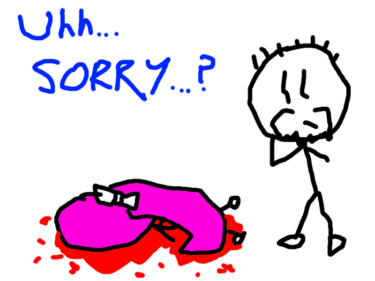
Death end re;Quest Code Z forces the player to interrogate their relationship with the death of their on-screen avatar — particularly one that is supposedly aware of them. Sayaka never remembers any of her deaths, but you know you caused them, and there's a helpful checklist of all 104 possible ways to die and the skill tree itself to remind you quite how many times you've seen her devoured, eviscerated, beaten to a bloody pulp, disintegrated, decapitated and any number of other nasty words you might care to mention. Undoubtedly the most "efficient" way to play is to repeatedly let Sayaka die in the first dungeon, but doing so is tedious — and thinking that should give you pause. You are repeatedly murdering someone, and it's boring. Are you that desensitised to violence that you can bring yourself to do that?
Some of you will be absolutely fine with it, I'm sure, and I'm not judging you for it. But after a few initial deaths in that first dungeon, I really started to hesitate and think "hang on a minute, this doesn't feel right at all". And I can't remember the last time a game made me feel quite like that about the protagonist, through my actions, being killed off.
This has made me determined to see how far it's possible to progress without killing Sayaka repeatedly. I've reached a point where I don't give a toss about PlayStation trophies any more, so I don't have the "pressure" from the two that related to getting all the Death Ends and unlocking all the skills weighing on me — and thus it really is up to my own feelings of morality about whether I want to buff up Sayaka by murdering her over and over again, or if I genuinely want to see her succeed, taking her shortcomings into account.
Thus far this is turning out to be one of Compile Heart's most interesting games. I'd expect nothing less from a series whose other two entries were also thoroughly fascinating. I'm intrigued to play more — and it certainly is the season for a bit of horror.
Want to read my thoughts on various video games, visual novels and other popular culture things? Stop by MoeGamer.net, my site for all things fun where I am generally a lot more cheerful. And if you fancy watching some vids on classic games, drop by my YouTube channel.
If you want this nonsense in your inbox every day, please feel free to subscribe via email. Your email address won't be used for anything else.
Discover more from I'm Not Doctor Who
Subscribe to get the latest posts sent to your email.
