#oneaday Day 699: Final Fantasy XI and the art of patience

As… promised? threatened? recently, I've started playing Final Fantasy XI again. And I am reminded, once again, for the umpteenth time, that I really like this game, particularly in its current form. I'm sure there are plenty out there who will bemoan how "dumbed down" its 2026 incarnation is compared to what it was like 20 years ago, but man, c'mon. You can play most stuff solo now; some might say that misses the point of an MMO, but there's still a markedly different vibe existing in a world knowing there are other players around. You see other people going about their business; you participate in the economy; you contribute to asynchronous team activities.

I am also reminded that Final Fantasy XI is not a game for everyone. Specifically, it is not a game for the impatient, because there is a lot to do, and it takes quite a long time to do pretty much anything… except level up, now, which goes at a significantly more brisk pace than it did the first time I played it all those years ago.

But we're talking about a game where the ability to run slightly faster than normal is dependent on someone completing a long and difficult quest, it rolling a random chance of the "Swift Shoes" effect coming up, and then you healing to full and having a nice sit down for a couple of minutes to "charge" the slightly-faster-than-normal movement speed — which, of course, immediately fades away the moment you either attack something or get attacked.

We're also talking about a game whose original implementation of "fast travel" required you to fight your way to a huge "crag" two zones away from your starting city and collect a crystal from it, all for the privilege of being able to teleport an inconveniently long distance away from any of the game's towns.

We're talking about a game where, when you want to cross the sea, you have to physically stand and wait for a ship, and when you're on the ship, you have to wait for the voyage to complete. (Sometimes monsters attack. A lot of the time you just have to enjoy the ride.)

If those descriptions make you smile, even a little bit, you are probably someone who will enjoy Final Fantasy XI.

The fact the game demands so much patience makes it feel very rewarding, though. When you achieve something, you feel like you've bloody well earned it. This is not a game where you are a super-special Warrior of Light pretty much from the get-go; this is a game where you are a relatively normal person — albeit one with, arguably, extraordinary combat abilities compared to your "peers" among the NPCs — just trying to make their way in the world. Make a bit of cash, get a bit of training in, visit some new places.

It's this rather open-ended feel that I really like about Final Fantasy XI. In many ways, it feels like a very pure reflection of what I call the old "world RPG" formula exemplified by titles like the early Ultima games. There is a long-term goal to go and complete, but the vast majority of your playtime will be spent doing rather freeform activities to build up your character in a way that you see fit.

Some of the best things that have been added to Final Fantasy XI since its original release are designed to make it more than just grinding monsters for hours at a time. The "Records of Eminence" quests do a great job of giving you things to do and acting as a sort of guide to what it is possible to do in the game, without having to spend half your playtime looking at a wiki. The "Field Guide" and "Grounds Tome" books at the entrances to field and dungeon areas respectively provide you with focused sets of monster targets to down in exchange for generous experience bonuses. And of course there's plenty of quests, the main storyline missions and, once you get later into the game, lots and lots of side activities. I don't yet know how "important" some of these things are — or indeed what 90% of them are at this point — but I'm intrigued to find out.

Thus far I'm up to level 25 on the job I started with — Warrior this time around — and I'm levelling Monk as a subjob for now. I'm on the "rank 2" missions for my home nation, and making good progress. I've also kicked off the Rhapsodies of Vana'diel storyline that was added much later than the other main stories, and acts as another kind of "guide" through what the game offers, with its own narrative to follow — and plenty of extremely helpful benefits as rewards along the way.

I'm enjoying myself a lot. I don't know how long it's going to take me to get through the various storylines, but levelling has been going at a brisk pace, and I'm feeling good about how things are going so far. I'm looking forward to finally doing things like taking down the Shadow Lord, which I've never done before, and particularly getting into the well-regarded Chains of Promathia expansion storyline, which longstanding FFXI players have been banging on about the quality of for years.

So yeah. It's a good time. You just need patience. And if there's one thing I have developed over the years, it is a very strong sense of patience.


Want to read my thoughts on various video games, visual novels and other popular culture things? Stop by MoeGamer.net, my site for all things fun where I am generally a lot more cheerful. And if you fancy watching some vids on classic games, drop by my YouTube channel.

If you want this nonsense in your inbox every day, please feel free to subscribe via email. Your email address won't be used for anything else.

#oneaday Day 696: The missing day

I apparently missed yesterday! Whoops. Oh well. It was a bank holiday. Let's just say I was having the day off. Better yet, let me point you in the direction of something I did write yesterday, which was a thorough write-up of Capcom's Pragmata.

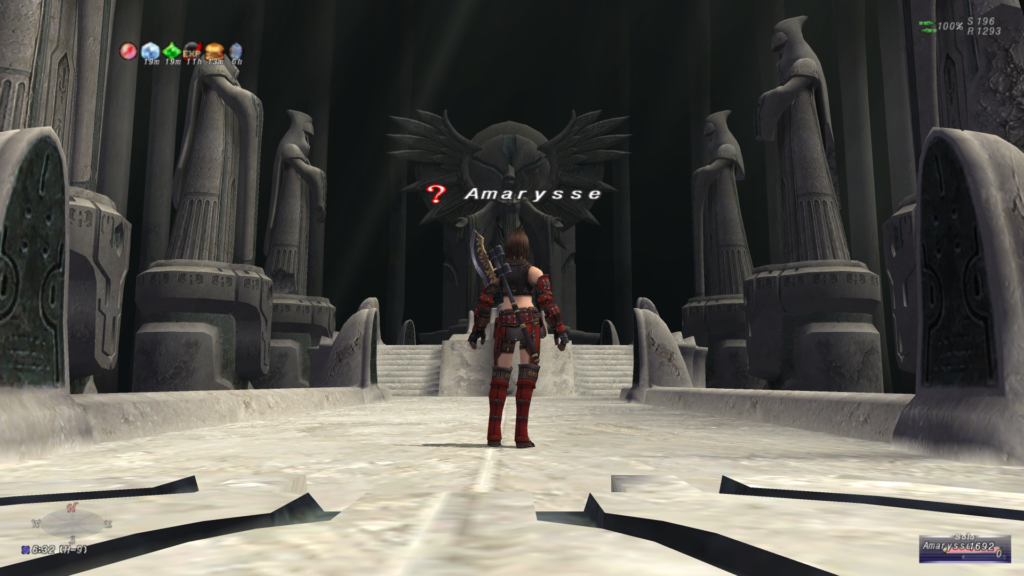
And then indulge me while I write two things today, because I feel like I "should". I'm just like that. Also I have just reinstalled Final Fantasy XI and it has to go through its whole many-hours patching process, so I may as well do something to fill the time.

I've decided to give Final Fantasy XI another honest go because I've always enjoyed it when I've played it in the past, I have been wanting to play through its story for more than 20 years (and there's a lot more of it now than when I first wanted to play it!) and I'm sort of "between games" right now. This time around, I want to make a proper effort to get through the main scenario. I know there's a lot of other stuff in Final Fantasy XI, but we'll see if I feel the need to jump into any of that as I work my way through; my priority is just seeing what the main storylines are.

The reason I say this is because I've pretty much made a decision: I'm going to head back into Final Fantasy XIV at some point before the new expansion drops — likely when the new "Beastmaster" job is added in the next main "part" of the Dawntrail finale patch, which is looking like July. Before that happens, I'd like to have had a good crack at Final Fantasy XI, so I'm going to treat it as my "main" game for the immediate future. I think it's going to be interesting — particularly as, for several years now, the game has been in a state where much of it is eminently soloable thanks to the fact you can bring recruitable NPC "Trusts" along with you for pretty much everything in the game, not just instanced dungeons like in Final Fantasy XIV.

As I say, I don't know how much into the weeds I'm going to get, because my main priorities are 1) getting to the level cap of 99 and 2) getting through the main storylines of the base game and all the expansions. The two will likely intertwine somewhat, and gearing up, particularly once at level 99, will likely involve dipping into some of the activities outside of the main story, but we'll see. I'm going to try and minimise guide usage as much as possible, too, because I think that will be much more interesting. I'm also curious to see if it's even possible to play that way — and if it isn't, well, there are 20+ years worth of FAQs, wikis and all manner of other resources out there to follow along with.

I'm excited! I'm also aware that I've fallen off Final Fantasy XI multiple times in the past, not because I wasn't enjoying it, but because something else came along that occupied my attention. Hopefully that won't happen this time around — because I'm increasingly conscious that, because of the game's age, there is likely only so much more time I have to be able to actually do this quest.

So Vana'Diel awaits! In about two hours' time, according to the PlayOnline Viewer, anyway. So how should I occupy myself in the meantime… hmmm?


Want to read my thoughts on various video games, visual novels and other popular culture things? Stop by MoeGamer.net, my site for all things fun where I am generally a lot more cheerful. And if you fancy watching some vids on classic games, drop by my YouTube channel.

If you want this nonsense in your inbox every day, please feel free to subscribe via email. Your email address won't be used for anything else.
#oneaday Day 493: The breakneck pace of Final Fantasy IV

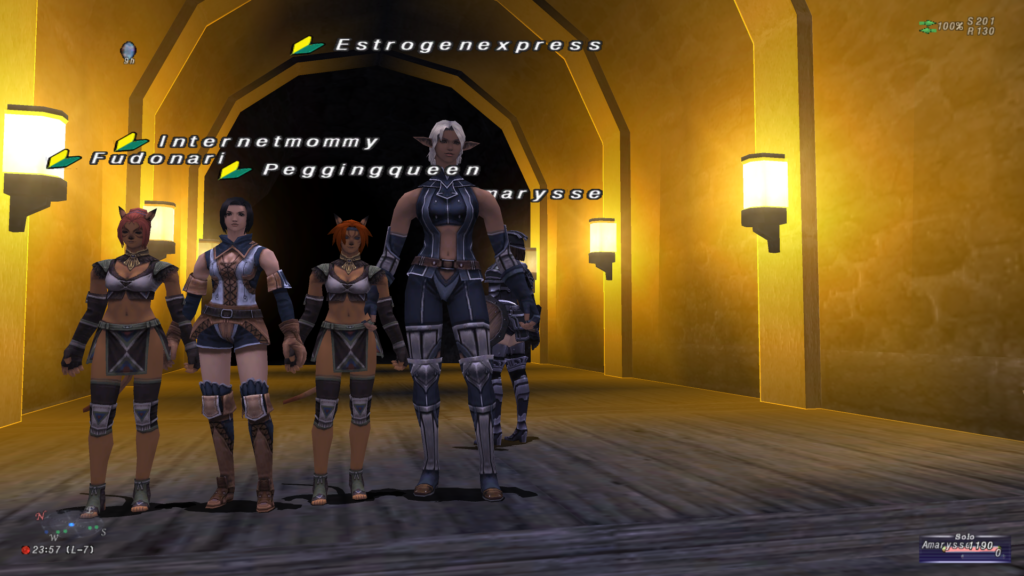
As one of several games I have on the go right now — for a bit of variety, like — I decided to start up Final Fantasy IV Pixel Remaster. I've played Final Fantasy IV I think twice before — and one of those was on PlayStation, so your sympathies are gratefully received, though that version at least isn't quite as bad as PS1 Final Fantasy VI — and remembered it being quite short, though I had forgotten quite how fast it moves.

I'm two hours in and already — apologies in advance if any of this is a spoiler, but the game came out in 1991 — the main character has committed a war crime, adopted an orphan child that he was directly responsible for orphaning, become separated from his best friend (who inevitably turns traitor), rescued his loved one from a deadly bout of Desert Fever by retrieving a valuable gem from a slobbering Antlion, rescued a prince from the ruins of his devastated castle and his broken heart, and attempted (mostly unsuccessfully) to fend off an assault on another kingdom.

It moves so fast. I had forgotten how fast. I have played so many modern (relatively speaking) games that feature epic-length story sequences between the core "gameplay" sections that it almost feels rushed. I mean, hell, after two hours in a Persona game from 3 onwards, you're barely through the initial character introductions and you almost certainly haven't set foot in a dungeon yet.

This is both a strength and a weakness of Final Fantasy IV, looking at it with a 2025 pair of eyes. It's a strength because it means that there's never particularly long to wait before you're doing stuff again — exploring the world, clearing dungeons, fighting monsters, levelling up, buying new equipment — and that is quite a refreshing change from today's narrative-centric games that, while undoubtedly considerably more ambitious in their storytelling, sometimes do feel like they're getting a little bogged down. Not only that, but Final Fantasy IV is done and dusted in less than 20 hours, which makes it a veritable light novel by RPG standards.

However, it's also a weakness, because there are some sequences that were clearly intended to be quite significant narrative moments, but the way the game just whizzes through them makes them feel almost laughable.

I'll give you an example. Rydia, the girl that the protagonist, Cecil, rescues from a war crime he inadvertently committed at the behest of his king, is a Summoner in Final Fantasy Job terms. This means that not only can she summon big things to deal heavy damage, but she can also cast both white and black magic spells. When you first get her, she's an inexperienced kid at level 1, so she barely knows any spells, but a bit of levelling in the field will net her a few initial, useful spells. Except you'll notice one black magic spell is prominently missing: Fire.

Think about it for a moment and it's obvious why: because she lost her entire village, including her mother, in a fiery explosion, she is, of course, going to be hesitant to call upon the power of fire. This little bit of characterisation is initially delivered without the game drawing any attention to it whatsoever, but you can notice it early from a simple browse of the menu. Very cool. Ambitious for the time, even!

What is less cool is when the party finds their path up a mountain blocked by a big chunk of ice, and the other members, eventually getting Rydia to admit that she "hates fire", pretty much tell her to stop snivelling and get over it because they jolly well have a quest to accomplish. It's almost certainly not intended to come across that way — the other members are all "yay, you did it, I always believed in you" after she does successfully cast her first Fire spell, presumably with tears streaming down her face and the knowledge that this is probably going to need years of therapy to truly deal with — but with at least a couple of decades' worth of games that handle sensitive topics rather more delicately behind us, it does feel rather… blunt.

But, again, you have to remember that this was 1991, just a year after the SNES had come on the market, and Final Fantasy IV was on a cartridge that contained less than a megabyte of data in total. In fact, during development, the script had to be cut considerably to fit on its cartridge; lengthy exposition was something that developers simply couldn't afford to do back in these days, because every byte mattered, and text can potentially take up a lot of space if there's enough of it. As such, it's not altogether surprising that some sequences feel like they move a tad fast by modern standards — short of shipping on a larger capacity cartridge, which was presumably a decision that needed to be made relatively early in development, there were very real constraints on what Final Fantasy IV would be able to do.

Of course, Final Fantasy IV has been expanded on quite a bit in later remakes such as the polygonal 3DS version, the Game Boy Advance version and the PSP version; each of these had their own additions to the basic Final Fantasy IV formula.

But the Pixel Remaster; that's based on Final Fantasy IV as it originally existed, graphics and music aside, and thus you have the plot that speeds off over the horizon as you just think you're getting caught up on proceedings.

All this is no shade on Final Fantasy IV, of course; it's a game I like very much (though it's far from my favourite Final Fantasy) — I just found it interesting to revisit this after so many years and be reminded that at one time, RPGs moved a lot more quickly than they do now!


Want to read my thoughts on various video games, visual novels and other popular culture things? Stop by MoeGamer.net, my site for all things fun where I am generally a lot more cheerful. And if you fancy watching some vids on classic games, drop by my YouTube channel.

If you want this nonsense in your inbox every day, please feel free to subscribe via email. Your email address won't be used for anything else.
#oneaday Day 491: Some first impressions from Death end re;Quest Code Z

I am a big fan of Compile Heart's Death end re;Quest series. For the unfamiliar, it's a series of three (to date… with it looking like there's more on the way) narrative-centric console RPGs with strong horror themes, and involvement from some maestros of the genre like Makoto "Corpse Party" Kedouin on scenario duties and Kei "Mary Skelter" Nanameda on the art.

What I've found very interesting about Death end re;Quest to date is that all the games in the series have been very different from one another. Mechanically, the first two were quite similar, but tonally and thematically they were very different. The first game primarily involved an "if you die in the game you die for real" kind of MMO-gone-mad situation, while the second was based around horrible goings-on in a tiny European town that doesn't appear on any maps. As Compile Heart games, both of them also involved more than a touch of yuri to them — particularly in the case of the second one.

Death end re;Quest Code Z, meanwhile, changes up both the narrative setting and the game's core mechanical conceits. Narratively, I'm not far enough into the game to know exactly what the situation is, but it involves characters from both of the previous two games, many of whom didn't interact with one another directly in their original games — and, moreover, some characters who were very much dead in previous games, such as the father of the second game's protagonist, Mai — are alive in this one. I can't comment on that further as yet, but I'm interested to know more.

The most obvious difference between Death end re;Quest Code Z and its predecessors is that it's now a Mystery Dungeon-like. For those not familiar with such things, this is a Japanese take on the roguelike genre that typically (though not always) favours cutesy visuals; grid-based, turn-based movement and combat; a heavy degree of resource management; limited inventory space; and, of course, a series of increasingly deep, procedurally generated dungeons in which to hack, slash, explore, level up and loot.

Death end re;Quest Code Z mostly plays things relatively straight in this regard, with the exception of one thing: rather than an "energy" or "hunger" bar, the protagonist, Sayaka, has a sanity rating. This gradually declines as you explore, with various "milestones" on the gauge corresponding to her field of view contracting, the background audio becoming more distorted (or completely replaced) and, in the case of extremely low sanity, interface elements like the minimap being unusable and the likelihood of her harming herself going up considerably.

This is very much in keeping with the horror tone the series has always had, but it also means that the game has quite a "survival horror" feel to it as well. Since you're juggling your health, sanity and available items as you progress through each dungeon, you have to make some tough and interesting choices as you play — particularly if you're playing on the "Expert" mode (which I actually recommend in this case), where Sayaka's level is reset every time she leaves a dungeon, and she suffers notable losses in terms of inventory items and weapon power-ups if she's actually killed.

The other interesting thing relates to the series' titular "Death Ends". In prior games, Death Ends came about if you made bad choices during the storytelling sequences, and usually resulted in the protagonist and/or members of the core cast suffering a horrifying, gory death, described in excruciating detail. Towards the end of the first game — mild spoilers, I guess — one of the characters becomes aware of you, the player, and starts addressing you as "God of Death" in recognition of the number of times you have led the cast to a sticky end, and Death end re;Quest Code Z builds on this further by having the main protagonist, Sayaka, constantly aware of and communicating with you — even putting her trust in you.

There's some interesting conflict here, because Sayaka trusts you to lead her through the challenges ahead of her, and you need to successfully do so in order to progress through the story. But! And this is a big but: if you let her die, you can make her stronger. Because every time you see a unique Death End in Death end re;Quest Code Z, Sayaka gets a skill point that you can invest in passive boosts to her basic abilities and resistances, and even complete immunity to certain status effects. The more she dies, the stronger she gets and, presumably in theory, the easier the game gets.

But that places you, as her "Partner" (she very pointedly keeps referring to you as such) in a difficult position. Because in keeping with series tradition, every time Sayaka carks it, there's a lengthy narration of exactly how she dies, often delivered in something of a mocking tone. This is coupled with a gory (and often somewhat sexualised) event image depicting her dying yet again. Thus you are faced with a quandary: do you kill Sayaka a bunch in order to power her up? Do you deliberately lead her to her death multiple times in succession to score some easy skill points at the outset of the game? Or do you actually try and take care of her somewhat, knowing that in doing so you are leaving her as a somewhat sub-optimal character?

Death end re;Quest Code Z forces the player to interrogate their relationship with the death of their on-screen avatar — particularly one that is supposedly aware of them. Sayaka never remembers any of her deaths, but you know you caused them, and there's a helpful checklist of all 104 possible ways to die and the skill tree itself to remind you quite how many times you've seen her devoured, eviscerated, beaten to a bloody pulp, disintegrated, decapitated and any number of other nasty words you might care to mention. Undoubtedly the most "efficient" way to play is to repeatedly let Sayaka die in the first dungeon, but doing so is tedious — and thinking that should give you pause. You are repeatedly murdering someone, and it's boring. Are you that desensitised to violence that you can bring yourself to do that?

Some of you will be absolutely fine with it, I'm sure, and I'm not judging you for it. But after a few initial deaths in that first dungeon, I really started to hesitate and think "hang on a minute, this doesn't feel right at all". And I can't remember the last time a game made me feel quite like that about the protagonist, through my actions, being killed off.

This has made me determined to see how far it's possible to progress without killing Sayaka repeatedly. I've reached a point where I don't give a toss about PlayStation trophies any more, so I don't have the "pressure" from the two that related to getting all the Death Ends and unlocking all the skills weighing on me — and thus it really is up to my own feelings of morality about whether I want to buff up Sayaka by murdering her over and over again, or if I genuinely want to see her succeed, taking her shortcomings into account.

Thus far this is turning out to be one of Compile Heart's most interesting games. I'd expect nothing less from a series whose other two entries were also thoroughly fascinating. I'm intrigued to play more — and it certainly is the season for a bit of horror.


Want to read my thoughts on various video games, visual novels and other popular culture things? Stop by MoeGamer.net, my site for all things fun where I am generally a lot more cheerful. And if you fancy watching some vids on classic games, drop by my YouTube channel.

If you want this nonsense in your inbox every day, please feel free to subscribe via email. Your email address won't be used for anything else.

#oneaday Day 373: Getting to grips with Cyberpunk

Played a bit more Cyberpunk 2077 on Switch 2 today, and I'm really enjoying it so far. I'm starting to get to grips with how to play a bit more stealthily, and it's considerably more gratifying to play this way than going in all guns blazing. The fact you can go in all guns blazing is also gratifying, but after one of the "fixers" telling me I had done sloppy work because in the process of attempting to steal a bit of data, I had murdered everyone in the building, I figured I should learn how to do things a bit more appropriately. I've put all those points into Intelligence and Technical Ability, after all, so I might as well use them!

What's fun about playing stealthily is that it makes each mission feel a bit more varied. Rather than showing up, aggroing the first guard you see and then effectively playing a cover shooter for a bit, you generally have to explore the environment a bit more thoroughly to find suitable means of entry and exit. Canny use of Quickhacks can also allow you to "tag" important objectives, mechanisms and guard positions, so you can keep track of them even when they're not in direct line of sight. And if you take control of security cameras — something you can do with your starter Cyberdeck — you can use their perspective to hack things that aren't within protagonist V's direct line of sight.

I'm anticipating that long-term, you'll probably be able to get into a position where you can complete an entire mission without setting foot inside the building once. I'm not at that point yet, largely because I think I'm lacking some useful Quickhacks for achieving that, but I have reached a point where I can convincingly perform reconnaissance on the target area before attempting to breach it. What then follows is a bit of wandering around outside, usually to find a means of getting on top of the building, and then planning a means of attack that either allows me to avoid everyone, or perhaps perform some silent takedowns.

The silent non-lethal takedowns are immensely satisfying to perform. By sneaking up behind an unaware enemy, you can grab them and drag them into another room before either killing them or knocking them out; the latter option is usually encouraged. Once you have a body, you can then pick it up and move it somewhere, including stuffing it into dumpsters (fatal), the boot of a car (not fatal) or just an out-of-the-way location.

This sort of thing is what I was talking about when I said I hoped Cyberpunk 2077 was going to feel like an old-school PC game. I'm talking sort of Deus Ex and Thief: The Dark Project era. I can't remember the last time I picked up an unconscious body and stashed it somewhere out of sight in a video game. Perhaps that says something about the games I typically play, but it feels like something we don't do a whole lot of in games any more. And that's a shame, because well-implemented stealth sections are a lot of fun.

And there's the rub, I think: I reckon a lot of people, having experienced many bad stealth sections in games, have forgotten what well-implemented stealth is like, and at worst have conditioned themselves to think that stealth is automatically bad. But one thing Cyberpunk 2077 shows is that if you do stealth sections correctly — and by that I mean providing the player with plenty of tools to monitor the situation and strategically plan things out — they can be as fun as all-out gunplay.

Cyberpunk 2077 doesn't do anything especially out of the ordinary. You have a little minimap in the corner of the screen that acts a bit like the radar in Metal Gear games. Enemies can be unaware, cautious or alerted, and it takes a moment for them to "switch" between those states; if you can get out of sight before they fully reach the new state, you can escape their notice. Cameras and security devices can be hacked, manipulated and even turned against enemies. And various things you do — ranging from stumbling over discarded noisy debris to attempting to hack their mainframe — have the potential of giving you away.

Since I'm not very far in the game's main story, I haven't seen a lot of additional options to customise V's cyberware to hack in various different ways, but already I'm starting to see how all this works. My "Netrunner" skill stat is getting a nice workout, and it's satisfying to see that rise with use.

And thus far I've mostly been doing random-ish odd jobs rather than progressing the main story. None of these have felt throwaway, either; they all have narrative context, and feel just as important to the overall setting as the main missions. That's good; it's helping the setting to feel nicely immersive, and making the game a whole lot more enjoyable.

So yeah! I'm glad I picked it up. It looks and runs great on Switch 2 — and with no frame of reference for the PC or PlayStation versions I don't feel like I'm "missing out" on any graphical flourishes — and it's a lot of fun to play. So it may be five years old, but to me it's new, fresh, and exciting — and I'm looking forward to playing more.


Want to read my thoughts on various video games, visual novels and other popular culture things? Stop by MoeGamer.net, my site for all things fun where I am generally a lot more cheerful. And if you fancy watching some vids on classic games, drop by my YouTube channel.

If you want this nonsense in your inbox every day, please feel free to subscribe via email. Your email address won't be used for anything else.

#oneaday Day 286: It's Xenoblade time

It's Xenoblade Chronicles X: Definitive Edition release day, and I was very good and didn't even boot it up until I'd done all my work for the day and emptied the cats' litter trays and gone out to get some stuff from the shop. Still managed nearly four hours of getting into the swing of things.

It's a delight to return to this game. As I've alluded to several times, I'm going to do some more in-depth coverage of this over on MoeGamer as I play through, but I thought I'd also post some first impressions from the Switch port here, since it's what the majority of my evening has consisted of.

It's been a long time since I played the Wii U version (ten years, in fact!) but a lot of things already feel comfortably familiar. I even inadvertently picked the exact same voice for my character that I did first time around, though I didn't realise I'd done that until she came out with one particular line that suddenly triggered a memory.

Xenoblade Chronicles X is an absolutely massive game, but it does a good job of easing you into things. The early story missions take you through the absolute basics you'll need to know to get up and running, then by about the third chapter you can start enjoying some of the game's more "freeform" structure by taking on various missions. As you continue to progress the main story, you unlock other features such as the online modes and the ability to pilot (and later fly) the "Skell" giant robots. Crucially, though, the game doesn't throw all this at you at once. You can quite feasibly spend a very long time playing the game before even getting anywhere close to jumping into a Skell.

The main thing I was wondering about, which is how they'd implement the hex-based "segment map" that was originally on the Wii U GamePad's screen while you played, has been incorporated about as well as they could have done given the Switch's lack of a second screen. It's now a separate Map screen that you can access from the game's main menu, which means you can't look at it while you're wandering around, but it does also mean you can concentrate on it without having to worry about Tyrants coming to attack you while you tinker with your mining probes.

Performance and visuals-wise, the Switch version does a great job. There are understandable technical limitations of the same ilk seen in other Xenoblade games on the console — most notably characters and some objects "popping in" as you approach rather than being drawn from a distance — but, given the scale of the game and the relatively underpowered hardware it's running on, it's just fine. The tweaks to the interface to make it more readable are very welcome indeed, and I suspect even more so for those playing in handheld mode; this is really a game made for big TVs, though, as the vistas throughout remain absolutely spectacular.

Coming to this almost straight off the back of Xenoblade Chronicles Definitive Edition, it's also interesting to note how different the combat feels. While the basic mechanics are almost identical, the focus on responding to your party members' callouts and the ability to switch between ranged and melee weapons on the fly really makes battles feel a lot more dynamic. Enemies move around a lot more, too, meaning you also have to move a lot more to be able to strike them from the side or behind — and a welcome addition over the original Xenoblade's combat is a clear on-screen indicator as to whether you're considered in front of, flanking or behind an enemy.

I'm very happy to be back on Mira, and since I have no other "big games" going on right now, I'm going to see quite how much of this game I can complete this time around. Because although I finished the storyline of the Wii U version, I feel like I only scratched the surface of the things the game has for you to do. Because as I saw someone else point out the other day, Xenoblade Chronicles X is actually two stories: one is about your companion Elma rather than you, and that's the "main scenario" you go through. The other is the emergent narrative you build yourself: your career with BLADE, the missions you complete, the people you encounter, the choices you make. And it's that latter part that goes on for a lot longer than the relatively short main scenario.

Because I was deep into Final Fantasy XIV at the time Xenoblade Chronicles X came out for the first time, I felt a certain amount of "guilt" at getting too invested in the latter. But since I've drifted away from Final Fantasy XIV for the moment, Xenoblade Chronicles X is getting my full attention. And if you're yet to play it, I highly encourage you to check it out this time around. You no longer have the excuse that it's on a platform that no-one owns, because it's on one of the most popular console platforms in the known Universe.

Anyway. I wanted to post something about it today at least. I should probably go to bed now, but there are missions to do, things to find, Tyrants to fight…


Want to read my thoughts on various video games, visual novels and other popular culture things? Stop by MoeGamer.net, my site for all things fun where I am generally a lot more cheerful. And if you fancy watching some vids on classic games, drop by my YouTube channel.

If you want this nonsense in your inbox every day, please feel free to subscribe via email. Your email address won't be used for anything else.
#oneaday Day 212: Engage!

I've been playing Fire Emblem Engage since I finished Paper Mario: The Thousand-Year Door and The Legend of Zelda: Echoes of Wisdom, and I've been having a lovely time. Fire Emblem is a series that has always passed me by despite it being, in theory kind of in my wheelhouse.

I say "kind of" rather than "completely", because while I absolutely love the high drama fantasy RPG side of the narrative, I've always had a bit of a rocky relationship with strategy games. I'm not good at them, see, and I've always had a hard time trying to determine how to get better at them. Because while there are plenty of guides out there for games like Fire Emblem, none of them simply sit you down and talk you through how to play them effectively. And that, for me, has always been a problem. It's why I bounced off Fire Emblem Awakening on 3DS, the last entry in the series that I tried, and why I have held off on playing the copy of Fire Emblem: Three Houses that's been on my shelf for several years at this point.

Why am I playing Fire Emblem Engage when Three Houses, a game almost universally considered to be superior in every way, is right there on my shelf? Well, because I had somehow got it in my head that Engage was a little more "straightforward" — and, perhaps more importantly, shorter. Three Houses is an absolute beast of a game, particularly if you do all the narrative routes (which I'm assured you should), whereas Engage is a once-and-done sort of affair, with replay value coming from the harder difficulty levels.

Mechanically, I don't think Engage is any more straightforward than what I know of Three Houses. There are elements where it's arguably more complicated, in fact — most notably with regard to the Emblem Bond and Skill Inheritance systems — but I wasn't to know that going in, and I'm about 25 hours in now, so, well, I guess I've dealt with it successfully.

I'm not ashamed to admit that I'm playing on Normal difficulty and Casual mode — i.e. the one without permadeath. I was having enough difficulty with the initial missions in the game that adding the opportunity to completely gimp my playthrough via poor performance seemed like an unwise choice. I am new to the series, I am still finding my feet in how it all works and how to play effectively, and thus I want minimal barriers to just enjoying myself. The options are there, so I'm using them.

With that "guardrail" in place, Fire Emblem Engage is still quite challenging. If you lose a unit during a mission, you still have to do the rest of the mission without that unit, and that can really fuck you over. It took me a few early-game missions to figure out what I was doing wrong, but then something interesting happened: I figured out what I was doing wrong.

This is not something that normally happens with strategy games. I normally end up being trounced by whoever I'm playing against, then never wanting to play it again as a result — or, in the case of tabletop affairs, not getting much opportunity to "practice". But with Fire Emblem Engage, I've ploughed on, and I've started to get a real feel for how the strategy works, and what is effective. I still make mistakes now and then — and the game's generous "Draconic Time Crystal" mechanic that allows you to undo stupid moves has been very helpful here — but I am definitely getting better at How To Play Fire Emblem. And that's a good feeling.

Because Being Able To Play Fire Emblem means that you can Enjoy Fire Emblem. And there is a lot to enjoy. The story of Engage, while relatively clichéd RPG fare — dark dragon long thought safely sealed away has come back, heroic band must gather a bunch of rings to summon enough power to drive the bastard back to the abyss — has been really compelling so far, and the character-centric nature of modern Fire Emblem is exactly what I like in this sort of game. I'm getting a real feeling that I'm getting to know the individual characters, both through the protagonist character's interactions with them and their interactions with one another.

For the unfamiliar, modern Fire Emblem features a relationship mechanic whereby units can "support" one another by fighting alongside each other in combat and doing activities together between battles, and your reward for reaching a new milestone in two characters' relationship with one another is a "support conversation", which depicts the two of them getting to know one another. There's not a Support mechanic in play for every pairing of characters in the game, but plenty that make logical sense, and it's lovely to see everyone getting to know one another, having comedic misunderstandings and deepening their feelings of friendship.

Anyway. I'm not sure how far through the game I am — I reckon probably about halfway maybe? — but I've been playing it all weekend and having a great time. I should almost certainly have it finished ahead of Xenoblade Chronicles X coming out on Switch in March — because you better believe I'm revisiting that game thoroughly having adored it on Wii U — but in the meantime I think I'm a convert to the series. I'm sure longstanding fans will scoff at me playing on non-permadeath mode, but I bet all of them reload a save the second anyone dies anyway. Also it doesn't matter how someone else enjoys a video game.

So yeah. Fire Emblem, pretty good. Who knew?


Want to read my thoughts on various video games, visual novels and other popular culture things? Stop by MoeGamer.net, my site for all things fun where I am generally a lot more cheerful. And if you fancy watching some vids on classic games, drop by my YouTube channel.

If you want this nonsense in your inbox every day, please feel free to subscribe via email. Your email address won't be used for anything else.

2518: The Pitioss Ruins

0518_001

I finished Final Fantasy XV's main story earlier on. It was a spectacular conclusion, but that's not what I want to talk about today. Instead, I want to talk about the game's "secret" dungeon, the Pitioss Ruins.

As you have probably surmised, spoilers are ahead, albeit not story ones, since the Pitioss Ruins is a purely mechanical challenge. I am going to talk about all the different aspects of the dungeon, though, so if you want to encounter it for yourself, look away now.

Continue reading "2518: The Pitioss Ruins"

2516: Alola!

0516_001

When I've not been playing Final Fantasy XV, I've been giving Pokémon Moon a serious shot, as I'm determined to try and understand the obsessive appeal the series has. And I think, finally, I'm starting to "get it".

Part of this is, as I described a few days ago, the fact that Sun and Moon have refined their systems and interfaces to a level where I'm not frustrated by a lack of information any longer, although I do feel there's a certain amount of "assumed knowledge"; an understanding that many of the people who are playing this have previously played at least one Pokémon game to death. This leads to a certain amount of flailing around in the early hours as you try to figure certain things out — though pleasingly, the game does actually take the time to point out what common series abbreviations like "TM" stand for, which is something I don't recall and Y doing.

Pokémon has evolved considerably over time. I played Red and Gold when they first came out on Game Boy, then set the series aside until and which I gave a go for a bit but didn't really feel, although there were certain aspects I did like. Chief among these was the amount of customisation there is in the game, which has really come to the forefront in the 3D installments. I'm a sucker for any game that gives me the opportunity to play a cute girl and dress her up in cute outfits, and Moon certainly hasn't been disappointing in this regard, with plenty of hair and clothing options to choose from. (I actually found myself not wanting to customise and Y's default female character because I liked her standard look so much, though I understand there was a similar situation here.)

Moon's online feature — the Festival Plaza — is a little peculiar in that true Nintendo "no direct online interaction!" way, but it's charming, endearing and friendly in, yes, that true Nintendo way. Not only do you get the opportunity to ogle the wonderful avatar creations of other players — both from your friends list and randomly gathered from online — but you also get to interact with them in various ways. Perhaps the most appealing part of all this is the fact that it's possible to populate your online profile with a questionnaire covering all manner of different topics, and there are a wide variety of different responses you can give to the prompts — some sensible, some nonsensical. This allows players the opportunity to express themselves and their personality without the potential for unpleasantness that unfiltered direct online communication often brings with it.

As for the main game itself, the setup has been enjoyable so far. In typical Pokémon fashion, you set out from your childhood home to have an adventure, largely prompted by the local crazy professor. Along the way you encounter a rival (who is more of a friend in this character than in some previous installments) and a recurring team of villains (who are, as usual, comedically incompetent in this installment, with the main difference being that the general populace of the Alola region knows how comedically incompetent they are rather than living in fear of them) as you seek to prove your might as a Pokémon master.

I like the fact the structure of the game has been shaken up a bit from "get to each town, visit gym, defeat everyone in there" from the previous games. The new "trials" concept covers the same basic ground, but seems to handle things more like a traditional RPG dungeon, with objectives to complete along the way followed by a boss at the end. I'm interested to see how this develops further in the game — I'm still on the first island at present.

I'm not yet quite sure if I'm "doing it right" with regard to my team makeup and levelling strategy, but I'm sure there are no mistakes I might make that can't be corrected with a little grinding or, if the worst comes to the worst, catching a fresh new Pokémon of a particular type. In the meantime, I'm genuinely enjoying Moon, and I'm keen to see how the game develops in its later hours.

2511: Maybe Catch Some of 'Em

0511_001

I decided to give Pokémon another go with the latest installments Sun and Moon, specifically Moon, since Andie picked up a copy of Sun.

I've only spent a little over an hour with it so far but already it looks as if Sun and Moon have addressed some of the things I found frustrating about the previous installments, and that, coupled with reports from friends who say it's a lot more story-heavy than previous Pokémon games, makes me think I'm probably going to enjoy it a lot more.

One of the things that always frustrated me about earlier Pokémon games was the fact that it was pretty vague about things like debuffs and suchlike. "Pikachu's attack fell!" the game would say. "How much?" I would want to know. "Does that debuff stack if the opponent keeps using the same move?" Neither of those answers were particularly forthcoming in previous installments — or if they were, I certainly didn't know where to find them.

In Sun and Moon, however, there's a handy mid-battle status screen that allows you to see that yes, debuffs do stack, and how many times your Pokémon has been inflicted with a particular debuff. (It still doesn't tell you how much your stat has been reduced by, but you can make an educated guess as to the impact according to the levels of your Pokémon and your opponent.)

Even better, Sun and Moon use information from the Pokédex to allow you to quickly see which moves are effective, super-effective and not very effective against your current opponent, negating the need for constant flipping back and forth between menu screens or keeping copious notes on what was weak and strong against what. Doubtless for some purists learning all this stuff was part of the appeal, but the way Sun and Moon does things is a lot more friendly to people like me who haven't invested thousands of hours in the series as a whole.

These niggly little features aside, I'm impressed with the overall presentation of Sun and Moon, a lot more so than previous installments. While and had some reasonably nice character models, their proportions were a bit weird in comparison to the official art. In Sun and Moon, meanwhile, the characters look just like their hand-drawn counterparts and are animated well, to boot. The only sign it's running on the underpowered 3DS hardware is any time the camera gets a bit close to a character and you can see big jagged pixels on the textures.

I'm not far enough in the story to be able to comment on it as yet, but the early introduction of the character Lillie — current darling of the fanart community, from what I can tell online — gives the story some interesting momentum right from the get-go, and the incidental characters are appealing and fun. In particular, the protagonist's mother is extremely likeable, helping to make your character's home feel a lot more… well, homely.

I'm looking forward to seeing how it develops further; I'm going to give it a proper chance this time around, even if I am currently attempting to juggle it with Final Fantasy XV, which is monopolising most of my gaming time at present. Perhaps I'll finally understand why people go apeshit for each new Pokémon release.