1159: WAY More Than Seven Days

Back on Day 793, you may recall that I mentioned I was working on a game and that I was quite enthusiastic about it. Well, it stalled somewhat for various reasons — work, general lethargy, moving house, jury service, many other reasons that aren't really excuses — but this week I've started working on it again, and it's a good feeling.

To be honest, doing what I'm doing was partly spurred on by this painfully accurate article from The Onion. I figured that I'm in a relatively good position right now — financially secure, working in a job which is reasonably challenging at times but which leaves me with plenty of free time — so instead of sleeping until 10-11am (usually unintentionally) I should make use of some of that extra time. As such, I've been getting up a bit earlier and, well, making use of some of that extra time.

In the previous post I linked to, I talked about how much I enjoy the world-building aspect of creating a game. Today, I've been rediscovering the joy of populating those locales that I've created with people. Specifically, the stuff I've been working on over the last couple of days has been the first appearance of the story's main characters, so it's been an absolute pleasure to see these characters I've had in my head (and a Google document) finally appear on screen and act the way I've told them to.

I'm going to do that annoying developer thing and not talk in specifics about the project because I'd like some aspects of it to remain a surprise, but I will say a few things about what I've achieved so far.

Thus far I've got a controllable protagonist and an interactive introduction sequence that introduces her, the setting and the context of the story. I've got some sequences where the player is able to make choices and subtly change some of the things that occur next. I've laid a few "hooks" for future interactions between the protagonist and other characters, and I've put together the story up until the point where the protagonist meets up with the other main characters. And, as I type this, I've composed the initial conversations between the protagonist and the other characters — including, again, a few events that change a little bit according to choices that have been made.

I'm deliberately keeping things relatively unambitious with this project, as I would very much like to actually finish it at some point. It's a concept that I really like and would very much like to carry through to completion, so I'm keen to try and devote some time to it. One thing that was stopping me was a lack of certain art assets that I needed to progress, but now I've found those (or at least got some solid placeholders put in) I have, as far as I can make out, everything I need to pick up this project and run with it, motivation and free time permitting. Aside from the art assets I was lacking, most of the other stuff I'm using is either RPG Maker's built-in content or publicly-available/royalty-free stuff. The somewhat "generic" nature of using built-in and publicly-available assets is entirely deliberate — if and when it's finished you'll hopefully see why I chose to go that route. It wasn't just laziness and/or a desire to get up and running without having to worry about creating custom content — though being able to work with pre-made character sprites and the like certainly makes working on this a bit easier.

I'll leave it at that for now, and if I make any significant progress that I'm happy to share in the near future, I may drop in a few screenshots here and there. Suffice to say that for the moment, I'm happy with the way things are going and hopefully I'll have something more to share soon.

1157: The 'Fandisc' Experience

So having finally completed Kira Kira (which is excellent, by the way — one of the best visual novels I've had the pleasure of playing to date) I decided to make a start on its semi-sequel Kira Kira Curtain Call, which is considerably shorter and more of a spin-off than a full sequel. Technically, it's a "fandisc", which is a concept I hadn't come across prior to getting into the visual novel medium.

I'm assuming this probably means that you aren't familiar with it either, in that case, what with VNs being rather niche and all. Basically it's exactly what it sounds like: it's a disc (or download) of extra content that continues where the main game left off. Sometimes it involves the same characters, sometimes it has side stories. It's usually considerably shorter than the original game, too, but it's a standalone game in its own right rather than an addon. I guess the closest equivalent in Western gaming would be a standalone expansion pack or piece of DLC.

Not many of these fandiscs make it over to the West, for some reason, though there are a few that have. Persona 3 FES could be considered a fandisc, for example, due to its 20-hour extra campaign that ties up the loose ends left by Persona 3's main campaign. Corpse Party: Book of Shadows could be considered a fandisc for the original Corpse Party, too, since it fleshes out (no pun intended) a number of the incidental characters from the original before continuing the plot in preparation for a true sequel. And Kira Kira's English-language publisher Mangagamer have taken to translating and releasing some of these fandiscs for the more popular visual novels out there — Kira Kira is one of them.

Kira Kira Curtain Call is a two-part follow-up to the events of Kira Kira, and stars a mostly new cast of characters. Unfolding several years after Kira Kira's conclusion (and assuming that the "True End" was, well, true), the game initially begins with the player in the role of Souta Honda, a passionate, fiery-haired young man who is angry and frustrated at the world, and wants nothing more to express himself through the medium of rock music. At the same time, though, he doesn't want the trappings of fame that being a famous musician begins — indeed, shortly after the game begins, we see him thrown into a sexual situation with two groupies and an old senpai who is now a member of a successful band, and he refuses to take part.

Souta, you see, is desperately in love with a girl named Yui, and herein lies one of the reasons why Curtain Call is such an interesting and distinct experience from the original game. Rather than the first part of the game allowing the player to get to know the characters and then, through their choices, progressing down one of their "routes" to their eventual conclusion, in Curtain Call we begin with a protagonist who is already obsessed with the object of his affections. In what I've played so far, Yui's feelings towards Souta are somewhat ambiguous, but it's clear that there's some affection there despite Souta's previous advances leaving her with mild androphobia.

Souta is a marked contrast to the original game's protagonist Shikanosuke. Initially, Shika was a guy very much caught up in a tidal wave of events that you always felt were slightly beyond his control — though it was abundantly clear by the end of the story that he was genuinely enjoying himself despite spending a good half of the game in drag — but he grew and changed in various ways according to which of the three heroines' paths he proceeded down. Each of the paths had something in common, though: the fact that the main cast's band left an indelible mark on their high school of Oubi Academy, and you get a real sense of this fact in Curtain Call. In a nice touch, Shikanosuke's sister Yuko, who was often heard but never seen in the original Kira Kira, is one of the main supporting characters in Curtain Call and has even been very obviously designed to resemble Shikanosuke in drag to an almost uncomfortable degree.

Other characters put in an appearance, too: the second half of the game (which I haven't reached yet) focuses on one of Kira Kira's supporting characters and his attempts to make his own band. In one of the routes through the original game, Shikanosuke becomes part of this group as he attempts to [SPOILER REDACTED] but in the "True End", we simply hear that this band exists.

All in all, I really like the idea of a "fandisc". It provides the potential for a story to continue and for the game's world to be considerably more fleshed out even after the main game has concluded. Of course, you have to be careful not to outstay your welcome — Persona 3 FES ran into this issue with its immensely frustrating, cheap boss fights — but if you handle it well, it gives the player the opportunity to spend just a little more very welcome time in a game world with some characters and settings that they have become very fond of. While I was completely satisfied with the way Kira Kira concluded in all its various routes, I'm happy to have the chance to see "what happened next" and take part in the extension of that story.

1155: The Tablet Revolution

Page_1I've come to the conclusion that I'm a dusty old bastard who is set in his ways like an old man. That or everyone else is just plain wrong. Or perhaps a combination of the two.

I'm specifically referring to the "tablet revolution" — that futuristic gubbins that supposes everyone is going to replace their computer/console/handheld/everything with a tablet such as an iPad or whateverthefuck the bajillion Android tablets are called these days. I even read an article earlier where someone from Zynga said that tablets are "becoming the ultimate game platform".

I must respectfully disagree — at least for my needs and wants, anyway.

Our house has three tablets — an iPad 2, a Motorola Xoom and a Nexus 7. The Nexus 7 is currently in for repair, but got a fair amount of use by Andie, largely for free-to-play mobile games and Kairosoft titles. The iPad 2 also gets a fair amount of use by Andie for the same reasons. My Xoom gets barely any use, though the fact I have SNES, Mega Drive and various other emulators on there ready to go at a moment's notice is pretty cool.

But yeah. The fact stands: I hardly use these devices at all. Why? Because for my purposes, they don't offer a superior experience to other bits of kit. For gaming, I have consoles, dedicated handhelds, a laptop PC and a desktop PC. For work, I have my Mac, the aforementioned laptop PC and the desktop PC at a pinch. For browsing the Internet, I have… you know how this goes by now. For me, all of these devices offer a considerably superior experience to all of the tablets we have in this house.

Oh, sure, tablets can ably perform several of these functions, but they don't do any of them as well as the pre-existing devices. About all they do offer, really, is the fact that they're incredibly quick to turn on (assuming they have some charge left in them, which my Xoom in particular rarely does) and are a lot more portable and lightweight than many other devices.

But personally speaking, the fact that, say, the iPad is thin and lightweight isn't enough to make up for the fact that it's a lot more difficult to type on than an actual physical keyboard. And yes, I know, you can pay through the nose and get an iPad-compatible wireless keyboard (or a generic one for Android) but not only does that remove one of the main benefits of a tablet — its all-in-one portability — there's other issues too: the pain in the arse it is to access the file system (on iOS, anyway; this is one area where Android is marginally better), the fact that proprietary iOS and Android apps rarely play nicely with established formats (just try getting a Microsoft Word file with any formatting or layout whatsoever to look even a little bit right in Pages for iOS), the fact that some of the work I do requires the precision of a mouse rather than the cack-handedness of a touchscreen, the fact that some websites I want to use are designed for use on a computer with a keyboard and mouse rather than a touchscreen and a virtual keyboard.

And don't get me started on the games. "The ultimate gaming platform"? Don't make me laugh, Zynga. While mobile and tablet games have been enormously successful in getting more and more new people into video games, and that's a good thing for the industry as a whole, there is no way you can say with any good conscience that tablets are an adequate replacement for more established systems — and better-designed control schemes in particular. Have you ever tried to play a first-person shooter on a touchscreen tablet with no buttons? It is one of the most bewildering experiences you'll ever encounter: why would anyone want to put themselves through that? There are certain genres that work well, of course: strategy games, board game adaptations, word games and adventure games are all good uses of a touchscreen interface… as are the never-ending throng of isometric-perspective building/farming/dragon-raising games that are little more than vehicles for monetisation. There are very few tablet-based games that hold my attention for more than a couple of minutes, in short — the last was Ghost Trick, which doesn't really count as it was a conversion of a Nintendo DS game.

I guess that's sort of the point, though. The main benefit of tablet devices (and smartphones, for that matter) is their immediacy — you turn them on, you tap a button and you're (almost) straight into a game, and you can be out of it again within a matter of minutes if you just needed to fill an awkward silence or wait for someone to come back from the toilet. And that's good, in a way; it just doesn't really fit with how play games. As I noted in a reply to Anne on yesterday's post, I play games as my main form of entertainment. I don't watch much TV, I don't watch movies, listening to music is something I tend to do while engaged in some other activity, and so games are my main "relaxing time" activity. I want to sit and play something for an hour or two (or more) at a time, and between freemium energy please-insert-credit-card-to-continue bullshit and the "bite-size", disposable, forgettable nature of most mobile/tablet games, I just don't get a satisfying experience from them.

Meanwhile, the laptop I bought a short while back is easily my favourite piece of kit in this house. It's powerful enough to play pretty-looking games like TrackMania, yet portable enough to carry around in a bag. Its battery life is decent (though not a patch on a tablet) and it has a nice screen. It's a good means of playing visual novels without having to tie up the TV, and it copes well with anything I might want to throw at it while working on the go. In short, it's an all-in-one device that does absolutely everything I want it to without making any compromises or dumbing the experience down at all. Sure, it takes a bit longer to turn on than the iPad, but it's also infinitely more useful and fun to me.

Fuck the tablet revolution, basically. Long live the laptop. And the games console. And the desktop PC. And the dedicated handheld. And, you know, sometimes, just a piece of paper.

1154: Operation Successful

I beat Trauma Team this evening, and I am very happy with the way it all played out. Despite having a touch of that recognisable Atlus craziness about it, the team did kind of keep to their promise of providing a more "realistic" experience that veered less into the realms of sci-fi and more into the realms of vaguely plausible… I don't know what you'd call it, really. Disease horror?

Of course, that realism doesn't extend to the operation sequences being in any way "authentic" — the Trauma Center series has always been about being quick and skilful rather than accurately simulating real-life surgical procedures — but it really doesn't matter too much. The six different styles of gameplay all complement each other very well, and the pace of the narrative is such that you never really get bogged down in a single discipline for too long — unless of course you choose to do so in the non-linear first half of the game.

As I predicted even before I played the game, I think the Dr Naomi forensics sequences were my favourite aspect. These combined some lightweight adventure game-style gameplay with a lot of lateral, logical thinking and some great character development. There was a wonderful sense of piecing together a narrative in these cases, even though you didn't directly see any of it unfold until you'd "solved" it all. Instead, Dr Naomi's habit of thinking out loud fulfils the same narrative function as things like Phoenix Wright's internal monologues in the Ace Attorney series, of the narration text in a more traditional visual novel. You have to use your imagination a fair bit, but somehow this doesn't diminish from the emotional impact of some of the tales told. The very nature of Dr Naomi's specialism means that there was always going to be a degree of darkness about her cases, but I was quite surprised how far they went in a few cases.

Trauma Team manages to be so emotionally engaging throughout thanks to its strong cast of characters. The focus is very much on them instead of the patients — indeed, in the surgery sequences, patients are always represented as abstract mannequin-like figures — and the game has a strong character-led story as a result. If we were getting bogged down in the individual tales of each and every patient these doctors came into contact with, the impact of the game's "true" story (which unlocks after you've completed all the individual episodes for each of the six doctors) would be somewhat diminished. Instead, each of the doctors' episodes is to do with their own sense of personal growth and coming to understand something about themselves, or about life, or about each other. By the end of the game, it's very clear that they're all better people in one way or another.

I think this point above is why I like the Trauma Center series so much. I was initially drawn to it by the fact that games about surgery are something you don't see very often, but it quickly became apparent that these aren't really games that are overly concerned with providing a realistic depiction of life in a busy hospital — though Trauma Team does a much better job of that than its predecessors. No, instead, they're games about the characters, and about the overarching plot, which is usually fairly ridiculous in nature but somehow seems perfectly reasonable in context.

Atlus' skill at storytelling — achieved through its excellent character artists, talented music team and skilled writers (and localisers, for that matter) — has pretty much earned them a "free pass" from me for anything they put out in the future. Between strong offerings like the Trauma Center and Persona series plus quirky one-offs like Catherine, they're easily one of my favourite developers, and I hope they continue to make great games for years to come.

Now, let's have a new Trauma Center game for Wii U, hmm?

1153: Reasons to Own a Wii

Poor old Wii. Despite being one of the biggest-selling consoles of all time and bringing new people who never would have considered gaming before to the hobby, it doesn't have the best reputation among self-professed "hardcore" gamers. In fact, it's not really taken seriously by the press or public alike in most cases, with Wii titles often being noticeably absent from "best of the generation" lists and people often forgetting that it is, in fact, home to some astonishingly good games.

What's also worth noting is that if you've picked up a Wii U recently, you have access to all of these previous-generation games and can discover them for the first time if you've never checked them out.

I'm going to share some of my favourite Wii games now, and none of them are going to be Mario or Zelda games. They are, however, all excellent games, and you should absolutely check them out. If the sole reason you haven't checked them out is because the Wii runs in 480p resolution, get over yourself and stop being so shallow. You're missing out on some fantastic experiences.

So without further ado and in no particular order, here we go:

Xenoblade Chronicles

First of the three "Operation Rainfall" games, Xenoblade Chronicles is a sprawling Japanese role-playing game that bucks almost every convention of the genre to create an experience that should get even the most hardened, grizzled Western RPG veteran to sit up and pay attention. The game features a sprawling open world populated with hundreds of unique NPCs, many of whom have quests to give you; an awesome real-time(ish) MMO-style combat system with some fantastic party AI; some brilliant British voice acting (and the option for Japanese if you prefer); a decent story in a highly imaginative setting; and a rockin' soundtrack, Xenoblade Chronicles is an absolute winner that will keep you busy for well over a hundred hours in total.

The only real criticisms you can level at it are that there's a bit of filler content (that you can easily ignore), the character faces are a bit blurry and facial animations are a bit inconsistent. The latter two are side-effects of the game being produced on a much smaller budget than a game of this magnitude would require on HD consoles, and as such are easily forgiven.

The Last Story

The second of the three "Operation Rainfall" role-playing games, The Last Story is a cinematic JRPG with a resolutely linear storyline that is over and done with within 25-30 hours, making it something you can play and enjoy without having to dedicate a month or two to it. It has interesting and unconventional characters, a well-realised "hub town", a cool story, an interesting combat system and the pedigree of Hironobu "Final Fantasy" Sakaguchi behind it.

Common criticisms include the prevalence of brown in the graphics (a deliberate stylistic choice to sepia-tint the whole thing that you'll either be into or not), the fact that some parts are pushing the Wii a little too hard, leading to drops in frame rate, and the fact the unusual real-time combat system takes a little while to get interesting. Still well worth a punt, though. There's also a multiplayer mode, bizarrely, though I'd be surprised if anyone's still playing.

Pandora's Tower

The third of the three "Operation Rainfall" games, and the most unconventional of the lot. Unfolding more like a cross between Zelda, Ico and Shadow of the Colossus than a typical Japanese role-playing game, Pandora's Tower is an emotional tale of a young man trying desperately to save the woman he loves from a horrific curse — and the pair of them doing anything it takes to survive the ordeal. By turns romantic and horrific, Pandora's Tower is simultaneously epic and intimate, with a wonderful sense of atmosphere and excellent use of the Wii's unique control scheme.

Trauma Center: Second Opinion

Despite the name, this was the first Trauma Center game to hit the Wii; the Second Opinion part of the title refers to the fact that it is a remake of the first Trauma Center game: Under the Knife for Nintendo DS. The plot tells the tale of rookie surgeon Dr Derek Stiles and his assistant Angie as they attempt to rid the world of a mysterious illness known as GUILT, and the Wii version adds some new story material to the mix courtesy of newcomer Dr Naomi Kimishima and her assistant Navel.

Gameplay is a peculiar fusion of visual novel sequences and frantic, terrifying, arcade-like surgery sequences in which your skill with the Wii Remote and its unique capabilities will be well and truly put to the test. Don't be fooled into thinking this is a realistic medical drama — this is entertaining Japanese sci-fi at its finest, and you'll find yourself doing everything from performing relatively conventional surgical procedures to battling mutant viruses and defusing bombs with your surgical implements. It's not perfect — lack of 16:9 aspect ratio support is a sticking point for some — but it's still worth playing. As is its sequel.

Trauma Center: New Blood

The first all-new Trauma Center game to hit the Wii brings a whole new cast, a new storyline and a new disease to battle against. It also adds 16:9 aspect ratio support, a rather unnecessary (and not particularly well-implemented) two-player cooperative mode, full speech for the story sequences and generally a nice refinement of the formula. The main theme tune also sounds like it was ripped off from House.

Trauma Team

The ultimate refinement of the Trauma Center formula, Trauma Team features not only the surgery gameplay of the previous two games, but also adds a variety of other gameplay styles — the frantic pace of First Response missions, the tense, skill-based gameplay of Orthopedics, the Descent-style first-person exploration of Endoscopy, and two distinct adventure game-style components in Diagnosis and Forensics. Each of the game's characters has their own distinct plotline to follow, and they all come together for a seriously epic final episode towards the end of the game. The traditional visual novel presentation of the earlier games has been replaced by a fantastic "motion comic" style, and the whole experience is absolutely gripping.

Fire Emblem: Radiant Dawn

I must confess to not having played this yet, but you can't go wrong with Fire Emblem. Radiant Dawn is the direct sequel to Gamecube title Path of Radiance, and continues the series' iconic strategy-RPG gameplay.

Zack & Wiki: Quest for Barbaros' Treasure

This unusual and all-but-unknown offering from Capcom is a curious fusion of traditional point and click adventure and puzzle game, and has a huge amount of visual charm. Deceptively simple gameplay — point at things with the Wii Remote and click on them — belies some absolutely fiendish puzzles that alternate between slow-paced headscratchers and tests of reflexes.

Silent Hill: Shattered Memories

Arguably one of the best Silent Hill games, and one of the most thought-provoking games out there. Silent Hill: Shattered Memories is a complete reimagining of the first Silent Hill game (and consequently requires no knowledge of the franchise) and features some immensely clever psychological tricks and treats over the course of its narrative. It's also noteworthy for featuring no combat whatsoever, instead replacing the fighting and gunplay of the other games in the series with "running frantically away in the dark" sequences that aren't entirely successful, but do evoke a pleasing feeling of panic.

Honourable Mentions (that I haven't played but have on my shelf)

No More Heroes/No More Heroes 2
Sin and Punishment
Resident Evil 4
Cursed Mountain

____

Got any more to share that don't have Mario or Zelda in the name? Feel free to comment!
1152: Gaming on the Go

I play a lot of mobile games for my day job. Some of them are great. Some of them are fucking atrocious. Very few of them hold my attention after I have reviewed them. I've been trying to pin down why this is, and it comes down to a variety of factors.

Firstly, and probably most seriously, is that I don't get any real feeling of "accomplishment" (or perhaps more accurately "fulfilment") from playing them for the most part. In the vast majority of cases, I find myself drawn to games that have a bit more "structure" to them, usually in the form of a strong narrative. So many mobile games — particularly those with social features, or which purport to be a "mobile MMO" — completely eschew any sort of narrative in favour of a completely open-ended experience with no discernible end and no real "goal" save for the short-term objectives set by the ever-present quest system. If I have nothing to aim for, I have no incentive to play. And no, "reach level 50" isn't enough of an incentive for me — I know it is for some people, just not for me.

Secondly is the fact that it's often difficult to shake the feeling that in many cases, there are plenty of better games I could be playing. I play something like Candy Crush Saga with its obnoxious £35 in-app purchases and just feel that I'd rather be playing Bejeweled 3 on PC; I play something like Infinity Blade and feel that if I wanted to play an extended Quick-Time Event, I could just play Fahrenheit or Heavy Rain and have a decent story to go along with my occasional carefully-timed button pushing; I play a slot machine game and I'd rather slit my wrists.

Thirdly is the frequency with which in-app purchases ruin everything. If they're not throttling your play sessions (hello, Real Racing 3), they're unbalancing the gameplay so that you need to pay money to progress — that or grind the same level for three thousand years to earn the money you need for the slightly better gun that is always just out of your reach. I also just get a bad taste in my mouth any time I play a game in which I have the choice between using my skill to progress or simply paying up to bypass anything that might be a bit difficult. Again, I know there are people who are fine with this; I'm just not one of them.

Fourthly is the fact that so many mobile games are so fucking completely clone-tastically identical to each other that I have absolutely no need (let alone desire) to play them in my free time. I have no desire to ever play another bubble shooter, Bejeweled ripoff, slot machine game, text-based "card battle RPG", isometric-perspective citybuilder or "hardcore" (hah) strategy (hah) game. I wouldn't mind so much if these developers were ripping off good ideas, but as far as I can tell they rip off the lowest common denominator, "most likely to make idiots pay through the nose in IAP" ideas, flooding the market with complete turds and making the genuinely good games utterly impossible to find if you don't know what you're looking for.

What this leaves me with is a significantly reduced proportion of mobile games that I can actually find enjoyable. If you discount all the directionless free-to-play crap in which the sole purpose of playing is mindless busywork with no long-term goal, there's significantly less in the way of quality interactive entertainment. But thankfully there are still developers out there who cater to people like me, even though people like me don't necessarily lead to obscene monthly profits.

Today I reviewed a title from an indie studio called Vlambeer. The game was called Ridiculous Fishing and has been in development for two and a half years, which is an incredibly long time for a mobile game. The reason for its incredibly long gestation period is that shortly after the team started development, they discovered that a large mobile game publisher called Gamenauts had completely ripped off their game idea (from an earlier Web-based version of what would later become Ridiculous Fishing) and released their own iOS game before Vlambeer could even officially announce their own offering. Understandably demoralised, they put the project on the backburner and almost cancelled it, but this week it finally hit the App Store and has been doing very well. It's a $2.99 paid app with no in-app purchases whatsoever. I bought it immediately without hesitation; I like the developer, and I was sorry to see how bummed they were when their game was cloned. I also want to support the survival of the "pay once, play forever" business model, because it's a dying breed in the mobile sector.

Ghost Trick. Chaos Rings. Sword of Fargoal. Anything by Jeff Minter. Anything by Cave. Support these developers and the great work they do, because if you don't, mobile gaming will become a wasteland even more devoid of creativity than it already is. Fuck it if the price of admission isn't "free" for these games; "free" doesn't mean "free" any more. Forgo a latte and a sandwich from your local coffee house and support the hard work of developers who have brought you quality creative entertainment rather than regurgitated clonesville crap.

1150: Further Enthusing Regarding Trauma Team

Page_1It's not an exaggeration to say that I have been eagerly anticipating the ability to play Trauma Team ever since it was first announced, and I have been inordinately frustrated until recently at Atlus' complete lack of a regular European distributor meaning that it never got an official release on this side of the pond. Now that I am happily playing my North American copy on my hacked Wii, you'll hopefully forgive me if I perhaps dedicate a few posts to the awesome things about this game I've been waiting to play for a very long time — because judging by the bit I played tonight (I know I said I wouldn't, but I am weak) there are going to be a lot of them.

I specifically wanted to talk about the Forensics missions today, because they're one of the reasons I was so interested to play this game. A friend of mine described the presence of these missions as "you got Ace Attorney in my Trauma Center" — and if you know me well, you'll know that that sounds like a match made in heaven for me. I'm pleased to note that these missions very much lived up to their promise.

In a Forensics mission, you take on the role of Dr Naomi Kimishima, a character who occasionally showed up in Trauma Center: Second Opinion. Naomi is a forensics specialist with a curious (and secret) talent — when she enters a crime scene, she can hear the victim's dying words on her phone. Exactly why this is the case hasn't been explained yet, but given that we're dealing with a game in which an orthopaedic surgeon is also a superhero and the hospital's resident endoscopy specialist comes from a long line of ninjas, I'm not entirely surprised by this turn of events.

Anyway. Gameplay in a Forensics mission involves nipping back and forth between Naomi's office, the evidence room that houses the corpse and their personal effects, and the crime scene itself. By examining various items and pointing out abnormalities, Naomi collects "cards" that represent items of evidence or thoughts about the situation. By combining these cards together or sending them off for analysis to her FBI partner "Little Guy" (rather charmingly represented as a Mii avatar on her computer — this is a Wii game after all) she can inch them closer to being "solid evidence". When all the cards she has in her possession are "solid evidence," the case is solved, and you have to point out the relevant cards as she does her police procedural-style "wrap up" of the end of the case.

It's not quite that simple, though. You effectively have to "show your working" as you deduce various things about the situation by answering multiple-choice questions. These generally ask what you, the player, have deduced from the items of evidence you've observed or combined. Most of the time, thinking logically through them will get you through, but there have already been a few headscratchers and pieces of misdirection along the way — plus you have to make sure you remember plenty of details about the case as you go along. You can't just try every answer until you get it right, either — make too many mistakes and you'll fail the mission.

The whole thing was brilliantly presented with some atmospheric music, excellent visuals and decent voice acting, and it's exactly the sort of thing I'd like to see more of in the console space. Essentially, it was nothing more than a kind of point and click adventure, but it was hugely fun and massively engaging. I'm looking forward to seeing more of Naomi — and of seeing how her story ties in with that of the other doctors, as so far she's been largely separate from the rest of them. Trauma Team has a very interesting narrative structure, but that's something I'll save talking about until a later time when I'm a bit further on.

This sort of experience is exactly why I love Atlus, and why I love the Trauma Center series in particular. I'm doing things in this game that I have never done in any other game before — not just in Naomi's forensics section, but also in the diagnostic and surgery components, too. The game is also a fantastic use of the Wii's distinctive control scheme, making brilliant use of all the Wii Remote and Nunchuk's features, ranging from their accelerometers to the pointer function and even the speaker in the handset. It's a game that really couldn't be done in the same way on any other platform — perhaps PlayStation Move, though making a Move-exclusive title is pretty much commercial suicide — and a fantastic experience that I would very much like to jam in the face of anyone who complains that the Wii doesn't have any good games.

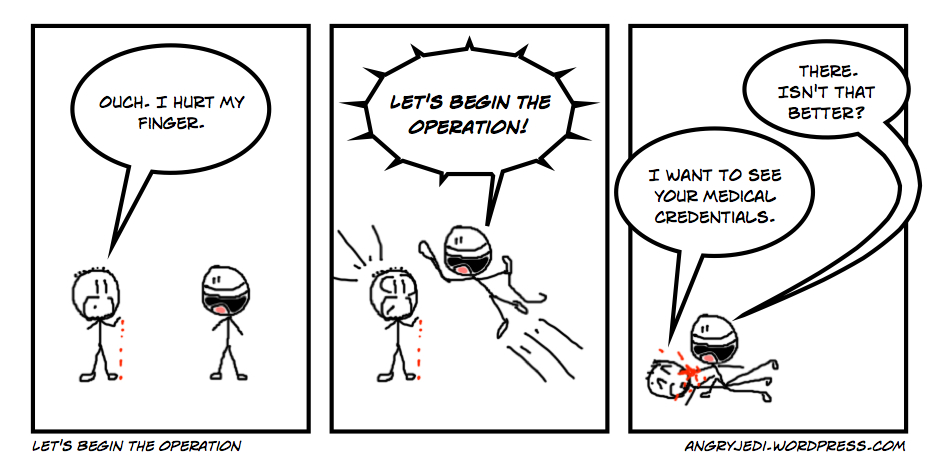
1149: Let's Begin the Operation

Page_1I really love the Trauma Center games, and have done ever since I first picked up Under the Knife on a whim early in the lifetime of my Nintendo DS. (As a matter of fact, it was a combination of Under the Knife and Phoenix Wright Ace Attorney that convinced me to pick up a DS in the first place, thereby proving that there most definitely is a market of at least one person for games based around relatively "mundane" things.) I loyally picked up all the subsequent entries that made it to the UK, these being the Wii remake of Under the Knife (known as Second Opinion) and the official sequel (on Wii again) New Blood. To my knowledge, Under the Knife 2 for DS never made it other here, and neither did Trauma Team. It's the latter I'd like to talk about today, as I've had a brief play with it for the first time this evening.

The early Trauma Center games, lest you're unfamiliar, were curious beasts, somewhere between medical procedural drama, simulation, visual novel, arcade game and batshit crazy sci-fi extravaganza. Essentially they unfolded with lots of talking head scenes between the main characters and others who were involved in the story, and were frequently punctuated with frankly terrifying surgery sequences in which you had to perform various lifesaving procedures with a considerable degree of gusto. Time limits were tight, vital signs were constantly dropping and the dramatic music didn't help matters. To date, I've never played any games that set me so delightfully on edge.

The format didn't change a huge amount between the three games that made it to the UK. Sure, it jumped from the touchscreen interface of the DS to the "pointer" control of the Wii (which I actually preferred, I think) but for the most part, you were doing fairly similar procedures. In a sense, this was a strength of the series' gameplay — by learning how to do these relatively straightforward procedures (and learning to recognise when you needed to perform each one) you could eventually end up as some sort of lightning-fast surgery god by the end of each game. It was immensely satisfying to, say, complete a heart operation within the space of about 30 seconds while any astonished onlookers gaze, bewildered, at your frantically-wiggling hands. And by golly, did you need those skills by the end of each game. Each Trauma Center's final boss (yes, they had final bosses — I told you they were batshit sci-fi crazy) was an immensely challenging piece of game design that forced you to use all the techniques you'd learned as quickly and efficiently as possible, and it felt good when you finally took them down.

A common criticism of the early games was their drift away from recognisable (if "arcadified") medical procedures and a reliance on made-up diseases that were best treated by playing Space Invaders inside someone's lungs. (I exaggerate. But you get my drift.) Trauma Team was set to be a rethink of the series, though. To quote Atlus themselves:

"Trauma Team is a subtle departure from the standard Trauma Center game experience. By moving the experience away from a sci-fi concept and making the situations more realistic, our new focus is on the characters and the sense of accomplishment that stems from having saved a life instead of simply beating a stage. It's our intention to provide you with a medical drama more immersive and fulfilling than any you've ever experienced."

Of course, two pages later in the manual we have this:

"This young surgeon was apparently involved in a biochemical attack on Cumberland University that killed several people, during which he lost his memory but not his impressive surgical skills. While serving a 250-year sentence for the atrocity he can't remember committing, he was approached by the government with an unusual offer…"

…but then it just wouldn't be Atlus if there wasn't a touch of crazy in there. (See also: the orthopaedic surgeon who is also a superhero.)

Trauma Team takes the focus off the surgery (although that's still present) and adds a bunch of different specialisms that you can flip back and forth between at will. In total, you'll find yourself indulging in "regular" surgery (hah), first response (improvised surgery with limited tools and multiple patients), endoscopy (first-person perspective bowel ulcer-blasting), orthopaedic surgery (banging nails into things?), diagnosis and forensics. This evening, I tried a touch of the endoscopy and diagnosis, and both were pleasingly distinctive experiences.

In endoscopy, you take control of an endoscope and must carefully thread it through the patient by fine-tuning its angle with the Nunchuk stick and pushing it forward by holding buttons and pushing the Wii Remote towards the TV. Along the way, you'll run into various symptoms that need to be treated — blood pools need to be drained, ulcers need medicine injecting into them, injuries need haemostatic forceps applying to them. While doing all this, you need to make sure you don't bang into any walls, and on occasion you'll find yourself having to thrust your endoscope through various pulsating sphincters without getting caught. The introductory mission wasn't too tough, but I can see this being good old Trauma Center edge-of-the-seat stuff later on.

Diagnosis was really interesting, though. Rather than being "actiony" like the various surgery sequences, diagnostic sequences are much more adventure gamey. In the episode I played this evening, a teenage girl came in complaining of shortness of breath and it was up to me to determine what was wrong with her. Coming to a diagnosis is achieved through a pleasingly authentic-feeling procedure in which you must question the patient, point out statements that include abnormalities, perform an examination with a stethoscope, review CT, MRI and another type of scan I've forgotten the name of results and finally determine what the hell is wrong with the person. There's even a fun House-style deduction minigame in which your computerised assistant presents you with a bunch of possible diseases, and you have to match the symptoms you've found with the various descriptions to whittle it down to a definitive diagnosis.

I'm yet to try the other specialisms, but I can already tell I'm going to like this game a lot. The past games had interesting characters and fun (if insane) stories, and I'm looking forward to seeing where they go with this one. Plus the Trauma Center team is one of the few series where I've found myself actively wanting to go back and improve my scores/ratings.

Before I play any further, though, I should probably complete something else. I'm coming up on the end of Kira Kira, so once that's done I'll be able to play Trauma Team without guilt alonside Ar Tonelico 2 and SimCity!

1147: SimCity Limits

So I played an hour or two of the new SimCity earlier, and I have some thoughts. I shall now elaborate on these thoughts for your reading pleasure.

  • After the game applied a patch (which took a few minutes, though this may be more down to the fact that I hadn't long started up my computer and it was still doing that inexplicable hard-drive churning Windows does for about half an hour after you turn it on when you've had a computer for more than a year or so), I logged straight in and started playing with no hiccups whatsoever. Looks like those server issues are mostly sorted out — though there are plenty marked as "full". The team at Maxis/EA have bumped up the server number by a significant amount, however, so you should always be able to find one on which you can play. Pleasingly, too, you can play on any server in the world, meaning cross-region play is viable.
  • Is the "online-only" requirement a form of DRM? Frankly I don't give a shit, much like I didn't with Diablo III. As far as I'm concerned, it's an online game, regardless of the previous games' single-player status. Thinking of it in that way, regardless of the reasons for it, means considerably less frustration. It's annoying when you can't log in, yes, but it's annoying when you can't log in to World of Warcraft or Guild Wars 2, too. Getting irritable doesn't solve the issues, though. Go and play something else for a bit. There are enough neat things added to the game by it being online that I have no problem with it requiring a connection to play. It should have worked perfectly on launch day, yes, but I am yet to see any online game from any publisher — even those who know what they are doing — not have server issues for the first few days after launch. We should be past that by now, but we're not; that's a fact we can do little about.
  • The actual online component of the game is very cool, giving the game "world" a much greater feeling of life than in any other past SimCity game. I was playing a small two-city region with a friend earlier, and I was constantly kept updated as to what was going on in their city as well as mine. I could set up trade routes, send gifts of products or money or volunteer some of my "spare" emergency services to go and help out in their city, which brought me some money. There's actually a pretty neat requirement to cooperate here — if your city is manufacturing tons of stuff and has nowhere to sell it, you'd better ask the other people in the region nicely if they wouldn't mind awfully building some commercial districts so that you can send them your goods. The various city plots also all have various resources that can be tapped using the right specialist buildings, so there's plenty of scope for collaboration there.
  • The actual gameplay is simultaneously familiar and probably the biggest change to the series since it went isometric-perspective with SimCity 2000. Gone is the grid-based system, meaning you can build roads in any shape you like, and even make them actually curve. Gone is the rectangular zoning system, replaced with the ability to only zone immediately along roads, with the maximum building size on a road determined by how big the road is. In comes a much deeper use of various buildings like the police station and fire station, all of which can be expanded by bolting extra bits on to them such as new garages, offices, prison cells and other things appropriate to the structure in question. There's a huge amount of depth, but it's kept accessible by a simple, logical interface in which clicking on a particular category of items to build also summons relevant overlay information relating to, say, power, water or crime.
  • The available area for buildings cities is quite small, but again I don't mind too much. I don't think I ever played a previous SimCity well enough to fill a full region, so I'm absolutely fine with the small space. When it's full, I can either work hard to try and optimize it, knock it down and start again, or go and play in another region altogether. The game features a sort of "win condition" if you want one — each region has a space for a "Great Work" that generally requires the collaboration of all the cities in the area to complete, and if you want to say that you've "won" when you've built one, so be it.
  • The soundtrack is lovely, being composed by one Mr Chris Tilton of Alias and Fringe fame.
  • The tutorial is a bit patronising. I've played too many Facebook games to tolerate condescending pulsing arrows telling me what I should click on. I couldn't see a means of skipping it, either, though it did at least have some useful information to impart.
  • On the whole, it's pretty good. It scratches that nice "creative" itch that SimCity has always stimulated, and the collaborative aspect opens up some really interesting possibilities. Once the server issues are stabilised and the team at Maxis can start concentrating on doing things like the regular special events and competitions, it's going to be a really cool experience, I think.

1146: Doing It Wrong

We've had a day of board gaming today, including a game of Agricola, a game of Small World and finishing off with a quest and a half worth's of Descent: Second Edition.

Partway through our Descent session, I looked up something on a whim, and it transpires that we've been playing a certain rule completely wrong for the duration of our campaign. It turns out the Stun condition, which we'd been playing as completely eliminating a figure's go (i.e. the only action they could take that turn is getting rid of Stun status) actually only removes one of a figure's two actions per turn. Given that one of the hero characters has an ability that automatically inflicts Stun on any monster figure that begins their turn adjacent to them — and, more to the point, has been making extensive use of that ability — this has likely had a significant knock-on effect on our campaign. I knew that ability as we had been playing it felt distinctly unbalanced, and now I know why — the way we were playing it, it was!

Fortunately, Descent 2 is fun enough that even with the hero players being armed to the teeth with a variety of ill-gotten gains through earlier quests that they might not necessarily have won had my Overlord's forces not spent most of their time staggering around in a daze, it's still enjoyable to play. I'm still losing pretty much every quest and it's entirely likely that I will lose the entire campaign as a result of our earlier fuckup, but it doesn't matter too much. We know now, at least, and from the sound of the conversation around our gaming table this evening it looks highly likely that we're going to do another run through the campaign once we're finished, with everyone in different roles.

This is the one tricky thing about board games versus video games. In video games, assuming they have been programmed correctly, there is no way to do that wrong. Had Descent 2 been made as a Fire Emblem-style video game (which would be fantastic, incidentally — I would pay good money for a video game version of it, particularly with multiplayer) then there would have been no ambiguity about the rules. We'd always be using the correct skills, we wouldn't inadvertently be breaking the rules and there'd be no disputes over what the wording of certain cards meant.

This is actually a common problem with the theme-heavy games that I'm such a fan of. Because theme-heavy games tend to have a lot of rules, many of which only apply to very specific situations (usually tied to happenings in the "narrative" of the play session), it's very easy to misunderstand, forget or otherwise mutilate the rules in some way. If everyone agrees on a variation, it hurts no-one, but it can be frustrating to have played something for a hefty period of time and discover that you've been Doing It Wrong.

Oh well. As I say, I'm not too worried. I've had a blast playing through the Descent 2 campaign so far, and we're coming up on the finale. Once that's done and dusted, we'll be able to start a new game — possibly with the recently-released expansion pack — and play it, you know, properly. We have a running joke in our gaming group that if we fuck something up rules-wise and it's too late to do anything about it, the game in question is a "training game". When it comes to a multi-session campaign like this, it's a little harder to justify, but as I say, since we're highly likely to be playing it again we can chalk our experiences this time around up to learning the ropes, and hopefully do a better job next time around.

If I haven't made it clear by the several other posts I've written on this subject to date, Descent 2 is a really good game. It's been a big hit with our gaming group due to the fact that it marries genuinely strategic gameplay with theme-heavy shenanigans and lovely-quality components — the miniatures in particular are beautifully-detailed, if rendered in rather bendy plastic — and thus appeals to both the people who enjoy games with "stories" and a lot of theme, and those who enjoy competitive, strategic play. I can highly recommend it for anyone looking for a good, relatively easy to understand (rules for the Stun condition aside) game with a lot of variety and huge replay value.