1172: Mage Knight

It was a board games evening tonight, and since we were down one member from our usual troupe to play Descent: Second Edition we decided to crack open a new acquisition and give it a shot: Mage Knight.

None of us really knew anything about Mage Knight prior to going in save for the fact it was supposed to be good, so it was always going to be something of a learning experience. Due to the relative complexity of the rules — or at least, the relative complexity of introducing the rules to everyone — we didn't manage to finish a complete game, but at least now we have a good understanding of the basic mechanics and will probably be able to romp through the introductory scenario without too much difficulty.

Mage Knight, if you're unfamiliar, is a rather interesting game with elements of role-playing, strategy and deck-building card games. You play a single character who begins with a deck of basic abilities — one of which is unique to each character, the rest of which are the same for everyone — and then work your way towards the objective of the scenario you're playing. Scenarios vary from cooperative ones where you work together as a group to competitive ones, where whoever gets the most points after the end condition is fulfilled wins, to "very competitive" ones, where whoever fulfils the victory condition first wins.

Play is split into rounds, which represent either day or night-time, and each round can and will go on for several circuits of the table. On each turn within a round, you can play some cards from your hand, some of which award you with movement, combat or influence points, and can then use those points to do various things. For example, moving requires a particular number of points according to the type of terrain you're moving over, and influence is used in settlements and other friendly locations to do things like make use of services or acquire troops. Some cards have special abilities, too, and most have two possible functions — one simple one that can be used for "free", and a more powerful one that generally requires a specific colour of mana to activate. Mana can be acquired through cards, through crystals you've stocked up on through various means, or most frequently through the dice that represent the "Source" — the mana naturally flowing through the world.

Through moving and attacking, you'll reveal more and more areas of the map, each of which include various things to do. In villages, you can recruit new troops, get healing or pillage them. Come across a fortress and you can assault it in an attempt to take it over for yourself. Discover a wizard's tower and you'll have the opportunity to get some powerful spells. Most actions affect your "fame" level — which acts as a combined score and "experience" system, allowing the player to grow stronger in various ways every so often — and your reputation in the area, which provides bonuses or penalties to the amount of influence points required to do "friendly" actions. Defeating marauding monsters improves your reputation; attacking fortresses unprovoked has a negative impact. There's a nice feeling of "consequence" to your actions.

We didn't play far enough to finish the first scenario, but we learned enough to be able to make it through the next time we try it. We learned about the simple but elegant combat system, which requires you to make careful use of your cards to defeat your enemies, and about the various ways you can acquire the more powerful abilities and items. There's clearly a lot to this game, and the really nice thing about it is that it's one of those games that, like Descent, scratches both the strategic Eurogame and theme-heavy Ameritrash itches simultaneously. Consequently, I can see it hitting the table reasonably often — though the only downside for our group is that it only supports up to four players, whereas our full complement is typically five people.

I'm looking forward to trying it again, anyway. It looks like a great game and the components are gorgeous — lovely linen-backed cards, pre-painted miniatures and high-quality tokens and other bits and pieces. It takes a while to set up but once you're up and running it's a game that continues to look good in the middle of a session rather than devolving into a chaotic mess. Combine that with the host of scenarios and variants provided in the rulebook and here's a game with the potential to be pretty different each time you play it. I can see why it's so well-regarded.

1171: Easy Listening, Part 2

As promised, I'm continuing yesterday's post with another game music fest to introduce you to the joys of some soundtracks you might not be familiar with.

Today, it's Cavia/Square Enix's strange, wonderful and rather depressing action-JRPG Nier.

Nier

Nier wasn't particularly well-received by critics upon its release due to a variety of factors. Having played it (and adored it, I might add), I can see why it was criticised, but equally I feel it was treated a little too harshly. Not only was it doing some fascinating things with the way it told its story and what its story was about — I'll leave the spoilers out of the discussion for now — but it was also doing some really interesting things with its gameplay, too. What initially appeared to be a relatively conventional third-person character action game/RPG subsequently revealed itself to have elements of visual novels, text adventures, farming sims, 2D platform games, isometric-perspective dungeon crawlers, bullet hell shooters and numerous other genres. It really was a massively interesting game in almost every way.

And then there was its soundtrack, which even if you don't like the game is indisputably amazing. Let's look at some standout tracks.

This track, known as Hills of Radiant Wind, is one of the tracks you'll hear most frequently in the game, since it typically accompanies your jaunts across the countryside surrounding the small settlement where the title character Nier and his daughter Yonah live. This track is hugely memorable both for having a catchy melody and capturing the atmosphere of the game world beautifully. The pounding drums at the bottom of the mix give a sense of adventure and driving forwards, while the vocal line atop the relatively simple accompaniment gives a suitable air of melancholy to the experience. Nier is not a happy game, and this track, while one of the more "upbeat" ones from the soundtrack, reflects that nicely.

This song, simply called Grandma, is beautiful, and is, to me, probably the most representative piece of music that illustrates what the Nier experience is all about. A simple accompaniment accompanied by a mournful voice provides a massively atmospheric backdrop to some of the most emotional story moments in the game.

And then we move on to a few tracks that use the "leitmotiv" technique I'm so fond of, where a number of different pieces make use of similar melodic or harmonic sequences to reflect various things happening to different characters and/or places.

Let's start with Emil, who, without spoiling anything, gets fairly consistently screwed over throughout the course of the whole game, through no fault of his own. Poor kid.

Anyway, here's Emil's "Sacrifice" theme, which accompanies some heartbreaking, sad moments:

And by contrast, here's his "Karma" theme, which comes shortly after a heartbreaking, sad moment when you're venting some aggression on the perpetrators:

The addition of the pounding drums and the urgent piano line in this one always gives me shivers, particularly when I remember how it was used in context.

Then we have Popola and Devola, two characters who are extremely important to the overall narrative in ways I won't spoil right now. When we encounter them, we hear various versions of the "Song of the Ancients" theme, beginning with this acoustic guitar-centric version:

…and moving on to this… I'm not sure how to describe this, really. Plinky-plonky version?

Well, if you're going to do two different versions based on the two characters who sing it, you might as well do a third version where they sing it together, mightn't you? Yes, obviously. This, along with Devola's theme above, are some of the only examples of diegetic music in the game — the rest is there to evoke a mood rather than actually be "present" in the world.

And, hell, if you're going to do that, you may as well go the whole hog and have a battle theme based on their (by now) iconic song, right? Of course.

The latter one, like Emil's "Karma" theme, still gives me shivers because I can remember it in context. Gobsmacking.

Then we come to Kainé, possibly one of the most fascinating characters in any game ever for a whole host of reasons, many of which aren't made entirely explicit in the game. Kainé has two main versions of her theme: a slow one, which goes like this…

…and a fast one, which goes like this.

Those who know their Nier lore will be familiar with the fact that Kainé is intersex. If you weren't familiar with your Nier lore, now you know too — don't worry, this isn't technically a spoiler in terms of the game's overall plot, and in fact knowing it beforehand brings a whole host of hidden meanings to a bunch of sequences in the game to the fore. I like to think that the markedly different character of these two pieces reflects Kainé's "masculine" and "feminine" sides, because she is most definitely in possession of both. She is, it's fair to say, a very angry person — and with good reason — but not afraid to express her feminine side in some rather… flamboyant ways.

One of the most interesting things about the vocal-heavy tracks in Nier are that they don't use a language from this world. Instead, vocalist Emi Evans was encouraged to make up words in a "futuristic language" — Nier is set in the far, far future — and used elements of Scottish Gaelic, Portuguese, Spanish, Italian, French, English and Japanese to create something with a very distinctive sound, but which doesn't "mean" anything in and of itself. Instead, the vocal sounds are simply intended, for the most part, to evoke the overall feeling of sadness that pervades the whole game without distracting the player with recognisable words.

So that's Nier. Easily one of my favourite game soundtracks of all time, and a score which adds a huge amount of emotion to what is already a game rammed to the rafters with heartbreak.

1170: Easy Listening, Part 1

I am, as you probably know, a big fan of video game soundtracks. They've come on a very long way since the bleep-bleep-bloop of yore, and in many cases these days are eminently worth listening to in their own right.

Over the next few posts I'd like to take a mildly self-indulgent tour around some of my favourite tracks from some of my favourite soundtrack albums. YouTube-heavy post ahead… you have been warned.

Trauma Team

Let's start with something that's fresh in my memory. The Trauma Center series as a whole has pretty consistently great soundtracks, largely composed by Atlus mainstays Shoji Meguro and Atsushi Kitajoh. Both of them have a very distinctive (and quite similar) sound to their compositions, and this is very much in evidence throughout the Trauma Team soundtrack.

What's most striking about the Trauma Team soundtrack, though, is how well the various pieces of music reflect the different characters. For example, for the cool "ice maiden" that is forensic investigator Dr Naomi Kimishima, we have this wonderfully chilled-out number called, appropriately enough, Cool Beauty:

Dr Naomi's segments, as it happens, have some of the best music in the game. For the uninitiated (or those of you who haven't read my enthusing at length about this wonderful game), Dr Naomi's levels are adventure game-style puzzles in which you must unravel the mystery of what happened to one or more corpses using various forensic investigation techniques. As you progress through them, the truth gradually gets closer and closer until finally everything clicks into place and you understand exactly what happened to the poor person lying on the slab in your examination room.

That gradual uncovering of the truth is something beautifully captured by this piece, imaginatively titled Uncover the Truth, which starts out simple and gradually builds up in complexity as it progresses through. Accompanying this piece on screen is Dr Naomi piecing together all the case's various pieces — with a little help from you, of course — and coming to a firm conclusion about what happened. It's pretty great — and surprisingly powerful in context:

Dr Naomi is just one of six different doctors who star in Trauma Team, however, and each of them has their own distinctive "sound" throughout. For example, nameless surgeon "CR-S01"'s pieces are all rather electronic-rock in nature and wouldn't sound out of place in a Shin Megami Tensei game — unsurprising, considering the composers:

Meanwhile, Dr Hank Freebird's pieces focus a lot more on gradually-building tension, such as this piece, which in-game builds itself up as your "combo" of moves made without mistakes (or taking a break) grows:

Dr Cunningham the diagnostician, meanwhile, is a much more laid-back sort of dude for the most part:

Except when things get serious, of course.

Trauma Team's story is split into two distinct segments. The first half sees the six doctors working largely independently from one another, following their own parallel storylines that do nonetheless make a coherent narrative if played in the correct order. However, the really interesting stuff starts happening in the second half, which is completely linear, and follows the entire team's attempts to battle against a disease known as the Rosalia virus.

This part of the game makes use of one of my favourite compositional techniques for soundtracks, which is to take one theme and gradually evolve and adapt it over the course of the story. Rosalia's theme goes through a number of changes throughout the second half of Trauma Team, culminating in something pretty spectacular.

Here we have Spread of Rosalia, a piece that plays during the endoscopy sequences of the game while battling against the Rosalia virus. The recognisable chord sequence and strings backing of the Rosalia theme is present and correct here, with a nervous, tense, slow-moving melody overlaid over the top of it. Treating Rosalia is something that requires care, precision and nerves of steel; this piece of music reflects that rather nicely.

Encounter Rosalia during Maria's First Response missions, meanwhile, and you get treated to this wonderfully intense number that really gets the pulse pounding. Just the thing you need while you're running back and forth between five different patients trying not to let any of them die, huh?

This piece of music, meanwhile, plays during Dr Hank Freebird's orthopaedic surgery missions where he comes across Rosalia. Hank's missions aren't as time-sensitive as many of the other operations throughout Trauma Team, but the high level of accuracy required in them makes them some of the most tense, most physically-exhausting levels you'll be challenged with:

This track, on the other hand, plays while discussing Rosalia and how best to treat it. It's less intense than the other Rosalia pieces, but has a certain air of desperation about it, while at the same time offering a sense of hope… before exploding in intensity towards the end.

Finally, spoilers I guess, our final showdown with Rosalia comes pre-packed with this rockin' piece of music — beautifully fitting for an intense surgical battle against a thoroughly unpleasant illness. Will our heroes make it through…? Well, that's up to you, really…

More tomorrow.

1168: Dev Diary

I've been working a bit on my game over the weekend. And just to prove I'm not just all talk, I present to you two world exclusive screenshots.

oneyearlater
"The Strip", the main shopping street in the capital city of Acathlata. That's the department store Don Lewis on the left, and on the right is the Green Boar Inn. Further to the right out of shot are the Fighters' and Mages' Guilds and the pub The Tail of the Dog.


oneyearlater2
Protagonist Amarysse (left) and her erstwhile companion Feena (right) shoot the breeze in The Tail of the Dog.

"Boy," you're probably thinking. "That sure looks like an RPG Maker game." And, of course, you'd be absolutely right. The relatively generic appearance and use of stock assets is deliberate for several reasons, though: firstly, it allows me to concentrate on what I feel is the important part of the game, which is the writing and overall structure, and secondly, if you read my vaguely spoilerish post from a few days ago you'll doubtless be familiar with why I've chosen to stick with the "default" aesthetic for the moment.

What these screenshots perhaps don't clearly show is that I've built a little on the stock assets with some additional material from the RPG Maker community and beyond. The portraits you see in the second image, for example, were created by RPG Maker community members Archeia and Scinaya, who took the time to make some "emote" variations on the stock characters' portraits. This means that I no longer have to have characters smiling even while they were being angry or upset, which was a little disconcerting.

What you really can't tell from the screenshots is the fact that I've found some great royalty-free music to use for the game's soundtrack. While I would absolutely love to compose the entire score to the whole game, again that's something that would distract from the important part of things, which is actually writing and implementing the game's story and structure. I'm not ruling out the possibility of composing a custom soundtrack in the near future, but for now I'm very happy with the high-quality stuff I'm presently using, as it suits the atmosphere I'm going for quite nicely.

Insofar as the story and scripting is going, it's going slowly but well. I'm almost finished with the interactive introductory sequence, which is probably one of the more complicated parts of the game, as it will branch off into more linear "paths" shortly after all that concludes. I've been taking care to incorporate hooks for my intended game structure, which will help encourage people to replay with variations on scenes and alternative ways for events to unfold according to the player's past actions and decisions. I've implemented these in such a way as to make them hopefully seem pretty "seamless" when playing the game for the first time, but those with a keen eye playing through again will notice the places where it diverges slightly. I believe doing this sort of thing is quite important, as no-one really wants to read through the exact same material several times just to see the whole game. Plus there are other rewards and incentives in place to explore all your available options, too, but I'll refrain from discussing that side of things too much for now.

Perhaps most importantly, I've figured out my ending, or more accurately, my "true ending". Again, no spoilers for now, but the structure of the game will be such that you'll need to play through all the "normal" paths and meet a couple of other conditions (which I'm debating whether or not I should make explicit) in order to see the definitive conclusion to the game's narrative. I can see how the ending will unfold in my mind's eye, and it's a good 'un — in my humble opinion, anyway. I actively want to get the story to that point, to bring the characters to that finale. I'm half-tempted to make the finale events now while they're fresh in my mind then go back and fill in the middle part of the game, in fact. But we'll see.

So far as writing the rest of it goes, I have a vague idea of how each path is going to go, but not the specifics as yet. I have a firm idea of who all these characters "are" in my mind, though, which will make it easier to write scenes with them as I progress onwards. I like the characters, too, which is important, and the introductory scenes I've created so far hopefully help to establish their personalities and other character traits. The challenge from here is, of course, ensuring they remain believable and consistent as the rest of the story progresses, but we'll cross that bridge when we get to it.

Anyway. In summary, things are going slowly but well. I'm enjoying myself. And hopefully at some point in the next fifteen years I'll have something more to show those of you who are interested.

1167: How NimbleBit Finally Nailed It

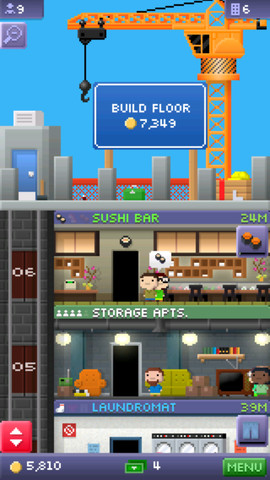
mzl.dirqlssw.320x480-75If you own a modern mobile phone or tablet, chances are you've encountered NimbleBit's games at least once, most likely in the form of their runaway success Tiny Tower.

Lest you're one of the few people out there who never played Tiny Tower, let me explain: you run a tower block, presented in Commodore 64-style low-resolution pixel art. In order to progress in the game, you must continue to purchase and build new floors onto your tower, which can be assigned as residential or commercial properties. Residential properties hold, well, residents, while commercial properties must be staffed with residents and can then generate money for you even when you're not actively playing the game. However, there's a limit to how much money they can make, since each commercial establishment only has a limited amount of stock for each of the three items they sell, and when it runs out, you need to manually restock it by tapping on it.

Essentially, that was pretty much all there was to the gameplay. You booted it up, you tapped on a few things, you marvelled at how much money you'd "earned," you felt a bit depressed that the amount you'd earned was less than a tenth of what the next floor costs, you closed the app only to repeat the process a few hours later. In terms of complexity it was little more than FarmVille, and the early comparisons to SimTower it attracted were most certainly not justified in the slightest.

Tiny Tower was a free-to-play game. That means it was free to download but you could purchase things with real money. For the most part, this took the form of "Bux", a premium currency that allowed you to bypass anything in the game that would normally take a long period of non-interactive real time to complete, such as building a new floor. The game was fairly generous about giving out Bux for free, but it was still essentially a "pay to win" experience, whereby the more money you paid in, the faster progress you made. Exactly the same was true for Tiny Tower's follow-up Pocket Planes, which adopted the exact same faux-retro aesthetic and was just as devoid of meaningful decision-making as Tiny Tower was.

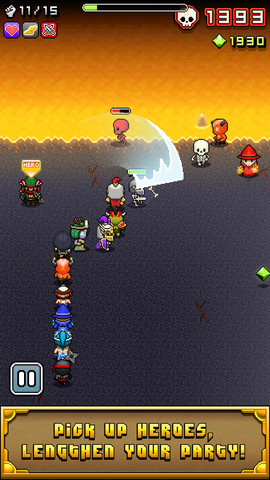
mzl.ugpnqerz.320x480-75NimbleBit are back with a new game. It's still self-consciously retro in terms of both gameplay and presentation, but in terms of being a quality experience it's a huge jump over the company's past work. Nimble Quest is a curious combination of Snake and Gauntlet, it's free-to-play, and it's fabulous.

In Nimble Quest, you select one of a number of unlockable heroes to start the game and then proceed to use that hero's style of attacking to defeat enemies. Different heroes have different styles of attacking — some are melee, some are ranged, and within those groupings there are variations, too: some ranged heroes fire fast-moving arrows straight forwards, others throw short-range bombs at anything nearby and deal splash damage, for example. As you progress through the game, certain enemies will release additional heroes whom you can "collect" — these are then added to your "snake", tagging along behind your lead hero and performing their own individual attacks when appropriate. Heroes other than the lead can be defeated without penalty (besides losing them, obviously) while if the lead hero either runs out of health or ploughs into a wall or enemy they die immediately and the game is over.

To progress through the game, you have to defeat a particular number of enemies on each level. This number increases with each subsequent level, but so too do the number of enemies on screen at once and the different types of assailant you'll have to deal with. The further you manage to get in one playthrough, the more types of hero you'll unlock and the longer your maximum "snake" length becomes in all subsequent games. Heroes also gain experience when they're used as the lead, and level up through three distinct levels. They can also be levelled up early by paying with the gems you find scattered around the levels.

The "free to play" bit primarily comes in the form of "Tokens", which are Nimble Quest's equivalent of "Bux" from Tiny Tower and Pocket Planes. Here, though, they're not used to bypass inconveniences; instead, they're used for actually useful things. They can be spent on buffs before each level starts. They can be spent on continuing after death — and pleasingly, this prevents itself from becoming a "pay to win" scenario by forcing you to restart the level you're on with your score and team as it was then rather than simply magically resurrecting without penalty — and they may also be spent on competing in the social "Arena" leaderboards in cooperation with friends. Like Bux, they're awarded at a healthy rate through normal play, so there's absolutely no obligation to pay for them unless you're a bit spend-happy with them. Crucially, though, the game never stops you from playing if you don't have any tokens — it never forces you to sit through long wait times or anything like that; it just means you need to earn some more before you can use what effectively amount to very slight "cheats".

It's this "monetising without inconveniencing the player" thing that makes me look very favourably upon Nimble Quest. At no point do I feel like I'm being punished for not purchasing currency — in fact, the game has more longevity if you don't pay, because it'll take you longer to level up all your heroes and get good enough at the game to survive the very challenging later levels. Nothing in the game feels like "pay to win" — even the continue feature is well-implemented so as to allow you the opportunity to correct a mistake while still running the risk of actually doing worse than you did on your previous attempt.

Most important, though, is the fact that Nimble Quest is actually a good game. No-one really wanted to admit that Tiny Tower and Pocket Planes just weren't very interesting or fun once you got over the aesthetic and humour in them, but Nimble Quest has been designed as a fun game first and foremost rather than a monetisation vehicle, and it really shows. It's a top-quality mobile game, and one which every iOS owner should have on their device. This is how you do free-to-play right… and this is how you do mobile gaming right, too. Please download and support it to send the right message to NimbleBit. More of this and less tap-tap-tap-snore nonsense, please.

1165: Endless Infinite Discussion

Around this time of year in 2011, one Mr Tom Ohle, a fine upstanding gentleman at the forefront of promoting games you might not have heard of quite so much as the games you have heard of a lot, wrote this post, named The Case of the Great Game Nobody Saw.

Lest you're too lazy to follow the link, allow me to summarise: Tom works in PR for video games. The titles his company Evolve PR has represented over the years include things like CD Projekt Red's The Witcher series, the deep strategy games of Paradox Interactive, TimeGate Studios' Section 8 series, the Anomaly series and numerous others. As all good PR people should, Tom believes in the games he's paid to promote — some more than others. Sometimes games come along that are genuinely excellent — games that, in Tom's words, are "magical, revolutionary, disruptive or otherwise worthy of consumers' awareness" — and, as you'd expect, Tom and co. would very much like to see these titles succeed, and they do their utmost to try and convince various outlets that these games are worthy of coverage and promotion. When these games don't get the coverage they deserve — either because of "bigger" games monopolising the front page or simply through being rejected outright — it's enormously disheartening, not only for Tom and co. but also for the makers of these games.

"At its core, this is an issue that pervades entertainment and consumerism as a whole," writes Tom. "People stick with brands they know. Everyone craps all over themselves (myself included) when a new Rockstar game is announced. That's fine; they make great games. But in an industry that so often complains about derivative sequels, soulless big-budget productions and a lack of risk-taking, isn't it about time we started focusing on quality? Shouldn't those companies looking to push the boundaries of the medium begin to reap the rewards? If things keep going the way they are, we'll never shed the $60 price point, we'll get sequels to major franchises every year, and we'll all keep complaining and wishing things were different."

Almost two whole years have passed since Tom wrote that post, and I don't think things have improved at all since then. If anything, I think they've got worse. For all Polygon's posturing about reinventing games journalism and for all Kotaku's posting of random bullshit only tangentially related to games, we're still in a situation where an alien visiting the games industry would believe there were only a few interesting games released every year, and that they're often entries in the same series. Call of Duty. Battlefield. Assassin's Creed. And so on.

Most recently, I've been becoming somewhat frustrated with Bioshock Infinite. I have no doubt whatsoever that it's a fantastic game, and everything I've heard seems to indicate that it is, in the words of a friend of mine, "intelligent Hollywood… a 'The Matrix of gaming'" and that is, on the whole, a good thing. We need creators like Ken Levine in the mainstream of the industry to push things forward and prove that there's a market for intelligent experiences as well as Mildly-Racist Brown Michael Bay Manshoot #327. I am glad that Bioshock Infinite exists, that it is apparently living up to the hype and that, I imagine, it is probably selling quite well as a result of all that hype.

What I'm less thrilled about is the fact that it's not really solving the problem Tom was talking about in his post. Bioshock Infinite may be "intelligent Hollywood", but it's still Hollywood. It's still a single game from a high-profile creator monopolising press coverage and social media, completely dwarfing smaller-scale experiences that — shhh — might actually be more interesting. Do we need videos explaining "why you should play Bioshock Infinite on Hard mode", articles about its ending, articles about why Ken Levine doesn't believe in Utopias, articles about how to edit the INI files, tips articles, articles about why having it spoiled didn't matter, articles about… have I made my point yet? This is a disproportionately large amount of coverage for one game — one very good game, admittedly, and one which has a lot of expectations to live up to, yes, but still just one game, and one game that people were already very much aware of in the run-up to its release. I'm already absolutely fucking sick of hearing about it, and the more I hear about it, the smaller the already-miniscule chance I will ever play it becomes — a phenomenon I discussed in this post.

The standard response to this is, of course, that this is what the greater audience is hungry for. Millions of people are going to buy, play and love Bioshock Infinite, and they should be catered to, as those millions of people are probably also going to want to read lots of things about Bioshock Infinite.

However, here's my (slightly selfish) question. What about me? What about people like me? What about all of the people out there — I'm sure I'm not the only one in the world — who didn't really like the first Bioshock all that much (I played System Shock 2 almost immediately beforehand, which just made the fact that Bioshock wasn't System Shock 3 all the more painful and frustrating) and consequently are not all that interested in this new one? What about the people who are more interested in other types of games? Don't we deserve some quality and wide-ranging coverage of the things that we're interested in? (Where's my "Tips for playing Hyperdimension Neptunia Victory" post, hmmm?) We have fan communities and enthusiast blogs, sure, but where's our high-profile professional outlet covering this stuff that's a bit off the well-worn path? (Besides Games Are Evil, of course, which I'm not going to pretend is anywhere near as big as I would love it to be!)

The gaming medium has grown up enormously in the last few years. With constantly improving software and hardware technology providing more and more flexibility for interactive artists to realise their digital dreams, and the rise of the indie space and Kickstarter allowing game makers to break free of the shackles of corporate culture, we're most definitely undergoing the "Cambrian explosion of possibilities" that SimCity, The Sims and Spore creator Will Wright talked about back in 2008. It's a great time to be someone who enjoys playing games.

But the games press has not evolved alongside the medium as a whole. The medium as a whole is now, as I've said numerous times in the past, far too broad for one outlet to be able to do justice to all of. And yet pretty much all of the big outlets choose to focus on the same part of this massively diverse medium. It's the part with the biggest audience, the biggest budgets and the biggest amount of money involved in it, yes, but it's still just one part of a whole. Read the news pages of one big site and you've read them all. Read the reviews section of one site and you've read them all. The sheer volume of things on display at events like PAX East and GDC help a little, but more often than not you still just hear about the same things from slightly different perspectives. Or you hear about Battlefield 4.

Why haven't we got to a stage where big outlets can feel confident enough to distinguish themselves from one another yet? Don't give me a reason to stick with one outlet, give me a reason to read all of them because of their completely different content. (Right now, I don't read any of them with any degree of loyalty, because very few of them provide coverage of the sort of thing I'm interested in any more!)

It's massively frustrating, and I don't even work in PR. I can bang my drum all I like about the types of game I'm interested in and want to experience more of… but is anyone really listening?

1163: The Engine

[Sorry I've been lax with the cartoons recently — been blogging late and when I'm tired so haven't felt inclined to do many. They'll be back soon.]

As I've noted a couple of times recently, I've been beavering away at the game I'm making with RPG Maker VX Ace and trying to do a little bit each day. It's slow progress at the rate I'm going, but it is satisfying to see things coming together piece by piece.

One thing that always impresses me with toolsets like RPG Maker is how active the community is, and how willing they are to help each other out. There's relatively little in the way of insular thinking, with people wanting to keep all their trade secrets to themselves — quite the opposite, in fact. No, the RPG Maker community is filled with people who create graphical, musical, audible and script…able resources for public consumption and are more than happy to share them with other aspiring developers out there in exchange for nothing more than a wee credit in the finished game.

It's a marked contrast to the ridiculous secrecy in other parts of the games industry, which is infested with embargoes and other bullshit to control the flow of information. I think that's quite interesting. While I get why it happens, I think it's starting to lose its impact. I've mentioned before on a number of occasions how all the reviews for a particular game hitting simultaneously makes me not want to read any of them (and, more often than not, not want to play the actual game ever) but this also goes for carefully-timed announcements and the like. The trouble is that a lot of these announcements are for things that people are expecting. A new Assassin's Creed — surprise! A new Call of Duty — HOLY SHIT. A new Grand Theft Auto screenshot — STOP THE PRESSES.

Even the mobile sector has ridiculous embargoes in place. This always strikes me as weird given the sheer volume of mobile apps and games that are released every day. Companies are lucky to get their product covered at all in most cases, and enforcing arbitrary restrictions on said coverage can only be counter-productive, surely.

But I don't want to get on an embargo rant. I just thought the openness of the amateur development community was an interesting contrast to the OMG TOP SEKRIT nature of mainstream game development.

I guess it's largely to do with the fact that the majority of people tinkering around with stuff like RPG Maker and its ilk are amateur/bedroom developers putting stuff together in their own time rather than as their job. There are exceptions, of course, but the fact that RPG Maker is so easy to get up and running encourages people to give it a shot a lot more than the rather daunting task of learning a programming language and/or how to use an engine like Unreal Engine 3. The fact that there's a sense of joyous discovery and entering a strange new world of wondrous creativity helps encourage a pleasing sense of camaraderie — plus the people who develop the more well-known scripts and resource banks become mini-celebrities in their own right, which must be nice for them. It's also something they can potentially put on their CVs, I guess — saying that you're the person behind one of the most widely-used battle system Ruby scripts for RPG Maker VX Ace may not have quite the same clout as saying you designed Unreal Engine 3, but it must count for something.

I can't say I've gotten overly involved with the RPG Maker community as a whole yet since keeping up with forums always seems like a whole lot of hassle, but I'm certainly very grateful for the hard work of artists like "Archeia" and "Scinaya" and scripters like "Yanfly", who are helping my game come together one piece at a time. If and when it ever gets finished, they'll certainly be getting some love from me.

1162: Launch Lineup

I have a curious habit that I tend to fall into pretty much any time I purchase a new games system. Thinking about my recent purchasing habits and my ongoing desire to forgo the "triple-A" experience in favour of more interesting, distinctive titles from further down the "food chain" it's actually entirely understandable in retrospect, but I always used to wonder why I did it.

It's this: whenever I purchase a new games system, I will typically not buy the "system-seller" games, and instead buy something that looks interesting and quirky. I've been doing it for quite some time, as it happens, if my memory is to be believed, anyway.

When I bought a PS2, I picked up Shadow of Memories (aka Shadow of Destiny) instead of, uh, whatever was exciting in the PS2's early days. When I bought an Xbox, one of the first titles I grabbed was Sudeki. When I bought a Gamecube… actually, I can't remember what I bought with my Gamecube. Possibly that Sega volleyball game Beach Spikers. Anyway, you get the general idea.

When it came to the Nintendo DS, I forget exactly what the first games I bought were, but it was one or all of Phoenix Wright Ace Attorney, Trauma Center: Under the Knife and/or 42 All-Time Classics (aka Clubhouse Games in the States). All of them are still favourite games.

42 All-Time Classics is a particularly interesting one to me. I'm not entirely sure what inspired me to pick it up in the first place, as on paper it sounds like shovelware of the worst kind — 42 simple board, card and touchscreen games that you can play either against the computer, against other players in the same room with other DSes or via the Internet. It's the sort of thing that these days you'd download for free on your mobile phone and then be expected to shell out in-app purchases for "energy" or extra games or game-breaking powerups or something.

But no. 42 All-Time Classics was a full-price game for the DS (and was subsequently split into a number of smaller individually-downloadable chunks on DSiWare) that offered everything you need for a virtual "game night", so long as you had a few DSes to hand around. You only needed one copy of the game, though; thanks to DS Download Play, you could transmit a copy of the game you wanted to play with other people over Wi-Fi and play with a single cartridge. This is still one of my favourite things about the DS system.

42 All-Time Classics is such a great DS game because it doesn't do things half-heartedly. There's a hefty single-player mode that will keep you busy for a long time completing specific missions and unlocking new content through "stamp" mode. The multiplayer mode allows childish chatting through PictoChat during play, which is somewhat pointless when you're in the same room as your fellow players, but I must applaud any game that practically encourages you to draw knobs at your friends while you're playing multiplayer with them.

The presentation is pretty good, too. While there's only so much you can do to visually represent various classic board and card games, 42 All-Time Classics supports its relatively simple visual aesthetic with pleasant little animations, catchy music and distinctly "gamey" sound effects. It doesn't overdo any of these things, but they round the whole experience off nicely — and cute little touches like the music getting more "dramatic" when someone's about to win a game add a bit of drama to the experience.

42 All-Time Classics is a great little diversion and pretty much the perfect handheld game. While a lot of people prefer playing this sort of thing on their phone these days, the simple knowledge that I can just open up 42 All-Time Classics on my DS and play without having to connect to the Internet, share to Facebook, make in-app purchases or wait for energy to restore makes it worth the price of admission all by itself. So if you own a DS… well, I strongly recommend grabbing a copy.

1161: Hospital Affairs

Continuing my trend of "playing games that reviews didn't like much and ending up liking them a lot," I picked up a copy of the Nintendo DS game Lifesigns: Hospital Affairs (also known as Lifesigns: Surgical Unit in the States) recently. And I've been loving it.

Lifesigns, or Resident Doctor Tendo 2: The Scales of Life as it was known in Japan, is actually a contemporary of the original Trauma Center: Under the Knife in Japan, but it didn't come out until two years later in the West — nearly three years later for Europe. The reason I mention this is that the game suffered somewhat from comparisons to Trauma Center in reviews, when in fact this is a completely unfair comparison that has diverted attention away from what is actually a very interesting game.

Don't get me wrong. I love Trauma Center. It does its own crazytown sci-fi medical horror thing and it's fantastic for it. It remains, to date, one of the most genuinely nerve-wracking series of games I've ever had the pleasure of playing, and it always manages to spin an interesting story to couple with its action-packed gameplay. The latest installment Trauma Team, which you'll recall I was babbling on about recently, refined that formula brilliantly by toning down somewhat on the sci-fi aspects and jacking up the feeling of "this is a team of doctors working together in the same place". Ultimately, though, as good as the story was, Trauma Team was still just as much about performing the various operations as it was about the unfolding story.
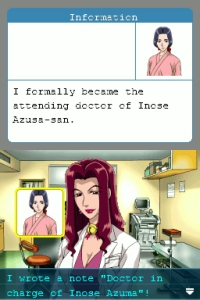
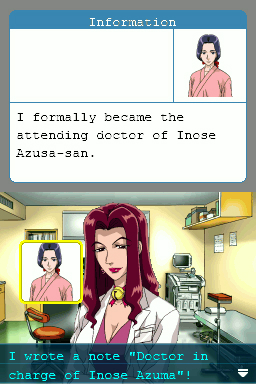
image0036Lifesigns, meanwhile, is actually a completely different beast. Sure, it's set in a hospital and features a number of surgery sequences, but it is not Trauma Center. Instead, I was delighted to discover, it is rather more akin to the Ace Attorney games — longstanding favourites of mine — than anything else, placing a much stronger focus on well-written character development and unfolding narrative than on the "action" sequences. It's for this reason that comparing it to Trauma Center and complaining about there being "too much talking" — a criticism also levelled at the Ace Attorney series by some — is utter nonsense. Without the talking… well, there would barely be anything left. The talking is sort of the point. Whether or not you like that is a matter of taste, of course, but given the continued existence of visual novels as a storytelling medium you better believe that there are plenty of people out there who are more than happy to play games that are about nothing more than people talking to each other.

As the Japanese title suggests, Lifesigns is actually the second game in the Resident Doctor Tendo series, though the first never made it to the West for reasons unknown. Ultimately this doesn't matter too much, as like the Ace Attorney games, the overarching plotlines are completely self-contained and only occasionally make reference to the events and characters of the previous game. When they do, they take their time to explain who these random characters that the protagonist knows (and the player doesn't) actually are, too, so it hasn't been an issue.

Lifesigns casts the player in the role of the eponymous Dr Dokuta (yes, really) Tendo, a second-year intern at the fictional Seimei Medical University Hospital. We learn quickly that he had quite an eventful first year, with one of the major events seemingly being a misdiagnosis that nearly ruined his career. We also learn that he was partially inspired to get into medicine after his mother died of cancer, and partially by the fact that his father is a heroic firefighter. We also learn that the resident evil-looking dude Dr Sawai is Tendo's biological father and that there's some bad blood (no pun intended) there.

The game's first episode introduces the major characters around the hospital — Tendo's mentor Suzu-sensei, an attractive older woman whose trademark appears to be a large cat bell around her neck; head nurse Florence, who has an alarming talent for gossip; adorable nurse Hoshi, who is clearly carrying a rather large torch for Tendo; and Aoshima, the new first-year intern whom Suzu assigns Tendo to keep an eye on. There are also a selection of other incidental characters who put in occasional appearances such as the frankly terrifying surgical assistant nurse Kurai, the deadpan anaesthetist Masui and Tendo's relatively normal-seeming friend in paediatrics Dr Ueto. All of them are fun, distinctive and, like the characters in Ace Attorney, just the right blend of believable and caricature to make them all memorable.

The majority of gameplay in Lifesigns requires the player to move from location to location in the hospital to advance the story. The location map shows which characters are hanging out where at any given moment, though there's no indication given as to whether the conversation you'll have in that location is an important one or not. (Important conversations advance the plot and tend to change around the arrangement of which other characters are hanging around where; non-important ones tend not to impart useful information for the most part but are usually entertaining or give a little further insight into the characters.)

When you reach a location, important conversations tend to unfold automatically and occasionally require some input from the player. This is accomplished in a similar manner to in Ace Attorney, whereby you open up your Court… sorry, Medical Record and present various objects, concepts and characters to the other person. Yes, much like in Ace Attorney, your inventory is not necessarily restricted to holding physical items; instead, as the plot unfolds, Tendo will take various notes, which he can then discuss with people. Usually if you're stuck at some point, you simply have to present something to someone else to advance the plot along. Occasionally, there are sequences where you have to convince another character to do something — these unfold in much the same way, albeit with more dramatic music and visual effects and an on-screen meter depicting how close you are to successfully convincing them. Presenting the wrong piece of information in these scenarios can lead to a bad ending, so you have to be careful — though bad endings don't necessarily mean the end of the game.
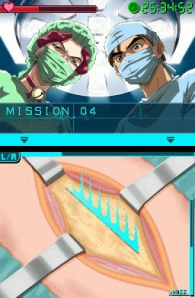
image0050What with Tendo being a doctor, you'll be unsurprised to note that you do actually get to do a bit of doctoring around the place, too — life in a hospital isn't just flirting with the nurses and hanging out with the pervy old cancer patient who can't resist pinching female doctors' bottoms. No, at least once in each of the game's five episodes, you'll find yourself having to deal with realistic medical cases, beginning with an examination in which you must successfully diagnose their symptoms, and usually concluding with a surgery sequence in which you must treat their ailment accordingly.

The diagnosis sequences are like a simplified version of Dr Cunningham's episodes in Trauma Team (or it's perhaps more accurate to say that Dr Cunningham's episodes are like expanded versions of Lifesigns' diagnostic sequences) — after having an initial discussion with the patient, you're presented with a view of them that you can look up and down and then interact with in several ways — inspecting areas visually, using a stethoscope to listen to the body's sounds and palpating areas by rubbing the touchscreen. The patient will generally give you a few clues here and there ("ooh, it hurts more on the other side…") but for the most part you're expected to perform a thorough examination to find all the symptoms. Unlike in Trauma Team, there's no chance of missing anything as you can't proceed until you've made a successful diagnosis; and also unlike Trauma Team you don't have to worry about eliminating possible candidates by matching symptoms to your database. Tendo knows his stuff — though often the visual examination is followed up by one or more "spot the difference" ultrasound/X-ray/CT/MRI scans in which you have to circle the abnormal areas on the touchscreen and pin down a final diagnosis.

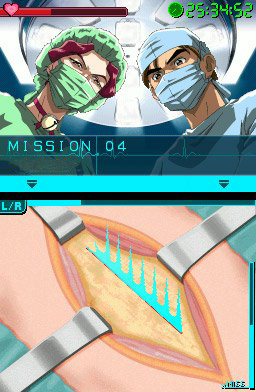
The surgery sequences, meanwhile, are not very much like Trauma Center at all… aside from the fact that they're incredibly tense and quite challenging. Rather than tending to follow the same format, requiring the player to remember the appropriate means to deal with "common" ailments such as lacerations, tumours and inflamed areas, each surgery sequence in Lifesigns is a unique procedure that doesn't necessarily involve opening up the patient. For example, in the first episode, you'll find yourself performing an appendectomy as your first operation, then later you'll be navigating a catheter through someone's blood vessels in an attempt to stop some internal bleeding.

The diversity of tasks in the operations means that rather than trusting the player to switch between tools as they need to, each surgery is split into a number of smaller objectives which must be achieved in linear sequence to progress. Making mistakes injures the patient and causes damage to their vitals bar, and there's no convenient "cure all" stabiliser to inject here — though performing a task quickly and accurately has a chance of restoring the vital signs somewhat. There's also a "concentrate" button that displays the areas on which you're supposed to perform the current action along with the movements required, but all the time you're holding down this button the operation's time limit is zipping by five times faster than usual. Experienced surgeons will, of course, be able to complete the operations without having to rely on this at all, and in at least one situation the ending of an episode is determined by how quickly you complete an operation. (You can save beforehand… but as noted before, the "bad endings" to each episode aren't game-ending, so it's often worth continuing and perhaps replaying the game later to see the different possible conclusions.)
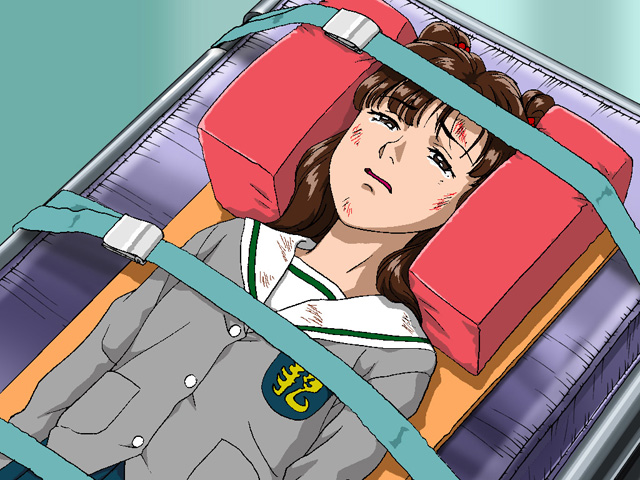
133I'm only partway into the second episode so far so I'll refrain from speaking further on the plot and whatnot, but so far it's been pretty great. It successfully combines the character- and dialogue-driven narrative of the Ace Attorney series with the tension of Trauma Center and comes out feeling like its own distinctive experience. While, yes, there is a lot of talking, as I said earlier that's sort of the whole damn point. This isn't a kinetic novel with arcade sequences like Trauma Center was (that's not a criticism, incidentally) — it's a visual novel/adventure game in which performing surgery plays an occasional role, but in which the relationships between the hospital staff, the patients and the other people in their respective lives is brought to the forefront. It's a really interesting game, and I strongly suggest you check it out if you're a fan of games that are a little bit off the beaten track.

1160: Spoilers Ahead

After writing yesterday's post and doing a little more work on it today, I've decided that I would actually quite like to talk about my RPG Maker project a little more rather than being unnecessarily vague and obtuse about it. Those of you reading who like the concept might be able to give me some motivation to continue with it in the long-term, then, which is probably going to be a valuable thing if (when, more likely) this initial burst of enthusiasm runs out.

However, I am also conscious that discussing some things about this project may constitute spoilers of various descriptions, so I am going to add a "read more" tag to this post so those who would like the finished product to remain a complete surprise can avoid it if they desire.

So, without further ado, click the link to continue reading if you want to… otherwise, I'll see you tomorrow!

Continue reading "1160: Spoilers Ahead"