1187: Dev Diary 4

This is actually more of a "writing diary" rather than a dev diary, because I'd like to talk specifically about the way I write, and how this relates to the game I've been making.

I've never been the sort of writer who plans things out in exhaustive detail. I know, I know, this is probably woefully self-evident from the nonsensical ramblings I've been posting here for the last 1,187 days (and more occasionally beforehand, too) but it works for me. It got me through all of school, all of university and what has so far been a relatively lucrative career in writing professionally.

Note that I'm not saying I don't plan things out at all. (Although some better planning would have probably avoided that awkward double negative right there.) No, instead what I tend to do is get things firmly in my mind in fairly broad terms, then "fill in the blanks" as I go along. It's not quite writing by the seat of my pants, but it's also not doing a detailed, bullet-pointed list of every single point I'm going to cover over the course of the complete piece. It gives me a sense of structure, but also allows me the flexibility to veer off in another direction if I want to. Those of you who have read my past month-long creative writing endeavours on this site will have likely spotted the points in the (largely improvised) narratives where I had what I thought was a great idea at the time and proceeded down that path with gay abandon, sometimes to discover I'd written myself into a corner and promptly had to dig my way out somehow. (Oh, God. I shouldn't have said that. You'll all be looking for those moments now.)

Anyway, how does this relate to One Year Later? Well, quite a lot, as it happens. Writing an interactive game isn't quite the same as writing a novel. Even writing a visual novel isn't quite the same as writing a regular novel, since you (usually) have to deal with branching plot paths and whatnot. In the case of One Year Later, there is a linear path of "story beats", for want of a better word, but each of those has several different possible things that could happen, and within those several different possible happenings comes a series of optional things that people might not see at all. These optional things let me play with various aspects of the characters while still allowing the plot to continue moving forwards.

This is all very vague, as I'm trying not to spoil things, but let me give you a specific example to make things a bit clearer.
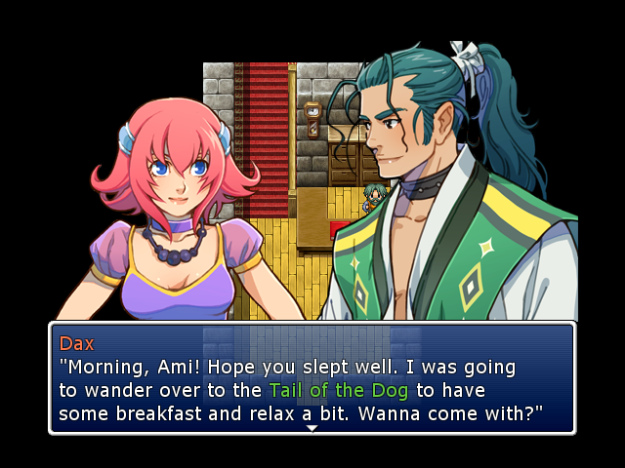
Who wouldn't want to go and have breakfast with Dax here?

Early in the game, the protagonist Amarysse wakes up bright and early in the morning and goes out into the city. As she's leaving the inn where she's staying, she's accosted by Dax, one of the other main characters, who invites her to go for breakfast with him. If she accepts, they go for breakfast, they have a nice chat and various tidbits of information about both Ami and Dax are revealed, after which time passes and it becomes the afternoon. If she refuses (or, more accurately, defers his invitation until she has all the information available to make a decision) then she can go out into the city streets, where she comes across Feena, another one of the main characters, who invites her to go shopping. The player can only pick one or the other during this particular "time slot" of the game; both focus on Ami and a different main character, and both have the potential to reveal some new information, but they also exclude each other.

Someone who wants to go shopping with Feena, obviously.

This, naturally, presents a challenge in later scenes, where I can't really refer to information in scenes that the player might not have seen. However, what I can do is use the built-in game mechanics to determine whether or not Ami knows about a particular subject, and if she does, trigger some different (or additional) dialogue to if she was discovering this information for the first time. An example of this comes if Ami chose to speak to Feena earlier in the game and revealed the information that Feena is, for some reason, not as happy as she could be. In game terms, hearing this information for the first time rewards Ami with a "topic" item called "Feena's Worries"; later, asking Feena specifically about it when given the opportunity upgrades the topic item with new information (she's not happy with her work), allowing Ami to then automatically pick up on little things that Feena says about her work and put them in context — something that she doesn't do if she doesn't have any knowledge of the topic at all, or if she doesn't know that the thing that's making Feena antsy is her work.

It's very interesting (and challenging!) to write this way, as it really forces me to think about the characters and how they might have interacted in the past, and how that might inform their future interactions. One Year Later is a game all about dialogue and interpersonal relationships, so it's important to get this right. I hope I do!

This particular piece of dialogue only shows up if, indeed, Amarysse discovered Feena's real age the previous night -- an optional bit of dialogue that some players might miss.
This particular piece of dialogue only shows up if, indeed, Amarysse discovered Feena's real age the previous night — an optional piece of information that some players might miss.

What this brings me on to is something I suddenly noticed very consciously earlier on while writing some optional, missable incidental dialogue between Ami and Feena: I very much get "into character" while writing.

I say I noticed this earlier; I've actually been conscious of it for quite some time when doing more traditional writing — it's one reason why I enjoy writing stories from the perspective of a first-person participant narrator — but it seemed particularly pronounced earlier. I very much felt like I was "inside the heads" of both Ami and Feena as they talked to each other about, frankly, fairly mundane things — things that those racing through the game would miss, but which those who wanted a deeper understanding of these characters would appreciate as a reward for thorough exploration and investigation.

The thing to be careful of when feeling like this, of course, is getting that characterisation across to the player, who doesn't "know" these characters in quite the same way as I do. Since while I'm writing the dialogue between these characters I'm effectively "role-playing" them, hopefully this will give the dialogue a reasonably natural-feeling flow. This is something that I won't be able to tell for sure until someone else who doesn't know these characters at all plays the game — which is a scary prospect, for sure!

Anyway. That's it for today. I've been doing some good work on the game recently and making some good progress. There's not enough there to proudly show off in playable form yet (though there is just under an hour of "Stuff to Do" implemented now, which feels a significant amount!) but there will be before long. In the meantime, I intend to post some occasional thoughts on the subject of its development on this 'ere blog as I (hopefully) continue to make progress.

One day you might even be playing it. Who knows?
1186: Don't Hate

There's a curious phenomenon in comments sections around the land. And that phenomenon is that it is seemingly the law that someone, somewhere, must hate everything. Actually, that's badly phrased; I don't mean that one person hates everything — though I'm sure there are people who do — but instead I mean that whatever the thing that has been posted, there will always be at least one person who dislikes it for some reason and is inevitably the sort of person who is very vocal about their dislike of it.

This seems to happen particularly frequently in sectors that already have passionate userbases, or in which the userbases are seen as being a "subculture" and/or outside the "norm" somehow. I'm thinking specifically of the video games and anime sectors here — and before you start on me, for all the massive steps forward these media have made in terms of mainstream acceptance over the last 20-30 years they are still indelibly tarred with the "geek" brush to one degree or another.

Today, I was exploring the RPG Maker community who, by all accounts, appear to be a fairly friendly and helpful bunch for the most part, as I've previously mentioned. I was curiously browsing through some of the other users' projects in progress and came across a few interesting-sounding games. One of the users noted that they had submitted their game to Steam Greenlight, the process whereby a game can end up being sold on Valve's popular PC gaming digital download storefront if it gets enough positive votes from the community.

The game, by all accounts, sounded interesting and unconventional, and something I'd be intrigued to play. It was an "artistic" game, for want of a better word, designed as a means for the author to show what it was like living with depression. The author said upfront on the site that it was a mostly-linear, narrative-centric experience with a lot of text, and made no apologies for this fact. (For people like me, the terms "narrative-centric" and "lot of text" are selling points, not things to be ashamed of!)

Sadly, the Greenlight comments section was less than supportive for various reasons, featuring disparaging remarks for everything from it being "another depression game" (oh, sorry, there have been so many of those) to dismissing it simply because it's an RPG Maker game. I've made my feelings on the latter point quite clear in the past, but they bear repeating: if a tool is available to help someone realise their artistic vision, there's no reason why they shouldn't use it, regardless of how many other people are also using it. And besides, some of my favourite games in recent memory have been RPG Maker titles — Corpse Party, To The Moon, Cherry Tree High Comedy Club… all of them were made in earlier versions of RPG Maker that were considerably less sophisticated than the excellent toolset that is VX Ace.

But I digress. The point is that the comments section was filled with hate for the sake of hate rather than actually constructive feedback. The fact that the game in question (Actual Sunlight, I believe it was called) was "another depression game" and an RPG Maker project had nothing to do with its quality, or its "value" to the Steam community as a whole, and yet these things were used as reasons to reject it, without even bothering to check it out.

In the anime sector, it seems that it's fashionable to hate on whatever the biggest name show is at the time. Most recently, this has been seen with Sword Art Online, which I found to be a rollicking good time with an astonishingly spectacular soundtrack, some memorable characters and an interesting, intriguing and pleasingly mature (for the most part, anyway) storyline. It was a good show, in short; while it perhaps wasn't the most intelligent anime you'll ever see, it was certainly far more than a dumb, formulaic show.

Perhaps not something everyone would want to watch, no, but certainly far better than the overly-negative comments that would appear on J-List's Facebook page any time site owner Peter Payne posted a piece of artwork relating to SAO. (Granted, J-List's Facebook page is a place where any time a picture of a vaguely attractive anime girl is posted, one specific user will always be along within three comments of the start of the thread to helpfully inform everyone that "[he] would fuck her", so it's perhaps not the best place to go for objective criticism, but still; you'd expect a community of Japanophiles such as the followers of J-List's page to be a bit more enthusiastic about the things they supposedly like!)

I honestly don't get why this happens, and it seems to happen a lot. Why waste your time on hate when there is so much stuff out there to get you excited? Wouldn't you rather feel happy and intrigued by something than angry or upset?

1185: Top Ten Panty Shots in Video Games

I'm not normally a big fan of Ben Kuchera's work (for reasons I won't go into right now because they're not relevant to what I want to talk about) but he's bang on the money (no pun intended) with this piece.

I shan't reiterate Kuchera's points here — read the feckin' article! — but I will say that on this note, I do agree with him.

The Internet's (and tech in general's) reliance on advertising has to end. It's not sustainable. It simply isn't. And in the meantime, all it's doing is devaluing content, pissing people off and causing us to continually circle the plughole, drawing ever closer to being sucked into oblivion forever, or at the very least into that weird, disgusting black smelly goo we found in the end of the pipe the last time our sink got blocked.

Whenever a site like, say, Kotaku (who are usually the ones who get picked on for this sort of thing, but they're far from the only offenders) posts some bullshit story that gets everyone riled up about how irrelevant/pointless/offensive it is, the war cry that goes up is that they're doing it "for the hits". More accurately, as Kuchera says, they're doing it for the pageviews, because like it or not, the bullshit stories that make everyone angry are the ones that lots of people take a look at "just to see what the fuss is about". The Daily Mail makes a living from posting this sort of garbage on a daily basis; Kotaku at least punctuates its rubbish with some interesting and thought-provoking pieces, while the Mail is just uninterrupted crap. As Kuchera notes, though, the bullshit more often than not pays for the interesting and thought-provoking pieces.

It's not just professionally-written content that suffers from this problem, though. Look at Facebook and the idiotic, illiterate ads that festoon its sidebar on every page. Look at Facebook (again) and its obnoxious, obtrusive "Sponsored Posts" thrusting themselves in your face uninvited. Look at Twitter and its "Promoted Tweets" that you don't want to see. Look at whatever bullshit ad WordPress has decided to serve up underneath my writing on this site (although only on the mobile site, seemingly) Look at the mobile app I reviewed today, which rammed two full-screen ads down my throat before I could even open the main menu, and two more when I started picking a photo from my device's photo library to manipulate. (I was not kind to said app in the review.) Look at the ads you get for casinos and shady-sounding "download services" any time you browse for porn or torrents or anything else you wouldn't admit to looking for in polite company, but which we all know everyone looks for. (Yes, even you, you pervert.)

Internet advertising isn't positive or helpful. It is, for the most part, shady, misleading, obnoxious and obtrusive. Which is, of course, why it's so understandable that so many people — particularly the tech-savvy among us — run ad-blockers and thus deprive many sites of what little revenue they are scraping in from these revolting blights on the otherwise awesome nature of the Internet's global community.

I don't run ad-blockers. Honestly, this isn't for any particularly noble reason — I simply haven't set one up. But knowing what I know of the online publishing industry from the inside, I don't intend to run one, either. Those "One Weird Tip to Peel Your Skin Off and Whiten Your Teeth in the Casino that One Weird Old Florida Mum Found While Downloading Now!!" ads are many sites' main means of income. This isn't the magazine industry — there's no "cover price"; no newsagent looking over your shoulder and asking rather bluntly "you gonna buy that, mate?" (The magazine industry is, of course, in decline, meaning its model isn't necessarily particularly desirable either — but what do you think damaged it beyond repair in the first place?)

It's clear that this situation has to change. But it's not going to be an easy process. Readers used to consuming content for free and blocking ads are going to have to suck it up and start paying for their content. Content creators need to be confident enough in their work to make it worth paying for. And those responsible for the sort of bullshit ads you see on the Internet every single day… well, frankly they need to find a new career, because they've done more than enough damage to the media biz already.

If things don't change, there are going to be big problems down the line. Whether these problems take the form of the entire "new media" industry turning into the most stupid parts of your Facebook News Feed over and over again or the business collapsing entirely remains to be seen — but I'd rather not see either of those things happen if at all possible.

1180: Dev Diary 3

I'm pleased to report that work on my game is continuing apace and even seems to be accelerating somewhat. This is very pleasing, as making progress is hugely motivating. Every time I add a new bit and it works properly, it feels good. Okay, I'm not doing anything massively complicated, unlike some of the badass scripters out there (some of whose work I've incorporated into this project for simple improvements to RPG Maker's basic functionality) but I am making something that's more than a completely linear path to the finish line. (To be fair, that can be challenging enough, depending on what you're doing!)

Anyway, I thought I'd share two more WOLD EXCULSIVE!! screenshots with you to give you a sneak peek at what's going on so far.

oneyearlater3Look at it being all night-time and stuff! Night-time effects are easy to create in RPG Maker thanks to the convenient screen-tinting command — this even incorporates various presets for times of day and weather conditions if you don't trust yourself to tweak the sliders.
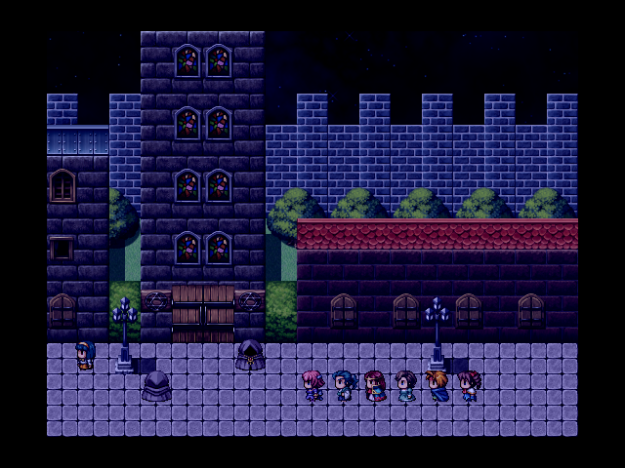
If you'll recall my previous post where I shared a couple of images, you may recognise this as the other end of "The Strip," a road in the capital city where a lot of the game's business unfolds. In this shot, we see the complete party following Amarysse following an evening of debauchery in the Tail of the Dog on the right, and two creepy mages wandering around outside their mysterious guild tower. The one on the left is called Bill. He has sweaty armpits.

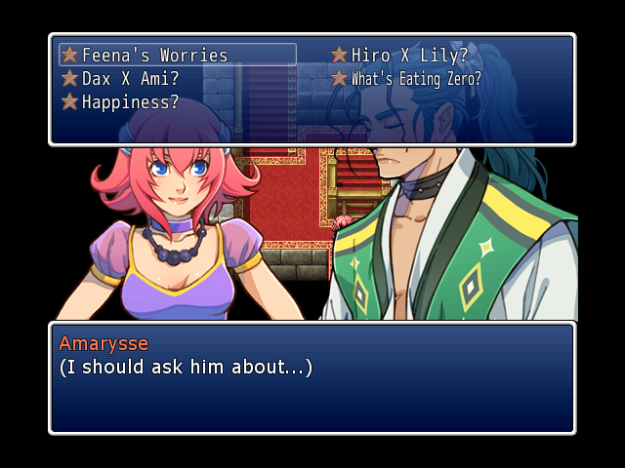
oneyearlater4Here's the "topic" system I talked about last time I wrote about the game. Ami and Dax here are having a late-night chat about various bits and pieces, and Ami's decided to ask Dax about some specific things she's got on her mind rather than just general chitchat. This "Ask" system won't be available for every conversation because that will just slow things down unnecessarily, but in situations where Ami is free to wander around and chew the fat with her companions — most commonly before everyone goes to bed — it will provide the opportunity to pick everyone's brains on various subjects and potentially gather some further information. The end of each day in the game will also provide the opportunity for Ami to reflect on the things weighing on her mind, and there will be events throughout where Ami will have to use the topics she's gathered to convince people of things or prove something. I'm taking strong cues from Ace Attorney and Lifesigns here.

Implementing this system was actually surprisingly easy without any need for delving into complicated scripting. Instead what I've done is I've replaced the staple RPG "Key Items" menu with a "Topics" menu, and simply added topic key items to Ami's inventory as they come up in discussions. The actual "Ask about…" functionality is a straightforward event call in RPG Maker that prompts the player to select one of their key items (or topics in this case). This event call stores the value of the item the player selected in a variable, which you can then check to see what was picked. All you need to do then is add some "conditional branches" to check if the item picked was [x], [y] or [z] and then display the appropriate exchanges between the characters — and just to cover all bases, add a generic event handler if the player picks something about which the character doesn't have anything in particular to say.

If that all sounds like gibberish, don't worry. It's actually just a series of simple, logical statements, though. If you were telling a person to handle what I've just described, it would go something like this:

Let the player pick one of the topics, and remember what it is. Was the topic they picked about "Feena's Worries"? If so, then play back the conversation on that subject; after that, forget the topic they picked and give them the opportunity to pick another one. Was the topic they picked about "Hiro X Lily?" If so, then play back the conversation on that subject; after that, forget the topic they picked and give them the opportunity to pick another one. Was the topic they picked something else? If so, then play back a generic conversation; after that, forget the topic they picked and give them the opportunity to pick another one.

Clearer? No? Well, never mind. I know what I'm doing, and that's the important thing.

Anyway, it's 1:30am and I must resist the urge to tinker and fiddle around with things (IN THE GAME) and go to bed. There'll be plenty of time for tinkering and fiddling over the weekend, particularly as I'm not friends with my PS2 any more — it scratched the bejesus out of my Ar Tonelico 2 disc to such a degree that the ending videos don't work at all any more. I've had to order a new copy (thankfully not that expensive) and I've also ordered an old-school PS2 fat (also thankfully not that expensive — the two items cost the same as a single new copy of Bioshock Infinite, which is quite amusing to me), as this scratching problem is apparently a known issue with PS2 Slims of a certain age. What that does mean is no Ar Tonelico 2 for a few days until those replacements arrive, so plenty of time to work on my own game. Or possibly just bum around with something else. Or start Ar Tonelico 3.


1179: Open for Browsing

A few days ago, the app AppGratis was pulled from the App Store for specific reasons unknown, but many conjectured it was due to the service that the company provided for developers — specifically in promotion of their apps. AppGratis, it was claimed, was gaming the system and manipulating the charts of the App Store so that they didn't really accurately reflect reality. I don't know whether or not that's actually true, but it's plausible given the shadiness of some parts of the mobile sector.

What I do know, however, is that the App Store charts are useless anyway, largely due to the huge amounts of miscategorisation (is that a word? It is now) going on, making it absolutely impossible to browse and find something you're looking for.

But is it really that bad? I decided to do a little experiment to see how accurate the descriptors in the Games category — the only App Store category to have subdivisions — actually are. Let's take a look at the Top 10 in a selection of these categories and see if the games therein actually belong in those groupings, shall we? Wait, where are you going…?

Huh. Sod those guys, we didn't like them anyway, right? Here we go, then.

Adventure Games (Paid)

Wikipedia's definition of adventure games:

An adventure game is a video game in which the player assumes the role of protagonist in an interactive story driven by exploration and puzzle-solving instead of physical (e.g. reflexes) challenge.[1] The genre's focus on story allows it to draw heavily from other narrative-based media such as literature and film, encompassing a wide variety of literary genres. Nearly all adventure games (text and graphic) are designed for a single player, since this emphasis on story and character makes multi-player design difficult.[2]

  1. Temple Run Oz — not an adventure game, it's an action/arcade game
  2. Minecraft — not an adventure game, it's a… Minecraft
  3. Badland — not an adventure game, it's a platform game
  4. Doodle Jump — not an adventure game, it's a platform/arcade game
  5. Grand Theft Auto: Vice City — not an adventure game, it's an action game
  6. Temple Run Brave — see No. 1
  7. Dead Crossing — not an adventure game, it's a shooter/driving game
  8. Eden — not an adventure game, it's a Minecraft-alike
  9. Clear Vision — not an adventure game, it's a sniper-centric shooting game
  10. Blue Toad Murder Files — HOLY SHIT AN ADVENTURE GAME

One out of ten is correctly categorised. So that's not all that good, really, is it? Let's look at the free adventure games.

Adventure Games (Free)

  1. Gangster Granny — shooter
  2. Temple Run 2 — See No. 1 in the Paid category
  3. The Simpsons: Tapped Out — citybuilder
  4. The Sims: FreePlay — It's The Sims, but more boring
  5. The Croods — citybuilder/farming game
  6. Frontline Commando: D-Day — shooter
  7. Minecraft Lite — Minecraft
  8. Jail Break Now — vaguely adventure-ish
  9. Tap Paradise Cove — citybuilder/farming
  10. Nimble Quest — Snake with a twist

Nope. Nope. Nope. One out of ten, and that might not even count as it's more of a stealth game. Let's look at a favourite genre: role-playing games.

Role-Playing Games (Paid)

Wikipedia again:

role-playing game (RPG and sometimes roleplaying game[1][2]) is a game in which players assume the roles of characters in a fictional setting. Players take responsibility for acting out these roles within a narrative, either through literal acting or through a process of structured decision-making or character development.[3] Actions taken within many games succeed or fail according to a formal system of rules and guidelines.[4]

  1. Slayin — arcade game with RPG elements
  2. Gemini Rue — THIS IS AN ADVENTURE GAME WHAT THE FUCK IS IT DOING IN THE RPG SECTION
  3. Mighty Dungeons — old-school dungeon-crawler. It counts.
  4. Skylanders Battlegrounds — Sort of RPG-ish, but more action game than anything
  5. Dentist Surgery Game — NO. Not even a little bit.
  6. Minecraft Explorer Pro — Not even a game; this should be in the Reference section.
  7. World Explorer – Made for Minecraft — Crap Minecraft clone. Not an RPG.
  8. Monster Wars — Strategy game
  9. Surviving High School — Visual novel/adventure game, not RPG
  10. Minecraft Papercraft Studio — Not a game at all

Hmm. Slightly better. Still not great. And the presence of Gemini Rue in there just feels like the App Store is mocking me for writing this. Let's look at the freebies.

Role-Playing Games (Free)

  1. Beauty Dentist — NO. (Also what the fuck is up with all the dentist games?)
  2. Tekken Card Tournament — Vaguely RPG-ish, but no. It's a card game. There is a card game section.
  3. Mighty Monsters — Pokémon ripoff. Crap, but could accurately be described as an RPG.
  4. Come on, Zombie! — More of an RTS than an action RPG, but I'll allow it.
  5. Campus Life — Poor-quality The Sims knockoff.
  6. Campus Crush — Visual novel/dating sim, not RPG
  7. Dungeon Hunter 4 — Yes!
  8. My Beauty Spa — No!
  9. Epoch — shooter
  10. Crime City — Citybuilder wanting to be edgy, actually just crap. Not RPG.

Oh dear. (And seriously, people, why all the virtual dentistry?)

What about board games? I like board games, and there are some good adaptations on the App Store, I know that for a fact. So what do the charts look like?

Board Games (Paid)

  1. Monopoly — Yep
  2. Scrabble — Yep
  3. Words With Friends — Yep
  4. Monopoly Here & Now: The World Edition — Yep
  5. Trivial Pursuit — Yep
  6. The Game of Life — Yep
  7. MahJong — Please learn the difference between "Mahjong" and "Mahjong Solitaire", but yep
  8. Pentix: warning! this developer likes to put stupidly long titles in things in the hopes of making their game look better! — Nope
  9. Doodle God — Nope
  10. Risk — Yep

Much better. Not perfect, but better. Shame all the top-selling ones are crap board games, though. Seriously, people, two different varieties of Monopoly? I don't mean to sound like a board game snob (actually, I do) but there are far better games out there. But at least it's actually in the right fucking category.

Board Games (Free)

  1. 6 Numbers — Countdown ripoff. More of a puzzle game.
  2. Lazors — Again, more of a puzzle game, but there is a board game a bit like this.
  3. Bingo — Nope. To the Casino section with you! Away, filth!
  4. Four In A Row 2013 — (Spoiler: it's the same as Four in a Row has always been) Yep
  5. Words With Friends Free — Yep
  6. Monopoly Hotels — NOPE. This is a shitty Monopoly-themed building game, not a board game. Sadly, there isn't a "shitty building game" category, but it would better belong elsewhere.
  7. Sudoku — Puzzle, not board game.
  8. Ruzzle — Yet another Boggle ripoff, but yep
  9. Chess Free — Yes!
  10. Friendle — Live Board Games with Friends and Family — The clue's in the name!

Again, better. But again, crap that has nothing to do with board games (except the name in Monopoly Hotels' case) is in the board games category.

So the situation varies a bit from category to category. But it should hopefully be clear from that that there are some significant problems there. Imagine you really want to play an adventure game on your iPhone or iPad — something like the excellent Gemini Rue or Broken Sword. Browse through the adventure game category and you may well have trouble finding things that are actually adventure games. That's a problem.

Sadly, without a complete wipe of the App Store's catalogue and recategorisation of everything, I think we're too late to really do anything about this. Developers deliberately submit their titles to the wrong categories to get greater visibility, and this effect spreads as more and more people do it — and in the meantime, Apple don't appear to care all that much when things are incorrectly categorised. The whole situations is a big ol' mess, and I'm not surprised independent developers working on genuinely great games are enormously frustrated that it's impossible to get their stuff seen amid all the other shite.

1178: Mage Knight Night

We played Mage Knight again this evening and actually managed to successfully get all the way through the introductory scenario, which allows the opportunity to explore the basic rules and get a feel for how the game as a whole works, but which is also (theoretically) significantly shorter than the other scenarios. It still took us about three hours altogether.

I have mixed feelings about long games like this. On the one hand, I really like the experience — the depth and complexity inherent in long games means that they tend to remain consistently interesting throughout, even in something like Mage Knight where there's a fair amount of downtime. Mage Knight is designed in such a way that while other people are taking their turns, you can easily be planning what you're going to do next, so in actual fact you can keep turns fairly snappy if you take the time to think ahead. There are still a lot of turns to take, however.

On the other hand, games that take a long time tend not to hit the table all that often, and we tend to end up playing something we're all familiar with like Agricola, which still frustrates me inordinately because I suck at it. (I do at least have my own copy with which I can practice now, however.)

Despite the apparent complexity of the game that the "walkthrough" game guide appears to imply it has by explaining everything in exhaustive detail, Mage Knight's mechanics are actually relatively simple. It's basically what you get if you combine a deck-building game like Dominion or Ascension with a turn-based strategy RPG-type thing. There are random elements, but for the most part the game is a matter of setting yourself up for success, and then being able to make the best use of the resources you have to hand at any one time.

The basic mechanic involves playing cards to gain values in various abilities. Move cards allow you to, err, move; Influence cards allow you to purchase items and perform special actions in populated locations such as villages and forts; Siege and Ranged Attack cards allow you to deal damage before the enemy attacks; Block cards let you fend off enemy attacks; Attack cards let you attack the enemy after they've had a pop at you; Attack and Block cards with elemental affinities are more or less effective depending on the capabilities of the enemy you're going toe-to-toe with. These "value" cards are then supplemented with cards that allow the use of various special abilities, and most cards have both a weak and a strong effect, with the stronger effect requiring the expenditure of "mana," which can either be collected (and possibly stockpiled) through special actions or drawn from a common pool that changes every so often.

The introductory scenario is basically a case of trying to collect as much shit as possible before the game is over. Bonus points are scored for all the "extra" things you acquire over and above your starting deck — spells, special abilities, mana crystals, treasures, supporting units — and lost for any damage you're still suffering from at the end of the game. In retrospect, triggering the end of the game when I did tonight was a silly move — I should have moved away and simply continued to try and rack up points. (Yes, I lost. Except at being wounded, which I was the best at. Yay negative bonuses!)

My trouble with strategy games like this is that I often lack the confidence to try certain more adventurous things. I'll give you an example: in Mage Knight, when you uncover a "Mage Tower" structure on a new map tile, you can conquer it if you can defeat its guardians, who are typically quite strong and resistant to certain types of damage. The rewards are great — particularly when you take end-game bonuses into account — but it's a bit of a risk, especially if you have a crap hand of cards at the time. This is where the "planning ahead" bit comes into it, I guess — something I clearly need to work on, since I spent most of my time earning points from exploring the map and defeating the "rampaging" enemies on the map rather than the more difficult opponents that would have earned me both more points immediately as well as the potential for bigger bonuses at the end of the game.

Anyway. I'm pleased we got through a whole game, and I'm keen to try it again — perhaps just the introductory scenario again, making some different decisions along the way — and see if I can do any better. I'm also quite tempted to get my own copy, since there are full rules for playing it solo, which I think will be quite an interesting experience. It has the feel of an old-school computer role-playing game — moving a bit at a time over a sprawling map, interacting with people through abstract systems and gradually growing in power. It works well — it's just very time-consuming!

1177: Dev Diary 2

Progress has been continuing on the RPG Maker game I'm working on (which is called One Year Later if you missed the slightly spoilerish post a while back). I'm very pleased with how things are going, because I've pretty much figured out How It All Works and am picking up speed with actually making things happen.

Here's the gist of things. All of this will be common knowledge to the player before they start playing if they read the accompanying "manual" or help file or website or whatever I put out alongside it, so these aren't really spoilers. I will keep specific plot details that aren't immediately apparent under wraps for now, however — I'd like people to explore this game's story with "beginner's mind", after all!

The game is set one year after the conclusion of a typical JRPG, when our plucky band of heroes drawn together by fate successfully defeated the demonic overlord T'Bon and restored peace to the land. At the end of their adventure, they had one last meal together in a pub they'd grown fond of, and agreed to meet back up again exactly one year later. The game begins on that day.

There are six main characters in the story.

Amarysse "Ami" Jerhynsson is the game's main character. She's a 30-year old woman from the farming village of Wishford, the destruction of which set her on her path to adventure when she was rescued from the wreckage by a wandering mercenary. She became the de facto leader of the group thanks to her level-headedness and rationality, despite the fact she never saw herself as particularly remarkable. Since her adventure, she's spent the last year helping the citizens of Wishford rebuild their town, and has been taking after her parents by tending the farm beside her house, much to the pleasure of Wishford's citizens.

Daren "Dax" Zael is the mercenary who rescued Ami from the wreckage of Wishford. No-one knows exactly how old he is, but he appears to be of a similar age or slightly older than Ami in appearance. As soon as he opens his mouth, however, his immature sense of humour and crudeness generally makes people think a little differently about his otherwise seemingly noble bearing. He was a strong fighter and was always the first into battle to protect his friends from harm.

Feena Denimore is a priestess of the Order, the organised religion that worships the divine entity known only as "The Goddess". She is skilled in divine magic and is a beloved priestess, but when she lets her hair down outside of her holy duties, she's cheeky, spunky and flirtatious, and more than capable of drinking someone like Dax under the table.

Hiro Nagase is a teenage boy who spent his formative years learning to fight with a sword under the tutelage of his father. These skills were put to the test shortly after the party came across him in his seemingly-abandoned family home — his parents had been killed by T'Bon's forces, and Hiro decided to tag along with the party in an attempt to get revenge. He likes to make out he is braver than he is, gets easily embarrassed and frequently says stupid things without thinking them through first.

Lily Cole is a teenage girl who came from the small fishing village of Bannford. She once had the strange ability to summon "Guardians" — supernatural creatures thought to be nothing but a myth — and eventually used this skill to seal away T'Bon once and for all. Since the final battle, she lost her powers and is now nothing but a normal, rather cheerful and optimistic teenage girl — traits she somehow managed to retain even in the party's darkest hours.

Zero is a powerful, knowledgeable mage whose real name is unknown. The party rescued him from torture at the hand of one of T'Bon's lieutenants, and he adopted the name "Zero" as a mark of spite against those who had abused him — an attempt to reclaim the word and give it positive connotations. Zero is typically stony-faced, contemplative and quiet, but occasionally displays a dry, dark sense of humour.

The game begins with Amarysse leaving home and heading for the capital, then meeting up with her former comrades-in-arms. Exactly where the story goes from there depends on the choices the player makes as Amarysse — which aren't always explicit choices from a menu. Sometimes taking a particular action (or choosing not to act) has an effect on the unfolding story and its eventual conclusion. There will be multiple endings as well as a "true ending" that is only accessible once certain conditions have been met. Discovering the "true ending" will require that the player make use of the New Game+ feature to carry over certain data from one playthrough to the next when they see one of the conclusions.

Interacting with the game will largely be like a regular top-down sprite-based JRPG. Players will control Amarysse and any party members tagging along with her as they visit various locations. The emphasis is very much on the story, so what needs to be done next in order to advance the plot will always be very obvious, though charging straight for the next story trigger without completing certain side objectives may mean you miss out on certain events — or perhaps trigger new ones later. Through the New Game+ system, the game will reward the player for experimenting and trying all the possibilities in various playthroughs.

Amarysse collects "topics" as discussions unfold between her, the party members and other incidental characters. Topics have three levels — at "bronze" level, they're something Amarysse is curious about; at "silver" level, they're something she's found something out about and wants to know more; at "gold" level, they're a truth she's discovered beyond any doubt. Advancing the plot will sometimes require Amarysse to use the topics she has collected to trigger various events or discussions between characters. At other times, she will have the opportunity to relax a little by herself and contemplate some of the things that are weighing on her mind. Sometimes, whether or not Amarysse has knowledge of a particular topic will have a significant impact on whether or not she can resolve a critical situation.

Currently, I have a plot outline in my mind. I know how the whole thing is going to end, and I know a few snippets of things that are going to happen along the way. I just have to work out the specifics, which I've found tend to flow quite naturally once I start actually composing scenes. I'm very much looking forward to exploring these characters through writing, and I hope some of you will take the opportunity to explore them through playing the game when it's finished. At present, I have no idea when that will be, but I will, of course, keep you posted!

1174: The Second Tower

I beat Ar Tonelico II: Melody of Metafalica this evening. Or, more accurately, I saw one of its four endings. Two of the other endings won't be particularly difficult to obtain with the tactical saves I made on the way to the finale, but the last remaining one will require playing about 80% of the game again, albeit with a completely different second "phase". I'll probably take care of that last ending alongside a new game, which will either be Hyperdimension Neptunia Victory or the third Ar Tonelico game, both of which I anticipate I will be enthusing about considerably on these pages in the very near future if previous instalments in their respective franchises are anything to go by.

Anyway, Ar Tonelico II. It's… well, fantastic. I must confess to having not been as immediately smitten with it as I was the first game, as the conflicting art styles between the field and battle sprites (and between the field sprites of the first game and the second game) were initially a little jarring. (Seriously, everyone has really, really big hands and massive feet on the field maps and it's very disconcerting to begin with.) But after not very long at all, I found myself looking past this rather superficial consideration and immersing myself in what turned out to be a very pleasingly deep and meaningful story packed with good characterisation and questionable translation from the original Japanese. (On that note, though, the translation was at least understandable despite a few errors, and certainly no worse than some visual novels I've played.)

Spoilarz Ahead

2a91og8Ar Tonelico II stands on its own, but also fits into the current "trilogy" as the sort of "dark middle episode". Whereas the first Ar Tonelico was rather bright and breezy most of the way through, the land of Ar Tonelico II is a bit bleaker. The people are struggling, there isn't enough land for everyone and everyone is clinging to the seemingly hopeless desire that the land's Holy Maiden will be able to create "Metafalica" — a verdant green land summoned through the use of Reyvateil Song Magic. Plenty of political machinations and backstabbings threaten to fuck everything up completely (and pretty much do on several occasions over the course of the entire narrative) but, this being a JRPG, our plucky band of heroes are there to wander the lands, right wrongs and eventually figure out how in the world they are going to help everyone find hope for the future.

Ar Tonelico II's story is nice in that it isn't quite the clichéd "Big Bad wants to destroy the world" business. Sure, there's world-threatening stuff going on and the eventual aim of the game is to save the world from an unpleasant fate, but it's not quite what you might expect. For starters, you spend most of the game not being quite sure who the "good" and "bad" guys are. There's no sign of a single easily-identifiable antagonist who is fucking shit up and needs a good Omnislash to the face; no white-haired pretty boy accompanied by tubular bells and organ music every time he appears. In fact, over the course of the narrative, none of these characters are presented as one-dimensional — most of them go through some sort of change and/or growth as the story progresses.

Perhaps the most interesting thing about Ar Tonelico II in this regard is the fact that the final boss "Mir" from the first game is actually a party member in the second — though you don't know this when you first meet her, and in fact it's entirely possible to go through pretty much the whole game without noticing this or figuring it out, depending on the choices you make and the optional events you witness. Not having played the first game won't affect your enjoyment of the second, but if you have played the first game, the moment where you find yourself going "Wait… OH. Mir?!" is a "big reveal" on a par with Darth Revan in Star Wars: Knights of the Old Republic or SHODAN's first appearance in System Shock 2.

Herein lies one of the interesting things about the first two Ar Tonelico games in general: "good" and "evil" aren't absolute. In Ar Tonelicowe get some insight into why Mir is the way she is and why she is so angry about everything — and it's easy to find yourself sympathising with her rather than just wanting to kick her ass. In Ar Tonelico II, by spending some time with her as a (relatively) normal person, we get to find out a whole lot more about her — what happened to her in the distant past, what led her to her actions in the first game, and how she feels about what has happened to her then and since. If you follow her "route" through to its complete conclusion in Ar Tonelico II, it's a really wonderful story arc for one of the most interesting, troubled characters I've encountered in a very long time. I don't yet know if she shows up in Ar Tonelico Qoga, the third game, but I'll be very happy to see her again if she does.

The overriding theme of the Ar Tonelico series is that of bonds between people, and this is particularly apparent in the second game. The main theme of Ar Tonelico II's story is that the more intense a relationship between two or more people, the more painful it is. The more people you surround yourself with, the more "alive" you feel from being part of something bigger than yourself, but the more pain you suffer when you lose those precious people. The world-ending chaos at the end of Ar Tonelico II is not brought about by a desire for dominance or a display of power, but instead out of a simple desire to not feel that sharp pain of loss any longer. If everyone was able to abandon their physical bodies and live on purely as an individual spiritual entity, the primary antagonist's theory goes, no-one would have any need for other people, no-one would feel the pain of loss, and everyone would be happy in their complete and total individuality. But, responds the protagonist, no-one would be truly alive then. Life would not have meaning drawn from the people around you and the hardships you work together to overcome. You'd be little more than data.

It's an interesting and somewhat bittersweet message, but it works hugely well in the context of both the overarching plot and the smaller, individual character-led stories that unfold over the course of the whole game. I'm all for exploring deep and thought-provoking themes through interactive entertainment, and Ar Tonelico II successfully achieves that without sacrificing the "spectacular" side of its overall experience. It's still recognisably a JRPG with all the over-the-top pyrotechnics and anime-style special attacks that entails, but at the same time it's a complex and emotional tale far beyond the "Evil Guy Is Over There, Go Stab Him" trope that people (largely incorrectly) assume still characterises the genre.

In other words, just go play it, all right?

1173: Am I Missing Something?

Yesterday, game-centric social network Raptr reported that in the month of March, its members played more of King's Candy Crush Saga than StarCraft II, World of Tanks and Halo: Reach (all historically very popular games) combined.

This is significant for a number of reasons. Firstly, it shows that Raptr is getting some pretty wide usage by more casual gamers as well as those who care about achievements, hour counts and whatnot — demonstrating (arguably) that a lot of people playing Candy Crush Saga are "serious" enough about their gaming to sign up for a game-centric social network and tracking service.

Secondly, it shows something we all know: the vast numbers of people playing Facebook and mobile games far outstrips those who have perhaps grown up with the industry and who play what one might call "traditional" video games — players whom mobile and social gaming companies euphemistically refer to as "core" gamers.

The second point isn't all that surprising; how many people do you know who don't have a Facebook account? While we're not yet in a world where every single person is permanently jacked in to the social network via a transmitter in their spinal column, I'm willing to bet that regardless of your age, there's probably a large proportion of the people you know who have Facebook accounts, and of those people most of them have probably tried playing some games at least once. The exact same situation is true when we consider smartphone ownership these days — of those who have acquired a new mobile phone recently, it's highly likely that it was one of the two most well-supported platforms out there: iOS and Android. And of those who haven't acquired a new mobile phone recently, a lot of people are investigating tablets as a home computer solution — pretty much all of which run, you guessed it, iOS and Android.

It's the first point that surprises me, though. Raptr is the sort of service that is historically only of interest to those "core" gamers we mentioned earlier, as your average soccer mom who only plays games on Facebook has no real need or desire to keep up with industry happenings or the latest stupid thing that a Microsoft employee has said on social media — let alone how their number of hours played stacks up against their friends. So what does it mean when the number of hours racked up on Candy Crush Saga outstrips some of Raptr's most heavily-tracked, popular titles?

Well, it could mean one of a couple of things. Firstly, it could mean that Facebook and/or mobile gamers are more serious about tracking their playtime and achievements in the games they play than most people thought. I find this rather difficult to believe, to be honest, as the sort of people who only play Facebook and mobile games are typically playing them as a means to fill a spare few minutes rather than as an engaging form of entertainment that they feel particularly passionate about.

Secondly, it could mean that those "core" gamers out there are playing Facebook and mobile games as well as (apparently, more than) "traditional" computer and console games that are aimed specifically at them? Judging by the notifications that pop up on the Raptr client that runs on my PC, this is much more likely; there are several people on my friends list whom I would describe as "core" gamers by that definition, but who are regularly seen playing everything from FarmVille to Marvel Avengers Alliance and Candy Crush Saga.

One question, though: why?

No, seriously, why?

If you're a "core" gamer by the popular definition, you're serious about your interactive entertainment. You might play games instead of (or as much as) watching movies and TV shows. Your exact reasons for playing may vary — those who enjoy Call of Duty play it much like a competitive team sport, while people like me prefer narrative-centric experiences that stimulate similar parts of the brain to movies and TV shows — but the fact is, you're highly likely to make time for your gaming rather than indulge in it as an idle diversion. You'll sit down, you'll play a game for a not-inconsiderable amount of time, then you'll switch off and do something else. Or pass out with the controller in your sweaty mitts.

So if you're investing time and probably money into what is, after all, a hobby rather than a mindless pastime, why, dear "core" gamers, aren't you playing anything better? Don't get me wrong, Candy Crush Saga has performed so well because it's a polished product that is pretty accessible even to those who haven't played many games before, but 1) it's a Bejeweled ripoff, and Bejeweled 3 (or just Bejeweled as it is called on mobile) is a better game with more variety; 2) it's rammed to the gills with obnoxious enforced "social" features that don't actually promote social interaction at all (ask for lives! ask friends to unlock levels! brag about your score!); 3) it's rammed to its other gills with obnoxious monetization — aside from the fact that every so often you'll run into a wall where it literally just stops you from playing unless you either wait for several hours or pay money, there's one powerup in the game that costs £35 and can be used once per level. Thirty-five pounds. Bejeweled 3, which, as previously mentioned, is an infinitely superior game that doesn't bug you every five fucking seconds to insert coins or invite friends, costs £14.99 — less than half the price of that one powerup in Candy Crush Saga — on Steam (and is regularly reduced in price in sales), and sixty-nine pence on mobile phones.

"But Candy Crush Saga is free to download!" I hear you cry. "Surely people aren't dimwitted enough to repeatedly spend money on this when they could just buy a copy of Bejeweled outright and then never have to pay again!" Wrong. Candy Crush Saga is, as I write this, the number 1 Top Grossing app on the App Store. Note: "app" not "game". (It is also the number 1 Top Grossing game, but that shouldn't be surprising given its other position.)

Let me reiterate that. Candy Crush Saga, which is free to download, is making more money than apps that cost money. By a significant margin. It is making more money than high-quality productivity apps for professionals, which typically carry a relatively hefty price tag. It is making more money than high-quality "pay once, play forever" games. It is making more money than Bejeweled, which is basically the same fucking game for the price of a packet of Chewits. It is making more money than anything else on the App Store.

It is at this point I throw my hands up and say I absolutely do not understand why this is the case. It absolutely boggles my mind, because can see why I wouldn't want to repeatedly and indefinitely churn money into a game that isn't noticeably better than another game I've already paid for once (Bejeweled), so why can't these hundreds, thousands, millions of other people? It does not make any sense whatsoever. And this isn't even considering the question above of why on Earth "core" gamers are apparently playing this game so much when there is so much other good stuff out there — too much for one games enthusiast to ever hope to fit into one lifetime, even if they became hikikomori in order to try and do so.

I am so, so torn about this sort of thing, and have been for a while now. On the one hand, it's great that more and more people are embracing video games as a pastime, form of entertainment or even hobby. On the other, the swathes of people who are coming to gaming as a result of free-to-play mobile and social games are perpetuating a business model that, while immensely profitable, is not particularly friendly to the consumer and is actually quite unsafe to people who don't keep a tight rein on their finances. More people playing games? Good. Sending the message that charging £35 for one powerup is okay? Very, very bad.

1172: Mage Knight

It was a board games evening tonight, and since we were down one member from our usual troupe to play Descent: Second Edition we decided to crack open a new acquisition and give it a shot: Mage Knight.

None of us really knew anything about Mage Knight prior to going in save for the fact it was supposed to be good, so it was always going to be something of a learning experience. Due to the relative complexity of the rules — or at least, the relative complexity of introducing the rules to everyone — we didn't manage to finish a complete game, but at least now we have a good understanding of the basic mechanics and will probably be able to romp through the introductory scenario without too much difficulty.

Mage Knight, if you're unfamiliar, is a rather interesting game with elements of role-playing, strategy and deck-building card games. You play a single character who begins with a deck of basic abilities — one of which is unique to each character, the rest of which are the same for everyone — and then work your way towards the objective of the scenario you're playing. Scenarios vary from cooperative ones where you work together as a group to competitive ones, where whoever gets the most points after the end condition is fulfilled wins, to "very competitive" ones, where whoever fulfils the victory condition first wins.

Play is split into rounds, which represent either day or night-time, and each round can and will go on for several circuits of the table. On each turn within a round, you can play some cards from your hand, some of which award you with movement, combat or influence points, and can then use those points to do various things. For example, moving requires a particular number of points according to the type of terrain you're moving over, and influence is used in settlements and other friendly locations to do things like make use of services or acquire troops. Some cards have special abilities, too, and most have two possible functions — one simple one that can be used for "free", and a more powerful one that generally requires a specific colour of mana to activate. Mana can be acquired through cards, through crystals you've stocked up on through various means, or most frequently through the dice that represent the "Source" — the mana naturally flowing through the world.

Through moving and attacking, you'll reveal more and more areas of the map, each of which include various things to do. In villages, you can recruit new troops, get healing or pillage them. Come across a fortress and you can assault it in an attempt to take it over for yourself. Discover a wizard's tower and you'll have the opportunity to get some powerful spells. Most actions affect your "fame" level — which acts as a combined score and "experience" system, allowing the player to grow stronger in various ways every so often — and your reputation in the area, which provides bonuses or penalties to the amount of influence points required to do "friendly" actions. Defeating marauding monsters improves your reputation; attacking fortresses unprovoked has a negative impact. There's a nice feeling of "consequence" to your actions.

We didn't play far enough to finish the first scenario, but we learned enough to be able to make it through the next time we try it. We learned about the simple but elegant combat system, which requires you to make careful use of your cards to defeat your enemies, and about the various ways you can acquire the more powerful abilities and items. There's clearly a lot to this game, and the really nice thing about it is that it's one of those games that, like Descent, scratches both the strategic Eurogame and theme-heavy Ameritrash itches simultaneously. Consequently, I can see it hitting the table reasonably often — though the only downside for our group is that it only supports up to four players, whereas our full complement is typically five people.

I'm looking forward to trying it again, anyway. It looks like a great game and the components are gorgeous — lovely linen-backed cards, pre-painted miniatures and high-quality tokens and other bits and pieces. It takes a while to set up but once you're up and running it's a game that continues to look good in the middle of a session rather than devolving into a chaotic mess. Combine that with the host of scenarios and variants provided in the rulebook and here's a game with the potential to be pretty different each time you play it. I can see why it's so well-regarded.