1145: Metafalica

Page_1I've been continuing to play Ar Tonelico II and it's really rather good. One thing I've found particularly endearing about it is the fact that just when you think you've got a handle on the way it does things, it goes and does something else interesting just to throw you off a bit. And yet even despite all these mechanics that get added over time, it still feels like a coherent experience as a whole.

Let's take the stage I've got up to now — "Phase 2" in game terms. In the first Ar Tonelico, the change from Phase 1 to Phase 2 marked the point where you were out of the "exposition" chapter and into the plot proper. Phase 2 was also the point where you had to choose between the two heroines, and then had two completely separate (but related) storylines to follow along with. The paths then reconverged towards the end of Phase 2 and remained together for the (completely optional) Phase 3, which offered the "true" ending of the game.

Phase 2 in Ar Tonelico II is a bit different. Rather than, like the first one, being set in the same locations and simply branching off in two different directions, Phase 2 of Ar Tonelico II takes place in a completely different area that works completely differently to the environment you've spent the previous 12 hours in. The early part of the game is, aside from its many and varied peculiar gameplay systems, relatively conventional — you visit towns and do stuff in them, then you go to dungeons. Then you go back to towns. And so on. The linear plotline is broken up by an optional "hunting" sidequest in which you can track down various "I.P.D."-infected Reyvateils to add to your "Girl Power" arsenal (I'm not even going to get started explaining that, I'll be here all day) but for the most part, you're doing the usual JRPG business.

Phase 2, meanwhile, takes place in an environment that changes according to your choices. Early in the Phase, you're introduced to a new mechanic known as the Infelsphere. This virtual world works in a similar way to the "cosmospheres" found inside the heroines' minds, but rather than reflecting their inner turmoil and anxieties, the Infelsphere represents the relationship between the two heroines and how they understand each other. Events unfold in the Infelsphere in which you have to make choices as to how to respond, and the choices you make in the Infelsphere subsequently affect what parts of the "real world" open and close to you. Your eventual goal is to get to a specific location by navigating your way through a maze of these pathways that open and close according to how the Infelsphere events unfold, with each point on the path containing some sort of "trial" to overcome. This might be as simple as defeating a monster, or it might be a challenge such as successfully smuggling biscuits past the penguin-like "Pippen" creatures.

Thematically, in each of these trials, you're "proving your love" to one of the heroines, which subsequently provides you with keys to unlock new events in the Infelsphere, and so it continues. It's a really peculiar, really interesting structure that not only offers some unconventional JRPG gameplay in the "real world" sections, but also provides some intriguing insights into the characters and the way they respond to various situations in the Infelsphere component.

You'll notice I haven't really mentioned the plot in this description, and that's deliberate, as discussing the plot surrounding all this would be a massive spoiler, so I'll spare you that — for now, anyway. What I am finding particularly pleasing about Ar Tonelico II as a whole, though, is that even if it didn't have a compelling plot and awesome characters — which it does — it would still have rock-solid gameplay with an absolute bucketload of things to do. It is just one of the many, many examples out there that prove JRPGs are far more than the "ATTACK, MAGIC, ITEM"-fests that ill-informed detractors of the genre assume these games still are.

They haven't been that way for a long time, people. So if you haven't played a JRPG since Final Fantasy VII I strongly recommend you check out what the genre has done since then — you might just be very pleasantly surprised by what you find.

1144: A Life Without Nerd-Rage

Page_1I haven't even contemplated going back to Twitter yet, but not because I have no desire to run into the scumbuckets who drove me off it in the first place. No, my lack of desire to go back to Twitter stems from my dislike of irrational table-thumping arguments on the most ridiculous of subjects, usually video game-related.

Mr Craig Bamford said it best back in February:

CAN WE PLEASE STOP TRYING TO HAVE SERIOUS DEBATES ON TWITTER OF ALL THINGS?

See title.

No, really. See title. I’m enormously, impossibly tired of how everybody who writes about games seems to think that the best-or-only way to have debates on serious, often wrenchingly-personal issues is on Twitter.

Yes, I’m guilty of this myself. I know. But every single time it happens, I feel like I’ve made a mistake. I’m just reminded of how Twitter is an incredibly dumb way to handle these things. The posts are too short, there’s no proper threading, you can’t follow the discussion properly unless you follow everybody involved, expanding the size of the group makes it even worse, you can barely mention people without drawing them in…

…it’s just a gigantic dog’s breakfast that makes absolutely everybody involved look bad.

Worse, it elevates bad arguments. It seems custom-tailored for dumb appeals to authority/popularity and thrashing of strawmen and misquotation and pretty much everything OTHER than an actual grownup  discussion of issues. It’s absolutely one-hundred-percent boosting the arguments that are “simple, straightforward, and wrong”, as the saying goes. That likely has a lot to do with why everybody seems to rush to the most extreme interpretation of arguments and positions. Extreme arguments tend to be straightforward ones.

Sure, there’s worse. Facebook, for example. But every day I’m more and more convinced that Twitter should really be used to link to  arguments, instead of make arguments. It’s not working. So, please, stop.

I agree with him entirely. Too many times over the last year in particular have we seen game journalists and critics with disproportionately loud online "voices" telling us what to think. Usually these loudmouths are attempting to address the issues of sexism and misogyny in the industry — a noble goal, for sure, as few can deny that women still get treated like shit at times through no fault of their own — but more often than not they get so embroiled in beating their fists on their desk that they lose all track of their arguments and end up coming across as… well, a bit childish really. Often these rants come about when the full information on a given situation isn't available, either — they're a kneejerk response to things which often aren't the "problem" they appear to be at first glance.

Let's take the recently-released Tomb Raider reboot as an example. I haven't played it yet, but I've been discussing it with a friend who has this evening. He's an intelligent sort of chap with a keen critical eye, and he has found himself very impressed with the depiction of the young Lara Croft as a vulnerable young woman caught up in a situation that she isn't entirely comfortable with, and having to do things that she finds difficult or scary. The tale of Tomb Raider is as much one of Lara overcoming her own difficulties at dealing with particular things as it is about… whatever the overarching plot of the new game is. (I'm intending to "go in blind" when I eventually play it, so I have no idea what the actual story is about.) My friend compared it to the movie The Descent, with which it sounds like it shares many of its themes and much of its tone. This means that Lara is frequently put in various types of danger — from the environment, from wild animals, and from other people. This also means that there are times when the wet-behind-the-ears young Lara is absolutely fucking terrified of what is happening to her, and justifiably so.

Is this sexist? No, not really; it's a perfectly human response to shit your pants (not literally… I don't think) at the prospect of having various forms of unpleasantness inflicted upon you, regardless of whether you're male or female. Likewise, as much as we would like to forget it happens, violence and sexual assaults do happen to women — and men too, for that matter — because there are certain portions of human society who are complete scumbags who have no regard for human life, male or female.

Lara happens to be female, which means that the situations she is put in over the course of Tomb Raider have been under a disproportionately greater amount of scrutiny than if she was a male hero — regardless of whether or not said male hero is a realistically-rendered character (as Lara is intended to be in this reboot) or a muscle-bound caricature. Lara is put into some difficult situations over the course of the game, including at least one scene where she appears to be at risk of sexual assault. Much was made of this scene when it was first revealed — particularly comments from the development team that it would make players "want to protect Lara". This was immediately interpreted by the aforementioned loudmouths as being misogynistic and in a sense they're correct to say that — the characters in the game are misogynists who don't care about Lara's wellbeing. But — and here's the thing — this doesn't mean that the developers share these attitudes just because they put these characters in the game. You have to have conflict and tension for something to be exciting. Did it have to be the implied threat of sexual assault? No, of course it didn't, but equally that doesn't mean we should shy away from such subjects in our entertainment — to do so can actually be pretty harmful, as it makes genuine victims of this sort of thing feel like their suffering is something to be ashamed of. It's also just plain insulting to grown-ups who want their entertainment to acknowledge that Sometimes Bad Shit Happens to Good People.

I don't want to get too bogged down in Tomb Raider because it's just one example of this sort of thing going on. I happened to sneak a glance at Twitter earlier out of curiosity and it seemed that the latest controversy to hit the Intertubes related to Sony's new God of War game, which features an automatically-attained story-related Trophy awarded to the player the moment after the lead character Kratos stomps on the face of a Fury following what, I assume, is one of the series lengthy combat sequences. The trophy is called "Bros Before Hos", which is arguably somewhat in bad taste, but we're talking about a series full of a muscle-bound man ripping the eyeballs out of mythological creatures the size of your average Ikea while shouting incoherently, so I think we can agree that subtlety went out of the window a long time ago.

Because a Fury is a woman, this scene (and by extension the Trophy) is now misogynistic. Again, it might well be in the context of the game — I haven't played any of them so I don't know what sort of person Kratos is (besides "the angriest man in Greece") and what his attitudes towards women are — but in the case of the game's development, God of War is based on established mythology (or an interpretation thereof, anyway) in which the Furies were (are?) female, and not very nice things to encounter to boot. If you had the opportunity and the means, you would probably want to stamp on their face too, and that's nothing to do with the fact they are women — it is, however, everything to do with the fact that they are infernal goddesses of much unpleasantness. Do we now have to disregard established mythology because of concerns over violence against women? No, that's ridiculous; that's wrapping the world in cotton wool, which helps no-one.

Note that in all of these cases I am not advocating for people to be free to promote things that are harmful to society. I would feel deeply uncomfortable playing a game in which you were somehow rewarded for inflicting domestic violence on someone, for example — although if tackled with sensitivity and care (which many triple-A developers lack, but which many smaller-scale or indie developers have proven themselves to possess in abundance) it could be possible to create an interesting, if distressing sort of interactive story about domestic violence. (In fact, it has sort of been done at least once, to an extent anyway: for a fascinating and challenging exploration of an abusive relationship through the use of allegory, play the game Magical Diary — which was written by a woman — and pursue the romance with Damien.)

What I am instead saying is that getting outraged any time a female character (or, for that matter, a non-white, young, elderly, homosexual, trans or other "non-white twentysomething cis male" character) is placed in peril, regardless of the circumstances, is counter-productive. It diminishes the value of the arguments as a whole, and distracts attention from content that genuinely is a problem. After the controversy over the Hitman trailer with all its leather-clad nuns and other assorted ridiculousness dreamed up by the 14-year olds in Square Enix's marketing department, I confess I found myself blocking most of the people involved in the "discussions" around the issue on Twitter not because I wanted to deny there was a problem, but because I couldn't deal with the way people were arguing about it. There was no debate, no discussion — nothing but "I'm Right, You're Wrong" for day after day. And as soon as one controversy subsided, another appeared. And so it continued for month after month after month. It made me stop caring completely, which is the complete opposite of what these people presumably intended.

Rage like this doesn't even have to be directed at a sociological issue, though; just recently everyone has been getting extremely angry at EA because of SimCity's online requirement, just like they did with Diablo III. Again, very few people are considering all the facts at play here, which I won't get into now, and instead resorting to kneejerk rage which, if you disagree with, you're somehow an asshole. There always has to be something to be angry about. And it's exhausting.

So, in summary, I am very happy to have now, for the most part, taken a step back from the seething masses — and while said masses are still seething I have very little intention of heading back in a Twitterly direction unless absolutely necessary.

I'll let Irina sum up how I feel about all this with the Understatement of the Century.

President6Quite.


1141: Give Me A Reason to Race

Page_1Why are there no racing games with stories? No, wait, scratch that, why are there no racing games with good stories? Or at the very least well-told stories?

It is surely not a difficult thing to do. You take the basic game structure from Wing Commander and replace all the space combat with racing cars around tracks and/or city streets. Then you profit. Why has no-one done this?

The few racing games out there that do have storylines of sort are generally half-assed efforts where all the plot is delivered through badly-written text put into the game as an afterthought, or they simply don't carry their potential through far enough.

I can think of a few recent examplesMotorstorm Apocalypse, though I didn't play it, reportedly had a plot of sorts, but it fell into the former category above. Motorstorm Apocalypse, lest you're unfamiliar, had you racing around a city that was blowing up and falling to pieces — surely an ideal situation for a rudimentary Michael Bay-style plot with some characters and shouting. It wouldn't have to be a complex plot, just something to break up the racing with some motivational scenes that gave it some meaning.

Split/Second had a go, too, with its TV show-style presentation, incredible electro-orchestral cinematic soundtrack and episodic structure. It stopped short of actually giving the game's antagonists, the "Elite Racers", any degree of personality (or indeed faces), though it did end on a cliffhanger (which will now never be resolved — thanks a lot, Disney).

Recent Need for Speed games have taken a pop at it too, but tend to lose interest after the introductory sequences. The closest example I've seen to what I'm looking for is Need for Speed The Run, but apparently — again, I haven't played it — neither the racing nor the plot are particularly up to much. (I must say, I am curious to try it, though, purely to see how close they get to what I'm imagining in my head.)

There's also a Japanese eroge called Moero Downhill Night Blaze that reportedly combines a visual novel with racing action, but judging by its required system specifications, I'm not counting on it being an especially spectacular offering on the racing front. (I do intend to play it, though, as the whole series sounds like fun in story terms, even if the racing ends up sucking.)

And then there's Midnight Club Los Angeles, which occasionally has Grand Theft Auto-style cutscenes, but not nearly enough to carry a coherent plot.

I'm honestly bewildered as to why no-one has tried this properly yet. We live in an age where video games are more "cinematic" than ever, and yet the racing game genre is still following the same old conventions it's been using since the PlayStation 1 era — and possibly before. I would pay good money for a racing game with a good, well-written plot — given that I never, ever complete racing games (Split/Second is, to date, the only exception), an unfolding narrative with interesting characters and a degree of overblown drama would be just the incentive I need to up my game and see the experience through to its conclusion.

If I had any clue how to make such a game — or indeed access to a team to make such a game — I would do so in a heartbeat. Sadly, though, I have a sneaking suspicion my desire to see a game like this will remain nothing but a far-off dream.

1140: Another Valley Without Wind

I really liked A Valley Without Wind, even though I never came anywhere near to "finishing" it, for want of a better word. (I say that because once you beat the "Overlord" who was supposed to be your antagonist throughout the game, you simply moved on to another randomly-generated continent that was being threatened by another Overlord.) It was a really interesting, if somewhat flawed game that obviously had a lot of love thrown into it. It was a game clearly put together by people who had a vision of what they wanted to achieve and were willing to experiment in order to realise that vision.

For those who are unaware of A Valley Without WindI wrote about it a few times approximately three hundred days ago. Here's one post, here's another, and here's a bit of creative writing inspired by the game's emergent narrative.

I was intrigued and excited to hear that the developer was putting together a sequel to the game, and that said sequel would be provided free to everyone who owned a copy of the first game. (You don't see that sort of generosity in the triple-A sector, that's for sure!) Details were relatively scarce to begin with, but it sounded like the intention was to completely overhaul the game and make it a more focused experience. The reason it was being developed as a sequel and not as another one of the many updates that the first game saw is that it involved a fundamental rethinking of the game structure in particular — rather than being potentially endless and rather freeform like the first game, A Valley Without Wind 2 was to have much clearer victory and loss conditions, making for a game which felt much more like it had a "point".

I spent a little while playing A Valley Without Wind 2 today and I'm intrigued by what I see so far. Here's the gist: rather than playing the role of a series of adventurers given magical powers by a "glyph" like in the first one, in this game you play a single character who is immortal thanks to a crystal given to them by the big evil demon overlord dude whose dark forces you've infiltrated. This means that you can't technically die — well, you can, but it's more of an inconvenience than a tragedy, since you can just come back again afterwards.

You're thrown into command of a ragtag group of survivors on the planet of Environ as they attempt to scavenge resources, build up their defences and eventually take down the big evil demon overlord dude. The game unfolds in two distinctive components — a turn-based strategy game and a 2D side-scrolling platform game. This is a similar structure to the first game, though the overworld map in the first game didn't involve much strategy and was more a means of simply exploring rather than anything else.

Each turn, you can move any of the survivors in your group to any of the "purified" squares in your domain. If they're already in a suitable location, they can perform an action such as working a farm to produce food, working a factory to produce scrap metal or building a new structure. Occasionally, monsters emerge from the overlord's lair on the map and the survivors must deal with them. Eventually, after 15 turns, the overlord comes out to play and starts stomping around the map, and the survivors must avoid his unwanted attentions as much as possible while you build up your power to a strong enough level to take down His Demonicness.

To end a turn, you move yourself into a space next to your currently-controlled area and begin a 2D platform game mission in which the aim is to get from left to right and destroy a generator to "purify" that square and its surroundings. Beating the level ends the turn, causing time to advance. Each level has a different theme according to its terrain type, and many have special buildings and structures to explore. Within the levels, you'll find various types of enemy and pieces of equipment, many of which have peculiar randomly-generated special effects — how does a pair of boots that makes you run faster but sets you on fire in the process sound?

Your character is highly customizable, and you can tweak your "loadout" each turn if you want — though not once you're into a mission. Several different classes are available at the outset of the game, each of which has their own set of four spells. Additional classes become available as you explore, and defeating bosses in special "Level Up" towers unlocks new perks that improve your abilities in various ways. You have to find a good balance between expanding your territory so the survivors have space to run away from the overlord when he comes out to play; finding Level Up towers to improve your own abilities; and ensuring your forces have enough resources to survive. As soon as your last survivor dies, you lose the game, so it's in your interest to keep expanding and recruiting new members to your forces.

I really like what I've seen so far. It's much more "focused", though this has come at the expense of the wonderfully complex randomly-generated levels of the original game. One thing I really liked about the first A Valley Without Wind was the sheer amount of stuff there was to do. You could wander into pretty much every building and explore it to try and find cool stuff. You'd never get anywhere if you did that, of course, but the fact it was possible was really cool. By contrast, A Valley Without Wind 2's levels are much shorter and more linear, and traipses through buildings are linear shortcuts between two parts of the level rather than sprawling, mysterious structures to explore. On the whole, it's a change for the better — as I say, though, it does make me miss some of the first game's idiosyncrasies.

One thing I'm not sure how I feel about is the change to the soundtrack. The original game featured a rather wonderful score that had more than a touch of chiptune about it, giving the retro-style gameplay an even greater sense of retro flair. The new game features a number of recognisable themes from the first game, but a much more "realistic" sound to its score. It's good — but is it as charming as the bleepy chiptunes from the original? I'm not sure. One thing I will say, though; the title screen music is absolutely gobsmacking and well worth just sitting and listening to for a bit.

I'll be checking this game out a bit more in the coming days, and I'll be intrigued to see if it can hold my attention. I liked the first game a lot, but the fact I never really felt like I was getting anywhere put me off playing a long way into it. This new version appears to have fixed that particular problem with a much more focused experience, so I'm keen to see how it plays out. Knowing my general abilities in the strategic department, I am anticipating a complete loss at the hands of the overlord within 20 turns, but we'll just have to wait and see about that, won't we?

1138: Song Magic

Been playing some more Ar Tonelico 2 this evening, and I'm liking it a great deal. Like its predecessor, it has a very pleasing system of "feature creep" whereby it starts out feeling rather straightforward but gradually, over the course of the early stages of the game, introduces more and more new and interesting mechanics until you have something that is very, very distinctive.

In the original Ar Tonelico, we were introduced to the basic combat system; then the way it worked when you have the magic-using Reyvateil characters in your party; the Dive system, in which you could explore the inner recesses of the heroine's mental "cosmosphere" worlds; the "bedtime conversations" system whereby the protagonist and the heroines could get to know each other a bit better (and subsequently unlock deeper levels in the cosmosphere); the "Grathmeld" crafting system, whereby you could take all the junk you'd acquired from the hundreds of NYO?!s you'd killed and turn them into various items, then enjoy some amusing scenes as the heroines try and convince you to let them name the item something ridiculous; and the "Install" system, whereby you're able to insert crystals into the heroines (and yes, they relish the opportunity for innuendo inherent in this process) to power up their various abilities and customise the effect of their spells.

In Ar Tonelico 2, meanwhile, we're first of all introduced to a new and rather odd combat system in which the two sides in the combat alternate attacking and defending for a set period of time — when attacking, you have to press buttons corresponding to the party member you'd like to attack and combine it with a directional button to do a specific move; when defending, you have to time button presses carefully to protect the back-line Reyvateil "mages" from attack, if they're present. The way the Reyvateils work is then introduced — a weird meter in the corner of the screen reflects what they want the front line to do, and fulfilling their demands provides bonuses, helping them to cast more effective spells more quickly. Then, once again, we have the Dive system, which works largely as it did before, albeit with a lot more multiple-choice bits where you have to say the right thing to proceed. Then we have the "I.P.D." system, whereby part of the plot dictates that you have to subdue and capture Reyvateils that are infected with I.P.D., which hasn't been explained yet. Then we have a slightly different crafting system, whereby certain items can only be crafted in certain places (you can only make food in a restaurant kitchen, for example), and the same recipe has different outcomes depending on which heroine you get to help.

Then things get a little odd. "Dualstalling" replaces the "Install" system from the previous game, and is the only way of levelling up Reyvateils, who no longer gain experience normally. Instead, at regular opportunities, you have to let them take a bath in water infused with crystals you've collected or purchased. During the bath (which looks rather large and luxurious, I must say), they wander around a bit, and if they pass over one of the crystals they dropped in, they gain a temporary special effect until the next time they bathe. And if you drop in toys (bath toys, you pervert) and scented oils, different effects might emerge. Oh, and if both heroines are bathing together, they'll often chat about things, too, which helps improve their "sync" value, which in turn helps them fight more effectively together in combat.

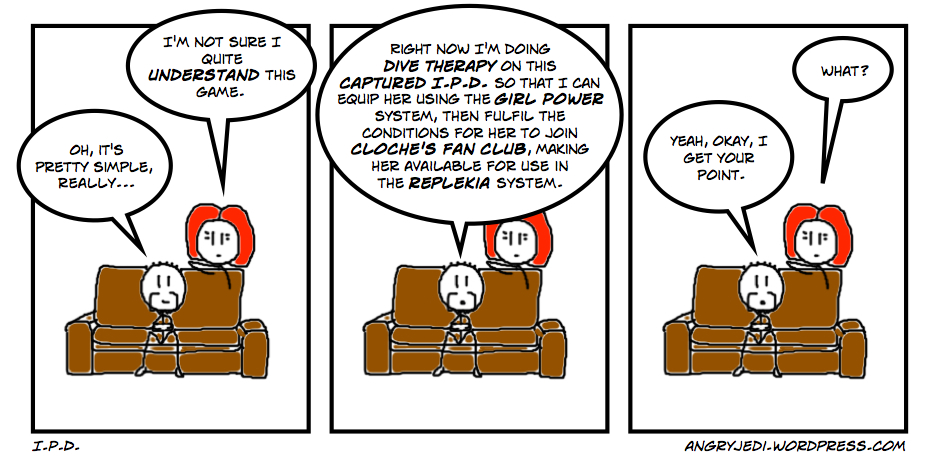
Then we have the "Dive Therapy" system, which I was introduced to in tonight's session. Now the subdued I.P.D.-infected Reyvateils have a purpose — they can be "cured" by one of the characters, who is a Dive therapist. Indulging in Dive Therapy involves talking to the Reyvateil and attempting to manipulate her mood to its ideal level on a meter at the top of the screen. Administering various treatments can affect the rate at which this meter changes with each response you give to their statements. Some responses increase the meter, others drop it, and each infected Reyvateil has a "sweet spot" where the meter needs to be in order to be cured.

That's not all you can do with them, though. The cured Reyvateils then bugger off and scatter themselves around the world to form a fan club for one of the heroines, and their affection for her increases as they see her doing cool stuff. When their affection maxes out, they will help out — exactly how, I'm not sure yet, but we'll see.

Oh, and also through the "Girl Power" system you can "equip" rescued Reyvateils to help the protagonist out in various ways. They then level up and improve their abilities and… waah, my head hurts.

All these weird and wonderful mechanics may sound overwhelming, but they're introduced at just the right rate. You're shown a new concept, then given a period of time in which to explore it in practical terms. Then another one comes along, and you can explore that. And so it continues. The nice thing is that only a few of these mechanics are "spoiled" in the game's manual, meaning the existence of things like the Dive Therapy system and various other bits and pieces are a nice surprise when you come across them for the first time. (Unless you've read this post first, of course.)

On the one hand, it's nice to be ready for all the game's mechanics and be able to refer back to a manual when you need to. But on the other, it's quite interesting (and oddly liberating) to play a game that trusts you to experiment a bit and figure out what on Earth (Metafalss?) is going on. Take the Dualstalling system, for example — while the help menu in the game explains roughly how it works, it's only by fiddling around with various arrangements of bathtime goodies that you'll figure out the most effective means of letting your mage-ladies wash their stinky bits and level up.

Basically, Ar Tonelico 2's more esoteric features are something you'll either be on board with or not. As you've probably gathered, I love them — and besides, are they really any more weird than summoning giant chariot-riding penis demons by fusing cards together, or sucking the magic out of monsters to somehow attach to your own strength? No. No they're not. So shush.

1136: Thoughts on RPG Maker

Page_1I read this piece by Robert Boyd of Zeboyd Games earlier. Now, I normally agree with Mr. Werezompire on a lot of things, but I take issue with a few things he says about RPG Maker in this article, which was posted shortly after the latest version RPG Maker VX Ace hit the Steam store a while back.

Boyd is quite right to note that this is the first time a piece of software such as RPG Maker has hit a mainstream digital download storefront for PC — past iterations of the software were sold directly by the publisher via a rather cumbersome e-commerce solution, so to get it on Steam is a big step forward in both accessibility and visibility. Boyd is also right to note that lowering the barrier of entry to creating games through tools such as RPG Maker also encourages everyone to want to have a go — and that this can result in a glut of "incomplete, buggy, generic, or downright awful games". (It also results in people who are otherwise unable to get their heads around programming becoming empowered to realise their own digital dreams and creativity.)

What I take a certain degree of umbrage to is his assertion that it is a "general RPG maker" and thus ill-suited to producing anything more than the most generic JRPG possible. While it is true that the default art assets and music provided with the game are aimed at people who want to get a fairly generic JRPG up and running quickly, the very nature of the software is that it is completely customisable depending on how much "individuality" you want to give your project. You can have something fairly convincing up and running in a matter of minutes using the default assets… but with a bit of time and artistic talent (or at least creativity), you can completely revamp the default "look" to anything you please. Not only that, but by using its built-in Ruby-based scripting language, you can completely overhaul the way the game works — battle system, menus, method of moving around the game world, anything can be modified or added if you know what you're doing. And even if you don't, there's a lively and active community out there that has put together plenty of free scripts for anyone to make use of.

This isn't "trying to modify RPG Maker to do things it wasn't really intended to do," as Boyd asserts. This is, in fact, using RPG Maker in the manner in which it was intended for power users — and it also aptly demonstrates one of the most admirable things about the application: the fact that it is simple and accessible enough for beginners to use, yet powerful and flexible enough for more advanced users to take complete control of. You only have to look at examples like To The Moon and Cherry Tree High Comedy Club, both of which were created in RPG Maker XP (two versions previous to the current edition) to see what is possible — and to be fair to Boyd, he does at least mention these titles in his post.

Boyd makes some fair points in the article, but what I don't like much is the underlying tone that "if you're using RPG Maker rather than programming it yourself, you're doing it wrong." While it is undoubtedly more satisfying to program your own engine from scratch and see a complete game come together from literally nothing, not everyone has the time, ability and/or C#-speaking friends to be able to do that. Plus if there's a perfectly good tool already out there to realise what you want to do… why shouldn't you use it?

1135: Melody of... The Other Place

Page_1As I noted yesterday, I completed Ar Tonelico: Melody of Elemia. So naturally, having discovered a new RPG series that I like very much, what's a boy to do but to make an immediate start on the sequel, much to the delight of my Ar Tonelico-adoring friend who convinced me to play the damn things in the first place?

Ar Tonelico 2: Melody of Metafalica is a surprisingly different beast to its predecessor in many ways. Its Japanese incarnation came out in the same year as the first Ar Tonelico hit Western shores, but it wouldn't be until 2009 that North American and European players would get their hands on it. That actually makes it a surprisingly recent game, released in the twilight of the PS2 era. This might explain why I never really paid it much mind first time around (besides being unfamiliar with the prequel, obviously) — everyone (including me) was already well and truly enraptured by "next gen" by that point, though games like Persona 4 (which also came out in 2009 in Europe) had shown me that the previous generation still had plenty to offer.

The whole Ar Tonelico experience has had a complete overhaul in Ar Tonelico 2. Gone are the distinctly PS1-ish isometric-perspective graphics (though I actually sort of miss them now), replaced with hand-drawn backdrops in towns and a pleasing combination of polygons, flat objects and fixed camera angles to create "3D" dungeons. The sprites, too, have had a bit of a change in aesthetic — they have peculiar, stylised proportions now, which frankly has taken a little adjusting to, but the improved amount of emotive animation on them makes up for the fact that everyone has really, really distractingly massive hands.

The biggest change is in the battle system, however. I liked Ar Tonelico's battle system, as it combined conventional JRPG turn-based battling with an interesting magic system that encouraged you to find creative ways to finish battles "well" rather than quickly. It was a bit repetitive by the end, however, and it was consistently way too easy pretty much all the way through the entire game.

Ar Tonelico 2's battle system, meanwhile, is a completely different beast. It's still sort of turn-based, but not in the same way as its predecessor. Instead, the two sides in the conflict each take turns to attack and defend. When it's your turn to attack, you have a limited amount of time to use your two "vanguard" (front line) characters to attack; when it's your turn to defend you have to carefully time button presses to protect the back line Reyvateils from taking damage. The Reyvateils make demands on you during battle, too, requesting that you perform specific attack moves by pressing the button for the corresponding front line character and a particular direction. Fulfilling these demands gives you various bonuses that make the battle turn in your favour. It's interesting, as it means you have to really concentrate on every battle rather than just mashing the "attack" button, but I'm yet to have a significantly challenging battle to show its full potential just yet.

The "Dive" system makes a return, and is almost identical to its predecessor. You get to know the game's heroines in the real world by talking to them at campsites and inns, then "dive" into their mental "Cosmosphere" world to find out more about their various inner struggles and problems. Overcoming these problems helps them craft new Song Magic which you can then use in battle — plus these are entertaining mini-stories in their own right. Diving is mostly the same, though there are a lot more situations where you're given a choice of responses to a particular situation and must pick the correct one rather than simply following it through.

In "new, weird gameplay mechanics" news we have the new Dualstall system, which replaces the "Install" mechanic from the previous game (which allowed you to boost a Reyvateil's abilities by plugging various crystals into her… spells in a rather suggestive manner). Dualstalling essentially means flinging the game's two heroines into a bath infused with magic crystals, nice-smelling bath oils and bath toys and letting the attached abilities, uh, be absorbed. The heroines will also have a good chat in the bath, so this is a good way of building up their "Sync" gauge, which helps them work together better in battle.

So far I'm about four hours into the new game and enjoying it a lot so far. The change in aesthetic and gameplay style gave me a bit of "culture shock" initially but that thankfully soon faded, and I'm now enjoying the story and characters just as before. It's interesting to note that the game still feels recognisable as an Ar Tonelico game, yet has a different setting (albeit in the same overall world), different characters and different gameplay mechanics. I'm assuming that the third game (which is where the series made the jump to PS3) will be "similarly different", too, judging by a quick flick through the manual.

Further reports as events warrant.

1134: Melody of Elemia

Page_1I completed Ar Tonelico: Melody of Elemia this evening. What a fine, fine game that was. I'll be writing somewhat more "professionally" for want of a better word about it this Wednesday over on Games Are Evil, but for now I just wanted to enthuse a little about the great experience that was that game. There may be some spoilers ahead; be forewarned.

The most immediately striking thing about Ar Tonelico for a new player coming to it for the first time in 2013 is that it looks old. It's also worth noting that it came out in 2007, so it actually looked pretty old when it first came out. That said, after a few hours of play, the low-resolution isometric-perspective sprite-based graphics cease to matter on a technical level, and the amount of character and personality in them starts to shine through. A friend of mine just noted that the visual style is actually something of a successor to stuff like Secret of Mana and the like and that's a great comparision — I'm kicking myself for not figuring that out sooner.

Outside of the in-game graphics, Ar Tonelico has some absolutely lovely character designs. Lyner may look fairly "generic JRPG hero" in his stylings, but at least he has some personality about him. The two heroines Aurica and Misha are both attractive and appealing in completely different ways, and a plot twist I won't go into here sees you interacting with Misha in both her "spunky young girl" and "equally spunky young woman" forms. The third Reyvateil introduced later in the game also proves herself to be an interesting character in her own right, again with her own unique visual style and "appeal elements".

One of the most interesting things about the game to me — and the thing I'm intending to write about this Wednesday — is the game's multi-route, multi-ending structure. Now, this could very easily be a recipe for disaster, as multiple endings in lengthy RPGs are often a good method to ensure your players won't see all of the awesome story content you made. That's not necessarily a bad thing — it's kind of cool when you can discuss a game with a friend and discover they had a completely different experience to you — but it's also frustrating to some people who like to know they've got everything they can out of a game before moving on.

Ar Tonelico's multiple endings and routes are handled in a rather peculiar manner. There are three "phases" to the game, each of which is a complete story arc in and of itself, complete with final boss confrontation at the end of each. Early in the second "phase", you have the opportunity to go with one of the two heroines and experience their story. Aurica's story gives you an overall view of what is going on in the overarching plot of the game, while Misha's story gives you a more personal view of what is going on with her and how she is relevant to everything. If you play Misha's route first, there are a number of scenes you see completely without context that don't really make sense. If you play Aurica's route, however, you play an important part in these scenes. The two paths then converge towards the end of the second phase, and the game then apparently ends — the credits roll and everything.

There's a twist, though. In a post-credits sequence, you get to run around and do all the usual JRPG "our party's splitting up, say goodbye" business, but once you've done all that, you're presented with another choice: live a happy life with [insert girl you chose here], or refuse to accept that as "the end" and move on. If the latter option is chosen, you find yourself entering a completely optional third phase that is about 20 hours by itself, and which leads to the "true" ending.

Except in that third phase, there are four possible endings, three of which relate to one of the three heroine characters — the latter of whom only becomes a major player in this third phase. The third phase is pretty much identical regardless of which girl you picked earlier, but the very end — if you fulfilled some very precise conditions — allows you to pick between the girl you chose earlier and the new addition. There's also a "bad" ending relatively early in the third phase that basically says "I can't be bothered with all this sidequesting, let's just get this over with".

So that's a total of… hang on… (counts) six endings? Fortunately, there's absolutely no need to play through the game six times to see all of them — instead, you can play through once, save before the "big decision" in phase 2, play one route to either the end of phase 2 or to complete completion in phase 3, then go back and do the other route, stopping wherever you didn't stop first time around. In my case, I played Aurica's route through to total completion, then played Misha's route to the natural end at the conclusion of phase 2. I don't feel like I missed out on anything, and it only required me to play less than 10 hours over and above what I'd already played anyway. And I feel rewarded for having done so — I have a deeper understanding of the story as a whole, and particularly the characters.

So that's Ar Tonelico — a really, really excellent JRPG and surprisingly thought-provoking if you can look past the notorious innuendo (of which there isn't anywhere near as much as people make out). It's also in possession of I think the best soundtrack I think I've ever heard in a JRPG… though I'm about to start Ar Tonelico 2 as I type this, so I may well be revising that statement in the near future!

1133: Board Game List of If Not Wishes, then Certainly Mild-to-Moderate Interest

I really like board games and relish the opportunity to play them with my friends — an opportunity I get much more often now that I live in the same place as them.

One of my favourite things about board gaming as a hobby is getting a new game, punching out all the bits and learning to play it for the first time — though arguably it's your second or third game where a new title really starts to hit its stride, as you generally know the rules reasonably well by then.

The trouble with getting new games is that often if they don't prove an immediate "hit" with the group, then they can be relegated to the shelf for quite a long time, with old favourites instead hitting the table much more frequently. Our group is a little prone to this, tending to fall back on stuff like Agricola and Ticket to Ride, though my (relatively) recent acquisition of Descent: Journeys in the Dark 2nd Edition proved to be pretty popular with everyone thanks to its excellent balance of strategic ("hmm, if I use this ability, then move here, I'll be able to win in two turns…") and thematic ("I AM A WIZARD! BOOOOOOOOM!!") gameplay.

As well as player tastes — our group is split roughly 50/50 on people who prefer strategic/mechanic-focused games and thematic-focused offerings — there's also things like player count to consider. Some games only work with three or more people — fine if you have a regular group — while some are for two players only. All of these things can conspire to ensure that something doesn't necessarily hit the table as often as you might like.

With absolutely none of that in mind, here are some board games that have caught my eye recently that I am somewhat interested in acquiring and playing with someone. If any of you, dear readers, happen to have played any of them, please feel free to tell me whether they're actually any good or not.

In no particular order…

Cadwallon: City of Thieves

pic715841_lg

(Image credit: BGG user bretteur)

I was unaware of this game prior to today, as it happens, but when I wandered into Forbidden Planet in town and saw it on the shelf, it caught my attention.

From the sound of things, it's a competitive game between up to four teams of "thieves guilds" vying for control of a small city district. A number of different scenarios challenges the 2-4 players to, in most cases, nick as much stuff as possible while attempting to ensure the other players get royally screwed over. According to reviews on Boardgamegeek, it's a relatively simple game with an element of strategy to it.

I'm actually fine with it being simple — we have plenty of complex games like Agricola and Power Grid, so it's nice to bust out something simple once in a while. That certainly explains why stuff like Ticket to Ride hit our table so often. The other nice thing about it being simple is that if everyone can remember the rules, everyone's likely to want to play it again in the future — especially if it's a relatively short game, which is sounds like this is.

So chalk this one up as a "very interesting" for me.

RuneWars

pic717838_lg

(Image credit: BGG user brainst0rm)

I'm primarily interested in this one because it's from the same team as made Descent, and Descent is a popular choice among our group for reasons already outlined above. Rather than being a small-scale strategy RPG type thing with asymmetrical competitive multiplayer like Descent, however, RuneWars is a larger-scale strategy game between up to four players vying for control of an overall world map. I don't know a great deal about how the game works but simply from reading descriptions of it, it sounds like it could potentially prove popular with our group for similar reasons to Descent. Tim and I (the players who favour theme-heavy and co-op titles) will be happy going "DRAGONS! ROOOOOAR!" while Sam and Tom (the players who favour more strategic, mechanics-focused experiences) will be happy planning out elaborate strategies to flatten everyone and declare themselves Overlord of Everything.

The only thing stopping me from immediately picking up a copy of this is the fact that a game takes about 3-4 hours, which means it probably wouldn't hit the table too often. The only other game we have of that length is Arkham Horror, which everyone seems to like, but which everyone is also reluctant to play due to the sheer amount of time it takes to do so.

Carcassonne Expansions

pic78106_lg

(Image credit: BGG user j0ran)

I like Carcassonne. It's a nice simple game that anyone can pick up the rules of very quickly. It's fun, strategic, has plenty of scope for screwing over your opponents and has the potential to be very different every time you play due to its heavily-randomised nature.

One thing I've not explored, however, is the wealth of expansions available for it. There are loads of them, and I have no idea which ones are actually any good or not. I think the thing to do will be to just pick up one or two and give them a shot to see how they are.

See also: Catan expansions.

BattleLore

pic403596_lg

(Image credit: BGG user jtspecial)

BattleLore itself is apparently out of print now, which means that new copies of it will set you back £80 or more — that's only about £20 more than it was when it was readily available, but it's still quite a lot. BattleLore is a two-player skirmish game in which two players face off against one another in an attempt to kick the snot out of each other using their armies. Apparently the game system for this works very well, with a nice combination of luck and strategy making it both accessible and deep.

A new version of BattleLore has been released, based on the Game of Thrones universe. I don't know the setting well — the limit of my knowledge is playing the surprisingly good Facebook game (seriously, try it — you'll be pleasantly surprised, especially if you like stuff like King of Dragon Pass) — but it certainly seems like the ideal setting for armies to kick the snot out of each other.

Two things have stopped me picking this up — one, it's two-player only (though the original BattleLore had an "epic" variant allowing additional players) and two, it apparently involves a bit of faffing around to get all the miniatures sorted out and ready to play. I don't have anything against that per se, but I'd need to know I'd be able to play it semi-regularly before committing to a campaign of supergluing tiny men to plastic bases.

Various "Living Card Games"

pic1066934_lg

(Image credit: BGG user FortyOne)

There's a few of these that look interesting — particularly the Call of CthulhuWarhammer and Lord of the Rings ones. Again, I don't know a huge amount about them, but I'm assured that they're good fun, offering the enjoyment of deckbuilding without having to repeatedly shell out ridiculous amounts of money for booster packs that contain cards you've probably already got.

The main thing stopping me checking these out further is that deckbuilding games have had a relatively mixed reception at our gaming table to date — Dominion doesn't come out that often, though I like it a lot, but Ascension proved to be a lot more popular. Again, I'd need to know I'd be able to play them reasonably regularly before investing in one of these.

Elder Sign

pic1099165_lg

(Image credit: BGG user ckirkman)

I'm a fan of Cthulhu-themed stuff, which partly explains why I enjoy Arkham Horror so much. From what I understand from playing the iOS version, Elder Sign has a fair amount in common with Arkham Horror in thematic terms — it even uses the same characters and artwork — but has much simpler mechanics and a playtime that doesn't extend into the days. I believe it's rather more luck-based, though, being primarily based around dice rolls, though Arkham Horror certainly isn't without its share of dice-based randomness, either.

Perhaps I'll play the iOS version a few more times before I consider looking into this one.

____

As with so many things in life, there are hundreds of examples of great games that I'd love to try, but not enough time and/or opportunities to do so. If nothing else, though, building up a collection of board games certainly looks impressive — even if it is a pain in the arse to move the bloody things from one house to another!

1132: Stop Calling it "Gen4"

Page_1The eighth generation of video games consoles is upon us — yes, despite the fact that EA desperately wants everyone to believe that it's the fourth generation it is, in fact, the eighth. Don't believe me? Allow me to prove it before proceeding further.

  • First generation: Magnavox Odyssey, Atari Tele-Games Pong, Coleco Telstar, Nintendo Color TV Game
  • Second generation: Magnavox Odyssey2, Intellivision, Atari 2600, Atari 5200, ColecoVision
  • Third generation: NES, Master System, Atari 7800
  • Fourth generation: TurboGrafx-16, Mega Drive, Super NES, Neo Geo
  • Fifth generation: 3DO, Jaguar, Sega Saturn, Sony PlayStation, Nintendo 64
  • Sixth Generation: Dreamcast, PlayStation 2, Gamecube, Xbox
  • Seventh Generation: PlayStation 3, Wii, Xbox 360
  • Eighth Generation: PlayStation 4, Wii U, something from Microsoft.

See? Proof. Thank you, Wikipedia.

Anyway. My point was not that people are getting the generation number wrong (I KNOW it's the "fourth generation of 3D consoles" but it's still stupid, so sod off) but that we are well and truly into the eighth generation now. One of the "big three" game console manufacturers has already released their new console (Nintendo with the Wii U) while a second has announced some skimpy details about what is to come (Sony with the PlayStation 4). We can doubtless expect something from Microsoft very soon.

It's going to be an interesting generation, I think, because the leaps hardware is taking forward with each subsequent generation are getting smaller. Graphics and performance still have room for improvement, sure, but there's actually been something of a backlash towards the striving for photorealism that has been the driving force behind most new game-related technological enhancements. Turns out people still like games that look like video games, which explains the popularity of heavily-pixelated titles like Fez as well as the heavily-stylized artwork of a lot of Japanese games. It also explains why people are so cynical about the "brownness" of Western games, though this is actually nothing new — I vividly recall my brother referring to the original Quake as "the brown game" before the turn of the century, so a drab colour palette is something we've been enduring for a while yet.

Because the leaps in hardware are getting smaller, though, that means each platform has to distinguish itself in different ways. Nintendo has fired the opening salvo with the use of its Gamepad for asymmetrical multiplayer in titles like Nintendo Land, and it works very well when used appropriately — we just need some more games that make creative use of this second screen. The lack of games isn't really cause for concern as yet, despite what professional industry doomsayers like Michael Pachter might say, because it also took developers a while to get their head around the two screens of Nintendo's last handheld the DS, and that ended up being the most popular handheld in the history of ever. There's no guarantee the Wii U will catch on in the same way, of course, but it's far too early to declare it a failed experiment as some have.

Besides, Nintendo are doing some other interesting things, too. The integration of the console's proprietary social network "MiiVerse" into a variety of different games is a really nice idea — complete a challenge in Nintendo Land, for example, and you can see drawings and messages from other people who are playing, and you can interact with these people. In games that are built for playing socially — think of the possibilities in something like Animal Crossing, for example — there's a lot of potential here, though from a personal perspective I really hope that it's not something that makes it into all games. Or if it does, I hope you can turn it off. Seeing silly messages after a go on Donkey Kong's Wild Ride or whatever the minigame in Nintendo Land is called? Fine. Seeing "lol i cant beet dis bossss lol xx" message while I'm playing an epic RPG? Not OK.

This "social" thing seems to be a big deal with the PlayStation 4 too, though I'm yet to review the information about the new console in any great detail. Apparently the controller has a "share" button right there, allowing players to do things like record brag clips and share them with their friends. Perhaps fun for someone 15 years my junior, but I personally don't really see the point for the most part — we'll see if it's used for anything interesting in the long run.

I'm a bit torn about the increased emphasis on "social" aspects of games consoles. On the one hand, it's quite fun to be able to see what other people are playing and talk to them about it. On the other hand, the vast majority of games that I enjoy are single-player experiences that I don't want interruptions from. I can't help feeling that my experience with, for example, the Halo series was tarnished somewhat by continually being frustrated by popup messages from friends inviting me to play multiplayer when all I wanted to do was see if the dreadful story was going anywhere. I could have just gone offline, of course, but it felt a bit "rude" to do that. Irrational and silly, I know. But it's the way I felt.

As for "sharing"? We're yet to find a really good balance of that. Both the PS3 and Xbox 360 allow you to share Achievements/Trophies to Facebook to brag about cool things you've accomplished, but neither are implemented particularly well. Part of the problem is the tendency for modern (younger) Internet denizens to "overshare" and make absolutely everything they do public, which diminishes the meaning of these "brags". This is a trend which is perpetuated by a large number of mobile and social games, many of which post crap all over social networks without you really wanting them to or, in worse cases, bribing you to do so. It's a means of marketing the game, yes, but more often than not — among my circle of friends anyway — it's a turn-off rather than something that makes people want to check out the game in question.

I don't have much interest in the promise of streaming games to PS4 via Gaikai because 1) my experiences to date with game streaming via OnLive haven't always been optimal, 2) I like to own my games and 3) I'd rather the quality of experience I get from my games not be reliant on my Internet connection, thank you very much. I hope Sony includes some form of backwards compatibility in the PS4 through a means other than Gaikai, but I won't be surprised if they don't. Sony, Microsoft and Nintendo have all made it clear that backwards compatibility is not a particular priority for them, and this is a trend I expect to see continue in the next generation. Consequently, I don't see myself getting rid of my 360 and my PS3 (or my PS2, for that matter) when the PS4 hits.

In short, I'm yet to be totally won over by the PS4, but yet to be dissuaded entirely either. A number of developers that I like have reportedly pledged their support to the new console, so that's something, but I'll have to wait and see if there's anything I want to play before I'm convinced to pick one up. Triple-A just doesn't cut it for me any more; I need something that appeals to my specific and peculiar tastes, and if it ain't there, it ain't getting my support.