1130: Pour One Out for 1up.com

The "digital age" brings with it many benefits — most of which relate somehow to the concept of "convenience" — but an unfortunate side-effect of it is that things aren't as permanent as they once were. Sites grow, change and relaunch, and occasionally die altogether.

Today it emerged that Ziff Davis, former owners of 1up.com until it was sold to IGN, and now the company that owns IGN (and consequently 1up.com again… yes, it's confusing) would be shuttering three sites, including 1up.com.

This is immensely sad news for a number of reasons. Today I will primarily be outlining my own personal feelings about that site; I'm sure a number of people reading this will have their own opinions and thoughts about the site and the changes it's gone through over the years, so feel free to share them in the comments.

I first became aware of 1up.com while my brother was working at Ziff Davis on Electronic Gaming Monthly and the Official U.S. PlayStation Magazine (I think I've got that chronology right). He played an important role in shaping the site and its content, and it became a regular hangout for me not just because of me supporting my bro, but also because I really liked what it was doing. It was my first real contact with what was to become "social networking", and I found myself really enjoying making use of all the site features — the ability to blog, the forums, the ability for users to create clubs and communities as part of the main site. My 1up blog was one of the first places where I wrote about games regularly, primarily for myself but also in an attempt to keep myself in "practice" should I ever find myself in a situation where I'd be able to do so professionally.

My main reason for thinking so fondly of 1up.com is the Squadron of Shame. I've told this story before, but it doesn't hurt to tell it again.

The Squadron of Shame was a group of people who came together as the result of a fairly throwaway feature on one of 1up's podcasts. The podcast participants had got talking about their "Pile of Shame" — all the games they owned but had never got around to finishing (or even playing in some cases) — and discussion had turned to Tim Schafer's cult classic Psychonauts. The intention was for the Pile of Shame to become a regular feature on the podcast as the participants played through the games together and gave their thoughts on more obscure titles that people might have missed out on.

It was a short-lived feature, and quickly abandoned on the show — but a bunch of people on the 1up forums really liked the idea and thus decided to come together and finish the job they'd started. We checked out Psychonauts and had a blast playing through it together. Then we started talking about other games that people might have missed — System Shock 2Psi OpsOdin Sphere and all manner of other titles. For each one, we made a thread on the forums for discussion, played through it together and got to know each other a bit better in the process. It was a fantastic experience, and I made a lot of very good friends in the process — friends who I still "talk" to on a daily basis even today.

Trouble was on the horizon, though. The once-sprawling 1up.com forums, which used to be split into a wide variety of distinct sections, were merged into simple "Games" and "Not Games" categories. The Squadron of Shame's threads used to call the "1up Radio" forum home — this forum primarily related to the site's podcasts and the features therein, and was generally a home of more mature, respectful discussion than other parts of the forums as a whole. Suddenly, though, our thoughtful threads — which often included long posts with members writing mini-essays on their experiences with the games we were playing — were lumped in with all the "wot iz ur favorit wepon in halo" threads from the hoi polloi of the site. Consequently, on at least one occasion we found ourselves being rather unpleasantly trolled by users who, for some inexplicable reason, took great umbrage to our writing of posts that included more than five words, knew how to use paragraphs and punctuated properly, and discussion wasn't quite so easy any more.

Around that time, the "club" pages on 1up got an overhaul; there used to be a "communal blog" where individual members could post in a linear fashion, but this was replaced by a dedicated forum just for that club. We made use of that for a while, but further trouble was on the horizon with the event which became known as the Great Upheaval, when a huge proportion of the talent from the site was laid off as part of the transition to new owners UGO. The site wasn't the same after that, so a lot of people drifted away from the community, mostly to places such as Twitter.

It was around this time that we started producing the Squadron of Shame SquadCast, an irregularly-occurring podcast that continues the Squad's original mission in earnest. To this day, we still have a small but dedicated following keen to tune in and hear our thoughtful, mature (and lengthy!) discussions on obscure games and gaming-related topics. It's something I'm really happy to be a part of, and something that still feels me with great pride any time I hear someone from outside my core friendship group talking about — people like Garnett Lee, one of the original 1up podcasters who gave us the idea in the first place.

Today, the Squad primarily lives on Google+, which seems to be a good home for our discussions. You can check out and join our community here. Prior to that, a healthy amount of discussion also took place on the "Squawkbox", a WordPress site we set up to emulate the old-school "club journal" format from the original 1up.com club, but which is now primarily used as a site linking to the SquadCast's archives. There have been plans on and off to make a "proper" Squad site for many years now (including a nice-looking mockup), but they're yet to come to fruition. One day…?

Anyway, I'm drifting off the point somewhat. The main thing I wanted to say is that none of this would have happened without 1up.com. Without 1up.com, I never would have met this disparate group of people from all over the world and made a group of friends with whom I really feel that I can be "myself". Without 1up.com, I wouldn't have as solid a "support network" as I feel I do today. Without 1up.com, there's every chance that I'd be a lot more lonely than I am today. I feel privileged and honoured to have met everyone who came together as a result of the Squad, and am glad that we're still attracting new members a few at a time every so often, many of whom are fast becoming just as good friends as those who I have known since those early days of the group. I now have a solid group of international friends that I trust and depend on, and without 1up.com I simply wouldn't have that. (Of course, there's every chance that I would have made a similar group of friends on a different website, but, you know.)

So it's for this reason I'm sorry to see 1up.com go. The loss of the articles and writing talent on the site is sad too, of course, but for me it will always be the community side of things that captured my heart and imagination, and showed me that my passion for video games was not something to be embarrassed or ashamed about, but instead celebrated and explored.

So thanks for the memories, 1up. You'll be sorely missed.
1127: The Stench of Manure

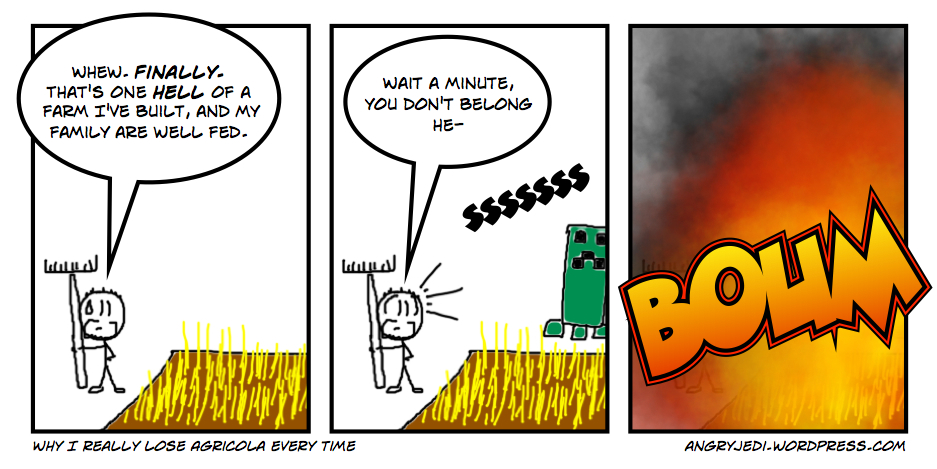
Page_1There are a few games that our gaming group plays on a regular rotation. One of them is Days of Wonder's Ticket to Ride, which is a fantastically accessible game that pretty much anyone can pick up and enjoy. The other is Z-Man Games' Agricola, which is still relatively easy to understand, but which I find immensely difficult. (And, judging by a few comments I received on Facebook earlier, I'm not alone in that!)

Agricola, for the uninitiated, is a game based on the thrilling world of 16th century German farming. As experienced board gamers will know, however, fairly tedious-sounding themes like this are actually ideal for adaptation into a board game. You have a variety of different tasks to perform and inevitably not quite enough time in which to perform them. You have the opportunity for expansion and building. And you need to think ahead in order to enjoy success.

My trouble with Agricola has always been that I get overwhelmed by all the possible courses of action and end up picking just one, following it to the exclusion of all else. While this is a valid strategy if no-one else is doing the same thing as you, the second someone takes an action that you were planning to do, your whole plan falls apart, since in the cutthroat world of 16th century German farming, only one person may plough a field at any one time.

Such was the difficulty I've had with Agricola in the past that I had convinced myself that I don't like it very much, and found myself generally resisting requests to play it in our group. (I like to play something I can win every so often!) However, in an attempt to better myself and also allow my friends to play the games they want to play a bit more often, I picked up my own copy of Agricola recently in the hopes of getting in a bit of practice and improving my own skills.

The nice thing about Agricola is that it's eminently suitable for solo play. Sure, it takes a bit of time to set up and it has a tendency to sprawl across the entire table, but as a solitaire game it's relatively quick and straightforward to play, and the nature of its mechanics mean that there aren't too many difficult-to-remember rules adaptations for solo players. Consequently, it's an experience fairly similar to playing with others, only without people getting in your way — and as such, it's a good means of trying out a few different strategies.

I've played a couple of solitaire games so far, and my score improved between the two of them. I'm not sure if I was actually playing better or if I simply had better "luck" the second time around, but I did feel a bit more confident and comfortable with my choice of actions in the second game. Rather than feeling like I was "wasting" certain turns, as I was in my first solo game, I felt like each turn achieved something. In an attempt to study my own way of playing, I even made a note of how each turn unfolded — what I did and how it affected my score. I'm not sure how helpful those notes will be, though I will say that writing things down as I played actually helped me to think a bit harder about what I was doing. It's not always easy to organise complex, abstract mechanics in your head — let alone plan several moves ahead and take into account the fact that anyone might scupper your plans at any minute.

The net result of me playing a few solo games of Agricola, though — plus introducing Andie to it earlier (she liked it! Yay!) — is that I feel a bit better about the prospect of playing it again in the future. I have no doubt my score will still be demolished by my companions, who have all played it much more than I have and thus know the good strategies and cards to look out for, but at least I'll feel like I have a bit more of a fighting chance.

We'll see, I guess. To the farm!

1126: Ah! Tonelico

I've been continuing to play through Ar Tonelico, and it's certainly pushing all my buttons in all the right ways. I've stopped noticing the "subpar" (compared to its contemporaries) graphics and accepted them as quaint and charming, and have found myself able to concentrate on the story and characters, both of which are great stuff.

The highlight of the game by a long shot is still the Dive system, which I believe I mentioned in a previous post on the subject. Just in case I didn't, though (I'm tired and can't be bothered to go back and check, all right?) let me explain once again.

One of the key plot concepts in the Ar Tonelico universe is the relationship between humans and the Reyvateil, the latter of whom are the only ones able to make use of "Song Magic". A Reyvateil and her partner, known as an Oracle, share a close personal bond — so close, in fact, that it's possible for her Oracle to "Dive" into her mind and explore the worlds inside her imagination, known as her Cosmosphere.

Note that I said "worlds," not "world" — each Reyvateil has multiple similar but not identical worlds inside her head, each of which reflect a particular facet of her personality, something she has had to deal with (or repress) and struggles she is yet to overcome. As the Oracle delves deeper into her mind, the worlds become increasingly strange and twisted, and the problems that the Reyvateil must overcome more deep-seated and difficult to resolve.

Inside the Cosmosphere, the player character Lyner comes across numerous different incarnations of the Reyvateil he's diving into. On one level, she might be a shrine maiden who wants to protect people, but who is anxious about being able to do so. On another, she might be a schoolgirl with no faith in her abilities, who believes she'll never be able to live up to her peers. On another, she might be sexually aggressive and dominant. Sometimes incarnations from other levels put in an appearance, too, and their interactions reflect the Reyvateil's inner struggles between clashing emotions and ideals.

Alongside the incarnations of the Reyvateil, Lyner also encounters characters whom he (and the Reyvateil) know in the real world. But there's often something a bit "off" about these characters, something not quite right. It transpires that these projections of familiar characters reflect how the Reyvateil sees them, not necessarily how they actually are. This provides yet another interesting perspective on the Reyvateil's personality — not only do we see her internal struggles, but also her own attempts to deal with how she thinks other people see her.

I love this kind of thing. It's one of the reasons I adore Persona 3 and particularly so much. Games are a brilliant medium through which the inner workings of a character's mind can be explored, and games that do just that are among my most fondly-remembered titles — stretching right back to The Adventures of Alundra on PS1 and its "nightmare dungeons". Ar Tonelico is certainly scratching that itch very nicely — and it helps massively that the characters involved are entertaining and fun to be around. Plus it seems there's a very obvious "split" just after the halfway point, so after I've finished it once I can go back and focus on the other Reyvateil to see what her subconscious has to say about herself. Looking forward to it.

I haven't touched on the series' endearing use of innuendo, which is seemingly the main thing it's known for, but I'll save that discussion for another day — perhaps when I've played the apparently increasingly-shameless sequels!

(Comics back tomorrow.)

1121: Dreamscape

Page_1I had a "game dream" last night. As any longtime gamer will tell you, these happen with increasing frequency the more you like or have spent time playing a particular game, are often extremely vivid and are usually quite memorable, too.

In my case — and disappointingly for this blog post, which is about to get a whole lot of padding — I can't remember the specific details about said dream. What I can remember, however, is the peculiar combination of games that formed the basis of said dream. First up were Ar Tonelico, which is my new RPG jam having finished Hyperdimension Neptunia mk2; and Hyperdimension Neptunia mk2 itself — hey, I really, really liked it, okay? These two aren't especially weird to put together, since Ar Tonelico's developer Gust also contributed to Hyperdimension Neptunia and was even personified in the game as the character called, err, Gust.

Combining with Ar Tonelico and Hyperdimension Neptunia was the visual novel Kira Kira, which I was reading shortly before I went to sleep last night, so it's perhaps unsurprising it put in an appearance. Kira Kira doesn't really fit with the other two, though — it may also be Japanese, but it's 1) not an RPG 2) not in a fantasy setting and 3) not quite as "crazy" as the other two.

This isn't as bizarre an inclusion as the presence of CD Projekt Red's dark fantasy opus The Witcher, however, which also put in an appearance courtesy of its white-haired protagonist Geralt, who looked very much out of place alongside the colourful characters from the other games.

As I say, I can't remember what actually happened in the dream, so this story is mostly a waste of time, but I thought it was an interesting combination of things that my subconscious chose to put together — particularly since I haven't played The Witcher for quite some time.

Game dreams don't always blend together experiences like this. Sometimes they're a focused experience based on a single game. Puzzle games used to be particularly bad for this — I remember shortly after getting my very own Lynx (Atari's ill-fated 16-bit handheld which was absolutely enormous) and playing a whole bunch of Klax that I had a number of Klax-related dreams, which mostly centred their attention on my mental image of the female voice that whispered such sweet nothings as "Klax Wave!" and "Yeah!" and "Oooh!" while you were playing. (I think it was the latter that made me go weak at the knees. It was quite a sexy "Oooh!". I have tried to find it on YouTube but instead found nothing but Flight Simulator videos. Apparently "KLAX" is the abbreviation for Los Angeles International Airport. What was I talking about again?)

Um, anyway… Yeah.

Dreams are a strange thing. I am fairly convinced that you can influence your own dreams strongly by what you're doing immediately before you go to sleep (wash your mind out, pervert) but it seems that the most vivid dreams tend to show themselves when you're not specifically trying to think really hard about something, and instead have a mind full of things that have stimulated it. In my case last night, the rather wordy prose of Kira Kira obviously kept my mind active as I drifted off to sleep, and then other influences that I felt strongly about drifted in there, too.

That still doesn't really explain the presence of The Witcher, but eh, I'm tired, so I'm off to read a bit of Kira Kira and then go to sleep for hopefully some more subconscious happy fun times. See you on the other side.

1120: Warm Symbol

Page_1So I finally popped my Fire Emblem cherry today. This is a series that I've been aware of on the periphery of my vision for some time, but have never actually got around to exploring. Which is sort of weird, really, because it's exactly my sort of thing.

Naturally, because I'm an arbitrary sort of person, I am not playing the newly-released Fire Emblem Awakening on 3DS (largely because it's not out yet, and also because Andie is away all week and has taken the 3DS with her) — no, instead, I am playing the Gamecube game Path of Radiance, which I acquired at great expense recently after being informed that I should probably play it before the Wii version Radiant Dawn that I got for a pocketful of change when Game was undergoing its, uh, "troubles" a while back.

Although Fire Emblem Awakening's immensely positive reception from press and public alike has caused the series to enjoy unprecedented visibility recently, it's entirely possible that some of you reading this may, like me, have missed out on it so far. So allow me to explain.

Fire Emblem is a strategy RPG series developed by Intelligent Systems, who over the years have also been responsible for the Paper Mario and Advance Wars series as well as the excellent 3DS puzzle games Pushbloxpullmo or whatever they're called in each territory. It is closer in execution to a strategy game with a linear campaign like Advance Wars than something more explicitly RPG-ish like Final Fantasy Tactics, but the important thing about it is that you're taking it in turns with the enemy to move little dudes around on a grid-based map and beat the snot out of each other, much like a board game.

Even the mechanics are very similar to Advance Wars — certain units may only perform "direct" attacks by standing next to enemies; others may only perform "indirect" ones by standing a square away from their target. Attacking an enemy isn't a guarantee you'll get away unscathed, either — a typical combat exchange between two units allows both attacker and defender to strike, assuming the defender survived the initial blow, of course.

I often find strategy games somewhat daunting as I'm not very good at them, but the relatively little I've played of Path of Radiance so far does a good job of introducing concepts to you very gradually and letting you explore them for yourself. At the core of the combat system is a sort of "rock, paper, scissors" system whereby characters with swords are better against ones with axes, characters with axes are better against those with lances, and characters with lances are better against those with swords. This is gradually built upon with ranged combat, mounted units, magic-using units who can cast spells using a staff, static ballistae on the battlefield and numerous other considerations. It eventually — presumably, anyway, I'm only four missions in — builds up to something of satisfying complexity, but which remains straightforward enough to be easily understandable for even rookie wargamers.

Then there are the interesting other mechanics laid atop these foundations. In maps based on towns, for example, you can spend a turn "visiting" any building with an open door, which leads to a short conversation with the inhabitant and usually an item. It also secures that building and prevents the enemy from destroying it; conversely, an enemy who gets to an open-door building before you will raze it to the ground, preventing you from getting at the goodies within and making you feel bad for the residents in the process.

And, of course, there's the series' trademark: permadeath or, in other words, if you lose a unit it's gone forever. This is a thorny issue for some — some believe that it adds an extra layer of excitement to the game (I'm inclined to fall into this camp) while others simply find it frustrating. Others still find themselves appreciating the permadeath system, but restarting any mission they lose one of their units on — a point which Matt's blog post linked above argues may be missing the point a little!

I'm a fan of the permadeath system. The last game I played that was vaguely like Fire Emblem was Aselia the Eternal, which featured a similar system whereby if you lost a particular character, they were gone forever. I managed to get all the way through the entire game (with a few tactical reloads, admittedly) only using one single unit in the final battle. (Her sacrifice was worth it.) I tend to find that a permadeath system is best paired with a strong sense of characterisation, however; for some people, the feeling of having nurtured an awesome character up to level amazing is enough, but for me I like to know who this person is before I feel bad about losing them. It's something that Aselia the Eternal did particularly well with its incidental scenes between its protagonist and his troops, and it also looks like Fire Emblem will be this way, too.

I'm very early in the game so far but I can tell it's going to be a pretty cool experience, plus its extremely linear mission-based nature means that it's friendly to being played alongside other stuff and has natural "break points" to stop, which is good. I will probably play it alongside Ar Tonelico and the other bits and pieces I'm enjoying at the moment, and then move on to Radiant Dawn when I'm done. By the time I'm finished with that, you never know, the 3DS Awakening might be out over here in Europe!

1117: Another Game with a Barely-Pronounceable Title

Page_1If you had no idea what genre a game called Ar Tonelico: Melody of Elemia fell into, it's highly likely that you'd guess that it was a JRPG. And you'd be absolutely correct. It's a title that doesn't make a whole lot of sense if you know nothing about the game, though to its credit, unlike many other barely-pronounceable game names, its relevance does become apparent almost immediately. However, it's still pretty much the exact opposite of the rather literal naming conventions adopted by social and mobile games these days, which tend to be called things like "City Wars" and "Farm Town" and "Slots".

Strange name aside… yes, I've been playing the PS2 game Ar Tonelico: Melody of Elemia, hereafter referred to as Ar Tonelico to save me typing out that whole title every time. I knew literally nothing about this game prior to firing it up for the first time, but had been urged to do so by a friend over at the Squadron of Shame who has been accompanying on my journey through the oddest and quirkiest undiscovered treasures that the Japanese role-playing game genre has to offer. I promised him that the next game I played after I completed the crap out of Hyperdimension Neptunia mk2 would be Ar Tonelico, so here I am.

So what's it all about? Well, if you live in the UK, don't count on any help from the box or manual — the game never saw an official release in the UK despite being fully-translated into English, and instead your best bet for a copy these days is Italy, of all places. It's rather peculiar to think of Italians playing JRPGs, but there you go.

Anyway. Ar Tonelico initially appears to be a rather straightforward JRPG with a floppy-haired, youthful protagonist wandering around the world seeking adventure on a Grand Quest to Save the World. And on the one hand, it is. On the other hand, however, it does a lot of very, very interesting things that have really made me sit up and pay attention, even only about four hours into the whole experience.

For starters, there's a deep crafting system to explore. This is a game from Gust, developers of the Atelier series (which I am yet to try but have all the PS3 incarnations of on my shelf), and their specialism is deep crafting systems. In Ar Tonelico's case, it takes the form of the peculiarly-named "Grathmeld" system, in which you have to find recipe cards around the world and in shops, find ingredients inside chests, shops and monsters and then fuse them all together using crystals. When you craft, you get a fun little animated sequence of your character Lyner assembling whatever item it is, then if it's a new item he has a fun little conversation with one of the other characters about it, and a discussion often ensues about what the new item should be called. You can't freely rename items, which is a shame, but you do get to choose between a couple of different suggestions, and the game then tracks which character named which item, which is a nice touch.

Perhaps the most bewildering aspect of the game is its battle system. For the first hour or two, it's a very conventional turn-based "attack, magic, item" affair. But as soon as you encounter the "Reyvateil" characters, also known as Song Maidens, things start to get interesting.

Reyvateils sit in the back row of your party and don't follow the usual turn order. Instead, they act like a mage or priest in an MMO, sitting behind the front row of fighters charging up spells (or Songs, in this case) to have various effects, while at the same time the front row is knocking seven shades of shit out of the enemy and ensuring the Reyvateil doesn't take damage. A strong focus is placed on the party's "harmonics" with the Reyvateil, with this represented by a bifurcated horizontal meter at the bottom of the screen. The left half of the bar fills when the front row lands successful attacks and drops when they take damage. The right half of the bar fills as the Reyvateil chants to charge up a spell. Should the two halves meet, the whole party goes up a "Harmonic level", which means the Reyvateil's spellcasting speeds up and the front row gain access to stronger attacks. The Harmonic level at the end of the battle also determines what rewards you receive.

There's another consideration in that system, which is the cap on the Harmonic level. At the start of each battle, you can only level the Harmonics up to 2; to increase the cap, you have to let the Reyvateil unleash her magic and deal enough damage for a separate bar to fill and open up the next level cap. The trouble is, at least early in the game, most enemies are absolutely obliterated by the Reyvateil's Song Magic, so you'll sometimes find yourself deliberately pulling your punches a little in an attempt to earn some higher Harmonic levels. It's an interesting system that will doubtless come into its own in more difficult battles later.

By far my favorite part of the game so far, however, has been the "Dive" system, where the protagonist Lyner is able to enter the subconscious of a Reyvateil and learn more about her. A Reyvateil's subconscious is split into ten distinct levels, each of which is made up of a number of different locations. Lyner must spend "Dive Points" earned through battle — which represent the trust the Reyvateil holds in him — to trigger various events, with revelations and strange happenings often unlocking new spells for the Reyvateil to cast in the real world. These vary from simple attack magic to "green magic" spells which can be cast outside of battle, usually to solve puzzles.

In gameplay terms, it's an elaborate means of unlocking abilities. But in story terms, it's a way of literally doing a deep dive into a character and discovering their innermost secrets. The scenes I've seen already have been heartfelt, interesting and help make me interested in the character. I'm very intrigued to see how they continue as the game progresses, as it's clear that the whole point of the "Dive" system is to help the Reyvateil come to terms with repressed memories and emotions in a vaguely similar manner to Persona 4's "Midnight Channel" — or perhaps just to peek in on some embarrassing things they'd rather forget about.

At four hours in, that's about all I can say so far, but I'm enjoying it a great deal. It looks super-dated — it's in 4:3 aspect ratio running on the PS2 and it pretty much looked like a PS1 game in the first place — but none of that matters to me. It is worth noting that it has an astonishingly good soundtrack, and that the English dub appears to be handled by the entire cast of Persona 3, which is fine by me — if a little odd to hear voices I recognise playing characters I'm less familiar with. (If you're wondering why I'm not playing with the Japanese voices, which are also included on the disc, it's because the FMV sequences in the game use the English voices, and it would be somewhat jarring to go back and forth between the two. The game also isn't fully-voiced, either, so it doesn't make as much difference as it would have in, say Hyperdimension Neptunia mk2.)

I'll be sticking with this one, then — though I may well be splitting my time between it and the Gamecube version of Fire Emblem when that eventually arrives. (The new 3DS version isn't out here until April, and I'm told I should play the Gamecube version before the Wii version that I scored for a song when Game was in trouble a while back.)

1116: Neptunia Master System mk2

Page_1I finally completed the shit out of Hyperdimension Neptunia mk2 tonight. And by that I mean I did pretty much everything it was possible to do in that game. I feel confident in saying it's one of the most consistently fun JRPGs I've played for quite some time — not necessarily the best, no, but certainly one that most definitely has its heart in the right place.

It was a really interesting game on the whole, and one that clearly knew its (small, niche) audience very well. I found it particularly interesting that instead of making a direct sequel to the first game, which apparently sold pretty well in Japan but bombed over here due to appalling review scores, they instead chose to reboot the setting and characters, creating a game which newcomers could happily start with but which those who played through its predecessor could appreciate on a deeper level. Neptunia mk2 wasn't a retelling of the first game's story — it was a completely new tale that pretty much assumed the first game didn't happen. This was a little jarring at first, as characters showed up whom I thought should know each other having played the first game, and the characters IF and Compa were obviously retconned to be childhood friends. Over time it ceased to matter, though, and it became clear that Neptunia mk2 was intended to be taken on its own merits without the baggage of its predecessor — a sensible choice, I'm inclined to think.

Besides proving to be a good jumping-on point for the series (the physical package's apparent rarity aside), Neptunia mk2 also dialed back its reliance on rather forced game and anime references for its humour, instead opting to focus on its distinctive and entertaining (if rather archetypal) characters. The one notable exception to this was in the game's "true ending" path, where there's a wonderful scene shortly before the final boss that features the "older sister" characters (meant to personify the seventh-generation consoles plus the ditzy Neptune/Sega, who has no idea what she's doing and is more interested in cookies than ruling the world) arguing over whose console is best, while the "younger sisters" (who are really the main characters of the game, and who personify the current-generation handheld systems… and, err, the Game Gear) sit and play Monster Hunter together while talking about how awesome Shenmue was.

A side-effect of the above is that the game's endearing sense of humour can be enjoyed by pretty much anyone, regardless of your knowledge of the video games industry as a whole. Those who have been playing for a long time, however, will appreciate the numerous sly nods and winks throughout — an area called Atari Marsh; a city called Sim City; characters called Cave and Falcom; and enemies that resemble everything from Tetris blocks to Dr Kawashima's freaky floating head from the Brain Age/Brain Training series.

The overall plot, which is essentially an anti-piracy, pro-"reward the creators of the content you enjoy" parable, initially appears to be a bit heavy-handed with its message, but this is nicely subverted by the time the previous game's protagonist Neptune puts in an appearance and berates the other characters for "sounding a bit preachy and stuff". It has a good narrative arc, building to a suitably dramatic conclusion and one of seven different endings — including a shockingly dark one that is quite impressive in its brutality. (Though it could possibly have gone even a bit further than it did.)

One of the most interesting things about it is its female-centric nature. While there's a lot of fanservice in it — within five minutes of starting, there are three quasi-"bondage" scenes; several characters are prone to flashing their panties at every opportunity (and the in-game camera is happy to encourage this); and a number of the "event" pictures feature a childishly amusing "jiggle" feature that… well, you can probably imagine — it's difficult to look on the game as being particularly anti-women.

In fact, it's very positive about a lot of things to do with sex and gender. The whole (enormous) party of playable characters is made up of women, for starters, and while many of these use anime archetypes as the basis for their personality, they're all their own individual characters with their own quirks and ways of interacting with each other rather than being nothing but shallow stereotypes. This team of ass-kicking women doesn't once rely on a man to help them out throughout the course of the entire story — and in fact, the few faceless appearances that men do make throughout the plot tend to depict them as shallow, image-obsessed borderline sex pests, with the exception of the boss character Brave, who is more of a Transformer than a man anyway. (Any good that Brave does for the male gender's representation in the game is immediately undone by Trick, however, who it's not an exaggeration to say is a revolting robotic paedophile, and one of the most delightfully odious characters I've had the pleasure of virtually beating up for a long time.)

There are also no unnecessary romantic scenes in the game, though there's a subtle implication that all the main characters in the story are gay and that there's nothing wrong with this whatsoever. (Because, you know, there isn't.) This doesn't mean lesbian melodrama or anything, either; rather, it's simply accepted that some of these girls like each other a bit more than others, and this is depicted in the way that they interact with one another with obvious tenderness and care. It's clear that these characters and their relationships have been written with genuine affection and a desire to make them believable people rather than just tits and arse, and I came away from the experience feeling like I had a good understanding of who they were, who they got along with the best and who they clashed with. It was one of those experiences where the final credits rolled and I felt like I was going to miss the characters, which is always a good sign.

So that's that. It's all done. No more Neptunia… at least until March, when the third game in the series arrives and I will inevitably become obsessed all over again.

1112: Freebies

Page_1It is a truth universally acknowledged, that a mobile game which carries the price tag of "free" must be in want of the contents of your wallet.

There are exceptions, of course, but it's pretty rare to find something that you can download for free that actually is free these days.

It's even rarer to find one of these games that doesn't suck, as the market becomes increasingly-flooded with appalling "card battle" games and gameplay-free tap-fests in which you do little more than log in every few hours for a shower of coins.

The last free-to-play mobile games which really captured the public's imagination came from Nimblebit. Their game Tiny Tower in particular got an alarming number of people hooked, despite the fact that there really wasn't actually very much gameplay there at all, and there certainly wasn't enough strategy to call it a successor to Sim Tower, like some people were. Their follow-up Pocket Planes captured people's interest for a while, too, but by that point a lot of people were starting to get wise to the fact that these games were little more than fairly mindless diversions rather than anything which required something more than the very minimum of brainpower.

It's been a while since Pocket Planes, and a whole ton of free-to-play mobile games have come and gone since then, many of them bloody awful. So it's only fair, then, that I pay a bit of attention to some which aren't complete crap and which are even actually — hush, now, don't tell anyone — quite good.

Here they are. They're free, of course, so you can try them out for yourself and see if they're worth bothering with for more than a single session.

Pixel People

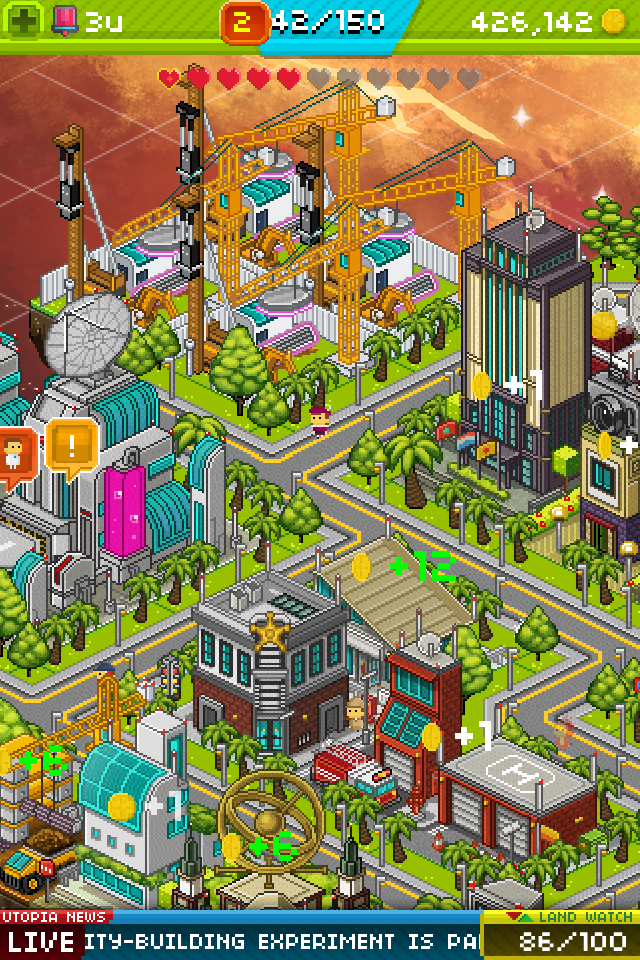
IMG_2147This new title published by Chillingo has more than a little bit in common with Nimblebit's games. It's populated by oddly-endearing pixelated people, there is no real hard "goal" as such and the majority of your time is spent making sure your income stream is as efficient as possible. You don't have any expenses to worry about — it's just a matter of how quickly you can make your pixelated town earn the spondulicks required to level up and expand your territory.

The basic gameplay in Pixel People revolves around genetic splicing. You're building a Utopian colony of clones, you see, and in order for it to run smoothly you need clones in appropriate roles. When clones are delivered to your colony — which will happen regularly so long as you have houses available for them — you are able to pick two "jobs" that you already know and splice them together to hopefully make a new one. The interface gives you feedback as to whether or not the combination you're trying will make a new job, so you won't waste clones or time, and there are various ways to unlock hints (including, yes, paying up) as you progress through the game.

The thing I like about Pixel People is that as you play through, you're constantly discovering new neat little things. You're never doing much more than picking random combinations of jobs and tapping on buildings to keep them producing money, but every so often you'll discover that tapping on a certain building performs a special function. Tap on the police station, for example, and you'll find your achievements list — the game doesn't even log in to Game Center until you've discovered this for yourself — and be able to claim rewards for challenges you've already completed. Tap on the observatory, and you can change the background of your colony — and also score yourself an achievement. While none of these things vastly affect the way you play the game and certainly don't give it any "strategy," they're a nice touch that keeps you wanting to play without resorting to the usual Skinner Box tricks of using experience points and showers of gold.

By far the best thing about Pixel Peoplethough, is that it just looks like one of those awesome gigantic pixel art town pictures. Despite the fact that the placement of your buildings and roads doesn't matter in the slightest — and you can move anything around at will, anyway — I've found it oddly compelling to just want to arrange my buildings into an aesthetically-pleasing, vaguely "realistic" arrangement rather than just clustering them all together haphazardly like I did when I first started playing. So now my cloning centre has a road running from it with shops and other facilities down it, running around a corner (on which the L-shaped university building sits), past a large park and into a residential district. Beyond the residential area is some natural forest land, which is where the sheriff and his deputy live, next to the Utopium mine.

I'm overthinking it. It's not that good, really, but if you liked Tiny Tower you'll probably enjoy Pixel People — and, like Nimblebit's titles, you never feel like you need to pay up to make satisfying amounts of progress.

Book of Heroes

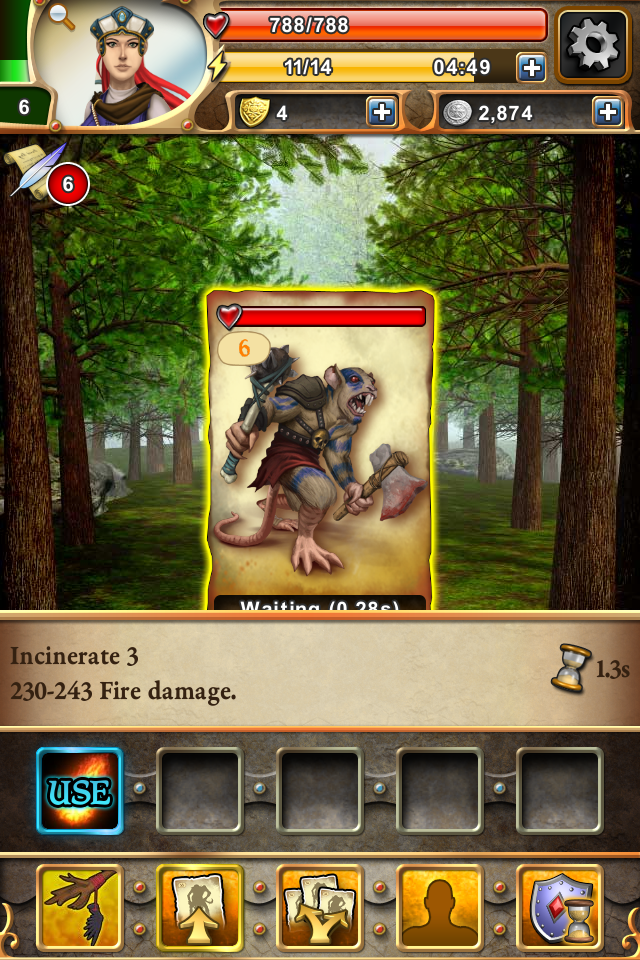
IMG_2148I remember trying this for the first time a good few months back, and I remember quite liking it then. Book of Heroes is a role-playing game specifically designed to be played in short, bite-sized instalments on your phone. It's largely text-based, its interface is designed for touchscreens, and it's not trying to be World of Warcraft or anything.

Since I last tried it, what I believe used to be a single-player experience has gone full-on MMORPG on your ass. Now you can compare your characters with your friends, chat in real time with other people, join guilds and go on "raids" together in an attempt to prove your own supremacy.

Mobile MMORPGs of this type are often utter garbage, usually falling into the "card battle" category and being completely free of any sort of gameplay or strategy whatsoever. Where Book of Heroes differs is in the fact that it actually demands some interaction from its players; rather than following a linear line of quests, you gradually open up a large number of areas in the game world to "explore" (well, fight a string of battles in) and complete various objectives before returning to town to spend all that hard-earned loot.

Combat is the main area where Book of Heroes differs from its rivals. Rather than taking all control away from the player, as happens frustratingly frequently with this sort of game, Book of Heroes allows the player to control their character's actions in a quasi-turn based format. Each action takes a set amount of real time to perform — we're talking seconds here, not "pay up to do this quicker" — and while an action is "charging" the enemies are doing the same thing. It becomes a matter of weighing up whether or not it's worth using the slow-charging super-powerful attack or whether you should try and get some quick hits in before the enemies have a chance to attack. It's a fairly simplistic system, but it works well in the context of a mobile game.

____

The thing with both of these titles is that they understand how mobile players treat games — as a diversion to dip into for a few minutes at a time, not a massively compelling experience intended to keep them hunched over staring at their tiny screen for hours. They're both eminently suitable for toilet play, and they're both simple to pick up but provide plenty of long-term… I hesitate to say "challenge" because neither of them are difficult in the slightest… umm… content, I guess, for players to check out over time. So, in short, they're at least worth a look.

Grab Pixel People here and Book of Heroes here.

1110: The Collector

Page_1Reading this post from Matt Mason earlier made me think somewhat about my own game buying and playing habits and how they have evolved over time. I've come to the conclusion that I'm becoming something of a "collector", particularly when it comes to more obscure games that almost inevitably become hard to find if you don't snag them immediately upon release.

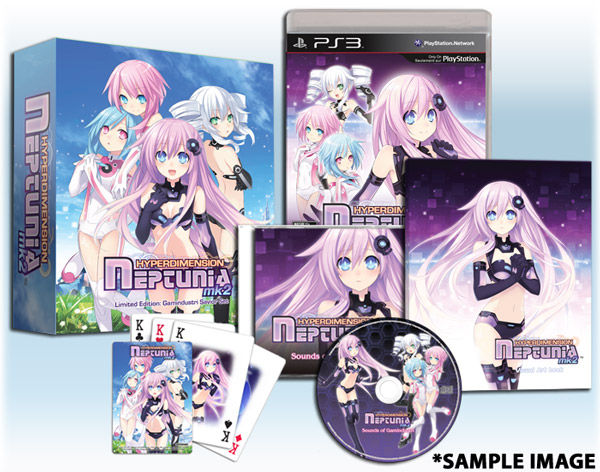
This doesn't mean that I pay over the odds to get "Collector's Editions" of games, though, because I tend to think that for the most part those are a waste of time — or perhaps it's just that I've never really had a Collector's Edition for a game that I felt particularly passionately about. Had I known how much I was going to love Hyperdimension Neptunia mk2, for example, I might have seriously considered spending a bit more and picking up the swanky limited edition that came with a soundtrack CD, an art book and some playing cards. (Yeah, I know the cards are a bit lame, but I love soundtrack CDs.)

NepnepLE-More often than not, though, the super-expensive limited edition versions are for games I have no interest in, like Call of Duty, Assassin's Creed and Skyrim. For sure, these limited editions are often cool, but there's only so many gigantic statuettes that you can scatter around your house before people start asking questions. (Particularly if one of those statuettes is a gory female torso… but let's not open that can of worms again.)

I'm actually fine with this, though, because I've been tending to find that the games I'm most interested in playing are the ones that maintain their value the best — simply because they're often not put out in particularly large quantities and thus often become quite hard to find after a little while. As such, I've come to accept that taking a chance on a new game like this often involves an outlay of at least £20 and may, in a few isolated cases, require payment of a price considerably inflated from what it would have cost when the game was first released. (I ordered a copy of Fire Emblem for Gamecube recently, for example… I'm pretty sure that's not what it cost when it first came out.) The fact that I've had to hunt for these games and occasionally pay a bit more for them than something of an equivalent age that had a wider release makes them feel somehow more "valuable", and makes me feel like my growing collection is something that I can be proud of. I know they're "just" games, but they represent a hobby that I truly love and which inspires me to do other things.

What this "collector's" attitude has meant in practical terms is that I'm now much more inclined to pick up interesting-sounding titles as soon as I become aware of them, rather than when I know I have time for them. This inevitably leads to an ever-growing backlog, of course, but it also means that I have things to look forward to. It's also an approach which works for my personal circumstances at present. In other words, I don't spend a lot of money on other "vices" — I don't drink, I don't smoke, I don't buy DVDs (with the exception of anime that can't be found for streaming online), I don't tend to travel a lot and, by the end of this month, I won't have any car expenses either (apart from any contributions I make to help Andie out with hers). This means that I tend to have a fair bit of disposable income that I don't feel guilty about splurging on my collection, and still have plenty left over for living expenses and to do nice things for Andie.

I like having physical things that I collect. My bulging Steam library also counts as part of my collection, but somehow that big list of games inevitably acquired for a couple of quid during a holiday sale isn't quite as satisfying as seeing that big shelf full of cases. Downloadable games feel more "disposable" somehow, like they won't last; I often find myself worrying what will happen to all these games when, say, Steam or PSN or Xbox Live don't exist any more. How will future generations be able to play awesome stuff like Flower, or Journey, or any of the other titles which everyone raves about now but which are only available via download? (I got around this issue with some of the visual novels I own by burning a copy to disc and printing my own inlay for the DVD case. Sad? Perhaps. But it means I can add them to my shelf with some degree of pride.)

The unfortunate side-effect of collecting physical things, of course, is that you have to find space for all of them, and if you get into full-on "hoarding" mode, where you don't want to trade anything in, ever, then you need more and more space as time goes on. I've currently still got a few shelves free on the other bookcase, but it's starting to get a little bit tight… and then what? Creative packing time.

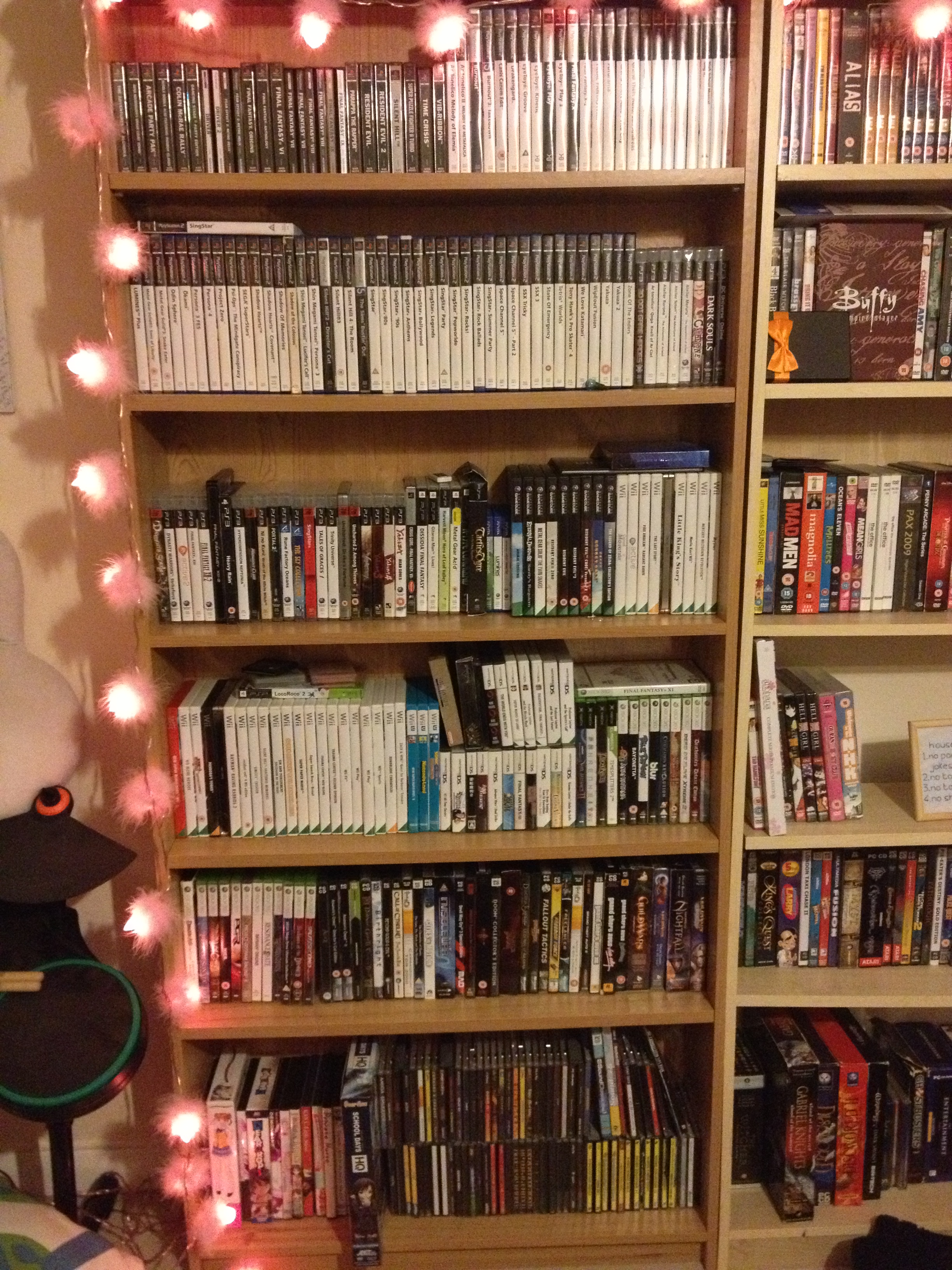
photo (3)If you're curious, here's my game shelf as it stands right now. (The fairy lights were Andie's idea, but they are pretty sweet.) If you click to embiggen and zoom in on the image, you might even be able to see individual titles of at least some of the games. I haven't played all of these, not by a long shot, but they each — even the array of PS2 SingStar titles — represent something with genuine meaning to me. And that's pretty neat to think about.


1109: Killachine

Page_1Another day, another article declaring the console will be "dead" before we know it. Lots of people — mostly analysts and business-savvy people who work in the mobile and social sectors — have been saying things like this recently, so it must be true, right?

Nah. 'Tis bollocks, as usual. While it's impossible to deny the huge impact that mobile devices have had on bringing the concept of playing games to the masses — the actually-not-all-that-good Temple Run 2 recently surpassed a whopping 50 million downloads — to say that they are going to "kill" consoles and/or dedicated gaming handhelds is, frankly, ridiculous.

Why? Because they cater to completely different markets and tastes. Mobile and social games are, for the most part, designed for players to while away a few minutes while something else is going on — perhaps a lengthy dump, a wait for a bus or a particularly boring meeting with a conveniently-placed table to hide what you're up to — while computer and console games are, for the most part, designed for players to sit down in front of for a more protracted period of time and immerse themselves in the experience. There are exceptions in both cases, of course — hence the "for the most part" disclaimers — but, on the whole, that's where we stand. And there's nothing wrong with either aspect of gaming — they both exist, and they will both more than likely continue to exist.

The word "games" isn't all that useful any more, in fact, because the medium it describes is now too diverse to be covered by a single word. I can say "I like playing games" and that will mean something completely different to what someone else means when they say it. When I say it, I mean that I like relaxing on my couch with a controller in my hand, staring at the TV and immersing myself in a game with depth, an interesting story, or both. When someone else says it, they might mean that they have three-starred all the levels on Angry Birds, or that they fire up FarmVille during quiet periods in the office, or that they have fifteen Words With Friends games on the go at any one time. These are obviously completely different experiences, though there can be a degree of crossover between the two extremes — there's nothing to stop someone who, say, is big into competitive League of Legends play also enjoying playing Scramble With Friends against their less gaming-savvy friends and family.

Where we start to get problems is when developers and/or publishers from one group start to try and step across the invisible line into the other group. More often than not, this is seen in the form of mobile and social developers promising a mobile or social experience that will appeal to "core gamers" — in other words, the group that, like me, enjoys immersing themselves in an experience for hours at a time rather than as a throwaway diversion. It is, sadly, abundantly clear that a huge number of developers who try and take this route have absolutely no clue whatsoever how to design a game that will appeal to these players. The article I linked above is from the CEO of a company called Kabam, who specialise in developing a variety of almost-identical "strategy" (and I use the term loosely) games that supposedly appeal to "core" players. All of their games are the same (literally — I tested three side-by-side as an experiment once, and the quests the player was expected to follow were completely identical, right down to the wording) albeit with a slightly different visual aesthetic, and all of them are as dull as ditchwater.

The bewildering thing is that someone, somewhere, is playing these games — and, more to the point, spending money on them — enough to let them be considered a "success". So more and more of them start appearing, each inevitably following the exact same template, making all the same mistakes and pissing off the same people while somehow convincing the same others that reaching for their credit card is a really, really good idea.

Note that I'm not saying here that mobile, social and/or free-to-play games are inherently bad in and of themselves; it's that in many of these cases — particularly those that are supposed to be designed to appeal to "core" gamers — they are designed by people with an astonishingly strong sense of business savvy, and a complete lack of understanding in what makes a game actually fun or interesting to play. In other words, the fact that something is financially successful should not be the only criteria for it being considered "good" — you just have to look at Mobage/Cygames' shockingly awful Rage of Bahamutone of the top-grossing mobile games in the world, to see how this is the case.

No, the problem that we have is that everything new always has to "kill" something else. This flawed logic has been seen with numerous other technologies in the past; laptops would kill desktops, tablets would kill laptops, TV and video would kill the cinema… the list goes on. In very few cases is it actually true. Okay, DVD killed VHS, but that was a simple case of a superior format doing the same thing rather than two vaguely related — but not identical — things battling it out for supremacy. People still use desktops as well as laptops because big screens are nice and more practical in many circumstances. People still use laptops as well as tablets because typing on a touchscreen is still a horrid experience. People still go to the cinema as well as watching TV or DVD/videos because it's nice to see something on a huge screen with room-shaking sound.

Why does everything have to be reduced to binaries? Why does something new always have to "kill" something else, even if it clearly isn't performing the same function? Can't these people just accept that certain parts of the populace are happy with one thing, and others are happy with another?

Ahh, if only.