"Are you going to paint them?" Andie asked, looking at the wealth of miniatures in the big-box HeroQuest set that arrived today.
"Probably not," I said. "I don't know how."
This probably isn't quite accurate — as Andie pointed out, the how of painting something is pretty bloody obvious. But what I meant by that was I have no idea how to do it in such a way that it doesn't look absolute shite.
Now, granted, I am basing this on my previous attempts to do this, some 30+ years ago, when I had a Citadel Miniatures starter paint set and a single brush that was, frankly, woefully inaccurate for the job at hand. The results were, as you might expect, Not Very Good — not least because I only ever really got as far as doing base colours, and never got into doing highlights and shadows. I always got hung up on the how of those bits — how do you know which bits need highlights and shadows? (Obviously, you shine a light on it, and put shadows in the bits that have shadows in them, and lighter bits on the bits that have light on them — I realise that now.)
With this in mind, I've been pondering whether I should try again. And I was surprised and pleased to discover that miniature painting technology has, unsurprisingly, moved on quite considerably in the intervening 30+ years since I last attempted it.
I'm especially interested in some curious little gizmos called Speedpaint Markers by a company called The Army Painter. This is, in turn, a spinoff of a type of paint this company creates called Speedpaint, which purports to do all the highlighting and shadowing for you to a certain extent. It does this through a particularly blended paint, whose properties mean that when it gets into cavities it takes on a darker tone, while on flatter, more raised areas it has a lighter tone, and on everything in between it has a… well, kind of "normal" tone, whatever that means for the specific colour you're using. It's a different sort of idea to acrylic-based paint, which is what I had previously experimented with, and looks like being a very beginner-friendly approach to painting minis.
The Markers take things a step further. Rather than requiring a specialist brush, palette and other equipment, they're a little brush-pen hybrid that delivers the paint right onto the miniature without any other equipment required. Obviously you still need to prime them beforehand, but that's simple enough that even I can do it.
I'm tempted to give them a try. It's a bit of money to get a decent starter set of colours (and, annoyingly, the one thing the "starter set" of markers lacks is a regular flesh tone) but if it really is as easy as it looks to use these things, I might finally be able to enjoy something that has, to date, eluded me.
I dunno. I'll think about it. But it would be cool to have painted minis for HeroQuest.
Want to read my thoughts on various video games, visual novels and other popular culture things? Stop by MoeGamer.net, my site for all things fun where I am generally a lot more cheerful. And if you fancy watching some vids on classic games, drop by my YouTube channel.
If you want this nonsense in your inbox every day, please feel free to subscribe via email. Your email address won't be used for anything else.
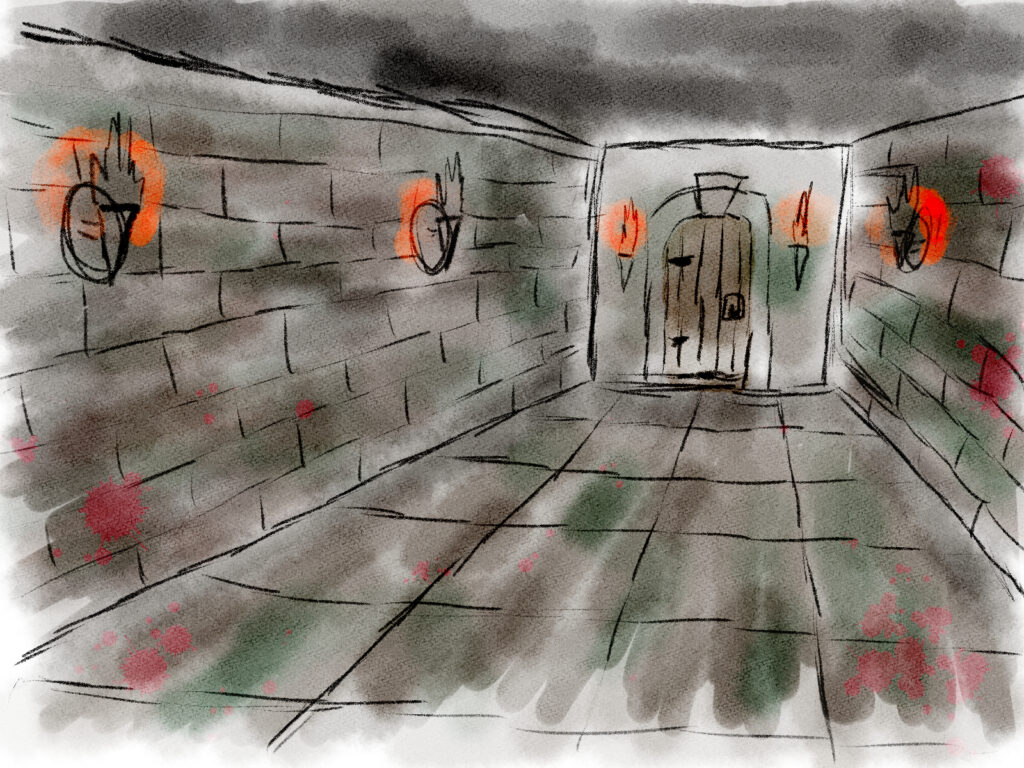
(Experimenting with some different techniques today. The above isn't what I'd call a "finished" image but I feel like I can probably build that into something.)
We were originally supposed to be having some friends over to play HeroQuest today, but the collective illness of me, Andie and at least one of the friends in question over the course of the last week caused us to postpone to next weekend. So I can't really offer a recap of what occurred in our first session, but I can take a moment to ponder exactly why I'm looking forward to jumping into this.
HeroQuest was an important part of my childhood. I was introduced to it through my brother's girlfriend at the time, who was big into heavy metal, fantasy role-playing and suchlike. Her Dad was into miniature wargaming, also, so I wonder how much that was an influence on her — though, of course, Warhammer and its ilk was always a lot cooler than the sort of "historical re-enactment" miniatures her father collected. Perhaps it was a case of "oh, I kind of like those, but I don't want my Dad to think he's cool, so I'll get into something tangentially related".
Anyway, fact is, I was introduced to HeroQuest by my brother's girlfriend, who did an admirable job of putting up with her boyfriend's annoying younger brother by letting me look at her stuff. I don't think I ever actually played HeroQuest with her, but I was so enamoured with it that I asked my parents to get me a copy of Advanced Heroquest one birthday or Christmas, and I got it. Still have it, in fact.
To my frustration over the years, I've actually had relatively few opportunities to play either the original HeroQuest or Advanced Heroquest with real people. Fortunately, Advanced Heroquest includes some very robust solo play rules, so it wasn't a complete waste, and I did manage to play it a few times with people over the years. But the original HeroQuest was always something I really wanted to play with other people over the long term — ideally with me in the role of the games master, taking the players through a full campaign of adventures.
HeroQuest, for the unfamiliar, is a fairly straightforward dungeon-crawling board game. The original MB Games version from the late '80s was developed in conjunction with Games Workshop's Citadel Miniatures brand, and thus was regarded as part of the Warhammer universe; Advanced Heroquest made this much more explicit. A few years back, however, Hasbro and its Avalon Hill brand, now rights holders for the HeroQuest license, decided to resurrect the game with a crowdfunding campaign.
The new HeroQuest has had a few changes since its late '80s release. The new version is now universal worldwide, being based on the previous incarnation's North American rules, rather than having European and North American variants. This means a few things. Firstly, the games master player is now called Zargon instead of Morcar, which to my mind is an infinitely worse name, but it seems "Morcar" is being reintroduced to New HeroQuest with an upcoming expansion, so I'm not too mad about it. Secondly, the game is a tad more difficult — in the European original, all monsters had just one Body Point, so you just had to hit them in order to kill them, even in the case of "bosses". Thirdly, there are some differences and variations in how the quests are composed.
I initially bought the First Light standalone "starter" set for HeroQuest but, having seen a good price on the full-size core set, I've splurged on that too. (Christmas money!) It's actually worth having both, though, because First Light has a completely different campaign of quests to take on as well as a double-sided board with a new map layout that isn't in the original. The downside of First Light is that as a lower-cost starter set, it only has five miniatures: the four Heroes and a dragon boss that recurs throughout the First Light campaign; the remainder of the Stuff is implemented either as flat cardboard tiles, or cardboard standees. Conversely, the full core set has miniatures for all the main monster types in both the First Light and original core quests, plus plastic 3D furniture to put in the rooms.
I'm really looking forward to getting into playing this, because as much as I have had fun with some subsequently release dungeon crawler games such as Descent: Journeys in the Dark, The Legend of Drizzt, Gloomhaven and another one I've completely forgotten the name of, a lot of those feel like they get a bit bogged down in being tactical wargames rather than exploration-focused dungeon crawlers — and it's the exploration and storytelling that has always attracted me to HeroQuest and its surrounding works.
Hopefully at this point next week I'll be able to provide a report on how our first session went. I'm looking forward to it a lot, and hope it will be able to become a semi-regular activity. We shall see!
Want to read my thoughts on various video games, visual novels and other popular culture things? Stop by MoeGamer.net, my site for all things fun where I am generally a lot more cheerful. And if you fancy watching some vids on classic games, drop by my YouTube channel.
If you want this nonsense in your inbox every day, please feel free to subscribe via email. Your email address won't be used for anything else.
No drawing today as I've been doing other creative things, as I shall talk about in a moment.
I have not felt at all like making any videos for a while, which is a little bit frustrating to me, because the first two episodes of my Space Rogue playthrough actually did surprisingly decent (for my channel) numbers, and I reckon there's just one or two episodes more of The Granstream Saga to do before that's all finished. I just haven't quite been able to summon up the energy to continue those recently, not helped by a week of feeling ill that I'm just getting over.
However, with a soft embargo date approaching for Super Woden Rally Edge, a game I wanted to cover — the video I made on this game's previous installment is the best-performing video on my channel by a long shot — I felt a bit more inspired to actually do something today. So I recorded a bunch of voiceovers: both for this, and for some other things that I've previously written articles for, but wanted to turn them into videos. All in all, I've recorded voiceovers for Super Woden Rally Edge, Old Skies, Return to Castle Wolfenstein, Wolfenstein 2009 and Wolfenstein: The Old Blood, which should result in a nice spread of 15-20 minute videos for each. I've even edited the Super Woden Rally Edge and Old Skies ones already, but I'm going to leave the Wolfenstein ones to another time — maybe tomorrow, maybe later in the week, depending on how I'm feeling.
I continue to go back and forth on what is "best" to do for my YouTube channel. Up until now, I've built it on Let's Play-style playthroughs of games, and I think a lot of my viewers like that sort of thing, particularly as I make an effort to explain how to play the game, why it's interesting, why it's still relevant (if it's an old game, which it usually is) and what I, personally, think of it. These are fairly easy to record and edit, but they are time- and energy-consuming to produce, since they do involve me sitting and playing a game, often for quite a long time, and attempting to find meaningful things to say for the duration.
At the same time, the pre-scripted videos tend to overall do better, particularly over the long term. I think I'm probably more "proud" of those overall, too, since they involve more in the way of editing, and delivering a voiceover is a different skill overall to off-the-cuff, unprepared commentary while playing "live". However, they take a lot more time to both prepare and edit, since there is often a lot of miscellaneous footage required to capture along with the footage of the main thing I'm covering, and the editing process involves a lot more in creatively finding ways to visually represent the things I'm talking about.
Part of me wants to commit to one or the other of these approaches, because I feel it would probably be a good idea to. At the same time, I think there's value in both approaches; you can show things in "live gameplay" that you can't show in a "video essay"-style production, and vice versa.
I do, however, think that kicking off long playthroughs again might have been a mistake. The videos for The Granstream Saga have performed more poorly than anything I've done for a long time, although, as I say, the first couple of episodes of Space Rogue did surprisingly well. So I'm inching towards abandoning those, though I feel like at this point I probably should finish The Granstream Saga at the very least.
Anyway, that's something to think about another day. I have enough on my plate with these new videos for now, so watch for them coming soon to my channel!
Want to read my thoughts on various video games, visual novels and other popular culture things? Stop by MoeGamer.net, my site for all things fun where I am generally a lot more cheerful. And if you fancy watching some vids on classic games, drop by my YouTube channel.
If you want this nonsense in your inbox every day, please feel free to subscribe via email. Your email address won't be used for anything else.
There was a good post that went around earlier by the VTuber, journalist and activist Ana Valens, reflecting on her time as part of the games media landscape, and how she was part of the sector's slow decline into almost total irrelevance as SEO-baiting and click-chasing became the norm. I strongly encourage you to give it a read — you can do so by clicking here. Go on, I'll be here when you get back.
One of Ana's points in her piece was that as games media slowly circled the drain, particularly as groups such as Valnet and GAMURS started hoovering up once-respectable brands and then systematically destroying them one by one, a new type of "media" stepped in to take its place. This, of course, is the oft-trumpeted advent of YouTubers and streamers, whom many claim to find more "trustworthy" than the traditional games media in many cases — despite the obnoxious rise of the term "influencer", and the clearly documented use of "influencer marketing" being far more egregious than any sort of "paid reviews" that, in my experience, never actually took place when the traditional games press was at its peak.
But I'm not here to rant about the rise of YouTubers and streamers. They have their place — hell, I do a lot of stuff on YouTube and I've dabbled with streaming — but for me, they've never been an adequate replacement for having a publication that was "yours". Back in the '80s and '90s, this would be your magazine of choice: the one you would dutifully buy a copy of every month, or subscribe to if you could convince your parents to do so. As the new millennium rolled around and this World Wide Web thing became the norm — particularly as high-speed always-on broadband Internet established itself as the rule rather than the exception — print gave way to online, and we had some wonderful websites like 1up.com that were as much community as they were professional publication.
Sites like that still exist to a certain degree — I believe IGN and Gamespot still have a certain amount of social features, and the relaunched Giant Bomb is more community-focused than ever — but no site has ever managed to quite recapture that wonderful time: an age of personalities, of brave new frontiers in writing about video games, of figuring out exactly what the "games media" really was.
YouTubers and streamers don't quite replace that for me. Sure, it's nice to find someone who aligns with your values and tastes — and sometimes challenges them — but it's not quite the same as finding an entire publication, put together by a team of people, that resonates with you for one reason or another. There are YouTubers I watch fairly regularly, but I don't think of them at all in the same way as I do 1up.com in the early aughts, or favourite magazines like ACE, N64 Magazine and Electronic Gaming Monthly from the late '90s.
Part of that is their individuality, but it's also a completely different medium with its own appeal elements — and there's not necessarily the crossover you might expect. I will gladly read a lengthy magazine article about something I am interested in, but present me with someone who has made a multi-hour YouTube video on the subject and I will immediately switch off. People keep recommending Noah Caldwell-Gervais to me, for example, and I'm sure his work is very good, but his video on the Resident Evil series is seven and a half hours long. I am not watching that when I could be spending those seven hours doing literally anything else — including beating multiple Resident Evil games in that timeframe.
I'm the same with streaming. I'm sure there are some streamers I'd enjoy watching, but I just can't be arsed to spend my time doing so. I'm not someone who can easily split my attention between a stream and Something Else, and I genuinely think it's disrespectful to the creators to engage with a creative work like a game while watching a video or listening to a podcast. (I also think the opposite, to be clear; if I'm watching a video or listening to a podcast, the absolute most I will be doing at the same time is a tedious, repetitive task at work, or driving somewhere.) And, given the choice between spending several hours watching someone else stream a game and sitting down to play a game myself, I'm always going to choose playing something myself.
Conversely, give me someone who writes well, is passionate about what they do and who tries to find the fun rather than get bogged down in negativity — all traits I try to follow in my own games writing — and I will follow that person's blog to the ends of the Earth. In fact, this year I'm going to make a specific effort to follow more individual blogs and independent gaming sites, because, for me, those are the nearest alternative to what I was describing earlier: a publication that speaks to you, and which you feel comfortable checking in on regularly.
But how is an individual writer different from a YouTube video essayist or streamer? I guess in some ways they aren't. But for me it's all down to how that person delivers their message. I see a seven and a half hour YouTube video and feel like that's not something I'm ever going to spend time watching, but I see a light novel-length article and will happily read it from start to finish. It's just inherently more digestible to me — I'm not in this to "consume content"; I actually want to read interesting things! And, honestly, fair or not, the first thing I think of when I see a YouTube video of a length that absurd is "content". I see a website with a bunch of interesting-looking headlines and I think "fantastic, something to read".
I don't know how much sense I'm making here, so I'll stop talking in circles. I guess the main point I want anyone who happens to stumble across this to take away from the whole situation is that we should continue to reject the click-hungry corporate interests of publications under demonstrably awful labels like Valnet and GAMURS, and instead focus our time and attention on individual, independent creators that we enjoy the work of, and that we feel represent our tastes and interests well.
I aspire to be that for at least some people, and I know MoeGamer in particular has at least semi-regular readers. So I encourage you: if you find something that particularly resonates with you, be sure to tell the people behind it that you enjoyed it — and share it with your friends who you think might also enjoy it! Word of mouth is still an incredibly powerful thing on our increasingly broken Internet, and as the world continues to collapse all around us, it's going to be these little communities we can build away from corporate interests that will remain important lifelines for many.
Want to read my thoughts on various video games, visual novels and other popular culture things? Stop by MoeGamer.net, my site for all things fun where I am generally a lot more cheerful. And if you fancy watching some vids on classic games, drop by my YouTube channel.
If you want this nonsense in your inbox every day, please feel free to subscribe via email. Your email address won't be used for anything else.
As you may or may not know, I work for Blaze Entertainment on the Evercade retro gaming console. I write the manuals for the cartridges, and I also put out a variety of digital Stuff to support our releases, much of which ends up on the Evercade blog and YouTube channel. So today, the last day of 2025, I'm going to share the stuff I've written for the Evercade blog. 'Cause I bet you haven't read it, have you? Hmmmmm?
The "What's on the Cart?" posts are intended as a preview of upcoming cartridges, but they also provide a nice summary of everything that's on a particular cartridge. We kicked off 2025 with Indie Heroes Collection 4, which included 11 games, many of which were released through our "Game of the Month" programme in 2024. That's where for a hefty chunk of the year, Evercade devices play host to a game that any owners can play for free, even if they don't own the cartridge it's usually on. We've used this system to showcase both new indie titles (which end up on the Indie Heroes cartridges) and games from the system's back catalogue.
Indie Heroes Collection 4 is a fun compilation. Some of the individual games had a bit of a "meh" response from the community when they came up as Game of the Month, but the cartridge as a whole has proven to be quite well-regarded thanks to a few particular standout titles — notably the arcade-style Dig Dug/Bomberman fusion that is Murtop, the point-and-click adventure Batty Zabella and the excellent platformer Flea!2.
To go along with the "What's on the Cart?" previews, we also kicked off a similar retrospective series looking at cartridges from the back catalogue that are still available. One of the most popular from the Evercade launch lineup is Data East Collection 1, which includes some absolute bangers like Burnin' Rubber, Magical Drop 2, Side Pocket and Midnight Resistance. This is one of my personal favourite cartridges from the library, so I was more than happy to give it a bit of love.
Although Evercade is a plug-and-play system, we add new features to it through firmware updates throughout the year — typically after fan requests for such features, but also just because we think they'll be cool. In March of this year, we introduced DIP switch support for arcade games, which allows you to customise the difficulty of games on the purple arcade cartridges. This was, as you might expect, rather well-received!
This year, we switched the indie-centric Game of the Month for Highlight of the Month, a showcase of games from our back catalogue of cartridges that are still available. The opening salvo was Data East's excellent Midnight Resistance, a top-tier 16-bit run-and-gun title with a killer soundtrack.
We teased NEOGEO coming to Evercade at the end of last year, and this year we released our first three NEOGEO Arcade cartridges. The first of these, imaginatively titled NEOGEO Arcade 1, features Metal Slug, The King of Fighters 2000, Sengoku and more, and it proved to be immensely popular! Given that original format NEOGEO cartridges have always commanded a hefty sum ever since they were new, this cart is solid value for some truly excellent games.
A bunch of classic games have hidden features, known as Easter eggs, because you're supposed to hunt for them, see? In this piece, we explore some of the best examples available on Evercade, including hidden games, sneaky programmer credits and more. Plus the Evercade system itself has a bunch of hidden Easter eggs, too!
With Atari's acquisition of the properties that originally belonged to Stern Electronics, they suddenly had a bunch more games available to license, including all-time classics like Berzerk, interesting rarities like Rescue and Maze Invaders, and the excellent Tazz-Mania, a game I'd never heard of before, but which is now one of my favourite arcade blasters. This post takes a quick look at the 10 games on this fun cartridge that will particularly appeal to those who appreciate early '80s arcade games.
The next Highlight of the Month was Old Towers, an excellent "modern retro" indie game with a simple premise and execution, but a series of increasingly challenging puzzles for you to contend with. This game is a fine showcase of the sort of stuff publisher Mega Cat Studios puts out, and, while relatively short, puts up a stiff challenge while it lasts.
We broke from our usual naming convention for this one because we figured that no-one would know who "PAON" were. These games were originally published by Data East, but we couldn't call it Data East Arcade 3 because the rights for the Data East name and mark are with a different company to that which holds these five games. Isn't licensing fun? Anyway, this cartridge sneakily marked our first NEOGEO game, releasing a little while before the first NEOGEO Arcade cartridge came out, and features some fan favourites. Although Windjammers and Karnov are the best-known games on this cart, don't sleep on the relatively little known Vapor Trail and Rohga: Armor Force, as both are spectacular shoot 'em ups.
This year marked the fifth anniversary of Evercade, a console which successfully released in the middle of the COVID-19 pandemic and which has continued to thrive in its niche ever since. For the occasion, we put out a hefty firmware update including a variety of cool features, including a brand new hidden game!
Highlight of the Month continued with this exciting gallery shooter from Gaelco, in which two skateboarding kids blast into space to do battle with alligator-like aliens.
One of my favourite releases of the year was Roguecraft DX, an enhanced and expanded version of a new Amiga game that first came out last year. We worked closely with the guys at Badger Punch Games to make the Evercade version the definitive way to enjoy this game, and we absolutely succeeded.
We helped Team17 celebrate Worms Armageddon's anniversary with a showcase of the Mega Drive version of the original Worms. This version is a good, simple way in to a classic series that gets more complex with later installments.
We released the third of our Evercade Alpha bartop arcade units this year, this time themed around TAITO games. In this piece, I took a look at the included games that are built-in to the machine.
As part of Toaplan's 40th anniversary celebrations, I put out a few Evercade Game Spotlight pieces on some favourite games from this developer's back catalogue. Alcon is a personal favourite, featuring deliberate pacing and a player-controlled power-up system.
Toaplan's anniversary celebrations continue with a look at their second run-and-gun title, FixEight, the follow-up to Out Zone. This is one of Toaplan's most accessible games, and well worth a playthrough for its sheer ridiculousness.
Following on from the anniversary celebrations, the next Highlight of the Month was Toaplan's classic vertically scrolling shoot 'em up, Truxton. This is a hard game, but an immensely rewarding one once you get to grips with it. You'll need practice and memorisation, though!
In our most packed cartridge to date, we brought you 27 Llamasoft classics in The Llamasoft Collection, including the first VIC-20 and Atari ST games on Evercade! Having grown up with Jeff Minter games, I love this cartridge, although it's a shame we weren't able to squeeze the Atari 8-bit version of Attack of the Mutant Camels in there.
Irem Arcade 1 is a fan favourite that unfortunately our license is expiring for next year, so we thought it would be a good time to celebrate the wonderful games in this collection, including classics like R-Type and Moon Patrol, plus lesser-known hits like In the Hunt and Lightning Swords.
A relatively small update for October 2025, but including a couple of highly requested features: the ability to reset saved high scores for arcade games, and a "suspend save" feature for Roguecraft DX, allowing you to leave a game half-finished and pick it up again later.
I'm generally quite down on sites using "guide content" as SEO bait, but I must admit I do enjoy writing a good guide. So in time for Halloween, I thought I'd give people a helping hand with the excellent Batty Zabella from Indie Heroes Collection 4.
Sunsoft's hard-as-nails platformer was the next Highlight of the Month, giving everyone the opportunity to enjoy the excellent music on the first level, at the very least. I managed to get a bit further in order to take some screenshots!
For me, Activision Collection 1 is one of our most exciting releases, as these games haven't had a standalone rerelease since the PlayStation 2 era. I also love these games — particularly River Raid, MegaMania and Crackpots, plus I've discovered an appreciation for Demon Attack now, too.
A surprise announcement for many was our partnership with Rare, bringing together a selection of the company's finest home computer, console and arcade titles. Yes, you can finally play Jetpac and Sabre Wulf on Evercade! Also Battletoads, R.C. Pro-Am and the Conker game from before he went all naughty.
The final Highlight of the Month for the year was Jaleco's The Astyanax, a platform action game in which you wield a powerful fire axe as you attempt to defeat an evil wizard. Capturing footage and screenshots for this game gave me a new appreciation for it, since it's one I hadn't spent a lot of time with up until now.
I'm always keen to help people understand more complex, tricky retro games — particularly those which I've only just learned how to play properly myself. In this article about Atic Atac by Rare's predecessor, Ultimate Play the Game, I outline exactly what it is you're supposed to do and even provide some maps!
Then I went and did the same for pioneering isometric adventure Knight Lore. I may suck at the game, but at least I know what you're supposed to do now.
And that's your lot for this year! I hope you've enjoyed these digests of my posts from the year gone by, and if I don't hear from you before the time comes, a very happy new year to you all.
Want to read my thoughts on various video games, visual novels and other popular culture things? Stop by MoeGamer.net, my site for all things fun where I am generally a lot more cheerful. And if you fancy watching some vids on classic games, drop by my YouTube channel.
If you want this nonsense in your inbox every day, please feel free to subscribe via email. Your email address won't be used for anything else.
In this piece, I explore a game that an independent developer sent me a copy of. Inspired heavily by both classic computer role-playing games such as the Ultima series and the works of H.P. Lovecraft, this is a lovely, atmospheric retro-style RPG that is easy to pick up and play, but tricky to master. The developer is currently working on a sequel.
Payment processors' control over the arts has to stop
A story broke this year that Visa and Mastercard are seemingly trying to prevent consenting adults from choosing what they spend their money on. Specifically, both companies have been making it very hard for anyone with the slightest connection to sexually explicit (or, in some cases, provocative) entertainment to make a living. It's crazy to think that I posted this back in July, and the situation is still ongoing, with seemingly no resolution in sight.
This is one of the best games I played this year, and the game that caused me to think that, once and for all, the point-and-click adventure sector is in an even better space today than it was back in its supposed LucasArts and Sierra-led "golden age" of the late '90s.
I adore the first two AI: The Somnium Files games, so I was excited that a third one was coming. I ended up not loving this one quite as much as the first two, but it's still pretty solid, and the new mechanical elements in the escape room sequences are a great addition to the overall formula. It just didn't come together quite as well as the prior two — perhaps because series creator Uchikoshi was a little more hands-off with this one.
Arzette: The Jewel of Faramore – more than just a mockery
I was immediately intrigued by Arzette: The Jewel of Faramore and the fact it was paying homage to two notoriously not-very-good games. I was even more surprised that it was actually a very good game in its own right. Poking gentle fun at its source material while correcting all their annoyances, this was a real pleasure to play through.
I've had a double-pack of this game and its spiritual successor Rise of the Third Power on my shelf for ages, so I decided while we were away on holiday, I was finally going to play them. And I had a really lovely time! Ara Fell adopts an interesting quasi-open world approach and is an immensely rewarding, engaging experience.
Rise of the Third Power, spiritual successor (but not "sequel") to Ara Fell, is one of the best story-centric RPGs I've played for a long time. Brilliant characterisation, stirring music — all the more remarkable considering it was drawn from royalty-free libraries rather than specifically composed — and a wonderfully engaging story make this a highly memorable game that I highly, highly recommend.
Master Detective Archives: Rain Code – what price justice?
Although it gets a little bogged down in itself over the course of its complete runtime, this murder mystery adventure from the Danganronpa creator was nonetheless a compelling, entertaining thrill ride, set in a thoroughly fascinating setting and, in true Danganronpa tradition, presenting some immensely stylish, abstracted takes on the "mechanics" of investigation and deduction.
Lumines Arise, the art of sincerity and creating meaning without explicit narrative
It's easy to assume that the only games with real "meaning" are those that tell an explicit story. But sit down with Lumines Arise, a new take on a classic puzzle game developed by the same folks who did the incredible Tetris Effect, and you will feel very differently. This is a game that is designed to make you feel things while you play. And it's enormously successful at doing that. A truly wonderful experience.
I started playing Tears of the Kingdom a little while back, and I am reminded of one of the things I liked so much about Breath of the Wild: the fact that the whole game is a series of little mini-adventures that you stumble across pretty much at random as you explore the world. This is a markedly distinct approach from the "hoover all the icons up off the minimap" structure that many other open-world games take, and it makes for a much more enjoyable game.
Notoriously banned from release on Steam, HORSES from Italian developer Santa Ragione is really not worth all the fuss there's been over it. It was an interesting experience, for sure, but you'll see more upsetting material on late-night TV.
Return to Castle Wolfenstein and my history with Nazi-blastin'
As I've noted a few times recently, I love Wolfenstein 3-D and its follow-up Spear of Destiny, but I've never played any of the Wolfenstein games that followed. I am now in the process of correcting this, so I wrote this after beating Return to Castle Wolfenstein: Tides of War on original Xbox. I had fun, though the game shows its age in a few places — in both good and bad ways.
And that's your lot for now. Tomorrow I will review my Evercade blog posts for the year… and then it will be 2026! Hurrah. Possibly. Here's hoping the new year is better than the old one… but I'm not holding out much hope at the moment. At least I have plenty of things to distract me, apparently!
Want to read my thoughts on various video games, visual novels and other popular culture things? Stop by MoeGamer.net, my site for all things fun where I am generally a lot more cheerful. And if you fancy watching some vids on classic games, drop by my YouTube channel.
If you want this nonsense in your inbox every day, please feel free to subscribe via email. Your email address won't be used for anything else.
I've written a lot of stuff this year! I write a lot of stuff every year, much of it absolute nonsense, but I thought with the end of the year coming up, I'd highlight some bits and pieces that you might have missed, and which I was rather pleased with for one reason or another. The following lists will not include anything from this specific blog — you can review the archives yourself, after all — but instead encompass pieces from both my gaming site, MoeGamer, and the official Evercade blog.
In rough chronological order, then, I present a chunk of my MoeGamer output for the year, with more to follow tomorrow. The following are presented as embedded article excerpts; simply click through on them to read the full thing.
The excerpt says most of it: I am bad at strategy games, but I've always been interested in Fire Emblem, so I decided to give myself a gentle introduction by playing Fire Emblem Engage on Normal difficulty with permadeath turned off. And I had a lovely time, chronicled in this MoeGamer piece.
Revisiting Xenoblade Chronicles
With Xenoblade Chronicles X: Definitive Edition releasing this year, I decided I wanted to refresh my memory on the very first game in the series, since the last time I played it was on Wii, and I was interested to try out the Switch-based Definitive Edition version. I wrote about my experiences and observations over the course of several pieces on MoeGamer, linked in the following extracts:
Hopefully self-explanatory. I am looking forward to the eventual full release of this game, as the Early Access version on Steam was delightful. I write a bit about that version in the above piece.
The Excavation of Hob's Barrow: Gothic horror and tragedy done right
I finally got around to playing the well-regarded point-and-click adventure The Excavation of Hob's Barrow this year, and I was very taken with it. I was particularly enamoured with how it is an interactive take on the Gothic literature tradition, and an exploration of Classical tragedy in the video games space.
Tokyo Dark: Remembrance and the bleaker side of Japanese life
Tokyo Dark: Remembrance is a really interesting adventure game developed by a team with a western background that has been living in Japan for some time. As such, it's unmistakably "anime" in style, but also provides the sort of perspective only an outsider to the culture can provide. The story is not only a compelling horror narrative, it's also a scathing takedown of the seedier aspects of Japanese culture and nightlife — but simultaneously respectful to the country's overall culture and sensibilities.
Inkle's EXPELLED! is an excellent text adventure with beautiful presentation and a spectacular amount of player agency. Casting you in the role of a 1920s schoolgirl, the game challenges you to get out of trouble for a crime you may or may not have actually committed, using a quasi-roguelite structure that enables you to discover more information with each playthrough. Fiercely feminist, intensely thoughtful and immensely amusing throughout, EXPELLED! is one of the best games I played this year, and deserves your respect.
One of the most fascinating horror games I've ever played, Homebody is a combat-free, puzzle-centric game that sensitively explores matters of social anxiety, agoraphobia, isolation, obsessive-compulsive tendencies and lingering guilt. I played this as a "filler" game between big releases of the year, but it came out as one of my favourite things I played this year.
Xenoblade Chronicles X: Definitive Edition
I'd been waiting for the return of this underappreciated, wonderful RPG for a very long time, and I was delighted by what the Switch Definitive Edition ended up being. Not only did it refine elements of the original that were a little tricky, it also added a new, more conclusive ending that, while divisive, worked well as a means of wrapping the whole thing up. I wrote several pieces about this game:
My pal Matt from Digitally Downloaded has been working on a visual novel for some time now, and has ploughed a lot of his own effort and money into making it as good as he wants it to be. I played through a demo version of the game's opening and penned some thoughts on the experience here. (You can wishlist the game on Steam here!)
I wrote this while I was still playing Blue Prince. I don't abandon many games once I've started them, but this ended up being one of them. I am now sure how I feel about Blue Prince: I do not like it at all, for most of the reasons outlined in this piece. (This does not mean I think Blue Prince is bad! I am glad so many people got so much out of it. I just did not enjoy it at all.)
Initial thoughts on Clair Obscur: Expedition 33 from a devoted "JRPG" player
Clair Obscur: Expedition 33 is probably my personal Game of the Year, with the caveat that they get a big ol' slap on the wrist for using generative AI at any point in their creative process. "It was just a placeholder!" Yeah, sure. Long before this little kerfuffle, though, I was skeptical about whether this game that had come out of nowhere was actually a big deal, given that turn-based RPGs have been nowhere near as dead as some people think for quite a long time now.
The Sword of Hope: Adventure and RPG, together again
Hamster kicked off its new Arcade Archives 2 range with a port of the arcade version of Ridge Racer, marking the series' first "new"(ish) release for quite some time.
My thoughts haven't changed a lot from here. 90% of the time, my Switch 2 is a slightly better Switch — but I have enjoyed the exclusives I've played on it this year, including Donkey Kong Bananza, Hyrule Warriors: Age of Imprisonment and Kirby Air Riders. It's perhaps telling that at the end of the system's first year on the market, I only have four physical games, though.
The Death end re;Quest Code Z limited edition is enormous
One of my favourite Zelda games got a remake a couple of years back, and it turns out the remake is just as delightful as the original. (Plus it runs great on Switch 2!)
Whew, that's more than I thought it was. Let's pick up where we left off tomorrow — that lot should keep you busy for a while, after all!
Want to read my thoughts on various video games, visual novels and other popular culture things? Stop by MoeGamer.net, my site for all things fun where I am generally a lot more cheerful. And if you fancy watching some vids on classic games, drop by my YouTube channel.
If you want this nonsense in your inbox every day, please feel free to subscribe via email. Your email address won't be used for anything else.
I have crossed something off my gaming To-Do list! Yes, I have beaten Return to Castle Wolfenstein, kicking off my exploration of The Bits of the Wolfenstein Series That Aren't Wolfenstein 3-D and Spear of Destiny. I wrote about my experiences over on MoeGamer if you'd care to check it out. I appreciate that doing one whole click is challenging and exhausting, so I will be very grateful if you successfully accomplish that.
Anyway, to summarise, I had a mostly good time with Return to Castle Wolfenstein. You can tell it's over 20 years old in numerous ways — both good and bad — but I had a mostly good time with it. I'm looking forward to investigating the rest of the series; I know the Machine Games stuff from more recent years is very well regarded for the most part, but I'm perhaps most intrigued by the Xbox 360 entry in the series, which doesn't seem to get talked about all that much. There may well be a reason for that — or it may just be that it sort of fell by the wayside a bit.
As you can see, I'm still enjoying my drawing tablet and Clip Studio Paint. Clip Studio Paint, I have discovered, has a strange quirk where it won't start unless you tell it to run in Windows 8 compatibility mode, but aside from that it seems to work great with my tablet, and it's a lot of fun to use. I've barely scratched the surface of it thus far, but I'm looking forward to experimenting with it a bit over the coming days, weeks, months, years. I can't promise an overly elaborate drawing every day, but there will be, at the very least, a stickman doodle drawn by hand rather than by mouse.
I have bought a copy of the new HeroQuest base set, First Light, and hopefully we're going to be putting that through its paces sometime soon. I'm interested to try this, as although it lacks some of the fancier features of the "big" base set (which is still available, and which I still might pick up a copy of) it has some notable new features, such as a double-sided board for variety in map layout, plus a unique series of 10 quests that are different from the standard ones included in the regular base set. For the unfamiliar, modern HeroQuest is a recreation of the MB Games version from the late '80s, but with all the Warhammer references removed, and with the Evil Wizard player being named "Zargon" instead of "Morcar". I believe this latter change is to bring the game in line worldwide, as the North American version of the late '80s version used "Zargon" as the Evil Wizard's name. He'll always be Morcar to me.
Modern HeroQuest has a whole bunch of expansions available, too, which is exciting. I'm going to resist splurging all my money on them immediately, but I'm hoping our prospective players will enjoy the game sufficiently to want to take on a reasonably lengthy campaign of quests — at the very least, the 10 from the base game, and hopefully onwards into an expansion or two. We shall see, though. As anyone who has attempted to run an ongoing game of something will know, these projects often start with good intentions but run out of steam unless someone steps up and keeps things running. I will likely be the one to do that in this instance, as I have been wanting people to play HeroQuest with regularly since… well, since the late '80s.
All right, that's about everything for today. It's been a nice quiet one at home for us today. We're out of food in the house and we've both been resisting going out in the cold to get something to eat, but we're going to have to do that eventually. In fact, I might go and do that now, because I'm getting a bit hungry and Andie is busily playing Final Fantasy XIV with her friends.
Food!
Want to read my thoughts on various video games, visual novels and other popular culture things? Stop by MoeGamer.net, my site for all things fun where I am generally a lot more cheerful. And if you fancy watching some vids on classic games, drop by my YouTube channel.
If you want this nonsense in your inbox every day, please feel free to subscribe via email. Your email address won't be used for anything else.
There are many things I mourn about Times Gone By, but I think the biggest thing I miss is being able to enjoy video games together with other people. Oh, sure, you can play online with anyone in the world, but getting someone in the same room as you to play something with you — or even just sit and watch while you play! — feels like a distant memory at this point. And yet it used to be such an important part of our daily lives!
When I was growing up, I used to spend a lot of time "going on the computer". This was primarily a solitary activity, though I do recall my Dad and brother getting involved in the very early years, giving me an introduction to programming in Atari BASIC and teaching me how to use both the Atari 8-bit and ST machines.
One of the things I loved doing when I either went to a friend's house or had them over to my place was "going on the computer" together. At my friend Matthew's house, we'd play on his BBC Micro when we were younger, and later on his Archimedes. His Dad worked for Acorn, so these were the computers in his house; although I was an Atari fan by virtue of the computers we had in our house, I enjoyed the unique experiences that both the Beeb and the Archie offered, since they were often completely distinct from what I could enjoy at home.
I believe I went to my sometimes-friend Dale's house on just one occasion, and I remember that was the one and only time I played on a Sega Master System as a kid, but I remember really liking the few games he had. My friend Mike, meanwhile, had an Amiga, and we had a lot of fun with that — not just playing games, but also fiddling with creative programs like Deluxe Paint and the like.
Once we got to secondary school, my closest friends went to one another's houses a lot, and we would play on both computers and consoles together. At my friend Edd's house, we'd play on his Amiga and Mega Drive; at my friend Andrew's house, we'd play on his MS-DOS PC and Super NES; later, we'd all get Nintendo 64s and PlayStations, and we'd play together on those.
At university, we spent a lot of time going to one another's houses to play Nintendo 64 in particular, as that console remains unmatched for the sheer breadth of multiplayer titles on offer. But a little later, when the next generation of consoles rolled around, I would have friends over and we'd play Grand Theft Auto III together, despite it not being multiplayer, and we'd play through entire cooperative campaigns of games like Halo and Baldur's Gate: Dark Alliance. I have some truly wonderful memories of enjoying games like that.
Today, though, it is almost unimaginable to play through an entire game with a single co-op partner in the same room as me. Hell, at this point, it's unimaginable to even have a few friendly matches on a fighting game, first-person shooter or racing game.
And this sucks! I've got easy access to more games than we have ever had at any point in our lives, but getting anyone to actually want to come play them with me is like pulling teeth from a particularly bloodless stone. That makes me intensely, terribly sad, and I wish things could be different. But the world has, apparently, moved on from this sort of thing as a regular, normal thing to do; I just have to take whatever opportunities I can get — which very occasionally come up, but not often — to enjoy this long-lost art of having fun together.
Want to read my thoughts on various video games, visual novels and other popular culture things? Stop by MoeGamer.net, my site for all things fun where I am generally a lot more cheerful. And if you fancy watching some vids on classic games, drop by my YouTube channel.
If you want this nonsense in your inbox every day, please feel free to subscribe via email. Your email address won't be used for anything else.
It is, of course, my job to love and appreciate everything we release for Evercade — and for sure, there is not one single game from the library that I have not been able to "find the fun" with to date.
DISCLAIMER:You are an intelligent person and I should not have to say this, but I am going to anyway. The following list represents my personal opinion and does not reflect any sort of professional judgement or the collective opinion of my employer. It should not be taken as any particular games or cartridges having received any sort of preferential treatment, either personally or professionally, nor that I have received any sort of incentive (financial or otherwise) from any of the license holders to feature their games on this personal blog that no-one reads. Also any cartridges that do not end up featured in this list does not mean I think those carts are shit, it means I have 10 slots and a lot more than 10 games to choose from.
Got that? All right, let's Top 10 this thing.
10. Twinkle Star Sprites
I think Twinkle Star Sprites was one of the first NEOGEO games I was ever introduced to, back when DotEmu did those absolutely terrible ports for PC a while back. I was sold on it by the promise of it being a blend of shoot 'em up and puzzle game — two genres I adore — and that is exactly what it provides: the frantic action of a shoot 'em up, combined with the competitive piece-matching, combo-building and garbage-throwing that is the competitive puzzle game genre.
It's a super-fun game, which I only put relatively low in these rankings due to the inevitable "arcade bullshit difficulty" that it pulls on the solo player from partway through proceedings. If you have the opportunity to challenge a friend, take it — there really is nothing quite like it.
9. Rohga: Armor Force
I'd never heard of this side-scrolling mech 'em up until we started work on the Windjammers, Karnov & Friends cartridge, but it quickly became a favourite with its gorgeous anime-inspired pixel art, its rocking soundtrack and its excellent gameplay.
Taking a strongly cinematic approach despite the relatively limited tech it's running on, Rohga: Armor Force is a thrill ride of a shoot 'em up that offers something just a little bit different from the norm. If you enjoy making things explode in a hail of bullets from a side-on perspective, this is definitely one you need to spend some time with.
8. Atic Atac
Atic Atac is a game that I played back in the day — I think on a friend's BBC Micro — and while I never understood what you were supposed to do in it back then, I found it immensely striking for a number of reasons: its top-down perspective; its personality-packed sprites; and the unusual "chicken" health bar, where your proximity to death is depicted by how picked clean of meat a chicken carcass is.
Now I know what you're actually supposed to do in Atic Atac, I like it even more. It's a nice evolution of the formula established in games like Atari's Adventure and Haunted House, and its randomised elements and multiple playable characters make it eminently replayable.
7. Murtop
I absolutely adore the minor trend there's been of modern developers making brand new games that look and feel like classic arcade games. Last year we had the incredible Donut Dodo, and this year we had Murtop, a blend of elements from Dig Dug and Bomberman. Best of all, the version for Evercade was specially redesigned to look great on a horizontally oriented display — it looks especially good on the 4:3 screen of Evercade Alpha.
Murtop is one of those games that is very easy to learn, but tricky to master. It's also a game where you will feel a sense of absolute exhilaration when you have "the perfect run" that just sees your score continuing to escalate. Also it has a brilliantly energetic soundtrack that has been stuck in my head ever since we featured it as a "Game of the Month" title in 2024.
6. Super Gridrunner
The Llamasoft Collection is a massive pile of woolly goodness from the one and only Jeff Minter, and there are a lot of games I really like in this collection — including some that I've only played for the first time between this cartridge and Digital Eclipse's interactive Llamasoft documentary.
If pushed, though, I'd have to pick an old favourite: Super Gridrunner, originally released on Atari ST. This frantic blastathon has beautiful, distinctive presentation, challenging gameplay and a wicked (occasionally sadistic) sense of humour. It's been a favourite of mine ever since we had the original ST version on floppy disk (I still have it!) and it's a delight to be able to play it on Evercade.
5. Garou: Mark of the Wolves
I'm not a Fighting Game Guy. I played and enjoyed Street Fighter II back in the day, and I've had some fun with the Dead or Alive ladies over the years, but most fighting games released post-Street Fighter II overwhelm me with their complexity. As such, I've never really found a good in-road to the genre, despite appreciating 2D fighting games in particular from afar thanks to their beautiful character art and animation.
For some reason, Garou: Mark of the Wolves clicked with me almost immediately. I think it's because it's specifically not overwhelming in any way: there's a relatively small cast of playable characters, making it easy to pick a character you want to get to know better; its mechanics are straightforward to understand; its special moves are relatively easy to perform; and it has an excellent "make the game easier for me" button any time you have to continue, meaning if you're primarily in it to see all the beautiful stages and the various endings, you can do that without too much frustration.
4. Tazz-Mania
This is another game I'd never heard of prior to our work on Atari Arcade 2, but it became an immediate favourite thanks to its simple but compelling gameplay. It's one of those games that you can feel yourself getting better at — and see yourself improving by climbing up the score rankings.
As an arena shooter, there's not a lot here that you haven't seen before, but its solid mechanics and little twists, such as the player character's rapid-fire machine gun and the walls closing in on you as you attempt to clear each stage, help elevate this well above being a simple Robotron clone.
3. MegaMania
Do you have any idea how long I've been waiting for an official modern rerelease of Activision's Atari 2600 output? I absolutely adore these games, and it's always been a bit frustrating to me how dodgy the emulation of them is in their last official rerelease, Activision Anthology.
While our Activision Collection 1 cartridge may lack Tainted Love and its ilk on the soundtrack, it's a collection of 15 great games, all of which I absolutely love having easy access to again. I could have picked any number of these for my top 10, but going purely on the number of times I've played it since the Activision Collection 1 cartridge came in, I think MegaMania has to take the top spot.
2. Metal Slug
Metal Slug is a series that I've always meant to explore, but have somehow never gotten around to. Now I have no excuse — and as I could have predicted, I really like it. Now, I'm sure there are some of you out there with strong opinions as to which Metal Slug is best, but I'm going with the first one purely because, so far, it's the one I've played the most of and got the best at.
It's a brilliant example of why the NEOGEO is so beloved for its pixel-pushing capabilities — despite the series, collectively, being some of the worst-performing games on the platform in terms of slowdown — and just a great run-and-gun shooter that is easy to get into and incredibly satisfying to get better at, a little bit at a time.
1. Roguecraft DX
Finally, I have to put the wonderful Roguecraft DX at the top spot for a variety of reasons. Firstly, it's a really good game, taking the traditional roguelike formula and making it incredibly accessible while resisting the temptation to overwhelm players with mountains of persistent progression and unlocks. Secondly, it's a brilliant showcase of why the Amiga rocks. And thirdly, the folks at Badger Punch Games, whom we worked with closely to get this release out the door, are really lovely chaps.
Roguecraft DX is an endlessly replayable, delightfully fun game that is eminently suitable to both quick handheld sessions and longer session in front of the TV. It's my number one highlight from our releases of 2025, and I'm thrilled to have been part of making that release happen.
So there you go: my top picks for the year. It's been an incredible year to be part of the Evercade project, and next year promises to be even more exciting. But you'll just have to wait and see what we have planned for you, non?
Want to read my thoughts on various video games, visual novels and other popular culture things? Stop by MoeGamer.net, my site for all things fun where I am generally a lot more cheerful. And if you fancy watching some vids on classic games, drop by my YouTube channel.
If you want this nonsense in your inbox every day, please feel free to subscribe via email. Your email address won't be used for anything else.