#oneaday Day 561: A world of misinformation

We mock Donny Trump's obsession with "fake news" because he always busts that out whenever someone criticises him, but it's an unfortunate fact of life that we are living in a world that is riddled with misinformation right now — particularly if you're the sort of person who primarily gets their information from social media. And, distressingly, that is quite a lot of people these days.

Not all bits of misinformation are dangerous, of course, but they're no less frustrating to see. The other day, for example, I saw a post on Bluesky where someone commented that someone waxing nostalgic over the original Quake for being "from the days before you needed to spend thousands on graphics cards" or suchlike was "the funniest game they could have picked to comment this on". Funny! Except Quake didn't need a 3D accelerator card, as it ran entirely in software, meaning that while a decent non-3D graphics card would help in unlocking graphics modes, it was primarily dependent on how good your CPU was. Its 3D-accelerated version was never officially supported, despite being developed by id Software, and was primarily put out as a test for what they were planning to do with Quake II, which was 3D-accelerated by default.

Likewise, when a near-complete version of Resident Evil for Game Boy Color was unearthed and released to the public the other day, there were people talking about how it "included" the pre-rendered backgrounds of the PS1 version (it doesn't, they are low-resolution pixel art recreations) and how it "used the same isometric perspective" as the PS1 version (neither the PS1 nor the GBC versions are depicted from an isometric perspective).

I didn't comment on either of these at the time because that would have made me an "Um Actually" guy, and no-one wants to be one of those. But as someone who cares about this stuff — particularly about game history, and modern folks appreciating the many varied and wonderful things that classic games were doing — it was frustrating to see these statements go completely unchallenged.

The problem, as I've already alluded to, is people seeing someone saying something on social media and then immediately taking that as gospel truth without verifying it for themselves. In cases such as the above, perhaps younger people might not know what they would need to search for in order to verify those things — or indeed even if they needed verifying in the first place. Neither of those cases particularly matter in the grand scheme of things, but they're a microcosm of times when more serious misinformation — misinformation that could, say, seriously damage someone's reputation — has found itself spreading in one way or another.

They say "the Internet never forgets" — and with the sterling work the Internet Archive does, that's mostly true. Unfortunately, this sometimes means that the Internet never forgets something that was wrong in the first place. And once that misinformation takes root among enough people as being "the truth" — or, perhaps more accurately, "good enough" to sound like the truth — it's very hard to dig it out again to correct things, because not only does no-one like an "Um Actually" guy, even when they're correct, people are simply very resistant to having their assumptions challenged and corrected.

That feels like it might be a problem we should deal with sooner rather than later. But how…?


Want to read my thoughts on various video games, visual novels and other popular culture things? Stop by MoeGamer.net, my site for all things fun where I am generally a lot more cheerful. And if you fancy watching some vids on classic games, drop by my YouTube channel.

If you want this nonsense in your inbox every day, please feel free to subscribe via email. Your email address won't be used for anything else.

#oneaday Day 560: The weapons-grade Game Boy

Earlier today, the company ModRetro announced that it would be producing a special edition version of its "Chromatic" FPGA-based Nintendo Game Boy clone.

ModRetro is a company that is already on the shitlist of a lot of people thanks to its founder, Palmer Luckey, also being the cofounder of Anduril Industries, a company that makes autonomous weaponry. Drones, in other words.

Up until now, a lot of people have sort of begrudgingly been able to separate the two — the Chromatic is supposedly a very good FPGA Game Boy, and the fact that the company has been releasing new Game Boy-compatible cartridges for it, showcasing a variety of modern indie developers' work on the platform, would initially appear to be quite laudable.

At the same time, the brand has had vociferous critics, keen to point out at every opportunity that Luckey is a dangerous bellend who profits from atrocities. Indeed, the man himself makes no attempt to hide this fact on a blog post on the ModRetro website.

The more… outspoken of these critics have, in the past, engaged in behaviour that I personally found a tad distasteful — by which I mean borderline harassment of people who had written about the Chromatic as simply being a very good FPGA Game Boy, without spending their entire article waxing poetic about how much of a warmongering shitbag Luckey is. On the one hand, I understood these criticisms, but the way in which they were expressed, on more than one occasion, was not, to my eyes, particularly acceptable or productive.

Today, though… I get it. Because the new special edition Chromatic that ModRetro announced is explicitly Anduril-branded, and advertises itself as being "finished by hand in America with Cerakote, the same ultra-durable ceramic-polymer formulation that protects Ghost — Anduril's flagship autonomous air vehicle". Later in the product page description, it spells things out even more explicitly by noting "the body of Chromatic is made from the same magnesium aluminium alloy as Anduril's attack drones".

This is… weird, right? Why would you explicitly sell an FPGA Game Boy that, in your own words, is made from the same materials as devices that cause death and suffering, if not to thumb your nose at the people who have previously criticised the brand for its association with an arms dealer? Granted, the thing looks classy and sounds like it can stand up to a lot more punishment than most other handheld gaming devices in the world — but if you're going to make a really durable handheld, why bring up "attack drones" and "autonomous air vehicles" at all, if not to specifically provoke certain people out there?

Not only that, but you can bet that there are certain types of people out there who are going to buy this thing specifically to spite people who have, in the past, spoken out against Luckey for one reason or another — even if it does mean paying over four hundred dollars for a Game Boy.

This whole thing leaves a particularly foul taste in the mouth. It's very clearly not about giving retro gaming enthusiasts the best possible experience, and all about whitewashing what "Anduril" means in the modern world. Let's not even get into how many modern companies doing terrible things (like Anduril) have adopted nomenclature from J. R. R. Tolkien without even the slightest trace of irony or understanding of what Tolkien was actually saying in his works.

It's going to be interesting to see who has the balls to actually call this out for being as odious as it is — and then standing their moral ground to back up their criticisms — and who treats it as just another silly little gaming story.

I certainly won't be touching anything ModRetro-branded any time soon.


Want to read my thoughts on various video games, visual novels and other popular culture things? Stop by MoeGamer.net, my site for all things fun where I am generally a lot more cheerful. And if you fancy watching some vids on classic games, drop by my YouTube channel.

If you want this nonsense in your inbox every day, please feel free to subscribe via email. Your email address won't be used for anything else.

#oneaday Day 559: Event horizon

I've been thinking recently: with all the annoyance and frustration over CEO after CEO saying that their game development studios are using generative AI in their work, are we finally at a point where one could actually completely stop buying new stuff, and subsist entirely on titles developed and released prior to this AI bullshit getting everywhere?

I'm pretty sure we are. In fact, I'm pretty sure we've been there for a while. I still buy a fair few new games, but right now, given the size of my physical and digital libraries, I'm pretty sure I could just flat-out stop buying games altogether and still have enough to keep me occupied until my dying day.

I mean, hell, just on Evercade there is somewhere in the region of 700 games. There are over a thousand games in my Steam library. Another 540 in my GOG.com library. In my physical collection, I have 422 Nintendo Switch games, 169 PlayStation 4 games, 147 Xbox 360 games, 92 PlayStation 3 games, 282 PlayStation 2 games and plenty more besides. On the MiSTer Multisystem 2 I have every game from pretty much every platform I care about from the Atari 2600 up until the PlayStation, Sega Saturn and Nintendo 64. I really could stop buying games today and I would still be entertained until the end of time. Hell, I think I could probably get by on Doom and Final Fantasy VII replays.

Part of me wants to try doing this, but a certain degree of FOMO prevents me from committing to it entirely, because I know there are games in the pipeline that I definitely want: the third Final Fantasy VII reboot; Ace Combat 8; the Trails in the Sky: 2nd Chapter remake. The limited print publishing companies — which, honestly, is where I buy the majority of my games from these days anyway — have been doing a great run of physical versions of otherwise digital-only games that I want to play, and new versions of games I enjoyed back in the day, but which are a pain to get up and running on modern PCs.

I think we have reached a sort of "event horizon" similar to that found in other media, where enthusiasts of the medium can comfortably drift away from the mainstream, popular, current side of things and subsist entirely on niche interest material from the past that they find personally resonant. This absolutely happens in other forms of creative media — there are people who enjoy listening to music who never touch chart hits; there are people who love movies who have never seen a "blockbuster"; there are people who love reading who read nothing but classic literature.

So I think what I'm going to do is not necessarily commit to a complete purchasing blackout, for the reasons I've already outlined. I am still going to buy whatever the third Final Fantasy VII remake project game is; I am still going to buy Ace Combat 8; I am still going to buy any limited-print games that come up which I have been eagerly awaiting a physical copy of.

But what I am going to do is curtail impulse purchases. A significant portion of the physical library I own I picked up because I knew I wanted to play the games in question someday, and when that day rolled around I didn't want to find myself in a situation where it would cost three figures (or more) to be able to do so. I already feel a great sense of regret from the day I traded in my copy of Castlevania: Symphony of the Night on PlayStation, and I have no desire to feel that way again.

What I do find myself feeling to an increasing degree from modern video game publishers and developers, though, is… nothing. Honestly, I just looked through the list of everything announced at the recent The Game Awards, and the only thing that registered even a slight twinge of excitement for me was Ace Combat 8. Everything else just sort of drifted past me and I had no particularly strong feelings about it. And the recent behaviour of Larian Studios' head honcho has put me right off wanting to get caught up on the Divinity series.

So here's what I'm going to do.

  • I'm going to finish all the "finishable" games I have on the go right now, which includes Yakuza 5, Death end re;Quest Code Z, an Ace Combat 7 replay, Return to Castle Wolfenstein, Hyrule Warriors: Age of Calamity, The Legend of Zelda: Tears of the Kingdom and Cyberpunk 2077. I'm already giving myself anxiety by having so many half-finished games on the go, some of which I haven't touched for months, so I want to check all these off my list because I've been enjoying all of them and want to see them all through to their respective conclusions.
  • Throughout the year, I'm going to buy anything that I already know I want without guilt. That includes the stuff I've already mentioned, plus any surprise announcements in series that I follow and appreciate, or from companies that I consistently enjoy the work of.
  • Throughout the year, I'm also going to buy any limited-print stuff that I already know I want. This primarily includes previously digital-only stuff that has been out for a while, and modern rereleases of titles I loved in the past like Heretic, Hexen and the System Shock games.
  • I am not going to buy games just because I see them while browsing a shopping site and think "ooh, that looks interesting", because these are the things that end up on the shelf and don't get played for literally years at at a time.
  • I am not going to buy games for previous-generation platforms unless I know they are games that I have already played and want to revisit, or games that I never got the chance to try back in the day.

I say all the above with the caveat that if something like this year's Clair Obscur: Expedition 33 comes along and surprises everyone, I reserve the right to jump in and explore it for myself. While I was initially cynical about that game when it first appeared, it ended up being one of my top games of the year. (Conversely, I really didn't like Blue Prince at all.)

This might all sound a bit half-arsed and I freely admit that it is. But I wanted to acknowledge the feelings of… discontent that I have with the current direction of video games while still allowing myself the opportunity to enjoy the things that I am looking forward to.

I love video games, you see. Love them. And I always will.

I'm just not sure I love Video Games That Were Made In 2025 And Beyond, going by some of the recent happenings.


Want to read my thoughts on various video games, visual novels and other popular culture things? Stop by MoeGamer.net, my site for all things fun where I am generally a lot more cheerful. And if you fancy watching some vids on classic games, drop by my YouTube channel.

If you want this nonsense in your inbox every day, please feel free to subscribe via email. Your email address won't be used for anything else.
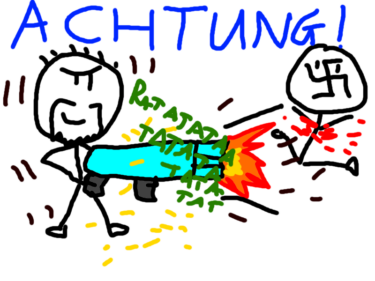
#oneaday Day 558: Blast a Nazi today

I love Wolfenstein 3-D a great deal. In fact, I love it so much that ten levels that I made as a teenager are part of the official Wolfenstein 3-D Super Upgrades pack that was distributed by original publisher Apogee. I made $200 from that — who says random encounters with strange men on CompuServe forums never lead to anything good?

Anyway, despite the fact that I adore Wolfenstein 3-D and its quasi-sequel Spear of Destiny, I have never actually played any of the other Wolfenstein games. None of them! I have always meant to, over the years, but somehow never got around to it. I have decided to finally correct this oversight, prompted by some enthusing on the part of some friends who particularly enjoyed the recent Machine Games entries in the series.

From what I understand, the various Wolfenstein games over the years since Wolfenstein 3-D have rebooted the series continuity multiple times, but I still wanted to catch up on all the games I'd missed, so I decided to jump into Return to Castle Wolfenstein on Xbox first of all. I went for Xbox because the console versions of the game have an extra prologue chapter on top of what the PC version offers, plus there's no need to faff around with mods to make it run on modern machines. I have little to no patience for modding these days, so a plug-and-play console version is just what the doctor ordered.

Anyway, I didn't really know what to expect from Return to Castle Wolfenstein, other than what little I had read prior to playing it. I knew that it was the first of several "reimaginings" of the series, for starters, rather than an actual "sequel" (despite the implications of the name) and that it focused to a certain degree on the Nazis looking into black arts such as necromancy. For those unfamiliar with the Wolfenstein series, who had been labouring under the assumption that it was a Serious War Series, undead, monstrous enemies have been part of proceedings since Wolfenstein 3-D and Spear of Destiny. (They were not, to my knowledge, part of the original 8-bit home computer Castle Wolfenstein games, but those have little to do with the various different continuities of the rest of the series anyway.)

Return to Castle Wolfenstein casts you in the role of recurring series protagonist William "B.J." Blazkowicz, an American soldier who is a bit of a one-man army. While Wolfenstein 3-D began with Blazkowicz captured and imprisoned in Castle Wolfenstein, Return to Castle Wolfenstein's console versions open with a mission where our hero is investigating what the Nazis are up to in Egypt. It seems they're in the business of raiding tombs for something that they seem to think is important, so it's up to Blazkowicz to discourage them from doing so with a variety of World War II-era weaponry.

Following this, Blazkowicz and his contact, Agent One, get captured and taken to Castle Wolfenstein. Whether or not Agent One survives depends on if you are playing the two-player co-op mode or not. Either way, Blazkowicz has to bust out of Castle Wolfenstein, make his escape, throw some further spanners into the Nazi plans to dig up the mysterious "Death Knights" and mystical artifacts, and then proceed onwards to a series of Nazi-thwarting missions.

Thus far I think I'm about halfway through the game — I'm on the fifth mission out of eight — and I've mostly been having a good time. Return to Castle Wolfenstein is a first-person shooter from the early 2000s, and there are times where you really feel the 25 years between this game and now. This isn't necessarily a bad thing, though; it means that Return to Castle Wolfenstein is a game that focuses on making its gameplay solid and interesting rather than indulging in overly spectacular setpieces. It also means that its levels strike a good balance between providing a decent amount to explore and keeping you heading on a clear path forwards. More than anything, the further I go in the game, the more it reminds me of something like Rare's GoldenEye — levels have different routes you can take, and there are various objectives to accomplish, and the exact way things unfold will vary according to whether you decide to go all-guns blazing or at least make a cursory attempt at stealth.

Stealth isn't mandatory for the most part, thankfully. There's one level where you'll fail if the guards set the alarms off, but for quite a lot of that level the guards can spot you and aren't within reach of an alarm, so you don't have to spend too much time creeping around. In other levels, it sometimes pays to know what's coming up ahead of time so you can prepare a suitable "ambush" with an appropriate weapon — the game has some excellent rifle weapons (both with and without zoomable scopes) that make picking off enemies from a distance a pleasure, and when it comes time to switch to closer combat, there are plenty of options there, too.

The weapons perhaps lack some of the oomph of more recent takes on the genre, but there are plenty of them, and the further you go in the game, the more ridiculous they get. While the early stages will see you using fairly conventional pistols, rifles and machine guns, later stages will allow you to wield the chaingun-esque "Venom" weapon, the "Panzerfaust" rocket launcher and even a flame thrower. None of these are an "instant win" button, either; the game's levels and encounters are designed quite nicely to encourage picking the right weapon for the job.

The game features a beloved feature of early 2000s first-person shooters, which is enemy characters who have conversations while you approach them. Many of these are quite silly — though none quite match the classic No-One Lives Forever, trope codifier for this sort of thing — and although clearly a threat, the game also makes many of the Nazis appear cartoonishly incompetent.

There are a few minor annoyances, chief among which is the complete lack of subtitles for spoken audio. There's not a lot of critical in-mission speech, but it does sometimes get drowned out by everything else that is going on. The cutscenes are well-mixed, at least — and hearing Tony Jay in the role of the Director of the Office of Secret Actions, the organisation that Blazkowicz works for, is an absolute delight.

The game balance at times feels a little questionable, with enemies seemingly either spraying bullets everywhere but your location, or hitting you right in the middle of your head and knocking out most of your health bar with a single shot. There are a few enemies that have seemingly superhuman reflexes at times, which can lead to some frustrating sequences where you'll have to repeat things over and over and over until you master them, but there are usually some things you can try differently to tip the odds in your favour — and the ability to save at any time, as well as automatically at checkpoints, is very welcome indeed. I'm not sure how much of my difficulty with a few sequences stems from my playing on "Bring it On" difficulty, which I guess is technically "Hard" mode — but, well, I've come this far now, so I will continue as I have been doing!

I'm enjoying the game, then. I wish there were a few more homages to the original Wolfenstein 3-D — it would have been nice to hear some remixes of the classic music, for example — but I am led to believe that Wolfenstein 3-D itself unlocks as a bonus extra when you beat the main single-player campaign, so if that's the case then all will be forgiven. I suspect this is probably going to be the weakest of all the post-Wolfenstein 3-D entries in the series — or, at least, this is the most obviously aged of them all — so hopefully it'll only be improvements from hereon. I'm certainly looking forward to finally discovering how the series evolves.

Now I think I might go blast a few more Nazis before bedtime…


Want to read my thoughts on various video games, visual novels and other popular culture things? Stop by MoeGamer.net, my site for all things fun where I am generally a lot more cheerful. And if you fancy watching some vids on classic games, drop by my YouTube channel.

If you want this nonsense in your inbox every day, please feel free to subscribe via email. Your email address won't be used for anything else.

#oneaday Day 557: How to torch universal goodwill with one simple interview

Today, Larian Studios, makers of the Divinity series and the universally acclaimed Baldur's Gate 3, found itself in the crosshairs of the Internet's ire due to comments made by its CEO, Swen Vincke during an interview with Bloomberg.

According to Vincke, Larian has been using generative AI behind the scenes to, in his words, "explore ideas, flesh out PowerPoint presentations, develop concept art and write placeholder text". None of which are things you need generative AI for, and all of which are things that people have been perfectly capable of doing with their own human brains for decades. In fact, there are people who specialise in elements of what he described — most notably concept art, which is the area a lot of critics have been focusing on.

Vincke's comments are remarkably ill-considered given the number of times that generative AI use in video games has been subject to backlash from the general public and journalists alike over the course of just the last year — and for many of the same reasons that Vincke is arguing in favour of.

The otherwise well-regarded sci-fi game The Alters was irreversibly poisoned for a lot of people earlier this year when it became apparent that they had used ChatGPT to generate placeholder text for background textures and localised strings for non-English languages.

The umpteenth reboot of Everybody's Golf came under fire for non-specific use of generative AI that I'm not sure anyone ever quite got to the bottom of.

The new Let It Die game, which has no involvement from the previous game's original developers Suda51 or Grasshopper Manufacture, has been lambasted for extensive use of AI-generated material.

The promising "people sim that isn't called The Sims" inZOI turned huge swathes of prospective players away by its game's heavy reliance on generative AI, as well as its publisher Krafton's insistence that they are pivoting to becoming an "AI-first" company.

The latest hot "extraction shooter" (I still don't really know what that is, and no, I don't really care) ARC Raiders got dinged with a 2/5 review score for its use of AI-generated voices — not just because they were AI, but because using AI-generated voices is at artistic odds with the story the game is trying to tell.

Even the once-beloved Oliver Twins, former stars of the UK "bedroom programming" scene in the '80s, got a kicking from press and public alike for their absolutely terrible AI-generated "follow-up" (and I use the term loosely) to their old Spectrum game, Ghost Hunters.

People hate this shit — and with good reason. Generative AI is a lazy, soulless solution for feckless CEOs to foist on their creative teams because they think it will "add value" for shareholders, when in fact there is growing evidence by the day that the entire generative AI scene is financially, environmentally and societally ruinous.

On top of all that, it doesn't work well enough to be worth using! Every single AI "tool" currently available carries a prominent disclaimer that it "might" (read: "will") get things wrong from time to time, making them fundamentally useless for doing anything useful with — and their "fun" uses are causing the Internet to become overrun with even more meaningless, pointless slop than was already splattered everywhere in the first place, on top of boiling all our lakes. At least stupid things from a bygone age like Badger Badger Badger and Seepage (to name just two examples from what I believe to be the golden age of Internet nonsense) are the result of both genuine human creativity and skilful use of creative tools that don't involve typing "make me funny video garfield giant boobs mechahitler piss filter" into a chatbot.

Vincke's point was not that the new Divinity game will be riddled with AI-generated voice lines or visuals. In fact, he claims that the studio is "neither releasing a game with any AI components, nor are [they] looking at trimming down teams to replace them with AI", but that AI is "a toolset for creatives to use and see how it can make their day-to-day lives easier, which will let us make better games".

Vincke has, apparently, been receiving some pushback from within Larian about this — and he's certainly been getting some choice words from former employees today, too. The situation escalated to such a degree that he issued a statement in response to IGN earlier today. Unfortunately, said statement doesn't really say anything — and, worse, attempts to obfuscate his earlier statements by pointedly using the term "ML" (for "Machine Learning") rather than his earlier use of "AI" — today typically interpreted to mean "generative AI" when used in contexts such as this.

For me, the worst thing was his final paragraph:

While I understand [generative AI] is a subject that invokes a lot of emotion, it's something we are constantly discussing internally through the lens of making everyone's working day better, not worse.

Here's the thing. You see that people are getting sniffy about generative AI, something which is well-established by this point to be A Thing The Public Fucking Hates. The sensible thing to do from a public relations perspective at this point, regardless of what you actually think, is to go "okay, you know what, we hear you, this sucks" or something along those lines, and then promise to "do better" or the like. A bunch of people won't believe you, of course, but this is better than going "no, well, I actually do think everyone at Larian should use this, and by 'discussing internally' I probably actually mean mandating that all employees have to use it at least a certain amount", which is how this is all coming across right now.

The particularly dumbass thing about this episode is, as I said above, none of the examples he gave are situations that need generative AI — or even where it is particularly beneficial. In fact, several creative types have commented today on how using "good enough", plausible-looking placeholders is actually detrimental to the entire creative process. Former Rocksteady employee Amy-Leigh Shaw commented thus on Bluesky earlier:

Placeholder text isn't supposed to be unique per line. It is supposed to be an instruction to the writer with a great big warning sign slapped on the top, so that it doesn't slip into the finished game. Unique sentences of bland writing are the least helpful thing to use for that purpose!

I also find that one of the more frustrating blockers to writing is when there's already a (bad) suggestion of what you should say. You are no longer able to organically find the idea because the suggestion in front of you knocks you off the track of your natural thought process.

Shaw is talking specifically about writing here, but several artists agreed that this is the case when dealing with concept art, too. The difference between a hastily scrawled Microsoft Paint doodle and the "this sort of looks right" thing that generative AI spits out is enormous — and in the latter case, it will absolutely colour an artist's interpretation of a scene or character, often unconsciously.

In other words, there's no defence of using generative AI as "placeholders" for text, concept art, voice acting, music — anything that a creative person is actually going to get involved with. The entire point of a placeholder is that it's something obviously shit and out of place so it can be easily spotted and subsequently replaced by a specialist at some point in the development process. Because generative AI produces something that is often "good enough" to the untrained eye or someone not looking closely, it's easy for it to get missed — as happened with The Alters earlier in the year.

Vincke's comments — and his subsequent follow-up statement — have torched a significant amount of goodwill that people had for Larian Studios in the space of just a single day. People fucking loved Baldur's Gate 3 and the previous Divinity: Original Sin games! It feels like it shouldn't have been a difficult job to maintain that goodwill while hyping up your new game — even if some found themselves a tad squicked out by a rather grim trailer at The Game Awards. But no. C-suite gonna C-suite, I guess — and it appears that this is true for companies people had, up until now, actually liked, as much as it is for companies people love to hate. And the net result of this for Larian is that people who were previously excited about a new Divinity game are now not going to touch it.

I know this has certainly given me a great degree of pause on wanting to check out any of Larian's work. I've been meaning to look at the Divinity: Original Sin games and Baldur's Gate 3 for a while — but now I'm in even less of a hurry to do so than I was already.

I'm so very tired of this. I, like many others, cannot wait for this fucking bubble to pop so we can get back to something approaching "normality", whatever that even means any more.


Want to read my thoughts on various video games, visual novels and other popular culture things? Stop by MoeGamer.net, my site for all things fun where I am generally a lot more cheerful. And if you fancy watching some vids on classic games, drop by my YouTube channel.

If you want this nonsense in your inbox every day, please feel free to subscribe via email. Your email address won't be used for anything else.
#oneaday Day 554: The Battle of Polytopia

After my post the other day, concerning a mobile game developer complaining that mobile games aren't taken seriously because people (correctly) assume that the scene is a "world of predatory monetisation and low quality", I decided to be fair to the chap and actually give his game a try.

The game in question is called The Battle of Polytopia, and it's a lightweight 4X strategy game heavily (heavily) inspired by the classic Civilization series, swapping semi-realistic visuals (aside from the city-sized horses) for a distinctive, untextured, voxel-esque "low-poly" look.

In The Battle of Polytopia, your task is to be the civilisation that comes out on top. In the default "Perfection" game mode, this requires you to have scored the most points by the end of 30 turns; alternatively, you can play in "Domination" mode, which is a last-man-standing mode; there's also a "Creative" mode that allows you to set up a game however you please, with up to three computer-controlled opponents (or no opponents at all, if you prefer) and the ability to play in the previous "Perfection" or "Domination" modes, along with an "Infinity" mode that has no win state. You can also play multiplayer, and the official website seems to indicate there are regular tournaments going on.

There are a selection of civilisations to play as, but the only real differences between most of them are the tech that they start with, the number of "star" resources they begin with, and their aesthetics — however, there are some tribes available as one-time in-app purchases that add some unique mechanics to the mix, such as being able to live and build in the water, having the ability to use magic, or an emphasis on poisoning and corrupting the land.

Once into the game, you're presented with an isometric view of the land around your starting city, with the remainder of the map covered by fog of war. Tapping on resources in the tiles around your city allows you to harvest them in exchange for the generic "star" resource, and doing so will add population to your city. Once the city's population has reached a certain stage, it will advance a level, and this usually rewards you with a choice of two benefits. These vary from level to level; sometimes you'll be able to expand the borders of the area the city controls; at others you'll be able to build special one-time only buildings that provide additional benefits; at others still you'll have the opportunity to "scout", which uncovers part of the fog-obscured map.

Some resources can have buildings constructed on them, which allows them to provide an income of stars each turn. Some buildings can be boosted by having other buildings in close proximity. Many of them require you to have unlocked a particular technology in the tech tree, which, again, costs stars.

Cities can also construct troops, which can then be sent out into the world to explore, uncover more of the map and potentially attack other civilisations, and the exact troop types you can build are determined by your unlocked technologies. Some troops can move further, some can attack from range, others still are better suited for a defensive role.

Other civs aren't necessarily hostile when you encounter them, but the game feels balanced in such a way that conflict will become inevitable before long, particularly if you want to expand your territory beyond its starting area.

And that's basically it. The game is easy to pick up and play thanks to it being considerably less complicated than the games that inspired it, and I can see it being a reasonably fun little diversion to play on one's phone if you want to while away a few minutes and don't have any other gaming devices with you. It's not obnoxiously monetised and it doesn't blast ads at you every five minutes, which in itself is worthy of praise in today's mobile sector.

But, I don't know. I played it and I felt… nothing. I didn't really feel attached to my little civilisation, I never really felt like there was much threat from the rival CPU-controlled players — although, granted, I was playing the tutorial map, which is likely set to the easiest difficulty level — and I didn't feel like I was making a lot of meaningful choices along the way.

The area where this stood out the most was in the tech tree. Simply unlocking features with the currency you earn each turn makes the "discovery" of each new tech feel quite underwhelming, particularly as in the late game you can unlock a whole bunch at once without really feeling like you've had to work for them or prioritise what to concentrate on next. There's no real "weight" to the game, for want of a better word, and that leaves the whole experience just feeling a bit unsatisfying.

"Civilization Lite" can work, as anyone who ever played the excellent but largely forgotten Civilization Revolution on Xbox 360 will attest. The Battle of Polytopia plays it just a bit too "lite", though, leaving it feeling like pretty much every other mobile game for me — fun for a few minutes if there's literally nothing better to play, but ultimately rather forgettable, and not something I'm going to go out of my way to spend time on.

And definitely not Game of the Year material!


Want to read my thoughts on various video games, visual novels and other popular culture things? Stop by MoeGamer.net, my site for all things fun where I am generally a lot more cheerful. And if you fancy watching some vids on classic games, drop by my YouTube channel.

If you want this nonsense in your inbox every day, please feel free to subscribe via email. Your email address won't be used for anything else.

#oneaday Day 551: Mobile gaming is perceived as a "world of predatory monetisation and low quality" because that's what it is

A recent article on Gamesindustry.biz drew attention to a LinkedIn (ugh) post from one Christian Lövstedt, CEO of a company called Midjiwan AB, who is complaining that people don't take mobile gaming seriously.

Midjiwan AB, if you were curious, apparently make a mobile game called The Battle of Polytopia, which I've never heard of, which I suspect is at least partly what this is all about. In fairness to all the following, The Battle of Polytopia does not look all that bad… but I'd still rather play a game like that anywhere other than my phone. But I digress before we've even begun, so let's get back on track.

"Mobile gaming is one of the most played and most profitable platforms in gaming," Lövstedt says, "currently representing 55% of the global gaming market, but is often ignored and looked down on [because] it is perceived by too many as a world of predatory monetisation and low quality."

Okay. Let's start with this. People love to trot out that "over 55% of the market" figure (with variations on the exact figure quoted) but let's be real about this: the reason why mobile accounts for so much revenue in the global games market is precisely because it is a world of predatory monetisation and low quality.

Consider some of the most popular mobile games out there. Candy Crush Saga, which charges up to £34.99 for cheats that allow you to bypass levels — coupled with design that makes it near-impossible to win without buying these cheats. Gacha games such as Azur Lane, Granblue Fantasy and Fate/Grand Order, which exploit horny young people (particularly, though not exclusively, men) with attractive JPGs of hot anime characters, necessitating that you pay at least £20 at a time to be in with a reasonable chance of actually getting the character you want. And I'm pretty sure there are still plenty of "tap and wait" games out there that ask you to pay up to make things go faster or be able to simply play the game more.

When you consider that the term "whale" was coined to describe those who spend excessive amounts of money on free-to-play games, particularly in the social and mobile spaces — and that pursuing these whales to exploit them (at the expense of providing a good experience to free players) is a primary goal of the developers of these popular games — you will perhaps start to see exactly why mobile accounts for so much of the "market". It's because one user playing one heavily monetised mobile game will account for considerably more revenue than one user playing one pay-once-play-forever premium game on PC or console.

Games like this, you see, don't just ask you to buy them and are then happy with that. No; the most "successful" mobile games — measured by most folks who complain about mobile not getting its dues as the ones that generate the most revenue — are the ones that provide the opportunity for perpetual monetisation: the ones that entrap players into dark patterns that make them feel like they have to continually pay money into the game, month after month, in order to remain "relevant" and "current".

When you start from there, it's understandable why people see mobile gaming as rife with predatory monetisation and low-quality games. But let's look at the rest of this open letter.

"While some amazing mobile-first titles, like Monument Valley, manage to get the industry's attention," Lövstedt continues, "many other extremely popular and successful titles do not."

Monument Valley came out in 2014. That's over ten years ago! If you can't think of a more recent example than that of Doing It Right, I think we may have found the problem!

But he continues:

"Mobile games like Clash of Clans, Temple Run, Crossy Road and Candy Crush Saga are critically and commercially successful, yet are never or rarely acknowledged at game awards."

Perhaps that's because Clash of Clans, Temple Run and Candy Crush Saga are all prime examples of games with predatory monetisation and low quality? I actually don't know about Crossy Road, so I am willing to take a moment to actually research it before I brand it with the same scarlet letter. Give me a moment.


Tangent: Pete tries Crossy Road

"Contains ads. Contains in-app purchases". We're not off to a good start already. But let's download this and see.

After an initial tutorial, during which the simple tap-and-swipe, Frogger-inspired gameplay is introduced, I am given a "free gift" of in-game currency and then immediately invited to "win a prize". It costs the 100G of in-game currency I was just "gifted" to draw from a virtual gacha machine, which awards me with a mallard duck avatar to play in the game instead of the default chicken.

I am then taken to a main menu screen where I get an immediate popup about a new time-limited game mode and "sweet sales in the store". I'm then taken into that mode without having asked to play it. After playing it briefly, I am shown my top score with two non-descript icons, the purposes of which are not made entirely clear. It seems the one that the eye is most immediately drawn to — i.e. the one where you'd expect an "OK" button to be in typical UI design — is a "share" function for you to send a screenshot of your concluded run to any of your phone's connected social services or contacts.

After that, I am given a timer countdown to my next "free gift" and informed how many "G" of in-game currency there is "to go" until my next blind box of whatever the fuck you unlock in this game.

To Crossy Road's credit, it has no play-throttling energy system, no paying to bypass timers and it does have a one-off payment of £7.99 to remove all ads (if you're not already blocking them), but it also sells extra game modes, has "limited time sales" on special characters and sells a power-up to double your in-game currency income. And you can bet that it gets regular "content updates" to ensure there are always new things for people to pay for.

But it's just not very fun, the countdown timers and grind for currency make it feel more like work than play, and the "business" part of it being so front and centre is exactly why people don't take it as seriously as premium, pay-once games for PC and consoles.

So in conclusion to that little bit, while Crossy Road isn't as egregious as the other examples cited, it's still not… great. And certainly not the sort of thing that is in any way deserving of an award.


"Just because [low-quality] games [with predatory monetisation] like that do exist in the mobile market, it should not diminish the achievements of the market's best games," Lövstedt continues. "It perhaps makes them more impressive. And if we're honest with ourselves, there are AAA industry darlings crammed with the same monetisation mechanics."

Two things to pick out here: firstly, outside of the aforementioned Monument Valley (which, again, is eleven years old at this point), he cites no specific examples. And yes! Yes, triple-A does pull all this shit, too! And you know what? People hate it there, too!

"D.I.C.E., one of the better award bodies for acknowledging mobile gaming, has only ever nominated a mobile game for Game of the Year twice," he continues. "Angry Birds HD and Pokémon Go. And they were the only dedicated game awards body to nominate them, despite how commercially and culturally impactful both games are."

Okay. I have to look into this. Bear with me.


Tangent: Pete looks into the D.I.C.E. Awards

Angry Birds HD was nominated for Game of the Year in 2011 alongside Mass Effect 2 (which won), Call of Duty: Black Ops, God of War III and Red Dead Redemption. Honestly, the fact that it was even nominated is borderline laughable, because Angry Birds is not a particularly amazing video game. It's fine for what it is, but in 2011 people were still feeling the novelty of playing games on a tablet — the iPad first launched in 2010 — and the calibre of the other games that were nominated is just in a completely different league. What Lövstedt doesn't mention is that Angry Birds HD did win a D.I.C.E. Award that year — for Casual Game of the Year. Which is absolutely fair, although given it was up against Pac-Man Championship Edition DX, Plants vs. Zombies and Bejeweled 3, it wouldn't be my vote. (And I don't even like Plants vs. Zombies.)

Pokémon Go, meanwhile, was up for the 2017 Game of the Year award, where it was up against Overwatch (which won), Battlefield 1, INSIDE and Uncharted 4. My personal tastes put that as a much weaker overall lineup than that of 2011, but there's still a world of difference between gamifying Google Maps and the cultural phenomenon that was Overwatch in its first year. And, again, Pokémon Go won a perfectly acceptable award for what it is: Mobile Game of the Year.

Lövstedt is right; Pokémon Go in particular did have a certain amount of cultural impact, particularly as we moved into the pandemic years. But, again, it's just not a very good video game, which is why it lost out on the overall Game of the Year award. "A lot of people played this because they were bored" is not the same as "this is an incredible video game that should be celebrated as the pinnacle of its medium".


In conclusion, then, I have to reiterate that mobile gaming's reputation as being filled with low-quality games with predatory monetisation is well-earned. This isn't to deny that there are developers apparently doing interesting things on mobile — Lövstedt's own The Battle of Polytopia looks quite worthwhile, so I might have to actually give it a go — but at this point, the damage done by Apple introducing in-app purchases (and Google following suit) has already been done. There's no easy way to turn that back; no easy way to reclaim mobile gaming's reputation from those who, thanks to their greed, generate enough income to account for a supposed 55% of the global games industry's revenue.

Because what are Apple, Google and the other app store platform holders going to do? Just suddenly give up such a profitable revenue stream? Because let's not forget they get a cut of every purchase, so it is absolutely not in their interests to try and fix this.

Also, playing games on a touchscreen — particularly on small ones like those found on phones — sucks ass. This, honestly, is one of the biggest reasons I have zero desire to play any games on my phone today — even if they weren't low-quality games with predatory monetisation. Which a significant portion of them are, so I have precisely zero incentive to look any deeper — particularly because the vast majority of those which are cited as "good examples" (including the aforementioned Monument Valley, plus titles like Stardew Valley and Vampire Survivors) are available on platforms with control schemes that don't suck!

So in summary: if you want to be taken seriously, release your game on a platform that people will take seriously. Have you seen the shit they let onto Steam these days, recent examples notwithstanding…?


Want to read my thoughts on various video games, visual novels and other popular culture things? Stop by MoeGamer.net, my site for all things fun where I am generally a lot more cheerful. And if you fancy watching some vids on classic games, drop by my YouTube channel.

If you want this nonsense in your inbox every day, please feel free to subscribe via email. Your email address won't be used for anything else.

#oneaday Day 549: The Yakuza games are the ultimate video games

I've been thinking it for a long while now, and finally making some time to go back to Yakuza 5, which I left half-finished a good few months back, I have cemented my feeling that the Yakuza (or Like A Dragon, as they're now known, to be more true to the original Japanese title Ryu ga Gotoku) games are, in fact, Peak Video Game.

By this I mean that if there is a single game you are going to invest a lot of time and effort into playing, a Yakuza game is an excellent choice. And there are a whole bunch of them now! Best of all, given that each one unfolds in a different time period, they all have a markedly different feel from one another — and, of course, as the series goes on, it expands beyond its original setting of Kamurocho to a much wider variety of locales.

Thus far in my journey through the series, Yakuza 5 is the series at its most broad. Like its immediate predecessor, the game is split into several distinct parts, each with a main protagonist taking the leading role. Unlike Yakuza 4, however, which was entirely set in Kamurocho, Yakuza 5 features several town centres for the various different protagonists to explore before they all meet up for the finale.

So far I'm on the third part out of four, which means I've finished the initial part with longstanding series lead Kiryu Kazuma living under an assumed name and working as a taxi driver in Fukuoka, the second part that involves Taiga Saejima breaking out of prison, living for a brief while in a mountainside hunter village, then hanging out in Sapporo for a bit, and I'm now on the first half of the third part, which concerns Kiryu's adoptive daughter, Haruka, and her quest to become an idol in Osaka.

Thus far, each main section of the game has been very different from the last in terms of tone. Kiryu's started with a bit of "everyday life in a small city district" feel before ratcheting up the yakuza angle once the story got underway. Saejima's was quite a personal story of this imposing, hulking brute of a man and the soft centre within. Haruka's, so far, has been deliberately a bit silly, but also with a hint of the sleaziness and darkness that underpins the real-life idol industry.

The nice thing about giving each protagonist their own areas to wander around is that it allows them to have different activities available to them. Yakuza 5 introduces the concept of each character having a "Side Story" as well as the series' iconic "Substories"; each "Side Story" is quite an involved plot that runs parallel to the main scenario, and generally concerns the main character developing their skills in an area that is somehow important to them. In Kiryu's case, we get to work his job as a taxi driver; as Saejima, we take him through learning how to hunt on the mountain; as Haruka, we follow her idol career from its humble beginnings and onwards into greater success.

In each instance, the Side Story is handled in a different way rather than just being a glorified way of marking your progress through a series of cutscenes. Kiryu's taxi driving Side Story, for example, involves a combination of driving people around Fukuoka and ensuring that they get good service, punctuated by some extremely silly arcade racing sequences as he investigates a racing gang. Saejima's hunting sequences involve unique mechanics surrounding avoiding detection by wildlife, shooting rifles in first-person, surviving in extremely inhospitable conditions, and setting traps. Haruka's Side Story sees her having Dance Battles in the street, building up her performance-related stats in various ways, and working through an ever-lengthening list of obligations her career places in front of her as she grows in prominence and fame.

If the Yakuza games were just about the main plot, these Side Stories and the Substories, they would already be extremely substantial. But then there's all the other stuff too. Eating at all the restaurants. Training with each character's "master" to learn new moves. Seeking out unusual happenings to have "Revelations" that, again, unlock new moves. Playing darts, pool, bowling. Playing real-life Virtua Fighter 2. Playing a fictional but nonetheless enjoyable shoot 'em up. Catching prizes in the crane game. Hitting some balls at the driving range and batting cages. The list goes on.

The great thing about Yakuza games is that you can engage with them as much or as little as you like. If you want to plough through the story and just see what happens, you can do that with no real penalty. You might not have levelled up as much as if you'd thoroughly completed all the Substories, but you can do it.

Alternatively, I suspect most players will find themselves unable to resist engaging with at least some of the optional activities — because each of them are handled with such thoroughness, and are so enjoyable in their own right, that they could quite feasibly have each been their own standalone games.

This is the genius of Yakuza. Back in the '80s, the software publisher Imagine got itself into a lot of trouble as it attempted to develop a series of "Mega Games" for the Commodore 64 and ZX Spectrum, but none of these projects ever came to fruition — though some had some successor projects.

Yakuza games, meanwhile, are "Mega Games". Each entry is a single game that you could quite feasibly play for a very long time indeed — possibly even forever, depending on how much you like mahjong and shogi — and there is absolutely nothing quite like them out there.

And they're a markedly different experience from western open world games that provide a huge, boring map littered with objective markers and expect you to hoover them up systematically while working through a tedious skill tree that gives you 0.1% poison resistance with every level up or something equally meaningless. No; although Yakuza games are full of things to do — and each comes with a handy "Completion List" marking how much of all its component Bits you have "completed" — not one of them feels like it has been designed with "player retention" in mind. Not one of them is designed for the explicit purpose of 1) being your "forever game" and 2) monetising the crap out of its user base.

No; Yakuza's wealth of things to do is all in service of creating one of the most detailed, compelling worlds in all of gaming. And although I'm very behind on the series at this point, I am well and truly determined to catch up and see where things go from here. Because after this many hours, this many games and this many in-game years having passed, I care what happens to these characters!

If you've never played a Yakuza game and are daunted by the prospect of there being (counts) 11 games set in the main series continuity, a further two spinoffs in the same setting but not directly connected, and a wealth of other, non-canonical spinoffs that range from historical adaptations to a Fist of the North Star-themed adventure, don't be afraid! Start with Yakuza Zero, play it, love it, see how you like it. And then you'll understand. And, several games later, you'll be about where I am now.


Want to read my thoughts on various video games, visual novels and other popular culture things? Stop by MoeGamer.net, my site for all things fun where I am generally a lot more cheerful. And if you fancy watching some vids on classic games, drop by my YouTube channel.

If you want this nonsense in your inbox every day, please feel free to subscribe via email. Your email address won't be used for anything else.

#oneaday Day 546: Why are we still arguing over "games as art"?

Back in April of 2010, the first time around on this #oneaday malarkey, I wrote a post responding to the late Roger Ebert's ill-advised argument that "video games can never be art".

Today, on the 5th of December 2025, some 5,710 days later (or "over 15 years" if you want to be a bit more normal about it), we are, apparently, still having this argument. Roger Ebert is, of course, dead, so this time around it has come from someone else: Ian Bogost, a professor at Washington University, St. Louis and hilariously forever doomed to be "most known for the game Cow Clicker" so far as the broader Internet is concerned.

A bit of context if you've not come across this chap before: Cow Clicker was designed as a satirical take on the rise of "social games", as they were known when they first started appearing on Facebook. You know the sort of thing: wait for timer to expire, click on thing, get stuff. Pay up if you want to get stuff more quickly. Marvel at the meaninglessness of existence.

Cow Clicker was good satire! It made some solid points about the way social games abused not only their players, but the broader community surrounding those players. Anyone who lived through Facebook in the 2010s will almost certainly remember being spammed with "invitations" to "help" on someone's "farm" or similar, because although it was patently obvious to anyone who had ever played a video game before that social games were absolute dog eggs, they introduced a lot of people who had never touched video games before to the idea of playing games on their computer or mobile phone. And, as a result, they are indirectly responsible for those tedious shitheads who argue that Candy Crush Saga is relevant to modern gaming rather than yet another abusive, predatory free-to-play game.

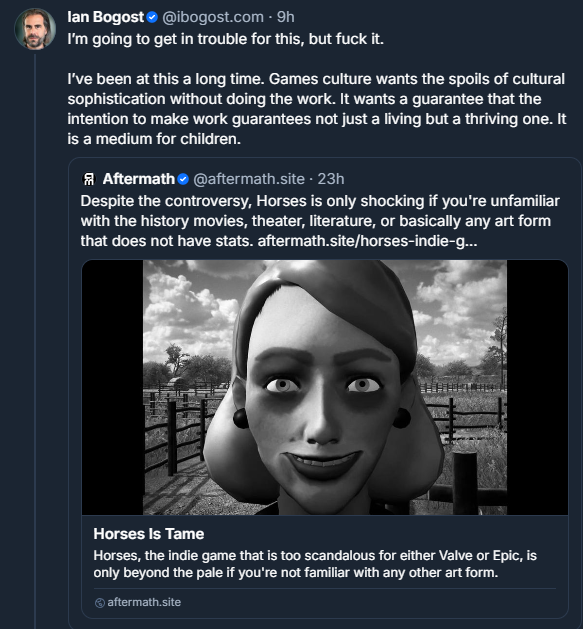
Anyway, I hadn't seen Bogost around for a while, but I'd always thought that he had vaguely… sensible ideas. Today he came out with these humdingers — relating to, of course, HORSES, the hot topic du jour (as you will know if you have read my last two posts and my piece on the game over on MoeGamer):

(Bluesky screenshot)
‪Ian Bogost‬
‪@ibogost.com‬

I’m going to get in trouble for this, but fuck it. 

I’ve been at this a long time. Games culture wants the spoils of cultural sophistication without doing the work. It wants a guarantee that the intention to make work guarantees not just a living but a thriving one. It is a medium for children.

(Quoting the following post:)
‪Aftermath‬
‪@aftermath.site‬

Despite the controversy, Horses is only shocking if you're unfamiliar with the history movies, theater, literature, or basically any art form that does not have stats.
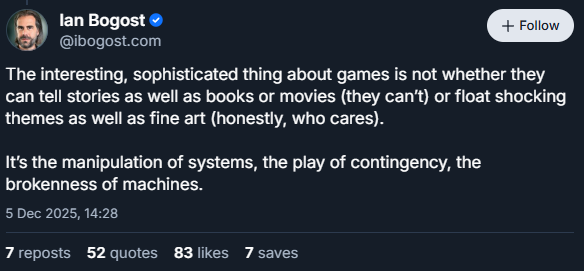
(Bluesky screenshot)
Ian Bogost
‪@ibogost.com‬

The interesting, sophisticated thing about games is not whether they can tell stories as well as books or movies (they can’t) or float shocking themes as well as fine art (honestly, who cares).

It’s the manipulation of systems, the play of contingency, the brokenness of machines.
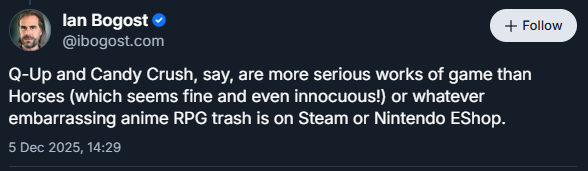
(Bluesky screenshot)
Ian Bogost
‪@ibogost.com‬

Q-Up and Candy Crush, say, are more serious works of game than Horses (which seems fine and even innocuous!) or whatever embarrassing anime RPG trash is on Steam or Nintendo EShop.

There are some truly amazing bad takes in this mini-thread, but his argument appears to stem from "I am older than you, therefore my opinions are the correct ones." At least he correctly assumed that he would "get in trouble for this".

He falls into the usual traps of assuming that books and movies are inherently superior forms of media because they have been around longer and are thus more refined, but this exceedingly shallow viewpoint fails to accommodate the existence of books and movies that are unashamed to be absolute pulp fodder, trash, blockbuster nonsense or whatever other mild pejoratives you might care to fling at them. Not only that, but gaming is a medium that has grown much quicker than both books and movies, at least partly because it was able to draw on artists' experiences in developing those mediums, and adapting the things that work into the interactive space.

Now, one area where I do kind of sort of align with Bogost is where he notes that games are "the manipulation of systems, the play of contingency, the brokenness of machines". However, where I drift apart from him is his seeming assumption that that is all there is to gaming.

Games can be about the manipulation of systems, the play of contingency and the brokenness of machines. There are some truly compelling games that focus exclusively on those things — and yes, there are plenty of those that I would well and truly describe as exhibiting their own form of artistry. There is an elegance to a well-designed, well-balanced game — it keeps you playing; it keeps you invested; it plays on your mind even when you're not directly engaging with it, in much the same way as a great work of art that you, personally, found particularly impactful "stays with you" long after you were in its physical presence.

This side of things is something that I feel the more "artsy" side of game criticism — and the more artsy side of gaming enthusiasts, for that matter — could do well to study more. As someone with an appreciation for both narrative-centric and mechanics-focused games, it is inordinately frustrating to see those who prefer narrative experiences completely dismiss the artistry of mechanics-centric games. At the same time, it is also frustrating when people who are primarily appreciators of mechanics will completely discount the artistry of a good story.

You see, games aren't one or the other! They can be both, or they can be one of those things — or they can probably be neither of them if you're determined enough. But in most cases these days, there's a little of column A and a little of column B in there — and both of those aspects have been developing rapidly as the medium and technology have evolved, to such a degree that it is an astonishingly galaxy-brained take to say that "games cannot tell stories as well as books and movies" as a blanket statement.

HORSES is an interesting one because it's not a very "good" video game in terms of its mechanical aspect, and there are arguments to be made that its narrative aspects aren't anything particularly out of the ordinary either. I enjoyed my time with it well enough — I found it compelling enough to play through in a single sitting — but I also found myself wondering if anyone would remember it a year from now, particularly if the whole situation with it being "banned" from various platforms hadn't happened. There are plenty of artsy-fartsy walking simulators out there, and some have done their job better than others; it's actually a surprisingly challenging genre of game to get "right", and opinions vary wildly on exactly what getting it "right" really means.

But that's art! Art provokes discussion and debate. It sometimes makes people feel uncomfortable. It sometimes carries deep meaning for people. It resonates with some people more than others, and for different reasons even among those who all found it "meaningful" to a similar degree.

I'm truly astonished that we're still in a situation where games are having to justify their existence as an incredibly creative, artistic medium in 2025. Yes, there's garbage out there — although let's not even get into the casual racism of Bogost's "embarrassing anime RPG trash" statement right now, which is another matter entirely — but there are garbage books, movies and paintings out there, too. To put "established" forms of media on some sort of unassailable pedestal purely because they've been around longer and because the Big Scary Professor At Washington U Says So is just absurd. Because if video games as a medium are not "established" by this point… exactly when is the cutoff point for them to be taken the slightest bit seriously?

There are certain people out there who seem weirdly desperate for video games to forever be regarded as toys for little children — particularly little boys. We are long past that. And I would expect someone like Bogost to know better by this point.


Want to read my thoughts on various video games, visual novels and other popular culture things? Stop by MoeGamer.net, my site for all things fun where I am generally a lot more cheerful. And if you fancy watching some vids on classic games, drop by my YouTube channel.

If you want this nonsense in your inbox every day, please feel free to subscribe via email. Your email address won't be used for anything else.

#oneaday Day 545: Couldn't drag me away

I played HORSES this evening. I wrote about it in depth over on MoeGamer, so go read that if you want to find out a bit more about it. Short version: it was a decent Art Game, I'm not sure it'll be remembered in a couple of years' time, and the controversy surrounding it is, frankly, laughable.

That side of things is worth pondering a moment, because it's been an absolutely absurd game of telephone that has culminated in some people — including professional games journalists! — coming out absolutely convinced that the game was justified in being banned because at one point during its development it had something they considered to be child sexual abuse material.

For context, this is the scene as it ended up in the final game. The only change is that the woman atop the horse-masked individual is now in her twenties rather than being fourteen.

If you think that scene is in any way sexual, I really don't know what to tell you. There's nothing the slightest bit titillating about the whole scene, and for the majority of it, it looks like this:

That's "you" on the left, and the girl on the right is the daughter of a wealthy businessman considering purchasing one of the "horses" in the game (actually enslaved, naked humans) — during this scene even the dialogue isn't remotely sexual; instead, the woman delivers a lengthy diatribe about how people should know their place in society, how those with morals perceived to be "loose" tend to have "dangerous" ideas, and how those who live their lives "recklessly and indulgently" end up getting what they deserve.

HORSES is provocative — deliberately so — but honestly, having played through the whole thing this evening, it is so laughably tame compared to some other video games out there that the entire situation just feels bizarre. There are people thumping tables out there arguing that this game deserved to be banned while having absolutely zero knowledge of what the whole thing is actually about, but for once it seems like the majority opinion — even among games journalists — is that this game doesn't deserve the treatment it's gotten.

And that treatment is worth talking about. As Chris Person notes in his excellent piece on the game over on Aftermath, HORSES encountering such difficulty with getting a widespread release is a troubling sight for the industry. "If this is what's considered the limit for which games can and cannot be sold on mass marketplaces," he writes, "then we're all in trouble, and everyone involved in that decision should be thoroughly embarrassed."

The problem is that Valve holds a near-monopoly on the digital PC games market with their Steam platform, and thus a game from a small, independent team with a limited budget not being able to release their game their is very bad news for that team and their game. HORSES has probably sidestepped this particular issue thanks to the widespread press coverage it has had, but it's a solid case study in why the present situation is a bit of a problem.

"Well, just release it elsewhere!" some of you might say. And sure: you can buy the game on GOG.com and Humble. But for most PC gamers, neither of those storefronts are the first place they look to get new games. For most PC gamers, PC gaming begins and ends with Steam — particularly if they do their gaming on a device like a Steam Deck, which, as the name suggests, obviously prioritises Steam as its main source of material.

As I say: HORSES itself is probably going to be all right after all the coverage it's gotten. But will the next game to suffer this situation be as lucky? Probably not.

And besides, part of the reason the HORSES situation specifically is so absurd is the fact that there is much worse stuff already on Steam with zero issues. Not only do reasonably big-name recent releases like Silent Hill f feature more explicit, disturbing content than HORSES does, but you also have shovelware shit like the Sex With Hitler (yes, really) series happily existing with zero issue. I'm sure I don't need to tell you that this is a rather major problem with consistency and transparency.

Transparency is, honestly, probably the biggest problem with all this. HORSES' developer Santa Ragione did their best to try and work with Valve on ensuring that it was compliant with all appropriate platform policies, and when its initial version was rejected, they changed everything that could have been remotely considered to be a bit dodgy — even if, as outlined above, it almost certainly wasn't dodgy. But they were given no chance to appeal, no second chance — it was just gone from the platform, and with it a significant opportunity at organic discovery.

The Epic Games Store situation is even more bizarre. It seems like Epic themselves re-submitted the game to IARC, an international body that issues local content certifications for digital games, and that caused the game to end up with an "Adults Only" rating from the ESRB, which isn't allowed on Epic (except for blockchain and NFT-based games, because Tim Sweeney is a cunt). This is unusual because it's not Epic's place to submit games to IARC or any ratings bodies — it's the responsibility of developers and publishers, and a storefront going out of their way to re-submit something that had already attained a rating is unheard of, and probably not actually allowed.

Anyway, it's all a shitshow, and with this coming amid payment processors continuing to cut off adult content creators and sex workers from their sources of online income, it's just generally a pretty dark, shitty time for various forms of self-expression.

I enjoyed my time with HORSES. I wasn't blown away, but I enjoyed it. It's definitely worth four quid and a couple of hours of your time if you're on board with narrative-centric games that have minimal mechanics. I wonder if it will be remembered in a few years for anything other than this whole situation with the platform holders.


Want to read my thoughts on various video games, visual novels and other popular culture things? Stop by MoeGamer.net, my site for all things fun where I am generally a lot more cheerful. And if you fancy watching some vids on classic games, drop by my YouTube channel.

If you want this nonsense in your inbox every day, please feel free to subscribe via email. Your email address won't be used for anything else.