2098: Makina, the Girl in the Wrong Place at the Wrong Time

0098_001

I finished Makina's route in The Fruit of Grisaia at last. It's a long route with a noticeably different tone to the previous three I've completed, but it was just as enjoyable.

Spoilers ahead, so I'll put the rest behind a More tag for the convenience of those browsing my front page.

Continue reading "2098: Makina, the Girl in the Wrong Place at the Wrong Time"

2097: Dungeon Travelers 2: Some Initial Impressions

0097_001

Dungeon Travelers 2 came out on PlayStation Vita yesterday. To say I've been eagerly anticipating this game is something of an understatement; I've been deliberately holding off playing anything else "big" until it came out, because I was keen to be able to devote some time to it. And, after a good few hours with it today, I'm not at all disappointed with my decision to do so.

For the unfamiliar, Dungeon Travelers 2 is a first-person perspective dungeon crawler RPG (of the Wizardry mould that Japan loves so) created as a collaborative effort between visual novel producers Aquaplus, weird-but-cool RPG specialists Sting and That Company People Mostly Know The Name Of Because of Persona, Atlus. It has a somewhat convoluted history: its Japan-only predecessor Dungeon Travelers was a fleshed-out remake of a dungeon crawler that was part of a fandisc for Aquaplus' visual novel ToHeart 2, though Dungeon Travelers 2 itself doesn't have anything to do with either the first game or ToHeart 2simply sharing some aesthetic sensibilities and mechanics.

Dungeon Travelers 2 shot to notoriety a few months back when Polygon's Phil Kollar berated publisher Atlus for localising the game, which he referred to as a "creepy, porn-lite dungeon crawler". I responded in some detail to Kollar's nonsense back when he first blurted it out over at MoeGamer; take a lookIronically, Kollar's condemnation of the game actually made a lot of people — me included — who had never heard of it before aware of its existence, and I can't help feeling that the game has been a bigger success than it probably would have been if he'd just kept his mouth shut. In that sense, I'm not complaining; it's just a little frustrating to know that he almost certainly won't have given it any time and attention since that initial piece, having written it off as the usual pervy nonsense.

DT2-1

Dungeon Travelers 2 is an ecchi game, though, make no mistake, if you hadn't already noticed from the artwork that peppers this post; within five minutes of starting the first dungeon, you're presented with a rather fetching view of one of the heroines' panties-clad buttocks, and every boss fight is followed by some rather beautifully drawn artwork of said boss in a somewhat disheveled, suggestive state. Not only that, but the vast majority of enemies are scantily clad cute female characters (the rest are, inexplicably, sentient fruit) that draw a certain degree of inspiration from the popular "monster girl" aesthetic, albeit in a less overt way than something like the anime Monster Musume.

Here's the thing, though; the ecchi content of Dungeon Travelers 2 works because, like other games that fully embrace their ecchi (or even hentai) side, it's consistent in its use and it thus becomes part of the overall aesthetic. It's a sexy game; it's not about sex as such, mind you, but beautiful girls in sexy poses are very much part of the way it looks, and it is not at all ashamed of that fact. In order to fully enjoy it, you absolutely can't be ashamed of it, either.

But the ecchi content is the least interesting thing to talk about when it comes to Dungeon Travelers 2, because it's a really solid game with some interesting mechanics. Of particular note is the game's approach to teaching you how to play; the electronic manual provided with the software gives you only a bare-bones outline of the interface, but through a combination of in-game lectures (delivered by the deliciously sarcastic Maid-Sensei) and in-context, in-character sub-events that are triggered by your various actions in the dungeon and in battle, the game teaches you how to play and things to watch out for without resorting to insulting your intelligence. Maid-Sensei's lectures are the nearest thing to an outright tutorial, but those are skippable; the sub-events, meanwhile, are short, snappy, humorous and get their point across without being dull.

DT2-2

There are some interesting systems at play. The concept of the game revolves around "Libras", who are individuals that are able to seal away monsters in books. The protagonist character is one of these Libras, but he doesn't take an active role in battle; instead, the game is presented as you, playing the role of Fried the Libra, issuing orders to your gradually expanding party of pretty girl bodyguards and performing the important task of sealing away the monsters when they've been defeated.

It doesn't stop there, though; the Libra concept is a core system of the game. By defeating enough monsters, you can create "Sealbooks" which have two main functions: firstly, they represent the fact that you have researched the monster sufficiently to understand their behaviour and characteristics, depicted in game as revealing their full stats, and secondly, they can be used as a piece of equipment, with each individual monster's Sealbook having a different special effect. Thanks to a "completion percentage" figure in the game, there's a definite element of "gotta catch 'em all" going on that I anticipate is going to cause me some issues in the future.

Alongside this is a detailed class system for all your party members, with each character able to level up a number of different classes and learn skills using earned skill points. It's possible to build and specialise characters in a variety of different ways, and the early game introduces you to a selection of interesting classes, beginning with a fairly straightforward tank and DPS combo — pleasingly, the tank class is able to provoke enemies and increase the likelihood that they'll be hit in favour of squishy mages — before giving you the peculiar "Spieler" class, which so far appears to be heavily based on luck and random chance, and the "Maid" class, which plays a supportive role that is very distinct from a dedicated healer by buffing and allowing characters to restore the points they use on skills as well as their all-important HP.

DT2-4

I'm not particularly deep into the game as yet, so the dungeons haven't got especially complicated so far. There have already been some challenging fights, though, and the game is not afraid to slap you about a bit until you remember that you have to play dungeon crawlers a little differently to more conventional RPGs. I got a Game Over in the third fight I had in the whole game, for example, because I overextended myself and forgot that it's perfectly acceptable in this type of game to advance a bit then run screaming for the exit to lick your wounds and restock; compare and contrast to your more typical JRPG, meanwhile, in which you tend to always be moving forwards rather than backtracking or making multiple expeditions.

In fact, what Dungeon Travelers 2 reminded me of, of all things, is a board game of the Advanced Heroquest ilk. The basic structure is the same: get overarching quest, go into dungeon, come back out if things get hairy, go back in, find treasure, go back out, resupply, go back in, fight a bit further… and so on. The "multiple expeditions" nature of exploration in the game is inherently satisfying, since you can easily see on the convenient automap when you're making progress, because you'll be revealing new areas. Discovering new monsters is enjoyable, too, since they're all depicted with some truly lovely artwork, and the juxtaposition between the "pretty girl" monsters and the "sentient fruit" monsters is bizarre and hilarious.

I'm enjoying it a great deal so far, then, and I'm looking forward to spending a lot of time with it. I'm a relative newbie to the dungeon crawler subgenre of RPGs as a whole, but between Demon Gaze (which was my first real hardcore dungeon-crawling experience) and what I've experienced of this so far, I'm very much a believer already.

To the dungeons, then, where pretty girls await!
2096: Sod Off, McIntosh

0096_001

I have, to date, resisted taking the bait of the one and only Jonathan McIntosh, the complete tool who is responsible for the majority of the garbage that Anita Sarkeesian spouts on a regular basis, but witnessing his whining today that tabletop gaming is heavily steeped in colonial themes and mechanics, and that this leads to it being an overwhelmingly white hobby — this somehow being a bad thing, even if it were true (which I somehow doubt, since he failed to show any actual data to back up his assertion) — just proved to be a little too much for me. First he attacks video games; now, it seems, he's starting on other forms of entertainment, too.

I honestly pity him a little bit. I don't really understand what could have possibly happened in his life to make him such a malodorous thundercunt, but it can't be a particularly pleasant life looking at the world through such an utterly joyless lens. Video games and tabletop games — not to mention all the other forms of entertainment media he's doubtless had a pop at — are designed to bring joy to people, and in the latter case in particular, they're designed to bring people closer together to share an experience in a face-to-face, social environment.

I'm not denying that there are plenty of games — particularly of European origin — that have colonial themes. But the reason for this is not anything to do with living out white supremacy fantasies or anything like that; it just so happens that the very concept of building up a civilisation or colonising an unexplored land makes for compelling, competitive gameplay.

And McIntosh's assertion that the heavy use of colonial themes leads to it being a white hobby is absurd, anyhow; tabletop gaming is one of the most inclusive hobbies in the world. Thanks to its heavy reliance on abstract rather than literal representations, you can imagine whatever you like unfolding on the board in front of you. Who's to say that the colonists in The Settlers of Catan are white, since you never see them? The meeples of Carcassonne have neither gender nor race. Agricola features a completely egalitarian society where both men and women do their part for the greater good as much as each other. Terra Mystica's "human" characters are of a variety of ethnic origins. (Sorry, they're "People of Colour"; God, I fucking hate that obnoxious phrase.)

Not only that, but his assertion that there are a "staggering number" of board games that focus on colonialism is likewise absurd. Looking over at my game shelf, it's clear that this is just plain bollocks. Just on the top part of my shelf, I have a game based around King Arthur and the Knights of the Round Table; one about medieval monks solving a murder; another about 1920s high society solving a murder on a train; another about Egyptians building a palace for Cleopatra; another about Middle Eastern-inspired nomads attempting to take control of a desert region and the genies that live there; one about driving cars very fast; one about the whole world coming together to fend off an alien invasion; and a dungeon crawler whose main character is a dark-skinned elf.

So fuck the fuck off, Jonathan McIntosh. Your views are utterly poisonous to the sanity of people who just want to enjoy their hobbies. If these things bother you so much, then perhaps you should find something more enjoyable to do with your time. Go and help starving children in Africa or something if you really want to make the world a better place. But no; that would involve getting off your pasty white arse and actually doing something rather than indulging in constant armchair slacktivism on the Internet, wouldn't it? And we couldn't possibly have that; far better to keep scripting nonsense for that pet hoop-eared cretin of yours to keep regurgitating just as everyone is starting to forget about you and enjoy the things they love again.

Get some joy in your life. And allow those of us who already have some joy in our life to enjoy it in peace, you absolute bellend.

I thank you.

2095: Exploring Space

0095_001

I'm starting to get a bit interested in Elite Dangerous after chatting about it with a friend the other night. It sounds like the ongoing, active development of the game is starting to pay off a bit with some actual Stuff to Do, albeit Stuff that gets a bit repetitive after a while, from what I understand. There's a great deal of potential there, however, and with the status of Star Citizen a little uncertain, Elite Dangerous is starting to look a little more like the "safe" choice for next-gen space opera action.

I'm a little loathe to pay full price for Elite Dangerous at this point, however, since the thing I'm particularly interested in — the Horizons expansion, which adds planetary landings to the mix — costs about the same as the base game of Elite Dangerous and, in fact, comes with a copy of Elite Dangerous included, too, meaning that if you want to play Elite Dangerous now and enjoy Horizons when it comes out, you effectively have to pay for it twice, which is a bit poo, but that's not what I'm going to get into today.

Anyway. The point is, while I was looking at Elite Dangerous and willing the price to magically drop by itself, I spotted some "related" games on Steam that looked intriguing. One in particular caught my eye: Rodina. I became even more interested in this after reading a user review that compared it favourably to 16-bit classics Starglider and Damocles, so I decided to check out the free demo this evening.

Rodina is a game that prides itself on seamless exploration. And for once, that isn't an exaggeration: you start the game on foot on an asteroid, follow a signal to find your spaceship, hop into your spaceship, wander around inside your spaceship, take off, fly around the asteroid, find some bits to make your spaceship better, take off again, leave the asteroid, start flying around the solar system and start investigating planets for a mysterious alien menace that appears to have thwarted humanity's attempts to colonise the stars.

Rodina is technically in Early Access at the moment, but it is possible to "finish" it already, apparently, by seeing through the whole story. The story is primarily told through text boxes that appear through a combination of messages you receive on your ship's communication system and data crystals you find scattered around on the various stellar bodies around the solar system. It's an intriguing little tale with some good writing, though seeing interactions between people depicted through this rather cold medium makes the game itself feel like a rather lonely experience — doubtless intentional.

The premise is intriguing enough, to be sure. The execution… well, it's difficult to make a fully informed judgement based on just an hour of the demo — take note, Mike Diver of Vice and your atrocious Senran Kagura 2 review, no I haven't forgotten about you — but I have mixed feelings so far. On the one hand, it's cool to see a game with such a great sense of scale; the solar system in which the game unfolds feels big, and stellar bodies feel like more than bitmaps you fly towards until they suddenly, magically become a 3D planet surface. There's a cool atmospheric re-entry system where you have to wrestle with your ship's controls as you descend, and successfully popping out of the bottom of this is always a satisfying moment.

Trouble is, like many games of this type, the scenery is a little bit bland, or at least it has been in what I've seen so far. Everything, be it planet or asteroid, appears to be variations on "coloured ground with procedurally generated mountains"; there aren't any real geographical features to speak of, so don't expect something like No Man's Sky from this. This takes a little bit of the fun out of the exploration; a key part of space exploration simulators — and what I'm hoping Elite Dangerous: Horizons will nail later in the year — is allowing you to discover all manner of weird and wonderful things around the galaxy. Rodina has plenty of things to discover, for sure, but for one thing, they're all signposted with waypoints when you get close enough, and secondly, everything I've discovered so far has been nothing more than a few randomly scattered crates and barrels and one or two data crystals. While the story these apparent crash sites was revealing was interesting, by the end of the demo it was already starting to get a little bit tiresome to track down these logs.

There's a lot of potential, for sure, and just as I was finishing the demo, the game was starting to open up a bit, suggesting that I travel to the actual planets in the system to deal with the alien menace rather than just finding log after log. It sounds as if at the present time, there aren't really any friendly NPCs to interact with, which is a shame, but it's something the developer intends to include in the future.

I'm not sure I liked the demo enough to want to drop 11 quid on the full game just yet, but it's certainly an intriguing little game with a great deal of potential that I'll probably keep my eye on to see how it develops. I'm all for more space games, since we've been deprived of them for a good few years; hopefully this is the beginning of a renaissance.

2094: The New School

0094_001

In response to The Daily Post's writing prompt: "The New School."

"You get to redesign school as we know it from the ground up. Will you do away with reading, writing, and arithmetic? What skills and knowledge will your school focus on imparting to young minds?"

As longtime readers (and actual friends) will know, I used to be a teacher — initially in secondary schools and later in primary schools. In the first instance, suffering a massive stress and depression-induced nervous breakdown caused me to abandon that particular career path; in the second instance, recognising the telltale signs of Something Bad About To Happen In My Brain caused me to get out before it happened again. I still do some private music teaching, but my classroom days are well and truly over.

Thing is, my woes in the classroom weren't because I was a bad teacher. In fact, I was actually a pretty good teacher, as observations of my practice will attest. The trouble is that the way schools are in the UK today — or, at least, as they were when I was teaching back in the early years of the new millennium up until about 2010 or so — aren't particularly conducive to effective teaching by people like me who know their stuff about a variety of topics, but who aren't necessarily particularly strong on the whole "behaviour management" side of things. And unfortunately, the overall standard of behaviour in modern schools has significantly declined since I was a student myself; teachers no longer command respect and authority simply by virtue of the fact that they are teachers, and many students are able to get away with appalling behaviour, often with a ready-made "special educational needs" excuse ready to go as soon as you might want to do anything about it.

So what would a completely redesigned, money-is-no-object, Utopian school look like in my mind? Well, let's consider a number of different areas.

Firstly, I think it's important to take ability levels into account: there should be specialist teachers for different strata of ability in different subjects as well as just subject specialists. The reason I say this is that there are some teachers who are particularly adept at handling pupils who struggle to take in or retain information, and others who are particularly strong at pushing the more talented children as far as they can possibly go. Mixing both of these types of pupil in the classroom along with a bunch more who are somewhere around the middle is not conducive to good learning; the requirement to provide "differentiated" lesson plans is largely a product of the way schools work these days rather than a particularly effective, proven method of getting things done. This is particularly apparent in primary school, where classes tend to stay together for all their subjects, with one teacher expected to effectively deliver three or four different lessons simultaneously in order to cater to each of the ability groups.

When handling ability groups, however, it is, of course, important to have a little tact and sensitivity about the whole thing: there should not be a stigma attached to being in a particular group. This is something I'm not entirely sure could be prevented entirely: even if you make a specific effort to obscure the fact that groups are based on ability levels, kids, in my experience, tend to know when they're in the "top" or "bottom" sets for something. An alternative, more radical approach, of course, would be to make schools themselves more selective, with entire educational establishments specifically catering to "challenging", "gifted" or "average" students. That way the entire school can be set up to support all its pupils most effectively.

Yet another angle you can take on this is that modern youth's perception of academic success and suchlike needs to be repositioned. For many years now, it's not been particularly "cool" to perform well in school; an effective new way of thinking about school would incentivise good performance — or at least progress — to encourage all pupils to push themselves that little bit further. The con to this sort of idea, of course, is that it engenders elitism; those students who know that they are at the top of the ladder may become complacent, and this may lead to conflict. This is why I'd lean towards my earlier idea of stratifying entire educational establishments: that way, the attainment level across an entire establishment is fairly "flat" and thus all but eliminates these conflicts — though also an element of healthy competition.

Alongside questions of ability levels is the matter of the dreaded "league tables" — those facts and figures that come out each year and reduce each school down to the number of A-C grades they get at GCSE and/or A-level time. The trouble with league tables is that while they demonstrate a school's ability to prepare pupils for exams, they don't demonstrate other aspects of education such as preparation for later life and learning skills. They also don't take into account how much individual pupils improve between joining and leaving a school, which, in many ways, is a far more relevant metric than just the end results of each cohort's exams. League tables as they are, then, need to be scrapped altogether in favour of something that paints a more realistic picture of how schools are performing — and which doesn't encourage schools to be seen as "better" or "worse" based purely on a rather arbitrary number.

Now, the biggie for me would be the matter of behaviour. As I mentioned earlier, behaviour management was not one of my strong points, and this was largely because I didn't feel like I was particularly well-equipped to deal with a lot of situations that came my way. How do you handle a child who threatens to knife you because you asked them to stop talking, for example? A child who continues to beat up his peers because his parents told him it was all right to do so (and whose parents repeat this advice to you at a Parents' Evening)? A child who shows fundamental disrespect for other people's property, even when taking good care of that property would allow them to have a more enjoyable experience at school? As modern education stands, there is really very little that most teachers can do against poor behaviour; it mostly comes down to psychological tricks of various degrees: convincing children that they "want" to behave well; incentivising good behaviour; leading by example.

Balls to all that, I say; teachers need the power to punish. I'm not (necessarily) talking about corporal punishment — though I got smacked as a kid and sure as hell didn't do the things that got me a smack again after the first time — but rather a wider range of tools and support that teachers can use to keep their classrooms under control. Whether this is additional people in the classroom to help out or stronger powers to impose sanctions on poorly behaved children, I'm not entirely sure; what does need to happen, though, is that pupils need to know their place and to show the appropriate amount of respect, both to authority figures and to their peers. This, I think, would be the most challenging part of redesigning schools, but would probably have the biggest impact if done correctly.

Other ideas I've had floating around my head include some means of "gamifying" the classroom. Rewards of various kinds have been proven to provide a good incentive for kids to perform and behave well, but there's not much in the way of consistency with how these are applied between educational establishments. So how about some sort of nationwide reward scheme, administered electronically with its information stored on the Internet? There could be leaderboards and achievements, just like a video game, and these could run the gamut of the school life experience from academia to sports, thereby allowing all students to clearly see where their strengths are and have their achievements celebrated. Were money no object, these could even translate into some form of real-life rewards to encourage healthy competition or striving for clearly-defined goals.

These are all nice dreams, but unfortunately all of them would doubtless be impractical to implement in one way or another. Shame, really, since if many of these were in place, I'd strongly consider returning to the classroom. As it stands, though, I value what is left of my sanity too much to ever stand at the chalkface ever again.

2093: Pondering Crowdfunding

0093_001

I've gone back and forth in my opinions on crowdfunding a little, but after seeing a number of people spilling a bunch of salt yesterday over nothing more than a rumour that Square Enix might be looking into the possibility of using it to bring more niche, "unlikely" titles over from Japan to the West, a bit of reflection has convinced me that, on the whole, I'm in favour of it.

It is important to accept, however, that there have been a number of crowdfunding fuckups over the years — and, more importantly, a number of high-profile projects that have so far failed to live up to their potential or deliver what was originally promised. Anita "I Hate Fun" Sarkeesian's Tropes vs. Women YouTube series (which I seriously regret chipping in even $5 towards, feeling the way I do about the social justice crowd these days) is several years behind schedule; Keiji Inafune's Mega Man successor Mighty No. 9 has been delayed several times and has had a number of setbacks along the way; Chris Robers' Star Citizen is in a state where no-one seems to quite know what's going on with it and if we're ever going to see it at all, despite it being the most crowdfunded thing in history.

All of these projects still arguably have time to redeem themselves if the finished product comes out worthwhile (fuck Sarkeesian, mind, the joyless hoop-eared twat) but it's understandable that issues like this have caused some people to view crowdfunding with a certain degree of trepidation.

But then at the other end of the spectrum — and here's where my overall positive attitude towards it comes in — there are the success stories. Ambitious visual novels that people once believed would never see a Western release are being localised, for example — the Grisaia trilogy saw its first release a few months back, with the second installment's translation nearing completion; Clannad is coming along soon; and Muv-Luv's Kickstarter is a hair's breadth away from its final stretch goal — and crowdfunding has proven to be an effective means for people to demonstrate that yes, they really want to see things like a new 2D Castlevania (in everything but name), a third installment in the Shenmue series, or the return of early '00s-style isometric role-playing games. Without crowdfunding, none of these things would have happened, because the (understandably) risk-averse games industry as it exists in 2015 would have a tough time convincing shareholders and the like that yes, it really would be a good investment of time and budget to put together something along the same lines as a game released 15 years ago.

One of the most common arguments I see against someone like Square Enix dipping their toes into these waters is that "they have enough money already; why do they need us to give them our money up-front?" Well, for exactly the reasons just mentioned: game companies are, like it or not, a business first and foremost — though they may be staffed by artistic, creative types — and as such, they need to know that any project they undertake is going to be worthwhile for them. Crowdfunding is a means of not only gauging interest in a potential project — with little to no risk if the desired target isn't reached — but also generating some initial operating funds to get it underway. Some projects run over budget, of course, while others are specifically designed with additional funding sources in mind — Shenmue III springs to mind in this instance, for example — and others still, like Star Citizen and Broken Age, end up with a whole lot more money than they originally expected and have to make some tough decisions on how that money is to be spent. The point stands, though; crowdfunding is an easy way to demonstrate that yes, there is an audience for this sort of thing, here's a rough estimate of how big that audience is, here's what we might be able to do for them.

Crowdfunding also taps into an important development in modern society: social media, and the effect this has had on the concept of "word of mouth". I wrote a while back about how the Kickstarter for Muv-Luv comfortably achieved its initial funding goal entirely through word of "mouth" (with "mouth" in this instance also covering "keyboard fingers"), without a peep from the mainstream press — though Kotaku, to their credit (there's something you won't hear me say all that often) did eventually put up a story about it a few days later. We're no longer in an age where new products are dependent on the press to get noticed and promoted; there are plenty of creative works out there across all media now that don't have any column inches — be they print or virtual — devoted to them but are still regarded with love by their fans.

So I don't necessarily think that Square Enix delving into crowdfunding is particularly greedy. They're a business — and a big one, at that — who need to ensure that they're going to be able to make money on any projects they undertake, particularly as they've become a bit more cautious in the last couple of years after a few big-budget failures. Something like RPG series that have traditionally sold quite poorly in the West (hello, Dragon Quest) don't represent a particularly good return on investment for them to just do out of the goodness of their hearts, whereas if fans can show their support for such projects financially up-front, Square Enix is more likely to sell more copies and fans are more likely to get things that they previously thought they'd never be able to enjoy if they were leaving things entirely to the Men In Suits.

As such, if Square Enix decides to jump into the crowdfunding arena, I say good on them. If it means we get games that we wouldn't get otherwise, I am all for it. The traditional model is no longer the only way of funding and buying games, and we should embrace new ways of showing our support for the things that we want to see rather than pissing and moaning about the inevitably drab nature of commercially "safe" products. There's always going to be dull-as-dishwater commercially viable megahits; they're never going to go away, not with the size of the industry as it is today. But what we do have some control over is the smaller end of the market: the niche interest titles that have the most passionate fans in the world; the games that have enthusiasts who will do anything to play a new installment in their favourite series; the games who have fans that are willing to put their money where their mouth is and show that little projects matter, too.

The end result is a more interesting, colourful and diverse games industry; the alternative is a situation where we're subjected to nothing but Call of Duty, Assassin's Creed and Forza Motorsport until the end of time. And while all of those games are good, if that's all there was to play, I wouldn't be nearly as interested in and excited by gaming as I am today. So if a way to support alternatives presents itself, I'm going to take it; you should think about it, too.

2092: I Can Have a Darkside If You Want Me To

0092_001

I decided that I was going to get over my "rut" with Final Fantasy XIV today and get my mojo back, so I booted it up and decided to try something I hadn't done before: give Dark Knight a go.

Dark Knight is the new tanking class that was added in the Heavensward expansion. So far, I've levelled Paladin (the main "defense tank") to 60 as my main, and I have Warrior (the main "wallopy tank") at 50, so I have a reasonable understanding of it. Dark Knight was a bit of a mystery, though; although I'd read a bit about it, I didn't really have a bead on how it might actually feel to play it.

Turns out it feels like a hell of a lot of fun — far more so than the rather weedy-but-graceful-feeling Paladin, and, for my money, also more so than the cumbersome swings and heavy hits of Warrior.

I've only levelled fro 30-34 so far (you start Dark Knight at 30, unlike pre-expansion classes, which start at 1) so I don't have a huge amount of experience as yet, but I've enjoyed what I've done. The class feels like a good balance between the relatively straightforward, set combos and defense of Paladin and the more intricate combos and damage-buffing of Warrior. There also seems to be a bit more in the way of "stance-dancing", since there are a number of abilities that only work when you have a specific status effect active — or in some cases, if you don't have it active. The skill "Blood Weapon", for example, which increases your attack speed and allows you to drain MP from enemies, will not work if you're in the defensive "Grit" stance, but that's fine, since Blood Weapon is an offensive skill and Grit carries a hefty damage penalty, so the two aren't really compatible.

I like this way of playing; rather than Paladin's approach of sticking with Shield Oath most of the time and giving it a bit of Sword Oath only when you have a hefty aggro lead on the rest of your party, Dark Knight allows you to switch back and forth a lot more freely, giving combat a much more dynamic feel. The rhythm I was getting into by the end of tonight's session saw me doing my basic aggro combo, weaving in the "Low Blow" stunning kick (which is off the global cooldown) and also dropping in the off-GCD "Reprisal" proc to reduce enemy damage after a successful parry. Then, when Blood Weapon was up — it actually has a pretty short cooldown — I'd drop Grit, hit Blood Weapon, unleash as many attacks as I could manage — including DRK's DoT, which, unlike PLD's, isn't part of a combo, so can be applied immediately — before switching back into Grit again once Blood Weapon dropped. The timing of Blood Weapon's cooldown usually meant that I could rotate defensive cooldowns at the same time as throwing up Blood Weapon, too, so I could mitigate at least some of the increased damage I'd be taking by dropping Grit's considerable (20%) reduction in incoming damage.

DRK's AoE aggro move is also a bit more intuitive than PLD's Flash, whose radius I'm still not entirely 100% sure of. Unleash, meanwhile, displays a very clear area of effect when you use it, making it extremely apparent whether your positioning is right or not. It's not quite as satisfying as WAR's cone-area Overpower, being a weird-looking spell with an annoying sound effect rather than a distinctly HULK SMASH-style swing of your axe, but I've also found so far that DRK appears to be able to hold aggro pretty well even with only a couple of Unleashes at the start of the fight — perhaps a side-effect of its increased damage when compared to something like PLD.

I'm digging DRK so far, then, and although it's another tank class like my main, it feels different enough from PLD already that I feel like it's going to be enjoyable to level. And who knows? I might even end up maining it if and when I get it to 60.

2091: Singular Sensation

0091_001

In response to The Daily Post's writing prompt: "Singular Sensation."

"If one experience or life change results from you writing your blog, what would you like it to be?"

I've talked about how this blog is helpful to me personally on a number of occasions in the past. It's an outlet, mostly, albeit one I've chosen to make public as a means of sharing "who I am" with the rest of the world. You may like what I say, you may hate it, you may judge me harshly or you may empathise with the things I'm saying, but you can be certain that everything I write here is the honest truth at all times, warts and all.

And, to be honest, I've already had experiences and life-changing results from writing this blog, though I didn't necessarily know what effect I was having at the time. My particularly tough year back in 2010 is something I keep coming back to, but I don't mind admitting that sitting down and getting some thoughts down on "paper" on this very site each day helped me through the worst of a terrible situation. It didn't immediately resolve anything, but it at least gave me the chance to feel like I was able to express the many, many conflicting feelings swirling around in my head at the time.

And this is something I still keep in mind when I write something here every day now. I write from the heart, without particularly planning things out or attempting to compose something with good structure; instead, this is a scratch pad for random thoughts, a place to jot down memories so I don't forget them, a place to enthuse about the things I love and a place to rant about the things I hate. I do try not to stick to the same topic all the time, but you know what people are like — everyone likes what they like, so even with the best of intentions, I know that I inevitably find myself drifting back towards the things I enjoy writing about the most.

Actually, my occasional adoption of these writing prompts from The Daily Post is an attempt to mix things up a bit; the prompts aren't always particularly appealing or relevant to me, but when they are, they can providing a good starting point for something to write about. Plus I've found that posting a pingback to The Daily Post via the link at the top of one of these posts brings in some new people who perhaps wouldn't have found me normally. Sometimes those people stick around; at other times, they may linger for just one or two posts before disappearing into the darkness of the Internet once again. Either way, it's nice to come across new people now and again, and know that I've touched their lives, even in a minor sort of way.

So, then, I don't think I have any particular grand plans for something I want to achieve using this blog. By this point, it's something I just keep around because I've been doing it for so long — and, well, I kind of enjoy coming up with something to write about each day, too. It's part of my routine now; so much so that whenever I'm away from home I always make sure I have some means of posting while I'm away. After 2,091, it's a hard habit to break — and I don't particularly want to, either.

So whether you're a longtime reader or someone who's just dropped by after seeing a pingback on The Daily Post, thank you, once again, for listening to my nonsense, and I hope you got something out of it, even it was just the hint of a smile for whatever reason.

2090: Fighting Games Are Confusing Love Max!!!!!

0090_001

Was playing a few games with Andie earlier, and on a whim I decided to give Arcana Heart 3 Love Max!!!!! a try, since it had been eyeing me up from the Steam store for a while, and I'd been curious to give a modern fighting game a go.

My history with fighting games is a bit patchy. I played a lot of Street Fighter II back on the Super NES; I had an American copy, so it ran in super-widescreen thanks to NTSC/PAL differences, but it was still pretty fun. I also played a bit of Street Fighter IV on the 360, and various installments in the Dead or Alive series over the years. But I've never really got my head around anything more complex than the original Street Fighter II which, as fighting game enthusiasts will doubtless know, is considerably simpler than the monstrosities we have today.

One of the reasons I decided to give Arcana etc etc a go was because it appears to be regarded as a reasonably accessible example of a genre that has become increasingly impenetrable to newcomers over the years. It still has its fair share of complexity, mind you, and a few systems whose use isn't immediately obvious — not to mention a lack of in-game tutorial — but once you get your head around the basic systems, it's relatively straightforward.

arcana2

The basic controls are pretty simple. You have a light, medium and heavy attack, and standard Street Fighter-style button combinations (various quarter and half-circles along with the Dragon Punch Z-shape plus an attack button) tend to unleash special moves for most characters. There's also a "homing" button, which is Arcana Heart's main distinguishing feature from other games of its ilk; tapping this causes you to home in on your opponent, and tapping it again causes you to home in more quickly while allowing you a certain degree of control over your trajectory. By using this, you can have some pretty impressive mid-air battles rather than being confined to the ground; it also makes for some interesting dodging mechanics that I haven't quite got the hang of yet.

The Arcana part of the title refers to a significant addition to the usual fighting game formula: as well as selecting a character, you also pick an Arcana to assign to them. Each of these Arcana have their own set of benefits and drawbacks as well as a few extra special moves; essentially, they allow you to tweak and customise the character you're using in various ways according to how you like to play. It also effectively makes the character roster expand considerably, as equipping a new Arcana in many cases makes a character play rather differently.

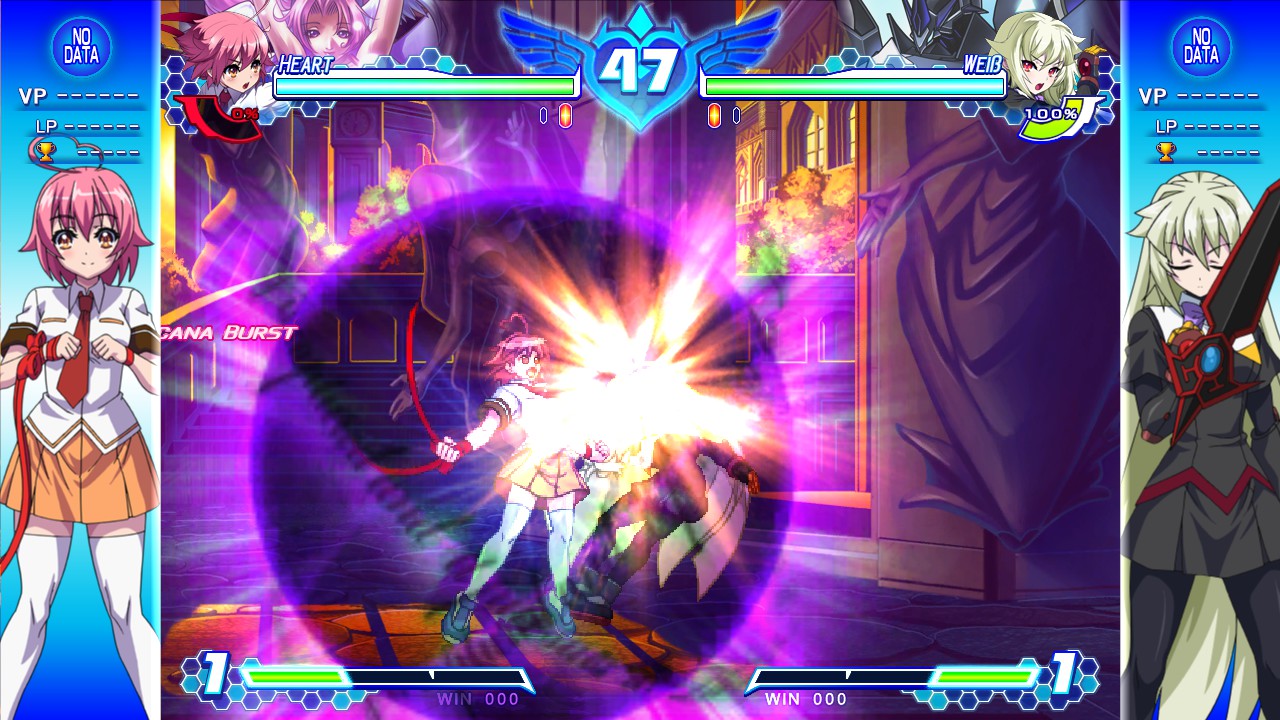
The bit that usually confuses me about modern fighting games is all the gauges on screen at any time. Arcana Heart, despite doing a piss-poor job of explaining these in the game itself, is relatively easy to understand once you know what they all do. Your health bar is self-explanatory; the little curvy bar next to it is called the "Focus bar" and allows you to trigger a short-lived mode where you move faster and have some other buffs; the bar at the bottom is your "Arcana bar" and is expended on super-special moves of various descriptions. The Arcana bar starts at one-third of its maximum possible value; in order to expand it, you have to land attacks or get hit, but the bar will only grow if it's not in the process of recharging. In other words, you have to restrain yourself a bit with the supers if you want to grow the bar to its maximum potential, which you'll need to do if you want to unleash the most devastating moves in your character and Arcana's respective arsenals.

arcana1

I absolutely haven't got my head around how to play the game well yet, but I feel I at least understand the basic systems, which is more than I can say for some other modern fighting games out there. I feel like with a bit of practice — as well as curtailing my tendency to panic when playing fighting games and lapse into button-mashing mode — I might be able to get the hang of this, and hopefully have the opportunity to teach it to some friends, too, as I can see it being a lot of fun against other people owing to its inherent ridiculousness.

A decent investment, then; I'll be curious to see how much — or indeed if — I improve with a bit of practice.

2089: Connect the Dots

0089_001

In response to The Daily Post's writing prompt: "Connect the Dots."

"Scour the news for an entirely uninteresting story. Consider how it connects to your life. Write about that."

When looking for "entirely uninteresting stories", your first port of call should almost certainly be your local newspaper. Sure enough, the Daily Echo didn't disappoint with this marvel:

BREAKING: City bridge closed due to 'police incident'

A SOUTHAMPTON bridge was closed this evening due to a 'police incident'.

The Itchen Bridge was shut at around 6.30pm but the exact nature of the incident is unknown.

And the bridge was quickly reopened at 6.40pm.

This is currently the top story on the Daily Echo website, which probably gives you an idea of the sorts of things that get posted on there. But let's ponder the actual question from the daily post: how this connects to my life in some way.

Well, okay. This is actually quite an easy one in many ways. The most obvious connection, of course, is that I live in Southampton, and consequently I know where the Itchen Bridge is. But the connection actually runs a little deeper than that: about five or six years ago, I used to live very near the Itchen Bridge in the town centre. The bridge itself was within walking distance, only about five minutes or so away. This didn't really have much of an impact on my life for the most part, as I tended to find other ways to cross the river owing to the toll gates at the other side of the Itchen Bridge. But during my oft-mentioned "difficult period" in my life — the time my first wife left and my life pretty much fell apart — the bridge became somewhere that I liked to occasionally head towards in order to just stand and reflect.

I don't think I ever seriously considered jumping off the bridge, though with my mental state at the time I won't lie to you: I certainly thought about it more than once or twice. Ultimately I knew that I'd never actually have the courage to do it, though, for all manner of reasons: firstly, part of me, despite being deeper in a pit of misery than I'd ever been in my whole life, I didn't really want to die; secondly, even contemplating that sort of thing made me feel guilty about the people I'd leave behind; thirdly, the idea of jumping off a bridge into horrible dirty water sounded both terrifying and unpleasant. And, I mean, I know killing yourself (or the contemplation thereof) isn't particularly pleasant anyway, but I kind of figured there were easier, less painful ways to do it.

That didn't stop me regularly going out to that bridge, though, noticing the Samaritans stickers on the railings every time I walked up to its highest point to look out over the water. I never called them — as I say, I knew that I didn't really want to jump — but they always gave me pause when I saw them. Perhaps they did help, in their own way.

Eventually I settled for getting these musings out of my system with a piece of creative writing. In the short first-person narrative — which was left a little open-ended in case I wanted to expand it into a full-on story at some point — the protagonist, who was very obviously me, walked out to a bridge that was very obviously the Itchen Bridge, tormented by his own despair, and jumped. At the last moment, he was saved from his seemingly inevitable demise by a character I'd created and had my own story in mind for; this particular little narrative was set after that other story, even though, to date, I still haven't written all of it. In other words, the character who saved me was the character as she was at what I had planned to be the conclusion of her original tale; as it happened, she fit nicely into this little fantasy scenario, though.

But I digress. How does this news story connect to my life? Well, my first thought upon reading the headline of the story on the Daily Echo website was "someone's probably jumped". Given that the bridge was re-opened after just ten minutes, though, I wonder whether that was really the case or not; at the moment, it looks pretty much like a non-story, despite its prominent billing on the Daily Echo website. I guess my thought process ran something along the lines of "I wonder if there would have been a story like that on the Daily Echo website if I'd actually given in to my despair and jumped back in those dark days?"

Bleak? Oh, absolutely and definitely. But, well, there you go. That's me.