1092: Modest-Breasted Heroine

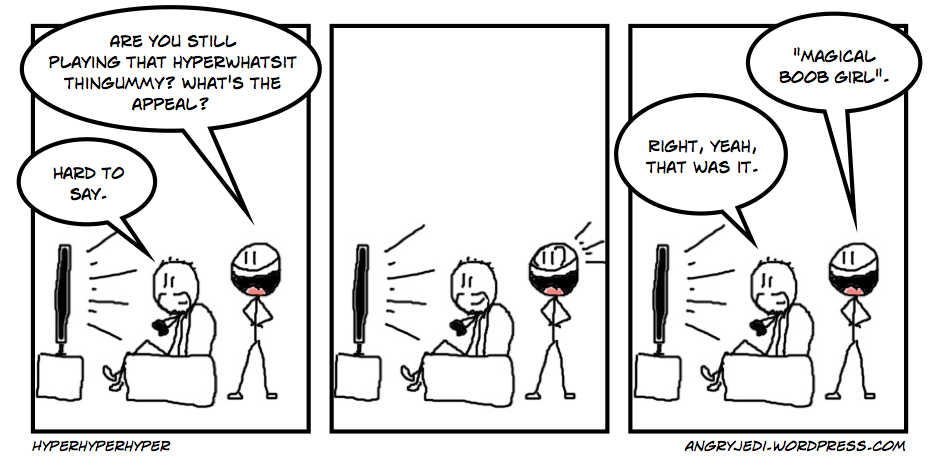
Page_1The title of this post is taken from a trophy I attained in Hyperdimension Neptunia today celebrating my acquisition of the character "Nisa", an embodiment of the game's Western publisher NIS America. ("Nisa", geddit?) Nisa wears a Bayonetta-style super-revealing leather catsuit unzipped to beneath her bellybutton, but is constantly ridiculed for having small breasts. She doesn't seem to mind too much, to be fair, even when surrounded by the heaving bosoms of squeaky-voiced Compa and Neptune in her, I quote, "magical boob girl" form.

Hyperdimension Neptunia revels in the sort of innuendo and playful, childish humour prevalent in a lot of anime, particularly of the moe variety. In many ways, it's quite refreshing to play a game that doesn't really hold back on the boob-related humour, but it's also easy to see how some might take issue with the game and its all-female cast's shenanigans. Having played it for more hours than I'd care to count (the game doesn't include the usual timer seen in most other RPGs) I can say with a fair degree of confidence that the game certainly doesn't mean any harm by all this — it's being bawdy and lewd for the sake of getting a few cheap giggles out of the player (regardless of gender) rather than explicitly "sexy", a few fanservicey "event" pictures and costumes aside.

More importantly, though, said bawdy humour is but a small part of the game as a whole. After a while it just becomes the way things are in that world; part of the aesthetic. The characters all do plenty more than comment on the size of each others' jumblies; they're all actually rather well-realised, if a little reliant on rather conventional anime tropes. (I swear this game has more tsunderes per square foot than anything else I've ever played… b-but it's not like I'm complaining or anything!) That said, the game often lampshades said anime tropes with the characters calling each other on when they're falling into particular stereotypes, and there are several who have occasional surprises up their sleeves.

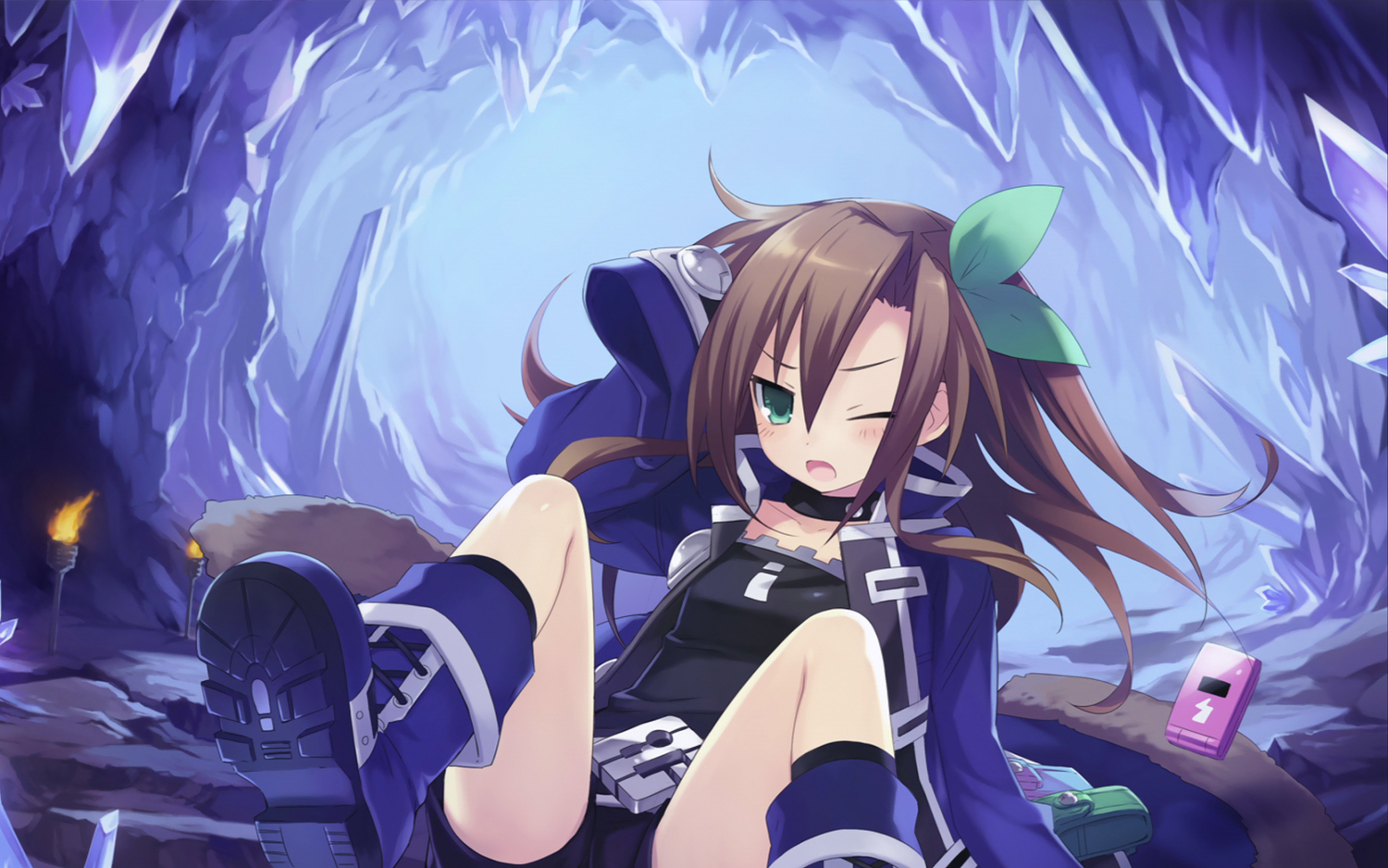
IF/Iffy/I-chan is a case in point. Initially appearing to be your stereotypical sour-faced textbook tsundere, Iffy quickly reveals herself to be quite an interesting character on the whole, particularly if you pursue the story arcs of the two DLC characters 5pb and Red. In the case of 5pb, we see Iffy acting as a confidante and counsellor to the chronically-shy idol, who is immensely insecure in herself when not hosting her radio show or performing her songs for fans. In the case of Red, we see Iffy humouring a childish girl's fantasies and showing a softer side to her sometimes gruff-seeming exterior. It would be easy for Iffy to tell Red and her "Wifey number 1!" babblings to take a hike, but instead she plays along, even going so far as to award her "charisma points" any time she does something good.

The "goddess" characters are something of an enigma at this point in the story, but it's quite amusing that the grumpiest of all the tsunderes in the whole game is the one supposed to be representing the Nintendo Wii, the happiest and most sunshiney of all consoles. The land of "Lowee" is a fantasy kingdom filled with houses that look like cakes, rainbows, mushrooms and bizarre, surreal happenings, but its ruler is a sour-faced, foul-mouthed young girl who would much rather lock herself in her room and read a book rather than have to deal with any of the events that are transpiring in the world. The PlayStation-themed goddess, meanwhile, is rather Gothic Lolita in her stylings (and very tsundere when in her "CPU" form) while the Xbox goddess is a sleepyhead blonde-haired, blue-eyed girl (anime shorthand for "foreigner") who is addicted to online games.

It's been a pleasure to discover the various layers this game has as I've progressed through it. The dungeon crawling is still very straightforward and unlikely to change significantly for the rest of the game, but the moves the characters are unlocking are becoming increasingly ridiculous, the time-attack dungeons are fun to challenge and the growing party means that I can start to take advantage of interesting mechanics such as the ability to switch party members in mid-combo.

The pacing is such that you never spend too long battling through endless random combats, either; each dungeon is short (if you know what you're doing and skip the excess of the attack animations you can clear each one in 3-5 minutes tops) and you're often rewarded for making progress with additional entertaining scenes between the girls. And as the game's narrative has continued, these characters have started to show that they have been crafted with what seems like genuine affection from their creators. There's a good sense of them being friends with one another, though the various "optional" characters don't put in nearly enough appearances in the story scenes. I guess that's understandable, though. The "core" of the game is the way the three contrasting characters of Nep-Nep, Compa and IF behave around one another; the others are relatively incidental characters whom you just happen to be able to take into batle.

I'm a little under 50% done with the game according to the menus, and I have no intention of stopping until I've finished it. Whether I tackle any of the free DLC dungeons (many of which have obscenely high "recommended levels") remains to be seen, but I certainly intend to see as much of the core game as possible. And then move on to the sequel.

So yes. I laugh in the face of Hyperdimension Neptunia's sub-50 Metacritic score. I'm having a blast, and you can't stop me! MWAHAHAHA!

1083: Hyperwhatnow Nepperwho?

Page_1I finished Trails in the Sky this morning (not last night — it got to 4am and I still hadn't reached the final boss so I decided to save it for this morning, and it was well worth the wait) so today saw that age-old question, "What to Play Next" rear its head.

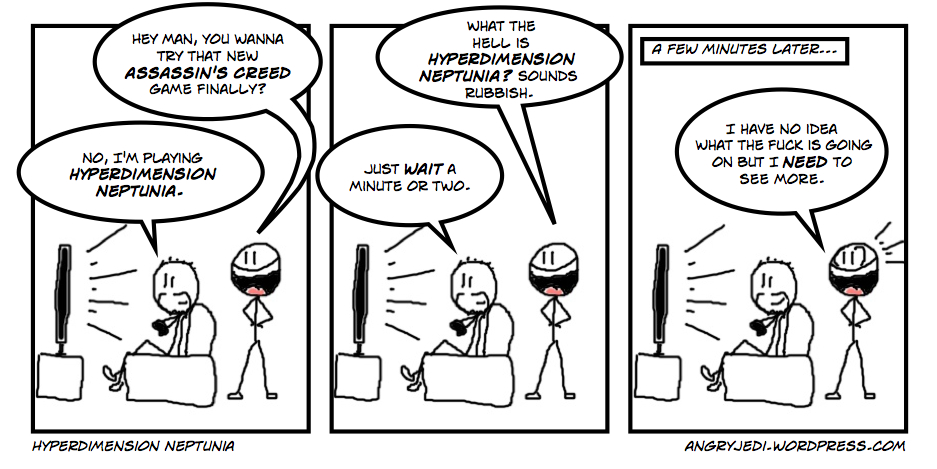
I fancied something light-hearted and silly, so I chose Hyperdimension Neptunia. I knew nothing about this prior to starting to play, and just knew that it was rather silly, very Japanese, packed with rather unnecessary fanservice (that I secretly quite enjoy) and not necessarily what you'd call "good" by the traditional definition. However, given that many of the games I've enjoyed most of all over the course of the last year have not been what you'd call "good" by the traditional definition (Nier springs immediately to mind) I was willing to give it a chance.

I think I'm going to like it.

Hyperdimension Neptunia casts you in the role of Neptune, a personification of the cancelled console the Sega Neptune. Cast out of Celestia by her goddess sisters (each of whom represents one of the Xbox, PlayStation and Wii respectively) and forced to fend for herself in the lands of Gamindustri, it's up to her to… well, I don't really know yet, as I haven't got that far and the events in the intro left her with amnesia which she conveniently points out is to help the players understand what is going on. I swear I'm not making any of what I just said up. This is indeed a game that represents the seventh-generation "console wars" as ridiculous anime-style battles between anthropomorphised hardware manufacturers.

Besides the silly premise, which I have a lot of time for, there actually seems to be quite an interesting game under there, too. The game unfolds in several distinct components — visual novel-style storytelling sequences; a "between missions" bit where you can shop, read background information and discover sidequests; and dungeon-crawling. The game isn't really a traditional JRPG in terms of structure — there's no wandering around field screens or towns, for example, and the story scenes all unfold using head-and-shoulders shots of the characters rather than in-engine graphics, like a visual novel rather than a standard JRPG.

Where the interesting gameplay comes in is in the dungeon-crawling component. Structurally, this is very straightforward — you wander around a dungeon finding treasure chests and occasionally getting into random battles. The characters in your party each have "dungeon abilities" that recharge over time that allow them to do different things — Neptune can smash through obstacles, for example, while Compa, a character who appears early on, can trigger tough battles at special summoning zones to temporarily lower the random encounter rate, and IF, another early character, has the ability to lead the way to normally-invisible treasure chests.

The battle system is turn-based, but makes use of an "ability points" system, whereby each character has a certain number of points that they can spend on their turn. Each move they do costs ability points, and up to four moves can be chained together into a combo. Certain moves allow the combo to continue registering with second, third, fourth sets of four button pushes, and the longer a combo goes on for, the better.

It's this combo system that provides some rather daunting complexity to the battle system. You're not limited to the basic skills the game provides for you. Rather, you can redefine pretty much any combination of four buttons to perform any of the character's unlocked skills to create custom combos. Some skills are learned through levelling up, others through acquiring CD-Rs and CD-R/Ws with skill information on. CD-Rs have preset skills; CD-R/Ws have customizable skills that you can rename and visually tweak by importing an image from your PS3's photo library. So yes, you can have a spell that summons, say, Twilight Sparkle to kick some ass. This is, as they say, awesome. And hilarious. It also gives people an actual reason to load some images into their PS3's photo library, which is surely worthy of praise.

So thus far it seems like an interesting game, albeit one with more than a few flaws. On the technical front, the frame rate and graphics aren't all that great (though the visual novel scenes look lovely and feature animated characters); the dungeons look like they might be a bit "samey" over time; and the game doesn't do a great job of explaining its more complicated aspects in detail. But, for me anyway, part of the joy in this sort of thing is in discovering the hidden secrets for oneself and working out just what the fuck is going on.

It's early days yet, but I've enjoyed what I've seen so far. Let's see if it has what it takes to keep me playing in the long run!

1075: Those Trails in the Sky Get Longer

[Author's note: See, I resisted the temptation to make another "Tits" joke in the headline. You should be proud of me.]

After a bit of a break to play some other stuff, mainly Persona 3: FES, I am back on my Vita and proceeding nicely with Trails in the Sky.

Trails in the Sky, for those who missed the earlier post I made about it, is a role-playing game for the PSP and Vita from Falcom. It also happens to be one of the best role-playing games I've played in recent memory, for a diverse array of reasons, some of which I've already talked about and others of which I will touch on today.

Plot-wise, Trails in the Sky isn't your conventional JRPG. I'm over 30 hours in now and there's been no trace of any villain wanting to take over the world, call down a meteor, kompress time [sic],  sit inside a mountain going "MWAHAHAHAHA" or indeed any of the other things that JRPG villains typically want to do. In fact, I'd be hard-pushed to identify a single "villain" as yet — there have been villainous groups and individuals, sure, but not a single character that I'd particularly identify as a specific "antagonist". No-one with silvery-white hair flowing down their back; no-one with a good line in evil laughs; no "evil empire" to fight back against. The closest we've had is a few men clad in black, and they're clearly working for someone.

While this may cause you to worry about the game being directionless — what's an epic RPG without an antagonist taunting you throughout making that final boss smackdown all the more satisfying? — in actual fact the opposite is true. The focus may be different, but there's most definitely a plot with direction and good pace going on here.

The focus in this case is the relationship between the two lead characters Estelle and Joshua, foster siblings and a classic case of a "will they, won't they" relationship that will undoubtedly come to smooches by the end of the game's 50-hour quest. The main thrust of the game's story is the pair's journey around the game world, training their abilities and learning more about themselves, each other and the way they feel about one another. Third and fourth party members come and go, but Estelle and Joshua are permanent fixtures, with the player taking direct control of Estelle for the vast majority of the game.

Estelle is a great lead character, largely because she's not a traditional female protagonist. She may be pretty cute visually — as a redhead/brunette with twintails, she's seemingly designed to appeal specifically to me — but personality-wise, she's certainly far from demure, cute or helpless. She's spunky, loud, opinionated, brash, sarcastic and quick to anger. At the same time, she doesn't deny her feminine side to herself — even if she seemingly tries to hide it when others are around. There are a number of scenes, particularly late in the game, where she tries to come to terms with her own feelings towards Joshua that give us some interesting insight into what she's really thinking behind her slightly-abrasive facade.

The side-effect of Estelle's somewhat tomboyish nature when she's around other people is that said other people tend not to treat her in a particularly "girlish" manner, often deriding her for not particularly conforming to gender stereotypes and acting in a "mannish" or "boyish" manner. She takes it in her stride throughout, often swiping such comments aside with a sarcastic rebuttal or two of her own, and you get the impression that she is someone who is thoroughly comfortable in who she is — or at least comfortable with the "public face" she shows to people. Despite her self-assuredness, though, a sure-fire way to make Estelle skittish and nervous is to bring up the possibility of her getting together with Joshua, which in many cases makes her literally want to run away or furiously deny any such accusations, even if it's blatantly obvious that she's thought about it more than once in her life.

I'm looking forward to seeing the game through to its conclusion. It's structured very nicely in that you always feel like you're doing something, and grinding has been absolutely non-existent so far. Wandering monsters provide relatively trivial amounts of experience points, and are primarily used to acquire the "Sepith" gems used to craft new special ability items called Orbments, and if you're that way inclined, you can race through most of the game without stopping to have random encounters at all if you don't want to — though you may find yourself struggling to acquire better spells if you do so.

In short, it's nice to play a JRPG that focuses on the good things about the genre — exploration, discovery, questing, character development and narrative — and doesn't force players to live with frustrating and outdated conventions like grinding. If you're an RPG fan toting a PSP or Vita, you should consider Trails in the Sky an essential purchase, as it is a fine example of how the genre is alive, well and more than happy to not follow the traditional Final Fantasy "OMG WORLD IS ENDING" route. (That's not to say that doesn't have a place, of course — I still love saving the world, but I'm well aware many others are sick of it.)

Check out the official website to find out more — and I believe there's a sequel inbound at some point in the near future, too.

1070: Victory and Answers at Last

I finished Persona 3: The Answer. I won't lie, I am more relieved than anything, but after such an ordeal I find myself glad that I have now played the complete Persona 3 experience from start to finish. (This is, of course, excluding the female protagonist's path through the PSP version, but I think I may need a bit of a break from Shin Megami Tensei for quite a while now — so that will have to wait!)

The Answer is a curious beast. All the while I was playing it, I had a big question in my mind, appropriately enough. That question was "should this exist?"

It's a fair question. Does it need to exist? I certainly wasn't unsatisfied with the way Persona 3's original story ended, but I was also excited by the prospect of it continuing, which is why I immediately picked up a copy of Persona 3 FES as soon as it came out, despite having bought the original at full price. (Both are still on my shelf. And yes, it has taken me this long to finally get around to actually beating FES. For those who aren't keeping track, FES came out in 2008. It is now nearly 2013.) I was excited by two things: firstly, the prospect of a "director's cut" of the main Persona 3 story, and secondly, by an additional 20+ hours of gameplay that resolved more than a few unanswered questions posed by the ending.

On balance, I think I am glad that The Answer exists, because the story that runs through it and particularly its ending are very satisfying — at least, they are if you've played through all of The Journey beforehand. I just wish that the execution was better.

It's sort of difficult to imagine how they could have done it differently, however. The core concept of The Answer is that the party have trapped themselves in the situation they're in through their own regrets and desires, which means that they're literally stuck in the same place at the same time on the same day until you beat it. This means none of the awesome "life sim" aspect of Persona 3 — no going out and going to school, no balancing whether or not you should go to Track Team or Music Club after school, no hanging out with the drunken old monk in the bar in the evening, no singing karaoke to build up your Courage statistic. Just dungeons. Fighting. Lots of fighting.

I like Persona 3's combat system. (I prefer Persona 4's ability to let you take direct control over all your members, but I still like Persona 3's.) There's nothing fundamentally wrong with the idea of an add-on campaign involving a whole bunch of fighting using what is a very good JRPG combat system. However, what is wrong with The Answer's gameplay is that it is regularly cheap, unfair and controller-flingingly frustrating, particularly when it comes to boss battles, and especially later in the game.

A key part of the Persona 3 combat system is learning the various weaknesses of enemies and then exploiting them to knock them down. Knocking all the enemies in an encounter down at the same time allows the entire party to unleash an "All-Out Attack" for massive damage, so generally speaking your aim in any battle is to knock down the enemies as efficiently as possible to trigger one of these, as they will usually if not finish the battle immediately, they will certainly tip the scales in your favour.

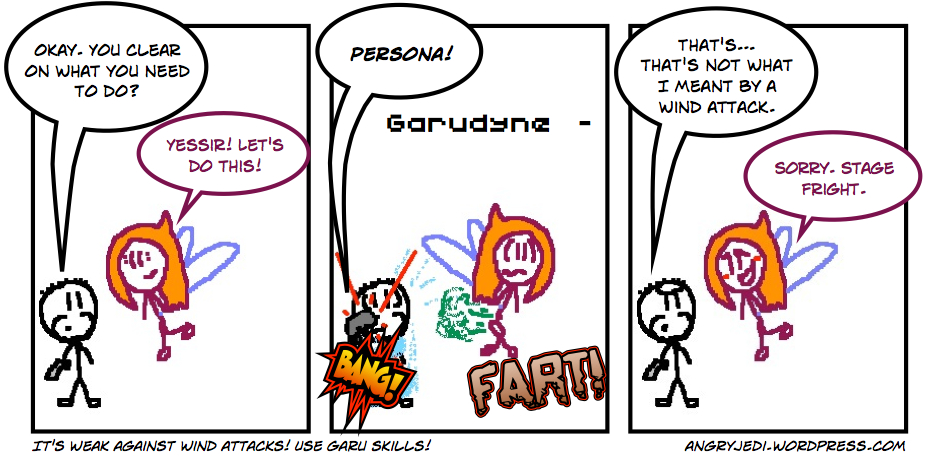
Here's the annoyance with The Answer's bosses, though — many of them have these weaknesses as in The Journey, but they also have passive abilities that allow them a not-insignificant chance of automatically avoiding any attack with the attributes they are weak to. For example, in one encounter there are three enemies — one is weak against fire, another is weak against ice, another is weak against wind. The one who is weak against fire has the "Evade Fire" skill, which means that on a significant number of occasions when you attack it with fire and attempt to knock it down, you will simply miss. The other two also have the corresponding "Evade [x]" skills, making it very difficult to actually knock them over and deal damage. I'm all for a bit of a challenge factor, but because these mechanics are so heavily based on luck rather than skill or strategy, it just felt incredibly cheap any time I died because of them.

To add insult to injury, The Answer's final boss, while spectacular to look at as all good final bosses should be, was almost insultingly easy to beat, making the big finale more of a test of patience more than anything else. Actually, I can't be too mad about this, because if I had to repeat the cutscenes leading up to that final battle as I had to repeat the cutscenes leading up to numerous other boss battles on a number of occasions earlier in the game, I would have probably been very annoyed. As it happened, I was able to take it down in one attempt, meaning the story kept flowing nicely at the moment when it needed to be pacy.

So after completing the whole shebang I am left with somewhat mixed feelings. On the one hand, I am happy that I saw the story end conclusively. I am satisfied that I successfully beat a very difficult game. But at the same time I am a little annoyed that a game as brilliant as Persona 3 has been slightly soured in my memory by the amount of annoyance The Answer gave me.

Am I glad The Answer exists? Yes, I think I am. Will I ever play it again? No fucking way!

1004: Thwarting The Fall

I finished Persona 3 FES: The Journey this evening, something I've been meaning to do for a very long time and finally got around to. Persona 3 remains one of my favourite games of all time, and the additions to The Journey — the story told in the original version of Persona 3 — are very welcome, offering deeper insight into the characters as well as some good old-fashioned fanservice.

Persona 3's biggest strength is also one of the reasons why I imagine an awful lot of people won't finish it: its length. Having played The Last Story earlier this year, I'm very much of the opinion that JRPGs don't have to be incredibly long to be tell satisfying stories, but in the case of Persona 3 and its sequel, both of which are somewhere in the region of 85-100 hours in length, I can't help but think that a lot of the respective stories' impact would be lost if they decided to reign things in a bit and keep them snappy.

Persona 3, for those who haven't played it, takes place over the course of a school year in Japan. You start in April, increasing amounts of Bad Shit comes to pass as the year progresses and you eventually finish either on New Year's Eve with a bad ending or on January 31st with a good ending. And you're expected to play through all the days in between, with only a couple of exceptions.

A day in Persona 3 typically consists of getting up, going to school (assuming it's a school day), perhaps answering a question or two in class, hanging out with friends after school then either going dungeon-crawling, studying or socialising in the evening. The format occasionally gets shaken up with public holidays (and Sundays) when you don't have school to worry about, and there's a couple of trips out of the game's main Japanese town setting at specific points in the story, but for the most part you are living the life of a Japanese teenager, albeit one who fights monsters after midnight.

It's a long, slow slog through the game's days, in short, but it's only through dealing with this that you truly come to respect the sacrifices the game's main cast has made in the name of trying to build a better world and beat back the darkness. Sometimes you really want to hang out with that hot girl who seems to have taken an interest in you, but instead you know that you should go shopping with the nice policeman who sells you various sharp implements, then go climbing the mysterious tower that appears after midnight and start twatting some Shadows in the face. Having to find this optimum "work-life balance" means that the time you do actually get to spend with your in-game friends becomes more precious — particularly as each of the "Social Link" stories that is attached to each person ends up being interesting and often emotional.

By the time you reach the game's final battle, you have been through Hell and back with these characters, both in terms of having to cope with the everyday stresses of teenage life — exams, angst, friendship drama — and in having fought your way through hordes of Shadows to strengthen your party. By the time the final boss appears, you are ready to kick some ass and save the world.

And then the final boss fight takes somewhere in the region of an hour to complete. The game isn't going to let you win so easily. It's not an especially difficult fight if you've prepared appropriately, but it is long — a test of endurance… and of whether or not you remembered to stock up on items before wandering into the dungeon. It's not boring, though — it's paced in such a way that it shakes things up regularly, requiring you to change and adapt your strategies accordingly, particularly as you get closer and closer to final victory. By the time you finally take down the boss and get onto the "home straight", as it were — and there's actually a surprising amount still to see even after you've kicked its ass — you are physically and mentally exhausted, just like the characters, and the game knows this, hitting you with some intensely emotional scenes while you're weakened.

Persona 3, then, uses its length to its advantage. While there is plenty of stuff in there that is clearly designed to allow masochistic players to inflate their play time yet further (I didn't beat the Reaper, for example, and I seriously doubt I will ever seelet alone beat the "Ultimate Opponent" secret boss that only appears in New Game+) for the most part, it's good stuff that allows you to immerse yourself in the small but very well-realised game world. You're either doing teenagery things, or you're fighting Shadows. Fight too many Shadows and you'll exhaust yourself, meaning you'll need to make sure you get some rest before you do anything strenuous — but while you recover, all your friends are waiting for you.

There's always something to do and someone to see, and meanwhile the clock is ticking ever-onwards towards an inevitable conclusion. As time passes, everyone's life goes on — even the incidental NPCs sitting around in various locations all have their own stories to tell that progress gradually as the seasons turn. Will the shy girl ever talk to the boy she's stalking? Will the girl who's obsessed with Mitsuru ever confess her feelings? Will the elementary school student at the station ever stop being a jerk to her obviously-nervous new teacher?

"Bonds of people are the true power," runs the tagline to the Persona 4 anime, and it's right. Both Persona 3 and 4 are what they are because of the people in their respective game worlds. After 80+ hours with them, it's difficult to not feel a sense of attachment to them — even the most seemingly-innocuous incidental character. This sense of "belonging", of immersion in a game world with realistic, believable characters — that, right there is why I love these games so much.

On to The Answer next, which I know nothing about beyond the fact it's supposedly very difficult and wraps up the ambiguities left by The Journey's ending. I'm very intrigued to see how it concludes for real, so doubtless you can expect another post on the subject after another 20 hours of gameplay or so.

#oneaday Day 866: NierCast

20120603-013721.jpg

I've finally beaten Logic into submission and got it up and running on my new Mac, which means I've finally been able to edit the most recent Squadron of Shame SquadCast. Here it is:

(Direct link for those who can't see the inline player)

The subject of the podcast is Nier, an action RPG for PlayStation 3 and Xbox 360 published by Square Enix and developed by Cavia. You may recall I was enthusing about this game quite a lot back in early May, and that enthusiasm was what sparked the desire for us to do this particular podcast.

Nier is a fascinating game. Whether or not it's actually a good one is up for debate somewhat, but it's certainly a unique experience in the console space. In fact, to call it an "action RPG" as I did above is a gross injustice, since the game also incorporates elements of bullet hell shooters, text adventures, 2D platform games and open world quest-based "traditional" RPGs. The only games I can think of that offer a comparable experience include Space Rangers 2 and King Arthur: The Role-Playing Wargame, both for PC, and both offering wildly divergent experiences from Nier, but both taking this "kitchen sink" approach to genre blending.

Nier also distinguishes itself by having a mature plot that is worth following through. Sure, it's pure fantasy, but it's good, compelling fantasy — and the fact that the game was released as part of a much larger opus that spans several forms of media is very much apparent if you take the time to read up on it using sources such as Grimoire Nier. The game can most certainly be enjoyed in its own right without exploring any of the additional background material, but it becomes a far richer experience once you delve into the lore of the world — and, for that matter, the story of the game's creation. It's very much an example of a game whose world and characters are "bigger" than the game they inhabit, much like an author who plans out their characters by writing scenes for them that never appear in the book in question.

Perhaps the most interesting thing about Nier, though, is its treatment of "New Game+" — the ability to go back and replay it after you've beaten it once. In many role-playing games, taking on a New Game+ is simply a matter of starting again with all your awesome items, equipment and buffed-up characters from the end of your first playthrough and then romping through the game slicing off heads with gay abandon and nary a fear for your own safety. Nier certainly does this — on subsequent playthroughs, boss fights that were once challenging are an absolute joke — but it's not the most important point.

Without getting into spoilers, Nier's New Game+ gradually adds new layers of complexity and nuance to the plot, calling into question the actions that you undertook without even thinking in your first playthrough. The player is given additional context with which to understand exactly what is really going on — and this manages to seamlessly pull the player's perspective around between several different characters and conflicting viewpoints while still keeping them in direct control of the titular hero. It's a very interesting experiment in a variation on the "unreliable narrator" trope, and one which could really only be done so effectively in an interactive form of entertainment such as a video game. It also makes Nier's New Game+ something that is actually worth doing rather than something which is just there for a bit of fun — and it's worth noting that it makes it abundantly clear when you've done absolutely everything there is to do by actually deleting your save file when you're done. In the context of the game, this somewhat dramatic action makes a great deal of sense (though you are asked to confirm whether you're sure you're okay with this five times) — but can you imagine what would have happened if, say, Mass Effect had pulled something similar? It would have been brilliant, but those complaining about the game's ending would have been even more furious than they are.

The final thing worthy of note about Nier is that it takes no more than 40 hours to do absolutely everything in the whole game including three New Game+ runs (an utterly stupid real-time farming minigame aside, which can be easily gamed by dicking around with your console's clock), making it eminently friendly to the busy lifestyles we grown-ups tend to lead these days.

So if you've never given Nier a shot, give it a chance. You might be pleasantly surprised. And if you have played and loved Nier — or, indeed, have no intention of ever playing it, ever — be sure to listen to our podcast for some in-depth discussion on this remarkable game.

#oneaday Day 829: Nier: Some Early Impressions

20120427-003819.jpg

I've been playing Nier, a game I've been meaning to try for absolutely ages and struggled to find a copy of. As it happens, my local second-hand games emporium had a copy, allowing me to sample its delights. Like many titles I've wanted to try for a while, I've managed to go into the experience with a relative sense of "beginners' mind", allowing me to enjoy it as if it were "new", so to speak. This, I feel, is a key part of the Nier experience, since it continually throws you curveballs as you play, remaining constantly surprising.

At its heart, Nier is a simple action RPG, but to call it that is to do it a gross injustice. The hack-and-slash combat may be a bit simple, but when combined with the variety of bizarre magical attacks Our Hero gains the capability to perform over the course of his adventure, the gameplay is shaken up regularly enough to keep you questioning exactly what sort of game it is that you're really playing.

So far I've experienced open-world "run around and kill shit to get their stuff" gameplay; lots of "fetch quests"; side-on platforming sections; top-down Zelda-style sections; fishing; "bullet hell" shooter sections… and I have little doubt that the game has further surprises along the way.

Nier subscribes to the "less is more" viewpoint by taking place in a relatively limited geographical area. Within these relatively few zones, however, lots of things happen. Locals have their own little questline stories to follow, many of which end in surprisingly bleak tragedy. Some people drop a few hints about Nier's curious far-future setting. It's quite a believable world at times, and your attachment to it as a player grows as Our Hero tries his very best to Do Good.

One of my favourite things about the game so far has been the stark contrast between the random errands you find yourself doing for locals and the more intense, "main story" stuff which tends to culminate in ridiculously over the top boss fights. For the best part of 10 hours, for example, I barely gained any experience points whatsoever, instead choosing to pursue quests. In the process I acquired plenty of items and money, but most importantly I learned a great deal about the world of Nier and its characters. It's a vaguely similar approach to what The Last Story does with its completely optional, often seemingly reward-free sidequests on Lazulis Island. By immersing yourself in the lives of the characters going about their day to day life, their struggles carry greater meaning when things start to get a bit crazy.

The writing is worthy of note, too. Early in the game, Our Hero acquires a sentient magical book known as Grimoire Weiss, and there are some extremely well-scripted sequences between the two of them prompted by all sorts of things — starting a new quest, going fishing, coming across a new location. The very British-seeming sarcasm of Weiss is juxtaposed beautifully with Our Hero's stoic determination — but Nier himself isn't above the odd sarcastic comment. "Try not to get crushed!" yells Weiss during an intense boss battle that carries the risk of being crushed. "That's good advice, thanks," spits Our Hero sarcastically as he rolls to escape the aforementioned fate.

I'm given to understand that there are numerous endings to the game requiring several playthroughs to fully appreciate, so I'm going to reserve full judgement and further comment on the game until I've done exactly that. I will say, however, that I am having a blast with it so far, and am even enjoying running back and forth doing errands for the people of Nier's world.

Expect further bulletins as events warrant!

#oneaday Day 828: It's Time to Get Over the Graphics Thing

20120426-001100.jpg

I read this piece on Game Informer tonight. It made me cross. If you can't be bothered to read it yourself, the gist of the piece is that Xenoblade Chronicles, one of the best games of the generation (in my humble opinion, anyway) "deserved better than what [Nintendo] forced [it] to be."

To be fair to the author Chris "Warcraft" Kluwe, he does commend the game's strengths: its excellent world, its inventive, creative ideas; even going so far as to say that the game had the potential to be "this generation's Final Fantasy VII". But to say that the Wii "laughs at [developer MonolithSoft's] dreams… and flushes them down the toilet of GameCube-era hardware Nintendo likes to call cutting edge" is a spectacularly blinkered viewpoint.

The fact is, it's unlikely that Xenoblade Chronicles (and its spiritual successors The Last Story and Pandora's Tower) would ever have been released had it not been for the Wii. The Wii's lower demands in terms of asset production means that a sprawling, ambitious game such as Xenoblade Chronicles can be produced on a fraction of the budget of an HD title. Even then, though, MonolithSoft had to cut corners; the "gasping fish mouths bobbing up and down through beautifully crafted dialogue" that Kluwe refers to are a symptom of this.

The sad fact is that Japanese role-playing games are not the unstoppable juggernaut they once were. Where once they were a system seller, now they are a niche interest at best. The "mainstream" has shifted well and truly to the West; even Square Enix's venerable Final Fantasy series is seen as little more than a particularly well-polished curio these days. Big-budget role-playing titles for HD consoles such as Lost Odyssey and, to a lesser extent, titles like Nier (aside: which I'm currently playing and is awesome) struggle to find a substantial audience (compared to "triple-A" titles, anyway) and, by extension, the ability to recoup the enormous spend necessary to craft a beautiful world in high definition and 5.1 surround sound. So developers and publishers simply aren't taking the risk because it's, well, too risky.

But the Wii gives them a platform to make these titles without having to spend as much money and time on the creation of assets. It's not a case of Nintendo "shackling an obviously talented team like MonolithSoft to the ball and chain of the Wii because [they] want to sell waggle" (for just one of many things wrong with that statement, Xenoblade Chronicles features no waggle whatsoever). It's a case of Nintendo giving talented teams the opportunity to do what they do best and then release them to a market of enthusiasts who are still clamouring for these titles. Yes, the Wii has a lot of waggle-based crap. But it also has an impressive library of Great Games That Absolutely Fucking No-One Has Ever Heard Of Ever Because They're A Bit Weird Or Nichey And Have 480p Visuals.

Just because JRPGs don't sell well compared to titles like Call of Duty and Mass Effect doesn't mean that no-one wants to play them any more. In fact, the audience for the genre is probably actually the same size that it's ever been; the difference is that the Call of Duty players have sprung up around them and outnumber them considerably. Given the simple choice between making something that will make fans happy and something that will make a metric fuck-ton of money, the vast majority of publishers will take the latter option. That's simply "good business", and there's nothing wrong with that at all — developers gotta eat, after all. But to deride Nintendo for providing a platform eminently suited to developers who actively want to create niche titles for console — games which often provoke intense passion among their fans (as you can probably tell from this post) — is simply ridiculous.

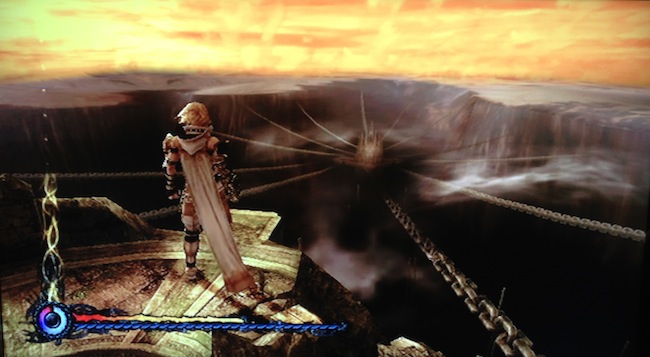
It's an age-old adage in the games industry that graphics do not maketh the game. Never has it been more true than in this strange period where we have two HD consoles and one SD system. Would Xenoblade Chronicles, The Last Story and Pandora's Tower have been better games had they been released on the Xbox 360 or PlayStation 3? Absolutely not. (Pandora's Tower, in fact, would have been considerably inferior due to the fact it actually makes good use of the Wii's unique control scheme.) They would have been better-presented games, sure, but the core gameplay in all three cases is brilliant — and, to add insult to injury, the graphics for all three aren't even what you could possibly describe as "bad" — just low-resolution. There's a difference — sadly, one seemingly lost on many reviewers who describe their visuals as "muddy" or "poor" and, in many cases, knock a point off the final score in punishment. I defy anyone who has stood on the Makna Falls overlook in Xenoblade Chronicles, seen the beautiful afternoon sunlight and shadows in the castle courtyard in The Last Story or stood atop the Observatory gazing towards the Thirteen Towers at sunset in Pandora's Tower to say that these games have "poor" visuals.

As such, I implore those of you who are gamers to stop caring so much about titles having pin-sharp graphics, fully orchestrated soundtracks and a voice cast of Major Hollywood Talent. Yes, these things make games more impressive and exciting to watch and play, but given the choice between a world made up of nothing but HD first-person shooters starring Morgan Freeman (with the world's population of racist teenagers on backing vocals via Xbox Live) and a world where I can play 100+ hours of Xenoblade Chronicles in 480p with a selection of unknown (but excellent) British voice actors, I know which I'd rather spend my time in.

That's just me, though. I illustrate my blog with stickmen, so take my word with a pinch of salt if you wish.

(Edit: Here's an unedited picture of Pandora's Tower running in 480p taken with my iPhone camera. Looks pretty lovely to me.)

#oneaday Day 808: Xenoblade Chronicles is Out Tomorrow, and Here's Why You Should Play It

20120406-005656.jpg

As a European, I was lucky enough to be able to play the Nintendo-published, MonolithSoft-developed Wii role-playing game Xenoblade Chronicles last year. It ended up being my favourite game of 2011, and many North American gamer friends were suitably jealous that I had been able to play it through while they hadn't. I didn't feel too guilty, though, because North America has its own branch of Atlus and doesn't have to depend on other publishers to bring titles like the Persona series over.

But I digress. Xenoblade Chronicles is out tomorrow — April 6 — in North America, and here is why you should play it if you're an American. Or even if you're not.

The Japanese role-playing game genre is often accused of stagnation and a lack of innovation. This is, in fact, not particularly true — even the much-maligned Final Fantasy XIII was trying things which other role-playing titles hadn't attempted before. Okay, they weren't always successful, but it was at least attempting to innovate.

The real issue is actually that for whatever reason, Japanese role-playing games (and, to a certain extent, Japanese-developed games in general) have lost the resonance they once had with the core gamer audience in the West. Players are quick to judge them as clichéd and derivative before moving on to whichever game starring men in armour with guns is the flavour of the week. Specific attempts by Japanese developers to create games that appeal to Westerners end up having limited niche appeal despite their quality (see: Platinum Games' Vanquish, which isn't an RPG but demonstrates the point effectively) or end up being laughable attempts to pander to the Japanese image of what a Westerner supposedly wants (see: The Last Remnant).

Xenoblade Chronicles is a remarkable game because it nails that balance between Western and Japanese sensibilities, making a game that combines the positive aspects of WRPGs (freedom, exploration, a degree of sort-of-non-linearity) with those of JRPGs (stronger storytelling, more memorable, well-defined cast members, a firm sense of being unafraid to continually up the ante). The result is quite brilliant, and a significant step forward for the genre in one possible direction it way wish to take in the future.

The game casts players in the role of Shulk. Initially, he seems like every other teenaged JRPG hero, but a number of aspects make him stand out. He doesn't whine. He's not moody or angsty. He's just a guy, but he has a personality. He has friends, too, who form your early party in the game, and these, too, don't fall into the trap of clichéd character archetypes. This pattern continues throughout the course of the whole game. Even the "small furry thing" character introduced later in the story isn't typically irritating — he's quirky and silly, sure, but his character is defined well, and he proves to be more than just a means through which to provide silly slapstick gags.

The diverse, likeable cast you find yourself travelling with over the course of Xenoblade Chronicles' lengthy adventure provides several highlights to the game experience. Firstly, and most simply, they're a good ensemble cast who help drive the story forward. That's not their only function, however. As you might expect from an RPG, they each have their own role to play (natch) in combat, and finding the best combinations of three characters to take into battle is a key part of the experience. This affects not only your battle effectiveness, but also one of many stats that the game tracks in the background — Affinity.

Affinity is, quite simply, how much characters like each other. Characters with high Affinity with one another fight better alongside each other, but as their relationship develops, they also have the opportunity to participate in numerous "Heart to Heart" events that are scattered around Xenoblade Chronicles' vast world. These short sequences provide the opportunity for two party members — not necessarily including protagonist Shulk — to spend a little alone time with one another and get to know each other a little better. These typically involve multiple-choice conversations, providing the "correct" answers to which will give a big boost to the pair's Affinity with one another. (Giving "incorrect" answers often provides very amusing exchanges and still gives a smaller Affinity boost, however, so you shouldn't feel like you have to reach for the walkthroughs immediately.)

Affinity doesn't just affect combat and unlock Heart to Hearts, however; there's a host of little touches in the game that it affects, most notably during and after combat. Rather than simply yelling individual stock "battle victory" phrases, characters will often have short conversations with one another. This banter between characters is a real highlight of the experience, and while you will have heard everything they have to say a good few times by the end of the game, they remain entertaining and endearing.

Speaking of combat, Xenoblade Chronicles' battle system is a refreshing change from the turn-based systems that Japanese role-playing titles usually adopt. You control a single character out of the three in your active party, and are able to freely move around during combat. You and your party lock on to a single enemy at a time and automatically attack it, though many battles involve multiple assailants. In order to gain the upper hand in battle, it becomes necessary to make use of the unique skills the character under your control has.

Most characters have more skills than it's possible to hold in the "quickbar" at the bottom of the screen, so it becomes possible to customize the way they play to your own personal style. Some skills manage aggro, some attack areas, some provide more damage or inflict status effects when unleashed from beside or behind an enemy. Some skills are dependent on other characters doing things like knocking the enemy down or stunning them, and the AI which controls the other two party members does an absolutely astounding job of keeping up with what you're doing and understanding the strategy you're going for. It's very rare that you will be cursing the game for causing you to fail — more often than not it's a result of you either adopting a poor strategy, or simply needing to go and do something else for a while until you're a little stronger. This doesn't mean you have to resort to grinding, either — inevitably there will be some quests you have missed that you can go back and do, and returning to earlier-visited locations often throws up even more things to do.

Another great thing about the combat is that you can elect to control any of the game's cast in battle, not just Shulk. Each character plays in a significantly different manner to all of the others, so if you find yourself getting bored of the same old skills over and over, simply switch to another character for a brand new experience. Fed up of tanking? Spend some time with Sharla, a ranged character with healing abilities. Or Melia, a magic-user who can summon elementals that either provide ongoing buffs or can be "unleashed" to deal direct damage. Or the aforementioned small furry creature, whose skill names are genuinely hilarious.

Perhaps the strangest but coolest innovation in the combat, however, is the fact that you're occasionally presented with "visions" of the immediate future, usually when a character is either about to die or be afflicted with a debilitating status effect. A countdown timer starts, and you're given the opportunity to either do something to take attention off the enemy's target or warn another party member. If you do the latter, you're able to pick one of the warned character's skills to unleash — usually either a healing or aggro-management skill — and hope for the best. If you do the former, you have until the countdown timer depletes to do something very special, or your party member will suffer their grisly fate. It's a neat system that isn't overused.

Outside of combat, there's plenty to do, too. Exploring each of the game's massive zones rewards you with experience points and uncovers part of the map as you discover each sub-area. There are collectible items scattered around each area at random, with rewards on offer for collecting whole sets. Those who find item-hunting frustrating, however, may instead complete these quests by trading with other non-player characters. There are rare monsters to take down, loot to find, secret locations to discover. Xenoblade Chronicles' world is more than just a pretty backdrop for combat — it's a rich, beautifully-rendered environment in which to spend time, and it looks gorgeous. This may be a Wii title, and it may have been even more lovely to see it in HD, but it doesn't detract from the fact that the hugely-varied vistas you find yourself running and fighting over throughout the course of the game look simply magnificent. There's a waterfall you'll come across partway through the game which is genuinely breathtaking to look at, for example — you'll know it when you see it.

If the game's combat, quests and exploration aren't enough for you, there's also a deep Achievement system to delve into. Since these Achievements aren't online-connected, they're simply there as challenges for you to undertake, and all provide you with experience point rewards. In essence, they're mini-quests (although some will take you the majority of the game to complete) and rarely feel as "gratuitous" as some examples seen on Xbox Live and PSN. Rather, they provide yet another means of getting an enormous amount of entertainment out of an already vast, sprawling title.

This isn't even getting started on the deep crafting system, which allows characters to team up to create enhancements for their weapons and armour, with the results of their collaborative efforts dependent on their Affinity and compatibility with one another. Or the fact that the game allows you to change the time and fast-travel at will, eliminating a lot of the inconvenience and backtracking endemic to the genre. Or the colony-building minigame. Or the fact the voice acting is all British rather than American, giving the game a unique aural aesthetic in a genre typically dominated by whiny teenagers and squeaky-voiced females. Or the fact that when you're all done, you can New Game+ it and do the whole thing again with your levels, Affinity and a suitably broad spread of awesome equipment intact — something I will be doing when North America gets its hands on the game tomorrow.

Xenoblade Chronicles is, in short, a magnificent evolution of the Japanese role-playing game genre. While it's easy to dismiss it as "an offline MMO" or "a Final Fantasy XII wannabe", the reality is something quite different. This is truly a game that is greater than the sum of its already-fantastic parts, and one which will have you bellowing "Now it's Reyn time!" at your friends for months to come.

(Grab yourself a copy soon, though, as this is the kind of game that will get pretty tough to find pretty quick.)

#oneaday Day 806: Shadow Hearts: Covenant: A Scoreless Review

20120404-003526.jpg

Shadow Hearts: Covenant (aka Shadow Hearts II) is, quite simply, a must-play JRPG. Whether you're a devoted fan of the genre or a jaded veteran who decries its supposed lack of innovation in recent years, there is a ton of stuff for you to like in this epic PlayStation 2 title from Nautilus (née Sacnoth).

Let's rewind a moment before we get into specifics. Is it necessary to have played the original Shadow Hearts to appreciate its sequel? As you'll recall, I noted that the previous game hadn't aged hugely well, with its pixelated prerendered backdrops, wooden animations and low-budget voice acting bearing the brunt of the ageing process. It's still a solid game, but those who expect a bit more than a PS1 RPG that runs at 60 frames per second may find themselves suffering from culture shock for a little while — whether or not that culture shock is insurmountable depends entirely on the individual.

To answer the question, though, yes and no. That may be a copout answer, but it's true. Shadow Hearts: Covenant's story stands completely by itself as a self-contained tale, but it also follows on directly from the first game's narrative. There are a number of shoutouts throughout the course of the adventure which refer back to prior events, characters and locations, too, which will delight series veterans. In short, if you can't stomach the old-school sensibilities and aesthetic of the original, you can jump into Covenant without guilt, but those who are willing to play the two games one after the other will have an altogether deeper experience to appreciate.

What makes Covenant a more easily-palatable title than its predecessor, however? Many things, starting with the presentation. Rather than taking the old-school approach of polygonal characters on a prerendered backdrop, Covenant features fully 3D environments, albeit with preset camera angles a la Final Fantasy X. The characters have been infused with a great deal more detail, too, with hair and fur looking particularly good, and some excellent animations thanks to motion capture. Alongside this, the voice acting has been given a kick up the arse, with a full English dub, fully-voiced cutscenes for the more important story scenes and none of the original's corner-cutting. Were it not for the lack of widescreen support, this game wouldn't look out of place today being released alongside titles like Xenoblade Chronicles and The Last Story.

Like its predecessor, Shadow Hearts: Covenant revels in the fact it has an eccentric cast who rarely fall into standard JRPG tropes. While protagonist Yuri initially appears to be the moody "Squall" type, he quickly shows himself to be a deeply-nuanced character who undergoes some significant development over the course of the story. As he's joined by the other cast members, who include a puppeteer, an exotic dancer/fortuneteller/aromatherapist, a female German World War I officer (whose nationality and occupation quickly becomes completely irrelevant) and a fricking wolf among others, it becomes abundantly clear that we're not dealing with a conventional sort of JRPG setup here. To its credit, the game plays things admirably straight all the way through, which makes its more humorous scenes all the more effective — and proves that it's not afraid to make its characters suffer a little along the way in the name of drama. It doesn't descend into exaggerated melodrama at any point, and for the most part resists the temptation to get too wacky. Characters occasionally make a few "fourth wall"-breaking comments, though these are spread far enough apart to be effective and amusing rather than feeling like the game is going "LAUGH, DAMMIT!" A few characters are a little underdeveloped and underused over the course of the story (and one in particular is introduced much too late to give the player a chance to get to know them as well as the others) but this is a relatively minor niggle — those who are most important to the narrative are well-defined, deep, likeable cast members whom it's a pleasure to spend time with.

An RPG often lives or dies by its story, and thankfully Covenant provides a good one that I won't spoil here. But those who play for the joy of discovering things and building up an unstoppable fighting force won't be disappointed, either, for Covenant provides a brilliant combat system that puts many recent titles to shame. Based around the cool "Judgement Ring" system of the original game whereby successful actions are determined by timed button presses, and featuring multi-character combos, an array of wonderfully silly character-unique abilities and a flexible but simple magic system that allows for the detailed customisation of characters, Covenant is a satisfying game to play even during plot downtime. While each "dungeon" only contains maybe three or four different types of enemy tops (plus a boss, usually), combat is such a joy and the encounter rate is so finely tuned that it never becomes a chore. The fact that grinding seems relatively unnecessary if you take a little time to go and do some sidequests — which are worth doing, incidentally, as they feature some of the best scenes in the game — is also a pleasing development.

In short, the whole thing comes together to create a joyful whole that will keep you busy for about 40-60 hours depending on how much optional stuff you want to do. It's a good length — while it's approximately twice the length of its predecessor, it never feels like it's outstaying its welcome, with a wide variety of locations to explore, treasures to find and creatures to fight. Completionists who like to explore and find all the hidden secrets in a game will be amply rewarded, while those who simply want to charge ahead with the plot won't find themselves punished for wanting to progress.

As I said at the beginning, Shadow Hearts: Covenant is, quite simply, a must-play JRPG. Should you have the opportunity to pick up a copy, do so. I'm disappointed I didn't take the time to explore this series sooner, as it's shot to somewhere around the top of my list of favourite games of all time. I am, however, very glad that I took some time away from the mainstream, from current-generation consoles and from the shitstorm surrounding Mass Effect 3 to immerse myself in a true, underappreciated classic. You should try it, too.