#oneaday Day 797: Enthusing Regarding Shadow Hearts: Covenant

20120326-020545.jpg

Haven't written about what I've been playing for a little while, so here's an update.

I'm currently playing Shadow Hearts: Covenant, aka Shadow Hearts II. If you've been reading my previous entries, you'll know that this is the second entry in a PS2-based RPG series published by Midway (in Europe, anyway) and developed by Nautilus (nee Sacnoth). If you haven't been reading my previous entries… uhh… Shadow Hearts II is the second entry in a PS2-based RPG series published byMidway (in Europe, anyway) and developed by Nautilus (nee Sacnoth).

Jesting aside, Shadow Hearts II is a significant upgrade over its predecessor. Where the original Shadow Hearts could have easily been a PS1 game, with its prerendered backgrounds, polygonal characters and turn-based combat, Shadow Hearts II is not only a fine example of a PS2 game, but a game which still stands up remarkably well today regardless of platform. Replacing the original game's prerendered vistas with a 3D world full of dynamic (but still game- rather than player-controlled) camera angles is the most obvious difference, and it's striking what a change it provides. Shadow Hearts didn't look bad but it did suffer a little from characters standing around somewhat woodenly when having conversations. Shadow Hearts II, by comparison, takes a much more cinematic approach to its presentation and looks great as a result. It helps that the character models are fantastic and well-animated, too — this really is a great-looking PS2 title.

Going hand-in-hand with the cinematic presentation of the visuals is the move to the game being mostly voiced rather than almost entirely text-based. This has the sad side-effect of meaning it's no longer possible to rename your characters, but since the original Shadow Hearts featured a voiced ending sequence in which the default names of the characters were used even if you'd played for over 30 hours with a party sporting a completely different nomenclature… well, I can deal with that. The voice acting is mostly decent, but pays absolutely no attention whatsoever to the countries that the cast members are supposed to be from. Leading lady Karin, for example, is supposed to be German, but she sure doesn't sound it. It doesn't take long for the suspension of disbelief to kick in, however, as you immerse yourself in Shadow Hearts' surreal parallel reality in which World War I is happening at the same time as Bad Shit is going down with demons and monsters. Eventually the fact that everyone from a wide range of different nations all sounds American ceases to matter, and the fact it's set in the real world alongside real-life historical events and figures becomes almost incidental. It just becomes a cool JRPG story in which the place names sound very familiar.

I'm not going to talk too much about plot here as I'll save that for a post once I've finished the game, so instead I'll now dwell a little on some mechanical highlights from the game — specifically, the combat system.

Shadow Hearts featured a functional, fun combat system that didn't deviate hugely from the traditional turn-based "heroes line up one side, enemies line up the other, polite violence ensues" system used by many RPGs over the years. The main twist on the formula was the use of the Judgement Ring, which required carefully-timed button presses to ensure the success of actions. More powerful, complex moves required more button presses, while the use of the Ring also allowed the designers free reign to throw in a variety of unconventional status effects besides the usual Poison, Paralyse and the like. Some enemies might make your Ring very small, for example (stop sniggering at the back) while others might make it spin very fast. It was a pleasing extra layer of interactivity atop an otherwise fairly conventional battle system.

Shadow Hearts II keeps the good bits of the original — the Judgement Ring and the need to keep an eye on your party's emotional as well as physical state during combat — while completely shaking up the core battle mechanics. No longer do both sides stand still waiting to be smacked across the face. Instead, characters move around the battlefield to make use of their abilities, and various different types of attack allow the player a degree of control over the battlefield. If you see a bunch of enemies lining up for a concerted attack, for example, then you can perform some sort of explosive move that scatters them and prevents them from unleashing said attack.

This system is given a whole new layer of depth by the Combo mechanic. Characters (player or enemy) who are standing directly adjacent to one another are eligible to participate in a "Combo" attack. This still takes place in a turn-based manner, but allows characters to take their turns outside of the usual order determined by their agility statistic. Repeatedly wailing on a single enemy with several characters also gradually increases the damage inflicted, with more and more total hits contributing to a bigger and bigger damage bonus, particularly if you combine this with knocking the enemy up against a wall. It's immensely satisfying to pull off successfully, and adds a much greater degree of strategy to battles. Do you risk characters being knocked out in favour of unleashing a four-man combo? Or do you keep someone held back on healing duty while the others batter the enemies with magic and a giant frozen tuna? Karin's sanity is a bit low — can you risk her going Berserk after she's done her job in the combo?

Alongside the excellent combat comes a fine system of character development. Player characters may equip "Crests", which allow them to cast spells. Almost any character may equip any combination of Crests, so long as their total level doesn't exceed their "capacity" statistic. This allows you to set up characters as healers, buffers, offensive mages or any mix you please.

This doesn't make characters interchangeable, however — far from it. Alongside the Crest Magic system is the Personal system, which features a unique mechanic for every character. Karin must collect Wagner scores to inexplicably teach her new swordplay moves. Friendly wolf Blanca (incidentally, one of the most subtly hilarious characters of any game I've ever played) powers up his special moves through defeating rival wolves from around the world in one-on-one combat. Vampiric wrestler Joachim learns new moves from his "Teacher", real-life wrestler The Great Gama. Not only that, though, but he occasionally suffers uncontrollable transformations into a golden bat, an invisible form or a superhero alter-ego according to his biorhythms. Highlight of this "Personal" system, however, though, has to be Gepetto the puppeteer, who fights using his slightly creepy kid-like doll Cornelia, who gets new dresses infused with new magical capabilities by taking cards with naked, muscle-bound male pinups on them to a rather effeminate French tailor who persistently follows the party around from location to location. No, I'm not making any of this up.

Herein lies the genius of Shadow Hearts II. It is filled with inspired lunacy, and every time you think you've got the hang of its peculiar mindset, it throws something newly bizarre into the mix. And the best thing about it is that it plays it all so straight, so deadpan. These strange systems are just how things work — no explanation required. In the case of Joachim's transformations, for example, the game doesn't even bother to mention that this might happen at some point, or even explain it when it does happen for the first time. Instead you're left gazing at your battle screen, bewildered as to why a party member has inexplicably turned into a bat without warning. Fortunately, there's an in-game help facility which does explain these quirky little features, but in a way it's more fun to discover things for yourself and only resort to the help if you find yourself really confused.

It's proving to be an utterly brilliant game so far, then. I've no idea how far I am off finishing it — I'm about 40 hours in and have been on the second disc of two for a little while, so I'm guessing there's not that much left — but I'm certainly going to continue to enjoy the ride while I can. And if you get the chance to, you absolutely should play this and its predecessor, too.
#oneaday Day 787: Shadow Hearts: A Scoreless Review

20120316-014112.jpg

Shadow Hearts for the PS2 is a game which seems to be almost universally adored by everyone who has played it. It's certainly a far cry from the reaction its PS1 predecessor Koudelka got, for sure, proving that yes, sometimes developers do learn from their mistakes.

Is it worth playing in 2012, though? That's one of the questions I set out to answer when I eschewed the latest and greatest in fancy-pants HD gaming and booted up Sacnoth's classic for the first time. I'd never played it before, so coming to it as a 2012 gamer would be my first experience — hopefully allowing me to determine whether or not it's still worth your time.

First impressions are striking, and not necessarily in a good way. We're in full-on old-school JRPG mode here, with polygonal characters wandering around on top of pixelated prerendered backdrops, occasionally stopping to perform a canned animation and generally not looking overly natural in their surroundings. Couple this with that much-maligned mainstay of Japanese roleplaying games, the random battle, and you have an experience which takes a little getting used to if you're accustomed to the ways in which the genre has grown, changed and adapted over the years.

Once you get your head into the mindset of how things work, though, all that culture shock quickly fades away. The characters may have somewhat wooden animations, but they're detailed 3D models with plenty of personality, and they provide the party you eventually assemble over the course of the game's 30 hours or so with a distinctive look. When combined with the good quality localisation job which has been done on the game's dialogue, the game's cast comes together as a loveable, memorable crew of misfits that is all the more notable for not relying on traditional JRPG archetypes.

The plot, too, is interesting and unconventional, blending real-world events from the early 20th Century with pure fantasy that occasionally drifts into Lovecraftian "it came from beyond the stars" territory, though with a slightly light-hearted edge on everything. It works well, and all the more so for the fact that it doesn't feel the need to necessarily spell things out for the player. You can tell that we're dealing with some sort of twisted alternate history here when we see how comfortable everyone is with the use of magic, for example — there are no exaggerated "Wow, you have amazing special powers!" scenes when new characters join the party, even when protagonist Yuri reveals the ace up his sleeve: his ability to transform into slobbering death monsters.

The characters' special abilities are what provides depth to the game's combat system. Characters tend not to be single-minded specialists, but often have a range of skills that unlock over the course of the game which can be applied to a variety of situations. Even leading lady Alice, who is set up pretty early on to be your stock "healer" character, has some entertaining tricks which she can perform — and she's not the only one with the ability to heal, either. Even some of Yuri's monster forms have the ability to heal, meaning the player can stick with a party arrangement that works for them — or that is simply made up of characters they find appealing. Given Yuri and Alice's importance to the overarching plot, however, most players will likely find themselves spending the majority of their time in the game with these two and one of the four other characters in the third slot.

Combat unfolds via a rather sedate turn-based system. There's no time bars here, just a simple behind-the-scenes initiative calculation determining who gets to go next. There are two twists on the traditional turn-based combat formula, however: sanity, and the Judgement Ring.

Sanity points gradually drain over the course of a fight, reflecting the mental strain battling horrific eldritch monsters has on the human psyche. Running out of sanity points causes the character to go Berserk, attacking enemy and ally indiscriminately accompanied by the word "Violently" curiously emblazoned in the air over their head. In a nice nod to characterisation through statistics, different characters have varying pools of sanity points according to their own mental faculties. Alice, for example, being a bit of a scaredy-cat girly-girl at times, has a very small pool of sanity points, while Yuri, who is wandering around with a variety of monsters living in his psyche, has a very large pool which he expends any time he turns into a monster — presumably a rather traumatic experience.

Meanwhile, the Judgement Ring is the mechanic which drives the whole game. Rather than simply hammering the Attack button to get through fights as quickly as possible, the Judgement Ring is a timing-based system that requires players to accurately tap the X button on their controller in time with a predefined pattern. Said pattern varies according to what the player is trying to do — using an item only requires one tap, for example, while the characters' later special abilities may require three or four carefully-timed taps in total. It's a simple means of making combat feel significantly more interactive than turn-based titles otherwise can, and it's also used outside of combat to resolve situations which would be handled by a dice-based "skill check" in a tabletop RPG — kicking down a door, negotiating for better prices in a shop, perfomring a task which requires endurance.

Whether or not you'll find Shadow Hearts to be a palatable play experience in 2012 will depend a lot on your patience. While the random encounter rate isn't overly high, you can expect exploration of the game's world to be frequently interrupted by battles with enemies — and, as is common for this breed of role-playing game, you'll see the same enemies and groups of enemies quite a lot over the course of a dungeon. Boss battles, meanwhile, are generally fairly lengthy experiences, partly to put a bit of pressure on the game's sanity system. Later conflicts can feel like they're dragging on a bit, particularly once you've managed to acquire some equipment for the party which allows them to shrug off things like status effects. The requirement to use the Judgement Ring with each ability use and attack helps keep things moving, but a few of the later bosses just go on a little bit too long to be comfortable or fun. The final boss is particularly prone to this, it has to be said, as it's something of a damage sponge. In a game where three-figure damage is considered a strong hit, taking down something with over 10,000 hit points is a task you'd better set aside plenty of time for.

Presentation has also moved on significantly since the game's original release back in 2001. Video sequences feature characters with that obvious sort of "rendered on the cheap" animation, and the voice acting is woefully inconsistent. Some English characters speak with an American accent, and others speak English at times and then yell something in Japanese in the middle of battle. The slightly rough edges do give the game a certain degree of charm, however, and the lengthy sequence where an old lady reads you a ghost story — complete with vocalised sound effects — is extremely memorable.

All in all, though, Shadow Hearts' charms considerably outweigh its idiosyncracies, and the game remains fun, entertaining and engrossing today. While it's not the most technically polished, high-budget JRPG — something which was apparent even back on its original release, especially when compared to Final Fantasy X, which came out the same year — it's certainly one of the most memorable. And, crucially, by clocking in at around 25-30 hours, beating the game is well within the reach of even people who like to go outside sometimes. In these days of everyone seemingly being increasingly busy, the importance of brevity shouldn't be underestimated.

So should you check it out in 2012 if you've never played it? Sure, but do be prepared for that initial culture shock as you adjust to the Way We Did Things over ten years ago. Times have changed, for sure.

#oneaday Day 762: So, Should You Play Final Fantasy XIII-2?

20120220-012257.jpg

I've been playing Final Fantasy XIII-2 for most of today and am almost at the end. I have reached the final boss, in fact, though haven't beaten it as yet.

You are doubtless wondering whether or not it is worth playing this game, as you may have heard mixed reviews from around the Internet. I therefore present a list of bullet points which you may wish to take into consideration when deciding whether or not you actually want to pick up a copy and try it for yourself. I am going to present each point as neutrally as possible, as some people may react strongly one way or the other to each factor, and those reactions may not coincide with my own feelings!

I'm assuming at least passing familiarity with Final Fantasy XIII here.

  • The main story can be completed in approximately 25-30 hours, making it significantly shorter than a lot of other RPGs in this generation.
  • Following completion of the main story, there is a veritable shitload of stuff to do. Progress in the game is measured through your collection of 160 fragments. At my current point (final boss) I have 62. There is plenty more I can go back and do after the credits have rolled.
  • The main story is somewhat confusing, and all the more so thanks to its non-linear structure. The antagonist's motivations are not made entirely clear until the very end of the game.
  • You play the same two characters all the way through the game. Neither of them have particularly "personal" stories to follow, though there is an underdeveloped narrative thread regarding Noel's memories.
  • There is a squeaky-voiced companion character present throughout the entire game. It is a Moogle, true in every way to past incarnations in the series, right down to ending almost every sentence with "kupo".
  • Final Fantasy XIII's characters all put in at least one guest appearance throughout the course of the game, but only one plays a major role in the story.
  • When you meet Hope, he is older than he was in Final Fantasy XIII and seems to have got over his "issues".
  • The time travel mechanic is more of a location menu. There aren't any particularly clever time manipulation puzzles throughout the course of the game, though there are a few sections where you revisit the same areas in different eras.
  • There are puzzles in certain areas. These take the form of "anomalies" in which you have to complete one of three different types of puzzle — finding a route over a board of tiles which disappear when you step on them while collecting crystals; joining like-coloured crystals with lines to form pictures; and a complex clock-themed puzzle that requires either forward planning or a lot of patience.
  • The game does not hold your hand as much as Final Fantasy XIII-2. This is most apparent around about 15 hours in when you are given a quest to go and find five items throughout time out of a possible seven, and given only vague clues and a picture to help you locate them. Said items are almost invisible in the field, but the Moogle reacts to them when you are close.
  • There is a quest system, where certain characters will exchange a Fragment for completing a small task, which usually takes the form of either a fetch or kill quest. There is no means of visually distinguishing questgivers from just people you can normally talk to, though once you have accepted their quest they get a marker above their head and on the map.
  • Collecting set numbers of fragments rewards you with extra special abilities.
  • Gameplay has a much stronger focus on exploration and observation than Final Fantasy XIII's straight-line corridors.
  • The automap is good and tells you how much of an area you have successfully explored. There is a quest late in the game to 100% as many maps as possible. Areas which you visit in different time periods share map completion percentage.
  • The weapon upgrade system from Final Fantasy XIII is no longer present. Instead, certain new weapons which you purchase require certain components acquired from monsters.
  • The Crystarium level-up system is a little different to Final Fantasy XIII. Both Serah and Noel do "laps" of a single crystal formation rather than having a longer "map" per role. On a lap, they can distribute their levels across any of their available roles. On completion of a lap, they can either unlock another role, enhance the bonus of one of their existing roles or extend their Active Time Battle bar, allowing them to complete more actions in succession.
  • After 25 or so hours, I have maxed out 3 of the 6 possible roles for both Noel and Serah. Progress slows with each lap around the Crystarium, requiring more Crystogenesis Points (acquired by defeating monsters and recovering Fragments) for each level gained.
  • There's a monster collection and training aspect. You can equip up to three monsters at once, each one specialising in a single role. These can then be incorporated into the Paradigm system to create custom party lineups.
  • Monsters are levelled up by feeding them special items rather than spending CP. When a monster completes a lap of its own Crystarium, it starts requiring rarer and/or more expensive items to level up further.
  • Monsters can be renamed by choosing from a large list of preset names, and adorned with decorative items found throughout the game.
  • Content has been withheld for DLC. This is most apparent in the "casino" area, where asking an attendant to explain the card games pops up a window that simply says "reserved for future DLC."
  • The music is very good and features a mix of both brand new tracks and recognisable ones from Final Fantasy XIII.

So there you go. A series of facts about Final Fantasy XIII-2 which may assist you in the decision of whether or not you want to give it a go. For what it's worth, I've been enjoying it more than I thought I would at the bewildering outset, but it's not the strongest Final Fantasy there's ever been, not by a long shot. It is significantly better than Final Fantasy XIII in most respects, however, so those who disliked that may wish to give this one another chance.

I've got a few days to finish this off, and then a copy of The Last Story is on its way to me. Given that that game is made by many members of the old Final Fantasy team (notably Hironobu Sakaguchi and Nobuo Uematsu), I am very interested to see what it offers.

#oneaday Day 761: I Think They Were Lying When They Said "Final"

20120219-015407.jpg

In an about-face from recent activities, I've been playing a relatively mainstream game today in the form of Final Fantasy XIII-2. Despite being a big release, however, one could put forward the argument that the Final Fantasy series is actually becoming somewhat niche again thanks to mixed opinions on the more recent titles.

Said mixed opinions are largely due to the fact that here is a series that is absolutely not afraid to reinvent itself every so often — with varying results.

Up until Final Fantasy IX, you pretty much knew what you were getting — a traditional-style JRPG with random battles. Sure, each one had its own unique ability system, some of which worked better than others (FFV's Job system was a highlight for many, while FFVIII's ridiculously abstract Junction system was both needlessly overcomplicated and far too easy to game) but for the most part, you could rely on the fact that you'd have a lengthy quest involving dungeons, towns, a world map, an airship and eleventy bajillion random battles along the way which, from FFIV onwards, used the series' iconic Active Time Battle system, offering gameplay somewhere between real-time and turn-based.

It was said prior to FFIX's launch, however, that that particular game would be the last "traditional" Final Fantasy title. And in many ways, that game did feel like a farewell to the series, featuring numerous references to all the previous entries in the franchise, a great story, some lovable characters and an utterly bewildering finale. It was also to be the last Final Fantasy to grace the PS1.

Final Fantasy X, the first entry in the series to arrive on the PlayStation 2, shook things up. While it was still fundamentally an RPG with random battles, a lot of elements which people had taken for granted had changed completely. Gone was the traditional experience and levels progression system, replaced with the Sphere Grid, a flexible system that allowed for a degree of character customization — or a lot of character customization if you elected to play in the "Advanced" mode. Also gone was the traditional world map, with the whole game structured as one continuous journey through the world rather than jaunts through key locations punctuated with running across a peculiarly-scaled map screen. Also gone was the Active Time Battle system, replaced by a more cerebral turn-based system in which players could manipulate turn order with the use of certain abilities. It was a neat system, but Active Time Battle returned with Final Fantasy X-2 — itself a departure for the series by being the first ever direct sequel to a previous Final Fantasy game.

Final Fantasy X-2 was great. Some people hated it for the fact that its tone and attitude was so different to that of its predecessor which, despite all its changes, told a pretty good tale, despite having one of the most irritating main characters the franchise has ever seen. Some people hated it for the fact it was as camp as a row of pink tents. Some people didn't even give it a chance after seeing the seriously cheesy intro sequence. But beneath the girlish nonsense lay a deep JRPG with an excellent character development system that combined elements of FFX's Sphere Grid and FFV's Job system.

Then came Final Fantasy XI, which was an MMO. This caused even series mainstays to shy away, and also proved that Square Enix had a lot to learn about making MMOs. It was difficult, progress was painfully slow and its tech was rather janky — due in part to the fact it was a cross-platform release on PC and PS2 (and later Xbox 360). But somehow despite this it was still recognisable as a Final Fantasy on some level — particularly once you started getting into the story missions and boss fights. You'd be forgiven if you skipped this one, however, as it required a time investment that many players aren't able or willing to give. That said, it's still going relatively strong today, meaning there must be something there that people like.

Final Fantasy XII reinvented the series once again, taking a few lessons from Final Fantasy XI and applying them to a single-player game. Ditching the concept of random battles altogether, Final Fantasy XII took place in an open world divided into zones, much like an MMO, and saw combat taking place on the field. There was a far greater focus on exploration and freedom than in any previous Final Fantasy game (except, arguably, the very first one, which pretty much plonked you down in the world and told you to get on with it with nary a hint of coherent plot) and, for the first time in the mainline single player series, the game focused far more on game mechanics than plot. This wasn't a bad thing — it was great fun to play, and the new systems worked brilliantly — but the plot was rather lacking, ending up as a rather poor imitation of Star Wars without the space combat. It just wasn't a very interesting story, which caused it to suffer. This, coupled with the fact that the game was so fundamentally different to what people thought Final Fantasy was — despite the fact it had been continually reinventing itself since X — caused many people to treat it with a degree of caution. The soundtrack was a bit rubbish, too — a big deal in a series that was known for its stirring, memorable music.

And then came Final Fantasy XIII, the first "next-gen" Final Fantasy. Conscious of the fact that some JRPG fans had shied away from the Westernness of XII, XIII took on a much more traditional JRPG structure. It was linear for the most part, it featured battles which took place on a separate screen, it had a levelling system somewhat reminiscent of FFX's Sphere Grid and it had a strong cast of characters participating in a plot best described as "bewildering". It was certainly a spectacle to watch, and remains one of the best-looking games of all time to this day. Unfortunately, its extreme linearity coupled with the fact that it was still throwing tutorial messages at you by the time you were a good 20 hours into it caused many people to, again, respond negatively to it.

Now enter Final Fantasy XIII-2, a game where Square Enix seem to think they've learned from the mistakes of the past. And in some senses they have done — gone is the straight line corridor design of XIII and in are much more open-plan areas which require exploration to discover all their secrets, for example. But in some senses, they've taken a few steps backward, too — the plot, for one, which is complete nonsense, even for a Final Fantasy game. There's a lot of time travel, though it's not until a good while into the game that you start to see this used in an interesting manner with parallel timelines and whatnot. Chrono Trigger it ain't. For the most part, it's used as a bit of a lazy excuse for whatever disastrous event is afflicting the next location you go to — it's always "a paradox", and dealing with it usually involved beating the snot out of some giant monster. 16 hours in and this format is starting to change up a bit, though, so I'm hoping for a bit more variety later in the game. (Yes, obligatory disclaimer here: I haven't finished it yet.)

There's a few technical issues which mar the experience, too. While XIII was criticised somewhat for its relative lack of character interaction, it did at least have properly-directed and blocked scenes for all the important conversations. XIII-2 occasionally takes the lazy way out, with characters standing woodenly in place and flapping their mouths at each other. This wouldn't be so bad were it not for the fact that the character you aren't controlling at the time you initiate the conversation freezes in place when the conversation starts, meaning that if they're in a position where they block the camera, the entire cutscene might be watched through their back. And sure, Serah has a nice bum, but it's nice to see the faces of people you're talking to.

All that said, these considerations don't stop XIII-2 from being an enjoyable game. They stop it from being a truly great, essential purchase game, but they certainly don't stop it from being fun. The battle system is straightforward and satisfying (if a little easy for the most part) and there is certainly plenty to do — and usually plenty of options for things to do at any one time rather than forcing the player down a linear path, too. There's a lot to like and a bit to dislike. If you hated XIII, it's worth a look to see the changes that have been made. If you hate Final Fantasy or JRPGS in general, it's probably not going to change your mind. If you're one of the relatively few people who enjoyed XIII, you'll enjoy the new (if batshit crazy) plot with numerous guest appearances from recognizable characters. And if you passed up playing XIII because of its mixed reviews, you can still get an enjoyable experience out of this thanks to its "Beginner's Primer" feature as well as numerous explicit explanations of past events throughout the course of the game.

Were I to believe in review scores (which I don't, really) I would give it a solid 7. Good, not great. Worth playing, but not essential. Flawed, but enjoyable.

#oneaday, Day 5: The FF Gambit

In an attempt to batter the shit out of my Pile of Shame, I'm playing Final Fantasy XII, a game which I bought upon its initial release—just like every Final Fantasy—and have spectacularly failed to finish—just like every post-IX Final Fantasy. (I have since finished X and X-2 and maintain that X-2 is an excellent game despite being almost—but not quite—as gay as Space Channel 5)
The thing is, FFXII is good. Really good. Like, "it's a Final Fantasy for people who hate JRPGs" good, in that it dispenses with all the usual bullshit (rigid linearity until the last hour, when saving the world can be inexplicably put on hold to go and raise some chickens, endless random battles) and provides an experience that is altogether more "Western" in its feel. We have a much more open world. We have enemies wandering around in the field. We have immensely satisfying combat which takes place in the field. We have sidequests with a bloody quest log and we have an interesting, if unconventional, character development system.

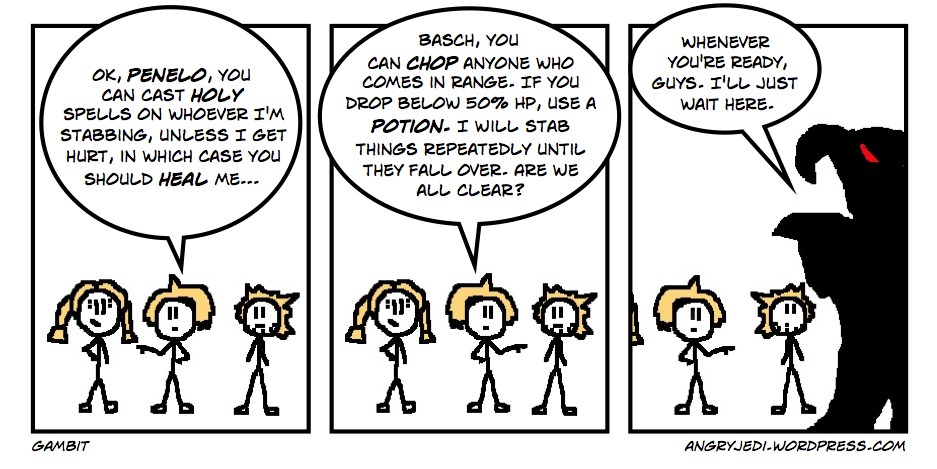
And we have Gambits. I was all set to dismiss Gambits as a means of getting the game to play itself. But having played it for about twelve hours now (coming up on the point that I originally got distracted by something else on my initial partial-playthrough, so we're nearly into new territory) I've discovered something: Gambits are awesome.

If you passed on FFXII, let me enlighten you. A Gambit is a means of "programming" your party members to act in particular ways. You give them a particular condition, such as "Ally has less than 50% HP", and then give them an action, like "Cure". You can prioritise the actions, too, so certain things will take precedence when more than one of the conditions are true. And as such, you can plan out the way you'd like a battle to unfold before it starts.

In many senses, it's like that "group huddle" you have in something like World of Warcraft before you take on a dungeon's boss. Everyone has a role to play, and it's important that people stick to that plan where possible, but be able to adapt to the situation if necessary. That's why FFXII gives you the opportunity to immediately issue direct commands, too, which override any and all Gambits in play. In fact, it's technically possible to play the entire game by micromanaging every action all your characters do, but it would probably take you approximately ten times longer to play the game if you chose to do that. Gambits aren't letting you leave the game on autopilot—they're letting you plan out a battle before it happens and then just focus on responding to situations as they arise. You'll frequently have to switch them out to take advantage of particular enemies' weaknesses, and I've noticed myself spending a lot more time in the menu in FFXII than I would do in earlier, more traditional entries in the series. Planning out the way the characters will respond is interesting and addictive, and immensely satisfying when it goes right.

In fact, the only thing which may be a bit off-putting to some people about FFXII these days is the graphics. In this HD age, FFXII looks pretty ugly, and ironically this is because it was a pretty good-looking PS2 game. There is a lot of detail in both the textures and the characters, but the low resolution which the game runs at gives the whole thing a very "muddy" and flickery look which some people may find a bit difficult to deal with. It's certainly not unplayable, though, and spending a bit of time in the company of the PS2 serves as a reminder that games didn't always need HD graphics and Achievements to be good.

(Interestingly, FFXII does actually feature a proto-Achievement system in the form of the Sky Pirate's Den, which fills with trophies as you fulfil certain accomplishments in the game.)

So, if you're hungering for a great almost-Western-style RPG with a JRPG aesthetic? Give ol' FFXII a chance. If FFXIII didn't push your buttons with its "here's a straight line to the finish, apart from this bit" mentality, FFXII is what you need. Join me in my quest through my Pile of Shame!

#oneaday, Day 316: Pity The Poor Shopkeeper

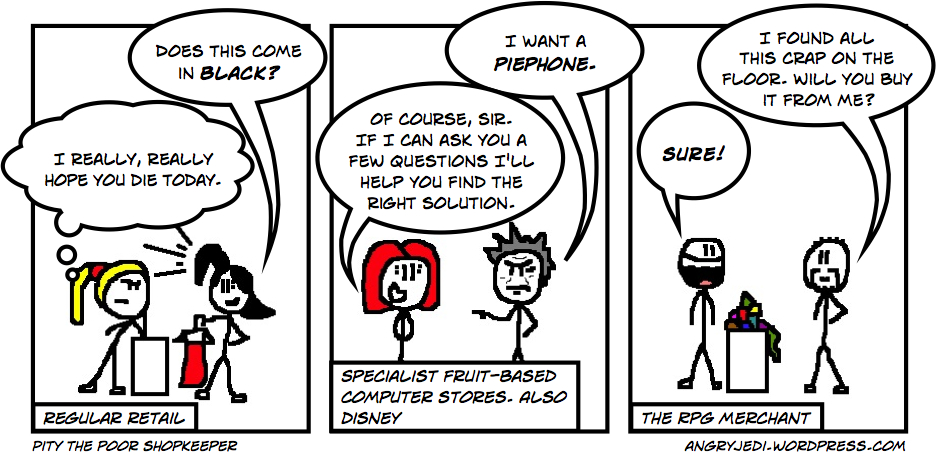
The poor shopkeeper doesn't have it easy, whatever form they take. If they're a retail monkey working for minimum wage in some sweaty hell-hole where chavs repeatedly come up and ask if the nearly-black garment they have in their hands is available in black, then they're probably losing the will to live by the second. If they're working in a, shall we say, "premium" retail environment they're probably having a better time but rapidly growing sick of the fixed grins they're forced to wear, not to mention the stock phrases that spew forth from their mouths like some form of verbal effluvia.
And then there's the poor, downtrodden RPG merchant, forced to sell all manner of crap, apparently only to adventurers, who then helpfully restock them with an endless supply of boar intestines, bits of wood, crystal chippings and used swords that they don't need any more. It must be a difficult life. And frequently a tedious one, as anyone who entered the online world of Ultima Online with lofty ambitions of owning a huge retail empire will attest.

It's this odd premise that quirky Japanese indie game Recettear: An Item Shop's Tale (available on Steam, as well as directly from the distributor's website) decides to explore in great depth. Playing the role of Recette, an adorable young girl with an absentee father, it's the player's job to help her run a successful RPG item store and make enough money to pay off the debt her father left her with. She's not in it alone, of course. She has a fairy assistant named Tear. Tear works for the financial institution with which Recette's father took out the loan, "because fairies are good at administration" and is there to help Recette pay off the debt she's been saddled with. The two become friends quickly, but should Recette be unable to make any of the weekly payments she's required to, Tear will quickly repossess her house and leave the poor girl living in a box.

So far, so Animal Crossing, you might say. And you'd kind of be right. Except not. There really isn't another game quite like Recettear out there. There are games which focus on individual elements of the game, sure. But none which blend together such peculiar and diverse elements with such successful results.
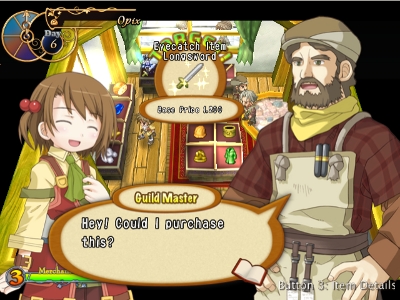
The game is split into three main sections. Firstly, there's the item shop itself. Recette can dump anything from her inventory onto the shelves in the store. Stuff in the window is likely to attract customers. If she chooses to open the shop, she has to deal with a flow of customers coming in and asking for things. If they're on display, all she has to do is agree a suitable price with the customer. If they agree, cha-ching. If they disagree, Recette has one chance to make a more reasonable offer before they leave.

Simple enough. As the game progresses, though, more elements are added to this formula. For starters, in true RPG tradition, people start selling stuff to Recette, too. This can be a good way for her to build up stock, as she can often get stuff for knock-down prices with a bit of shrewd haggling. Then people will place special orders, requesting that she deliver, say, three hats in two days' time. Recette has to not only make sure she has the hats in stock but also remember to have the store open when the customer plans to return. And finally, some customers will come in not quite sure of what they want, and Recette will have to make recommendations from the stock she has on display and in her inventory.

It's a straightforward mechanic, and you soon get to know how much certain customers are willing to pay over base prices. A few twists come in later with a news ticker informing Recette of increased or decreased prices in the market, but it's mostly a case of buy low, sell high.

If Recette chooses to leave the store, she can wander around town and occasionally bump into the people who frequent her store. These come in the form of random townsfolk and adventurers. Completing requests for adventurers will sometimes net her their Guild Card, which enables her to make use of them for expeditions to the local dungeons.

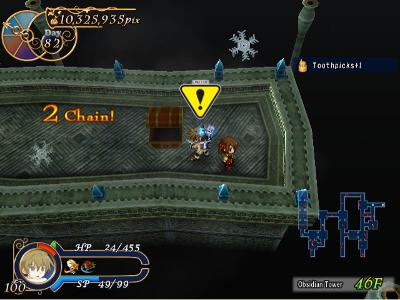
Yes, there are dungeons. Because sometimes the local markets just don't have the things people want to buy. When that's the case, Recette is free to pop down to the local Adventurers' Guild and hire one of the guildies she's made friends with. It's then into an action-RPG dungeon crawler to kick monster booty and gather lots of crap that people might want to buy.

It works, brilliantly well. The item shop stuff occurs quickly enough that it never gets tiresome. The storytelling scenes feature attractive artwork and a truly excellent localisation from the Japanese. And the dungeon-crawling, while simplistic, is fun and satisfying, broken up by regular boss battles and in-dungeon special events.

The whole game is distinctly adorable, but deceptive. The artwork, music and squeaky-voiced Japanese girls make it look like something which should be incredibly embarrassing and cringeworthy to play. But in fact, there's a distinctly acidic sense of humour underneath all the sweetness, and a large number of the dialogue exchanges are genuinely laugh-out-loud funny. The kawaii presentation coupled with fairly sophisticated, intelligent humour and a wonderfully self-aware nature reminds me a lot of the Disgaea series.

I'm probably about halfway through the game now, having made two of Recette's repayments successfully. There's the hints of a bigger plot at work, and a bunch of new characters have been introduced, most of whom will presumably end up being playable adventurers for the dungeoneering sections.

If you're after something that is both comfortably familiar and quite different to any JRPG you've ever played, then Recettear: An Item Shop's Tale is well worth checking out. I fully intend on posting a full review somewhere once I've beaten it.