1171: Easy Listening, Part 2

As promised, I'm continuing yesterday's post with another game music fest to introduce you to the joys of some soundtracks you might not be familiar with.

Today, it's Cavia/Square Enix's strange, wonderful and rather depressing action-JRPG Nier.

Nier

Nier wasn't particularly well-received by critics upon its release due to a variety of factors. Having played it (and adored it, I might add), I can see why it was criticised, but equally I feel it was treated a little too harshly. Not only was it doing some fascinating things with the way it told its story and what its story was about — I'll leave the spoilers out of the discussion for now — but it was also doing some really interesting things with its gameplay, too. What initially appeared to be a relatively conventional third-person character action game/RPG subsequently revealed itself to have elements of visual novels, text adventures, farming sims, 2D platform games, isometric-perspective dungeon crawlers, bullet hell shooters and numerous other genres. It really was a massively interesting game in almost every way.

And then there was its soundtrack, which even if you don't like the game is indisputably amazing. Let's look at some standout tracks.

This track, known as Hills of Radiant Wind, is one of the tracks you'll hear most frequently in the game, since it typically accompanies your jaunts across the countryside surrounding the small settlement where the title character Nier and his daughter Yonah live. This track is hugely memorable both for having a catchy melody and capturing the atmosphere of the game world beautifully. The pounding drums at the bottom of the mix give a sense of adventure and driving forwards, while the vocal line atop the relatively simple accompaniment gives a suitable air of melancholy to the experience. Nier is not a happy game, and this track, while one of the more "upbeat" ones from the soundtrack, reflects that nicely.

This song, simply called Grandma, is beautiful, and is, to me, probably the most representative piece of music that illustrates what the Nier experience is all about. A simple accompaniment accompanied by a mournful voice provides a massively atmospheric backdrop to some of the most emotional story moments in the game.

And then we move on to a few tracks that use the "leitmotiv" technique I'm so fond of, where a number of different pieces make use of similar melodic or harmonic sequences to reflect various things happening to different characters and/or places.

Let's start with Emil, who, without spoiling anything, gets fairly consistently screwed over throughout the course of the whole game, through no fault of his own. Poor kid.

Anyway, here's Emil's "Sacrifice" theme, which accompanies some heartbreaking, sad moments:

And by contrast, here's his "Karma" theme, which comes shortly after a heartbreaking, sad moment when you're venting some aggression on the perpetrators:

The addition of the pounding drums and the urgent piano line in this one always gives me shivers, particularly when I remember how it was used in context.

Then we have Popola and Devola, two characters who are extremely important to the overall narrative in ways I won't spoil right now. When we encounter them, we hear various versions of the "Song of the Ancients" theme, beginning with this acoustic guitar-centric version:

…and moving on to this… I'm not sure how to describe this, really. Plinky-plonky version?

Well, if you're going to do two different versions based on the two characters who sing it, you might as well do a third version where they sing it together, mightn't you? Yes, obviously. This, along with Devola's theme above, are some of the only examples of diegetic music in the game — the rest is there to evoke a mood rather than actually be "present" in the world.

And, hell, if you're going to do that, you may as well go the whole hog and have a battle theme based on their (by now) iconic song, right? Of course.

The latter one, like Emil's "Karma" theme, still gives me shivers because I can remember it in context. Gobsmacking.

Then we come to Kainé, possibly one of the most fascinating characters in any game ever for a whole host of reasons, many of which aren't made entirely explicit in the game. Kainé has two main versions of her theme: a slow one, which goes like this…

…and a fast one, which goes like this.

Those who know their Nier lore will be familiar with the fact that Kainé is intersex. If you weren't familiar with your Nier lore, now you know too — don't worry, this isn't technically a spoiler in terms of the game's overall plot, and in fact knowing it beforehand brings a whole host of hidden meanings to a bunch of sequences in the game to the fore. I like to think that the markedly different character of these two pieces reflects Kainé's "masculine" and "feminine" sides, because she is most definitely in possession of both. She is, it's fair to say, a very angry person — and with good reason — but not afraid to express her feminine side in some rather… flamboyant ways.

One of the most interesting things about the vocal-heavy tracks in Nier are that they don't use a language from this world. Instead, vocalist Emi Evans was encouraged to make up words in a "futuristic language" — Nier is set in the far, far future — and used elements of Scottish Gaelic, Portuguese, Spanish, Italian, French, English and Japanese to create something with a very distinctive sound, but which doesn't "mean" anything in and of itself. Instead, the vocal sounds are simply intended, for the most part, to evoke the overall feeling of sadness that pervades the whole game without distracting the player with recognisable words.

So that's Nier. Easily one of my favourite game soundtracks of all time, and a score which adds a huge amount of emotion to what is already a game rammed to the rafters with heartbreak.

1145: Metafalica

Page_1I've been continuing to play Ar Tonelico II and it's really rather good. One thing I've found particularly endearing about it is the fact that just when you think you've got a handle on the way it does things, it goes and does something else interesting just to throw you off a bit. And yet even despite all these mechanics that get added over time, it still feels like a coherent experience as a whole.

Let's take the stage I've got up to now — "Phase 2" in game terms. In the first Ar Tonelico, the change from Phase 1 to Phase 2 marked the point where you were out of the "exposition" chapter and into the plot proper. Phase 2 was also the point where you had to choose between the two heroines, and then had two completely separate (but related) storylines to follow along with. The paths then reconverged towards the end of Phase 2 and remained together for the (completely optional) Phase 3, which offered the "true" ending of the game.

Phase 2 in Ar Tonelico II is a bit different. Rather than, like the first one, being set in the same locations and simply branching off in two different directions, Phase 2 of Ar Tonelico II takes place in a completely different area that works completely differently to the environment you've spent the previous 12 hours in. The early part of the game is, aside from its many and varied peculiar gameplay systems, relatively conventional — you visit towns and do stuff in them, then you go to dungeons. Then you go back to towns. And so on. The linear plotline is broken up by an optional "hunting" sidequest in which you can track down various "I.P.D."-infected Reyvateils to add to your "Girl Power" arsenal (I'm not even going to get started explaining that, I'll be here all day) but for the most part, you're doing the usual JRPG business.

Phase 2, meanwhile, takes place in an environment that changes according to your choices. Early in the Phase, you're introduced to a new mechanic known as the Infelsphere. This virtual world works in a similar way to the "cosmospheres" found inside the heroines' minds, but rather than reflecting their inner turmoil and anxieties, the Infelsphere represents the relationship between the two heroines and how they understand each other. Events unfold in the Infelsphere in which you have to make choices as to how to respond, and the choices you make in the Infelsphere subsequently affect what parts of the "real world" open and close to you. Your eventual goal is to get to a specific location by navigating your way through a maze of these pathways that open and close according to how the Infelsphere events unfold, with each point on the path containing some sort of "trial" to overcome. This might be as simple as defeating a monster, or it might be a challenge such as successfully smuggling biscuits past the penguin-like "Pippen" creatures.

Thematically, in each of these trials, you're "proving your love" to one of the heroines, which subsequently provides you with keys to unlock new events in the Infelsphere, and so it continues. It's a really peculiar, really interesting structure that not only offers some unconventional JRPG gameplay in the "real world" sections, but also provides some intriguing insights into the characters and the way they respond to various situations in the Infelsphere component.

You'll notice I haven't really mentioned the plot in this description, and that's deliberate, as discussing the plot surrounding all this would be a massive spoiler, so I'll spare you that — for now, anyway. What I am finding particularly pleasing about Ar Tonelico II as a whole, though, is that even if it didn't have a compelling plot and awesome characters — which it does — it would still have rock-solid gameplay with an absolute bucketload of things to do. It is just one of the many, many examples out there that prove JRPGs are far more than the "ATTACK, MAGIC, ITEM"-fests that ill-informed detractors of the genre assume these games still are.

They haven't been that way for a long time, people. So if you haven't played a JRPG since Final Fantasy VII I strongly recommend you check out what the genre has done since then — you might just be very pleasantly surprised by what you find.

1138: Song Magic

Been playing some more Ar Tonelico 2 this evening, and I'm liking it a great deal. Like its predecessor, it has a very pleasing system of "feature creep" whereby it starts out feeling rather straightforward but gradually, over the course of the early stages of the game, introduces more and more new and interesting mechanics until you have something that is very, very distinctive.

In the original Ar Tonelico, we were introduced to the basic combat system; then the way it worked when you have the magic-using Reyvateil characters in your party; the Dive system, in which you could explore the inner recesses of the heroine's mental "cosmosphere" worlds; the "bedtime conversations" system whereby the protagonist and the heroines could get to know each other a bit better (and subsequently unlock deeper levels in the cosmosphere); the "Grathmeld" crafting system, whereby you could take all the junk you'd acquired from the hundreds of NYO?!s you'd killed and turn them into various items, then enjoy some amusing scenes as the heroines try and convince you to let them name the item something ridiculous; and the "Install" system, whereby you're able to insert crystals into the heroines (and yes, they relish the opportunity for innuendo inherent in this process) to power up their various abilities and customise the effect of their spells.

In Ar Tonelico 2, meanwhile, we're first of all introduced to a new and rather odd combat system in which the two sides in the combat alternate attacking and defending for a set period of time — when attacking, you have to press buttons corresponding to the party member you'd like to attack and combine it with a directional button to do a specific move; when defending, you have to time button presses carefully to protect the back-line Reyvateil "mages" from attack, if they're present. The way the Reyvateils work is then introduced — a weird meter in the corner of the screen reflects what they want the front line to do, and fulfilling their demands provides bonuses, helping them to cast more effective spells more quickly. Then, once again, we have the Dive system, which works largely as it did before, albeit with a lot more multiple-choice bits where you have to say the right thing to proceed. Then we have the "I.P.D." system, whereby part of the plot dictates that you have to subdue and capture Reyvateils that are infected with I.P.D., which hasn't been explained yet. Then we have a slightly different crafting system, whereby certain items can only be crafted in certain places (you can only make food in a restaurant kitchen, for example), and the same recipe has different outcomes depending on which heroine you get to help.

Then things get a little odd. "Dualstalling" replaces the "Install" system from the previous game, and is the only way of levelling up Reyvateils, who no longer gain experience normally. Instead, at regular opportunities, you have to let them take a bath in water infused with crystals you've collected or purchased. During the bath (which looks rather large and luxurious, I must say), they wander around a bit, and if they pass over one of the crystals they dropped in, they gain a temporary special effect until the next time they bathe. And if you drop in toys (bath toys, you pervert) and scented oils, different effects might emerge. Oh, and if both heroines are bathing together, they'll often chat about things, too, which helps improve their "sync" value, which in turn helps them fight more effectively together in combat.

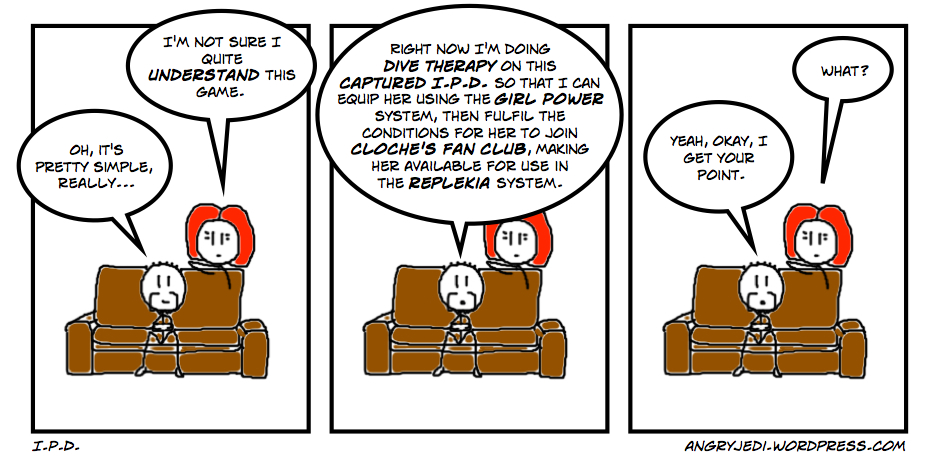
Then we have the "Dive Therapy" system, which I was introduced to in tonight's session. Now the subdued I.P.D.-infected Reyvateils have a purpose — they can be "cured" by one of the characters, who is a Dive therapist. Indulging in Dive Therapy involves talking to the Reyvateil and attempting to manipulate her mood to its ideal level on a meter at the top of the screen. Administering various treatments can affect the rate at which this meter changes with each response you give to their statements. Some responses increase the meter, others drop it, and each infected Reyvateil has a "sweet spot" where the meter needs to be in order to be cured.

That's not all you can do with them, though. The cured Reyvateils then bugger off and scatter themselves around the world to form a fan club for one of the heroines, and their affection for her increases as they see her doing cool stuff. When their affection maxes out, they will help out — exactly how, I'm not sure yet, but we'll see.

Oh, and also through the "Girl Power" system you can "equip" rescued Reyvateils to help the protagonist out in various ways. They then level up and improve their abilities and… waah, my head hurts.

All these weird and wonderful mechanics may sound overwhelming, but they're introduced at just the right rate. You're shown a new concept, then given a period of time in which to explore it in practical terms. Then another one comes along, and you can explore that. And so it continues. The nice thing is that only a few of these mechanics are "spoiled" in the game's manual, meaning the existence of things like the Dive Therapy system and various other bits and pieces are a nice surprise when you come across them for the first time. (Unless you've read this post first, of course.)

On the one hand, it's nice to be ready for all the game's mechanics and be able to refer back to a manual when you need to. But on the other, it's quite interesting (and oddly liberating) to play a game that trusts you to experiment a bit and figure out what on Earth (Metafalss?) is going on. Take the Dualstalling system, for example — while the help menu in the game explains roughly how it works, it's only by fiddling around with various arrangements of bathtime goodies that you'll figure out the most effective means of letting your mage-ladies wash their stinky bits and level up.

Basically, Ar Tonelico 2's more esoteric features are something you'll either be on board with or not. As you've probably gathered, I love them — and besides, are they really any more weird than summoning giant chariot-riding penis demons by fusing cards together, or sucking the magic out of monsters to somehow attach to your own strength? No. No they're not. So shush.

1135: Melody of... The Other Place

Page_1As I noted yesterday, I completed Ar Tonelico: Melody of Elemia. So naturally, having discovered a new RPG series that I like very much, what's a boy to do but to make an immediate start on the sequel, much to the delight of my Ar Tonelico-adoring friend who convinced me to play the damn things in the first place?

Ar Tonelico 2: Melody of Metafalica is a surprisingly different beast to its predecessor in many ways. Its Japanese incarnation came out in the same year as the first Ar Tonelico hit Western shores, but it wouldn't be until 2009 that North American and European players would get their hands on it. That actually makes it a surprisingly recent game, released in the twilight of the PS2 era. This might explain why I never really paid it much mind first time around (besides being unfamiliar with the prequel, obviously) — everyone (including me) was already well and truly enraptured by "next gen" by that point, though games like Persona 4 (which also came out in 2009 in Europe) had shown me that the previous generation still had plenty to offer.

The whole Ar Tonelico experience has had a complete overhaul in Ar Tonelico 2. Gone are the distinctly PS1-ish isometric-perspective graphics (though I actually sort of miss them now), replaced with hand-drawn backdrops in towns and a pleasing combination of polygons, flat objects and fixed camera angles to create "3D" dungeons. The sprites, too, have had a bit of a change in aesthetic — they have peculiar, stylised proportions now, which frankly has taken a little adjusting to, but the improved amount of emotive animation on them makes up for the fact that everyone has really, really distractingly massive hands.

The biggest change is in the battle system, however. I liked Ar Tonelico's battle system, as it combined conventional JRPG turn-based battling with an interesting magic system that encouraged you to find creative ways to finish battles "well" rather than quickly. It was a bit repetitive by the end, however, and it was consistently way too easy pretty much all the way through the entire game.

Ar Tonelico 2's battle system, meanwhile, is a completely different beast. It's still sort of turn-based, but not in the same way as its predecessor. Instead, the two sides in the conflict each take turns to attack and defend. When it's your turn to attack, you have a limited amount of time to use your two "vanguard" (front line) characters to attack; when it's your turn to defend you have to carefully time button presses to protect the back line Reyvateils from taking damage. The Reyvateils make demands on you during battle, too, requesting that you perform specific attack moves by pressing the button for the corresponding front line character and a particular direction. Fulfilling these demands gives you various bonuses that make the battle turn in your favour. It's interesting, as it means you have to really concentrate on every battle rather than just mashing the "attack" button, but I'm yet to have a significantly challenging battle to show its full potential just yet.

The "Dive" system makes a return, and is almost identical to its predecessor. You get to know the game's heroines in the real world by talking to them at campsites and inns, then "dive" into their mental "Cosmosphere" world to find out more about their various inner struggles and problems. Overcoming these problems helps them craft new Song Magic which you can then use in battle — plus these are entertaining mini-stories in their own right. Diving is mostly the same, though there are a lot more situations where you're given a choice of responses to a particular situation and must pick the correct one rather than simply following it through.

In "new, weird gameplay mechanics" news we have the new Dualstall system, which replaces the "Install" mechanic from the previous game (which allowed you to boost a Reyvateil's abilities by plugging various crystals into her… spells in a rather suggestive manner). Dualstalling essentially means flinging the game's two heroines into a bath infused with magic crystals, nice-smelling bath oils and bath toys and letting the attached abilities, uh, be absorbed. The heroines will also have a good chat in the bath, so this is a good way of building up their "Sync" gauge, which helps them work together better in battle.

So far I'm about four hours into the new game and enjoying it a lot so far. The change in aesthetic and gameplay style gave me a bit of "culture shock" initially but that thankfully soon faded, and I'm now enjoying the story and characters just as before. It's interesting to note that the game still feels recognisable as an Ar Tonelico game, yet has a different setting (albeit in the same overall world), different characters and different gameplay mechanics. I'm assuming that the third game (which is where the series made the jump to PS3) will be "similarly different", too, judging by a quick flick through the manual.

Further reports as events warrant.

1134: Melody of Elemia

Page_1I completed Ar Tonelico: Melody of Elemia this evening. What a fine, fine game that was. I'll be writing somewhat more "professionally" for want of a better word about it this Wednesday over on Games Are Evil, but for now I just wanted to enthuse a little about the great experience that was that game. There may be some spoilers ahead; be forewarned.

The most immediately striking thing about Ar Tonelico for a new player coming to it for the first time in 2013 is that it looks old. It's also worth noting that it came out in 2007, so it actually looked pretty old when it first came out. That said, after a few hours of play, the low-resolution isometric-perspective sprite-based graphics cease to matter on a technical level, and the amount of character and personality in them starts to shine through. A friend of mine just noted that the visual style is actually something of a successor to stuff like Secret of Mana and the like and that's a great comparision — I'm kicking myself for not figuring that out sooner.

Outside of the in-game graphics, Ar Tonelico has some absolutely lovely character designs. Lyner may look fairly "generic JRPG hero" in his stylings, but at least he has some personality about him. The two heroines Aurica and Misha are both attractive and appealing in completely different ways, and a plot twist I won't go into here sees you interacting with Misha in both her "spunky young girl" and "equally spunky young woman" forms. The third Reyvateil introduced later in the game also proves herself to be an interesting character in her own right, again with her own unique visual style and "appeal elements".

One of the most interesting things about the game to me — and the thing I'm intending to write about this Wednesday — is the game's multi-route, multi-ending structure. Now, this could very easily be a recipe for disaster, as multiple endings in lengthy RPGs are often a good method to ensure your players won't see all of the awesome story content you made. That's not necessarily a bad thing — it's kind of cool when you can discuss a game with a friend and discover they had a completely different experience to you — but it's also frustrating to some people who like to know they've got everything they can out of a game before moving on.

Ar Tonelico's multiple endings and routes are handled in a rather peculiar manner. There are three "phases" to the game, each of which is a complete story arc in and of itself, complete with final boss confrontation at the end of each. Early in the second "phase", you have the opportunity to go with one of the two heroines and experience their story. Aurica's story gives you an overall view of what is going on in the overarching plot of the game, while Misha's story gives you a more personal view of what is going on with her and how she is relevant to everything. If you play Misha's route first, there are a number of scenes you see completely without context that don't really make sense. If you play Aurica's route, however, you play an important part in these scenes. The two paths then converge towards the end of the second phase, and the game then apparently ends — the credits roll and everything.

There's a twist, though. In a post-credits sequence, you get to run around and do all the usual JRPG "our party's splitting up, say goodbye" business, but once you've done all that, you're presented with another choice: live a happy life with [insert girl you chose here], or refuse to accept that as "the end" and move on. If the latter option is chosen, you find yourself entering a completely optional third phase that is about 20 hours by itself, and which leads to the "true" ending.

Except in that third phase, there are four possible endings, three of which relate to one of the three heroine characters — the latter of whom only becomes a major player in this third phase. The third phase is pretty much identical regardless of which girl you picked earlier, but the very end — if you fulfilled some very precise conditions — allows you to pick between the girl you chose earlier and the new addition. There's also a "bad" ending relatively early in the third phase that basically says "I can't be bothered with all this sidequesting, let's just get this over with".

So that's a total of… hang on… (counts) six endings? Fortunately, there's absolutely no need to play through the game six times to see all of them — instead, you can play through once, save before the "big decision" in phase 2, play one route to either the end of phase 2 or to complete completion in phase 3, then go back and do the other route, stopping wherever you didn't stop first time around. In my case, I played Aurica's route through to total completion, then played Misha's route to the natural end at the conclusion of phase 2. I don't feel like I missed out on anything, and it only required me to play less than 10 hours over and above what I'd already played anyway. And I feel rewarded for having done so — I have a deeper understanding of the story as a whole, and particularly the characters.

So that's Ar Tonelico — a really, really excellent JRPG and surprisingly thought-provoking if you can look past the notorious innuendo (of which there isn't anywhere near as much as people make out). It's also in possession of I think the best soundtrack I think I've ever heard in a JRPG… though I'm about to start Ar Tonelico 2 as I type this, so I may well be revising that statement in the near future!

1126: Ah! Tonelico

I've been continuing to play through Ar Tonelico, and it's certainly pushing all my buttons in all the right ways. I've stopped noticing the "subpar" (compared to its contemporaries) graphics and accepted them as quaint and charming, and have found myself able to concentrate on the story and characters, both of which are great stuff.

The highlight of the game by a long shot is still the Dive system, which I believe I mentioned in a previous post on the subject. Just in case I didn't, though (I'm tired and can't be bothered to go back and check, all right?) let me explain once again.

One of the key plot concepts in the Ar Tonelico universe is the relationship between humans and the Reyvateil, the latter of whom are the only ones able to make use of "Song Magic". A Reyvateil and her partner, known as an Oracle, share a close personal bond — so close, in fact, that it's possible for her Oracle to "Dive" into her mind and explore the worlds inside her imagination, known as her Cosmosphere.

Note that I said "worlds," not "world" — each Reyvateil has multiple similar but not identical worlds inside her head, each of which reflect a particular facet of her personality, something she has had to deal with (or repress) and struggles she is yet to overcome. As the Oracle delves deeper into her mind, the worlds become increasingly strange and twisted, and the problems that the Reyvateil must overcome more deep-seated and difficult to resolve.

Inside the Cosmosphere, the player character Lyner comes across numerous different incarnations of the Reyvateil he's diving into. On one level, she might be a shrine maiden who wants to protect people, but who is anxious about being able to do so. On another, she might be a schoolgirl with no faith in her abilities, who believes she'll never be able to live up to her peers. On another, she might be sexually aggressive and dominant. Sometimes incarnations from other levels put in an appearance, too, and their interactions reflect the Reyvateil's inner struggles between clashing emotions and ideals.

Alongside the incarnations of the Reyvateil, Lyner also encounters characters whom he (and the Reyvateil) know in the real world. But there's often something a bit "off" about these characters, something not quite right. It transpires that these projections of familiar characters reflect how the Reyvateil sees them, not necessarily how they actually are. This provides yet another interesting perspective on the Reyvateil's personality — not only do we see her internal struggles, but also her own attempts to deal with how she thinks other people see her.

I love this kind of thing. It's one of the reasons I adore Persona 3 and particularly so much. Games are a brilliant medium through which the inner workings of a character's mind can be explored, and games that do just that are among my most fondly-remembered titles — stretching right back to The Adventures of Alundra on PS1 and its "nightmare dungeons". Ar Tonelico is certainly scratching that itch very nicely — and it helps massively that the characters involved are entertaining and fun to be around. Plus it seems there's a very obvious "split" just after the halfway point, so after I've finished it once I can go back and focus on the other Reyvateil to see what her subconscious has to say about herself. Looking forward to it.

I haven't touched on the series' endearing use of innuendo, which is seemingly the main thing it's known for, but I'll save that discussion for another day — perhaps when I've played the apparently increasingly-shameless sequels!

(Comics back tomorrow.)

1117: Another Game with a Barely-Pronounceable Title

Page_1If you had no idea what genre a game called Ar Tonelico: Melody of Elemia fell into, it's highly likely that you'd guess that it was a JRPG. And you'd be absolutely correct. It's a title that doesn't make a whole lot of sense if you know nothing about the game, though to its credit, unlike many other barely-pronounceable game names, its relevance does become apparent almost immediately. However, it's still pretty much the exact opposite of the rather literal naming conventions adopted by social and mobile games these days, which tend to be called things like "City Wars" and "Farm Town" and "Slots".

Strange name aside… yes, I've been playing the PS2 game Ar Tonelico: Melody of Elemia, hereafter referred to as Ar Tonelico to save me typing out that whole title every time. I knew literally nothing about this game prior to firing it up for the first time, but had been urged to do so by a friend over at the Squadron of Shame who has been accompanying on my journey through the oddest and quirkiest undiscovered treasures that the Japanese role-playing game genre has to offer. I promised him that the next game I played after I completed the crap out of Hyperdimension Neptunia mk2 would be Ar Tonelico, so here I am.

So what's it all about? Well, if you live in the UK, don't count on any help from the box or manual — the game never saw an official release in the UK despite being fully-translated into English, and instead your best bet for a copy these days is Italy, of all places. It's rather peculiar to think of Italians playing JRPGs, but there you go.

Anyway. Ar Tonelico initially appears to be a rather straightforward JRPG with a floppy-haired, youthful protagonist wandering around the world seeking adventure on a Grand Quest to Save the World. And on the one hand, it is. On the other hand, however, it does a lot of very, very interesting things that have really made me sit up and pay attention, even only about four hours into the whole experience.

For starters, there's a deep crafting system to explore. This is a game from Gust, developers of the Atelier series (which I am yet to try but have all the PS3 incarnations of on my shelf), and their specialism is deep crafting systems. In Ar Tonelico's case, it takes the form of the peculiarly-named "Grathmeld" system, in which you have to find recipe cards around the world and in shops, find ingredients inside chests, shops and monsters and then fuse them all together using crystals. When you craft, you get a fun little animated sequence of your character Lyner assembling whatever item it is, then if it's a new item he has a fun little conversation with one of the other characters about it, and a discussion often ensues about what the new item should be called. You can't freely rename items, which is a shame, but you do get to choose between a couple of different suggestions, and the game then tracks which character named which item, which is a nice touch.

Perhaps the most bewildering aspect of the game is its battle system. For the first hour or two, it's a very conventional turn-based "attack, magic, item" affair. But as soon as you encounter the "Reyvateil" characters, also known as Song Maidens, things start to get interesting.

Reyvateils sit in the back row of your party and don't follow the usual turn order. Instead, they act like a mage or priest in an MMO, sitting behind the front row of fighters charging up spells (or Songs, in this case) to have various effects, while at the same time the front row is knocking seven shades of shit out of the enemy and ensuring the Reyvateil doesn't take damage. A strong focus is placed on the party's "harmonics" with the Reyvateil, with this represented by a bifurcated horizontal meter at the bottom of the screen. The left half of the bar fills when the front row lands successful attacks and drops when they take damage. The right half of the bar fills as the Reyvateil chants to charge up a spell. Should the two halves meet, the whole party goes up a "Harmonic level", which means the Reyvateil's spellcasting speeds up and the front row gain access to stronger attacks. The Harmonic level at the end of the battle also determines what rewards you receive.

There's another consideration in that system, which is the cap on the Harmonic level. At the start of each battle, you can only level the Harmonics up to 2; to increase the cap, you have to let the Reyvateil unleash her magic and deal enough damage for a separate bar to fill and open up the next level cap. The trouble is, at least early in the game, most enemies are absolutely obliterated by the Reyvateil's Song Magic, so you'll sometimes find yourself deliberately pulling your punches a little in an attempt to earn some higher Harmonic levels. It's an interesting system that will doubtless come into its own in more difficult battles later.

By far my favorite part of the game so far, however, has been the "Dive" system, where the protagonist Lyner is able to enter the subconscious of a Reyvateil and learn more about her. A Reyvateil's subconscious is split into ten distinct levels, each of which is made up of a number of different locations. Lyner must spend "Dive Points" earned through battle — which represent the trust the Reyvateil holds in him — to trigger various events, with revelations and strange happenings often unlocking new spells for the Reyvateil to cast in the real world. These vary from simple attack magic to "green magic" spells which can be cast outside of battle, usually to solve puzzles.

In gameplay terms, it's an elaborate means of unlocking abilities. But in story terms, it's a way of literally doing a deep dive into a character and discovering their innermost secrets. The scenes I've seen already have been heartfelt, interesting and help make me interested in the character. I'm very intrigued to see how they continue as the game progresses, as it's clear that the whole point of the "Dive" system is to help the Reyvateil come to terms with repressed memories and emotions in a vaguely similar manner to Persona 4's "Midnight Channel" — or perhaps just to peek in on some embarrassing things they'd rather forget about.

At four hours in, that's about all I can say so far, but I'm enjoying it a great deal. It looks super-dated — it's in 4:3 aspect ratio running on the PS2 and it pretty much looked like a PS1 game in the first place — but none of that matters to me. It is worth noting that it has an astonishingly good soundtrack, and that the English dub appears to be handled by the entire cast of Persona 3, which is fine by me — if a little odd to hear voices I recognise playing characters I'm less familiar with. (If you're wondering why I'm not playing with the Japanese voices, which are also included on the disc, it's because the FMV sequences in the game use the English voices, and it would be somewhat jarring to go back and forth between the two. The game also isn't fully-voiced, either, so it doesn't make as much difference as it would have in, say Hyperdimension Neptunia mk2.)

I'll be sticking with this one, then — though I may well be splitting my time between it and the Gamecube version of Fire Emblem when that eventually arrives. (The new 3DS version isn't out here until April, and I'm told I should play the Gamecube version before the Wii version that I scored for a song when Game was in trouble a while back.)

1116: Neptunia Master System mk2

Page_1I finally completed the shit out of Hyperdimension Neptunia mk2 tonight. And by that I mean I did pretty much everything it was possible to do in that game. I feel confident in saying it's one of the most consistently fun JRPGs I've played for quite some time — not necessarily the best, no, but certainly one that most definitely has its heart in the right place.

It was a really interesting game on the whole, and one that clearly knew its (small, niche) audience very well. I found it particularly interesting that instead of making a direct sequel to the first game, which apparently sold pretty well in Japan but bombed over here due to appalling review scores, they instead chose to reboot the setting and characters, creating a game which newcomers could happily start with but which those who played through its predecessor could appreciate on a deeper level. Neptunia mk2 wasn't a retelling of the first game's story — it was a completely new tale that pretty much assumed the first game didn't happen. This was a little jarring at first, as characters showed up whom I thought should know each other having played the first game, and the characters IF and Compa were obviously retconned to be childhood friends. Over time it ceased to matter, though, and it became clear that Neptunia mk2 was intended to be taken on its own merits without the baggage of its predecessor — a sensible choice, I'm inclined to think.

Besides proving to be a good jumping-on point for the series (the physical package's apparent rarity aside), Neptunia mk2 also dialed back its reliance on rather forced game and anime references for its humour, instead opting to focus on its distinctive and entertaining (if rather archetypal) characters. The one notable exception to this was in the game's "true ending" path, where there's a wonderful scene shortly before the final boss that features the "older sister" characters (meant to personify the seventh-generation consoles plus the ditzy Neptune/Sega, who has no idea what she's doing and is more interested in cookies than ruling the world) arguing over whose console is best, while the "younger sisters" (who are really the main characters of the game, and who personify the current-generation handheld systems… and, err, the Game Gear) sit and play Monster Hunter together while talking about how awesome Shenmue was.

A side-effect of the above is that the game's endearing sense of humour can be enjoyed by pretty much anyone, regardless of your knowledge of the video games industry as a whole. Those who have been playing for a long time, however, will appreciate the numerous sly nods and winks throughout — an area called Atari Marsh; a city called Sim City; characters called Cave and Falcom; and enemies that resemble everything from Tetris blocks to Dr Kawashima's freaky floating head from the Brain Age/Brain Training series.

The overall plot, which is essentially an anti-piracy, pro-"reward the creators of the content you enjoy" parable, initially appears to be a bit heavy-handed with its message, but this is nicely subverted by the time the previous game's protagonist Neptune puts in an appearance and berates the other characters for "sounding a bit preachy and stuff". It has a good narrative arc, building to a suitably dramatic conclusion and one of seven different endings — including a shockingly dark one that is quite impressive in its brutality. (Though it could possibly have gone even a bit further than it did.)

One of the most interesting things about it is its female-centric nature. While there's a lot of fanservice in it — within five minutes of starting, there are three quasi-"bondage" scenes; several characters are prone to flashing their panties at every opportunity (and the in-game camera is happy to encourage this); and a number of the "event" pictures feature a childishly amusing "jiggle" feature that… well, you can probably imagine — it's difficult to look on the game as being particularly anti-women.

In fact, it's very positive about a lot of things to do with sex and gender. The whole (enormous) party of playable characters is made up of women, for starters, and while many of these use anime archetypes as the basis for their personality, they're all their own individual characters with their own quirks and ways of interacting with each other rather than being nothing but shallow stereotypes. This team of ass-kicking women doesn't once rely on a man to help them out throughout the course of the entire story — and in fact, the few faceless appearances that men do make throughout the plot tend to depict them as shallow, image-obsessed borderline sex pests, with the exception of the boss character Brave, who is more of a Transformer than a man anyway. (Any good that Brave does for the male gender's representation in the game is immediately undone by Trick, however, who it's not an exaggeration to say is a revolting robotic paedophile, and one of the most delightfully odious characters I've had the pleasure of virtually beating up for a long time.)

There are also no unnecessary romantic scenes in the game, though there's a subtle implication that all the main characters in the story are gay and that there's nothing wrong with this whatsoever. (Because, you know, there isn't.) This doesn't mean lesbian melodrama or anything, either; rather, it's simply accepted that some of these girls like each other a bit more than others, and this is depicted in the way that they interact with one another with obvious tenderness and care. It's clear that these characters and their relationships have been written with genuine affection and a desire to make them believable people rather than just tits and arse, and I came away from the experience feeling like I had a good understanding of who they were, who they got along with the best and who they clashed with. It was one of those experiences where the final credits rolled and I felt like I was going to miss the characters, which is always a good sign.

So that's that. It's all done. No more Neptunia… at least until March, when the third game in the series arrives and I will inevitably become obsessed all over again.

1106: Nepgagaga Complete... Mk2

Page_1I beat Hyperdimension Neptunia Mk2 tonight, and have now seen one of its seven endings. The one I got tonight was the most fiddly and awkward to get — those who have played the game will know it as the "Conquest Ending" — and was also very, very, dark. Said darkness was all the more effective considering how light and breezy the rest of the game had been; after some 20-odd hours of all-female yuri moe shenanigans in the party, to suddenly be confronted by something that was quite genuinely emotionally affecting was testament to what a good job the game had done in building up its characters' personalities and relationships.

But I shan't talk too much more about the plot for fear of getting into spoiler territory. I do, however, want to make a point of talking about the game itself a bit more, and reiterating a few things I have previously said about it.

The main thing that I would like to say about it is that it's quite possibly the most fun I've had with a JRPG in ages. It was consistently fun, didn't outstay its welcome (a single playthrough clocks in at under 30 hours on your first time through and is considerably quicker if you New Game+ it up after that) and made use of some great (and quite original) systems. It then wrapped the whole experience in a plot that, while a little preachy at times, provided a great opportunity for the characters and setting to shine and show that the world of Hyperdimension Neptunia was far more than just a one-trick pony of self-referential humour relating to anime and games.

It's a stark contrast to the first Hyperdimension Neptunia; I had a huge amount of fun with the original game, but any time I talk about it I feel the need to add a disclaimer that I'm aware of all its flaws and that it was critically panned on release. And that's at least partly justified; if you don't get into the plot, setting and characters of the first Hyperdimension Neptunia, there's little more than a mediocre dungeon crawler with an interesting combat system underneath — probably not enough to hold the interest of someone who is not fully invested in the experience.

The second installment, meanwhile, is quite simply a good game. While it's still got its cheeky, innuendo-filled self-referential sense of humour intact and its tongue firmly planted in its cheek for most of the way through, it doesn't rely on cheap gags and references alone to carry the experience. Beneath the silliness is a rock-solid JRPG with some really cool mechanics.

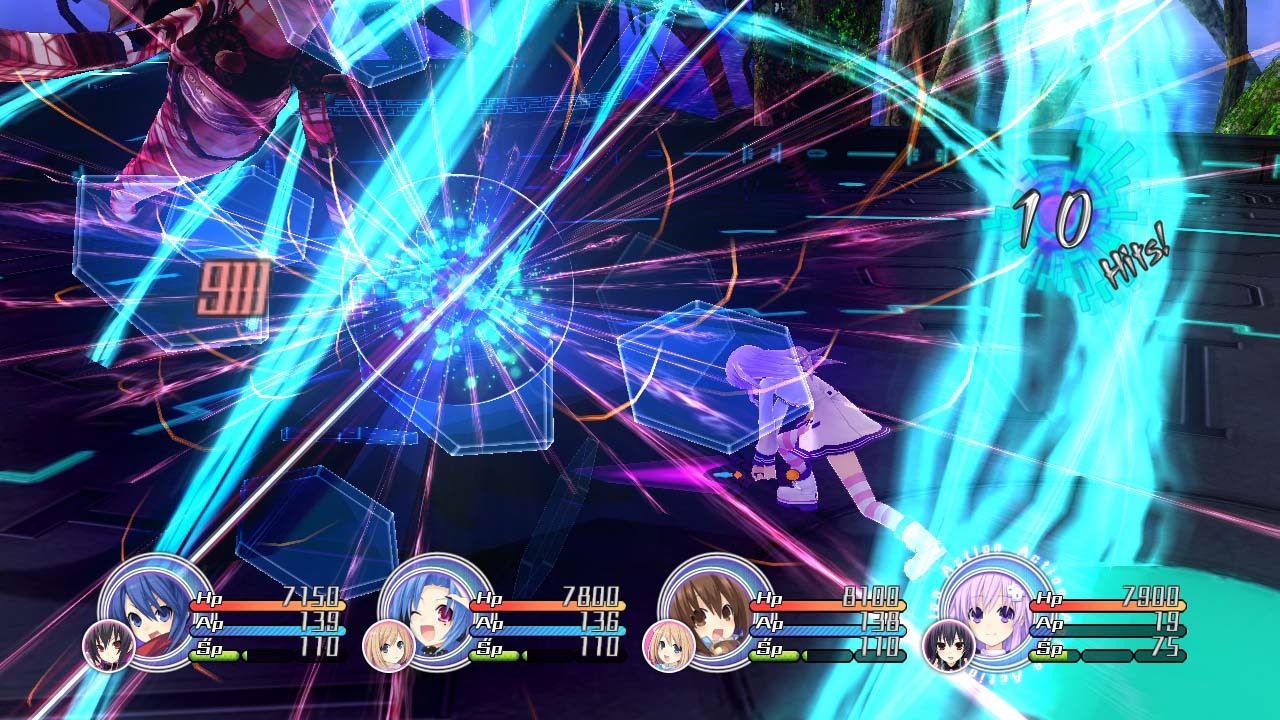
hyperdimension_neptunia_mk2_featured_screenshot_04Let's start with the combat system. Unlike the previous game, which followed a fairly conventional turn-based system coupled with a Xenogears-style combo-making mechanic, Hyperdimension Neptunia Mk2's battle system brings in some additional tactical elements that really change things up.

In the first game, each character had a set amount of "action points" (AP) to expend on their combos each turn, and various achievements such as breaking an enemy's guard or performing a special "combo link" move would give some of these points back, allowing a single turn to last for longer. You could also switch the currently-active member with one who was in the off-screen "back row" using certain special combo finishers, effectively allowing you a free turn if you were careful about your AP expenditure.

The second game maintains the AP system, but provides a degree more flexibility. Each character has a base amount of AP that top up to full at the start of each turn if they used them all the previous turn, but AP can also "overflow" over their maximum if the character deliberately finishes their turn early. This is a necessary tactic to unleash some of the more effective "EX combos" — special moves triggered by specific button combinations, some of which require more than a full AP bar's worth of AP to use.

Alongside the AP system is a new stat called Skill Points (SP). This is a mechanic in which hitting an enemy and taking damage adds to a bar which gradually counts up to 300. Characters' unique skills — now selectable from a separate menu rather than having to be incorporated into a combo — all cost a particular number of AP and SP to unleash, with the more devastating moves requiring more SP. SP skills vary from powerful attacks on a single enemy to area or line attacks, or buff/healing skills to benefit the party. Protagonist Nepgear and the other "CPU Candidate" characters can also transform into their "Hard Drive Divinity" goddess forms by spending 100 SP, but the remaining SP after the 100 ticks down each turn, and they revert to human when SP runs out completely.

There are three different types of move that can be performed in combat: fast moves hit multiple times and thus build up the SP bar faster, hard moves inflict more damage and are often magical in nature, and breaker moves concentrate on damaging the enemy's "guard" bar, which, when depleted, allows the player characters to do more damage than usual. Fighting effectively is a case of knowing what moves to use when — some enemies are more susceptible to magical hard attacks, for example, while others take more damage from multi-hit combos. Building up a big combo also helps Nepgear and her friends to maintain their goddess forms for longer.

Oh, you can move around in combat, too. It's surprising what a huge difference this makes; the simple addition of a mechanic whereby attacks affect a physical area rather than a specific enemy/character means that positioning is very important.

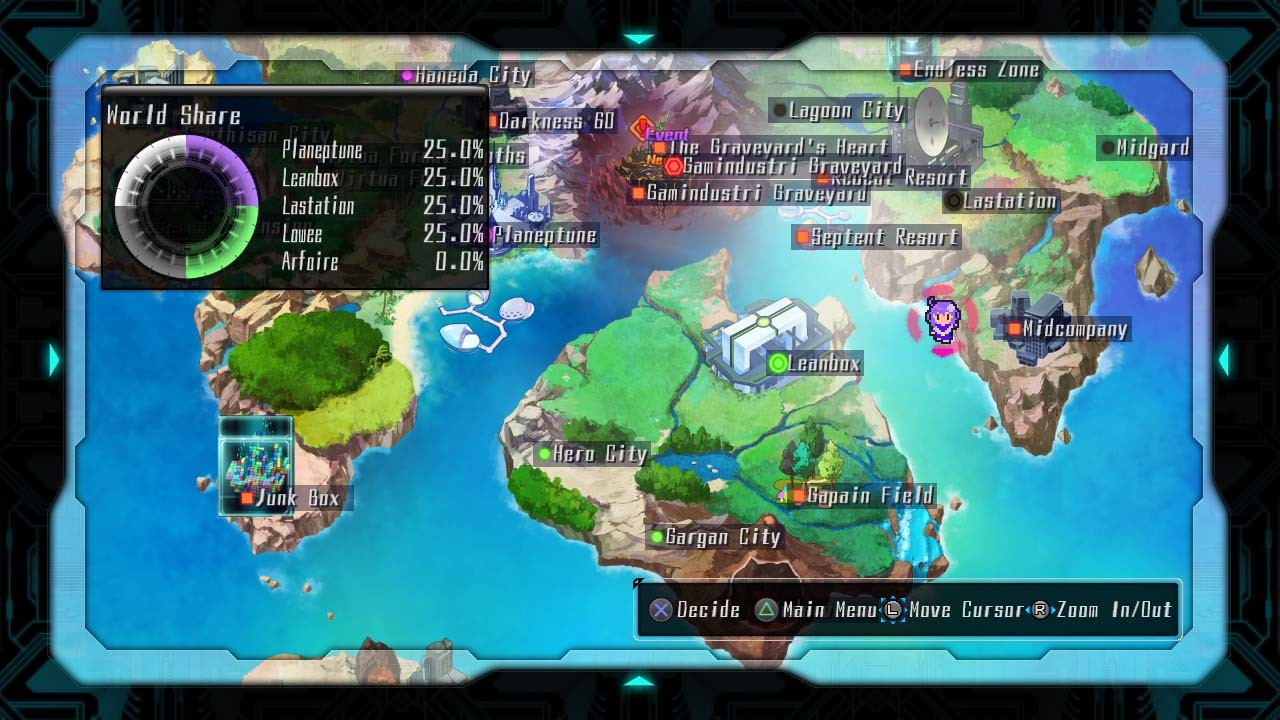
hyperdimenision-neptunia-mk2-01 (1)So that's the combat system. The other interesting mechanic is the "shares" system, which was also present in the first game but never explained at all, despite its manipulation being necessary to attain the "true" ending. The amount of control the game's four "friendly" nations and the antagonist faction have over the game world is reflected by the shares, and forms an interesting (if lightweight) strategic metagame atop the whole experience. There's an overall "world control" chart, which shows which faction has the upper hand — initially the antagonists by a considerable degree — and localised charts corresponding to each nation's capital and smaller, non-interactive towns around their landmass.

You can manipulate the shares by doing quests. Each quest has a sponsor city somewhere on the map — either one of the four capitals or one of each nation's smaller towns — and will increase one faction's shares in that area while depleting another's by the corresponding amount. By manipulating the shares, you can effectively change which faction controls each area, and which area has greater dominance over the world as a whole. It's not always simple, though — sometimes you'll have to run one quest to wrest an area's control away from the antagonists and into its native hands, then another to give these shares to another territory if necessary.

While it may be tempting to simply plough all your efforts into increasing Nepgear's native Planeptune shares as high as possible, this isn't necessarily advisable — controlling more than 55% of the world by a particular point in the story unlocks the aforementioned "Conquest" ending, which is rather traumatic if you're not ready for it!

The shares are used for a number of different purposes. Firstly, they affect various characters' stats — if you're using one of the "goddess" characters from the land of Lastation, for example, increasing Lastation's world share will make these characters stronger while others become weaker. It is possible to keep things nicely balanced if you want to use all the goddesses in your party — you'll just have to eradicate the antagonist's faction altogether to do that.

The second function of the shares is to help determine the ending you get. I've already mentioned the 55% world share that Planeptune requires for the "Conquest" ending; that's by far the hardest one to get, as it involves effectively taking over the other countries through a whole bunch of careful questing. Other endings have less stringent requirements; faction-specific endings simply require that particular capital cities have a strong majority control by their native territory as well as Nepgear having a good relationship with the goddess characters of the area, while the "human" ending requires that you avoid any sort of dominance whatsoever. Finally, the "true" ending, which goes on for a whole extra chapter after the game usually ends, requires that the world is divided up nice and neatly between the four factions, and that the antagonists are wiped out as much as possible.

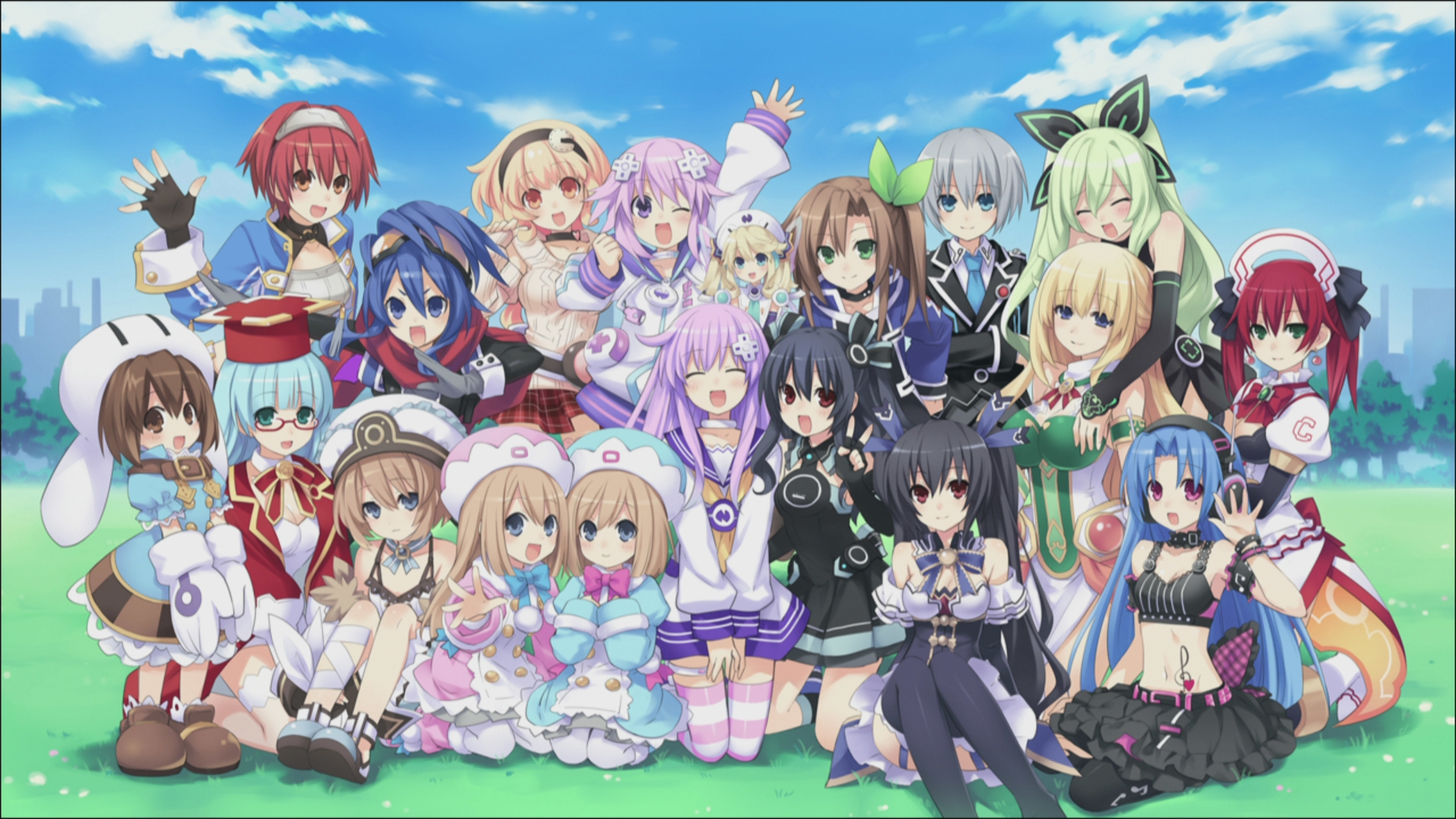
Neptunia_Mk2_CastYou'll notice I've barely mentioned the plot at all in this post, and that's because I want to make a point about Hyperdimension Neptunia Mk2 — even without its big-eyed anime girl shenanigans, it would be a rock-solid game. It's a crying shame that so many people I've spoken to won't even consider playing it because of 1) its predecessor's poor reputation and 2) its aesthetic and character design. Hopefully the things I've said in this post have at least piqued your curiosity a little — it's a great game and genuinely well worth your time, and if you don't feel like you can stomach the first in the series (which I maintain is fun and entertaining despite its myriad flaws) it's perfectly accessible to newcomers.

I'll see you in Gamindustri!

1098: Nepgagaga Complete!

Page_1I finished Hyperdimension Neptunia tonight, thereby proving beyond a doubt that review scores are now completely and utterly useless to me. I kind of suspected this already, but the fact that I devoured and loved a game that Eurogamer gave a 2/10 speaks volumes about how far my tastes have drifted from the mainstream.

With that in mind, some people have been expressing curiosity about this game after hearing me talk about it, so I am going to use this post in an attempt to share some facts about it that may help you reach a decision as to whether or not you would find it an enjoyable experience. Not everyone will like it, and that's fine — I really enjoyed it, but I recognise its flaws.

So here we go then.

It's roughly 50% visual novel. Story scenes in Hyperdimension Neptunia are selected from a menu rather than occurring naturally during exploring a town or something, and are all presented in a head-and-shoulders visual novel style. In a twist on the usual way in which VNs are presented, however, the portraits are animated — they breathe, change expressions, have lipsyncing and move their heads. It's not quite the same as a fully-animated anime scene (or indeed in-engine cutscenes) but it looks very nice and the art is lovely.

The other 50% is old-school JRPG dungeon crawler. You'll spend your non-story time in Hyperdimension Neptunia wandering through a variety of rather samey dungeons. There are a very limited number of environments, and only a set number of layouts to explore. Objectives are generally either "reach the exit" or "kill the boss", with occasional "collect [x] of [y]". Structurally, it's nothing special, and the "collect [x] of [y]" or "kill [x] of [monster]" objectives are largely dependent on luck, which some may find frustrating. The game is non-linear all the way through, however, meaning if you're struggling on one dungeon (or even the final boss!) you can simply shoot off and do something else for a bit.

There are random encounters. A hangover from the old days of JRPGs, random encounters are the bane of some RPG fans' existence. They are present and correct in Hyperdimension Neptunia. Whether or not you get irritated by random encounters will play a big part in determining whether or not you will have an enjoyable time.

This girl is the PlayStation personified. I'm not even joking.The combat system is GREAT. To counter the potential annoyance of random encounters, the combat system is hugely enjoyable. Taking its cues from Xenogears, each character has a set number of Action Points to spend per turn. Three of the PS3 controller's face buttons are assigned to different attacks (each costing a particular number of AP) by default, and as each character levels up they learn new moves. These moves must then be manually assigned to individual button presses in any of the possible combinations of four buttons that make up a combo. Different moves have different "end bonuses" if placed in the fourth slot of the combo — some allow the combo to continue registering after the fourth button press, others allow the party member to "switch" with one in the back row, effectively granting the player a free turn, and some characters have the magical girl-esque ability to transform. It's great fun setting up and naming your own combos, and there's a pleasing almost puzzle-like element to working out which ones will flow nicely into other ones while still leaving you with enough AP to be effective.

You can customize a whole ton of stuff in combat. You can rename button combos and apply your own images to certain special attacks. Other special attacks that you find throughout the course of the game are all based on old Sega games, allowing you to do things like summon the dude from Altered Beast or Alex Kidd to lay the smack down on your enemies.

There's a really weird item system. Rather than a conventional item system, Hyperdimension Neptunia makes use of a strange "crafting" system in combat to handle healing and the like — you can't heal outside battle, except by leaving or completing a dungeon. There are four crafting materials that you collect and/or purchase, and different combinations of these are required to activate each character's unique "item skills", each of which has a time when it occurs, a trigger condition and a target. For example, a basic healing item skill might be "When damaged and HP is 50% or less, heal 30% of HP in exchange for 5 of one item and 5 of another." The twist is that each character only has a limited number of "item skill points" which can be funneled into any of their item skills — one point equates to a 1% chance that when the condition is fulfilled at the appropriate time, the skill will trigger. For example, the character IF has a skill that will resurrect any fallen party members with 50% HP at the end of her turn, but this is only absolutely guaranteed to happen if you put 100 points into that skill. You can shift these points around at will — even during combat, except in the middle of a combo — and it adds an interesting degree of strategy to an otherwise attack-focused combat system, but it's bizarre, only sort-of works as a concept and will almost certainly piss some people off. I quite liked it by the end of the game, but it takes some adjustment to get your head around.

There's a "skip animation" button in combat. If you're starting to find the endless fighting rather dull, you can simply tap the L2 button to skip any animation, whether it's a regular attack by you or the enemies or a lengthy piece of JRPG "final attack" showboating. This means that you can romp through combats super-quickly if you're not too concerned about watching animations.

There's a bunch of grinding later in the game if you want to get the best ending. There are three endings to the game that are dependent on whether or not you recruit three characters in the story — a "bad" one if you don't recruit any of them, a "good" one if you recruit one or two of them and a "true" one if you recruit all three of them. Getting all three of them involves manipulating a mechanic which is never explicitly explained in the game, and requires replaying a lot of dungeons that are, by that point, far too low-level for you and thus almost insultingly easy. Fortunately, you can make use of the aforementioned "skip animation" button to rip through most of these dungeons in a minute or less.

The in-engine graphics aren't great. While the hi-res visual novel scenes look lovely, the in-game graphics look distinctly PS2ish and suffer from a fairly poor frame rate when compared to their mediocre quality. This is, apparently, fairly common practice for the developers Compile Heart and Idea Factory, and doesn't affect the enjoyment at all, but those who appreciate super-pretty graphics will only find functional visuals here. That said, the animations are nice and the characters all have plenty of personality about them.

The music is annoyingly catchy, but limited. There aren't many different music tracks in the game, which means by the end you may well be tiring of some of them. That said, they are catchy, recognisable themes that you may well find yourself humming along with, and there are multiple battle themes rather than the same one all the way through the game.

The game offers both Japanese and English voiceovers. Both have their merits, though some parts haven't been dubbed into English, meaning they're just text. On the whole, the Japanese voice track is superior in terms of acting quality (though beware the high-pitched voices if that sort of thing bugs you), but it's nice to hear the American voice actor who plays Yukari in Persona 3 again on the English track.

The game is genuinely amusing… if you're a fan of Japanese media and video games. The game prides itself on affectionate lampshading of anime and video game tropes, with the characters regularly breaking the fourth wall to talk about their role in the game. There are also plenty of optional scenes with references to various video games and anime, though some feel a little forced. If you don't like things being very obviously referenced, the humour in this game may not be for you. See also:

The game is stuffed full of innuendo and fanservice. The party in Hyperdimension Neptunia is exclusively female, and male characters throughout are very limited, mostly represented as silhouetted portraits alongside the huge, animated head-and-shoulders shots of the girls. There's a lot of boob-related humour, particularly surrounding the discrepancy in size between several party members' breasts, and a number of comic misunderstandings that initially appear to be somewhat sexual in nature but later turn out to be something far more innocuous. There's also a clearly-underage openly-lesbian character (though it's implied that most of the characters have at least a slight inclination in this direction), you'll see a lot of pantsu-flashing and suggestive positions (see below) over the course of the game, most of the girls wear incredibly impractical outfits (see below), and their boobies bounce on the special "event" pictures that normally accompany a character's first appearance (see below!). It's all fairly harmless and there's nothing outright pornographic; it feels cheeky and light-hearted rather than malicious or exploitative and is certainly no worse than anything seen in popular anime, but some may object to it or find it embarrassing.

This is how you first encounter IF, Iffy, I-chan.There's a bunch of DLC, 90% of which is completely unnecessary. For the true Hyperdimension Neptunia fan, the game carries a wide selection of downloadable content, most of which takes the form of free additional quests that can be added into the game. Most players who download these will be very surprised to discover that a lot of them have recommended levels well into the hundreds, while the level cap in the game is just 99. You can, however, purchase extensions to the level cap to take it right up to 999, along with "boosters" to increase the various characters' stats if you're really struggling. None of these are essential, and these high-level dungeons provide the exact same experience as the rest of the game, so they're really not worth downloading. (If you do want to grind to 999, it will take you roughly the length of the rest of the game put together doing the same dungeon over and over and over again. Methinks someone was having a laugh with this DLC.)

The other 10% of the DLC should probably have been in the game in the first place. There are four pieces of DLC that are worth buying — two "battle tickets" that allow the use of otherwise non-playable party members in combat, and two additional characters who have their own sequence of event scenes. Again, none of these are essential — the additional characters' plotlines tend to be kept fairly separate to the main core of the party, and you get plenty of characters over the course of the main game to fill up your party — but it's curious that these weren't just included on the game disc. (They're not on-disc DLC, either — each is a 100MB+ download.) Given that you can find a copy of the game for not-very-much-money fairly easily these days, I didn't really object to paying a couple of extra quid to see what I might be missing out on — as it happens, they were a nice addition, but I'm not sure I would have missed them if I chose to forgo the DLC.

The characters are memorable and adorable. For all the game's flaws, the thing that kept me coming back over and over again until the very end was the cast. While most of them are recognisable anime archetypes, the self-aware nature of much of the game's humour means that they're not above calling each other out when they're behaving in a particularly stereotypical fashion. The central cast of the ditzy, airheaded Neptune, the pink and fluffy cries-at-the-slightest-provocation girly-girl Compa and the rational, sensible but somewhat tsundere IF complement each other perfectly, and poor old IF, as the "straight man" (well, woman) of the ensemble usually ends up having to deal with the aftermath of all the other characters' idiosyncracies. She's by far the most sympathetic character by the end of the game, but there's something eminently likeable about all the rest of them, too.

So there you go. A list of facts about Hyperdimension Neptunia. Don't go into it thinking it's going to be the best thing ever because you will almost inevitably be disappointed. If you have a lot of patience for what is essentially a combination of an old-school, combat-heavy JRPG and a visual novel, however, there's a highly enjoyable experience with some very memorable characters and some endearingly self-referential humour to be had here. If that sounds like your sort of thing, give it a shot.

I'll be starting the sequel tomorrow, and I understand that's a superior experience. I'll be interested to see quite how different it is.