1933: #WaifuWednesday: The Girls of Omega Quintet

One of the central themes of Idea Factory and Compile Heart's new PlayStation 4 RPG Omega Quintet is the contrast between the private lives of those looked up to as "idols" and the public face they put on display.

This concept is actually, to some observers, a key aspect of Japanese culture at large. It's known as honne and tatemae and, specifically, describes the contrast between your true feelings and desires (honne) and the facade you put up to the public (tatemae). It accounts for a lot of things, particularly in popular culture — media like anime and video games are, among other things, a means of exploring and engaging with honne without having to crack tatemae.

It may sound like a strange concept, but in fact a lot of us do it without even thinking: ponder, if you will, the things you've looked at on the Internet in the last week, and how likely you are to talk about them with other people. It may be that you're fortunate enough to have open-minded friends and relatives who are more than happy to discuss anything and everything with you — or perhaps you simply don't care what people think of you — but there are bound to be at least some situations where you know to keep your mouth shut about things you find interesting, whether they're some form of fucked up pornography or unpopular sociopolitical ideas. Any time you bite your tongue and think better of "oversharing"? Well, that's the closest we have to tatemae in the West.

But I digress. We're here to talk about the Omega Quintet girls, and I did have a point to make: each of them display both honne and tatemae to varying degrees, and, through necessity, in a far more exaggerated manner than your average citizen. Due to the protagonist's role in the story as the girls' manager — and the player's adoption of that role — you get to see both sides: the honne aspect when they're hanging out and talking among themselves, and the tatemae aspect they display when they're being broadcast to the public.

Otoha_IdolOtoha is arguably the "leading" heroine in the story due to the fact that she's introduced alongside the protagonist Takt. Otoha is a cheerful, positive, upbeat young girl who has always looked at idol culture — or, in the context of Omega Quintet, "Verse Maiden" culture — with starry-eyed awe. Although Omega Quintet's world is post-apocalyptic and in many ways both bleak and dystopian, Otoha's infectious energy allows her to bring a sense of brightness and lightness to even dark situations; fellow Quintet member Aria even says as much in a rare moment of lucidity.

Otoha struggles the most with honne and tatemae. She's a ditz, to put it bluntly, and she often lets this aspect come across even when she's on camera. The first time she attempts to make her "debut", she is literally pushed to the ground and upstaged by Kyouka, who is, at this point, working independently. She struggles for the longest time to get the Verse Maidens' fans to even remember her name and, over time, comes to recognise that her talents don't always match up to her enthusiasm.

That doesn't stop her, though; despite numerous setbacks, she remains determined to realise her dream of being a successful Verse Maiden, and her determination proves inspirational and infectious to her comrades. Even the rather dour Takt is swept along by her energy at times, though he'd never admit it; after all, in the game's earliest moments, it is Otoha who saves Takt from an unpleasant end at the hands of the Blare.

Kanadeko_IdolKanadeko, meanwhile, is another energetic character. While Otoha is passionate and determined, Kanadeko is more concerned with having fun and being friends with everyone. This is reflected through everything from her perpetually wide-eyed facial expressions to her seeming inability to stand still and her loud voice. She's keen to do a good job as a Verse Maiden not because she's especially passionate about it in the same way as Otoha — though she is dedicated to her work — but because she thinks it will be a fun thing to do.

Kanadeko is the most naturally at home on stage, too. She has natural presence and an energetic aura about her, and in fact she is, in many ways, the character who displays the least difference between her honne and her tatemae. Both on and off the stage, she's confident, loud  and, while she recognises that she may not be the best at what she does, she both enjoys it and is keen for others to enjoy it along with her.

Nene_IdolKanadeko's perpetual companion is Nene, who in many ways is the polar opposite of her loudmouthed counterpart. Nene is shy, awkward and has a tendency to babble incoherently when she's feeling nervous — which is quite frequently. In extreme cases, this trait exhibits itself through her blurting out some things that make people feel a little uncomfortable — such as her enjoyment of and enthusiasm for firearms — usually closely followed up by some embarrassed awkwardness as she apologises for saying "strange" things.

In contrast to Kanadeko, Nene has probably the largest difference between her honne and her tatemae. On stage, she almost becomes a different person. She channels her nervous energy into projecting a confident appearance to the world and, despite both her own shortcomings and her lack of belief in her own abilities, she does a good job. Off the stage, meanwhile, she struggles with depression and anxiety, particularly in social situations, and tries to stick close to Kanadeko whenever she can for two reasons: she trusts Kanadeko, as the two have been together for some time at the story's outset, and she knows that Kanadeko is more than capable of distracting people so she can slip quietly into the background.

Kyouka_IdolKyouka, meanwhile is the character that is probably most directly concerned with her honne and tatemae. As a "class president" sort of character, Kyouka is serious and determined and almost painfully tsun at times, but she sees her lack of confidence in her performance abilities as a failing, and consequently tries to do something about them. She is also very concerned with what people think about her; she spends quite some time worried that her former mentor Shiori hates her for coming to join the other Verse Maidens, and it takes a reluctant intervention by Takt to help the pair at least start to realise that neither of them really resents the other, though they both find that impossible to admit.

Kyouka wants to be the best, and she finds it inordinately frustrating that Aria is a more natural performer seemingly without realising it or even being aware that she's doing it. She channels that frustration into working herself hard, and indeed it's this determination that brings her together with the other Verse Maidens in the first place: her desire to be the best even at the expense of her own personal welfare sees her throwing herself into a battle she can't possibly win alone, only to be helped out by her soon-to-be-friends.

Kyouka's harsh exterior occasionally slips around the other girls and Takt, however; the first time Takt comes to her room, he's surprised to discover that it's a mess, with notes pinned to the wall, clothes on the floor and rubbish overflowing out of the bin. Kyouka initially thinks nothing of this until it's pointed out to her by Takt and some of the other girls, then becomes extremely embarrassed about it. Several days later, Takt returns to her room only to discover it's in exactly the same state as the last time he saw it; she admits that she eventually concluded it wasn't worth the hassle and that she was more comfortable this way. It's a rare moment of clarity and honesty from Kyouka, and helps to humanise her a great deal.

Aria_IdolFinally, Aria is the most enigmatic of the Verse Maidens. Initially introduced as a happy-go-lucky, cheerful girl whom Kanadeko and Nene knew when they first joined the group long before Otoha and Takt came along, we subsequently discover that she suffered greatly at the hands of the Blare and went into hiding. When she re-emerges, she's seemingly emotionless — but not cold — and seemingly not quite aware of everything that's going on around her. The damage to her mind by the Blare, it seems, was severe.

Or was it? The interesting thing about Aria is that despite her habits of speaking very slowly and hesitantly or referring to people she's talking directly to in the third person, she's clearly one of the more insightful members of the cast, often pointing out things the others don't see. And, because the damage to her mind also seemingly removed any sense of tact, she'll say things bluntly and honestly, sometimes without realising that they might be interpreted as hurtful. At the other end of the spectrum, she frequently tries to make jokes, but her stony-faced expression and emotionless voice often make people misinterpret them as something rather more horrifying — particularly when she jokes about subjects like suicide.

Aria's intriguing to me because she presents an interesting reflection on what it's like to live with depression. Nene does this to a certain degree, too — I find her social anxiety particularly relatable — but Aria's floating through life in her own little world, observing and commenting on things and seemingly being surprised when people notice or acknowledge her, is actually a fairly accurate (if exaggerated) representation of what it feels like some days when depression takes over your perception of the world. You don't quite feel "connected" to anyone; you don't quite feel "real"; sometimes you're not even sure how to interact with others — or if you want to. It's likely no coincidence that her colours are the darkest of all the Verse Maidens — black and purple — and that these colours are shared with the Blare, the source of her trauma.

I'm yet to beat the game so I don't know how these girls' personal stories continue and conclude, but I'm very interested to find out. It's a great ensemble cast overall, and one from which it's very difficult to pick a favourite.

If I had to be pressed for one, though? Nene. Even if she is occasionally terrifying.

1930: Fun with Harmonics

Spent some more time with Omega Quintet today, and I am, as I may have mentioned a couple of times already, absolutely thrilled with how enjoyable it is — and that it's much more than a reskinned Neptunia. Don't get me wrong, you know how much I love me some Neptunia, but I'm glad that Compile Heart and Idea Factory weren't resting on their laurels with this one; it would have been very easy indeed for them to simply lift Neptunia's admittedly very fun combat system and plonk it in Omega Quintet, but instead Omega Quintet has something all of its own.

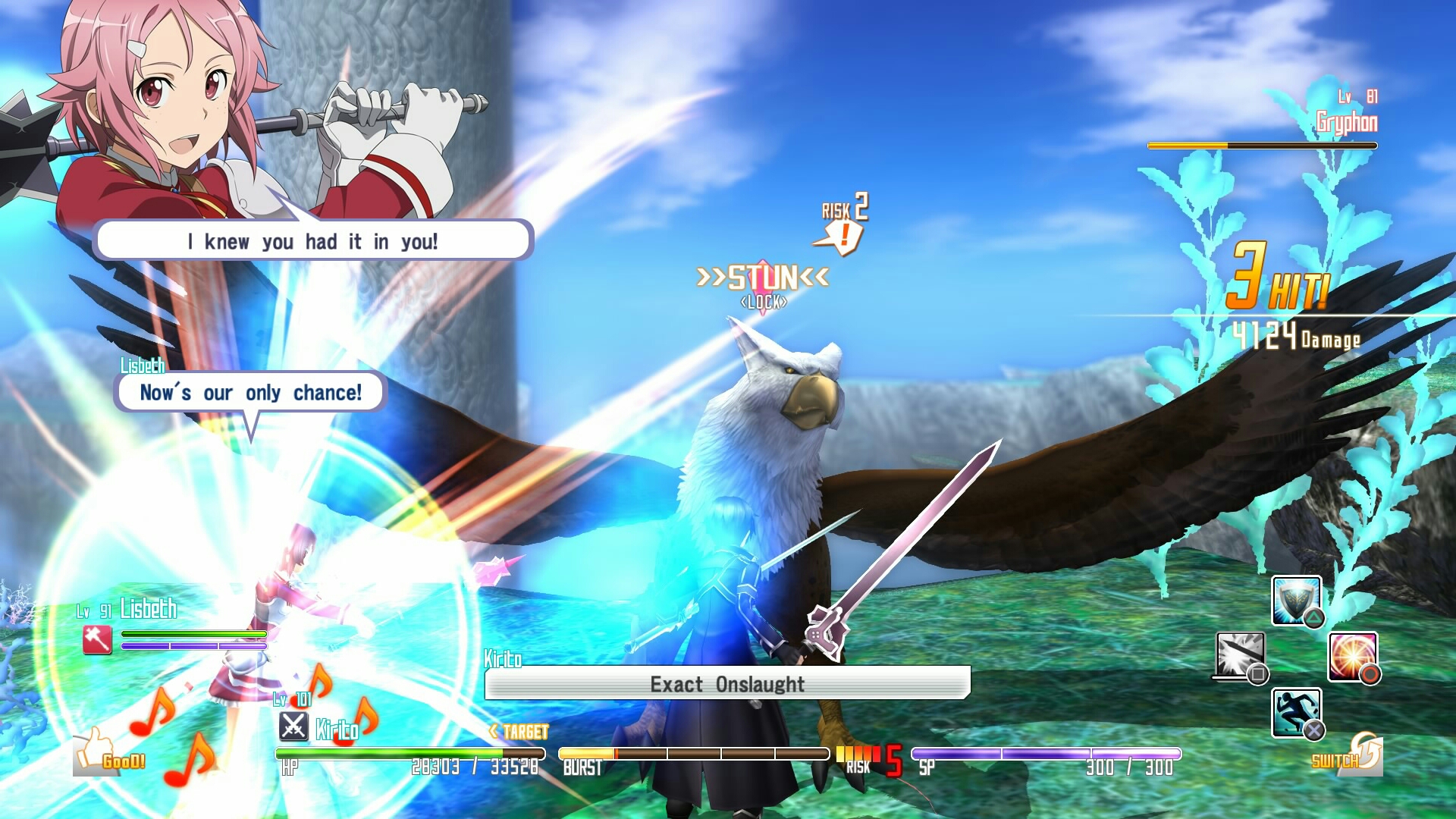
Perhaps "all of its own" isn't quite the right description, mind, since Omega Quintet's combat is executed as something of a curious blend between the battle systems from the Atelier series, the Ar Tonelico series, The Legend of Heroes: Trails in the SkyFinal Fantasy X and Final Fantasy XIII. That's quite a mixture, but it works really well, particularly when you pull off something as enjoyably silly as this:

The above sequence was recorded at just level 20, by the way; I shudder to think what numbers the girls will be putting out by the end of the game.

Interestingly, the game doesn't bombard you with the complete combat system right from the get-go; it gradually increases in complexity over the course of the first few chapters at a fairly sedate pace, allowing you to get comfortable and familiar with each new concept before a new one is introduced. Ultimately, by the time the complete battle system has unlocked, you should be well familiar with all the possibilities it has to offer. At about 15 hours or so in, I haven't seen everything the system has to offer, yet; for some, this may draw unfavourable comparisons to Final Fantasy XIII, which was lambasted for having a "20 hour tutorial", but it's worth noting that Omega Quintet does sidestep this issue a little by being somewhat less linear than Final Fantasy XIII was; at any given moment, there's a bunch of sidequests to do, hidden treasures to find, new areas to open up, items to craft, special items to unlock and all manner of other things to do. (And besides, there was nothing the fuck wrong with the way Final Fantasy XIII did things, anyway. So there.)

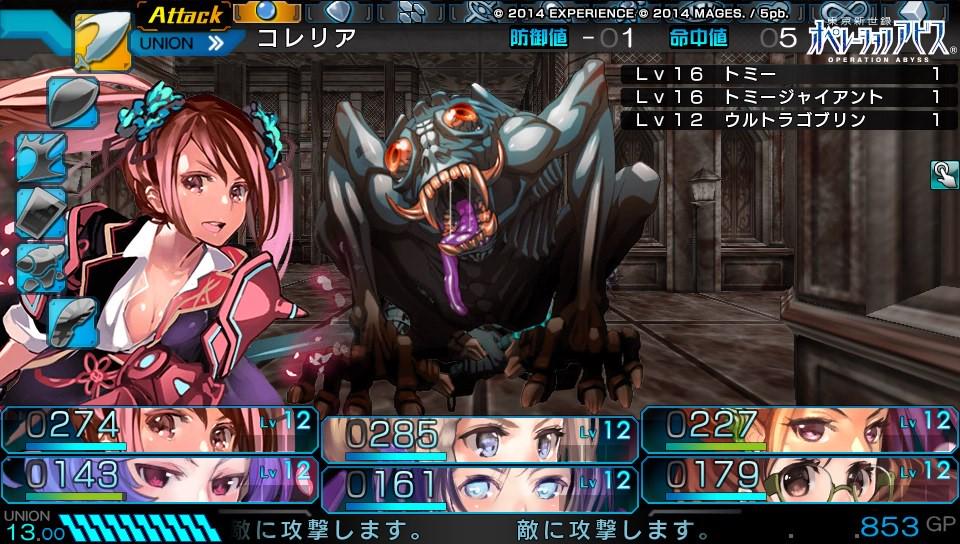
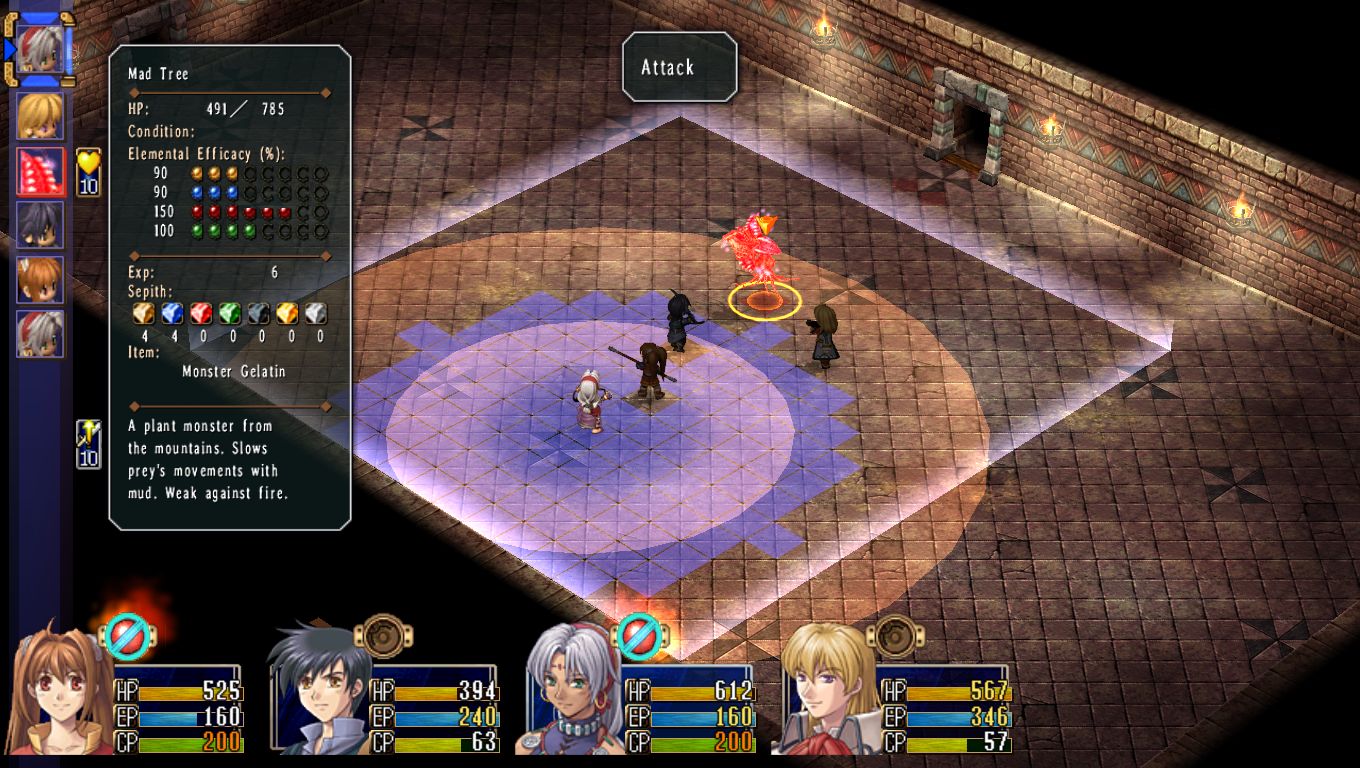
Here's roughly how the system works. Like the Neptunia games, you can get the advantage at the start of combat by attacking an enemy before they come into contact with you; conversely, letting an enemy touch you from behind will give them the advantage. How battle begins sets the opening initiative order, and from there the game follows a clear to understand turn order system, reflected by a graphical representation down the side of the screen.

Each party member has a number of actions per turn, increasing as they increase their overall proficiency with each of the game's five weapon types — axe, gun, spear, fans and gauntlets. These actions can be used to attack, use a skill or use an item, and when all the actions have been chosen, the party member performs each of them in sequence before the turn order moves on to the next combatant. Of key consideration when choosing skills is the "wait time" — more powerful skills will push the party member's next turn further down the turn order, potentially giving enemies the opportunity to attack several times before she can go again. Conversely, certain skills increase the enemies' wait time when they successfully land, so you can manipulate the turn order yourself to a certain degree.

Attacks, skills and even items have an effective range, represented by coloured lines on the ground. Do something to someone in the green area and it will be most effective; then comes blue, yellow and finally red, which means you either can't do the action at all, or it will be at severely reduced effectiveness. Certain attacks and skills also have a radius, either circular or a range of "tiles" horizontally, vertically or both, meaning you can hit multiple enemies at the same time. At the start of a party member's turn, you can move them forward or backward in the formation, allowing you to manipulate the positioning to your advantage. There are also "knockback" skills, which are self-explanatory, and "reverse" skills, which… uh, I'm not entirely sure what they do.

Here's one thing I have to nitpick slightly; there are certain aspects the game doesn't explain very well or, indeed, at all in some cases. The stat names, for example, don't take the usual Attack/Defense/Magic Attack/Magic Defense/Accuracy/Agility format from other Compile Heart games; instead we have Song Power/Stamina/Knowledge/Divinity/Technique/Vitality. You can work out what they are from a bit of experimentation, but it takes a bit of adjustment. Likewise, some of the status effects and added effects (such as the aforementioned "Reverse") aren't made very clear at all, though again, you can probably work these things out for yourself.

Personally, I'm actually all for games encouraging you to figure out some of their mechanics for yourself. You don't need to understand these things to get a kick out of Omega Quintet, but if you're the sort of person who likes to min-max your characters and have them fighting at maximum effectiveness, be aware that you'll need to get your hands a little dirty — particularly as the characters in Omega Quintet are significantly more customisable than, say, the Neptunia girls, who don't allow you to take any control over their development at all, though they do allow you to set up your own custom combos according to how you like to fight. In other words, Omega Quintet's apparently deliberate obtuseness at times will be a turn-off to some people, but personally, I actually like not being spoon-fed absolutely everything.

Anyway. It's good. Real good. And I can't wait to play more. So I'm probably going to do just that right now; I've got a combo record to beat, after all.

1374: Nep-Ko

Now that I've finished Tales of Xillia I am, as promised, once again playing Hyperdimension Neptunia Victory. I'm now pushing 60 hours of playtime, a significant proportion of the last few of which have been spent doing nothing but non-story content.

And lordy, what a lot of non-story content there is. There's sidequests to do, which tend to have fairly modest rewards but challenge you to battle powerful monsters and master the game's various mechanics. There's a crafting system, which requires you to discover new recipes for various items, then gather the materials for them either from enemies or "harvest points" in dungeons. There's the Scout system, in which you send out numerous NPCs on your behalf to check out dungeons and potentially manipulate the items, enemies, drop rates or experience point gain in particular areas and occasionally discover completely new places. And there's little tricks like earning money by gathering an item called "Invisible Cloth," purchasing a cheap costume, combining it with the aforementioned Invisible Cloth to make a new item of clothing and then selling them for 1.5 million credits a pop.

All of this side stuff is conspiring to prevent me from advancing the game's story. Said story is immensely entertaining as it always has been in the Neptunia series, but Victory's mechanics and optional content are far more solid than even Neptunia mk2, which certainly had plenty of things to do. The combat system has been refined into something that is immensely enjoyable to repeatedly engage in, the difficulty has been ramped up considerably over the rather straightforward mk2, and just chasing down these sidequests and items is extremely addictive.

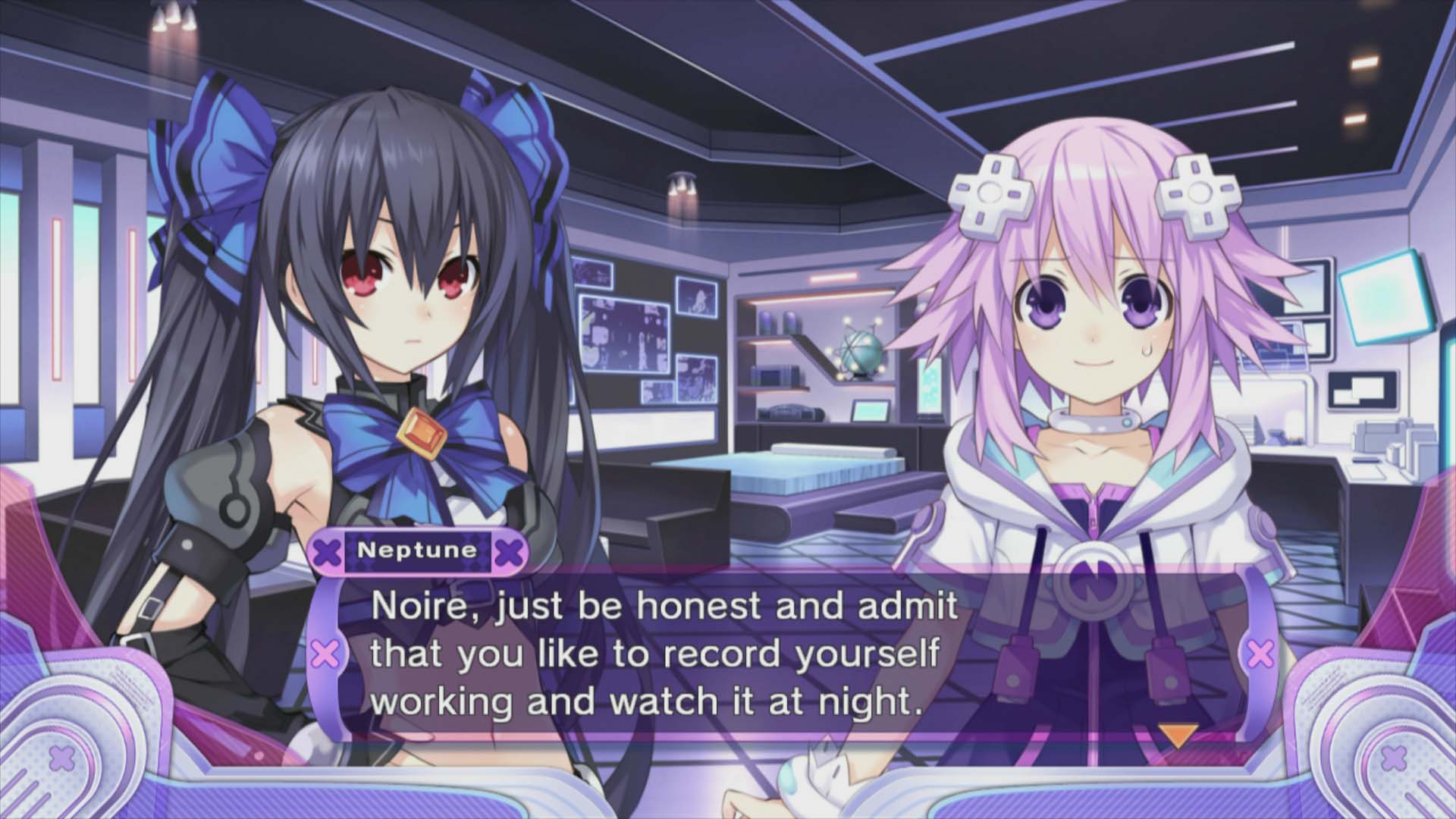
Although the Neptunia series is widely derided by the mainstream press, I'm consistently impressed by what it's managed to achieve over the course of three games. What initially began as something of a cheap joke at the expense of the games industry and the "console wars" in particular has developed into something much more over time — each of the game's main characters has been developed into their own unique person with a distinctive personality. Okay, there's plenty of standard anime tropes at work, but combined with the fact that these characters are supposed to represent games consoles and manufacturers, it really works; why wouldn't PlayStation be a tsundere who enjoys nothing more than working too hard, and why wouldn't she have a sister afraid of never quite being able to match up? Why wouldn't Nintendo live in a vibrantly-coloured candyland but actually be ruthless, cold and prone to bouts of completely irrational anger?

By nearly 60 hours into Victory, I'm no longer really thinking of the Neptunia cast as "the Sega one, the PlayStation one, the Microsoft one"; they've become great characters in their own right, and their interactions with one another are a real highlight. In fact, such is the popularity and success of the series in its native Japan, it's got its own anime spinoff which I'm curious to watch at some point, and there are several new games on the way, too.

I find it quite odd but also rather pleasing how much this game series has resonated with me since I first picked it up on a whim out of interest one day. "Objectively" speaking — in as much as it's possible to be "objective" when talking about pieces of entertainment — there are far better games out there, both in terms of gameplay and technical proficiency, but something about the adventures of Neptune and the gang has really spoken to me ever since that clunky first game, and has ensured that any time something with the words Hyperdimension Neptunia is released, it's pretty much an instapurchase for me. It's been a while since a "big-name" game has elicited that sort of feeling from me.

1360: Lord of Spirits

After going back and forth on whether or not I really felt like doing it, I've decided to go for a Platinum trophy on Tales of Xillia. As I wrote some time back, I've started thinking of trophies (though not so much Achievements, for some reason) as a means of showing my appreciation for a particularly good game. Working on the assumption that developers and publishers are looking at trophies and achievements as some sort of metric as much as they're intended as a metagame for players, I'm happy to put in a bit of extra effort to show I liked the game enough to devour every bit of content it had to offer.

My hesitation with Tales of Xillia's trophies is that although the game itself is excellent, the trophy list was rather uninspiring and distinctly grindy. A significant proportion of the trophies consist of "use [x] character's [y] ability [z] times", and there's one frustratingly missable trophy that's going to require a second playthrough to get. (Fortunately, I was intending on doing that anyway, since Tales of Xillia gives you the option to run through the story as one of two different main characters.)

What I've found in the course of going for some of these trophies, though, is that they're slightly more enjoyable than they might have suggested. The most interesting thing about a lot of them is that they're seemingly designed to give you a deeper appreciation of the battle system and how it works — sure, you can knock the difficulty down to Easy and basically hack-and-slash your way through, but go for some trophies and you'll come to understand that each character handles noticeably differently, and has special abilities that are suited to various situations, many of which require actual skill to pull off. Jude, for example, has an ability called "Snap Pivot" where if you block and backstep at the right moment, you'll zip around behind an enemy for some uninterrupted pummelling for a moment; performing the same move with Leia, meanwhile, causes her staff to extend, giving her a greater reach for a few moments.

The way the trophies help you understand the battle system extends beyond the ones where you have to actively trigger skills, though. Each character has a "link skill" that they perform when you're not actively controlling them, but you partner them up with your active character. Achieving some of the trophies requires that you understand how, why and when these link skills are triggered: Jude heals you if you get knocked down (assuming he wasn't knocked down as well); Leia steals from enemies if you knock them down, requiring you to figure out which skills are reliable knockdown providers; Rowen protects you from magic; Alvin breaks guards; and Milla can "bind" enemies.

I've still got a way to go yet — including a whole other playthrough, which hopefully shouldn't take too long, given that I'm cleaning up as many of the time-consuming trophies as possible in the post-game section of my first run — but I'm still enjoying myself, and given how consistently good Xillia has been, I'm happy to show it my appreciation by striving for a Platinum.

1174: The Second Tower

I beat Ar Tonelico II: Melody of Metafalica this evening. Or, more accurately, I saw one of its four endings. Two of the other endings won't be particularly difficult to obtain with the tactical saves I made on the way to the finale, but the last remaining one will require playing about 80% of the game again, albeit with a completely different second "phase". I'll probably take care of that last ending alongside a new game, which will either be Hyperdimension Neptunia Victory or the third Ar Tonelico game, both of which I anticipate I will be enthusing about considerably on these pages in the very near future if previous instalments in their respective franchises are anything to go by.

Anyway, Ar Tonelico II. It's… well, fantastic. I must confess to having not been as immediately smitten with it as I was the first game, as the conflicting art styles between the field and battle sprites (and between the field sprites of the first game and the second game) were initially a little jarring. (Seriously, everyone has really, really big hands and massive feet on the field maps and it's very disconcerting to begin with.) But after not very long at all, I found myself looking past this rather superficial consideration and immersing myself in what turned out to be a very pleasingly deep and meaningful story packed with good characterisation and questionable translation from the original Japanese. (On that note, though, the translation was at least understandable despite a few errors, and certainly no worse than some visual novels I've played.)

Spoilarz Ahead

2a91og8Ar Tonelico II stands on its own, but also fits into the current "trilogy" as the sort of "dark middle episode". Whereas the first Ar Tonelico was rather bright and breezy most of the way through, the land of Ar Tonelico II is a bit bleaker. The people are struggling, there isn't enough land for everyone and everyone is clinging to the seemingly hopeless desire that the land's Holy Maiden will be able to create "Metafalica" — a verdant green land summoned through the use of Reyvateil Song Magic. Plenty of political machinations and backstabbings threaten to fuck everything up completely (and pretty much do on several occasions over the course of the entire narrative) but, this being a JRPG, our plucky band of heroes are there to wander the lands, right wrongs and eventually figure out how in the world they are going to help everyone find hope for the future.

Ar Tonelico II's story is nice in that it isn't quite the clichéd "Big Bad wants to destroy the world" business. Sure, there's world-threatening stuff going on and the eventual aim of the game is to save the world from an unpleasant fate, but it's not quite what you might expect. For starters, you spend most of the game not being quite sure who the "good" and "bad" guys are. There's no sign of a single easily-identifiable antagonist who is fucking shit up and needs a good Omnislash to the face; no white-haired pretty boy accompanied by tubular bells and organ music every time he appears. In fact, over the course of the narrative, none of these characters are presented as one-dimensional — most of them go through some sort of change and/or growth as the story progresses.

Perhaps the most interesting thing about Ar Tonelico II in this regard is the fact that the final boss "Mir" from the first game is actually a party member in the second — though you don't know this when you first meet her, and in fact it's entirely possible to go through pretty much the whole game without noticing this or figuring it out, depending on the choices you make and the optional events you witness. Not having played the first game won't affect your enjoyment of the second, but if you have played the first game, the moment where you find yourself going "Wait… OH. Mir?!" is a "big reveal" on a par with Darth Revan in Star Wars: Knights of the Old Republic or SHODAN's first appearance in System Shock 2.

Herein lies one of the interesting things about the first two Ar Tonelico games in general: "good" and "evil" aren't absolute. In Ar Tonelicowe get some insight into why Mir is the way she is and why she is so angry about everything — and it's easy to find yourself sympathising with her rather than just wanting to kick her ass. In Ar Tonelico II, by spending some time with her as a (relatively) normal person, we get to find out a whole lot more about her — what happened to her in the distant past, what led her to her actions in the first game, and how she feels about what has happened to her then and since. If you follow her "route" through to its complete conclusion in Ar Tonelico II, it's a really wonderful story arc for one of the most interesting, troubled characters I've encountered in a very long time. I don't yet know if she shows up in Ar Tonelico Qoga, the third game, but I'll be very happy to see her again if she does.

The overriding theme of the Ar Tonelico series is that of bonds between people, and this is particularly apparent in the second game. The main theme of Ar Tonelico II's story is that the more intense a relationship between two or more people, the more painful it is. The more people you surround yourself with, the more "alive" you feel from being part of something bigger than yourself, but the more pain you suffer when you lose those precious people. The world-ending chaos at the end of Ar Tonelico II is not brought about by a desire for dominance or a display of power, but instead out of a simple desire to not feel that sharp pain of loss any longer. If everyone was able to abandon their physical bodies and live on purely as an individual spiritual entity, the primary antagonist's theory goes, no-one would have any need for other people, no-one would feel the pain of loss, and everyone would be happy in their complete and total individuality. But, responds the protagonist, no-one would be truly alive then. Life would not have meaning drawn from the people around you and the hardships you work together to overcome. You'd be little more than data.

It's an interesting and somewhat bittersweet message, but it works hugely well in the context of both the overarching plot and the smaller, individual character-led stories that unfold over the course of the whole game. I'm all for exploring deep and thought-provoking themes through interactive entertainment, and Ar Tonelico II successfully achieves that without sacrificing the "spectacular" side of its overall experience. It's still recognisably a JRPG with all the over-the-top pyrotechnics and anime-style special attacks that entails, but at the same time it's a complex and emotional tale far beyond the "Evil Guy Is Over There, Go Stab Him" trope that people (largely incorrectly) assume still characterises the genre.

In other words, just go play it, all right?

1171: Easy Listening, Part 2

As promised, I'm continuing yesterday's post with another game music fest to introduce you to the joys of some soundtracks you might not be familiar with.

Today, it's Cavia/Square Enix's strange, wonderful and rather depressing action-JRPG Nier.

Nier

Nier wasn't particularly well-received by critics upon its release due to a variety of factors. Having played it (and adored it, I might add), I can see why it was criticised, but equally I feel it was treated a little too harshly. Not only was it doing some fascinating things with the way it told its story and what its story was about — I'll leave the spoilers out of the discussion for now — but it was also doing some really interesting things with its gameplay, too. What initially appeared to be a relatively conventional third-person character action game/RPG subsequently revealed itself to have elements of visual novels, text adventures, farming sims, 2D platform games, isometric-perspective dungeon crawlers, bullet hell shooters and numerous other genres. It really was a massively interesting game in almost every way.

And then there was its soundtrack, which even if you don't like the game is indisputably amazing. Let's look at some standout tracks.

This track, known as Hills of Radiant Wind, is one of the tracks you'll hear most frequently in the game, since it typically accompanies your jaunts across the countryside surrounding the small settlement where the title character Nier and his daughter Yonah live. This track is hugely memorable both for having a catchy melody and capturing the atmosphere of the game world beautifully. The pounding drums at the bottom of the mix give a sense of adventure and driving forwards, while the vocal line atop the relatively simple accompaniment gives a suitable air of melancholy to the experience. Nier is not a happy game, and this track, while one of the more "upbeat" ones from the soundtrack, reflects that nicely.

This song, simply called Grandma, is beautiful, and is, to me, probably the most representative piece of music that illustrates what the Nier experience is all about. A simple accompaniment accompanied by a mournful voice provides a massively atmospheric backdrop to some of the most emotional story moments in the game.

And then we move on to a few tracks that use the "leitmotiv" technique I'm so fond of, where a number of different pieces make use of similar melodic or harmonic sequences to reflect various things happening to different characters and/or places.

Let's start with Emil, who, without spoiling anything, gets fairly consistently screwed over throughout the course of the whole game, through no fault of his own. Poor kid.

Anyway, here's Emil's "Sacrifice" theme, which accompanies some heartbreaking, sad moments:

And by contrast, here's his "Karma" theme, which comes shortly after a heartbreaking, sad moment when you're venting some aggression on the perpetrators:

The addition of the pounding drums and the urgent piano line in this one always gives me shivers, particularly when I remember how it was used in context.

Then we have Popola and Devola, two characters who are extremely important to the overall narrative in ways I won't spoil right now. When we encounter them, we hear various versions of the "Song of the Ancients" theme, beginning with this acoustic guitar-centric version:

…and moving on to this… I'm not sure how to describe this, really. Plinky-plonky version?

Well, if you're going to do two different versions based on the two characters who sing it, you might as well do a third version where they sing it together, mightn't you? Yes, obviously. This, along with Devola's theme above, are some of the only examples of diegetic music in the game — the rest is there to evoke a mood rather than actually be "present" in the world.

And, hell, if you're going to do that, you may as well go the whole hog and have a battle theme based on their (by now) iconic song, right? Of course.

The latter one, like Emil's "Karma" theme, still gives me shivers because I can remember it in context. Gobsmacking.

Then we come to Kainé, possibly one of the most fascinating characters in any game ever for a whole host of reasons, many of which aren't made entirely explicit in the game. Kainé has two main versions of her theme: a slow one, which goes like this…

…and a fast one, which goes like this.

Those who know their Nier lore will be familiar with the fact that Kainé is intersex. If you weren't familiar with your Nier lore, now you know too — don't worry, this isn't technically a spoiler in terms of the game's overall plot, and in fact knowing it beforehand brings a whole host of hidden meanings to a bunch of sequences in the game to the fore. I like to think that the markedly different character of these two pieces reflects Kainé's "masculine" and "feminine" sides, because she is most definitely in possession of both. She is, it's fair to say, a very angry person — and with good reason — but not afraid to express her feminine side in some rather… flamboyant ways.

One of the most interesting things about the vocal-heavy tracks in Nier are that they don't use a language from this world. Instead, vocalist Emi Evans was encouraged to make up words in a "futuristic language" — Nier is set in the far, far future — and used elements of Scottish Gaelic, Portuguese, Spanish, Italian, French, English and Japanese to create something with a very distinctive sound, but which doesn't "mean" anything in and of itself. Instead, the vocal sounds are simply intended, for the most part, to evoke the overall feeling of sadness that pervades the whole game without distracting the player with recognisable words.

So that's Nier. Easily one of my favourite game soundtracks of all time, and a score which adds a huge amount of emotion to what is already a game rammed to the rafters with heartbreak.

1145: Metafalica

Page_1I've been continuing to play Ar Tonelico II and it's really rather good. One thing I've found particularly endearing about it is the fact that just when you think you've got a handle on the way it does things, it goes and does something else interesting just to throw you off a bit. And yet even despite all these mechanics that get added over time, it still feels like a coherent experience as a whole.

Let's take the stage I've got up to now — "Phase 2" in game terms. In the first Ar Tonelico, the change from Phase 1 to Phase 2 marked the point where you were out of the "exposition" chapter and into the plot proper. Phase 2 was also the point where you had to choose between the two heroines, and then had two completely separate (but related) storylines to follow along with. The paths then reconverged towards the end of Phase 2 and remained together for the (completely optional) Phase 3, which offered the "true" ending of the game.

Phase 2 in Ar Tonelico II is a bit different. Rather than, like the first one, being set in the same locations and simply branching off in two different directions, Phase 2 of Ar Tonelico II takes place in a completely different area that works completely differently to the environment you've spent the previous 12 hours in. The early part of the game is, aside from its many and varied peculiar gameplay systems, relatively conventional — you visit towns and do stuff in them, then you go to dungeons. Then you go back to towns. And so on. The linear plotline is broken up by an optional "hunting" sidequest in which you can track down various "I.P.D."-infected Reyvateils to add to your "Girl Power" arsenal (I'm not even going to get started explaining that, I'll be here all day) but for the most part, you're doing the usual JRPG business.

Phase 2, meanwhile, takes place in an environment that changes according to your choices. Early in the Phase, you're introduced to a new mechanic known as the Infelsphere. This virtual world works in a similar way to the "cosmospheres" found inside the heroines' minds, but rather than reflecting their inner turmoil and anxieties, the Infelsphere represents the relationship between the two heroines and how they understand each other. Events unfold in the Infelsphere in which you have to make choices as to how to respond, and the choices you make in the Infelsphere subsequently affect what parts of the "real world" open and close to you. Your eventual goal is to get to a specific location by navigating your way through a maze of these pathways that open and close according to how the Infelsphere events unfold, with each point on the path containing some sort of "trial" to overcome. This might be as simple as defeating a monster, or it might be a challenge such as successfully smuggling biscuits past the penguin-like "Pippen" creatures.

Thematically, in each of these trials, you're "proving your love" to one of the heroines, which subsequently provides you with keys to unlock new events in the Infelsphere, and so it continues. It's a really peculiar, really interesting structure that not only offers some unconventional JRPG gameplay in the "real world" sections, but also provides some intriguing insights into the characters and the way they respond to various situations in the Infelsphere component.

You'll notice I haven't really mentioned the plot in this description, and that's deliberate, as discussing the plot surrounding all this would be a massive spoiler, so I'll spare you that — for now, anyway. What I am finding particularly pleasing about Ar Tonelico II as a whole, though, is that even if it didn't have a compelling plot and awesome characters — which it does — it would still have rock-solid gameplay with an absolute bucketload of things to do. It is just one of the many, many examples out there that prove JRPGs are far more than the "ATTACK, MAGIC, ITEM"-fests that ill-informed detractors of the genre assume these games still are.

They haven't been that way for a long time, people. So if you haven't played a JRPG since Final Fantasy VII I strongly recommend you check out what the genre has done since then — you might just be very pleasantly surprised by what you find.

1138: Song Magic

Been playing some more Ar Tonelico 2 this evening, and I'm liking it a great deal. Like its predecessor, it has a very pleasing system of "feature creep" whereby it starts out feeling rather straightforward but gradually, over the course of the early stages of the game, introduces more and more new and interesting mechanics until you have something that is very, very distinctive.

In the original Ar Tonelico, we were introduced to the basic combat system; then the way it worked when you have the magic-using Reyvateil characters in your party; the Dive system, in which you could explore the inner recesses of the heroine's mental "cosmosphere" worlds; the "bedtime conversations" system whereby the protagonist and the heroines could get to know each other a bit better (and subsequently unlock deeper levels in the cosmosphere); the "Grathmeld" crafting system, whereby you could take all the junk you'd acquired from the hundreds of NYO?!s you'd killed and turn them into various items, then enjoy some amusing scenes as the heroines try and convince you to let them name the item something ridiculous; and the "Install" system, whereby you're able to insert crystals into the heroines (and yes, they relish the opportunity for innuendo inherent in this process) to power up their various abilities and customise the effect of their spells.

In Ar Tonelico 2, meanwhile, we're first of all introduced to a new and rather odd combat system in which the two sides in the combat alternate attacking and defending for a set period of time — when attacking, you have to press buttons corresponding to the party member you'd like to attack and combine it with a directional button to do a specific move; when defending, you have to time button presses carefully to protect the back-line Reyvateil "mages" from attack, if they're present. The way the Reyvateils work is then introduced — a weird meter in the corner of the screen reflects what they want the front line to do, and fulfilling their demands provides bonuses, helping them to cast more effective spells more quickly. Then, once again, we have the Dive system, which works largely as it did before, albeit with a lot more multiple-choice bits where you have to say the right thing to proceed. Then we have the "I.P.D." system, whereby part of the plot dictates that you have to subdue and capture Reyvateils that are infected with I.P.D., which hasn't been explained yet. Then we have a slightly different crafting system, whereby certain items can only be crafted in certain places (you can only make food in a restaurant kitchen, for example), and the same recipe has different outcomes depending on which heroine you get to help.

Then things get a little odd. "Dualstalling" replaces the "Install" system from the previous game, and is the only way of levelling up Reyvateils, who no longer gain experience normally. Instead, at regular opportunities, you have to let them take a bath in water infused with crystals you've collected or purchased. During the bath (which looks rather large and luxurious, I must say), they wander around a bit, and if they pass over one of the crystals they dropped in, they gain a temporary special effect until the next time they bathe. And if you drop in toys (bath toys, you pervert) and scented oils, different effects might emerge. Oh, and if both heroines are bathing together, they'll often chat about things, too, which helps improve their "sync" value, which in turn helps them fight more effectively together in combat.

Then we have the "Dive Therapy" system, which I was introduced to in tonight's session. Now the subdued I.P.D.-infected Reyvateils have a purpose — they can be "cured" by one of the characters, who is a Dive therapist. Indulging in Dive Therapy involves talking to the Reyvateil and attempting to manipulate her mood to its ideal level on a meter at the top of the screen. Administering various treatments can affect the rate at which this meter changes with each response you give to their statements. Some responses increase the meter, others drop it, and each infected Reyvateil has a "sweet spot" where the meter needs to be in order to be cured.

That's not all you can do with them, though. The cured Reyvateils then bugger off and scatter themselves around the world to form a fan club for one of the heroines, and their affection for her increases as they see her doing cool stuff. When their affection maxes out, they will help out — exactly how, I'm not sure yet, but we'll see.

Oh, and also through the "Girl Power" system you can "equip" rescued Reyvateils to help the protagonist out in various ways. They then level up and improve their abilities and… waah, my head hurts.

All these weird and wonderful mechanics may sound overwhelming, but they're introduced at just the right rate. You're shown a new concept, then given a period of time in which to explore it in practical terms. Then another one comes along, and you can explore that. And so it continues. The nice thing is that only a few of these mechanics are "spoiled" in the game's manual, meaning the existence of things like the Dive Therapy system and various other bits and pieces are a nice surprise when you come across them for the first time. (Unless you've read this post first, of course.)

On the one hand, it's nice to be ready for all the game's mechanics and be able to refer back to a manual when you need to. But on the other, it's quite interesting (and oddly liberating) to play a game that trusts you to experiment a bit and figure out what on Earth (Metafalss?) is going on. Take the Dualstalling system, for example — while the help menu in the game explains roughly how it works, it's only by fiddling around with various arrangements of bathtime goodies that you'll figure out the most effective means of letting your mage-ladies wash their stinky bits and level up.

Basically, Ar Tonelico 2's more esoteric features are something you'll either be on board with or not. As you've probably gathered, I love them — and besides, are they really any more weird than summoning giant chariot-riding penis demons by fusing cards together, or sucking the magic out of monsters to somehow attach to your own strength? No. No they're not. So shush.

1135: Melody of... The Other Place

Page_1As I noted yesterday, I completed Ar Tonelico: Melody of Elemia. So naturally, having discovered a new RPG series that I like very much, what's a boy to do but to make an immediate start on the sequel, much to the delight of my Ar Tonelico-adoring friend who convinced me to play the damn things in the first place?

Ar Tonelico 2: Melody of Metafalica is a surprisingly different beast to its predecessor in many ways. Its Japanese incarnation came out in the same year as the first Ar Tonelico hit Western shores, but it wouldn't be until 2009 that North American and European players would get their hands on it. That actually makes it a surprisingly recent game, released in the twilight of the PS2 era. This might explain why I never really paid it much mind first time around (besides being unfamiliar with the prequel, obviously) — everyone (including me) was already well and truly enraptured by "next gen" by that point, though games like Persona 4 (which also came out in 2009 in Europe) had shown me that the previous generation still had plenty to offer.

The whole Ar Tonelico experience has had a complete overhaul in Ar Tonelico 2. Gone are the distinctly PS1-ish isometric-perspective graphics (though I actually sort of miss them now), replaced with hand-drawn backdrops in towns and a pleasing combination of polygons, flat objects and fixed camera angles to create "3D" dungeons. The sprites, too, have had a bit of a change in aesthetic — they have peculiar, stylised proportions now, which frankly has taken a little adjusting to, but the improved amount of emotive animation on them makes up for the fact that everyone has really, really distractingly massive hands.

The biggest change is in the battle system, however. I liked Ar Tonelico's battle system, as it combined conventional JRPG turn-based battling with an interesting magic system that encouraged you to find creative ways to finish battles "well" rather than quickly. It was a bit repetitive by the end, however, and it was consistently way too easy pretty much all the way through the entire game.

Ar Tonelico 2's battle system, meanwhile, is a completely different beast. It's still sort of turn-based, but not in the same way as its predecessor. Instead, the two sides in the conflict each take turns to attack and defend. When it's your turn to attack, you have a limited amount of time to use your two "vanguard" (front line) characters to attack; when it's your turn to defend you have to carefully time button presses to protect the back line Reyvateils from taking damage. The Reyvateils make demands on you during battle, too, requesting that you perform specific attack moves by pressing the button for the corresponding front line character and a particular direction. Fulfilling these demands gives you various bonuses that make the battle turn in your favour. It's interesting, as it means you have to really concentrate on every battle rather than just mashing the "attack" button, but I'm yet to have a significantly challenging battle to show its full potential just yet.

The "Dive" system makes a return, and is almost identical to its predecessor. You get to know the game's heroines in the real world by talking to them at campsites and inns, then "dive" into their mental "Cosmosphere" world to find out more about their various inner struggles and problems. Overcoming these problems helps them craft new Song Magic which you can then use in battle — plus these are entertaining mini-stories in their own right. Diving is mostly the same, though there are a lot more situations where you're given a choice of responses to a particular situation and must pick the correct one rather than simply following it through.

In "new, weird gameplay mechanics" news we have the new Dualstall system, which replaces the "Install" mechanic from the previous game (which allowed you to boost a Reyvateil's abilities by plugging various crystals into her… spells in a rather suggestive manner). Dualstalling essentially means flinging the game's two heroines into a bath infused with magic crystals, nice-smelling bath oils and bath toys and letting the attached abilities, uh, be absorbed. The heroines will also have a good chat in the bath, so this is a good way of building up their "Sync" gauge, which helps them work together better in battle.

So far I'm about four hours into the new game and enjoying it a lot so far. The change in aesthetic and gameplay style gave me a bit of "culture shock" initially but that thankfully soon faded, and I'm now enjoying the story and characters just as before. It's interesting to note that the game still feels recognisable as an Ar Tonelico game, yet has a different setting (albeit in the same overall world), different characters and different gameplay mechanics. I'm assuming that the third game (which is where the series made the jump to PS3) will be "similarly different", too, judging by a quick flick through the manual.

Further reports as events warrant.

1134: Melody of Elemia

Page_1I completed Ar Tonelico: Melody of Elemia this evening. What a fine, fine game that was. I'll be writing somewhat more "professionally" for want of a better word about it this Wednesday over on Games Are Evil, but for now I just wanted to enthuse a little about the great experience that was that game. There may be some spoilers ahead; be forewarned.

The most immediately striking thing about Ar Tonelico for a new player coming to it for the first time in 2013 is that it looks old. It's also worth noting that it came out in 2007, so it actually looked pretty old when it first came out. That said, after a few hours of play, the low-resolution isometric-perspective sprite-based graphics cease to matter on a technical level, and the amount of character and personality in them starts to shine through. A friend of mine just noted that the visual style is actually something of a successor to stuff like Secret of Mana and the like and that's a great comparision — I'm kicking myself for not figuring that out sooner.

Outside of the in-game graphics, Ar Tonelico has some absolutely lovely character designs. Lyner may look fairly "generic JRPG hero" in his stylings, but at least he has some personality about him. The two heroines Aurica and Misha are both attractive and appealing in completely different ways, and a plot twist I won't go into here sees you interacting with Misha in both her "spunky young girl" and "equally spunky young woman" forms. The third Reyvateil introduced later in the game also proves herself to be an interesting character in her own right, again with her own unique visual style and "appeal elements".

One of the most interesting things about the game to me — and the thing I'm intending to write about this Wednesday — is the game's multi-route, multi-ending structure. Now, this could very easily be a recipe for disaster, as multiple endings in lengthy RPGs are often a good method to ensure your players won't see all of the awesome story content you made. That's not necessarily a bad thing — it's kind of cool when you can discuss a game with a friend and discover they had a completely different experience to you — but it's also frustrating to some people who like to know they've got everything they can out of a game before moving on.

Ar Tonelico's multiple endings and routes are handled in a rather peculiar manner. There are three "phases" to the game, each of which is a complete story arc in and of itself, complete with final boss confrontation at the end of each. Early in the second "phase", you have the opportunity to go with one of the two heroines and experience their story. Aurica's story gives you an overall view of what is going on in the overarching plot of the game, while Misha's story gives you a more personal view of what is going on with her and how she is relevant to everything. If you play Misha's route first, there are a number of scenes you see completely without context that don't really make sense. If you play Aurica's route, however, you play an important part in these scenes. The two paths then converge towards the end of the second phase, and the game then apparently ends — the credits roll and everything.

There's a twist, though. In a post-credits sequence, you get to run around and do all the usual JRPG "our party's splitting up, say goodbye" business, but once you've done all that, you're presented with another choice: live a happy life with [insert girl you chose here], or refuse to accept that as "the end" and move on. If the latter option is chosen, you find yourself entering a completely optional third phase that is about 20 hours by itself, and which leads to the "true" ending.

Except in that third phase, there are four possible endings, three of which relate to one of the three heroine characters — the latter of whom only becomes a major player in this third phase. The third phase is pretty much identical regardless of which girl you picked earlier, but the very end — if you fulfilled some very precise conditions — allows you to pick between the girl you chose earlier and the new addition. There's also a "bad" ending relatively early in the third phase that basically says "I can't be bothered with all this sidequesting, let's just get this over with".

So that's a total of… hang on… (counts) six endings? Fortunately, there's absolutely no need to play through the game six times to see all of them — instead, you can play through once, save before the "big decision" in phase 2, play one route to either the end of phase 2 or to complete completion in phase 3, then go back and do the other route, stopping wherever you didn't stop first time around. In my case, I played Aurica's route through to total completion, then played Misha's route to the natural end at the conclusion of phase 2. I don't feel like I missed out on anything, and it only required me to play less than 10 hours over and above what I'd already played anyway. And I feel rewarded for having done so — I have a deeper understanding of the story as a whole, and particularly the characters.

So that's Ar Tonelico — a really, really excellent JRPG and surprisingly thought-provoking if you can look past the notorious innuendo (of which there isn't anywhere near as much as people make out). It's also in possession of I think the best soundtrack I think I've ever heard in a JRPG… though I'm about to start Ar Tonelico 2 as I type this, so I may well be revising that statement in the near future!