2146: More Xenoblade

0146_001

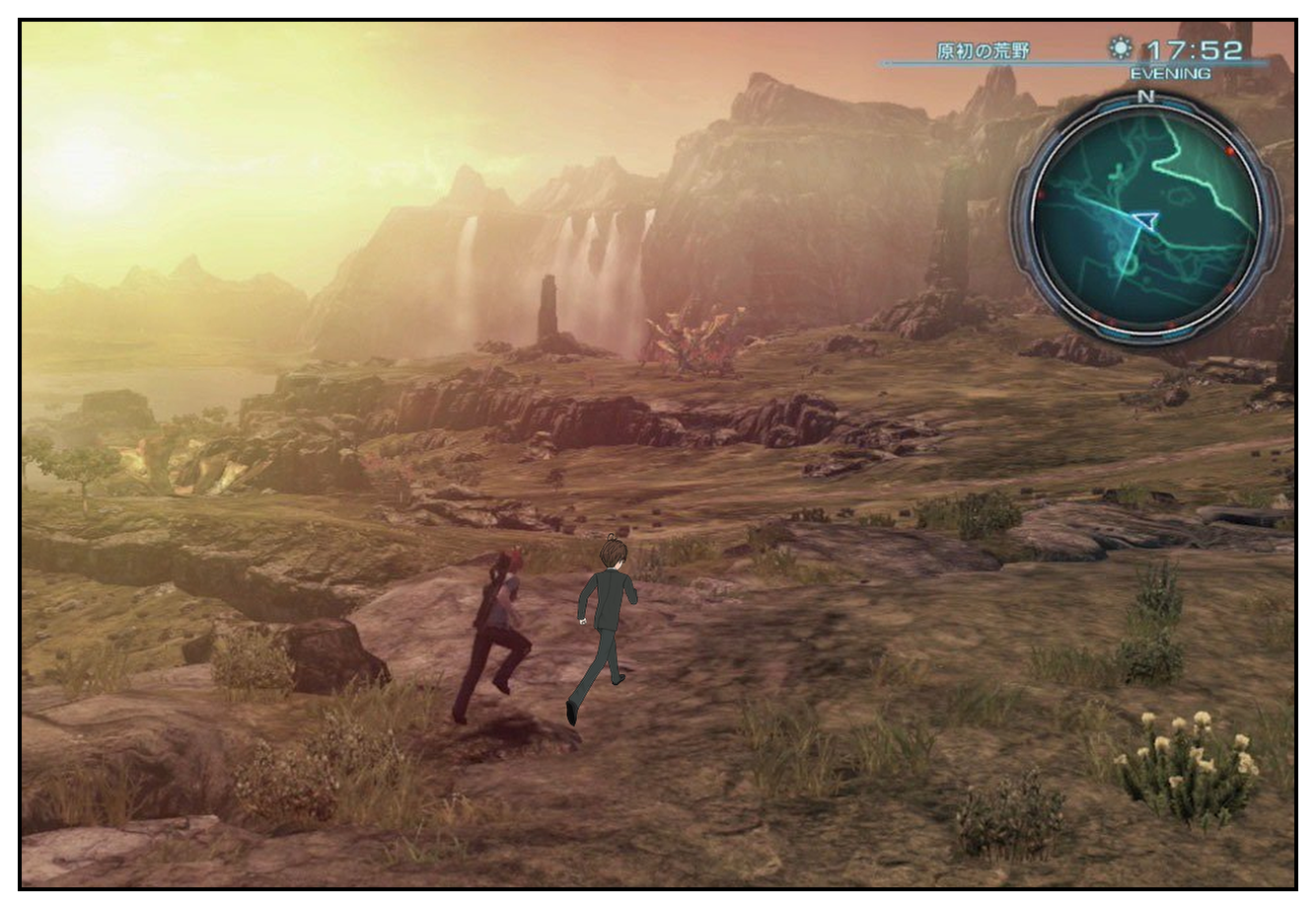
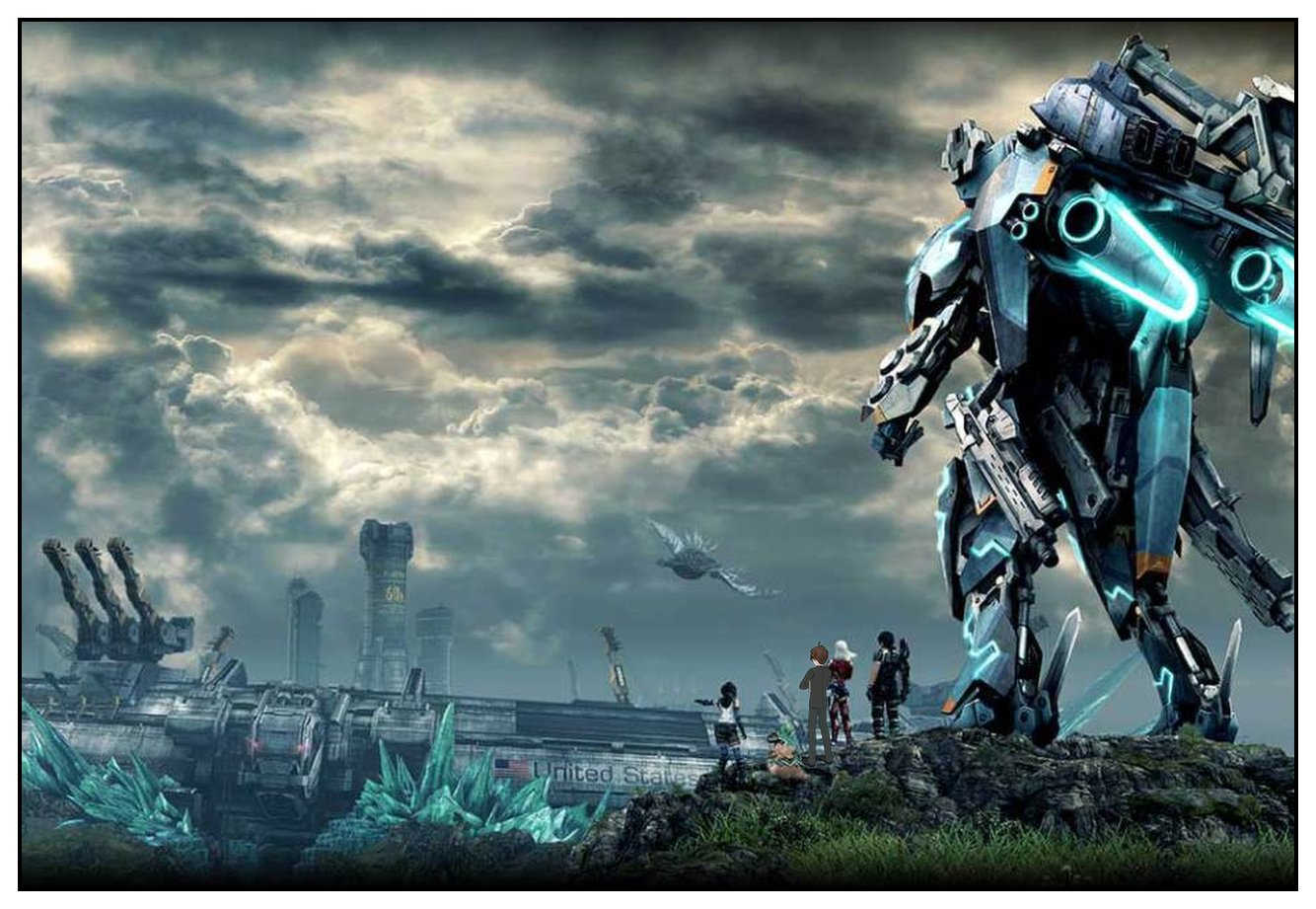
Pretty much all I've done today is finish off a bit of work I had to do and play Xenoblade Chronicles X, so I'm going to talk a bit more about my experiences with the latter.

If yesterday's entry didn't already make it clear, I love it. It's actually not the kind of RPG I traditionally used to love, so this surprises me; it's open world, it's non-linear, it's nowhere near as story-centric as many other RPGs out there… but it's compelling, addictive and beautiful.

I think one of the things I like most about it is that it feels something like the realisation of a longstanding fantasy. Let me explain.

Way back in secondary school, I was renowned among the teaching staff as someone who put way too much effort into creative writing assignments, usually delivering pages and pages of epic prose where my classmates would put in maybe one or two at most. I can still remember most of these stories I wrote, from early example Timeslip (a riff on Back to the Future, which my friend Daniel was obsessed with, that featured a time-travelling lorry rather than a DeLorean, and what was essentially Rainbow Road from Super Mario Kart to represent the pathways between times) to later pieces such as my A-Level English Language assignment, where I delivered a surprisingly confident but harrowing first-person stream-of-consciousness narrative from the perspective of a girl who was raped.

Anyway. One of the stories I wrote — I forget exactly when, but I do remember writing it — was called Colony. Having somewhat grand plans for what I had written, I had tagged it Chronicles of the Scorpio, Book 1, despite having not even finished the entire story of Colony. That is beside the point; what is important is what Colony was about.

Colony was loosely inspired by a PC CD-ROM game I'd been playing called Alien Legacy. This concerned an interstellar colonisation ship waking up its crew a long way from where they were supposed to be, and the crew and colonists having to make the best of the situation in which they found themselves. Colony featured a similar kind of situation, with the UNS Scorpio finding itself pulled through a wormhole into (if I remember correctly) the Beta Caeli star system, which conveniently had an M-class planet for humanity to plant itself on. The remainder of the story — which I finished — described the colonists' struggle for survival as they discovered they were not entirely alone on this planet, and so on and so on.

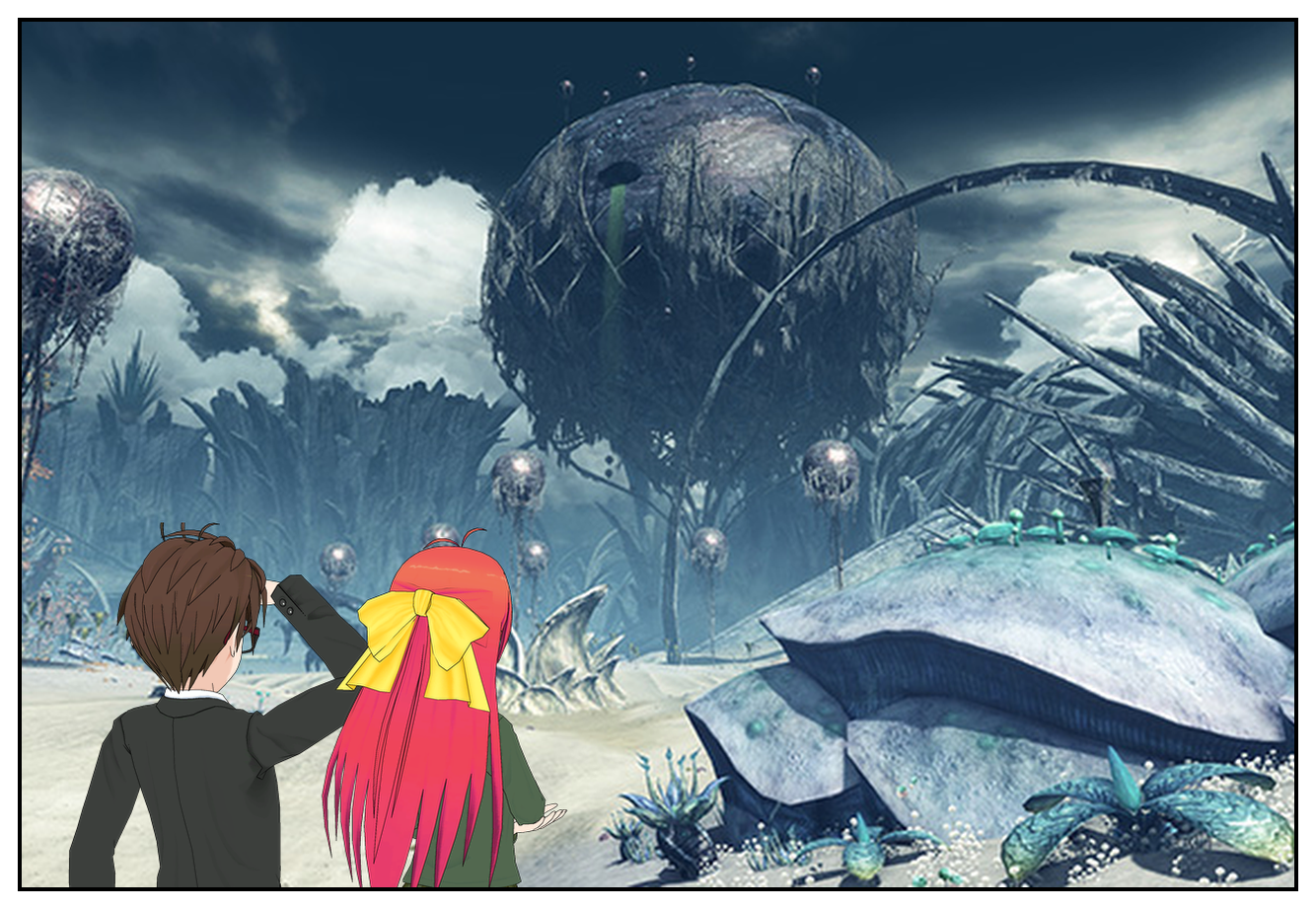
To the point, then: the thing I like about Xenoblade Chronicles X is that it feels like I'm exploring that story: one that's been stuck in my head since I was a teenager. I don't think I've ever played a game with such a brilliant sense of exploration, discovery and having to fend for yourself on a very alien world, and Xenoblade Chronicles X's handcrafted setting puts the randomly-generated locales of Minecraft and its ilk to shame by being absolutely fascinating to explore. The experience of surveying planet Mira is exactly how I pictured the characters in Colony spreading out from their initial base camp to discover exactly where they had landed.

There's so much to do, with an excellent sense of constant progression. You can follow the story missions — something that I haven't done much yet so far — or you can make an effort to survey as much of the planet as possible. It's extremely satisfying to take a look at the Segment Map on the GamePad screen and see a number of little checkmarks indicating that you've completed that particular area… but it's also somewhat daunting to see how many other areas don't have little checkmarks in them and realise quite how much there is left to do.

I am fine with this, though. The sheer amount of stuff to do in Xenoblade Chronicles X distinguishes it significantly from MMORPGs, which is what it's getting most frequently compared to: rather than grinding out the same content over and over again in an effort to get an incrementally small reward and creep up in power week by week, you can pretty much always be doing something different and be making progress somehow: you can be levelling up your character, or increasing the rank of your current class, or increasing your rank in the BLADE organisation, or earning money, or gathering resources, or researching weapons for the arms manufacturers, or… you get the idea.

The online seems like fun, too, though I've only dipped my toes into it so far. Taking the form of short, instanced missions for up to four players at once, the Squad Missions feature allows you to play with others and cooperate to take down some tough challenges together. The game is set up in such a way that direct communication isn't necessary, with characters instead using the "Soul Voice" system to automatically shout out things to each other and boosts to your abilities being appropriately applied if you respond correctly to these shouts. It's also possible to communicate through emotes and, if you so desire, the slightly clunky "Free Report" system, which is not quite real-time text chat, but it's testament to the game's solid systems that four strangers can come together and take on some significant challenges without any need for voice or text chat to coordinate things. I wonder if this will still be the case at higher levels? We shall see, but being only level 15 so far, I have a way to go yet!

Anyway. If you've been dithering over whether or not Xenoblade Chronicles X is worth a purchase, stop; it absolutely is. (And, to answer a question from the comments yesterday, no you don't need to play Xenoblade Chronicles first, because they're two completely independent games.) It's one of the most ambitious, impressive RPGs — no, games, full stop — that I've ever played, and it deserves a big, appreciative audience. I'm telling you now, games industry; if this game gets passed over in Game of the Year talk, we are going to have some serious words…

2145: Xenoblade Chronicles X First Impressions

0145_001

So, Xenoblade Chronicles X came out today, and I picked up a copy.

Is it any good? Well, after eight hours of play in one day, I think it's fairly safe to say that yes… yes it is.

38 words is not quite enough to articulate why this game is worth your time and attention, however; so I shall attempt to elaborate somewhat. I wrote a little the other day about how much I enjoyed the previous Xenoblade Chronicles game on the Wii, and much of that still applies, though as I suspected from what I'd heard prior to release, Xenoblade Chronicles X is a bit of a different beast to its predecessor.

Let's start from the beginning, then. Xenoblade Chronicles X casts you in the role of a survivor of a spaceship crash on the planet Mira. The game begins with you being rescued from your stasis escape pod and emerging into this strange new world with no recollection of who you are/were. You're surprised to discover that the remnants of humanity have been somewhat busy in the intervening two months between the ship crashing and your rescue, but you quickly adjust to life in New Los Angeles, a city constructed from the wreckage of your former ship's habitation module.

In those two months, it seems said remnants of humanity have organised themselves in what appears to be a fairly efficient manner. Of chief importance to the building of humanity's new life on Mira is the organisation known as BLADE, which stands for Building a Legacy After the Destruction of Earth, but which everyone just calls Blade, because that's cooler.

BLADE is responsible for most of the day-to-day running of life on Mira for humanity. Its employees go out and explore the world, gather materials, keep the more feisty members of the local fauna in check, deploy probes and set up resource infrastructures. It doesn't take long for you to be inducted into the ranks of this group, and before long you're swearing allegiance to one of the "Divisions", which determines the most efficient means you have of ranking up within the BLADE organisation, though regardless of your allegiance you're free to pursue any activities you see fit.

Once you step outside New LA onto Mira proper, there's plenty to do. Like the previous Xenoblade game, the world is strewn with collectables that can be put into the Collectapedia; there are plenty of enemies to fight of all shapes and sizes — with the biggest being some of the biggest… things I've seen in any video game ever, including Shadow of the Colossus — and there's a ton of exploration to be done. By wandering around, you'll discover landmarks, sightseeing spots, unexplored areas such as caves and ruins, places to install mining equipment and all manner of other things.

When you get into combat, you're presented with a system somewhat like the previous game's, but with a number of refinements. Of chief importance is the "Soul Voice" system, whereby party members can chain attacks together by shouting things out during battle based on various trigger conditions. By using the appropriate Arts when your companions yell out the relevant things (which are colour-coded to make things easier for you) you can achieve various helpful bonuses and special effects. Likewise, when you perform a particular ability and then hit the B button at just the right time, you can encourage your allies to trigger a Soul Voice in the same way. Combat feels fluid and interesting, and the fact you can switch between ranged and melee weapons at will means you can tweak your playstyle how you see fit — a fact that is further compounded by the array of different character classes on offer, which you're free to switch between whenever you like.

There's also some online functionality that is pretty interesting. After clearing the third chapter of the main story, you sign up for a "Squad", which is an online group of up to 32 players. Once you're in a Squad, you receive notifications about their achievements and gain the ability to make "reports" about things that go on around the world, things you've done or simply to chat. You can trade things with other players, too, and there are communal Squad objectives to complete collectively as a group.

For those who want to take things a step further, there's a full multiplayer mode where you can take on Squad Missions together in parties of up to four people. These tend to be short, timed missions where you have to achieve specific objectives such as defeating enemies, but playing alongside other people and chaining your Soul Voice effects into each other has a markedly different feel from playing with the AI characters. It's also a good opportunity to admire other players' custom avatars, since the game features a vanity system whereby you can wear one set of gear for its stats, then apply the appearance of a different set for your own custom outfit.

Xenoblade Chronicles X is a game that appears to be incredibly daunting in its scope, with numerous intertwining game systems that, after the initial few story chapters, it leaves for you to explore for yourself rather than guiding you through by the hand. The electronic manual is essential reading, since not everything in the game is explained in tutorials, and there are a few bits and pieces that will doubtless prove bewildering without explanation.

So far I've had an absolute blast, though. The environments are spectacular, the creatures are weird, wonderful and gigantic, the combat is fun, the story is enjoyable, the characters are pleasant to hang around with, and the setting is well-crafted with a pleasing sense of coherence to the whole thing.

In short, it's pretty gobsmacking, not only as a game in its own right, but in how much of an improvement over its predecessor it is, too. And it's doubly impressive for being quite this spectacular on the Wii U, by far the least powerful of the current generation of consoles. Frankly, if this game doesn't shift a few Wii U systems, nothing will, because I find it hard to believe anything more impressive will be squeezed out of Nintendo's hardware.

2143: Anticipating Xenoblade

0143_001

I'm picking up a brand new game release on Friday. It's not often I buy a new game the moment it's released, but in the case of Xenoblade Chronicles X, I feel almost obliged to, given that it's not only a game that's been a long time coming, but also a game that's likely to be one of the most impressive titles for Nintendo's underappreciated Wii U console — much like its predecessor was for the original Wii.

I don't know a lot about Xenoblade Chronicles X as yet save for the fact it's a bit of a departure from the style of the previous game; I've been deliberately avoiding too much coverage of it because it's one of those titles for which I'm keen to go in almost completely blind, much as I did with Xenoblade Chronicles. I can, however, talk a little bit about my memories of Xenoblade Chronicles, and why they lead me to anticipate Xenoblade Chronicles X quite so much.

I'm not massively familiar with the overall Xeno metaseries. I played Xenogears back when it was originally released on PS1 and enjoyed it a lot, despite its rushed second disc. To date, I know nothing at all about the Xenosaga series, and my next contact with the overall Xeno quasi-franchise was Xenoblade Chronicles on Wii. Again, I came to this knowing almost nothing about it save for the fact it was one of three games for the Wii that a pressure group known as "Operation Rainfall" had been encouraging Nintendo to bring to the West, the others being The Last Story from original Final Fantasy creator Hironobu Sakaguchi, and the unconventional, wonderful Pandora's Tower from Ganbarion.

In other words, I picked up Xenoblade Chronicles based entirely on hearsay — people whose opinion I respected said that it was an important release, and that as someone who enjoyed JRPGs, I would do well to check it out. It was also noteworthy in that it actually made it to Europe before North America, which is not something that tends to happen all that often with localisations, and its dub featured English, rather than American, voiceovers — a fact which gave it a considerable degree of charm as well as inadvertently creating a number of memes that persist to this day, including "I'm Really Feeling It" and "Now it's Reyn Time", the former of which was helped enormously by protagonist Shulk's inclusion in the Wii U version of Super Smash Bros.

Anyway. Booting up Xenoblade Chronicles for the first time, I was confronted by a JRPG experience quite unlike any other JRPG I'd played to date. Well, that's not quite true; it was a bit like Final Fantasy XII in many ways, but it definitely had its own unique identity that combined influences from traditional, story-heavy Japanese role-playing games; open-world, mechanics-centric Western role-playing games; and the sheer, daunting amount of content found in your typical massively multiplayer online RPG.

Of particular note was its combat system, which is the main aspect that Xenoblade Chronicles X carries across from its predecessor. Allowing you to take direct control of any of your current three party members, gameplay changed significantly according to how you chose to play each character. Each party member had a fairly obvious "role" in the party that they were supposed to play, but there was a decent amount of customisation between learning new Arts and Skills for them, as well as the limited number of Arts the characters could have equipped (and, thus, usable) at any given moment.

Combat was much more than simple hack-and-slash; in fact, simply running up to an enemy and hoping to whittle down its health was an invitation to disaster, even early in the game. Instead, you needed to know your characters' abilities, including positional bonuses, and make appropriate use of them at the right times. This is where MMO influences showed themselves once again; since you were only controlling a single character, you had to trust that your AI-controlled companions were up to the task of doing their job — which, to their credit, they usually were — while you concentrated on doing yours.

I typically played as Shulk for most of the game; Shulk, in party-based MMO terms, would have been a melee DPS class somewhat akin to a rogue, dragoon or monk in Final Fantasy XIV. In other words, his abilities were largely focused on both dealing damage and inflicting debuffs on enemies, and many of them were conditional on him being in a particular position in relation to the enemy. One of his Arts required him to hit an enemy from behind, for example, while another had bonus effects when used from the side. Mechanics such as this kept combat dynamic and interesting rather than simply having two groups hacking away at each other until one or the other's HP ran out.

Then there was the world. Oh, goodness, the worldXenoblade Chronicles was running on one of the weakest consoles of that particular generation, but it managed to be one of the most impressive games there was in terms of scope and visual design. Unfolding on the overgrown, long-dormant bodies of two mysterious giant mech-type things known as the Bionis and the Mechonis, Xenoblade Chronicles' world combined the realistically natural with the fantastic to create an absolutely beautiful, memorable world with some genuine landmarks that were worth seeking out just to admire the visual majesty of. I still remember vividly the first time I came across Makna Falls and had to stop and just admire this beautifully crafted environment for a few moments; it was somewhere I'd want to actually go in reality, such was its beauty.

To reiterate an earlier point, I know very little about Xenoblade Chronicles X, and that includes details about its world. If it's half as interesting and thrilling to explore as its predecessor, though, I'm excited to jump in and start running around… and later, to start stomping around it in the big mech-like Skells.

Xenoblade Chronicles X is out on Friday. There are online and multiplayer features in the game, so if you're planning on playing it and would like to do stuff with me, let me know and we can exchange Wii U friend details.

2099: Further Travels in the Dungeons

0099_001

I've played about twelve hours or so of Dungeon Travelers 2 so far, and despite my relative inexperience with the genre, I'm inclined to agree with those people who describe it as one of the best dungeon crawlers on the Vita. The really exciting thing about it is that I know I haven't seen everything the game has to offer, and that it's gradually increasing in depth and complexity as I progress.

This is a good structure: it keeps a challenging game accessible and easy to understand, and allows the player to spread their wings a bit as they become more confident with the various systems.

A case in point is the party formation and progression systems, which gradually introduce you to core concepts of the game a little bit at a time, then present you with more and more unusual cases, then open up progression a bit, then a lot, then give you more party members, and so on.

You start the game with just two characters: a Fighter (tank) and Magic User (damage dealer/healer). Shortly afterwards you're joined by a Spieler (essentially a damage dealer, but with many skills relying on RNG), then later by a Maid (a support class that doesn't use "TP" to power her skills) and a Scout (a high-speed damage dealer that can either be a melee or ranged combatant).

Once each of these characters hits level 15, they can move up a tier of classes, with each class splitting into two or three alternatives, then each of those splitting into another two possibilities further down the levelling track. Fighter can become either Paladin (damage-soaking tank) or Berserker (damage-dealing tank), for example; Magic User can become a Sorceress (straight damage dealer), Enchantress (buffer) or Priestess (healer). The interesting thing is that changing class in this way doesn't prevent you from accessing the skill tree of the old class; it simply adds a new skill tree, offering you more choices to spend your skill points on with each level up. In this way, you can customise each character significantly — and, importantly, there's the opportunity to undo things if you made a mistake, though this does involve resetting their level to one of the significant milestones (level 1, level 15 and so forth) and levelling them again.

I like this approach; it's a little different from the Demon Gaze/Etrian Odyssey approach of allowing you to create your own party completely, because it means that you're eased into the game's systems with a proven, workable party lineup that you get more and more freedom to play with as the game progresses. The drip-feed of new characters into your party is entirely deliberate, too; in total, there are 16 different playable characters in the game, but rather than overwhelming you with endless possibilities from the outset, you're introduced to these characters and their classes one at a time, giving you the opportunity to get a feel for how they work in a party situation, then by the end of the game you'll have a complete lineup of available characters to pick and choose for your active party as you see fit. Given the apparent complexity of the game's systems, this seems like an eminently sensible way to do things, striking a good balance between accessibility for genre newcomers and flexibility for veterans. True dungeon crawler vets will doubtless be most interested in the "endgame" dungeons, anyway, by which point any frustration they might have felt at the artificial limitations imposed on them in the early game will have been removed entirely.

So the systems are good, then — at least, they certainly appear to be from my experience thus far. What I've been pleasantly surprised to see alongside these solid mechanics is some decent writing, story and characterisation. Dungeon crawlers are often designed in such a way that the story just sort of happens with or without the player character(s) having an active role in the unfolding narrative, but Dungeon Travelers 2 makes a point of making each and every party member — including your protagonist — into a human being rather than a set of stats and abilities. This is achieved in a variety of ways: interactions and conversations in the story scenes between dungeon missions; one-liner comments as you explore the dungeons; and "sub-events" that are triggered by the actions you've taken in the dungeon and in battle. This latter aspect is particularly impressive; there are sub-events for a wide variety of different situations and events, ranging from equipping a particular item to a character getting knocked out in battle, and as well as being entertaining and amusing, they can also help you figure out things about the game systems for yourself. When Melvy the Magic User complains that her spells were being interrupted by heavy hits, for example, you then become aware that you, too, can interrupt enemy spells if you hit them hard enough — and that you need to shield Melvy from attack when she's chanting.

The other good thing about this part of the game is that it gives a strong sense that the game world is bigger than the part of it that you see. As the name suggests, Dungeon Travelers 2 unfolds almost entirely in dungeons, with story scenes confined to menu screens and visual novel-style talking head segments. Despite the lack of an "overworld" and "towns" to explore, you get a very clear sense that the writers have thought about the game's overall context, including off-screen characters, how society works, events that occurred prior to (and during) the game's narrative and relationships between characters. You see all this through the eyes of just one individual, but there's a strong feeling that you're part of a much bigger world, even if you won't see most of it in the game itself. This is good; it gives your actions in the game context and meaning, and helps provide some impetus to keep pushing forwards. It's no good being told to save the realm if you don't know anything about the realm in question, after all.

As you can tell, then, I'm having a real blast with the game so far. After my initial embarrassing death in just my third fight, the game hasn't kicked my ass too severely, though it is pretty good at sending clear signals that Now Would Probably Be A Good Time to End This Expedition and Go Back to Town, usually by flattening one or more party members unexpectedly. It never feels cheap, though; any and all character KO's are usually the result of overextending yourself and getting a bit ambitious, and as I recall from my tentative first steps into Demon Gaze, dungeon crawlers are all about being cautious as well as killing things and taking their stuff.

I've no idea how long the game is or indeed how large the dungeons get. I'm hoping this is a game that's going to last me a while, though; I have every intention of trying to see everything it has to offer.

2097: Dungeon Travelers 2: Some Initial Impressions

0097_001

Dungeon Travelers 2 came out on PlayStation Vita yesterday. To say I've been eagerly anticipating this game is something of an understatement; I've been deliberately holding off playing anything else "big" until it came out, because I was keen to be able to devote some time to it. And, after a good few hours with it today, I'm not at all disappointed with my decision to do so.

For the unfamiliar, Dungeon Travelers 2 is a first-person perspective dungeon crawler RPG (of the Wizardry mould that Japan loves so) created as a collaborative effort between visual novel producers Aquaplus, weird-but-cool RPG specialists Sting and That Company People Mostly Know The Name Of Because of Persona, Atlus. It has a somewhat convoluted history: its Japan-only predecessor Dungeon Travelers was a fleshed-out remake of a dungeon crawler that was part of a fandisc for Aquaplus' visual novel ToHeart 2, though Dungeon Travelers 2 itself doesn't have anything to do with either the first game or ToHeart 2simply sharing some aesthetic sensibilities and mechanics.

Dungeon Travelers 2 shot to notoriety a few months back when Polygon's Phil Kollar berated publisher Atlus for localising the game, which he referred to as a "creepy, porn-lite dungeon crawler". I responded in some detail to Kollar's nonsense back when he first blurted it out over at MoeGamer; take a lookIronically, Kollar's condemnation of the game actually made a lot of people — me included — who had never heard of it before aware of its existence, and I can't help feeling that the game has been a bigger success than it probably would have been if he'd just kept his mouth shut. In that sense, I'm not complaining; it's just a little frustrating to know that he almost certainly won't have given it any time and attention since that initial piece, having written it off as the usual pervy nonsense.

DT2-1

Dungeon Travelers 2 is an ecchi game, though, make no mistake, if you hadn't already noticed from the artwork that peppers this post; within five minutes of starting the first dungeon, you're presented with a rather fetching view of one of the heroines' panties-clad buttocks, and every boss fight is followed by some rather beautifully drawn artwork of said boss in a somewhat disheveled, suggestive state. Not only that, but the vast majority of enemies are scantily clad cute female characters (the rest are, inexplicably, sentient fruit) that draw a certain degree of inspiration from the popular "monster girl" aesthetic, albeit in a less overt way than something like the anime Monster Musume.

Here's the thing, though; the ecchi content of Dungeon Travelers 2 works because, like other games that fully embrace their ecchi (or even hentai) side, it's consistent in its use and it thus becomes part of the overall aesthetic. It's a sexy game; it's not about sex as such, mind you, but beautiful girls in sexy poses are very much part of the way it looks, and it is not at all ashamed of that fact. In order to fully enjoy it, you absolutely can't be ashamed of it, either.

But the ecchi content is the least interesting thing to talk about when it comes to Dungeon Travelers 2, because it's a really solid game with some interesting mechanics. Of particular note is the game's approach to teaching you how to play; the electronic manual provided with the software gives you only a bare-bones outline of the interface, but through a combination of in-game lectures (delivered by the deliciously sarcastic Maid-Sensei) and in-context, in-character sub-events that are triggered by your various actions in the dungeon and in battle, the game teaches you how to play and things to watch out for without resorting to insulting your intelligence. Maid-Sensei's lectures are the nearest thing to an outright tutorial, but those are skippable; the sub-events, meanwhile, are short, snappy, humorous and get their point across without being dull.

DT2-2

There are some interesting systems at play. The concept of the game revolves around "Libras", who are individuals that are able to seal away monsters in books. The protagonist character is one of these Libras, but he doesn't take an active role in battle; instead, the game is presented as you, playing the role of Fried the Libra, issuing orders to your gradually expanding party of pretty girl bodyguards and performing the important task of sealing away the monsters when they've been defeated.

It doesn't stop there, though; the Libra concept is a core system of the game. By defeating enough monsters, you can create "Sealbooks" which have two main functions: firstly, they represent the fact that you have researched the monster sufficiently to understand their behaviour and characteristics, depicted in game as revealing their full stats, and secondly, they can be used as a piece of equipment, with each individual monster's Sealbook having a different special effect. Thanks to a "completion percentage" figure in the game, there's a definite element of "gotta catch 'em all" going on that I anticipate is going to cause me some issues in the future.

Alongside this is a detailed class system for all your party members, with each character able to level up a number of different classes and learn skills using earned skill points. It's possible to build and specialise characters in a variety of different ways, and the early game introduces you to a selection of interesting classes, beginning with a fairly straightforward tank and DPS combo — pleasingly, the tank class is able to provoke enemies and increase the likelihood that they'll be hit in favour of squishy mages — before giving you the peculiar "Spieler" class, which so far appears to be heavily based on luck and random chance, and the "Maid" class, which plays a supportive role that is very distinct from a dedicated healer by buffing and allowing characters to restore the points they use on skills as well as their all-important HP.

DT2-4

I'm not particularly deep into the game as yet, so the dungeons haven't got especially complicated so far. There have already been some challenging fights, though, and the game is not afraid to slap you about a bit until you remember that you have to play dungeon crawlers a little differently to more conventional RPGs. I got a Game Over in the third fight I had in the whole game, for example, because I overextended myself and forgot that it's perfectly acceptable in this type of game to advance a bit then run screaming for the exit to lick your wounds and restock; compare and contrast to your more typical JRPG, meanwhile, in which you tend to always be moving forwards rather than backtracking or making multiple expeditions.

In fact, what Dungeon Travelers 2 reminded me of, of all things, is a board game of the Advanced Heroquest ilk. The basic structure is the same: get overarching quest, go into dungeon, come back out if things get hairy, go back in, find treasure, go back out, resupply, go back in, fight a bit further… and so on. The "multiple expeditions" nature of exploration in the game is inherently satisfying, since you can easily see on the convenient automap when you're making progress, because you'll be revealing new areas. Discovering new monsters is enjoyable, too, since they're all depicted with some truly lovely artwork, and the juxtaposition between the "pretty girl" monsters and the "sentient fruit" monsters is bizarre and hilarious.

I'm enjoying it a great deal so far, then, and I'm looking forward to spending a lot of time with it. I'm a relative newbie to the dungeon crawler subgenre of RPGs as a whole, but between Demon Gaze (which was my first real hardcore dungeon-crawling experience) and what I've experienced of this so far, I'm very much a believer already.

To the dungeons, then, where pretty girls await!

2041: A Little Respect Goes a Long Way

0041_001Whew, that got pretty heated, huh? I make absolutely no apologies for yesterday's post: it needed to be said, and I stand by every word of it. To reiterate: if you don't like ecchi content in your games, that's absolutely A-OK. The second you start branding people who do like ecchi content in their games as paedophiles, though, that's when you cross a line from "opinionated person" into "total cunt".

I'm really disappointed to hear of the number of NeoGAF bans that have resulted from the article I mentioned yesterday. (Still not going to link to it.) Quite a few friends — and quite a few new acquaintances — all found themselves banned simply for expressing dissent or dissatisfaction with the article, often in a polite manner. And no, that's not just excuse-making — they really were polite about it. More polite than I was yesterday, anyway.

I've never been a member of NeoGAF. Not through lack of trying, though every time I have tried, my email address hasn't been "good enough" for them to allow me in, whatever the hell that means. In one particular instance, it took nearly two years for my "application" to be rejected; I didn't try again after that.

If it hadn't been Omega Labyrinth, some other game would have been the victim (and, likely, beneficiary of a ton of new publicity) of the latest round of outrage.
If it hadn't been Omega Labyrinth, some other game would have been the victim of the latest round of outrage — and, it has to be said, likely a beneficiary of a ton of awareness it wouldn't have had otherwise, so it's not all bad.

NeoGAF is regarded by many as the de facto gaming community online. It's where all the game journalists from the mainstream publications hang out, it's where game developers and publishers hang out — in short, it's a huge, centralised place to talk about games. Or at least, it should be: in the last few years, however, there's been an increasingly tight leash put on exactly what is and is not acceptable to talk about there — and, relevant to what we've been talking about, a lot of the stuff that is outright banned from discussion falls under the Japanese gaming umbrella.

Trouble is, from what I can tell as an outsider to the overall community, there is pretty much no rhyme or reason to what is and is not acceptable. Senran Kagura is acceptable, it seems — or, at least, it was; a significant number of participants in the long, active Senran Kagura thread got banned as part of this latest nonsense — but something like Criminal Girls is not. Japanese games are the only games that appear to be subject to this much scrutiny; big Western games are discussed without any issues whatsoever, regardless of if they have any sexual or violent content in them.

I don't want to dwell too much on NeoGAF because, as I've already said, I'm not a member there and so cannot comment with authority from the perspective of an actual community member. What I do want to talk about, however, is the broader problem that NeoGAF's situation and yesterday's debacle really highlights: the fact that it's deliberately (and, I'd argue, maliciously) creating a divide between different "strata" of people who enjoy video games. In other words, if you like one of the "approved" games, you're absolutely fine; you can continue discussing games and gaming culture as much as you like. But if you like one of the "forbidden" games — regardless of the fact that these games are not illegal, are not banned and are sold at retail — then your opinion is, it seems, automatically invalid; you're not welcome to discuss it in the Internet's equivalent of "polite society" and are instead forced underground to find cliques and subcultures who will accept you for your tastes, rather than everyone being in a happy melting pot respectfully exchanging opinions and learning from one another.

Dungeon Travelers 2 was the last game to come under the microscope for being responsible for all society's ills. Unfortunately for the outrage brigade, it turned out to actually be a really good game, too.

As I've argued before both here and over on MoeGamer, this situation does a lot of creative works an enormous disservice. In my last ever JPgamer column at USgamer, I commented on the fact that a lot of the games that are habitually branded as "creepy" (or worse) by mainstream critics actually tick a considerable number of the boxes that these people tend to want to see as evidence that gaming is "growing up".

Female protagonists? Or at least women in important positions with regard to the narrative? Sure; check out the Neptunia series, Omega QuintetCriminal Girls, the Agarest series, Akiba's Trip, Monster Monpiece, Moe Chronicle, Demon Gaze, Dungeon Travelers 2.

Unconventional storyline that isn't simply "solve all your problems by punching/shooting/swording them to death"? Sure! Check out the Atelier series, Recettear, the Ar Tonelico series and plenty more.

Ambitious narrative themes? Sure! Take a look at The Witch and the Hundred Knight (coming soon to PS4!), Time and Eternity, Senran Kagura, Criminal Girls, Ar Tonelico…

You get the idea: these games don't get anywhere near enough credit and are, more often than not, either ignored or derided by people purely on the grounds that they're open and up-front about — in most, not all cases — wanting to indulge in a bit of light-hearted, cheeky teasing as part of their overall aesthetic. In some cases, the ecchi content is even used genuinely effectively to depict the growing relationship between characters; Time and Eternity and Demon Gaze were both particularly good in this regard, reflecting the protagonist's sexual frustration and the growing relationship of trust and love between the player character and their main quest-giving "contact" Fran respectively.

Now, as Brad Gallaway wrote in his absolutely exemplary review of Dungeon Travelers 2, "people who are allergic to skin-heavy content might have a hard time getting past it to enjoy the game underneath. And honestly, that's all right. I've always said that not every game is right for every person, so bouncing off of Dungeon Travelers 2 for that reason alone would be totally understandable." This is the point that appears to be most frequently missed: games are not always for everyone. Sure, there are plenty of box-ticking focus-grouped triple-A games out there that are designed to appeal to the broadest possible demographic: they have to, because they cost an absolute fortune to make, so they'd better sell through multiple millions of copies to prove all the developers' hard work wasn't for naught.

I was specifically forbidden from even mentioning Monster Monpiece during my time at USgamer because of its provocative artwork -- despite the fact that it's a really interesting collectible card game.
I was specifically forbidden from even mentioning Monster Monpiece during my time at USgamer because of its provocative artwork — despite the fact that it's a really interesting collectible card game.

But here's the important thing: not every game is like that, nor should it be. Games with ecchi content are designed for a specific audience — and that audience cannot simply be defined or written off as "horny teenage boys", as it usually is, though they are certainly part of it. In reality, the market for otaku games is male and female; young and old; straight and gay; trans and cis; and made up of pretty much each and every race, nationality and religion. The one thing they have in common? They like what they like. Simple as that. And these games are designed to push their buttons without caring what people outside that existing niche think of them. And that's absolutely fine.

Tastes in art are complex, fluid, ever-changing, and one person can be into lots of things. You can enjoy high-class art and the most lowbrow of entertainment, and I know plenty of people who do. Likewise, you can also choose to enjoy just high-class art or just the most lowbrow of entertainment, or something middle-of-the-road. In the world of games, you can be someone who plays every "walking simulator" out there and believes they're the future of interactive entertainment. You can be like my Dad, and only ever play Microsoft Flight Simulator. You can play nothing but hidden object adventure games. You can be someone who just plays Call of Duty with their friends on weeknights. You can be someone who has invested a thousand or more hours into Dota 2. Or you can be someone who enjoys games where anime girls have breasts and flash their panties.

Or — and here's how you get the richest possible experience from one of the most exciting and complex forms of creative media in the world in 2015 — you can be into multiple things, and you can be open to new experiences. You don't have to like everything, and you almost certainly won't. That's all absolutely, completely and utterly fine; the diversity in tastes is one of the best things about modern gaming, and the fact that month after month, all manner of different tastes are specifically catered to by developers and publishers is absolutely brilliant.

I maintain that anyone who hates Neptunia needs far more joy in their life.

What's emphatically Not Okay by any stretch of the imagination is, as we've already said, shaming people for what they are into, regardless of what it is. Don't like anime panties? Fine. Don't throw horrible names at people who do. Don't like Gone Home? Also fine; likewise, don't throw horrible names at people who do. Don't like Call of Duty? Also fine… you get the idea, no? To sum up: don't be a total cunt.

A little respect goes a very long way. And gaming culture as a whole is not remembering that fact right now, and it saddens me greatly. Let's all try and do our bit to make our wonderful medium a little bit better for everyone, shall we?

2026: Hollow Fragment

0026_001The next "big game" of the moment for me is Sword Art Online: Re: Hollow Fragment, a PlayStation 4 rerelease of an earlier Vita game, which itself was an expanded version of an even earlier PSP game. The Vita version had a notoriously dreadful translation, but I'm pleased to report that the PlayStation 4 version is at least readable — though the conversation system is still bafflingly nonsensical at first.

Sword Art Online, for those not into the animes, was a popular show a couple of years back. It was one of those "mainstream" shows that became really popular and which everyone subsequently decided they hated for one reason or another. I never quite understood the hate; sure, it was cheesy as fuck in places, but it was an enjoyable, beautifully presented show with an amazing soundtrack and a concept I've always loved ever since I played .hack for the first time: the MMO that is trying to kill you.

1269018045555712327

The Sword Art Online anime concerns Kirito, a protagonist who is a blatant self-insert for the writer, but I won't hold that against anyone, since self-inserts can be a wonderful means of escapism. Kirito becomes trapped in the new virtual reality MMO Sword Art Online after the game launches out of beta and the "logout" button is removed by its designer, capturing all 10,000 launch day players in the virtual world. To make matters worse, said designer — the villain of the piece — informs the players of a little tweak to the rules of the game: if they are forcibly removed from their VR equipment, or if they run out of HP and "die" in the game, then their VR equipment will fry their brain with microwaves, killing them instantly.

There's a get-out clause, though; if the game is cleared by someone defeating the final boss on the 100th "floor", everyone who survived will be allowed to escape. After two years of the game, it becomes apparent that this goal is still a long way off, and player numbers are dwindling as more and more people either fall victim to carelessness or despair along the way. Ultimately, the first arc of the anime concludes with Kirito and his friends defeating Sword Art Online's designer and freeing themselves from the virtual world of Aincrad, only to find themselves in numerous subsequent adventures in other virtual worlds. You'd think they'd learn.

20150807192933

Hollow Fragment, meanwhile, takes place in a reality where Kirito's defeat of Heathcliff at the end of the first arc was not the end of Sword Art Online, and the players find themselves still trapped within the game. Moreover, they discover that once they pass the 75th floor — the floor where Kirito defeated Heathcliff — they are unable to return to the lower floors, and many of their skills and items become "corrupted", mere shadows of their former selves. The game, then, continues; it looks as if the only way to escape really will be to defeat the boss on the 100th floor.

Except that's not all, because clearing out 25 floors of dungeon would be far too easy a task. In the opening of the game, Kirito finds himself transported to the "Hollow Area", an unexplored part of the Sword Art Online world where strange things happen and rare, high-level monsters and items abound. Acting as a sort of "testing area", the Hollow Area allows Kirito to uncover a number of mysteries surrounding the virtual world of Aincrad as well as beef up his own character's power significantly through various research trees. The flow of the game then becomes a journey back and forth between three distinct components, then: Aincrad, the Hollow Area, and what I like to refer to as Waifutown.

20150807192908

Aincrad is pretty straightforward. Upon arriving on a new floor, you're shown a big tower off in the distance and informed the boss is waiting for you at the top of it. Between you and said tower are several overworld areas populated by enemies, so you'll need to fight your way up to the boss room in order to challenge it. Along the way you'll also need to gather intelligence on the boss by completing quests and defeating specific named monsters (NMs) as well as helping your fellow "players" to level up enough to take on the challenges ahead. Each "floor" is pretty linear in its design, though the dungeon at the end of it is more maze-like and unfolds across several levels, and you'll be doing a fair amount of backtracking to complete quests.

The Hollow Area works a little differently. Rather than a linear sequence of areas leading to a dungeon maze, the Hollow Area is an interconnected network of zones more akin to a regular RPG or even MMO map. The Hollow Area is split into several different regions, each of which you'll need to build up points in by completing "Hollow Missions" that appear and disappear in real-time as you play. While completing Hollow Missions, you can take on research tasks, which give you specific objectives to complete; once these are completed, you can then implement the research into Kirito's character to improve it. You have to content with bosses here, too, though in the Hollow Area they guard region transitions rather than separate floors.

20150807192902

Waifutown, meanwhile, is what you do when you're not adventuring. The town on the 76th floor that acts as your adventuring home base is home to most of the characters who got their own episode in the original Sword Art Online anime arc, along with a couple from the later arcs (Leafa and Sinon) who have been shoehorned in for the sake of having a few more waifus to pursue. In town, you can shop, upgrade weapons and hang out with your fellow adventurers. This latter aspect is important; by hanging out with your prospective adventuring partners, you can increase your relationship with them (up to and including sleeping with them) which subsequently helps them perform better in battle. By building up your relationship as well as "training" their AI by praising it when it does well, you can tailor each of the companion characters to your own liking. Or you can pick a waifu and spend the whole game with them if you so desire.

Sword Art Online is an enormous and surprisingly complex game. There are a lot of different systems at play — it's going all-out with the "simulated MMO" aspect in this regard — and, while it's daunting to begin with, the many different ways in which it's possible to progress in the game make it feel like you're always achieving something, and that there's always a choice of things to do at any given moment. While its graphics look like butt outside of the beautiful 2D artwork — its PSP roots are very apparent — it really doesn't matter all that much; it plays satisfyingly well, feeling quite like a high-speed Phantasy Star Online at times, and there's a wonderful, constant sense of discovery and exploration as you work your way around this strange and wonderful virtual world. (And yes, I'll probably make a video about this at some point so you can actually see how it plays.)

20150807205839

Also you can bed Lisbeth. 10/10

2005: Dan's List of Vita RPGs

0006_001This is one of those posts I write specifically to respond to something someone asked me recently where Twitter or chat messages aren't a particularly ideal solution to give an answer. In most cases, though, people other than the original person who asked can also get something out of my response, so I post it here.

In this case, my good friend Dan Lipscombe enquired as to whether I could give him any Vita RPG recommendations.

Well, of course I can!

Here goes, then. Some Vita RPGs that are either well-regarded or that I have personally enjoyed. This isn't an exhaustive list by any means!

Persona 4 Golden

p4g_screens_adayinthelife_withmarie

This is the one everyone recommends, and with good reason; it's great. Even if you played the original Persona 4 on PlayStation 2, Golden is worth playing due to its amount of additional content and tweaked gameplay.

If you're unfamiliar with Persona 4, it's a combination of murder mystery, school life simulator, dungeon crawler and Pokemon. Taking on the role of a transfer student to a school out in the sticks of Japan, you start investigating a spate of strange murders that sees people disappearing then showing up a few days later hung upside down from television aerials. It's up to you and your school friends to discover the truth behind what is going on, which is far stranger than you might expect.

Persona 4 Golden is an excellent game that has transcended its originally niche appeal to become a truly mainstream title that most people have heard of by now. It's well worth playing through to completion — though be warned, it is long. Like, 80+ hours long, even if you don't do much of the optional side content. It's a journey well worth taking, though, and the lengthy slog makes the characters' personal journeys all that more meaningful.

Hyperdimension Neptunia Re;Birth
neprebirth

There are three Hyperdimension Neptunia Re;Birth games on Vita. There's no real requirement to play them in order, since they're self-contained stories that don't really have anything to do with each other, but playing them in order will give you a better understanding of the characters — plus an appreciation for how the series has continually grown, developed and changed for the better over time.

Neptunia's concept is based on anthropomorphised game consoles going about their business in the land of Gamindustri. The three games' stories veer off in different directions, but there are usually strong anti-piracy messages involved, along with commentary on not forgetting the past, the futility of fanboyism and general satire of both games industry and anime culture.

The Neptunia games are occasionally clunky, sometimes balanced questionably and not the most technically impressive games you will ever see — but my God, are they ever charming and delightful, not to mention rare examples of comedy and satire in games actually working well.

Hyperdevotion Noire

scr15

A spinoff of the main Neptunia series, Hyperdevotion Noire focuses on PlayStation personification Noire and gives the tsundere princess her own personal story. Unlike the regular Neptunia series, Noire is a strategy RPG a la Fire Emblem and Final Fantasy Tactics. A wide cast of characters, each of whom personify a well-known Japanese game series (such as Final Fantasy, Dragon Quest and Resident Evil) all have unique abilities, strengths and weaknesses, and "gimmicks" in each stage force you to think a lot more strategically than "charge at the enemy and cut them down in order".

I'm not normally very good at strategy RPGs, but Noire is accessible, fun and enjoyable — plus it continues the series tradition of good humour, charm and satire, and Noire is absolutely a strong enough character to carry her own game.

Demon Gaze

demon-gaze-prometh

If you liked old-school dungeon-crawlers on PC — I'm talking stuff like Wizardry, Lands of Lore and Might & Magic — then you might want to give Demon Gaze a shot. Creating your own custom party of adventurers, you venture forth into an array of dungeons to battle terrible demons, capture them and make use of their power.

In between your adventures, there's a delightful little soap opera going on in the inn that you and your party call your home, with a cast of colourful characters getting up to all manner of mischief. It's a lovely blend of the narrative-centric approach that more conventional Japanese RPGs tend to take, and the mechanics-centric, challenge-heavy nature of first-person "gridder" dungeon crawlers. It also has absolutely gorgeous artwork, and an unconventional but enormously catchy soundtrack that makes use of Vocaloid voice synthesisers.

Operation Abyss

operation-abyss-new-tokyo-legacy

I haven't actually played this one yet, but it's on my shelf; given that it's from the same folks who made Demon Gaze, though, it's a fair bet that it will be similarly good, and the people I know who have played it have enjoyed it a whole lot.

Trails in the Sky

Technically a PSP game, this is downloadable and playable on Vita, and well worth your time. Following the adventures of Estelle and her adoptive brother Joshua as they attempt to become full-fledged "Bracers" — essentially state-supported mercenaries — Trails in the Sky is a sprawling adventure with a beautifully crafted world, some wonderful writing and a fun battle system.

The game blends the sidequest-centric nature of Western RPGs with the more linear storytelling typically found in Japanese RPGs to great effect. The sidequests each have their own little stories and characters to explore, and really help the world to feel truly alive.

Criminal Girls

This one won't be for everyone due to its relatively explicit sexuality, particularly exploration of sadomasochistic themes. If you can deal with that sort of content, though — along with the fact it's very obviously a PSP port — Criminal Girls tells a fascinating tale of personal redemption for a colourful cast of characters as they come to terms with traumatic experiences from their past and attempt to move beyond them.

Criminal Girls is noteworthy for its exploration of "trust" through both its narrative and its mechanics — I wrote in more detail on this topic here.

Akiba's Trip

Not an RPG in the typical sense, Akiba's Trip is most akin to Sega's Yakuza series in that it provides an open world that covers a relatively small geographical area — in this case, Tokyo's Akihabara district — and a ton of things to do, plus a nigh-unparalleled sense of atmosphere thanks to its detailed world.

Thrown into the underworld by your discovery of — and recruitment into — the ranks of the "Synthisters" (essentially synthetic vampires), it's your job to find out where this scourge has come from and put a stop to it — while simultaneously keeping your little sister happy, taking photos for tourists and attempting to end up in the arms of one of the game's lovely leading ladies.

Akiba's Trip has fun brawler-style combat with a huge selection of upgradeable weapons ranging from baseball bats to bus stop signs and computer monitors. Combat involves smacking Synthisters around a bit until they're in a position where you can grab their clothes and rip them off them, which exposes them to sunlight and, in true vampire tradition, causes them to combust.

Steins;Gate

This isn't an RPG at all, but if you own a Vita (or PS3… or PC) and haven't read this extraordinary visual novel, you need to right now. Blending real-world urban myths (such as the legend of John Titor and questions of what CERN are really up to with that big underground particle accelerator) with a creative yet plausible interpretation of how time travel and parallel worlds might work, Steins;Gate follow the adventures of an impressively unreliable narrator as he tries his best to stop something horrible happening to someone he cares about.

Here's a full review of it.


There are tons more great RPGs and visual novels available on Vita, but I've rambled on for over 1,200 words now, so that should be enough to get you started. Hope you enjoy at least some of these!

1990: Idols' Journey

Having finished the main story of Heavensward, I returned to Omega Quintet this evening in the hopes that I would be able to polish off the "true ending". I succeeded, though this isn't the end of my time with the game just yet: there's the optional "training facility" dungeon, which features some of the toughest monsters in the game, and there's a bunch of sidequests that open up even after the "final" boss. I'm undecided as to whether or not I'm going to pursue the Platinum trophy, as a few of the trophies are a bit grindy, but I probably will end up going for it.

As for the true ending — oh, spoilers ahead, by the way — it was a satisfying conclusion.

For context, the "normal" ending was surprisingly downbeat, even bleak, leaving the story with a somewhat bittersweet ending that didn't really leave any of the characters in a situation that could really be called "happily ever after". Aria was revealed to have become a Blare when she was attacked prior to the events of the game, with the Blare in question effectively devouring her emotions and turning her into the seemingly morose individual she is depicted as throughout the main narrative. Said Blare is revealed to be the cat-like creature that had been following her around for the whole game, and this obnoxious little creature "awakens" Aria to her true Blare self.

This sets up the final confrontation of the normal ending, where the depleted ranks of the Verse Maidens, now a quartet rather than the quintet they had been for the majority of the game, have to strike down their former friend, who is, it becomes clear, utterly beyond help. But even after she's defeated, the people of the city no longer trust the Verse Maidens thanks to Aria having tricked them for so long, and as such they're doomed to a life of unappreciated toil, fighting back the Blare for a populace that hates them.

The true ending takes this as a starting point but makes a few changes. When the time comes to fight Aria, she doesn't completely lose herself and transform into the "Avatar of Destruction" she becomes in the normal ending. Instead, the Verse Maidens strike her down but refuse to eliminate her, instead dragging her back to their headquarters despite her protestations — but not before "Pet" has revealed its true nature and threatened to bring even greater chaos to a world that is already practically in ruin.

It's a slow route to healing for the populace, but eventually they come to accept and support Aria once again, as her mysterious nature had always meant she was one of the more popular members of the quintet. Ultimately, the girls discover that Pet's plan is to gather as many Blare as possible in one place and attempt to control them in the name of "fun"; Pet, having consumed Aria's original cheerful personality but lacking the emotional maturity to know how to handle it correctly or appropriately, is more concerned with entertaining herself than any great master plan, and it eventually transpires that she neither knows what to do with all the Blare once she gathers them in the city's Central Tower, nor is she really able to control them effectively.

Thus begins the true final battle, first against Pet, who eventually admits defeat and volunteers to try and get rid of the trouble she caused following an epiphany brought on by having the shit kicked out of her, and subsequently against a gigantic, horrible monster that appears as Pet allows herself to be completely consumed by the Blare she summoned. The Verse Maidens are ultimately triumphant over this fearsome foe, and a convenient side-effect of the fact that it was made up of so many Blare concentrated in one place means that their conflict all but frees the city itself from the oppression of the Blare.

The world still has some healing to do, however; the story ends with protagonist Takt and one of the five girls (you get to choose) setting out on a grand journey into the wider world, clearing out the Blare as they go and discovering a new-found appreciation for one another. The post-final boss gameplay, meanwhile, unfolds before this happens, and sees Takt and the Verse Maidens — plus their predecessor Momoka, who manages to come out of retirement thanks to a useful bit of experimental technology — attempting to clear up the last few stragglers around the area of the city and continuing their work as Verse Maidens, bringing hope to the people.

It was an enjoyable ending and the final boss battles were pretty great; the last one in particular had some superb music. I'm interested to see what the post-game has to offer now; the Training Facility dungeon promises to be a stiff challenge, and there's proficiencies to level up, affection to increase, archives to find and quests to complete, so I think even though I've technically "finished" the game there's still probably a fair amount left to do!

To cut a long story short, Omega Quintet is an excellent RPG that I'm very glad I took the time to play. It's another in a long line of titles from Compile Heart that has helped cement this quirky Japanese developer's position in my mind as one of my absolute favourite game makers out there, and I have to feel a little sorry for those people who can't find joy in their colourful, humorous, witty games that are absolutely bursting with character and soul.

1964: 95 Hours With the Idols

My game clock in Omega Quintet now reads somewhere in the region of 95 hours. I'm now about three-quarters of the way through my New Game Plus run and attempting to get the True Ending, and then there's a bunch of post-game stuff, too, so that timer's going to tick well over 100 by the time I've finished, I'm sure. This officially makes Omega Quintet certainly the Compile Heart game I've spent the longest on, and probably getting on for the overall RPG (Final Fantasy XIV excepted, of course) that I've spent the longest on. The previous record holders were Hyperdimension Neptunia Victory from Compile Heart, and I think I took slightly longer than the 100 hours I took for Victory over Xenoblade Chronicles on Wii — and didn't see anywhere near everything.

Anyway. I don't want to dwell on how long this game is — I could have been done long ago, since I've technically already "cleared" it once and I'm doing all of the optional side quests — but rather on something that I noticed as I was playing today: after nearly 100 hours, I'm still spotting new things about the mechanics and working out ways to leverage them to my advantage.

Compile Heart games are often quite mechanically interesting. The original Hyperdimension Neptunia, for example, featured a combat system in which I spent hours assembling combo attacks that would neatly chain into one another, swap out characters mid-combo and do all sorts of other cool things. The later Neptunia games took a different approach to battle, with freedom of movement, area-of-effect attacks and different types of strike. Hyperdevotion Noire is a solid strategy RPG with easy to understand but tricky to master mechanics involving elemental affinities, range, height and areas of effect. Moe Chronicle — my copy of which arrived today, hooray! — sees you equipping stereotypically moe traits onto a range of monster girls to give them various special abilities. And there are a few I'm still yet to play, too.

One thing that the Neptunia series in particular lacks a bit, though, is customisation. The characters aren't completely fixed in their abilities — you have some flexibility in the combo attacks you can equip each character with, and it's possible to customise the special attack combo-finishers they use, too — but so far as their main special abilities go, they're fixed.

Enter Omega Quintet, then, which offers more customisation than I think I've ever seen in a Compile Heart game, with the possible exception of the original Neptunia. And it's far, far slicker than that game — much as I love it, it was very, very flawed in many places.

The early part of the game sees you assembling the titular Quintet, and various mechanics are locked out until you've assembled them all and you've read all the tutorials (which are thankfully skippable, so you don't need to read them again on a second playthrough). When the team is assembled and all the mechanics are in place, the default setup gives each of the five girls a different weapon and a basic few skills that they've already learned.

Skills fall into three broad categories: Elemental Skills (or E Skills) are magic-like abilities that either attack with elemental affinities or provide beneficial effects such as healing or buffing. Mic Skills — the weapons are known as "Mics", because they're idols, after all — are attacks that are tied to an individual weapon type, so the character must have the appropriate weapon equipped in order to use them. And Special Skills are character-specific attacks that require "Voltage" built up through performing well in combat to be able to pull off.

Of these abilities, only Special Skills are fixed on a per-character basis; everything else is fully customisable. The girls each clearly have a favoured weapon — the one they start with — but there's nothing stopping you from levelling their proficiency in other weapons, too. In fact, it's beneficial to do so, since levelling up a weapon proficiency provides you with additional "Disc Analysis" points besides those you already get from increasing the character's overall level.

Disc Analysis is Omega Quintet's main progression and customisation system. Each character has a large diamond-shaped grid with lots of nodes on it. Each node represents a new skill, an upgrade to an existing skill or a buff to the character such as additional E Skill slots or increased stat growth when levelling up. Spending the Disc Analysis points acquired through levelling and increasing in proficiency unlocks new abilities and opens up new nodes, since some nodes have prerequisites before you can use them or require you to "approach" them from a particular direction on the grid.

In my first playthrough, I wasn't terribly careful with how I organised my characters' development. I kept long-term goals in mind — "I want that ability that's all the way over there" — and attempted to take the most direct routes across the grid to where I wanted to go, picking up any necessary prerequisites along the way. This mostly worked, but it left each character feeling fairly "generic", since a lot of them had ended up learning the same or similar skills, and none of them were particularly playing to their strengths.

This second playthrough, I've been more focused, since I'm playing on the Advanced difficulty. (It hasn't been too difficult yet, but that may be something to do with the fact I carried over my weapons and items from my first playthrough, making me a powerhouse in the early game) I've been specialising my characters and paying more attention to the "Chain Skill" system, which allows multiple characters to trigger more powerful special attacks if they perform the right skills in the right order using the "Harmonics" (simultaneous turn) system.

Kyouka, for example, has high Vitality — Vitality in this game is your speed stat, for some reason, rather than its more common usage as "ability to take punishment" — which means she usually acts first in a fight. This puts her in an ideal position to be a "buffer", so I've given her all of the stat-boosting spells and, using her four actions per turn, she can increase any four of the party's Song Power (physical attack), Stamina (physical defense), Knowledge (magical attack), Divinity (magical defense/healing power), Technique (accuracy) or Vitality (speed). Alternatively, she can use her spear skills to attack; she has a couple of useful area-of-effect attacks as well as one which draws enemies closer, helping to negate the damage penalty for attacking something at the "wrong" range for your weapon or ability.

Aria, meanwhile, has high Divinity, putting her in a good position to be a healer. So I've given her the healing spells. Her high Divinity also means that she can shrug off magical attacks quite easily — sometimes they even miss her altogether, and she has good resistance to status effects. When she's not healing, her combat fan skills have some large area-of-effect attacks as well as two skills that steal items from enemies, making her very useful indeed for farming items.

Nene has the highest Knowledge in the party, making her the "mage". Most of the other characters have fairly woeful Knowledge stats, making their E Skill attacks next to useless for anything other than the status effects or stat penalties most of them come with. Nene, however, probably does more damage with her E Skills than with her gun, so I've given her the most powerful, most costly area-of-effect offensive E Skill spells, making her a powerhouse for blowing things up. She's also very useful for item farming, since her Special Skill comes with a "Rare Steal" effect attached, allowing you to acquire items that you can't get otherwise. In the case of the powerful bosses in the Training Center optional dungeon, these rare items are extremely profitable, though you can seemingly only fight each of these bosses twice before they're gone for good, so no endless farming!

Otoha and Kanadeko are more "average" characters, with their main strengths stat-wise being Song Power, Stamina and, in Kanadeko's case, Vitality. This makes them solid physical attackers, and in Kanadeko's case, her high Vitality means that she usually acts immediately after Kyouka, allowing for some quick hits before the enemy gets started on pummelling the party. The two of them are distinguished by their Mic Skills, however; Otoha has two large area-of-effect attacks and a huge area-of-effect Special Skill, while Kanadeko has some smaller area-of-effect attacks and a single-target Special Skill, but does considerably more overall damage and also has the ability to delay enemy turns with many of her skills.

Things get even more interesting when you throw the Chain Skills into the mix. Because Chain Skills necessitate each "step" being performed by a different character, this makes each individual character's arsenal of E Skills important to consider to give access to the widest possible variety of Chain Skills at any given moment. But then you need to consider that character acting by themselves, too, since you can't always guarantee you'll be able to get the turn order to line up just the way you want it in order to pull one off.

Then you have the Neptunia-esque guard break system, whereby each enemy has a "magnetic field" surrounding them that weakens to varying degrees with each hit they take, and which replenishes fully when the enemy's turn next rolls around. When the field is broken, not only does the enemy take more damage, but certain abilities — particularly Chain Skills and Special Skills — activate a special mode called Pursuit, which extends the usual animation for the skill and does additional hits, usually for quite a bit more damage. As such, it's in your interest to try and batter the magnetic field down as efficiently as you can with low-cost skills, then unleash the powerful Chain Skills and Special Skills when the field is already broken, since Pursuit will only activate if the field is broken at the start of the move in question.

Sound complicated? It kind of is; the game does explain each of these individual elements to you on your first playthrough, but it doesn't really tell you how to apply them to your advantage. That part is entirely up to you to figure out, and after nearly 100 hours I think I've pretty much cracked it. We'll have to see if these tactics will take me safely to the end of the game and beyond, or whether I'll have to have a strategic rethink at some point!

Anyway, I've been playing the damn thing all day so I'm going to bed now.