#oneaday Day 712: Cognitive surrender

I wouldn't say I check in on Penny Arcade regularly, but when I do, I am always entertained — and I always find myself scrolling through quite a few comics and blog posts. Today, my attention was captured by this post from Jerry "Tycho" Holkins, and particularly this paragraph:

Sometimes I don't know how to feel about something because my moral superiors have not yet made a super long video. They don't always make a video about the thing I need, though. Like, I don't know if someone is still bad or if they've been exonerated. Since we don't trust any structure that would provide exoneration, and objectivity is illusory, since the law is merely another arena to sift power dynamics anyway, my guess is that their good opinion, once lost, is lost forever. Speaking of power dynamics, It must be neat to have the reins of a parallel legal system whose norms kaleidoscopically shift at a rate of one million shibboleths per second. The main issue is that it's not clear which games I'm allowed to buy. All I can do – all anyone can do – is spin very quickly in place while refreshing YouTube for the next sermon. I'm currently ablur.

man in blue crew neck shirt wearing black framed eyeglasses
Photo by Andrea Piacquadio on Pexels.com. I choose to believe this guy's hair only does this when he shouts.

Tycho is specifically referring to the hoohah over Zero Parades: For Dead Spies, the recent new game from ZA/UM, the company behind the exceedingly brilliant Disco Elysium, and a company mired in controversy for the way it subsequently treated the actual people who made Disco Elysium. I don't really know much more about it than that, and to be perfectly honest, I don't really give enough of a shit to look into it further. I'm sorry, I just don't.

You see, as you might expect in such a situation, moral grandstanding over the way ZA/UM has behaved in the past has been overshadowing any meaningful discussion of Zero Parades itself, with the reviewers who took it on its own terms and gave it a positive assessment — apparently it's very good! — getting lambasted by people who think they are The Most Correct Person in the Room.

The phenomenon Tycho is talking about is the disconnect one eventually starts to feel when constantly confronted by this: the situation where you want to talk about how much you like something that you have taken on its own terms, divorced from "context" — regardless of whether this was a deliberate move, or just because your particular life and social circumstances meant you had never come into contact with any "controversy" — but find yourself having to bite your tongue, because you know it's not "acceptable" to like the thing for one reason or another.

I'm not even talking about particularly controversial material here — like, even the most perverted hentai connoisseur knows when not to bring up his collection of Rias Gremory boob bouncing gifs — but rather, situations like we have here, where an entity that is tangentially connected to the thing in question is deemed to have done something so unconscionably unacceptable that it taints anything and everything associated with itself, regardless of whether the thing itself is any good or not, and regardless of whether the people who actually made the thing had anything to do with the controversy.

A lot of this stuff spreads via social media and, as Tycho says, via video platforms like YouTube and TikTok. A lot of people look to "influencers" (ugh) as opinion leaders, and wait to learn whether it's "acceptable" in the eyes of someone they believe in before even considering engaging with it. Essentially it's a form of cognitive surrender; they willingly give up their own ability to make their mind up about something in favour of blindly following everything their opinion leader of choice says and does. And this sort of person tends to hold a grudge for a very long time indeed; as Tycho says, it's exceedingly rare for anyone branded with a scarlet letter to be exonerated, while the reverse is also true: someone who has been a beloved figure for years can be quickly turned on, torn to shreds and then left to rot, never to be forgiven and never to regain their former regard, regardless of whether or not they clearly make an effort to make amends for past wrongs.

Honestly, at this point it's exceedingly tiresome. There are certain people on Bluesky I've had to mute just because their constant response to people Just Enjoying The Thing is to bring up the controversy du jour and, in many cases, cast exceedingly unflattering and negative aspersions on the people who continue to Just Enjoy The Thing. In just the last week it's happened not only with Zero Parades, but also with Forza Horizon 6, and I'm sure there will be plenty more. There have certainly been plenty of prior examples, including numerous instances of the "we will never forgive them" situation.

Look, I get it. In this revolting, shitty world we live in, it's nice to think that you have some principles and that you're willing to stand up for them. Everyone should have at least a few issues that they're willing to stand up and be counted on. But there comes a point where you're just being a tedious scold at people who are simply trying to derive some joy out of existence, and who really do not have the time or energy to give a shit about every single little issue in the world, particularly when the issues that you supposedly care about are in the extreme periphery of the thing they are trying to enjoy — and seemingly not even directly connected at all, to the average person who is not huffing Internet fumes 25 hours a day.

I'm sorry, but it is just like that. If you do try and give a shit about every single little issue in the world, you will quickly end up driving yourself insane, driving everyone who might have once been your friend away, and never, ever experiencing a day of happiness in your life ever again.

On top of that, if your idea of Being A Good Person is scolding random strangers on Bluesky rather than actually getting out into the world and making some sort of meaningful difference to the lives of people who need it, then you might not actually be A Good Person. You just want people to believe that you are.

Life is too short for that. So if you want to play Zero Parades, I don't care. If you want to play Forza Horizon 6, I don't care. If you want to boycott everything ZA/UM and Microsoft ever put out, I don't really care, either. But if you start actively getting in the way of people who simply want an escape from the shittiness of life in 2026 — or to build a warm, kind community of people who want a collective escape from the shittiness of life in 2026 — then I'm sorry, but I don't really want to know you.


Want to read my thoughts on various video games, visual novels and other popular culture things? Stop by MoeGamer.net, my site for all things fun where I am generally a lot more cheerful. And if you fancy watching some vids on classic games, drop by my YouTube channel.

If you want this nonsense in your inbox every day, please feel free to subscribe via email. Your email address won't be used for anything else.

#oneaday Day 575: Independence

There was a good post that went around earlier by the VTuber, journalist and activist Ana Valens, reflecting on her time as part of the games media landscape, and how she was part of the sector's slow decline into almost total irrelevance as SEO-baiting and click-chasing became the norm. I strongly encourage you to give it a read — you can do so by clicking here. Go on, I'll be here when you get back.

One of Ana's points in her piece was that as games media slowly circled the drain, particularly as groups such as Valnet and GAMURS started hoovering up once-respectable brands and then systematically destroying them one by one, a new type of "media" stepped in to take its place. This, of course, is the oft-trumpeted advent of YouTubers and streamers, whom many claim to find more "trustworthy" than the traditional games media in many cases — despite the obnoxious rise of the term "influencer", and the clearly documented use of "influencer marketing" being far more egregious than any sort of "paid reviews" that, in my experience, never actually took place when the traditional games press was at its peak.

But I'm not here to rant about the rise of YouTubers and streamers. They have their place — hell, I do a lot of stuff on YouTube and I've dabbled with streaming — but for me, they've never been an adequate replacement for having a publication that was "yours". Back in the '80s and '90s, this would be your magazine of choice: the one you would dutifully buy a copy of every month, or subscribe to if you could convince your parents to do so. As the new millennium rolled around and this World Wide Web thing became the norm — particularly as high-speed always-on broadband Internet established itself as the rule rather than the exception — print gave way to online, and we had some wonderful websites like 1up.com that were as much community as they were professional publication.

Sites like that still exist to a certain degree — I believe IGN and Gamespot still have a certain amount of social features, and the relaunched Giant Bomb is more community-focused than ever — but no site has ever managed to quite recapture that wonderful time: an age of personalities, of brave new frontiers in writing about video games, of figuring out exactly what the "games media" really was.

YouTubers and streamers don't quite replace that for me. Sure, it's nice to find someone who aligns with your values and tastes — and sometimes challenges them — but it's not quite the same as finding an entire publication, put together by a team of people, that resonates with you for one reason or another. There are YouTubers I watch fairly regularly, but I don't think of them at all in the same way as I do 1up.com in the early aughts, or favourite magazines like ACE, N64 Magazine and Electronic Gaming Monthly from the late '90s.

Part of that is their individuality, but it's also a completely different medium with its own appeal elements — and there's not necessarily the crossover you might expect. I will gladly read a lengthy magazine article about something I am interested in, but present me with someone who has made a multi-hour YouTube video on the subject and I will immediately switch off. People keep recommending Noah Caldwell-Gervais to me, for example, and I'm sure his work is very good, but his video on the Resident Evil series is seven and a half hours long. I am not watching that when I could be spending those seven hours doing literally anything else — including beating multiple Resident Evil games in that timeframe.

I'm the same with streaming. I'm sure there are some streamers I'd enjoy watching, but I just can't be arsed to spend my time doing so. I'm not someone who can easily split my attention between a stream and Something Else, and I genuinely think it's disrespectful to the creators to engage with a creative work like a game while watching a video or listening to a podcast. (I also think the opposite, to be clear; if I'm watching a video or listening to a podcast, the absolute most I will be doing at the same time is a tedious, repetitive task at work, or driving somewhere.) And, given the choice between spending several hours watching someone else stream a game and sitting down to play a game myself, I'm always going to choose playing something myself.

Conversely, give me someone who writes well, is passionate about what they do and who tries to find the fun rather than get bogged down in negativity — all traits I try to follow in my own games writing — and I will follow that person's blog to the ends of the Earth. In fact, this year I'm going to make a specific effort to follow more individual blogs and independent gaming sites, because, for me, those are the nearest alternative to what I was describing earlier: a publication that speaks to you, and which you feel comfortable checking in on regularly.

But how is an individual writer different from a YouTube video essayist or streamer? I guess in some ways they aren't. But for me it's all down to how that person delivers their message. I see a seven and a half hour YouTube video and feel like that's not something I'm ever going to spend time watching, but I see a light novel-length article and will happily read it from start to finish. It's just inherently more digestible to me — I'm not in this to "consume content"; I actually want to read interesting things! And, honestly, fair or not, the first thing I think of when I see a YouTube video of a length that absurd is "content". I see a website with a bunch of interesting-looking headlines and I think "fantastic, something to read".

I don't know how much sense I'm making here, so I'll stop talking in circles. I guess the main point I want anyone who happens to stumble across this to take away from the whole situation is that we should continue to reject the click-hungry corporate interests of publications under demonstrably awful labels like Valnet and GAMURS, and instead focus our time and attention on individual, independent creators that we enjoy the work of, and that we feel represent our tastes and interests well.

I aspire to be that for at least some people, and I know MoeGamer in particular has at least semi-regular readers. So I encourage you: if you find something that particularly resonates with you, be sure to tell the people behind it that you enjoyed it — and share it with your friends who you think might also enjoy it! Word of mouth is still an incredibly powerful thing on our increasingly broken Internet, and as the world continues to collapse all around us, it's going to be these little communities we can build away from corporate interests that will remain important lifelines for many.


Want to read my thoughts on various video games, visual novels and other popular culture things? Stop by MoeGamer.net, my site for all things fun where I am generally a lot more cheerful. And if you fancy watching some vids on classic games, drop by my YouTube channel.

If you want this nonsense in your inbox every day, please feel free to subscribe via email. Your email address won't be used for anything else.

#oneaday Day 89: Under the influence

I'm not entirely sure when exactly "influencer" became a widely accepted job title, but I do vividly remember when I first heard it that I felt "…we probably shouldn't make that a thing". And in 2024, I stand by that. I find it horrifyingly dystopian that we live in a world where people are unironically referred to as "influencers" — and, perhaps even worse, there are people out there who see "influencers" as somehow inherently more trustworthy than traditional media.

The traditional media has its problems, of course, and it always has done. But there has always been a certain separation between editorial and commercial content — and when there isn't, it is clearly demarcated. There are no such demarcations when it comes to "influencer marketing" — and, from where I'm sitting, there appears to be absolutely zero scrutiny or oversight of how "influencers" are doing business, with minimal obligations for them to share the fact that they're being paid to say things.

The scourge of "influencers" is a universal one, but obviously my most direct experience with it is in the world of gaming. One of the most common criticisms thrown at old-school games journalists is that they've been "paid off" by publishers to do things a certain way — either to inflate a product's review scores above what it is perceived to "deserve", or perhaps to disparage rival products.

Having spent several years in the industry, I don't doubt that there have been occasions where that goes on. And there have been plenty of related incidents, too, with probably the most famous being "Gerstmanngate", where a writer was let go from Gamespot for giving a bad review to a game whose publisher had spent a considerable amount on advertising said game.

Most people would agree that a games journalist being in the pocket of a publisher is a bad thing. I don't believe it goes on nearly as often as the most insufferable people on the Internet think it does, but I think we can all agree that if money changes hands in this way, the "journalism" on the thing in question is compromised.

And yet the same people who would take a games journalist to task for accepting money from a publisher to cover a game are all over the world of "influencers", believing that having your face on YouTube makes you inherently more "real" and "trustworthy" than those people who hid behind all those pesky written words. And "influencers" (no, I'm not going to stop with the scare quotes, I fucking hate the term) are openly accepting paid promotional deals, then covering the products in question. Some of them remember to disclose this; not all do. But regardless of whether or not any disclosure is going on, how is that any fucking different?

I find it absolutely unfathomable that "influencers" accepting money for coverage of things is apparently just tickity-boo, whereas the exact same thing was one of the worst accusations you could throw at a games journalist. How does that make any sense whatsoever?

I feel mostly immune to influencer marketing, but it's very clear that the younger generation in particular are very susceptible to it. And it's dystopian. It's horrible. And it's one of those things that we can't just "walk back" any more, because the influencer "industry" has become so massive over the course of the last decade or so.

I saw someone argue earlier that we're probably overdue for a brand new "segment" of the Internet, like how we once had stuff like Telnet and Gopher alongside the World Wide Web. If the Web has become this utterly devastated late-stage capitalism wasteland, perhaps it's time for people to move on to something else? And no, not the fucking Metaverse. Honestly, at this point, I'd welcome the ability to engage with a fully text-based Internet that wasn't 99% controlled by advertisers. Then we can leave all the "influencers" and their mindless zombie followers to it, and build something better elsewhere.

And then wait for that to be ruined. Still, it might be fun for a few years at least, before the Brands find it.


Want to read my thoughts on various video games, visual novels and other popular culture things? Stop by MoeGamer.net, my site for all things fun where I am generally a lot more cheerful. And if you fancy watching some vids on classic games, drop by my YouTube channel.

If you want this nonsense in your inbox every day, please feel free to subscribe via email. Your email address won't be used for anything else.

1085: Don't (Always) Ignore the Crap

Page_1I last wrote about this topic some time ago, so I figure it's time for a revisit, given what I've been playing and enjoying on my PlayStation 3 recently.

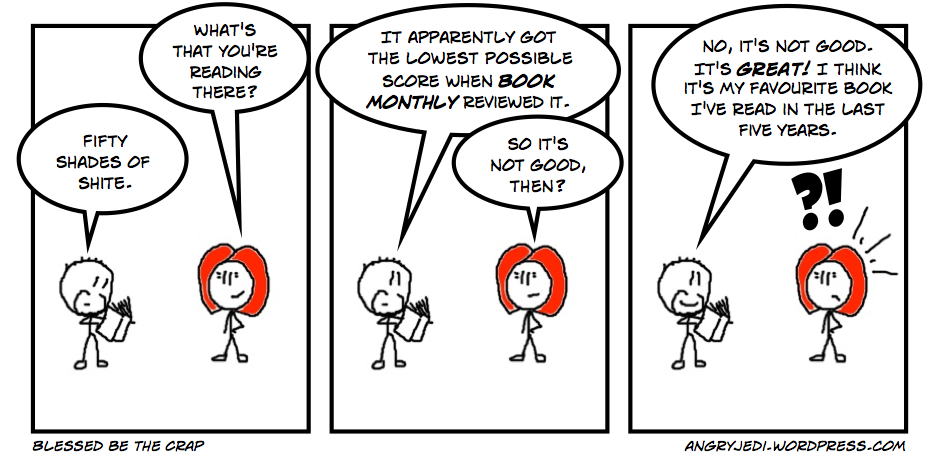
My point today is this: you shouldn't immediately dismiss stuff that is regarded as "crap" because there's every chance that if you tried it for yourself, you might just find yourself enjoying it. (Note: I'm not saying that stuff regarded as "crap" is always going to end up being good — some stuff we can all agree is shite — but in many cases it pays to go in with an open mind!)

Let's take Hyperdimension Neptunia as a timely example. Hyperdimension Neptunia received a spectacular 2/10 panning from Eurogamer's Simon Parkin, by all accounts a well-respected critic whose opinions a large number of people trust. Consequently, a lot of people didn't even bother to pick it up. This was such an issue that the (apparently considerably superior) sequel only had a limited print run and is now extremely difficult to find a copy of. (I tracked one down from Italy — European console games tend to be in English by default, perhaps with the packaging localised.)

And yet, while I can see its many flaws, I am having a lot of fun with Hyperdimension Neptunia. It's bright, brash, colourful, silly and rather entertaining despite being the sort of game some people I know would be embarrassed to be seen playing, particularly when the occasional "fanservice" images make an appearance, or every time the character Compa trips over and flashes her panties at the end of a fight. It's genuinely amusing, though — if deliberately cringeworthy at times — and packed with plenty of things to do. It combines two of my favourite styles of game — visual novel and JRPG — into one package with some really nice features. I love the ability to set custom images on "summon" spells, for example. Seeing the "I HAS A HERB" cat setting off a wind spell never gets old.

Hyperdimension Neptunia is far from the only example of a game which was poorly received but which I have ended up enjoying. In the post I linked to at the top, I mentioned Duke Nukem Forever and Alpha Protocol, both of which endured critical drubbings for various reasons — Duke for its grossout, sexist humour and Alpha Protocol for its broken gameplay aspects and appalling console versions. And yet in both cases — for I played them both to completion — I found myself having fun, being able to look past the flaws or "problematic" material and find an entertaining experience underneath. Am I somehow "wrong" to feel this way?

Well, of course I'm not. Opinions are entirely subjective, after all. I could tell you I found the critically-acclaimed movie Drive to be stultifyingly boring, for example (I did) but that doesn't stop you from enjoying it, rewatching it a bajillion times or putting it atop your "My Favourite Movies of All Time" list. Likewise, Nier's heavy reliance on fetch quests and seemingly tedious activities may cause you to switch off completely, while I found the experience to be an interesting example of a game requiring the player to "method act" the role of the protagonist, and found myself playing it obsessively as a result. We both might tell each other about how much we like our respective Things We Like, but it's unlikely we'll sway each other around to our way of thinking. And that's just fine.

The sad thing, though, is the fact that there are people out there who hold a considerable degree of influence over the public's spending decisions, and their opinion carries an undue amount of weight that might cause some people to miss out on things they might actually like. If Parkin gives Hyperdimension Neptunia 2/10, you better believe that's going to affect a large number of people's decisions as to whether they're going to buy it or not. (Probably the latter in this instance — in the notoriously top-loaded game review score scale, a score of 2/10 is theoretically reserved for an absolute stinker that is completely broken.) How many of those people whose opinion was swayed by Parkin's review would actually enjoy the game if they gave it a chance? How many people are actually going to give it a chance after reading that review?

The other thing worth mentioning particularly when it comes to titles like Hyperdimension Neptunia and Duke Nukem Forever is the fact that some critics seem to feel obliged to act as arbiters of taste and decency, when in fact everyone's tolerance for potentially "offensive" content is completely different. Both Hyperdimension Neptunia and Duke Nukem Forever attracted accusations of sexism on their original release to varying degrees of justification — the specifics of which I'm not going to get into right now because that's a whole other matter, particularly in the former's case — and these accusations negatively impacted the critic's view of the game in both instances. That's fair enough — as I said, everyone's "good taste" boundaries are different and said critics are entitled to voice those views — but when it comes to interactive entertainment, subject matter is just one part of the whole experience. And more to the point, in all forms of media, enjoying something that contains potentially objectionable subject matter doesn't imply that the person reading/watching/playing the thing in question is, by extension, a supporter of that particular viewpoint. In other words, you can like anime boobies and still see actual real-life women as actual real-life people. (I say "you" when, obviously, I mean "I".)

If you enjoy something, you enjoy something; you shouldn't feel guilt about your own tastes. Unless, you know, your "tastes" involve bludgeoning kittens, puppies and babies to death with a sledgehammer. (In real life, not in video games, obviously.) Or, you know, actively stirring up hate against a specific social group. Or just generally being a dick. Then you should probably feel a bit guilty. Basically, so long as you're not actually hurting anyone (physically or psychologically) or actively oppressing someone with the things you like, enjoy whatever you want within reason!

Now, if you'll excuse me, I'm off to plumb the depths of the bottom half of Metacritic to see what awesome experiences I can find to enjoy next…