1221: How Do You Make Friends Again...?

May 23 -- FriendsOne of my earliest and most enduring memories of my time at secondary school is also, coincidentally, the first time I was consciously aware of what I now recognise to be a longstanding case of social anxiety.

It was the first day of secondary school. Everything was big and new and scary — I'd come from a small village school in which the entire school population was roughly the size of a single year group in my secondary school. I'd chosen to go to said secondary school because a lot of my friends were going there, and also my brother had attended there some years previously and had come out of the experience as what is generally accepted to be a Good Person. Also, a lot of the people who had been bullies to me in primary school were going to a different secondary school, so I knew that I wanted to avoid that one like the plague.

But I, as ever, digress.

It was the first day of secondary school. I was sitting in my new seat in my new tutor group, and our tutor, Miss Quirk (yes, really), had tasked us with spending a few minutes getting to know the people around us.

I gazed around me. I was sitting next to a boy named Murray whom I didn't know. In front of me was a girl named Claire, whom I had instantly fallen in love with due to her long shiny blonde hair and the fact she wore short skirts with tights — something which I found (hell, find) inexplicably attractive. (Hey. I was eleven years old and easily pleased — but to be fair, she did remain consistently stunning throughout our entire school career.)

Behind me was my sometime best friend from primary school, Matthew. I say "sometime" because he wasn't always my best friend — he was a somewhat fickle chap rather prone to occasionally deciding he'd rather hang out with the "cool" kids, whose opinion of me tended to flip-flop back and forth on an almost weekly basis. Needless to say, I ditched him fairly soon into my secondary school career as a result of two events: one, him sneezing so hard he snotted over his hands and then ate it — mmm — and two, him deciding that sitting in his chair, miming masturbation and bellowing "I'm a wanker! I'm a wanker!" would be somehow amusing. (To be fair, it was sort of amusing, but perhaps not in the way he intended; needless to say, I didn't really want to be associated with him after that.)

Anyway. Our seating arrangements were the way they were in order to encourage us to interact and get to know each other. We'd been deliberately seated next to people we didn't know to encourage us to break out of our primary school "cliques" and widen our friendship circles — a theoretically sound idea that even at that tender age, I could see the benefits of.

Unfortunately, I couldn't act on it. Given the prospect of being thrown into enforced interaction with someone I didn't know from Adam, I froze up. I had no idea how to begin a conversation, how to get to know this person. Frantically, I turned around to gaze at Matthew (a pre-"I'm a wanker! I'm a wanker!" Matthew, I might add) and looked at him pleadingly.

"I can't remember how to make friends!" I said quietly to him. He just laughed and motioned for me to turn around and talk to Murray. He obviously hadn't taken my statement seriously, and that was frustrating, but I had little option but to try. It was a terrifying experience, though, and obviously I didn't set a particularly good first impression on Murray, because he became a complete bellend who bullied me on a regular basis. (I got my own back by punching him in the face just as the principal was walking around the corner and, although I was punished for lashing out like that, the unspoken consensus between my parents and the teachers involved was that he probably deserved it — and to be fair, he didn't bother me again after that.)

That first day and that pitiful statement — "I can't remember how to make friends!" — stuck with me, though. Because I can't remember how to make friends. It just sort of happens. I have made friends with people over the years, of course — the friends I made after I abandoned Matthew following the "I'm a wanker!" incident (such as Edward James Padgett, who has been mentioned in this post since it was first written, he just didn't see it); my university flatmates; my fellow students on my music course (though not on my English course — I didn't really get to know anyone on that side of things); and people I've worked with — but if I'm thrown into a new situation with unfamiliar people, or simply decide that I want to get to know new people who perhaps share my interests… I still have no idea how to do this.

This is, as I'm sure you can appreciate, frustrating, particularly as at the age of 32 I finally feel that I have found a number of geeky "niches" that I fit nicely into, and would like to share these experiences with like-minded people. I greatly enjoyed spending time with Mark and Lynette while we were over in Canada because they are both My Kind of People who enjoy the things I do — but I also found myself somewhat envious of them for having a group of friends they play Dungeons & Dragons with, watch anime with while drinking cocktails and all manner of other things that are in keeping with their interests.

This isn't to say I don't have friends, obviously. The friends I see most frequently are my regular(ish) board gaming group, and I wouldn't exchange them for anything, since I really, really appreciate the time I spend with them indulging in our mutual hobby. However, we do have our own incompatibilities — two of our number are really into football, for example, while the rest of us either have no strong feelings or actively hate it. (I fall into the latter category.) Similarly, I very much like Japanese video games, while several of the others cling to common misconceptions about them and thus either refuse to play them or have little interest in exploring them and having their misconceptions disproven — though at least they are patient and willing to listen to me talk about them. Conversely, a couple of our number are big into Skyrim, a game which I found almost unbearably tedious after a while. To continue the pattern, I'm a big fan of anime and would really like it if I could have a semi-regular viewing session with a small group of people, but no-one from that particular group is biting for various reasons — some don't like or don't see the point of sitting and watching something together as a group; some aren't interested in anime.

You get the picture, anyway. I obviously don't begrudge my friends these incompatibilities we have — everyone is different, after all, and thus has their own tastes — but I find myself wishing on a regular basis that it was a bit easier to find additional friends (note: not "new" friends, because to me that implies a degree of "replacement", which I don't want) who have common interests.

Actually, let me qualify that somewhat: I find myself wishing that it was a bit easier to find additional local friends who have common interests. It's obviously no problem whatsoever to find new friends on the Internet who have similar tastes to me, and I'm very grateful for the fact that I do have so many people on the Internet that I can rant and rave about how awesome Ar Tonelico is or how much Kana Little Sister made me cry or whatever. But as much as I appreciate these friends in far-flung corners of the world, it's not quite the same as having someone you can just pop over and see at short notice, hang out and do some things that you both enjoy.

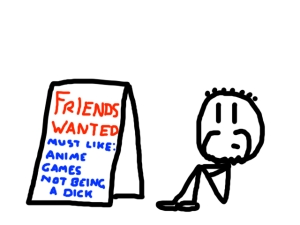
So, uh, anyone want to hang out, play some games and watch some anime?
1186: Don't Hate

There's a curious phenomenon in comments sections around the land. And that phenomenon is that it is seemingly the law that someone, somewhere, must hate everything. Actually, that's badly phrased; I don't mean that one person hates everything — though I'm sure there are people who do — but instead I mean that whatever the thing that has been posted, there will always be at least one person who dislikes it for some reason and is inevitably the sort of person who is very vocal about their dislike of it.

This seems to happen particularly frequently in sectors that already have passionate userbases, or in which the userbases are seen as being a "subculture" and/or outside the "norm" somehow. I'm thinking specifically of the video games and anime sectors here — and before you start on me, for all the massive steps forward these media have made in terms of mainstream acceptance over the last 20-30 years they are still indelibly tarred with the "geek" brush to one degree or another.

Today, I was exploring the RPG Maker community who, by all accounts, appear to be a fairly friendly and helpful bunch for the most part, as I've previously mentioned. I was curiously browsing through some of the other users' projects in progress and came across a few interesting-sounding games. One of the users noted that they had submitted their game to Steam Greenlight, the process whereby a game can end up being sold on Valve's popular PC gaming digital download storefront if it gets enough positive votes from the community.

The game, by all accounts, sounded interesting and unconventional, and something I'd be intrigued to play. It was an "artistic" game, for want of a better word, designed as a means for the author to show what it was like living with depression. The author said upfront on the site that it was a mostly-linear, narrative-centric experience with a lot of text, and made no apologies for this fact. (For people like me, the terms "narrative-centric" and "lot of text" are selling points, not things to be ashamed of!)

Sadly, the Greenlight comments section was less than supportive for various reasons, featuring disparaging remarks for everything from it being "another depression game" (oh, sorry, there have been so many of those) to dismissing it simply because it's an RPG Maker game. I've made my feelings on the latter point quite clear in the past, but they bear repeating: if a tool is available to help someone realise their artistic vision, there's no reason why they shouldn't use it, regardless of how many other people are also using it. And besides, some of my favourite games in recent memory have been RPG Maker titles — Corpse Party, To The Moon, Cherry Tree High Comedy Club… all of them were made in earlier versions of RPG Maker that were considerably less sophisticated than the excellent toolset that is VX Ace.

But I digress. The point is that the comments section was filled with hate for the sake of hate rather than actually constructive feedback. The fact that the game in question (Actual Sunlight, I believe it was called) was "another depression game" and an RPG Maker project had nothing to do with its quality, or its "value" to the Steam community as a whole, and yet these things were used as reasons to reject it, without even bothering to check it out.

In the anime sector, it seems that it's fashionable to hate on whatever the biggest name show is at the time. Most recently, this has been seen with Sword Art Online, which I found to be a rollicking good time with an astonishingly spectacular soundtrack, some memorable characters and an interesting, intriguing and pleasingly mature (for the most part, anyway) storyline. It was a good show, in short; while it perhaps wasn't the most intelligent anime you'll ever see, it was certainly far more than a dumb, formulaic show.

Perhaps not something everyone would want to watch, no, but certainly far better than the overly-negative comments that would appear on J-List's Facebook page any time site owner Peter Payne posted a piece of artwork relating to SAO. (Granted, J-List's Facebook page is a place where any time a picture of a vaguely attractive anime girl is posted, one specific user will always be along within three comments of the start of the thread to helpfully inform everyone that "[he] would fuck her", so it's perhaps not the best place to go for objective criticism, but still; you'd expect a community of Japanophiles such as the followers of J-List's page to be a bit more enthusiastic about the things they supposedly like!)

I honestly don't get why this happens, and it seems to happen a lot. Why waste your time on hate when there is so much stuff out there to get you excited? Wouldn't you rather feel happy and intrigued by something than angry or upset?

1176: Absolute Destiny Apocalypse

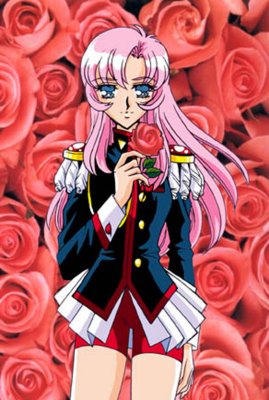
Utena-1-_(2)At the insistence of my good friend Lynette (well, all right, she mentioned it a couple of times and I was intrigued) I have been watching an anime series called Revolutionary Girl Utena, also known in various places as Shoujo Kakumei Utena and La fillette révolutionnaire Utena.
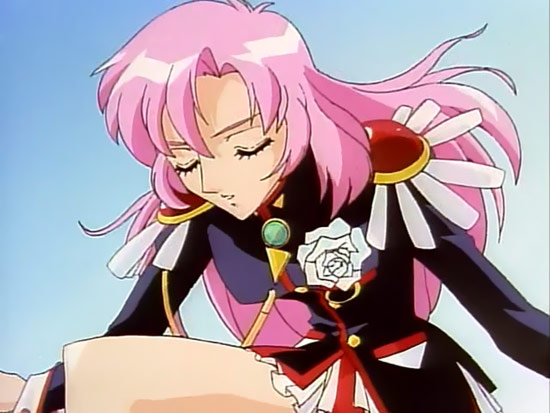
Utena, as I shall refer to it from hereon, is clearly from a very different period to the anime I have watched to date. It has a very distinctive "'90s anime" appearance to it, particularly with regard to character proportions and design — everyone has chins that could cut glass, and all the girls have inhumanly long legs, a fact usually accentuated by their clothing — but it still makes use of a lot of common non-realistic "stylized" features that we see in modern anime, particularly with regard to facial expressions and the way people move.

Thematically, it's also of a genre I haven't really explored before — technically, it could be described as a "magical girl" anime since Utena regularly gains special powers accompanied by special effects and recognisable catchphrases, but it's a lot more than just Pretty Girl Fights Crime. No; so far I'm only relatively few episodes into the whole thing but it's very clear that there are a lot of things going on.

A friend of mine described Utena as being "like a fever dream" and that's absolutely true. There's a curious sense of surrealism about most of the episodes, with fairly mundane activities juxtaposed with obviously fantastic happenings that only certain characters are aware of. The whole thing is also absolutely riddled with imagery and visual metaphor, some of which are more obvious than others and most of which only contribute to the strange, surreal feelings of things not quite being what they seem.

But you probably want to know what it's all about, right? Well… as I say, I've only seen a few episodes so far so I can't comment with full authority on everything that has happened, but here goes.

00003sp0Utena is a statuesque high school girl who habitually dresses as a boy. The reason for this is that when she was younger, she was helped by a kind "prince", who gives her a ring with a rose signet and tells the young Utena that it will "lead her to him". It transpires that there are other people out there who wear the rose signet on their rings, and they're at Utena's school. Specifically, they're the student council, who appear to have some sort of special relationship with an unknown entity, person or organisation known as "End of the World" and are keen to "smash the world's shell to bring about revolution" as dictated by their creed. ("If it cannot break out of its shell, a chick will die without being born. We are the chick. The world is our egg.")

Key to the plans of the Student Council is the "Rose Bride" Anthy Himemiya, who also happens to be a student at Utena's school — and who appears to share some characteristics with the "prince" from Utena's past. Anthy, for the most part, appears to be a normal girl, but whoever is "engaged" to her "possesses" her and can make her do anything they want. Through a series of unfortunate happenings, Utena becomes engaged to Anthy and then proceeds to protect her from the other members of the Student Council, who all have their own reasons for wanting to possess the "power of Dios" that Anthy contains.

The interesting thing about the series so far is that no-one is really outright "evil" — there are plenty of obnoxious characters who are unpleasant or dislikable, but they all appear to have their reasons for doing the things they do. In fact, there are several characters who, despite being on the Student Council and thus at various points taking the role of "antagonist", are actually rather sympathetic and/or likable. It's really cool, and I'm looking forward to finding out the truth behind some of them.

Anyway, given that I'm only partway through the series' first story arc, that's really all I can say for now, but I will say that I'm enjoying it, even if it's currently very confusing and bewildering. I get the impression that's entirely deliberate, though — I wonder how many answers I'll have by the end of it all?

1166: The Invader Comes from the Bottom of the Sea!

It's been a while since I talked anime here, so I'm going to talk anime. Oh yes indeedy. Specifically, I'd like to talk about a bizarre little show I've just started watching called Squid Girl, also known as Ika Musume.

squidgirl1Squid Girl is a rather peculiar show in a number of ways. Firstly, it's not quite "episodic" in the same manner as other anime series, though there is a sense of progression throughout. Instead of being a sequence of 20-minute episodes, each "episode" of Squid Girl is instead made up of three short self-contained mini-stories that tend not to have a great deal to do with each other besides having the same core cast. However, the whole thing does have a clear chronology, since characters, concepts and settings introduced in earlier episodes tend to show up again later rather than being "one-shots". I haven't watched far enough to know exactly how it all ties together — if at all — yet, but already in the four full episodes I have watched we've seen the introduction of certain characters and their subsequent return — and I'm sure there'll be more to come.

Secondly is the concept, which anime pros probably won't bat an eyelid at, but which those used to more… "conventional" Western entertainment might find a little bizarre. As you might expect from a show called Squid Girl, the main character is a girl who shares a number of characteristics with squid. Specifically, her blue hair is actually a set of ten tentacles which she can manipulate independently at will, her hat causes the shape of her head to resemble that of a squid (and removing it will apparently kill her) and she is able to spew squid ink from her mouth. She also has the abilities of various different types of squid, including luminescence, the ability to change her weight at will and flapping the… flappy bits on her hat. The English subtitles and dub also see her making frequent squid- and tentacle-themed puns in her dialogue, while in Japanese she tends to end her sentences with "de geso" (translated literally, something to do with squid legs) similar to how super-cute moe characters often deliberately overuse or exaggerate the "desu" or "desu no" final particle (see Compa and Gust from Hyperdimension Neptunia for good examples), and she also tends to emphasise the syllables "ika" ("squid") in her speech whenever they come up, regardless of whether or not doing so would really make sense. (Aside: I love finding out about the equivalent of puns and the like in other languages, as I do often find myself wondering how non-English languages deal with jokes, slang, dialect and puns like this. It's fascinating to learn this stuff through things I enjoy.)

squidgirl2The basic premise of the show sees Squid Girl coming ashore ostensibly to subjugate all of humanity in revenge for the shitty way they've treated the ocean, but she instead finds herself forced into working as a waitress at a beachfront restaurant when an outburst and demonstration of her "power" ends up smashing through the wall. The various mini-stories that make up the episodes depict Squid Girl learning more about human society and what a "normal" life is, and much of the humour comes from her complete unawareness of how to behave like a human despite resembling one for the most part. There's also a huge amount of comedy value inherent in her interactions with the owners of the beachfront restaurant she damaged, who seem completely unperturbed by the fact that she is obviously not human and each have their own distinct characters and means of dealing with the girl-shaped hurricane that is Squid Girl. Eiko is slightly weary and a little tsundere but tolerates Squid Girl for the most part. Her sister Chizuru, meanwhile, initially appears to be the stereotypical quiet, demure and kind "older sister" type, but reveals herself very early on to have a distinctly dark side that utterly terrifies poor old Squid Girl. In actual fact, this "dark side" is not truly threatening or unpleasant — it's simply the ability to perform a "withering look" that is the Holy Grail for parents and teachers alike, but which is often depicted as a horrifying dark aura from Squid Girl's perspective. Even as Squid Girl tries to convince herself that she's still going to subjugate humanity, she quickly learns not to step out of line when Chizuru is around.

For the most part, Squid Girl is thoroughly silly fun, and I frankly wasn't expecting much more than something fairly throwaway to watch while I had breakfast and then forget about shortly afterwards. However, one of the mini-stories I watched earlier well and truly changed my mind and convinced me that this is actually a show doing some surprisingly clever things. I shan't spoil it completely for those who are planning on watching the show, but I'll just say that the "mini-Squid Girl" vignette — which was depicted almost completely wordlessly — was surprisingly heartfelt and touching, and I was very surprised to realise that even after just a few episodes, I already cared very much about these characters.

squid girlI shouldn't have been surprised, really; one of the things that continually strikes me about Japanese media the more of it I consume — be it video game, anime or manga — is the deft skill with which creators are often able to weave their magic to create compelling characters and make you care about them remarkably quickly. Squid Girl, as ridiculous as it sounds on paper, is certainly no exception to that, and I look forward to seeing the rest of this surprisingly captivating nonsense.

1118: My 1,118th Blog Post Can't Be This Cute

Page_1Anime is full of surprises and frequently subverts your expectations, prejudices and preconceptions. In few places is this more apparent than in the recent show Oreimo, also known as Ore no Imouto ga Konna ni Kawaii Wake ga Nai or, literally in English, My Little Sister Can't Be This Cute.

Now, with a title like that, you'd be forgiven for thinking that this show is one of two things — or perhaps both. One: moe moe happy funtimes featuring a wacky little sister running around being cute. Two: incestuous "sister complex" story in which male protagonist ends up falling for his little sister through various shenanigans they get up to together. While I can't speak for number two in the show as a whole — I've only watched four episodes so far, so I'm still half-expecting them to pull the frequently-used "but they're not blood relations!" trope out of the bag (please don't spoil it even if that is the case!) — number one couldn't be further from the truth. Far from being a wacky show about nothing in particular as I expected it would be, Oreimo is, it turns out, an oddly personal show about being true to oneself and accepting each others' idiosyncrasies.

The concept is fairly straightforward. The main character Kyosuke is a 17-year old high school student who has had a somewhat strained relationship with his 14-year old sister Kirino for some time now. The reasons why they have been struggling aren't explained, at least at the start of the show, but it's clear that there's a certain degree of tension between them, whether that be the usual case of siblings resenting one another or something more. Kirino is a model student — she's pretty, she's popular, she gets good grades and she's a top athlete — and she also makes a lot of money doing modelling work for various catalogues and magazines.

But she has a secret.

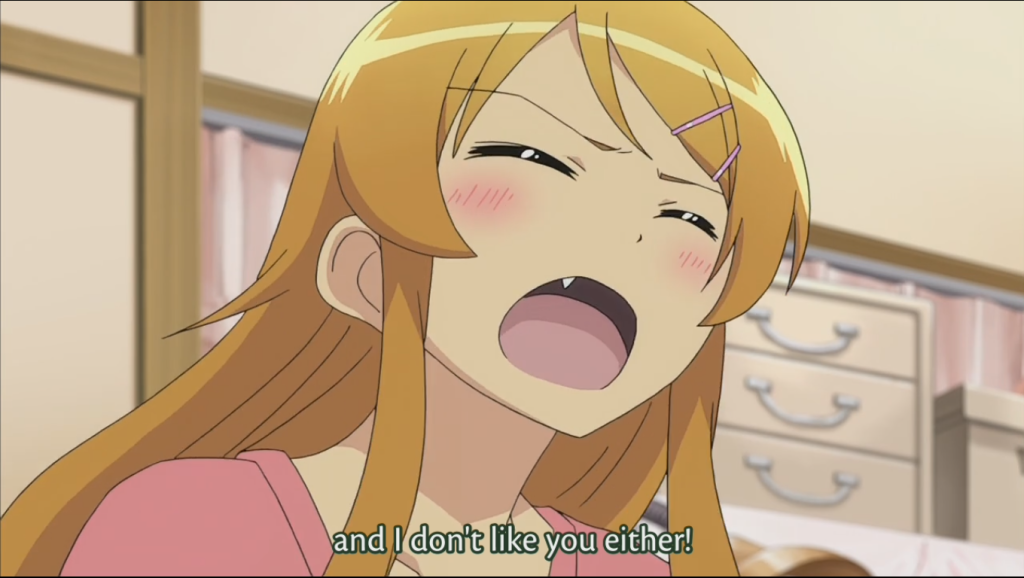
Oreimo12-23Early in the first episode, Kirino makes a bold move. She comes to Kyosuke's room in the middle of the night, wakes him up and confesses something that she's been hiding for a long time: she's a secret otaku with a hidden closet full of anime, manga, doujinshi and eroge — all paid for with her modelling earnings — with a particular focus on one particular (fictional) magical girl show, and also on anything related to little sisters. Kyosuke initially isn't sure how to react, but it becomes clear that Kirino wants his help, even though her own pride and somewhat tsundere nature prevents her from stating this outright. He agrees to help her work out how to handle her secret "addiction" and figure out what to do with her life, because the stress of leading a "double existence" is starting to take its toll on her, as she feels uncomfortable showing the world who she really is.

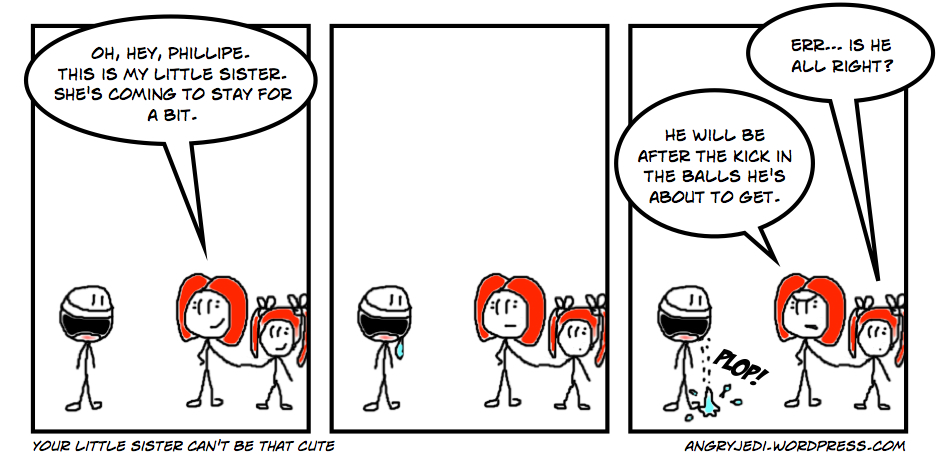
As the series progresses, Kirino learns to make friends who are into her secret hobby, and comes to trust them. Kyosuke watches with some degree of pride as he sees his little sister starting to open up and be herself, but it isn't an easy ride — particularly when her two worlds start to collide as the siblings' parents and Kirino's non-otaku friends start to find out what has been going on. Kirino faces constant judgement and scorn from people who look down upon her hobby, and has a habit of becoming defensive and lying as her first reaction, often leaving Kyosuke to take the fall — something which he usually resigns himself to without complaining, even when it involves (as it frequently does) him being kicked in the testicles.

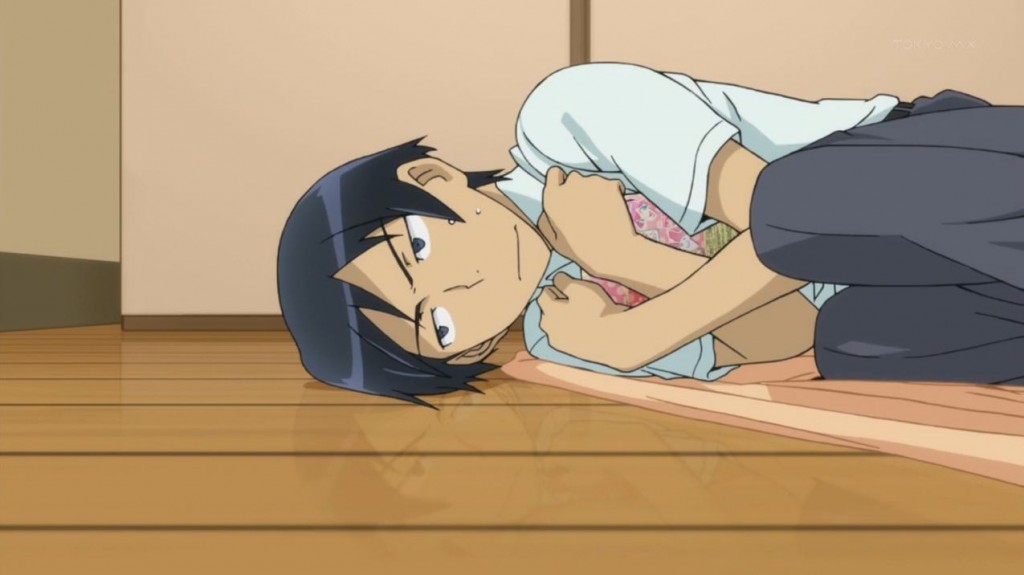
The face of a defeated man.

When it comes down to it, though, Kirino will often (eventually) stand up for herself and say what she believes in; she's passionate about her hobby, and over time begins to accept the fact that there will always be people out there who will judge her for it — often without knowing anything about it. Kyosuke, meanwhile, comes to understand his little sister a bit better, and also becomes something of a focal point for all her friends and acquaintances when various problems arise.

The nice thing about Oreimo that I've seen so far is that, a little like the excellent series Welcome to the NHK, it deals with subject matter that divides opinion but does so without being judgemental or preachy about it. You don't get the impression from watching the show that it specifically wants you to think that being an otaku is either okay or that it is vile and shameful; it simply presents things the way they are, places a strong focus on the concepts of people's "public" and "private" faces, and others' reactions to those faces. Far from being wacky, silly fun times, it's actually proven so far to be an interesting, very human story that doesn't hide behind moe shenanigans despite having, as the title suggests, a super-cute female lead. (It could probably do without some of the occasional curiously-angled shots of said super-cute female lead's bum, admittedly, but… well, there's not much you can do about that, really.)

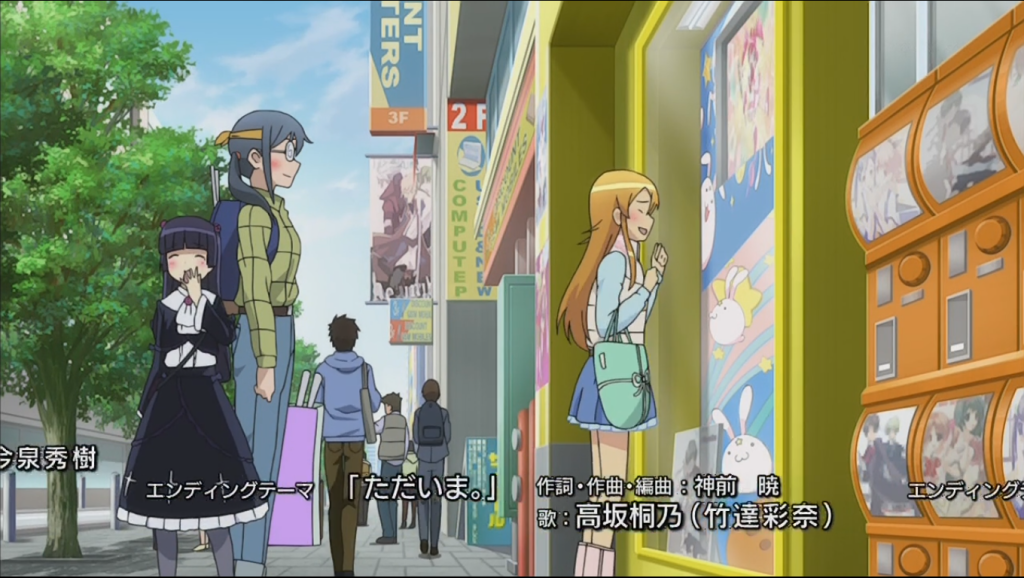
Oreimo12-42Anyway. Thus far I've been enjoying it a lot, and am looking forward to seeing how it continues. Further reports will undoubtedly follow.

1104: Tsuntsun, Deredere

Page_1It's funny to think that it was only this time last year that I played Katawa Shoujo, rekindled my love for all things Japanese and got properly "into" the visual novel medium. Over the course of last year, I played a bunch of VNs and took some tentative steps into the world of anime, too, and I haven't really looked back since. I've found a medium (well, several forms of closely-related media, really) that "speaks" to me, and that's always a pleasant feeling, particularly when there is a whole shitload of stuff in that medium for you to explore and discover.

Because it was only last year that I got into all this shit, though, it was only last year that I found out what the word "tsundere" means. I had occasionally heard it mentioned by people I knew were into anime and Japanese games, but I'd never thought to look it up before — perhaps because I assumed it was an obscure, specialist piece of jargon relating to something that I wasn't, at the time, particularly immersed in.

There's a good chance that there are a few of you reading this who have absolutely no fucking idea what I'm talking about right now, so allow me to educate you. Then you can walk away from one of these posts feeling like you've learned something for once. Wouldn't that be nice? Of course it would. Let's go, then.

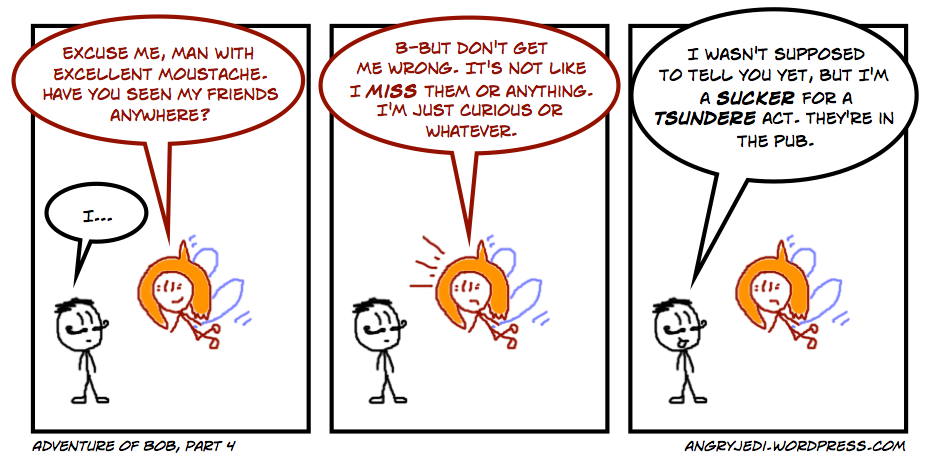
"Tsundere" is a word primarily (though not exclusively) used in relation to characters in Japanese media (manga, anime, games and everything in between) who run "hot and cold". Tsunderes are usually female, though not always. The word is a portmanteau that combines parts of two different words to describe the two main moods of the character — tsuntsun describes the part of the personality that is aloof and/or irritable or even outright hostile; deredere describes the soft, squishy and adorable lovestruck centre that the abrasive exterior is protecting.

The tsundere is a stock character in a variety of Japanese works, and can pretty much be guaranteed to put in an appearance in any "harem" stories — i.e. those that include a male protagonist and a disparate gaggle of female heroines who flock to him for various reasons that are not always to do with love or sexuality. (Popular anime Sword Art Online has been described by some as a harem work, for example; even though the main focus of the story is on the romantic relationship between protagonist Kirito and female lead Asuna rather than Kirito attempting to knob his way around cyberspace, a number of episodes introduce a female character who is drawn to the protagonist for some reason before disappearing without a trace by the next episode.) They are a character type that is obviously exaggerated for either comic or dramatic effect — sometimes both — and thus it's unlikely that you'd find a real-life tsundere. At least, not one that takes quite the same form as you'd see one in an anime or game.

The tsundere can be recognised through a number of different means. Most commonly, it's through the use of the iconic combo of stuttering slightly when around the object of their affections, and the curiously-specific denial of something that belies their deredere side through what initially appears to be tsuntsun behaviour. ("What? I-it's not like I've been thinking about you or anything…!") Other tell-tale signs include excessive use of the word "baka" (idiot, stupid) for the slightest misdemeanour and blushing beet red when confronted with an obviously romantic or sexual situation that they haven't steeled themselves for.

Most tsunderes have tsuntsun as their default behaviour pattern and lapse into deredere when they let their guard down, but characters who represent an inversion of this format exist, too, spending most of their time adorably lovestruck and occasionally lapsing into abrasiveness and hostility if provoked. The latter type can easily be confused with the yandere, which also has deredere as their default behaviour type, but hides proper full-on psychotic mania underneath if the object of their affections either doesn't want them or is taken away from them. (A tell-tale sign that an anime yandere is about to go bonkers, incidentally, is that their eyes go completely blank, lacking the usual "sparkles" seen in the corner of anime eyes. If a character goes like that, you should probably get worried, and you can pretty much guarantee that someone is going to die very soon.)

Yanderes aside, the tsundere's behaviour is usually tolerated and accepted by their friends, and rarely commented on directly — it's just the sort of person they are. The object of their affections usually has to take the brunt of the tsuntsun side, but close friends who want to help the tsundere get closer to the person they obviously like often have to deal with this, too. More often than not, the long-suffering best friend either just shakes it off or is completely oblivious to it, having presumably learned to tune it out a long time ago.

There's something oddly attractive about a tsundere character, which probably explains why it's such a commonly-appearing trope. I couldn't possibly speak for everyone on why this is, but from my own personal perspective, I find the commonly-used "hard-hearted bitch showing a softer side" approach to be an effective one that helps me to sympathise with the characters in the relationship. Reasons that "tsuntsun by default" tsunderes act the way they do vary by story, but one thing is constant — letting that deredere side out is a sign that they're letting down the barriers around themselves and showing another character that they both trust them and care about them. It can be a very touching moment if handled effectively.

Here are a few of my favourite tsunderes. Oh come on, you knew this was coming.

noireNoire (Hyperdimension Neptunia)

Noire, the character who represents Sony and the PlayStation in the Hyperdimension Neptunia series of games, is very obviously a tsundere thanks to her regular use of curiously-specific denials when talking to Neptune in particular. She seems aloof, arrogant and abrasive most of the time, but gradually reveals herself to be someone who just really likes to try and do their best at all times. She obviously likes Neptune, despite what often appears to be open hostility, and has found that her efforts to make the land of Lastation as good as it can be have left her lonely.

President4Irina (My Girlfriend is the President)

Irina Vladimirovna Putina, the Rusian [sic] president in the visual novel My Girlfriend is the President, is a textbook tsundere. Spending most of her time early in the game alternating between yelling at the protagonist Junichiro and twatting him around the head with her slapping fan every time he does something pervy (which is quite often), she eventually shows a softer side and ends up being a positive influence on Jun. Jun also has a positive effect on her; while she manages to mellow him out somewhat, his easygoing nature helps her be less uptight.

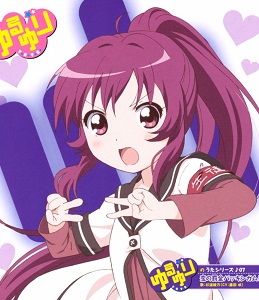
Yuru Yuri no Uta Series 07 - Sugiura AyanoAyano (Yuru Yuri)

Poor old Ayano is the butt of a bunch of jokes in the slice-of-life anime Yuru Yuri. The feisty redhead is obviously carrying a rather large torch for resident chaotic character Kyoko and is completely unable to express her feelings adequately, instead regularly flying into a blind rage at Kyoko's slightest misdemeanours. Kyoko, being Kyoko, doesn't mind at all, and is oblivious to Ayano's feelings. The only one who is truly aware of Ayano's crush is student council member Chitose, who regularly fantasises about the pair of them, usually resulting in a violent nosebleed.

1052: Kiss, Kiss, Fall in Love

Page_1During November, as you know, I was writing non-stop fiction in my own NaNoWriMo spinoff. This doesn't mean I wasn't doing anything worth talking about in my spare time, however. You may recall that a relatively short while back I well and truly "got into" anime and had some enthusiastic words to say about a number of different series. I thought I'd share my thoughts on one more that I finished at some point in the middle of last month: Ouran High School Host Club.
This was a recommendation from my anime-enthusiast friend Lynette, who has been the source of many good recommendations to date. I wasn't entirely sure what to expect from it, though armed with my relatively limited knowledge of "host club" culture that I'd picked up from playthroughs of Yakuza 1, 2 and (I'm still yet to tackle 4, but I'll get there) I had a general idea.

(For those unfamiliar with this particular quirk of Japanese culture, host/hostess bars are establishments in which patrons can come in and settle down for a pleasant evening's chat with a host/hostess of their choice. Their chosen companion will ply them with drinks and food and attempt to get them to spend as much money as possible, though if Yakuza is to be believed there's every possibility that the host/hostess and their client will strike up a genuine friendship "and maybe more" in the process — good for the people and good for the business, too. It is, it should be said, rather different from prostitution.)

Anyway. Ouran High School Host Club revolves around a group of bored, rich male students at a very exclusive high school (the titular Ouran Academy) who formed their own host club in an attempt to entertain the equally bored, rich female students. The club covers a diverse array of "tastes", ranging from pretty boy Tamaki to the borderline-incestuous twins Hikaru and Kaoru via the… whatever the male equivalent of "loli" is embodied by the childish, cake-loving "Honey".

Enter Haruhi, who is a girl. Haruhi stumbles upon the Host Club's premises — the disused music room — and inadvertently breaks an incredibly valuable vase in the process. She is saddled with a debt that she couldn't possibly repay, so the club agrees that if she joins as a host and entertains the girls of Ouran Academy, they will let her "work off" her debt.

Thing is, certain members of the club initially don't realise that she is a girl, since she first appears dressed in a boy's uniform and sporting a rather boyish short, shaggy haircut. Hilarity, as you might expect, ensues, and the series progresses as Haruhi and the gang get into a series of increasingly silly scrapes, all the while learning new things about each other and their backgrounds. The rich kids of the Host Club learn about Haruhi's poor background, her deceased mother and her cross-dressing father — one of the more memorable characters in anime I've seen recently — while Haruhi learns to come out of her shell a bit, and solidifies her own idea that gender doesn't define her personality.

At heart, Ouran High School Host Club is a very silly show. The characters are heavily exaggerated, and the visual aesthetic is very stylized — everyone has noses that you could cut glass with, for example, and the show isn't afraid to pop up captions to explain various things or even to put big flashing arrows over the top of something that will become important in a few minutes' time. Similarly, the show is a textbook example of anime not being afraid to have characters that defy the laws of physics for comic effect — there's lots of exaggerated facial expressions, black clouds looming around the depressed and angry people suddenly becoming inexplicably huge. The whole thing is presented with an almost childish degree of enthusiasm, and the energy is relentless. It's perhaps for this reason that I actually found it difficult to watch more than one episode at a time, whereas conversely I can and will watch a whole bunch of slower-paced stuff in a single sitting. (I devoured the entire series of AnoHana in one go, for example, but that's a story for another post altogether.)

As well as being silly, though, there's a tender heart beating within. The characters have very real affection for one another and their relationships deepen and blossom as the show progresses. It manages to pull this off without dropping into the realms of cliché, either, except where it is deliberately lampshading romantic clichés — usually through the identical twins duo of Hikaru and Kaoru.

The show is gloriously, gloriously camp, managing to pretty much out-gay both Bayonetta and Space Channel 5 (both of which are games, I know, but they're the yardsticks by which I measure relative campness) but it also knows when to show restraint. There's a time and a place for shenanigans and prancing around, it seems to say, and a time for people to be serious. The good pacing that the show enjoys means that it builds to a very satisfying payoff come the end of the series — and not necessarily in the way you might expect, either. I shan't spoil it for those who are planning to watch it, but suffice to say it's worth sticking it out for the whole run, even if the seemingly-relentless chaos of some episodes feels like it might be a bit much sometimes.

In short, I enjoyed it a lot. It doubtless won't be to everyone's taste — what is? — but I found it a lot of fun. Give it a chance if you're looking for something a little bit different from the norm.

1010: Connected Hearts

I finished watching another new anime tonight specifically so I could write about it for today's post. Oh, don't worry (as if you were) — I was enjoying it a lot, so I was more than happy to zip through it and see how it concluded.

Kokoro Connect is its name, and it's an interesting one. It's also not at all what it makes itself out to be initially, which I can't help but feel is perhaps not to its benefit. But that aside, it's worth a watch, and here's why.

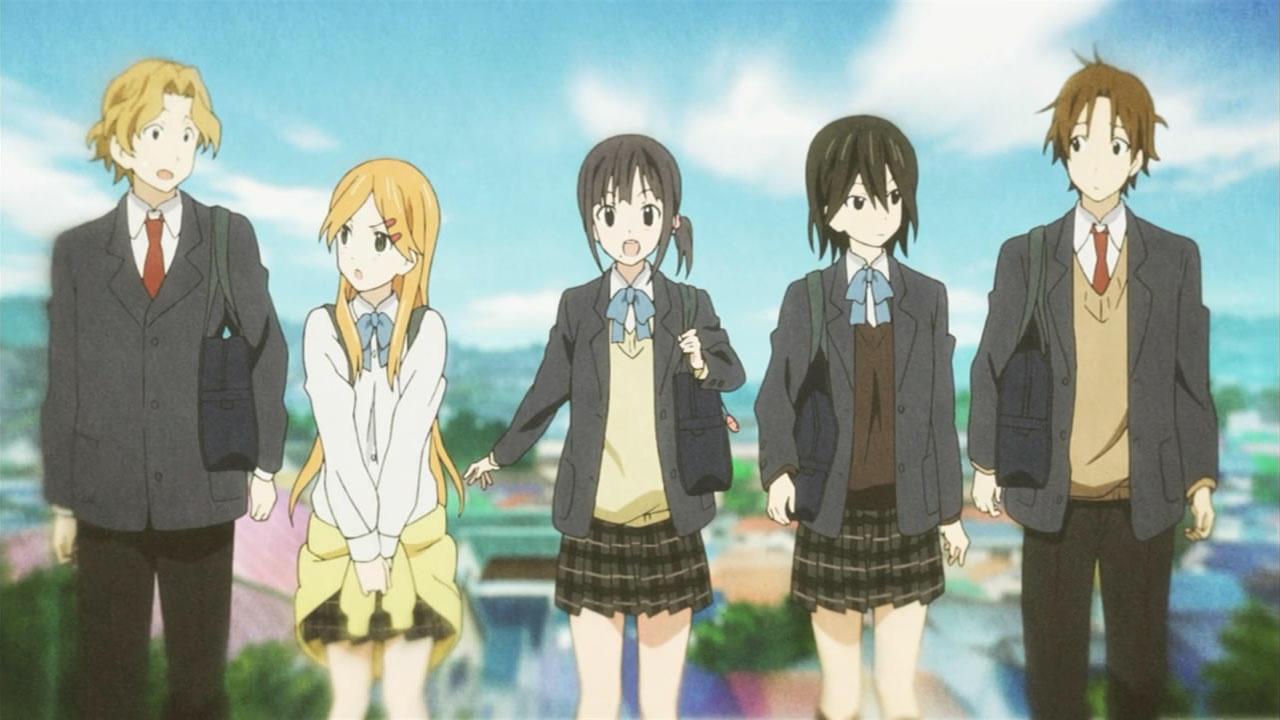
The elevator pitch of Kokoro Connect is as follows: five high school students have escaped their school's You Must Join A Club rule by establishing the Student Cultural Society, or StuCS for short. Ostensibly, StuCS is responsible for putting together a school newspaper, but in actuality they spend most of their time hanging out in their club room in relative privacy, talking to one another.

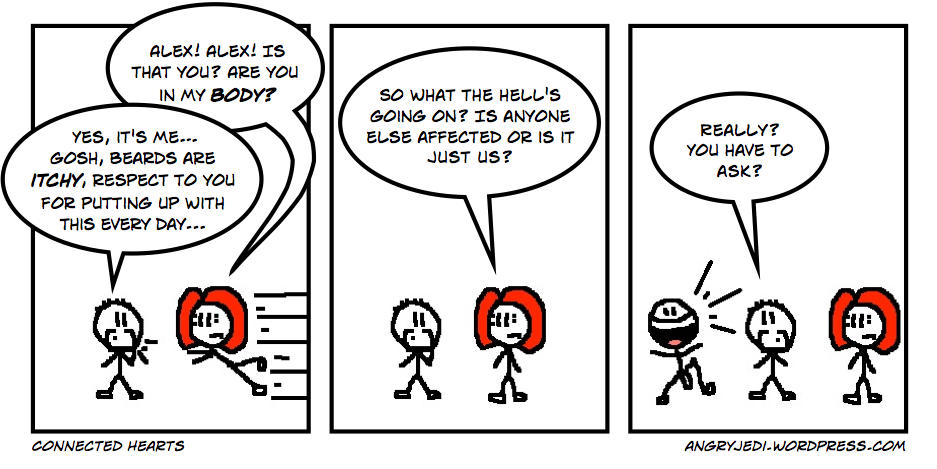
Everything is shaken up one morning when two of the group show up visibly shaken by what appeared to be a strange dream they both had at the same time. For half an hour, they believe that they had switched personalities, with their respective consciousnesses swapping places and then shooting back with no explanation. The others are understandably skeptical of this bizarre story… until it happens again while everyone is watching. Thus begins a rather peculiar tale.

That's how Kokoro Connect sells itself, anyway. The reality is, in fact, much more interesting, as while the whole "body-swapping thing" is cool, it's a difficult concept to sustain over a long period. Consequently, the supernatural "hook" of Kokoro Connect actually ends up taking a back-seat to the real reason to watch it — its five characters and their growth over the course of the show's 13 episodes.

Kokoro Connect's cast is a relatively diverse one, initially appearing to cover a selection of predictable tropes. We have Taichi, who is the relatively "blank slate" male character; Aoki, who is the jocular "best friend" character; Yui, who looks (presumably unintentionally) identical to Asuna from Sword Art Online and is the "quiet girl"; Iori, who is the "loud, immature girl"; and Himeko, who is the "cold, aloof, mature girl".
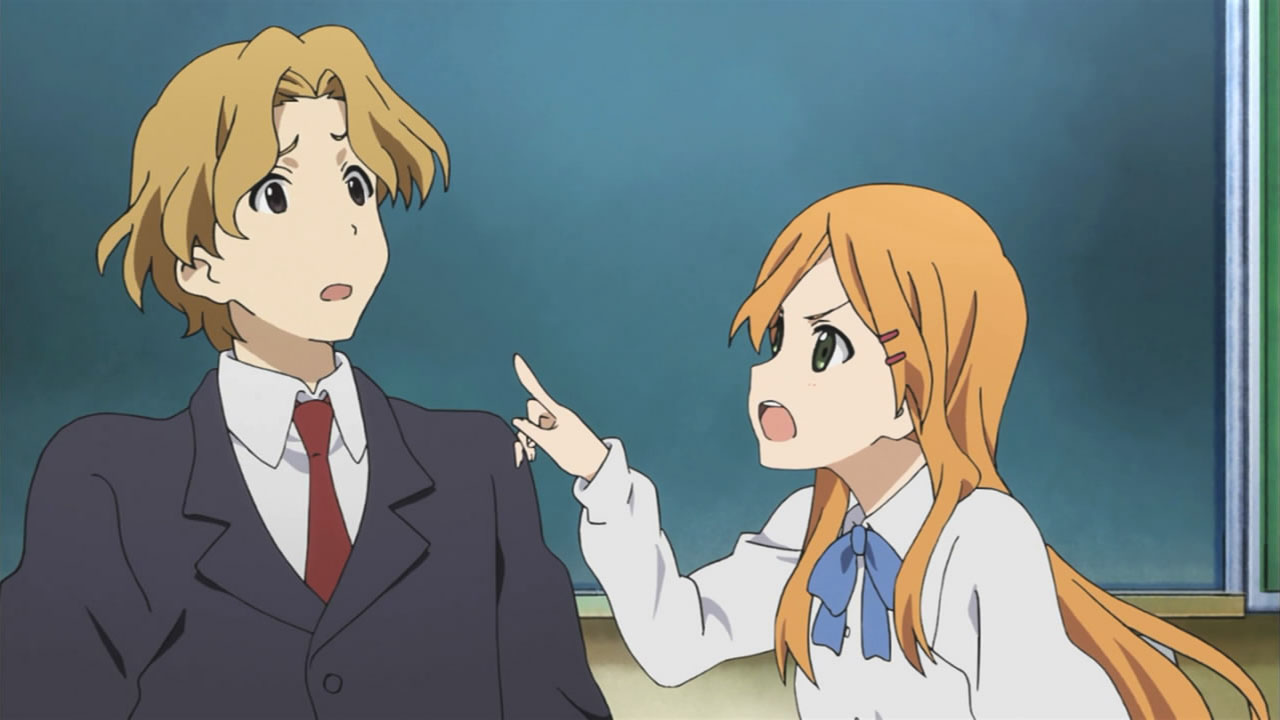
As you might expect from modern anime, however, none of these characters are quite what they appear to be at first glance. I shall resist spoiling exactly what's up with each of them — because there is something "up" with all of them — but suffice to say that they all have plenty of hidden depth that is explored throughout the course of the series. The various supernatural happenings (which eventually extend beyond body-swapping) serve as a trigger for each of them to confront their various issues and discover their "true" selves — sometimes independently, but more often than not with the help of their friends.

Kokoro Connect is, at its core, a show about friendship and the way people can and/or should help each other through hardships. A key theme is whether or not you should always help someone when they're hurting, or whether or not it would be more beneficial to let them work things out themselves in the long run. A question that is asked explicitly partway through the run, in fact, is whether or not you should hide from your problems (both individual and collective) or face them head-on, knowing full well that doing so will probably hurt both you and those around you.

It's actually quite Persona-ish in many ways — specifically, it's a lot like Persona 4, which is about people accepting themselves, including the parts they might not want to acknowledge. The supernatural aspect of Kokoro Connect is significantly toned down compared to Persona 4 and is never really adequately explained — a situation which may well be resolved in the four new episodes set to be released next year — but it doesn't really matter. If it wasn't there at all, these would still be interesting characters and interesting stories. (This does, of course, raise the question of why it's there in the first place, but it does serve as a good catalyst for a number of subplots throughout the show's run.)

If I had to critique the show specifically, I'd say that a couple of the characters' "issues" are resolved a little too quickly and I would have liked to see some more time spent exploring them, but to be fair, no-one ever comes out and suggests that they've been magically "fixed" — the resolution of said issues tends to be of the "I think I know how I might be able to deal with this now" variety rather than anyone having a "magic bullet" to administer.

This aside, it's a great watch with some very likeable characters who make up a good ensemble cast. There's a nice balance of light-hearted comedy alongside the fairly serious issues the story tackles, and it isn't afraid to depict high school kids like how high school kids actually are rather than the squeaky-clean paragons of virtue they're sometimes portrayed as. (There's a particularly toe-curling exchange of "secrets" between Taichi and Himeko at one point, but I'll spare you the details.) This latter aspect is another thing that the Persona series was particularly good at, and it's a big draw here, too.

All round, then, if you like character-driven stories that tackle personal issues with just a dash of the supernatural, then you should give it a shot. If you can get Crunchyroll where you are, you can do just that right here.

1005: Easygoing Lilies

Well, as I suspected might happen when I wrote my first post on the subject of Yuru YuriI appear to have become mildly addicted to the thoroughly silly adventures of the Amusement Club.

For those who missed aforementioned post and are too lazy to click on the link and see what I'm talking about, Yuru Yuri is a show about lesbian schoolgirls. No, not like that. That is basically what it is, though. (A show about lesbian schoolgirls, not porn.) It's a show that features an all-girl cast where homosexual feelings towards one another are the norm rather than the exception — rather refreshingly, the show regards same-sex feelings of attraction and love as just something that happens rather than something that is in any way "shocking" or out of the ordinary. It's not a show that's trying to push a particular agenda on its viewers, in short — certain members of the cast feel certain ways towards one another, and they just happen to be girls. Which is cool with me.

After a little while, this simply becomes something you accept in the world of Yuru Yuri, and you are then able to focus on the real highlight of the show — the characters. This is not a show where anything earth-shatteringly important happens, you see; no-one is struggling with Big Issues, no-one is feeling a sense of guilt over their sexuality, no-one suffers anything other than the most temporary setbacks (and then usually only for laughs) and no-one gets hurt in anything more than the most ridiculous slapstick fashion — we're in the territory of comedy "bumps" popping out of people's heads here, which is something I don't think I've seen since I was a kid.

But no; there are no Big Issues to come to terms with, which lets the characters shine simply by being themselves. It's an excellent and diverse cast made up of an interesting mix of established tropes and characters who subvert said tropes nicely.

Chinatsu, Akari, Yui and Kyoko, the four girls who make up the school's "Amusement Club" pictured above, are the main stars, with Akari ostensibly being the "protagonist". Akari's main distinguishing feature is that there is absolutely nothing remarkable about her whatsoever, however, which tends to lead her being the butt of many episodes' jokes as she gets left behind entirely or, in some cases, ends up turning completely invisible due to her lack of presence. She is endearing and entertaining in her own right, however, and despite the show's joking insistence that she is not worth focusing on, she's sweet and cute. She also has the most terrifyingly creepy siscon older sister I've ever seen, too — in one particularly hilarious and memorable (if weird as fuck) scene, said sister settles in for a comfortable evening home alone, clutching her Akari body pillow which she's dressed in one of Akari's uniforms, and wearing a pair of Akari's knickers on her head. It's a gloriously uncomfortable scene, particularly when Akari comes home early and her sister only just manages to hide the evidence of her misdeeds.

Yui, meanwhile, is "the sensible one", and a bit of a tomboy. She's the sort of character who rarely smiles and is quite softly-spoken. In many ways, she's the mother figure of the group, as she lives by herself and puts up with the others — particularly Kyoko — invading her home and demanding food. Yui sometimes seems to be a bit of a "blank slate", but occasionally we get a glimpse of her humanity through her getting into a video game or playing with her younger relative Mari. Yui is also particularly skilled in dealing with Kyoko, regularly shutting down her often-incoherent hyperactive rants with just a single word.

Chinatsu is the exact opposite of Yui. A lively, energetic young girl with bright pink frizzy hair in bunches, Chinatsu is carrying a rather large torch for Yui and will do anything to try and get closer to her. While she is initially presented as a sweet, innocent, shy girl, it becomes very apparent very quickly that Chinatsu can be aggressive, grumpy, mean and a bit of a bully at times — though she's not particularly good at any of those things, often leaving her looking rather ridiculous. She's also terrible at drawing, creating pictures that look like something out of a particularly unpleasant horror movie.

Kyoko is the clear highlight of the show, however. Kyoko does not give a shit what anyone thinks and just does what she feels like. She clearly has some sort of attention-deficit disorder, and is usually hyperactive. Despite this, however, she is fiercely loyal to her friends and clearly values her time with the group. She's also caring and considerate, and is also the most obviously "gifted" of the group — not only is she a talented (and respected) doujinshi manga artist, but she's also able to score full marks on almost every test she takes with minimum effort, much to the chagrin of her rival Ayano. She's also mildly obsessed with Chinatsu's unbearable cuteness, and takes every opportunity to find an excuse to make her cosplay as "Witch Girl Mirakurun", to whom Chinatsu bears an uncanny resemblance even when out of costume.

Although these four make up the main cast, the secondary characters are all interesting and entertaining too, particularly in the second season, where they each get much more of a chance to shine. We have the aforementioned tsundere student council vice-president Ayano, who likes Kyoko but would never admit it; her best friend Chitose, who has a habit of getting nosebleeds as a result of perverted thoughts about Ayano and Kyoko getting together every time she takes her glasses off — and also goes on a kissing rampage any time she ingests chocolate; and the ever-entertaining duo of rivals Sakurako and Himawari who are absolute polar opposites in almost every way but clearly care deeply for one another. Sakurako is extremely childish, aggressive, demanding, hot-headed and flat-chested; Himawari is mature, motherly, firm but fair and in possession of a fine pair of breasts which Sakurako is quite understandably very jealous of.

The way these girls interact with one another and play together is the reason to watch Yuru Yuri. You can get to the end of an episode and realise that absolutely nothing happened beyond "some girls hung out together" — but that despite this, you still had an entertaining experience. It's one of those experiences where you feel like you're "friends" with the characters and that you're getting the opportunity to just chill out and hang around with them. It's not a show that's going to slap you around the face with The Feels on a regular basis, nor does it ever claim it's going to be, but for something that's just plain fun to watch, I think it's going to be hard to beat.

1001: Yuriyurarararayuruyuri

Hello! And welcome to the first post-1,000 post on this blog. I hope you like the "New Game+" redesign I've done. I figured it was worth doing something noticeable to highlight my achievement. And now I'll stop blowing my own trumpet. Back to business as usual.

I've been continuing my journey through the strange and bizarre world of anime recently. I finished watching The World God Only Knows a while back, so I was looking for something new to explore. I have a few DVDs of recommendations from my friend Lynette on the way, but I was interested in trying something a little bit different while I waited for them to arrive.

So it was that while browsing Crunchyroll I came across Yuru Yuri, an anime that I'd seen mentioned by a few people around the place. I didn't really know anything about it save for the fact that "yuri" is a term often used to refer to "girls love" or, to be less euphemistic about it, material with lesbian themes. I had no idea whether Yuru Yuri's title actually had anything to do with yuri as a genre, or whether it was just part of the name. "Yuri", after all, is also a fairly common Japanese name that means "lily".

As it turns out, Yuru Yuri (literally "easygoing yuri") is most certainly a yuri work, though more in a sense that it focuses on close personal relationships between a group of girls rather than having sexual overtones at its core.

Yuru Yuri centers around a group of middle-school girls who start an "amusement club" in the defunct Tea Club's premises at their school. They essentially use this as an excuse to goof off and avoid doing anything that would actually require effort, and over the course of the series, their relationships with one another (and with a small cast of supporting characters outside the main four) grow and change — in some cases into love; in others into fantasies about one another that will (probably) never be fulfilled; in others still into close friendship. The show doesn't make a big deal of the fact that seemingly almost everyone at the all-girls school they attend is homosexual; instead, it's simply treated as the way things are. People can like each other, regardless of gender, and this can lead to exactly the same sort of awkwardness and confused feelings as in heterosexual relationships. Just like real life! Who'd have thought it.

All this perhaps makes Yuru Yuri sound a bit more serious than it actually is. The girls' relationships and feelings for one another are an important part of the show, sure, but for the most part it's very much a "slice of life" anime in which the cast get into various amusing scrapes that are usually resolved by the end of the episode. It's very lightweight and cheerful in tone throughout, and the characters are all very distinctive and exaggerated in terms of their appearances, personalities and iconic behaviours — though the show isn't above subverting its own tropes at times if the opportunity to play something for laughs exists.

One amusing aspect of the show is that Akari, the character set up to be the series' "protagonist" in the first episode, gets some fairly harsh treatment throughout. Not necessarily in terms of the things that actually happen to her, mind — this isn't a show that does nasty things to its characters — but in the fact that more often than not an episode ends up focusing on the other characters to her exclusion. On more than one occasion she gets sidelined in favour of seemingly incidental plotlines, and in some episodes she's not even present at all. This particular aspect of the show is lampshaded continually, with the "next episode" previews often consisting of the characters arguing over who is actually the protagonist, regular references to Akari's lack of presence (often represented by her literally turning invisible) and the pre-credits "Yuru Yuri is starting!" sequence (hosted by Akari) getting increasingly ridiculous as the series progresses. It's a fun commentary on the "blank slate" nature of a lot of anime protagonists.

There are also plenty of silly things that happen in almost every episode, too. For example, Chitose, one of the supporting cast members, is obsessed with her best friend Ayano the student council vice-president getting together with Kyouko, one of the main four cast members. Every time Chitose takes her glasses off, she "tunes out" of reality because she can't see and ends up fantasising about what Ayano and Kyouko would get up to if they ever admitted their feelings to one another. These fantasies are usually rather suggestive, but always stop before anything actually happens, usually because Chitose has a near-fatal nosebleed as a result of her pervy thoughts.

It's a strange show, to be sure, and an acquired taste. It's one of those things where nothing of any particular note happens in any episode, but the comfortable familiarity of the characters and the gentle sense of slightly suggestive humour that pervades it gives it a very endearing feel, assuming you can stomach its unrelenting moe cuteness. The whole cast — main and supporting — is likable and distinctive, and it's just a very pleasant watch if you don't want to have to concentrate too hard or be bombarded with The Feels at every opportunity.

You can watch Yuru Yuri on Crunchyroll.