1331: Not That Irish Band

Been a while since I talked anime (relatively speaking, anyway) so, well, here we go.

I finished watching the second season of Haiyore! Nyaruko-san recently and enjoyed it a great deal — perhaps not quite as much as I liked the first season, but certainly enough to regard it very fondly — and have now moved on to a series I've seen a lot of people mention in the past, but have never checked out myself: Clannad.

I know very little about Clannad save for the fact it was originally a visual novel (that, to my knowledge, never received an official English release, nor a complete fan-translation — do please correct me if I'm wrong) and that it was a show with a certain degree of notoriety for being emotional and moving. As those of you who have been following me a while will know, I have a real soft spot for emotionally engaging media, and take a perverse pleasure from works that are genuinely "harrowing" in some way. I liked Corpse Party so much, for example, because I found it genuinely horrifying, disturbing and upsetting — you might think that would make it unappealing, but in my mind it was just a sign that it was achieving exactly what it set out to do. I think fondly of To The Moon because it legitimately made me properly full-on cry at the ending, and I feel the same way about Kana Little Sister. You get the idea.

So I was always going to check out Clannad sooner rather than later, despite knowing next to nothing about it. And after four episodes, I still know next to nothing about it, but I do know enough to talk a little about my first impressions and what I like about it.

Clannad initially appears to be one of the many slice-of-life high school comedy dramas that make up so much of the modern anime landscape. I'm a big fan of this style of thing, so I have no problem with this, but I'm also conscious of the fact that some people don't like it quite so much.

Where Clannad differs from your usual slice-of-life business is in its atmosphere. On the surface, it's the usual sort of high-energy, high-intensity chaos that this type of show is known for, but there's a very peculiar atmosphere overlaid on the top of it all. Specifically, despite the show's initial impression of being colourful, vibrant and full of energy, there's a very clear sense of melancholy about it, too; a feeling of loneliness.

This is partly personified by the character Nagisa, a lonely girl whom the protagonist comes to befriend. Exactly what Nagisa's deal is hasn't quite been revealed yet, but it's clear that she's a sickly girl — she missed a year of school and had to repeat, and in one early episode she just collapses in the rain without explanation. I have the distinct feeling that Things are going to Happen with Nagisa at some point in the series, though exactly what I don't know just yet — and I'm avoiding spoilers like the plague for the moment.

Nagisa isn't the only source of this loneliness, though; occasionally, the show cuts to a seemingly completely incongruous sequence where a young girl lives alone at the end of the world, and ends up building herself a mechanical friend out of junk. I have no idea of the relevance of all this, yet, whether it's real, dream, metaphor or all three, but it's certainly got my attention.

There's not a lot more I can really say about the show as yet, save for the following opinions: 1) The art and animation is gorgeous. 2) Its visual novel roots are obvious, what with the protagonist's recurring encounters with the female leads. 3) It has the most irritatingly catchy ending song ever. (Dango, dango, dango, dango, dango daikazoku!)

More to almost inevitably follow once I've watched a bit more.
1321: My Blog Post Can't Be This Cute

I thought I hadn't written about OreImo before, but apparently I have, and with almost the same title as this post, too. Oh well. I'm going to write about it again, then I'm going to watch the last two episodes that are disappearing from Crunchyroll at 9pm PT this evening, because I'm hooked.

OreImo, or, to give it its full title that I have to look up every time, Ore no Imouto ga Konna ni Kawaii Wake ga Nai (My Little Sister Can't Be This Cute) is a really interesting show that wasn't at all what I expected it was going to be, and it made that fact abundantly clear within a few moments of it starting. I was expecting some sort of lighthearted slice-of-life anime with a long-suffering male protagonist dealing with the wacky behaviour of his moe moe little sister. Instead, what I got was an intriguing exploration of a number of interesting characters, and a genuinely surprising story that I found hard to predict — not in the sense that it was chaotic, but in that I was never quite sure which direction they were going to take it.

I'll refrain from posting spoilers here in case you're intending to watch it, but suffice to say it explores a number of interesting themes: what it means to be an otaku; dealing with the conflict between your public persona and your "true self"; what it means to confide in someone; the nature of true friendship; and the fickleness of teenage love. There is also an undercurrent of "will they, won't they" incestuousness, which makes some people uncomfortable, but having watched (nearly) the whole series now I'm firmly convinced that this feeling of discomfort is entirely deliberate. I shall say no more on the matter for now.

The characters involved are all interesting to explore, too. The protagonist Kyousuke is a late-teens guy who clearly thinks he's going nowhere, and appears to be quite depressed about it as a result — along with the fact that, at the outset of the series, his relationship with his little sister Kirino appears to be broken beyond repair. The two series then unfold as he tries to repair the rift between them by attempting to understand her and her tastes a little better.

It's not just a two-hander, though — there are others involved, too, and they each have interesting roles to play. Kuroneko, for example, is a character even more obsessed with anime culture than Kirino is, and appears to live her life in a constant delusion that she actually is one of her favourite manga characters — or at the very least, puts across that impression in order to escape from reality. Saori, another "otaku" character that Kirino gets to know early in the series, is also escaping from reality, but for different reasons — to explain why, however, would be a spoiler, so I'll refrain from talking further.

At the other end of the spectrum is Ayase, Kirino's supposed best friend and someone who is not at all sympathetic to otaku culture and tastes. Seeing Ayase struggle to come to terms with the truth about her best friend — and her feelings for Kyousuke, for that matter — is one of the more interesting parts of the show. Plus she's kind of a badass, too.

It's nearly 1am here, but I have a couple of episodes to watch before sleep if I'm going to catch them before they're gone, so I'm out of here. Good night!

1320: Anime After Hours

I started a new anime discussion community over on Google+. You can find it here. If you're wondering why I chose Google+, the most-frequently-ridiculed-by-people-who-have-never-used-it social network on the Internet, it's because Google+'s Community tools are both really good and extremely simple to use, with unnecessary fluff kept to a minimum. Also, it's ad-free, which is lovely.

Anyway, my thinking behind creating the Anime After Hours community, as it's called, was relatively simple. There are a number of anime communities on G+ already, but the vast majority of them tend to end up doing the same things: posting pictures without context (usually with at least one commenter yelling at the poster to remember to put a source in their post); asking the same simplistic questions over and over again; playing tagging and meme games; and only discussing the most popular, mainstream titles.

This is all fine, of course; it's great that there are active communities that allow people to discuss the mainstream side of anime — stuff like Naruto, Pokémon and the like — and that are friendly to the younger end of the market. But, as any anime fan who's looked a little deeper into the medium will know, there's a lot more going on than just Naruto. A lot of anime is aimed at more mature audiences; late teens at the earliest, grown adults in some cases. And I'm not just talking about ecchi or hentai adult content; I'm also talking about shows that take in mature subject matter, or which are violent, or which kids simply wouldn't get.

As I watch more and more anime series and find myself discovering the things I like, I was becoming more and more conscious of the fact that there was a serious dearth of places for people around my age to discuss the medium — it's difficult to be heard in the rapid posts of G+'s more popular anime communities, for example, and they're not saying anything particularly interesting anyway. As such, Anime After Hours was designed as a place for people to come and discuss their favourite anime, whatever form that might take. It's an inclusive community that will accept anyone, on the understanding that it's a community for talking and discussing, not for superficialities. Already there's 13 members, which isn't that much, but we've started kicking off some interesting discussions — and I'm sure as (if?) more people roll in, the community will become more active.

So consider this your invitation, dear reader; if you're the slightest bit interested in anime and you've been looking for a place to come and discuss the medium free of Naruto-loving kids, you know where to come. All you need is a Google account.

See you there?

1305: Kiss Kiss

Okay. After mentioning it the other day in my lengthy post about hentai, I feel compelled to talk a little more about the anime KissXSissince I've watched a few more episodes of it now and am about halfway through the complete run.

KissXSis is, let's not mess around here, not a fine work of art. I am finding it entertaining, certainly, but I question as to whether or not it's "good". It's certainly not something that everyone would appreciate, given that it's riddled with gratuitous fanservice throughout and actually gets a whole lot racier in certain episodes than I thought it was going to.

Speaking completely honestly and frankly, though, this is quite refreshing in a strange sort of way. It's a show that has absolutely no shame whatsoever — in its subject matter; in its gleeful celebration of eroticism; in its acknowledgement that teenagers — both male and female — are horny little fuckers. While I'm well familiar with this side of Japanese culture from eroge, this is, I think, the first show that actually goes noticeably further in this direction than others I've seen.

Let's back up a mo just in case you're unfamiliar with this series — and let's face it, unless you've specifically sought it out for one reason or another, you probably are. (I'm actually fuzzy on exactly how I came across it in the first place, to be honest; I think I may have stumbled upon it on a fansub site or something.)

KissXSis is a slice-of-life anime (there, that's probably enough to put a bunch of you off; as regular readers will know, however, I'm a big fan of this sort of thing) in which the male lead Keita is constantly harassed by his twin stepsisters Ako and Riko. Keita — initially at least — knows that despite the fact he is not related to his sisters by blood — and despite the fact his father (his blood parent) is seemingly desperate for him to get with one or both of them — it would probably be a bad idea to do anything inappropriate with them. That doesn't stop them from trying, however, and indeed the temptation proves to be a little too much for Keita on more than one occasion — though the show consistently interrupts anything truly outrageous happening before it gets out of hand.

If that were all, the show could have probably hobbled along as something of a one-trick pony for twelve episodes or so, with Ako and Riko concocting increasingly elaborate plans to seduce Keita — and indeed it looks as if it might go that way in the first couple of episodes. As the series progresses, though, the cast gradually expands and Keita's relationships become more complex. We have his awkward relationship with the quiet, shy librarian girl Miharu whom Keita regularly ends up accidentally and unintentionally doing totally inappropriate things to, usually as an indirect result of the twins' interference; we have his "childhood friend"-type relationship with his underclassman Mikazuki, a loli with an pantsu-flashing fetish whose innocent appearance belies the fact she's actually far more mature than her 23-year old sister; and, in the arc I'm just getting into, said 23-year old sister — also Ako's homeroom teacher — turns out to not only be a closet otaku, but also a bit of a pervert herself, much as she'd rather deny that fact to herself and everyone around her.

It's a horny little show, much of whose humour revolves around sexuality and inappropriateness, and it's perhaps for this reason it's not all that well-known over in the West — I don't believe it's had an official translation or localisation, which might explain the hack job on the subtitles in some of the episodes I've watched so far. It's oddly endearing, though, and like a good eroge it knows when to turn up the heat and when to relax. It's a massive prick-tease for a significant proportion of its screen time, and if you're as shallow a pervert as I am that will doubtless be enough to keep you watching. However, alongside all this is an amusing — if occasionally uncomfortable — tale about teenagers coming to terms with themselves and their feelings, told by a genuinely memorable cast of characters. Ako and Riko in particular are both genuinely loveable characters and I've found myself rooting for them to get with Keita even despite the inherent "wrongness" of it all.

So, then, while it's not a show I'm going to recommend specifically to you or to anyone, I'll just say that I am enjoying it as a bit of a guilty pleasure at present and leave it at that. You may do with that information as you please. (Except blackmail. I hate blackmail.)

(Oh, and it has one of my favourite ending animation/song combos I've seen. Super-simple, but super-effective. I'll leave you with it.)

1284: MIRAKURU ROMANSU

I'm a little further into Sailor Moon now. (That sounds a bit wrong. Never mind, let's just run with it.) Still not a long way, but long enough for both Sailors Mercury and Mars to have shown up, which has thrown an interesting twist into things.

As I suspected, both Mercury and Mars are considerably more competent than poor old Usagi, who is still a clumsy crybaby even when transformed. That said, it's interesting to see the different ways that Mercury and Mars come to "competence" — Mercury, in keeping with her "normal" incarnation as Ami, is quiet, intelligent and thinks things through; Mars, meanwhile, is aggressive, quick to anger and courageous. Mercury is by far the most "mature" of the bunch, despite Mars clearly being the oldest (I assume, anyway; I'm judging largely on the basis of their physical development and the fact that Mars has a job rather than attending school) [correction — the episode I watched the day after this post was written saw Mars turn up in a school uniform, so scratch that!] — the episode I watched today featured Usagi and Mars arguing throughout, with Mars in particular betraying the facade of maturity she clearly tries hard to keep up by getting sucked into Usagi's ridiculous world. I'm spotting a bit of a tsundere streak in Mars, too (well, mostly tsuntsun at present) which, of course, means I find her tremendously attractive.

The show continues to be simplistic, entertaining fun at its current stage. I don't know if it gets any more complex later on, but to be honest, I don't mind at all if it continues in its present, rather formulaic fashion. You don't have to think too hard about it or try to hunt for hidden meanings; you can just flop down in front of it and enjoy the silliness. It's the Saturday morning cartoon formula — predictable villains who are always after the same thing (the curiously non-specific "energy" in Sailor Moon's case), a predictable main cast who get to do one majorly awesome thing per episode that can be easily represented through the insertion of stock footage, and a comic sidekick character. (That said, Sailor Moon's sidekick character Luna the cat is actually the most mature, sensible one out of all of them.)

What's interesting about Sailor Moon at this early stage — and I could be wrong about this, since I'm only ten episodes into the whole run — is that it's essentially a superhero show, focused almost exclusively on female superheroes, in which said female superheroes don't appear to be there just to be "sexy". Sure, they're all in short skirts, Sailor Mars is wearing some distinctly impractical-looking high heels and there was a rather gratuitous pantsu shot (Sailor Mars again) in the last episode I watched, but for the most part when they're in their Sailor Senshi forms, it's all business, bubbles, fireballs and Moon Tiara Action. (Incidentally, I feel that Sailors Mercury and Moon drew the short straws when it came to their awesome powers — Sailor Mars can set things on fire, while Mercury can, err, make a lot of bubbles, and Moon can throw her tiara at things. Granted, getting hit by Sailor Moon's tiara generally appears to make things turn into dust, but still. Sailor Mars can set things on fire.)

Anyway, yeah. Sailor Moon is awesome. I'm disappointed in myself I haven't watched it sooner, but at least I can make up for lost time now.

1281: MIRACLE ROMANCE

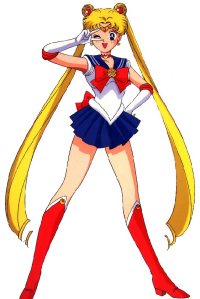
SMoonI guess about now is a good time to admit that I've started watching Sailor Moon and, predictably, enjoying it a great deal.
In my defence, after watching Revolutionary Girl Utena and finding it enjoyable but immensely confusing, I felt obliged to check out Sailor Moon for further education in the ways of the magical girl. I have a sort of ulterior motive for educating myself on this particular aspect of anime — for starters, I've always been interested in it, but never got around to checking any of it out; secondly, I hear that Puella Magi Madoka Magica or whatever it's called is very good, but is something of a deconstruction of the magical girl genre as a whole and consequently is best appreciated when you have more than a passing familiarity with its tropes.

So, Sailor Moon, then. In stark contrast to Revolutionary Girl UtenaSailor Moon is charmingly unsubtle about everything it does. The lead character Usagi seems to do nothing but shout or cry all the time, and the show's moral messages are only a couple of steps removed from He-Man's posturing. While there's no "Hey, Kids!" moment at the end of a Sailor Moon episode, the inherent "message" of each chapter is so startlingly obvious within about five seconds of it starting that it becomes more of a Columbo-style show, where you're waiting to see how it reaches the conclusion you already know from the outset, rather than holding on tight for some narrative twists and turns.

That's not to say it's bad, though; simple is good sometimes, and God knows it's appreciated after UtenaSailor Moon's characters are charming and endearing, even if they're loud, and they've all grown and developed even in the space of the few episodes I've watched to date. I'm looking forward to seeing how Usagi — who, spoiler, is also Sailor Moon — develops over the course of the 300 bajillion episodes there are, because she is comically incompetent at present, despite ostensibly being the show's heroine. Her "sidekicks" who are teased in the show's opening titles haven't shown up yet, but I assume it's only a matter of time.

It's clear even from this early stage that Sailor Moon was very influential, however. I'm seeing elements of its humour and characterisation in the latest Hyperdimension Neptunia game, for example, where Neptune takes on the Usagi role of "amusingly rubbish protagonist who's aware she's rubbish", and her companions are actually far more capable than she is. There's also the more obvious fact that Neptune and co are all themselves magical girls, able to transform into their "Hard Drive Divinity" forms to power up and become stronger — though there's less "identity hiding" in the world of Neptunia than there is in the more "grounded in reality" world of Sailor Moon.

And that music. Amazing. While the copies of the episodes I'm watching aren't brilliant quality — or perhaps they really were that poor quality when originally broadcast — the amazing background music still stands out, if only for the fact it sounds like it belongs in a 1960s TV series rather than the 1992 anime from which it actually hails. Huge string orchestras, wakka-wakka guitars, choirs of singers mewling "oooooooh, oooh-ooooooohh, Saiiiiloooor Mooooooon…" as Usagi transforms. Marvellous stuff.

Anyway. I'm going to watch a lot more of Sailor Moon, I predict. I have the whole series to hand, but it remains to be seen if I can manage all of it. I'm sure I can, and I'm sure I will feel suitably satisfied at its conclusion. I hope there's a good ending. Please don't tell me if the ending is rubbish!

1272: The Worst Headache in the World

I went to see Akira at the cinema this evening. I recall around the period anime first got fashionable in the UK that there was a considerable degree of snobbery about this movie, with people saying "oh, you have to see it on the big screen" and whatnot whenever it came on TV.

You know what, though? Having now seen it both on TV and on the big screen… yeah, the snobs were right. It's spectacular.

The reason I was seeing Akira at all this evening was because my good friends George and Mitu, whose marriage we are attending later in the year, happened to be in the area and had booked tickets. George popped up on Steam earlier and asked me if I fancied coming out at short notice for a 10.30pm showing, and because I'm never really doing anything of note, I accepted. (If anyone else is in the area and wants to do something fun… try me. I'm usually available.) So thanks, George and Mitu, for getting me out of the house on a Saturday evening and seeing a film I don't think I've seen for at least 15 years or so.

I first saw Akira when it came on Channel 4 late at night one evening. Well, to be more precise, I taped it, because it was on at some ungodly hour in the morning. Eventually I sat down and watched it, though, and was thoroughly bewildered by almost everything about it. I hadn't really watched many foreign-language films before, so watching something with subtitles was new, and I also hadn't really had much contact with anime before, either, so the concept of an "adult" animation (not that kind of "adult," though there is one pair of visible boobs, albeit not in an even slightly titillating context) was also something new to me.

I think it's probably fair to say that I didn't really "get" Akira the first time I saw it. Those who have seen Akira will know that not "getting" it is part of the point, really; again, this was a concept that was somewhat new to me at the time I first saw it. I was used to things being much more literal, and indeed even today I do sometimes find it difficult to latch on to stuff that is being too deliberately obtuse.

Seeing it today, though, I feel I appreciated it a lot more than when I first saw it. It's a real spectacle, all the more remarkable for the fact it came out in 1988 and thus would have been largely hand-animated. As George pointed out when we came out, a lot of things blow up, shatter and collapse in Akira, and someone had to animate each and every one of those bits of rock, glass and other miscellaneous bits of debris by hand. Quite a feat.

Akira's also interesting for having quite a distinctive style. While recognizable Japanese in appearance, it doesn't look like modern anime, nor does it look like stuff that came a little later in the '90s. I'm mostly familiar with more recent anime, but '90s stuff in particular has a very distinctive look that is a bit different from today, and Akira is different again.

One thing I thought that was quite interesting about the film's look is that all the characters actually look like Japanese people, whereas from '90s anime onwards, we tended to see a lot more in the way of the heavily-stylised, big-eyed look that typifies the medium today. The characters are also relatively subdued in their defining characteristics, and realistic in their appearance. Of the three female characters who put in an appearance in the movie, not one of them is intended to be "the hot one" or "the cute one" or anything like that — they're just women. (Well, okay, one of them is a weird, wrinkled, old-looking child with blue skin, but eh.) Very progressive, particularly for 1988.

Anyway. I enjoyed myself. It was good to revisit a movie I hadn't seen for a long time, and it was good to see friends I hadn't seen for a long time, albeit in a situation where we couldn't really talk a lot! Now it is 1:30 in the morning so I had probably better get some sleep.

1264: Smash the World's Shell

I finished watching Revolutionary Girl Utena at last today.

Honestly, I'm really not sure what to make of it. I don't mean I didn't like it — I did — but rather, I feel like I've woken up from a dream and don't really know how to parse what I watched.

As anyone who has watched Utena will tell you, of course, this is part of the attraction of the show. It is a show that prides itself in its surrealism, symbolism and deeply metaphorical nature. There's a sense throughout that nothing is quite as it seems, and that you probably shouldn't be taking some of the things that happen over the course of the 39 episodes too literally — not least because none of the characters appear to. They seem to shake off the frankly utterly baffling things going on with alarming rapidity, which leads you as the viewer to question whether those things were really happening at all, or whether they were merely representative of something else.

One of the best yet most frustrating things about Utena is that there are no definitive answers, though. The show's creator, I'm told, enjoys taunting fans and deliberately misleading them, and pointedly won't say what the definitive explanation for it all is. This might be because there isn't a definitive explanation for it all; or it might simply be an attempt to get people to figure it out for themselves, come to their own conclusions and take whatever they want from the show as a whole.

In some respects, the whole thing reminded me somewhat of Silent Hill, of all things. Obviously the two series are very different from one another despite having a common heritage — Silent Hill is Japanese psychological horror, while Utena is colourful Japanese anime — but both actually have a surprising amount in common, not least of which is the fact that both are pretty open to a hefty degree of interpretation.

Both are riddled with psychosexual imagery, too. Neither are outright explicit with it — though Silent Hill 2 does feature a scene where Pyramid Head, that game's iconic recurring monster, is raping a tailor's mannequin — but both feature a very strong sense that sex and sexuality are a core theme. In Silent Hill's case — particularly Silent Hill 2 — there's a sense of guilt and shame attached to sexual desires for a variety of reasons; Utena, meanwhile, is rife with both phallic and… uh… whatever the word for the vaginal equivalent of phallic is… imagery. (Just "vaginal", I guess, but that doesn't seem to fit quite right.) There's a strong sense of Utena's characters reaching sexual maturity and coming to terms with that in different ways, much as James had to come to terms with aspects of his own sexual desires in Silent Hill 2.

Frankly, I'm not sure I'm intelligent enough to be able to do a particularly deep reading of Revolutionary Girl Utena without spending a significant amount of time researching, but suffice to say I enjoyed it and very much respected what it was doing, even if I didn't always understand it fully. As I say, though, that was probably sort of the point all along.

If you're curious, I'll share a super-interesting essay I read earlier immediately after finishing the series. It doesn't claim to be a definitive interpretation of the show, but it's certainly a plausible reading of it, and definite food for thought. Check it out here.


1236: On Being That Guy Who Picks 'Japanese' in the Sound Menu

Jun 07 -- AaaaaaaaI always used to be one for having my game's voices in English. I liked being able to understand what they were saying as well as reading the subtitles on screen. In some cases, I didn't have the option; I'll always associate Persona 3 and 4 with English voices, for example, even though, in retrospect, it would probably be better with Japanese voice acting. In others, the English voiceover job was so genuinely good that I didn't want to try the Japanese version — Xenoblade Chronicles springs immediately to mind in this regard.

I can remember the moment that I realised Japanese voice acting was something worth exploring even though I didn't speak the language, though. It was while I was playing the utterly terrifying PSP visual novel/adventure game Corpse Party — one of my favourite games on that platform, and legitimately one of the most disturbing games I've ever experienced — that I realised that, frankly, Japanese video game voice actors aren't afraid to let rip with the utterly raw emotion. They'll shout until their voice cracks; they'll scream; they'll cry. And by God, they sound like they mean it.

It was around one of the many points in Corpse Party where one of the characters is bawling their eyes out and screaming in terror at the horrific situation they've found themselves in that I realised when it comes to voice acting in games — which are typically accompanied by subtitles, particularly in the visual novel and JRPG genres — it's not about the words that are being said, but about how they're being said. It didn't matter that I didn't understand the Japanese words that were being screeched into my ears (seriously, play that game on headphones and you'll never want to turn the light out again) — the meaning was all too clear simply from the tone of voice.

Those who have been reading regularly will know that I've been playing Ar Tonelico 3 recently. I played the first game in that series in English, largely because I found the English voices in the video cutscenes too jarring when paired with Japanese speech in the main game. I played the second in Japanese because I'd been warned that the English dub, much like the overall translation job, was somewhat questionable. And I started the third in English, but after not very long I switched to Japanese. It is a decision I did not regret.

It's very obvious from the huge rift in quality between the English and Japanese voice tracks in something like Ar Tonelico 3 that the English actors are, for the most part, phoning it in somewhat, while the Japanese actors care about what they're doing. In many cases, it is the difference between a rush job (English) and having well-known professionals handle the voices.

I witnessed a scene this evening — no spoilers — that had me more than a little choked up due to the amount of raw emotion and passion that the actress playing one of the characters was throwing into the delivery of her lines. I believed that she meant what she was saying. This character was supposed to be upset, and I believed that.

The other thing that comes into play is that when a game's dialogue has been translated relatively literally from the original Japanese rather than fully localised, reading it out loud in English often sounds very stilted and artificial, simply because that's not how English people talk. We don't say things like "what is this, all of a sudden?" and start entire conversations with "By the way". We don't refer to ourselves in the third person to be cute. (Usually. Saki will do it!) And we don't use the term "lovey-dovey" anywhere near as much as Japanese people apparently do.

There's nothing wrong with doing a literal translation from the Japanese — so long as you do it with enough care to make it understandable, of course — but if you're going to take this approach to translation, I've come to the conclusion it's best to leave the voices as they are. If, on the other hand, you're going to take the Ace Attorney/Cherry Tree High Comedy Club/Recettear approach to localisation and actually make the dialogue significantly and noticeably more "Western" in the process, then we can talk about English voiceovers.

I must confess to always having found an attitude like the one I just described a little snobby in the past. Having immersed myself in this side of gaming (and anime) culture for this long, though, I totally get it. Once you get used to the infinitely more professional job Japanese voice actors do on productions like Ar Tonelico (and even on lighter fare like Hyperdimension Neptunia, for that matter) you'll likely never want to go back.