1555: Rebels Against the God

Having finished To Love-Ru a few days ago, I decided to jump into another show I'd heard of but didn't know much about: Angel Beats!, a show from P.A. Works and Aniplex, with a story and character design from two members of Key, the folks behind Clannad. (I mention this because the latter aspect is particularly noticeable; the show has the same gorgeous, well-animated style as Clannad, though thematically it's rather different.)

Angel_Beats_-_12_-_Large_17_7482

I'm only three episodes in so far but I'm very interested to see more already simply because the premise is so unusual. Unfolding in the afterlife, the show follows the exploits of a group who call themselves the SSS — a group of people who are attempting to resist a non-specific "god" to prevent themselves from being "obliterated" and subsequently reincarnated. Each of the characters clearly has their own story to tell about how they died and why they don't want to give up and accept their fate; three episodes in, we've already seen a couple of them, and I predict there will be quite a few tearjerking scenes before the end.

Like Clannad, though, Angel Beats! doesn't rely purely on wringing out your tear ducts until you can't cry any more. In fact, even more so than Clannad, there's a heavy dose of humour to the proceedings, and it's often rather black in nature. In the second episode, for example, the main cast are attempting to find their way to a hidden base from which they can procure weapons and supplies for their fight against what appears to be God's representative, an emotionless young girl called Angel who constantly thwarts them with her mysterious, seemingly supernatural powers. Along the way, it becomes apparent that the "anti-Angel traps" that had been set along the route have been activated, and one by one the group gets picked off in a series of gruesome manners. One guy gets crushed by a rock; another drowns; another is sliced to ribbons by being too big and muscular to duck under an arrangement of laser beams. In most shows, this sequence of events would be a horrifying tragedy, but since all the characters in Angel Beats! are inhabitants of the afterlife, we're quickly reminded that something that would kill you in reality will merely inconvenience you for a few minutes if you're already dead. I sense this is something that's going to come around again in the future.

One of the things I'm enjoying about the show so far is how it juxtaposes darkly humorous sections like the aforementioned — trust me, it is funny despite all the violence — with sections that are just plain dark. The sequence where leading lady Yuri explains her regrets from the latter days of her life is utterly heartbreaking, for example, as is the story of how songstress Iwasawa shuffled off the mortal coil and found herself in the afterlife. I'm pretty certain that the rest of the cast will have a similar tale to tell — with the final story undoubtedly being reserved for the currently amnesiac male protagonist, who is thoroughly confused by the whole situation he finds himself in.

The show's beautifully presented; aside from the aforementioned lovely art and glorious animation, the soundtrack is excellent, too. There's been heavy use of diegetic music in the episodes I've seen so far, with the lyrics often being relevant either to the specific situation the gang finds themselves in, or their overall situation in the afterlife. It can sometimes be a challenge to keep up with the two sets of subtitles running at once — one for the music, one for the dialogue — but it's worth attempting. (It's also nothing compared to the bizarre way the show handles teasers for the next episode: short clips from the episode of characters talking, all overlaid on top of each other at a more and more frantic pace until you can't possibly take any more.)

So that's that. At three episodes in I'm hesitant to say too much more at this juncture, but I've very much enjoyed what I've seen so far and am looking forward to watching more. I'm sure I'll have further thoughts when I have a few more episodes under my belt.

1540: Darkness

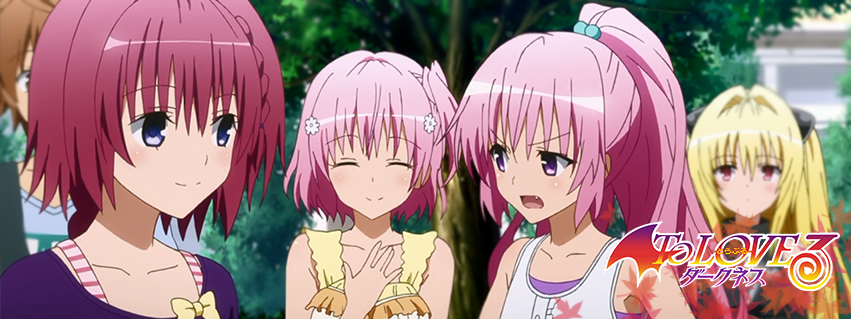
The focus of the new season is very much on what were previously secondary characters.

I'm finally on to the final (well, most recent) season of To Love-Ru, aka To Love-Ru Darkness, and it's been really interesting to see this show's evolution over time in several ways, even over the course of just a few years.

The first series of To Love-Ru came out in 2008 and was a fairly conventional episodic format in which each episode was largely self-contained. Motto To Love-Ru, which followed two years later in 2010, instead followed the "mini-episodes" approach of Ika Musume/Squid Girl. And To Love-Ru Darkness, which aired two years after that in 2012, returns to an episodic format, but with a much stronger sense of ongoing plot and frequent use of cliffhangers to close off each episode.

The atmosphere has changed markedly over time, too. The original series of To Love-Ru was rather silly, light-hearted nonsense that, as I've previously mentioned, was pretty undemanding fluff that you can watch without having to concentrate too hard — but it did close out the season with a spectacular two-part finale that brought things to a natural break, if not complete closure.

Motto To Love-Ru, meanwhile, was enjoyable but for the most part felt even more "disposable" thanks to its short mini-episodes. Over the course of the series, we got a better understanding of the various characters involved by simply seeing them in a variety of different situations, but there was relatively little in the sense of overarching narrative that advanced as the series progressed aside from the introduction and exploration of a couple of new characters. The season finale, meanwhile, was a big moment for several of the characters involved, but in a completely different way to the original show. Rather than being an overblown epic involving protagonist Rito battling against unfeasible odds in an attempt to prove himself as in the first season, it instead was a fairly low-key affair that, in contrast to the rest of the run, linked its three mini-episodes together and culminated in a long-awaited confession from Rito to lead heroine (and super-cute space alien) Lala — and an unfortunate misunderstanding as he attempted to also confess to secondary love interest Haruna (who is likewise super-cute, but not a space alien).

To Love-Ru Darkness picks up directly from where Motto To Love-Ru left off, in contrast to how Motto To Love-Ru assumed some time had passed between the first series, the first set of OVAs and the new season. And it has a noticeably different focus so far in the few episodes I've watched, too; rather than focusing on the relationship between Rito and Lala that was the centrepiece of both To Love-Ru and Motto To Love-Ru, early episodes instead explore the character of Lala's sister Momo, whose devious machinations sort of have Rito's interests at heart, but are fundamentally largely incompatible with the norms of Earth society.

Lala, the centrepiece of the previous two seasons, doesn't even appear in a lot of promotional artwork for Darkness.

In short, Momo decides after seeing Rito make his heartfelt confessions at the end of Motto To Love-Ru that she, too, likes Rito, and decides that the best thing for everyone involved in the increasingly complicated love polygon situation they all find themselves in would be if Rito marries Lala, becomes King of the Universe and consequently no longer bound by the rules of Earth society, then marries everyone else that he has ever had feelings for or who has had feelings for him. She, in short, is firmly in favour of creating a harem of concubines for her beloved — a harem in which she, too, will play her role, of course.

Rito, thus far, is somewhat resistant to this idea, since being of the "perpetually confused protagonist" mould, he is still not quite sure what his true feelings are with regard to Lala and Haruna, let alone Momo (who keeps showing up almost naked in his bed at night-time, much to his chagrin), class representative Kotegawa (whom Rito has a habit of falling over into inappropriately), the extraterrestrial assassin Golden Darkness (who clearly doesn't really want to kill Rito) and, indeed, his own sister Mikan, who has struck up something of a friendship with Golden Darkness. Constantly yanked from one situation beyond his control to another, I can sense that this season is going to see some of Rito's toughest trials to date — particularly now that some new characters, such as Golden Darkness' "sister", have gotten involved.

In keeping with the previous seasons and OVA sets, the amount of fanservice has once again been ratcheted up, with the number of bare nipples and panty flashes in To Love-Ru Darkness having increased noticeably since the original (rather tame in comparison) season and even since the somewhat more suggestive Motto To Love-Ru. The show refuses to devolve into nothing but T&A, however; even amid all the clear and present fanservice, there's still an ongoing plot that, this time around, seems to blend the silliness of the earlier seasons with something that provides a bit more meat on the bones.

It's shaping up to be an interesting season, all round, and I'm looking forward to seeing where Rito's misadventures take him next.

1533: Motto

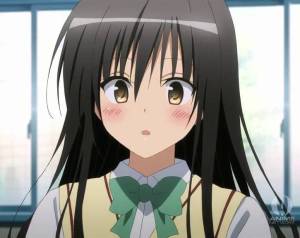
Kotegawa is the best.

As a suitable means of switching my brain off when I need it (which is quite frequently at the moment) I've been continuing to watch To Love-Ru and am now onto the second series, Motto To Love-Ru.

I was interested to discover that this second series is structured rather differently to the conventionally episodic first season, instead adopting the same approach as Ika Musume (aka Squid Girl) by making each individual episode up out of three short stories rather than one large story that kind of sort of ties into the overall narrative. That said, narrative coherence is not a huge priority in To Love-Ru, since there are a couple of points throughout the series where things just evidently happen "between episodes" without explanation — or perhaps they just happened where I didn't notice. (Or, more likely, in the original manga, since it's not at all unusual for anime adaptations of popular manga to simply skip over chapters at a time for brevity's sake.)

The series remains enjoyably fluffy, however, despite the predictability of the protagonist Rito falling over at least once per episode either face-first into someone's crotch or with his hands on someone's boobs. Despite the occasional bout of fanservicey smuttiness — which gradually increases in frequency between the first series and the first set of OVAs, and then again between the OVAs and the Motto second season — the show remains consistently good-natured, with it generally being Rito as the one who is ridiculed and made to look an idiot rather than the rapidly expanding female side of the cast, most of whom tend to come off pretty well out of their various misadventures.

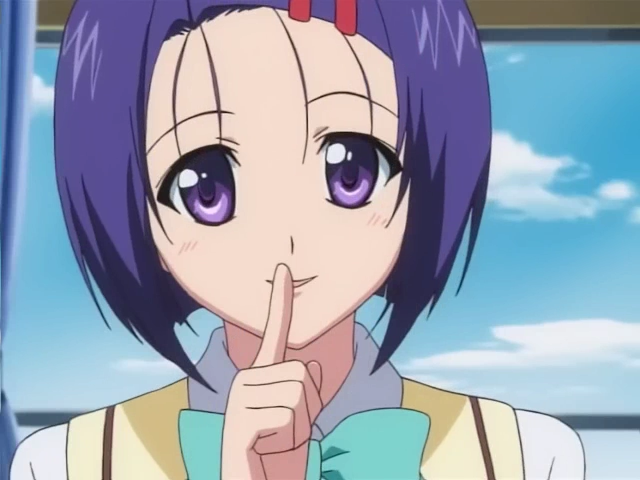
Except for when Yami is the best.

And as clichéd and tropey as a lot of those female cast members are, they all have their own appeal elements and twists on the usual formula. The stern, harsh class president Kotegawa, as you might expect, has her deredere side to go with all the tsuntsun, and predictably, it's adorable. Meanwhile, teen idol Run-chan's twist is that she turns into a boy when she sneezes — a side-effect of being an alien, naturally — while Oshizu is a ghost whose spirit has a tendency to evacuate her artificial body whenever she gets scared, such as when she sees a dog. (Naturally, one of the other characters has a dog, so this situation comes up quite a bit.) And then there's Yami-chan, aka Golden Darkness, who is all the things I loved about Ell from My Girlfriend is the President and then some. Also, she has hair that can turn into weapons and punch people. Hnnnnng, as they say.

I'm not even going to pretend that To Love-Ru is anything more than fanservicey, switch-your-brain-off fluffy nonsense that is designed for pure entertainment value rather than attempting to say anything big or meaningful. It doesn't have the clever Lovecraftian references of the rather similar (but later) Haiyore! Nyaruko-san, nor does it have the clever self-awareness of other comedy anime. It's simple, it is, at times, sexy, and it is, at times, utterly stupid. And sometimes that's exactly what you need from a piece of entertainment. And thus I make absolutely no apologies whatsoever for enjoying it; it's a delightful accompaniment to my brain's boot-up sequence while I'm having breakfast of a morning, and it's likewise a pleasant accompaniment for the shutdown sequence of an evening before I go to bed.

Anyway. Once I'm done with To Love-Ru (the rest of Motto, followed by some OVAs, followed by the third and, currently, final season To Love-Ru Darkness) I will watch something a bit more intelligent, I promise. Maybe. Possibly.

Come on, I survived Clannad. I deserve this! 🙂

1527: Trope-ical Crush

The word "tropes" has taken on something of a pejorative meaning in recent years, but I find something oddly comforting about the use of common, established, recognisable tropes — particularly when it comes to Japanese entertainment. I also find it interesting that Japanese entertainment — both games and anime — is a lot more willing to fully embrace the idea of tropes as part of the medium's language rather than attempting to hide what it's doing.

Take the common character tropes, for example. In a typical "harem" situation (usually a male protagonist surrounded by female characters, one of whom is typically positioned as the "main" love interest, but the others of whom are optionally also either interested in the protagonist or the objects of the protagonist's affections) you tend to have your tsundere, your kuudere, your childhood friend, your "princess" type, your genki girl and, depending on how many characters are involved, numerous others. And yet the predictability of this type of cast makeup, for me, doesn't prove to be tiresome; quite the opposite, in fact. I enjoy being able to point to the various characters and say "well, she's clearly… and she's clearly…" because it provides a recognisable, established starting point for these characters that can then subsequently be built on over the course of the rest of the work.

Exactly how — or if — these tropes are built upon by the work depends entirely on the work in question. Some works embrace the established tropes wholeheartedly and make the characters into textbook examples of the character types they initially appear to be: a valid approach. Conversely, some works deliberately work to subvert the tropes they establish in their early hours with some surprising twists and turns for the characters: also a valid approach. And, for some archetypes, subversion of expectations is part of the trope itself: witness the tsundere, for example — usually frowning, overly defensive and, at times, somewhat aggressive — and how her character arc typically involves her "softening" and showing her deredere side. Or the yandere — quiet and meek, but with something seriously unpleasant festering inside that demure exterior. Knowing that at some point she's going to strike doesn't diminish the impact when it happens; if she's a particularly well-disguised yandereit's even more shocking and surprising.

I'm a fan of tropes, then; I enjoy that feeling of comforting familiarity that comes about when I come across a new character and recognise their traits. And everyone has their favourites, too; for me, I must confess to having a soft spot for tsunderes, but I do also like a kuudere and there's always something heartwarming about a nice childhood friends romance. And the older sister "nee-chan" type. And a cutie imouto. And… Oh dear. (Essentially, I think I'm saying that my ideal anime harem would be made up of the cast of My Girlfriend is the President.)

If you'll excuse me, I'm off to bed to read TVTropes. (Warning if you're at work: settling down for a "quick read" of that site is a good way to lose a few hours.)

1517: The Misunderstood Fan

It can be a trying task being a fan of something at times. And by "fan" I don't mean "rabid, frothing fanboy/fanmadam" (thanks NISA); I mean simply someone who has a particular preference for something, and who will, in many cases, indulge in that thing to the exclusion of other, perhaps more "mainstream" things.

Since pretty much "coming out" as a fan of visual novels, anime and associated goodness around the time Katawa Shoujo was released, I've run into this issue a number of times. In the case of Japanese entertainment, the cultural rift between East and West means that some people are less than understanding about certain aspects of what our friends in the East produce.

And perhaps that's understandable in some cases; even as a fan of a broad spectrum of Japanese entertainment, I'll happily admit that there's plenty of content — primarily around the area where sex and violence cross over — that makes me uncomfortable, and so I deliberately choose not to expose myself to that sort of thing. ("Discovering" Urotsukidoji in my teens was quite enough, thanks.) It exists, though, and I can deal with that; it's simply something I choose not to engage with. (I also don't believe for a second that it's actually harmful — to believe as such is to show an alarming lack of faith in humanity's ability to distinguish between fact and fiction, and a similarly alarming willingness to believe that everyone is stupid enough to just want to emulate everything they see. Sometimes fantasy is just fantasy.)

The trouble comes when people start to assume the worst about an entire culture's output based on some of its more questionable or discomfort-provoking aspects, or even, in some cases, based on things they just think they know — the "lol Japan" approach.

Let's take the recently released Senran Kagura as an example. Here we have a game that explores and respects its characters in great detail — going so far as to give each and every one of them their moment in the spotlight in lengthy, well-written visual novel sequences — that also happens to feature characters with big jiggly boobs who occasionally flash their pantsu. Are the jiggly boobs and pantsu necessary? Of course they're not, but they don't detract from all the other good stuff that the game is doing — and frankly, what is there to be ashamed of there, anyway? Senran Kagura's cast is depicted to be a bunch of strong, independent young women who are more than capable of taking care of themselves and who are, above all, confident and comfortable in who they are and what they look like. (Those who have played it will know that the possible exception to this rule is Hibari, but her own character arc revolves around her coming to terms with her own inferiority complex; the end result is her accepting herself, flaws and all, and recognising that she doesn't have to go it alone.)

Admirable traits, I'm sure you'll agree, and so what does commentary about the game focus on? You guessed it; the jiggly boobs and the pantsu. And the aggression with which these criticisms are delivered is astonishing — take this outstandingly vitriolic takedown of the game that appeared not on someone's personal blog, but on the official Nintendo magazine's website. Or take the comments that habitually appear on any article about the game, which usually involve accusations of those who enjoy the game being "perverts" or, in more extreme cases "paedophiles". It's gross and disgusting, and it makes my heart sink any time I see it. And there's no point trying to argue your case against these people; they're people who have made their minds up about something, and have no interest in changing it.

For what it's worth, I'm firmly of the belief that there's not actually anything wrong with enjoying the fanservicey aspects of titles like Senran Kagura and its ilk; acknowledging your own sexuality is a healthy thing to do, and finding something that isn't real attractive does not necessarily say anything about your attitudes towards a real-world equivalent. Indeed, I'll happily admit to having been attracted to some Japanese titles purely by the fanservice aspect, whether it's video games or anime; in pretty much every single case, I've been pleasantly surprised to discover that beneath the often in-your-face sexuality of some works, there beats a heart of gold; in many cases, I've even discovered that the fanservice aspect is a lot "tamer" than a lot of people tend to make out, and the whole point of it is actually to tell an interesting story with some loveable and, yes, attractive characters. (There's also some stuff that purely exists to be sexy, and that, too, is both fine and can be enjoyable.)

Here's the thing: I, like, I'd wager, pretty much anyone else who enjoys anime and other Japanese forms of entertainment, am capable of distinguishing between fantasy and reality — and anime-themed entertainment is so obviously fantasy that I find it very difficult to take the more vitriolic criticisms of it seriously, particularly when they're delivered with such furious anger that it often becomes clear that the one raging has very little actual experience with the work in question beyond the most superficial knowledge — see that Official Nintendo Magazine piece.

I often find myself wondering if fans of other niche interests find themselves subject to similar scorn. Is one of my dearest friends, who is such a fan of heavy machinery (whether military or agricultural) that he describes his reaction to various hulking metal beasts in terms of how "tumescent" they make him, likewise a "pervert" for talking about things in this way? Of course not. Whether or not they really do make him tumescent is neither here nor there, and is nothing but his own business; his own personal interest in such things is something that is important to him, something that I respect and something that, on several occasions, has in fact led me to checking out things that I otherwise never would have explored for myself at all. An ultimately positive experience, in other words.

It's a pity that not everyone feels they can be open-minded about things not immediately familiar to them, and instead jump to conclusions without bothering to investigate them for themselves. It happens in all aspects of society, not just the ultimately not-all-that-important really fandoms of various forms of entertainment, and it sucks every time it comes up, particularly when I see it upsetting people I know and like. (Or when it upsets me which, I won't lie, it has done on a number of occasions.)

Live and let live. And perhaps, just once, ask your friend what it is about [x] that they like so much. Be willing to take a look for yourself and reconsider your opinion.

And if you still don't like it? Don't be an ass to people who do.

1509: Love Trouble

Having finished Clannad a while ago, I needed my next anime fix. So the logical thing to do seemed to be to ignore all the things I've bookmarked and queued on Crunchyroll, and the DVDs I've bought but haven't watched yet, and instead check out something that I've often seen mentioned (largely by J-List, which tends to be my main source of "have you heard of…?" content when it comes to anime) but didn't know a whole lot about: To Love-Ru, alternatively known as Toraburu (which actually makes a little more sense, as it's supposed to be a pun on the word "trouble" — hence the title of this post — and "toraburu" is how you would pronounce the English word "trouble" using Japanese syllables).

As I say, I didn't know much about To Love-Ru before I watched it other than it involved a cute pink-haired girl with a tail and was a tad fanservicey. Frankly, I stopped being ashamed of enjoying fanservicey content a long time ago — why deny that you like something? — and so, unlike many other people when confronted with the prospect of fanservice, didn't see the latter aspect as a negative thing at all. Beyond that, I knew nothing. It looked and sounded like enjoyably lightweight fluff, though, and after the emotional turmoil that Clannad put me through, that's exactly what I wanted.

Shh. Don't tell anyone Pete admitted to liking fanservice.

I've learned one thing in the few episodes I've watched so far, then: the "alien girl visits Earth" trope I was introduced to with the excellent if ridiculous Haiyore! Nyaruko-san is apparently widespread enough to be a genre in its own right. To Love-Ru has a lot in common with the aforementioned Nyaruko, as it happens, primarily in terms of the dynamic between the hapless protagonist Rito and Lala, the pink-haired, tail-sporting cute girl.

Rito, much like Nyaruko's protagonist Mahiro, is a boy in his mid-teens who is clearly at the age where he's just starting to get interested in girls. He's had his eye on his classmate Haruna for some time, it seems, but just as he thinks he might build up the courage to talk to her, Lala bursts into his life in explosive fashion, and subsequently begins a chain of increasingly ridiculous events.

Lala is from the planet Deviluke, and through an unfortunate series of coincidences — her running away from home to avoid an arranged marriage, her ship being shot down over Earth, her teleporting herself free of the wreckage and ending up in Rito's bathtub — ends up engaged to Rito. (Deviluke custom dictates that grabbing a woman's breasts is a proposal; something that Rito did completely accidentally while his bathtub appeared to be exploding around him as Lala made her entrance.) What then follows is an increasingly farcical comedy as Rito attempts to come to terms with being engaged to a perpetually energetic alien princess with a habit of getting herself and everyone around her into trouble, and whether or not he has finally had his last chance to confess to Haruna.

Somewhat like Nyaruko again, there's a fair amount of sexual tension between Rito and Lala, though this is largely due to the fact that Lala is completely unashamed of her body and appears to be completely lacking in the ability to feel embarrassed, even when, for various reasons, all her clothes fall off. Rito, meanwhile, seems to constantly find himself in compromising positions with Lala just as Haruna is walking around the corner, leading to plenty of comic misunderstandings (and embarrassment on Rito's part) along the way.

Like many shows of this type, incidental characters often get some of the most memorable moments, and Lala's personal bodyguard Zastin, an imposing figure clad in spiky armour, speaking in that stereotypical "badass" anime voice, is a particular highlight. After an initial misunderstanding when he first meets Rito, he subsequently has a habit of dropping in at unexpected moments; it's always amusing when Rito shows up home from school and Zastin is there in full armour happily drinking tea with Rito's younger sister.

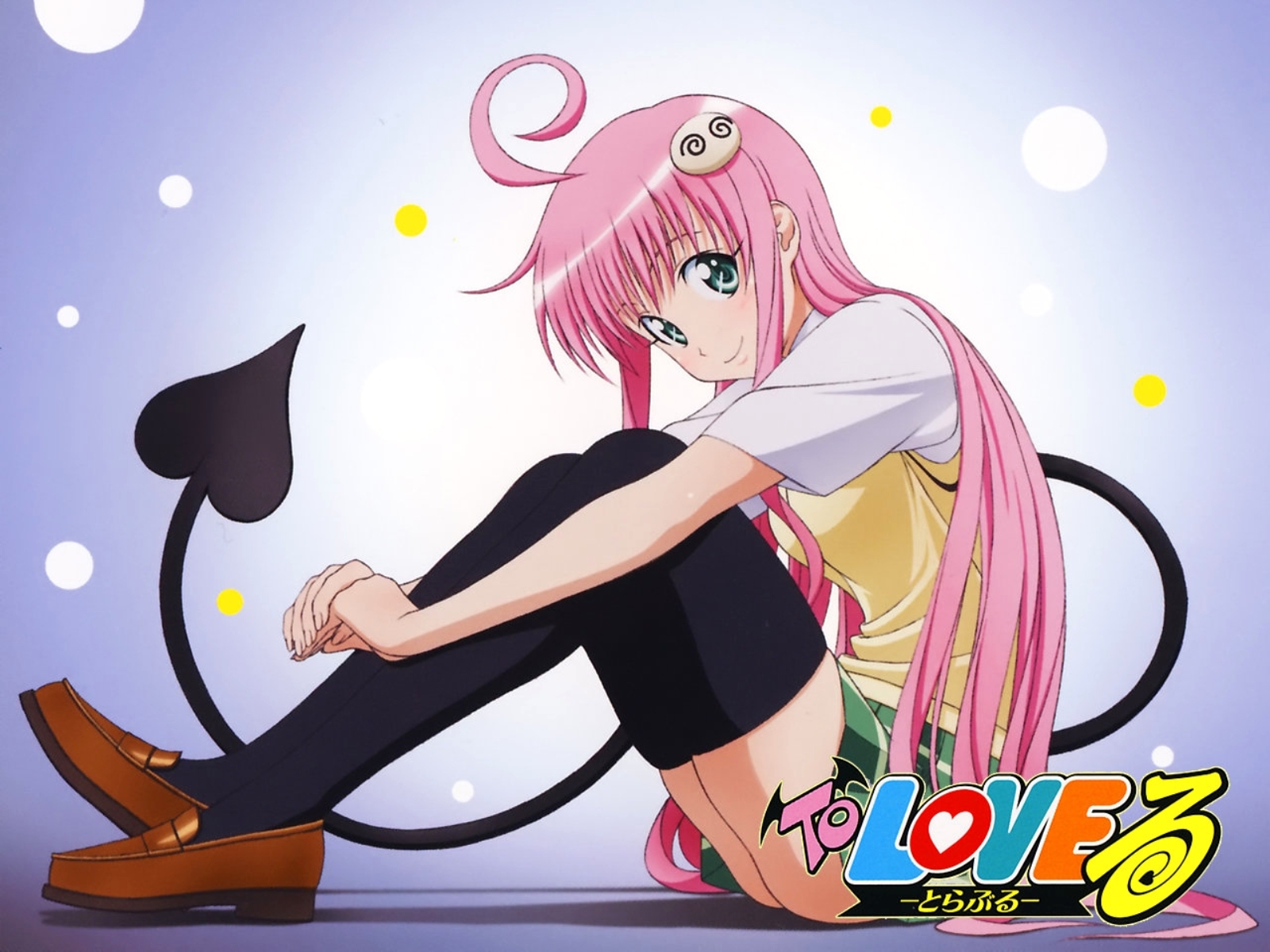
Lala. See? Cute.
Lala. See? Cute.

The main draw to keep coming back, though, is Rito's relationships with the various women in his life. It becomes clear very quickly that despite his protestations and his constant reassurances that he is in love with Haruna, he cares for Lala very deeply, even though she is a constant pain in the backside for him whenever she's around. Likewise, Lala treats Rito with genuine affection — though being from a literally alien culture, she sometimes doesn't treat him with the same degree of consideration that we humans typically expect from one another. And then on top of all that, it gradually becomes obvious that Haruna has feelings for Rito, too, but that Lala is constantly getting in the way between these two apparently star-crossed lovers.

Will they ever get together, or is Rito doomed to an admittedly fun-looking life with the overly energetic Lala? I have no idea as yet, since I'm only a short way into the series as a whole, but I'm looking forward to finding out.

1506: A Girl Who Lives in a World That Has Ended

Did I say that I finally finished watching Clannad all the way through? I'm not sure I did. Anyway, yeah; I finally finished watching Clannad all the way through. And what a fantastic series it was.

Its reputation as "the crying anime" is well-earned, particularly during the second "After Story" season. After Story is just made up of moving scene after moving scene, delivering frequent emotional gutpunches without a moment's remorse, though the first season certainly wasn't averse to all this.

I particularly enjoyed it because it didn't feel the need to spell absolutely everything out. It was mostly realistic and down-to-earth, but there were occasional subtle suggestions that there was something peculiar or possibly supernatural going on. It never took over the story — and, in fact, it was never truly explained conclusively — but it was there. It gave the whole thing a very strange atmosphere throughout; as I've mentioned before, even during fairly happy, joyful scenes there was a strange undercurrent of melancholy about the whole thing.

It helps that the show is held up by a strong, interesting cast, each of whom have their own stories to tell. Stars of the show are, naturally, protagonist Tomoya and heroine Nagisa — Tomoya is relatable and empathetic without being bland, while Nagisa has a few moe appeal elements without taking things too far — but the supporting cast are worthwhile additions, too.

Tomoya's friend Sunohara provides some often-needed comic relief while dealing with his own personal struggles. Twin sisters Kyou and Ryou make up the tsundere and "sweet, shy girl" part of the cast nicely, with the twist that both of them may or may not have their own interest in Tomoya. Tomoyo, who is disappointingly absent from the series after it moves on from the cast's school life and into adulthood, is an ass-kicking student council president-type who doesn't take any shit from anyone. Kotomi is a wonderfully flawed genius with an airheaded personality (and a total inability to play the violin) but a keen mind.

Even the characters who are seen even less frequently are well-defined and memorable. Particular highlights are Nagisa's parents Akio and Sanae, who are polar opposites in almost every way, and Sunohara's sister Mei, who is simply adorable, but who also cares for her brother without getting into the incestuous territory that many shows stray into.

In a way, the manner in which various characters drift in and out of the "main" cast of the show is reflective of real life. After all, how many people you knew at high school are you still in touch with? Relatively few, I'd guess, but you'd still have a good catch up with them if you happened to be in the same place, I imagine. The same is true of Clannad's cast and unfolding story — it's Tomoya and Nagisa's tale primarily, but people come and go as their respective lives grow and change.

Interestingly, one of the most interesting things the series does is outside of the main story arc, and it betrays the show's roots as a visual novel. At the end of both the first and second series, there's a "bonus" episode in which we get to see a "what if?" scenario where Tomoya gets together with someone else — Tomoyo in the first series, and Kyou in the second. Kyou's was a particularly good episode, and it actually made me want to see more of her; she was one of my favourite characters throughout the show, and should I ever get the opportunity to play the original visual novel in English — I'm not entirely sure if the fansub project was ever completed — I have a sneaking suspicion she'd be the route I went for first of all.

Anyway. It was a sometimes painful, emotional struggle to make it through the complete series, but it was excellent. Memorable characters, touching moments, beautiful artwork and a satisfying conclusion; it's an anime well deserving of its "classic" status, and if you think you can deal with All the Feels, I'd recommend you check it out when you get a chance.

1480: Before the End of After Story

Looking back over these entries, I can see that I started watching the Clannad anime quite some time ago, and still haven't quite finished it. I'm closing in on the end, though, but it's tough going. Really tough going.

In short, its reputation as "the crying anime" is pretty well-deserved, given that the last three episodes have all, well, you know. Let's just say that watching them first thing in the morning while trying to get fired up to do some work perhaps wasn't the best idea.

This isn't a bad thing, of course, and one of the things I've come to particularly like about Clannad is that, despite its reputation, it's not overtly emotionally manipulative. There's a lot of filling in the blanks yourself, a lot of figuring things out — and that moment when you come to a realisation yourself is what hits the hardest. Certain things aren't made at all explicit, leaving you to come to your own conclusions about what happened. Said conclusions may not be particularly difficult to come to — I'm trying to remain spoiler-free here for the sake of those who haven't seen it — but still, somehow, you're left with a few questions as to whether or not you're really right. After one episode I watched, I simply couldn't go back to it for a couple of days because the possibility of something awful having happened that I wasn't sure I'd reached the correct conclusion about was something I couldn't quite deal with at the time. Eventually I found the courage, though; like any tragedy, you have to face up to things sooner or later.

Part of this vaguely ambiguous feeling about it stems from the faintly otherworldly, dream-like atmosphere it has. I commented back when I was watching the first series that there was something of an air of melancholy flowing through the backdrop of even the most joyful scenes, and this continues during the After Story second arc. After Story also contains more in the way of outright tragedy, but the obviously bad things happening aren't necessarily the most affecting moments — it's the consequences that sometimes come two or three episodes later that hit the hardest.

Similarly, After Story continues the seemingly unrelated parallel storyline that appears to have nothing to do with the main narrative, but which occasionally kind-of-sort-of-possibly-maybe? reflects what's been happening in terms of tone and overall feeling. Having not yet watched until the very end of the whole series, I can't yet tell if this is wrapped into the overall narrative in a specific way, or whether it remains as it was left at the end of the first series — as a story one of the characters ends up telling — but it's certainly something that regularly gives you food for thought throughout the entire run.

I'm appreciating it because I find the protagonist Okazaki quite relatable, too. He's a young man (I know I'm not quite so young as I used to be, but humour me) who appears to have a certain degree of difficulty showing outward signs of emotion, but who occasionally explodes with pent-up feelings that simply can't be held in any longer. To those not familiar with him, he might seem cold or morose, but the complete run of Clannad reveals him to be a sympathetic character who quietly deals with his own turmoil as best as he can while trying not to bother other people with the things that are on his mind. Despite this, he's a passionate, caring person who tries to do the right thing and gets frustrated when the injustices of the world conspire to prevent him from doing just that. He's humble and realistic; he doesn't get ideas above his station, but he wants to try and do what he can for the people who love him.

I'm intrigued to see how it all ends. I have about five or six more episodes left, I think, and things are starting to tie themselves up towards a conclusion. I have literally no idea how it will actually finish right now, though I'm sure there will be more tears before the final credits roll.

1351: After Story

I was surprised to discover that Manga Video had a booth at the Eurogamer Expo over the weekend, so I took a moment to rifle through their collection between seeing various bits and pieces.

As good fortune would have it, it would seem that Clannad After Story has recently been released in "complete series" box set format, so I snapped up a copy — £25 is eminently reasonable for six DVDs, particularly when compared to some other anime DVDs, and particularly particularly when compared to the exorbitant prices Forbidden Planet charges for anime DVDs.

Ever since I got to the end of Clannad — which wasn't that long ago — I've wanted to see After Story, which picks up directly where the original leaves off. It's the anime adaptation of the second half of the original visual novel, and continues the story beyond the end of school over the course of the following seven years.

This alone makes it noteworthy in anime, since most "slice of life" or school-based drama shows restrict themselves to just the school years, so it's unusual to see the characters actually grow older and move on from school and into their lives proper. Indeed, this is usually the case with visual novels, too, which often tend to have high school-age protagonists and heroines, and stick that way. There are exceptions, of course — Kana Little Sister and Kira Kira immediately spring to mind — but it's something that, in my experience anyway, happens more often than not.

I've only watched a single episode of After Story so far so I can't comment with any great authority on what the new series is like, but I'm looking forward to exploring it. The original Clannad series didn't end how I was expecting it to end — no spoilers — but in retrospect, I think this was because I wasn't aware that After Story was not just a direct follow-up, but the continuation and conclusion of the complete narrative.

I can guarantee now that it's going to make me cry at least once, though. I found the Fuko arc in the first Clannad series incredibly emotional, and if After Story is going to go where I think it's going to go, it's going to be about three bajillion times worse. That's okay, though; the reason I'm even watching Clannad in the first place is because I know it's sad. This may sound like a strange reason to watch something, but there's something oddly enjoyable (if that's even the right word) about getting emotionally engaged with something to such a degree. People still watch sad movies and listen to sad music, after all — and, despite the fact I know absolutely nothing about Breaking Bad (and don't want to right now, thanks; I'm going to watch it when everyone else shuts up about it, which should hopefully be soon now that it's finished) I understand that it's not exactly the most cheerful thing on the tellybox.

Further reports as I continue watching, I'm sure.

1342: Hidden World

I've been continuing to watch Clannad, and I'm thoroughly enamoured with it. I haven't yet finished it, though I am pretty sure how it's going to end and I am also pretty sure that if it follows the path I think it's going to follow it's going to be very, very sad in the way I perversely enjoy so much.

Mild spoilers ahead?

One of the things that has struck me throughout is how quietly weird it is. For the most part, it's your usual sort of slice-of-life story complete with all the clichés that usually involves — someone trying to resurrect a long-dead school club; a harem of female characters who each initially seem to encapsulate one main defining factor but later reveal themselves to have hidden depths and/or dark pasts; a protagonist who is down on his luck but inspired to become a better person by said group of girls.

But then it goes and throws a few curveballs along the way, the first of which is the character Fuko, whose physical presence and relationship with the other characters is seemingly impossible due to the fact that she's really lying in hospital in a coma. After her particular story arc is finished, she disappears, not only from regularly appearing in episodes but from the characters' memories, too — though every so often she shows up for a brief cameo in a future episode, usually in some botched attempt to make a difficult situation better. Since I haven't finished watching the series as a whole yet, I don't know if the deal with Fuko is truly and conclusively explained, or if it's left somewhat open to interpretation. I'd be fine with either, actually, though at my current point 18 episodes deep into the complete run, I'm torn between a few theories.

Then there's the character Kotomi, who initially appears to be the resident socially-inept "weird genius" character, but whom it transpires has some forgotten history with the protagonist. Not only that, but her parents were supposedly researching some sort of theory about when the universe was created, a tiny dimension was sealed away. I don't know if that gets resolved, either.

And then there's the occasional cuts to "the girl who lives alone in a world that has ended" with her mechanical companion. These sequences are almost Nier-like in their bleakness, and at present I have no idea how they fit into the narrative as a whole.

I'm absolutely and completely intrigued by what's going on, though. Someone is clearly going to die at some point, or perhaps they're already dead. There's a feeling of "fever dream" about the whole thing, where it's not quite all making sense yet, but I feel I'm getting closer to the truth.

In other words, I'm very much looking forward to seeing how the whole thing plays out — and it's pretty much a given that I'll be checking out Clannad After Story once I'm done, too. Expect some more spoileriffic thoughts when I've made it through the whole lot.