1893: Sweet Vanilla Salt

I started watching Toradora! after finishing Golden Time because it's an earlier work by the latter's writer, and as my posts from a short while back will attest, I enjoyed the latter very much indeed.

I knew nothing about Toradora! going in save for the fact that it was well-regarded by quite a few people (the exception being Andie's sister, who thought it was "tripe", but conceded that she was not the target audience) and it had even been a "jumping-on" point to anime for a lot of people. So I was confident it would at least be an entertaining watch if nothing else.

Toradora! tells the story of the relationship between the "Dragon" and the "Tiger", better known as protagonist Ryuji and leading lady Taiga. Neither of these are typical leads according to slice-of-life/romance anime tropes: Ryuji is (at least initially) feared by his classmates for his sour-faced, intimidating appearance — a genetic inheritance from his father, whom it seems is no longer around thanks to seemingly being involved in some questionable activities — while Taiga is… well, she's very short, and not at all happy about it, particularly as the combination of her height, slight figure and somewhat petulant tendencies tend to make her come across as considerably younger than she actually is.

Ryuji and Taiga are brought together by their attraction to each other's friends; Ryuji likes Taiga's friend Kushieda who, as a spunky, loud genki girl is the polar opposite of Taiga in terms of personality, while Taiga likes Ryuji's friend Kitamura. Ryuji discovers Taiga is living a somewhat lonely existence in the apartment building next to his house: she's living all alone in an apartment too big for her, and clearly doesn't know how to take care of herself. Ryuji, having had to be the "man of the house" for some time thanks to his departed father and his dirty stop-out of a mother, takes it upon himself to look after her, cooking her meals and helping her out with all sorts of domestic chores.

Unfortunately, this, of course, leads to misunderstandings when people see them together, and this in turn makes their pursuit of their prospective paramours somewhat more challenging. I have little doubt that the two of them will end up with one another by the end of the series — though I will be pleasantly surprised if the show goes another route — because they complement one another nicely. Taiga doesn't show any fear towards Ryuji and sees him for who he is; at the same time, Ryuji manages to bring out a side of Taiga she doesn't show many people: an honest, frank and vulnerable side. It's a rocky relationship, to be sure, but it has the makings of an entertaining watch indeed.

As I said above, I'm only four episodes in so far, but I'm enjoying it a lot. It's sharply written, with some genuinely funny moments, and the cast of characters all have their own little surprises that defy the initial impressions they might make. I'm intrigued to see where it goes and how the relationships depicted in the show develop over time, and can already appreciate why this is such a well-regarded series.
1887: Fading Gold

Finished watching the romance anime Golden Time today. It was a quiet day, so I marathoned the last few episodes — though at a little over 20 minutes apiece, it wasn't really much of a "marathon", I guess. Still, I have now watched the entire series and feel a little more qualified to comment on the whole thing.

I enjoyed it a lot overall. Its biggest strengths come from its more unconventional characteristics: a protagonist (Banri) that's a little more fleshed out than your average self-insert leading man found in a lot of other romantic anime and visual novels; a heroine (Koko) who, although certainly physically attractive, is presented from the outset to be a little, to put it politely, "difficult" (and consequently, perhaps, to some, a little less desirable than she perhaps might have otherwise been); an amnesia backstory that isn't used as a crutch for the whole show, but instead as an interesting source of conflict; and a fast-moving, pacy plot in which something of significance happens in every episode.

The last few episodes do meander a bit more than those that had come previously, as it becomes time to finally resolve the amnesia plot. The meandering comes from said plot being wrapped up fairly comprehensively, however; the payoff is very much worth it, with some emotional final scenes and a satisfying conclusion to the whole run that gives everything a pleasing sense of closure.

I wasn't quite sure what to expect from the end, as it happened. The tone of the show is interesting; comedic one minute, very serious the next. It's effective in making the situations depicted feel fairly down to earth and realistic, and a probably intentional side effect was that I spent the entire run wondering if things would end neatly or very, very badly, because there was the potential for it to go either way right up until the last moments. You've probably already inferred which way it went from my comments above, but just in case you haven't, I'll refrain from spoiling how it all ends for now.

There are some great side characters supporting the main cast. Protagonist Banri's childhood friend Linda is a very likeable "other woman" throughout, for example, but the potential angst she could have generated is kept on a tight leash: it's explored, and features a number of touching scenes (and one surprisingly sexy one), but it doesn't force the show into a cliched love triangle situation. Instead, Linda is depicted as an interesting, sympathetic character in her own right who plays her role in the story of Banri and Koko's love without derailing it.

Probably the highlight of the supporting cast is "2D-kun", though. Initially introduced as the stereotypical glasses-wearing otaku character, 2D-kun repeatedly proves himself throughout the series to be a true friend for Banri, as well as exhibiting considerably more character depth than the usual "hurr, hurr, I like 2D girls" this type of character is often limited to. Indeed, he plays an absolutely crucial role in the final moments of the series, and his contribution here makes him a worthwhile — and, judging by comments on Crunchyroll, beloved — addition to the cast.

Overall, I enjoyed it a great deal, then, and thoroughly recommend it to anyone looking for an enjoyable anime series with interesting, realistically flawed characters and a somewhat unconventional take on the usual romance formula. Well worth your time.

1886: The Order

(Couldn't resist, sorry. This post has nothing to do with The Order 1886.)

Spent the evening round at my friend Tim's house this evening. We played some multiplayer games and just hung out a bit. It was pleasant.

On the multiplayer front, we gave ZombiU a go properly now that I have a Classic Controller Pro or whatever the Wii U Xbox controller knockoff is called. It's much more playable than the cumbersome, weird Nunchuk and Wiimote setup we tried it with last time, and made for a far more enjoyable game.

ZombiU's multiplayer mode is a lot of fun. There are two distinct ways to play: a Capture the Flag-style mode and a variant on a "Horde" mode. Neither of these are conventionally implemented thanks to the focus on asymmetric play: one player has the Wii U GamePad, while the other has some form of more traditional control scheme (preferably a Classic Controller Pro) and plays on the TV. The GamePad player is essentially playing a top-down real-time strategy game, while the player on the TV is playing a conventional first-person shooter.

It's a simple idea, but very effective. The GamePad player is able to summon zombies of various types into the player's game by tapping the screen, though there are certain limitations: firstly, different types of zombies cost a certain amount of resources, which increase gradually over time; secondly, you can only have up to eight zombies summoned at once; thirdly, you're not able to just plop zombies down right next to the player: red zones on the map (including a mobile one in the player's immediate vicinity) show where you're not able to summon one of your minions. Each time you place a zombie, you creep closer to a level up, which allows you to unlock new zombies and abilities; in other words, the longer the match goes on, the more difficult it gets for the "Survivor" player.

It's definitely worth a try. Not sure how much "staying power" it has, but we played it for a good while this evening and it was consistently fun.

Having the opportunity to spend some time with Tim this evening got me thinking, though. It's been a while since we were able to hang out together, and with two of our regular board gaming group now considerably busier than they once were — one with a new house, another with a new baby — it's getting more and more difficult to find opportunities to spend time together and do fun things. This is all part of "growing up", of course, but, to sound like a petulant child for a moment, I don't like it all that much.

Over the last few months, I've found myself feeling quite a bit more isolated for various reasons. I haven't seen quite a few of my "real life" friends for quite some time, partly because they're busy with their own real lives — there are several new babies in my circle of friends, for example — and also partly because my own social anxiety makes me feel like I'm being a bother when I consider asking people if they have time to hang out.

There are lots of things I'd like to do with people, but I'm not entirely sure if the people I know now would be interested in doing them. I'd like to play board games with a wider circle of people, for example; I'm envious of my friends elsewhere who have groups who can meet much more regularly than mine. I'd like to play some role-playing games — both silly ones like Maid: The Role-Playing Game and more traditional ones like Dungeons & Dragons — but I'm not entirely convinced I know anyone who'd be up for it. And I'd like to shamelessly copy my friends Mark and Lynette in having a regular "anime and cocktails" evening (perhaps with less emphasis on the latter, as I don't drink much these days) during which we watch several different shows with markedly different themes. I am at least thankful that I can share Final Fantasy XIV with Andie.

Chances are I do know at least a couple of people who would be interested in some or all of the above, but it's sometimes difficult to know how to bring these things up — or, in some cases, how to ask to join other well-established friendship or activity groups who would be into this sort of thing. It's even more daunting to contemplate the prospect of finding completely new friends, so I have to wonder if I'll continue to be stuck in this faintly dissatisfied situation, never quite able to truly share some of the things I enjoy with other people?

1882: More Golden Time

I've watched a few more episodes of Golden Time this evening. I was planning on only watching one, but, well, they got interesting and exciting and, at the time of writing, I've watched three in succession and am very much considering watching another one before I go to bed.

For those who missed my previous post on the subject, Golden Time is an interesting slice-of-life anime focused on the relationship between amnesiac protagonist Tada Banri and heroine Kaga Koko. I suppose technically it's a "romance" anime, but there are elements of comedy and ghost stories in there, too, and so far it's been a thoroughly compelling watch.

There are a number of elements contributing to this. Firstly, Banri is an interesting protagonist. While visually very much fitting in to the usual generic floppy-haired anime protagonist mould, his amnesia, while something of a narrative cliche, makes for a compelling hook. As snippets of his past are revealed over the course of the show's run — both through him remembering them and through the explicit depiction of the "ghost" of his past life — we start to get a picture of who he really is, what he's really feeling and, this being a show that very much enjoys a bit of drama, how these feelings conflict with how his current self is living its life.

Koko is the more fascinating of the two central characters, however. Far from being a typical tropetacular anime heroine, she's a deeply complex character who is initially introduced as being a possibly unstable stalker-type whom Banri's friend Mitsuo just can't seem to shake off. As she and Banri get together, though, we start to discover more about her. The word "unstable" still applies somewhat, given her violent mood swings and occasional inability to deal with the world in a rational manner, but it becomes apparent over time that she's not unstable just for the sake of it: it's not her defining characteristic. Rather, it's a symptom of something that runs a little deeper: her dissatisfaction with her life and her place in the world, and her difficulty coming to terms with living as an "adult".

With two characters as complex as this making up the central couple of the story, you'd expect their relationship to be somewhat troubled, and indeed it is. This isn't your standard, neat anime romance by any means; it's not even the apparently-rocky-but-actually-still-pretty-solid tsundere romance you get with some heroines. No; Banri and Koko have a rocky path ahead of them, and things frequently comer to rather violent heads whenever Koko's stress over her existence becomes too much to bear, or when Banri starts recalling things that are fundamentally incompatible with his new life. They have, so far, managed to stay strong, however, though not without some heartbreaking scenes along the way.

I'm about seven or eight episodes off the end of the run now, and I'm thoroughly hooked. I'm interested to see where it goes; despite its often light-hearted nature, it's the kind of show that I can see ending with heartbreaking tragedy, though being unfamiliar with the source material — the original manga — I can't say for sure whether or not that will be the case. I'm looking forward to finding out, though, and feel I can pretty confidently recommend the show to anyone looking for an interesting, enjoyable and emotionally engaging drama.

1867: Golden Time

Started watching a new (well, new to me) anime a little while back after finally finishing Silver Spoon. It's called Golden Time, and I'm not entirely sure how I became aware of it, but it was in my Crunchyroll queue and had intrigued me, so I decided now was the time to check it out.

On paper, it's a fairly straightforward slice-of-life anime. Protagonist Tada Banri is starting his new life at university, and in the process meets a number of new friends, including the obligatory harem of potential romantic interests. Of the main cast, however, the most interesting — and the one highlighted in the show's opening and ending titles — is Kaga Koko, a strikingly beautiful young woman from a privileged background who has shown up at Banri's university in pursuit of her childhood friend and supposed love of her life Mitsuo. Mitsuo, meanwhile, wants nothing to do with Koko, having surreptitiously switched universities in an attempt to get away from her, but she wasn't about to let him escape that easily.

Central to the show is the developing relationship between Banri and Koko as the former tries to help the latter come to terms with the constant rejection she gets from Mitsuo. It's a troubled and unconventional relationship, and doesn't follow the usual tropes of anime romance stories, largely because Koko is such an unstable but delightfully fascinating character.

When Koko is alone with Banri, we see what is clearly the "real" her. She's frank, candid and honest, and willing to open up about her feelings — though she'll pretend that she's putting on a front to garner sympathy from others. Occasionally she lets some obvious, genuine feelings slip, however, such as in one of the early episodes where she complains to Banri that no-one will talk to her because she has the reputation of being "that rich, beautiful girl that is out of everyone's league". Banri consistently gives her the time of day, however, and quickly falls in love with her; she rejects him, however, and puts him well and truly in the "friend zone" with her constant and emphatic reiteration of What Good Friends They Are.

When Koko comes across Mitsuo, though, her whole personality changes. She becomes obsessive, jealous and irrational. When she sees Mitsuo with the adorably cute Chinami, whom Mitsuo has taken a liking to, she is extremely rude to Chinami; Chinami, however, is a lot stronger than she looks, and brushes off the torrent of abuse she gets, even going so far as to deliberately try and befriend Koko in later episodes. Koko claims to Banri that the person she is when she's with Mitsuo is the "real her", but it's abundantly clear that the complete opposite is true; the only person with whom she can truly be herself is Banri.

The other interesting twist in the tale, aside from the complex and difficult relationship between Banri and Koko, is the fact that Banri is an amnesiac. Prior to the events depicted in the show, Banri was in an accident that cost him all of his memories from before he turned 18 and left for university. He doesn't remember who he is, what his personality is or what his relationships with others were like. As the show progresses, he starts to uncover things about his past — and I'm only a short way in so far, so I'm not sure how far it goes, but it has a lot of potential to be very intriguing indeed.

Interestingly, Banri's amnesia is depicted not only by him struggling to recall things, but by a ghostly apparition of his past self that occasionally narrates short sequences. The ghost describes himself as having "died" the day of the accident, and that the current Banri is nothing but an empty shell. Again, things aren't that simple, though, as amnesiac Banri starts discovering ties to his past — and the fact that people whom he thought were strangers and new friends actually have a lot more to do with him than he initially thought.

There are two big things I like about the show as a whole: one, that it's constantly raising new questions and drawing the viewer in through Banri's journey of self-rediscovery; and two, that a lot happens in each episode. So often with slice-of-life anime, things just sort of pootle along for a while and nothing really happens; this is fine, so long as the characters are strong enough to carry this sort of nothing-really-happens story, but Golden Time sidesteps this style of slice-of-life in favour of something that, while obviously the stuff of fiction, is plausible, believable and emotionally engaging.

I literally have no idea how things are going to turn out by the end of the 24-episode run, but I'm looking forward to finding out. I'm enjoying the show a whole lot so far, and cautiously recommend it to anyone looking for a slice-of-life show with a bit more depth than many other offerings.

1860: Silver Spoon

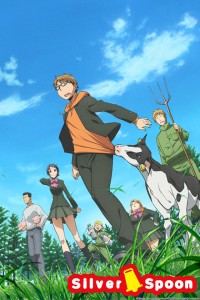
silverspoonI finally got around to finishing off the anime series I've been watching off and on for some time now: Silver Spoon. And I enjoyed it a whole lot — the amount of time it took me to watch the damn thing from start to finish was more a matter of time than the fact I wasn't enjoying it, I should add.

Silver Spoon is an interesting anime because although it technically falls in the "slice of life" category, it eschews the usual "high school harem" situation that genre usually favours, instead presenting an uncompromising, realistic, educational and non-judgemental look at the world of agriculture.

Now, you may not think that sounds like a particularly thrilling premise for an anime, but it really works. At least part of this is due to the fact that the protagonist Hachiken is put in much the same situation as most members of the audience when they start watching Silver Spoon: he's bewildered, doesn't know much about agriculture and is frequently surprised, distracted and horrified by some of the things he finds out. Over the course of the show's two seasons, both the audience and Hachiken go on a journey of discovery and learn a lot about the sometimes harsh truths that members of the agricultural industry have to deal with every day.

The show doesn't shy away from matter-of-factly explaining about how livestock is reared only to be sent to the slaughterhouse — and how animals that aren't "good enough" are treated differently — though it doesn't resort to shock tactics like actually showing the slaughtering process. (There is plenty of poo, though, and the occasional cow giving birth — though again, you don't see full gory detail; it's mostly about Hachiken's reaction rather than shock value.)

It also doesn't shy away from depicting the grim realities many modern farmers face: rising debt levels, ranches having to close down due to insufficient business, and children of long-standing farming families feeling forced into taking over the family business when they're barely out of school. There's a nice degree of drama to the whole series, delivered in an interesting, compelling and occasionally heartbreaking manner through Hachiken's interactions with his classmates, all of whom have ended up at the agricultural high school in which the show is set for different reasons.

The show's run is currently for two seasons, and while the second season does wrap up on a satisfying, suitably "final" feeling episode, there are still plenty of unresolved plotlines to explore that I believe have been covered in the manga the show is based on. Hopefully we'll get the chance to see a third season someday, because it really did turn out to be one of the most surprisingly enjoyable anime series I've had the pleasure of watching for quite some time. It's witty, it's funny, it's heartfelt and it has something to say without beating its audience around the head with The Message.

If you're looking for something a little bit different from your usual fare to watch, I can highly recommend checking it out.

Check it out on Crunchyroll.

1853: Waifutine's Day

The whole "waifu" thing is something I find quite interesting.

For the uninitiated, a proud declaration that someone is your "waifu" (or, optionally, and possibly spelled differently, "hasubando") is something oddly peculiar to fans of Japanese popular entertainment. It goes far beyond simple attraction to the physical depiction of a character — particularly since it's very rare for anime- and manga-styled media to have unattractive characters, particularly female ones — and instead is to do with how the character is depicted: usually a combination of artwork, animation, voice acting and writing.

I say it's peculiar to fans of Japanese popular entertainment because you simply don't see it happening with Western entertainment. People might be sexually attracted to someone like, say, Doctor Who's Amy Pond; people might be attracted to the intelligence of someone like Deep Space Nine's Jadzia Dax; people might simply want to hang out with someone cool like Robin from How I Met Your Mother (yes, these are all examples from my own personal tastes; please feel free to replace them with your own choices, including gentlemen, if you so desire) — but it's pretty rare for someone to proudly and simply declare that one of these characters is their "waifu" (or just plain "wife") and develop a borderline obsession with them. Among other things, it's seen as creepy to have an obsession with a "3D" person, whereas when it comes to "2D" characters, pretty much anything goes as far as most people are concerned, since they're not "real people" in the first place.

Perhaps it's to do with the contrast between animation and live action: in Japanese popular media, we get animation covering all sorts of subject matter and for all ages, while in the West, with a few exceptions like Archer, The Venture Bros., South Park and a few others, animation is still seen very much as children's entertainment, and live-action is seen as more appropriate for adults. The thing with animation is it depicts a heavily idealised perception of reality where pretty much everyone is physically beautiful and completely visually distinct from one another, and a lot of characters fall into easily definable, easily categorisable tropes that people can latch on to and identify as being appealing to them.

In this way, the declaration of a "waifu" could be argued to be a distillation of a person's individual tastes. It's rare (and undesirable) to pigeon-hole real people into neat tropes like tsundere, kuudere, ojou-sama and the like, since real people are complex; meanwhile, it's expected in anime and Japanese games. These characters are deliberately exaggerated interpretations of particular personality traits; in reality, everyone might have a bit of all of these tropes in them, whereas when we're talking about animated entertainment, one of these tropes tends to be the defining characteristic of a particular character. In other words, by declaring a particular character to be one's "waifu" you are effectively nailing your colours to a particular personality trait's standard and declaring that this, above all others, is something you find appealing for whatever reason.

And it doesn't even have to match how you feel in the "real world". I'm crazy about tsundere characters in games and anime, for example, but if I was confronted with someone who was that bitchy and mean to me in reality, I'd be quite uncomfortable. (Although if you listened to Andie and I insult one another on a daily basis — without meaning any of it, I might add — you might question my assertion here.) Likewise, something like the yandere trope can be extremely compelling — your favourite, even — in fiction, but something you would absolutely want to stay the hell away from in reality. (And with good reason; if you're not sure what a yandere is, I'd urge you to go and play School Days through a few times; if you hit the "Bloody End", then you'll soon figure it out.)

On a vaguely related note, having now completed three out of the four endings of Akiba's Trip on the Vita, I'm fairly confident that Rin will be my waifu from that particular work of interactive entertainment. And I will fight anyone who doesn't agree she is best girl! 🙂

1805: Christmas is Over

Well, it's the evening of Sunday December 28, and I'm counting down the hours until I have to get up at some ungodly hour in the morning and trudge all the way to work. (Okay, I drive most of it, but there's still an honest-to-goodness half-hour trudge at the other end, which I'm really not relishing in the current cold weather.)

The Christmas break has been nice, and the fact I'd spent the previous few months at work, away from home (as opposed to working from home as I was previously) has made me appreciate it somewhat more. I've enjoyed the time off, I've enjoyed having the opportunity to just relax without the pressure to "do" anything, and I've enjoyed having the time to indulge in some favourite games, TV shows and anime without time commitments.

I finished the Hanzou story in Senran Kagura Shinovi Versus today — that's one of the four stories in the game. I enjoyed it a lot; gameplay-wise, it's a significant improvement on the first game thanks to its jump to 3D, and its narrative is interesting. Throughout the course of the story, we learn some new things about the main cast as well as get introduced to the newcomers in this particular installment: the girls of the Gessen shinobi school, and the new members of the Hebijou school that Homura and her gang hailed from in the original game before being exiled following the events at Burst's finale.

My initial reaction to the Hanzou story was that I was slightly disappointed there weren't more of the visual novel sequences giving background on the girls and how they were feeling about various things — but on balance, I think there was a good amount. The game didn't try to do too much: it introduced one major plot/background point per character through several of these sequences peppered throughout the course of the entire narrative arc, and the rest of the story was delivered through snappy but enjoyable talking-heads sequences that were just about characters talking to one another, not narration. It worked well, and it teased just enough information about the Gessen girls to make me want to find out more about them: fortunately, I can now do just that by playing through their story, followed by Hebijou and finally Homura and her friends in the Crimson Squad.

I also, as we saw yesterday, made a start on Final Fantasy. I'll be writing more about that as I make more progress through it, though with my intended creative writing project in January this will likely be over on the Squadron of Shame forums rather than here.

I've also watched some anime for the first time in what feels like months; I've been continuing with the farming-themed series Silver Spoon, which was recommended to me by some anime-loving friends, and I've been reminded what a good show it is. It has an enjoyably understated plot about a teen boy feeling somewhat out of his depth in an agricultural academy, and some appealing, entertaining characters who occasionally reference recognisable anime tropes without being defined by them. There's one character in particular who looks like he would be more at home in a series like Dragon Ball Z, for example, so seeing him mucking out cows and working with chickens is rather entertaining, to say the least!

Anyway. Early-ish night for me tonight due to the aforementioned Danger of Work bell tolling, so I'll sign off there and simply say I hope you all had as restful and pleasant a Christmas as I had, and are looking forward to a good new year.

1576: Angel Beats: Gone Before Your Time

Looking back on recent entries, it occurs to me that I never summed up my final thoughts on the anime Angel Beats!, so let's rectify that right now, shall we?

Angel Beats! was an excellent show, tragically cut short by a not-insignificant degree: about 7 episodes, to be exact. What ended up as a 13-episode show was originally intended to be explored more fully across a larger number of episodes, but it never got the opportunity; there is supporting material in other forms of media, apparently, but the anime itself leaves a significant number of unanswered questions and rushes through its latter half at a disappointingly rapid clip.

Despite this aspect, however, it's still a great show, and shouldn't be passed up on just because it has stuff "missing". On the contrary, it has the feel of a great, unfinished work of art about it, and one can't help but wonder if, on a different worldline, the world was ever graced with a full 20-episode run of Angel Beats!

But enough about what the show doesn't have; what it does have is a whole lot of personality. Like Clannad, which a lot of the same people worked on, Angel Beats! features a combination of light-hearted humour and tearjerking scenes that will put your heart through a wringer. The juxtaposition of the two elements is, I feel, even more considerably pronounced than it was in Clannad; while Clannad had a few silly characters — Fuuko and, at times, Kotomi being probably the most obvious examples from the main cast — Angel Beats! has a lot more in the way of self-consciously silly, slapstick scenes. There's a beautiful sequence in one episode, for example, that sees the main cast attempting to create a distraction in class — a distraction that is achieved by, of all things, several cast members' chairs being equipped with small rocket engines that send them blasting off into the ceiling. The sheer unexpectedness of this sequence coupled with its deliberately melodramatic presentation — when they're blasting off, they do so in slow motion, accompanied by the heartfelt, tearjerking main ending theme to the series — makes it genuinely hilarious.

But then, often within the same episode where something ridiculous happened, there'll be at least one moment that will have all but the strongest souls in tears. These moments normally revolve around the series' central concept of the afterlife's inhabitants being "obliterated" and reborn as soon as they find true peace; rather than presenting a character's obliteration as the dramatic, over-the-top moment suggested by the word "obliterate", some excellent direction tends to mean that they just disappear — they're there in one frame, then the moment the camera angle changes, they're gone. Simple, beautiful — and often heartbreaking.

I know that some people aren't a big fan of how the whole series ends and while I agree to a certain extent — the last few episodes are very rushed, and the show both introduces and shows an antagonist the door with alarming rapidity — I found the actual finale to be a wonderful way to wrap up the whole series. Despite the obviously missing content — most notably, a number of main cast members lacking backstories — there was a satisfying sense of closure to the final scenes, and I was both impressed and surprised to note that the show didn't exactly end up in the place where I thought it was going to go when I first started watching.

And that's a real strength of the show as a whole. Most things about it start out as a mystery, and you're given a gradual drip-feed of information as the series progresses. By the end, you feel like you have a good understanding of at least the cast members positioned as the "main" characters; it's a shame that distinctive secondary characters such as TK (a blonde guy who speaks entirely in Engrish bastardisations of American clichés) remain completely unexplored, however.

I'd love to see a "director's cut" one day that features the "missing" episodes. I'm not sure it'll ever happen, even with the show's good reception and popularity, but it's certainly a nice possibility.

1569: Life Gets In the Way

I was chatting with my friend Lynette earlier about various things, and the subject turned, as it often does, to anime. Don't worry, this isn't going to turn into a lengthy spiel on how emotional the ending of Angel Beats! was — though I did watch the last episode today, so expect some thoughts on that shortly. No, instead, it's going to be about the frustrating feeling of discovering things that you really like when it feels like it's almost "too late".

I don't mean that I'm too old for anime or related media, of course — I really hope the day never comes when I feel like I've "grown out" of the things I love today — but rather I feel like the opportunity to enjoy and share these things with friends has been, to a large degree, mostly lost.

I mention this because of my aforementioned conversation with Lynette. Aside from this blog — where, as we all know, I'm pissing in the wind — Lynette is one of the few people I have the opportunity to enthuse about anime with on a fairly regular basis. And it's somewhat frustrating to both of us that we're several thousand miles apart and consequently unable to get together regularly for cocktails, popcorn and a few episodes of some favourite anime series, perhaps educating one another on recent discoveries that we want to share. It's something we'd both really like to be able to do — indeed, we have done it before, on the occasions when I've had the opportunity to visit her and her husband Mark (also a close personal friend, and also someone with whom I can enthuse about anime) in Toronto.

This is one unfortunate side-effect of the whole "global village" (hah, bet you haven't heard that term since a '90s issue of PC Format) thing the Internet has brought about. It's never been easier to find like-minded friends who share the same interests and passions as you, but the thing people don't mention about that seemingly great development in socialisation is how frustrating it is to not be able to get together with those friends on at least a semi-regular basis. (Unless you're loaded enough to be able to simply hop on a trans-Atlantic flight at a moment's notice whenever you fancy it, in which case I think I hate you a little bit.) I have friends literally all over the world — America, Canada, the Middle East, Japan, Australia — who I would love to hang out with and do all sorts of mutually enjoyable things with (no, not that sort of thing, pervert) but am unable to do so. I'm fortunate enough to have these friends in the first place, of course, but by gosh, I sometimes wish they were just around the corner so I could drop them a text, invite them over for an anime evening and subsequently have an enjoyable time.

Why not ask your local friends, you might wonder. Because my local friends all have their own passions and interests — and, with us being the age we are (we're not in university any more!) a lot of them are doing distinctly "grown-up" things like grouting their bathrooms (whatever that means) or having children. I certainly don't begrudge them any of those things, but it can be sad and frustrating when it's difficult to get people together for anything more than the most cursory of social occasions. Life gets in the way, in other words.

So, uh, anyone local want to hang out and watch some anime? We have popcorn.