#oneaday Day 826: No Kind of Atmosphere

20120423-235558.jpg

I've been watching Red Dwarf on Netflix recently. In the process I've discovered that there's actually a hell of a lot of that series that I'd never seen before, so I've been delighted to (re)discover it.

Red Dwarf was one of those series that That One Guy At University Who Endlessly Quoted Things endlessly quoted. Well, perhaps not endlessly — sometimes he was quoting Blackadder. I'm only just now, some ten years later, coming around to the idea that I can actually watch those shows again without hearing That One Guy At University Who Endlessly Quoted Things' voice in my head.

That's beside the point though. And the point is that Red Dwarf is still an excellent series, for more reasons than one.

First up, it's quite simply an excellent comedy series. The small cast of exaggerated characters makes for some excellent comic situations. The fact that all of the characters have at least one major flaw in their personalities is what makes them entertaining, too — Lister is arguably the closest we get to a "straight man" in the show, but even he's flawed; he's gross, he's selfish and his reliance on curry as his primary form of sustenance doubtless makes him rather unpleasant to live with. Rimmer, meanwhile, is by turns arrogant and crippled by self-doubt; The Cat is vain to a fault; and Kryten has difficulty with acting independently when it conflicts with his programming. Put these dysfunctional characters together and you have a recipe for plenty of comic conflict.

The less-considered side of the show is that it's actually a surprisingly decent sci-fi show, too. While it doesn't have anywhere near the budget of what we might be used to from more recent titles — or even shows like Star Trek: The Next Generation, which ran at a similar time — it manages to convey a convincing feeling of what Life Is Like In The Future. The show doesn't batter the audience over the head with lengthy descriptions of what things do or how they work; rather, it simply drops things into conversation that make it clear that we're absolutely not on 21st century Earth any more.

Part of this comes from the show's use of language. Its use of terms like "smeg", "gimboid", "goit" and numerous other faux-expletives was initially to get around the fact that it wasn't okay to say certain things on television, but over time these words became part of the show's identity. Numerous other shows have taken a similar approach since — Firefly features Chinese swearing, for example, while Battlestar Galactica features the multi-purpose invective "frak" at regular intervals. (It's not clear how much Red Dwarf's use of fake swear words influenced these titles, if at all.) Initially, the presence of these words is jarring as you wonder what they mean and why they're not simply using regular expletives. But over time, as you become invested in the worlds created by the writers, you begin to let these words wash over you and enter your vocabulary even though, in most cases, they're completely made up, portmanteau words or "loan words" from another language.

Ultimately, Red Dwarf succeeds due to the fact it never tries to get ideas above its station. It knows that it's a low-budget sci-fi comedy with a small cast, and rarely attempts to deviate too much from that formula. Some may argue that the later seasons do deviate from this formula and are consequently weaker as a result, but having not (re)watched them yet, I'm not going to comment on that right now. One thing the show doesn't do, however, is rest on its laurels; each season has its own distinctive identity, and it's quite fascinating to see the changes it goes through as the years pass by and the budget increases.

It's still great, then, in short, and if you've never had the pleasure of watching it, then you should check it out. It's all on Netflix (in the UK, anyway), so be sure to check it out if you're a member.

#oneaday Day 814: Myself, Myself and Myself

20120411-235428.jpg

Watched The Apprentice tonight. Out of the interminable string of asinine reality shows that the idiot-box forces into our collective consciousness, Lord Sugar's ouevre is the one that offends me the least. It still offends me, of course, though not for the same reasons that, say, Britain's Got Talent does. No, Britain's Got Talent makes me feel stupid for watching it. (So I don't.) The Apprentice, meanwhile, finds me infuriated at the people depicted therein — the fact that the show itself typically shows them up to look like the bunch of chancers they are takes the edge off, however.

One of the worst things these people do is talk. No, seriously. Every time they open their mouths it's a veritable string of business cliches, one after another. One of the most prolific, egregious examples is the incorrect use of the word "myself". Everyone on that show seems to think that using the word "myself" instead of "me" or "I" makes them sound more "formal" or "polite".

"Who was responsible for this?" yells Lord Sugar.

"That was myself," pipes up someone with impossibly blue eyes.

"And who worked in the production side of things?"

"Myself was working in production, along with Randolph, Bellend and Fuckwhistle," comes the reply from the blonde one with the annoying attitude. (I can't remember their real names.)

You get the idea.

The same principle is also, it seems, applied to the word "yourself", which has apparently become an acceptable substitute for the word "you" somewhere along the line.

"I think the team working on this should be yourself, myself and Craptwat," says Fuckwhistle.

I can't work out where this faux-formality that makes people talk incorrectly (or, to be less prescriptive about it, "faux-formality that makes people complicate their speech unnecessarily") has come from. Perhaps it's a modern-day variant of the archaic "thou art/you are" distinction, which everyone uses incorrectly these days anyway. (And with good reason, obviously — it's archaic, duh.) Whatever it is, it needs to die, for the same reason that people who use words like "trendy" and "funky" just need to stop right now. Words like that are ones which lose all their meaning and become the opposite of what they're supposed to be as soon as they come out of someone's mouth. The same is also true for anyone who says Internet memes out loud or — God forbid — says "LOL" in earnestness.

But I digress.

Language is constantly changing and evolving, usually for the better. We have a veritable shit-ton more words than we used to (and plenty more, like "shit-ton", that you won't find in the OED) and the English language has never been more complex, more expressive and more descriptive than it is now. It doesn't need to be overcomplicated with misplaced formality. There are already pretty good systems in place for indicating that you're speaking formally — lose the contractions, cut the slang, actually bother to pronounce the letter "t" — so stop making up rules. And while we're on, grab a dictionary and look up what "literally" means. It's not an intensifier. It means something actually happened. Stop using it wrong or I will literally jam this pencil into an orifice of yours that it's not usually supposed to find itself in.

And yes, I mean literally.

#oneaday Day 805: Geek and Sundry

20120403-022323.jpg

I'm a big fan of both Wil Wheaton and Felicia Day. The pair of them, along with people like Jonathan Coulton, Paul & Storm, Gabe and Tycho and numerous others, have done a great deal to make being a geek "cool". And not in a particularly obvious "hey, we're going to make geekdom cool!" way — simply by being themselves and exhibiting an admirable amount of passion in their interests, they've brought numerous geeky pursuits to the attention of a wide variety of people who may not have investigated things like board games, web shows and other eccentricities before.

Today, Wheaton, Day and several others took a big new step in their campaign to provide bored geeks with ways to waste their time. The launch of Geek and Sundry had been teased — particularly by Day — for some time, and Sunday saw a 12-hour Google+ hangout "subscription drive" show to promote the new site, featuring a variety of events and very cool-sounding interviews. As I live in the silly UK time zone, I was fast asleep for most of these, but the good bits are likely on YouTube somewhere.

Anyway, what is Geek and Sundry? It's a YouTube channel. Nothing overly fancy there, but unlike a lot of YouTube channels, Wheaton, Day and their team have made a big effort to organise their work and provide regular programming. And between them, there's a wide variety of different shows that will cater to most (geeky) tastes. I spent a bit of time checking out a couple of the shows today, and I can see myself regularly checking in on them. They're good quality, interesting and presented by charismatic, likeable people. Doubtless not everything will be to everyone's taste — I know for a fact I have a number of friends who find Day's ditzy "Elliot Reed"-style personality quite irritating, for example, so they may wish to avoid her content — but there's a broad mix of things that should, between them, appeal to most people.

So what's on offer? Well, I could spend some time describing each show in detail but they've been good enough to provide trailers for each bit, so let's just explore those, shall we?

The Guild

Many of you will be familiar with The Guild by now, as it's been running since 2007 and has appeared on YouTube, the Xbox Live Marketplace, Zune Marketplace, MSN Video, iTunes, Netflix, Hulu and DVD. For those of you who aren't, it's a comedy series about the lives of a group of online gamers who all play a massively-multiplayer online RPG together. Exactly what game they play is never revealed, with them referring to it only as "The Game", but the focus is more on the quirky "real people" who make up the titular Guild rather than their online personae.

Day stars as Cyd "Codex" Sherman, who has to attempt to do her best when a guildmate — previously only known online — shows up on her doorstep. Hilarity, as you may expect, ensues.

Geek and Sundry will be showing the fifth season of the successful show.

The Flog

Fans of Felicia Day, this is where to go. The Flog is a weekly "vlog" show in which Felicia Day babbles nonsense for a few minutes and then goes off to do something interesting. The first episode sees her going to visit a blacksmith so she can better appreciate her Skyrim character's level 100 blacksmithing skill. She gets very excited about hammers, which is kind of adorable.

Tabletop

This has been the highlight of what I've watched so far. Wil Wheaton hosts a half-hour show devoted to a specific tabletop game. Throughout the course of each episode, he and his companions explain the rules of the game under scrutiny and play through it. (You don't see the whole game — just "edited highlights". Probably for the best, given the lengthy playtime of many board games.)

The format looks to be a great way to find out more about various tabletop games, and the banter between Wheaton and his guests is entertaining. The first episode demonstrates Small World, which is a game I've been interested in for a while.

Sword and Laser

Those who enjoy those strange tablet devices with paper pages will want to check out Veronica Belmont and Tom Merritt's show Sword and Laser. Based on the duo's podcast, the show focuses on sci-fi and fantasy and features interviews with authors, reviews of new releases and discussion of recent news in these genres.

Written By a Kid

This has the potential to be a lot of fun: original sci-fi, fantasy and horror stories by kids aged between 4 and 9 are turned into live-action and animated shorts by a variety of directors including Dane Boedigheimer (Annoying Orange), Rhett & Link (IFC's Commercial Kings) and Daniel Strange (Between Two Ferns with Zach Galfianakis).

LearningTown

Fans of "nerdcore" music will be right at home with this one, as dynamic musical duo Paul & Storm "blend vocal harmonies with comedic scenarios as they are tasked with reviving the flagging educational show of their childhoods".

If you've ever witnessed the majesty of Paul & Storm performing "Frogger: The Musical", then you'll likely know what to expect from this one.

Dark Horse Motion Comics

Finally, comic book fans will want to check in on the Dark Horse Motion Comics show, where a number of Dark Horse Comics properties including Hellboy, The Goon, The Umbrella Academy and others will be brought to live with motion graphics. The first episode is already up, based on "The Secret" by Mike Richardson, with art by Jason Shawn Alexander. (I know nothing about comics. I include these names for the benefit of people who do!)

I've subscribed already, as several of these shows sound like they're going to be great. The first episodes of some are now available, with others to follow in the next couple of weeks.

To find out more, check out the official website or subscribe on YouTube.

#oneaday Day 799: Um, Fluttershy

20120328-011325.jpg

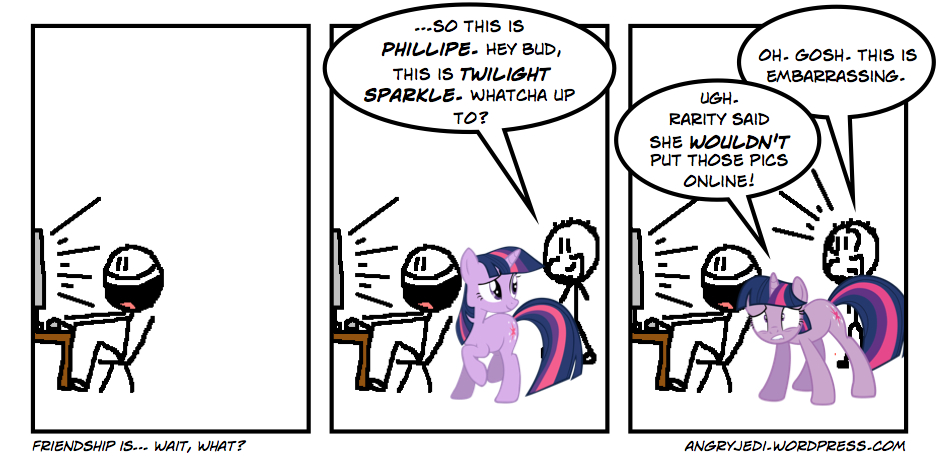
A discussion with my friend Lynette earlier today (who, it has to be said, squeed rather enthusiastically at the news that I have been watching My Little Pony) saw us pondering, as so often happens with strong, character-led pieces of work, which My Little Pony was the most "us" — or at least the one we felt most able to relate to.

My answer — Fluttershy — is apparently one of the more popular ones, for a variety of reasons that I haven't explored as yet and am mildly terrified to, given the deep, deep rabbithole that sites such as knowyourmeme and TVTropes can be.

I imagine, given her timid nature, that there's at least an element of crossover between Fluttershy fans and Hanako fans — a category which, if you recall, I count myself firmly in. Her endearing meekness, anxiety and loyalty are character traits I can well and truly understand, and I know I have more than a few similar traits myself.

Take the fact that she has a clear case of social anxiety, and is nervous about showing off her talents except when absolutely necessary or in a situation where no-one can judge her. When taken along on a perilous journey to use her talent for "parenting" (for want of a better word) to convince an unruly, belligerent dragon to go and sleep somewhere else, she's (understandably, I feel) too scared to go in there and do her thing, even in front of her friends. And only partly because she's dealing with a fucking dragon.

I know too well how all that feels — of the difficulty and anxiety which surrounds using your talents and abilities in "public", even in front of people you love and trust. (Not the "dragon" bit.) I know, for example, that I'm a decent writer and that people enjoy reading my stuff, but I hate hate hate anyone watching me write. I have absolutely no idea whatsoever why this is — whether it's anxiety over people "backseat editing" or judging the things I've written before I've finished is anyone's guess. I just know that I hate it — but I like showing it off when it's finished, namely when I can hit "publish", light the blue touch paper and just walk away. (At this point, my fear of negative, destructive feedback comes into play, but that's a whole other matter.)

Same thing with music, really. Practicing is a necessary part of being able to play complex pieces of music, but I hate people listening to me practice. Performing? Fine. Playing the same bit over and over and over again until I get it right? Well, that's something to do with headphones or when no-one's in the house. Something of a combination of perfectionism ("if anyone's going to hear this, I want it to be right") and worrying about the judgement of others ("they won't want to hear those three bars repeated over and over and over! They'll tell me to shut up, or hurry up and get it right or something"), perhaps? I don't know.

Same with doing anything vaguely creative, in fact. I hate being watched doing something like that. Perhaps it's because doing something creative puts you in a vulnerable position where your "soul" (or whatever) is on display, and anyone could quite easily strike it for massive damage with an unkind word or an ill-timed snigger. It's something I could really do with Getting The Hell Over, but it's also one of those things that has indelibly stamped itself onto my personality over the years.

Whatever the reasons for it all… Um, Fluttershy? I feel your pain, girl.

#oneaday Day 798: My Little Pony, Skinny and Bony, Made out of Plastic, Looks Like a Sp--

20120327-015810.jpg

I'm just going to confess this up-front right now as I'm not really ashamed of it, but I can see how some people might be embarrassed to admit such a thing in a forum as public as their personal blog viewed by literally tens of people. Not me, though. I am unashamed, as you can clearly see from the amount of filler in this first paragraph, coupled with the fact that I have not yet introduced the topic of this entry, which is obviously visible in the post title.

All right. No more inane babbling. (Hah.) One… Two…

IwatchedthreeepisodesofMyLittlePonyearlierandenjoyedthem.

Whew. That sure feels good to get off my chest. See you tomorrow.

Wait, you want a little explanation? Well, all right. I guess you can't just drop a bomb like "I Watched My Little Pony Today" (hey, it does get easier once you've said it once) and just walk away. You probably want to know if I'm feeling all right, whether there's anything you can do to help me and if the authorities should be notified.

There is nothing to be concerned about. My interest in the new My Little Pony series (My Little Pony: Friendship is Magic, to give it its full title) was initially sparked by online discussion and the phenomenon of "bronies" — male fans of the show aged between 14 and 35-ish. The rise of the curious and unexpected fanbase for the show is, according to Wikipedia, originally attributed to discussion on renowned Internet dark corner 4chan. The memes which came from the Friendship is Magic show spread outwards from 4chan, as memes are wont to do, and the "brony" was born.

This sort of situation was unthinkable back when I was a kid, which is incidentally the last time I was even the slightest bit aware of the existence of My Little Pony. As a boy at primary school, the absolute worst possible insult that could be hurled at you (not counting "your mum" jokes, since those technically aren't insulting you) was to be accused of liking girly things. My Little Pony was, at the time, the very pinnacle of girliness, and to be branded as a boy who liked the sparkly equines? Well, that would be the end of your social life, since, as we know, kids can be bigoted little shits at times. (Unless you were friends with girls. But what self-respecting primary school kid in the 1980s was friends with icky girls? Bleeeeurgh.) (Full disclosure: despite being bullied as a kid, I fortunately, to the best of my recollection, escaped the dreadful fate of being branded a girlyboy. Further disclosure: I always thought the Ponies' hair looked nice. Additional notes: GIRLS.)

Anyway, back to the present, and Friendship is Magic. I watched the initial self-titled two-part episode with some curiosity, having no idea what to expect save for the art style that I had seen scattered around a few Twitter avatars in recent weeks. The distinctive, big-eyed aesthetic for the Ponies was one that appealed to me, so I knew that I was at least going to like the look of the show — it was the content that I knew next to nothing about.

What I found was actually rather entertaining. While the show is obviously somewhat "girly" in many of its themes and characters (you can count the number of speaking male characters on the fingers of two fingers in the three episodes I've watched so far, and one of them is voiced by a woman) it features that kind of multi-layered humour that sets truly great kids' TV shows apart from the disposable fluff. While on the surface the episodes each contain a commendable message about friendship, trust and cooperation, there are several other layers on which the show can be appreciated.

Firstly, there's the characters, who are all well-defined but nuanced, and many of whom contribute to the show's often exhausting, manic pace — it reminds me of shows like Powerpuff Girls at times, at least partly due to prolific voice actress Tara Strong's involvement. Secondly, there's the wide variety of humour types which are presented — everything from slapstick to surrealism, with some musical comedy usually thrown in for good measure whenever Pinkie Pie is around. Thirdly, there's a ton of cultural references tossed in there — in just the three episodes I've watched to date, the show has referenced The Brady Bunch, The Benny Hill Show, The Wizard of Oz and doubtless a bunch of other things that I've missed.

Perhaps the most striking thing that I like about it, though, is its almost unrelenting cheerfulness and positivity. In fact — and this will sound like a strange comparison, but bear with me — it reminds me of the reason that I enjoy Japanese role-playing games. The colour. The strong, exaggerated characters. The way in which said characters tackle their "issues". Hell, the first two episodes even culminate in a very JRPG-style "boss fight" featuring the Ponies unleashing the power of the six Elements of Harmony in order to teach temporary antagonist Nightmare Moon a lesson she won't forget in a hurry.

It's silly, enjoyable nonsense, in other words, though with a commendable underlying message. It's fun, undemanding but rewarding, and just the thing with which to unwind if you can't deal with too much angst, tension or people trying to be too clever. In short, it is what it is, and you should feel absolutely no shame whatsoever in enjoying it if you find it happens to tickle you in your happy places.

I guess all of the above makes me a Brony by default, then. You know what? I'm cool with that.

#oneaday Day 741: Glee - It's a Feeling You Get When Your Brain Finally Lets Your Heart Get In Its Pants

20120130-005623.jpg

I posted a short while ago that I had been watching Glee, and had found myself surprised that I was rather enjoying it. Like many other people (I imagine) I had certain preconceptions as to what the show would be about — misconceptions, as it happens. Misconceptions fuelled by media coverage of the phenomenon of "gleeks", and endless playing of their version of Don't Stop Believing on the radio.

Watching the show with an air of objectivity, i.e. having ignored most of the coverage about it because of my misconceptions it was cheesy and lame, has surprised and delighted me with its quality. I'm genuinely enjoying it — cheesy songs and all — and have come to care about the characters. As I've said on a number of occasions before, caring about the characters in something is the one thing that will keep me watching or playing something, even after said piece of media in question might have long outstayed its welcome with other people. And I can see how Glee could easily rub people up the wrong way. It's an acquired taste, but one I have well and truly acquired with aplomb.

Glee is good at high school angst. Above all else, outside of all the cheesy songs and elaborate dance routines, it's about teenage troubles. And some surprisingly weighty issues, too — I'd assumed that it would all be a bit Disney, judging by the saccharine, autotuned nature of the music. But in the space of the season and a quarter that I've watched so far, the show has taken in teen pregnancy, homosexuality, bullying, infidelity, abstinence, discrimination and a wealth of other topics, and it's handled them all in a surprisingly sensitive manner. Most of the "dealing with" said issues involves singing a song that is tangentially related to the issue in question, but somehow this never seems too forced. Sure, if you're going to go over it with a fine-tooth comb and pick apart exactly why a high school could never have the budget to pull off some of the productions they do, you'll come away feeling slightly I satisfied by the whole experience. But accept it for what it is — a heavily stylised depiction of high school that blends realism with escapist fantasy — and there's an incredibly satisfying, well-written and, at times, very touching show underneath.

It's a show of great characters, too. Mr Shuester (or however you spell it) is a great lead. While there's an element of "cheesy choir leader" about him by the nature of his character's role, he's a deep, interesting and flawed character who presents an interesting counterpoint to the colourful adventures of the teen stars. Sue Sylvester, too, makes a brilliant "villain", and is all the more powerful for being a very complex, unpredictable character. It would have been easy to leave her as nothing but a heartless bitch, but even well into the second season, she continues to surprise.

Barring a few missteps early in season 2 — the themed episodes based on Britney Spears and the Rocky Horror Show were a bit silly in that they felt far too shoehorned in, even for a show about retrofitting pop songs to express your inner angst — the show is fairly consistently great. Said theme shows were followed up by some brilliant episodes, however, with the eighth entry of the second season providing one of the most genuinely moving moments I've seen in a TV show in recent years. (I shan't spoil it for those who intend to watch it, but suffice to say for those who have seen it, it's the bit where that song "You're Amazing" is used, if that's what that song is actually called. I'd check, but, you know, I can't be arsed. You know the one I mean.)

I will be following Glee with interest as it continues — particularly as the high school nature of it means that the entire cast of kids will theoretically have to be replaced over the course of the next few seasons.

#oneaday Day 739: I'm Flickin' Me Net

20120128-003638.jpg

I mentioned it briefly yesterday, but I feel some good, old-fashioned enthusing about Netflix is in order. I know, I know, you American types have been enjoying its streamtastic charms for a very long time now, and us Brits have been watching enviously for the whole time (and occasionally trying to do clever things to see if we can get signed up) — but now, we have it too.

And it's awesome.

As I've noted on some post back in the dim and distant history of this blog, I'm not huge on movies. It's not that I don't like them, it's that I'd rather spend two hours at a time doing something else. I'm not sure why this is. Perhaps there's something in my brain that sets me up to enjoy interactive, rather than passive entertainment — I'll happily sit and play one game for hours at a time, after all. But that doesn't explain why I might take a new TV show discovery and devour large proportions of a season at once (see: Community). That's no more interactive than a film, and yet I have no qualms in doing that.

I think my main bugbear with movies has historically been their perceived "value" when buying them to put on your shelf. I have a bookcase in front of me at the time of writing — look, it's over there — that is almost filled with DVDs. (The bottom two shelves are console games.) Of those DVDs, the only ones that I think I have watched more than once or twice are the TV show box sets. The movies I've kept around… well, I'm not sure why, really, since I certainly haven't watched Human Traffic for a very long time, and my copy of Hot Fuzz actually remained shrink-wrapped for a considerable period, too (it was cheap in HMV, then it was on TV, so I didn't really need to watch the DVD). I guess there's some sort of curious feeling of "attachment" to many of these movies, like I remember the time I bought them and associate them with a particular period in my life. As such, it's never really occurred to me to get rid of them, even though I rarely watch them.

The age of Netflix, however, has me rethinking this. Now for a few quid a month I have instant access (assuming I have an Internet connection) to a pretty huge library of movies and TV shows. Some are complaining that the selection is a little limited at this time — and perhaps it is if you're a big film buff, but it's certainly more than satisfactory for me at the moment. And the reason I mention the "perceived value" vs "time constraints" thing above is that I've been more than happy to just sit and watch a movie on Netflix, because I know that I haven't spent £[x] on it, and have to feel obliged to enjoy it.

It's the same for the TV shows, as it happens. I've been meaning to check out Twin Peaks for a very long time, for example — even more so since I played Deadly Premonition — but never got around to picking up the DVD set. It always seemed a bit expensive for something that was — to me, anyway — an unknown quantity. Would I like it? (As it happens, I love it, 90s hairstyles and all) Would it be worth the money, or would I be stuck wishing I'd spent my £[x] on something better?

This consideration is now irrelevant. Like Spotify allows me to check out music that I might not have felt inclined to buy outright, Netflix allows me to broaden my tastes in film and TV shows without any risk of feeling like I've wasted my money. And through the "creepy" (no it's not) autoshare to Facebook facility, I have plenty of opportunity to check out what my friends are watching, start some discussions about it and become more "well read" in the media of TV and film.

So, then, fellow Brits; if you have a decent Internet connection and like watching people perform for you inside your TV, PC, iPad or iPhone, I suggest you get yourself signed up for a free trial. For me, it's been worth it purely for the iPad compatibility — Netflix on iPad in bed has revolutionised insomnia.

#oneaday Day 738: Diversifying

20120126-220014.jpg

In a recent blog post, one Ben Goldacre described Spotify's auto-sharing behaviour as "creepy" and called for greater transparency in opt-out procedures. While I don't disagree that users should have the option of whether or not to share what it is that they're doing, I do disagree with the good Doctor's assertion that showing off your tastes to others is somehow "creepy" or "wrong".

The reason I don't find it either of those things is because of discovery. Spotify is built in such a manner that it's easy to check out an artist or album you're unfamiliar with in a risk-free environment. You don't drop any money on the album directly, so if you wind up hating it, you haven't lost out. And if you end up loving it, you can whack it in a playlist or star it for future reference.

Combine this ease of trying things outside of your usual comfort zone with social features and you get a powerful tool to expand your own tastes. Because music is an ever-present part of society these days — silence, it seems, is frowned upon by most people, particularly those of more tender years — conversations about what artists are awesome are less common than they once were in the age of buying CDs (and, heaven forbid, cassettes). Music is just there for many people — a disposable thing that people may well have a strong connection to but perhaps don't always think to actually discuss,

What Spotify's sharing feature does is allow you to see what friends have been listening to and, if it takes your fancy, jump right in there and have a listen yourself. I've discovered more than a few new favourites this way, and I'm certain other people will have been curious about some of my tastes too. I don't have any objection to people seeing what I've been listening to and I'm certainly not ashamed of it. The same is true for Netflix, newly launched in the UK and nicely integrated with Facebook to allow you to share what you're watching. On the whole, I'm much more inclined to pay attention to new releases if my friends are enjoying them rather than if they're simply "critically acclaimed". See: The Squadron of Shame

Goldacre suggests that people will make judgements based on what you have been listening to, and your playlists which, if you weren't already aware, are made public by default. And perhaps people will — but the attitude I have always taken with personal taste is that it is just that: personal. If you're the sort of person who ridicules someone else just because of what music they listen to, how they dress, or their appearance… I probably don't really want to know you. Everyone is free to make their own choices with regard to what entertains them (unless, you know, if you're into something fucked up and illegal) and so people should not feel ashamed or embarrassed to share what it is that they have been enjoying.

In fairness, it's entirely possible that there is the scope for cyber-bullying among schoolkids based on what they might have been listening to with Spotify, or the content of their playlists. But there's the scope for cyber-bullying based on their photos, their status updates, all the other stuff that's on Facebook, too. This isn't excusing it. However, it does mean that Spotify itself isn't some sort of creepy bully-magnet. As with all forms of social media and teens interacting with others on the Web, it's important for parents to be involved and aware of what their offspring are up to. If it looks like causing a problem, they should be familiar with the options that are there to protect people — and Spotify has those options if, for whatever reason, sharing things does become a problem. But someone's listening habits are public by default — and why shouldn't they be? There's nothing to be ashamed of there.

Perhaps I have a naïve view of social media and sharing information on the Web. But I just don't see how sharing your entertainment consumption is particularly harmful. Sharing deeply personal information, yes. But the fact that you listened to the Lazy Town soundtrack today? For me, that's the start of an interesting conversation, not something creepy.

#oneaday Day 723: The Escapist

Escapism is cool, and an important and valid method of keeping yourself sane.

There are, of course, many means of escapism, and different ones are more or less effective for different people.

There's the escapism of a child giving life to the inanimate lumps of plastic they own. Without a child, they're just potential, models, things to be looked at, without life. Add a child (or, more specifically, someone still in possession of their childish imagination) and something magical happens — those objects come alive, engaging in battles to save the galaxy; heroic adventures; or even just a normal day in a normal street.

Then there's the escapism of a good book. Good readers also have one of the most important qualities of a good creative writer: that active imagination again. But it's partly also down to the writer to create a convincing world, compelling characters and a reason for the reader to commit part of their life to staring at tiny print on paper, e-ink or an LCD display. You know a writer's done their job properly if you can hear the characters' voices, see the places they're in, picture the things they're doing. And as a reader, your interpretation and mental imagery might not be the same as the writer (or indeed the person who designed the book's cover) — but that doesn't make it any less valid.

There's the escapism of interactive entertainment. Instead of passively observing an unfolding story, you become a part of it. It doesn't have to be an explicit narrative as such — a long game of Civilization tells a story just as much as a chapter of Heavy Rain. The meaning the player chooses to assign to the experience is what makes interactive entertainment special.

There's the escapism of film. Increasingly designed as memorable spectacles these days, a good movie plunges its audience into darkness before casting them into a whole new world. It could be a world of giant robots; of CIA agents; of lads on a pulling holiday. For those couple of hours, though, the outside world ceases to matter.

There's the escapism of a good TV show. When you find a show that resonates with you, you want to stick with those characters, to find out what makes them tick, what they want, what they find challenging. You cheer for their successes, feel bad when they encounter adversity. And given the amount of time you spend with the cast of a TV show over an average run of a moderately successful show these days, it's not beyond the realm of possibility that the cast might feel like "friends" by the time you're through.

And there's the escapism of music. Music is a powerful imaginative stimulus, but again it means different things to different people. For one person it might stir up dormant memories. For another it might encourage them to close their eyes and picture themselves in a whole new situation. For yet another it might have an emotional impact that reflects the things that are weighing on their mind at that moment in time. And for others still it might inspire them to push forward, to do their best, to power on through and do that extra set at the gym, or put in that extra bit of effort at homework.

All this isn't even getting into what it means to be a creator as opposed to a consumer of all the above media, either.

The fact is, the world can be, at times, a bit of a sucky place. Having something comforting to escape into, whatever form that escapism might take, is important. No-one likes to feel trapped, so even if it's only for a short while, escape into something awesome and return to the real world refreshed, invigorated and ready to tackle any challenges it might want to throw at you.

And if you don't have anything like that? Then you need to have more fun.

#oneaday Day 721: We're Gonna Live Forever, We're Gonna Sleep Together

I have a confession to make. I enjoy musicals and, by extension, musical episodes of TV shows.

No, whatever social stereotypes might have you believe, this is not a euphemistic way of coming out as a homosexual. It is simply a statement of a fact: I appreciate musicals, in all their gloriously cheesy, camp glory.

After watching the entire series of Community, I realised that I had enjoyed the various musical numbers that pepper the series on both ironic "haha, musical" and non-ironic "hey, I'm actually genuinely enjoying this" levels simultaneously. Come on, you can't say that this isn't one of the catchiest songs you've ever heard.

I had a similar experience with the Buffy the Vampire Slayer musical episode, which is, to date, one of my favourite episodes of any TV show, ever. And a YouTube comment just reminded me that it's ten years old. Jesus. Anyway:

And this isn't even getting into South Park: Bigger, Longer, Uncut, which is both a brilliant parody and a genuinely brilliant musical at the same time. Here's my personal highlight from it, clear evidence that Trey Parker and Matt Stone have watched and enjoyed Les Miserables at some point in their lives:

After some consideration of all this, I figured that it was about time I checked out Glee. My only experience of Glee to date has been hearing the songs on the radio and, the first time I heard what they'd done to Journey's Don't Stop Believin', wanting to kill them all, as tends to happen when I hear cover versions that really aren't a patch on the original.

Having watched a few episodes of the show now, though, I get it. Glee's music isn't intended to be listened to in isolation. Its overly-processed, super-cheesy, unconvincingly mimed numbers are meant to be watched as much as listened to, with intricate dance routines, cheesy montages and, in some cases, comically overwrought facial expressions. And when watching one of these numbers, it would take a hard-hearted soul to not crack at least a fragment of a smile.

Why, though?

It'll likely be different for different people, but from my perspective, here's what I've enjoyed so far — about both Glee and musicals in general.

I find them a satisfying experience to watch and to listen to. It's difficult to pin down exactly what I mean by that, but let me attempt to explain. It's to do with a sense of "fullness", or all your senses being bombarded with something that is infused with emotion, however false it might be. In some senses, the exaggerated, stylised nature of musicals means that they're a very "pure" art form — they're light on the subtlety and heavy on the audience cues for how they should be feeling. It's the exact opposite of the sort of movie where everyone mumbles and no-one moves their facial muscles more than the absolute minimum required to form words.

This "fullness" extends to the sound of the music, too. Autotune is, generally speaking, a great evil, particularly when overused, but when used effectively it can add a degree of richness and otherworldly "perfection" to a voice — particularly if said voice is then harmonised to high heaven. If you want to know what I'm talking about and own an iPhone, then go download the free Glee Karaoke app and sing the Twinkle, Twinkle, Little Star tutorial song when no-one else is around. Then tell me that hearing yourself harmonised in that beautifully rich, inhumanly perfect manner isn't at least a little bit satisfying. It sounds artificial, sure, but the very nature of musicals is that they should be stylised. It's not just visuals which can be stylised, after all — there's nothing to say you can't make a human voice sound somewhat… well… inhuman.

Don't get me wrong, this isn't me turning my back on "real", "gritty" or "authentic" music. I've always had something of a soft spot for cheesy music, and music from musicals scratches that itch very effectively. Seeing as how Glee combines both cheesy music with one of my favourite "guilty pleasures" in TV and movies — high school drama — I'll be giving the series a bit more of a chance. Coming to it with "beginners' mind" and without the media hysteria that seemed to accompany it when it first burst onto the scene, I feel like I can enjoy it somewhat objectively. It won't appeal to everyone, for sure, but it's certainly providing me with some pleasing entertainment for the immediate future.