#oneaday Day 575: Independence

There was a good post that went around earlier by the VTuber, journalist and activist Ana Valens, reflecting on her time as part of the games media landscape, and how she was part of the sector's slow decline into almost total irrelevance as SEO-baiting and click-chasing became the norm. I strongly encourage you to give it a read — you can do so by clicking here. Go on, I'll be here when you get back.

One of Ana's points in her piece was that as games media slowly circled the drain, particularly as groups such as Valnet and GAMURS started hoovering up once-respectable brands and then systematically destroying them one by one, a new type of "media" stepped in to take its place. This, of course, is the oft-trumpeted advent of YouTubers and streamers, whom many claim to find more "trustworthy" than the traditional games media in many cases — despite the obnoxious rise of the term "influencer", and the clearly documented use of "influencer marketing" being far more egregious than any sort of "paid reviews" that, in my experience, never actually took place when the traditional games press was at its peak.

But I'm not here to rant about the rise of YouTubers and streamers. They have their place — hell, I do a lot of stuff on YouTube and I've dabbled with streaming — but for me, they've never been an adequate replacement for having a publication that was "yours". Back in the '80s and '90s, this would be your magazine of choice: the one you would dutifully buy a copy of every month, or subscribe to if you could convince your parents to do so. As the new millennium rolled around and this World Wide Web thing became the norm — particularly as high-speed always-on broadband Internet established itself as the rule rather than the exception — print gave way to online, and we had some wonderful websites like 1up.com that were as much community as they were professional publication.

Sites like that still exist to a certain degree — I believe IGN and Gamespot still have a certain amount of social features, and the relaunched Giant Bomb is more community-focused than ever — but no site has ever managed to quite recapture that wonderful time: an age of personalities, of brave new frontiers in writing about video games, of figuring out exactly what the "games media" really was.

YouTubers and streamers don't quite replace that for me. Sure, it's nice to find someone who aligns with your values and tastes — and sometimes challenges them — but it's not quite the same as finding an entire publication, put together by a team of people, that resonates with you for one reason or another. There are YouTubers I watch fairly regularly, but I don't think of them at all in the same way as I do 1up.com in the early aughts, or favourite magazines like ACE, N64 Magazine and Electronic Gaming Monthly from the late '90s.

Part of that is their individuality, but it's also a completely different medium with its own appeal elements — and there's not necessarily the crossover you might expect. I will gladly read a lengthy magazine article about something I am interested in, but present me with someone who has made a multi-hour YouTube video on the subject and I will immediately switch off. People keep recommending Noah Caldwell-Gervais to me, for example, and I'm sure his work is very good, but his video on the Resident Evil series is seven and a half hours long. I am not watching that when I could be spending those seven hours doing literally anything else — including beating multiple Resident Evil games in that timeframe.

I'm the same with streaming. I'm sure there are some streamers I'd enjoy watching, but I just can't be arsed to spend my time doing so. I'm not someone who can easily split my attention between a stream and Something Else, and I genuinely think it's disrespectful to the creators to engage with a creative work like a game while watching a video or listening to a podcast. (I also think the opposite, to be clear; if I'm watching a video or listening to a podcast, the absolute most I will be doing at the same time is a tedious, repetitive task at work, or driving somewhere.) And, given the choice between spending several hours watching someone else stream a game and sitting down to play a game myself, I'm always going to choose playing something myself.

Conversely, give me someone who writes well, is passionate about what they do and who tries to find the fun rather than get bogged down in negativity — all traits I try to follow in my own games writing — and I will follow that person's blog to the ends of the Earth. In fact, this year I'm going to make a specific effort to follow more individual blogs and independent gaming sites, because, for me, those are the nearest alternative to what I was describing earlier: a publication that speaks to you, and which you feel comfortable checking in on regularly.

But how is an individual writer different from a YouTube video essayist or streamer? I guess in some ways they aren't. But for me it's all down to how that person delivers their message. I see a seven and a half hour YouTube video and feel like that's not something I'm ever going to spend time watching, but I see a light novel-length article and will happily read it from start to finish. It's just inherently more digestible to me — I'm not in this to "consume content"; I actually want to read interesting things! And, honestly, fair or not, the first thing I think of when I see a YouTube video of a length that absurd is "content". I see a website with a bunch of interesting-looking headlines and I think "fantastic, something to read".

I don't know how much sense I'm making here, so I'll stop talking in circles. I guess the main point I want anyone who happens to stumble across this to take away from the whole situation is that we should continue to reject the click-hungry corporate interests of publications under demonstrably awful labels like Valnet and GAMURS, and instead focus our time and attention on individual, independent creators that we enjoy the work of, and that we feel represent our tastes and interests well.

I aspire to be that for at least some people, and I know MoeGamer in particular has at least semi-regular readers. So I encourage you: if you find something that particularly resonates with you, be sure to tell the people behind it that you enjoyed it — and share it with your friends who you think might also enjoy it! Word of mouth is still an incredibly powerful thing on our increasingly broken Internet, and as the world continues to collapse all around us, it's going to be these little communities we can build away from corporate interests that will remain important lifelines for many.


Want to read my thoughts on various video games, visual novels and other popular culture things? Stop by MoeGamer.net, my site for all things fun where I am generally a lot more cheerful. And if you fancy watching some vids on classic games, drop by my YouTube channel.

If you want this nonsense in your inbox every day, please feel free to subscribe via email. Your email address won't be used for anything else.
#oneaday Day 561: A world of misinformation

We mock Donny Trump's obsession with "fake news" because he always busts that out whenever someone criticises him, but it's an unfortunate fact of life that we are living in a world that is riddled with misinformation right now — particularly if you're the sort of person who primarily gets their information from social media. And, distressingly, that is quite a lot of people these days.

Not all bits of misinformation are dangerous, of course, but they're no less frustrating to see. The other day, for example, I saw a post on Bluesky where someone commented that someone waxing nostalgic over the original Quake for being "from the days before you needed to spend thousands on graphics cards" or suchlike was "the funniest game they could have picked to comment this on". Funny! Except Quake didn't need a 3D accelerator card, as it ran entirely in software, meaning that while a decent non-3D graphics card would help in unlocking graphics modes, it was primarily dependent on how good your CPU was. Its 3D-accelerated version was never officially supported, despite being developed by id Software, and was primarily put out as a test for what they were planning to do with Quake II, which was 3D-accelerated by default.

Likewise, when a near-complete version of Resident Evil for Game Boy Color was unearthed and released to the public the other day, there were people talking about how it "included" the pre-rendered backgrounds of the PS1 version (it doesn't, they are low-resolution pixel art recreations) and how it "used the same isometric perspective" as the PS1 version (neither the PS1 nor the GBC versions are depicted from an isometric perspective).

I didn't comment on either of these at the time because that would have made me an "Um Actually" guy, and no-one wants to be one of those. But as someone who cares about this stuff — particularly about game history, and modern folks appreciating the many varied and wonderful things that classic games were doing — it was frustrating to see these statements go completely unchallenged.

The problem, as I've already alluded to, is people seeing someone saying something on social media and then immediately taking that as gospel truth without verifying it for themselves. In cases such as the above, perhaps younger people might not know what they would need to search for in order to verify those things — or indeed even if they needed verifying in the first place. Neither of those cases particularly matter in the grand scheme of things, but they're a microcosm of times when more serious misinformation — misinformation that could, say, seriously damage someone's reputation — has found itself spreading in one way or another.

They say "the Internet never forgets" — and with the sterling work the Internet Archive does, that's mostly true. Unfortunately, this sometimes means that the Internet never forgets something that was wrong in the first place. And once that misinformation takes root among enough people as being "the truth" — or, perhaps more accurately, "good enough" to sound like the truth — it's very hard to dig it out again to correct things, because not only does no-one like an "Um Actually" guy, even when they're correct, people are simply very resistant to having their assumptions challenged and corrected.

That feels like it might be a problem we should deal with sooner rather than later. But how…?


Want to read my thoughts on various video games, visual novels and other popular culture things? Stop by MoeGamer.net, my site for all things fun where I am generally a lot more cheerful. And if you fancy watching some vids on classic games, drop by my YouTube channel.

If you want this nonsense in your inbox every day, please feel free to subscribe via email. Your email address won't be used for anything else.

#oneaday Day 555: Silly things from around the Web

I can't think of anything in particular to write about today, so I'm going to just talk about a few random things I happen to have seen around the Web recently, or perhaps not-so-recently in a few cases. Hopefully that will at least provide me with some inspiration to say something about each of them. So let's begin.

Lord Heath's farts

This is one of those things that I don't remember the specifics of how I stumbled across it, but I was thoroughly glad that I did. There's a chap on YouTube who goes by the name "Lord Heath", and his channel primarily consists of him doing short, light-hearted review videos of various soft drinks.

However, at various points in his past, he has also committed to video some of the most impressive flatulence ever emitted by a human being. I present to you exhibit A, which still makes me literally cry with laughter every time I watch it (and, more importantly, listen to it):

Everything about this is perfect. The earnest explanation. The explosive opening. The gradual howling of descending pitch. The crescendo towards the end as it comes in to land. The final thrust that accompanies the last burst. The fact that he's naked. Absolutely no notes whatsoever.

Five years I have been pissing myself laughing at that specific video. And I suspect I will continue to do so for many more years to come.

Jucika Daily

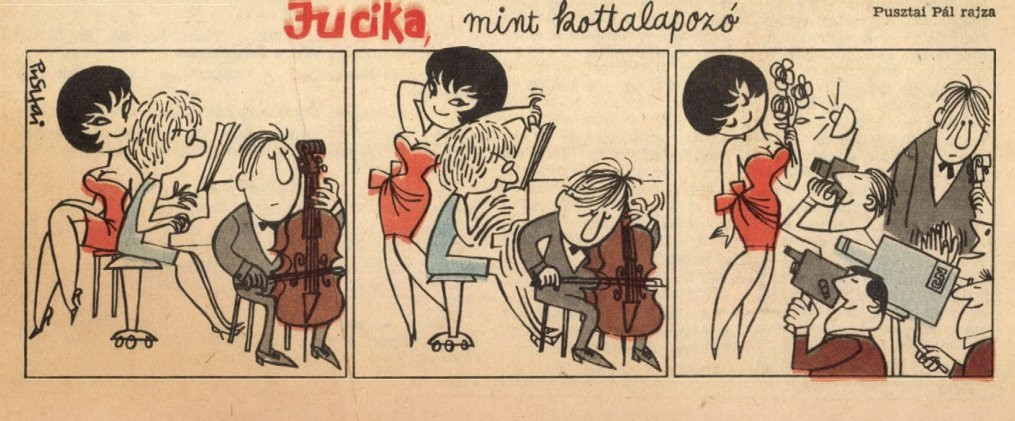
Jucika Daily originated on Twitter before migrating over to Bluesky when everyone realised that the place had become a Nazi bar. It's an account that posts Jucika strips, with Jucika being a mostly wordless Hungarian comic strip that ran from 1957 up until its creator's death in 1970.

Jucika centres on the life and times of an attractive young woman called Jucika and the various misadventures she has. She is depicted as being somewhat saucy, risqué and romantically forward, but the comic mostly parodies sexist attitudes rather than objectifying Jucika herself. Indeed, more often than not, Jucika is shown taking advantage of the sexist attitudes of the men around her in order to put herself at an advantage.

The Jucika Daily account posts comics from the 500 strip strong Jucika archive every day, and often includes helpful context in the alt text for each image. While the comics are almost always entirely free of dialogue, there are occasional Hungarian terms that appear on signs and suchlike, so the creator goes out of their way to explain these things where necessary.

At the time of writing, the account's creator is facing a large medical bill for an emergency kidney operation, but they are continuing to post strips while promoting their crowdfunding efforts. Even if you have no intention of handing over money to a complete stranger on the Internet, do at least go and check out the comic strips — they will make you smile.

CheapShow

The CheapShow podcast is ostensibly a show about going through the bargain bins and Poundlands of Great Britain and coming back with the treasure from amongst the trash, but really it's an excuse for best friends Paul Gannon and Eli Silverman to hang out and get very silly with one another — and to include us, the audience, in with their nonsense.

CheapShow has a number of regular features, including The Price of Shite, where Paul and Eli have to guess the prices of various pieces of tat purchased from charity shops; Off-Brand Brand-Off, where one or the other does a blind taste test of branded and unbranded variants of a particular product to determine which is best; and Eli's Country Urban Noodle Test-lab Kitchen, in which the pair taste-test different varieties of instant noodles. Alongside these, which tend to rotate in and out with each episode, the pair also often go on real-life "walkabout" episodes, where they decide to follow a walking tour on a route that falls outside of the usual "tourist" spots in London, and perhaps learn something along the way.

CheapShow works so well because Paul and Eli have magnificent chemistry with one another, and brilliant senses of humour that will resonate well with anyone around the age of 40 or so — particularly those who enjoy a good bit of old-fashioned British toilet humour. Paul and Eli are also both thoroughly lovely chaps outside of the podcast, and they deserve your support.


That'll do for today. I hope you find some enjoyment from these — I certainly have!


Want to read my thoughts on various video games, visual novels and other popular culture things? Stop by MoeGamer.net, my site for all things fun where I am generally a lot more cheerful. And if you fancy watching some vids on classic games, drop by my YouTube channel.

If you want this nonsense in your inbox every day, please feel free to subscribe via email. Your email address won't be used for anything else.

#oneaday Day 550: I'm so tired of online

I've had to block two different people on two different platforms today, both for the same reason: showing up uninvited and spewing some sort of borderline-abusive quasi-scolding because they happen to disagree with something rather innocuous that I had said. The details don't really matter — though if you must know, they really were innocuous opinions, firstly on the fact that localisation into English is not "censorship" (which it isn't, and if you're already typing an angry comment, I invite you to stop, take a deep breath, and just leave), and secondly, that it was surprising someone with terrible handwriting and an obvious lack of care in what they were writing could actually spell a rather complicated surname correctly. Hardly the stuff of epic meltdowns, I'm sure you'll agree — although the localisation topic does tend to bring some of the absolute worst people on the Internet out of the woodwork.

I have a zero tolerance policy for rudeness these days. If a complete stranger were to show up at my door and start hurling abuse at me, I would slam the door in their face. And as such, if a complete stranger decides to show up at my digital door online and start hurling abuse, I will gladly slam that door in their face, too. The platforms on which I blocked these two particularly odious individuals today — my other site MoeGamer, and my Bluesky account — both have pretty robust self-moderation tools that allow you to put nasty little piggies out of sight, out of mind, permanently.

My favourite moderation tool in this regard is YouTube's "Hide user from channel" function. YouTube does many, many stupid things, but this little option is a work of genius. Effectively acting as a shadowban, using this function on a user not only makes the comment you used it on disappear from everyone else's screens, including yours, it also prevents any future comments from that person from appearing on any of your videos. However — and here's the good bit — the user in question has no indication that this has happened to them, meaning they can quite happily continue spewing their hateful rhetoric "at you", and you will remain completely oblivious, while they inevitably get more and more frustrated. This is just delightful.

But you know what? I'm tired. It sucks that these mechanisms have to be in place for a quiet life online these days. And I'm increasingly fatigued with the very idea of putting myself out there — for what, exactly? — only to get chucklefucks who are incapable of responding to a post without resorting to The Usborne Big Book of Logical Fallacies crapping up the comments sections.

I don't do anything online with the intention of pissing people off, or even being a little bit provocative. I'm honest about things — I'm honest about the person I am, I'm honest about the things I feel and believe, and I'm honest about the things I enjoy. The thing I am most honest about is that I have absolutely zero desire to argue with anyone online, which is why, as a general rule, on platforms such as my YouTube channel and MoeGamer, I make a specific effort to focus on the good and the positive.

Yes, I rant and rave and complain a fair bit here — I will freely admit that! — but this place is for me. It's my place for self-expression, for self-therapy, for processing my own thoughts, feelings and emotions, and it just happens to be publicly accessible. That does not mean I crave sweaty Internet-poisoned dudes in my mentions arguing with everything I say. I am more than enough sweaty Internet-poisoned dude for myself; I certainly don't need any more.

It might be time for another social media break over the holidays. I've already dialled things back a lot from where I was, which is good. But the holidays promise to be a nice time with family, so I'm looking forward to enjoying the peace and quiet. And that peace and quiet will have to be, at least partly, of my own creation.


Want to read my thoughts on various video games, visual novels and other popular culture things? Stop by MoeGamer.net, my site for all things fun where I am generally a lot more cheerful. And if you fancy watching some vids on classic games, drop by my YouTube channel.

If you want this nonsense in your inbox every day, please feel free to subscribe via email. Your email address won't be used for anything else.
#oneaday Day 543: Tabbed browsing

I like browser tabs. I think they were a good invention, and a good addition to modern user interfaces in general — although not universally, as some application and website designers seem to think.

I find it convenient to be able to switch back and forth between things I might need to keep looking at. But I quite regularly come into contact with opinions that make me feel like I'm not using them in the same way as a lot of other people on the Internet.

For example, these are my tabs that are open right now:

Yes, that's all of them.

And yet just a few minutes before I started writing this entry, I saw this Bluesky post from Aidan Moher, one half of the delightful FunFactor Podcast that I've extolled the virtues of previously on this site. (Twice, in fact.) The fact the post is from Aidan isn't particularly relevant to what I'm talking about here. I just thought I'd take the opportunity to plug the excellent podcast he's involved in.

What Aidan's talking about here is by no means unusual, but it is completely alien to me. I have never left a browser tab open longer than 24 hours, and even then it's only to remember something that I will need in the very immediate future; in most cases I will use either a bookmark or a note in Google Keep instead and close a tab when I'm not using it.

This is the bit where I, apparently, differ from the "norm": when I'm done with the contents of a tab, I close it. Why would I leave it open if I no longer need that information right now?

These are my tabs right now, incidentally:

A few more, due to me checking the links on things that I've mentioned above, but all still mostly relevant to what I'm doing right now. In fact, hold on.

There. I don't need my email right now, so I closed it. See how easy that is? In fact, you know what?

Fuck yeah. Two tabs. One window. I probably don't even need Bluesky right this moment. In fact, yeah. Let's remove all distractions.

Hoo boy. I bet some of you are getting the collywobbles right now. How can this human being function with only one tab open? Quite easily, as it happens! The Thing I Am Doing Right Now is Writing A Blog Post, so that's all I need to have open. If I needed to research something specific while I was writing, I would have a tab open for it (or perhaps a separate window so I could see the research materials side-by-side with my post while I was writing it) — but since I don't, I don't have anything else open.

I hear horror stories about people having literally thousands of tabs open at once, and all I think when I hear that is… how the hell did you get yourself into that situation? This, for me, is the threshold of when it is Time To Close The Entire Browser And Start Again:

You know, the point where if you don't know a site's favicon, you're never going to find the right tab again? (It probably says something that I actually found it very difficult to find enough websites to open that many tabs without resorting to stuff like PornHub and Wikipedia.) Honestly even this is uncomfortable:

Basically I reach that right margin — the point where tabs start to contract and become less useful — and I find myself contemplating existence. Once you get to this point — which is everything on my Bookmarks bar, incidentally — I feel like you really start questioning whether you can feel God's light any more:

Like… help me out here. How is that useful? This isn't even a lot of tabs before it becomes a nigh-unusable mess of icons, and there are people out there using hundreds or even thousands of tabs at once? How do you function? How do you sleep at night?

There, that's better. Sorry, was hyperventilating a bit.

But seriously, I don't understand this peculiar relationship some people seem to have with tabs. Are you the sort of person who reads a magazine or a book and then just leaves it lying around randomly in your house, open on the page you last read? Do you open all your emails in individual windows and then leave them all open? Do you have over a hundred active WhatsApp messaging groups?

I ask these questions because I know there are people who do those things. And yet I, as someone who can often be disorganised and messy, is definitely autistic and quite possibly has ADHD tendencies (though those are undiagnosed, so I don't wish to concretely label myself in that regard) feel physically uncomfortable if more than about five tabs are open at once — and the concept of leaving some tabs open for a week or more is completely alien to me.

Browser tabs might have been a mistake for some people, apparently. But I feel like I'm using them "correctly", if such a concept exists. Put your shit away when you're done with it. It's very easy to do that in the digital realm. Just click that little cross button!

And mobile browsers who think I might want "tab groups"? I do not want "tab groups". Please stop adding new tabs to "tab groups" seemingly at random based on some indeterminate (and possibly inconsistent) context clues that I am not privy to. Just follow the basic rules of the Old Web: open a new tab if you're taking me off the website I'm on; just change the page if you're taking me to a different page on the same website.

Am I the only one who remembers that?


Want to read my thoughts on various video games, visual novels and other popular culture things? Stop by MoeGamer.net, my site for all things fun where I am generally a lot more cheerful. And if you fancy watching some vids on classic games, drop by my YouTube channel.

If you want this nonsense in your inbox every day, please feel free to subscribe via email. Your email address won't be used for anything else.
#oneaday Day 530: My way is always better

The review embargo for the "Analogue 3D" FPGA-based N64 clone system came up yesterday, and as is usually the case with such things, about a bazillion reviews all dropped at the same time. The machine looks like a nifty bit of kit — although calling your brand "Analogue" and then not actually having any analogue outputs on your device is a bit weird — and has been reviewing well. As an owner of a MiSTer Multisystem 2, I have no real need for one — just as well, since ordering Analogue stuff is an absolute fucking nightmare — but I'm glad this thing exists and, moreover, appears to be pretty cool.

What has been less cool are the inevitable arguments that have been breaking out in the comments of pretty much every single video and article I have seen on this thing. It's utterly ridiculous to see grown men (and I would place good money on it being all men) of a certain age all getting pissy over how different people choose to experience retro games.

Here's my feelings on the subject: I don't care. Really! I do not give the slightest shit, so long as you're having a good time and you aren't causing anyone else any trouble.

If you want to set yourself up with a MiSTer stack you built yourself, fab. If you want to buy a MiSTer Multisystem 2 to take the hard work out of building an FPGA device, great. If you want to buy a SuperStation One, I hope you love it. If you're running Batocera on a mini PC, more power to you. If you do all your retro gaming on an Anbernic handheld running its stock OS, have fun. If you've spent several weeks finding the perfect alternative operating system for an Anbernic handheld, I hope you've had a fulfilling time doing so. If you're an original hardware junkie with a massive physical collection, can I come and visit? If you have your childhood console and nothing but an Everdrive, amazing! And I'm probably contractually obliged to mention that if your experience with retro gaming begins and ends with an Evercade or Super Pocket handheld, that is 100% fine, too.

Y'see, the important thing with enjoying retro games, to me, is, funnily enough, the games themselves. So long as you're able to experience the games you want to play in the way you enjoy experiencing them, it absolutely does not matter how anyone else wants to do it.

And yet you just have to look through any of these comment threads to see the FPGA nuts arguing with passionate advocates for RetroArch; Windows vs Mac OS vs various flavours of Linux; "download for free!" types against "I prefer to buy official rereleases" people. Basically, if there are two opposing viewpoints possible in this area — and there are quite a few of those — you can count on representatives of those viewpoints all yelling at one another.

Why? Why does it matter to you that some people think the Analogue 3D is a cool device, and you don't? Why does it matter to you that you use software emulation on your Mac and some people prefer to use an FPGA solution?

It's just another example of the Internet being constantly, unnecessarily adversarial, and it's really rather tiresome. As I say, so far as I'm concerned, I have no personal pressing need for an Analogue 3D, as I already have a suitable solution for enjoying N64 games in place — but I absolutely, definitely do not begrudge anyone their desire to add one to their collection! So if you happen to be one of the people lucky enough to have one coming your way soon, I sincerely, absolutely hope you enjoy it. And that you play Beetle Adventure Racing if you haven't already.


Want to read my thoughts on various video games, visual novels and other popular culture things? Stop by MoeGamer.net, my site for all things fun where I am generally a lot more cheerful. And if you fancy watching some vids on classic games, drop by my YouTube channel.

If you want this nonsense in your inbox every day, please feel free to subscribe via email. Your email address won't be used for anything else.

#oneaday Day 525: Less than diVine

Apparently the erstwhile Twitter and Bluesky founder Jack Dorsey has funded a relaunch of the social video service Vine in the form of "diVine", a new app/service that not only does what Vine did, but also has an archive of "more than 100,000" Vine videos from before the service shut down.

Vine, for the unfamiliar, was a service where you could post six-second looping videos. And that was pretty much it.

Some people I've seen are really excited about this and I do not understand it. To my eye, Vine's six-second videos were not only the height of pointlessness, they were the beginning of one of my least favourite evolutions of the Web: the obsession with "short-form content" that has led us to today's TikTok-obsessed society, and the fact that some people would inexplicably rather get their news in vertical video form from someone holding a camera too close to their face, yelling and presenting subtitles for what they're saying one word at a time in an obnoxiously loud font.

To some folks, Vine was the height of comedy, and I still don't get it. I've seen supposedly popular Vine skits and found them painfully unfunny. To others, it was a place to enjoy music loops, but I'd rather listen to full tracks rather than six-second loops. To others still, I'm sure it was a place to perv on girls dancing (which is, to this day, one of the first things many people suggest to me when I indicate my distaste for TikTok), but if I want to get my rocks off to sexy girls, the Internet has been built on that for decades.

When Vine was originally a thing, I downloaded it to see what all the supposed fuss was about, but deleted it in less than an hour after completely failing to understand the appeal. I had absolutely no desire to make six-second videos of my own, and the six-second videos the app had put in front of me as a new user did not convince me of the platform's value as a means of expressing oneself.

Like I say: to me, Vine was the beginning of the brain-addled, attention-deficit Internet of today, where no-one is capable of focusing on anything for more than about six seconds. I didn't want to support it back then, and I'm certainly not celebrating it coming back now.

Interestingly, this sort of ties in with something else I wanted to talk about, which was that Metroid Prime 4 previews have been met with a certain degree of consternation following the reveal of an apparently quite annoying "sidekick" character. I can't comment on whether or not he actually is annoying myself as I haven't really looked into any of the coverage as yet, but what I did find interesting was the following Bluesky post:

Alexa Ray Corriea
‪@alexaray.bsky.social‬

You wanna know why we're having nag line discourse in 2025? Because developers know we're fighting an attention economy war we'll lose no matter what. Players don't read, have TikTok open next to them, god forbid we are scared you miss something and then blame us for not giving you all the info.

"Nag lines" are those moments when a sidekick or companion character continually bugs you to do something in a video game, with one of the most notorious examples being the now-elderly "Shoot the Hinges" YouTube video. These days they tend to be a little more elaborate, but they're widely disliked by a lot of people for either stating the obvious or giving away things that the player could have otherwise discovered organically. In some cases, games that launched with extensive "nag lines" ended up patching them out after people complaining — Alexa Ray Corriea, author of the above Bluesky post, cites Horizon: Forbidden West as just one example.

But she also has a point. Nag lines are there because of the not-unreasonable assumption that a statistically significant proportion of people playing a game aren't really paying attention. Whether it's because they're listening to a podcast, watching a YouTube video or stream, scrolling through social media, posting in group chats, flipping through TikTok, swiping people on Tinder or whatever it is people do these days, their attention isn't 100% on the game, because today's Internet practically encourages you to act like an ADHD squirrel rather than settling down and focusing on anything.

And to me, Vine was the beginning of that. Actually, that's not quite true; I was very resistant to joining Twitter in the beginning, because I wasn't a big fan of the microblogging format for similar reasons, but I got over that and found some value there. Vine, though… I never found that value there. I never understood what it was for, or what the appeal was. And I firmly believe that Vine and its subsequent imitators like TikTok had an incredibly adverse effect on anyone who found themselves addicted to them, because they normalised and commodified short-form content and turned people into dribbling consumers of content.

I feel like this is a problem we need to address. Actually, I feel like we're long overdue addressing it. Because at the moment the norm, particularly in big-budget triple-A games, which is where "nag lines" are most frequently heard, is to pander to the lowest common denominator in terms of attention span and intelligence, and that results in experiences that are annoying and patronising to anyone even slightly above that minimum basic standard.

But the statistics back it up, unfortunately. Do you know the most depressing YouTube analytic? It's "watch time", which indicates that a significant number of people will click into a video, watch it for less than ten seconds and then click away. The same is true with websites; the assumption — which is, unfortunately, not too far from the truth — is that people will decide whether or not to stick around within less than five seconds.

There is so much competing for our attention online at any given moment, and the modern Internet has conditioned many of us to believe that we must consume as much content as possible, as quickly as possible. A member of a Discord I'm in once proudly explained how they "kept up" with all the content they wanted to consume, and it was a frankly terrifying account of watching some things at double speed, trusting AI summaries (which, let's not forget, are frequently wrong) and never actually taking time to really enjoy and digest something.

I am, at least, thankful that the entire world hasn't gone the short-form, attention deficit route. I am presently playing through The Legend of Zelda: Tears of the Kingdom, and that game couldn't be further away from this whole philosophy if it tried. No nag lines, no pressuring you to constantly be doing, no constantly rewarding you for every little meaningless thing you do, no achievements, no social features — just a big ol' world to explore, with lots of things scattered throughout it that you'll only ever stumble across by accident if you're being curious, taking your time and really drinking everything in. (I say all this with the caveat that the Switch 2 version features a certain amount of ADHD gaming features such as a "daily bonus" you can access via your mobile phone, but all this stuff is easily ignored — and by that I mean "it doesn't appear unless you specifically ask for it", not "it only does a few little pop-ups" — and can be turned off altogether if you find it intrusive.)

I've said many times over the last couple of decades that I don't feel like the modern world is built for me at all. And I mean that in numerous different ways. I am thankful that I still have a few ways to escape from the sheer manic energy of it all, but I worry that one day it won't be possible to hide from all this any longer.

In the meantime, "diVine" can go fuck itself. Actually, no. I will give it a moment's praise for the fact it is specifically weeding out AI-generated slop and not allowing it on the platform. But then I will still tell it to go fuck itself.


Want to read my thoughts on various video games, visual novels and other popular culture things? Stop by MoeGamer.net, my site for all things fun where I am generally a lot more cheerful. And if you fancy watching some vids on classic games, drop by my YouTube channel.

If you want this nonsense in your inbox every day, please feel free to subscribe via email. Your email address won't be used for anything else.

#oneaday Day 508: Pondering a new video idea

I play a lot of classic games on my YouTube channel, and that's not going to be changing any time soon. But I'm always pondering interesting new things I might be able to do with the channel, and something popped into my head earlier.

What if I do some videos specifically about programming in Atari BASIC, with an aim to showcasing what an interesting, flexible language it is — particularly compared to some other micros' BASICs — and basing the videos on the numerous tutorials published in magazines like Page 6 and Atari User? (Crediting the original writers, obviously.)

My thinking behind it comes from several perspectives: one, there is a niche interest "market" in videos about programming for classic computers, as evidenced by the thoroughly lovely Yawning Angel Retro channel, who specialises in programming the Amiga with the AMOS language.

Two, I just think it would be an interesting twist on what I do on the channel.

Three, I will probably learn something from it — albeit something that may not necessarily be especially "useful" in the modern world.

Four, it's something to do with the magazines I've been acquiring besides just doing flipthroughs of them (which I also intend to keep doing on an occasional basis).

And five, it's something a bit different to do with the computer stuff. I'm not exactly bored of doing the games — there are still myriad titles I haven't covered on both Atari 8-bit and ST! — but I have reached a point where I want to do something a little different. This is part of the reason I've done so much console stuff on the channel recently — that and the MiSTer Multisystem 2 making it so easy to capture from all manner of different platforms — but I'm always conscious that the backbone of my channel was built on Atari home computer stuff.

I think I will try an experiment in the coming weeks and months. I will start with the absolute basics (no pun intended) for the sake of those who have never programmed in '70s/'80s computer BASIC, and gradually move on to the Atari specialisms: graphics, sound, manipulating the Display List, Player/Missile Graphics and all manner of other things. Some of these things I've never understood, so I feel like taking the time to make a video version of some of these tutorials may well allow me to improve and advance my own knowledge — something I've always kind of wanted to do, but never really made the time for.

In time, maybe I'll even be able to Snorkify some Atari BASIC games. But let's not get ahead of ourselves, shall we…?


Want to read my thoughts on various video games, visual novels and other popular culture things? Stop by MoeGamer.net, my site for all things fun where I am generally a lot more cheerful. And if you fancy watching some vids on classic games, drop by my YouTube channel.

If you want this nonsense in your inbox every day, please feel free to subscribe via email. Your email address won't be used for anything else.

#oneaday Day 504: Enshittification comes for TV Tropes

Like it or loathe it — and there's an increasing number of people in the latter camp in more recent years, for reasons I'll get onto — but TV Tropes is an Internet institution.

At least it was, until today, when they decided that enough was enough with all those pesky users who didn't want their privacy invaded and their data sold and thus were running adblockers. Now, when attempting to view a page on TV Tropes, you get this screen:

TV Tropes
Please allow ads on our site or subscribe

Looks like you're using an ad blocker. We rely on advertising to help fund our site. Please turn off your ad blocker and refresh the page.

Allow Ads
Subscribe
Login

This will probably be familiar to anyone who has viewed any number of websites in recent years. It's a step back from being a complete paywall, in that they'll allow you in if you just disable your adblocker a little bit, pweeeze, we'll only share some of your data with unknown third parties. But it's still a shitty move — particularly for a site like TV Tropes, which has always been a community-driven site. In fact, without the community, TV Tropes wouldn't exist.

As writer Aidan Moher put it earlier on Bluesky:

Aidan Moher
@aidanmoher.com
(Games Journalist)

TROPE: Popular website built entirely on unpaid community labour dies after blocking content from community unwilling to submit to exploitative data collection monetization methods.

That's right. Part of the reason why TV Tropes was so beloved, even with its problems — we're getting to those, I promise — was because it was built by the people. Much like Wikipedia, albeit on a somewhat smaller scale, TV Tropes was absolutely dependent on its enthusiast, volunteer authors and editors. Without those people tirelessly cataloguing examples of tropes used in all manner of media to a frighteningly comprehensive degree, there would be no TV Tropes.

But… now what? People are not going to pay for TV Tropes, and an adblocker is pretty much essential for browsing the modern Internet if you want an experience that is in any way tolerable. So now someone who might otherwise have wanted to contribute to the community effort that is TV Tropes is now locked out from doing so, with their only choices being to pay up or open the floodgates to God knows whatever advertisers are doing these days. (No, I'm not opening up a non-adblocked browser just to see what it's like now.)

Not only that, but this is essentially TV Tropes saying that it wants to profit from the unpaid labour all those volunteer contributors and editors have put in over the years. Because you can bet your sweet bippy none of that $5 a month/$25 a year subscription fee is going anywhere near the pockets of the people who have really made the site what it is today.

This, obviously, sucks, and is just another example of enshittification. Specifically, it's almost a textbook example of what Cory Doctorow was referring to in one of his first pieces he wrote on the subject, The Enshittification of TikTok:

Here is how platforms die: first, they are good to their users; then they abuse their users to make things better for their business customers; finally, they abuse those business customers to claw back all the value for themselves. Then, they die.

I call this enshittification, and it is a seemingly inevitable consequence arising from the combination of the ease of changing how a platform allocates value, combined with the nature of a "two-sided market", where a platform sites between buyers and sellers, holding each hostage to the other, raking off an ever-larger share of the value that passes between them.

In the case of TV Tropes, you have your "users", who are the people who browse the site for fun, entertainment or in the hope of learning something; then you have your "business customers", who are the volunteer contributors, without whom the site wouldn't exist; the abuse of those "business customers" through locking them out unless they subscribe or open the adblock gates is the stage we're at now. I'd argue in this instance we skipped the usual "abusing users" part and jumped straight to "abusing business customers and users".

As I say, this clearly sucks, and it seems like a sure-fire way for TV Tropes to almost immediately make itself completely irrelevant to the rest of the Internet.

But! That might not be the worst thing in the world. Hear me out.

This is not to put down the incredible amount of time and effort TV Tropes contributors have spent cataloguing myriad tropes and even more countless uses across many, many different forms of media. I absolutely do not have an issue with the people who have taken the time to do that, because those people are creatives; they have made something.

No, the problem with TV Tropes is that, over time, it became a resource for the lazy. This is not TV Tropes' fault itself, but rather it's an extension of a general sense of dwindling media literacy across society. Why think for yourself about something you've just seen, played or heard, when there's a 3 hour YouTube video essay waiting to "explain" it to you in what appears to be authoritative detail? Why ponder the specific way a movie, TV show, video game or book chose to present its narrative, when you can just look it up on TV Tropes and get a ready-made list of "discussion points" that you can "borrow" and use for yourself? (Certain members of the "3 hour YouTube video essay maker" group are definitely prone to this, with some pretty much quoting TV Tropes pages verbatim in the name of "analysis".)

I have had conversations with people who will not even consider starting to watch a new TV show if there isn't a "companion" podcast (official or otherwise) ready and waiting to explain each and every episode to them. This is both frightening and baffling to me! Particularly when it comes to media that is designed to be fairly undemanding, mainstream entertainment!

TV Tropes isn't solely to blame for this, of course — blame can also be laid at the feet of reactionary, short-form video content on platforms like TikTok and YouTube Shorts as well as the generally dwindling attention span of people online these days — but it is a symptom of a broader problem. And one of those sources of that problem going away might not be a terrible thing in the long term, as callous as that might sound to those who have poured hours of time and effort into researching things for that site.

Regardless of your feelings on TV Tropes — on the whole, I've always been fond of it, but then I've always used it more as entertainment than a source of "serious" research or analysis — this is an unfortunate day for an Internet institution, and I suspect it absolutely will not be the last longstanding website to take this direction.

Once Wikipedia and the Internet Archive go that way — and no, them occasionally badgering you for donations doesn't count — that's when you know we're really fucked. Let's hope that never happens.


Want to read my thoughts on various video games, visual novels and other popular culture things? Stop by MoeGamer.net, my site for all things fun where I am generally a lot more cheerful. And if you fancy watching some vids on classic games, drop by my YouTube channel.

If you want this nonsense in your inbox every day, please feel free to subscribe via email. Your email address won't be used for anything else.

#oneaday Day 502: Another reminder that traditional games journalism is all but dead

It emerged today that the entire Features team of the gaming website TheGamer has been laid off, after owner Valnet decided that it likes money more than having actual employees who are capable of writing.

I'll admit that I was never a particular fan of TheGamer for a variety of reasons, but regardless of my own personal feelings about the site, this sucks. It's the latest instance of something that has continued to suck for a while now, with even big names of the games journalism industry — if such a thing even exists any more — suffering widespread layoffs, cutbacks and significant worsening of what they offer for their audiences. Enshittification, if you will. And yes, even longstanding behemoths like IGN and Eurogamer have been subject to this. According to VideoGamesChronicle and PressEngine, more than 1,200 journalists have left the business entirely in just the last two years — and that's not taking freelancers into account. (That puts the figure nearer 4,000.)

Honestly, seeing this happen to TheGamer isn't a surprise, though. This is just what the site's owner, Valnet, does. They buy up sites that were once successful, rip out everything that made them distinctive and unique — i.e. the people who worked hard on establishing the site's identity — then proceed to replace everything with slop. I would not be surprised at all if in short order we start seeing casino advertorials and AI-generated garbage on what remains of TheGamer.

Valnet and their big rival, Gamurs, are a scourge on what was once a thriving sector. They both take this model: they buy "verticals" (ugh) that they want to add to their portfolio, and then think that just because they now own, say, Polygon, that they have unlocked an infinite money glitch. But they have not — for a variety of reasons, not which is the model on which ad-supported commercial games journalism has been forced to operate for years now.

This article by Luke Plunkett of Aftermath sums it up nicely: these sites had been stuck in operating in the same way as 2000s-era Kotaku, which is to post as much as possible, as often as possible, and it didn't matter too much if nothing of any real substance was being said. It was all about the content.

I've been through this, too. During my time on both GamePro and USgamer, I was specifically hired to be someone who operated on a different time zone to the rest of the staff, with my responsibility being to ensure that there were things ready to read on the site by the time North America woke up. These typically end up being "news" posts, which, in the churn of having to produce so much content every day, often end up being little more than you could learn from just following a company's social media account or signing up to their mailing list.

"Guide content", that odious practice where every single site has to have 5,000 articles explaining every minutiae of every hot new game (and often badly, to boot), is also at play here, with the entire Internet gradually being flooded by "what is today's Wordle solution?" posts, individual articles explaining each and every shrine in The Legend of Zelda (often badly) and inconclusive, vapid answers to questions no-one was really asking with any great seriousness. It's all about the pursuit of endless, relentless content, and it doesn't matter if it's any good or not, it just has to be fresh, constantly updated and now.

And it sucks! It's not doing anyone any good! It's not making the writers on these sites look good, it doesn't make the games they're covering look good, it doesn't make the site look good, and it doesn't inform the readership of anything worthwhile. It just means those readers have something new to scroll through every time they refresh the page while they're staring, glassy-eyed, at their phone for the 14th consecutive hour that day.

It sucks that it has to be this way, too, because the presence of a specialist press is important. The idea that we might, one day, be completely without a games press altogether is absolutely baffling, but with every round of layoffs like the one we've seen today, we get closer to that dystopia.

Reader-supported sites such as Aftermath, 404 Media (not games, but relevant) and Giant Bomb are doing great work, but it remains to be seen how sustainable that model is — particularly as so many of the bloody things are starting to pop up that it is no longer possible or affordable for anyone to be "widely read" when it comes to good-quality games coverage. That's not necessarily a bad thing, given that back in the '80s and '90s we tended to be loyal to individual magazines rather than reading all of them, but it's a big shift in how the Internet has traditionally worked.

I don't even know what to think any more. It's bleak out there. And I wonder if it's ever going to get better again. I just want to have some fun websites to read again, by people who know their craft and are passionate about it. We used to have that — why can't we have that again? Why can't we have 1up.com again?

Those are rhetorical questions.


Want to read my thoughts on various video games, visual novels and other popular culture things? Stop by MoeGamer.net, my site for all things fun where I am generally a lot more cheerful. And if you fancy watching some vids on classic games, drop by my YouTube channel.

If you want this nonsense in your inbox every day, please feel free to subscribe via email. Your email address won't be used for anything else.