
#oneaday Day 443: MiSTer whatchacallem whatcha doin' tonight

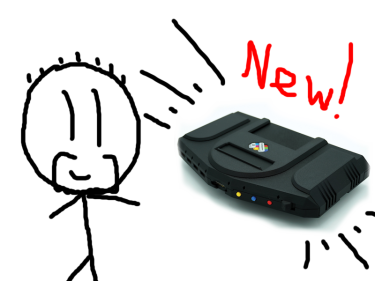
So! My MiSTer Multisystem from the lovely folks at Heber and the Retro Collective arrived yesterday, and… I've been spending a lot of time setting it up. This was entirely expected, so I'm not annoyed or anything — though I was a tad surprised that the update_all script took nearly 24 full hours to complete. It's my fault for running it on Wi-Fi in the room that has the weakest Wi-Fi signal in the whole house. I thought before I started, "I wonder if I should do this over Ethernet," and I knew on some level even then that the answer to that was an emphatic "yes", but still.

Anyway, it is done now, and now I have a working, functional MiSTer Multisystem up and running. There's one thing I haven't been able to test thus far, which is analogue connectivity to a CRT TV — it seems the cable I bought to use with the MiSTer isn't quite right, so I have some replacement options arriving tomorrow — but from a very brief play earlier, I'm very impressed so far. While there is plenty of scope for nerdy nerds to get deep into the weeds tinkering with things and trying to "optimise" their experience, after running update_all and installing some games, the whole thing is remarkably straightforward and easy to use, particularly if you're just connecting up to an HDMI display.

On the offchance you don't know what a MiSTer Multisystem is, it's… well, it's sort of complicated. MiSTer itself is an open-source project that uses FPGA hardware emulation to recreate the experience of using classic computer and gaming hardware. It is different from software emulation for reasons I don't entirely understand, but the gist of it is that an FPGA chip can be reconfigured by issuing it commands, and in doing so you can make an extremely accurate simulation of a physical piece of electronic hardware. The upshot of it is that FPGA emulation has the potential to be much smoother and more authentic to the original experience than software emulation is.

The MiSTer Multisystem — or, to be more accurate, the MiSTer Multisystem 2, which is what I've got — is an attempt to make MiSTer more accessible. For many MiSTer users, putting together a MiSTer system involved getting a DE-10 Nano little computer-on-a-board thing, plus some I/O boards, putting them altogether in a stack and then installing the software on an SD card. As hardware projects go, it's not especially complicated or super-expensive, but there was definitely a market for a more "consolised" experience. MiSTer Multisystem 2 takes all the pain out of the actual hardware side of things in that it's a ready-to-go console available in both digital (HDMI) only or digital-and-analogue (HDMI plus VGA and/or SCART) forms. The whole thing is pre-assembled, no need to build anything, and it's also not reliant on the DE-10 Nano, either, which can sometimes be tricky or expensive to track down.

You still have to set the software side of things up yourself, though this is made pretty straightforward through the aforementioned update_all script, which connects to the Internet and downloads pretty much everything you need apart from the actual games themselves — and even then, it will even download the arcade games that the MiSTer's various "cores" support, so once you've run it, you'll have things to play, ready to go, even if you don't add any of your own ROMs and disc images to the system.

MiSTer itself is modular and expandable, and so too is the Multisystem 2. A cartridge slot allows for the connection of "SNAC" (Serial Native Accessory Converter) cartridges, which allow you to plug in original control pads and accessories for a variety of systems, plus the system has 7 USB ports for connecting controllers, keyboards, mice, external storage devices, Wi-Fi dongles and any other gubbins that might be useful. There are also some slots inside the system itself, accessible by removing the special flaps at the side, though exactly what those are used for is not yet known.

But anyway! Once you're up and running, you pick something from the main menu to play, the "core" for the device the system is emulating will boot up, and then you're away. Some excellent video options allow for some quite convincing CRT emulation on HDMI displays, and if you have a model that supports analogue video output, you should be able to just plug in an RGB SCART cable and connect to a suitable display. I'm hoping to take advantage of that side of things when my new cables arrive tomorrow.

I have a lot of games still to transfer to the system, but I think I've earned a bit of a play for the rest of this evening. Hopefully by the end of tomorrow I'll have this thing up and running and ready for a whole heap of fun!


Want to read my thoughts on various video games, visual novels and other popular culture things? Stop by MoeGamer.net, my site for all things fun where I am generally a lot more cheerful. And if you fancy watching some vids on classic games, drop by my YouTube channel.

If you want this nonsense in your inbox every day, please feel free to subscribe via email. Your email address won't be used for anything else.
#oneaday Day 441: Is it actually impossible to recommend things to anyone any more?

I can't remember the last time I successfully recommended something to someone. Be it TV show, movie (not that I really watch movies any more), music or video game, it seems inordinately difficult to get anyone to give a shit about something you might feel quite passionately about — even if you're close with the person you're attempting to recommend something to.

I say this in the light of online Discourse™ right now being taken up almost entirely by breathless ejaculations in the direction of Hollow Knight: Silksong, which apparently now has a release date and everybody (except me) is enormously excited about to the exclusion of pretty much anything else in existence.

I've talked before, I think, about the phenomenon of "inverse hype", where the more something is talked up and talked up and talked up, the less I give a shit about it. It's happened with numerous things over the years for me: Star Wars, Mass Effect (I've still never even touched the third one despite quite enjoying the first two), Undertale (which I have since played and enjoyed) and now — and for the last seven years — Hollow Knight: Silksong.

It's the Internet's fault, of course. The seven-year long "joke" of responding to literally every video game announcement or livestream with "silksong when" quickly wore out its welcome and then proceeded to continue for nearly a decade. It's been so long now that I feel active antipathy towards Hollow Knight as a whole, despite it being a type of game I would typically rather enjoy. I don't want anything to do with Hollow Knight precisely because people will not shut the fuck up about it.

And part of that not shutting the fuck up also includes closing one's ears to any alternative possibilities. Already other developers are (perhaps wisely) moving their release dates so they don't "overlap" with Silksong when it eventually releases in early September.

The problem exemplified by Silksong, I think, is that apparently "The Community", whatever that actually means, is only capable of Giving A Shit about one Thing at a time. That Thing changes from moment to moment, but it's always something that has, for one reason or another, had both a lot of blanket coverage and a lot of speculation about it. And while that Thing is the Thing Of The Moment, no-one has any time whatsoever to even contemplate that other Things might exist, because if you're not "part of the conversation" while Thing is Thing Of The Moment, you might as well just kill yourself, you stupid, pointless, irrelevance, you.

It's probably a personal failing to be frustrated and resentful of this, but I've never really operated that way. There's the occasional thing that I enjoy jumping on board with to enjoy at the same time as everyone else — the last two were Mario Kart World and Donkey Kong Bananza — but other than that, I typically enjoy things at my own pace, sometimes a very long time after they were initially released. This often means that I "discover" something when it's outside of the mainstream public consciousness — if it was ever there in the first place, which in many cases for the things I personally enjoy, it wasn't.

Unfortunately, that lack of blanket coverage and generally mainstream "approval" is seemingly crucial for a lot of people, so if you recommend something that the person you're making the recommendation to hasn't heard of, typically, I find, you'll be dismissed or even ignored.

I suspect this ties in with the "well, why would I waste my time with a 65/100 game when I could be playing nothing but 95/100 games?" I'm sure many of you know my answer to this already — it's because the 65/100 games are, in many cases, more interesting and creative than the 95/100 games, and also because slapping numerical ratings on something unquantifiable is stupid. But too many times I've encountered the "well I read a review once that didn't like it" response to a personal recommendation — which I made because I knew the thing I was recommending would particularly appeal to the person I was recommending it to, if they'd give it a chance — and, at this point, it's just getting far too annoying to even attempt recommending anything any more.

The real problem at the heart of all this is doubtless that there are too many Things. The implication behind the "why should I waste my time with a 65/100 game" question is that an individual has a finite amount of time, and that time is somehow "wasted" if it is not spent "optimally", even if that time is being spent engaging with something that is entertaining, artistic, enriching. And "optimal" to a lot of people today means the mistaken assumption of the "objectively best" thing — a concept which doesn't actually exist.

Right now, while polishing off Donkey Kong Bananza, I'm also playing through Mystery Detective Archives: Rain Code, a game which came out in 2023. I'm willing to bet that I'm probably the only person playing that game right now, because two years ago might as well be the Dark Ages for some people.

Sigh. This really isn't worth getting worked up over, I know. It's just frustrating when you try and start a conversation and you feel like you're continually confronted with a blank wall with "silksong when" scrawled on it in crayon.


Want to read my thoughts on various video games, visual novels and other popular culture things? Stop by MoeGamer.net, my site for all things fun where I am generally a lot more cheerful. And if you fancy watching some vids on classic games, drop by my YouTube channel.

If you want this nonsense in your inbox every day, please feel free to subscribe via email. Your email address won't be used for anything else.

#oneaday Day 426: Dear me, I was...

Having finished No Sleep for Kaname Date, which I will try and make some time to do a proper write-up of soon, I decided, this evening, to play through Dear me, I was… from Arc System Works, a Switch 2 wordless visual novel type thing that is less than an hour long, and which I was pretty certain was going to be an emotional gutpunch. Sometimes you need a good one of those, and Dear me, I was… certainly delivers on that front.

I shan't say too much about the details of the game because, as I say, it's very short, and it's the sort of thing best experienced for yourself — so long as you're open to the idea of what is basically a short animated film with occasional very minor (but nonetheless meaningful in the context of the story) interactions.

The concept is simple: the game follows the life of an unnamed woman, from her earliest childhood memories up to her old age. Each chapter represents a particular part of her life, with each opening with one of the few interactive sequences in the game: her eating breakfast. It's surprising quite how much meaning is layered into these simple sequences, whether it's the way her breakfast evolves as she ages, or little things like how her child self leaves the tomatoes on the side of her plate.

Dear me, I was… is one of those games that is probably going to mean different things to different people, but at its core it's a story about the protagonist's relationship with art, and how she uses it to help process her emotions, connect with other people and reflect on her past. A number of things happen to our leading lady over the course of her life, many of which are rather mundane, but nonetheless meaningful to her as an individual. Some things are left a little ambiguous and open to interpretation, which will doubtless help each individual player to connect with the complete work in their own way, and other things are obvious, indisputable truths, but aren't dwelled on.

I feel like part of the point of the game as a whole is to reflect on the idea that life passes you by before you know it; while, when you're young, you might feel like an eternity stretches ahead of you, as you get older, things definitely feel like they start to accelerate in some ways. Sometimes this makes difficult events from the past easier to let go of or at least reflect on; at others, it makes it all the harder to process things.

The game definitely got me feeling things, and absolutely tearing up at numerous points throughout. I'm not sure I could tell you exactly what was making me feel the various emotions I felt over the course of the game, but it's testament to the game's excellent use of visuals and music to tell its wordless story that I felt those things at all. Of particular note is its use of colour; events unfold in three distinct "styles" as a reflection of the emotion of what is happening at any given moment — or perhaps the protagonist's mental state and feelings — and it hits surprisingly hard when, say, the colour fades from the world, and everything starts to be represented in shades of grey, or even just line art. Likewise, it's almost a relief when you see the beautiful watercolours return; a reflection of how everyone's life is full of ups and downs, and the only person who can truly understand one's own feelings is oneself.

To say too much more would probably be getting into spoiler territory, so I'll leave that there for now. Suffice to say that if you're the slightest bit open to video games as a storytelling medium — don't expect any sort of "mechanics", puzzles or challenge here — this is an essential play. Absolutely one of the most beautiful things I've experienced for quite some time, and highly recommended to those who like this sort of thing.


Want to read my thoughts on various video games, visual novels and other popular culture things? Stop by MoeGamer.net, my site for all things fun where I am generally a lot more cheerful. And if you fancy watching some vids on classic games, drop by my YouTube channel.

If you want this nonsense in your inbox every day, please feel free to subscribe via email. Your email address won't be used for anything else.
#oneaday Day 414: Two types of game

Finishing up Old Skies today (read my article on it over on MoeGamer!) and then jumping right back into Donkey Kong Bananza, I was suddenly struck with the clearest way yet to express something I've been pondering for quite some time. And it stems from the core differences between those two games.

I put it to you, dear reader, that there are just two types of video games: ones where someone watching asks "what's it about?", and ones where someone asks "what do you have to do?"

Old Skies? "What's it about?" (Time travel, regrets, grief, making your mark on the world.) Donkey Kong Bananza? "What do you have to do?" (Find all the bananas.)

Essentially what this boils down to is the game's main priority: does the game primarily exist to tell a story, or does it exist as a form of "play"? To put it even more simply, is it a "narrative" game, or a "mechanics" game?

There's crossover, of course — narrative games can have strong mechanics, and mechanics games can have strong narratives. But pretty much every game you'll ever play will strongly skew one way or the other, to such a degree that in some cases, fans of one won't enjoy something from the other category.

Donkey Kong Bananza is a good example of this. It's a mechanics game; the narrative setup is flimsy at best, and there's not really a "story" to follow as you go through. Instead, you visit a bunch of places, meet some characters, unlock new abilities, then use all of those abilities to explore the broader world and, as noted above, find all of the bananas.

The fact that Donkey Kong Bananza doesn't really have an unfolding story is enough to put some people I know off from playing it completely. And while I maintain that those people are missing out on one of Nintendo's finest games to date, I completely understand. For the longest time, I felt like I favoured narrative games to the exclusion of all else, but as I've grown older — and, perhaps more crucially, I've developed my knowledge of how games are designed, how they work and the many different approaches developers can take when constructing an interactive experience — I have a much more balanced approach: I can (and do) enjoy both. This, of course, stands me in good stead for my day job, which involves enthusing about everything from Atari 2600 and Intellivision games up to PlayStation and NEOGEO titles.

I suspect at least part of this also stems from the fact that I grew up playing exclusively mechanics games, because the technology didn't really exist to deliver narrative games effectively. Except that's not quite true; text adventures and early graphic adventures existed pretty much from when I was old enough to use the computer, but as a child, they often felt a bit too complicated for me, even as an avid reader. So the vast majority of games I played on my first gaming systems — Atari 8-bit, Atari ST, Super NES — were "what do you have to do?" games, where narrative was typically reserved for introduction and/or ending sequences, if indeed the game had any in-game storytelling at all.

Things started to change when we switched over to MS-DOS and Windows 3.1 for our daily driver computer. Point-and-click adventures really came to the forefront, with titles like Indiana Jones and the Fate of Atlantis and The Secret of Monkey Island proving that story-centric games could absolutely be a thing. And by the time I played Final Fantasy VII for the first time, I was absolutely all-in on video games as a storytelling medium, leading me to primarily focus on "what's it about?" games for the longest time.

In fact, you can see the evidence here on this blog how long this attitude lasted: a post which actually got showcased by WordPress.com, back when they actually cared about the community rather than garbage AI, highlighted my desire to play a racing game with a story. I felt that the racing game genre had been done something of a disservice by never having a game that took the Wing Commander approach of alternating narrative scenes with mechanics scenes, and on some level I think this might actually still be a fun idea… except I've played a few games where they've tried that, and the story scenes are just… not very good.

I'm not sure if it's just that the scenes weren't particularly interesting, inspiring or well-written, or if racing games really don't actually need a story to be fun — I suspect a little of both — but these days, I'm much more happy to let the racing game genre, a type of game in which "what do you have to do?" is so obvious that most people don't need to bother to ask, pootle along in the way it always has done. In fact, I've often found it quite refreshing to go back to games like the Project Gotham Racing series, where there's no open world or overcomplicated metagame to engage with, just a series of "levels" that you complete, one at a time, and gradually unlock harder challenges.

I suspect some games may even be different things to different people. Ultima IV: Quest of the Avatar is a good example; to one person, it's a "what do you have to do?" game, where the answer is "wander around, explore, beat up monsters, find treasure", while to another, it's a "what's it about?" game, where the answer is "proving your worth in the Eight Virtues and becoming the Avatar". In other cases — The Last of Us, say — the distinction is probably pretty clear-cut.

Anyway, that was my meandering thought for the day. You're welcome to borrow my theory for your own pointless discussions with your friends if you want to. I'll let you. Or you can just leave it to rot here on this forgotten corner of the Internet as we all, gradually, bit by bit, turn to dust. Your call, really.


Want to read my thoughts on various video games, visual novels and other popular culture things? Stop by MoeGamer.net, my site for all things fun where I am generally a lot more cheerful. And if you fancy watching some vids on classic games, drop by my YouTube channel.

If you want this nonsense in your inbox every day, please feel free to subscribe via email. Your email address won't be used for anything else.
#oneaday Day 409: Beneath the Old Skies

I've talked a bit recently about how the adventure game genre is probably in a better place than it's ever been — in fact, I think I'd even argue that now, it's better off than it was in its supposed heyday of LucasArts and Sierra in the early '90s.

The reason is games like Wadjet Eye's Old Skies, which I've played a good four hours of this evening. This is a masterfully put together adventure game in terms of involvement, emotional engagement and just being a plain compelling interactive narrative. While there are some who have criticised it for not having interesting "mechanics" — by that, what they really mean is that it doesn't have any puzzles they got stuck on — I think there's a strong argument to be made that the genre has moved beyond the necessity for being overtly and deliberately obtuse for the sake of inflating playtime.

Y'see, while Sierra and, to a lesser extent, LucasArts games put in deliberately complicated and sometimes baffling puzzles as a means of hiding the fact that their total runtimes were, in many cases, only one or two hours at most, today's adventure game developers have the resources, budget and ability to put together games that are much longer. As such, there's no real need for these games to artificially inflate their length through obtuse puzzles, because the core of what they offer — their narrative, and the player's involvement in it — is compelling enough to stand on its own merits.

This is definitely the case for Old Skies, which has a thoroughly interesting and enjoyable premise. You take on the role of Fia Quinn, a time-travelling agent who accompanies clients on recreational jaunts to the past in order to ensure that they don't get up to mischief or cause any paradoxes that are too significant. The nature of time travel means that there will always be a certain amount of impact on the future, reflected in the game world by flashes of purple light that signal a "Chrono-Shift", where something notable changes in the "present" due to interference in the past, but the Earth depicted in Old Skies also has sufficient technology to "Chrono-Lock" anything that is particularly important, protecting it from such instances.

Each main chapter of Old Skies focuses on one of Fia's jaunts to the past with her client. The first is a relatively short trip back to the New York of 2024 as a renowned scientist hopes to resolve some lingering regrets. Things… do not go entirely according to plan, setting what one would anticipate to be a template for the rest of the game. But interestingly, the second immediately subverts that expectation by being much longer, more involved and more complex, both mechanically and narratively. In this chapter, set in the "Gilded Age" of the late 19th Century, something still goes "wrong", but in an entirely different way, forcing both Fia and her client to work through a complex series of events in two closely related time periods (six months apart) in order to set things what is, to their best interpretation, "right".

The whole thing raises some interesting questions about the very ethics of something like time travel. How do you ensure someone's selfish actions don't make a real mess for everyone in the future? How, exactly, do you police such things? Who decides who and what is "important" to the coherence of the overall timeline — and how? Why were they given that opportunity?

I'm looking forward to seeing how the story evolves, and it also appears that this game is going to be pretty substantial by adventure game standards. At four hours to complete the first two chapters, and I believe at least seven in total, this is looking like a fairly beefy adventure, though its chapter-based structure also means that it feels nicely episodic, so you can leave it at a natural break and come back to it another day.

Thus far, I haven't really seen the problem that some reviewers argue is the game's "weak mechanics"; the game doesn't rely much on using inventory items on things in the game world to progress, but instead prompts you to think carefully about the pieces of information you gather, how they relate to one another and, in some cases, how closely related time periods might relate to one another, too. There are some particularly clever sequences in the second chapter, requiring you to jump back and forth to revisit the same locations six months apart and manipulate the information you find in order to secure an advantageous outcome for everyone involved… as much as is possible, given your own interference, anyway.

The game is beautifully presented, with some absolutely stellar voice acting and music, and some really nice animation on the main characters. It's also nice to see an adventure game breaking free from the seeming "obligation" that some developers feel to use '90s-style pixel art; Old Skies instead adopts a true high-definition look that feels like a true successor to the brief period of "Super VGA" adventures during the winding-down of the Sierra and LucasArts "golden age".

Anyway, I'm sure I'll have more to say in the coming days/weeks as I work my way through it on evenings where I feel like something a little more chilled out than Donkey Kong Bananza. In the meantime, if you're a point-and-click type, I can highly and confidently recommend Old Skies; it's another fantastic game from Wadjet Eye (developed by them this time, as opposed to the numerous other titles they've published in recent years) and well worth the £17 it costs. Take that, £75 video games!


Want to read my thoughts on various video games, visual novels and other popular culture things? Stop by MoeGamer.net, my site for all things fun where I am generally a lot more cheerful. And if you fancy watching some vids on classic games, drop by my YouTube channel.

If you want this nonsense in your inbox every day, please feel free to subscribe via email. Your email address won't be used for anything else.
#oneaday Day 408: Don't spoil yourself

One thing that I've become quite frustrated with in the last 10 years or so is the prevalence of "guide content" on video game websites. Guides and walkthroughs have always been a thing, of course, and I completely understand why sites feel the need to get guides up day-one when a big new video game comes out: they are freshly-squeezed, ready-mixed SEO juice just waiting to be taken advantage of, and if you're a site that makes the majority of its money from ad impressions, you would probably be foolish not to take advantage of the immediate thirst for knowledge that comes with the release of a new game.

Now, I won't be hypocritical and say I've never looked at a guide for a game. Some games, one feels, were designed in such a way that looking at a guide — particularly the Official Strategy Guide, back when those were still a thing — is near-essential if you want to see everything that the game has to offer. Take something like Final Fantasy VII's chocobo breeding, for example; while you probably could work all that out yourself, it would take a very long time to do so, and it would be hard not to end up resenting the time you'd spent on failed experiments.

But I feel like the deliberate, immediate posting of Guide Content the second a new game releases is destroying the sense of wonderment and discovery we should have with a brand new game. Hell, game developers themselves are absolutely spoiling their own games — one can't help but feel that Pauline's reveal in Donkey Kong Bananza would be a thousand times more impactful if we hadn't had it completely spoiled weeks in advance by Nintendo's own trailers — but all Guide Content does, for me, is instil a sense of FOMO, and that one should be playing the game as "efficiently" as possible. Consume content until next product, then get excited for new product, or whatever the quote was.

I've been deliberately trying to avoid looking at guides for Donkey Kong Bananza while I'm playing it, and I'm having a good time doing so. Of course, the game featuring a "checklist" of all the things you have and haven't found also instils that same sense of FOMO, even though you absolutely do not need to "find everything" in order to 1) have a good time with or 2) beat Donkey Kong Bananza. As such, I've found it very hard to resist just sneaking a peek at a guide or two just to fill in the few frustrating spaces I have left in my list. But that stops here and now! I'm going to get through the rest of the game at my own pace, and then use the game's own built-in features — you can buy maps with the in-game gold to show you where the collectibles are, but you still have to determine how to get there yourself — to finish the game to my own satisfaction.

Games shouldn't feel like work, and the risk you run when having a guide by your side at all times is turning them into a chore. Games like Donkey Kong Bananza, Zelda and suchlike are made to be enjoyed, savoured, experienced at the player's own pace; you absolutely lose something if all you do is immediately look up where everything is.

I will add at this point that none of this is to take away from the sterling work good guide creators do. IGN's guides are particularly impressive, featuring interactive maps and checklists so those who do want to play the game in that way can not only read the guide, but also mark off their progress. I just wish there weren't so many of them, and that looking up information for a game around launch didn't immediately bombard you with the temptation to spoil the shit out of it for yourself.

I guess it's all about self-control. GameFAQs has been a thing almost as long as the Internet has, after all; all that's happened now is that commercial sites are using guides to juice their own SEO. Which makes commercial sense, but also, speaking as someone who was laid off from a publication and immediately plonked on "Guide Content" duty to keep him out of trouble during his notice period, is immensely demoralising and frustrating to see.

There are amazing writers out there crying out for opportunities to do good criticism and analysis. And yet it feels like nine opportunities out of every ten posted online in the games biz these days are to be a "guides editor" — a job that, in most cases, is underpaid, utterly thankless and easy to blame if the site's traffic figures aren't where they should be.

Anyway, back to Donkey Kong Bananza. Without a guide.


Want to read my thoughts on various video games, visual novels and other popular culture things? Stop by MoeGamer.net, my site for all things fun where I am generally a lot more cheerful. And if you fancy watching some vids on classic games, drop by my YouTube channel.

If you want this nonsense in your inbox every day, please feel free to subscribe via email. Your email address won't be used for anything else.

#oneaday Day 406: Kong for me

My copy of Donkey Kong Bananza arrived today, and I've spent most of the evening playing it. It's really good! As with most things video game-related, I'll likely do a full write-up on MoeGamer once I've beaten it, but for now I wanted to give a few immediate impressions based on a few hours' play this evening.

The first thing I'll note is that in exploratory games, I am almost certainly absolutely insufferable to watch, because I will never go straight for where I'm "supposed" to go. You drop me into a discrete level, the first thing I will do will be turn around and see if there's anything behind the starting point. I will deliberately run off in the opposite direction to any objective markers, and in many cases find myself running into obstacles well before the game considers that I'm "supposed" to encounter them, often resulting in me having to work out how to use controls that haven't been explained to me yet — or in some cases, finding creative exploits to overcome obstacles without the player's full toolset available.

The reason I note this is because Super Mario Odyssey, the spiritual precursor to Donkey Kong Bananza (they're by the same people), was absolutely built for me. At every point I went climbing around the levels into places I wasn't "supposed" to be going, I'd find a Moon waiting for me, rewarding my curiosity. It felt like the game's designers had anticipated players like me exploring the game to the fullest, and they had ensured that there were plenty of rewarding things available if you did choose to play that way.

Donkey Kong Bananza is, it will doubtless not surprise you to learn, exactly the same. Only this time, you have the option of pummelling a significant portion of the level geometry into oblivion while hunting for hidden secrets. While bashing a tunnel through a mountain often isn't the best way to get somewhere — and the game does have enough "indestructible" materials to mean you can't just dig your way around the whole map — it is often an option. If you have a general idea of where to go but are struggling to find the route you're "supposed" to take… just make your own. Nine times out of ten, you can do that.

Another Nintendo series that I'm very fond of due to it catering to my very worst, most obsessive tendencies in this regard, is Splatoon. While the various single-player campaigns in the Splatoon games and their DLC were all discrete, relatively small levels, they again rewarded player curiosity and willingness to diverge considerably from the critical path. There's some of that DNA in Donkey Kong Bananza, too, because as well as the large, quasi-open world "layers" you explore for the majority of the game, there are also a variety of special challenge missions that you access through special doorways and hatches around the place.

While the combat-centric challenges are usually pretty straightforward — and there's usually a "trick" to each one to complete it efficiently — the more "platformy" challenges typically have three Banandium Gems, the game's main doohickey, to find. Two of these will usually be straightforward: there's usually one at about the halfway point of the challenge and one at the end, the other one is typically concealed a little more deviously. You'll need to peer over the edge of levels, look under things and get creative with your exploration, just like tracking down the optional objectives in Splatoon campaign levels. And it's great.

So yeah. I'm having a lovely time so far. Down to the second "layer" now — didn't quite get all the bananas in the Lagoon layer, but I think I was only missing about four or five in total, so I'll go back for them at some point. That's my weekend sorted, I guess!


Want to read my thoughts on various video games, visual novels and other popular culture things? Stop by MoeGamer.net, my site for all things fun where I am generally a lot more cheerful. And if you fancy watching some vids on classic games, drop by my YouTube channel.

If you want this nonsense in your inbox every day, please feel free to subscribe via email. Your email address won't be used for anything else.

#oneaday Day 405: No Kong for me

I was hoping to have been playing Donkey Kong Bananza for several hours by this point in my life, but sadly, it seems the Royal Mail have let me down. Despite my copy having been shipped from Nintendo HQ on Monday, it is currently milling around the North West Midlands mail centre, and has been since yesterday. Joy!

Still, no biggie. As my wife said earlier, at no point will I look back on my life and wish I'd had the chance to play Donkey Kong Bananza a day earlier than I actually got to. Assuming I don't die or lose the use of my hands tomorrow, obviously.

Anyway, I spent much of the evening playing Scar-Lead Salvation, a third-person shooter roguelike-esque thing from Compile Heart. This arrived along with Death end re;Quest Code Z a few weeks back and I gave it a quick go one evening when I fancied playing something a bit different. Honestly I wasn't super taken with it from that first session, but playing it this evening feels like it's "clicked" somewhat.

I'll write in more depth about it over on MoeGamer when I've beaten the main story mode — it looks as if that involves two runs through the game, but since there are only three main "areas" to progress through, that shouldn't be too bad, assuming the difficulty level doesn't ramp up too drastically. Which it's entirely possible that it might, what with this being a game with somewhat vaguely roguelike tendencies.

What Scar-Lead Salvation is at heart is a game about spotting enemy patterns and then successfully dealing with them, sometimes with several going off at the same time. Each enemy type has a very distinctive silhouette that you will come to associate with its distinctive attack pattern, and success in the game involves knowing what each enemy is going to do — and how to handle it. This involves a bit of target prioritisation, a bit of careful aiming and a bit of nimble dodging. It's not a particularly out-of-the-ordinary combination of elements, but it works well, the controls are tight and responsive and the encounters are satisfying.

Where the game falls down a tad is in its environments, which are drab and boring, albeit thematically appropriate for the narrative, which I won't get into right now. This isn't a game where "exploring" is particularly fun — largely because, so far, each level has been a completely linear path, and I don't yet know if that changes — but, to be fair to it, it sets expectations pretty clearly up front that the main focus here is going to be the combat and the progression, and both of those aspects are pretty good.

Anyway, like I say, I'll have more to say on that once I've actually beaten it — though if Donkey Kong Bananza arrives tomorrow, that will delay any completion efforts significantly — so please look forward to that. In the meantime, if you like third-person shooting with shoot 'em up-style bullet patterns to deal with, consider giving Scar-Lead Salvation a look. It won't knock your socks off or anything — it is a Compile Heart game, after all — but it is pretty solid at its core.

Now, since I spent much longer than I intended playing it this evening — told you it "clicked" — I should probably go to bed. I will almost certainly feel like death in the morning, given that it's nearly 1am, but I feel like death every morning, so I guess it doesn't matter all that much. Either way, I'm off to bed now, so there.


Want to read my thoughts on various video games, visual novels and other popular culture things? Stop by MoeGamer.net, my site for all things fun where I am generally a lot more cheerful. And if you fancy watching some vids on classic games, drop by my YouTube channel.

If you want this nonsense in your inbox every day, please feel free to subscribe via email. Your email address won't be used for anything else.

#oneaday Day 403: Falling asleep to Let's Plays

Not for the first time, I find myself reassured by an article from Aftermath, this time on the subject of falling asleep to Let's Plays, which is something my wife and I do on the daily. Nightly. Whatever.

Anyway, I knew that falling asleep to some sort of "noise" was becoming increasingly widespread for various reasons — not least of which being the huge ball of anxiety pretty much all of us appear to be carrying around inside our respective heads at all times these days — but I wasn't sure how common specifically using Let's Plays was. I especially wasn't sure about the use of Game Grumps, one of our shows of choice.

But, according to the article, it seems that it's not only common (right down to using Game Grumps!) but that there might actually be a certain amount of value to it. And that's an actual neurologist saying that.

I never used to "need" noise to get to sleep, and I'm not sure I really do now. But my wife Andie finds it difficult to deal with complete silence, particularly in the dead of night, and so we've both fallen into the habit of having something playing when we are ready to go to sleep. Most of the time, it is either the aforementioned Game Grumps — or my own videos, which, as it turns out, are pleasantly relaxing to listen to.

In fact, I'll be honest here — and I'm aware that this may well make me sound much more narcissistic than I actually am — I find my own videos to be the absolute best thing to help me get to sleep. I think it's because I'm already so familiar with all of them — both from having made them, and from having listened to each of them many times each at this point — that they strike a good balance between making enough noise to distract me from Thinking Bad Thoughts, and from not engaging me enough to want to pay attention to them. The trouble I occasionally have with Game Grumps is that I enjoy listening to them so much — particularly if it's a series I haven't watched or listened to before — that I end up paying attention to them rather than concentrating on getting to sleep.

I don't know if I'm a textbook "insomniac" as such, but I've always found it difficult to get to sleep. I get stuck in a sort of loop where I lie down and close my eyes, then my brain suddenly pipes up and goes "you don't actually know how to make yourself go to sleep, do you?" I then spend ages thinking "I really want to go to sleep, I wish I could go to sleep right now", but the act of thinking those things means that my brain is not shutting down and actually going to sleep. This can go on for hours at a time, particularly if the room is silent.

And that's where the Let's Plays help. If there's some noise on, my brain can latch onto that, and it doesn't get caught in that self-destructive cycle. It has to be the right kind of noise, though; I've found that music doesn't tend to work, and neither does simple, straightforward white noise (and/or its variously "coloured" relatives). But talking does, particularly if it's about something I find relaxing, familiar and comforting.

And so that's how we typically fall asleep: either to Danny from Game Grumps playing King's Quest IV or Space Quest for the umpteenth time… or to me playing old Atari games (including, on occasion, King's Quest and Space Quest games).

I'm reassured to learn that this isn't "a weird thing that we do"; it's a thing that seemingly is quite widespread.

Now, I just need to decide what's on the playlist for tonight…


Want to read my thoughts on various video games, visual novels and other popular culture things? Stop by MoeGamer.net, my site for all things fun where I am generally a lot more cheerful. And if you fancy watching some vids on classic games, drop by my YouTube channel.

If you want this nonsense in your inbox every day, please feel free to subscribe via email. Your email address won't be used for anything else.

#oneaday Day 401: Kountdown to Kong

I'm looking forward to playing Donkey Kong Bananza. I say this as someone who has always found Donkey Kong himself to be one of Nintendo's least appealing characters, and who has never played any Donkey Kong games past Donkey Kong 3. Yes, that's right; I am a bad enough person to have never played any Donkey Kong Country games, nor did I ever play Donkey Kong 64 back in the day — although there are, I'm sure, some who would say that, DK Rap notwithstanding, I dodged a bullet on that one.

But I'm finding a lot appealing about Donkey Kong Bananza. Chief among this is the fact that it's the Super Mario Odyssey team working on it, and Super Mario Odyssey was superb. Not only was it simply an excellent Super Mario game, but it also remains one of the most technically impressive, visually stunning Switch games. Given how good that game looked on the original Switch's underpowered hardware, I'm confident that Donkey Kong Bananza is going to be particularly pleasant to look at.

It also looks like it's going to be really fun. The super-destructive nature of the gameplay and the fact that you can seemingly smash the absolute shit out of each level is very appealing to me, but it seems like there's going to be plenty of depth and exploration, too. With the various special abilities and collectibles on offer, the game looks almost like it's going to hew closer to a Zelda than a Super Mario game — or perhaps it will be its own distinct thing, which I'm suspecting will be the most likely outcome.

The trailers so far have been pretty spectacular, too, and it sounds as if the music is going to be outstanding. Since the game features a teenage Pauline, whose song Jump Up Super Star! from Super Mario Odyssey was a real highlight of that game's soundtrack, I'm anticipating that there will be at least a few vocal numbers, and indeed the trailers would appear to back that up. In fact, and this feels like a very strange thing to say about Donkey Kong, it looks like this game might actually be quite emotionally engaging.

To be clear, Nintendo is absolutely capable of making a game that can grab you in the feels and make you cry. It's just the absolute last place I would expect to encounter such a game would be in the Donkey Kong series — but you watch the most recent trailers and listen to the soundtrack revealed so far and you tell me that there won't be at least a couple of tearjerker moments throughout.

On top of all that, if the Nintendo eShop is to be believed, the whole thing fits into just 10GB, which is dinky wee tiny by modern game standards, particularly on a 4K-capable console. (For context, Super Mario Odyssey is 5.7GB, so if Donkey Kong Bananza is a project on a similar scale, being roughly twice the file size would track considering the jump in hardware generations. For further comparison's sake, The Legend of Zelda: Breath of the Wild is about 15GB, as is Xenoblade Chronicles X.)

Given modern triple-A games typically break the 70-100GB boundary these days — and even smaller-scale affairs such as the Tony Hawk remakes are pushing 40GB — it's impressive to see what Nintendo is apparently capable of with a fraction of that file size. Because I'm willing to bet that 10GB will have plenty of substance to it.

Having finished the Switch version of Link's Awakening today, I now have a few days to burn prior to Donkey Kong Bananza arriving. Perhaps it's high time I actually tried some of those older Kong games…?


Want to read my thoughts on various video games, visual novels and other popular culture things? Stop by MoeGamer.net, my site for all things fun where I am generally a lot more cheerful. And if you fancy watching some vids on classic games, drop by my YouTube channel.

If you want this nonsense in your inbox every day, please feel free to subscribe via email. Your email address won't be used for anything else.