1048: HELLO

Page_1

Hello! I'm back. Yes, it's me. You know, Pete. The guy who runs this blog. I'm not writing in character or being creative any more. Well, I am being creative. Sort of. Just not in quite the same way I spent the last month. It's back to my normal ramblings from now.

It occurs to me every so often that I write an absolute buttload of words every day. Seriously, if we could power the world on words, I could probably power a small city on the number of words I produce each day. I don't have to produce this many words each day, as only a portion of them are for paid employment but, you know, I like it. So I do it in my spare time, too. You probably knew that already, particularly if you've been following this blog for even a fraction of the 1,048 days I've been writing daily nonsense, or if you've been good enough to check out what I've been doing with the rest of the team over at Games Are Evil.

Occasionally I get the urge to write something for a purpose a little bit less amorphous than that of this blog, and consider writing a novel, or a game, or something else with lots of words in. Unless I specifically set myself a target, though, those things can and do fall by the wayside. My hard drive and Google Docs account are filled with half-finished (or barely-started) novels; I have at least a few awesome game intros that I've made, too. (There's also one three hour-long game called The Adventures of Dave Thunder that was lost to a catastrophic computer failure a few years back, which I've never quite forgiven Sony for, even if it was my own fault for not backing the bastard up.)

Recently, a games writer released a 50,000 word ebook on the subject of a single video game. I'm not a big fan of the writer in question, to be honest — and no, there shall be no bitchy blog post explaining why, they just rub me up the wrong way — so I have very little intention of actually reading (let alone purchasing) said book. However, what I have found is that the mere existence of this ebook has given me a bit of a nudge to start on something that I've been considering doing for a while. Said nudge is a result of the ineffable law of Well If They Can Do It I Certainly Can Too combined with the fact that I knocked out over 50,000 words of creative writing over the course of the last month without breaking too much of a sweat. Which is nice.

This is what I'm going to do: I'm going to write a book on the subject of the visual novel medium. Regular readers will know that I'm hugely enamoured with this largely Japanese subgenre of gaming, and you may even check in regularly on my weekly "READ.ME" column on Games Are Evil each Sunday. The visual novel medium has a lot in common with anime, but is very much its own distinct thing. And there are books on anime out there — so why not visual novels?

READ.ME is by far my favourite thing to write each week (scathing reviews of particularly awful mobile apps aside) and thus I figured it's a natural extension to 1) write more about something that I genuinely love and 2) spend some time delving deeper into the background of the medium and its cultural context. Rather than focusing on a single game for the entire book — which is probably possible in many cases, given the depth of their narratives — I have decided to take a "collected essays" approach in which I tackle a selection of different titles, each of which exemplifies a particular theme, narrative style or tone. This gives me the excuse to play a wide variety of different titles as well as write more about the ones that I've already played (and, in some cases, written about) to death. It also means that the complete project can be broken down into smaller, more easily-manageable targets rather than being a single, daunting task.

So yeah. That's the plan. I've already started, having bashed out 2,500 words on Kana Little Sister today (with more to come when I've seen its other endings) and lined up several other chapters while their subject matter is fresh in my mind. We'll see how it goes. To Scrivener!

1016: A Few More Aselia Thoughts

I finished my first playthrough of Aselia the Eternal this evening. Clocking in at about 54 hours, this $30 title is certainly good value for money in terms of its dollars-to-hours ratio.

It's also a very, very good game, though one that will undoubtedly not be to everyone's taste. Simply put, if you enjoy the narrative being the focus of a game rather than its gameplay, you will dig Aselia the Eternal. If you're the sort of person who skips cutscenes even if you haven't seen them before, you will not like Aselia the Eternal.

This is not to say that Aselia the Eternal is as "gameplay-free" as most other visual novels, however — in fact, it plays host to an excellent strategy-RPG component as well as its decision-based visual novel aspect — but you have to be willing and able to deal with the fact that the game will frequently break without warning in mid-"mission" for a considerable amount of plot exposition. I love that the game does this, as it gives a nice feeling of "coherence" to the experience rather than sharply demarcating where "plot" and "game" are. Equally, it will doubtless annoy some others. If it sounds like it might annoy you, you will probably not appreciate Aselia the Eternal.

There are eight endings to the game. I have now seen one of them. After the break, some spoileriffic thoughts on the whole playthrough.

MAHOOSIVE SPOILERS AHEAD, in case that wasn't already clear.

Continue reading "1016: A Few More Aselia Thoughts"

1015: JARNAWRITINGLIZMZ

The discussion surrounding the recent "Games Journalists Might Be Corrupt" debacle continues, it seems, with a recent piece by Ben Kuchera over on the Penny Arcade Report summarising nicely why it's an issue worth discussing. I don't really want to get into that conversation again right now because it's already being researched and reported on by people with more time and resources on their hands than me.

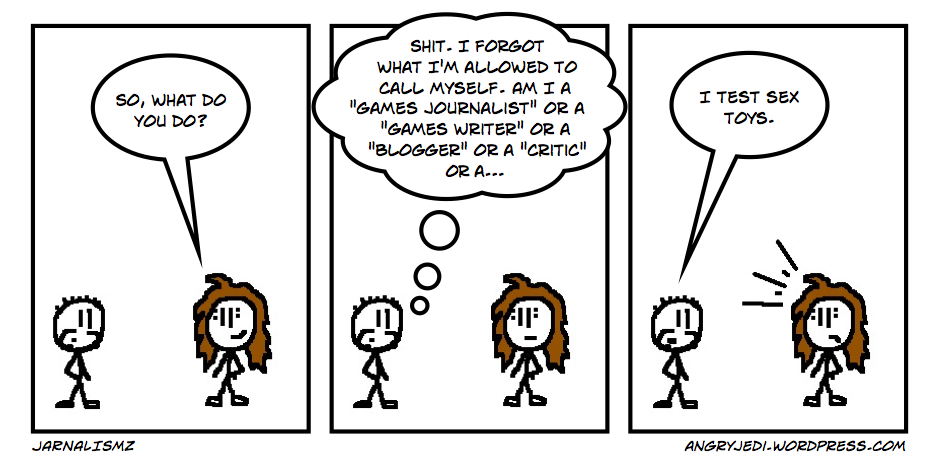
What I do want to talk about, though, is the ancillary discussion which always crops up any time Issues surrounding "games journalism" crops up — that is, a matter of what is "games journalism" and the divide between "journalist", "blogger" and any other definitions you'd care to give.

I saw an interesting quote earlier today on Twitter. I forget who it was from so I can't link to it, unfortunately, but it read something like this:

"Don't get into games journalism because you like games. Get into it because you love writing."

That's exactly the reason I enjoy writing about games — because I love writing, as the 1014 posts prior to this will attest. I mean, sure, I love games, too, but I could love games without wanting to write about them, and yet I voluntarily compose thousands of words on the subject every week — here, over at Games Are Evil and for my day job. If I didn't love it, I wouldn't do it.

There's something of an air of snobbery surrounding writing about games, though, and it's all to do with that "J" word. When outlets like Polygon publish a piece like this, you get people expressing genuine surprise that someone has "done some actual games journalism". For sure, well-researched investigative pieces are very much worthy of note and should be praised — but just as in regular newspapers, they are not the be-all and end-all of writing. In mainstream culture and current affairs, we have plenty of critical and opinion pieces alongside the deep-dive investigative pieces — so why is this sort of thing looked down upon in games writing?

It's the obsession with that "J" word. "Journalism" carries with it certain expectations — specifically, reporting and investigation, and perhaps uncovering some facts that might not have come to light otherwise. But there's just as much value in someone composing an in-depth personal response to something they've played in detail, or indeed an opinion piece on a pertinent current issue in the industry.

It's not "one size fits all", in short, and I think part of the problem in the "writing about games" sector (whatever you want to call it) is that too many outlets are trying to be one size fits all. We see sites like VG247 posting articles on everything from the latest DLC drop for Call of Duty to sales figures via who has got a new job on a magazine — something which the vast majority of gamers who are not involved in the industry probably wouldn't give a toss about. We have sites like GamesBeat experimenting with a review format that features feedback from a games critic, a business analyst and an academic, and it's not entirely clear who that's for.

We need greater focus and less generalisation. The outlets that are good at "real journalism" such as Kuchera's Penny Arcade Report (and to a lesser extent Polygon) should keep doing what they do because it's important — and it'd be good to see more outlets focusing on this side of things with properly-trained staff. But at the same time, the sites who are effectively "magazines" as opposed to "newspapers" should keep doing what they're doing too. Their work is no less valid or important, but their purpose is different — while the "journalistic" outlets' primary purpose is to inform, the "magazine" outlets' primary purpose is to entertain. There's a degree of crossover between both, of course, but I can't help but feel that focusing on either one or the other rather than ending up doing a half-assed job at both would benefit everyone in the long run.

I actually wrote a piece on this subject a while back regarding the ever-controversial Kotaku, a site which consistently draws heat for its seemingly "irrelevant" articles and often irreverent attitude. I still stand by what I say in that post — if Kotaku was more honest and open about its target audience (18-30 year old men) and tailored its content accordingly, then I feel it would be a better publication as a result.

It's also what I'm trying to do over at Games Are Evil with a limited team and resources. We're not under any illusions about being the first to report on anything or the most timely with our coverage, but in acknowledging that fact and taking a more "magazine-like" approach — weekly, focused columns punctuated by brief news snippets on subjects that are a little "off the beaten track" and regular features such as our daily Song of the Day — I feel we're building a better, more distinctive publication rather than yet another "me too" blog, and one that I'm actually pretty proud of so far.

Anyway. The "games journalism is broken" discussion will probably continue in perpetuity, particularly given recent events. I do know one thing, though, and that's that I am really glad I am not Lauren Wainwright right now.

1014: Aselia the Exceedingly Lengthy but Still Well Worth Playing

Back in early October, I did an initial blog on my impressions regaring a Japanese-developed visual novel known as Aselia the Eternal. Since that time, I've written two columns on the subject for Games Are Evil one about the game itself, the other about how it creates a convincing, coherent-feeling game world mostly through words — and there's still a huge amount more to say about it. So I'll brain-dump it all here and you can sift through at your leisure.

The first thing I want to say is that it's a pity more people won't play this. I can shout its name from the rooftops all I like, but I know for a fact that most of you reading this are not even considering picking it up and trying it out. This is the one failing of the video games medium becoming so broad and wide-ranging in recent years — no-one has time to play everything, so the vast majority of people concentrate on the recognisable names, the new releases, the triple-A blockbusters and the "indie darlings" of the moment, leaving titles like Aselia to — relatively speaking — flounder. Take a look at this great article by Rowan Kaiser, for example, in which he suggests a variety of games to give a gaming newbie a "crash course" in what the medium is all about. Everything on that list is, I'd argue, mainstream or at least "well-known", and yes, I include titles like Journey and Papo and Yo in that description. They're all "safe" options — and that's not a particularly bad thing, especially when trying to introduce someone new to the medium — but a lot of people don't ever step out of this comfort zone because there's no real need to.

On the plus side, however, this means that the fans of these particularly niche games are almost infinitely more passionate and willing to discuss them than someone who has completed, say, Assassin's Creed III. (There are exceptions, of course — I know I follow several people on Twitter who are obsessed with Ezio di whateverhisfullnameis and the overly-complicated lore of the Assassin's Creed series to an unhealthy degree — but I'd argue the people who care that much are in the relative minority.) And, of course, there's the fact that titles like Aselia represent "mainstream  PC gaming" in Japan, so if you can actually speak Japanese (I'm working on it… slowly!) you'll find like-minded people out there.

But anyway. If you have played Aselia the Eternal (or indeed any other visual novels) and want to enthuse about them with me, please feel free to do so at any time.
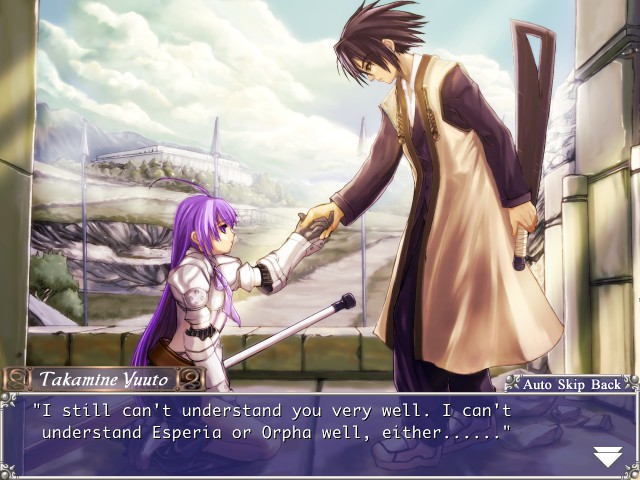
Now. To business. Indulge me a moment while I explain what it is that makes Aselia the Eternal particularly noteworthy or at least "interesting" to look at.

First of all, a little history. Aselia the Eternal was originally released in 2003 on PC as an 18+ eroge called Eien no Aselia – The Spirit of Eternity Sword. In 2005, it was stripped of its erotic content and released on PlayStation 2 as Eien no Aselia – Kono Daichi no Hate De (Aselia the Eternal: At the Ends of this Earth). Rather than the excision of the erotic content making it a "gutted" experience, however, the game was rewritten to make it more friendly to a wider audience. This "all-ages" version was later backported to PC in 2010, and translated into English by JAST USA in 2011, leaving us with the version we have today. JAST took the decision to translate the "all-ages" version rather than the 18+ original due to content which would have proven "problematic" to get around the censors — specifically, there are a number of characters who look very young (despite, as with most eroge, character ages not being made explicit anywhere), which makes erotic content involving said characters out of the question to Western audiences; and also, the original carried an "evil path" through the story which featured graphic scenes of violence and sexual assault — also deemed unpalatable to Western players. 

The upshot of all that is that the version of Aselia the Eternal you can buy legally today is not compromised in any way from the vision of its writers, but equally it does not feature any content that you might not want anyone viewing over your shoulder. In other words, this is not a hentai game; rather, it is simply a Japanese visual novel/strategy game/RPG type thing sans bonking.

It's the peculiar blend of genres in its gameplay that makes Aselia the Eternal an interesting one, though. Initially appearing to be a fairly conventional visual novel involving a cast of high school students, a pair of (foster) siblings with a mildly questionable relationship and the occasional innocuous-seeming choice that you just know will have surprisingly far-reaching ramifications, the game gets truly interesting after about 5-6 hours of pure exposition — 5-6 hours that will determine whether or not you're in it for the long haul. The game's player-protagonist Yuuto as well as several other characters get spirited away to a mysterious fantasy world, and a battle for survival begins. From this point on, you'll be splitting your time between the number-crunching of a strategy RPG and the plot-heavy relationship manipulation of a visual novel. The two aren't necessarily clearly demarcated, either — the game frequently breaks in mid-mission for 30-60 minutes of plot advancement — but this actually works in the game's favour as it tries to tell its story, and stops story feeling like a "reward" and instead like everything you do is part of the ongoing narrative.

It helps, of course, that the actual gameplay in the strategic side of things is extremely solid. Here's how it works.

As you progress through the game, you gain control of a wide variety of female "spirits" of different colours, as well as the protagonist. Differently-coloured spirits have different specialisms — blue spirits are good at direct attacks, for example, while green spirits tend to have higher HP and defense. Red spirits, meanwhile, are good at magic, while black spirits are a bit of a "jack of all trades, master of none" class, with good HP and defense, decent attack power and some useful enemy-crippling abilities.

Your forces are split into four "squads" of up to three units each. The unit in the first position of the squad is the Attacker, the second is the Defender and the third is the Supporter. The Attacker's job is to… well, attack… the Defender's job is to soak up damage and prevent critical hits, and the Supporter's job usually involves casting spells of some description, which might be direct attacks, buffs or debuffs. Each unit has up to three equipped skills for each of the three different squad positions, for a total of nine skills at any one time. I say "at any one time" because as they level up, abilities get overwritten — sometimes this is your choice, other times, "Limited Skills" mean that you must overwrite a previous level of a skill when you earn a new one. Only one skill from each category may be "set" at once — this is the one which will be used in battle — and each skill only has a limited number of uses before the unit needs to return to a friendly town to rest and recharge.

You move around the "campaign map" via preset pathways, one "space" per turn. If you move onto an enemy, you attack them. Before the battle resolves itself, you can see the lineup of the enemy squad (including HP and abilities), and you then have the opportunity to rearrange your squad members and set the abilities you would like them to use in the upcoming battle — this is an immensely important step that can mean the difference between life and death — and then it's into combat.

Battle unfolds in several phases. First of all, the attacking side's Supporter casts an "Attack Support" spell if it has one set — these include buffs or some healing spells. Then the other side gets to do the same. Then the attacking side's Attacker gets to make an attack, which is usually intercepted by the Defender if there is one, then the Supporter, then the Attacker finally. Certain skills allow units to target specific units other than the Defender — this can be particularly useful if the Supporter has a nasty spell ready, but not many HP left.

Following the first attack, the Supporter gets to cast a Divine Magic spell if they didn't already case an Attack Support spell. These are mostly offensive in nature. Then the defending side gets to attack, then Divine Magic. This then repeats until all the units involved in the battle have expended the number of "actions" for the skills they have set. Certain skills may be used more than once per battle, and this can be used to your advantage — if, for example, the enemy Defender can only use their damage reduction skill once per battle and you have a powerful attack that can be used twice, that second attack will connect and do "critical" damage.

There's an added twist with the Attack Support and Divine Magic spells — blue spirits have the special "Ice Banisher" ability when in the Supporter role, which can interrupt certain spells. Naturally, there's a trade-off — blue spirits are also the strongest Attackers, so having one in the Supporter slot means that they're not doing damage, but making effective use of Ice Banisher is essential to survival as the enemy gains access to stronger spells.

It's a system that initially appears rather complex and confusing, but becomes second nature after no time. It's actually a very elegant system that forces you to think carefully about which characters would be most useful in dealing with the situation in front of you, and requires that you manage your army carefully to ensure they're strong enough to take on the challenges ahead of them. It also means that there are often a number of ways of getting past seemingly insurmountable challenges — that boss who is giving you grief may hit hard, but he only has two uses of his attack skill before he's left unable to damage you, so if you can just keep your green spirit alive for two turns, you can then exact bloody revenge at your leisure.

Pleasingly, there's no grinding in Aselia the Eternal. While you're wandering the game world, your captured towns are converting their stored "mana" to "ether" at a rate dependent on how many Ether Refinery buildings you've constructed. The more towns you have, the more mana in your pool, but mana can't be used in its raw state — it has to be converted to ether first. Once you have ether, however, this can be spent on constructing new buildings or, most importantly, levelling up spirits and the protagonist. To do this, they must be located in a town which has a Training Facility constructed, and their entire squad must rest while the individual unit trains. You gain access to various different trainers with different specialisms as the story progresses, putting an effective "cap" on your progress as you go through — but sometimes you hear rumours of trainers in far-off locations, and can enlist their services if you send a squad to go and pick them up.

So Aselia the Eternal would be an interesting strategy game even if it didn't have the plot attached to it. What makes it a remarkable experience, however, is how the plot makes you feel about those units scampering around the world map. Because you get to know all the people in your squads in various story scenes, not just the main characters, you care about them and you don't want them to die. Letting a unit die means that you'll never see them again in the story, because there are no revive skills until very late in the game. When you see how many little subplots involving these seemingly "unimportant characters" are weaved into the overall narrative, you'll very much want to be "that guy" and reload every time someone kicks the bucket. After all, Halion promised you that she'd bake some special treats for you in her shop when the war is over… you can't let her die, now, can you?
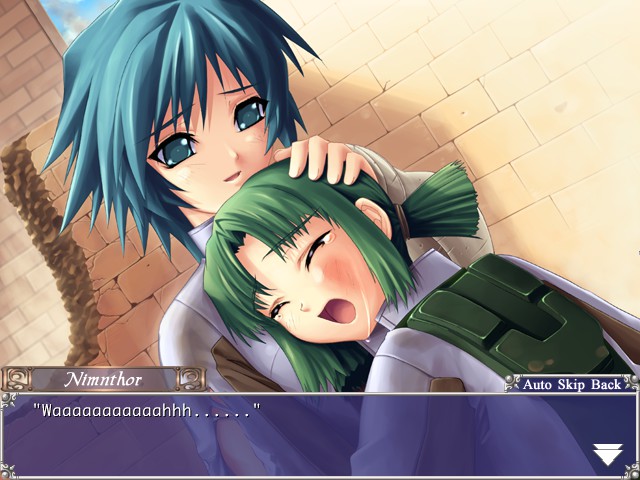
And goodness me. The Feels. Aselia the Eternal has them by the bucketload, particularly when it comes to chapter finales. This is a game that doesn't hold back on the emotional manipulation at all, and does its very best to make you feel terrible about every virtual life you take. The overarching story is at once both epic in scale and very personal to the protagonist, and the romantic subplots are expertly weaved into the narrative as a whole rather than serving as the sole focus as in some other visual novels.

I have one more chapter of the story to go, and I'm very interested to see how it concludes. Hopefully that will happen sometime this week.

But I feel I should probably stop there, as I've wittered on for over two thousand words. I won't tell you to buy and play Aselia the Eternal because I know that probably 95% of you aren't going to, but if, on the off-chance, you do, be sure to come and enthuse about it with me sometime.
1012: Indisputable Measure of Quality

I can tell when an iOS app or game is genuinely good — I keep it on my phone after I've finished reviewing it.

For my day job, I spend an awful lot of time trawling through iOS games and apps of various descriptions and quality levels. There are some true gems among them, and there is some complete bollocks, too — and not just in gaming. I've lost count of the number of utterly pointless and unnecessary mobile-social networks I've come across in just the last few weeks, for example, and you'd be surprised how many Instagram clones there are out there.

On the gaming front, I've played too many completely shallow card-battle games to count — so many, in fact, that I've actually forgotten the name of most of them as they all blend into one another so much — and far too many isometric-perspective citybuilders that have absolutely no strategy whatsoever. I was also very disappointed to discover that the upcoming My Little Pony mobile game from Gameloft will be — you guessed it — an isometric-perspective citybuilder. Fuck.

But the amount of utter garbage on the App Store makes the titles that are actually good worth celebrating. As such, I'd like to present you with a breakdown of everything that is currently installed on my iPhone. I haven't necessarily played or used some of these recently, but I like to keep them around because they have either been useful/fun in the past, or simply because I feel "attached" to them. Or in some cases, I've just forgotten that they're on there.

Here we go, then. In no particular order… well, all right, in the order they're in on my disorganised home screen:

  • Google+ — official mobile app for Google's oft-ridiculed-but-actually-rather-good social network. Beautifully-designed app in my opinion, though said design is a bit divisive.
  • Facebook — official mobile app for the world's most popular social network. The app may be a bit clunky and festooned with obtrusive "sponsored links", but it's finally become a reasonably solid experience.
  • WordPress — official app for the service this blog is hosted on. The app is reasonably good, but limited compared to the Web interface. It also lacks a word count facility, which annoys me more than I thought it would.
  • Skype — not actually sure why I still have this installed. In fact, I'll delete it right now.
  • imo.im — my instant messaging client of choice. Supports most protocols you'd care to think of, including Skype.
  • Formspring — I haven't used Formspring for ages but occasionally it's fun to answer silly questions. The app makes that easy to do on the go.
  • LinkedIn — also not entirely sure why I have this installed, given that I never use LinkedIn. Time to delete!
  • Steam — official mobile app for Valve's digital storefront and social client. Seems to lack push notifications, but otherwise quite useful to get in touch with friends for whom Steam is a reliable point of contact.
  • Comic Touch — old app that hasn't been updated for ages, but features some fun, silly camera effects and the ability to add annotations and speech bubbles. Mobile version of the software I use to create the comic strips on this blog.
  • Instagram — still the best pretentious photography app in the world.
  • Snapseed — a genuinely excellent and surprisingly powerful photo manipulation app.
  • Brushes — best paint program for iPhone, bar none.
  • Evernote — probably the most solid "cloud notebook" solution there is, particularly now it is compatible with a bunch of other apps.
  • Bump — I never use this any more, but it carries positive associations of a very dear friend with it, so I've kept it around.
  • Air Sharing — handy little Wi-Fi file sharing app, allowing transfer of files between computer and iPhone easily. Also has built-in image viewer, media player and whatnot.
  • iDisk — urgh. FUCK YOU APPLE for removing the most useful thing about MobileMe.
  • Red Laser Classic — occasionally useful for price-checking while you're out and about, though you inevitably don't have mobile signal when you're in a Waterstones.
  • HippoRemote Lite — an excellent, reliable and free virtual trackpad/keyboard that can be used to control computers.
  • Box — I signed up for a Box account when someone tweeted one of those special offer links. I don't think I've used it, but it's handy to know it's there if I need it.
  • MotionX-Dice — no longer available, but an excellent virtual (six-sided) dice app.
  • Night Stand — my favourite app that puts a big clock on your screen. Not sure this version is still available.
  • Lloyds TSB — convenient access to mobile banking, though the app itself is a bit shit.
  • Primrose — strange and addictive puzzle game by Jason Rohrer of Passage fame.
  • WordFu — a game you should not start playing on the toilet.
  • Scramble CE — Didn't realise I still had this installed. Superceded by Scramble with Friends, which I can no longer be bothered to play.
  • Bejeweled Blitz — Still a fine toilet game, even with the increasingly-obtrusive monetization.
  • Spelltower — a brilliant little word puzzle game.
  • Fruit Ninja — probably no introduction needed. Slice fruit, have fun.
  • Tilt to Live — one of the best games iOS has ever seen, and certainly a game with one of the best soundtracks of all time. Known as "Try Not to Die" by my friend Woody, who can never remember the name of it.
  • DoDonPachi Resurrection — spectacular, wonderful bullet hell shooter with an outstanding soundtrack, gorgeous graphics and a touchscreen control scheme that works really well.
  • Mushihimesama Bug Panic — curious top-down action-adventure shooter from the DoDonPachi developers.
  • Groove Coaster — one of the best rhythm games ever.
  • Gridrunner — fantastic new version of one of Jeff Minter's classic games.

(Jesus. I didn't realise I had quite so much crap on here. No wonder I never have any space left. Continuing…)

  • RogueTouch — An excellent iOS version of the original Rogue.
  • Sword of Fargoal — Fantastic reimagining of a Commodore 64 roguelike classic.
  • 100 Rogues — Possibly the best roguelike on the App Store. Apart from Sword of Fargoal and Rogue Touch.
  • Frotz — Interpreter for text adventures and interactive fiction. Comes with access to a whole bunch of old and new classics.
  • Various board game adaptations: Catan, Blokus, Carcassonne, Ascension, Bohnanza, Ticket to Ride, Elder Sign
  • Necronomicon Redux — Fun Cthulhu-themed card game.
  • Hard Lines  Geometry Wars meets Snake.
  • Bit.Trip BEAT — Pong with rhythm.
  • Space Invaders: Infinity Gene — Very little to do with the original. But awesome.
  • Shazam — occasionally useful, but one of those apps you inevitably don't have mobile signal when you actually want to use.
  • Apple Remote — occasionally useful when, say, I want to listen to music from my Mac while I'm on the toilet. Somewhat superceded by the use of iTunes Match.
  • Spotify — it's Spotify on my phone.
  • Modizer — brilliant chiptune and MOD file player with access to a variety of downloadable selections.
  • Instacast — nifty podcast discovery and subscription app.
  • NanoStudio — portable music production lab. Should probably play with this more than I have.
  • Netflix — it's Netflix on my phone.
  • Co-Pilot GPS — this satnav app has never steered me wrong.
  • King of Dragon Pass — terrifyingly complex strategy game that I don't really understand, but would very much like to someday.
  • Starbase Orion — it's Master of Orion on my phone.
  • Game Dev Story — The only Kairosoft game that's really consistently held my interest.
  • Cardinal Quest — Actually, this is one of the best roguelikes on the App Store.
  • Pages — Not really sure how practical this is on iPhone, but it's nice to have it there.
  • MyFitnessPal — useful calorie-tracking app that I should probably start using again sometime.
  • RunKeeper — best run/cycle/walk-tracking app there is.
  • Diptic — got this when it was free, never used it.
  • Zookeeper Battle — see this post.
  • Super Hexagon — the most irritating game in the world.
  • Figure — cool little synth toy thing from the makers of Reason.
  • Any.DO — excellent to-do app.
  • Neon Blitz — surprisingly addictive, mindless little game.
  • Crunchyroll — anime wherever I go!
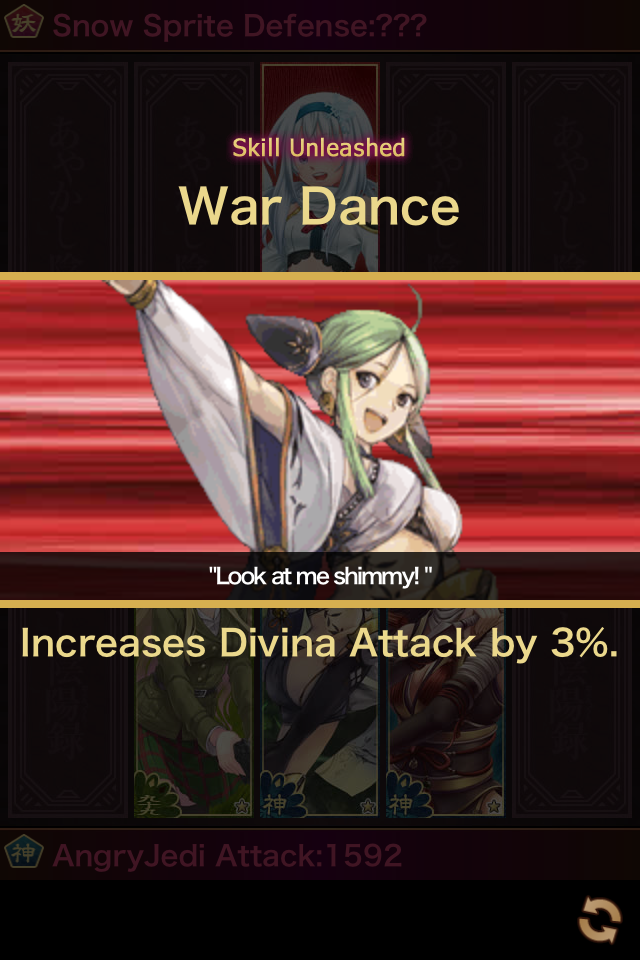
  • Ayakashi: Ghost Guild — for some reason, I am still playing this and attempting to determine why this has appealed to me where other card-battle games have failed. I think it's the fact it actually has a story, and is presented pretty well. In-app purchases are far too expensive though.
  • Rune Gems — excellent Shanghai-meets-match-3 puzzler.
  • Rayman Jungle Run — best game on iOS, hands down. I will fight you if you disagree. Unless you cite Tilt to Live as the best game on iOS, in which case I will forgive you.
  • YouTube — everyone bitched about the lack of the built-in iOS YouTube app, but Google struck back with a new one that is infinitely better than the previous crap which had barely been updated since iOS 1.0.
  • MangaCamera — this is awesome fun. Just try it.
  • Skitch — skitchy skitchy skitch!

WHY AM I STILL DOING THIS

oh, thank God, my battery has died. Oh well. I'll have to leave that there. Anyway. I hope you have found this list helpful, interesting or just, you know, eh. Whatever. I don't know. I'm tired. Bugger off. *slumps face-first onto keyboard*

1011: Sigh... Another Shitstorm

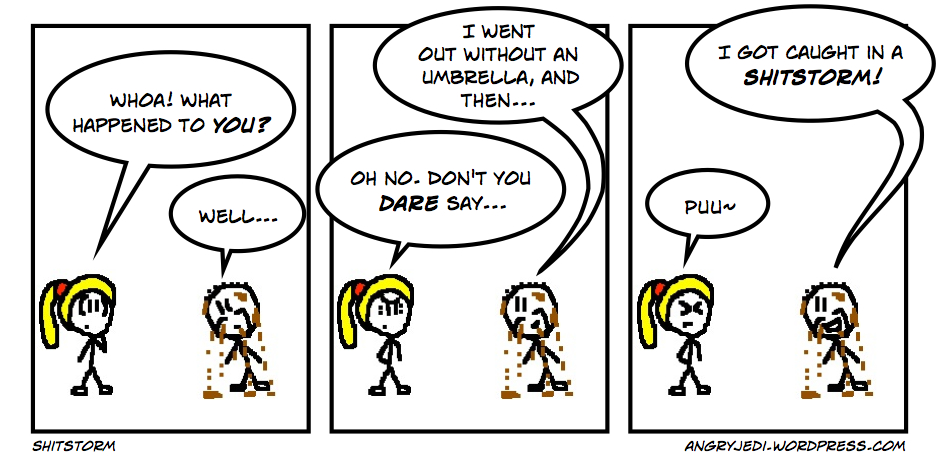
Boy, it all kicked off earlier. Again.

For those who missed the whole shebang, basically, this is the flow of events over the last two days to the best of my knowledge.

Yesterday:

  • Twitter "debate" erupts over whether or not it was ethical for UK games journalists attending the annual "Games Media Awards" ceremony to be tweeting promotional hashtags in the hope of winning a PS3.
  • Winners of said competition name-checked by several Twitter users.
  • Several of said winners speak up and say they are giving away their PS3s.
  • Eurogamer publishes this article by Robert Florence (now recreated on GAF because the Eurogamer-hosted one has been edited) in which he notes that journalists defending such a competition could be seen as corrupt. He quotes tweets from several public sources (mostly Twitter) in said article.
  • MCV staff writer Lauren Wainwright, who was originally quoted in Florence's article, posts on Facebook "Yes, I've seen it. Yes, it's slander. No, it's not being taken lightly." and quickly makes it clear that she is referring to Florence's article.

Today:

Most of the salient points surrounding this issue have probably already been addressed far better than I will do in this post, but since this is my personal blog I thought I would give my take on the matter, as something of an "outsider" to the UK games industry. (It's true; despite living in the UK, pretty much all games/tech journalism work I've done in the last few years has been for American outlets — the last UK publication I wrote for was the UK Official Nintendo Magazine, and that was back when the N64 was one of the current-generation consoles.)

I have come to the conclusion, not just as a result of this shitstorm, that I am Not A Fan of the UK games journalism industry.

Actually, that's not quite true — there are plenty of people in the UK industry with a considerable degree of integrity who sadly toil away in relative obscurity. People like Lewis Denby over at Beefjack, Ashton Raze and Tom Hoggins over at The Telegraph's games column, and itinerant freelancer Chris Schilling — and scores of others, too, most of whom I follow on Twitter. These are all people that I may not have had the pleasure of actually meeting in most cases (though I met Denby at the Houses of Parliament one day) but whom I have interacted with and have grown to trust the opinions of. I have no issue with these people.

However, what I do have an issue with is the "old boys' club" that is at the core of the UK games journo industry; a toxic heart beating away and infecting all around it with its bitterness and vitriol. In this inner circle, most people seem to actively hate their job, mocking it at every opportunity and deriding genuinely interesting ventures such as a games journalism introductory session that IGN attempted to host in London a short while back. The apparent priority for a number of these individuals — from what I can tell from their public output, anyway — is getting drunk and taking the piss out of the medium they're supposed to be representing. "VIDEOGAMES," they'll say (and misspell), deriding something that everyone is already aware of and completely ignoring the more interesting things going on in the business.

The focal point of all this vitriol is surely the Games Media Awards, an odious annual event hosted by Intent Media, the parent company of Wainwright's employer MCV. Now, you might not think that celebrating the achievements of hardworking journalists is a bad thing, and for the record, I don't either — but for the last two years I have seen nothing but obnoxious behaviour surrounding this event. I don't know about you, but for a professional industry awards ceremony, I expect a certain level of professionalism, formality and decorum — none of which are readily apparent in the slightest when looking at the GMAs, which are little more than a pissup for journalists organised by PR staff and publishers.

I knew that something was up when the "humorous" Twitter account promoting the event last year was publicly lambasting anyone (including me) who took umbrage with its less-than-professional tone. These suspicions were only confirmed when the sponsors for the event showed up brandishing about a million free condoms and with an army of dwarfs in tow. The event was a complete debacle and many of the journos present did decry the sponsor Grainger Games' behaviour as abhorrent, to be fair — but equally, there were plenty of "oh man, I was so drunk" stories circulating.

This year, it was a different controversy — specifically, a whole lot of behaviour which Florence quite accurately pointed out could be interpreted as shilling. Journos were getting their photograph taken with the dude from Far Cry 3 and tweeting about some game I've never heard of called Defiance, and publicly sharing both on Twitter. Some people quite rightly criticised this, and that's what kicked off this whole debacle. Specifically, it was Intent Media and various other members of the "inner circle" defending their behaviour that kicked off this whole debacle.

You see, part of the problem with the "inner circle" is that it believes itself superior and immune to criticism. At no point were those who had been "caught in the act" willing to discuss the possibilities that their actions might be misinterpreted, whatever the actual intentions behind them. Wainwright's "complaint" and possible threat of legal action is just one of many silencing tactics that have been used surrounding this issue, with the others being the old favourite "remember when we just talked about games? Games were fun!" and "get back to work" arguments.

Well, yes, games are fun, and it would be nice to get back to talking about them. But these conversations that we're having here are important, too. This whole ridiculous situation came about for a reason, after all, and it's something that the industry should learn from. Specifically, outlets should begin getting their staff better acquainted with media law, and they should also instill in their employees a culture that criticism is not always a negative thing; sometimes it is an opportunity to grow, change and improve.

Will the industry actually learn from this, though? Probably not, sadly. I would, however, like to state for the record that I have never seen this level of ridiculously shameful behaviour from the American games press. Sure, there's been plenty of public spats — particularly surrounding high-profile figures such as Destructoid's Jim Sterling and the Polygon crew — but nothing that's actually left me feeling as ashamed of the industry I've worked so hard to be a part of as the last 48 hours have.

I'll leave you with this excellent piece by Jeff Grubb from back in the early days of Bitmob. I agree with everything my hirsute honey says. And that's the last I will say on the matter!

1009: Some Favourite Characters

One of the things I always find most memorable about any story I experience, be it a book, TV show, movie, anime or game, is the characters. If the characters aren't interesting, chances are I'm not going to get hooked in. It's the reason I usually cite as to why I loved the open-world adventuring of Xenoblade Chronicles but find Bethesda role-playing games and most MMOs rather tiresome after a while, but it applies to pretty much any medium.

As such, I would like to present to you a randomly-chosen selection of five of my favourite characters that have popped into my head immediately upon attempting to think of my favourite characters. If that makes sense. I make no apologies for the fact that some or all of these are likely to be big-eyed anime or computer game people.

Grace (Gabriel Knight)

Most people cite Tim Curry's memorable portrayal of the lewd, womanising bookshop owner in Gabriel Knight: Sins of the Fathers as the highlight of that game, but the unsung heroine of the piece is most definitely Grace Nakamura, his long-suffering assistant.

Grace is a realistic female character in that she's not there to be eye candy, she's not there to be a useless sidekick hanging on everything the hero does and she actually has a personality. She doesn't take any shit from Gabriel, and you'd better believe that he regularly gives her shit — his always-rejected advances are a highlight of their interactions, and yet it's clear that the pair of them do, in fact, care deeply for one another, otherwise Grace would have been out the door long ago.

The exact nature of Grace and Gabriel's relationship, at least in the first game, is kept deliberately rather ambiguous. Grace often acts as something of a mother figure towards Gabriel, though it's never quite clear if she actually wants to "tame" him or simply sand down a few of his rough edges. Gabriel is certainly receptive to the things she says and appreciates the hard work she puts in for him — and yet the clear sexual tension between the two of them goes unresolved. Proof that you can have two characters of the opposite sex to one another without them ending up in a predictable love scene.

Angel (Buffy, Angel)

Buffy the Vampire Slayer and its spin-off series Angel remain two of my favourite TV shows of all time. David Boreanaz's brooding vampire Angel appears in both, but really comes into his own when he gets his own series.

It would have been easy for Whedon and the gang to leave Angel as your stereotypical brooding vampire, haunted by his past and trying to make amends for deeds that can never be forgiven. And indeed for many of his appearances early in Buffy, he's little more than that, providing a convenient "forbidden love" interest for Buffy while allowing the show to explore some traditional vampire themes.

In Angel, however, he cuts loose and we get to see him for who he really is. Sure, he broods and spends a lot of time sitting in the dark — something that is regularly commented upon by his companions — but he also does a fine line in completely deadpan one-liners.

Also, this.

Incidentally, a comment on that YouTube video reads thus: "I always thought Angel was a ponce in the first three season of Buffy…then He moved to L.A. L.A. changes people."

Damn right.

Toshino Kyouko (Yuru Yuri)

If there's one reason to watch Yuru Yuri, which I believe I have already extolled the virtues of on several occasions, it is Toshino Kyoko.

Kyoko, as you can probably tell from the image above, does not give a shit what people think of her, and she's immensely entertaining as a result. She's often the instigator of the various scrapes the group gets into, and her hyperactivity is a big part of what gives the show so much energy. Part of her appeal comes from the fact that her blonde-haired, blue-eyed appearance sets her up to be "the pretty one" and she then subverts stereotypical expectations completely with her wild and crazy behaviour.

At the same time, though, she's a dedicated friend and companion, and the whole "possibly unrequited love" thing going on between her and the huggably tsundere student council vice president Ayano (whom I also considered including on this list, but settled on making her my Facebook avatar instead) is another big draw for those who enjoy seeing blushing anime girls simpering at one another and then denying their feelings vehemently. I-It's not like Ayano wants to spend every waking moment with Kyoko or anything, after all! Idiot!

Seiko (Corpse Party)

Seiko was one of my favourite characters from Corpse Party, a game with an incredibly well-defined and interesting cast all round. The best thing about Seiko, though, was how self-consciously "not girly" she was. She's open, honest, brash, crass and, a bit like Kyoko, does not give a damn what people think of her. At the same time, she's cheerful and does her best to keep the people around her in high spirits, even as they are trapped in a horrifying, terrifying situation from which there appears to be no escape.

It becomes clear after only spending a short amount of time with her in the game that she has a number of deep bonds with her friends — particularly with the character Naomi, for whom it's rather strongly implied that she's harbouring romantic and/or sexual feelings.

To say too much more about Seiko would probably be to spoil Corpse Party more than I'm willing to, but suffice to say that she's a definite highlight of the game. And, oh look! Corpse Party is half-price on the PlayStation Store (PSP and Vita) right now. You should go and buy it if you have a Sony handheld, otherwise I'm not sure we can be friends any more.

Polgara (Belgariad, Malloreon)

David Eddings' Belgariad and Malloreon series are rather traditional pulp fantasy novels in many ways, but a few aspects of them cause me to remember them fondly — and I've even re-read the whole set of books several times, which is not something I normally do.

One of these aspects is Polgara the sorceress. For those unfamiliar with Eddings' epics, they follow a relatively traditional pattern in which an unassuming young farmhand named Garion gradually gathers a party of various ne'er-do-wells and, through various combinations of circumstances — spoiler! — becomes incredibly powerful, battles against an evil god and wins.

One of Garion's constant companions throughout the entire series is his "Aunt Pol," who has been a constant presence in his life since childhood. It transpires that "Pol" is actually Polgara, a four thousand year old sorceress and daughter of Belgarath, sorcerer of legend and he who recovered the mystical artifact The Orb of Aldur from — look, let's just say he's Kind of a Big Deal, all right?

The reason Polgara is interesting is not because she's a kick-ass sorceress, though, it's the fact that she's a very well fleshed-out character with a hell of a lot of hidden depth. Garion learning the truth behind her heritage in the Belgariad is just the tip of the iceberg — Eddings went on to publish two additional books known as Belgarath the Sorcerer and Polgara the Sorceress which explained the ancient magicians' history in exhaustive detail, giving the entire world in which the two series were set an extremely strong feeling of being a "real" — or at least believable — place. Polgara and Belgarath's constant presence throughout the world's history give you something to latch on to as millenia tick by in the pages of the books — and yet both of them remain entertainingly "human" despite their obvious… non-humanness.

____

That was fun. I'll do this again sometimes soon. I won't ask what your favourite characters are, because no-one ever replies when I end a blog post with a question. I'll just say good night and leave it at that!


1007: Battle of the Cards

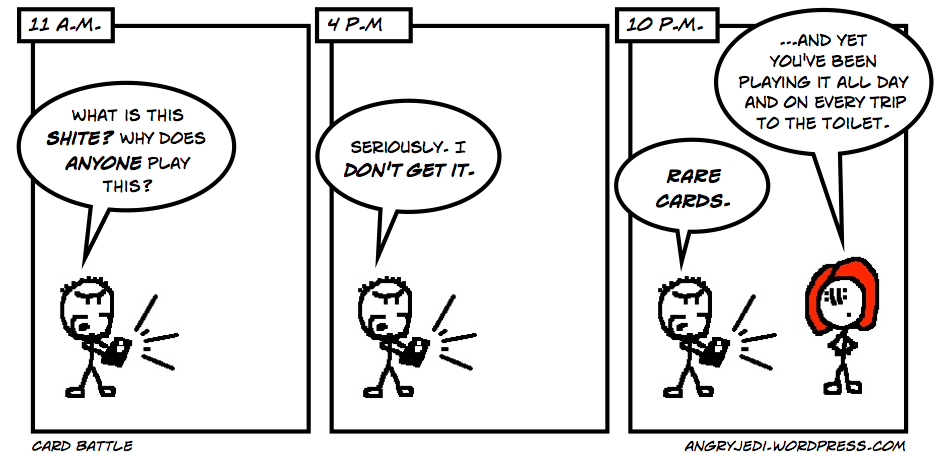
I've made my distaste for the growing trend for Japanese "card-battling" mobile-social games well-known on these pages a number of times in the past, but I've been growing increasingly conscious of the fact that I must be missing something. After all, these titles consistently show up in the Top Grossing charts on both Android and iOS, so there must be something to them that keeps people playing and, indeed, spending.

The other day, I reviewed a new mobile game from Zynga called Ayakashi: Ghost Guild. Before I go any further, let me explain something about the way Zynga does business for those who have always given their titles a wide berth for whatever reason.

Zynga behave very much like Apple do, in that they're not trendsetters — or perhaps more accurately, they're rarely the first to try something, as they're both often the ones to make something popular. What both companies are inclined to do is hang back, watch and wait to see what early adopters of new technology and systems are doing. What is proving popular? What are users ignoring? What are the potential pitfalls in doing something new, and can they be avoided?

Once they've done this, they'll swoop in with something fundamentally very similar to that which has come before, but polished to a fine sheen. Zynga's games are rarely, if ever, original, but it's hard to deny that they often have a significantly higher degree of polish than many other games that may have gotten there first. Similarly, Apple's work on iOS frequently lags behind Android in terms of features — a frequent criticism in the interminably tedious fanboy wars — but when said features hit, they tend to be implemented very well. (Of course, there are exceptions in both cases, but these patterns are noticeable enough to be worth commenting on.)

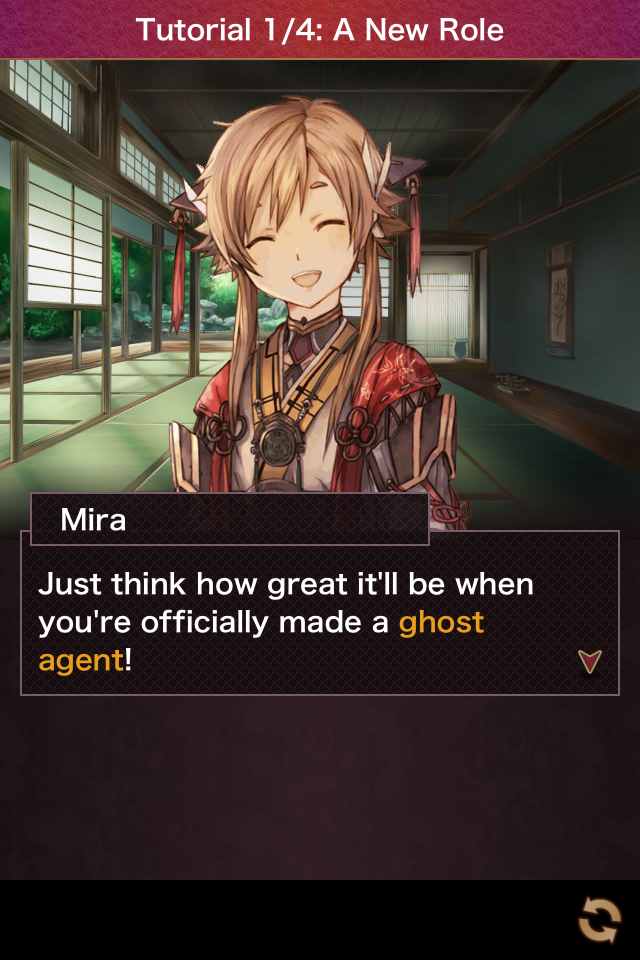
Anyway, I digress; Ayakashi: Ghost Guild is a card-battling title from Zynga, and it follows the outline above to the letter. It's clear that the specific developers behind it have examined what makes early trailblazers tick — many of which, like the inexplicably popular Rage of Bahamut, are very rough around the edges — and then given the whole set of proceedings a pleasing coat of paint. Where Rage of Bahamut is silent throughout, Ayakashi: Ghost Guild has an atmospheric, context-sensitive soundtrack; where Rage of Bahamut's story is completely throwaway and irrelevant, delivered via blocks of text that most players will ignore completely, Ayakashi: Ghost Guild makes an effort to introduce characters and an unfolding narrative with first-person visual novel-style scenes; where Rage of Bahamut's interface resembles a Geocities website from the late '90s… Ayakashi: Ghost Guild's interface resembles a Geocities website from the late '90s designed by someone who owns a copy of Photoshop. (You can't have everything.)

The thing that I've found most obnoxious about these games in the past is their seeming total lack of gameplay. But have I been giving them a fair shot? I have delved into Ayakashi in some detail over the past few days in an attempt to try and understand the appeal a little better, and I'm still not quite sure that I've made my mind up.

For those who haven't played one of these games before, allow me to give you a rundown of how play works, with specific regard to Ayakashi. You start by picking a card, usually from one of three different types that have particular strengths and weaknesses. Cards have an attack rating, a defense rating and a "spirit" value. They also generally have some lovely (and usually rather boob-heavy) Japanese-style artwork on them. Ayakashi: Ghost Guild does not disappoint in any of these regards.

Following this, there are two main components to gameplay — the single-player component, referred to in Ayakashi as the "Story" mode; and the multiplayer component, described simply as "Battle" mode.

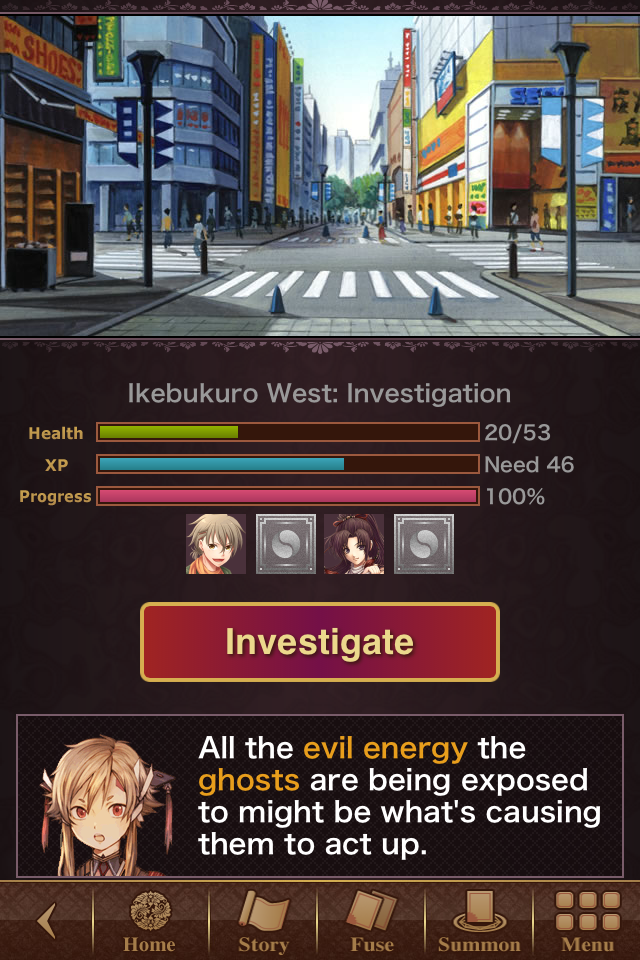
In Story mode, you're presented with a series of linear chapters to work through. To work through a chapter in Ayakashi (and, indeed, in all other games of this type) you simply press a button. At this point, several things happen: an animation plays, you lose some health, you gain some experience and you gain some progress in the chapter. Occasionally you will discover an item or a card — each chapter usually has a set number of hidden items which are clearly marked and discovered completely by chance — or run into another player, at which point you can add them to your "crew" if you have enough slots left. If you fill up the chapter's progress bar, you're given a story scene and can then move on — or stay behind if you want to try and collect the remaining items — and if you fill up the experience bar, you gain a level, gain some points to spend on your basic stats and refill your health to full. Your first few levels give you more health than is needed to level up a single time; after you reach about level 8 or 9, however, you'll either have to wait for health to regenerate (at the rate of 1 point per minute) or purchase restorative items using "Gold", a currency which may only be acquired through in-app purchases. Generally speaking, health is exchanged for experience at a 1:1 ratio; as the story progresses, the health cost and related experience gain for a single press of the "Investigate" button increases.

When levelling up, you have three stats to power up: health, which upgrades the amount in your health pool, allowing you to play Story mode for longer; Attack Spirit, which determines the cards you can hold in your "attack deck" for Battle mode; and Defense Spirit, which determines the cards you can hold in your "defense deck" to protect yourself against attacks from other players when you're not there.

Battle mode consists of you picking an opponent and then letting your attack deck compete against your opponent's defense deck. Some cards have special abilities which boost their base attack and/or defense power, and these are triggered at the start of battle. Following this, the winner is automatically determined with no interaction required from the players. This allows battles to unfold without both players having to be present. After a battle, your available Attack Spirit is depleted by the spirit value of the cards you used, meaning at least initially you can only do one battle at most in a single session if you use your most powerful cards — and why wouldn't you?

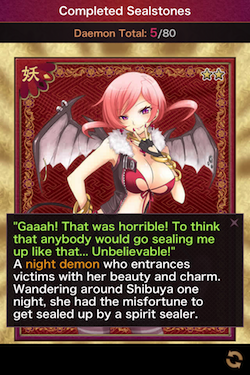
There's a reason to play Battle mode in Ayakashi — the collection of Sealstones. If you collect all of the colours of a particular Sealstone set, you'll get a rare card that is usually significantly more powerful than the ones you just find naturally in Story mode. Beat another player in Battle mode and you get to steal one of the Sealstones they have — but naturally, others will be trying to do the same thing to you, meaning you'll have to leave a strong defense deck behind in order to ensure they don't get nicked while you're not playing. You can also, you guessed it, buy special items with that in-app purchase currency Gold to protect your Sealstones against being half-inched by randoms.

Despite being a massively-multiplayer game, direct interaction between players in Ayakashi is, like most other games of its type, very limited. You can add a limited number of other players to your "crew", with the limit increasing as you level up. When you add a new crew member, you get more ability points — more than when you level up, in fact. You then have the option of "poking" or commenting at them once per day, and are rewarded with "Summon Points" for doing so. Collect ten Summon Points and you can get a free, usually shit, card. You can also get two additional free, usually shit, cards per day — one at any time, the other only at lunchtime.

Those free, usually shit, cards have a use, though — fusion. By picking a card to enhance and then choosing up to ten "material" cards to fuse with it, you can level it up, which increases both its attack and defense power and often makes any special abilities it has more effective, too. Some free, usually shit, cards are specifically designed purely for fusion purposes as they are otherwise terrible but provide massive experience point boosts; in other cases, ensuring you fuse cards of the same "type" (ideally identical ones) together nets you the biggest bonuses. Fusion costs in-game money to perform, though it's the type of money you can earn in the game very easily without having to spend real cash — the game bombards you with it throughout Story mode and you can sell those free, usually shit, cards you've been building up over time.

That's about it. You grind through Story mode, stopping when you run out of health (or until you purchase more if you just can't wait); you twat another player or two in the face to nick something, then you set the game down for a few hours and come back later. Then you repeat the process.

Is that fun? I'm honestly not sure. There is a certain degree of satisfaction to gradually levelling things up and making them more powerful — progress bars are, as we all know, a powerful motivational tool. The fact that Ayakashi has actually made an effort with its story makes it considerably more interesting than most games in this oversaturated genre, too. But the lack of interaction bugs me somewhat; if I'm supposed to be "investigating" a location, I'd like to be actually doing that investigating, not just tapping an "Investigate" button over and over again. If I'm fighting an opponent, I'd like to do more than simply sit back and let the battle resolve itself.

On the other hand, there's an argument that all Ayakashi and its numerous competitors are providing is the same experience you'd get from a "proper" MMO, albeit stripped down to its most bare essentials. What do people like to do in MMOs? Level up, so make that easy. What else do people like to do in MMOs? Compete against other players, so make that easy too. What these games are in effect doing is stripping down the conventions of MMOs into something that is a lot more friendly to mobile gamers' lifestyles — you can pick up Ayakashi for five minutes and "accomplish" something, whereas to do the same in, say, World of Warcraft or Guild Wars 2 takes a lot longer. But in that longer amount of time, you actually get to do stuff.

As I say, after having spent a bit of time with Ayakashi in particular, I find myself a little conflicted. With Rage of Bahamut, I felt justified in my dislike; it's a poorly put-together, amateurish effort that actually felt quite insulting to play. With Ayakashi, meanwhile, Zynga has taken the time to do its usual spit-and-polish routine to make something that isn't outright embarrassing to play from a presentation perspective. I'm just not entirely sure there's a game worth playing — much less paying for — beneath the glitz.

I will feel even more conflicted when the Persona 4 card-battling game eventually makes it to Western app stores.

1004: Thwarting The Fall

I finished Persona 3 FES: The Journey this evening, something I've been meaning to do for a very long time and finally got around to. Persona 3 remains one of my favourite games of all time, and the additions to The Journey — the story told in the original version of Persona 3 — are very welcome, offering deeper insight into the characters as well as some good old-fashioned fanservice.

Persona 3's biggest strength is also one of the reasons why I imagine an awful lot of people won't finish it: its length. Having played The Last Story earlier this year, I'm very much of the opinion that JRPGs don't have to be incredibly long to be tell satisfying stories, but in the case of Persona 3 and its sequel, both of which are somewhere in the region of 85-100 hours in length, I can't help but think that a lot of the respective stories' impact would be lost if they decided to reign things in a bit and keep them snappy.

Persona 3, for those who haven't played it, takes place over the course of a school year in Japan. You start in April, increasing amounts of Bad Shit comes to pass as the year progresses and you eventually finish either on New Year's Eve with a bad ending or on January 31st with a good ending. And you're expected to play through all the days in between, with only a couple of exceptions.

A day in Persona 3 typically consists of getting up, going to school (assuming it's a school day), perhaps answering a question or two in class, hanging out with friends after school then either going dungeon-crawling, studying or socialising in the evening. The format occasionally gets shaken up with public holidays (and Sundays) when you don't have school to worry about, and there's a couple of trips out of the game's main Japanese town setting at specific points in the story, but for the most part you are living the life of a Japanese teenager, albeit one who fights monsters after midnight.

It's a long, slow slog through the game's days, in short, but it's only through dealing with this that you truly come to respect the sacrifices the game's main cast has made in the name of trying to build a better world and beat back the darkness. Sometimes you really want to hang out with that hot girl who seems to have taken an interest in you, but instead you know that you should go shopping with the nice policeman who sells you various sharp implements, then go climbing the mysterious tower that appears after midnight and start twatting some Shadows in the face. Having to find this optimum "work-life balance" means that the time you do actually get to spend with your in-game friends becomes more precious — particularly as each of the "Social Link" stories that is attached to each person ends up being interesting and often emotional.

By the time you reach the game's final battle, you have been through Hell and back with these characters, both in terms of having to cope with the everyday stresses of teenage life — exams, angst, friendship drama — and in having fought your way through hordes of Shadows to strengthen your party. By the time the final boss appears, you are ready to kick some ass and save the world.

And then the final boss fight takes somewhere in the region of an hour to complete. The game isn't going to let you win so easily. It's not an especially difficult fight if you've prepared appropriately, but it is long — a test of endurance… and of whether or not you remembered to stock up on items before wandering into the dungeon. It's not boring, though — it's paced in such a way that it shakes things up regularly, requiring you to change and adapt your strategies accordingly, particularly as you get closer and closer to final victory. By the time you finally take down the boss and get onto the "home straight", as it were — and there's actually a surprising amount still to see even after you've kicked its ass — you are physically and mentally exhausted, just like the characters, and the game knows this, hitting you with some intensely emotional scenes while you're weakened.

Persona 3, then, uses its length to its advantage. While there is plenty of stuff in there that is clearly designed to allow masochistic players to inflate their play time yet further (I didn't beat the Reaper, for example, and I seriously doubt I will ever seelet alone beat the "Ultimate Opponent" secret boss that only appears in New Game+) for the most part, it's good stuff that allows you to immerse yourself in the small but very well-realised game world. You're either doing teenagery things, or you're fighting Shadows. Fight too many Shadows and you'll exhaust yourself, meaning you'll need to make sure you get some rest before you do anything strenuous — but while you recover, all your friends are waiting for you.

There's always something to do and someone to see, and meanwhile the clock is ticking ever-onwards towards an inevitable conclusion. As time passes, everyone's life goes on — even the incidental NPCs sitting around in various locations all have their own stories to tell that progress gradually as the seasons turn. Will the shy girl ever talk to the boy she's stalking? Will the girl who's obsessed with Mitsuru ever confess her feelings? Will the elementary school student at the station ever stop being a jerk to her obviously-nervous new teacher?

"Bonds of people are the true power," runs the tagline to the Persona 4 anime, and it's right. Both Persona 3 and 4 are what they are because of the people in their respective game worlds. After 80+ hours with them, it's difficult to not feel a sense of attachment to them — even the most seemingly-innocuous incidental character. This sense of "belonging", of immersion in a game world with realistic, believable characters — that, right there is why I love these games so much.

On to The Answer next, which I know nothing about beyond the fact it's supposedly very difficult and wraps up the ambiguities left by The Journey's ending. I'm very intrigued to see how it concludes for real, so doubtless you can expect another post on the subject after another 20 hours of gameplay or so.

#oneaday Day 999: Appeal Elements

I think I might have nailed down one of the big reasons that Japanese games and anime appeal to me quite so much. It's actually a relatively obvious conclusion, now that I think about it, but watching several different types of anime and playing several different types of Japanese game recently has pretty much confirmed what I suspected.

The thing I find most appealing about these forms of media is that they consciously and obviously divorce themselves from reality while retaining just enough that is relatable to make it still feel "relevant" to the viewer. I'm not just talking about the obviously outlandish storylines of titles like JRPGs and My Girlfriend is the President here, I'm talking about the heavily stylised way in which characters are represented, emotions are depicted visually and how character traits are often exaggerated to make individual cast members obviously distinctive from one another.

As I gradually get deeper in to the world of anime in particular, a lot of conventions are starting to make themselves apparent. One of the most obvious breaks from reality is the use of "emoticons" to depict how characters are feeling. (There may be a proper name for them, but I'm not sure what it is, if so.) Things like the throbbing red "vein" when someone's angry; the physically-impossible shadow being cast over someone's face when they're disappointed or scared; characters who literally catch fire or become engulfed in dark mists when they're feeling particularly strongly about something; the fact that anyone having pervy thoughts immediately gets a nosebleed. They're crazy and completely physically implausible, of course, but they create a handy visual shorthand for emotional reactions that might be otherwise difficult to depict in the relatively simplistic imagery of animation. For as much as anime characters (particularly of the moe variety) are designed to elicit emotional responses from the viewer, there's only so much you can do when you're not working with a real person who doesn't have all those muscles in their face to work with.

Actually, that's not true at all — when you're dealing with a drawing of someone, you can do absolutely anything with them, even things that are physically impossibleWhat you can't really do quite so easily, though, is show subtle nuances of emotion, which may account for the fact that an awful lot of anime features not only heavily-exaggerated characters, but also strongly-exaggerated emotional responses to situations too. Everything from the embarrassed "arm-flap" of a teenage girl having her crush revealed to a heroic protagonist running towards his rival engulfed in flames — these exaggerated, symbolic responses make it abundantly clear to the viewer what these characters are thinking and feeling.

At the same time, as I said at the start, they divorce the work from reality. They make a statement — this is not real — and encourage the viewer to suspend their disbelief. And that, for me, is one of the more appealing things about this type of media. I indulge in video games and watching anime as a means of escaping from the doldrums of everyday life which is, let's face it, rather tedious and dull at the best of times. At the same time, though, I like to maintain a connection to something relatable — usually characters — and I've found that anime and Japanese games have often provided a good balance between those two considerations for my tastes.

Obviously I don't expect everyone to agree with me — it'd be easy to see anime's exaggerated reactions as overly-comic, silly or childish, for example, sometimes making light of serious situations — but it works for me. Perhaps I just like having emotional responses clearly telegraphed to me rather than being expected to read the often-inscrutable faces of real human beings.

As a vaguely-related contrast to this, we went to see the Lion King stage show last night in Bristol. I did not enjoy it that much, and while I was sitting there a bit bored I found myself wondering exactly why I could suspend my disbelief for an anime about schoolgirls who have perverted fantasies about their classmates (and subsequent nosebleeds) every time they take their glasses off, but not for a bunch of people dressed as savannah animals leaping and cavorting around on stage. I found this a particularly interesting question to ponder given that I normally have a lot of patience for musicals.

The conclusion I came to is somewhat difficult to describe, but it's largely the fact that I found The Lion King difficult to relate to. I enjoyed the original Disney movie, but the stage show focused, for me, far too much on visual spectacle rather than making the characters relatable in any way. I didn't give a toss about young Simba (who was not portrayed particularly well by the child actor, which didn't help) and was painfully aware that these were just people wearing masks and weird costumes throughout. I couldn't suspend my disbelief and think of them as their characters. It went too far off the edge of reality and deep into the realm of "this is pretentious arty wank" for me, not helped by the amount of frankly unnecessary prancing around from certain members of the cast.

I was somewhat in the minority, though, as the show got a standing ovation at the end. Oh well. This certainly isn't the first time something with mainstream popularity has left me somewhat cold, as this blog will attest on a number of occasions!