1073: It's-a Me!

As I said I probably would, I picked up New Super Mario Bros. U or whatever it's called today. Mario in HD is a pleasing sight, though I'm one of those people who still likes the blocky old pixel-art too, and to whom SD graphics aren't as offensive as they appear to be to some. But I digress.

It's somewhat ironic that the most old-school Mario experience you can get today comes from a subseries with "New" as part of its title. Ever since the first New Super Mario Bros. launched on the DS and provided traditional 2D platforming with an up-to-date 3D aesthetic, this particular offshoot of the Mario series has remained firmly and staunchly set in its ways, providing gameplay that is not fundamentally any different from Super Mario World, which, let's not forget, came out in 1990.

This is not, I hasten to add, a bad thing. Super Mario World is probably my favourite Mario game of all time — at least it was. It remains to be seen whether or not this new Wii U version will be able to uproot it, but I will always have a very fond place in my heart for the SNES classic. It was so perfectly balanced, so completely fair all the way through — even on the ridiculously difficult Special Island levels — and so packed with things to discover that I actually played it through several times, which I don't normally tend to do with platform games. 96 levels (or, more accurately, exits) was a big deal at the time, too. It's still pretty massive for a platform game even today.

New Super Mario Bros. U follows the Mario World tradition very closely, with a few bits and pieces from Mario 3 along the way. You have your top down map screen with multiple routes to your eventual destinations (castles housing bosses, naturally); you have a mixture of levels where the challenge comes from evading enemies and levels where your pixel platforming skills are tested to the limit; you have a selection of interesting but natural-feeling puzzles incorporated into the gameplay; and you have gameplay so intuitive that there isn't a tutorial because there really doesn't need to be one. (After playing so many Facebook games for work where the tutorial literally doesn't let you press anything you want to press for anywhere between ten minutes and half an hour, this is a breath of fresh air.)

There are a few intriguing additions, however, some of which may have been present in the previous Wii-based New Super Mario Bros. game which I haven't really played much of. First up, there's the baby Yoshis, who can be carried around and fed, but unlike in Mario World, their special abilities can be used even in baby form. The pink one, for example, blows up like a balloon and can be used to reach otherwise inaccessible areas; the yellow one explodes in light, useful for dark caves. I'm not sure (yet) if there's anything more to them than this, but they add some interesting new game mechanics which, as Mario games always have done in the past, encourage experimentation.

I really haven't played a Mario game seriously since Super Mario Sunshine, which I didn't really enjoy all that much, and certainly haven't finished one since Super Mario 64. I was never quite sure how I felt about Mario's shift into 3D — although I respected Mario 64 in particular, I always felt like I preferred 2D platformers, and the same is still true today. New Super Mario Bros. U looks set to scratch that itch with tight controls, challenging levels and an interesting-sounding cooperative mode that I'm keen to try out when I get some friends around.

I'm very much enjoying the Wii U so far, if you hadn't already gathered. It's a console designed for pure fun. Whereas both the PS3 and Xbox 360 are trying desperately to be that "one box you need under your TV," Nintendo are once again sneaking past to provide a system that is fun, accessible and entertaining for the whole family. It may not be the most technologically advanced system in the world (though the Gamepad is super-cool — I'm looking forward to seeing some creative uses of that), the games may not be the biggest-budget blockbusters (though the presence of Arkham City, Darksiders II and Call of Duty in the launch lineup suggests that big-name publishers are at least willing to give it a shot for now) and it's doubtful it will become any "serious" gamer's primary console, but it does what it does extraordinarily well — and that is to provide "pure" gaming experiences such as those Nintendo has always provided. Hopefully we'll see some niche publishers taking a few risks like we saw towards the end of the Wii's lifespan, too — sequels or follow-ups to Xenoblade Chronicles, The Last Story and Pandora's Tower would be just lovely, thankyouplease.
1072: Christmas Day

Merry Christmas everyone! I hope you all had a good one. Mine was nice and quiet and relatively relaxing, which is, I guess, what it should be. There were no kids in the house (despite Andie and my parents' worrying obsession with the Santa NORAD tracker thingy) so it was pretty restrained.

Like I've said before, I sort of miss that feeling of excitement, though; that knowledge that on December 25th you'll have something awesome to unwrap and then spend the rest of the day scattering over the living room floor to play with. I had some pretty great presents over the years when I was a kid, ranging from a Super NES (unbelievably exciting at the time — and which I still own to this day, I might add) to a toy called "Manta Force" that was actually a giant spaceship filled with smaller vehicles and little dudes. On a subsequent Christmas, I got the Manta Force Battle Fortress, which complemented the main Manta Force set with a mountainside base that had working guns. That was awesome, though I never managed to get hold of a Red Venom (the "bad guys'" equivalent of the main Manta Force mothership), which was a shame. Still, the Battle Fortress was great fun to have two-player face-offs with.

This Christmas, I had a few cool goodies. Andie got me the world's biggest My Little Pony poster, which I'm looking forward to assembling (yes, it requires assembly, it's that big) and sticking on the wall of my new study. I got some books and some chocolate and a nice throw for our sofa that won't fit in our flat. And lots of money which I am looking forward to spending — the Wii U I acquired shortly before we came away will doubtless be getting some new game love (I'm thinking Mario at the very least — I haven't played a Mario game properly since Mario 64, I don't think), and I fully intend to pick up a copy of 999 for the Nintendo DS because I really want to play Virtue's Last Reward and everyone says I should play 999 first. So I will.

I've spent a bit of time rediscovering how lovely a piece of kit the Vita is, too. I downloaded a few demos and had a fiddle around with them. LittleBigPlanet for Vita looks lovely, for example, but still has floaty jumping that annoys quite a few people I know. There's a fun "brain training" game called Smart As… that features John Cleese on voiceover duties that seems quite fun, too, so I'm contemplating grabbing that as I always used to quite enjoy the old DS brain training games. (It is £20, though, which feels like a lot for that kind of game in these days of cheap crappy 69p apps, but I understand it has a healthy amount of content in it.)

I've resisted the Steam Sales so far, with a couple of minor exceptions — playing Sonic & All-Stars Racing Transformed got me in the mood to replay the Dreamcast Sonic Adventure games which I remember being praised quite highly back in the day (and enjoying a great deal) but which everyone seems to hate these days. I also have to play the rest of Sonic Generations at some point, which genuinely is good.

But anyway. I am just rambling away a load of bollocks now so I will curtail that forthwith and simply wish all of my readers a very merry Christmas, and a pleasant holiday season onwards towards the New Year.

1070: Victory and Answers at Last

I finished Persona 3: The Answer. I won't lie, I am more relieved than anything, but after such an ordeal I find myself glad that I have now played the complete Persona 3 experience from start to finish. (This is, of course, excluding the female protagonist's path through the PSP version, but I think I may need a bit of a break from Shin Megami Tensei for quite a while now — so that will have to wait!)

The Answer is a curious beast. All the while I was playing it, I had a big question in my mind, appropriately enough. That question was "should this exist?"

It's a fair question. Does it need to exist? I certainly wasn't unsatisfied with the way Persona 3's original story ended, but I was also excited by the prospect of it continuing, which is why I immediately picked up a copy of Persona 3 FES as soon as it came out, despite having bought the original at full price. (Both are still on my shelf. And yes, it has taken me this long to finally get around to actually beating FES. For those who aren't keeping track, FES came out in 2008. It is now nearly 2013.) I was excited by two things: firstly, the prospect of a "director's cut" of the main Persona 3 story, and secondly, by an additional 20+ hours of gameplay that resolved more than a few unanswered questions posed by the ending.

On balance, I think I am glad that The Answer exists, because the story that runs through it and particularly its ending are very satisfying — at least, they are if you've played through all of The Journey beforehand. I just wish that the execution was better.

It's sort of difficult to imagine how they could have done it differently, however. The core concept of The Answer is that the party have trapped themselves in the situation they're in through their own regrets and desires, which means that they're literally stuck in the same place at the same time on the same day until you beat it. This means none of the awesome "life sim" aspect of Persona 3 — no going out and going to school, no balancing whether or not you should go to Track Team or Music Club after school, no hanging out with the drunken old monk in the bar in the evening, no singing karaoke to build up your Courage statistic. Just dungeons. Fighting. Lots of fighting.

I like Persona 3's combat system. (I prefer Persona 4's ability to let you take direct control over all your members, but I still like Persona 3's.) There's nothing fundamentally wrong with the idea of an add-on campaign involving a whole bunch of fighting using what is a very good JRPG combat system. However, what is wrong with The Answer's gameplay is that it is regularly cheap, unfair and controller-flingingly frustrating, particularly when it comes to boss battles, and especially later in the game.

A key part of the Persona 3 combat system is learning the various weaknesses of enemies and then exploiting them to knock them down. Knocking all the enemies in an encounter down at the same time allows the entire party to unleash an "All-Out Attack" for massive damage, so generally speaking your aim in any battle is to knock down the enemies as efficiently as possible to trigger one of these, as they will usually if not finish the battle immediately, they will certainly tip the scales in your favour.

Here's the annoyance with The Answer's bosses, though — many of them have these weaknesses as in The Journey, but they also have passive abilities that allow them a not-insignificant chance of automatically avoiding any attack with the attributes they are weak to. For example, in one encounter there are three enemies — one is weak against fire, another is weak against ice, another is weak against wind. The one who is weak against fire has the "Evade Fire" skill, which means that on a significant number of occasions when you attack it with fire and attempt to knock it down, you will simply miss. The other two also have the corresponding "Evade [x]" skills, making it very difficult to actually knock them over and deal damage. I'm all for a bit of a challenge factor, but because these mechanics are so heavily based on luck rather than skill or strategy, it just felt incredibly cheap any time I died because of them.

To add insult to injury, The Answer's final boss, while spectacular to look at as all good final bosses should be, was almost insultingly easy to beat, making the big finale more of a test of patience more than anything else. Actually, I can't be too mad about this, because if I had to repeat the cutscenes leading up to that final battle as I had to repeat the cutscenes leading up to numerous other boss battles on a number of occasions earlier in the game, I would have probably been very annoyed. As it happened, I was able to take it down in one attempt, meaning the story kept flowing nicely at the moment when it needed to be pacy.

So after completing the whole shebang I am left with somewhat mixed feelings. On the one hand, I am happy that I saw the story end conclusively. I am satisfied that I successfully beat a very difficult game. But at the same time I am a little annoyed that a game as brilliant as Persona 3 has been slightly soured in my memory by the amount of annoyance The Answer gave me.

Am I glad The Answer exists? Yes, I think I am. Will I ever play it again? No fucking way!

1068: Still Waiting for The Answer

I never thought I'd say this, but I'm getting kind of sick of Persona 3.

Actually, that's not quite true. I still freaking love Persona 3. What I do not love, however, is the "epilogue" sequence The Answer that was added in the "FES" rerelease of the game. The Answer adds 20+ hours of dungeon-crawling in an attempt to resolve some of the story's loose ends, but in doing so strips out almost all of the things that made the main bit of Persona 3 such an amazingly awesome game.

For those still somehow unfamiliar with Persona 3 in general, allow me to elaborate.

The main part of Persona 3 (known as "The Journey") is nigh on 100 hours long. You begin the game at the beginning of the Japanese school year in April, and work your way up to the finale nearly a year of in-game time later. With a few exceptions, you "live" every day along the way as a relatively normal Japanese high school student — going to school, dealing with your exams, hanging out with your friends, looking for love. Because of your special Persona-summoning power, however, during the "Dark Hour" that occurs on the stroke of midnight every day, you also get to dungeon-crawl through possibly the biggest single dungeon in any RPG ever — the tower of Tartarus. You have to balance your time effectively between levelling up your "social links" with your friends, which infuse your Personas with power, and levelling up your characters through fighting in Tartarus. It's a good balance that combines dating sim/visual novel mechanics with more traditional RPG systems to produce something that gives all that fighting a huge sense of "meaning."

I won't spoil the ending of The Journey because I maintain that anyone who enjoys RPGs needs to play it, whether that's on PS2 or PSP. But let's talk about The Answer.

The Answer unfolds several months after the events of The Journey are concluded. The original protagonist is… indisposed elsewhere, so you are instead placed in the role of robot girl Aigis, a key character in the latter stages of The Journey. The original party (minus the original protagonist, and plus a new member) find themselves trapped in their dormitory, with the same day repeating itself over and over. A mysterious hole opens up in their lounge, and beneath their dormitory they discover "The Desert of Doors," which leads to "The Abyss of Time" and the answers to all their questions.

As such, the aim of The Answer is to work your way through all the doors in the Desert of Doors and figure out just what the jolly fuck is going on. Behind each door is a dungeon which, like Tartarus, is split into several sections with bosses guarding progress at regular intervals. Unlike exploring Tartarus, you don't have to manage your fatigue levels — you just keep going for as long as you think you can survive, then head back up for air when you're running low on items, health or skill points. Then you go back in, perhaps get a little deeper, perhaps beat the boss that's been giving you difficulty, and then you get a story scene when you reach the very bottom of each door's dungeon.

This process repeats a number of times over the course of about 20 hours or so, and there is no real break in it. The dungeons are all randomly-generated, and the tiles used to create them are mostly palette-swaps of what you've already seen in Tartarus. The enemies are almost all the same as what you've seen in Tartarus. And the bosses are all the cheapest, most irritating fucking assholes you will ever encounter, necessitating heavy reliance on either 1) luck or 2) copious amounts of grinding until you are overlevelled.

This is not fun, and it's starting to test my patience somewhat. Still, now, as a matter of pride I feel I have to get to the end of it for a number of reasons, not least of which is the fact that I actually want to find out what the titular "Answer" is. The Journey's ending is left nicely ambiguous and open to interpretation, and to be honest I would have been quite happy leaving it as is if The Answer didn't exist. As it does, however, I find myself really, really wanting to know. And that's why I'm enduring the suffering of grinding my way through these dungeons in an attempt to discover what's what.

Don't get me wrong, Persona 3's combat system is still great; Shoji Meguro's music is still J-ghetto fabulous; and the characters are still interesting — there's just not enough of the things that made The Journey great, and too many of the things that aren't the reason people play Persona 3 in the first place. I have managed to go this far without having anything spoiled for me relating to The Answer, so I have the joy of discovering what happens at the end still to come.

It had better be worth it!

1067: I Accidentally a Wii U

As the title says, I most certainly did accidentally a Wii U. And no, it's not dangerous.

Actually, it wasn't accidental at all; I'd been pondering getting one for a little while, particularly after hearing a number of my friends were having fun with their respective ones, and I saw in Game today that they were doing some quite nice deals. So, after gaining suitable approval from Andie (who is actually quite interested in playing with it too) I appear to find myself with a shiny new black Wii U plus copies of Sonic and whatever Racing Transformed and NintendoLand, which comes with the console.

I can't comment too much on the system's capabilities as we don't have reliable Internet access at our new place as yet — we're leeching Wi-Fi off our neighbours' bandwidth at present. (Legally, I might add — service provider BT offers the ability for users to set aside part of their bandwidth for public use, so we're taking full advantage of the fact that our neighbours have this facility turned on while we wait for our own high-speed line to be installed… which won't be until January 16. Boo!) However, I can comment a little on the games I have played so far.

Let's start with Sonic and… ugh, I'm going to have to actually check what the sodding thing's called, aren't I? Let's see… *rummages* Sonic and All-Stars Racing Transformed, commonly shortened to just Sonic Transformed. Right. Yes. Sonic Transformed. It is a kart racing game. As seemingly usually happens, someone else has beaten Nintendo, supposed masters of the kart racing genre, to the kart racing punch on their own system. And wouldn't you know it, it's actually rather good.

Sega's had a few goes at this kart racing lark with previous entries in the Sonic and All-Stars Racing series, and they've actually been quite good in my admittedly limited experience — even the iOS version is pretty decent, and it is very easy to fuck up the controls in an iOS racer. (Believe me. I know. I have suffered through a lot of them for the sake of reviewing them.) With Sonic Transformed, though, what they've done is channel Diddy Kong Racing, which is something I am very happy about because Diddy Kong Racing was freaking awesome.

For those unfamiliar, Diddy Kong Racing was a kart racer for the Nintendo 64 console, developed by Rare, who were the undisputed masters of development for that platform besides Nintendo. One of many cool things about Diddy Kong Racing was that you weren't limited to just straight kart racing — you also got to fly planes and race hovercraft over watery courses, too. This gave the game plenty more variety than your average kart racer, and meant that not only did you have to figure out how each character handled, but you also had to get to grips with each of the three vehicles' idiosyncracies, too.

Sonic Transformed also features karts, hovercrafts and aircraft. Only rather than having races focused around just one of these at a time, a single event in Sonic Transformed will more often than not see you switching back and forth between them at various points, with frequently hilarious results. For example, an After Burner-themed level sees you racing your karts across an aircraft carrier deck as F-14 Tomcats launch either side of you. Drive through the blue gate that signals a transformation, and suddenly you're flying through the air on the way to the next carrier, surrounded by dogfighting aircraft and other mayhem. Fly through the blue gate on the next carrier and you're back in your kart again, powersliding around the deck to head back the other way and repeat the whole process.

Sonic Transformed is also fantastic for Sega fanservice. While the characters and settings may not be quite as universally recognised as the old Nintendo favourites seen in the various Mario Kart games, it is absolutely delightful to be reminded of some of Sega's past masterworks — everything from Jet Set Radio to Panzer Dragoon via Skies of Arcadia, all with wonderful remixes of their iconic music, and all having their own dynamic take on the game's chaotic, track-shifting racing.

Sonic Transformed is, of course, also available on other platforms and whether or not the Wii U is the "best" platform for it is a matter of debate as I haven't played it multiplayer yet, though five-player local multiplayer is not to be sniffed at, plus there are a couple of "Party Play" modes that make use of the Gamepad device. When racing in single-player, the Gamepad is used to display a top-down map view — not particularly practical to glance at while racing, but a nice touch nonetheless.

So I'm impressed with Sonic Transformed. How about NintendoLand?

NintendoLand is clearly the Wii Sports/Play equivalent, in that it's a series of simple little games designed to showcase the system. Unlike Wii Sports and Play, however, the whole experience is fleshed out a little better, with incentives for progress, trophy scores to challenge and achievement-like stickers to collect. The games make good use of the Gamepad's capabilities, and many of them include nice little touches like displaying your face on screen during play using the Gamepad's front-facing camera. They're little more than minigames in most cases, but I can see these being fun at parties, plus the obsessive collector types out there will want to get their hands on as many "prizes" as possible.

In more general terms, I like the feel of the Gamepad a lot — it's not too heavy, and it's shaped nicely in the hand, though as with Nintendo's handhelds having to hold the stylus and use the buttons can sometimes be a little cumbersome. The use of sound is very clever — the Gamepad sound tends to complement what is coming out of your TV/home theatre speakers, giving a really nice "3D" effect as some noises are literally closer to you than others. This is put to interesting effect in NintendoLand, where the "guide" character Monita typically talks to you through the Gamepad, but her voice can also be heard in a muffled, mumbly form through the TV/HT speakers. I anticipate plenty of other games will make intriguing use of this functionality in the future.

So far I'm pretty impressed, then. It seems like a decent system that will only improve over time, and if nothing else it's likely to continue the Wii's legacy as the go-to machine for fun, easy to understand local co-op experiences. I'll be interested to try out the online functionality — particularly MiiVerse — but that will have to wait until we have proper Internet access here!

1062: In Defense of Theatrhythm iOS

It's not often you'll read me defending a free-to-play title these days, what with their increasingly-obtrusive business models, but Square Enix's latest release Theatrhythm Final Fantasy for iOS is not a game that people should be attacking.

Why? Because it's not exploitative at all. You put as much money into it as you want, and then you stop paying and get to keep everything your money has bought. There's no consumable energy systems, no gambling to get rare cards, no time-limited premium items… but I'm getting ahead of myself. Allow me to back up and explain what the deal is for those who are not familiar with Theatrhythm and its new iOS incarnation.

Theatrhythm Final Fantasy was originally released as a Nintendo 3DS game — specifically, a full-price retail game on cartridge. It includes a variety of songs from all the Final Fantasy games from I-XIII (excluding the spin-off X-2 and XIII-2 titles) plus also offers some additional songs for download for a fee. It is a rhythm-based music game — you tap, swipe and hold the touchscreen in time with various pieces of music to trigger various visual effects inspired by past Final Fantasy games. It's a simple but fun game, as most rhythm games are.

The game itself has several modes, and an obvious sense of progression. You play through all the songs on the easiest difficulty, then on the harder difficulty, all the while collecting an in-game currency called "Rhythmia". When you've collected 10,000 Rhythmia, you've basically "finished" the game, though there's nothing stopping you going back and trying to beat your scores, taking on the various "Challenge" missions or indeed purchasing the additional content.

Now Theatrhythm Final Fantasy is also an iOS game. Only instead of doing a straight port, Square Enix instead decided to revamp the game completely for mobile play. This is wise, because people play games on their mobile phone very differently to how they play on a dedicated games system, whether it's a handheld or a TV-connected console.

Instead of the sense of progression, you're presented with all the songs you have available — two in the basic free download, with others available via in-app purchase. You can play any of the songs you own at any time in a one-off session — good for on the toilet — or you can take on the "Quest" mode, which challenges you to make it through a bunch of songs randomly selected from your collection with a single HP bar. Quest mode rewards you with collectible cards and other goodies, so there's plenty of replay value — meanwhile, those who have less time to spare can just fire it up for a single song, then quit.

The press surrounding the iOS version of Theatrhythm has been placing undue focus on the amount of downloadable content available for the game and how much it costs if you were to buy all of it. Now, I'll grant to you that if you were to buy all of the songs available for Theatrhythm right now it will cost you a lot of money, and that figure will only increase as Square Enix adds content. But here's the thing — no-one is saying that you have to buy all of that content. I have bought one pack of content (a bundle of music from Final Fantasy VIII) and I'm happy with that for now — when I tire of it, I can purchase more or put the game aside. There is no obligation for me to buy all of that content, because that's not how free-to-play works — or not how it's supposed to work anyway.

Put it this way — if you played Rock Band or Guitar Hero, did you feel obliged to purchase every single piece of DLC? Probably not; and here with Theatrhythm for iOS you don't have the cost of entry — you simply pay for what you want. (Granted, both Rock Band and Guitar Hero come with a wide selection of songs, but I know very few people who like all of those)

I'd argue that Theatrhythm is actually one of the least-obnoxious implementations of free-to-play I've seen for a long time — as I said earlier, there's no obligation to keep paying over and over again due to energy systems and consumable items — you simply put in as much money as you would like to spend, if any, and then you get to keep that content. The free version is limited in what it offers, but it's enough for you to tell whether or not you'd like to spend more time with the game — if you decide you don't like it, no problem, simply delete the app and you're not out of pocket; if you decide you do like it, however, you can spread out how much content you choose to purchase over time.

Basically, I think what I'm saying is that we should stop trying to see free-to-play as universally evil. There are good and bad implementations, and Theatrhythm is a good one. Don't believe me? Go play any of the interminable string of shitty card-battle games on the Mobage and GREE platforms to compare and contrast. Then you'll see.

1060: Magical Diary

Still feeling shitty, but you don't want to read entry after entry about how shitty I feel, so I'll talk about a game I've been playing instead. I've had it in my Steam library for probably well over a year now — possibly more — but have only just got around to it. And wouldn't you know it? It's great.

The game in question is Magical Diary. This game initially attracted my attention with its promise of combining dating sim-like mechanics with dungeon crawling and puzzle solving. Any combination of "dating sim and…" will immediately get my attention and has done ever since I played Persona 3 for the first time, and here it's particularly well-implemented.

Here's the setup: you're a 16 year old girl (yes you are!) who has recently been inducted into Iris Academy, a Hogwarts-like establishment in New Hampshire that trains witches and wizards in the ways of pentachromatic magic. During your time at the school, you'll be juggling your time between studying the five colours of magic, each of which unlocks various different types of spells; managing your stress levels (which, naturally, increase with too much studying); and getting to know your fellow students, some of whom are rather more odd than others.

The gameplay is something like ancient eroge (and particular favorite of mine) True Love — at the start of each week, you set up your schedule, choosing which classes to attend (if any) and then letting the week unfold. Depending on your whereabouts at various points in the week along with past choices, numerous events will unfold and you'll have the opportunity to do things like run for class president, shop for magical accessories (which, pleasingly, appear on your character avatar as well as affecting your various stats) and, of course, go on dates.

Every so often, the school will throw you an "exam", which involves tossing you into a dungeon and demanding that you find your way out using the spells you've managed to learn. Generally there are several ways to solve a dungeon — for example, in one early case, you're locked in an area with no apparent exits, so you can do several things: methodically search the walls for illusions, cast a spell to stir up the air and indicate where the way out might be, cast a spell to determine if any living creatures passed by recently and so on. As you level up your five colours of magic, you learn a variety of interesting-sounding spells — and this isn't your usual "fireball, ice bolt" and that sort of thing — no, here you're dealing with things like empathy spells, manipulating matter, fooling the senses and all sorts of other things. It's really quite something.

I'm not that far into it yet, but I'm liking what I've seen so far. The graphics are good, the music is catchy, the writing is witty and full of character and the gameplay is interesting. It also looks like being a game that will be well worth replaying several times to tackle situations in different ways — I'll be very interested to do so when the time comes.

Right. Time to dope myself up on drugs and try and get some sleep. Or possibly play some more Magical Diary. One or the other…

1054: Death Means Nothing in Miami

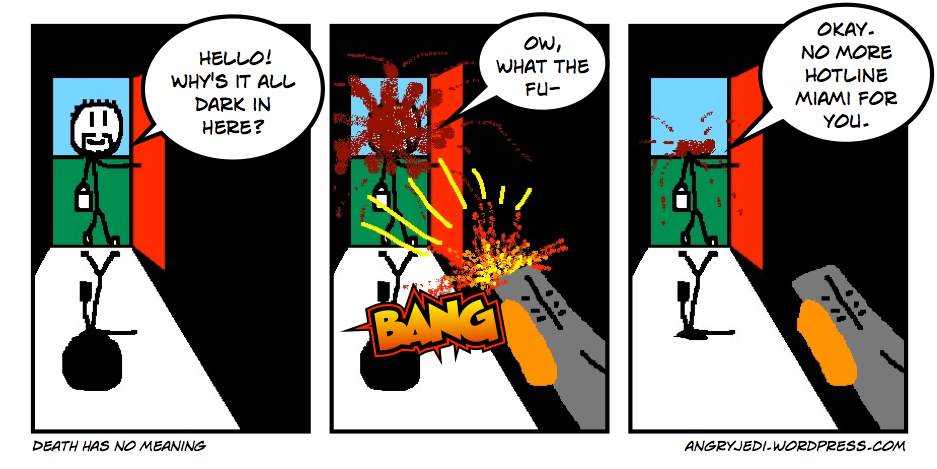
Page_1So, after being repeatedly bugged by almost everyone I know to try Hotline Miami, I tried Hotline Miami. Actually, to be more accurate, I sat down to play some Hotline Miami several hours ago and somehow here I am at 1am having completed it. What happened there?
I had been warned of the strange time-distorting properties of this curious little game by those who had played it, but having experienced it myself this evening… yes, there's something very odd going on there. A genuine feeling of, for want of a better word, "addiction" — of not wanting to stop until you've seen it through, even if the level you're on is ridiculously difficult. My "Die 1,000 times" achievement attests to the fact that I apparently did spend quite some time on it this evening.

But allow me to back up for a moment for those who are unfamiliar with Hotline Miami and its dubious charms.

Hotline Miami is basically that game the Daily Mail have been worried about for years. It's a straight-up game about murdering people with a variety of implements. It's gory, it's gross… and after about five or ten minutes of playing, it completely desensitises you to the acts of wanton violence you're committing. It then shows its true (neon) colours — despite its hyper-violence, it's actually a sort of puzzle game, a sort of lightning-fast strategy game, a sort of… I don't know. I don't like throwing this word around as it's rarely true, but I have a suspicious feeling that it's *whisper* unique.

The setup of Hotline Miami is that you, the faceless, nameless protagonist, repeatedly receive strange phone calls from a variety of sources. The phone calls themselves seem relatively innocuous, but when you get to the location you were told to go to, you apparently feel a strange urge to don an animal mask and then slaughter everyone who is there. Which is sort of convenient, because everyone there also wants to slaughter you.

You work your way through the levels by killing all the enemies. You have to scavenge weapons from dead enemies or the environment, and guns only have a small amount of ammunition in them when you do find them. Melee kills are silent, whereas attacking with a gun will often bring enemies running. When enemies are unaware of your presence, they follow very simple, predictable patterns. All you have to do is complete each stage of each chapter by killing all the enemies, at which point you'll receive a score breakdown showing how you did. The better you score, the better your grade and the more stuff you unlock.

Unlockable stuff includes weapons, which show up randomly in the levels, and masks, which you can equip before the level starts. Each mask has a special ability — one provides larger amounts of ammunition in guns, for example, while another makes your bare-handed attack (which normally just knocks enemies down, necessitating a ground attack to finish them off) a fatal strike. After unlocking the latter, I found that I didn't really use the others all that much. Perhaps I'm just unimaginative.

There is a plot that gradually unfolds as you progress through the levels. Like the swirly, pixelated, colourful visuals, it is rather vague and dream-like, and the end leaves a large number of questions. There are a few nice twists and turns, but it's not really the star of the show here — it simply provides a loose justification for the various top-down locations in which you visit and kill everything.

Hotline Miami is tough. There are levels that will repeatedly kill you over and over and over again — a thousand times or more, apparently — but somehow it will keep you playing in that same, inescapably compulsive way that Super Meat Boy encourages "just one more go". The fact that respawning after death is completely instantaneous helps this somewhat — there's no real feeling of being "penalised" for dying, it's simply part of the learning experience for each level. Death ceases to become something that makes you want to throw your controller out of the window, and instead becomes an exhortation from the game to try again and do better. It's still frustrating — I called the game (or possibly myself) "dickhead" a good few times while playing — but the important thing to note about it is that when you die, it's usually your own fault rather than that of the game. This is the sign of a well-designed difficult game — one where you accept that you'll make mistakes and learn from them, rather than where dying repeatedly simply makes you want to switch off and play something that repeatedly massages your ego, gives you a cuddle and tells you everything is going to be all right.

Anyway. That's Hotline Miami. If you have no issue with your games being borderline abusive in terms of difficulty, hyper-violent with little to no remorse, and leave you feeling like you've had some sort of drug-fuelled experience for several hours, then you should probably check it out. Conveniently, it's 50% off on Steam this weekend. How about that.

You should also check out this "two-headed review" over at Games Are Evil.

Now, if you'll excuse me, I need to sleep… and probably have some very peculiar dreams.

1053: Kira Kira, Sparkle Sparkle

Page_1Having completely and utterly 100%-ly finished classic visual novel Kana Little Sister, which you can read all about here (and in the book I'm still fully intending on writing and have already written just under 3,000 words of), naturally I immediately started on a new project, and one of a markedly different tone.
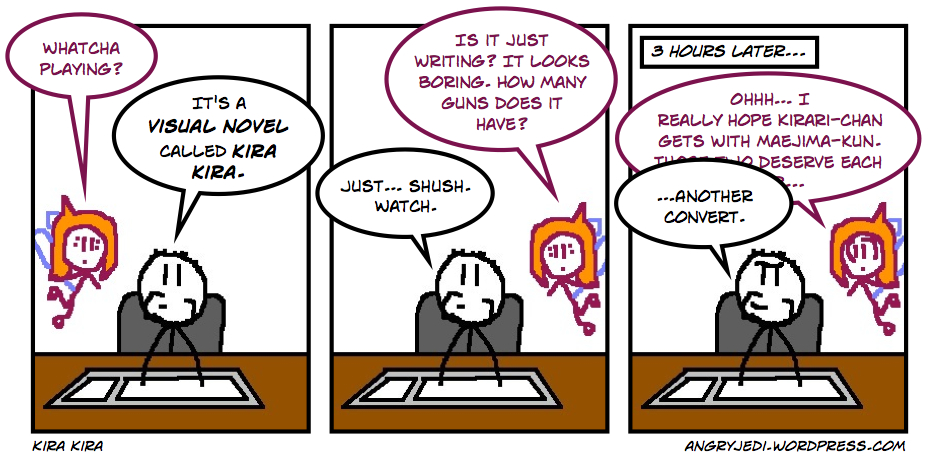
Kira Kira (which, apparently, is Japanese onomatopoeia for "sparkle sparkle") is a game about a bunch of high school kids (natch) who decide to put together a band. I haven't got far enough to know whether or not their band is particularly successful, but given the intro sequence showed them well and truly rocking out with suitably ridiculous hairstyles and outfits, I can only assume that they enjoy at least a small degree of success. Given that there is also a sort of sequel called Kira Kira Curtain Call, too, it's probably a fair assumption.

The reason I'm playing Kira Kira now is actually because of a completely different game I picked up a while back called DeardropsDeardrops is also about a bunch of high school kids who decide to put together a band — I think, anyway, as I haven't played that one at all yet — but a fellow (and considerably more experienced) VN enthusiast on Twitter recommended that I play Kira Kira first, because some of the characters have cameo appearances in Deardrops. Got all that? Good.

I like this sort of "crossover" idea, and apparently it's not all that uncommon — I understand that the story of Kana Little Sister is depicted as a movie in another game by the same developer called Crescendo, which is also in my growing pile of shame. (I have a sub-pile purely devoted to VNs, but given that the damn things are so time-consuming yet enjoyable, I'm not getting to anything outside it at the moment! That's… fine by me, to be perfectly honest. But I digress.)

Anyway. Kira Kira. As I say, I'm not all that far into it yet so I'm hesitant to say too much right now, but so far early impressions are very positive. Coming off the back of Kana Little Sister's 640×480 visuals and distinctly synthesized music — both of which are great, I hasten to add, just obviously dated — the super-sharp, crisp visuals, glorious digital music, quality voice acting and wonderfully atmospheric ambient sounds of Kira Kira make it obvious that this is a much more recent production. It's a much more multi-sensory, "multimedia" sort of experience, and it makes a massive difference. Kana immerses the player with its compelling story and interesting characters despite its relatively simplistic aesthetics; Kira Kira has, so far, immersed me with its presentation — it's a bit early for me to comment on the characters and plot so far, but they seem to be an interesting enough bunch.

Kira Kira isn't just interesting from an audio-visual presentation perspective, however. No, the way it's written and the way the text is presented is quite interesting, too, adopting a full-screen "novel" style similar to that seen in Kana Little Sister rather than the more common "adventure" (smaller text box, larger, unblocked image) interface seen in many other titles.

In terms of the way it's written, it seems to be quite wordy so far, but that's not necessarily a bad thing. It allows the player to understand the thoughts of the protagonist quite deeply, and the narration is presented almost as if the protagonist is talking to the player at times — not quite breaking the fourth wall, but certainly testing its structural integrity. Maejima-kun, it seems, thinks about things a lot, including his feelings about people, the things he's seen and where his life is going. His introspective nature makes the beginning of the game seem rather slow paced — it's a good hour or two before the OP video plays — but, as I say, I have no issue with this personally; he seems like an interesting character thus far, so I'm happy to have the opportunity to get to know him. Plus on subsequent playthroughs, the "Skip" button is right there if I want to fast-forward through all his exposition.

What's really interesting about the writing, though, is that it provides a uniquely Japanese take on something that is peculiar to the Western hemisphere — rock music. The setup of the game is that the school's "Second Literature Club", which Our Hero is a member of having quit the tennis club some time back, are struggling to think of something to do for the upcoming cultural festival. Naturally, after Our Hero and the resident squeaky-voiced, faintly annoying ditzy girl Kirari attend a live show by local legends "STAR GENERATION" (the capital letters are important), they decide that forming a band is The Right Thing To Do, despite the fact that none of them play an instrument or indeed know anything about music whatsoever. Enter Our Hero's friend, a fan of punk music that hasn't been to any live shows himself, who decides to educate the club with an informative video about The Sex Pistols and the punk movement. The club are understandably rather bewildered about all this, having hilariously little understanding of culture outside of Japan ("R&B? Isn't that music for black people?") but decide that yes, they'll give it a shot.

That's as far as I've got so far, but it's an intriguing setup with potential for plenty of hijinks — yes, hijinks — along the way. I'm looking forward to seeing how it progresses — and to hearing more of the excellent soundtrack.

1051: Take This, Right in the Feels

Page_1(With apologies to Jeff Green for the gratuitous use of "Feels".)

I was going to write something positive and happy today as a counterpoint to 1) yesterday's post and 2) the amount of anger that has been circulating on the Internet yet again today, this time as a result of an ill-conceived PR stunt by Square Enix. I'm not going to get into that now, because everyone yelling about it is already getting very tiresome. But I decided there was something else I wanted to discuss instead.

Instead I wanted to talk a bit about something which started up during the course of the last month — the Take This project, an attempt by a bunch of games industry professionals (including my good self) to do something positive about the stigma surrounding depression, anxiety and other mental health issues. Over at the site, numerous people are sharing their stories of their experiences with these issues in an attempt to encourage others to do the same, and to help people realise that they're not alone with the feelings they might be experiencing. Here's my contribution — more will probably follow in the near future.

I may well post something along these lines over on Take This at some point in the near future, but for now I thought I'd share it here.

I wanted to talk a bit about crying.

If you see someone else crying, chances are you'll start feeling pretty shitty too. It's not a nice thing to watch, particularly if you don't know what caused it. There's that air of immense awkwardness around the situation, particularly if a stranger's involved, where you're not quite sure if you're "allowed" to talk to the person and see if you can help with what they're upset about, and generally the whole thing is something most people like to avoid whenever possible. There's also an element of gender stereotyping that comes into play, too, where it's somehow "more okay" for women to cry than men. (I don't agree with this at all, but "big boys don't cry" is still a real stigma that stops many men from effectively expressing their emotions.)

But consider how that person who is in tears is feeling. It's sometimes difficult to judge from outside, because only the person who is crying knows exactly what they're feeling. Crying isn't always an unpleasant thing, either — sometimes it is a sweet release from pent-up emotion that has been bubbling away inside that person's head. Of course, sometimes it is outright hysteria, too — a complete inability to deal with a particular situation and a desire to simply let rip with some absolutely raw emotion. Only the person who is crying knows, and they're often not really in a position to talk about it while it's happening.

Oddly, though — and this is where I might lose a few of you — sometimes it's desirable or even enjoyable to cry. The feeling of being affected so profoundly by something that you actually want to weep is oddly intoxicating at times, and it can, at times, be outright pleasant.

It's not as strange as it initially sounds, though. How else can you explain the fact that most forms of media boast a "tearjerker" genre or equivalent?

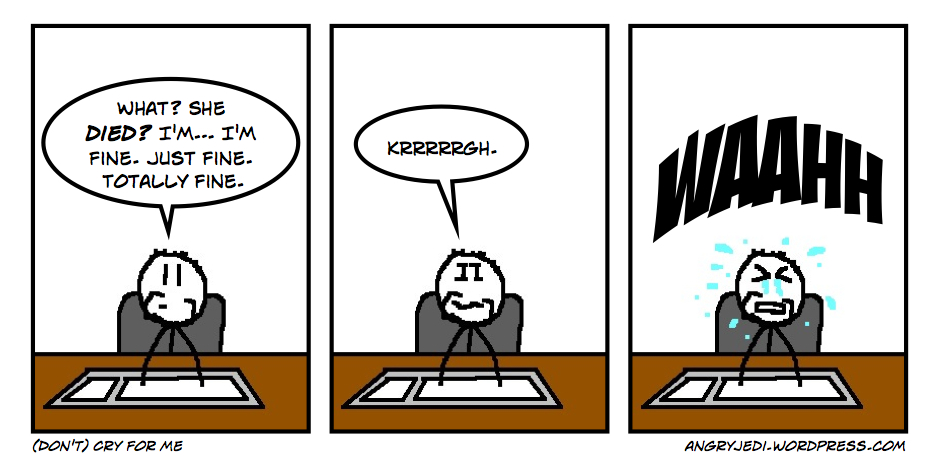
Most recently, I've been playing a visual novel called Kana Little Sister, which I talk about in greater detail over on Games Are Evil here. Kana is described as an "utsuge" — a "depression game", or a title that is specifically designed to elicit "negative" (for want of a better word) emotions in its audience, in this case sadness. (Other examples include Silent Hill 2, which evokes reactions ranging from slumping back in one's chair and sighing to crying bitter, bitter tears.) I have played through Kana five times now, and even though you know from the very outset that the titular little sister character is going to die at the end (spoiler: except in one ending), it still gets me every time, and the tears fall without fail.

This doesn't make me feel bad, though. It's a perversely enjoyable experience. I like responding to something in this way. I like the feeling of being overtaken by emotion and being physically affected by a work. It's an impressive mark of how much something has engaged me fully if it can make me cry — or if, for that matter, it can make my pulse race, or generate that hard-to-define feeling of "butterflies in the stomach" that a good, epic final confrontation in something like an RPG can sometimes manage.

Even now, though, as open as I generally am about this sort of thing, there's still a slight feeling of embarrassment when it happens. It's perhaps because when you cry, you're making yourself quite vulnerable. You're "letting go", turning off the safety switches that let you behave "normally" in polite society without breaking down into tears every five seconds. If you do it around someone else, you're showing a great deal of trust in them — trust that they won't laugh at you for having emotions in the first place, and trust that they won't think any less of you in the future because of your reaction.

Basically, I think what I'm saying is that you shouldn't be afraid to cry — regardless of whether you need to or just want to. So, you know, let it out.