1093: 'Problematic' is This Year's 'Entitled'

Page_1Remember last year when everyone was busily calling each other "entitled" for complaining about stuff like the Mass Effect 3 ending and Capcom's absurd DLC-on-disc policies? Ah, good times. They were fun, weren't they? Particularly when members of the press who should really know better starting insulting their audience. But let's leave that aside for now, because now it's 2013, and we have bigger fish to fry.

Now, you see, the fashionable thing to do is to declare something "problematic". I can't quite work out what irks me so about this word — in all likelihood it's simply its overuse — but it really does bug me.

The declaration of something as "problematic" usually ties in with the growing trend of guilt-ridden white straight cis men to want to champion the poor downtrodden parts of society — the women, the transsexuals, the homosexuals, the people of non-white ethnic backgrounds — and show themselves to be enlightened enough to stand up to the privileged of the world. Trouble is, a white straight cis man standing up for these groups only helps to reinforce that perceived "weakness" in many ways — and in worst-case scenarios, it starts to look a bit like bandwagon-jumping.

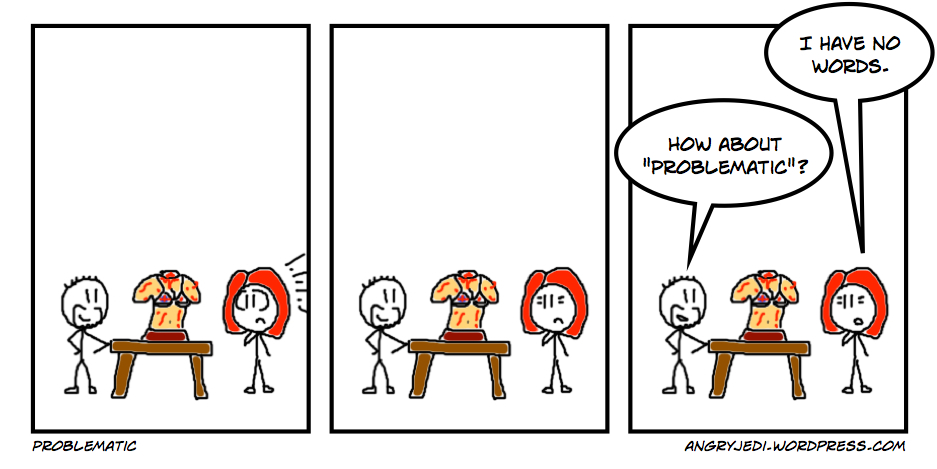
Such is the case with many of these things that have been declared "problematic" in recent months. A while back we had that beyond-stupid Hitman: Absolution trailer, more recently we had CD Projekt Red's actually quite excellent Cyberpunk 2077 trailer, and today we had the announcement of Dead Island Riptide's ridiculous "Zombie Bait" special edition. Leaving aside Cyberpunk 2077 for a moment, which is something of a different issue, both Hitman: Absolution and Dead Island Riptide are obviously incredibly stupid marketing ploys designed for shock value, little more. I find it honestly hard to believe that either Square Enix or Deep Silver genuinely want to condone violence against women or misogyny in general, but that is what they're being accused of with these "problematic" marketing materials — in the case of Dead Island, within minutes of the images hitting the Interwebs.

The thing is, all the shouting about how "problematic" these things are actually just plays right into the marketers' hands. For every table-thumping opinion piece that decries these things as the most awful thing ever dreamed up by a game's marketing team, there will be at least a few readers who will think "well hang on, actually I'm quite interested in that now," whether or not they actually admit to it in public. The amount of "OMG THIS IS AWFUL" stuff floating around about Dead Island Riptide's bloody torso is only really serving to make people more aware of the game's striking, gross (and Europe/Australia-exclusive) special edition; the hoo-hah over the Hitman: Absolution trailer likely helped raise awareness of the game in the run-up to its release to a considerable degree, and it had been all but forgotten by most people by the time the game actually came out.

In short, they're stupid and in poor taste, but all they are are marketing ploys, little more. And they're doing their job admirably — both games now have considerably higher visibility than they once had. As they say, all publicity is good publicity. If you really want to punish them, don't provide them with any coverage whatsoever.

The Cyberpunk 2077 trailer is a little more complex to discuss. Taken out of context, it could be seen as a representation of brutality against a sex worker — until it pans out and she reveals her MASSIVE FUCKING ROBOT SCYTHE BLADES, that is — but taken in the context of the original Cyberpunk 2077 source material from the '80s, it is, to my knowledge anyway, entirely in keeping with the aesthetic and atmosphere of that which it is based on. I observed some lengthy discussions about this on both Facebook and Google+ recently, and now that I know the context, it's clear that this trailer is entirely appropriate for the setting. One may argue that the use of a scantily-clad woman is somewhat unnecessary, and you might be right about that, but that doesn't mean that this is suddenly a huge violence against women issue. It's a stylistic choice; little more — a subversion of audience expectations. "A woman being abused by the police… oh wait, no, she's actually some sort of hideous mechanical monster with very little humanity remaining." (Spoilers.)

You could also argue that the requirement to be familiar with the source material before being able to recognise the trailer for what it is is something of a failing of the marketing, but then Cyberpunk 2077 was always likely to appeal to a very specific, niche audience — those who remembered the original tabletop RPG — anyway, so is there really anything wrong in catering to that specific, niche audience rather than attempting to make something bland, unremarkable and mainstream?

My point, essentially, is that by shouting and screaming about how "problematic" these things are, you're fuelling the fire. You're helping the things that you hate. You're making people aware of them, and not in the way you probably intend. It's a catch-22, really. If you say nothing, you might feel as if you're tacitly condoning things that you don't agree with; if you say something, you actually end up bringing it to a much wider audience, many of whom may become defensive when confronted with your viewpoints that counter their feelings.

The key thing, I think, is moderation. The trouble with the number of things that have been declared "problematic" recently is that it's losing its impact. We're apparently supposed to find so much stuff "offensive" these days that it's getting difficult to keep track — and who are the people who get to say what is and isn't offensive, anyway? Following the release of the Dead Island Riptide pictures today, for example, I saw a variety of comments from female gamers (as in, gamers who just happen to be female, not girls who make a big deal out of the fact they play games or specifically identify as "girl gamers") along the lines that it really didn't bother them and that they just found this sort of thing rather childish and amusing.

That, to me, is a more healthy attitude to take. All of the outrage I've seen today has been from men — always the same men, too, so much so that any time something like this comes up it's incredibly predictable who will be the first to jump on their virtual soapbox. It's easy to play the "champion of feminism" from behind a computer keyboard, but I have to question how many of these self-appointed arbiters of taste and decency have actually done anything beyond pen an angry blog post (yes, just like this one, I know) to help make life better for these groups they're supposedly standing up for.

Dead Island's bloody tits are a horrid thing you probably wouldn't want on your mantlepiece. Hitman: Absolution's nuns trailer was an exercise in how ridiculous a trailer they could get away with. I'm not defending either of them, because they're both shit, let's not beat around the bush. But I really don't believe they're symptomatic of anything more than marketing departments that are highly adept at taking advantage of "shock value". And attempting to make these into anything more than that will achieve little more than starting arguments that have little value to the real concerns, which are a much more complex set of sociological issues.

I like women and have never, ever thought of a woman as someone "inferior" to me. The thought of perpetrating violence against a woman in reality is, to me, abhorrent, but then the thought of perpetrating violence against a man is also, to me, abhorrent. But then I liked the Cyberpunk 2077 trailer, too. Does that make me an awful, hideous misogynist?

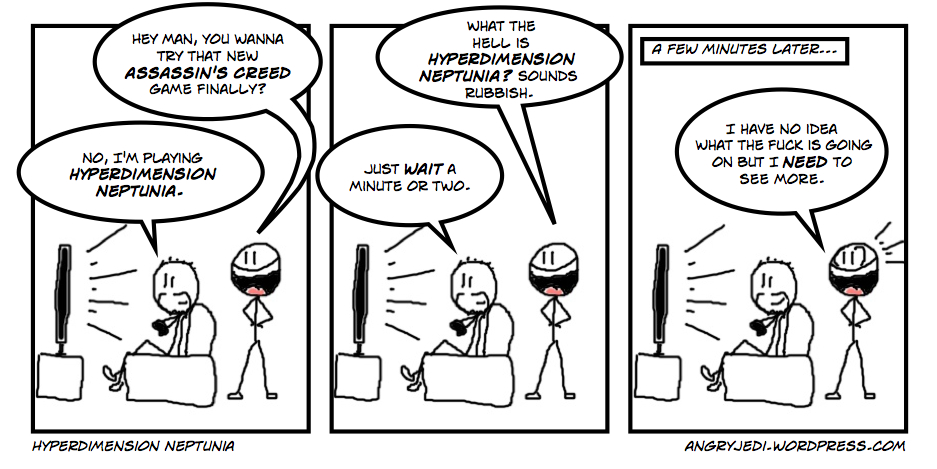
No, of course it doesn't. But what do I know? I like Hyperdimension Neptunia.
1092: Modest-Breasted Heroine

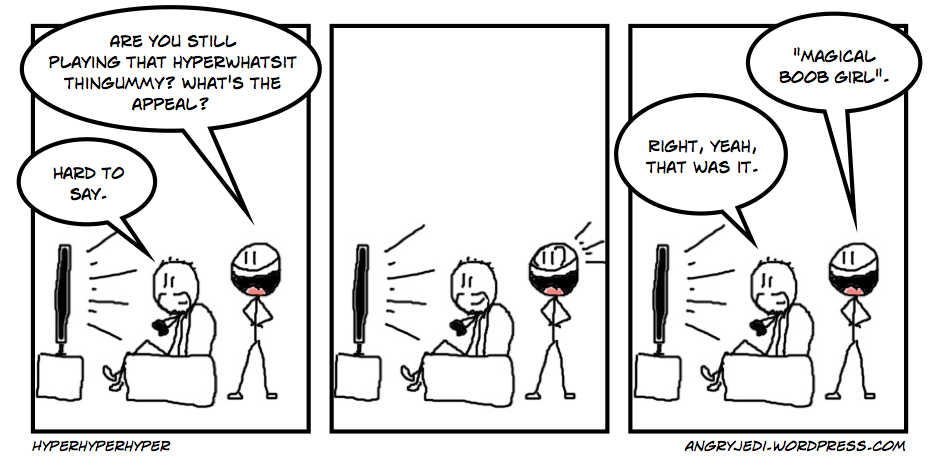
Page_1The title of this post is taken from a trophy I attained in Hyperdimension Neptunia today celebrating my acquisition of the character "Nisa", an embodiment of the game's Western publisher NIS America. ("Nisa", geddit?) Nisa wears a Bayonetta-style super-revealing leather catsuit unzipped to beneath her bellybutton, but is constantly ridiculed for having small breasts. She doesn't seem to mind too much, to be fair, even when surrounded by the heaving bosoms of squeaky-voiced Compa and Neptune in her, I quote, "magical boob girl" form.

Hyperdimension Neptunia revels in the sort of innuendo and playful, childish humour prevalent in a lot of anime, particularly of the moe variety. In many ways, it's quite refreshing to play a game that doesn't really hold back on the boob-related humour, but it's also easy to see how some might take issue with the game and its all-female cast's shenanigans. Having played it for more hours than I'd care to count (the game doesn't include the usual timer seen in most other RPGs) I can say with a fair degree of confidence that the game certainly doesn't mean any harm by all this — it's being bawdy and lewd for the sake of getting a few cheap giggles out of the player (regardless of gender) rather than explicitly "sexy", a few fanservicey "event" pictures and costumes aside.

More importantly, though, said bawdy humour is but a small part of the game as a whole. After a while it just becomes the way things are in that world; part of the aesthetic. The characters all do plenty more than comment on the size of each others' jumblies; they're all actually rather well-realised, if a little reliant on rather conventional anime tropes. (I swear this game has more tsunderes per square foot than anything else I've ever played… b-but it's not like I'm complaining or anything!) That said, the game often lampshades said anime tropes with the characters calling each other on when they're falling into particular stereotypes, and there are several who have occasional surprises up their sleeves.

IF/Iffy/I-chan is a case in point. Initially appearing to be your stereotypical sour-faced textbook tsundere, Iffy quickly reveals herself to be quite an interesting character on the whole, particularly if you pursue the story arcs of the two DLC characters 5pb and Red. In the case of 5pb, we see Iffy acting as a confidante and counsellor to the chronically-shy idol, who is immensely insecure in herself when not hosting her radio show or performing her songs for fans. In the case of Red, we see Iffy humouring a childish girl's fantasies and showing a softer side to her sometimes gruff-seeming exterior. It would be easy for Iffy to tell Red and her "Wifey number 1!" babblings to take a hike, but instead she plays along, even going so far as to award her "charisma points" any time she does something good.

The "goddess" characters are something of an enigma at this point in the story, but it's quite amusing that the grumpiest of all the tsunderes in the whole game is the one supposed to be representing the Nintendo Wii, the happiest and most sunshiney of all consoles. The land of "Lowee" is a fantasy kingdom filled with houses that look like cakes, rainbows, mushrooms and bizarre, surreal happenings, but its ruler is a sour-faced, foul-mouthed young girl who would much rather lock herself in her room and read a book rather than have to deal with any of the events that are transpiring in the world. The PlayStation-themed goddess, meanwhile, is rather Gothic Lolita in her stylings (and very tsundere when in her "CPU" form) while the Xbox goddess is a sleepyhead blonde-haired, blue-eyed girl (anime shorthand for "foreigner") who is addicted to online games.

It's been a pleasure to discover the various layers this game has as I've progressed through it. The dungeon crawling is still very straightforward and unlikely to change significantly for the rest of the game, but the moves the characters are unlocking are becoming increasingly ridiculous, the time-attack dungeons are fun to challenge and the growing party means that I can start to take advantage of interesting mechanics such as the ability to switch party members in mid-combo.

The pacing is such that you never spend too long battling through endless random combats, either; each dungeon is short (if you know what you're doing and skip the excess of the attack animations you can clear each one in 3-5 minutes tops) and you're often rewarded for making progress with additional entertaining scenes between the girls. And as the game's narrative has continued, these characters have started to show that they have been crafted with what seems like genuine affection from their creators. There's a good sense of them being friends with one another, though the various "optional" characters don't put in nearly enough appearances in the story scenes. I guess that's understandable, though. The "core" of the game is the way the three contrasting characters of Nep-Nep, Compa and IF behave around one another; the others are relatively incidental characters whom you just happen to be able to take into batle.

I'm a little under 50% done with the game according to the menus, and I have no intention of stopping until I've finished it. Whether I tackle any of the free DLC dungeons (many of which have obscenely high "recommended levels") remains to be seen, but I certainly intend to see as much of the core game as possible. And then move on to the sequel.

So yes. I laugh in the face of Hyperdimension Neptunia's sub-50 Metacritic score. I'm having a blast, and you can't stop me! MWAHAHAHA!

1091: You've Got... You Know

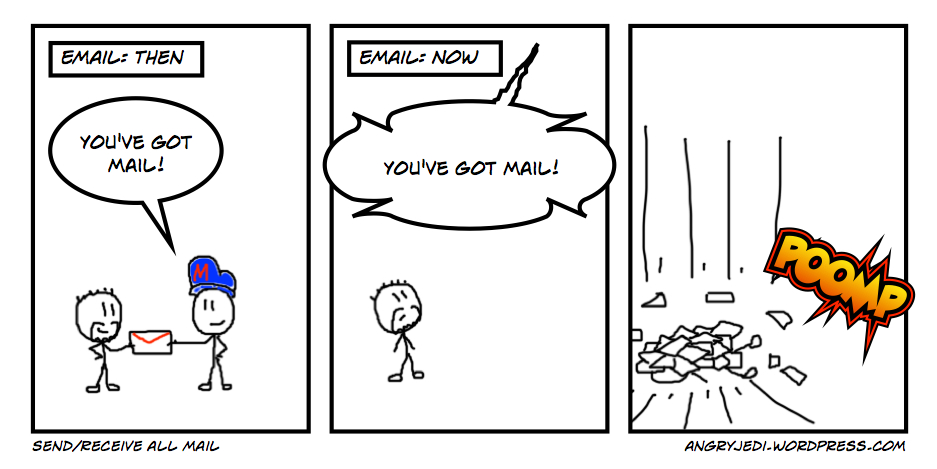
Page_1Speaking as someone who grew up with the early days of popular online activity (BBSes, CompuServe and finally the "proper Internet") I find it mildly interesting (or at least worthy of a late-night blog post, which isn't necessarily the same thing) how much the role of email has changed over the course of the last 15-20 years or so. I am prompted into these thoughts by a casual glimpse at my own inbox, which currently contains a devilish 666 messages, none of which visible on the front page are, to my knowledge, written directly to me by an actual human being.

This is something of a change from the earlier days, when clicking "Send/Receive Mail" in Outlook Express was an exciting moment, and you knew if the progress bar came up you had email incoming. Who would it be from? Would it be from someone interesting? What would they have to say? Would there be an attachment? In just a minute or two (LOL DIALUP) you would find out, and then you'd lovingly file the email into an appropriate folder to keep for all eternity. (I say "you" again when, of course, what I actually mean is "I". I don't know if everyone else was quite so fastidious with their email organisation when they first got online, but I certainly ran a tight ship… for a while, anyway.)

Looking at my inbox today, though, it's clear that email has a very different purpose today to what it once had. Whereas once it was effectively one of the only forms of social media (the others being forums and live chat rooms) it is now a general repository for crap. You'll occasionally get a meaningful message in there from someone who actually has a brain and a soul, but more often than not, if my inbox as of right now is anything to go by, it'll be a string of automated messages notifying you that so-and-so has added a new track to a playlist in Spotify (unsubscribe!), so-and-so has commented on something you don't give a fuck about on Facebook (unsubscribe!) or that that website you signed up for just so you could download a .zip file containing some porn/games that you wanted wants to wish you a happy birthday.

A relatively recent addition to the types of email you get nowadays is the guilt-trip "PLEASE COME BACK!" email. This happens with everything from mobile apps to online games, but the execution is always the same. "Here's all the great stuff you're missing out on!" it'll say, usually worded in such a way as to make you think that you're somehow doing something wrong by not using a service you currently have no need for. Often there will be some sort of bribe involved in getting you back, particularly when it comes to online games of various descriptions.

A Facebook game I reviewed a while back known as Outernauts was particularly bad for this. Outernauts was highly-anticipated by a lot of people because it was from a high-profile studio (Insomniac, for those in the know) and was aiming to be a social game that appealed to the sort of people who typically only played standalone, "pay once, keep forever" games on computer and console. It wasn't awful, but the overzealous means through which it was monetised — the ever-obnoxious "energy" mechanic — prevented anyone from being able to enjoy it for more than a few minutes at a time. Consequently, after an initial surge of interest, the very players it was trying to attract dropped it. Some months after I reviewed it and criticised it for its aggressive monetisation, it "relaunched", apparently with "fast recharging energy". It was still a pain in the arse to play. Some months after that, it relaunched again, this time promising "near limitless energy". Note: "near limitless", not "limitless".

I'm getting off the point slightly, but the fact is, every time Outernauts decided to do something a little different, it sent a begging email to me pleading for me to take it back, because it can change, it won't annoy me any more, it won't do that thing that annoys me any more. It was too little, too late, though; my experiences with Outernauts while reviewing it left such a sour taste in the mouth that I had (and still have) no desire to return, "near limitless energy" or not. That probably won't stop them sending me another email the next time they change something, though. Unless I blocked them. I might have blocked them.

Another offender in this sort of thing is a service called Earndit which I evidently signed up for at some point in the past. (I think I mistakenly signed up for it while looking for Fitocracy while the latter was still in closed testing; the two are different services but do have a few things in common.) Earndit sends me an email every week with sickly-sweet, overly-apologetic language about how I haven't earned any points this week, and that if they have it wrong I should get in touch with them PLEASE LOVE ME etc. It's annoying.

The response to all this annoying email is, of course, to unsubscribe from the mailing lists I've found myself on, send these messages to the spam folder or just to stop using my actual email address to sign up for things. But it's a pain to keep on top of. You can be as careful as you like to tick/untick the boxes that give websites permission to spam you with crap, but some will still get through, and over time there'll be so much incoming stuff that it's almost impossible to keep on top of your "unsubscribe" needs. The knock-on effect of all this is, of course, that genuine messages from real people can easily drift by completely unnoticed. If this has happened to you, it is nothing personal; you can blame Zynga, EA, Facebook, Twitter, Spotify, Google and indeed any of the million-and-one completely unnecessary social networking apps for mobile devices that I've reviewed over the course of the last year.

I miss the old days; the days when being notified you had a new message was exciting. Checking your email used to be a pleasure; now it's a chore.

1088: Shadows Over Camelot

Page_1I had some friends over tonight. (I'm still reeling from the novelty of being able to invite my friends over and them actually coming because I'm not a two-hour drive away from them, but I digress.) We played some Wii U (Nintendo Land is still great) and then settled down for a board game.

Tonight, it was the turn of Shadows Over Camelot, a new acquisition that I got for Christmas. It's a game that we've had on our collective radar as a board gaming group for quite some time, but none of us knew that much about it. All we really knew is that it had a mechanic similar to that found in the Battlestar Galactica board game (which is absolutely excellent, even for those unfamiliar with the show) in that there was a chance with every game that one player would be a secret traitor tasked with foiling the group's otherwise cooperative attempts to beat the game at its own… you know.

Shadows Over Camelot is a Days of Wonder production, and anyone who is into board games will know what that means — a nice hefty box with quality artwork, decent components, lovely thick gameboards and nice stiff cards that are easy to handle and shuffle. The only slight letdown with Shadows Over Camelot's components is with some of the miniatures provided — a few of them have unnecessarily "bendy" bits — swords in particular are very soft and bendy, though I suppose it's better that than them be rigid and easily breakable — or, for that matter, sharp and easy to poke into bits of delicate skin and make yourself bleed. (I speak from experience — Games Workshop's dungeon crawlers mauled me more than a few times in the past.)

I'd read through the instructions when I first got the game, but it didn't make a ton of sense without sitting down and actually trying it out for ourselves. We nearly didn't try it at all because as a group, we're generally terrible with new games — they tend to take twice as long as the suggested amount of time given on the game box, and we inevitably mess something up along the way. It had already got to 9pm by the time we'd eaten, so the worry was that we'd be there until the early hours of the morning playing.

Fortunately, there was no such problem, as Shadows Over Camelot actually has pleasantly simple, elegant mechanics that give it a nice, fast pace that constantly keeps flowing around the table — again, much like many other Days of Wonder titles.

Essentially, the aim of the game is twofold: firstly, do not allow any of the "defeat" conditions to come to pass, and secondly, ensure that victory is achieved. The players (except the traitor, if there is one) lose if there are twelve siege engines outside Camelot, if all the player characters die, or if the Round Table fills up and there are more black swords than white ones. Or if there are seven or more black swords, which amounts to much the same thing.

White and black swords are attained by going on quests, each of which are represented by small boards, and all of which are takes on Arthurian legends. You have the tournament against the Black Knight, the quest for the Holy Grail, fending off invasions, fighting dragons and claiming Excalibur.

Each quest has its own specific mechanics, but most involve playing cards in various arrangements. The Grail quest, for example, demands that players, between them, play a total of seven Grail cards onto the quest area — though if various "anti-Grail" cards appear, additional Grail cards must be played to remove these, too. Combat-focused quests, meanwhile, involve playing various poker-style hands one card per turn in an attempt to accumulate a high enough value to defeat the value of the black cards the game mechanics have been putting on the quest in the meantime. It's difficult to describe in words, but when playing, it makes sense very quickly.

A turn is simple and snappy. First of all, you do a "bad thing" — either take a point of damage, add a siege engine outside Camelot or draw a black card, which has one of a variety of bad effects. Later in the game, black cards that would normally be played on a quest that has now been completed summon additional siege engines, so the late game involves fending back the tides of darkness while attempting to push the game into a victory state.

Once your "bad thing" has been done, you get to do a "good thing". This can be as simple as moving, or performing an action unique to the quest you're currently standing on — playing a card, for example. Alternatively, there are some special cards you can play with specific useful effects, or you can even heal yourself by discarding a set of three identical cards. It's cooperative in that you are working together to defeat the game, but each player maintains their own independence to do as they please. Meanwhile, the traitor is doing their best to remain hidden while screwing everyone over as much as possible.

We were surprised when the game was over within an hour and a half — that's absolutely a new record for us when trying out a new game for the first time, and testament to Shadows Over Camelot's simple but elegant mechanics. I'm impressed, in short, and looking forward to trying it again, this time with a traitor — we followed the game's recommendation and played without one this time. Hopefully that will be pretty soon!

1085: Don't (Always) Ignore the Crap

Page_1I last wrote about this topic some time ago, so I figure it's time for a revisit, given what I've been playing and enjoying on my PlayStation 3 recently.

My point today is this: you shouldn't immediately dismiss stuff that is regarded as "crap" because there's every chance that if you tried it for yourself, you might just find yourself enjoying it. (Note: I'm not saying that stuff regarded as "crap" is always going to end up being good — some stuff we can all agree is shite — but in many cases it pays to go in with an open mind!)

Let's take Hyperdimension Neptunia as a timely example. Hyperdimension Neptunia received a spectacular 2/10 panning from Eurogamer's Simon Parkin, by all accounts a well-respected critic whose opinions a large number of people trust. Consequently, a lot of people didn't even bother to pick it up. This was such an issue that the (apparently considerably superior) sequel only had a limited print run and is now extremely difficult to find a copy of. (I tracked one down from Italy — European console games tend to be in English by default, perhaps with the packaging localised.)

And yet, while I can see its many flaws, I am having a lot of fun with Hyperdimension Neptunia. It's bright, brash, colourful, silly and rather entertaining despite being the sort of game some people I know would be embarrassed to be seen playing, particularly when the occasional "fanservice" images make an appearance, or every time the character Compa trips over and flashes her panties at the end of a fight. It's genuinely amusing, though — if deliberately cringeworthy at times — and packed with plenty of things to do. It combines two of my favourite styles of game — visual novel and JRPG — into one package with some really nice features. I love the ability to set custom images on "summon" spells, for example. Seeing the "I HAS A HERB" cat setting off a wind spell never gets old.

Hyperdimension Neptunia is far from the only example of a game which was poorly received but which I have ended up enjoying. In the post I linked to at the top, I mentioned Duke Nukem Forever and Alpha Protocol, both of which endured critical drubbings for various reasons — Duke for its grossout, sexist humour and Alpha Protocol for its broken gameplay aspects and appalling console versions. And yet in both cases — for I played them both to completion — I found myself having fun, being able to look past the flaws or "problematic" material and find an entertaining experience underneath. Am I somehow "wrong" to feel this way?

Well, of course I'm not. Opinions are entirely subjective, after all. I could tell you I found the critically-acclaimed movie Drive to be stultifyingly boring, for example (I did) but that doesn't stop you from enjoying it, rewatching it a bajillion times or putting it atop your "My Favourite Movies of All Time" list. Likewise, Nier's heavy reliance on fetch quests and seemingly tedious activities may cause you to switch off completely, while I found the experience to be an interesting example of a game requiring the player to "method act" the role of the protagonist, and found myself playing it obsessively as a result. We both might tell each other about how much we like our respective Things We Like, but it's unlikely we'll sway each other around to our way of thinking. And that's just fine.

The sad thing, though, is the fact that there are people out there who hold a considerable degree of influence over the public's spending decisions, and their opinion carries an undue amount of weight that might cause some people to miss out on things they might actually like. If Parkin gives Hyperdimension Neptunia 2/10, you better believe that's going to affect a large number of people's decisions as to whether they're going to buy it or not. (Probably the latter in this instance — in the notoriously top-loaded game review score scale, a score of 2/10 is theoretically reserved for an absolute stinker that is completely broken.) How many of those people whose opinion was swayed by Parkin's review would actually enjoy the game if they gave it a chance? How many people are actually going to give it a chance after reading that review?

The other thing worth mentioning particularly when it comes to titles like Hyperdimension Neptunia and Duke Nukem Forever is the fact that some critics seem to feel obliged to act as arbiters of taste and decency, when in fact everyone's tolerance for potentially "offensive" content is completely different. Both Hyperdimension Neptunia and Duke Nukem Forever attracted accusations of sexism on their original release to varying degrees of justification — the specifics of which I'm not going to get into right now because that's a whole other matter, particularly in the former's case — and these accusations negatively impacted the critic's view of the game in both instances. That's fair enough — as I said, everyone's "good taste" boundaries are different and said critics are entitled to voice those views — but when it comes to interactive entertainment, subject matter is just one part of the whole experience. And more to the point, in all forms of media, enjoying something that contains potentially objectionable subject matter doesn't imply that the person reading/watching/playing the thing in question is, by extension, a supporter of that particular viewpoint. In other words, you can like anime boobies and still see actual real-life women as actual real-life people. (I say "you" when, obviously, I mean "I".)

If you enjoy something, you enjoy something; you shouldn't feel guilt about your own tastes. Unless, you know, your "tastes" involve bludgeoning kittens, puppies and babies to death with a sledgehammer. (In real life, not in video games, obviously.) Or, you know, actively stirring up hate against a specific social group. Or just generally being a dick. Then you should probably feel a bit guilty. Basically, so long as you're not actually hurting anyone (physically or psychologically) or actively oppressing someone with the things you like, enjoy whatever you want within reason!

Now, if you'll excuse me, I'm off to plumb the depths of the bottom half of Metacritic to see what awesome experiences I can find to enjoy next…

1084: Darkdeath Evilman

Page_1So, I seem to have jumped down something of a rabbit-hole with regard to my current gaming. Specifically, I seem to have jumped down the NIS America rabbit-hole, which means lots of brightly-colored anime-style JRPGs with heavy degrees of ridiculousness. Hyperdimension Neptunia, which I discussed yesterday (and which I'm aware is developed by Idea Factory rather than Nippon Ichi themselves), is a fine example of said ridiculousness being taken to the extreme with its personifications of gaming platforms and companies as cute anime girls with a habit of flashing their panties.

I decided to start something on portable in parallel, though, so I had something to play on the toilet/in bed/in coffee shops. I wanted to pick something that was portable-friendly — i.e. something you could dip into in short sessions rather than feeling like you need to spend hours at a time playing, but which would last a good long while in total. The game I picked for this purpose was the rather gloriously-titled Z.H.P. Unlosing Ranger vs. Darkdeath Evilman for the PSP/Vita, a game from the Disgaea team and one which wears its influences on its sleeve.

Z.H.P. (as it shall be known from hereon) is an isometric-perspective tactical roguelike RPG that plays somewhat like Disgaea (which is normally a strategy game somewhat akin to Final Fantasy Tactics, if you're unfamiliar) would play if you only controlled one character and could only move them one space at a time per turn. It follows the traditional style of roguelike gameplay, in other words — you move, the enemies move, but between moves you can stand still and contemplate what to do next without fear of getting twatted while you come to your decision. As per usual for the genre, you find yourself exploring a series of increasingly-difficult, increasingly-complex randomly-generated dungeons in an attempt to become as strong as possible and eventually take down the titular bad guy Darkdeath Evilman.

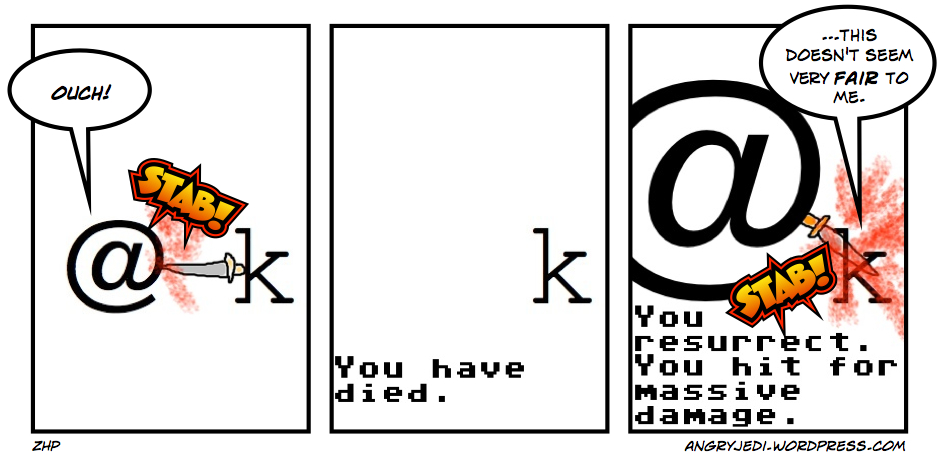
There's a bit of a twist on the usual formula, though. Rather than featuring a permadeath system that forces you to start over when you bite the big one in a dungeon, Z.H.P. instead features a rather odd levelling system whereby each time you enter a dungeon, you start at level 1, but your total levels gained over your lifetime playing the game determines your base statistics. If you die, you lose all the loot you acquired on that particular dungeon run, but any levels you gained are added on to your total level count, boosting your base statistics by a little and meaning that the next time you start a dungeon run, you'll be slightly stronger even though you're still technically level 1. If that makes your head hurt, don't worry — it starts to make sense after playing for only a short period.

The eventual aim of the game is to work your way through the story and make the nameless, voiceless protagonist (who, rather endearingly, is canonically named simply Main Character) into the hero he was supposed to replace — the Unlosing Ranger, the only one who can defeat Darkdeath Evilman. Every so often in the story, you'll find yourself returning to Earth from the Bizarro Earth in which you've been doing all your dungeon-crawling, and thrust into a traditional JRPG-style battle against Darkdeath Evilman, who is your stereotypical "final boss" sort of character. As the game progresses, these battle sequences become increasingly elaborate — they start with a first-person 8-bit sequence somewhat reminiscent of the end of the original Phantasy Star and gradually progress to… well, I'm not sure yet as I haven't got that far.

There are some fun additions to the basic roguelike formula, and it's here that the Disgaea influences are apparent. You can pick up enemies and fling them around, for example, though disappointingly you can't simply lob them off the edge of a precarious platform into the lava below. You can also throw items from your inventory, many of which have special effects. It also provides a use for items that have degraded to a durability level of 0%, meaning that the bonuses they normally provide are completely ineffective until repaired. If you don't want to spend your limited funds on repair bills, simply throw them at the enemies.

Then there's the guest appearances from the Prinnies, the weird explosive penguin-like things from Disgaea. Early in the game, you inexplicably find yourself married to one and gain the once-per-expedition special ability to summon your "wife" and have her bring you a lunchbox to restore your endurance points.

I could go on, but I would like to play the game a bit more before I talk about it too much. Early impressions are very positive, though, and if it's anything like Disgaea this will be a game designed to keep one occupied for a frighteningly long time. If you're looking for something endearingly bizarre but which backs up that bizarreness with solid gameplay and good presentation, you could do far worse than check out Z.H.P. — it works on Vita, too, so you can just download it from the PSN store rather than attempting to track down a physical copy.

See you in the dungeon, dood!

1083: Hyperwhatnow Nepperwho?

Page_1I finished Trails in the Sky this morning (not last night — it got to 4am and I still hadn't reached the final boss so I decided to save it for this morning, and it was well worth the wait) so today saw that age-old question, "What to Play Next" rear its head.

I fancied something light-hearted and silly, so I chose Hyperdimension Neptunia. I knew nothing about this prior to starting to play, and just knew that it was rather silly, very Japanese, packed with rather unnecessary fanservice (that I secretly quite enjoy) and not necessarily what you'd call "good" by the traditional definition. However, given that many of the games I've enjoyed most of all over the course of the last year have not been what you'd call "good" by the traditional definition (Nier springs immediately to mind) I was willing to give it a chance.

I think I'm going to like it.

Hyperdimension Neptunia casts you in the role of Neptune, a personification of the cancelled console the Sega Neptune. Cast out of Celestia by her goddess sisters (each of whom represents one of the Xbox, PlayStation and Wii respectively) and forced to fend for herself in the lands of Gamindustri, it's up to her to… well, I don't really know yet, as I haven't got that far and the events in the intro left her with amnesia which she conveniently points out is to help the players understand what is going on. I swear I'm not making any of what I just said up. This is indeed a game that represents the seventh-generation "console wars" as ridiculous anime-style battles between anthropomorphised hardware manufacturers.

Besides the silly premise, which I have a lot of time for, there actually seems to be quite an interesting game under there, too. The game unfolds in several distinct components — visual novel-style storytelling sequences; a "between missions" bit where you can shop, read background information and discover sidequests; and dungeon-crawling. The game isn't really a traditional JRPG in terms of structure — there's no wandering around field screens or towns, for example, and the story scenes all unfold using head-and-shoulders shots of the characters rather than in-engine graphics, like a visual novel rather than a standard JRPG.

Where the interesting gameplay comes in is in the dungeon-crawling component. Structurally, this is very straightforward — you wander around a dungeon finding treasure chests and occasionally getting into random battles. The characters in your party each have "dungeon abilities" that recharge over time that allow them to do different things — Neptune can smash through obstacles, for example, while Compa, a character who appears early on, can trigger tough battles at special summoning zones to temporarily lower the random encounter rate, and IF, another early character, has the ability to lead the way to normally-invisible treasure chests.

The battle system is turn-based, but makes use of an "ability points" system, whereby each character has a certain number of points that they can spend on their turn. Each move they do costs ability points, and up to four moves can be chained together into a combo. Certain moves allow the combo to continue registering with second, third, fourth sets of four button pushes, and the longer a combo goes on for, the better.

It's this combo system that provides some rather daunting complexity to the battle system. You're not limited to the basic skills the game provides for you. Rather, you can redefine pretty much any combination of four buttons to perform any of the character's unlocked skills to create custom combos. Some skills are learned through levelling up, others through acquiring CD-Rs and CD-R/Ws with skill information on. CD-Rs have preset skills; CD-R/Ws have customizable skills that you can rename and visually tweak by importing an image from your PS3's photo library. So yes, you can have a spell that summons, say, Twilight Sparkle to kick some ass. This is, as they say, awesome. And hilarious. It also gives people an actual reason to load some images into their PS3's photo library, which is surely worthy of praise.

So thus far it seems like an interesting game, albeit one with more than a few flaws. On the technical front, the frame rate and graphics aren't all that great (though the visual novel scenes look lovely and feature animated characters); the dungeons look like they might be a bit "samey" over time; and the game doesn't do a great job of explaining its more complicated aspects in detail. But, for me anyway, part of the joy in this sort of thing is in discovering the hidden secrets for oneself and working out just what the fuck is going on.

It's early days yet, but I've enjoyed what I've seen so far. Let's see if it has what it takes to keep me playing in the long run!

1081: Reasons to Get a Wii U (or a Friend Who Owns a Wii U): Nintendo Land

Page_1I had some friends over tonight for some computer and board game action. I lost our game of Agricola as usual (though not by as much as normal — I'll take that) but what I really wanted to talk about was the game we played earlier in the evening — Nintendo Land.

I had a feeling that Nintendo Land would go down well, but I'm super-impressed by quite how much fun it really is. We were concentrating on the competitive games, based on the Mario, Animal Crossing and Luigi's Mansion franchises, and all of them provide chaotic fun for up to five players along with an apt demonstration of exactly what the Gamepad controller device brings to the table.

The Luigi's Mansion game sees the player with the Gamepad taking on the role of a ghost and up to four players with Wii Remotes playing the part of ghost hunters armed only with torches. The ghost's job is to knock out all the ghost hunters by sneaking up on them and touching them; the ghost hunters' job is to reduce the ghost's hit points to zero by shining light on it. The twist is that the ghost is invisible on the TV screen, which the hunter players are referring to, and only the ghost player gets a full overview of where they are in relation to the others on the Gamepad screen. The ghost also occasionally reveals itself when lightning flashes and when it performs a "dash" action, and the hunters' controllers vibrate when the ghost is nearby. The ghost player has an on-screen marker showing the boundary of where the vibrations will occur, meaning they can play some amusing mind games with the other players if they desire.

The Animal Crossing game, meanwhile, casts the Gamepad player in the role of two guards and the Wii Remote players in the role of animals trying to collect sweets. The animal players have to collect a particular number of sweets before the guards catch them three times, though the more sweets they are carrying, the slower they move. The twist with this one is that the single Gamepad player controls both guards using the dual analogue sticks on the Gamepad, and their viewpoint pans and zooms to keep both guards in view at once, while the players on the TV may only see what is in their immediate vicinity.

Finally, the Mario-themed game casts the Gamepad player in the role of Mario and the Wii Remote players in the role of various-coloured Toads. It's Mario's job to stay un-caught until a timer expires, and it's up to the Toads to capture him as quickly as possible. Like in the Animal Crossing game, the Toads may only see what is in their immediate vicinity, and their controls are deliberately clunky and awkward to make it more challenging for them to catch the more agile Mario. The Mario player, meanwhile, has a screen that shows both an overview of the entire level (including where the two Toads are) and a close-up of their immediate surroundings. For the most part, the Mario player will be using the overview map to try and stay out of trouble, but when the Toads get near the close-up view comes into it own as Mario tries to avoid their tackles.

These three games offer a tiny subset of what Nintendo Land has to offer — there are a selection of more cooperative games on offer as well as a bunch of single-player games for the Gamepad that would still be fun for friends to take it in turns on.

The interesting thing about Nintendo Land is that it's a slight shift in attitude from Wii Sports, the pack-in game with the previous-generation Wii. Wii Sports was designed to be accessible and intuitive, making use primarily of motion controls that anyone could perform. Nintendo Land, meanwhile, assumes a basic level of "game literacy" — familiarity with a controller being used "traditionally" — but still remains accessible to a wide audience. Consequently, it strikes a good balance between being casual-friendly as well as challenging and fun to veteran gamers.

Next week I'll hopefully have the opportunity to play both Nintendo Land and the excellent Sonic & All-Stars Racing Transformed with a full complement of five players, so I'm looking forward to that. The games described above are great fun with three; I can only imagine the chaos with five. I can't wait.

Think about that. When was the last time you played a game that you couldn't wait to get your friends over to your house for?

1075: Those Trails in the Sky Get Longer

[Author's note: See, I resisted the temptation to make another "Tits" joke in the headline. You should be proud of me.]

After a bit of a break to play some other stuff, mainly Persona 3: FES, I am back on my Vita and proceeding nicely with Trails in the Sky.

Trails in the Sky, for those who missed the earlier post I made about it, is a role-playing game for the PSP and Vita from Falcom. It also happens to be one of the best role-playing games I've played in recent memory, for a diverse array of reasons, some of which I've already talked about and others of which I will touch on today.

Plot-wise, Trails in the Sky isn't your conventional JRPG. I'm over 30 hours in now and there's been no trace of any villain wanting to take over the world, call down a meteor, kompress time [sic],  sit inside a mountain going "MWAHAHAHAHA" or indeed any of the other things that JRPG villains typically want to do. In fact, I'd be hard-pushed to identify a single "villain" as yet — there have been villainous groups and individuals, sure, but not a single character that I'd particularly identify as a specific "antagonist". No-one with silvery-white hair flowing down their back; no-one with a good line in evil laughs; no "evil empire" to fight back against. The closest we've had is a few men clad in black, and they're clearly working for someone.

While this may cause you to worry about the game being directionless — what's an epic RPG without an antagonist taunting you throughout making that final boss smackdown all the more satisfying? — in actual fact the opposite is true. The focus may be different, but there's most definitely a plot with direction and good pace going on here.

The focus in this case is the relationship between the two lead characters Estelle and Joshua, foster siblings and a classic case of a "will they, won't they" relationship that will undoubtedly come to smooches by the end of the game's 50-hour quest. The main thrust of the game's story is the pair's journey around the game world, training their abilities and learning more about themselves, each other and the way they feel about one another. Third and fourth party members come and go, but Estelle and Joshua are permanent fixtures, with the player taking direct control of Estelle for the vast majority of the game.

Estelle is a great lead character, largely because she's not a traditional female protagonist. She may be pretty cute visually — as a redhead/brunette with twintails, she's seemingly designed to appeal specifically to me — but personality-wise, she's certainly far from demure, cute or helpless. She's spunky, loud, opinionated, brash, sarcastic and quick to anger. At the same time, she doesn't deny her feminine side to herself — even if she seemingly tries to hide it when others are around. There are a number of scenes, particularly late in the game, where she tries to come to terms with her own feelings towards Joshua that give us some interesting insight into what she's really thinking behind her slightly-abrasive facade.

The side-effect of Estelle's somewhat tomboyish nature when she's around other people is that said other people tend not to treat her in a particularly "girlish" manner, often deriding her for not particularly conforming to gender stereotypes and acting in a "mannish" or "boyish" manner. She takes it in her stride throughout, often swiping such comments aside with a sarcastic rebuttal or two of her own, and you get the impression that she is someone who is thoroughly comfortable in who she is — or at least comfortable with the "public face" she shows to people. Despite her self-assuredness, though, a sure-fire way to make Estelle skittish and nervous is to bring up the possibility of her getting together with Joshua, which in many cases makes her literally want to run away or furiously deny any such accusations, even if it's blatantly obvious that she's thought about it more than once in her life.

I'm looking forward to seeing the game through to its conclusion. It's structured very nicely in that you always feel like you're doing something, and grinding has been absolutely non-existent so far. Wandering monsters provide relatively trivial amounts of experience points, and are primarily used to acquire the "Sepith" gems used to craft new special ability items called Orbments, and if you're that way inclined, you can race through most of the game without stopping to have random encounters at all if you don't want to — though you may find yourself struggling to acquire better spells if you do so.

In short, it's nice to play a JRPG that focuses on the good things about the genre — exploration, discovery, questing, character development and narrative — and doesn't force players to live with frustrating and outdated conventions like grinding. If you're an RPG fan toting a PSP or Vita, you should consider Trails in the Sky an essential purchase, as it is a fine example of how the genre is alive, well and more than happy to not follow the traditional Final Fantasy "OMG WORLD IS ENDING" route. (That's not to say that doesn't have a place, of course — I still love saving the world, but I'm well aware many others are sick of it.)

Check out the official website to find out more — and I believe there's a sequel inbound at some point in the near future, too.

1074: Loving the Vita

It's fashionable to bash Sony's latest handheld, the Vita. This is partly justified, because it hasn't been selling particularly well — especially when compared to Nintendo's latest powerhouse the 3DS, which seems entirely likely to repeat the success of its predecessor the DS family. The poor sales can be attributed to its relatively high price and the fact that its proprietary memory cards are unnecessarily expensive and can't be used in anything else, unlike the standard SD cards that the 3DS uses.

But even though I know these criticisms are valid and warranted, it still bugs me a little that this means people are quickly writing off the Vita as a no-hoper, as a stillborn, with some even going so far as to compare it to disastrous past industry efforts such as Nintendo's dreadful Virtual Boy. That's just ridiculous.

Fact is, the Vita is a wonderful piece of kit. For your money, you get a gorgeous shiny gadget with a deliciously bright, big, high-resolution LED screen, two not-very-good-but-functional cameras (front and back) and not one but two touch-sensitive surfaces (again, front and back). Games specifically designed for Vita look beautiful on that big shiny screen, and the system runs downloadable PSP titles perfectly — though the lack of UMD drive means that those who have an extensive collection of physical PSP games will either need to keep their old handheld around or re-purchase their games as downloadable versions.

The PSP support is an aspect of the Vita that I can't help but feel is understated. I know, I know, you could buy a used PSP for a fraction of the price of a new Vita, but how great the games look on that LED screen shouldn't be underestimated — plus with the latest system firmware, it's possible to apply bilinear filtering to the games to smooth out edges without making them look overly-blurry, and assign the Vita's right stick and touchscreen to various functions. You'd be surprised quite how much more comfortable it is using the right stick to move the camera in games that previously used the shoulder buttons for this purpose — the PSP, let's not forget, didn't have a right stick and had that peculiar and uncomfortable "nub" instead of an actual stick on the left.

The other aspect of that PSP compatibility is that it makes the old "Vita has no games" argument sort of invalid — because not only do you have a healthy selection of largely good-quality Vita titles to draw on, you also have a huge selection of downloadable PSP titles to work your way through, too. If you're a JRPG or SRPG fan in particular, the Vita is a fantastic system. The first three Persona games; Trails in the Sky; all the Final Fantasy games up to IX plus spinoffs Final Fantasy Tactics and Dissidia Final FantasyTactics Ogre; the list goes on. (It goes on longer if you're American, because you also have titles like Growlanser and Gungnir to enjoy, too. Damn you, Atlus, for not having a European arm.)

As for the actual Vita games themselves, there are some real gems there. Everybody's Golf/Hot Shots Golf is fantastic fun, and packed with content. Gravity Rush is a beautiful, stylish, challenging game that makes good use of the Vita's accelerometers alongside a more traditional control scheme. The Vita version of Need for Speed Most Wanted is a very good one, ideal for a quick race on the go. Lumines Electronic Symphony is a fantastic puzzle game — though not very toilet-friendly, as sessions tend to go on for quite a while. LittleBigPlanet is an ideal fit for the Vita's interface and touchscreen. And then there are a bunch of cheaper download-only games that are also fantastic — the strange and abstract world of Sound Shapes; the John Cleese-voiced, Unreal Engine-powered brain training of Smart As…; the freebies like that ecosystem game I've forgotten the name of and hilarious pass-and-play party game Frobisher Says.

And then you have PlayStation Minis, which is home to some surprisingly brilliant games — Velocity by FuturLab being one in particular you should really check out. And then there's the newly-added support for PlayStation Mobile, which offers super-cheap ports of some of the best iOS and Android games out there.

Need I go on? Yes, the cost of entry may be higher than a 3DS or a PSP, but the Vita is packed with a ton of possibilities that people just aren't talking about enough. "The story" about the Vita always seems to be that it's "Sony's big failure" — and while that may end up being true, it'd be nice to see, just once, a feature in the professional press detailing the many things this system does wonderfully well rather than yet another predictable article heralding its apparently-imminent doom.  We've all seen this article many times over — so how about ditching the negativity for a bit and exploring the many good things the system does offer so those of us who do have one can unearth some of the platform's hidden gems — because they're out there.

If you happened to get a Vita (or PS3, for that matter) for Christmas, do feel free to add "Angry_Jedi" to your PSN friends list!