#oneaday Day 997: Rally the Troops

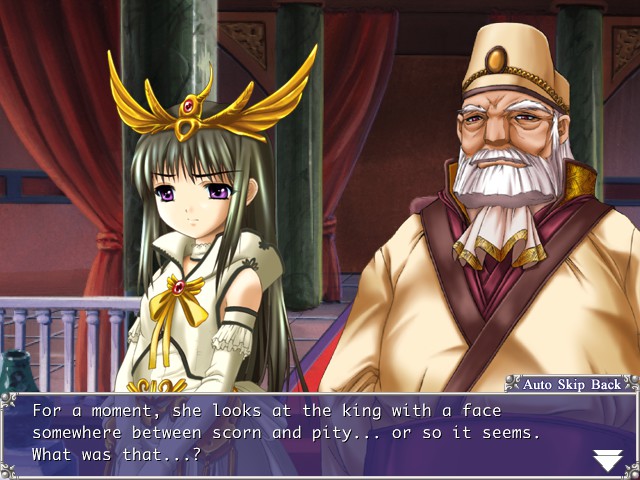
While the world and his dog is playing XCOM (which I fully intend to at some point — just not yet) it's been quite interesting to contrast the experience of playing Aselia the Eternal, which I first mentioned a few days back. At first glance, you might not think there's much to connect these two games, but after about 6 or 7 hours of Aselia's visual novel stuff (which is good in and of itself — but more on that in a future READ.ME column on Games Are Evil) you get into a surprisingly hardcore strategy RPG type thing, where you have a big scary overworld map, squads of warriors, buildings, resources and a need to actually think about what you do.

But there's an interesting side-effect to the fact that you've spent 6 hours reading before you get to pick up a sword and start twatting things — you develop an emotional investment in these characters. And this is where the XCOM comparison (or, more accurately, contrast) comes in. In XCOM, people typically rename their characters to customise them and feel like they're playing with people they "know" or have designed. The simple act of renaming a character, in most cases, is enough to develop a degree of "attachment".

In Aselia, meanwhile, you don't get to rename the characters, but you do get to see what they're like off the battlefield — and not just in a training room sort of scenario. No, a big part of Aselia involves having conversations and seeing these characters going about their daily lives. We learn a lot about their attitude towards combat, and even more about the game world's social hierarchy.

This means that when you go into battle with Aselia, Esperia and Orpha, you know who these people are, you care about them and you want them to succeed. You want them to come back safely — and not just because in most cases allowing one of the main characters to die causes an immediate Game Over. You're cheering for them as they take on increasingly-improbable odds, and you nurture them, training them up to be as badass as they can possibly be in order to take on these rising challenges. I can only assume this feeling of attachment will increase as the game progresses and the romantic subplots start.

It's one of the most interesting things about Aselia the Eternal, in fact. Like most visual novels, it's primarily been designed as a storytelling vehicle, in which the gameplay serves the narrative. The "battle" gameplay will frequently break for the characters to have a moment of soul-searching (or, more often, the protagonist to have some sort of at least partially-justified mental breakdown). Between battles there may be several hours of sitting around talking, drinking tea and bouncing underage-looking girls on your knee. But there's a great feeling of coherence to the game, helped partly by the fact that even though the strategy component is broken into discrete missions, there is persistence in the game world — any character improvements, buildings and other business you did in a previous mission will still be there when you next hit the battlefield.

It's clear, in short, that the game is someone's vision rather than something that's been focus-grouped. While this means it undoubtedly won't be universally appealing — not everyone enjoys spending six hours reading before they get to "do" anything — it makes for an experience that is dripping with personality and a feeling of authorial ownership. Someone wrote this as a story rather than designing it as a game, and it's a very interesting contrast to titles where the lines between narrative and gameplay are more clearly demarcated.

Further thoughts as I continue — it's a lengthy game, so expect at least one or two more posts on the subject.

#oneaday Day 995: Cultural Victory

Can you have too much culture? Can the sum of human creative endeavours add up to too much for someone to take in?

Well, first of all, those are two different questions. The answer to the second one, at least, is "yes"; the former? I'm not so sure.

We're already at a point where there is so much Stuff in the world it's impossible to keep on top of it all. Whatever media you're into, be it books, movies, TV shows, music or games, there's enough Stuff out there to keep you entertained probably for the rest of your life in just one of those formats, let alone if you, like most people, spread your time between several. Even if you spend your time focusing entirely on one genre within a single medium, you'll never get to the bottom of the pile. You'll never "finish" culture. You'll never see everything there is to see.

Depending on your outlook, this is either a fantastic thing or incredibly depressing news. For many, there's a degree of "shame" over not having caught up on things that are supposedly "canonical" or "essential" for everyone to have read/seen/played/whatever. The very term "pile of shame" (from which the Squadron of Shame takes its name) is used to refer to one's backlog of entertainment that has been purchased but not consumed — or, in some cases, the definition is stretched a little to include Stuff that the owner of said pile intends to consume at some point in the future, but perhaps hasn't quite got around to just yet.

With books, it's fine. Books are passed down from generation to generation; republished and republished. Today, we can keep a book alive forever by converting it to a digital format and scattering it to the four corners of the Internet. Sure, you lose some of the joy of turning paper pages and that distinctive musty smell they have, but at least the important bit — that's the work printed on those pages, lest you forget — is immortalised. You can read it on your computer; on your tablet device; on your e-reader; on your phone. You can annotate it and share your thoughts with other people around the world in an instant. Books are just fine.

Music, too, has proven itself to be pretty timeless over the years — for the most part, anyway. Throughout history there has been plenty of "disposable" music, but the true greats endure for years. Look how long the works of Bach and Mozart have lasted — people are still listening to, performing and studying these pieces hundreds of years after they were first composed. In more recent years, look at how the music of artists such as Elvis Presley and the Beatles is still interesting and relevant today. In very recent years… well, it remains to be seen which artists (if any) will leave a lasting legacy on culture, but there will almost certainly be some. (And if there's any justice, it won't be anyone who has ever won or been involved with The X-Factor.)

Movies, too, have become increasingly timeless with the improvements in technology over the years. While once a movie only lasted as long as the medium on which it was physically printed, now, like books, we can archive and keep movies forever. Sure, some moviemaking techniques now look antiquated and are unpalatable to modern audiences, but those truly interested in the full history of the medium can trawl back as far as they wish and see how it has developed.

Games, though, are arguably a bit more tricky, as they have an inherent "expiry date" due to the numerous proprietary technologies involved. While emulation technology is getting better all the time, it's still not perfect, and the legal grey areas surrounding it make it something that some people prefer to shy away from altogether. When you consider "PC" games, too, there's even titles that are ostensibly on the same platform that will no longer run on more modern technology. Fortunately, there are places like GOG.com who aim to keep these titles alive for modern audiences, but eventually even their remastered, tweaked versions will "expire" as technology makes the next big leap forward. What happens when computers become wearable and we don't use TVs any more? Will we still be able to play classic titles designed for the flat screen?

With all this, it's easy to wonder how you can possibly get through all those things that you're "supposed" to watch/read/see. The answer is surprisingly simple: don't. Accept the fact that you're never going to read Great Expectations; you're never going to see Citizen Kane; you're never going to listen to anything by The Smiths; you're never going to get caught up on the Assassin's Creed series. Cherry-pick the stuff you're interested in, finish what you start, and don't feel obliged to jump in to things just because they're brand new and everyone is talking about them right now. Get to them when you have time to appreciate them rather than rushing through them in the ultimately futile attempt to feel "relevant".

Crucially, enjoy (or at least appreciate) the culture you consume, whatever medium it's in. Your tastes are your own, and no-one has the right to try and change them. People can share their own opinions, sure, and these may help sway your thoughts one way or the other, but ultimately your feelings about the things you like and dislike are entirely up to you. There's no "correct" opinion; no gold standard of cultural awareness you need to aspire to; no "checklist" to complete. The sooner you recognise this fact, the sooner you can get on with working your way through that "pile of shame" — because there's some great stuff in there that you haven't discovered yet. And the stuff that is shiny and new right now will still be here in a few years time.

Take your time. Enjoy it. It's the least you can do for the people who have invested their time, money, blood, sweat and tears into entertaining you.


#oneaday Day 993: Why You Should Probably Play Quest for Glory

It feels like a good time to explain Why You Should Probably Play Quest for Glory, because 1) the complete series is available on GOG.com for $3.99 for one more day and 2) the Squadron of Shame just released a podcast detailing exactly why it's awesome. You can listen to it in the player below and go leave a comment here.

Quest for Glory remains to this day an aberration in both the point-and-click adventure and RPG genres, in that it is both. For those who have no experience of the series, the basic gist of all games in the series is that you have the mouse-driven "walk, look, use, talk" interface of an adventure game coupled with the stat-based system of an RPG. You wander around, you find out about quests, you get into fights, you save the sleepy Germanic valley/city/African-style savannah region/world.

Sounds simple, right? After all, RPGs and adventure games already have a lot in common — mainly the fact that both often involve a lot of talking — thus it's not much of a stretch to imagine an RPG with a point-and-click adventure game interface (or, in the case of earlier games in the series, text parser).

Except Quest for Glory doesn't stop there, because it makes its games noticeably and significantly different depending on whether you initially choose to play as a fighter, magic user or thief. (It's also worth noting that the "thief" class is a proper thief who breaks into houses and nicks stuff for personal gain, none of that namby-pamby "rogue" nonsense)

That's right — join the quest as a fighter and, for sure, you'll be doing a lot of fighting, but you'll also be using your brawn to solve non-violent problems. Become a thief and you'll be using your agility, climbing ability and stealthiness to sneak around and solve problems from the shadows. Become a mage and over the course of the various games in the series you'll outfit yourself with a diverse array of spells, only a couple of which are of the traditional "throw fiery objects at opponents" variety.

Best of all, if you're the sort of indecisive person who likes to play as a "hybrid" class, you can spend a few extra points on character creation to take a skill that doesn't normally belong to that type of hero. Want to be a wizard that's good at climbing? Go ahead. A thief with a good line in magic tricks? Sure! A fighter who knows what the word "sneak" means? Knock yourself out! All skills that are at higher than zero can be raised through grinding — the Quest for Glory series subscribes to the Final Fantasy II/Elder Scrolls mentality that skills should be raised organically as you use them rather than at arbitrary level boundaries. Crucially for the whole fun factor, though, it's relatively rare that you'll need to grind a skill, unless you're specifically aiming to do and see absolutely everything the game has to offer. (And if you are, you're a masochist.)

Then there's the fact that the Quest for Glory series was one of the first series that allowed you to transfer your save file from one game to the next. Beat one game and you'd be invited to export your character ready to import once the next game released. This was remarkably forward-thinking (and confident) of the developers at the time — and also somewhat symptomatic of the different times back then. Now, sure, we have franchises like Mass Effect and Dragon Age allowing you to import your save file from the previous game, but each game in the series didn't specifically include with a promise of the next one. In other words, whether or not a game gets a sequel these days isn't necessarily preordained — it's often dependent on sales. In Quest for Glory's time, it was built in to the design from the very beginning, even as technology improved over time.

This is one of the other interesting things about playing through any of Sierra's old adventure series. You can see how gaming technology evolved from game to game. Quest for Glory I and II initially used 16-colour 320×200 EGA graphics and a text parser, though Quest for Glory I was subsequently rereleased with 256-colour 320×200 VGA graphics and a mouse-driven interface. Quest for Glory II never got the same treatment officially, but a fan-made free remake (approved, but not funded or assisted by, the original team) brought it into the latter days of the 20th century rather nicely. Quest for Glory III then brought the series officially into the 256-colour VGA age, and Quest for Glory IV was the first CD-ROM based episode, featuring none other than John "Gimli and That Professor Bloke I Can't Remember the Name Of from Sliders" Rhys-Davies on narration duties.

Quest for Glory V marked a bit of a turning point, however, not just for the series, but for Sierra's fortunes and the adventure game genre at large. Being a CD-ROM only multimedia extravaganza with 256-colour 640×480 Super VGA visuals, polygons and a prerendered intro sequence that, while impressive at the time is utterly laughable if you watch it nowQuest for Glory V marked the point where, for many, the franchise lost its way. There are plenty of people who adore the game, of course, but those who grew up with the earlier entries in the series can't help but mourn the direction it took with its fifth instalment and its subsequent demise.

This wasn't the only time Sierra did something weird with one of its established series. In fact, almost all of Sierra's classic, long-running series ended up as something completely different to their original forms — King's Quest became a 3D action RPG with its eighth instalment; Police Quest became the tactical SWAT series after its fourth incarnation (later dropping the Police Quest moniker altogether); and Leisure Suit Larry just went off the rails altogether after its sixth episode (which, naturally, is called Leisure Suit Larry 7). In comparison to these other titles, Quest for Glory V's changes were actually relatively modest — but still enough to put some off.

Perhaps the saddest thing about the demise of the Quest for Glory series is that we really haven't had anything like it since. We've had a resurgence of point-and-click adventures in the last couple of years, sure, but nothing that so deftly blends two genres together with interesting stories, a genuinely amusing sense of humour and satisfying gameplay.

However, there's some good news for fans of Lori and Corey Cole — they're working on something new called Hero U, and will be opening a Kickstarter funding drive some time later this month. More details here. I'm pretty excited — they've said outright that it's not going to be a new Quest for Glory game, but it will incorporate some of the things they learned from making those games. Sounds awesome, right? Of course.

Hope you enjoyed the podcast. We certainly spent long enough recording it — and then I spent even longer editing it. 🙂

#oneaday Day 990: Aselia the Eternal, Early Impressions

For an upcoming READ.ME column over on Games Are Evil, I'm going to be covering a game called Aselia the Eternal. Depending on how much progress I make before Sunday, said column will either be this week or, more realistically, next week. But I thought I'd take a bit of time to share some less formal initial impressions on the game for those who are interested, or simply curious.

Aselia the Eternal is a visual novel for PC (and PSP in Japan, I believe). There are actually two versions available — an 18+ edition with H-scenes and a 15+ version without. Only the 15+ version has officially made it to Western-speaking territories due to some of said H-scenes supposedly being in questionable taste — and also because of Western publisher/localiser JAST USA's desire to start putting out a few "all ages" titles as well as their myriad 18+ shag-happy offerings.

The basic premise of Aselia the Eternal is thus: Protagonist Yuuto lives alone with his little sister Kaori. Their parents died a while back in an accident, but Kaori was spared thanks to Yuuto imploring anyone who would listen to give him a miracle and save his sister. It turns out someone was listening — the spirit of the sword "Desire," which, as these things tend to do, claims ownership over Yuuto's soul in exchange for his sister's life and, at an unexpected point after several hours of fairly typical high school drama, sucks Yuuto into another world where All Is Not Well. War is brewing, and Yuuto is about to become embroiled in it as part of a force of "spirits" — seemingly human creatures with strong bonds to their swords who are treated as nothing but weapons by the actual humans. Since humans make spirits (and "Etrangers" from another world such as Yuuto) do all their fighting, most places have little hesitation in going to war because there's actually very little risk to the "real" people, and as such Yuuto arrives just as It Is All Kicking Off, as it were.

The interesting thing about Aselia the Eternal is that rather than representing the conflicts and battles that Yuuto and his spirit companions get into purely through narrative text, there's actually a very competent strategy game built in alongside all the visual novel stuff. When it's time for Yuuto and his allies to saddle up and hit the road to complete a mission, gameplay switches from the usual "read, read, read, read, read, make a choice" to a tactical map view, at which point you need to put your strategic hat well and truly on if you're going to survive.

The world map of Aselia the Eternal's battles is node-based in nature. Player units, each of which may contain up to three members, may move one space per turn, as may the enemy. If a unit enters a contested space occupied by an enemy unit, a battle begins, at which point the makeup of the teams becomes important.

Each unit has an attacker, a defender and a supporter. The attacker makes use of direct-damage skills. The defender tends to mitigate damage. The supporter either casts damage spells or adds useful effects. Each individual character has their own set of skills that changes according to what slot they're in — the eponymous Aselia, for example, may attack with her sword twice in a battle if she is in the attacking position, whereas if she is in the supporter position she is able to block enemy spells and prevent them from causing damage. The "colour" of each unit also has an impact on their effectiveness — green spirits are best in defensive positions, blue spirits are best in attacking and red ones are best in support, though according to the enemy's abilities (which can be previewed before battle is resolved) you may wish to switch them around a bit. Each character only has a set number of uses of each of their skills before they either need to switch them around or go back to a friendly-occupied town or base to refresh themselves.

It's an unusual, original, simple and elegant system that works extremely well, offering a degree of tactical flexibility while rewarding those who think carefully about the best way to approach a particular situation. The node-based nature of the world map means that it's relatively accessible to strategic newcomers, but still offers the potential for pulling off clever tactics, particularly later in the game when you get access to additional characters and, by extension, units. It's surprisingly tough and unforgiving, too — lose a main character in battle and it's an immediate game over. No Phoenix Downs here. (Also, SAVE!)

What's surprising about the inclusion of this aspect of gameplay is not that it's in there at all — there are a number of visual novels that incorporate minigames — it's that despite it being there, the game is still a storytelling vehicle first and foremost. It's not a strategy game/RPG with lengthy story sequences, it's a visual novel with occasional strategic battles. This might not sound like a big difference, but it's the difference between playing something like, say, Final Fantasy Tactics, where the story sequences sometimes feel like they're just rushing you through towards the next battle as soon as possible, and what we have here, which is an unfolding story in which you occasionally have to fight. The "pace", for want of a better word, is a lot slower — though that's not necessarily a bad thing, as it gives you plenty of time to get to know and become attached to these characters before walking into battle with them.

In fact, what the experience really feels like is the developers sitting down and thinking "this is the story we want to tell. There are battles at this point, this point and this point because they serve the story." rather than "we are making a strategy RPG. We need gameplay to be 75% strategic battles, 25% story." It feels very much like something that has been designed primarily as a narrative, in short, rather than a game — and that's rather interesting, because I can't imagine any Western publisher greenlighting a game with such a seemingly skewed ratio of traditional gameplay to sitting back and just reading. (Of course, I can't imagine any Western publisher greenlighting a visual novel full stop, but that's beside the point.)

I like what I've seen so far. The story is quite slow to get going but it already has some interesting characters involved, and I'm intrigued to see where it goes next. Watch out for further thoughts when I've played a little further.

#oneaday Day 988: Love and Tolerate

The world is full of social issues that really, thinking about it, we should probably have gotten over by now. As a general rule, hating anyone for arbitrary reasons such as their gender, race, sexuality or haircut is something that the human race of the 21st century should have moved past now, but it's sad to see that this sort of thing still goes on. And yes, people probably should speak out against sexism, misogyny, racism and all manner of other issues when they crop up. If they don't, then these issues just continue to fester and get worse. If you don't get any sort of feedback on the things you say, you never learn that they aren't acceptable, after all.

At the same time, I can't help feeling discomfort at the tone in which some of these criticisms are presented. I read an article over on Boing Boing today about "why the fedora grosses out geekdom". Perhaps I'm not clever enough to "get" Leigh Alexander's writing, but I came out of that article having absolutely no idea of what she was getting at. Supposedly she was exploring why the fedora had such negative associations, even among members of geek culture — this is the first I've heard of it, I have to say — but it actually came across to me as yet another rant against the phenomenon of "Nice Guys". I've written about this topic in the past and it really does bother me — even more so since learning that a very good friend of mine (and a genuine nice guy (no caps) to boot) abandoned his previous (excellent) blog due to its name — "Nice Guy Gamer" — having negative connotations. While I don't argue that there are guys out there who do fulfil the "Nice Guy" (with caps) stereotype, as someone who believes himself to be nice (no caps) it irks me enormously any time this discussion comes up.

In short, Alexander's piece just came across as rather judgemental, even if that wasn't the intention. In providing links to the various "shaming" Tumblrs that focus on men wearing fedoras and these supposed negative connotations, she has fuelled the fire and made people aware of another avenue of bullying people based on their fashion choices. Not only that, she has also drawn attention to a supposed connection between the people who choose to dress this way and undesirable character traits. Statistically speaking, there probably are some men who wear fedoras and who are manipulative jerkwads, but equally, there are probably also plenty of men who choose to wear them purely as a means to express themselves. We geeks aren't particularly known for dressing well at the best of times, so perhaps we should cut those who make an effort to give themselves a distinctive appearance a bit of slack. (NB: I do not own a fedora. I do have a straw trilby that was purchased entirely to stop me giving myself sunstroke when sitting outside, and not as a fashion statement.)

I guess my point is that while there are plenty of issues that really do need resolving — the way that many women are treated on a daily basis is unacceptable; racial epithets just need to go away; medieval attitudes towards sexuality need to be thrown through the window — there are clearly better ways of going about it than attacking (or at least drawing unnecessary attention to) subcultures or trends that may or may not have anything to do with undesirable character traits. Attack sexism, misogyny, racism, homophobia and all that other bullshit the world can do without when it comes up, yes. Speak out against injustices. Make a difference.

But seriously. Dudes in hats? Let them enjoy their quirks. Love and tolerate. Not everything is bad. At this rate there will be very little left in the world for people to enjoy without feeling guilty or self-conscious. And that sounds like a pretty miserable existence to me — especially as a geek who feels perpetually uneasy and self-conscious.

#oneaday Day 983: The Mighty Jungle

If you own a PS3 and enjoy games that are just plain odd, do yourself a favour and drop £10 on a copy of Tokyo Jungle right now. While it may not be the deepest, best or most polished game in the world, it's super-interesting, super-weird and super-fun.

If you own a PS3, it's entirely possible that you're already familiar with this strange little game, but in case you aren't, here's the pitch.

The bulk of your time will be spent in Survival mode. Here, you are cast in the role of one of the game's many, many unlockable animals (beginning as either a Pomeranian dog or a deer) and tasked with surviving as long as possible. As soon as you're thrown into the post-apocalyptic Tokyo streets, time starts passing, and you only have 15 years in which to secure your animal's legacy. By hunting for food (other creatures if you're a carnivore, plants if you're a herbivore) to keep your hunger bar at bay, marking territory and finding a suitable mate, you'll ensure your species' survival into the future. By completing various objectives that appear at regular intervals, you'll earn "Survival Points" which act as your score and as a form of currency with which you'll unlock additional content as you play through the game.

As you play through Survival mode, you'll come across scattered data items hinting at the game's backstory — the reason the humans disappeared. Collect enough and you'll unlock a "story mission" in which the game flow is much more directed. Progress through the story to learn the truth while playing Survival to unlock additional content.

To describe Tokyo Jungle in such simple terms is to do it an injustice, though. It's a game about crazy emergent stories. Like that time your army of gazelles successfully took down a gigantic pig by unleashing a kick so devastating it practically launched said pig into orbit. Or the time your lone alley cat, near death by starvation, launched a kamikaze attack on a zebra and won. Or the time your dog bit a cow on the arse and was then trampled to death.

Things only get more bizarre and surreal when you start finding various items of equipment for your animals. Your stories start to become like the rantings of a madman. Remember that time that the beagle in a poker visor and green wellies chased a rabbit back and forth across Shibuya Station for five years before getting eaten by a crocodile? Remember that time the army of hippopotami in bikinis successfully fended off an attack from an army of chickens? What about that time your pig in a straw hat snuck through the bushes while the cats were fighting the chimpanzees and joyfully eviscerated all of them?

In many ways, Tokyo Jungle is a bit like a roguelike. While its levels aren't randomly generated, there is a degree of randomisation to the objectives you're expected to complete, and starting a new game with a new kind of animal tends to put an interesting twist on how your dynasty will unfold. The relentless pursuit of longer and longer survival periods and high scores — that's what the game is all about. Simple. Effective. Addictive. And batshit crazy. It's hard not to love it.

#oneaday Day 982: Must Try Harder

I'm not normally one to put down the hard work of others, particularly in my own field of writing, but I feel compelled to say a few words about some things that have been published this week.

Here's one.

Here's the other.

Now, lest I come across as some sort of joyless bastard, I am aware that both of these pieces were written in jest in an attempt to be — I assume, anyway — "satirical", but the fact is that they both utterly fail in what they are trying to do, leaving them both looking rather foolish — particularly the deranged scribblings of the Borderlands 2 piece.

There are several things that irk me about these two pieces. Firstly is the fact that they exist at all, and on high-profile, (arguably) respectable sites that actually pay their writers. It's hard to feel that this sort of thing is justifiable when there are plenty of people across the world writing purely for the love of writing about games. My team over at Games Are Evil is just one of many groups who don't write about games as their main, paying job but still put in a ton of effort to produce great content and strive to improve their own work over time. The scores of community writers over at Bitmob are another great example. The countless bloggers all over the world. Those who run enthusiast sites in their own time in an attempt to get noticed. All of those produce higher quality work than the two pieces linked above — and yet these are the articles that are deemed worthy of pay. There's no justice there.

The second thing that has vexed me somewhat regarding this matter is the amount of praise they have got — mostly from fellow professionals, it has to be said. The first piece in particular drew a frankly astonishing amount of fawning, with quotes including that it was the "most clever [review of Borderlands 2]" that one tweeter had ever read; that it was "anarchic stream-of-consciousness, like the game itself"; that it was the "most incredible piece of games journalism ever" and the "Ulysses of games journalism".

Now, I'm all for celebrating good writing. But this was not good writing. Even from the perspective of it presumably being some sort of parody (or "anarchic stream-of-consciousness") it just didn't work. The number of utterly bewildered comments beneath the article is proof of that — and it's the same for the Eurogamer piece.

The thing is, I know both writers are capable of much better — and I have nothing against either of them personally. The author of the Borderlands 2 piece is not only the editor of one of the biggest video game sites in the UK, but also a novelist. I expect considerably better from him, in short — or if he's going to try something clever, it should be something that actually works.

Since taking a step back from mainstream games journalism (my day job focuses on mobile and social games, and Games Are Evil focuses on the "alternative" side of computer and console gaming) I have regrettably confirmed a few suspicions I had about the state of the games journalism sector in the UK. A noticeable, vocal proportion of it is made up of a very insular "old boys' club" which appears to believe itself immune to criticism, meaning that it feels more and more liberties can be taken with what sort of work and attitude is acceptable — and anyone who steps out of line to say "hang on a minute…" gets summarily ridiculed. I found myself the recipient of such scorn last year when I pointed out my discomfort at the tone and content of the Games Media Awards Twitter feed, and consequently have shied away from publicly criticising things ever since. I was in two minds about posting this entry at all with that in mind, but in this instance I felt the need for a bit of cathartic release if nothing else.

There are plenty of fantastic games writers out there who don't need to resort to… whatever these two pieces were resorting to. Satire? Parody? Childishness? I honestly don't know, even after rereading them both several times.

Demand better from your articles about games. For all the pontificating about how games journalism is "broken" and how it should be "fixed", if these pieces are anything to go by it seems to be getting worse rather than better.

#oneaday Day 980: I Love You, Starship Ezekiel

It's another visual novel post, I'm afraid. (I'm not sorry at all. Aside from finally running through Persona 3 FES, which I am loving, VNs have been pretty much all I've been playing recently. And I have no problem with this.)

Ahem. Let's start again.

I saw Ell's route of My Girlfriend is the President through to its conclusion this evening, and it was just as magically adorable as I was expecting it to be. It was also quite a bit shorter than the previous two routes I've completed to date — those for Yukino and Irina — and structured a little differently, unfolding over two "episodes" after the initial setup instead of three.

Spoilers after the break.

Continue reading "#oneaday Day 980: I Love You, Starship Ezekiel"

#oneaday Day 979: Personal Thoughts on Demonbane

I wrote a piece on visual novel Deus Machina Demonbane over at Games Are Evil earlier today and I would be terribly thankful if you went and read it, even if you're not a particular visual novel fan. Demonbane, while fundamentally not that different from most other visual novels — you read, read, read, read, read, read and occasionally make a choice — is, as I say in the article, interesting and noteworthy for the fact that it's not your typical galge/eroge. The main point of the game is not to pursue a particular female character romantically, but rather to work your way through a more "traditional" (for want of a better word — its combination of thematic influences is anything but "traditional") narrative that wouldn't be out of place in a JRPG.

I wanted to talk a little more about the game than I had the chance to get into in that article, however, and I'm probably going to get spoilery from this point onwards, so if you are intending to play Deus Machina Demonbane and would like your mind to remain virgin pure beforehand, I suggest you stop reading now. For courtesy's sake, I shall put in a "More" tag for your convenience. Click the "Continue Reading" link to… you know. Continue reading. Otherwise, I'll see you tomorrow.

Continue reading "#oneaday Day 979: Personal Thoughts on Demonbane"

#oneaday Day 977: The Eternal Struggle Between Business and Pleasure

If you own an iOS device and haven't yet purchased a copy of Rayman Jungle Run, congratulations! You are the problem with mobile gaming. I won't get into why you should play Rayman Jungle Run — you can read my review for that — but I will reassure you that it is a game that you pay for once and then never have to pay anything for ever again. (At the moment, anyway.)

On the surface, it's easy to see why the freemium/free-to-play sector has exploded quite so much. People casually browsing for things are always going to be immediately more attracted to things that say "Free" on them rather than things that say "$2.99" on them, regardless of whether or not that "Free" comes with a caveat, which it usually does. But there's a growing level of discontent and frustration with this fact, particularly among "core" gamers — or, more specifically, people who have been playing games for many years. We've reached a stage now where this demographic actually wants to seek out paid games and apps because they know that "Free" tag always comes with a catch — and, sadly, more and more paid games are also coming with "Get More Coins!" buttons and unbalanced gameplay attached in an attempt to squeeze more and more money out of their player base.

I always have a curious sense of hypocrisy over this issue. I mean, my day job is reviewing mobile and social games, after all, and from a critical perspective I have to consider each title from a business perspective as well as that of the player — is the game going to make enough money for the developer for it to have been worthwhile? I can do this with no problem — though I will call out titles that are obviously taking the piss with their monetisation strategies — but it doesn't stop me from having a sour taste in my mouth whenever I'm "off the clock", as it were. I've dialed back my consumption of iOS games massively since realising that the vast majority of them are little more than time and money sinks designed as not-particularly-subtle attempts to extract players' money from them. And many developers and publishers don't even attempt to hide this fact — we're dealing with an industry that refers to users who spend a lot of money on in-app purchases and DLC as "whales", after all, which should give you an idea of the sort of people we're dealing with a lot of the time.

Now, I'm not saying that people shouldn't make money from their creations. Quite the opposite, in fact — I told you at the start of this post that you should pay money and download Rayman Jungle Run, for example, because it's great. But herein lies the rub — you should pay money for things that you think are worth money, things that you want to support, not things that are designed to psychologically manipulate you into pressing that "Get More Coins!" button. As soon as you become aware of a game's business model, it stops being quite so fun — at least, that's how I feel. Apparently I'm in something of a minority, though.

There's a problem with the system as it stands right now, which is partly why this situation has arisen. The distorted sense of value that the App Store has brought means that if people see anything that costs more than a dollar, they won't buy it unless they're absolutely sure it's worth the money. (These people are probably the same people who will happily spend four or five dollars on a coffee — yes, I'm aware that I'm English and automatically using dollars as my default currency, but that's what you get after working for American employers for the last two years — and consequently are quite happy to throw their money at something they will piss out within an hour or two) To exacerbate this fact, there is no requirement for app developers to provide a free trial of their products. Some do anyway, either by offering a free "lite" version of the app or distributing the app for free then unlocking it via in-app purchase, but there are many cases where it is impossible to "try before you buy" — so people end up not buying at all, instead reaching for those ever-tempting "free" apps and their spiderweb of monetisation.

Free trials won't solve the issue entirely, obviously, but they would be a good start. Personally speaking, I just find it a crying shame that a gaming platform with as much obvious potential as iOS (and, to a lesser extent due to lack of support by many developers, Android) finds itself focusing on shallow, fun-free timesinks rather than truly creative games — of which there are many available that go completely unnoticed. Quality games like Rayman Jungle Run should be celebrated and championed; crap like Tap Campus Life should be ridiculed.

That's enough for now.

Oh, one final thing. Buy Rayman Jungle Run.

I thenkyaw.