2206: Accentuate the Positive

0206_001

I'm feeling utterly shitty at the moment, but it doesn't do to keep dwelling on things that, at this specific moment in time, I can do nothing about. Best to try and focus on some more positive aspects of life — which I can at least be thankful there are a couple of, albeit not that many right now.

It was Slimming World this evening, and not only did I drop 4.5lb this week — successfully shifting the bit I gained last week and then some — but Andie and I were voted "Couple of the Year" by the group for being an inspiration to others. (Andie wasn't actually present at the meeting as she's not well and currently asleep at the time of writing, but the thought was there.)

My weight loss efforts with Slimming World have continued to surprise and, dare I say it, delight me. While the instances of me really, really craving something like a cinnamon bun seem to have increased a little recently — I blame the stress, since I always turned to food as a means of making myself feel better — on the whole I still don't really feel like I'm particularly missing out on anything. I've learned to like sugar-free/diet drinks (although Diet Coke is still shit; Diet Pepsi for life) and not to drink milk by the gallon; I've learned to control my bread intake; I've learned ways it's possible to enjoy favourite foods without making them enormously calorific and fatty.

And, over the course of the last year — almost to the day — I've lost over 6 stone in weight, which is like, a whole kid's worth of weight. A stone is actually pretty heavy; our previous group consultant used to bring in various sandbags weighing a pound, half a stone, a stone and so forth so we could physically feel how much weight we were carrying around or losing, and lifting up the "stone" one was rather enlightening; when I think that I've lost six of those, I think several things: firstly, I'm not surprised I was feeling exhausted when doing something as simple as walking up stairs, and secondly, wow, that is a lot of weight.

I'm still not quite where I want to be — and I suspect I'm going to have to do some sort of "toning" work when I am at the weight I want to reach to prevent having too many unsightly flappy bits — but I can, at least, point to my weight loss efforts as one single thing in my life that is actually going in the direction I want it to go in. I can only hope that more positivity will eventually radiate out from there. Eventually. Maybe.

2205: No End in Sight

0205_001

Regular readers will know that I'm going through a bit of a Rough Patch at the minute, to say the least. Tonight it's hitting me particularly hard, for various reasons that I shan't go into in detail. I wanted to talk a little more generally, as I find this often helps me sort things out in my mind a bit.

The thing that's making me feel particularly bleak right now is that it feels like there's no end in sight for this Rough Patch. I don't know how to resolve it; I don't know how to "fix" it. I feel like I've messed up — not once, not twice, but repeatedly, and I'm now reaping the anti-rewards that are the consequence of all the things I've done wrong in my life, all the poor choices I've made.

For sure, I know that I have made plenty of poor choices along the way, but many of them didn't seem like it at the time — and rationally speaking, I also know that I'm not the only one to blame for my current situation. The blame for that can be laid at the feet of a wide variety of people, including me, but that doesn't make it any easier to deal with — particularly as many of the non-me people that I blame for this situation are essentially "untouchable" despite me wanting nothing more than to at the very least yell at them and, were I feeling particularly feisty that day, slug them one right in the face.

Mostly I'm just frustrated because I'm not sure I deserve this. I feel like I have plenty to offer the world, and no way of making it clear to everyone that I matter, that I have value. I have friends and family, sure — both local and far-away — and that knowledge, to an extent, takes care of part of my emotional well-being, but it doesn't pay the bills, and it doesn't give me a sense of satisfaction that I am, in any way, making the most of my existence. Were I to drop dead tomorrow, 1) would anyone notice? and 2) would I be remembered for anything particularly worthwhile? Again, rationally speaking, I know the answer to both of those questions is probably "yes" — and I'm not planning on dropping dead tomorrow — but it's difficult to remember that sometimes when you find yourself struggling to stay afloat.

I really don't know what to do any more. For every bit of progress I feel like I make, I suffer some sort of setback. I end up not going anywhere — and, in the worst case, going backwards. When I left university, I was a teacher earning over £25k a year. Later, I had my dream job of writing about games for slightly less than that. Now I'm looking at retail jobs with wages of a relative pittance in comparison, on the grounds that 1) I feel like I can do them and 2) that's all I feel like I can convince prospective employers I'm good for. (Not that there's anything wrong with retail, obviously; it just feels like all that education was a bit of a waste, is all.)

I'll figure something out. Bad things have happened to me before and I made it through. And on those past occasions, it felt like I was drowning in black tar, with no means of escape visible in any direction — and yet I still did. I have no reason to believe this time will be any different; it's just a matter of when I can see the shoreline at the edge of this inky sea. At the moment it's somewhere beyond the horizon.

2204: Elite

0204_001

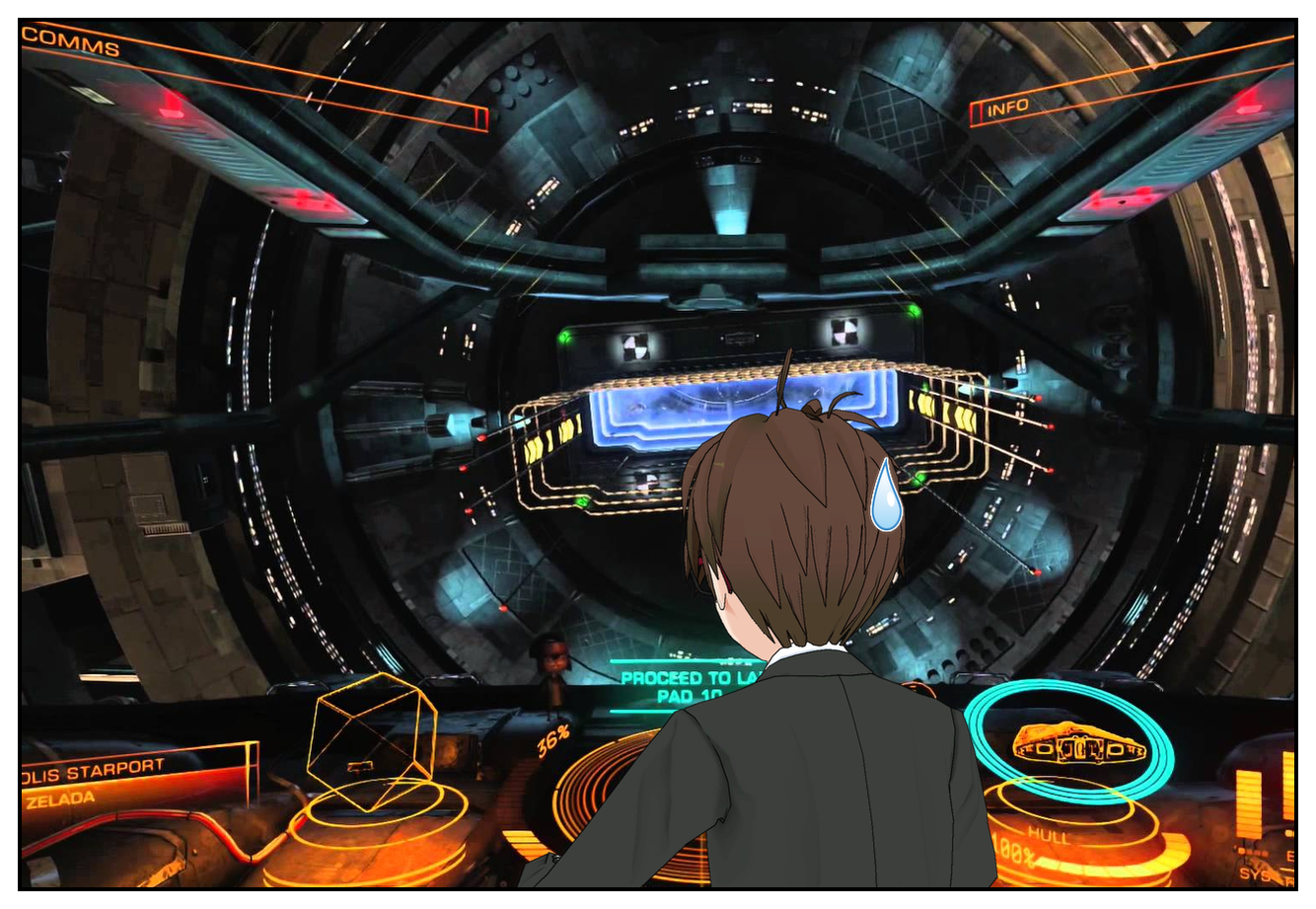
I spent a chunk of today trying out Elite Dangerous: Horizons. This was actually pretty much my first experience with Elite: Dangerous generally, aside from giving the tutorials a go yesterday, but I felt I was long overdue to try it out, particularly as I had bemoaned the lack of a good Star Trek game the other day. Elite is not a good Star Trek game, but it is one hell of a space sim. And, for once, that "sim" part seems apt; this certainly isn't an arcade-style dogfighting game, as evidenced by the fact that in several hours of play today, I didn't fire a single shot.

I used to really enjoy space games back in the 16-bit era — particularly those of a more free-form nature such as Paul Woakes' Mercenary series, Rainbird's Starglider series (particularly the enormously ambitious second installment) and, indeed, the original Elite. I say that — Elite is actually one that I never quite managed to get my head around when I was young, because there was a lot of things to think about while you were playing, and pages full of numbers that confused and bewildered me. Also docking with those spinning space stations was fucking impossible, so every time I tried I usually ended up quitting in disgust after smashing my ship to smithereens on the space station you start near.

I made the mistake of reading a few Steam reviews of Elite: Dangerous before giving it a go; while there are a few fair criticisms there, there's also a whole lot of whining about 1) not knowing what to do and 2) Frontier's business model for the game which, if you're unfamiliar, sees them essentially re-releasing the game at full price each year with the promise of a year's worth of major updates to the game systems. It's perhaps better to think of it as a yearly subscription fee, particularly as the game has a significant massively multiplayer element for those who care to engage with it.

Anyway. Discarding the Steam reviews and jumping in to try things out for myself, I was quickly enraptured by the feeling of flying my Sidewinder. I even unplugged the 360 controller and plugged in my 11-button joystick; it's no full HOTAS (Hands On Throttle And Stick) setup, admittedly, but it feels great when used in a game like this, particularly with the lovely visual feedback the game gives you with regard to movement: unlike the original Elite, whose cockpit was a static bitmap with a viewport into the flat-shaded 3D polygonal universe outside (I was playing the Atari ST version, so it had colours!), Elite: Dangerous' cockpit is set up to feel like you're actually sitting in it. Handling the controls causes your viewpoint to shift slightly according to how you're moving; it tilts when you roll, pulls forward and back when you speed up and slow down, and pulls up and down when you pitch. Given the game has been designed for virtual reality headsets from the get-go, it's understandable that the game would model head movement pretty well, but I'm glad to see that even when playing on a flat (admittedly large) TV screen it still looks very convincing.

What I've found most satisfying about the game so far is the moment-to-moment simulation of flying your ship. Everything you do is just satisfying to pull off, just for the sake of doing it. Especially fun is taking off and landing from various structures and space stations — and, in Horizons, you can now land on planets, too, either at settlements with dedicated landing facilities or just on the ground if you find a suitably smooth patch of terrain to set down. The handling of the ship is beautiful; pulling the stick around feels like you're wrenching a big, slightly unwieldy lump of metal around in zero- or low-gravity, and the sound design, where you hear your thrusters firing and your engines throbbing according to whatever you're doing, is absolutely impeccable. There's even a wonderful crescendo of your engines reverberating off the ground and surroundings as you set down for landing; it is, I think, the most convincing depiction of plausible pure sci-fi space travel I've seen for a very long time, perhaps ever.

The most common criticism of Elite: Dangerous is that it's "a mile wide and an inch deep", and I can kind of see where that's coming from: interactions with NPCs are rather sterile and menu driven, though later updates look set to put "faces" to significant characters in the universe. There's no prescribed narrative, either; you can get involved in the PowerPlay mechanic to swear allegiance to one of the various factions attempting to control the universe, which actually has a significant effect of the game for all players, but there's no "story" to follow as such besides that which you make for yourself.

In many ways, I think I sort of prefer that for Elite, though; while I do love a bit of story in my space games a la Wing Commander and the like, when playing something as freeform as Elite a story can kind of get in the way a bit, making you feel obliged to go and do certain things rather than exploring the galaxy at your own pace, making a name for yourself however you see fit.

I'll be interested to see if Elite holds my attention, but for now, it certainly feels like the space game I've wanted to play since I was a kid.

2203: Pete Reacts to Growing Older

0203_001

A significant proportion of the Internet has been up in arms over a recent copyright kerfuffle on YouTube recently, where a collective I've never heard of called the Fine Bros had apparently attempted to trademark the word "react". Digging deeper, it seems that the Fine Bros had done this ostensibly as a means of trademarking the concept of "reaction videos" and allowing others to make videos in the same format — one which the group have had plenty of success with in the past — while allowing themselves an opportunity to profit from licensing fees.

Leaving aside the whole ethical implications of attempting to trademark a common word such as "react" — one of several different "brands" that Fine Bros had attempted to trademark, theoretically as a catch-all term to encompass any specific series they might concoct in the near future — this whole debacle brought one thing into sharp focus for me, and that is that there are certain aspects of modern popular culture that I simply don't understand the appeal of whatsoever.

The concept of a reaction video is simple. You show some people — preferably from a specific demographic such as "teenagers" or "the elderly" — a thing that is Shocking in some way, then you film what they do while they're watching or looking at the thing that is Shocking. Early examples of reaction videos included various instances of people seeing the notorious "2 Girls 1 Cup" video (for heaven's sake, don't Google that if you've never heard of it) as well as well-known shocking scenes from TV or online videos such as Game of Thrones' "Red Wedding" scene.

Trouble is, in the few reaction videos I've managed to stomach, it all feels so painfully forced as to not be entertaining. No-one I know whoops and hollers at the television, bellowing "OH MY GOD!" as something shocking happens. The most I do when seeing something shocking is flinch and wince at something gory, particularly if it involves eyes, but I don't shout and scream or anything. (That said, given the general difficulty I have with expressing emotions clearly when I'm "in person", I may not be the most representative example, but none of the people I know are like this either.) In other words, it doesn't seem believable, with the whole situation being so contrived as to seem utterly pointless.

And aside from the implausibility of some reactions, I simply don't see the appeal whatsoever. Why on Earth would I want to watch a group of people gathered around a TV that I can't see all screeching and gesturing at something I may or may not already be familiar with? And, by extension, why on Earth would anyone want to trademark such an utterly inane concept on the arrogant assumption that other people would want to pay them for the dubious privilege of churning out more culturally bankrupt tat like this?

I guess you can just add reaction videos to the ever-lengthening list of things that I just don't "get" in modern online life. It joins the illustrious ranks of Twitch chat, Twitch in general (unless you're hanging out with an actual friend), MOBAs, unboxing videos and doubtless a whole bunch of other things I'm not even familiar with yet.

I'm 34 years of age. Some days I feel like I'm still 16. Today, however, I'm feeling every one of those years. Now get off my fucking lawn.

2202: Three Games I'd Like to See Made

0202_001

Posting my piece about Neptunia games I'd like to see the other day got me thinking more broadly about other interactive experiences I'd like to indulge in, should they ever be made. (Or perhaps they already exist, in which case please do let me know in the comments and I will investigate!)

The following games either don't exist at all, or the last time they were properly explored in gaming — in my opinion, anyway — was far too long ago for my liking. So here we go, then:

A proper spy game

I downloaded Sid Meier's Covert Action from GOG.com a while back when it was on sale for some ludicrously low price, and discovered that it was an immensely satisfying, fascinating game with a number of distinct facets. I wrote in detail about the game a while back, but for those of you too lazy to click through, the elevator pitch is thus:

You are Max (or Maxine) Remington, an agent. A Dastardly Plot is about to unfold in the world, and it's up to you to stop it. Ideally, you will find out what is going on before it happens, arrest everyone involved and follow the trail of clues to find the Mastermind behind it all. You will then repeat the process until all the Masterminds there are in the world are behind bars — or until you give up at the ludicrous level of difficulty the game escalates to on its higher settings.

Covert Action incorporates a variety of game styles ranging from puzzle (phone tapping) to code-breaking, car chases and top-down action-stealth-adventuring. While clunky by modern standards, it's an extremely clever game that, in true Sid Meier tradition, is busily simulating a whole bunch of things happening in the background while you appear to be doing something relatively simple. None of it is pre-scripted, either; each case you get is randomly generated, so there's no easy way to find the solution other than putting in the hard graft yourself.

To cut a long story short, we need a new Covert Action. There have been spy-themed games, sure — the most memorable of which for me is, without a doubt, Alpha Protocol — but these tend to be more scripted and action movie-like, rather than focusing on the interesting but perhaps less glamorous aspects of the job. I want a spy game where it's rare you'll pull your gun on anyone; I want a spy game that's more about setting up surveillance and investigating than shooting terrorists; I want a spy game where it feels like I'm a spy, not an action movie hero. (To put it another way: I want a spy game where it feels like I'm old-school James Bond, rather than new-school James Bond.)

A good Star Trek game

There's plenty of space games around, since they've been making a bit of a resurgence over the last few years. With the success of Elite: Dangerous and the anticipation for No Man's Sky, the time is surely ripe for a new Star Trek game to hit the market.

Oh, there are a couple of relatively recent Star Trek games around, of course, but neither of these quite scratch the itch I have. Star Trek Online is a massively multiplayer online RPG, with everything that entails — including lots of grinding and free-to-play monetisation that requires you to pay up for the coolest ships rather than earning them — while Star Trek Timelines is a mobile game with everything that entails — including lots of grinding and free-to-pla… you get the idea.

Neither of these games are particularly bad as such — though Star Trek Timelines' use of the obnoxious playtime-limiting "Energy" system that I really wish would die a horrible death is something I find hard to forgive — but neither of them are quite right. Both have good aspects: Star Trek Online has a great feeling of taking your ship around the galaxy, exploring uncharted areas and engaging in battle, while Star Trek Timelines presents you with some interesting non-combat scenarios to deal with, albeit only in text form. The trouble is, neither of them go far enough in simulating what it's like to be a crewman on a Starfleet vessel.

There are a few approaches I'd like to see a new Star Trek game take. Firstly and perhaps most obviously is a starship bridge simulator. I know these exist and are available on GOG.com, but with modern technology it would be possible to do something far more impressive — and perhaps even multiplayer, a la Artemis Starship Bridge Simulator.

Another possible approach is something along the lines of Spectrum Holobyte's elderly Star Trek: The Next Generation – A Final Unity, which combined starship operations (including combat and power management) with point-and-click adventuring down on planet surfaces. While the combat and engineering sections on the ship ended up feeling a little superfluous when compared to the game's narrative aspects — particularly as you could put them both on automatic without penalty — the whole thing felt suitably authentic as an interactive episode of The Next Generation, and ripe for updating.

I guess one of the main issues with the Star Trek license is that there's not a current TV series running to tie it in with, so it would probably have to be an original work, perhaps with guest appearances from established characters. That's not an issue for me, so long as it feels like Star Trek, but for some fans it may not be acceptable.

I believe there is talk of a new Star Trek series of some description coming soon, though, so it will be interesting to see if anything interactive comes of it. Anything's better than that dreadful third-person shooter that came out for consoles a year or two back and was promptly completely forgotten about…

A game about running a school

There are tons of management games out there, but outside of an extremely peculiar mobile game by Kairosoft called Pocket Academy, I don't recall all that many that focus on educational institutions, and I think this is something that would be ripe for the interactive treatment.

SimSchool, as we'll call it, has a considerable degree of scope to be a much more "personal" strategy game than many other management sims, since although running a school does include the standard stuff like budgeting, staffing and training, a key part of what keeps a school running effectively is interpersonal communications, rapports and morale.

In SimSchool, you'd play the new, young headmaster of a school that was struggling, and you'd have a certain amount of time to set things right. In true strategy game tradition, you'd be able to set up various conditions at the beginning of the game such as the affluence of the area the school is in, the size of the school, when it was built, its condition and suchlike, and have the game create a challenge for you accordingly.

As you worked your way through a campaign, you'd not only have to perform managerial duties to keep the establishment in the black and keep an eye on the day-to-day operations of the school, but you'd also have to interact with students, staff and parents in order to keep them happy. There'd be dialogue sequences in which you'd have to negotiate things and determine the best way to handle problem children — sometimes you'd even have to convince the local authority that the decision you'd made was the right one for the greater good. And, on the harder difficulty levels, you'd also have to contend with various "disasters" that make your life more difficult — this is a Sim game, after all!

My time working in schools was hellish, and I have no desire to return — but that doesn't mean I don't still find them interesting places. A game like this has a lot of scope to be an interesting twist on the strategy-management genre, and I'd certainly love to play it.
2201: Game Time is Precious

0201_001

As I get older and — when I'm working, at least — find myself with less time on my hands to devote to gaming, I've found myself having to make tough decisions about what I do and don't play. Having taken a step back from my beloved Final Fantasy XIV and found myself surprised at how little push I'm feeling to go back, even if a new content patch were to drop tomorrow, I find myself feeling disinclined to check out things that are very obviously timesinks and nothing else.

This doesn't mean I'm not interested in long games; on the contrary, the games I tend to gravitate towards tend to be Japanese role-playing games that are often in excess of 100 hours in length, and I don't begrudge them being that long, particularly as I've come to enjoy the pursuit of Platinum trophies in many cases.

No; I'm referring more to games that either artificially constrain your progress, or which don't feel like they have a real point to existing beyond being something to do with your hands if you have nothing better to do.

MMOs certainly fall into this category, but these at least have a skill-driven aspect that makes them satisfying: the best gear in the world won't let you clear Alexander Savage in Final Fantasy XIV if your skills aren't up to the job.

No, I'm largely referring to mobile games here: a phenomenon that I've been becoming increasingly aware of in recent years, and which was painfully obvious when I took a casual browse through the Google Play store earlier today and found nothing whatsoever that I wanted to download and play on my phone, for various reasons.

By far the most common type of mobile game we get these days is based on the "gacha" principle, whereby at regular intervals or by spending in-game currency, you have the opportunity to "draw" new "cards" (I put that in inverted commas because sometimes they're units, characters, weapons or whatever) and add them to your collection. You can then form a "hand" of these "cards" and use them in whatever the game's core mechanic is — usually some form of combat. Between fights, you can generally use additional, unneeded or weak cards to power up your main cards, allowing you to take on stronger and stronger challenges as you go.

A lot of these games are well-presented and initially appear to be reasonably fun. But there's so little depth to them that I find them ultimately unsatisfying — particularly when, as with something like previous favourite Brave Frontier, the mobile game that I've spent the most time with, they become extremely time-consuming to play for very little feeling of reward.

When I play a game, I like to feel like I'm achieving something, at least partly through my own knowledge and skills. I like the feeling of progressing against a difficult encounter, beating a difficult dungeon, clearing a complicated quest. And while many of these mobile games do pay lipservice to a feeling of progression through any combination of advancing through a linear world map, levelling up your character or levelling up your characters, I never, ever feel like they're rewarding anything other than persistence — and, in some cases, a willingness to pony up cash to guarantee the best possible draws.

These games pale in their unappealingness when compared to the new sensation that is "idle games", though, the appeal of which utterly eludes me. My wife Andie has been "playing" Clicker Heroes recently, and I don't understand why; I tried Sakura Clicker a while back, and despite me clearly being its target audience, found it utterly tedious and pointless.

For the uninitiated, an idle game is one that you start playing and then don't have to do anything with, outside of occasional upgrades and suchlike. In Clicker Heroes, for example, killing monsters earns gold, which allows you to hire heroes, who automatically deal damage to monsters, allowing you to just leave them to it while you go off and have a big poo or something; you can also upgrade your heroes in various ways, largely by throwing more money at them. The sole appeal element of these games appears to be making numbers as big as possible — which, as an RPG fan, I do totally understand the appeal of — but the trouble is, I personally don't feel any sense of accomplishment from making those numbers get bigger, because I know that I haven't really "earned" any of those rewards through anything other than remembering to check in on it every so often. I'm sure there is some sort of appeal factor that I'm missing somewhere along the line, since I know numerous people who spend a hell of a lot of time playing Clicker Heroes and its ilk, but… well, I just don't get it, and not through lack of trying. Sorry!

To return to my original point, the feeling that my gaming time is precious has only grown over the last few months in particular, and so every time I find myself tempted to download a new mobile game, or try out another clicker game to see if I can understand why so many people are seemingly addicted to them, I hit a new mental checkpoint in my head that reminds me how many unplayed games stretching back to the PS1 era I have on my shelves, and suggests that I should probably work my way through those rather than wasting my time on something that has no real sense of closure or completion.

With that in mind, I'm heading back into the world of Hyperdimension Neptunia Re;Birth2; gotta get through that before V-II arrives on the 12th!

2200: Happy Birthday, Tsunako

0200_001

Tsunako is the artist responsible for the character designs in the Hyperdimension Neptunia series, and consequently she is responsible for bringing more joy into my life than pretty much any other visual artist I can name. (Which isn't all that many, admittedly, but from the moment I got into Neptunia I liked the art enough to find out who was behind it.)

In celebration of it being Tsunako's birthday today, I thought I'd take the opportunity to share a selection of favourite images. Most of these are from the Neptunia series since I haven't yet got around to experiencing other series she has worked on such as Fairy Fencer F or Date A Live and thus don't know enough about them to be able to comment with any real authority.

Without further ado, then…

companep
The first image you see in the original Hyperdimension Neptunia and its Re;Birth1 remake. Pretty much sets the tone of what to expect.
cpus
This image, from the alternate universe in which Hyperdimension Neptunia Victory and Re;Birth3 take place, pretty much sums up the relationship between Neptune and the rest of the cast.
candidates
The "CPU Candidates" — little sisters of the main characters, representing the PSP/Vita (top left), Game Gear (top right) and DS (the twins)
makers
These characters, from Re;Birth1, are the "Makers", personifications of various software companies. Like most characters in Neptunia, their designs beautifully encapsulate their source material.
kiss
mk2 and Re;Birth2 made the implied yuri in the series a little more up-front.
nepschool
For me, one sign of a good character is being able to put them in a new situation/outfit and they still be recognisable; I think you'll agree that the goddesses in school uniforms still have very clear personalities.
noire
One of my favourite images of Lastation's leader Noire.
purpleheart
Neptune's transformed CPU form Purple Heart, demonstrating Tsunako's biggest strength, so far as I'm concerned: her ability to draw curves to die for.
vert
While much of Neptunia is self-consciously moe, there's little denying that Vert goes beyond "cute" into "beautiful".
neppurp
This image is not lewd at all, and if you think it is you are the one who is the pervert.
miku
And here's a Tsunako-drawn Hatsune Miku, just so this gallery isn't entirely Neptunia.

2199: Ever-Late to the Party: Fringe

0199_001

Couldn't get to sleep the other night and didn't quite feel like I had the mental capacity to watch something in Japanese (i.e. anime) so instead I trawled Netflix for a few moments and eventually settled on a show I've been meaning to watch for a long time: Fringe.

I knew very little about Fringe going into it, save that it seemed to be pretty well-received, and that my acquaintance Chris Tilton, who had appeared a couple of times on the Squadron of Shame SquadCast, had assisted creator J.J. Abrams' regular partner Michael Giacchino on the soundtrack. Other than that, I was going in pretty much blind, and had managed to remain unspoiled to date.

Turns out it's a fantastic show, and exactly the sort of thing I enjoy, so I'm well and truly hooked.

For those who, like me, have somehow let Fringe pass them by until now, here's the pitch: FBI agent Olivia Dunham becomes involved in investigations of weird happenings collectively known as "The Pattern" after she starts looking into the inexplicable melty-face issues that struck an inbound flight from Hamburg to Boston. In order to investigate these strange occurrences, she enlists the help of Dr Walter Bishop, a somewhat eccentric but clearly brilliant man who had been locked up in a mental institution for the preceding 17 years. In order to get Walter out of the institution, she also has to enlist the help of his son Peter, who has a past that can be charitably described as "checkered" and together, if you'll pardon the cliche, They Fight Crime.

If this setup sounds a little X-Files-ish, you'd be absolutely right, though rather than going in the "aliens!" direction, Fringe instead looks at seemingly paranormal phenomenon through the lens of "fringe science" — being able to explain them through scientific theories that may appear ridiculous to the layman, but which Walter proves time and time again to have some basis in reality. Or at least the reality that Fringe depicts, anyway.

Fringe's biggest strength is in its characters. Olivia is, in many ways, the most "normal" of the bunch — at least in the initial episodes — and the perfect foil to the somewhat tense relationship between Peter and Walter. Walter, meanwhile, is downright fantastic, punctuating his explanations and hypotheses with seeming non-sequiturs; sometimes they end up being relevant, and sometimes he really is just commenting on how much he enjoys a glass of milk fresh from the cow he keeps in his laboratory "because they're the closest thing to humans, genetically, which makes them ideal test subjects".

This isn't to downplay the ongoing narrative and its stranger aspects, meanwhile; J.J. Abrams has proven on numerous occasions — Alias springs immediately to mind — to be good at stringing out mysteries with apparently supernatural elements to them, and Fringe is no exception to this. Over the course of the first few episodes, we're introduced to a number of elements, some of which appear again in subsequent episodes, but which aren't explicitly pointed out to the viewer. Already I can see it's a show that would reward a repeat viewing knowing the full truth — which, only five episodes or so in, I have no idea of yet — because you'll doubtless spot things that you wouldn't have given a second thought otherwise.

I'm really intrigued to see where this series goes. And yes, I know I'm late. But I'm watching it now, okay? (Also, it's inspired me to go back and play Cognition again thanks to its thematic similarities. So that's good! I never finished the fourth episode, after all…)

2198: Petting Waifus and Gay Conversion

0198_001.png

It came to light today that Nintendo of America apparently hasn't stopped with the localisation edits to the upcoming Fire Emblem Fates that had already been revealed: it seems that the "petting" minigame, during which you can directly interact with the characters in your party — male and female — and improve your relationships with them has been excised completely. Kotaku described this as a "minor change in the name of localisation".

Perhaps it is "minor". Perhaps it is an unnecessary part of the game. Perhaps those who are unaware of the Japanese version won't even know it was there to be missed. But none of this changes the fact that a feature of the game — with this being the first Fire Emblem game where you could directly interact with party members in this way — has been removed entirely from the Western release, giving English speakers a version of the game which is comparitively gimped when placed alongside its original Japanese source material.

Before I go any further, I'd like to talk a little about my general views on localisation. In short: localisation can be helpful and sometimes necessary to ensure that the right audience can access a work. The Ace Attorney series, for example, benefited considerably from its rather drastic localisation, opening it up to a much broader audience than those who would have been comfortable with a protagonist called Naruhodo Ryuuichi rather than Phoenix Wright.

For me, the key thing when considering how drastic localisation changes should or could be is the question of cultural context. Sometimes the inherently Japanese context of a work is important — key examples include titles like the Persona series, which is set in and around Japanese high schools; the Shenmue series, whose entire first game was set in a few lovingly rendered regions of a Japanese town; the Yakuza series, which is about as accurate a simulation of Japanese nightlife as you're going to get, regular street brawls aside; the Senran Kagura series, which is steeped in both Japanese mythology and cultural peculiarities such as student rivalries and, you know, being a ninja; and any number of visual novels you'd care to mention, which often rely heavily on conventions of Japanese culture, particularly with regard to interpersonal relationships.

For other titles, though, it's less important to keep this authentically Japanese feel to it. Something like my perennial favourite the Hyperdimension Neptunia series, for example, works well with the breezy tone of its localisation, though more diehard fans remain dissatisfied with character traits introduced through NIS America's original translations of the PlayStation 3 games prior to Idea Factory International taking matters into their own hands. Likewise, the localisation of Final Fantasy XIV was excellently handled, featuring some well-done and deliberately flowery — almost Shakespearean at times — dialogue that many have noted added considerable depth to the original source's writing. Indeed, in Final Fantasy XIV's case, many of the things introduced through its localisation have found themselves "backported" to the Japanese version, so well-received were they — though I will admit if you know even a bit of Japanese, playing the game with Japanese voices and comparing to the English subtitles can be a little jarring.

Anyway: the point is, I'm not opposed to localisation where it's appropriate or necessary to broaden a work's appeal, and particularly if said work is aimed at mass market but is still riddled with Japanese cultural references no-one but 1) Japanese people and 2) weeaboos will recognise. Where a specifically Japanese tone and feel is necessary to an authentic translation of the work, though, I'd rather the translation be as literal (but readable) as possible where it can.

And so we come to Fire Emblem Fates. What we have here is a title that isn't particularly Japanese in feel or tone, since Fire Emblem has always erred on a stereotypically Western approach to fantasy at times. As such, I wouldn't be opposed to localisation changes that help a broad audience to access, understand and appreciate the work as a whole by toning down its "Japaneseness".

That's not what we're getting though. Fire Emblem Fates' most drastic localisation edits are nothing to do with helping people understand and access the work, but they are everything to do with minimising offense. Take the notorious "gay conversion" scene, for example: the original hoohah over this came about as a result of some Tumblrina spilling her spaghetti everywhere over what she perceived to be a male protagonist spiking the drink of a lesbian character and "converting" her to being straight enough to marry him. In actuality, the scene is about nothing of the sort: not only is the "magic powder" used to improve her battle effectiveness rather than get her into bed — fainting the moment you get close to a man isn't a good way to wage war — but the female character in question, Soleil, might not even be gay in the first place, if the Fire Emblem Wiki is to be believed: all Soleil's romantic interests are male, making the matter perhaps more one of something related to androphobia rather than homosexuality.

And as for the removal of the "petting" minigame, it just feels like a "mother knows best" moment; like we Westerners are somehow expected to be shocked and appalled enough at the prospect of physically interacting with a video game character and faint on the couch in protest.

I don't like this trend. It feels like a reversal of all the good work that was done in the late '90s and early '00s, where games were regularly praised for having the guts to include adult content other than the "usual" violence. I vividly recall Sierra's adventures Police Quest 4 and Gabriel Knight being highlighted as examples of the medium maturing because of their willingness to include the word "fuck" in their scripts, previously never heard in a game; and likewise I remember PC Zone magazine running a feature in one of its early issues about Megatech's hentai games, noting that their willingness to tackle adult themes — just like anime, which was starting to become popular and fashionable in the UK around the same time — was a sign that some game makers were finally starting to acknowledge that games weren't just for kids.

I'm no fan of Fire Emblem generally — largely due to a lack of experience with the series rather than an actual dislike of it — but these types of big changes made for the wrong reasons make me somewhat uncomfortable, because they're sanitising works of art in the name of appeasing small but loud groups of people, many of whom likely wouldn't have played the game in the first place. It's babying the Western audience, protecting them from things that might "offend" us, whereas one of the best things about art — any form of art, whatever the medium — is its ability to challenge us and get us to think about things in a different way. If you wipe out everything that might offend someone somewhere from art, you're left with a castrated culture that increasingly wants to retreat into its "safe spaces" rather than explore the strange, wonderful, terrible and fascinating things writers come up with.

Not to mention the inherent hypocrisy: Western games don't get butchered in this way in the name of "think of the children". Grand Theft Auto features strip club scenes where you can have a first-person view of a lap dance, which provides no gameplay benefits whatsoever. The recent Thief reboot featured a level where you could peek through a hole in a wall and witness an explicit BDSM sex scene — again, for no real reason other than for background decoration. One of the Far Cry games from a while back opened with a first-person sex scene. And there's the multitude of banging scenes in the Witcher series.

I don't object to any of the above — I'm of the opinion that it's nice for games to treat me like an adult who can handle seeing sexual material. But when Western games get away with stuff as explicit as this, whereas Fire Emblem Fates gets butchered for something far tamer than anything the aforementioned games included, I cry foul. It makes me particularly uncomfortable as a fan of Japanese games to feel that titles from certain publishers or localisation teams aren't providing me with an experience that's completely true to the source material. It may still be great, sure — and everything seems to indicate that Fire Emblem Fates is an ambitious, excellent game — but the experience is somewhat marred by the knowledge that I'm missing out on something that other regions are more than happy to include.

I hope this is a trend which fizzles out quickly; the sooner we get over this inane desire to "protect" people from content they might want to see, the better; in the meantime, I'm more than happy to continue supporting developers and publishers who bring titles over mostly if not completely unscathed: groups like Idea Factory International, Marvelous Europe, Koei Tecmo (with the exception of Dead or Alive Xtreme 3, of course), XSEED Games and latter-day NIS America.

"Gaming needs to grow up," the argument frequently runs. Well, for that to happen, you need to start acknowledging players like adults first.

2197: Putting the New WordPress App Through its Paces


0197_001.png

I was helpfully informed by my WordPress dashboard that there's a new WordPress app available for the desktop, so I figured I'd put it through its paces. I've used the mobile app for both iOS and Android a fair bit, so I was interested to see what benefit — if any — making use of a desktop app would have over just loading the site up in Chrome and making use of it.

Well… frankly, there's not a huge number of benefits, at least not for those who primarily make use of blogs hosted on WordPress.com. The main benefit is that the app contains the whole of the main "new-style" WordPress dashboard in local format, meaning that you can theoretically 1) use it offline and 2) write without the distractions of other browser tabs. It's also responsive to the window size, so you can scale the display according to what, exactly, you want to do with it: do you want to keep an eye on notifications, or do you want to write a full-on post?

You'll notice I pointed out that it makes use of the "new-style" WordPress dashboard, and that's an important distinction to make, because the new-style WordPress dashboard is emphatically not the same as the traditional wp-admin view. It's a lot simpler and cleaner, sure, and you can do most of the things you can do in wp-admin in the new dashboard, but there are, frankly, a number of issues that WordPress so far hasn't fixed with the main site that remain — and arguably are even more prominent — in the app.

Most notably, there are a significant number of flaws in what WordPress refers to as the "improved posting experience". Having been using this a fair amount since my initial reactions to it, I've noticed that there have been a fair few improvements and additional functions added so that now it is, roughly speaking, in line with the wp-admin-based editor. There are still some irritating factors, however, chief among them (for me) being the fact that even with the window at 1920×1080, the word counter is scrolled off the bottom of the screen so I have to manually scroll down to view it — sometimes even if my post is longer than a screen in height. This is just plain bad design, and seems to have been fixed in the Web-based editor through the use of a floating word count window in the lower right of the viewport. Apparently the locally stored version of the editor page used in the app hasn't taken this particular update on board, however; as I type this, my word count is once again disappearing out of the bottom of the viewport.

Another big flaw that requires less discussion is the fact that the Insert Hyperlink option does not include the option that the wp-admin-based editor does to search through your previous posts and link to them without having to look up the URL yourself. The absence of this from the "improved" posting experience is mildly irritating, and I have to wonder exactly why it was removed, since this is the exact opposite of an "improvement".

A few things do seem to work a little better in the standalone app, mind; when using the editor in Chrome, I've found that sometimes the cursor keys and modifiers behave in somewhat strange and unpredictable manners: sometimes attempting to move to the previous character or word with keyboard shortcuts inexplicably jumps to the end of the paragraph or somewhere completely unexpected, particularly if there a few different items of formatting (such as links or italics) used in a paragraph. So far, at the time of writing, as I type this, I've encountered no such issues — that doesn't necessarily mean that they're not there, but they shouldn't really be in there in the first place, so I've tended to assume they're a Chrome issue rather than a WordPress issue.

Since I originally looked at the "improved posting experience", too, I was pleased to discover that drag-and-drop images now work as they should: in other words, you can drag an image directly into the editor window and have it appear where the cursor was, rather than this simply being a shortcut to opening the "Add Media" window. So good job there!

Elsewhere in the app, you have access to the other features the WordPress dashboard offers, most notably site statistics and insights, allowing you to see at a glance how your most recent posts have been performing, which days you've been posting on and suchlike. The WordPress Reader system is also integrated into the app, allowing you to catch up on WordPress blogs you've subscribed to all in one place rather than having to remember to visit a bunch of sites. This is a helpful feature, but like everything else in the app, I'm not entirely convinced of the benefit of having it in a standalone app rather than just visiting the WordPress site in my browser.

All in all, then, the main benefit of the new desktop app appears to be little more than speed and a slightly more stable experience than the website under Chrome appears to offer. I suppose offline use is a benefit to those who are composing blog posts on the go using a laptop — or, indeed, catching up on downloaded Reader posts — but for me, this is some minor, not especially useful functionality, since I tend to compose my blog posts immediately before publishing them, which tends to mean that I have a stable Internet connection wherever I happen to be at the time.

I'll continue using the app for a while and see how I get on with it. If nothing else, its "distraction-free" nature due to its lack of browser tabs is quite pleasant, so it may prove to be a helpful way to concentrate, whether it's on my daily blogging "duties" or more substantial projects.

You can find out more about the app and download it for free here.