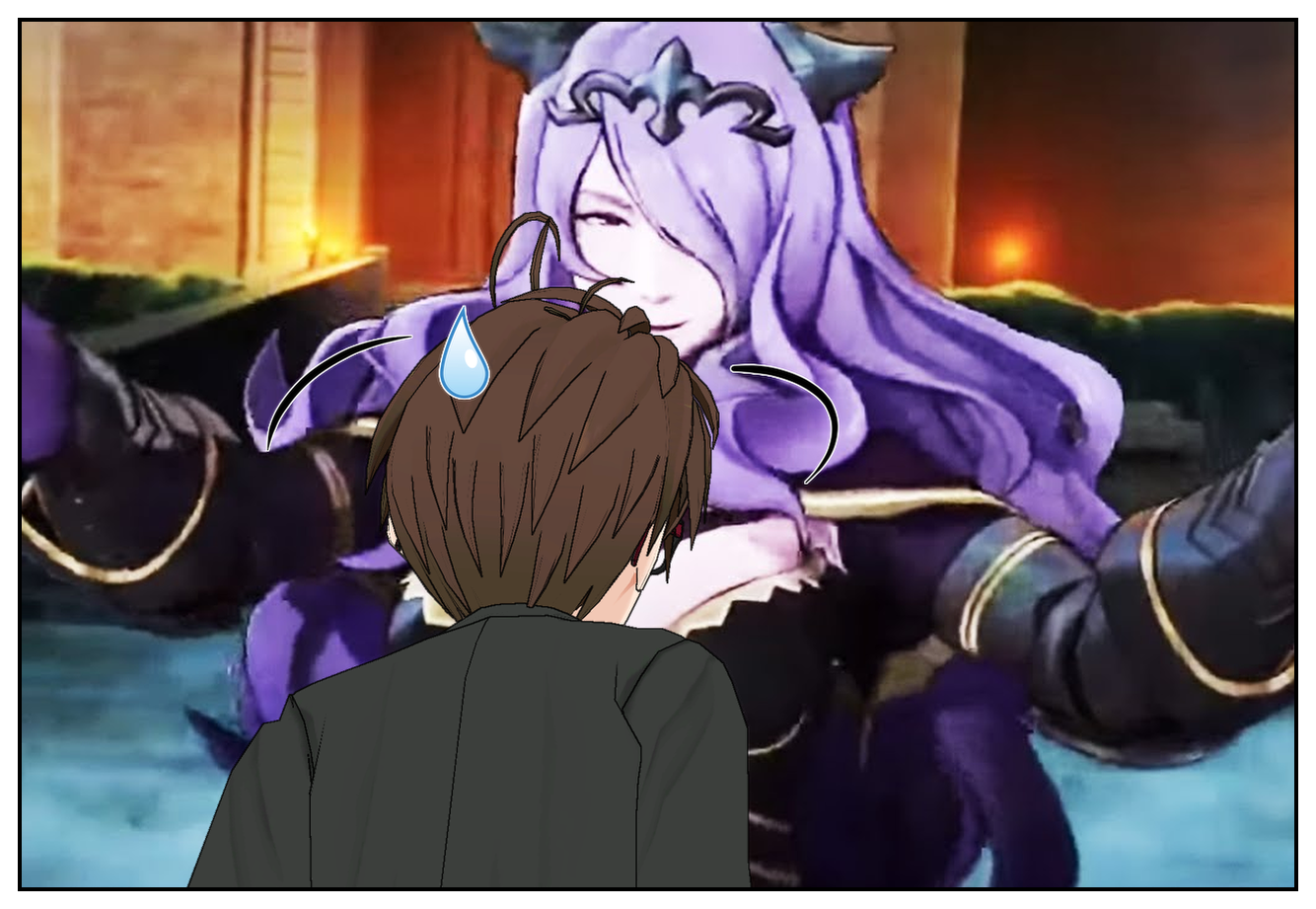
It came to light today that Nintendo of America apparently hasn't stopped with the localisation edits to the upcoming Fire Emblem Fates that had already been revealed: it seems that the "petting" minigame, during which you can directly interact with the characters in your party — male and female — and improve your relationships with them has been excised completely. Kotaku described this as a "minor change in the name of localisation".
Perhaps it is "minor". Perhaps it is an unnecessary part of the game. Perhaps those who are unaware of the Japanese version won't even know it was there to be missed. But none of this changes the fact that a feature of the game — with this being the first Fire Emblem game where you could directly interact with party members in this way — has been removed entirely from the Western release, giving English speakers a version of the game which is comparitively gimped when placed alongside its original Japanese source material.
Before I go any further, I'd like to talk a little about my general views on localisation. In short: localisation can be helpful and sometimes necessary to ensure that the right audience can access a work. The Ace Attorney series, for example, benefited considerably from its rather drastic localisation, opening it up to a much broader audience than those who would have been comfortable with a protagonist called Naruhodo Ryuuichi rather than Phoenix Wright.
For me, the key thing when considering how drastic localisation changes should or could be is the question of cultural context. Sometimes the inherently Japanese context of a work is important — key examples include titles like the Persona series, which is set in and around Japanese high schools; the Shenmue series, whose entire first game was set in a few lovingly rendered regions of a Japanese town; the Yakuza series, which is about as accurate a simulation of Japanese nightlife as you're going to get, regular street brawls aside; the Senran Kagura series, which is steeped in both Japanese mythology and cultural peculiarities such as student rivalries and, you know, being a ninja; and any number of visual novels you'd care to mention, which often rely heavily on conventions of Japanese culture, particularly with regard to interpersonal relationships.
For other titles, though, it's less important to keep this authentically Japanese feel to it. Something like my perennial favourite the Hyperdimension Neptunia series, for example, works well with the breezy tone of its localisation, though more diehard fans remain dissatisfied with character traits introduced through NIS America's original translations of the PlayStation 3 games prior to Idea Factory International taking matters into their own hands. Likewise, the localisation of Final Fantasy XIV was excellently handled, featuring some well-done and deliberately flowery — almost Shakespearean at times — dialogue that many have noted added considerable depth to the original source's writing. Indeed, in Final Fantasy XIV's case, many of the things introduced through its localisation have found themselves "backported" to the Japanese version, so well-received were they — though I will admit if you know even a bit of Japanese, playing the game with Japanese voices and comparing to the English subtitles can be a little jarring.
Anyway: the point is, I'm not opposed to localisation where it's appropriate or necessary to broaden a work's appeal, and particularly if said work is aimed at mass market but is still riddled with Japanese cultural references no-one but 1) Japanese people and 2) weeaboos will recognise. Where a specifically Japanese tone and feel is necessary to an authentic translation of the work, though, I'd rather the translation be as literal (but readable) as possible where it can.
And so we come to Fire Emblem Fates. What we have here is a title that isn't particularly Japanese in feel or tone, since Fire Emblem has always erred on a stereotypically Western approach to fantasy at times. As such, I wouldn't be opposed to localisation changes that help a broad audience to access, understand and appreciate the work as a whole by toning down its "Japaneseness".
That's not what we're getting though. Fire Emblem Fates' most drastic localisation edits are nothing to do with helping people understand and access the work, but they are everything to do with minimising offense. Take the notorious "gay conversion" scene, for example: the original hoohah over this came about as a result of some Tumblrina spilling her spaghetti everywhere over what she perceived to be a male protagonist spiking the drink of a lesbian character and "converting" her to being straight enough to marry him. In actuality, the scene is about nothing of the sort: not only is the "magic powder" used to improve her battle effectiveness rather than get her into bed — fainting the moment you get close to a man isn't a good way to wage war — but the female character in question, Soleil, might not even be gay in the first place, if the Fire Emblem Wiki is to be believed: all Soleil's romantic interests are male, making the matter perhaps more one of something related to androphobia rather than homosexuality.
And as for the removal of the "petting" minigame, it just feels like a "mother knows best" moment; like we Westerners are somehow expected to be shocked and appalled enough at the prospect of physically interacting with a video game character and faint on the couch in protest.
I don't like this trend. It feels like a reversal of all the good work that was done in the late '90s and early '00s, where games were regularly praised for having the guts to include adult content other than the "usual" violence. I vividly recall Sierra's adventures Police Quest 4 and Gabriel Knight being highlighted as examples of the medium maturing because of their willingness to include the word "fuck" in their scripts, previously never heard in a game; and likewise I remember PC Zone magazine running a feature in one of its early issues about Megatech's hentai games, noting that their willingness to tackle adult themes — just like anime, which was starting to become popular and fashionable in the UK around the same time — was a sign that some game makers were finally starting to acknowledge that games weren't just for kids.
I'm no fan of Fire Emblem generally — largely due to a lack of experience with the series rather than an actual dislike of it — but these types of big changes made for the wrong reasons make me somewhat uncomfortable, because they're sanitising works of art in the name of appeasing small but loud groups of people, many of whom likely wouldn't have played the game in the first place. It's babying the Western audience, protecting them from things that might "offend" us, whereas one of the best things about art — any form of art, whatever the medium — is its ability to challenge us and get us to think about things in a different way. If you wipe out everything that might offend someone somewhere from art, you're left with a castrated culture that increasingly wants to retreat into its "safe spaces" rather than explore the strange, wonderful, terrible and fascinating things writers come up with.
Not to mention the inherent hypocrisy: Western games don't get butchered in this way in the name of "think of the children". Grand Theft Auto features strip club scenes where you can have a first-person view of a lap dance, which provides no gameplay benefits whatsoever. The recent Thief reboot featured a level where you could peek through a hole in a wall and witness an explicit BDSM sex scene — again, for no real reason other than for background decoration. One of the Far Cry games from a while back opened with a first-person sex scene. And there's the multitude of banging scenes in the Witcher series.
I don't object to any of the above — I'm of the opinion that it's nice for games to treat me like an adult who can handle seeing sexual material. But when Western games get away with stuff as explicit as this, whereas Fire Emblem Fates gets butchered for something far tamer than anything the aforementioned games included, I cry foul. It makes me particularly uncomfortable as a fan of Japanese games to feel that titles from certain publishers or localisation teams aren't providing me with an experience that's completely true to the source material. It may still be great, sure — and everything seems to indicate that Fire Emblem Fates is an ambitious, excellent game — but the experience is somewhat marred by the knowledge that I'm missing out on something that other regions are more than happy to include.
I hope this is a trend which fizzles out quickly; the sooner we get over this inane desire to "protect" people from content they might want to see, the better; in the meantime, I'm more than happy to continue supporting developers and publishers who bring titles over mostly if not completely unscathed: groups like Idea Factory International, Marvelous Europe, Koei Tecmo (with the exception of Dead or Alive Xtreme 3, of course), XSEED Games and latter-day NIS America.
"Gaming needs to grow up," the argument frequently runs. Well, for that to happen, you need to start acknowledging players like adults first.
Discover more from I'm Not Doctor Who
Subscribe to get the latest posts sent to your email.

Browsing some this 'n that related to the fracas today I ran across a really good article by Patrick Klepek which I somehow missed back in December. Here's a linky link: http://kotaku.com/from-japan-with-changes-the-endless-debate-over-video-1747960323
I feel like Patrick does a great (and moreover evenhanded) job of breaking down the arguments on both sides of the localization / censorship debate. Worth a read, for sure — very interesting to hear from both the trenches of the XSEED and Treehouse camps. Even Senran Kagura is treated fairly and given its due by the Press. Shocking!
Speaking as a HUGE Fire Emblem fan with more than 10 years of deep love for the franchise, I'm inclined to disagree with your position vis-a-vis petting.
I can't speak to the magic powder — nobody's actually played that scene in English — but I do know a few things about FE. Despite its unquestionable grounding in anime tropes and lots of fluffy hair flying around, Fire Emblem is in fact notable for the way the series has been able to consistently pull off both a sense of narrative gravitas and a sense of knightly dignity in their storylines.
There's silly stuff all over the place as well, naturally – but Fire Emblem feels… Mature? In a very authentic way, despite counting characters like a sword weilding chuunibyo amongst its ranks (I'm looking at you Owain). The games have a 'grownup fairytale' sensibility about them that makes them easy to champion and easy to extol and love, especially in the non-J-game-aware broader world of gaming, and I believe this factor directly contributes to the series enduring popularity.
What I'm saying is that I'm OK with not having tickling and poking and petting digital waifus in my Fire Emblem — and this is from the most diehard FE fan around. FE is a series with all-ages pixar-style lasting appeal and a history of whip-smart localization choices backing it up. And it has broad responsibilities – I just don't think the niche treatment is appropriate for the brand.
I personally don't want to see a series with so much proud history proceed down the somewhat embarrassing road of Witch Touching. I have no prudishness at sexuality – I just personally feel like the tone of the whole thing is a little sophomoric and probably out of step with the larger FE brand. There are Witch Touching games for those who wish to touch witches. Go there and be free in your niche, godspeed – but leave Chrom and Lucina out of it.
I'm not saying that Nintendo isn't super quick to censor for the most meaningless reasons (there was never any problem with Tharja's butt) but honestly, my reaction to the removal of petting was one of mild relief. I suspect I am a microcosm of the debate that Nintendo was probably well aware of and likely influenced their decision.
Now… should there be outright sex in Fire Emblem? Much more interesting question. Treated respectfully? Probably via some kind of fade-to-black PG-13 way? It's a game about relationships after all, half the game is spent building up UST between characters. You do the math.
The thing is, though, is that the petting sequences have been made into something they're not. They're not sexual; they're a reflection of the common anime head-patting trope; a demonstration of affection rather than lust.
It's exactly the same in the Hatsune Miku games, which were also branded "creepy" (despite being adorable and entirely non-sexual) for having a head-patting minigame.
As I say, I don't really feel strongly one way or another about Fire Emblem at the moment as it's not a series I have a great deal of experience with. I'm mostly displeased with features being cut for no real reason on the grounds of "appropriateness", and the more this happens the more localisers get the message it's okay, despite extremely widespread censure of NoA's decisions by fans.
One thing to keep in mind with your comparisons to Western games: The Witcher/GTA/Thief/Far Cry/etc. aren't shooting for the same kind of rating that FE: Fates is. The FE games have all been fairly young on the Teen spectrum and even in comparison to anime, the series has always been pretty light on sexual suggestiveness. It seems like NoA decided to downgrade this game's age rating as a form of localization, but I have not looked at its rating in Japan.
It's a C-15; apparently the highest in the series, and one which often converts to an M rating under ESRB.
I think Nintendo is just trying to make sure the game doesn't turn off people precisely like Beige. You call these games "works of art," and I don't think Nintendo really gives a crap about that at all. Nintendo sees its games as products to sell to a fairly general audience. I think you yourself said on Twitter that Fire Emblem tries to aim for an audience in the west slightly broader than the typical audience that watches moe anime these days.
Fire Emblem wasn't even localized for the west until 2001 — roughly coinciding with the western anime boom, when anime and manga started to seem like they could break into the mainstream. Today anime has kind of receded back into being something mostly niche, mostly due to macroeconomic factors. In its home territory of Japan, Fire Emblem seems to have been forced to follow the trends of the broader anime and Japanese game market with stuff like touching minigames along with some of the character archetypes. These are things Nintendo thinks might turn off the western audience it's going for with Fire Emblem. Xenoblade and Fatal Frame are in the same position — Nintendo didn't even want to localize the predecessors to those games at first simply because of how niche their tropes and other elements are today. They're seen as games largely for the otaku audience and no one else. It's not even about people being offended. It's about how a lot of people might see some of the things in these games as juvenile and childish, or at least very low-brow.
I feel like if any other publisher was handling these games: NIS, XSEED, or whoever, they'd just let that content come through and only care about selling to the dedicated fans. Nintendo isn't like that. Nintendo doesn't want what the general American and European audiences might think of touching minigames and gay conversion to muddle their image of being the Mario and Pokemon company. To be honest I still see Xenoblade and Fatal Frame as outliers that Nintendo is only publishing and localizing to pad out the Wii U's barren library.
My take on this changes like this is that they're fine if there are actually a decent number of people who would be interested in buying the game who would be bothered by it- when it gets to be complete fucking bullshit is when the changes are clearly less about their actual customers and more about avoiding a shitstorm from conservative moral guardians or progressive Sarkeesian followers. The petting game seems to be at least a little closer to the former, but not being into these games I wouldn't really know.
Unlike when this shit happened in the 90s and 00s when we just took it because we were glad to get the game in any state, though, there's now a vocal segment of gamers that raises a shitstorm any time this kind of thing happens. Ideally this will push publishers to a point where they go "well, we're going to piss a bunch of people off no matter what we do, so fuck it, let's actually consider what our real customers want."