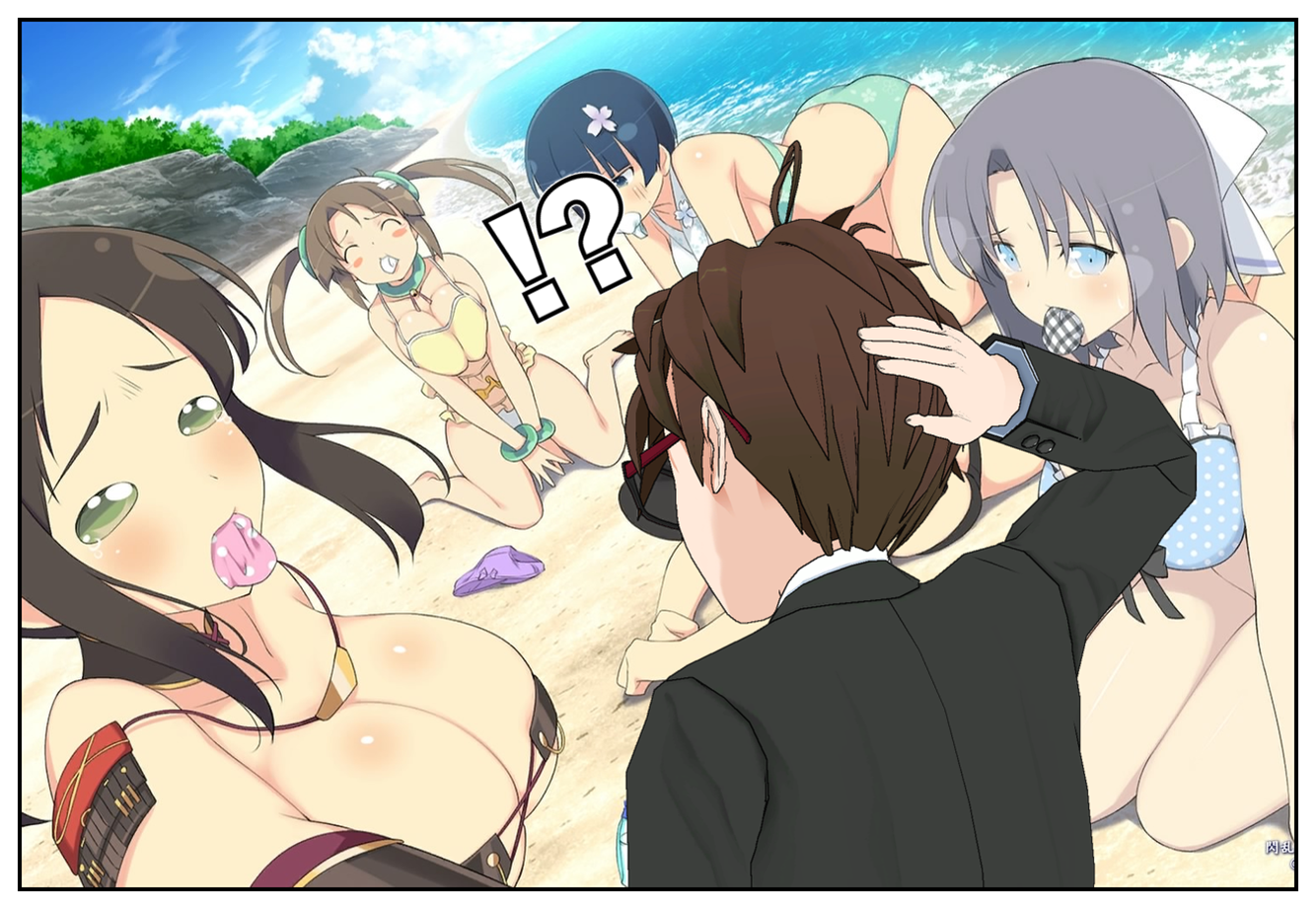
I made a mistake last night; actually, I made two. I read a Kotaku article, and then I commented on it.
The article in question was Mike Fahey's "Let's See How Long it Takes Senran Kagura to Make You Uncomfortable", which took the form of a Let's Play of the first half an hour of the game — well, the first half an hour of story, to be precise, up to the opening credits — and which was written in an obnoxiously holier-than-thou tone, with Fahey claiming that he is okay with fanservice, but then going on to completely contradict himself by not engaging with latest Senran Kagura game Estival Versus on anything more than the most superficial level.
I'm not going to take that article apart piece by piece because I already did that in my comment, which, within two replies, had me being accused of being a paedophile — how predictable thou art, Internet — but instead I want to talk a bit more broadly about what I think the issue is with coverage of popular but niche-interest titles such as Senran Kagura and Japanese games in general.
Sex.
Not the presence of sexual, titillating, provocative, ecchi or even hentai content; I'm all for that, and happy whenever games feature it in an unabashed manner. But the fact that whenever mainstream games writers come across one of these games, that is all they can fucking talk about.
Let's focus specifically on Senran Kagura for a moment. As legend has it, Senran Kagura as a series exists because creator Kenichiro Takaki wanted to see boobs popping out of the Nintendo 3DS' stereoscopic 3D screen. A shallow inspiration, for sure, and if he'd left it at that — if Senran Kagura had been nothing but pretty girls thrusting their boobs in your face — then the series would have sunk without trace before it even became a series. Instead, we're now confronted with Estival Versus, which is the sixth game in a series that has only been around since 2011 — a series which shows no sign of slowing down and, rather, much like fellow beloved niche series Neptunia, continues to go from strength to strength with each installment.
Surely "3D boobs" aren't enough to carry six games' worth of content, though, I hear you say, and you'd be absolutely right. The reason why Senran Kagura is so popular, and why it now spans four different platforms (Vita, PS4, 3DS and mobile) is because for all Takaki's bluster about "tits are life, ass is hometown", it is extremely, painfully obvious throughout every installment of the series that both Takaki and the people he works with absolutely adore these characters and want to tell interesting, enjoyable, emotional and thought-provoking stories with them. They also want to tell silly, funny, self-parodying stories with them. And they want us to watch these girls grow up, both as young women and as trainee shinobi. In other words, they want us to think of the complete Senran Kagura cast as, effectively, a set of "virtual actors" who can come back time and time again in different games, and fans will follow because they want to see what their favourite characters are up to, not because they want to see 3D boobs.
This is the frustrating thing that pieces such as Fahey's nonsense completely fails to take into account. Sexuality is part of Senran Kagura's aesthetic and appeal, sure, but it's not the main point. There are far more interesting things to talk about, such as the relationships between the girls, the nature of good and evil, the series' extensive use of Japanese mythology (specifically the subject of youma), the juxtaposition between the narratives' slice of life elements and the more fantastical shinobi elements, and how each and every one of those characters has gone on a significant personal, emotional journey since their first appearance in their respective games. (Mobile game New Wave is arguably the exception to this, being your bog-standard Mobage virtual collectible card game with non-existent gameplay, but, what with it being a mobile game, I don't really take it particularly seriously anyway.)
To put it another way, when writing about Senran Kagura — or indeed any other Japanese game that decides to make use of a provocative art style or aesthetic — focusing entirely on the sexual elements and how "weird" they are or how "uncomfortable" they make you feel is doing both the game and the audience an enormous disservice. The majority of the games' audience know what they're getting into with regard to the fanservice, so they probably want to hear more about what makes each particular installment unique; what the most interesting parts of the narrative are; whether they stand by themselves or fit into a larger narrative — that sort of thing. Focusing on sexuality and how "problematic" this sort of thing is is nothing but lazy writing that requires little to no research; indeed, when Senran Kagura 2 came out last year, there was at least one review that proudly stated it was based on less than half an hour of playtime, and I'm honestly surprised we haven't seen more Estival Versus bullshit. The European release isn't until Friday, so perhaps there will be some more then — or perhaps I'll be pleasantly surprised. I'm not holding my breath.
What I want to see, then, is someone covering a title like Senran Kagura and treating the sexy stuff as just what it is: part of how the game looks, but not the point. I'd even like to see someone challenge themselves to write about it without mentioning the sexy stuff at all if they didn't think it was directly relevant to what they found interesting. I want to see someone engaging with it on a personal, emotional level: how did the story make them feel? Which characters did they relate to? Were they particularly attached to any specific pairings of characters? Which characters did they enjoy playing as, and did that match up with the characters they liked as people? Did they learn anything from the experience? Did they come away from the experience feeling like they had taken something away from it, either emotionally or in terms of knowledge or skills?
These sorts of things are surely basic questions when it comes to criticism of creative works, but it seems they're too far beyond your average games journalist in 2016, who would rather post animated GIFs, talk about how jiggly boobies make his swimsuit area feel a bit funny and make implicit assumptions about people who do like this sort of thing — assumptions that are further reinforced by the attitudes of people in the comments section, who make people with differing viewpoints afraid to speak their mind for fear of being branded as something extremely unpleasant.#
The sad thing is that something like Senran Kagura ticks a whole lot of boxes that these hand-wringing idiots claim to want from their games: powerful, non-submissive women in lead roles; the presence of "people of colour" (God how I hate that fucking phrase); stories that acknowledge the complexity of emotions within the human heart and mind; gameplay that reflects the narrative themes; sensitive treatment of distinctly "adult" concepts, including trauma… the list goes on.
And yet because boobs, they either fail to see — or deliberately ignore — the presence of all these things. That's just sad; not (just) because I'm fed up of reading this sort of spastic dribbling on wannabe tabloid sites (not to mention feeling the need to write my own spastic dribbling in response) but because there are a lot of people out there who are deliberately, willfully depriving themselves of some excellent, intriguing, engaging and emotional gaming experiences, all because they can't look past something a bit sexy.
As I said on Twitter earlier today: thank heavens for social media and personal blogs, at least, where people who are actually into this sort of thing can find one another and enthuse about the things they love at great length without worrying about offending the always-offended. I just wish we hadn't been so let down by the media.
Discover more from I'm Not Doctor Who
Subscribe to get the latest posts sent to your email.

The thing that cracks me up most about this whole episode is that it was Fahey of all people who wrote the article. Fahey has a fucking tattoo of Etna from Disgaea. Etna is one of the most questionably designed characters in terms of her sexualized presentation in the game industry. I of course don't have a problem with that fact, per se, nor do I have a problem with Etna's design. But I do take issue with somebody who has a tattoo that, to a non-gamer, simply looks like a little girl in dominatrix gear, getting on his high horse about SK making him uncomfortable. These people are all a joke.
Also, this just occurred to me from my old Kotaku community days . . . I'm pretty sure Fahey's wife either is, or at some point was an actual burlesque dancer. So if there's anybody who should understand that explorations of sexuality can be presented for entertainment value without necessarily being dirty, pornographic, or prurient, you would think that it'd be Fahey.
I don't play these games myself, but can appreciate the titillating pics of the characters via Twitter that I see – some amusing, some risque, some coy, some twee, and some OTT. I do appreciate your steadfastly objective and subjective views on these games, and on the nature of the narratives and their affect on those playing and viewing the games. Carry on Pete . . . . 😀
When you go to the freak show, you're not there to talk with the freaks. You point, laugh, and move on. They probably have tragic backstories and they're growing up in a community and blah blah no one cares. Point. Laugh. Move on.
When you go to fanfiction.net, you don't engage with that either. You dig up the shittiest, most Twilight-meets-Sonic fics you can find, post them somewhere, laugh at them, and move on.
Your fandom is not special. It is not absolved of being hilarious just because you find meaning in it.
Or, OR, maybe you could live and let live, not be a total cunt towards people who are into different things to you and just get on with your own thing.
I'm not saying people who like SK or Japanese games in general are special. Quite the opposite. We don't want to be picked out by people who are unwilling to even attempt to understand what it is we find meaning in. And likewise, we don't have any desire to do the same to people who are into different things to us.
Everyone has different tastes. Someone having different tastes to you doesn't make them a "freak show". However, if that is what you believe, that does make you an insensitive, intolerant asshole.
Good day to you.
Go hang out on 4/8chan for a while, get the empathy burned out of you. You'll feel better about the net.
You mean 'become an unintelligent troll'. Thank God some people aren't interested in that.
I'm not interested in trolling. I actually like these games. Complaining about their reception really does no good though.
It's a shame that the inevitable backlash towards this game occurred. But then again, what do you expect from Kotaku. If you really want to
Go that route, it's hilarious that a grown man who says he doesn't mind fanservice games and has a tattoo of a scantily clad "anime" girl on his body critique the game while not playing the whole thing or knowing the backstory.
He's baiting the pubic with such a lame review. Preaching to those who judge such games and condemning those who like these sort of games. Imagine if there was a "sex-positive transgender game" and people complained how disturbing/sick the subject matter is and how it's sexual agenda is blatantly in one's face. They'd point fingers while ignoring the hypocrisy.
It's not real, it's fake. I hate
Steven Universe but you don't see me nitpicking every little thing about it or judge it's message.