#oneaday Day 660: This one particular type of headline is very annoying

Did you click on this article? Probably not, because statistically speaking most of you read posts from the site's front page (where the full posts are published) or in your email inbox. (The really cool ones read via RSS, of course.) I don't feel the need to clickbait on this site largely because 1) it's my personal site and I don't really care if anyone reads it (though it is nice) and 2) I have always found clickbait incredibly annoying.

I don't know if I'm just in a bad mood right now or if there really has been a rise in clickbait headlines of late, but I feel like I'm noticing it a lot more of late. I'm talking about stuff like this:

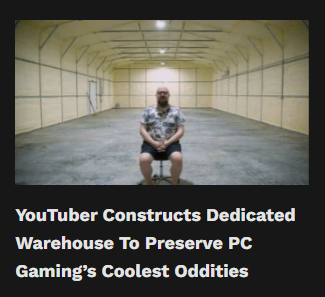
That's a piece from Kotaku about LGR building himself a warehouse. I find it very difficult to believe that anyone reading Kotaku on a semi-regular basis does not know who LGR is, so to deliberately obfuscate his identity in the headline just feels like it's being annoying on purpose.

One could argue that this headline has been written appropriately, however; it gets the broader point across in a way that is accessible to all, regardless of whether or not they know who LGR is. So I will begrudgingly give it a pass.

I do not give the following (from GameSpot) a pass, particularly because they "spoil" it in the accompanying image:

Just say Hercules. We can see it's Hercules. Also I'm not 100% sure Hercules counts as one of Disney's more "iconic" movies. I guess it was in Kingdom Hearts.

GameSpot is very fond of this sort of shit right now:

Yeah, fuck off with that. Just tell me what it is.

Double fuck off for this being based on a "rumour", something which I was always discouraged from reporting on when I was working the news beat in the games press. If your headline has "could" in it, just stop.

But let's not pick exclusively on GameSpot.

Let's also pick on GameRant, which, to be fair, is part of the odious Valnet group. This headline can get right in the fucking bin. (It's Elder Scrolls Blades, if you gave a shit.)

This one can, too. (Horizon Chase Turbo in this case.)

Look, I get it. If you're on the endless churn and trying to juice your site's SEO results in order to maximise your KPIs for men in suits who don't know what video games actually are, it's easy to feel like it's necessary to pull this shit in order to "get people curious enough to click". But people are savvy to it now, to such a degree that it's a practice that gets routinely mocked.

Just say what the article is actually about rather than this bullshit playground teasing ("I know something you don't!") and if the story has any merit, people will click through to it anyway to find out more details. Those "more details" someone clicks through to find out more about should not, repeat, not be the name of the subject of the story.

This sort of thing is rarely the fault of the individual reporters — although I'm sure there are a few out there who love pulling this little stunt. No, it's inevitably an edict from on high for the reasons just stated. With the general health of video games media being deep within the "critical danger" territory, the suits want quick solutions that, in theory, get results.

Only I'm not convinced this sort of practice does get results any more. Like I say, people are wise to it now. I refuse to believe that I am the only one who simply won't click on an article whose headline is a deliberate cocktease.

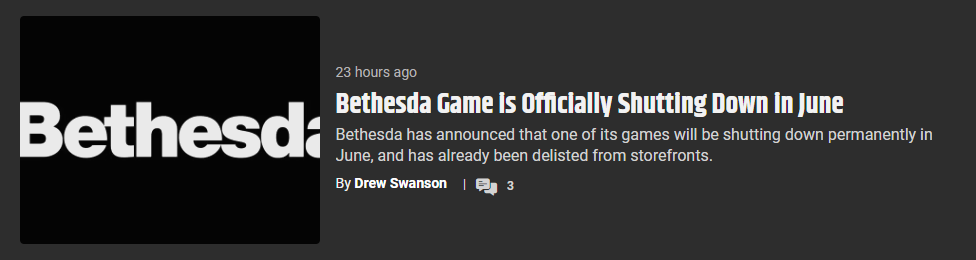
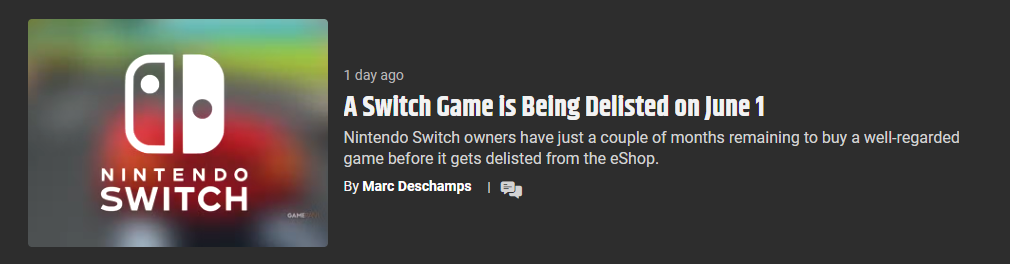
Look at it this way: why should I give a shit that "a Switch game is being delisted on June 1"? There are thousands of the fucking things, many of which I don't care about. "The eShop is full of crap" is a meme for a reason. I do, however, own a copy of Horizon Chase Turbo, and thus would be interested in hearing why that specific game is being delisted. (It's stupid, by the way. And you can blame Epic for it.)

Anyway, that has been your nightly grump. Please write meaningful headlines, especially if you want the few remaining dregs of the video games press to be taken even a little bit seriously.


Want to read my thoughts on various video games, visual novels and other popular culture things? Stop by MoeGamer.net, my site for all things fun where I am generally a lot more cheerful. And if you fancy watching some vids on classic games, drop by my YouTube channel.

If you want this nonsense in your inbox every day, please feel free to subscribe via email. Your email address won't be used for anything else.

#oneaday Day 629: Another site falls to AI

Earlier today, a review was being shared around. It was a featured review on Metacritic for the new Resident Evil Requiem, and it was very obviously AI-generated — both in terms of the review text itself, and the image and biography of the completely fictional author.

Now, I know there is plenty we can criticise Metacritic for, but to the site's credit, after being made aware of the situation, the review was not only pulled from Metacritic, but the site in question was blacklisted from being featured on there for future reviews, too.

The site in question was VideoGamer.com — not a site I ever particularly frequented, but one that has been around for many years, and one of many, many old games press brands that have been bought up by private equity and turned into sites filled with AI-generated drivel, usually in the form of undisclosed advertorial features pointing people towards shady gambling sites. VideoGamer is not the first site to fall in this way; previous victims have included AdventureGamers and The Escapist, and there are almost certainly countless more that we haven't found as yet.

My initial reaction to anything like this happening is to ask "why?"

Why are once-good sites being replaced with AI-generated drivel? Who do they think is reading this stuff? Why do the people in charge of these hollowed-out husks of websites think this is, in any way, a good idea?

The answer, of course, is that this is the natural endpoint of SEO-driven online writing. The sole reason these articles exist is to get people to click on them and generate advertising revenue for the site's owners. And if they can do that without having to do anything silly like pay actual people to write actual articles, so much the better! (Although the more astute among you out there may well point out that being an AI power user probably doesn't end up much cheaper than hiring an actual person — particularly in the games press, where, as Mat Jones of IGN put it earlier today, "games freelancers will turn in 2,000 words for an egg sandwich". I wish it wasn't true.)

Couple this with the news that Eurogamer and surrounding sites are suffering some considerable layoffs and things do not look altogether rosy. I also learned that VG247 is now little more than an SEO guideslop site; I never really liked that site all that much, but since most of my USgamer stuff ended up archived there after USgamer itself closed down, I do have a certain attachment to it.

The frustrating thing for me is that all this seems so unnecessary. Video games, as an industry, creative medium, art form, whatever you want to call them, are huge. One would assume that would mean they would need a specialist press around to cover them effectively, but given that so many sites have been gutted over the last few years — and, in many cases, replaced with AI slop — something doesn't quite seem to add up.

Sure, we've seen the rise of sites like Aftermath, who do good work, and it was gratifying to see Giant Bomb successfully extricate themselves from their former corporate overlords — full disclosure: I subscribe to both to support them — but neither of them quite take the place of what we used to have. And you can interpret that however you will, because the same is true if you think I'm referring to traditional "news, previews and reviews" websites, or if you think I'm referring to magazines. (Spoiler: I'm talking about both.)

Part of this feels like an extension of the whole "New Games Journalism" discussion we had in the latter-day 1up years. And while that discussion went to some odd places, I do acknowledge that there is some valuable work going on over at a number of worker-owned, reader-supported sites, particularly when it comes to telling the stories of people who work in games. But sometimes you just want to read something simple like what someone thought of a game you're interested in, y'know? And that side of things seems to very much be a dying breed.

One might argue that there's less need for that, what with social media, online discussion and "influencers" (you will never get me to not use scare quotes around that odious term) dominating the way games are promoted online these days. But I still like to read a straightforward review of something — and the continued existence of Metacritic, as flawed as it is as a concept, suggests that there's still a place for that sort of thing.

I can't help but wonder where all this will end up. With people starting to get interested in physical media once again, I would love to see proper magazines become a thing again. I suspect that won't happen, but we certainly can't go on like this. Can we? This feels like how you actually end up with a completely dead Internet.


Want to read my thoughts on various video games, visual novels and other popular culture things? Stop by MoeGamer.net, my site for all things fun where I am generally a lot more cheerful. And if you fancy watching some vids on classic games, drop by my YouTube channel.

If you want this nonsense in your inbox every day, please feel free to subscribe via email. Your email address won't be used for anything else.

#oneaday Day 598: Poptimism

There's been a lot of grumbling over a new game called Highguard just recently. I don't really know what Highguard is, which is part of the problem — apparently it was initially shown off at The Game Awards last year, then just went pretty much radio silent until its… launch? Now? Something like that?

From what I can make out, Highguard is a live service multiplzzzzzzzzzzz — ah, so that's why I haven't really been following it. But that's not precisely what I want to talk about today. I, instead, want to talk about the discussions that have been happening over the last few days on the subject of coverage of Highguard.

It started with an op-ed over on IGN written by Senior Editor Simon Cardy, whose article Can We Stop Dunking on Highguard Before It's Even Out, Please? is fairly self-explanatory in terms of its core thesis. Cardy argues that it's annoying when a game is seemingly randomly picked as a whipping-boy and becomes the butt of jokes before anyone has actually gone hands-on with it and is thus in a position to comment on it from an informed, experienced perspective.

I get this. I kind-of-sort-of agree with it. It is annoying when there's something you're interested in, and all you can find in terms of coverage is How Bad Does This Game Look?! clickbait. And it is a bit daft for people to be pre-judging Highguard based on a single trailer and a remarkably quiet marketing department.

At the same time, as this piece by Autumn Wright argues, there's a strong argument to be made that the press covering a particular medium is under no obligation to remain what they describe as "poptimistic". It is not the press' job to go to bat for a particular game or company — especially not ahead of its release — and there are a lot of things about Highguard that do warrant discussion. Exactly why has its marketing been so non-existent? Does the world really need yet another live service multiplzzzzzzzzz? I'm so uninterested in the game as a whole I can't even think of a third possible question, but I'm sure there's something else that needs asking.

The problem, as ever, is in how different people see the role of the enthusiast press.

Some see it as an extension of marketing — and indeed, there are plenty of outlets that operate like this. There are plenty of outlets that have since gone under that operate like this, and there will be more in the future. It's a bit of an occupational hazard; by engaging with the standard news-preview-review cycle, you are part of a Marketing Plan, whether you want to be or not. And that's always been the norm for the games press, dating right back to magazines. It was never really questioned all that much until relatively recently; people wanted to know what was coming up, and they wanted to know if the thing they had thought looked cool for the last six months actually ended up being any good or not.

Others see it as fulfilling a critical role — critical in the sense of "administering criticism", not as in "really important", though the people who feel this way would probably argue that also. People who feel this way are interested in the stories behind the games and how games can fit into broader cultural commentary. They ask what particular games can tell us about society, and what the artistic meaning behind a work — both intended by the author and perceived by the audience — might be.

The challenge, of course, is access. The former group gets access to games because they tacitly agree to being part of the Marketing Plan. They get invited to press events to try out a new game; they get sent preview and review codes early; they agree to embargoes so the publisher of a game, not the press outlet, remains in control of the coverage. The latter group, meanwhile, tends to have to fend for itself to a certain degree. This gives them a lot more freedom in terms of what they cover and how, of course, but they can't rely on having access — whether that means "getting an early copy of a game" or "being able to pick the lead writer's brain without a PR person breathing down their neck".

I don't really know what the answer is, or even if there is a satisfactory one. I don't quite fall into either of the above categories with what I do over on MoeGamer, but then that's a site by an individual run as a passion project, not a commercial venture. As such, I have the freedom to pick and choose what I cover, and to exclusively concentrate on things that I, personally, feel have some worth and value — or, at the very least, are interesting enough to want to talk about. That means my site skews positive, which is anathema to some people, but I'm not there to do a PR company's bidding — nor am I there out of any obligation to criticise things just because they "need criticising". I simply choose to focus all my attention on games that I think are worthwhile, and that I think more people should check out.

I hate to sound like I'm "both sides-ing" the issue, but the reality is, there are valid points from all angles here. It is silly to pre-judge Highguard with little to no information — or perhaps it's more accurate to say it's silly to make assumptions about what Highguard will be with little to no information. At the same time, though, outlets have no obligation to hype up a new release — and especially, one would argue, when the marketing department doesn't appear to have been doing its job at all.

This is, I can guarantee, the only thing I am going to write about Highguard. Because the one thing I have managed to glean from the discussion over it is that I don't really give a shit about it. So I'll just say I hope it's as good/bad as you were anticipating, and leave it at that.


Want to read my thoughts on various video games, visual novels and other popular culture things? Stop by MoeGamer.net, my site for all things fun where I am generally a lot more cheerful. And if you fancy watching some vids on classic games, drop by my YouTube channel.

If you want this nonsense in your inbox every day, please feel free to subscribe via email. Your email address won't be used for anything else.

#oneaday Day 502: Another reminder that traditional games journalism is all but dead

It emerged today that the entire Features team of the gaming website TheGamer has been laid off, after owner Valnet decided that it likes money more than having actual employees who are capable of writing.

I'll admit that I was never a particular fan of TheGamer for a variety of reasons, but regardless of my own personal feelings about the site, this sucks. It's the latest instance of something that has continued to suck for a while now, with even big names of the games journalism industry — if such a thing even exists any more — suffering widespread layoffs, cutbacks and significant worsening of what they offer for their audiences. Enshittification, if you will. And yes, even longstanding behemoths like IGN and Eurogamer have been subject to this. According to VideoGamesChronicle and PressEngine, more than 1,200 journalists have left the business entirely in just the last two years — and that's not taking freelancers into account. (That puts the figure nearer 4,000.)

Honestly, seeing this happen to TheGamer isn't a surprise, though. This is just what the site's owner, Valnet, does. They buy up sites that were once successful, rip out everything that made them distinctive and unique — i.e. the people who worked hard on establishing the site's identity — then proceed to replace everything with slop. I would not be surprised at all if in short order we start seeing casino advertorials and AI-generated garbage on what remains of TheGamer.

Valnet and their big rival, Gamurs, are a scourge on what was once a thriving sector. They both take this model: they buy "verticals" (ugh) that they want to add to their portfolio, and then think that just because they now own, say, Polygon, that they have unlocked an infinite money glitch. But they have not — for a variety of reasons, not which is the model on which ad-supported commercial games journalism has been forced to operate for years now.

This article by Luke Plunkett of Aftermath sums it up nicely: these sites had been stuck in operating in the same way as 2000s-era Kotaku, which is to post as much as possible, as often as possible, and it didn't matter too much if nothing of any real substance was being said. It was all about the content.

I've been through this, too. During my time on both GamePro and USgamer, I was specifically hired to be someone who operated on a different time zone to the rest of the staff, with my responsibility being to ensure that there were things ready to read on the site by the time North America woke up. These typically end up being "news" posts, which, in the churn of having to produce so much content every day, often end up being little more than you could learn from just following a company's social media account or signing up to their mailing list.

"Guide content", that odious practice where every single site has to have 5,000 articles explaining every minutiae of every hot new game (and often badly, to boot), is also at play here, with the entire Internet gradually being flooded by "what is today's Wordle solution?" posts, individual articles explaining each and every shrine in The Legend of Zelda (often badly) and inconclusive, vapid answers to questions no-one was really asking with any great seriousness. It's all about the pursuit of endless, relentless content, and it doesn't matter if it's any good or not, it just has to be fresh, constantly updated and now.

And it sucks! It's not doing anyone any good! It's not making the writers on these sites look good, it doesn't make the games they're covering look good, it doesn't make the site look good, and it doesn't inform the readership of anything worthwhile. It just means those readers have something new to scroll through every time they refresh the page while they're staring, glassy-eyed, at their phone for the 14th consecutive hour that day.

It sucks that it has to be this way, too, because the presence of a specialist press is important. The idea that we might, one day, be completely without a games press altogether is absolutely baffling, but with every round of layoffs like the one we've seen today, we get closer to that dystopia.

Reader-supported sites such as Aftermath, 404 Media (not games, but relevant) and Giant Bomb are doing great work, but it remains to be seen how sustainable that model is — particularly as so many of the bloody things are starting to pop up that it is no longer possible or affordable for anyone to be "widely read" when it comes to good-quality games coverage. That's not necessarily a bad thing, given that back in the '80s and '90s we tended to be loyal to individual magazines rather than reading all of them, but it's a big shift in how the Internet has traditionally worked.

I don't even know what to think any more. It's bleak out there. And I wonder if it's ever going to get better again. I just want to have some fun websites to read again, by people who know their craft and are passionate about it. We used to have that — why can't we have that again? Why can't we have 1up.com again?

Those are rhetorical questions.


Want to read my thoughts on various video games, visual novels and other popular culture things? Stop by MoeGamer.net, my site for all things fun where I am generally a lot more cheerful. And if you fancy watching some vids on classic games, drop by my YouTube channel.

If you want this nonsense in your inbox every day, please feel free to subscribe via email. Your email address won't be used for anything else.

#oneaday Day 376: The death of ambition

Earlier today, Dave Gilbert, renowned modern adventure game developer and publisher, happened to point out that Adventure Gamers, a website with a near 25-year history, had, at some point, sold out and become an online casino shilling site, leeching off the prior content — which, after 25 years, you can bet had some decent SEO juice, even with the myriad changes to such algorithms over the years — in order to hook people into shady gambling sites.

My immediate reaction to this was "ew, gross", shortly followed by "I bet I could make a really good adventure game site". Unfortunately, this thought was then almost immediately followed by "…but why should I bother?"

This isn't the first time I've thought something along these lines. The modern Web is killing, stifling any sense of ambition I might have once had. It's not one, single thing like generative AI causing me to feel this way — though you better believe the amount of AI slop out there is a big part of it — but rather a continual piling-up of little micro-enshittifications. Over the course of the last 10 years in particular, these micro-enshittifications have all accumulated into the garbage fire that is the Web of 2025: a place where it's hard to find reliable information, where it's even harder to verify whether what you're looking at is reliable information, and where the people with the power to make a difference don't seem to give a shit.

Let me tell you a little bit about myself, in case you've not been here on the previous occasions I've done so.

When I was a kid, I grew up surrounded by computers: specifically, the Atari 8-bit and ST, with MS-DOS and Windows PCs following along around the early '90s. For pretty much my entire childhood, my Dad and my brother were both regular contributors to an Atari magazine initially called Page 6 and later New Atari User, after it took over the name from a publication that was bowing out of the Atari 8-bit scene.

I loved getting a new issue of Page 6 every couple of months; I loved reading through all the features, even if I didn't understand all of them, and it gave me great pride to see my Dad and my brother's name in print pretty much every issue after a certain point. My Dad would cover flight simulators, productivity software and the use of music technology, while my brother would cover Atari ST games. We got a lot of free software out of this arrangement — much of which is now in my possession — and it's fair to say that this played an instrumental role in defining my interests and hobbies growing up.

When my brother left home, he had decided to forego university in favour of a staff writer position on a magazine called Games-X. This was a risky and ultimately unsuccessful venture on the part of publisher Hugh Gollner, but it was a nice idea: a weekly games magazine that covered new releases for the home computers and consoles that were around at the time — the tail end of the 8-bit era, the heyday of the ST and Amiga, and the days when the Mega Drive and SNES were just starting to get some attention.

I was immensely proud to have a family member in the games press, published every week in an actual magazine you could walk into a newsagent and buy. (Page 6 had a stint on newsstands, too, but it eventually went back to its roots as a subscription-only magazine, clinging on to dear life until 1998, impressively.) And my pride only continued after Games-X folded and my brother followed Gollner to the then-fledgling Maverick Magazines, where he initially worked as a staff writer on Mega Drive Advanced Gaming, while his girlfriend at the time held the same position on its Super NES counterpart Control.

It continued further still as he worked his way up the ranks, through several publications and publishing companies, until eventually he found himself in the United States working on the Official PlayStation Magazine and Electronic Gaming Monthly, and helping to launch the pioneering video game social networking site 1up.com — dearly missed.

Every step of the way, I followed his career with interest, conscious of the fact that I was 10 years younger than him, thinking "one day I'll get my chance; I really want to follow in his footsteps, and one day I'll have that opportunity if I just keep trying."

I did keep trying. I did some articles for Page 6, just as my brother had. I did some freelance contributions to PC Zone and the Official Nintendo Magazine, back in the days when one article would get you the money that two months' worth of news posts nets you today. I worked on some little sites, most of which have now disappeared, sadly, and I eventually had the opportunity to work on both GamePro and USgamer, two decent-sized but, admittedly, American sites.

For some reason I had found the UK games press perpetually impossible to crack after a certain point, and after attending a few PR events on behalf of both GamePro I understood why: there was very much a heavily cliquey, old boys' club thing going on, and as a socially awkward (and what I now know to be) autistic loser, that was not something I felt in any way able to crack my way into.

But still I wanted to believe. I wanted to believe that GamePro was the start of something big, until we were told via email one morning just before Christmas that none of us had jobs any more. I wanted to believe that USgamer was another opportunity for something big, until I found myself screwed over and, once again, informed via email, this time on my actual birthday, that I no longer had a job.

After that, I didn't seek any further positions in the games press. I'd taken too many beatings. But I didn't want to give up. That's when I started MoeGamer, which initially began as a means of continuing some of the work I'd done at USgamer covering Japanese games that other publications didn't give the time of day. This was work that people in both the industry and from the "public" side of things told me that they found valuable and helpful, because I wasn't just going "ew, anime art" and writing things off as "pandering" or whatever.

Long-term, I wanted to build MoeGamer into something that really stood by itself: a site where you could look up information on a wide variety of games and find some thoughtful, well-considered writing about it. And I think I have achieved that, even if I don't have the time or energy to update it as often as I'd like; the one positive about my previous job, which was beyond tedious, was that it gave me ample time and energy to write new articles and make new videos.

I still never really "made it", though. Few people online know who I am; even fewer go "oh, wow, a Pete Davison article, gotta read that" — although I do have a pleasingly enthusiastic following in the Evercade community, at least, thanks to my work on the official site — and I just find myself wondering… was all this for nothing? Is there even any point trying any more?

The Adventure Gamers thing stings, because were it 10-15 years ago, I'm pretty sure I could have put together a banger of an adventure game-centric website, developed a decent following and kept it up and running for 25+ years without selling out to online casino shills. But now, from every corner of the Web I read horror stories about sites struggling for discoverability, struggling to earn the money to keep the lights on and struggling to get anyone to give a shit about the written word. There are rare outliers, and the rise of worker-owned, reader-supported initiatives such as Aftermath and Giant Bomb is encouraging — but both of those (and others like them) already had ready-made, built-in audiences thanks to the people involved and their prior positions; how long would a brand-new website with a specialist focus even last these days, if it wasn't "the next project from [insert big name site] alumnus, [name]"?

I feel utterly demoralised. I feel like what was once my dream career just doesn't really exist any more. I recognise that I'm extraordinarily fortunate to have fallen into the position I'm in now, where I get to work on games that I care about, crafting written material to help people understand and appreciate quite why I love them so much — and hopefully help said readers learn to love them, too — but there are days of increasing frequency when I wonder if anyone really gives a toss. The days when I have people screeching obscenities at me on social media because they can't buy a cartridge that is out of print. The days when I have to deal with endless, mind-numbing, Queen's Duck-level "feedback" from people who absolutely don't care about the games I'm working on as much as I do. The days when I'm genuinely fearful for the history and legacy of the hobby I love so much, and where I weep for the traditional, written-word games press, a side of the industry which almost doesn't exist at all any more.

I was born 10 years too late. And believe me, it really sucks to have spent a significant portion of your life thinking "I really want to do that", only to find out, much too late, that "that" just isn't really a thing any more.

The obvious answer to all this is something I've thought of and felt before — that even if there doesn't seem to be a "place" for something, you should do it anyway, because someone, somewhere, will appreciate it. But with every site sold to private equity companies and gutted to turn into an AI slop factory, the motivation and ambition to do something significant and meaningful diminishes, bit by bit. What was once a roaring flame of determination is now little more than a flicker. And I hate that.


Want to read my thoughts on various video games, visual novels and other popular culture things? Stop by MoeGamer.net, my site for all things fun where I am generally a lot more cheerful. And if you fancy watching some vids on classic games, drop by my YouTube channel.

If you want this nonsense in your inbox every day, please feel free to subscribe via email. Your email address won't be used for anything else.
#oneaday Day 338: Bomb Reignited

Boy, it sure has been an… "interesting" time for the games media recently, as I've alluded to a few times recently. To catch you up: Valnet, the sweatshop of the media industry, has bought Polygon and laid off the vast majority of its staff, which, of course, suggests that Polygon is going to become yet another SEO slop factory where its writers are paid peanuts to produce nothing of any real cultural value.

For a time, it looked like the longstanding site Giant Bomb was going the same way, with upsets over "brand-friendly" (or, more accurately, "brand-unfriendly") shenanigans on streams causing a sudden halt to… seemingly everything the site was doing. Giant Bomb has changed hands numerous times over the years; until recently, it was in the hands of Fandom, the people who ruined Wikia with obnoxious autoplaying pop-over videos and links to "related content" that was not, in fact, related to the thing you were looking at in any way whatsoever.

You'll notice I say "until recently". That's because Giant Bomb is no longer under the Fandom umbrella; it was announced on a panel at PAX East yesterday that Fandom and the Giant Bomb staff reached an agreement for the latter to purchase the site and turn it into an employee-owned outlet, much like the growing number of other worker-owned arrangements that are really finding their feet these days.

This is excellent news. I must confess despite being in the official Final Fantasy XIV guild for Giant Bomb, I never really hung out there all that much, but I did know that Giant Bomb, for many folks, was all about the community — similar to the old 1up.com days. The site looking like it was going under thanks to corporate interference was really sad to see — and for once, the corporate interferers saw what was going on, had a seemingly genuine "oh, shit" moment and changed course. Strongly. You can criticise Fandom for many things, but the agreement they reached with the Giant Bomb staff is, to my knowledge, absolutely unprecedented in the online media biz.

I've decided to make an effort to join the Giant Bomb community a bit more. I've rescued my account that I apparently signed up for in 2010 (with a different email address that thankfully I still had access to) and pledged $10 a month to help the folks on the site out. I'm looking forward to seeing what it has to offer, getting to know the community and perhaps, hopefully, finally having a decent place to hang out and talk games.

What does this mean for all the other things I do online? Nothing. I'm still going to be blogging here, I'm still going to be writing about games on MoeGamer — it's just I might be posting a few more bits and pieces on Giant Bomb from hereon, in both the forums and using the site's blogging facility. If there's one thing I really miss from the Internet Gone By, it's 1up.com and its sense of community; I'm really interested to see if Giant Bomb can prove to be an adequate replacement, particularly for someone who is essentially "new" to proceedings over there. I'm intruding on 17 years of history (huh, the site is the same age as this blog) but the "Duders" are supposed to be thoroughly nice people, so we'll see.

Mostly I'm happy to see my pals Jeff Grubb and Mike "Tolkoto" Minotti back in action, because I know very well how hard those two chaps worked to claw their way up the mountain of shite that is the games media industry, and it was a massive bummer to see them seemingly kicked back to the ground. I've known both of 'em since the 1up.com, Bitmob and Squadron of Shame days, and it was wonderful to see that they'd made something of their passions — and that they will continue to be able to do that.

So yeah. Giant Bomb is back. Now, if we could just do something about the rancid degradation of everything else online…


Want to read my thoughts on various video games, visual novels and other popular culture things? Stop by MoeGamer.net, my site for all things fun where I am generally a lot more cheerful. And if you fancy watching some vids on classic games, drop by my YouTube channel.

If you want this nonsense in your inbox every day, please feel free to subscribe via email. Your email address won't be used for anything else.
#oneaday Day 329: Open your wallet

One thing that has been a constant in all the discussions over the death of Giant Bomb and Polygon yesterday is that we need to support independent creators. We need to support worker-owned organisations, we need to support publications that aren't corporate-owned, and perhaps most importantly, we need to support individual creators who, in many cases, do not have the backing of a corporation or even an organisation to help them out.

What this means in practical terms is that if you like something a particular creator or group of creators does, you should open your wallet and toss them a bit of change now and then. It doesn't have to be a regular pledge, it doesn't have to be a lot of money, but it's something we all need to get better at doing.

Of course, for those of limited means, ways of supporting creators that don't involve spending money are helpful, too. Telling others about the creators and their work; sharing links to ways people can support them; telling their own stories about why that creator and their work are important to them.

But there has to be a slightly mercenary element to this: there are people out there working hard who deserve to get paid for the work they put in — particularly if it is their actual job — and that payment shouldn't be contingent on SEO optimisation and ad revenue. The obsession with those to the exclusion of all else — including the quality of the work — is what has led us to a situation where almost the entirety of the traditional games press has collapsed, with the scraps being hoovered up by corporations that pay peanuts for absurdly unreasonable quantities of work. And when that happens, you get an Internet flooded with shite. And when there aren't workers to do that but the content still needs to flow, that's when you get an Internet flooded with AI-generated shite that is riddled with errors as well as being crap.

In many ways, the democratisation of information that the Internet has brought everyone is an amazing thing. There is no need to spend thousands of pounds on an Encyclopaedia Britannica because you have access to all that information and more via the Web. But the trouble is, this same democratisation of information has led everyone to expect everything for free. And that is simply not sustainable. People who make things as their job need to get paid. That money needs to come from somewhere. And we've proven pretty clearly beyond any shadow of a doubt that the ad-driven model is not a good way of doing things, for a variety of reasons: the workload it places on underpaid workers; the unreliability of it as an income stream; and the fact it encourages a race to the bottom in terms of content churn rather than the production of actually meaningful, worthwhile work.

So I say again: open your wallet. Think back to the days when if you wanted to read something about your hobby, you'd walk into Smiths and pick up a magazine, maybe flip through it a bit, then walk over to the counter and pay a few quid for it. You might do this multiple times a month for different aspects of your hobby, or, hell, for different hobbies altogether. You might even set up a subscription so you got the magazines sent straight to you. In doing that, you were supporting the people who made the magazines, the people who wrote the articles, and you were helping to ensure the continued existence of that magazine.

Sure, you could read the whole thing for free in Smiths if you wanted to, but I think most people were honest enough to actually pony up for a copy of a magazine if they had a quick flip through and saw one or two things they thought were worthwhile. More often than not, you'd find things you didn't expect to find interesting when you later perused the magazine in its entirety later in the day. And sometimes, you'd even return to that magazine years later and rediscover things you had forgotten about, or notice things you never saw first time around.

You can't easily do that with the churn of SEO optimised website content because of the sheer volume of it — and the inability to guarantee that the information will still be there [x] years down the line. Someone on Bluesky earlier noted that they were doing research for a video they were making and found a good article from 2014, but was unable to follow up on any of the sources that article cited because every link in it was broken.

So, I say again: open your wallet, if it is within your means to do so. Help writers produce fewer articles with more words that are better and which stick around for longer. Help video makers produce fewer videos that are better quality, more in-depth and completely devoid of SEO or ragebaiting.

And if anyone makes a new paper magazine about your passions, you throw those goddamn heroes a subscription.


Want to read my thoughts on various video games, visual novels and other popular culture things? Stop by MoeGamer.net, my site for all things fun where I am generally a lot more cheerful. And if you fancy watching some vids on classic games, drop by my YouTube channel.

If you want this nonsense in your inbox every day, please feel free to subscribe via email. Your email address won't be used for anything else.

#oneaday Day 328: Polygone

Well, another one bites the dust. Today, we learned that gaming site Polygon has been sold to Valnet, the sweatshop of online media, and that, as is standard practice in this situation, pretty much all the regular writing staff have been let go, to be replaced by contractors who will be paid absolute fucking peanuts to churn out SEO-baiting drivel and contribute nothing of any real value to the broader conversation about video games.

I was never a huge fan of Polygon, I'll confess. But this isn't about me. It's about yet another significant pillar of Video Games Journalism collapsing — because make no mistake, being sold to Valnet means that your brand is going to have very little value left afterwards — and the entire landscape of this section of the media getting just a little bit worse.

To make matters worse, it appears that Giant Bomb is circling the drain, too. I don't think anything "official" has been announced on that front yet, but from what some of the people involved have been saying publicly… yeah, that site isn't long for this world, either.

Why does this keep happening? Why are we allowing sites that are demonstrably good at what they do to get destroyed in this way? At this rate, we're going to have absolutely no "big names" in the games press left.

And perhaps that might, over the long-term, be a good thing. Because every time something like this happens, it feels like more and more worker/creator-owned outfits pop up and show that yes, it is possible to do things a bit differently; it is possible to put together an interesting and enjoyable site without resorting to SEO-baiting bilge and Guide Content; it is possible to build a sustainable publication that doesn't rely on ad-revenue and instead asks its most interested readers to pony up a couple of quid a month in exchange for stuff that is actually worth reading.

But will this successfully become the norm? We have to make that happen. We have to look beyond the search engine algorithms, start following the sites we actually care about… and support them. One of the worst things to ever happen to the press in general — not just in gaming — was to set the expectation that everything, everywhere, should be free, always. It's devalued the hard work of people working in the media, it's normalised paying people an absolute pittance for hard work, and it's actively making useful information and meaningful commentary harder to find. None of that seems the slightest bit desirable, but we keep heading down that path.

I already support a few folks I like via Patreon. I think it's probably about time I start ponying up for a subscription or two for sites I think are doing worthwhile work. Off the top of my head, I recommend Aftermath for gaming-related stuff, and 404 Media for tech journalism. Both are doing great work, and both are doing well through support from their audiences.

The issue, of course, is that if you end up supporting a lot of sites in this way, it can get pricy. But then think of it this way: did you buy every magazine that existed every month, or did you have a favourite? There you go. I guess the answer is to read fewer, better sites. And don't support the shittier behaviour of the sites that have already been fed to the Valnet monster, or which are in the process of sliding down that drain. You can solve today's Wordle by yourself, believe me. I believe in you!


Want to read my thoughts on various video games, visual novels and other popular culture things? Stop by MoeGamer.net, my site for all things fun where I am generally a lot more cheerful. And if you fancy watching some vids on classic games, drop by my YouTube channel.

If you want this nonsense in your inbox every day, please feel free to subscribe via email. Your email address won't be used for anything else.

#oneaday Day 314: The news churn

There was a good piece over on Aftermath today titled "Video game blogs from the 2000s were fast, reckless and very bad at news". The gist of the piece was that video game websites that adopted a continuously updating "blog" format, in contrast to the "magazine" approach many earlier gaming sites had used, inadvertently set in place a format for games journalism that isn't particularly helpful for readers, and is definitely not good for the writers.

The piece goes on to note that the pressure to have [x] number of articles per day, or the fact that many writers were paid (a pittance) by the article placed a great deal of pressure on the site's writers to make even the most mundane, pointless bullshit somehow "newsworthy". It is this, among other things, that led numerous websites to continuously and uncritically quote Wedbush Securities analyst Michael Pachter whenever he spouted off something that was either immensely obvious (the new Grand Theft Auto will probably sell well!) or so utterly vague as to be completely useless.

I wasn't involved in the biz at the start of this, but I definitely felt its effects. When I joined GamePro in 2011, the site was just starting to experiment with a new format for its news coverage. At the start of my shift each day, I was to dig up a bunch of stories and post them as just headlines and a brief summary on a front-page forum as a sort of "news briefing". Then, later in my shift, after the stories had all had a bit of time to percolate, I would write one or two up in further detail based on which of the posts had seemingly been the most popular, judged primarily by comments.

GamePro's readers initially fucking hated it, because the way it was implemented cluttered up the front page of the site's main forums, and I wasn't a huge fan of it, either, because it felt like the time I spent digging up those initial stories — which, more often than not, took the form of either another site having reported on something first, or a press release we'd received that morning — could have almost certainly been better used finding bigger stories to explore, or writing features, or reviews, or anything other than desperately, vainly scrabbling for just a scrap of news, please, guvnor.

That said, over time it did seem to settle down a bit, I broke a few genuine exclusives and provided some good editorial commentary on other stories that were happening, and I was told on multiple occasions that the work I was doing was playing a big role in giving the site a nice uptick in traffic.

Of course, even that uptick was all for naught when IDG Media unceremoniously closed the site and the magazine just before Christmas that year, meaning I woke up one morning all set to do work, only to find that not only was there no job to work any more, all the stuff I had written was about to become absolutely impossible to find due to the inexplicable decision to fold some (not all) of GamePro's material into the unrelated publication PC World. Good stuff. (If you dig deep enough into PC World's atrocious search function, you can still find the odd bit of my stuff, but it's not easy to find, which was great for building a portfolio, I can tell you.)

Something similar happened at USgamer, also. When we started the site, the intention was for the whole thing to be a return to something like the 1up.com days: a primarily personality-driven site, where each of the writers would have their own specialisms, and they would be free to write about whatever they wanted, developing their own little sub-communities in the process.

That went great for a while! I wrote about anime RPGs and visual novels, another chap wrote about racing sims, and all the other people on staff each had their own Things, too. Comments from the community were positive; I can't speak specifics to the other folks' work as I didn't tend to delve into their comment sections, but on my pieces, there was always a great deal of appreciation for my work making USgamer a site that was welcoming and inclusive to a portion of gaming that didn't always get a lot of love and respect from the mainstream sites. This was all pre-Gamergate, I'll add, so there was no culture war bullshit going on; it was just folks who liked anime-style games, including those with mildly provocative content (as there was a fair amount of in the mid-2010s) having an appreciation for a site that didn't just write their favourite games off as being for perverts or whatever.

That lasted for a few months, but then an edict came down from On High (in this case, USgamer's parent company Gamer Network) that we needed to juice the numbers. In other words, abandon everything we'd done to make the site unique and start the daily churn of news and guides that is so painfully familiar to this day. I went from being able to post whatever I wanted to having to get manual approval for each and every news story I wanted to post, and I was outright forbidden from covering certain games.

Eventually, when I was laid off from the site — again, through waking up one morning only to discover I didn't have a job any more — I was forced into spending the majority of my days rejigging and reposting "guide content" from Prima Games, which was also under the Gamer Network umbrella at the time. Out of spite, I stuck with several of my regular weekly columns even with this SEO-juicing bullshit I had been lumbered with, and it was that degree of spite for what the site had become that eventually led me to create MoeGamer: a site where I could play by my rule and cover whatever the fuck I wanted, and fuck traffic numbers.

MoeGamer itself has had a few evolutions over the years. Initially, it was an occasional blog where I basically continued writing my JPgamer column from USgamer — I'd just write about things that interested me, or which I'd happened to play recently, or which had been on my mind. Eventually, when I was working a series of very boring office jobs that had nothing to do with the games press, I launched my "Cover Game" feature, with a mind to giving underappreciated, oft-overlooked titles the level of detailed coverage that your average traffic-baiting triple-A title did. At the height of my boredom in the office, I was posting stuff on MoeGamer daily, including episodes in each multi-part Cover Game feature, plus shorter one-off articles about things that I found interesting, or had happened to collect back when CEX did free shipping (ahh, those heady days), or that I had always loved but never written about.

Today, I actually like my day job, so MoeGamer has had to take a bit of a back seat, but I'm still writing over there sporadically. It's nice to have a space that is for a specific subject, and a contrast from this general-purpose thought-dumping ground that is this blog. I don't have any intention of making MoeGamer "big" or "famous" or trying to make money from it; it's just my site about games I like, and over the last 10+ years I've filled it with a lot of work I'm very proud of. Today, I think I'm more proud of what I've built with MoeGamer than my all-too-brief time as part of the professional games press.

I've pretty much taken the MoeGamer approach with YouTube, too, albeit with more of a focus on retro games than RPGs and visual novels. And y'know what? While my channel hasn't exploded in terms of growth since I launched it (or since I started using it a bit more actively around 2018 or so), it has seen steady growth without me putting any effort whatsoever into either algorithm-baiting or SEO juicing. I have over three and a half thousand subscribers over there right now, and while that's a drop in the ocean compared to the Mr Beasts of this world, I feel creatively fulfilled and proud of what I've done, and am not an awful human being.

So much about the modern Internet sucks, and as Ed Zitron frequently notes, so much of it is about the growth-at-all-costs mindset. It's not just business that this "rot economy" infests; it's creative pursuits, hobbies, specialist fields. So many people are desperate to monetise everything they put online that the actual value for the people looking at the articles, videos and suchlike is diminishing — and the conditions for those producing the work are becoming increasingly intolerable. Throw AI garbage into the mix — and the fuckers who are now flooding YouTube and social media apps with AI-generated bilge that they pump out all day every day — and you have a real melting pot of absolutely rancid filth.

It's definitely a good idea for people who are Into Things to retreat into their own little specialised corners of the Internet, rather than the whole Internet being treated as some great Marketplace of Shit. This is happening to a certain degree, with many communities forming on Discord these days — though Discord itself isn't immune to enshittification, and I suspect we'll all have to find a new home before long — but I do miss the glory days of forums. I really do. I know a few forums still exist, but the 1up.com Radio Boards days are long gone, and every day I miss them a little more.

This has been quite the ramble, and I'm not sure I made a specific point along the way, but hopefully you understand what I was waffling on about. I am grateful to Past Me for setting up spaces like this blog and MoeGamer for me to continue to express myself, and as time goes on I feel personal spaces like these are going to once again become an important part of life online. Because the alternative is wading out into the mires of advertising-laden shit that is the rest of the Internet, and that gets less appealing day after day.


Want to read my thoughts on various video games, visual novels and other popular culture things? Stop by MoeGamer.net, my site for all things fun where I am generally a lot more cheerful. And if you fancy watching some vids on classic games, drop by my YouTube channel.

If you want this nonsense in your inbox every day, please feel free to subscribe via email. Your email address won't be used for anything else.

I'm coming to the end of an era, and I feel both relief and sadness.

This week is my last week as Editor of Rice Digital, and it's also my last week as part of the modern games press. I'm not ruling out occasionally writing something either here or on MoeGamer based on things that I've particularly enjoyed and want to share, but after this Friday, that's the end for me on regular commitments to Writing Stuff.

It's a bittersweet moment, but it's a step I've chosen to take — and yes, just to reassure you, this is entirely my decision — for a variety of reasons. Today I'd like to talk about them a bit in what will likely be a bit of a lengthy post. But I feel like I need to… express some things, even if no-one else actually reads them.

Before we go on, I'll clarify that my time with Rice coming to a close is because I'm going all-in on a project I absolutely believe in: the Evercade project, which I've been involved with for some time now, and which, from next week, I will be a completely full-time, 100% dedicated member of.

Anyway. Let's start with a bit of Pete backstory for the benefit of those who are newer acquaintances, or who don't know my full background.

As a child of the '80s, I was there for the beginning of home computing. Our family were relatively early adopters of home micros, quickly gathering beneath Atari's standard and remaining loyal to them right up until it simply became more practical to make the switch to IBM compatible PCs.

I don't actually know the exact reason my family chose to go with Atari, or the circumstances that led to us acquiring our first computer, an Atari 400, as they happened before I was aware of pretty much anything that was going on. By the time I had a vague amount of consciousness and sentience, though, computing was already an important part of our day-to-day life — and that continued.

The early days of home computer culture sounded like they were exciting to be a part of. My Dad and brother would often attend a local "computer club" — inevitably returning with armfuls of pirated software — and my brother had a (relatively) nearby friend who also had Atari computers and was more than willing to share his software with us.

My Dad had been a subscriber to a magazine called "Page 6" since its first issue. This began its life as a newsletter for a Birmingham-based Atari users' group known as BUG (Birmingham User Group) but the folks working on it decided that they could potentially make something more of it. As such, from the very first issue, they did their best to create something that would be of broad interest to Atari users nationwide, not just in Birmingham.

Page 6 was a great source of information on our computers. It was filled with interesting articles, tutorials and even programs that you could type in and save to disk or cassette. It helped emphasise the fact that a home computer was more than just a games machine, and that in the right hands, it could be a powerful creative tool and a real benefit to the household.

Indeed it was; our Atari computers were always more than just glorified games consoles. We played games, yes, but every member of my family used them for a variety of other reasons, too. My parents used them to help manage the household. My mother used them for creative writing. My father used them for music production. My brother used them for digital art. We all used them to create charming banners and cards with Broderbund's Print Shop software. And me? I did a bit of everything.

One day, my Dad became fascinated with a new piece of software he'd acquired: Flight Simulator II by subLOGIC. As a lifelong aviation enthusiast, my Dad was incredibly impressed by the seeming accuracy of Flight Simulator II — even despite the technological limitations of the Atari 8-bit — and found himself compelled to pen an article for Page 6 about it. As an enthusiast publication, Page 6 relied on contributions from its readership — and as a longstanding reader, my Dad felt a good means of giving something back would be to tell the rest of the Atari 8-bit community about this remarkable piece of software.

The article was published in the following issue — even getting a bit of cover space — and thus began a long relationship between our family and Page 6. My Dad would continue to contribute pretty much right up until the magazine finally folded in the late '90s, and my brother would kick off what has, to date, been a long and incredibly successful career in games-related media and surrounding environs by writing reviews of Atari ST games.

As an impressionable child, I was, of course, fascinated by all this — to such a degree that I'd often type up my own reviews of games in AtariWriter on the Atari 8-bit, print them out on our Star SG-10 dot matrix printer, then file them away in a ring binder. My parents would even go so far as to "edit" them for me — a fact that I feel probably played a significant role in my own fastidiousness when editing others' work today, as well as maintaining my own work to a set of high standards.

Eventually, when I was in my early teens, I finally got the opportunity I'd been waiting for: my Dad had negotiated with Page 6's editor Les Ellingham (who, incidentally, had remained in charge of the magazine from its very first issue to its absolute final moments) and agreed to let me pen a couple of short pieces for the following issue. It was nothing major — half-page reviews of two budget rereleases from Psygnosis' "Sizzlers" label — but the feeling I got when I finally saw my words in print was like nothing else.

Over the years, I contributed to a number of other publications, including PC Zone and the Official UK Nintendo Magazine. It never got any less magical to see my words on the page of a magazine you could buy on the newsstands — and back in those days, freelance writer rates were very generous indeed, it has to be said, particularly compared to the pittance offered by most websites today.

Things were changing, though. Internet connectivity was becoming more and more the norm for everyone, and websites were becoming more complex and interactive. One which my brother helped launch was known as 1up.com, and it showed the massive potential there was in building a publication that didn't just have a passive "writer -> reader" relationship, but rather building a community where not only could the regular staff pen their expert opinions, but community members could also publish their own stuff and discuss it with one another.

It was through 1up.com and the community I found there that I started to find myself seeing a much broader gaming landscape. No longer did I feel constrained to only seek out the games that got good reviews from monthly magazines; discussing things with friends and sharing experiences together helped show me that sometimes it was much more interesting to explore the quirky, weird or flawed games that didn't get much love from the press — or which passed by completely ignored, in some instances.

Magazines, which were already starting to die off by this point, still held an appeal for me — but this brave new online world seemed fascinating; it looked like a bright future was ahead for video games and the discussion surrounding them.

Over the years, though, something has gone horribly, horribly wrong. We've gone from a world where enthusiastic, specialist, knowledgeable writers share their well-informed thoughts about a variety of interesting games to one where outlets are unironically advertising for someone to oversee an AI churning out 200-250 articles per week just for the sake of having "content" on the site.

We've gone from a world where a "big release" remains relevant and interesting for months at a time, to one where a title that should be absolutely huge is forgotten about by the afternoon of release day.

And we've gone from a world where folks like to share their experiences in the hopes of convincing others to join them on a magical journey, to one where cynicism, bitterness and needlessly aggressive confrontation rules the roost.

Over the last decade or so in particular, I've done what I can to try and remain a positive force, celebrating the games that I've found particularly fascinating along the way, and especially when they've either got a raw deal from the mainstream press or been ignored completely.

I've done this both on a personal, passion project basis with MoeGamer, and professionally over at Rice. And I stand behind each and every thing I've written.

But I'm exhausted. You know why? Because it feels like no-one gives a shit. I tell people enthusiastically about a relatively unknown game I've enjoyed recently, and I'm greeted with silence at best, cynical or outright dismissive responses at worst. Hell, at the best of times I can't even get the slightest reaction out of people who are supposedly my closest friends when I share something I've written.

This is, I don't mind admitting, deeply saddening, particularly as someone who spent a significant portion of his life desperately wanting to be part of the games media; desperately wanting to be someone who helped chronicle this fascinating creative medium and celebrate its weird and wonderful creativity.

But when it seems that people would rather read SEO-optimised garbage like "Wordle Solution #756" or "How to Beat the K'ok Piz Shrine in The Legend of Zelda: Tears of the Kingdom" than an in-depth analysis of how a narrative-centric game successfully delivers on the ambitious themes it attempts to tackle? It's hard to drum up the motivation any more. I don't feel that same pride I once did when I saw my work in print — because I know that these days anything I write is just destined to be lost in the never-ending online "content" noise.

"Content" is king. People don't "read" any more, they "consume". And part of the difference between those two verbs is the amount of attention you pay. If you're reading, you're actively engaging; you're learning something; you take something away from it. If you're consuming, you're just skimming over something for the sake of it without really taking it in. It's just another way to fill time, to make existence feel a little less meaningless.

It's not just writing that this affects, either. Look at the shift towards short-form video that has been happening for the past few years. This is the result of people demanding more and more mindless content and less in the way of things that actually enrich their lives in some way.

People's attention spans are so shot from garbage like TikTok these days that stand-up comedians are now posting their jokes as individual 2-5 minute YouTube videos rather than expecting people to sit through a 90-minute set. And longer videos are regarded as "good background noise" rather than something you might want to pay attention to.

I detest it. It makes me sad, not just for the folks who have, in the past, worked hard on producing quality creative works for people to enjoy, but also for the idea of "culture" in general. I feel like if we're living in a world where a significant portion of the population would rather watch some "influencer" bellowing at the camera on TikTok than engage with a thought-provoking work of art, that we've gone terribly, terribly wrong somewhere along the line.

Perhaps I'm wrong. Perhaps I'm missing something. Perhaps I'm old now, and I'm just having that same moment previous generations had when things like television and video games came along for the first time.

But as someone who has long believed in the validity of the video games medium as a legitimate form of art and a formidably flexible creative medium, I can't help but feel like we're going through a bit of a cultural dark age.

And, having spent so much time trying to resist that tide to seemingly little effect, I'm sure you won't blame me for wanting to step back and just enjoy things for myself while, through my work, attempting to do good things for the medium in a somewhat different manner.