I finished Read Only Memories earlier. I liked it a lot! I posted a review on Steam, but I thought I'd post it here too because I'm feeling lazy.
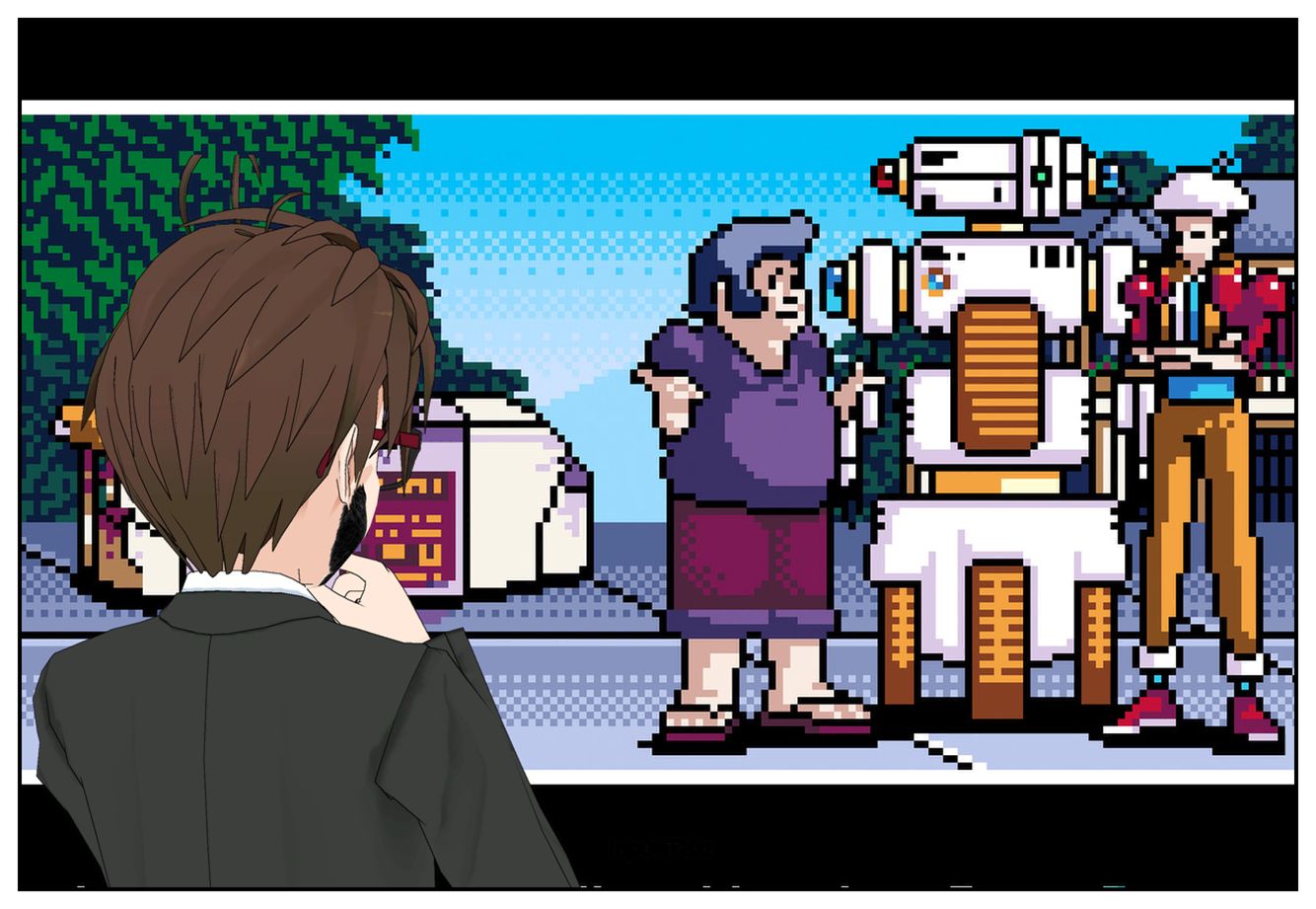
Read Only Memories is an adventure game in the '90s mould, seeming to draw specific inspiration from titles like Snatcher and Rise of the Dragon, and set in the same world as the (later, and wonderful) VA-11 HALL-A.
On the whole, it's a great experience. The pixel art aesthetic really works for the game and has clearly been designed by people who know what good pixel art looks like. Everything about the interface, including the font, is well-designed to look like a retro adventure game, and the FM-synthesis soundtrack complements it nicely.
Puzzles are relatively thin on the ground but in a couple of cases are more interesting than "use the thing on the thing", which is worthy of note, though the final puzzle in the game seems to play by some inconsistent rules that can lead to failure seemingly by no fault of your own.
The story is well-written and filled with interesting characters, plus deserves note for having a number of possible solutions to various situations, though not all will lead to the "best" ending. The game encourages you to consider the consequences of your actions and the things that you choose to say, even though those consequences may not become apparent until much later. I very much liked that your behaviour over the course of the whole game affected some later events rather than choices having an immediate impact on what was going on.
The overall plot is one of tolerance and understanding, and strikes a good balance between casting the player (whom you can name and gender as you desire, since you never see them) as an "everyman" sort of character prone to putting their foot in their mouth when confronted by groups they don't quite understand, and presenting a solid message about acceptance, learning to trust one another and personal growth.
The only real criticism I'd level at the game is that its handling of gay and transgender characters feels a little ham-fisted, with their presence and the "reveals" of their identity seemingly being calculated to go "SURPRISE!" rather than simply blending them into the setting. Big burly, manly bartender dude? SURPRISE! Next time you meet him, he has another big hairy dude all over him calling him "hon" at every opportunity (though that said, I couldn't help but like Gus). Meet an eccentric, long-haired, bearded TV producer? SURPRISE! They're a lady! That and the presence of a non gender-specific character demonstrates just how awkward using singular "they" as a pronoun is in dialogue.
Ultimately it doesn't hurt the overall plot at all, but these instances stick out like sore thumbs when they happen as they just don't quite feel like they're in keeping with the tone: the implication elsewhere in the plot is that society has moved beyond discrimination by gender and sexuality, and instead onto discrimination against those who are "augmented" in some way, either through cybernetics or genetic hybridisation. To specifically draw attention to gay and transgender characters in this way as the game does feels counter to this implication, which is otherwise well handled.
This game's spiritual successor VA-11 HALL-A handles gay characters much more elegantly by them simply… just being there, no big deal, no big fuss about who they are, no sense that the game is holding you down and urging you to admire how progressive its views are.
I played this game before the big update that adds voice acting, and if you're interested in this game, I'd encourage you to do the same. The few parts of the game that do already have voice acting (just the intro and epilogue at present) are immensely jarring with the rest of the game's presentation, and the delightful beepityboopityboop noise that dialogue makes throughout the rest of the game is a much more powerful stimulus to the imagination than a voice actor whose interpretation of the character may not match the one you have in your head after reading the text.
Overall, Read Only Memories is a game I give a solid thumbs up. The issues I mentioned above are minor in the grand scheme of things, but hopefully the team will learn from them — and from the things VA-11 HALL-A did better, despite being produced by a different team — and produce even greater works in the future.
I took a chance on a peculiar-looking game on Steam the other day. It wasn't a completely blind purchase, since the developer Front Wing were the creators of The Fruit of Grisaia, my favourite visual novel to date, but this looked like an altogether different sort of affair.
Purino Party is a puzzle game with a lightweight visual novel plot, loosely based on Front Wing's Japan-only straightforward visual novels Pure Girl and Innocent Girl. (Indeed, Purino Party reuses a number of event images from both Pure Girl and Innocent Girl, much to the chagrin of those who have read said works, but as someone unfamiliar with them but very much in love with the work of artist Nanaka Mai — who also designed Grisaia's characters — I didn't mind at all.)
The plot is lightweight, stupid fluff straight out of a nukige, which is unsurprising given the source material. You come to a town for a vacation, but are quickly accosted by mysterious local landlord Kei, who decides that your clearly godlike puzzle game skills make you an ideal person to help the girls in her charge realise their potential. (And shag them.) Thus begins a series of eight short stories, each focusing on one of the girls — first the four Pure Girl heroines, then the four Innocent Girl cast members — punctuated with increasingly difficult puzzle game challenges, with your reward being the advancement of the story and a picture to add to your gallery, most of which are lewd. (Most of which are very lewd if you install the optional X-rated patch, which Front Wing have been ballsy enough to link to on their Steam Store page.)
The puzzle gameplay may initially seem to be straightforward Bejeweled-style match three, but it's actually more akin to popular mobile game Puzzle and Dragons in that you can grab a piece and then slide it around the grid as much as you like, displacing other pieces along the way to shift them into advantageous positions, until a 10-second timer expires, at which point you're forced to drop it if you haven't already. Each level gives you a point target that increases with each episode of each girl's story, and a limited number of moves in which to accomplish this score. Later episodes also present you with a time limit, though this isn't normally too much of an issue.
The puzzles are really fun. The way in which you can move pieces around allows you to set up enormous chain-reactions of pieces, and indeed to meet most of the point targets in the game and progress, you'll need to do so. The fact you have ten seconds to move the piece around and displace the rest of the board as you see fit allows you to be strategic and methodical about arranging the pieces to your advantage rather than it simply being a challenge of spotting matches as quickly as possible. There's a touch of randomness that can sometimes screw you over a bit — if you start a round with a bad board layout, there's not a lot you can do — but you can usually mitigate this to a certain extent by taking advantage of the few special mechanics. Firstly, each girl has a "favourite" type of piece that loosely corresponds to their personality or interests, and you get more points for matching or chaining these pieces. Secondly, matching three or more "heart" symbols puts you into Fever mode, accompanied by some thumping cheesy J-pop. During this time, the points you gain are considerably increased; combined with the favourite piece bonus, this is generally the best way to score a lot of points quickly.
Meanwhile, the story is also entertaining. Don't go in expecting an emotional rollercoaster on the level of Grisaia, but each of the characters are endearing and appealing in their own way, and they all have their own personalities and stories to tell. A lot of it tends to descend into sex humour, particularly given that a number of the girls are total perverts, but amid the smuttiness (which, it has to be said, is amusing and curiously charming rather than weird) there are some genuinely funny jokes and some really likeable characters; it's just a shame we don't get to spend much time with them. Though I guess there's always Pure Girl and Innocent Girl to see more of them after the fact — assuming you speak Japanese or can find a suitable translation patch.
Purino Party isn't an amazing game or an amazing visual novel, but it does what it does well. It's lightweight, enjoyable fluff, not meant to be taken seriously in the slightest, and its bright colours, cheery music and immensely endearing characters make it just the sort of thing you can relax with for half an hour when you don't want to do anything too strenuous.
Kanae best girl. And not (just) because she looks a bit like Amane from Grisaia.
One of the things the video games industry has had trouble with over the years is the issue of "adult" games. I'm not talking about M-rated violence-fests — those are seemingly fine. I'm talking primarily about those that contain explicit sexual content and/or themes a little more ambitious than you might find in your typical focus-grouped commercial blockbuster.
The stigma attached to adult games is largely due to retailer concerns. Specifically, retailers like Wal*Mart and Target in America have historically refused to stock games that have an AO (Adults Only) rating from the ESRB (Entertainment Software Ratings Board), despite the AO rating existing and making it abundantly clear that the title is absolutely not for children. The situation is almost certainly the same in Europe when it comes to PEGI (Pan European Game Information) ratings, with the added awkwardness that different individual European countries have different rules on what is regarded as "decent". Germany, for example, has less of a problem with pornography than some other countries, but is very strict on depictions of violence, with many high-profile triple-A games either not making it to Germany at all or being gutted (no pun intended) of violent content in the process.
In other words, making an AO game would historically have been commercial suicide for a publisher trying to make money from their product. After all, if you can't get stock on the shelves of popular retailers, your avenues for selling your product are inherently more limited, and when it comes to big budget titles, you need every sales channel you can get.
But now we live in the age of the Internet, of course, and brick-and-mortar retailers are less relevant to our buying habits. It's still nice to be able to go into a shop, pick up a product and walk out with it (having paid for it, obviously) immediately, but a significant number of people now err in favour of the lower prices offered by online stores. And when it comes to computer and video games, the rise of high-speed broadband and high-capacity hard drives has made games with no physical component whatsoever a prominent part of the digital landscape. In fact, the ability for software to be released as digital-only has allowed more developers and publishers than ever before to be able to bring their products to market — without overheads such as duplication and distribution, developers can focus all their time on their product and, subsequently, promoting their product rather than boring logistics stuff.
And yet we're still stuck with the stigma over AO games. Console manufacturers won't allow AO games on their platforms' storefronts — presumably because it would be all too easy for minors to circumvent any sort of age gate technology and buy porn on Mummy's credit card (suggesting that they should perhaps think about stepping their age gate game up) — and Steam, while allowing a couple of games with boobs in to be sold on the platform, still seemingly stops short of allowing outright porn/hentai games to be sold. (There is, of course, a whole argument about why it's okay for The Witcher to have fairly explicit porking in it, yet the slightest hint of an anime titty gets the big red cross, but we won't get into that now; nor will we get into the "double standard" argument re: violence vs. sexual content.)
This has meant that until now, AO games have typically been sold direct or through specialist distributors. J-List, for example, sells AO visual novels in both physical and digital format from its own publishing arm JAST USA as well as third-party localisation companies like MangaGamer. MangaGamer also sell their own products on their own website. Localisation powerhouse Sekai Project, meanwhile, have their dirty little not-so-secret arm Denpasoft to sell their AO titles (or AO versions of titles that get a wider, edited release for platforms like Steam). It's good that we have all these places to buy AO titles, but until now there hasn't been a unified Steam-esque platform for them.
There still isn't quite that, but what Nutaku (very NSFW link!) is building is a step in the right direction. Nutaku, for the unfamiliar, is a website that sprang up relatively recently and provided adult browser games — typically the sort of gacha-driven free-to-play fare that you'd get on mobile phones, only with more porn. More recently, however, they've decided to launch a digital distribution platform for a variety of AO titles — primarily visual novels, as they tend to be — in collaboration with the popular publishers I've mentioned above.
This is a big deal. A centralised place for AO games to be distributed and for players to build up a library is a great thing, and helps deal with the inherent fragmentation of the market we've had up until now with everyone only distributing their own stuff (with the exception of J-List selling physical copies of some MangaGamer titles). While Nutaku's implementation of its storefront currently leaves a little to be desired — you have to buy games with the "Nutaku Coins" premium currency that is also used in their free to play browser games, and you can only purchase this in bundles rather than the exact amount you need to buy a game — it's very much a step in the right direction, and a system that is hopefully going to allow AO games to thrive in the online market. Perhaps it will even inspire some competitors to come along, or for services like Steam to have an age-gated 18+ section.
And it's started strong; some well-regarded titles such as the 18+ version of Princess Evangile are available on Nutaku's platform, and Sekai Project has even released the 18+ version of Sakura Dungeon first on Nutaku — even before the all-ages version hits Steam or the 18+ version releases on its own Denpasoft store. Let's hope it keeps up this momentum — and if you want some quality filth, be sure to support what they're doing.
JAST USA recently released Aselia the Eternal on Steam. The game's been around for a good few years now — its original Japanese version for even longer — but its release on Steam will doubtless allow a whole new audience to (hopefully) enjoy it. I will now attempt to explain why it is worth giving it a go.
Aselia the Eternal is a combination of a visual novel and a strategy game. The overall balance is very much in favour of the story side of things — it's a good six hours of reading before you get to the game's first strategy battle sequence — but when you do get to the strategic aspect, it's a game that puts up a good fight.
The narrative concerns the player-protagonist Yuuto, who finds himself drawn into another world populated by people who speak a completely different language to him. Unable to find his way home, he gradually learns to communicate with these people — the ones with whom he's staying known as "Spirits" — and finds himself recruited into the army as an "Etranger", a wielder of a powerful, sentient sword that regularly threatens to eat his soul.
Gradually, as Yuuto becomes more and more involved in the lives of the Spirits, he starts to worry less and less about trying to find his way back home and more about helping to resolve the conflict that threatens to tear this fantasy world apart. As such, the narrative becomes very much a high fantasy sort of affair — war on a grand scale, magic and mayhem around every corner, transcendence of humanity not at all out of the question — and builds to a thoroughly exciting conclusion that I won't spoil here.
The story is compelling, interesting, well-written and well-translated, but it's the gameplay part that is perhaps the most interesting thing about it, since it's one of the most original takes on strategic RPG-style combat I've seen. Virtually eliminating all luck from the equation, combat in Aselia the Eternal is actually about putting units together in small squads to perform most effectively according to what type of unit they are — and by doing this correctly you can effectively guarantee that you'll win a conflict before you reach it. The tricky part is in finding those suitable combinations in the first place.
The basic rules of engagement have each of your squads made up of three ranks — a frontline fighter, a mid-range tank and a support fighter bringing up the rear. Each of the different types of Spirits perform best in a particular slot: Blue Spirits (such as the eponymous heroine) do their best work as speedy damage dealers in the front row; Green Spirits tend to have the highest defense and HP, so sit in the middle; Red Spirits often have support abilities that can damage an entire enemy squad or provide suitable benefits to your own, so sit at the back. You're not limited to this arrangement — and indeed, with Yuuto in the mix, who is none of those things, you'll have at least one squad with an unconventional lineup — but there are clearly optimal ways to do things, making each of the battles in the game as much of a puzzle as a strategic RPG experience.
Aselia the Eternal comes together so nicely because everything it does is in service to its narrative and worldbuilding. Despite not having an open world you can freely explore, its excellent storytelling and descriptive narration builds a wonderfully convincing setting that gives the strategic sequences genuine meaning and drama. And, as a result of that worldbuilding, your units in the strategic sequences become more than just sets of stats and abilities; they become people. People who you don't want to see die, because yes, this game has permadeath.
The question of being "more than just a soldier" is one of the main narrative themes explored in the game, and it's a rather wonderful moment when you realise that you, the player, are having the same epiphany that the characters in the game are. There are some wonderfully touching sequences with Yuuto and the Spirits as they get to know one another, and you're right there with them. And, as the narrative ramps up and you bring more and more allies with you, the tension becomes palpable as you take them into battles that you really don't want to see them lose.
I don't want to say too much more because part of the wonder of Aselia the Eternal is exploring the experience for yourself and discovering everything this remarkable work has to offer. Suffice to say if you enjoy in-depth storytelling — and lots of if — and aren't averse to a bit of red-hot strategy action, you should most certainly check it out. And then strongly consider supporting JAST's recent release of the sequel Seinarukana, which I'll be investigating for myself in the near future!
There's been a lot of discussion over this topic on Twitter recently, thanks in part to the recent release of Fire Emblem Fates and its somewhat controversial localisation by Nintendo of America. There's a lot of noise and ill-informed opinion being thrown around by both "sides" of the debate, so I thought it would be a good time to stick my own oar in and muddy the waters still further.
There are basically two sides to the argument over Fire Emblem specifically. It's actually a little more complicated than that, but for the sake of simplicity we'll look at two core beliefs.
On one side, you have people who are arguing that they want a literal, authentic recreation of the Japanese original, only in the English language. They want character names to stay the same; they want conversations to unfold in the same way; they want all the same content that the Japanese players had in the game.
On the other, you have people who are arguing that during the localisation process, changes are both necessary and inevitable in order to fit the needs of the new market. The exact definition of these needs varies according to who you speak to — some suggest it's to do with a corporation (Nintendo of America in this case) wanting to continue curating a very specific brand image, while others suggest it's a cultural thing: things that are acceptable, palatable or recognisable to the original Japanese audience may mean nothing to an English-speaking demographic.
Both sides have their points. I've enjoyed localised games that err very much on one side or the other. Slice-of-life visual novels, for example, very much benefit from remaining true to the original Japanese as much as possible: interpersonal relationships in particular unfold in very different ways in Japan, and maintaining things like the honorifics in a text help to reflect the different ways people defer to one another according to perceived social hierarchy. Along the same lines, role-playing games that are very much steeped in Japanese culture — the Persona series is a good example — also benefit from remaining as true as possible to the original Japanese script as much as possible, since, like visual novels, the relationships between characters are often dependent on Japanese societal norms rather than Western ones.
On the other side of the fence, some more drastic localisations have been very good, too. Few people would argue that the Ace Attorney series is extraordinarily well written in its English incarnation, but it's very different to its Japanese counterpart, largely because a lot of the puns and jokes in the original Japanese simply wouldn't make sense in English. Same with the Neptunia series, whose original translation by NIS America is the source of some ire for more die-hard fans, but which has also remained the standard by which the series continues to be localised today. And the same with Final Fantasy XIV, whose floridly Shakespearean script was so good in English a lot of the changes actually ended up backported into Japanese.
Personally speaking, my priority for the most part is getting to play games that I wouldn't otherwise have the chance to play. I don't like content being cut and I don't like feeling that the experience I'm having is noticeably inferior to the Japanese original, but if it's a game I want to play and the changes are relatively unobtrusive — Dungeon Travelers 2 is a good example, since this is technically "censored" in places through the modification of a few images, but the changes are minor at best, and the game probably wouldn't have seen release if they hadn't been made — then I'll happily support the efforts of companies who attempt to bring games over as unscathed as possible.
I can't say I feel massively strongly about Fire Emblem Fates in particular because I have no real attachment to the series, but there are a number of issues with the localisation that I really don't like. One is the removal of content that wasn't offensive in the first place — the "head-patting" minigame, which is a reflection of the Japanese tendency to use head-pats as a sign of affection — not necessarily attraction or lust — between characters. Another is the outright butchering of the script that has taken place in a number of parts, most notably the support conversation between two characters which was an in-depth discussion of finding common ground, honour among thieves and whatnot in Japanese, but which has been replaced with four screens of them going "…" to each other in English. That is not, in any way, acceptable localisation, because it's completely changing the original intent of the scene.
Now onto the point I wanted to make with the title of this post: the "localisation means changes" brigade have a couple of favourite arguments. Let's take them in turn.
You want a literal translation? Run the script through Google Translate and see how you like it.
This is by far the most common, and it's based on a flawed assumption: the fact that people asking for a "literal" translation are literally asking for a literal translation, when they're not. In a way, it's their own fault for using the word "literal" perhaps incorrectly; "authentic" or "true to the original" might be a better description, but "literal" is the term that people tend to prefer to use, so let's stick with that for now.
No, as I discussed above, the people who want a "literal" translation are not asking for the text to be run through Google Translate, because, among other reasons, the differences in grammar between languages butchers the original intent of the scene beyond all recognition. What they are asking for is the scene to be correctly translated into its closest possible English equivalent, without any changes based on perceived appropriateness according to Western cultural norms. What they are also asking for is the maintaining of the text's "Japaneseness" as much as possible: that means maintaining the use of honorifics and concepts with no direct translation such as senpai and the use of onii-san/onee-san to people who aren't your brother/sister.
That's not a particularly unreasonable ask, is it? Doesn't that show a degree of respect to the original creators, an awareness of your audience and also has the added benefit of potentially teaching people about another culture? Some games actually run with this concept; visual novel Steins;Gate, for example,features an interactive hyperlinked glossary of Japanese terminology used in the game, including Japanese Internet memes and slang as well as more widespread cultural concepts.
So no. People asking for a "literal" translation aren't asking for the script to be fed through the mangler that is Google Translate. So stop responding to arguments they aren't making.
You want the authentic experience? Just learn Japanese. Oh, I forgot, learning a language is more difficult than complaining.
The whole point of localisation is so that new audiences have access to works from other cultures. Through a culture's art, we can learn about them, understand them, appreciate them — or, in some cases, be happy with what we've got ourselves! By mangling the cultural authenticity of a text, be it by inserting random Internet memes — which not only spoil the character of the piece in most cases, they also date it horribly — or by stripping out elements that made it authentically "Japanese" in the first place, you're doing a disservice to the original work, and to the audience who wants to know more about another culture that they find fascinating.
Moreover, a lot of people who argue in favour of drastic localisation changes are the same people who are constantly bleating on about buzzword of the moment "diversity" — used here to mean "celebrating anything that isn't by a white man". Isn't stomping all over the text of another culture using Western sensibilities the very antithesis of the "diversity" that seems to be the Holy Grail among progressive types at the moment?
Anyway. Asking people to learn Japanese isn't a terrible argument: not only does it let you play the original versions of localised games, it also gives you access to a huge library of titles that never make it across the ocean. But it's also not a particularly practical option for a lot of people. Japanese is a complicated language that takes a long time to learn, and some people simply don't have the right kind of mindset to effectively study a new language, particularly if they're a little older and their brain finds it more difficult to take in entirely new language-related information. Should people who are unable to study Japanese for whatever reason be denied access to authentic experiences? No, of course not.
I've seen both sides of this argument unfolding recently and it's frankly getting rather tiresome — mostly because many of the arguments, as we've seen above, are based on mistaken assumptions. This has been a worryingly growing trend over the last few years, and it's this, in part, that has led to the overwhelmingly negative atmosphere a lot of online interactions carry over their heads these days; everyone is afraid to offend everyone else.
In this instance, I would be inclined to defer to the opinions of people who passionately consume Japanese games and other media, and who want an authentic experience from their localised material. It's not as if we're short of Western experiences for people who find heavily Japanese titles "too Japanese" or otherwise inaccessible for some reason, and ultimately keeping things as true to their original form as possible helps everyone to understand each other that little bit better, which is surely the best possible outcome to all this.
But I'm sure this argument will keep raging and no-one will pay any attention to what I've said here, so what do I know…
I penned a lengthy article about The Fruit of Grisaia for my good buddy Matt Sainsbury over at Digitally Downloaded, and it was published today. Please go and read it (it's spoiler-free!); I was really pleased with how it came out.
In the piece, I noted that I believe the 18+ version of The Fruit of Grisaia to be the definitive version, and I stand by this statement, even with the all-ages version on Steam incorporating a few new scenes from the (also all-ages) Vita version to make up for the lack of rude bits. The story is mature and adult, after all, sex aside, so there's really no reason to read a version that is neutered in any way when a version more true to the writers' original vision exists.
This prompted an interesting discussion on Twitter after the fact, not directly related to Grisaia, but to sexual content in games and visual novels in general. We're still in a situation where a visual novel featuring explicit sexual activity — such as Grisaia, or numerous others like it — isn't able to be featured on high-profile storefronts like Steam on PC, the PlayStation Store on PS3, PS4 and Vita, and the Xbox Live Marketplace on Microsoft platforms. And I'm not talking about nukige (the visual novel equivalent of a "gonzo" porn movie, where the sexual content is pretty much the sole reason for its existence) — I'm talking about eroge, which are visual novels that incorporate sexual content as part of their narrative.
The Fruit of Grisaia features a number of scenes where the sexually explicit situations are integral to the overall narrative. I won't give specifics to protect those who intend to read it against spoilers, but suffice to say that in each and every case, the sex scenes serve a purpose, whether it's to reflect the deepening relationship between the protagonist and the heroines, to provide a tragic juxtaposition between pathos and eroticism, or simply to demonstrate another aspect of the characters' personalities. In Amane's route in particular, the sex scenes are very much front-loaded towards the start of her individual path, with the remainder exploring exactly why she is, in her own words, such a slut. And boy does she have some interesting and compelling reasons. But I digress.
The unfortunate thing with this topic is that there's a curious double-standard applied between Western and Eastern publishers in particular. Western publishers such as Rockstar and CD Projekt can get away with depicting explicit sex acts in their games such as Grand Theft Auto and The Witcher, but if a Japanese game dares to show a little skin, it makes the collected prudes of the world clutch at their pearl necklaces (not that kind of pearl necklace) and faint onto their chaise-longues. At best, we get "minor edits" to cover things up and make things a bit less explicitly sexual — Dungeon Travelers 2 on Vita, for example, had an image that depicted a monster girl apparently fellating a ghost changed so that she was just writhing around a bit instead — while at worst we end up with butchered "all-ages" releases cutting out entire scenes.
All-ages releases aren't always bad if they're done well, of course; one of my favourite visual novels, Aselia the Eternal, began life as an eroge but subsequently got expanded to such a degree in its all-ages console format (which was subsequently backported to PC, and this was the version that got localised) that the non-dirty version is now considered to be the definitive way to enjoy that particular tale. But there are cases such as The Fruit of Grisaia where I simply can't imagine them quite working in the same way without the erotic scenes.
The discussion on Twitter turned to localisation specialists Sekai Project, who Kickstarted the Grisaia trilogy and were originally intending to only bring us an all-ages release. After considerable feedback from fans, they eventually relented and agreed to publish a localised 18+ version of Grisaia via their Denpasoft imprint, even going so far as to allow Kickstarter pledges (like me!) to upgrade their donation and get digital copies of the 18+ versions as well as the physical, packaged and digital Steam releases of the all-ages versions.
In my experience so far, Sekai Project know their craft and they understand the art form that is the visual novel. They recognise that eroticism is an important part of many of these works, hence the existence of Denpasoft in the first place. But the concerning thing for some people is that the 18+ releases don't seem to get much attention, even from Sekai Project themselves. Denpasoft's website is a pretty bare-bones affair, and its Twitter account isn't particularly active, whereas Sekai Project is always tweeting about something or other, launching new Kickstarters and generally enthusing about their work — and with good reason.
Why, though, are the 18+ releases dirty little secrets rather than celebrated and promoted alongside the all-ages versions? I don't have a definitive answer for that, only theories, but I wonder how close to the mark I am.
In short, Sekai Project as a brand is keen to promote the Japanese visual novel as a valid art form and type of game to be celebrated by as many people as possible. Their keenness to get their work on Steam shows a keenness to get these titles in front of as many people as possible, since Steam is an enormous market to tap into. Unfortunately, Steam doesn't allow adult content — aside from the aforementioned exceptions for Western games — and so any originally 18+ visual novels that come to steam will have been necessarily neutered. Sometimes there are fan patches available to restore the cut content, though in situations like The Fruit of Grisaia, the all-ages and 18+ versions are completely different base games — the 18+ version is based on the PC original, the all-ages version on the Vita version — and cannot be easily patched.
Sekai Project, as a brand keen to get their stuff noticed, is probably aware of the way the games press has been in the last few years with regard to anything even remotely sexual. As such, their apparent unwillingness to promote the explicitly sexual versions of their games is probably less to do with them being "ashamed" of the content itself, and more an attempt to enjoy a quiet life without enraging the massed heavenly hosts of Anita Sarkeesian's 43rd Puritan Squadron (Polygon Division). Can you imagine what those narrow-minded, sex-negative fun vacuums would make of your average visual novel sex scene? It wouldn't be pretty. Fuck Anita Sarkeesian, and fuck what she has done to intellectual discourse about games as art. (I'm aware it's not entirely her fault, of course, but the members of the press who endlessly bleat on about feminism and the like are pretty much following her cultish teachings to the letter.)
I'm not saying that all visual novels have to have sex in them to be good, of course. But sex is an important part of art, which visual novels are, and sex is also an important part of relationships, which visual novels tend to depict with a strong degree of intimacy. Sex is a basic fact of life, of humanity, and the fact that there are so many roadblocks to exploring it effectively in video games and visual novels is kind of sad, really; thankfully, we're not (yet) in a situation where publishers like JAST, MangaGamer and Sekai Project are giving up on publishing erotic content in the West completely, but we're also sure as hell not (yet) in a situation where a mainstream press site would be able to publish something about a work of The Fruit of Grisaia's ilk without getting a massive hate-boner and then spunking vitriol all over the page, completely missing the point of the "controversial" content in the process; I vividly remember just mentioning Kana Little Sister in one piece on USgamer, and getting attacked by one particularly puritanical reader for "promoting a pedophilic incest simulator".
It's difficult to know how this situation can be improved — or even if it needs to be improved. Could there be scope for a Steam-esque platform that allows adult games to be released and promoted, rather than relying on Web stores that many people have understandable hesitancy trusting? I wonder. In the meantime, I'll keep banging my drum about the most interesting, compelling eroge — and, hell, nukige, since there's plenty of interesting stuff there, too — and hope that at least a few people will listen.
I finished Amane's route in The Fruit of Grisaia tonight, bringing my time with this absolutely incredible visual novel to a close, and frankly I'm a bit of an emotional wreck right now, but I will do my best to try and collect my thoughts and post something reasonably meaningful.
One thing I will say before I jump into spoiler territory after the "More" tag is that I'm really glad I saved Amane's route for last. Not just because she was immediately my favourite girl — and still is after playing through her route — but because her route acts as a rather wonderful way to wrap up the entire experience. Her good ending is particularly "conclusive", and as the last thing I saw in the whole work, it feels like I've had a great sense of closure — although, as always with this sort of thing, I'm going to miss these characters very much. At least I have two more games in the series to look forward to!
I finished Makina's route in The Fruit of Grisaia at last. It's a long route with a noticeably different tone to the previous three I've completed, but it was just as enjoyable.
Spoilers ahead, so I'll put the rest behind a More tag for the convenience of those browsing my front page.
Since I've become particularly interested in Japanese popular media, I've often found myself pondering which particular aspect is my favourite — in other words, what do I feel is the "best" means of enjoying a story that, in many cases, spreads its tendrils across a number of different forms of media with varying degrees of success?
There's not really an easy answer to that, but I feel my own personal attitude towards it is inclined towards whatever the original version of the work was composed in, where available. This isn't a hard and fast rule, by any means — on balance, I think I slightly prefer the anime of High School DxD to the manga, for example, and there are a number of interesting spin-off games that tell a completely different story to an anime or manga series, making them worthwhile in their own right — but I do tend to find myself preferring to experience a story as originally intended.
Part of the reason for this is enjoying a story in its original medium means that you don't "miss out" on anything. In theory, anyway; that theory runs that a creative work is composed for a specific medium, and then adapted to other media at a later date. The adaptation process often involves editing, changing and even cutting content from the original, usually as a means of ensuring that the important beats of the story fit into what may be a more restrictive format. Consider an indefinitely running manga series that is adapted into 20-minute anime episodes, for example; you're going to lose some detail, like it or not, unless you want the pace of the show to slow to a crawl. (Some long-running shows do indeed take this rather leisurely pace to their ongoing storyline, but for the most part, manga-to-anime adaptations tend to try and get through a significant amount of printed content over the course of 12-13 episodes.)
That said, different media are more or less appropriate for different ways of exploring material. Anime, as the most visually flexible of these media, allows you to outright depict things happening without having a narrator explain things (as in a visual novel, manga or light novel) and take a more subtle approach, implying things rather than making them explicit. At the other end of the spectrum, a novel relies almost entirely on the reader's imagination, perhaps stimulated a little by illustrations here and there. The nature of text means that the inner thoughts and feelings of characters can be explored in much more detail than in an anime, and even from multiple perspectives.
Visual novels, meanwhile, tend to unfold from a single first-person narrative perspective. This allows for in-depth exploration of a specific character and their responses, feelings and attitudes towards various situations — as if you "were" that character. It's not quite the same as a full-on game where you take full control of a character, mind; most visual novels give you relatively limited choices as to how they proceed, and the protagonist otherwise has a mind of their own: you're just along for the ride. Some visual novels do experiment with multiple perspectives — The Fruit of Grisaia's various routes each feature a sequence where the main heroine of that route narrates an important event in their lives, be it to the reader or to protagonist Yuuji; Deus Machina Demonbane, meanwhile, features a first-person protagonist narrator, but occasionally slips into third-person to depict things happening elsewhere when appropriate. For the most part, though, when you come to the end of a visual novel, the character you almost certainly understand the best is the protagonist.
Video game adaptations — i.e. those that aren't visual novels — present their own challenges by allowing the player to control iconic characters and perhaps make them behave in ways that aren't necessarily in keeping with their character as depicted in other media. This is partly a matter of attitude, though; someone who is already particularly engaged with a series and comes to a video game adaptation after reading the manga/visual novel/light novel or watching the anime may well find themselves "method acting" as the character they find themselves in full control of, even if the game mechanics do provide the opportunity for them to do unexpected and strange things.
In other words, I don't really have a concrete answer for the question. At the moment, I'm particularly enjoying reading The Fruit of Grisaia's visual novel, and after hearing how the anime adaptation packs the VN's many hours of narrative and interesting happenings into just a single season, I feel that the VN is probably the best means of experiencing this story in full detail. At the same time, I'm enjoying the video game of Sword Art Online, the manga of Monster Musume, the anime of Himouto! Umaru-chan — there really isn't a straightforward answer as to which one is "best".
It sometimes pays to explore a single work in different media, though; the unwritten rules that "the book is usually better than the film" and "video game adaptations are universally terrible" don't always apply!
Finished Sachi's route in The Fruit of Grisaia last night. Once again, this route proves to be significantly different in tone and theme than the others I've seen so far (Michiru's and Yumiko's) — it also felt like it was a bit longer, for reasons I'll get into later.
As ever, this post will contain extensive spoilers for Sachi's route in The Fruit of Grisaia. As such, if you want to avoid being spoiled, don't read! Here's a More tag to prevent accidental spoilage from my front page…