#oneaday Day 592: Abstinence from AI

I, as I may have made clear on a few separate occasions on these hallowed pages, fucking hate generative AI. I do not use it. I do not need to use it. I do not want to use it. And I cannot wait for the whole bubble to pop and this whole shitshow to go the way of the NFT and the Metaverse.

In the last few weeks in particular, I've found that there are a lot more people seemingly trying to push AI as "sort of all right, really". You know the sort of thing, people just casually, jokingly drop into a Discord chat that "out of curiosity, [they] threw it into Gemini to see what would happen" and before you know it, all meaningful human conversation has been replaced with copy-pasted obsequious fawning over the prompter, bold-type section headers and bullet-pointed lists.

Not only that, but the press are at it, too; just today, Undark Magazine (which I've never heard of prior to today) posted a piece called "Abstinence from AI is Not the Answer", in which the authors, C. Brandon Ogbunu and Cristopher Moore, make the baffling assertion that refusing to engage with AI "puts vulnerable people at risk".

"Like many new technologies," they write, "AI can either amplify inequality or ameliorate it, depending on how it is deployed. And fears about the likelihood of it amplifying stratification and segregation are valid. But advocating for abstinence will deny communities access to the tools the privileged are already using to help them write college essays, do their homework problems and learn a second language. Puritanical stances leave people ill-equipped to use this technology responsibly and unable to benefit from it."

Okay, but… hear me out… generative AI is terrible at all of those things. AI writing can be spotted a mile off. It gets answers to basic problems wrong, making it useless for homework. Due to its propensity to hallucinate and fawn over the user, you can't necessarily guarantee that its use of a non-English language is correct, nor that it will correct you if you get something wrong. And, more importantly than all of those things, relying on generative AI to do any of those things strips you of the ability to do them yourself. Not only that, it kills your curiosity to learn and discover new things for yourself, because it's much easier to just ask the chatbot to do it for you rather than to put in the work to learn a new skill yourself.

It's this latter part that really concerns me about generative AI. I've seen so many people willingly hand off to a chatbot during normal discussions and arguments and think that's a shortcut to "winning". When our legal and medical professionals are caught using these unflinchingly awful tools, their own skills and knowledge atrophy because they have no need to retain them — the chatbot will do all the hard work for them.

And what happens when, as looks increasingly likely, the money runs out and all these monumentally wasteful services are no longer able to operate? We're going to need humans who can actually do stuff again. And I'm concerned we're going to struggle to find them, because just over the course of the last couple of years I've seen a frightening amount of people completely give up on seeking out reliable information, knowledge and training for themselves because they can just ask the chatbot.

To address Ogbunu and Moore's main point — that abstinence from generative AI puts vulnerable people at risk — I say, full-throatedly, bollocks. The Internet has been a constant presence in all our lives — whether we're privileged or vulnerable — for decades at this point, to such a degree that it is considered one of the basic utilities these days. It is rammed full of helpful, thoughtful, weird and wonderful information, and the only skill one needs to cultivate in order to take advantage of this is how to determine whether or not something is a reputable source. That is something that we learn to do in school — or we should learn how to do, anyway.

If you hand that job over to a chatbot which is demonstrably wrong a statistically significant amount of times you ask it a question, you are not making use of that skill. That is not democratising the delivery of information; it is filtering all that information through a technology that, at its core, has been designed only with the interests of its billionaire owners in mind. And not only that, to get the supposed "best" out of these chatbots, you're expected to pony up $200 or more a month for a subscription. That doesn't sound very inclusive to the most vulnerable of society.

"Choices we make now will determine whether AI will be a tool for the powerful, dazzling the rest of us with its hype and subjecting us to its harms, or whether it will be a tool — imperfect but useful — in everyone's hands," conclude Ogbunu and Moore.

If it's an imperfect tool, it's not useful. I repeat: I do not use it; I do not need to use it; I do not want to use it. My choice is made; if I see anyone "powerful" using generative AI, I will laugh at them, because they are depriving themselves of the joy of thinking, of learning, of discovering, of creating. And then I will pity them.


Want to read my thoughts on various video games, visual novels and other popular culture things? Stop by MoeGamer.net, my site for all things fun where I am generally a lot more cheerful. And if you fancy watching some vids on classic games, drop by my YouTube channel.

If you want this nonsense in your inbox every day, please feel free to subscribe via email. Your email address won't be used for anything else.
#oneaday Day 533: Enshittified parking

The wife and I made the silly error of deciding to go into town today. We thought we'd go get a Currywurst from the German market, plus she wanted to enquire at a music shop about some various bits and pieces.

We were having second thoughts when we got up, because it was dark, miserable and raining outside, but we thought "ah, no, we should go out, it'll do us good to get out of the house".

Reader, it was not good. Apart from the Currywurst, that was good. Although £9 for it was absolute daylight robbery, but I guess that is Just What Things Cost Now. And my wife did at least get the information she wanted from the music shop.

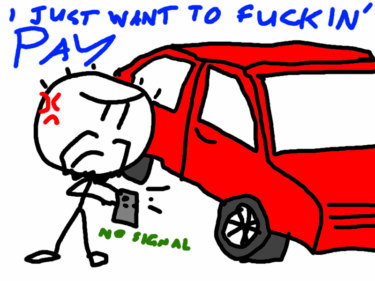
The rest of the trip was a miserable, rain-soaked experience, but probably the most irritating thing about the whole experience was what they've done to WestQuay parking. Instead of taking the tried-and-true approach of giving you a ticket, then you popping said ticket into a machine and paying for how long you spent in the car park, they have decided to make it all "technological", now requiring you to have your number plate scanned by ANPR when you enter, then before you leave, you have to remember to scan a QR code from a poster and pay on a website. Because that is somehow much better.

I will grant you that during busy periods, it could be frustrating to have to queue up for a ticket machine when you wanted to leave. It was frustrating when the ticket machine broke, too, or it ate your ticket, or any other shenanigans that might have occurred. But that's why they had the little man on the end of the "help" button to help you out.

The main issue with the "pay by phone" option they have chosen to go with is that there is no fucking phone signal inside the car park. Nor is there any Wi-Fi. So if you forget to scan one of the posters that is outside on the way back to the car park — or, indeed, if you took a route back to the car park that did not pass by one of these posters — it's an incredible pain in the arse to do something as simple as paying for parking, something which we have all been begrudgingly doing for many years at this point.

Of course, the whole thing has almost certainly been done in the name of collecting data on people who use the car park — they take your number plate when you enter and your name when you pay, so that's fun. They will probably try and spin this as somehow being "more convenient" when in fact it's several orders of magnitude more annoying than the old way of doing things.

But hey. We've made everything else worse with technology. Why should parking be left out of the party?


Want to read my thoughts on various video games, visual novels and other popular culture things? Stop by MoeGamer.net, my site for all things fun where I am generally a lot more cheerful. And if you fancy watching some vids on classic games, drop by my YouTube channel.

If you want this nonsense in your inbox every day, please feel free to subscribe via email. Your email address won't be used for anything else.
#oneaday Day 469: Where have all the 5.25" drives gone?

Earlier today, I had an idle thought that has occurred to me numerous times over the last little while, but today I thought I'd look into actually doing something about it.

A while back, I bought a Greaseweazle, which is a USB device you can connect to a modern PC at one end and a floppy disk drive at the other, then "rip" floppies using a particularly accurate method of imaging known as flux imaging. These images can then be converted into various formats, such as those commonly used with emulators (or MiSTer), and can then be safely archived.

I've got two boxes of 5.25" Atari 8-bit disks in my cupboard upstairs that I'd quite like to get all the stuff off — assuming the discs themselves have survived. I know some of them have (and, equally, some appear to have not) and so I thought it would be a nice, interesting and fun thing to do to archive my unique collection of disks, which in some respects are a snapshot of family life in the mid 1980s.

Besides the obvious disks full of pirated games, my brother and I both had our own disks that we'd save BASIC programs to — both those that we'd typed in from magazines, and those which we'd written ourselves. Then there's a bunch of disks that my Mum and Dad did stuff with — my Dad did all manner of things, including writing, music and various productivity things (that and Flight Simulator II, which "isn't a game") while my Mum, on several occasions, spent some time writing. My brother made pictures with AtariArtist. And I'm sure there are plenty of other hidden treasures among them, too.

Now, here's the problem. I bought the Greaseweazle with a mind to making some floppy disks that could be used with the Atari ST, which uses 3.5" 360K or 720K disks. (Actually, Atari format can push the 800K+ mark, but they're broadly MS-DOS compatible, so 720K is a sensible limit for everyday use.) The device worked great for that, though I ultimately got an UltraSatan for the ST (which is an SD card-based storage solution that effectively emulates a hard drive) and have now moved on to the MiSTer for most of my retro computing needs and wants.

I'd been putting off getting a 5.25" drive to archive these big boxes of Atari stuff, though. I knew the process of getting a 5.25" drive hooked up was a little more involved, for one thing, since a 3.5" floppy drive can power itself from the Greaseweazle, while a 5.25" drive generally needs an external power source. But something in me today said "right, go on, get this sorted". So I headed for eBay in search of what I thought would be an easy thing to find: an old, discarded but working 5.25" floppy disk drive that someone had grabbed out of an obsolete PC and decided to sell online.

Reader, it turns out that 5.25" drives are not, in fact, easy to find. In fact, there seem to be very few floating around out there, and the ones that are are surprisingly expensive. While you can score yourself a 3.5" drive very easily — and it probably be in decent working order, too — 5.25" drives are, apparently, like gold dust.

I did find one promising looking unit earlier, which was actually a self-contained enclosure with a power supply and two 5.25" floppy drives, but after bidding on it a few times, the price went a little higher than I was comfortable paying, so I dropped out. (Also, I was having dinner at the time the auction ended, so I kind of sort of forgot to check in.) The final price was over £80, though, which would have probably given me a certain degree of buyer's remorse. Or maybe not. I guess now we'll never know.

I'll keep keeping an eye out for reasonably priced drives, though. I really would like to get those disks archived and share them with my family — it's something I probably should have done a long time ago (before 5.25" drives went completely extinct, apparently) but I guess it's going to be a bit of effort to get up and running!


Want to read my thoughts on various video games, visual novels and other popular culture things? Stop by MoeGamer.net, my site for all things fun where I am generally a lot more cheerful. And if you fancy watching some vids on classic games, drop by my YouTube channel.

If you want this nonsense in your inbox every day, please feel free to subscribe via email. Your email address won't be used for anything else.

#oneaday Day 392: Never forgive them for what they have done to the computer

[Recommended reading: Ed Zitron's "Never Forgive Them", from which the title of this post is taken.]

This evening, my computer inexplicably ground to a halt while I was doing… nothing in particular. Browsing a few webpages, doing a bit of research in preparation for some videos I'd like to make, if I'm being specific, but it really wasn't anything the slightest bit demanding. For whatever reason, though, everything just stopped, nothing was responsive, and the only thing I could do was force the power off and restart.

When the computer restarted, it took 10 solid minutes to become responsive because a piece of software for a controller that isn't connected decided to spontaneously uninstall and reinstall itself, while at the same time popular chat app Discord decided to install 18 updates that were apparently essential, despite the fact I'd updated it yesterday, Steam updated itself (which, all credit to it, it did without complaining or holding anything else up) and, of course, Windows is bugging me to "upgrade" to Windows 11.

At the same time, my phone has been repeatedly sending me notifications telling me it "needs optimising" and "must restart", despite everything working absolutely fine, and despite it never having insisted on this process before. (It does, however, insist on "Optimising Apps" every time you turn it on or restart it, though, which makes what should be a very simple, quick process — turning it off and on again — take a good few minutes.)

This is what people mean when they say "enshittification". All of the above is unnecessary. All of the above are examples of tech deliberately making itself worse, for reasons that are not apparent to the end user, but which I'm sure are "providing shareholder value" via some means or another. This is what Ed Zitron means when he says "never forgive them for what they have done to the computer".

I love that description. I feel like people don't say "going on the computer" any more, because most of us spend pretty much our entire waking life joined at the hip to one form of computer or another, be it a PC, phone or tablet. When I was a kid, "going on the computer" was a discrete activity. You'd come home from school, do your homework, have some dinner, then go on the computer. And the computer would oblige. You'd turn it on, and there it was. If something went wrong, you turned it off, waited a moment, then turned it back on again, and nine times out of ten, the problem would be gone.

Now, granted, "the computer" that I'm talking about here is several orders of magnitude less sophisticated, powerful and, arguably, useful than the PC I'm typing this post on. But it still feels like we've lost something. Things have been taken out of our control. I could literally do nothing while those stupid update processes were running on my PC, because they were so badly programmed that they monopolised the system to such a degree that I couldn't even bring up Task Manager to stop them. And, as I discovered, turning the PC off and on again wouldn't have helped, because they'd have just started again — or, perhaps worse, fallen over because of the half-finished job I switched them off in the middle of.

I appreciate that updates are sometimes necessary to add new features, fix bugs and, in the case of operating systems, plug security holes that could be exploited by malicious actors. But man, do I ever miss turning on the Atari 8-bit, booting right into BASIC and being able to just get on with things. Those "things" may have been considerably less elaborate than what I can do on "the computer" today, but was that really so bad…?


Want to read my thoughts on various video games, visual novels and other popular culture things? Stop by MoeGamer.net, my site for all things fun where I am generally a lot more cheerful. And if you fancy watching some vids on classic games, drop by my YouTube channel.

If you want this nonsense in your inbox every day, please feel free to subscribe via email. Your email address won't be used for anything else.

#oneaday Day 372: In which my neighbour determines voice assistants are useless

I was having a poo earlier, as you do, and since our toilet is like sitting inside an actual blast furnace during the summer months, I had the window open as wide as it could go to let some air in. A side-effect of this is that I can hear what is going on outside (and quite possibly that anyone outside can hear what is going on inside the toilet, but I've never tested that theory) and, more often than not, I hear my neighbours going about various business in their garden.

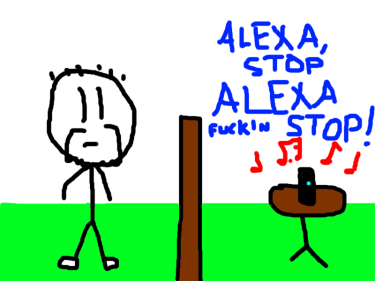
Our neighbours have a couple of kids, and the kids are often out the back using their trampoline. This evening it sounded like there was some sort of family meal or gathering outside, and there was music playing, evidently via some sort of Alexa-based smart speaker, because every couple of minutes — and inevitably well before a song had played to its conclusion, because who has time to listen to music in its entirety any more? — I heard one of my neighbours going "Alexa, next one". And, on multiple occasions, repeating this command at least once before Alexa actually played the "next one".

After several failed attempts to get Alexa to stop playing the Electric Light Orchestra, I heard some frustrated-sounding swearing coming from the garden, then the music stopped suddenly. A few moments later, it started again, but with no voice commands required. I imagine my neighbour had given up on trying to control the music with his voice and just gone back to good "old-fashioned" streaming from his phone.

I honestly have never seen the point of voice assistants. It is several orders of magnitude less convenient to do things with your voice than it is to just click on something on a computer or tap on it on a phone — with one of the chief reasons being, as demonstrated by my neighbour's frustrations, the fact that on a statistically significant number of occasions, you probably have to correct the device's misunderstanding of what you said, by which point you may as well have just fished your phone out of your pocket and typed what you were looking for into Google (not that Google is a great help these days with those fucking AI summaries) or opened your music app and pressed "Next".

I don't know. It's been said many times before, but it feels like a lot of today's tech is being built to solve problems that never existed in the first place. If I run out of milk, the last thing on my mind is telling a robot that fact; I either go out and get some milk myself, or I do what a normal person does and write it on a bit of paper on the fridge, forget about it until 10.48pm, then have to brave the mean streets of Southampton to walk to Tesco Express just so I can have a coffee the following morning. If I tell Alexa, or Google, or whatever, that I'm out of milk, sure, that fact is recorded somewhere, but it doesn't achieve anything. I could probably make it so that it ordered some milk from Amazon or something, but what an absolute faff. Shopping with a voice assistant is an absolutely alien concept to me, because it completely eliminates the ability to look at what's available, the prices and suchlike. So why would you bother?

Answer is, we don't. We have a couple of smart speakers, but all they get used for is finding our phones if we've forgotten where we put them down, and occasionally streaming some music, which we do via the "cast" button in our music apps rather than attempting to talk to them. I think our Alexa thing also controls our smart light switches, but again, no voice controls are involved there, and it could probably be done via another means.

When I did a very brief stint working for a courier company, it was vaguely useful to say "okay Google, take me to [postcode]" and it be able to navigate me there, but I'm not sure it was actually any quicker or better to do that than just typing said postcode into Google Maps. And if I'd typed it in, at least I knew it was right.

As tech critic Ed Zitron frequently notes, tech used to be fun and exciting, but these days it just seems to be finding new and exciting ways to make things less convenient and more annoying. And, of course, this isn't even getting into the "AI" garbage.

I hope that one day very soon the tech industry manages to wake up and realise that it's doing both itself and its customers a great disservice. Unfortunately, I am very concerned that process isn't going to be a pretty one, with the obscene amounts of money being thrown around for what, to the layman, very much appears to be products that don't actually exist.

What are we even doing any more?


Want to read my thoughts on various video games, visual novels and other popular culture things? Stop by MoeGamer.net, my site for all things fun where I am generally a lot more cheerful. And if you fancy watching some vids on classic games, drop by my YouTube channel.

If you want this nonsense in your inbox every day, please feel free to subscribe via email. Your email address won't be used for anything else.
2529: Mobile Phone Apathy

0529_001

I've always thought of myself as something of a gadget-head, but over the last few years I've become increasingly underwhelmed and bored with those most ubiquitous of devices, the mobile phone.

I remember getting my first mobile phone towards the end of my schooldays. It was a big fat Motorola thing with an extendable aerial, and I remember the most exciting thing about it was discovering that I could hold down a button to write lower-case letters in text messages, whereas I'd previously been writing in all-caps like a grandmother learning to use email for the first time. (We were all writing in all-caps like a grandmother learning to use email for the first time at the time.)

Every year or two after that, there was the excitement of The Upgrade. I upgraded from my Motorola to a Nokia 3210, which was exciting because it had Snake on it, and everyone loved Snake, despite it being something that I'd played some 15 years earlier on my old Atari 8-bit computers. Then I upgraded to a Nokia 3330, which had Snake II on it (which was essentially Snake with mildly better graphics). These two phones were pretty similar to one another, though this was also the age that phones were getting smaller rather than bigger, so the 3330 was pleasingly compact after the relatively bulky 3210.

After that, I went for a Sony Ericsson phone that had a colour screen and a camera. Well, I say it had a camera; actually, the camera was a separate unit you had to snap on to the bottom of it which took photos at approximately the size of a postage stamp that weren't any use to anyone. The colour screen was nice, though.

After that, I got a phone whose make and model I can't remember, but which I think was actually one of my favourite phones of all time. It had a pretty big screen — in colour again, a reasonable quality camera and, best of all, the ability to record sounds that could subsequently be used for ringtones, message tones, alarm tones and all manner of other things. It was a lot of fun, and an early phone to support Java, too, which meant you could download games for it. And there were some decent games available, too — most notably the excellent puzzle game Lumines, which had previously been something exclusive to PSP owners.

If I remember correctly, my next phone after that was the ill-fated Nokia N-Gage, which I picked up out of interest in its gaming capabilities. I actually ended up liking it as a phone more than a gaming device, since its vertically-oriented screen made a lot of games impractical and tricky to play, but the dedicated directional pad, the way you held it and the big, bright, clear screen made it a very comfortable personal organiser device. Sure, you looked dumb talking on it — it was notorious for its "side-talking" posture, whereby you looked like you were holding a taco up to your ear while talking on it — but I rarely talked on the phone anyway, so this simply wasn't a big issue for me. It's actually one of my most fondly remembered phones.

I forget if I had any other phones between the N-Gage and the iPhone that I was given for free while I worked at Apple — I was working retail during the launch of the device — but none spring to mind. The iPhone, meanwhile, was actually a little underwhelming when it first launched; while its bright display and capacitive touchscreen certainly looked lovely, iOS 1.X was severely limited in what you could actually do with it. About the most interesting thing you could do with a first-gen iPhone was browse the "full" Internet rather than only WAP-enabled mobile-specific pages. (Interestingly, with responsive sites, we've now actually gone back to having mobile-specific pages, albeit with a lot more functionality than old-school WAP sites.)

The iPhone was a bit of a watershed moment for mobile phones, though, because it's at that point that devices stopped being quite so different and unique from one another. Each and every iPhone is much like the last — perhaps a little faster, a little bigger, a little clearer, a little more lacking connection ports we've previously taken for granted — and each and every Android phone is much like the last too, except, of course, for the ones that function as inadvertent incendiary devices.

I've had my HTC One M8 phone for over two years now. I picked it up as an upgrade from my crusty old iPhone 4 because I was bored with iOS and wanted to see what Android was like, and discovered that yes, I liked Android, though it's just as boring as iOS is. Now, even as I'm eligible for an upgrade to the newest, latest and greatest, I have absolutely no desire to investigate my options whatsoever. The M8 works fine for what I use it for, and I find most new phones virtually indistinguishable from what the M8 offers. Again, they might be a little bit faster or offer a higher resolution screen — although at the size of a mobile phone, there comes a point where resolution becomes completely irrelevant, since individual pixels are too small to distinguish — but they don't do anything new or exciting in the same way that my pre-smartphone upgrades offered.

Each and every upgrade before the iPhone I had was genuinely thrilling, and something I wanted to show off to people. Each phone was unique from the last, and each brand offered its own particular twist on things. Now, the actual devices themselves are uninteresting and virtually indistinguishable from one another; simply a delivery medium for their operating system of choice. And operating systems aren't interesting.

I think a big part of my growing cynicism and apathy for this particular side of technology also comes from the fact that the mobile marketplace in general just feels a bit sleazy. Ever since the world was given in-app purchases — something which I knew would be a terrible idea as soon as it was announced — we've been subjected to revolting, exploitative free-to-play garbage, ad-infested messes and all manner of other bullshit. Rather than being the cool, exciting gadgets they once were, mobile phones feel increasingly like just another way for advertisers to invade your life and snake oil salesmen to part you with your case — although what part of life isn't this way these days?

All this is a rather long-winded way of saying that I'm in no hurry to upgrade my HTC One M8, and in fact, I've considered on more than one occasion actually "downgrading" to a feature phone rather than a smartphone. Maybe I should see how much N-Gages are going for on eBay…

2469: OK Google

0469_001

With the courier work I've been doing for the past few days, I've been relying heavily on Google Maps for navigation around the area, and I've been discovering the benefits of voice controls — it's much easier to simply say "take me to…" and Google work it out for you than to type in a postcode using Android's cumbersome and clumsy keyboard.

I've actually been pretty impressed with the accuracy of the voice recognition, since it even recognises non-standard words such as street names without too much difficulty, and it uses your location to make an educated guess at which one of the many Alder Roads in the world you might have actually wanted to go to. I counted only two hiccups in an entire day's work: one when it wanted to send me to Hedge End (which is the other side of the Southampton conurbation to where I was working) and one when it wanted to send me to Birmingham. Granted, one of those mistakes was pretty large, but given that it understood me on all the 50+ other occasions throughout the day, I think I can forgive it.

I find myself wondering if voice recognition will actually become particularly widespread or accepted. Apple now includes Siri with Mac OS as well as iOS, Microsoft has Cortana in more recent revisions of its operating systems, Google seems keen to bake voice recognition into Android and all its services and even my TV will let you talk to it. The technology is certainly there and seems to work reasonably well in most cases — certainly considerably better than it did even just a few short years ago — but it's still painfully awkward to use, particularly if you're in an environment where there are other people around you. And while I've seen the benefit of being able to shout at my phone while I'm in my car, I don't see the same benefit from talking to my computer, TV or games console when its physical controls are right there and allow me to complete the task I want to complete just as quickly "manually".

I think we're still lacking a certain degree of artificial intelligence necessary to make voice activated technology truly useful, worthwhile and ingrained in society. The aim, presumably, is to have something along the lines of Computer in Star Trek, where you can say pretty much anything to the voice activated computer and it will successfully parse what you say (within reason) and perform any task from turning the lights on to inverting the phased magnetic resonance coils into a Gaussian feedback loop. Specify parameters.

I wonder whether that's something that is truly desirable, though. Is it really more convenient to be able to vocalise something you want your computer to do? It probably is for those who aren't as computer-literate, but then there's still a chunk of the population who don't use computers or mobile phones at all. A shrinking chunk, admittedly, but a chunk nonetheless, and I'm not sure fully voice-capable hardware — which will probably still be on the expensive end of the spectrum — will convert that sort of person into being a believer in technology.

Still. "OK Google" helped me find my way around today, and that, at least, impressed me. Perhaps I'll discover more interesting uses of it in the future.

2453: A Meeting of Generations

0453_001

After a bit of fiddling around and faffing (and eventually giving up on the OSX side of things) I managed to get a 35-year old Atari 800XL talking to a modern-day Windows computer. Not only talking, but even reading and writing files back and forth.

The secret to this black magic is twofold. Firstly, you need a bit of kit called an SIO2PC module, which converts the signal from the Atari computer's SIO hardware — used for communicating with peripherals such as disk drives and cassette decks — into something which can be interpreted by modern systems, since SIO was a proprietary format and cable type. The SIO2PC module I had was serial-based, so I then had to run it into a modern computer using an RS232 to USB converter cable, since many computers these days don't come with serial COM ports as standard. The cable effectively sets up a "virtual" COM port via USB, tricking the serial device into thinking it's plugged into an actual serial port on the PC.

Once you've got that bit sorted, you need some software. There are three pieces of software I've experimented with today. Firstly, SIO2OSX just didn't work at all. I don't know if I didn't set it up correctly or if the Mac simply didn't have the appropriate drivers to set up the virtual serial port — though said virtual port certainly appeared for selection — but eventually I gave up and switched to my laptop PC, which has been gathering dust for a little while now.

Second up was Atari Peripheral Emulatoror APE for short. This Windows-based tool emulates a stack of Atari disk drives, printers and modems, allowing you to mount disk images and (theoretically, anyway) boot from them. I had trouble getting this part of the program to function correctly, but what did work was a separate application distributed as part of the APE package called ProSystem. This is a much simpler tool that allows you to either "rip" Atari disks to .ATR disk image files, or take an .ATR disk image and write it to a physical 5.25" disk to use in the Atari disk drive. While APE failed to do what it was supposed to, ProSystem had no problems whatsoever, reading from and writing to my ageing Atari 1050 disk drive with no problems whatsoever.

The final tool I tried was AspeQt, which is still in active development. AspeQt is pretty much an open-source tool that does most of the things APE does — APE is shareware — but I found it to work much more reliably than APE for simply mounting disk images and using the PC as a "virtual disk drive" for the Atari. AspeQt also has an excellent feature that I was specifically looking for: the ability to extract individual files from .ATR disk images and save them as standalone files on the PC filesystem. It even automatically converts from ATASCII — Atari's proprietary take on the now-standard ASCII character set — to standard ASCII, meaning that files such as AtariWriter documents can be easily transferred to PC for dumping into other applications with all the requisite line breaks and suchlike intact rather than being replaced with special characters.

My current Atari setup, then, is a bit of a kludgey mess, using ProSystem to rip and write complete disk images and AspeQt to mount and use individual files on a disk or image — ideally APE would act as an integrated solution for all of this — but it works, by God. And, boy, was it exciting to hear the 1050 snark into life when I clicked a button on my Windows PC. Just to prove it really worked, I downloaded a disk image for the AtariAge forums' current High Score Club games and wrote it to a blank disk. A few minutes later, I had a bootable floppy disk that you'd never know I'd downloaded from the Internet running on original Atari hardware. Black magic, I tell ye.

Getting all this working opens up all manner of exciting possibilities, and I'm sure I'll be exploring them more in the coming weeks.

2447: Left Behind

0446_001

I think one of the biggest sources of my anxiety these days is the growing feeling that I'm being "left behind" by the rest of the world thanks to the fact that everything changes so damn quickly these days… and moreover, if you don't keep up with it, you may well end up having difficulties.

As I type this, I'm occasionally stealing glances over to my dining room table, upon which sits an Atari 800XL and a CRT TV-monitor for which I'm currently awaiting a cable to allow the two to talk to one another. I'm excited to get the 800XL up and running not just because "woo, wow, retro", but because it formed such an integral part of my early life that it feels like a small piece of "stablity" in the turbulent waters of the modern age; a rock I can cling on to in order to avoid getting swept away.

This might sound like an odd thing to say with regard to a 30+ year old computer that I'm not entirely sure still works (I'm pretty sure it does), but since tracking it down I've become quite interested — excited, even — in the idea of using it for various purposes other than just games. Specifically, I'm perhaps most excited to use it as a "distraction-free" means of word processing; once I get it up and running, I fully intend to fire up the old copy of AtariWriter and actually do some ol' fashioned plain text composition. (My one nod to it actually being 2016 is the addition of an "SIO2PC" cable, which will allow me to transfer files from the Atari to a PC or Mac for safekeeping rather than relying on 30+ year old floppy disks.)

This probably sounds like a lot of effort to go to, but I'm excited because it allows me to focus on one thing rather than constantly being bombarded by the distractions that life in 2016 — and computing in 2016 — offers. Multitasking is all very well and good, but when you're trying to get anything done and Google Chrome is right there willing you to go and, I don't know, hunt for rare Pepes or something, it's sometimes hard to resist. Boot up a word processor that you have to load from disk and can't do anything else while it's running, on the other hand, and you have a situation much more conducive to Getting Shit Done, because once you've spent a couple of minutes listening to the soothing (and occasionally terrifying) sound of that disk drive snarking and zurbiting its way to your chosen program, it feels like something of a waste to then just shut it all down without actually doing anything.

I've drifted off on a tangent a bit, but my point is fairly simple: I long for the simplicity and the single-mindedness of days gone by, and am feeling increasingly stressed out and anxious by the constant demands for attention we get from all angles these days in 2016. I've attempted to minimise my exposure to these distractions as much as possible — primarily through minimising my contact with social media, which is probably the biggest distraction of all for most people these days — but with each passing day, I feel more and more inclined to just want to shut myself in a dark room and have a bit of peace and quiet to myself.

1696: Side Effects

One of the side-effects of 1) having a job that doesn't involve staring glassy-eyed at the Internet all day and 2) being in the middle of a self-enforced social media blackout (it's going great, by the way) is that your priorities and even interests change.

Oh, don't worry, I'm not about to stop boring you with tales of obscure video games any time soon, but what I have found is that I'm in no hurry to keep up with the latest news in gaming and related spheres such as technology.

This was really driven home to me today when someone asked what I thought of Apple's new announcements.

Eh? I thought. I haven't heard anything about those.

Apparently Apple announced a new iPhone and a smartwatch, whatever the fuck one of those is. And I was surprised to find how little of a shit I gave about either of them. My current phone is a functional workhorse at best, though without Facebook and Twitter demanding my attention every few minutes it stays in my pocket or drawer a lot more than it used to, and is largely being used for a bit of lunchtime Web browsing and playing music in the car. As such, I find it hard to get excited about the latest piece of shiny, pretty and overpriced tech that Apple is coming out with. My honeymoon period with "smartphones" is well and truly over: I'm not interested in playing games on them, I'm rapidly discovering the value of not having social media in your pocket, and for organisation, frankly I'd rather use a paper notebook and calendar. Get off my lawn.

It was the watch that particularly bewildered me, though. Before I left the games press, tech writers were just starting to get excited about "wearables", and I couldn't fathom why. I still can't. It just sounds like an unnecessary step in the process of consuming digital content, and a way for the ever-present menace of notifications to be even more intrusive to your daily life than a constantly beeping phone already is. A little computer on your wrist is something straight out of sci-fi and a few years ago I'd have been all over it, but on reflection, now? That's not what I want. Not at all.

I'm not writing about this to be one of those smug "well, I don't care about those things you're excited about" people — though I'm well aware it may well come across that way. Rather, I'm more surprised at myself; I always had myself pegged as a lifelong gadget junkie, and the trail of defunct-but-useful-at-the-time technology (Hi, Palm!) my life has left in its wake would seem to back that up.

But I guess at some stage there's a saturation point. You see something, and see no way for it to possibly fit into your life; no reason to own one. I already felt this way about tablets — I barely use our iPad even today — and I certainly feel it about Apple's new watch. Smartphones still have something of a place in my life — if nothing else, it's useful and convenient to have things like maps and a means of people contacting you (or indeed contacting others) in your pocket — but their role is much diminished from what it was, and I'm in no hurry to upgrade to the latest and greatest.

It's another case of, as we discussed the other day, solutions to problems you don't have. All this technology is great, but it convinces us that our lives would be an absolute chaotic mess without it — when, in fact, it's entirely possible that the opposite could be true. After all, the human race survived pretty well before we discovered the ability to photograph your dinner and post it on the Internet, didn't we? While I'm not ready to completely let go of my smartphone — not yet? — I'm certainly nowhere near as reliant on technology as I once was, and I'm certainly not obsessively checking news feeds to find out the latest and greatest news about it.

And you know what? It's pretty nice and peaceful. I could get used to this.