1182: Fixed That For You

Page_1I've had a week of not having a lot of luck with technology. Firstly, I was reminded that my electric piano was suffering a sticky key issue on the B above middle C (which is quite a commonly-used note) and proving rather difficult to play effectively. This was annoying, because as I noted yesterday, I'd just come into possession of the official piano arrangements for the Nier and Final Fantasy X-2 soundtracks along with some fan-arranged printouts of a variety of anime and game pieces.

Secondly, my PS2 Slim mutilated my Ar Tonelico 2 disc right in the middle of one of the endings I hadn't seen, causing it to freeze up completely and not be able to go any further. (I have since replaced the PS2 Slim with a PS2 Fat — which hasn't arrived yet — and acquired a new copy of Ar Tonelico 2, but that's some money I didn't really need to spend.)

Fortunately, one of these problems has been rectified thanks to Andie's willingness to get her hands dirty and tinker around inside things. (Get your mind out of the gutter.) Loosely following some instructions online, we took the casing off my Yamaha P80 and had a look inside. It wasn't immediately obvious what was causing the key in question to stick, but as it happened, the process of popping it out (which we didn't even manage to do completely, just sort of half-out) and popping it back in again completely fixed the problem. This was, as I'm sure you can imagine, extremely pleasing as it means 1) I don't have to attempt to fit my piano into the back of a Peugeot 207; 2) I don't have to drive it 25 miles to the nearest Yamaha engineer; and 3) I don't have to pay aforementioned Yamaha engineer £100+ to get it fixed. Don't get me wrong, I would have happily paid Captain Piano-Fix his fee in order to get things sorted, but given that the fix was apparently that simple — I guess the key must have got knocked out of its normal place somehow, perhaps while we were moving house — I'm glad that I don't have to do any of the above three things.

This isn't the first time I've seen something get "fixed" by peculiar means. Back in university, I came into possession of a Sega Saturn, which I still own to this day (though I no longer have any games for it). The controller that came with the Saturn didn't work very well, so, having nothing better to do that evening — my housemate was out and no-one fancied going down to the Union to get obliterated on Juicy Lucies — I took it apart and decided to see what I could do, despite not having any clue whatsoever about how it worked. Eventually, I ended up cleaning the contacts on the circuit board using a piece of kitchen towel dipped in vodka — I honestly have no idea why this particular combination of things seemed like the right thing to do at the time; I was possibly a bit drunk — and putting it back together again. Astonishingly, it worked after this. To date, I have no idea if my ridiculous efforts to "fix" the thing actually had any effect or whether it was just the simple process of taking it apart and putting it together again.

I guess the moral of this story is that if something is broken (and out of warranty) then there are worse things you can do than pull out all the screws, pull everything out and then put it back together again. Obviously don't try and do this on a human body, however, because 1) human bodies don't have any screws and 2) they're a lot harder to put back together once you've disassembled them, which is why degrees in Medicine take so long to complete.

1078: Things I Hope We See the Back of in 2013

As I noted yesterday, 2012 was a reasonable year, if a relatively unremarkable one. However, it did play host to a number of trends that really, really need to fuck the fuck off. Here is a selection of my picks for things that I would very much like to not see any more next year.

Gangnam Style

LOOK! LOOK AT THE FUNNY KOREAN MAN! HE DANCING! HAHAHAHAHA

No. Fuck off. When your "viral sensation" gets performed on X-Factor, you know it has officially jumped the shark.

The phrase "jumped the shark"

I can remember it now, but I originally had to look this up five or six times before I could actually remember what it meant. It is a Happy Days reference, for heaven's sake. Is there not something a bit more, you know, timely you could refer to? Or perhaps just say what you mean? Speaking of which…

Using the term "nice guy" to mean "creep"

I have ranted at length on this subject before so I will spare you that this time and simply say that by doing this you are simply perpetuating the stereotype that people who describe themselves as "nice guys" are creeps and rapists-in-training. Some of them are creeps, to be sure, but some of them are simply shy people with poor social skills. I count myself in the latter category, and have referred to myself as a "nice guy" in the past, and now feel hideously guilty about that. So quit tarring everyone with the same brush and find a new term to describe creepy guys who make women feel uncomfortable, regardless of what they call themselves. I suggest "creepy guys who make women feel uncomfortable" or perhaps just, you know, "creeps". Capitalising Nice Guy or adding a ™ is not an acceptable way of creating a new term.

Reducing complex sociological issues to binary debates

This is apparent when you look at a number of different issues in today's sociological climate, but it's particularly evident any time someone starts talking about sexism and/or feminism. If you're not in support of the most vocal, outspoken, ranty people who are standing up against sexism, you're a misogynist. If you are someone who speaks out against sexism, regardless of whether or not you're being obnoxious in your arguing techniques, you're a "feminazi". If you try and have a reasoned, rational debate on this subject, you're "part of the problem". There are no shades of grey here.

(Clarification that I am annoyed I feel obliged to include: My beliefs: sexism is bad, regardless of who it is directed towards. Women are awesome. Men are equally awesome. If the world learned this and treated people accordingly, it would be a much nicer place. Yelling incoherently at people is not the same as re-educating them.)

"dot TXT" Twitter accounts

NaNoWriMo participants, fanfic authors and bloggers are all pretty brave to put their work out there for public scrutiny, so how do you think they might feel about having extracts of things they have written or said quoted out of context, posted to Twitter and then retweeted to all and sundry? Yeah. Cut that shit out. On the subject…

Public shaming

Twitter users like "@fart" spend an awful lot of time trawling the social network for examples of things like "ungrateful teens" at Christmas, retweeting what is apparently their most offensive tweet and then, as a bit of frantic backpedaling, encouraging their followers not to harass these people. (I'm aware @fart isn't the only one, but he's certainly one of the most well-known.) Sites like BuzzFeed then collect together these tweets and post them as evidence of "first world problems" and other such bullshit. An example was here, but it has since been removed by the author, perhaps partly as a result of this article on Slate.

Public shaming of people for things like this is a horrible way to behave that makes you little more than a bully — especially in cases such as this, where we see that all is not necessarily as it first appears. Call people out if they are genuinely being publicly offensive, sure, but don't hold them up for ridicule.

Tumblr

Back in 2008, I posted this short entry in which I lamented the fact I didn't really know what Tumblr was for or why anyone would want to use it. Now I know: it's for telling the world how awful white people, men, and white men are. The second a white person says something stupid, you can count on there being a Tumblr for it within a matter of minutes, which runs whatever "joke" there was well and truly into the ground, often setting world records for how quickly it can make grumpy people like me want to set fire to anyone who makes such a reference.

White straight cis male guilt

Much of the above leads to white straight cis male guilt. (If you don't know what "cis" means, it is an abbreviation of "cisgender", which is where an individual's self-perceived gender matches their sex, and the opposite of "transgender". I had to look it up, despite the number of people who are now using it regularly, often in an attempt to make themselves look super-socially aware.) Being a white straight cis male is not anything to be ashamed of, but from the number of people who preface pieces of work by seemingly apologising for being the person they are, you'd think it was the worst thing in the world. The white straight cis male viewpoint is just as valid as the black gay transgender female perspective, and nothing to feel guilty about.

The only thing you should feel guilty about is not giving viewpoints other than your own the time of day, regardless of your ethnicity, sexual orientation, gender, sex and any other factors. You can give respect to viewpoints other than your own without diminishing the relevance of your own contributions.

Variations on that Keep Calm and Carry On poster

If I never have to see an "amusing" poster that says "Keep Calm and [something that isn't Carry On]" again in 2013 and beyond, I will be happy. Indeed, if I never see a piece of merchandise that has the original "Keep Calm and Carry On" slogan on it again in 2013 and beyond, I will be happy. For those who were unaware, the original poster was put out in very limited quantities in 1939 to raise the morale of the British public in the face of the rise of the Nazis, and was subsequently rediscovered in 2000, at which point it exploded and was everyfuckingwhere. Ironically, the reaction on seeing a "Keep Calm and Carry On" poster is now a crushing sense of distress at the state of the modern world rather than a feeling of increased morale.

Data limits

We're living in the future. We really are. We carry around gizmos in our pocket that are straight out of Star Trek, and yet our usage of them is artificially limited by mobile phone companies' desire to squeeze as much money out of us as possible. That didn't happen in Star Trek.

Negativity towards new tech

The new consoles that have been released recently — 3DS, Vita and Wii U — were all met with negativity upon their initial release. The situation with 3DS has improved somewhat, but Vita is still struggling a bit, and it's too early to say with Wii U so far. These are all great bits of kit that, in many cases, don't deserve the beatdowns they get. In 2013 I'd like to see a much greater focus on the things that these systems do well, and things that people who have bought one can appreciate, rather than endless Why Not To Buy One pieces.

Sales figures being equated to whether something is any good or not

People don't like buying stuff that isn't selling (see: Vita) but this doesn't mean that those things aren't actually any good. The Vita (sorry to keep harping on about it, but it's a good example) is a gorgeous piece of kit, but people are ignoring this arguably more important fact because its sales figures aren't very good.

Fact: pretty much everything I've enjoyed this year has been a "niche" title that hasn't been designed to sell in massive quantities. Not everything has to be a blockbuster.

Unnecessary mobile social networking apps

If you're considering seeking funding for a new mobile app that "lets you Like anything!" or is yet another Instagram ripoff then just stop. Now. No-one is going to use your product for more than five minutes. Before you design your app consider whether or not the world really needs it or would at least find it somehow beneficial. If the answer to either of those questions is "no", then reconsider what you are doing.

Blind reposting

This has been a particular issue on Facebook this year. People see something that they think is amazing (like that supposed Morgan Freeman quote on the school shooting) and then blindly reshare it to their Facebook friends without checking to see whether or not it's actually trueIt subsequently spreads and spreads and spreads, because very few people along the way bother to fact-check it. When someone does fact-check it, discovers it to be bollocks and says so, they are often lambasted. "It does no harm," people will say. "It's a nice quote, does it matter who said it?"

Well, perhaps not in the case of a thought-provoking quote misattributed to Morgan Freeman, but when you see the massive virality of scaremongering posts accusing, say, Red Bull of containing a chemical that causes brain tumours, that's when you can hopefully start to see where the problem lies.

Let me introduce you to Snopes.com. If something sounds suspiciously like bollocks, it probably is, so check it out on Snopes.

____

I could go on but I've already written nearly 1,500 words so far. I think if all of the above just went and vanished in time for the new year, I'd be happy for maybe a few days at least. Then something new will undoubtedly come along to irritate me, and I can write another post like this on December 31, 2013. See you then.

(Actually, I'll see you tomorrow, but you know.)

Oh, and happy new year for later, I guess.

#oneaday Day 841: Badass Teacher

20120509-000455.jpg

I know I've said many, many times on this blog that I'd never go back to teaching (and for the sake of my own mental health it's probably for the best that I don't) but I still, at times, find myself idly wondering how I'd manage The Perfect Classroom. By that I mean at a school that wasn't struggling to keep its head above water, that was adequately staffed, that was populated by children of a decent range of ability levels but whom weren't misbehaving little shitbags. A non-existent school, then, but a good starting point for a dream nonetheless.

Let's assume for the sake of argument this Perfect Classroom is at a primary school, because that generally means sticking with the same class the whole time and building up a good relationship with them. On balance, I think I slightly preferred that to the constant coming and going of secondary education in which it was very difficult to learn names even after several months of teaching the same children.

Organisation is the key to a successful classroom, so I'd have some sort of technological solution — ideally portable — in place to keep things organise. I'm thinking an iPad, tooled up with a specialised app such as TeacherPal or a more generalised database like Bento. Within said technological solution I'd keep detailed, ongoing records on my students and also include a photograph to help prevent forgotten names. Using said technological solution I'd be able to quickly call up information on a particular student's work and progress when required, be that for report-writing season or a parents' evening.

Said portable device would also, ideally, be hooked up to the interactive whiteboards that are present in most classrooms (essentially giant touchscreens with a projector) in order to allow presentation of material on the screen while remaining "mobile". (The inspectors love it when you don't stay at the front of the room all the time.)

Technology can also play a good role in home-school communication, and certainly none of the schools I worked at in the past took advantage of this. Statistically speaking, it's highly likely that a good proportion of the parents of the children in the class would have social media accounts, so why not take advantage of that? My class would have a Twitter and Facebook presence maintained (and carefully moderated) by me. The pages would provide regular updates on what the class has been up to and, crucially, publicly note any and all homework that had been set. Homework is a thorny issue, particularly in primary education, but having it spelled out in black and white on an "official" social media page would certainly allow me and the parents of my students to keep on top of things.

The social media page wouldn't just be a glorified homework diary, of course. It would also be a great place for celebrating achievements, which is something that pretty much every school is big on. This could range from sharing the names of who won things like attendance certificates to pictures of good work. (Obviously care would have to be taken with photos, names and other details that end up in the public domain lest the Thought Police swoop in and decry you as some sort of kiddie porn-peddling pervert.)

In the classroom's day-to-day life, I'd make an effort to use gamification theories to encourage students to progress. I'd allow them to earn rewards of some description — perhaps some form of "experience points" system, with tangible rewards given on every "level up", or perhaps some sort of "achievement" system, again with tangible rewards on offer for significant achievements. These wouldn't have to be big things — a congratulatory letter home, a sticker, some crappy pound shop toy — but they'd help motivate the kids to do their best. (I know, you shouldn't have to "bribe" children to do good work, but it certainly doesn't hurt to make them feel good about their achievements.)

It's a nice dream, isn't it? Pity it will probably never happen.

#oneaday Day 735: Enough with the Period Jokes

20120123-235536.jpg

I've been using our new toy, the iPad 2, for a little while now, and I have to say it is a most wonderful device of much majesty. Like many others, when the original model iPad was first announced, I was skeptical as to whether such a device could be useful when we already had smartphones. No one seemed quite sure who needed a tablet device, and it didn't look like Apple did either.

That's because, as it turns out, pretty much anyone can get something out of a tablet device. My experience with this particular breed of tech is, at this time, limited to Apple's entry to the market along with my Kindle (not exactly the same breed of device, but does what it does very well and is making me read more — always a good thing) but I can imagine there are similar benefits to Android tablets, albeit without the robust infrastructure that is the App Store.

Let's consider what I have used this device for today. I have browsed the Internet on it. I have looked at Twitter on it. I have shared images using it. I have played games on it — both five-minute diversions and deep RPG experiences. And right now I am writing a blog post on it, the cack-handed image you see at the top of which was also created on the iPad.

In short, I'm rather in love with it. In fact, the only thing I can't completely do with it is my job, since the sites I currently write for use self-hosted WordPress that isn't set up to work with the iOS app, and this means I can't upload images via the Web interface. A bit of a pain, sure, but at least I can write the posts on the go and put the images in later should I need to.

I've been impressed with what an all round entertainment device it is, particularly now we finally have Netflix in the UK. Should I find myself wanting to watch Twin Peaks while on the toilet, I can. We really are living in the future.

I'm sure the novelty will wear off soon, but the fact that since I've come home from Americai haven't played a single PC or console game as yet is somewhat telling, and the videos I've watched on the big TV were simply to have them on the big screen — if I wanted a more personal experience, it'd be no big deal to transfer them to the iPad, particularly now you can do it over Wi-Fi.

A sound purchase, then, and not a hint of buyer's remorse. I may be done with Apple as an employer, but it's hard to deny that they make damn good products through that gradual process of refinement they go through over the years. I'm intrigued to see what the third iPad may have to offer, should the rumours of its release in March of this year turn out to have any validity whatsoever.

#oneaday Day 140: 21st Century Boy

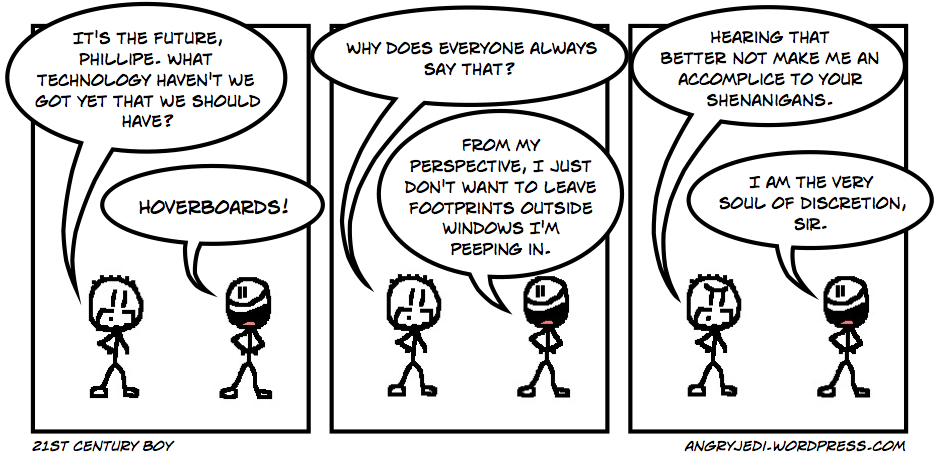
It's the 21st century. If you grew up in the 20th century like I did, this means that you're officially In The Future, because saying "21st century" sounded like it was a very long way off and not, as it happened, just around the corner.
Since we're officially In The Future, I think there's more than a few pieces of technology that we should probably have mastered by now. And I'm not going to say "hoverboards" because "hoverboards" would be rubbish. I can barely stay upright on a skateboard, and certainly not on rollerskates, so why the fuck would I want to remove the wheels and stand on a sheet of plastic floating in mid-air? No. Fuck hoverboards, and sort this lot out instead:

Pay-and-display machines that don't give change or accept card payments

Seriously. We're living in a digital society where you can pay for things by swiping your phone in front of terminals and yet when you park your car you still need exact change to purchase a ticket? Balls. Fix it.

Computers that don't tell you what the problem is

"An unexpected error has occurred." As opposed to an expected error? WHAT WENT WRONG? And no, I don't want to know the hexadecimal address of the piece of memory where something went wrong because I didn't write the program. I want something in plain English. "Your graphics card is buggered," for example, or "Your hard drive is too full for this program to work effectively."

Microwaves that have a power rating somewhere in between the ratings listed on a packet of food

The microwave here is 800W. Food packaging lists cooking times for 650W, 750W and 850W. Is it too much to ask for microwave manufacturers and those who package food to co-operate a little bit?

Clocks that don't auto-adjust to British Summer Time/Daylight Saving Time/Uzbekistan Testicle Appreciation Time

Changing the clocks is an annoying rigmarole anyway, and when some of the devices in your house do it automatically and others don't, it's a pain in the arse to figure out which is which.

Tiny things that you can't find

Everything should have a phone number or GPS tracking, meaning if you lose your keys, you should be able to phone them and locate them.

Companies who will let you sign up online but require you to phone them to cancel

I'm looking at you, LoveFilm. You were deliciously easy to sign up for, yet cancelling required me to speak to some indecipherable person on a bad line and explain to them that no, I had phoned to cancel so no, I don't want to extend my service or give them my payment information. Let me cancel online. I don't want to speak to other human beings on the phone. I hate the phone.

Companies who insist that all correspondence must be done through the mail

And I'm talking about the paper mail that comes through your letterbox. In this digital world, there's no real excuse for this any more. And while we're on…

Companies who take a week to respond to an email

"We will get back to you within 7 days." Probably with the wrong answer. It takes a few seconds to Google the question I had or to ask the person sitting behind you, to type in your response and to hit Send. Even if you have other people to deal with in the queue in front of me, I doubt it takes a week.

Erm. This may have become a bit more ranty than I intended. Oh well. We're living in the future. These things should be sorted by now. So fix them, world!

#oneaday, Day 40: Technology is Exciting!

It's been a funny few weeks for the games industry, what with spats between high-profile journalists such as Leigh Alexander and Jim Sterling; the whole Penny Arcade "dickwolves debacle"; and, yesterday, Fox News making the astonishing claim that Bulletstorm directly encourages rape.

This sort of thing is oddly symptomatic of the modern industry, though. We take technology for granted so much these days that new, exciting things are met not with the excitement that they deserve, but with cynicism, caution and, at times, outright hostility. This is arguably wise, given that technology generally isn't cheap, particularly for early adopters. But sometimes I miss the days of wide-eyed wonderment at a new gizmo that does something no-one else has ever done before.

Case in point: Sony and Nintendo's upcoming handhelds, the NGP and 3DS, respectively. Both are pretty impressive pieces of kit—the 3DS for offering glasses-free 3D glasses (which may or may not prove difficult to appreciate for those who actually wear glasses) and the NGP for being a veritable behemoth of pocket-sized power. Both will make a significant dent in your cashflow should you choose to adopt them, but both are incredibly exciting pieces of technology.

So then, why do the industry press feel the need to publish articles like this? This is perhaps a bad example, because PocketGamer did, in fact, also publish a counter-article about why you will buy an NGP. But this is by no means an isolated incident; game sites are filled with list articles like this offering you "reasons to sell your Wii", "reasons not to buy an [x]", "reasons why the [y] is rubbish" (I'm paraphrasing, obviously). It's a curious offshoot of fanboyism that some game sites seem to be voluntarily perpetuating—presumably because it encourages "discussion". Discussion means hits. Hits mean ad revenue. That's what it's all about for many of these sites these days, after all.

Sometimes I think there's a market for a site that treats things with the kind of wild-eyed enthusiasm that we as kids and teens in the 90s used to show for every new and exciting thing. Remember when Starfox/Starwing came out and it looked like games we'd been playing on home computers for years but everyone still loved it because it hadn't been done on a console before? Remember when the Atari Lynx had hardware sprite scaling? Remember when you were gobsmacked about how many layers of parallax scrolling Shadow of the Beast on the Amiga had? Yeah. That. I want that back.

Perhaps it's symptomatic of the fact that technology advances have slowed somewhat since those days. An oft-quoted line with every new generation of gaming technology is "it's difficult to imagine how graphics could possibly get any better than this", or "[x developer] claims they're using 100% of the [y console]'s power". But then someone does something cool. It might not be as huge a leap as that between, say, the SNES and the PS1. But it's still an improvement, and something that I, personally, feel is still worth getting excited about.

For so-called "enthusiast press", sometimes we're not very enthusiastic.

[Thanks to @Alex_Connolly for inspiring today's comic.]

#oneaday, Day 303: Panic Stations

Human beings, and especially British human beings, are inclined to panic at the most ridiculous things. It's probably a side-effect of being bombarded with negativity from the media and the news—if something bad could happen, then it probably already has, they tell us. (Maybe. I'm making that up a bit.)

But really, there's no need to concern yourselves with these things that might actually kill you. Seriously. Allow me to set your mind at rest for a few of these things that typically induce enormous amounts of panic.

The kettle isn't turning off!

The kettle is boiling and it hasn't made that familiar, comforting "click" of turning itself off, you say? Well, isn't that a pickle? Still, it's unlikely that your kettle will detonate like a bomb if you don't turn it off manually. In actual fact, it probably will turn itself off after a moment if you just leave it. Or if you're really that concerned, you can prevent inadvertent kettle detonation by simply turning it off yourself. You'll find it will stop boiling pretty quickly.

The toilet won't flush, and it's not my toilet!

Oh no! You did your business and now you can't get it to vacate the premises. How embarrassing! Because no-one else ever has a poo, right? You are literally the first person to ever have a poo in someone else's toilet. And explaining this situation to your hosts will be mortifying.

Never fear. In actual fact, your hosts have probably deduced the fact you were having a poo from the fact that you've been in there for more than the few seconds a wee normally takes. Also, you took a magazine and/or your iPhone/Nintendo DS with you. Simply explain to them that their toilet doesn't appear to be flushing and is there a special trick to it? Chances are if they live with an idiosyncratic toilet, they know how to talk to the toilet pixies and make it do the thing it's supposed to do.

Someone said a mean thing on the Internet!

You made a valid argument on a subject you feel passionately about, and someone called you a douchebag, whilst not contributing to the discussion at all. There's a simple solution to this problem: picturing the person who called you a douchebag. They're probably not a ripped jock with a six-pack who has a bevy of beautiful women satisfying his every sexual need at all times. He's probably an overweight gentleman with personal hygiene issues and a taste for Cheetos or similar snack foods.

This electrical device that was perfectly fine yesterday isn't working!

Rather than assuming that it's "broken" and wailing to the heavens, why not try checking the things that everyone forgets to check? Is it turned on? Plugged in? Is the socket working? Does it need new batteries? Does it need batteries at all?

On the off-chance that it is, in fact, "broken", consider what your life was like before you had the device in question. Was it significantly worse? If yes, then go get it repaired or buy a new one. If no, then you can probably live without your smoothie-maker/light-up dildo/automatic toilet paper dispenser.

I disagree with your opinion!

It's okay. Really. That's why it's called an "opinion". Well, it might not technically be the reason that the word "opinion" was chosen. But you are perfectly entitled to have your own opinion on something, and to be able to voice that opinion. You should also be prepared to deal with any consequences for voicing that opinion. If you slag off Call of Duty: Black Ops on the biggest Call of Duty fan site in the world, you're probably going to get called a douchebag by someone. If you stand naked in the middle of the street yelling "I AM A NAZI!" you will probably get arrested. If you tweet "Crap! Robin Hood Airport is closed. You've got a week and a bit to get your shit together, otherwise I'm blowing the airport sky high!!!" then you will probably get prosecuted.

This online service which I don't pay anything for isn't working!

Twitter down? Facebook failing? Reddit "under heavy load"? GO OUTSIDE.

No further questions, y'honor.

#oneaday, Day 238: Nerd Rage

As a new acquaintance from Twitter would say, nerd rage is one of the most formidable forces known to Man. It is a dreadful and terrible force, both specific and unfocused at the same time, often showing itself via the personification of inanimate objects who really don't know any better and are just attempting to do their job and failing. Raging at said inanimate objects or poorly-constructed pieces of software rarely does any good, but it is commonly assumed that it makes one "feel better".

As the years have passed, though, everyone's bullshit-tolerance threshold has lowered significantly to the stage we're at now, where if something doesn't work immediately and instantly and then remain working 100% of the time, people blow their top and spew their vitriol to whoever will listen, which is usually the Internet. Assuming the Internet connection isn't the thing which is causing the nerd rage, in which case alternative outlets have to be explored.

This is why issues such as the Xbox 360's infamous "red ring of death" smart so much. Not only is it a shoddy flaw in the system which should never happen in the first place, but people's tolerance for such shoddiness is far lower now than it would have been, say, twenty or thirty years ago. Hell, in the days of the NES, everyone was quite happy to accept the fact that if a game didn't boot up first time, it clearly and obviously meant that you had to blow in it to "get the dust out" despite no actual evidence that it was actually dust causing the game not to work correctly. And no evidence that those tiny flecks of gob that probably got into the cartridge circuitry while you were blowing in it actually helped matters, either.

It's also why we get such whingers in places such as Apple's App Store. "OMG 1 STAR COZ IT DIDNT WORK ONCE THIS IS A DIGSRACE REFUND PLZ". "Is it working now?" "Yes, but…" (etc.)

It's fair enough to want things to "just work". Apple in particular like to pride themselves on the fact that their products "just work" (which they do approximately 95% of the time, which means the remaining 5% incites nerd rage of a degree you've never seen before, particularly amongst recent converts and/or Android users). But it's worth remembering a time not so long ago when we enjoyed tape load errors, boot errors, numerical error codes you had to look up in a book, garbled graphics, tape decks that chewed up tapes and then spat them out, CD players that seemed to deliberately wait for you to insert your favourite disc then sprout internal blades to scratch the crap out of it and dial-up network connections where it was possible to get a "busy" signal for hours at a time. And there was no Internet to spew your vitriol over back then.

Nowadays we have complicated devices and software that no-one except superhumans understand really, and established solutions such as blowing on it, shaking it, hitting it, shouting at it, turning it off and back on again and setting fire to it don't work. So the only thing left to do is get frustrated. And possibly call up one of those superhumans. Because everybody knows at least one. (Note: If you don't know a superhuman nerd or don't want to bother them, you can save yourself a lot of time by referring to this chart.)

In other news, the router here is rubbish and crap and I hate it and it disconnects Xbox LIVE every five minutes when I'm playing Fable II and it doesn't like WordPress and SRSLY who uses AOL nowadays anyway and… (repeat to fade)

#oneaday, Day 199: Waving Goodbye

So, Google Wave is going bye-bye, huh? Can't say I'm particularly surprised. As cool an idea as it was, there just wasn't the buy-in from people that it deserved. Largely because a goodly proportion of the Internet population didn't seem to understand what it was actually for.

It's easy to assume people who didn't "get" Wave are just a bit slow. But the fact is, Google never did a great job of explaining what the technology was for in the first place.

"Yay, collaborative editing!" they'd say.

"Yay, we can do that with Google Docs!" everyone else would say.

"Yay, you can see people typing!" they'd say.

"Yay, who gives a shit?" everyone else would say.

"Yay, it's like a combination of email, Twitter and a word processing document!" they'd say.

"Yay, I've never wanted to combine those three things together!" everyone else would say.

It's a pity, as I've seen some genuinely interesting uses of Wave out there. One particularly cool Wave I was invited to took the form of a moderated "text adventure", where participants could direct the protagonist (played by the moderator in the role of an interactive fiction-style narrator) by inserting commands. Eventually, the non-linear nature of Wave allowed two parallel storylines to develop at once—one happening in the present, another as a flashback. Wave's ability for anyone to edit and insert new content at any point in the "conversation" meant that these two things could continue going on without becoming overly confusing.

Then there were all the possibilities for things like education. But then you have to deal with your average teacher's technophobia.

When I was working in schools, I had a grand idea that Wave could be used for the preparation of interactive resources. The fact that media such as YouTube videos, flash thingies, pictures, text, hyperlinks and even iFrames could be inserted meant that Wave could have been an ideal tool to use on interactive whiteboards during lessons, and also a good means of collaborative planning if teachers in question weren't able to meet and discuss things. As they frequently aren't.

As a result of many of these things, I had a Wave account which largely went unused because no-one else was using it. This is a shame, as I could see the potential in the service. But the fact the service was invite-only for so long, and then by the time it went public people were still scratching their heads and wondering what to do with it—these things meant that it didn't have a particularly "mass market" appeal for the average Internet user.

All is not lost for the moment, anyway. Wave is going to remain open—Google have just said they're stopping development on it. They've also open-sourced a goodly proportion of the code, so enterprising clever people with mathematics in their brains will be able to pull it apart and make it better, faster, stronger, I'm sure.

So it was a swing and a miss for Google on this one. To be honest, though, I think it's good to see them experimenting with different technologies as a company. It would be very easy for Google to just think "Right. We do these things. And we do them well. Let's just stop there and make bundles of money and stick them in our ears." But no; they seem to be on a constant quest to make the lives of the Internet's denizens better. Sometimes these things work. And sometimes they don't.

So raise a glass to Google Wave, the web app that couldn't. And start speculating on what they might be up to next!