#oneaday Day 518: Championing the Free to Play Model

I mentioned a few days ago that I was going to give some of Steam's free to play games a try, and mentioned I might investigate APB Reloaded and World of Tanks. I have played a tiny bit of APB (it's quite fun, if nigh-on-incomprehensible to begin with) but haven't touched World of Tanks yet. I also continue to enjoy Spiral Knights, although with the game's lack of quest structure and progression system tied to your equipment rather than your character I'm not entirely sure what the "point" is — but it's fun, regardless.

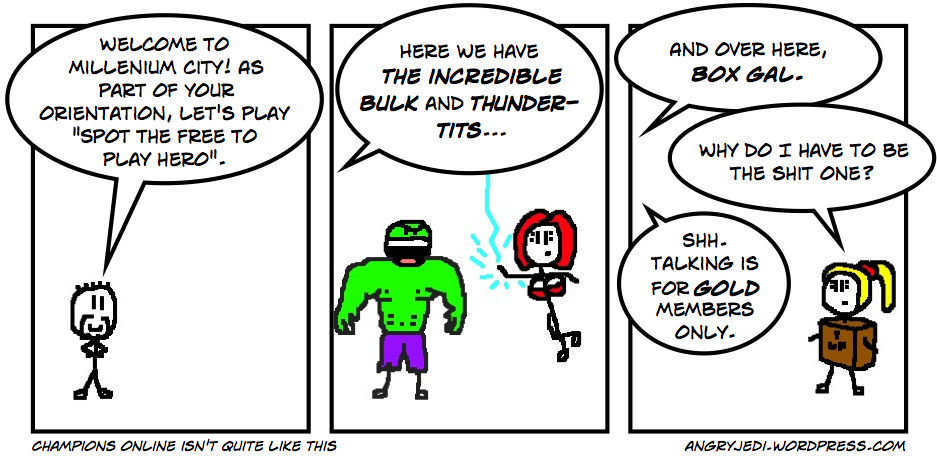
Instead, though, I've been spending a fair amount of time playing Champions Online, aka City of Heroes 2. This is one of a growing number of MMORPGs that used to be full-price products with subscription fees, but which have adopted the free to play model as a means of drawing in more customers and potentially earn more money via microtransactions.

Champions Online takes an interesting approach in that you can still pay a subscription fee for a "Gold" membership if you prefer, and that keeps the game pretty much in its original form — you get free access to all new content, are able to play a hero with your own completely customised set of powers and have a bit more flexibility in terms of how much currency you can own and the like. Free "Silver" members, on the other hand, are limited to selecting preset archetypes for their heroes and have to pay for episodic "adventure packs" — story-heavy instanced missions that offer experiences a little different from the regular world-and-instance-based PvE that the main game offers. Regular promotions allow Silver members to get access to some things for free for a limited period, and players can always buy individual things via microtransaction if they don't want to pony up for a full-on subscription every month.

The way this is implemented is incredibly smart. The fact that Silver players are limited to preset archetypes which are nigh-on-impossible to fuck up while Gold members actually have to plan out their builds in advance means that people are less likely to get themselves into a situation where it's impossible to proceed due to some unfortunate decisions 20 levels ago. It also allows players to effectively try out the various combinations of powers with characters that actually work properly — and have a lot of fun in the process. I'm playing a "Soldier" character right now and she doesn't feel gimped at all — she feels like a preset character class in a traditional action RPG. There's just enough level of choice to allow me to customise her a little bit without daunting me with complete freedom.

Champions Online falls into the usual traps that MMOs do — the interface is a bit clunky, the animations in cutscenes are either laughable or non-existent and aforementioned cutscenes have been put together by someone who doesn't know what "directing" or "cinematography" is. But that doesn't stop it being fun — and definitely higher quality than some of the crap that has been released under the free to play banner in the past. Quality of these games is definitely increasing, and I foresee that Champions Online will hold my attention for quite a while yet. So if you're a player, do join me! Look for "Lap Cat@AngryJedi" or just add me on Steam to see when I'm playing. Feel free to give me a shout and we can team up.

#oneaday Day 512: Freebie-Jeebies

Free to play games are here to stay, it seems, with Steam launching a dedicated category for the little buggers today — complete with Achievement support and Steam-powered microtransactions.

With that in mind, I've decided I'm going to delve into some of them and try to determine if any of them are actually any good. A lot of people hear the words "free to play" and assume it's going to be some lame-ass Facebook game with no gameplay whatsoever (seriously, I played one earlier that literally gave you experience points for doing nothing at all) but in actual fact, there's a surprisingly rich range of titles on offer out there.

I've just spent about half an hour with Spiral Knights from SEGA. This one appealed because of a recommendation from a friend, the most excellent CampfireBurning, who described it as a cross between Zelda and Phantasy Star Online. This sounded like an excellent combination of awesomeness, so I set Steam to downloading while I did some work.

It's a small download — less than a gig (when did that become "small"?) — and works on both PC and Mac. It has endearingly simplistic graphics that will likely run smoothly on absolutely anything and, unlike many other F2P titles, understands widescreen resolutions. It also has a pleasantly chiptuney sort of soundtrack, a straightforward control system and a no-nonsense approach to getting you into a party for some dungeon-delving.

Gameplay is similarly straightforward. You have a sword, with which you can slash, and a gun, with which you can pew. The sword does more damage than the gun, but the gun can pew at things that can't reach you. There are also blocks and bushes that hide coins and hearts, as well as "treasure blocks", which are self-explanatory.

I've only played the tutorial so far so I can't speak for the variety of the dungeons, but the simple, cartoonish nature of the graphics means that little more than a palette-swap is all that's really needed to give a level a distinct look — hopefully it offers a little more than that, though, as time goes on.

Hopefully the ease with which these games are apparently going to integrate with Steam will convince a lot more people to check them out. And the fact Steam has introduced a full free to play section should mean we get a lot more of these games on Steam, too, bringing them to a potentially huge audience. The future's bright for people who don't like paying for things but also don't want to pirate them!

I'm going to spend a bit of time with Spiral Knights and then post some more detailed thoughts in the very near future. After that, I'm going to investigate APB Reloaded and World of Tanks. Any other suggestions for free to play excellence?

#oneaday, Day 320: Achievement Locked

I've just done something I haven't done for a while. I've beaten a game with no Achievements. No, I don't mean that I played the game so terribly that I didn't get any Achievements (I don't think there's a single Achievement-supporting game out there that will allow you to do that)—I mean I started, played, enjoyed and beat a game which did not support Achievements of any kind, be they Steam Achievements, Xbox Achievements, PSN Trophies or a built-in Achievement-like system.
Said game was Recettear: An Item Shop's Tale, which I enthused about at some length a few days ago. I beat it tonight, but there's a load of stuff after the ending, too, so this isn't the end of my time with the game. I am, however, glad that there were no Achievements along the way.

Achievements are generally considered to be a good thing. And for some games, they are. Freeform games like Crackdown use Achievements to encourage players to try crazy things that they might not have thought to do otherwise. Skill-based games like Geometry Wars use Achievements to display player skill. But when you get into the territory of "Fire your gun 500 times", you know it's getting a bit silly.

I played Oblivion a while back and greatly enjoyed it. I got all 1250 Achievement points in it. The thing is, though, that wasn't the whole game. There are tons of sidequests in Oblivion which don't have associated Achievements. How many people do you think bothered to do them? Not many, I'd wager.

Achievements often direct your experience and encourage you to play in a specific way. For some types of game, that is good. In others, it's not. Part of the joy of Recettear is the discovery of how different things in the game work. Over time, you naturally figure out which customers you can get away with charging a bit more to, which ones will come in at what times of the day, which products appeal to which people and all manner of other things. Even the adventurer characters you can take into the dungeons have their own individual quirks for you to learn. As soon as you add Achievements like "Sell 20 Baked Yams" to that mix, you start playing differently in order to get that Achievement. You start focusing on becoming the best damn Baked Yams supplier there ever was, to the exclusion of more profitable things like treasure and adventuring equipment.

Achievements are, on balance, a good idea, I think. They provide an additional reward mechanic above and beyond that which the game should be offering anyway. But it's when they start to take over, to become the most important reward mechanic—more than the inherent rewards built into the game itself—that things aren't quite right with the world. It's a fine line, and I don't think making the support of Achievements mandatory is the correct way to be. Or if there's no way around that, let's see more games like DEADLY PREMONITION, which simply has an Achievement for beating each chapter, one for each difficulty level and one for 100%ing the game. Nothing more. Nothing more needed. Even then, I'm pretty sure there will be at least one person out there who will go back and replay the whole game just to get all three difficulty level Achievements. That shouldn't be why you replay DEADLY PREMONITION. You should replay it because it's awesome.

So, anyway. Don't be afraid to pick up a game with no Achievements. You might be surprised. Games can be fun without having to tell you how awesome you are every ten minutes.

#oneaday, Day 181: Vampire: Bloodlines

Body clock buggered up today. After getting to bed late last night, I slept solidly until about lunchtime. Nice, but ultimately unproductive, as it means here I am at 3AM in the morning.

Actually, there's another reason I stayed up so late, and that is Vampire The Masquerade: Bloodlines.

This is a game I've been meaning to play for absolutely ages. I'm a big fan of the White Wolf interpretation of vampirism and, to be honest, vampires in general. Just not the Twilight variety. Granted, I have never read or seen Twilight beyond reading a two-chapter preview on iBooks on my phone, but already both Bella and Edward seemed to be some of the most unsympathetic arseholes I've ever had the misfortune to come across in a book.

But that's beside the point.

White Wolf's interpretation of vampirism focuses much more on clan-based political intrigue, with each clan having its own unique outlook on life, special abilities and, in some cases, quirks. Part of the reason for this is for gameplay balancing in the pen-and-paper RPG. Instead of picking a character class, you pick a clan, and that determines your specialisms. But the pen-and-paper Vampire RPG is heavily focused on the RP bit as opposed to the G bit, meaning that these character backgrounds are hugely important from the perspective of actually playing your character in a realistic manner.

Bloodlines was the second Vampire game to hit the PC. The first, Redemption, was a mixed bag. It was notable for having a pretty good script, solid voice acting and (at the time) quite nice graphics. But the Diablo-style clicky-clicky combat really didn't work from the close-up over-the-shoulder camera view adopted. The AI of party members was beyond "dumbass". And there were lots of monumentally irritating bits where you had to sneak a four-person party through areas of sunlight. I never finished it as it got a bit frustrating, though I would like to return to it one day.

Bloodlines took a different approach. Based on an early version of the Source engine, it plays more like Deus Ex than anything else. You walk around LA from a first- or third-person perspective, meet people, talk to them, possibly suck their blood, fight them, complete quests in a variety of different ways and get involved in all the point-toothed intrigue you could shake a stake at.

The game was renowned for being hugely buggy on its original release. I haven't noticed any showstopping bugs since I've been playing this evening—one or two minor graphical glitches, sure, but that's more the old Source engine than the game itself I think. What I have noticed, though, is that it's an utterly fantastic game. While it appears that the overarching narrative takes a while to get going—I played several hours tonight and couldn't tell you what the "main" plot thread was—one of the best things the game does, much like Deus Ex, is immerse you in the game world. There are people in this world going about their business, and they are genuine characters whom you get to know and recognise.

One of the most compelling, immersive things about playing as a White Wolf vampire is the idea of the "Masquerade", where vampires must hide their true nature from humans. In game terms, this means that you mustn't let people see you feeding, using any obviously supernatural abilities or doing anything "vampirey". There are get-out clauses to this, though; seduce a human using your vampiric seduction skills and they won't mind you biting them, for example. But if anyone sees you doing that, you're in trouble.

So far I've really enjoyed what I've played. The balance between the RPG stat-building and the action-based combat is good, and some of the dialogue is genuinely well-written. The World of Darkness is introduced gradually in such a way that isn't daunting to new players but isn't patronising to those who know the lore.

In short, then, I can highly recommend the game from what I've seen so far. It's currently available on Steam and via Direct2Drive. Good luck finding a physical copy if that's your thing.

Dear Esther

I remember first hearing about Dear Esther a while back, during one of those interminable "games as art" discussions. It was held up as an example of using one particular genre of gaming (the first-person shooter, in this case Half-Life 2) as an interesting means of storytelling. Half-Life 2 itself is, of course, well-known for integrating storytelling and gameplay together, but Dear Esther set out to be something altogether different. Designer Dan Pinchbeck describes it as a "multimodal, environmental storytelling experiment" which "presents a sparse environment with no embedded agents, relying purely on the player's engagement with and interpretation of a narrative delivered through semi-randomised audio fragments". (source)

That's a very dry description of what this mod is doing, but it's an accurate one.

Dear Esther places the unnamed player on a seemingly-deserted island, starting on a jetty facing an abandoned house. The beautifully-delivered narration begins immediately, reading from a letter to the titular Esther and gradually developing as the player passes around the island.

The interesting thing about the story is that there are several threads running at once, and the randomised delivery of the audio cues throughout means that after a while, they all begin to blur together until it's not clear where one story ends and the other begins. Pinchbeck notes that "two plots develop simultaneously: the avatar's visit to the island following the historical record of a 17th century cartographer, and repressed memories of a car accident". The way these plots intertwine and seem to share themes and ideas in common, as well as wildly disparate elements too, mean that, in Pinchbeck's words, "a closed reading, or understanding, of the events is impossible to ever reach."

In this sense, Dear Esther is a dream come true for people who enjoy finding their own interpretations of games. The mod reminded me a lot of Flower, if not in execution then certainly in atmosphere. Flower makes very little of its story (if indeed there is one) explicit and is very open to wildly different interpretations. One could take it literally or metaphorically – and it is the same with Dear Esther. The game raises unspoken questions about whether or not the island you are walking around is actually real, who the mysterious characters the narrator refers to really are and, of course, who Esther actually is.

Pinchbeck himself was surprised at the positive response to his deliberately open narrative, noting that "the notion of an unfolding mystery that is never solved actually appeals to [players]" and that "the atmosphere and drive to find out more about the story is enough of a pull to get them all the way through the experience".

It's true. Dear Esther presents an intriguing mystery that makes it clear from the outset that there are no specific answers, yet there is a clear "goal" for the player to attain. This was achieved through use of the environment combined with the spoken narrative. Although the environment of the game is very "open-plan", being based on an island, at no point did it become difficult to determine where to go next, as there was always something that "looked interesting" over the next ridge. As the narrative progresses, a huge aerial in the middle of the island becomes visible with a large flashing red light, and the fact that this is almost constantly visible gives the player some indication of 1) where they are going and 2) how much longer they have to go.

Music is also used very effectively throughout. Haunting piano and string themes drift eerily over the speakers as the narrator slowly speaks his lines. As the story builds to something of a climax towards its "conclusion" (for want of a better word) the music becomes thicker, more intense, and with more mysterious, unidentifiable noises creeping into it. It gives a sense of progression in a game which leaves more questions unanswered than answered at the end.

There's certainly no denying that Dear Esther, like Flower, is an experience that will make you feel something. That "something" will be different to different people, as Pinchbeck notes that:

"…we have been surprised how many players report being scared. Several others describe the experience as eerie, moving and very sad. These last two are emotions that normally fall beyond the affective range of games, especially first-person games."

Lewis Denby, writing on Rock, Paper, Shotgun, had plenty to say on this subject, and it's well worth reading his excellent article. One particularly interesting point he had to mention was:

"I love my Marios and what-have-you as much as the next person, but I still feel games have an incredible untapped potential for negative emotions. Some have tried – Braid stands out for having a bloody good go – but we’re still a little too comfortable with enjoying everything we play. Any stretches of sadness in this medium tend to be restricted to self-indulgence or vapid tearjerker fare, and even they invariably make way for happy endings and bunny fluff."

Dear Esther, he says, is noteworthy for taking players into uncomfortable emotional territory and refusing to give in throughout. The whole experience is infused with a kind of melancholy throughout, and the final moments of the story as it comes to a close without any real "resolution" are heartbreaking.

All this in a barren, empty landscape with no human interaction, no speech besides that of the anonymous narrator, no guns, no white-haired pretty boys, no anime cutscenes – and yet somehow, deprived of all that exterior fluff, Dear Esther manages to present an intriguing story which has compelled more than a few people to play it through several times and develop their own interpretations further – and all this using an engine which is renowned for its fast-action run-and-gun FPS gameplay. It just goes to show what a little bit of creativity can achieve.

Dear Esther can be downloaded here.

Pinchbeck's notes on the mod can be read here.