#oneaday Day 887: Things I Don't Understand

20120624-002940.jpg

Herein follows an updated (though not comprehensive) list of Things I Really Don't Get, in no particular order.

  • Football. (Soccer for the Americans.) Those who have known me for a long time will be well-familiar with my aversion to the supposed "beautiful game" by now, and its popularity continues to elude me even as I'm supposed to be feeling patriotic and English while Euro 2012 is going on. I just couldn't give a toss, though. Related: I also don't understand why those who like football complain about ITV's coverage of it and then don't protest about it in a form any stronger than passive-aggressive tweets. Don't watch it if it bothers you that much. Crashing viewing figures would get their attention. (One response I received to this tonight was that they had "no choice" but to watch. This attitude is unfathomable to me when the vehement, often expletive-ridden criticisms of ITV's coverage is taken into account.)
  • Carly Rae Jepsen. Who the fuck is this person and why is their song Call Me Maybe so inexplicably popular at present? I listened to it out of curiosity on Spotify the other day and discovered a bland, predictable if marginally catchy pop song — certainly nothing remarkable to elevate it above similar offerings from other cheeseballs artists such as Ke$ha et al.
  • Rage of Bahamut. Discussed in greater detail here.
  • People who park in the pick-up area at supermarkets. Is your time so valuable to you that you need to park in an area that isn't a parking space, Mr BMW driver? (Because it inevitably is a male driver, usually in an expensive German car) There are free spaces over there. I'm sure it won't hurt you to get out and walk for an additional five seconds.
  • People who comment on brand pages on Facebook. Discussed somewhat here. It seems that for some people, the "like" and "comment" buttons have some sort of irresistible magnetic force that makes these people unable to leave an inane post by a brand alone before they've posted "lol" or some equally asinine comment. I follow J-List on Facebook because (1) I like the pictures (2) I find the posts about Japan interesting
  • Radio 1 giving an on-air guided tour of a festival ground when nothing was happening there. Radio 1 had/are having (I don't care enough to check) some sort of festival, and the other day they devoted a good ten minutes or so to someone walking around the (unoccupied) festival grounds explaining where everything was going to be. The impact was somewhat lost by radio's inherent lack of pictures.
  • Jedward. Come on. Are we not over this supposed "joke" yet?
  • Beauty products. Women must all be fucking scientists to understand all that crap they sell in Boots. I certainly wouldn't know when to buy a "serum" and when to buy "body butter".
  • The enduring popularity of shit TV. I don't think Take Me Out is on at the moment, but the sheer number of otherwise normal-ish people I follow on Twitter who voluntarily subjected themselves to this televisual carcrash is astonishing. Most claim they only did so in order to bitch about it on Twitter, but I can think of far less infuriating ways to spend an evening.
  • Instapaper, Read It Later et al. I've never used one of these services so I don't really understand what they do and can't really fathom out how they work from their descriptions. I'm something of a traditionalist in the way I read stuff on the Internet — I go to the site, I read it. If I don't have Internet access at the time, I don't read it. If you're lucky I'll subscribe to your blog by email but that's about it – I don't use Google Reader or anything either.
  • How you can play the same (non-MMORPG) multiplayer game for over 100 hours and not get bored. I got bored of the one time I tried Call of Duty multiplayer after about two or three hours tops. I got sort of into it for a little while but then realised that I wasn't really having as much fun as I thought I should be having and that I didn't feel like I was getting any better, either, so I stopped. The prospect of playing a multiplayer shooter enough to contemplate voluntarily paying a subscription fee for it is unfathomable to me.
  • How Microsoft Word still doesn't work properly yet. Word first came out in 1983, yet here in 2012 I am still getting frustrated by the fact it occasionally and unpredictably changes fonts for no apparent reason, decides to format my entire document in bullet points when I tell it to undo my last action and is just generally a big buggy mess. Surely it can't be that hard to get right? It's not as if I'm even doing anything advanced; this is basic text editing that still encounters these glaring flaws on a regular (but unpredictable) basis.
  • How it's possible to have a "collector's edition" of a game that is only available via digital download. Special edition, fine. Premium edition, fine. But "collector's edition"? No.
  • Why all car parks don't take cards. I never have any cash on me because I rarely need it, so I can imagine there are plenty of other people who live their lives in a similar fashion. Payment cards are so ubiquitous now; why can't you pay for your parking with a credit or debit card in 95% of British car parks? (I made that statistic up. But it's certainly a lot of them.)
  • Fruit tea. It smells so good; it tastes so much like dirty bath water. Why must Nature be so cruel?
I think that'll do for now. Feel free to share your own Things You Don't Understand in the comments.

#oneaday Day 885: Foul-Smelling Vagina

20120622-013552.jpg

There, that got your attention, didn't it? Mention a stinky faff in your headline and everyone suddenly takes note. I'll remember that for the future.

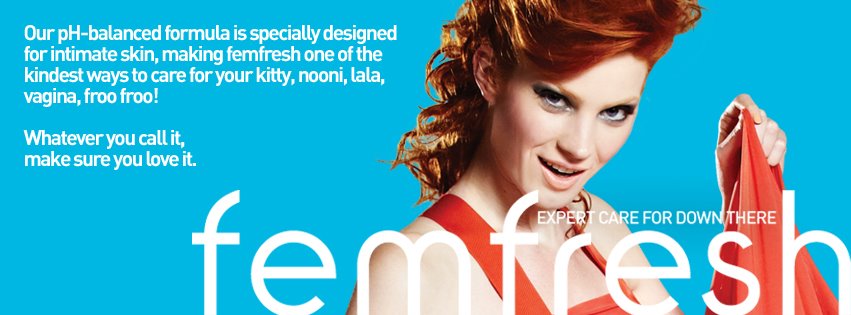
Anyway, I do actually sort of want to talk about fragrant fannies today, but not in quite the way you might be expecting. I am instead referring to the social media backlash which "intimate hygiene" product line Femfresh encountered today on its Facebook page.

There were a number of reasons that Femfresh drew the ire of the Internet community today, but one of the most common complaints was its cover photo. Here it is:

Apparently, it seems a lot of ladies find the company's seeming inability to use "adult" words for their respective minges somewhat patronising — and before I go any further, I will point out that my use of various offensive euphemisms throughout this post is purely for facetious comedy value (and variety) rather than any ulterior motive — and thus took umbrage with Femfresh's page as soon as they saw the top of it. (Quite what they were doing on it in the first place is their business and their business alone.)

Not only that, but it seems that on the whole (shush!) women are, in fact, rather well-educated about what is and isn't appropriate to smear over or stick up their flange. "Bacterial vaginosis" is the result of using the wrong things, it seems, and no, I haven't Googled that because I don't want to. Don't let me stop you from doing so, however, if you're curious. Just don't come crying to me if Google Images decides to serve you up some tasty treats.

Anyway. Here are a few choice comments from the public:

"I call it a vagina because I'm not 12 years old and because I love it I'll go nowhere near this vile 'care range. Cheers."
— Holly Rae Smith.

"Are you kidding me? Trivialising something innately precious by calling it something so thoroughly ridiculous offends me and, believe it or not, all the posters on this page. Did you not perform any market research on this area and then develop a communication and marketing strategy? It appears not otherwise you wouldn't have received such an insane backlash on your attempts to flog a thoroughly unnecessary and damaging product…"
— Helen T

"Just to clarify, is Femfresh for vaginas or vulvas? Because your ad says vagina, which implies your product is a douche, in which case you're advertising a harmful product. If it's for vulvas only, change the words you're using to make it clear."
— Kirsten Hey

I shan't talk any more about the science of quim because I'm not a gynaecologist (I can, however, spell gynaecologist without using spellcheck) but I will focus on the larger issue here, which is that social media advertising campaigns can and will go very, very wrong if they're not thought out effectively. Instead of simply advertising their (apparently controversial) product, Femfresh made the mistake of attempting to engage with their "fans" when there was really no need to. By actively encouraging people to comment on their posts (and by posting vapid, patronising nonsense) they essentially brought about their own downfall. Everyone has been talking about Femfresh today, and they haven't come off too well. "All publicity is good publicity" doesn't really apply when the vast majority of those "publicising" your product are pointing out proven health risks.

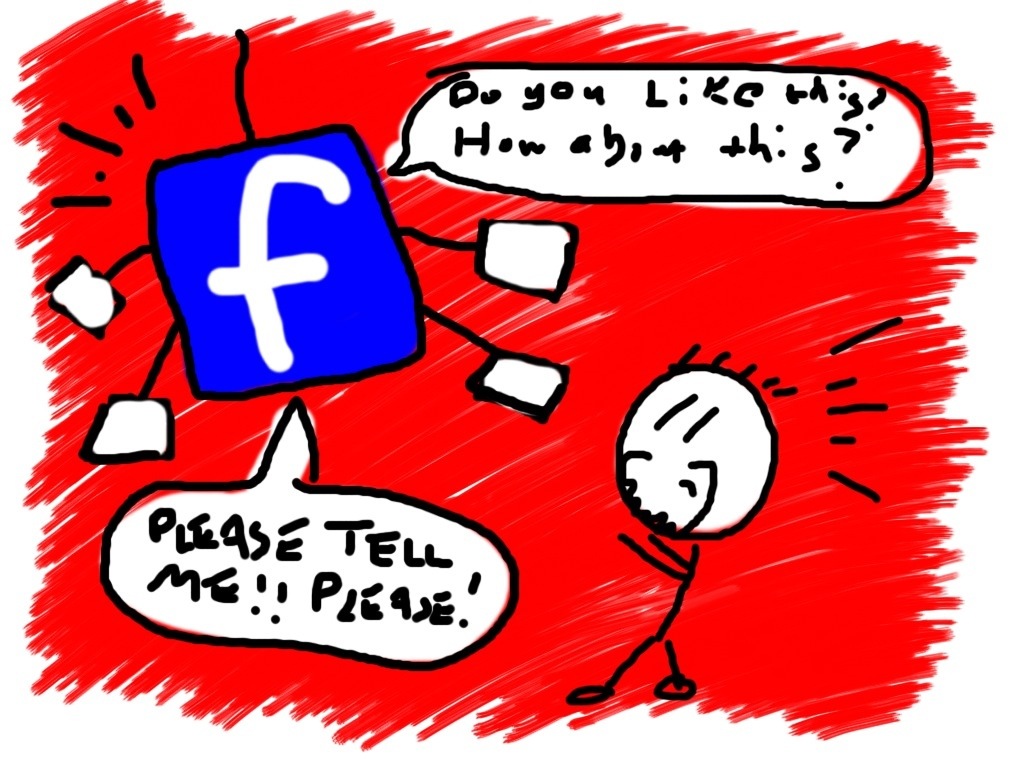
The broader issue here is that social advertising should not be "essential" as so many advertisers seem to believe it to be. On Facebook, you can "Like" everything from HP sauce to a favourite video game. Doing so used to simply be a means of self-expression — quite literally, demonstrating that you liked something. Now, publicly "Liking" something is inviting the brand in question to bombard you with crap, ask you asinine questions at all hours of the day in an attempt to "build a community" around things that really don't need a community built around them. If people honestly think that their lives are going to be enriched when they click "Like" on the page of a thing that they're quite fond of, they are sorely mistaken.

Those who have "Liked" (or at least come across) Femfresh have taken a stand against this sort of pointless nonsense that is infesting social media like, well, bacterial vaginosis. In this case, it's because the advertising was both patronising and inaccurate. For less contentious products, it's going to be harder to train people to not be corporate shills — the last post on Pepsi's Facebook page has 1,094 "likes" and 74 comments, for example, none of which say anything remotely meaningful — but it seems we're starting to see a backlash of people who are no longer willing to be an unpaid part of a product's promotional team. I've certainly started "unliking" pages on Facebook that post nothing but pointless questions or fill-in-the-blank exercises rather than useful information (although seriously, what "useful information" could the official social media presence of HP Sauce ever really give you?) and I'd encourage others to do so too. This form of social advertising adds nothing of worth to society and, as Femfresh have seen today, can be completely counter-productive for the brand in question. (I guess there's an argument for the fact that today's debacle may have educated some women about bacterial vaginosis, but still.)

I'll leave you with this:

#oneaday Day 853: Friend Collecting

20120521-013731.jpg

I didn't understand it back in the MySpace days, and I still don't understand it now.

Friend collecting. Why? Just… why?

I am, of course, referring to the phenomenon seen in the comments thread of this Facebook post here:

(with apologies to Kalam, who is nothing to do with this.)

"Who wants 2,000+ friend requests?" asks Ahmed Hamoui, only with poorer use of punctuation and a seeming inability to use the number keys on his keyboard.

To his question, I answer "Not me. Fuck off."

Facebook is noisy enough at the best of times. Can you imagine how chaotic and useless it would be if you 1) got 2,000 friend requests and 2) accepted all of them? It would completely negate the core concept of Facebook (or what it used to be, at least) which is to be a "social tool" that helps you to connect with family and friends. The very nature of the way Facebook works pretty much encourages you to limit the friends you add to being people you actually know, otherwise there's that horrid risk of people seeing photos they shouldn't. Because despite the fact that everyone knows you shouldn't post embarrassing photos online, everyone still does. (Not to mention the fact that you have no control over what other people post.)

This sort of thing happens on Twitter, too, with the whole "#TeamFollowBack" thing, whereby certain tweeters promise to follow back if you follow them. At heart, this sounds like a relatively admirable thing to do, promoting mutual, equal discussions and– oh wait, most of them are just collecting followers for no apparent reason then filling their entire timeline alternating between bragging about how many followers they have and bleating about how close to the next "milestone" they are. (Please RT.)

I trimmed my Twitter list massively a month or two back because it was just getting too much to deal with. I flip-flopped between two equally annoying problems: things moving too fast for me to be able to keep up with, and everyone posting the exact same thing at the exact same time either due to press embargoes or the death of a celebrity. So rather than complain about it, I cut the people who were irritating me or whom I hadn't "spoken" to for a while, and now enjoy a much more pleasurable life online. Sure, my timeline still gets flooded every time a celebrity (usually one I've never heard of) dies, but at least I can keep up with the conversations for the most part.

Which makes me wonder why on Earth you would want to put yourself in a position on Facebook or Twitter where it is literally impossible to follow and engage with that many people. Surely at that point social media ceases being at all "social" and simply becomes white noise?

Or perhaps I'm just getting old. It seems to be mostly young kids (particularly Justin Bieber fans for some reason) engaging in this behaviour. Perhaps they have a much greater tolerance for being bombarded with crap than I do. Perhaps they're numb to it. Perhaps they don't really want to "socialise" at all online, simply grow a bigger e-peen than their friends and/or strangers they don't know.

Whatever. I don't really care. I have cultivated a relatively small but close-knit circle of friends online, much as in "real life", and I'm happy with it that way. It's nice to have occasional new people trickle into the mix through, say, this blog or Twitter or what have you, but I certainly don't feel any need to bellow at the top of my lungs about how close I am to 1,500 Twitter followers, and I have no idea how many friends I have on Facebook — nor do I care.

If you'd like 2,000 friend requests on Facebook, simply "Like" this post then go fuck yourself.

#oneaday Day 841: Badass Teacher

20120509-000455.jpg

I know I've said many, many times on this blog that I'd never go back to teaching (and for the sake of my own mental health it's probably for the best that I don't) but I still, at times, find myself idly wondering how I'd manage The Perfect Classroom. By that I mean at a school that wasn't struggling to keep its head above water, that was adequately staffed, that was populated by children of a decent range of ability levels but whom weren't misbehaving little shitbags. A non-existent school, then, but a good starting point for a dream nonetheless.

Let's assume for the sake of argument this Perfect Classroom is at a primary school, because that generally means sticking with the same class the whole time and building up a good relationship with them. On balance, I think I slightly preferred that to the constant coming and going of secondary education in which it was very difficult to learn names even after several months of teaching the same children.

Organisation is the key to a successful classroom, so I'd have some sort of technological solution — ideally portable — in place to keep things organise. I'm thinking an iPad, tooled up with a specialised app such as TeacherPal or a more generalised database like Bento. Within said technological solution I'd keep detailed, ongoing records on my students and also include a photograph to help prevent forgotten names. Using said technological solution I'd be able to quickly call up information on a particular student's work and progress when required, be that for report-writing season or a parents' evening.

Said portable device would also, ideally, be hooked up to the interactive whiteboards that are present in most classrooms (essentially giant touchscreens with a projector) in order to allow presentation of material on the screen while remaining "mobile". (The inspectors love it when you don't stay at the front of the room all the time.)

Technology can also play a good role in home-school communication, and certainly none of the schools I worked at in the past took advantage of this. Statistically speaking, it's highly likely that a good proportion of the parents of the children in the class would have social media accounts, so why not take advantage of that? My class would have a Twitter and Facebook presence maintained (and carefully moderated) by me. The pages would provide regular updates on what the class has been up to and, crucially, publicly note any and all homework that had been set. Homework is a thorny issue, particularly in primary education, but having it spelled out in black and white on an "official" social media page would certainly allow me and the parents of my students to keep on top of things.

The social media page wouldn't just be a glorified homework diary, of course. It would also be a great place for celebrating achievements, which is something that pretty much every school is big on. This could range from sharing the names of who won things like attendance certificates to pictures of good work. (Obviously care would have to be taken with photos, names and other details that end up in the public domain lest the Thought Police swoop in and decry you as some sort of kiddie porn-peddling pervert.)

In the classroom's day-to-day life, I'd make an effort to use gamification theories to encourage students to progress. I'd allow them to earn rewards of some description — perhaps some form of "experience points" system, with tangible rewards given on every "level up", or perhaps some sort of "achievement" system, again with tangible rewards on offer for significant achievements. These wouldn't have to be big things — a congratulatory letter home, a sticker, some crappy pound shop toy — but they'd help motivate the kids to do their best. (I know, you shouldn't have to "bribe" children to do good work, but it certainly doesn't hurt to make them feel good about their achievements.)

It's a nice dream, isn't it? Pity it will probably never happen.

#oneaday Day 823: Information Diet

20120421-013424.jpg

Know what I hate? Chavs. Know what else? Teaching. Know what else? We could be here a while. I'll tell you. Press embargoes.

I get why they happen, obviously — publishers and their PR people want to ensure that coverage of something is coordinated nicely so that everyone gets suitably whipped up into a frenzy all at the same time. But there's an unfortunate side-effect if you happen to, say, follow a bunch of different video games outlets at the time a major announcement happens: everyone bellows the same fucking thing at the exact same fucking time.

It's happening more and more nowadays, too. The most notable examples that stick in my head in recent memory are Assassin's Creed III and Borderlands 2, both titles that I have a passing interest in but find myself becoming curiously resistant to the more and more I get battered in the face with the same information from slightly different angles.

I think, on the whole, this is the "problem" I have been having with mainstream gaming overall. There's too much information out there — too much coverage, too many "behind the scenes" videos, too many "exclusive" interviews, too many press releases announcing a single screenshot (yes, that is a real thing I received today and I have no shame in naming Square Enix as the perpetrator). After a while, you become completely saturated with information about a product and subsequently have absolutely no inclination to want to touch it, ever. This was a big part of why I didn't want to play Mass Effect 3, for example — EA's appalling behaviour was just the straw that broke the camel's back, really.

I feel for my friends who work in games PR for "B-tier" games, too. It's hard enough to get a title like, say, Risen 2 noticed at the best of times but when you're competing with everyone beating themselves into an orgasmic and/or angry frenzy over Mass Effect 3, there's little hope for your title outside of groups of people like me who have forsaken the mainstream in favour of enjoying less heavily marketed titles.

Conversely, the games I have been playing and enjoying are the ones where information has been trickling out slowly, usually straight from the developers mouths without dribbling through the PR sieve. Take the "Operation Rainfall" RPGs Xenoblade Chronicles, The Last Story and Pandora's Tower (which I'm currently playing), for example — these received very little in the way of press attention despite being fantastic games. The aforementioned Operation Rainfall, a grassroots campaign to get these three excellent games localised and released in Europe and the US, received plenty of press, but information on the games themselves was conspicuously absent. As a result, I was able to go into all three of them pretty much blind and have a fantastic experience in the process — a big part of what made all of them great is the sense of discovery inherent in all of them. That just doesn't happen if you've been smothered in information for the six months leading up to the game's release.

As a result of all this, I've come to a decision, and if you're feeling the same way as me, I recommend you follow it too.

Cut back. Cut out the crap. If you follow a buttload of games journalists and outlets on Twitter, unfollow them. If you want some gaming news, pick one outlet and keep it on your follow list, but chances are if you follow lots of gaming fans, someone will retweet the news as it happens anyway. Otherwise, go seek out the news when it's convenient for you. Check the sites when you feel like it. Subscribe to their RSS feeds. Use Google Currents or Flipboard to receive information in an easily-digestible format. Receive information on your terms, not that of a carefully-crafted PR campaign.

This doesn't have to apply just to games — it can apply to pretty much anything that suffers from the problems described above. Film, TV, celebrity news, business, tech… anything, really.

I'm going to give this a try. It will doubtless initially feel somewhat weird to not see some familiar faces and logos in my Twitter timeline, but I have a strange feeling that I'll be a lot happier, less frustrated and less cynical as a result. Check back with me in a week or two and we'll see.

(If you're one of the people I do happen to unfollow, it's nothing personal. You just might want to consider getting separate professional and personal accounts!)

#oneaday Day 818: "So Fed Up With SOMEBODY..."

20120415-222839.jpg

Passive aggression. It's an ugly business, for sure, but never has it been easier to participate in than in this age of social media. While the phenomenon has been around for many years in the form of bickering couples saying things like "SOMEBODY didn't do the washing up" or making other such pointed remarks either directly at each other or to other people within earshot of their partner, it wasn't until people gained the ability to broadcast their every waking thought to the entire world that it became the worldwide craze that it is today.

I'm not sure exactly what it achieves. I've indulged in it in the past — in my defence, there were extenuating circumstances at the time — and it didn't really make me feel any better, though it did have the effect I desired at the time: to get some validation and reassurance from friends, and to piss off, upset or otherwise get the attention of a specific person. I wasn't particularly proud of the result. I ended up feeling worse about the thing I was trying to get out of my system than before the passive-aggressive incident. So I try and avoid it in most cases these days. (Note: most. No-one is infallible. And I'm aware that not sharing the details of said incident above could be construed as a form of passive aggressiveness. But, well, shut up.)

Why has social media been a catalyst for the growth of passive-aggressiveness, though? Quite simply, it's because it gives people the ability to feel like they're being heard even when no-one is really listening. Post something along the lines of "SO PISSED OFF WITH SOMEONE RIGHT NOW!!!" on Facebook and within a matter of minutes you'll have at least one "Like" and one comment saying something along the lines of "u ok hun?". Since you're being passive-aggressive, though, you couldn't possibly say exactly what's up with you at the time, and as such you drop vague hints as to what is bothering you without actually saying it. Or, worse, you leave a comment to the "u ok hun?" commenter saying "I texted you", letting everyone else reading the comment thread know that you're telling someone all about what/who has pissed you off this week, encouraging a flurry of private messages and texts to said person asking "Do you know what's up with so-and-so?"

Eventually, of course, the whole sordid saga comes out because statistically, someone in your group of friends is likely to have loose lips. We know this from sitcoms where one member of a group of friends is forced to keep someone's secret but finds themselves increasingly tempted to reveal everything to someone else, whom it transpires actually knew it anyway. Or, to base ourselves back in reality, some people like telling others secrets because it gives them a feeling of power — "I know something you don't, but I'll tell you if you buy me a drink/buy me a pony/sleep with me" — and thus said secret gradually spreads and spreads until, inevitably, it gets back to the person it originated from, who traces it back to the person who they told in confidence and then posts another passive-aggressive status update about how they're, like, totally so pissed off with people who can't keep secrets.

You get the idea, anyway.

As human beings, we have a variety of means of communication at our disposal, and it's pretty clear to most of us that being upfront and honest about things often makes life a lot easier in the long run, even if it might be a bit like tearing off a plaster in the short term. But in the heat of the moment, it's all too easy to focus on that "short term" bit and take the easy option, which is to bottle up the things we're really feeling and simply spout vague bullshit into the ether in the hopes that someone — anyone — will reach out to us and give us someone to talk to.

We never learn our lesson, though — at least not if my Facebook news feed and Twitter timeline are anything to go by.

#oneaday Day 802: On 'Entitlement', and How the Games Industry May Have Brought This on Themselves

20120331-013201.jpg

Yet another op-ed discussing the controversy of Mass Effect 3's ending dropped today, this time from Gamesindustry.biz. In it, author Rob Fahey notes that "the advent of the Internet generation has done something deeply unpleasant and disturbing to the word 'fan'", going on to describe how the word has gone from meaning "I like this, it speaks to me on some level, I enjoy it, and I'm willing to spend money on it and advocate it" to "I like this, and thus it belongs to me, I own it, and I deserve a say in its future and its direction."

I don't argue with Fahey's key point here — that there are people out there who believe that they should have a say in the way their favourite franchises are run — but I do object to several things about this article. My main point of contention is that the tone of the piece is yet another example of the games press being unnecessarily confrontational towards members of the public, lumping everyone who disliked Mass Effect 3's ending together into one homogenous group. In reality, it's rather different — while it's true that there are people who have gone to the extremes of setting up petitions and complaining to official bodies over the ending, there are also people out there who dislike the ending because it's badly written, because it feels half-finished, because it feels like an excuse to tack on the obnoxious "Hey! Buy DLC!" dialog box after the ending, and many other valid reasons to say it is a bit poo. (I'm paraphrasing from discussions with several friends and podcasts I've listened to here, as I have not played the game and, as you likely know very well by now, will not be doing so.)

Fahey does, however, then touch on an important subject which I believe is what has led us to this whole mess in the first place over the course of the last few years.

"Game companies are excited, delighted, by the idea of having loyal fans," he writes. "Game companies have engaged with their fans, closely and directly. They nurture their communities. In BioWare's case, and God knows they're probably regretting this now, they openly talked about how important fan feedback is to them, about how Mass Effect was a series driven by its fans. It's become a creed, a mantra. The fans are important. We love our fans. We listen to our fans. Tell people that often enough and they start to believe you — and on the Internet, there are a whole lot of people who don't need much of a push to believe that they're important and must be listened to."

This is correct, but it is not the fault of the fans themselves. Rather, this situation has been exacerbated by the direct engagement with the audience that Fahey notes above. Fahey does concede that the industry has "forgotten that creativity isn't about the audience, first and foremost, it's about the creator" but seemingly shies away from what has actually caused this problem.

Two words: social media.

In BioWare's case, their seemingly exemplary social media strategy of direct, personal engagement with fans has actually turned out to be their downfall. Let's take a look at a bit of background to this.

For starters, a while back the company's own social media coordinator Erika Kristine took the bold step of providing an open link to her own personal Facebook profile. Fans were able to befriend her and talk to her directly — though, disappointingly, as an attractive female, many of the comments she ended up getting on her page and photos tended to be of the "ur so beautiful" creepy variety rather than people wanting to engage with her. Perhaps unsurprisingly, her personal Facebook presence appears to have vanished, to be replaced by a "fan page" which hasn't been updated since November of 2011. The damage was done, though — longtime fans knew that Erika, a human being, was in charge of BioWare's social media, and thus opened the gates for "negotiation".

Then there was the FemShep incident. What was previously a quirky subculture of the Mass Effect community — the cultish love for the female incarnation of Commander Shepard, voiced by Jennifer Hale — was adopted as a marketing tool by EA and BioWare. We started to get promises of FemShep trailers, FemShep art on the box, FemShep this, FemShep that. The whole thing came to a head with the odious "beauty pageant" public vote where subscribers to BioWare's Mass Effect page on Facebook were able to vote on which of a variety of computer-generated hotties — very few of which are actually possible to create using the in-game character creation tools — would become the "official face of FemShep". When the community objected to the fact that a "predictable" blonde, blue-eyed FemShep was winning the competition, the company opened another round of voting, this time providing a choice of hair colours for the same model FemShep. (We ended up with a redhead — a decision I applaud, but that's beside the point.)

These aren't isolated incidents, and they're not limited only to BioWare and EA. Most major game publishers these days have hopped on the social media audience engagement bandwagon and regularly post questions, invite feedback and hold votes for everything from which athlete should be on the front cover of this year's Madden game to what colour Serah's panties should be in the inevitable upskirt scene in Final Fantasy XIII-2. All right, I made that last one up, but given that Konami promoted NeverDead with an interactive picture where the game's heroine Arcadia stripped off more and more clothing as more people Liked the page, it's not beyond the realm of possibility. This revolting marketing ploy has thankfully disappeared now the game's page has moved to Timeline view.

Given the way developers and publishers interact with their fans, though, is it any wonder that some have started to feel like they have the right to exert some degree of "crowdsourced control" over their favourite franchises? If they can influence what FemShep looks like, why can't they influence the ending of Mass Effect 3?

In short, the industry has backed itself into this corner and no amount of complaining about how "entitled" the more vocal fans are is going to change that. These fans may well have a sense of entitlement, but that has come from somewhere — it hasn't just appeared from thin air. And no-one seems willing to acknowledge this fact, perhaps largely because it's much too late to do anything about now. Pandora's Box has been opened, Liked and Shared with eleventy bajillion people around the world, and it's going to be very difficult to close it again.

In order to fix this, developers and publishers need to take a step back from their audience, to stop engaging with them quite so directly and to stop soliciting feedback on every little irrelevant detail of, say, how many tassels there should be on the new Assassin's Creed dude's hoodie. If developers don't want a repeat of this whole Mass Effect 3 fiasco, then they need to stand back behind a barrier that carries a big sign reading "Look, chumps, we made this, and we hope you enjoy it. You're free to not enjoy it if you so please, but it is what it is — finished, complete, tied up with a pretty pink bow. If you enjoy it? Great. We'll keep making more if you keep buying them. If you don't like it? Don't buy it, then we'll know we need to do something else."

"This isn't a situation that'll change overnight," concludes Fahey's piece, "not least because immense inertia defines the role of 'fans' in our industry — but it's important for game creators to realise that things don't have to be this way. Engagement with fans doesn't have to mean letting the lunatics run the asylum, or even giving them the impression that they've been given the keys to the office."

His conclusion here is valid — this is exactly what game creators need to do. You can't crowdsource a big-budget game and expect it to come out coherently, so don't encourage people to think that's an option. However, the fact that some people have already come to that conclusion thanks to social media oversaturation doesn't make them "sociopaths", as Fahey calls them — it means that they have been brought to that conclusion via precedents set by the people they are complaining to. Similarly, those who simply dislike the ending on the grounds that it's just not very good — particularly when the rest of the series is used as a yardstick to measure it against — aren't being "entitled" or "sociopathic", they're just rather unfortunately finding their opinions lumped in with those who are taking more extreme arguments.

I hope the industry learns from this experience, but I have a suspicion it won't.

#oneaday Day 796: Social Unplugged

20120325-024732.jpg

I unplugged myself from a bunch of social networks yesterday. I haven't deleted my accounts as yet and probably won't do so unless said sites start spamming me excessively, but I have stopped using a number of services which were proving to be fairly unnecessary in my day to day life. All told, I said goodbye to Foursquare, Gowalla, Path, Quora, GetGlue and possibly some others that have slipped my mind. Cold turkey, too — I simply deleted the apps from my phone and didn't tend to use their websites anyway. It was a pleasingly liberating feeling to have released myself from some of these self-imposed shackles.

So what have I chosen to keep around? Facebook and Twitter, for starters, since those are the nearest we have to "industry standard" social networking tools. Twitter's integration into iOS 5, for example, proves that Apple is certainly willing to show its support for the microblogging site, and it's rare these days to see a TV show that doesn't prominently display an "official" hashtag for online discussion alongside the broadcast. Facebook, meanwhile, I largely keep around for two reasons: firstly, my job, which involves playing a large number of Facebook games; and secondly, I have a number of friends and family who don't really "get" Twitter (or have no real desire to do so) and thus Facebook is a reliable means of communication with them.

Alongside this I have a Google+ account and am still a fan of Google's clean, clear service. Despite superficial similarities to Facebook, it actually provides a rather distinct user experience, combining the ease of discovering new people of Twitter with the possibility for conversations of more than 140 characters at once of Facebook. A lot of people feel they don't "need" it and indeed many of my friends who also use Twitter and Facebook have kind of relaxed their use of the service somewhat, but this has left me with a variety of unique and fascinating people with whom to engage with. Despite the hoohah over Google's changed privacy policy a few weeks back, the Google+ integration across the Web (particularly noticeable on YouTube) is a great example of how to do the "sharing" thing right.

I also still have the Formspring app on my phone. I haven't used it for a while, but occasionally it's a lot of fun to ask for some bizarre questions, see what nonsensical queries people can come out with and then attempt to retort with some appropriately witty (or brutally honest) responses. It's utterly pointless for the most part, but it's actually a good means for flexing the writing muscles in a slightly different way to what this blog offers — rather than having to come up with a topic myself, a Formspring answer is a short piece of writing based on a stimulus provided by someone else. I enjoy doing this.

Besides those (and the WordPress app, of course, for maintaining this 'ere site), though, I've come to the conclusion I have no need for anything else. I have no real need to "check in" to places I'm at, things I'm watching or books I'm reading, because it's just as straightforward to just post on Facebook, Twitter or G+ that I'm doing those things. They were fun for a while (and GetGlue sends you actual real physical stickers if you earn enough badges on the site!) but ultimately they're meaningless noise in an already chaotic world. So away they go. And thus my life becomes approximately 27% more peaceful.

If you'd like to follow me on Twitter, you can do so here. If you'd like to circle me on G+, you can do so here. And if you'd like to ask me silly questions on Formspring, you can do so here. That's your lot!

#oneaday Day 779: Snark Pit

20120307-235746.jpg

I've kind of had it with snark. The whole "let's piss on everything" parade that shows up any time something vaguely interesting or cool happens is getting really rather tiresome, and over the last few weeks and months I've actually been taking steps to minimise my exposure to it by simply unfollowing people on Twitter who prove to be irritants in this fashion. (British game journos, you don't come off well in this poll, by the way, naming no specific names.)

Unfortunately, on a day like today, which held among other things the promise of a hotly-anticipated iPad-related announcement from Apple (which turned out to be "The New iPad" with its shiny retina display and quad-core processor… yum) it's difficult to avoid said snark. It seems that for a lot of people nowadays that if something isn't to your own personal preference, then no-one should enjoy it.

At this point I'll say that I'm well aware I've been guilty of this in the past, and for that I apologise. (The X-Factor is still unquestionably shit, though. There is no valid argument in favour of a show that gave the world Jedward. I'm just not going to rant at length about the subject any more.) I am trying my best these days to see arguments from both sides, but unless you're some sort of level 99 mediator, you're always going to come down on one side or another. So long as you don't force your views on others and expect everyone to agree with you, everyone should be free to do that. (Unless it's about something dickish. I think we can pretty much universally agree that those who judge people based on skin colour or sexual orientation can all pretty much just bugger off and sit on a spike.)

I digress. I was talking about snark, and specifically relating to today's Apple announcements. The new iPad is, by all accounts, a lovely-looking device, and the Retina display is sure to raise some eyebrows. As per usual for an Apple event, the company came out with its usual stuff about how it believed we were entering a "post-PC" era and about how people supposedly "preferred gaming on their iPad" to consoles and computers.

Contentious comments, for sure, but firstly, they're marketing hyperbole — Apple announcements are press events, after all, and a company as big as Apple is never going to be humble about its achievements or lofty ambitions — and secondly, it might not be quite so unreasonable as you think. Already many households are making use of iPads for simple tasks such as browsing the Web, checking email, watching TV and movies, playing games, keeping themselves organised and all manner of other things. And the sheer number of people who have downloaded Angry Birds, whatever you may think of it (I hate it) should give you pause when considering the gaming-related comments.

But instead of thinking these points through rationally and considering the perspective that Apple might have been coming from, in it was with the snark about how wrong Apple was and how much bullshit they were talking. Up went the defensive walls, and a veritable barrage of snark was fired over the parapets towards anyone who dared to say "hmm, hang on, that's actually quite interesting, and possibly plausible". (I'm not saying their comments were true, rather that they deserved greater consideration than immediate outright dismissal.)

It only continued when, as usually happens in Apple announcement events, software started to be shown. The new versions of iMovie and GarageBand for iOS drew particular ire, with various Twitter users making acidic comments about how awful the music people makes with GarageBand supposedly is, and how terrible the "movie trailers" facility of iMovie is.

Once again, no consideration was given to the audiences that these features might be directed at. As a former employee of the Apple Store, let me assure you there is absolutely no love lost between me and the tech giant of Cupertino, so I have no "need" or contractual obligation to defend them — and also, a company the size of Apple certainly doesn't need my defence either. But as a former employee, I know that Apple customers aren't just high-falutin' creative types, gadget freaks, tech snobs and people with more money than sense. I know that people who walk through the front door of that store range from very young to very old; from experienced computer user to complete beginner. I know that there's a considerable proportion of that audience who came to Apple because of its products' reputation of ease of use. I've even taught plenty of those people how to achieve simple tasks in products such as iMovie and GarageBand, and to see the looks on their faces when they realised that yes, they could be creative with their computers despite their lack of technological knowhow was, to use a word Apple itself is very fond of, magical.

As such, I feel it's grossly unfair and downright blinkered for people (including professional commentators in some situations) to completely dismiss a considerable proportion of Apple's audience and declare a feature to be "awful" or "crap" simply on the grounds that they don't see the appeal, or think that its results are cheesy. (They are, but imagine if you had no idea how to edit a video and suddenly discovered you could put together a slick-looking movie trailer from your holiday footage and upload it to the Internet. You'd be pretty stoked, and you wouldn't care that it was a bit cheesy. If you were inspired by this ease of use, you might even look into the subject further to find out how to take more control over the stuff you were creating.)

I'm using Apple as an example today since the announcement is still pretty fresh in everyone's mind. But the presence of snark can be found pretty much any time something interesting is announced or discussed, especially in the tech or gaming industries. You can count on there being an unfunny hashtag pun game mocking the story within a matter of minutes; endlessly-retweeted "jokes" trying to look clever; and, of course, protracted slanging matches any time someone calls these people out on it.

And, you know, I've had enough. If you have a valid criticism of something, by all means share it and back up your point. But if you have nothing to say other than "I think this is crap, therefore everyone else should too" then kindly keep it to yourself. Because, frankly, your opinion isn't anywhere near as important as you think it is.

#oneaday Day 765: Social Overload

20120222-235815.jpg

It may be simply my "over 30s" grumpiness starting to show, but I'm starting to find "brands'" use of social media to be immensely irritating. And even more irritating is the fact that their techniques seem to work — which, of course, perpetuates the whole hideous cycle until someone snaps and goes on a mad katana rampage.

I'm talking primarily about that faux cheerfulness that pretty much every brand page out there shows when addressing its audience. "Hey [insert collective noun here that is tangentially related to being a fan of the product in question]! [exclamation mark is important to show enthusiasm] We thought it'd be a great idea to [adopt some out of date Internet meme/take goofy photos of our office/make a cringeworthy video] so we did! And here's the proof! [insert link to photo/video/blog post]".

Getting your audience to engage with you is one thing. Getting them to engage with you on a meaningful level is an altogether different thing. I genuinely once saw the The Sims 3 Facebook page ask the community what their favourite colour was. Nearly a thousand people replied. I "Unliked" them shortly after that.

As I'm writing this, I'm trying to pin down exactly what it is that riles me so about this sort of thing. After all, the very fact that nearly a thousand people wanted to tell the faceless Sims 3 page that their favourite colour was, in fact, blue shows that it's a system that seems to work. But does it have any value whatsoever? Does feeling like a brand is someone you can "talk to" help you feel any more fondness towards the product in question, or is it simply a novelty and a means of building community?

It depends on how you handle it, of course. If a question posed by a brand page is the start of a larger discussion which representatives of the brand then participate in, then it's a good thing, in my opinion. However, for the most part in my experience, these sort of posts tend to just be "post something that lots of people won't be able to resist replying to or Liking, light the blue touch paper and stand back". After the initial question is posted, the brand steps back and doesn't participate in the discussion any further, leaving the community to fight each other over whether or not the man who said pink was his favourite colour is gay or not.

The side-effect of all this relentless posturing by brands is that it leads to a feeling of saturation. By way of example, I've been so bombarded with teaser videos, images, exhortations to "celebrate FemShep Friday" and numerous other pieces of detritus that I've, ironically, lost any enthusiasm I may have had for Mass Effect 3 and probably won't be buying it.

"Ignore it," you may say. "Unlike it. Unfollow it."

Believe me, I have. But sometimes you need to venture on to those pages to find out useful pieces of information — like, say, release dates — and end up having to mine your way through pages and pages of completely, utterly worthless nonsense in order to find anything relevant. That, surely, isn't how it's supposed to work. Or perhaps it is, and that's why I don't work as a "social media guru" or whatever.

On the flipside to all this, companies seem to be a lot better at using Twitter in a manner which doesn't infuriate me. The very way in which Twitter works — you don't see replies from people/brands you are following that are directed to people you aren't following yourself — means that a lot of this unnecessary noise is filtered out. And the fact that tweets are, by their very nature, somewhat transient means that there's no means for a 1,000-post comment thread discussion on favourite colours to take place. This is a Good Thing.

The best brands on Twitter do one of two things: post relevant information at a steady pace for you to check out at your leisure (see: feeds from websites or companies that have regularly-updating news) or use Twitter for one of its primary functions — as a means of communication.

In the former case, what you essentially get is a bit like an RSS feed relating to the product or company you're interested in. In the latter case, you get some of the most helpful customer support I've ever had the pleasure to experience.

Take the poor souls over on the XboxSupport Twitter account, for example. These absolute saints have to deal with bombardments of questions every day, and somehow they still manage to remain polite, professional and — most importantly — get straight to the point. Ask them a question and they'll do their best to answer you in a single tweet, and often very quickly, too. What you don't get from them is vapid crowd-baiting questions or upselling suggestions to check out/buy additional products.

A lot of other companies have cottoned on to this in the last couple of years. I was particularly impressed with Orange's support Twitter account, which helpfully resolved an issue I had tried (and failed) on several occasions to sort out over the phone. Xbox Support, too, have been great, and I'm sure there's plenty of other examples out there.

I suppose there's a lesson in all this somewhere. I should probably resist that inviting-looking Like button at the top of Facebook pages I can see are filled with vapid nonsense, and stick to only following things that actually provide useful information. Otherwise all that ends up happening is you feel completely burned out by the multisensory marketing bombardment you experience on a daily basis — and you end up hating things that you formerly liked. (Sorry, Mass Effect. It's not you, it's me.)