1115: Twittertwat

Page_1Quite a few people I know have quit Twitter in the last year or so. A few of them have also come back again, and some have gone through this process more than once, but a few have gone, never to return, either. Fortunately, in the cases of people I'm actually interested in staying in touch with, I have alternative means of contacting them, and Twitter was only ever a way of easily sending short messages to them — a global texting service, if you will.

I use Twitter a lot, for engaging in conversations, posting links to my work and just generally being part of the global community. But over the past few weeks, I'm starting to understand why increasing numbers of people are jumping ship.

The experience is, of course, as with so much else on the Internet, exactly what you make of it, and I've taken fairly ruthless control of my experience by simply blocking people I find objectionable and/or annoying. Not necessarily people who are being abusive — I appear to be a relatively inoffensive tweeter that doesn't attract trolls compared to some — but people whom I just don't want to hear from. (If only real life were that simple.)

Even with doing this, though, it's still increasingly frustrating when the entirety of my timeline is taken up by some sort of snark on one subject or another. Today, there were several subjects — a report by Edge about the next-generation Microsoft console which framed a bunch of rumours as if they were confirmed facts; the ECA announcing that HipHopGamer was going to be their new ambassador; and something about J. J. Abrams and Valve. I've only really dipped in and out of Twitter today, and the snark in relation to all of these things was unbearable then, so I can't imagine how irritating it would have been had I had a client open all day.

This is the thing, though. There's nothing really fundamentally wrong with having strong opinions on matters such as those mentioned above — which will, of course, mean nothing to people who don't follow the games industry — but Twitter is not a particularly good place in which to have discussions about those opinions. It's fine for raising awareness of something — perhaps posting a link to a relevant story — but when people start trying to have "debates" about these things, it all sort of starts to fall apart a bit, really. Any pretext of rational discussion is inclined to quickly go out of the window in favour of short, snappy arguments, and the ease with which a tweet can be posted means that things are often spoken in haste without any real thought. To me, the very benefit of arguing a point using the written word is that you can take your time over it and consider it carefully; not so if you're in a Twitter argument.

I haven't been involved in any of these discussions/debates/arguments as I know how they inevitably go. I also know the people to avoid engaging with by now — those who seem to take offense at everything it's even slightly possible to take offense to. Even though I don't engage with them, though — and in many cases, as mentioned above, have blocked them — it's still exhausting to feel that there are certain subjects which just can't be broached; certain turns of phrase which can't be used; certain words which are off-limits. (And I'm not talking about anything explicitly offensive like racial epithets or anything like that; I'm talking about words which these people specifically choose to interpret using the worst possible meaning rather than the tone and context in which they were intended.)

I'm rambling a bit, I know, but the gist of the matter is that this week I've come closer to quitting Twitter altogether than I have ever done. Twitter has been an important part of my life for a long time, a key way in which I stay in touch with a lot of my international friends and the means through which I first met Andie, but I'm beginning to feel that "honeymoon" period is over. It doesn't feel like the warm, welcoming, positive community it used to be. Perhaps that's just the people I follow, and I'm long overdue for a ruthless unfollow-and-block session — or perhaps people really are being more snarky than they were. Either way, the negativity is starting to get to me a bit.

It's doubtful that I will quit Twitter at any point in the near future — I still have too many friends who use it as their primary means of communication, and it's still the best way to quickly and easily share things that probably don't really need to be shared with the world — but I just found it mildly interesting that this is the closest I've ever come to actually ditching it.
1093: 'Problematic' is This Year's 'Entitled'

Page_1Remember last year when everyone was busily calling each other "entitled" for complaining about stuff like the Mass Effect 3 ending and Capcom's absurd DLC-on-disc policies? Ah, good times. They were fun, weren't they? Particularly when members of the press who should really know better starting insulting their audience. But let's leave that aside for now, because now it's 2013, and we have bigger fish to fry.

Now, you see, the fashionable thing to do is to declare something "problematic". I can't quite work out what irks me so about this word — in all likelihood it's simply its overuse — but it really does bug me.

The declaration of something as "problematic" usually ties in with the growing trend of guilt-ridden white straight cis men to want to champion the poor downtrodden parts of society — the women, the transsexuals, the homosexuals, the people of non-white ethnic backgrounds — and show themselves to be enlightened enough to stand up to the privileged of the world. Trouble is, a white straight cis man standing up for these groups only helps to reinforce that perceived "weakness" in many ways — and in worst-case scenarios, it starts to look a bit like bandwagon-jumping.

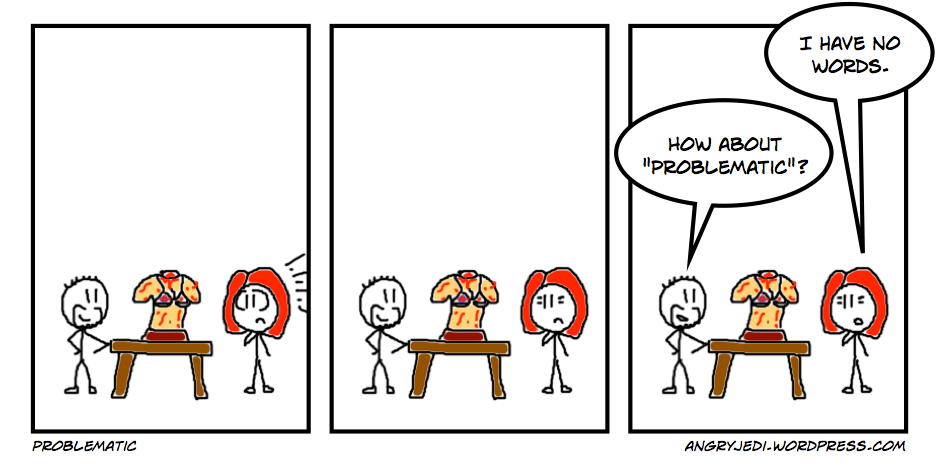
Such is the case with many of these things that have been declared "problematic" in recent months. A while back we had that beyond-stupid Hitman: Absolution trailer, more recently we had CD Projekt Red's actually quite excellent Cyberpunk 2077 trailer, and today we had the announcement of Dead Island Riptide's ridiculous "Zombie Bait" special edition. Leaving aside Cyberpunk 2077 for a moment, which is something of a different issue, both Hitman: Absolution and Dead Island Riptide are obviously incredibly stupid marketing ploys designed for shock value, little more. I find it honestly hard to believe that either Square Enix or Deep Silver genuinely want to condone violence against women or misogyny in general, but that is what they're being accused of with these "problematic" marketing materials — in the case of Dead Island, within minutes of the images hitting the Interwebs.

The thing is, all the shouting about how "problematic" these things are actually just plays right into the marketers' hands. For every table-thumping opinion piece that decries these things as the most awful thing ever dreamed up by a game's marketing team, there will be at least a few readers who will think "well hang on, actually I'm quite interested in that now," whether or not they actually admit to it in public. The amount of "OMG THIS IS AWFUL" stuff floating around about Dead Island Riptide's bloody torso is only really serving to make people more aware of the game's striking, gross (and Europe/Australia-exclusive) special edition; the hoo-hah over the Hitman: Absolution trailer likely helped raise awareness of the game in the run-up to its release to a considerable degree, and it had been all but forgotten by most people by the time the game actually came out.

In short, they're stupid and in poor taste, but all they are are marketing ploys, little more. And they're doing their job admirably — both games now have considerably higher visibility than they once had. As they say, all publicity is good publicity. If you really want to punish them, don't provide them with any coverage whatsoever.

The Cyberpunk 2077 trailer is a little more complex to discuss. Taken out of context, it could be seen as a representation of brutality against a sex worker — until it pans out and she reveals her MASSIVE FUCKING ROBOT SCYTHE BLADES, that is — but taken in the context of the original Cyberpunk 2077 source material from the '80s, it is, to my knowledge anyway, entirely in keeping with the aesthetic and atmosphere of that which it is based on. I observed some lengthy discussions about this on both Facebook and Google+ recently, and now that I know the context, it's clear that this trailer is entirely appropriate for the setting. One may argue that the use of a scantily-clad woman is somewhat unnecessary, and you might be right about that, but that doesn't mean that this is suddenly a huge violence against women issue. It's a stylistic choice; little more — a subversion of audience expectations. "A woman being abused by the police… oh wait, no, she's actually some sort of hideous mechanical monster with very little humanity remaining." (Spoilers.)

You could also argue that the requirement to be familiar with the source material before being able to recognise the trailer for what it is is something of a failing of the marketing, but then Cyberpunk 2077 was always likely to appeal to a very specific, niche audience — those who remembered the original tabletop RPG — anyway, so is there really anything wrong in catering to that specific, niche audience rather than attempting to make something bland, unremarkable and mainstream?

My point, essentially, is that by shouting and screaming about how "problematic" these things are, you're fuelling the fire. You're helping the things that you hate. You're making people aware of them, and not in the way you probably intend. It's a catch-22, really. If you say nothing, you might feel as if you're tacitly condoning things that you don't agree with; if you say something, you actually end up bringing it to a much wider audience, many of whom may become defensive when confronted with your viewpoints that counter their feelings.

The key thing, I think, is moderation. The trouble with the number of things that have been declared "problematic" recently is that it's losing its impact. We're apparently supposed to find so much stuff "offensive" these days that it's getting difficult to keep track — and who are the people who get to say what is and isn't offensive, anyway? Following the release of the Dead Island Riptide pictures today, for example, I saw a variety of comments from female gamers (as in, gamers who just happen to be female, not girls who make a big deal out of the fact they play games or specifically identify as "girl gamers") along the lines that it really didn't bother them and that they just found this sort of thing rather childish and amusing.

That, to me, is a more healthy attitude to take. All of the outrage I've seen today has been from men — always the same men, too, so much so that any time something like this comes up it's incredibly predictable who will be the first to jump on their virtual soapbox. It's easy to play the "champion of feminism" from behind a computer keyboard, but I have to question how many of these self-appointed arbiters of taste and decency have actually done anything beyond pen an angry blog post (yes, just like this one, I know) to help make life better for these groups they're supposedly standing up for.

Dead Island's bloody tits are a horrid thing you probably wouldn't want on your mantlepiece. Hitman: Absolution's nuns trailer was an exercise in how ridiculous a trailer they could get away with. I'm not defending either of them, because they're both shit, let's not beat around the bush. But I really don't believe they're symptomatic of anything more than marketing departments that are highly adept at taking advantage of "shock value". And attempting to make these into anything more than that will achieve little more than starting arguments that have little value to the real concerns, which are a much more complex set of sociological issues.

I like women and have never, ever thought of a woman as someone "inferior" to me. The thought of perpetrating violence against a woman in reality is, to me, abhorrent, but then the thought of perpetrating violence against a man is also, to me, abhorrent. But then I liked the Cyberpunk 2077 trailer, too. Does that make me an awful, hideous misogynist?

No, of course it doesn't. But what do I know? I like Hyperdimension Neptunia.

1091: You've Got... You Know

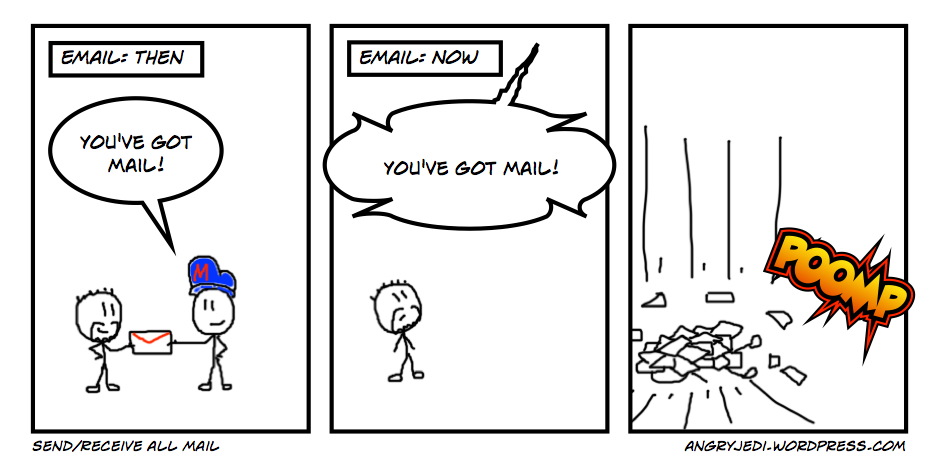
Page_1Speaking as someone who grew up with the early days of popular online activity (BBSes, CompuServe and finally the "proper Internet") I find it mildly interesting (or at least worthy of a late-night blog post, which isn't necessarily the same thing) how much the role of email has changed over the course of the last 15-20 years or so. I am prompted into these thoughts by a casual glimpse at my own inbox, which currently contains a devilish 666 messages, none of which visible on the front page are, to my knowledge, written directly to me by an actual human being.

This is something of a change from the earlier days, when clicking "Send/Receive Mail" in Outlook Express was an exciting moment, and you knew if the progress bar came up you had email incoming. Who would it be from? Would it be from someone interesting? What would they have to say? Would there be an attachment? In just a minute or two (LOL DIALUP) you would find out, and then you'd lovingly file the email into an appropriate folder to keep for all eternity. (I say "you" again when, of course, what I actually mean is "I". I don't know if everyone else was quite so fastidious with their email organisation when they first got online, but I certainly ran a tight ship… for a while, anyway.)

Looking at my inbox today, though, it's clear that email has a very different purpose today to what it once had. Whereas once it was effectively one of the only forms of social media (the others being forums and live chat rooms) it is now a general repository for crap. You'll occasionally get a meaningful message in there from someone who actually has a brain and a soul, but more often than not, if my inbox as of right now is anything to go by, it'll be a string of automated messages notifying you that so-and-so has added a new track to a playlist in Spotify (unsubscribe!), so-and-so has commented on something you don't give a fuck about on Facebook (unsubscribe!) or that that website you signed up for just so you could download a .zip file containing some porn/games that you wanted wants to wish you a happy birthday.

A relatively recent addition to the types of email you get nowadays is the guilt-trip "PLEASE COME BACK!" email. This happens with everything from mobile apps to online games, but the execution is always the same. "Here's all the great stuff you're missing out on!" it'll say, usually worded in such a way as to make you think that you're somehow doing something wrong by not using a service you currently have no need for. Often there will be some sort of bribe involved in getting you back, particularly when it comes to online games of various descriptions.

A Facebook game I reviewed a while back known as Outernauts was particularly bad for this. Outernauts was highly-anticipated by a lot of people because it was from a high-profile studio (Insomniac, for those in the know) and was aiming to be a social game that appealed to the sort of people who typically only played standalone, "pay once, keep forever" games on computer and console. It wasn't awful, but the overzealous means through which it was monetised — the ever-obnoxious "energy" mechanic — prevented anyone from being able to enjoy it for more than a few minutes at a time. Consequently, after an initial surge of interest, the very players it was trying to attract dropped it. Some months after I reviewed it and criticised it for its aggressive monetisation, it "relaunched", apparently with "fast recharging energy". It was still a pain in the arse to play. Some months after that, it relaunched again, this time promising "near limitless energy". Note: "near limitless", not "limitless".

I'm getting off the point slightly, but the fact is, every time Outernauts decided to do something a little different, it sent a begging email to me pleading for me to take it back, because it can change, it won't annoy me any more, it won't do that thing that annoys me any more. It was too little, too late, though; my experiences with Outernauts while reviewing it left such a sour taste in the mouth that I had (and still have) no desire to return, "near limitless energy" or not. That probably won't stop them sending me another email the next time they change something, though. Unless I blocked them. I might have blocked them.

Another offender in this sort of thing is a service called Earndit which I evidently signed up for at some point in the past. (I think I mistakenly signed up for it while looking for Fitocracy while the latter was still in closed testing; the two are different services but do have a few things in common.) Earndit sends me an email every week with sickly-sweet, overly-apologetic language about how I haven't earned any points this week, and that if they have it wrong I should get in touch with them PLEASE LOVE ME etc. It's annoying.

The response to all this annoying email is, of course, to unsubscribe from the mailing lists I've found myself on, send these messages to the spam folder or just to stop using my actual email address to sign up for things. But it's a pain to keep on top of. You can be as careful as you like to tick/untick the boxes that give websites permission to spam you with crap, but some will still get through, and over time there'll be so much incoming stuff that it's almost impossible to keep on top of your "unsubscribe" needs. The knock-on effect of all this is, of course, that genuine messages from real people can easily drift by completely unnoticed. If this has happened to you, it is nothing personal; you can blame Zynga, EA, Facebook, Twitter, Spotify, Google and indeed any of the million-and-one completely unnecessary social networking apps for mobile devices that I've reviewed over the course of the last year.

I miss the old days; the days when being notified you had a new message was exciting. Checking your email used to be a pleasure; now it's a chore.

1066: Doubleplusgood

There's been a lot of hand-wringing over both Facebook and Twitter recently, mostly due to both of them tweaking their terms of service in various ways that some people don't like very much. Me, I don't particularly mind too much because at the end of the day, I'm not paying for either of them, so as the saying goes, "if the product is free, then you are the product" — I accepted this some time back and think back on it any time one or the other of them does something apparently stupid. I use both daily to stay in touch with various people, so quitting either is out of the question.

For those feeling somewhat wary of the big F and the big T, however, I'd encourage you to give the big G another shot. (Unless you're one of those people who irrationally hates Google too, in which case… err, I hear Myspace is coming back soon?) Yes, G+ is still a smokin' hot social networking service that is far from the ghost town the media likes to portray it as. It's an active, thriving community that has only gotten better over time.

The latest addition to the service, and one which could well prove to be a "killer feature" with a little refinement, is Communities. Communities are little mini-networks within G+ that allow members to post content as they would do normally on G+, but keep it all within one community rather than sharing it publicly or having to use the slightly cumbersome "Circles" system. It's a good way of bringing people together who want to talk about the same thing, and it's pretty customizable, too — you can change the community's iconic image, title, headline and basic information, but also create categories for posts to help keep things organised, too. The latter feature needs a little tweaking — you can't reassign a post to a new category if you miscategorise it upon creating it, for example — but the groundwork is there for a solid community system.

And, crucially, people are using it. Google+ may not quite have the same number of daily active users as Facebook, but there are more than enough to make these communities active, vibrant places to hang out. The board games community I joined has over 2,000 members, for example, while there are over 3,500 bronies hanging out in the "Pony+" community. The anime community has over 20,000 members, as do various photography-related communities. G+ is an attractive destination for photographers, as it provides practically unlimited space for high-quality photo storage along with some basic editing tools — and the G+ interface is a nice means of showing off one's work, too.

G+ is built to be used on a variety of platforms, too. The mobile apps for both iOS and Android are quick to be updated with new features and are consistent in their behaviour and functionality. Pretty much everything you can do on the desktop website can be done from the mobile app — and the mobile app has the added bonus of looking rather lovely, too, for those who like that sort of thing.

So if you've got a Google account, give it a shot. And by "give it a shot" I mean do more than just open it up, complain that there's no-one to talk to and then close it down — like Twitter, you need to actually "follow" some interesting people before it starts to show its true value. The new Communities feature will help people find like-minded friends more easily, as this was one weakness of the old version — it was quite tricky to find new people to follow.

Here's some links to get you started. Here's my profile. Here's the Squadron of Shame Community. Here's the "Too Old For This" Community run by my buddies Chris and Jeff. Here's the board game Community.

Now get on there and get chatting! I'll leave you with this, from The Oatmeal.

1050: I Said A-Snark, Snark, A-Snarkitty Snark, A Snark-Snark-Snarkitty-Snark

Page_1Another day, another day of snark on the Internet. This time the sources were twofold: firstly, the Pope joined Twitter (and, apparently, his first tweet will be on December 12, begging the question why the account has been set up and announced now) and secondly, it emerged that Kate Middleton (or whatever we're supposed to call her now) is pregnant and suffering from "acute morning sickness", apparently.
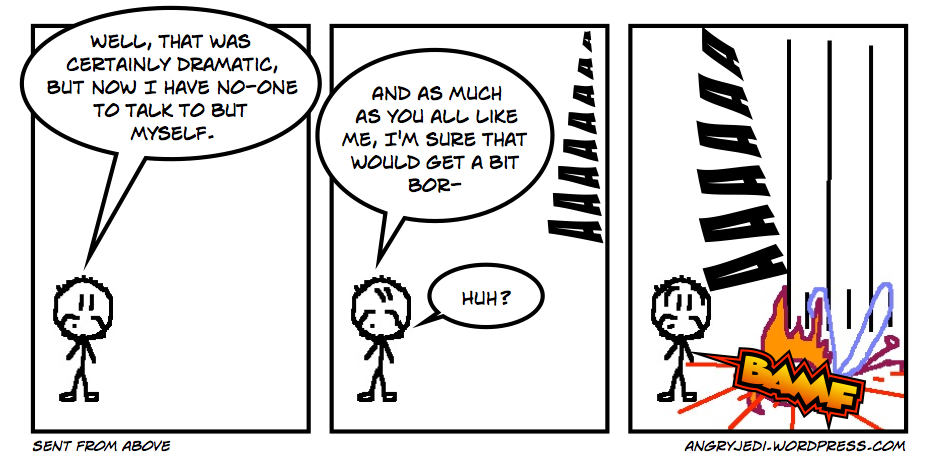
Neither of these things are of particularly earth-shattering importance, and both of them can be easily ignored. I have spent most of the day ignoring them both completely, and am only mentioning them now out of frustration — not at the things themselves, of course, but rather at the reaction to them.

The Pope's presence on Twitter was, of course, greeted by numerous sarcastic replies and fake retweets; the news of the "royal baby" (as it is now known) was greeted by general disdain and constant repetition of "THIS ISN'T NEWS". Well, whether or not it is is a matter of opinion, of course, but if you don't think it's news and have no wish to contribute to making it news, you could always, you know, stop talking about it.

I don't know if my weariness with this sort of thing is just a symptom of getting older or general fatigue at having seen so much snark over the past couple of years in particular, but either way… yes, I am tired of it. Because it doesn't let up, either. You can unfollow and block the people who are being a pain, but they'll get retweeted and quoted; you can close your social media windows altogether, but then you can't talk to your friends. (And when you are, at least for the next couple of weeks, a long way away from your nearest friends, yes this is a big deal.)

It is probably related to my general fatigue with the Internet-based slacktivists (previously discussed here) who rant and rave about a particular issue (usually, at the time of writing, sexism) until they're blue in the face but then don't appear to actually do anything beyond declare certain blog posts and articles "mandatory reading" and then ignore any attempts to actually engage in discussion or education.

The ironic thing with this behaviour is that it drowns out the actual message they're trying to convey. In the case of the fervent anti-sexism brigade, who are quick to splatter anyone who disagrees with them with the "privileged white male" brush — perhaps fairly in some cases, perhaps not in others — it means that the underlying message of tolerance, acceptance and equality gets lost in all the noise of people shouting and screaming and demanding that everyone unfollow a particular person on Twitter because they said something they don't agree with. (It wasn't me.)

Not only does it drown out the message they're trying to convey, it makes me care less, which is the complete opposite of what they're trying to do, surely. I don't know if anyone else feels this way, but I certainly do. The more these people froth at the mouth and shout and bellow and point fingers and demand that people read this article by their friend, the less of a shit I give — because I don't want to be associated with them. Not because I disagree with their ideals — as I've mentioned a number of times previously, I agree with what they're arguing for in most cases! — but because the confrontational, aggressive way in which they try to get their points across is just so completely loathsome to me that I don't want anything to do with it.

So I block them. I literally silence them. Which is exactly one of the things that they complain about, usually without any sense of irony that their own furious, righteous anger is itself intimidating and silencing people who genuinely want to discuss, engage and understand these complex, non-binary issues in greater depth.

I didn't take the decision to block a bunch of these people lightly, and I occasionally feel guilty that I have done so. Many of them are supposedly "respected" figures, and some are friends with people that I consider to be friends. But I haven't unblocked them.

Why? Because I have tried to engage them in discussion. I have tried to see these complex issues from a variety of different perspectives and talk about them accordingly. I have tried to have a rational, reasoned debate. And yet the last time I attempted to do this — I forget the exact topic now, as I unfollowed the Facebook comment thread shortly afterwards feeling genuinely upset — I was shouted down with the words "get a grip". No attempt to engage. No attempt to discuss or debate. No attempt to help me understand their points of view. A simple shutdown.

I gave up at that point. That is when I wrote this post. That is when I simply decided to avoid confrontation altogether and "stay out of trouble", as it were.

This isn't how it should be, surely. People should be aware of these issues and feel able to discuss them openly without fear. Fighting hate with hate is counter-productive and achieves nothing except alienating people like me while causing both "sides" of the debate to dig their heels in and argue ever-more aggressively.

#oneaday Day 994: I Don't Care

I'm coming to the rather cynical conclusion that I'm not sure I care enough about certain issues to want to shout and scream and rant and rave about them all day, every day. A big part of the reason behind this is the fact that people who do care enough about certain issues to shout and scream and rant and rave about them all day, every day are wearing me down significantly. I won't get into specifics, as that will likely only provoke more shouting, screaming, ranting and raving, but suffice to say I really can't be arsed with it any more.

I am fully aware that taking this rather apathetic attitude towards Big Issues makes me officially Part of the Problem. But, you know, I just don't care any more. I have had my share of shit things happen to me in my life — nothing on a par with the abuse and crap some social groups have to put up with, though, obviously — and I am just exhausted. I am 31 years old and I just want to settle down with a nice, quiet life. I want to have a nice house with a cat and/or a dog, a car that doesn't rattle when it goes around corners, a job that I enjoy that also allows me the free time to do things I want to do. I am partway there already (mainly on the job front) after a difficult couple of years, and I just do not have the energy to get upset and angry over things outside of my immediate situation any more. It's selfish, and I'm completely aware of that — and mildly guilty about it, to my annoyance — but it's true. I want my own life to be sorted before I try and fix the rest of the world, and I've still got a long way to go yet.

In honesty, it's not that I genuinely don't give a shit about the issues in question and don't think they're a problem. It's that any time a "discussion" on said issues comes up, it devolves within a matter of seconds into people throwing tables at each other, telling each other to "get a grip" or that Their Opinion Is Wrong. I've tried on several occasions to engage in such discussions in a reasonable, rational manner and every time this pattern has emerged, without fail. It's utterly predictable. Someone makes an inflammatory statement deliberately designed to provoke, someone else comes along with a counterpoint, then both sides gather the troops and proceed to bitch and scream at one another with no resolution being reached. Then the whole thing just happens again and again and again. In some cases, people in question repeatedly stoke the fire in an attempt to get the arguments to flare up again long after the initial flurry has passed.

I have one far-off friend in particular whom I otherwise like very much who I now feel I can't really engage with via social media any more because 90% of their posts seem to follow the pattern outlined above. This sort of person attracts like-minded individuals, most of whom are strong-willed and keen to argue their case aggressively. I hate unnecessary aggression and will do anything possible to avoid it, whether it's in actual conversation or on the Internet. If that means no longer talking to someone online, then it's a sad situation for sure, but it's what I'll do.

There's also the fact that in a lot of cases these screaming matches don't achieve anything whatsoever. A lot of the people who hold these strong opinions can very much talk the talk but then don't do anything to back up their bold words. If they took some sort of action regarding the things they feel so strongly about, I might be more inclined to care more one way or the other. But when the same old arguments arise day after day after day, I just get tired and don't want to engage with it any more. The impact is lost. I don't care any more. I just want to have a quiet life. If your points are making me — and doubtless plenty of others like me — feel like that, you are not arguing your case well.

Is that such a bad thing? Apparently so. But if it's wrong, to mangle the cliché, I really don't have the energy or give enough of a shit to be right.


#oneaday Day 962: Signal to Noise

We're reaching saturation point with social media. In fact, I think we got past that point a long time ago, meaning that we're at the "completely sodden and dribbling all over the carpet" stage.

There is too much social media. There are too many possible places for people to share things that nobody cares about with people they don't know. And it seems that every day some bright-eyed startup CEO decides that what we really need is yet another social network service of some description.

I've indulged in a few of these superfluous social networks over the years. GetGlue was a bit of fun, allowing you to "check in" to movies, books, games and even "topics" that you were interested in, leave comments and discuss things with other community members. This was at the height of the "gamification" craze, so there were plenty of achievements to collect, and you could even get some real-life physical stickers sent to you if you collected enough achievements.

Similarly, Foursquare and the now-defunct Gowalla proved fun for a little while. During the period of time when I was unemployed and quite spectacularly depressed, I made extensive use of Gowalla to "tag" various places around Southampton and assist with building up a crowdsourced map of places of interest. I even made some actual real-life friends through it, but since then location check-ins have lost their lustre — what's the point, really?

Then I tried Path, which promised to be a high-quality mobile-focused social network. But since you can access Facebook, Twitter and Google+ — the biggest social networks in the world — via your mobile phone, why on Earth would you need a mobile-specific one? Sure, Path had a lovely interface and the bizarre ability to track when you woke up and went to sleep, but it was ultimately pointless.

Today, I reviewed an app/social network whose purpose remained completely obtuse to me even as I made use of it — and even as an employee of the company frantically tried to convince me that the service was worthwhile via both Twitter and the service itself. (I'm not going to name it as I really can't be bothered to be chased further — I gave it a fair shot, I explored it, I found it to be a complete waste of time. Sorry.)

The service in question allows users to, like GetGlue, "Like" things. Any things. Like cake? Then "Like" cake. Like Tori Amos? Then "Like" Tori Amos. Not sure whether you like broccoli and stilton soup? Then add it to your "To-Do" list, then "Like" it if you like it. Great. Sure. Fine. One question: why?

This questionable usefulness was only further obscured by the fact that the app also, for some utterly unfathomable reason, allows its users to "plant" "Likes" at actual physical locations, meaning you can claim to have hidden, say, an iPhone 5 in your local McDonalds, or Jedward in your local sewage works. Fun for about five minutes again, sure — and a means of seeing who lives vaguely near you and likes Jedward — but again… why?

There's too much noise and not enough signal in social media these days, in short, and this fact is a big part of why I stripped back on all "non-essential" social apps a while back. I keep Facebook, Twitter and G+ around because there are people I regularly speak to on all of those, but outside of those "big three"? There's really very little reason for a lot of these services and apps to exist, but the amount of money being thrown at them by venture capitalists is terrifying.

Kind of makes me think that I should come up with an "innovative" idea for a mobile social network in order to attract several million dollars' worth of funding.

Okay… give me a minute.

Thinking.

Eureka! I got it. Everyone likes taking Instagram photos of food, right? Well, I propose a social photography network that is nothing but pictures of food with a selection of retro filters (some of which are available via in-app purchase). You can "check in" to the food you're eating, discuss it with other people and share photographs of your lunchbox. It'll be a big hit. I'll call it "füd", all in lower case, naturally.

That'll be two million dollars, please, Mr Venture Capitalist. KTHX.

#oneaday Day 936: Biggest != Best

No, I'm not talking about penises.

Let's talk about Facebook.

Facebook is massive. Facebook has taken over most people's daily existence on the Web to such a degree that there are plenty of people out there who genuinely believe that it is the Web. Like, all of it.

It's not. But then you probably knew that already.

But the fact stands that it is a massive global phenomenon, and something that has happily grown and evolved over time from its humble beginnings up to the multi-bajillion dollar business it is today.

Thing is, though, as it's grown, it's sort of lost sight of what it's for.

"Facebook is a social tool that connects you with people around you," the login screen used to say. When adding a friend, you used to have to indicate how you knew them, and the recipient of that friend request had to verify your story. It was actually quite a good idea that got around the MySpace "friend collecting" issue, whereby people would just add and add and add each other and then not talk to any of their 40,000 friends. Facebook's systems ensured that you 1) were actually friends with the people you marked as friends and 2) didn't fall into the "popularity contest" trap.

Whizz forward to today, and the Facebook of 2012 is a very different place. Now we get people promising "2,000+ friend requests" if you Like one of their pictures. I don't want two thousand friends. I want my online friends to reflect people I actually know, and occasionally give me the opportunity to meet someone new who is relevant to my interests and/or knows people that I know. Give me two thousand newcomers from all over the world, all of whom are vying for my attention simply to make some arbitrary number higher than everyone else, and you sort of lose that.

Part of the reason for this change is the different in what Facebook thinks we should use it for these days. I first joined the site quite a while after many of my friends had — at the time, I assumed it was going to be one of those passing fads like MySpace, and would quickly disappear into obscurity. But I found its value while on a trip to the States to visit my brother — while abroad, I could share the photographs I'd taken and easily stay in touch with my friends as a large group rather than emailing them individually. It was nice.

Over time, things started to shift. Facebook's big change to something a bit closer to its current layout upset a lot of people, and the addition of "applications" marked the beginning of how the social network looks now. At the time, I was of the attitude that the people complaining about it were bleating on about nothing, but in retrospect they may have had a point. As everyone's news feed started filling up with FarmVille brag posts, the signal to noise ratio started getting worse.

Then came the brands. Facebook undoubtedly thought they were doing everyone a favour when they opened up the previously "personal" social network to companies and businesses who wanted to grow their social presence. And in some cases, it worked well, with companies able to engage with their customers and post important information as and when needed.

Unfortunately, this too lost the plot somewhere. Now, pretty much every brand page uses the same obnoxious "engagement strategies" to keep people commenting, talking and Liking — the worst of which by far is the fucking awful "fill in the blank" status update that invites commenters to give their own meaningless opinion on something utterly asinine and irrelevant to the company's product. ("My favorite color is ____________!" proclaimed the Facebook Page for The Sims 3 on one memorable occasion. Over four thousand people replied.)

You see, people seem to absolutely love posting things that have absolutely no value. People love thinking their opinion is important, that they are being listened to, that the things they say are somehow valuable to someone.

The things you say are valuable to someone. The people they are important to are called your family and friends. Not the PR representative for The Sims 3. They don't care what your favourite colour is. They just want you to keep giving them page impressions and comments and Likes.

Likes. Fuck Likes. The Like button is Facebook's most enduring legacy, and one of the biggest blows to actual communication in today's connected world. Why comment any more when you can just click "Like"? It means nothing, particularly when it's connected to a sentence for which the verb "like" is completely inappropriate. ("My grandad died. So sad right now." "Insensitive Twat likes this.") It's a meaningless metric designed to measure how many people have seen something you have posted and want to interact with it, but are slightly too lazy to actually write anything.

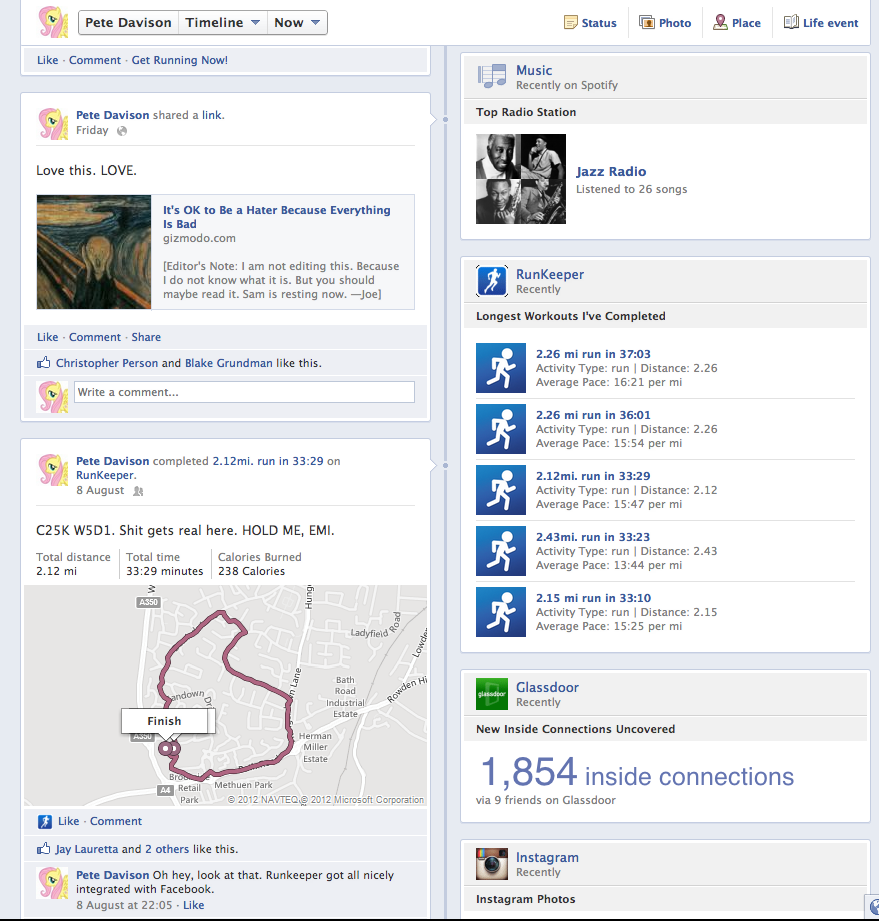
The diminishing sense of Facebook's usefulness for actual communication is perhaps best exemplified by the current way someone's profile looks. Known as "Timeline", the theory behind it is that it is an easy to navigate history charting everything interesting that has happened in someone's life.

It's a sound plan. Unfortunately its implementation is just terrible.

The problem is that there's no consistency in how posts show up, and seemingly no understanding of how people read content. Leaving aside the fact that one's profile cover image and fairly pointless basic information takes up over 500 lines — or nearly half of a 1920×1080 display — there's seemingly no rhyme or reason as to what gets posted at the "top" of one's profile.

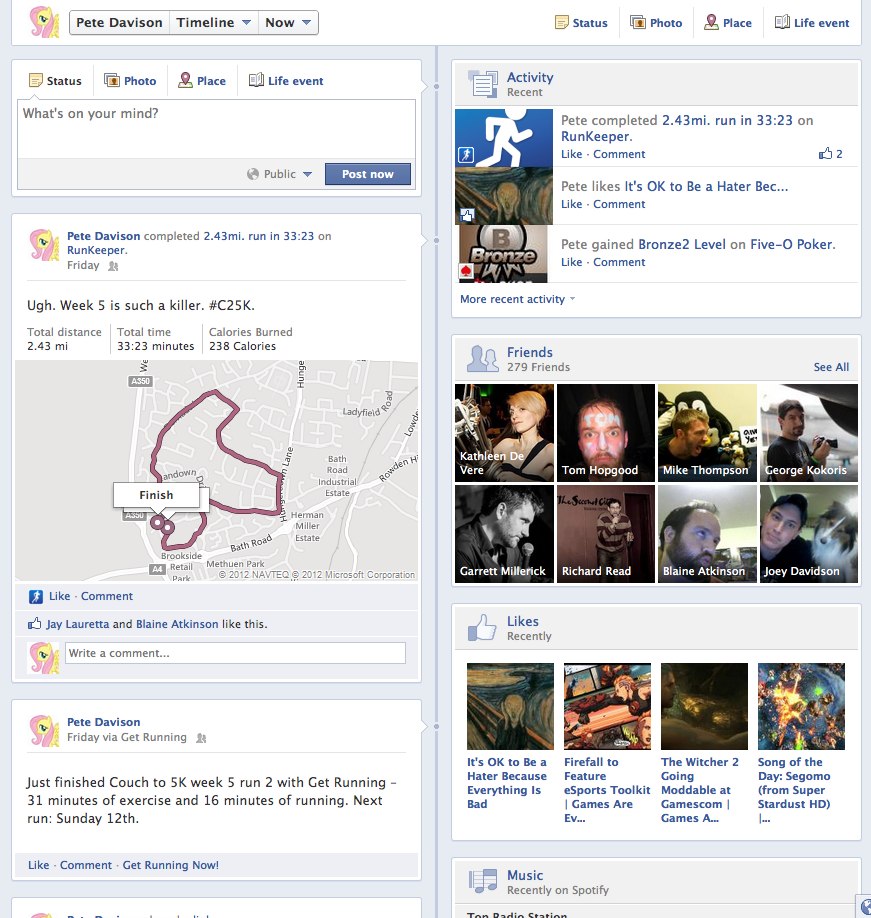
The conventions established by blogs and earlier social networks dictate that the most recent things go at the top, so anyone checking in on someone's page doesn't have to scroll around or search to find something new. Yet with all the sources from which Facebook can pull information these days — games, external sites, apps, Spotify, Netflix —  there is no consistency in what goes where. For example, at the time of writing, this is what the top of my Timeline looks like:

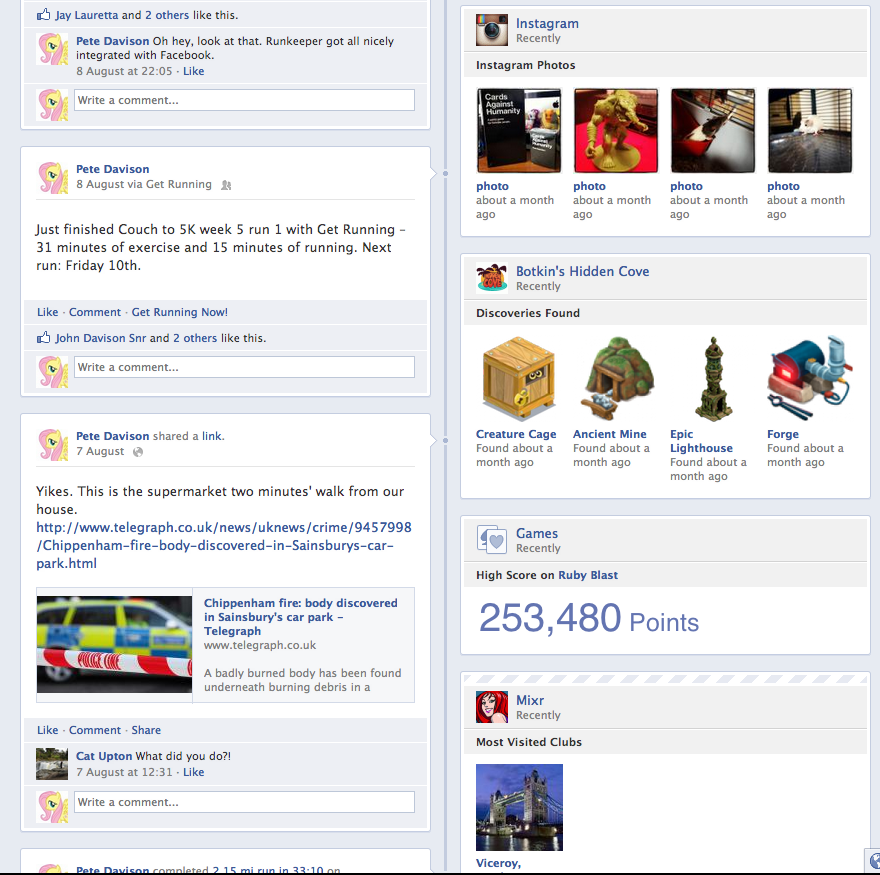
What a mess, and very little of it is stuff that I 1) actively shared and 2) feel people really need to know. I deliberately shared the RunKeeper stuff because I like sharing my fitness achievements because it helps keep me honest, but I have no need to show people who eight of my friends are, nor do people need to know that I achieved Bronze Level 2 in Five-O Poker, a game I reviewed earlier in the week and specifically told not to share shit on my timeline. At the other end of the spectrum, pages that I have "Liked" elsewhere on the Internet — and thus wanted to share with others, perhaps because I wrote them or just found them interesting — have been unhelpfully collected into a single box that shows just four of them. This behaviour changes seemingly daily, with Liked pages sometimes showing up as individual posts on one's Timeline (useful) and sometimes being collected into that box (not useful). At the time of writing, Facebook appears to have decided that "not useful" is the way to go on this one.

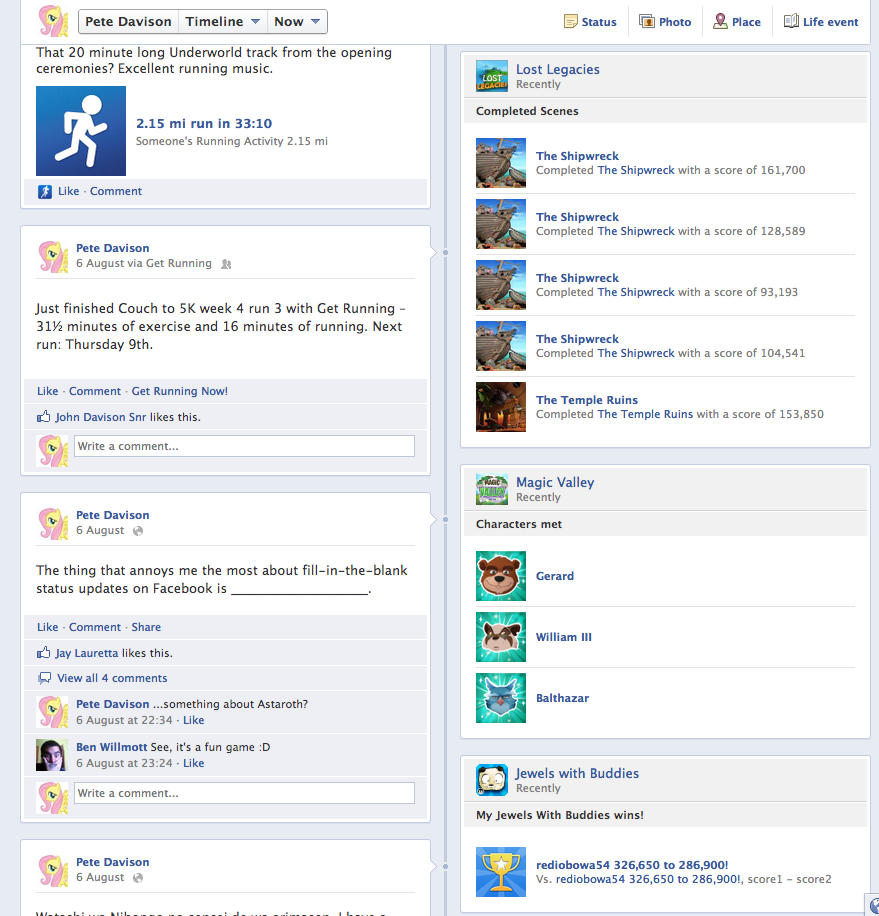
Let's scroll down a few "page heights" and see what else we have:

The left column? Sort of all right. The right column, though?

SO MUCH IRRELEVANT CRAP.

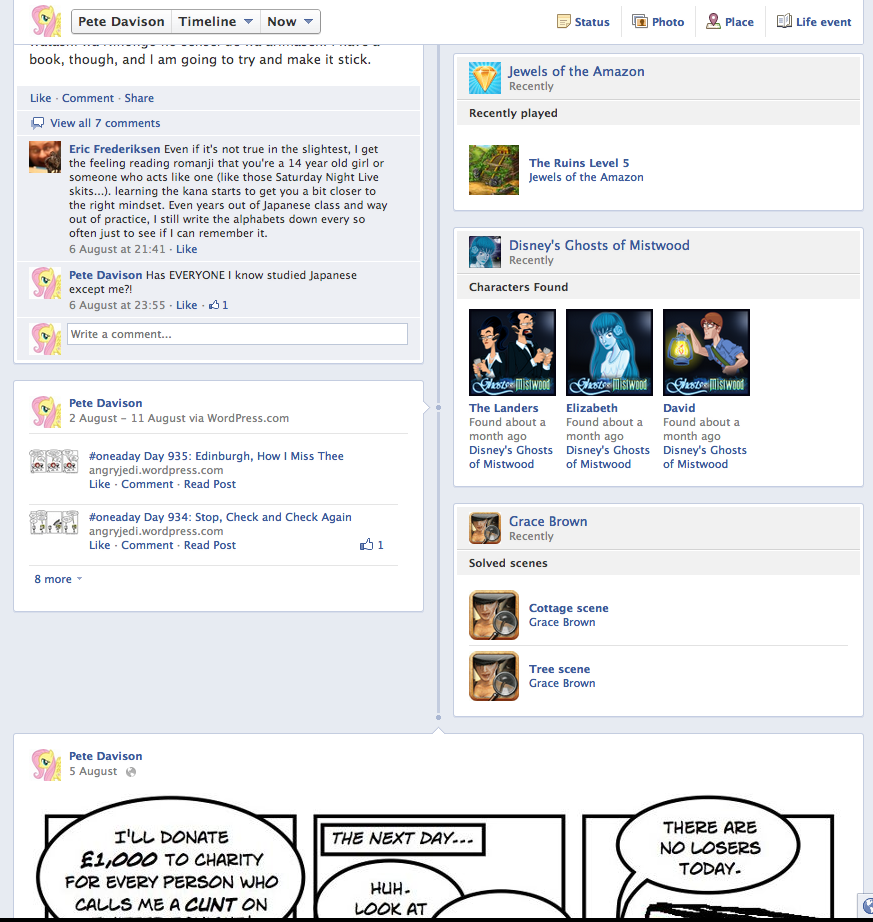
Including posts from games that I 1) didn't press a "Share" button in once and 2) have since removed from my Facebook account.

There. After five screen-heights worth of scrolling, I finally get to one thing that I actually want to share with people — my recent WordPress posts, aka a feed from this blog to my Facebook Timeline. Again, though, like the Likes, they have been collected together into a box that displays very little relevant information and, in this case, is put in a stupid, stupid place. Why stupid? Because the most recent post in that little WordPress.com box came considerably after the RunKeeper post at the top of my Timeline — and certainly considerably after all the spammy crap those games have plastered all over that infuriatingly useless right column.

"Facebook is a social tool that connects you with people around you" my arse. "Facebook is a digital scrapbook maintained by a five-year old with ADHD," more like.

I'll see you on Twitter.


#oneaday Day 914: Chinese Whispers

Twitter was angry today. There was some degree of justification — the horrific shooting in Aurora at the screening of the new Batman movie had emotions running high, and I certainly don't begrudge anyone that. But it demonstrated, once again, some of the dangers inherent in social media — a force which should, by all accounts, be a positive thing.

Misinformation spreads like wildfire on the Internet thanks to services like Twitter. People post things without thinking, without bothering to back things up with research and evidence. Journalists encourage this, with TV news being a particular offender, inviting people to contribute their own thoughts on a particularly pertinent story using hashtags. It thus becomes something of a challenge to determine exactly what the facts are, and what is simple hyperbole dreamed up by the increasingly-hysterical mass of people who suddenly all think that They Know Best.

I shan't talk too much about the Aurora shooting specifically here because I haven't read up on all the gory details myself as yet. I will refer to a couple of other recent incidents where this phenomenon became particularly apparent, however.

Most recently was the "Arctic Ready" campaign, in which Shell apparently made the amateurish misstep of opening up a slogan competition on a controversial subject — drilling in the Arctic — to the public. The "Let's Go! Social" gallery page promptly became filled with anti-drilling, environmentalist slogans and it looked, by all accounts, to be one of the most colossal fuck-ups in social marketing history.

Except that it wasn't. It was actually a genius piece of social marketing, but not by Shell. No; the whole thing was, in fact, a clever ruse by Greenpeace, who then went on to troll Shell even further by picking a "winner" from the supposed competition and putting it on a billboard right outside Shell's Houston headquarters.

It should have been pretty obvious to anyone who stopped to think about the whole thing for a moment that this clearly wasn't Shell's doing. The kind of people who handle social media marketing are generally fairly savvy sorts (though there are exceptions) and would have stepped in to deal with the mass trolling of the supposed competition. In fact, they would have probably removed it altogether fairly sharpish. They certainly wouldn't have left it up for several weeks, opened up a new Twitter account just to repeatedly request that people don't retweet "offensive" adverts and generally keep poking the fire.

Unfortunately, it wasn't obvious to a lot of people. It caught people out not once, but twice — first, when the "Arctic Ready" site first appeared, and again a few weeks later when the Twitter account appeared. People posted, retweeted and commented without stopping to think about whether or not it was real. Others who were wise to it posted, retweeted and commented about how it was clearly fake. But amid all the noise from both sides it became impossible to differentiate who was talking sense and who was simply repeating the digital equivalent of what they had heard down the pub while drunk.

The Shell incident isn't the only one either. The "Today Is The Day They Went To In Back To The Future Part II" hoax has been around twice, too. Both times it caught people out. Why? Because, again, no-one bothered to check. No-one took a moment to fire up the movie and take a look. If they had, they would have seen that the claims made by whoever started that ridiculous rumour on each occasion were patent nonsense.

It happens in journalism too, and particularly in games journalism. One site posts a "Rumour:" or "Report:" story, and others pick up on it. The content spreads and becomes somewhat distorted over time. It happened today with a story from MCV which, as it turned out, apparently misreported the facts in the first place (or rather, more accurately, posted a story with a misleading headline) and was then sourced by Destructoid and a ton of other sites. This then inspired Ben Kuchera, official unelected and self-styled arbiter of How To Do Games Journalism On The Internet, to pen this piece bemoaning the whole situation, and by God I hate agreeing with Ben Kuchera — but he had a point. With a bit of research (or indeed just carefully reading the quotes that MCV included in its own piece) it's clear that the "story" (or, more specifically, the headline) that was going around simply wasn't true.

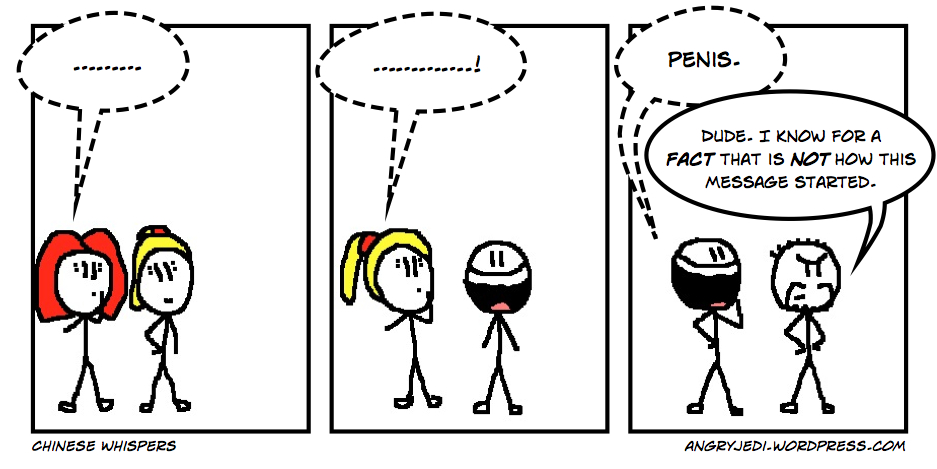
It's exhausting at times to keep up with all this stuff, and while it's great to be able to tap the pulse of everyone at the same time on a hot topic, it's less great to find yourself in the world's biggest game of Chinese Whispers. So do me a favour. Before you blindly retweet something that seems a little "off", take a minute and check to see whether or not it's actually genuine.

#oneaday Day 909: The Internet Is As Big As You Make It

Over the years, my Internet habits have changed significantly. This has been at least partly due to changes in technology over the years, but I still find it an interesting observation to think back on how times have changed since I first "got online."

My earliest experiences were with CompuServe which, for the unfamiliar, was somewhat like an online "walled garden". It included much of the things we take for granted on the Internet today — email, topic-specific forums, places to download stuff, real-time chat and probably, if you looked hard enough, something which could be used by someone as porn. Initially, you were limited to talking only to other CompuServe subscribers, but over time access opened up: firstly to allow emailing to Internet email addresses, and eventually to access the Web proper. I remember vividly trying (and failing) to get the browser Mosaic to work with CompuServe.

At this time, since I was just a kid and living at home, my Internet (or equivalent) access was severely limited. I had to plan out what it was I was going to look at (usually the Gamers' Forum and occasional delves into the "CB Simulator" — aka real-time chat rooms — to try (and fail) to pick up girls. (a/s/l?)

Over time, the Internet opened up to all, and we were all able to gain access to the information we wanted and some we didn't. The best free porn sites were (apparently) passed around in the schoolyard; the best sites to download shareware games were common knowledge; little communities started to spring up as people figured out things like "forums", "personal homepages" and "search engines".

Fast forward to today and, with an Internet that is growing at a frightening rate, I find myself limiting what I'm doing to a very small number of sites. Despite becoming increasingly irritated with it, I check Facebook. I check my GMail. I check in on the Squadron of Shame Squawkbox if there's been a new post. I write this blog. Occasionally I might check a gaming site for news of something I'm interested in, but that's really about it. I tweet from my phone and everything else that I really want to do is covered by those sites — and Google if I can't find the information I'm looking for straight away. I find myself going around and around and around the same sites over and over, hoping that something new and interesting has come up in the five minutes since I last looked. (It never does.)

One thing I've found myself not using anywhere near as much as I used to is dedicated, specific communities. Every time I find a forum that looks vaguely interesting, I might check it out and post there for a few days and then promptly forget all about it — even if it's a community I have little doubt that I'd really enjoy being a part of. This is kind of sad, since it limits my contact with people who are specifically in to the exact same things as me, but it's primarily a result of the fact that forum software tends to not play overly-nice with mobile devices — which, nine times out of ten, is the place where I want to be casually browsing. (Okay, a lot of forums bring up that annoying popup about Tapatalk, which I've never tried and might be the best thing ever, but still.)

It's mostly a time issue. I have lots of things I want to do every day, and I rarely (no, make that never) get to do all of them. So far as "priorities" go, checking forums, posting things and getting to know yet another online community is not particularly high up the list.

Perhaps it should be. There are a lot of things I am into that I would like to talk more about with others. Without thinking very hard, I can immediately point to both My Little Pony and The Secret World as communities I would like to be more involved with. And there are doubtless more out there. When I think about how vapid and pointless 95% of the conversations on Facebook are, I do sometimes wonder if my "social" time online could be better spent in a more focused community rather than browsing creepy baby photos posted by people I haven't seen since school.

Perhaps I should leave my own prejudices at the door and jump in to one of these communities to see what will happen. You never know where new friends are lurking, after all.