1242: Sod Off, LinkedIn

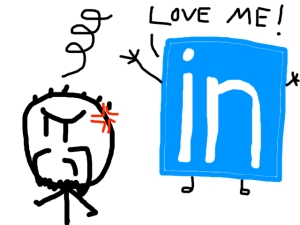
Jun 13 -- LinkedInI have a LinkedIn account. It is one of those things that people recommend you have. And yet I don't think I have ever used it. Not for finding a job, not for "professional networking" and certainly not for socialising. In fact, I find the whole thing massively irritating.

The thing that irks me so much about LinkedIn is that the people who do actually use it are inevitably the sort of greasy smarmballs who refer to themselves as "entrepreneurs" and "gurus" (neither of those are jobs; sorry to burst your bubble) and run "startups". They communicate exclusively in that particularly annoying brand of business-speak that gave us such awful additions to the English language as "monetise" and "leverage" used as a verb.

That's not all, though. LinkedIn itself perpetually bombards you with emails about what's "hot" on their network each week, and again, the articles linked to are almost certainly written by people who woke up one day, decided they were an expert on "business" and promptly started vomiting their thoughts all over the Internet.

This sort of thing occasionally spills over onto other social networks, particularly Google+, which appears to harbour a healthy number of LinkedIn refugees. You can spot one of these people's posts a mile off — they're inevitably an image post featuring some sort of "inspirational" image, and the accompanying text usually makes the person posting the image sound like they're a 50-year old discovering Imgur for the first time.

But I digress.

No, I find LinkedIn utterly useless because no-one I have come into contact with on there appears to use it for… well, anything at all, really. I have a "professional network" that is, apparently, 236 "connections" strong, and yet I have never spoken to any of them on LinkedIn. Many of them I speak to daily on Twitter and Facebook, which leaves LinkedIn rather — if you'll pardon the employment-related pun — redundant. The people I have as connections on LinkedIn who I don't speak to daily on Twitter and Facebook are generally people whose mobile apps I might have reviewed once in the past, and this apparently makes me a "professional connection", even if I slated their app for being shit. (I did that a fair bit; there's a lot of shit out there.)

I find myself wondering why I keep an account open at that God-forsaken website, but everyone I mention it to seems to think that you "must" have a LinkedIn account these days, otherwise you're some sort of unemployable nobody. I guess if nothing else it provides a reasonably convenient means of creating an electronic CV that can be easily shared with employers. The Recommendations thing is a good idea in theory, too — though the fact that they don't show up on your "public" profile, only to people who have actually added you as a connection is irritating — but these appear to have been superseded by "endorsements" whereby people who remember to log in to LinkedIn every so often click through a few automatic prompts to confirm that yes, I do indeed have skills in "Facebook" and "iOS", without even thinking about it.

Basically, LinkedIn represents all that is wrong with the social Web. It's full of self-important imbeciles who believe they are the ones who know how the world works, and that everyone else is wrong. It's utterly vapid and useless to 95% of the population, and the other 5% you probably wouldn't want to speak to anyway.

So yeah. Fuck LinkedIn.

1191: Social Burnout

I've been thinking this for quite a while, as you've probably noticed from past posts I've made on the subject, but I'm beginning to feel completely burned-out on social media. Everything has to be social these days. Everything has to have little like buttons and little comment buttons and allow every denizen of the Internet to spew their ill-informed thoughts and opinions over it, or to share it pointlessly to Facebook.

Earlier today, I was distressed to discover that an official Pizza Hut app is coming to Xbox 360, presumably aimed at those people who find phoning, using a mobile phone app or using the Internet to order a pizza too easy and would instead prefer to do so by navigating the monstrosity that is the Metro interface. One line in the Polygon article about it — here — jumped out at me and kind of drove it home how "way too far" we've taken social media these days. Here it is:

"After submitting an order, users can share their choice with friends via Facebook."

Why. Why. Why why whywhywhy would you want to do this?

Pizza Hut aren't the only offenders in this regard, of course — Amazon offer a convenient facility to tweet or share on Facebook anything that you've just bought, as do a lot of other websites. You can even set up the PlayStation 3 and Vita to automatically share every purchase you make on PSN to Facebook. And every time I see this facility, I wonder why on Earth anyone would want to use it. But apparently people do.

This glut of auto-sharing is killing the original point of social media, which was to allow people to engage in conversations with one another by sharing things that were important to them. Now, it's more like a convention of ADHD sufferers running around going "I JUST BOUGHT A PIZZA! LOOK AT THIS VIDEO OF A DUCK RUNNING! HERE'S A PICTURE OF A CAT! I'D SAY SOMETHING PASSIVE-AGGRESSIVE BUT 'SOMEBODY' WOULDN'T LIKE IT!" rather than what I remember my early experiences with Facebook being like.

I vividly recall resisting signing up to Facebook in its early days, because everyone seemed to be doing it and I just couldn't be arsed with it. When I eventually started using it, however, I was impressed to discover a site that was seemingly built for real-life friends. Any time I added someone to my friends list, I had to indicate how I knew them, and the other person had to verify that story. My profile was only visible in full to those whom I had marked as a friend, and there weren't really any privacy settings to worry about. Stuff that was shared was the sort of stuff you'd share if you were actually in the same room with friends — what you'd been up to, some photos from your holiday, perhaps a longer piece of writing in the form of a "Note". No games, no spam, no "I Fucking Love Science" posts. Just actual interactions. The Like button was there, but it didn't have the all-encompassing power it has now, and people hadn't really started using it as a substitute for actually saying things.

Now, though, with the proliferation of "LIKE IF YOU HATE CANCER, SHARE IF YOU LOVE KITTENS" posts, the signal-to-noise ratio is all out of whack, and people are used to posting tons of crap while simultaneously saying nothing of value. This has the side-effect of meaning that when you actually want a response from someone, it's quite difficult to get one. The other day I attempted to find someone to take care of our pet rats while we're on holiday in Canada; the only responses I got were jokey, non-serious ones, and within a couple of hours it had dropped off the face of everyone's News Feed, never to be seen again… unless I were to slip Facebook $7 to "promote" it, of course.

Or take today, when I saw someone post an actual non-rhetorical question that needed an answer, and the first response was a "Like".

Not helpful. At all. You "Like" my question? Great. Do you "Like" it enough to actually fucking answer it, perhaps? No? Then piss off. I'm not so desperate for validation that I count the number of "Likes" a particular post gets and see it as some form of brag-worthy e-peen.

That said, if you want to "Like" my new "K-On Girls Wear the Union Jack" fanart cover photo, feel free.

Sigh. I'm such a hypocrite.

I've been rediscovering forums recently — I was a member of a My Little Pony forum for a while before it shut down due to admin drama, and I'm currently taking some tentative steps into the RPG Maker community. While forums have their own issues — largely people being a little lawyerish about the community rules and regulations — I'm beginning to think they're not such an outdated means of discussion as many seem to think…

1186: Don't Hate

There's a curious phenomenon in comments sections around the land. And that phenomenon is that it is seemingly the law that someone, somewhere, must hate everything. Actually, that's badly phrased; I don't mean that one person hates everything — though I'm sure there are people who do — but instead I mean that whatever the thing that has been posted, there will always be at least one person who dislikes it for some reason and is inevitably the sort of person who is very vocal about their dislike of it.

This seems to happen particularly frequently in sectors that already have passionate userbases, or in which the userbases are seen as being a "subculture" and/or outside the "norm" somehow. I'm thinking specifically of the video games and anime sectors here — and before you start on me, for all the massive steps forward these media have made in terms of mainstream acceptance over the last 20-30 years they are still indelibly tarred with the "geek" brush to one degree or another.

Today, I was exploring the RPG Maker community who, by all accounts, appear to be a fairly friendly and helpful bunch for the most part, as I've previously mentioned. I was curiously browsing through some of the other users' projects in progress and came across a few interesting-sounding games. One of the users noted that they had submitted their game to Steam Greenlight, the process whereby a game can end up being sold on Valve's popular PC gaming digital download storefront if it gets enough positive votes from the community.

The game, by all accounts, sounded interesting and unconventional, and something I'd be intrigued to play. It was an "artistic" game, for want of a better word, designed as a means for the author to show what it was like living with depression. The author said upfront on the site that it was a mostly-linear, narrative-centric experience with a lot of text, and made no apologies for this fact. (For people like me, the terms "narrative-centric" and "lot of text" are selling points, not things to be ashamed of!)

Sadly, the Greenlight comments section was less than supportive for various reasons, featuring disparaging remarks for everything from it being "another depression game" (oh, sorry, there have been so many of those) to dismissing it simply because it's an RPG Maker game. I've made my feelings on the latter point quite clear in the past, but they bear repeating: if a tool is available to help someone realise their artistic vision, there's no reason why they shouldn't use it, regardless of how many other people are also using it. And besides, some of my favourite games in recent memory have been RPG Maker titles — Corpse Party, To The Moon, Cherry Tree High Comedy Club… all of them were made in earlier versions of RPG Maker that were considerably less sophisticated than the excellent toolset that is VX Ace.

But I digress. The point is that the comments section was filled with hate for the sake of hate rather than actually constructive feedback. The fact that the game in question (Actual Sunlight, I believe it was called) was "another depression game" and an RPG Maker project had nothing to do with its quality, or its "value" to the Steam community as a whole, and yet these things were used as reasons to reject it, without even bothering to check it out.

In the anime sector, it seems that it's fashionable to hate on whatever the biggest name show is at the time. Most recently, this has been seen with Sword Art Online, which I found to be a rollicking good time with an astonishingly spectacular soundtrack, some memorable characters and an interesting, intriguing and pleasingly mature (for the most part, anyway) storyline. It was a good show, in short; while it perhaps wasn't the most intelligent anime you'll ever see, it was certainly far more than a dumb, formulaic show.

Perhaps not something everyone would want to watch, no, but certainly far better than the overly-negative comments that would appear on J-List's Facebook page any time site owner Peter Payne posted a piece of artwork relating to SAO. (Granted, J-List's Facebook page is a place where any time a picture of a vaguely attractive anime girl is posted, one specific user will always be along within three comments of the start of the thread to helpfully inform everyone that "[he] would fuck her", so it's perhaps not the best place to go for objective criticism, but still; you'd expect a community of Japanophiles such as the followers of J-List's page to be a bit more enthusiastic about the things they supposedly like!)

I honestly don't get why this happens, and it seems to happen a lot. Why waste your time on hate when there is so much stuff out there to get you excited? Wouldn't you rather feel happy and intrigued by something than angry or upset?

1184: For the Love of God, Please Learn About Snopes.com

Hello, you, random acquaintance and/or friend of my parents on Facebook. Yes, you. The one who has been clicking "Like" and "Share" on everything from posts that imply you want cancer to kill everyone if you don't click "Like" to posts that wilfully spread misinformation, such as accusations that Red Bull causes brain tumours, that baby carrots are saturated with chlorine, or that aspartame causes cancer, brain tumours and multiple sclerosis.

You know who you are.

I'd like to introduce you to a website. I'd like you and this website to become best friends. I would like you to go to this website any time you find yourself questioning the validity of something that someone else asks you to share. I would like you to check this website before you share the thing that someone asks you to share. And if this website informs you that the thing that someone asks you to share is not, in fact, true, please politely tell the person who asked you to share the thing about this website, and direct them to the relevant entry debunking the thing they asked you to share. (Conversely, if this website informs you that the thing that someone asks you to share is, in fact, true, feel free to share as you see fit, but please stop using quite so many exclamation marks.)

This website is called Snopes.com.

It may not look like much, but it has been around in one form or another since 1995, and has been debunking chain letters and other urban myths ever since. It is a valuable resource that has been proven on numerous occasions to be both accurate and reliable. Please use it.

The reason I bring this up is that the unpleasantness that accompanied the Boston Marathon yesterday has brought with it a number of stories that are complete fabrications, and which have nonetheless found themselves spreading at an alarming rate across all varieties of social media. There is a convenient page summarising all of the claims made about the Boston Marathon and the events which supposedly occurred there right here. Please read it. Please familiarise yourself with it. Please take note of which stories are completely false and/or based on inconclusive, unproven information. Please do not share stories which have been proven to be false, or which are based on inconclusive, unproven information.

You may feel that there is "no harm" in "raising awareness" of issues by sharing things like this, even if they are not true. Unfortunately, that is not the case. By polluting social media with falsehoods, it becomes difficult for people who are personally invested in an unfolding story such as the Boston Marathon bombings to determine what the facts really are. By polluting social media with falsehoods, you run the risk of causing considerable distress to these people who are likely already very emotional. By polluting social media with falsehoods you continue to perpetuate a cycle where people willingly share misinformation in lieu of actually doing something useful, because clicking "like" and "share" feels like you've done your bit. And, frankly, by polluting social media with falsehoods, you make yourself look uninformed at best; gullible and stupid at worst.

So use a bit of common sense, will you? The next time something sounds unbelievable, it probably is; before you jump on that "Share" button, pay a quick visit to Snopes.com and look up the key points. And if Snopes.com tells you that the claims are complete rubbish, for heaven's sake don't just share them anyway. Educate the person you saw them from. Teach them about Snopes.com. And hopefully together we can make the world a less ignorant place.

1169: Suffering Fools

The Internet has ruined April Fools' Day.

That's the sentiment that seems to have been prevalent on social media for most of today. And to be fair, it has. Between Operation Rainfall's teasing of games that will never exist (Catherine 2, The Last Story II, Theatrhythm Deus Ex) to the utterly cringeworthy press release I received earlier claiming that Doodle Jump is becoming a Broadway show (seriously, guys, 1) Doodle Jump hasn't been relevant for several years now, and 2) try harder) it's been a thoroughly irritating day to be online. Thankfully, a significant proportion of the press seems to have grown up a bit and is refusing to play along with these shenanigans, but there's just as many reputable publications putting out exceedingly lame "jokes" that they really should know better than to post. The Guardian producing special liberal glasses that block Richard Littlejohn columns? Hilarious. The New Statesman rebranding entirely in Comic Sans? Oh, help me, Doctor Tendo, for my sides have split.

Thinking about it, though, I'm not sure April Fools' Day has ever been particularly… well, fun. Sure, the stuff Google comes up with is often mildly amusing, but for the most part it seems to be a day where people think that lying as much as possible is an adequate substitute for being genuinely entertaining. That's sort of mean when you think about it, really.

I'm trying to think back to a time before the Internet (yes, young 'uns, we did live in such dark times once) and whether or not April Fools' Day was fun then. I have a peculiar feeling that it wasn't. I recall a time at school when everyone suddenly and inexplicably learned the word "gullible" simultaneously for some dark purpose, and it was a hellish few weeks of people making up outlandish stories and then jeering "HAAHAHHAAH GULLIBLE" and running away if you even looked like you were about to say "really?" April Fools' Day is just like that, really. An opportunity for unfunny twats to be particularly unfunny twats and think they're being Comedy Gods.

I know it's all a bit of fun and I shouldn't be so grumpypants about it. But as with so many things on the Internet, oversaturation leads to cynicism and active dislike. And over the last few years, we've seen so many painfully obvious April Fools' Day jokes that it's just a bit old now. By far the most laughable example was the Doodle Jump press release I mentioned earlier — that actually really made me quite cross, though I restrained myself from rebuking the sender with a tersely-worded response — but that's far from an isolated example.

To quote my former editor Mr Jason Wilson: "Journalism isn't about jokes. No one for a journalistic site should be making up shit. No one at a PR agency should be, either. Send me that BS and you go straight into my 'you suck at PR' folder."

Quite. The news is enough of a disorganised mess in which it's a nightmare for some stories to get noticed anyway; quit cluttering these channels up with your made-up crap. It's not big, it's not clever and it's not funny.

This has been your Grouch for the day. Tomorrow I will write about something nice.

1158: Forking One's Dongle

Page_1Some of you may have been following this recent unfolding story via the social Web and other avenues, but I thought I'd mention it here for those who haven't seen it. I am talking about the recent incident at PyCon, a conference for Python developers all over the world.

There's a comprehensive rundown of what happened over at VentureBeat (and follow-up here), but in case you can't be bothered to read all those difficult words, here are the pertinent points:

  • "Evangelist" is an actual job title these days outside of the religious community. Sweet Jesus. No pun intended.
  • Adria Richards, a "developer evangelist" for a company called SendGrid that has something to do with email (I don't really understand it, to be perfectly honest, but that's not massively important) "called out" two male developers during a keynote session at PyCon for making allegedly "sexual" jokes about "forking repos" and "big dongles". She did this by taking a photograph of them and then posting it to Twitter.
  • "Forking a repo" apparently refers to taking a piece of source code and developing it into a new piece of software not, you know, fucking it, despite the fact "I'd like to fork that" is a somewhat innuendo-laden phrase, particularly if you say it like a Cockney while rubbing your thighs, which reports don't suggest these two gentlemen did.
  • "Dongle", a piece of hardware that allows a particular function to happen, is an indisputably funny word because it has the word "Dong" in it. "Dongle" is also ripe for innuendo because it has the word "Dong" in it.
  • The inevitable Twitter shitstorm kicked off as a result of Richards' tweet.
  • Richards started receiving rape and death threats but continued to feed the trolls.
  • One of the developers in the photograph was fired after the incident.
  • One of the developers (I'm not sure if it's the same one who was fired offhand) apologised to Richards.
  • SendGrid suffered a DDOS attack following the incident.
  • SendGrid fired Richards today, explaining that the company supported her right to speak out against content she found objectionable, but not in the very public, provocative manner in which she did so.
  • ???
  • Profi– wait, no, that's something else.

Now, I've said a number of times on here that I recognise and accept that women in the tech industry generally — not just the video games sector — are in a difficult position, having to compete against something of a "boys' club" mentality. And these women should speak out when something inappropriate is said or done to them.

This incident, though? I could tell yesterday when it all kicked off that it was going to be a real mess. The big issue we have here is that the things the male developers said weren't really sexist comments. They weren't directed at a woman, they clearly weren't maliciously intended and for all we know, they really were talking about literally wanting to fork the repo under discussion rather than making the rather childish joke it seems they were making. (And come on. When your profession requires you to talk about "dongles" with a straight face, even the most sour-faced git has to crack a smile every so often.)

There's also the issue of Richards and whether or not she invaded their privacy. The comments were made between the two men as a "private" joke — or as private as a joke can be in a crowded conference hall, anyway. Richards, the argument goes, eavesdropped on their conversation then shared details of it to the social Web when what she should have actually done was spoken to the two men herself, told them that the things they were saying made her uncomfortable, given them the opportunity to apologise if they wanted to, and that should have been that.

The flip side to the issue, of course, is that by making innuendo-laden jokes at a tech conference like this, these gents could be seen to be perpetuating the "boys' club" mentality — even if the comments weren't directly addressed to a woman. But in response to that I would again point out that at worst they were indulging in a childish, harmless pun that even a primary school kid would shake their head at, and at best they were simply using programmer slang with absolutely no intended sexual connotations whatsoever. Besides, I know plenty of women who are a dab hand at the old innuendo game themselves. And even Richards herself was caught making jokes about stuffing socks down someone's pants for when the TSA felt them up at the airport.

In short, the whole thing ended up being rather surreal, and no-one really came out of it a winner. Richards came out of it looking like one of the stereotypical feminists that those ridiculous "men's rights" groups get up in arms about, getting offended at something that really wasn't worth getting offended over. The developers who made the comments have had their names and faces dragged through the mud. And in the meantime, two people have lost their jobs and at least one of them is suffering a considerable amount of bullying and abuse as a result of this whole situation.

Ultimately, Richards' "speaking out" against the two developers' behaviour has probably done more harm than good, not least because the manner in which she did it cost her her own job and attracted the wrath of the very worst the Internet has to offer. I sympathise with her from that perspective, having suffered cyberbullying on a far smaller scale than this incident — but I also think she was a complete pillock for inciting this whole shitstorm in the first place. To reiterate: that doesn't justify the atrocious behaviour and abuse that has been directed her way, but at the same time, she's not at all blameless in this matter.

The social Web is a powerful tool and can be a force for good. But it can also destroy lives. Think about that before you do or say anything stupid.

1151: Twitter Let Me Down (Or: Why I'm Not Going Back)

Page_1Let's recap.

About a month ago, I was the victim of an organised "cyberbullying" campaign on Twitter. (Aside: I hate the term "cyberbullying", but it seems to be the accepted terminology so I will use it for now.) Members of an Internet-based organisation known as the "GNAA" (NSFW Wikipedia link) started harassing me, attempting to spread slanderous rumours that I was a paedophile, and copying me in on their pronouncements, presumably attempting to get a rise out of me. I blocked and ignored them as is the sensible thing to do in this sort of situation, but still they kept coming.

They started phoning people close to me — specifically, my brother and the owner of Games Are Evil, both of whose phone numbers are stored in the "WHOIS" information for their respective websites. Not just one phone call, either — several, each increasing the intensity of the threats to get the authorities called on me for my supposed (and, I'm sure I don't have to add, fictional) perversions.

The reason for this group's attack on me, it transpires, was the fact I had the word "Brony" on my Twitter bio. ("Brony", for those who don't know, is the term for adult-age fans of the recent My Little Pony: Friendship is Magic TV show, a group which I identify myself as being a part of. Seriously, that show's great.) This group had been attacking Bronies for a while and attempting to slander them in similar ways. They were also responsible for a high-profile attack on the social networking/blogging platform Tumblr back in December — said hack was also an attack on the Brony community.

Because this unprovoked assault on both me and my reputation was frightening and unpleasant, I reported it to Twitter. Because it was spilling out of the online sphere and into the "real world" with the phone calls, I also reported it to my local police station. The latter weren't able to do much about it — I wasn't really expecting them to be able to, to be honest — but I did at least feel somewhat reassured that I'd done all the things they would have suggested I do in this situation: change my username, block the perpetrators, do not engage with them, let other people know what's going on. Eventually, the perpetrators tracked down my new username and hijacked my old one, using it to impersonate me with the most obviously fake "this is what a paedophile does" sort of posts you'd ever see.

I reported the impersonation to Twitter as a separate issue, which required me to fax them a copy of my passport at my own expense to prove my identity. (Fax? Seriously?) It took them a few days to respond to this, but they eventually suspended my old Twitter username to prevent it from posting further offensive content in my name; in the meantime, I closed my Twitter account completely.

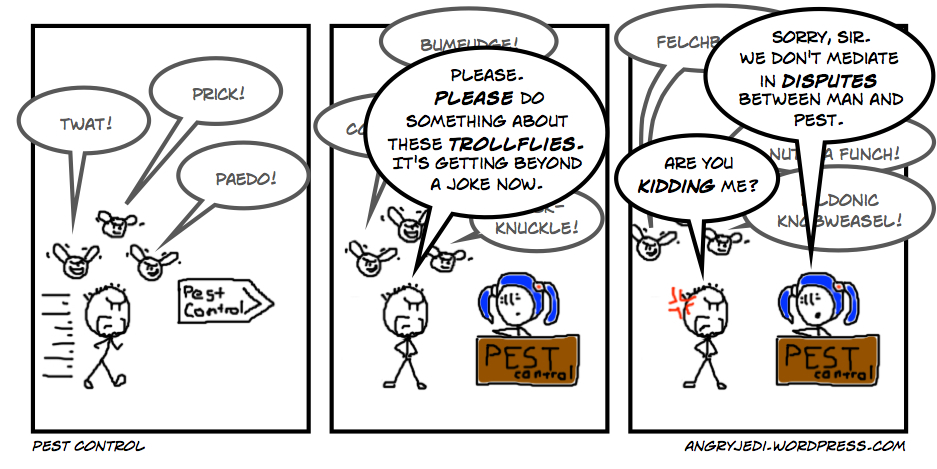
What I'm particularly disappointed about is Twitter's handling of the rest of the issue. I reported the problems I had been having back when that original post I linked to was written — mid February — and only received a response last night. The response I received was boilerplate text that simply said there had been no violation of Twitter policy, and that they didn't mediate in disputes between users. No attempt to address my concerns. No response to the fact that I had clearly laid out a series of tweets that showed an organised — and demonstrably unprovoked — campaign of hate against me. No concern for my wellbeing.

There is a difference between a "dispute between users" or a "difference of opinion" and an organised campaign to victimise someone based on their tastes and preferences. The offenders in this particular case went above and beyond simple name-calling into full-on harassment of not only me, but also my family and friends — and not only on the Internet, but also over the phone. None of this appears to have been taken into account in the month that Twitter's safety team have had to review this situation. In the meantime, the unpleasant individuals responsible for causing me such upset remain at large and unpunished, free to do it again to someone different for just the same stupid reasons they attacked me.

For this reason, I will not be returning to Twitter as a means of personal communications or social networking. While I appreciate a network of that size is difficult and time-consuming to police, that doesn't mean that the site's user safety department should get to just sit back and say "deal with it." This incident caused me considerable personal distress, and doubtless it upset and confused my family and friends who were dragged into it, too. The complete lack of concern Twitter's user safety department has shown towards a demonstrable case of organised harassment and bullying means that I do not feel comfortable trusting them in future; consequently, I will not be returning.

I doubt they care, of course; one user is but a drop in the ocean. I felt the need to share my frustration regarding this issue, however. Cyberbullying is a real problem that destroys lives — literally in many cases — and for Twitter to just turn a blind eye like this doesn't strike me as particularly acceptable.

If you used to follow me on Twitter, please feel free to share this post with any of our mutual friends. I would like to spread the word about this if at all possible.

Thanks, as always, for listening.

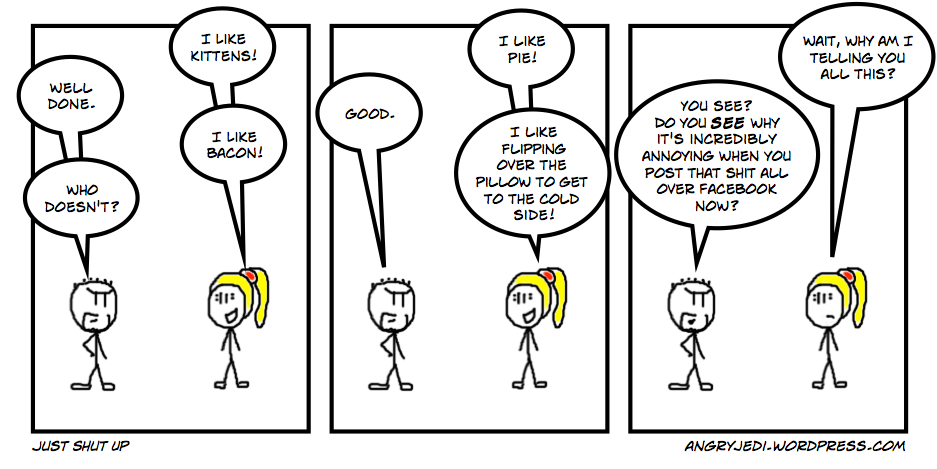
1139: Just Shut Up

Page_1I think I'm "over" social media. Allow me to clarify that bold statement, however, as it's perhaps not entirely accurate as is. I think I am over social media as it exists today — a sprawling, disorganised mess of ill-defined concepts that contribute very little to the people's understanding of one another, and more often than not is about vanity rather than actual socialisation.

In other words, I yearn for the days when social media was simple and straightforward — when its sole intended purpose was to allow people to stay in touch with each other and perhaps, occasionally, share a photograph or two with them.

Looking back on this blog, I see I have written about this subject at least twice in the past, and my disillusionment with it has only grown over the last year or so — perhaps due in part to the fact that as part of my job I come into contact with some of the most utterly pointless examples of social media that I've ever seen.

These days, there are social media apps to share anything you can think of. I mean, there are literally (YES LITERALLY) apps and services that allow you to share anything you can think of. There are also more specialised ones with questionable usefulness to society as a whole. I reviewed one recently where the entire purpose was to share what your current mood was — you couldn't add any text explaining said mood, only an emoticon — and another where you could share the weather in your local area, then "like" or comment on the weather in other places. Another still allowed you to send a video or photo to someone, but they were only allowed to look at it for ten seconds, after which it locked itself and became useless (I swear I'm not making this up).

The trouble with these things is that despite their pretensions towards being "social media," they're not actually all that social at all in terms of the way in which people use them. They're a means of broadcasting things and seeking approval of other people rather than a means of actually engaging in conversation with anyone. Take a look at the average comments thread on an Instagram picture of a moderately-attractive person (usually a woman) and you'll see what I mean. No-one's actually talking to each other — everyone's just dropping an asinine opinion bomb and then never coming back. The poster of the selfie is seeking approval from commenters telling them how attractive they are; meanwhile, the commenters are seeking approval from the poster and hoping that their specific compliment is the one that will get them some specific attention.

This isn't the case universally, obviously. There are still some actual conversations that go on on Facebook, for example, but these can easily be lost in the torrent of people resharing crap from pages like "I fucking love science" (do you? Then go do some rather than recycling endless fucking memes) and "LIKE AND SHARE!!" (NO!!). Twitter is a reasonable platform for discussion at times, but conversations are easily derailed and, as has been proven hundreds of times in the past year alone, 140 characters is really not enough to make a coherent argument about a complex issue. It's also incredibly easy to be taken out of context on Twitter.

Google+ perhaps fares the best out of all of these services in my experience, though even that's variable. Join a good, small community that has a clear focus and whose moderators keep a tight leash on discussion and you'll have a good experience chewing the fat with people who may well become good friends. Follow Felicia Day or Wil Wheaton and you might see some interesting content, but the quality of discussion goes out of the window. Follow Google+'s own page and all you get are blithering idiots making ill-informed political rants any time the team behind the page even dare to mention the President.

I think the thing that's been striking me most heavily recently is "do I really need to share this? Do people really need to know this?" And more often than not, the answer is "no". I don't feel the need to collect an arbitrary set of "Likes" with services like CircleMe or GetGlue. I don't feel the need to "check in" to places with Foursquare. I don't even really need to use stuff like Raptr to broadcast my gaming activity, but that has, on occasion, sparked some good discussions — as, I'm sure, the other services do in some cases. Just not mine. Not any more. Perhaps once in the past — I met some good friends through Foursquare's now-defunct competitor Gowalla — but not now.

Consequently, since quitting Twitter a while back (and not really missing it, to be honest — though I do miss some of the people) I've been paring back my personal social media use hugely. I've closed my Tumblr account — I never really understood the point of that site, and these days all it seems to be used for is white people shouting about how guilty they are about being white and how we should all stop being such racists/misogynists/fedora-wearing perverts — and I've unistalled the vast majority of social apps from my phone, including Twitter and Instagram. Facebook made the cut, because as much as I dislike it at times, it's still a good way of staying in touch with a lot of people, and Google+ also survived, as it's the new home of the Squadron of Shame and serving our needs well.

Obviously this blog is still going, too (and will be for a long time to come, hopefully!) and I still comment on friends' blogs — but I don't really count that as "social media" in the same way, particularly as the discussions had tend to be (for the most part, anyway) wordy and thought-provoking rather than inspiring little more than a knee-jerk "lol".

Everything else, though? Out the window. And life is much calmer and more pleasant as a result.

1128: Suddenly Silenced

Page_1While I don't particularly relish the circumstances under which I left Twitter recently — which I won't go into now as it's all still a bit "raw" and upsetting, to be honest — it's sort of been nice to not have the omniscient little blue bird hovering over my shoulder all the time.

Twitter was a big part of my life for a very long time. According to my Twitter archive — which I downloaded before I closed my account — I first posted a tweet on May 8 of 2008, but didn't really do anything with it until the end of June of that year. It's fair to say that I — like many other people — didn't really "get" what it was all about to begin with, largely because it was so ill-defined and hadn't pervaded popular culture quite as much as it has today. "It's like Facebook statuses," I'd say to people when trying to explain it, "but without all the other crap."

It sort of is like Facebook statuses without all the other crap — those early tweets of mine very much followed the "Pete is… [doing something]" format — but it quickly became a lot more than that. It became one of my primary means of communication with my international friends.

As many of you reading this may know, I have a lot of friends, but disappointingly few of them live in the same place as me. I have at least rectified that a little by moving back to Southampton to be near my university and board game buddies, but many of my other friends are still scattered the world over, all the way from America to Japan and lots of places in between. It's sort of awesome to have such a global group of friends, though it naturally means that I've never actually met an awful lot of them and possibly never will in some cases. It also meant that I needed a good, simple, reliable means of staying in touch with them; Facebook was all right, but as it gradually became more and more cluttered with crap, fewer and fewer people were using it as a serious means of communication. Today, it's a bloated mess that it's very difficult to be "heard" on, but it still has a place.

Twitter, meanwhile, was simple, pure and to the point. It was like exchanging text messages with friends, only on a global scale. I made a lot of new friends through Twitter and got to know some a bit better. I got through some tough times, too; the immediacy of the service meant that it was a good outlet for me to talk about the way I was feeling when I was going through my "difficult period" a few years back, and I appreciated the support I got from my friends — and sometimes strangers — during that dark period.

Twitter is addictive, though. It becomes a compulsion. Install it on your phone and you'll find yourself idly opening the app to see if anyone has said anything interesting in the last two minutes, even if you just stepped away from your computer where you were staring at a Twitter client. You'll find yourself wanting to step into (or start) conversations at silly hours in the morning, and get relatively little sleep as a result. It'll worm its way into your life, in short, and start to take over.

Not that that's necessarily a bad thing — as I've already outlined above, it proved to be a good means of communication for me, and a good means of meeting new people. It allowed me to put myself out there a lot more than I feel comfortable doing in the "real world", and in many ways helped me to build confidence. And let's also not forget that I met Andie through Twitter, so that's pretty cool.

The recent things that happened to me, though, brought the service's public nature into sharp focus. Sure you can be free to be open and honest about your feelings, your likes and dislikes, but that also means that you can be open to attack, too, without provocation. And once you're in the sights of one of these obnoxious groups, it's very difficult to get yourself out of them. Twitter the company aren't much help, either — after several support messages keeping them apprised of everything that was going on, the only thing I've heard from them is a request for a clarification on something. They take great pains in their terms and conditions to say that they don't mediate personal disputes — though I feel there's a strong case for what happened to me to be considered a criminal offence, and as such I reported it to the police and intend to keep hounding Twitter until they do something about it.

In some ways, I feel sickened and angry that I was forced off a service that has been a prominent and important part of my life for a long time now. In other ways, it's actually quite relieving to know that I don't need to read that feed of inanities any longer, or get frustrated at people trying to have in-depth discussions on tricky issues in 140 characters when what they should really do is pen a 3,000-word blog post. I'm not ruling out a return in the future when the scumbags who drove me away give up and do something else, but for the moment I can certainly live without it — and there's no way I'm going back to a service which I don't feel safe using.

1125: Low Ebb

After the events of the last few days, which I won't go into right now, I feel compelled to write a few words about bullying in general. I've already written a considerable number of words on the time I suffered workplace bullying towards the end of my time working at an Apple Store (check it out here) but I wanted to talk a little more about the subject in general.

The word "bullying" is an incredibly loaded one that brings to mind images of schoolkids taking the piss out of each other for the most ridiculous reasons. When I was a young child at primary school, it was my ears. They stuck out and looked quite large, so naturally I was picked on and ridiculed for that — not just occasionally, but pretty much daily. The experience left me with mental scars that  are yet to heal, and which manifest themselves in my cripplingly low sense of self-esteem.

But bullying isn't just something that children suffer from. Adults can suffer bullying, too, in a variety of forms. It could be workplace bullying such as that described in my previous post, where those in a position of "power" or "authority" use their influence to negative, unfair ends; it could be one group of people taking an irrational dislike to another group and expressing that dislike through verbal or physical abuse; it could be organised campaigns of hatred using the Internet.

The latter is an option that didn't exist when I was a youngster. The Internet wasn't a widespread thing until I was well into my teenage years, and social media certainly was nowhere to be seen. As such, any instances of bullying tended to confine themselves to the "real world" where they could normally be dealt with relatively easily, since there was usually an identifiable perpetrator to pin the blame on. It wasn't always easy for the victim to come forward and report the perpetrator, of course, for fear of reprisals — that "knowing them in real life" thing worked both ways — but if they could muster up the courage to do so, then the situation could often be dealt with.

With online bullying, though, it's a much more difficult proposition. There isn't always a visible perpetrator, because they often choose to hide behind a veil of anonymity. Some particularly arrogant online bullies do so under their real name because they've also taken steps to ensure that they will never get caught, and herein lies part of the problem: the very nature of online crime makes it extremely difficult to police, meaning that more often than not the groups responsible for making some people feel really, really shitty go completely unpunished and thus receive the message loud and clear that what they are doing is Okay.

The worst thing about bullying in all its forms is the degree of self-doubt it can instill in its victim. Am I worthless? they'll think. Do I deserve this? Are those things they're saying actually true? Do people really think that about me? Is that how other people see me? These are, of course, all things that I've found myself thinking at various points in my life.

It's useless and irrational to think that way, of course, but sadly, often the sort of people who are affected the worst by the actions of bullies are those who, like me, turn irrational when they have to deal with a difficult situation like this. Because it's not easy to stay rational in the face of totally irrational, unprovoked hatred, either, for in many cases these instances of bullying are born from little more than boredom rather than feeling particularly strongly about the person or group in question. It becomes a sport for the bullies, more about the chase and the observation of the victim's behaviour than specifically trying to hurt a person. This is particularly apparent when it comes to online bullying, where it's very easy to conveniently forget that the target of your vitriol is actually a real person with real feelings, and that any hurtful things you send off into the ether after you click that "Send" button may have a very real impact on that person's emotional, mental and, in some cases, physical wellbeing.

There's no easy solution, either. And that's sad. What's even more sad is the fact that we seem to have got to a stage as a society where we just accept that this sort of thing happens, and we don't do anything about it. I don't have any suggestions or solutions, either, mind you, but surely by the year 2013 you'd think humanity might have gotten over irrational hatred by now.

But apparently not.

(Sorry for the lack of comic today. I'm emotionally exhausted and there's no real way I can make all this shit funny.)